CARI Captures Issue 544: Malaysia to open its international borders in April


MALAYSIA
Malaysia to open its international borders in April

(8 March 2022) Malaysia will fully reopen its borders on 1 April 2022 following the prolonged lockdown since the pandemic hit in 2020. Vaccinated travellers will not need to go through a quarantine period though they will be required to undergo a Real Time-Polymerase Chain Reaction (RT-PCR) test two days before departure and a professional Rapid Test Kit-Antigen (RTK-Ag) test within 24 upon arrival. Unvaccinated travellers will need to undergo five days of quarantine upon arrival and they will be subjected to the same COVID-19 protocols as unvaccinated locals which include not being allowed to dine in at restaurants.

SINGAPORE
Singapore extends vaccinated travel lanes to more countries

(4 March 2022) Singapore will open a new vaccinated travel lane (VTL) with Vietnam and extend its VTLs to Malaysia’s Penang and Indonesia’s Bali effective 16 March 2022. The extended VTLs will kick off with four daily flights each way between Singapore and Penang, as well as two daily flights from Bali-Denpasar to Singapore. Singapore’s new VTL with Vietnam will be launched a day after Vietnam reopens its borders for international tourism, restoring two-way quarantine-free travel between the countries. Applications for these new VTL routes will open on 13 March 2022.

SINGAPORE
Singapore plans to shift from VTLs to fully open borders

(9 March 2022) Singapore is planning to allow all fully vaccinated travellers from “low risk” and “general travel” categories to enter the country without having to undergo quarantine according to its transport minister who was speaking during a session in parliament, though a timeline was not mentioned. According to him, the timing of this will depend on the public health situation in the country among other things. Passenger traffic at Changi Airport was at 3% of pre-COVID levels in early 2021 but thanks to the introduction of VTLs in September 2021, this figure rose to around 15% in December 2021.

SINGAPORE  
Singapore aims to up exports to US$733 billion by 2030

(7 March 2022) Singapore’s trade and industry minister unveiled a new plan that aims to grow the country’s exports to at least US$733 billion (S$1 trillion) and offshore trade to US$2 trillion by 2030. This will be achieved through the Trade 2030 strategy which will see the country growing its trade volume by widening the types of activities that it participates in and helping local enterprises break into overseas markets, as well as the Enterprise 2030 strategy which will help local enterprises at every stage of their growth. The new plan comes in addition to the Manufacturing 2030 plan launched in 2021 which aims to increase manufacturing value-add by 50% by 2030.

INDONESIA   
Indonesia tightens palm oil export curbs in a hit to global supplies

(9 March 2022) Indonesia will heighten its restrictions on palm oil exports for at least six months beginning 10 March 2022 by requiring exporters of crude palm oil and olein to sell 30% of their supplies locally, up from the current 20% requirement. The new restrictions come as the government looks to increase domestic supplies and suppress inflated cooking oil prices. The move could remove some 100,000 tonnes of palm oil each month from the global market, adding to a squeeze in global vegetable oil supplies caused by Russia’s invasion of Ukraine, a key global supplier of sunflower oil.

THAILAND
Thai exports under GSP and FTA privileges surged in 2021  
(4 March 2022) Thai exporters’ use of privileges provided under free trade agreements (FTAs) and Generalised System of Preferences (GSP) arrangements grew by 31.4% and 28.1% respectively in 2021, bringing the utilisation rate of FTA privileges to 78.2% up from 2020’s 76.5%. The FTAs that saw the highest growth in utilisation were ASEAN, China, Japan, Australia and India. Imports under FTA privileges also grew by 28.5% in 2021. Separately, Thai exporters’ utilisation of the Regional Comprehensive Economic Partnership (RCEP) rose by over 200% month-on-month as more exporters sought to utilise the agreement. Privileges for exports to Japan were the most in-demand.

LAOS
Laos aims for annual GDP growth of at least 4%

(9 March 2022) The Lao government is targeting annual economic growth of at least 4% per annum from now till 2025 with annual GDP per capita income reaching US$2,880 by the same. The service sector is expected to contribute to 40.7% of GDP and grow at an annual rate of 6% during the period, followed by industry which will account for 32.3% of GDP and grow at 4.1%, and then the agriculture sector that will represent 15.3% of GDP and grow at 2.5% annually. Several initiatives will be implemented in the coming years to achieve this, including modernising the revenue collection system, reducing the national debt, and reducing red tape to attract more foreign investment.


RCEP Monitor


SOUTH KOREA
Yoon Suk-yeol wins South Korea’s presidential election

(10 March 2022) Asia’s fourth-largest economy has elected conservative Yoon Suk-yeol to be its president for the next five years. Yoon has said that he is for market-led approaches such as through private sector-led job creation as opposed to government projects. His other proposals include allocating US$40 billion to support small merchants and the self-employed affected by the pandemic, lowering capital gains and property ownership taxes, deregulating the virtual asset industry and raising the tax threshold for cryptocurrency investments, developing at least 2.5 million homes during his term, and establishing a trilateral dialogue channel between South Korea, North Korea and the United States.

SOUTH KOREA, NEW ZEALAND
New Zealand and South Korea announce new sanctions on Russia

(7 March 2022) New Zealand has introduced sanctions against Russia in response to the Russia-Ukraine conflict, the first time the country has had to introduce new legislation to do so as it would traditionally have implemented sanctions through the United Nations Security Council. These sanctions include the ability to freeze Russian assets in the country and stop Russian ships and aircraft from entering New Zealand’s borders. Meanwhile, South Korea has banned transactions with Russia’s central bank and frozen assets held by the bank and blocked exports of strategic items to Russia among other measures.

JAPAN
Honda and Sony join forces on new electric vehicle

(4 March 2022) Japanese giants Sony Group Corp. and Honda Motor Co. will establish a joint venture this year to design and develop an electric vehicle which they plan to start selling by 2025. The joint venture will utilise Honda’s automotive manufacturing expertise and Sony’s expertise in imaging, telecommunication and entertainment to create an out-of-the-box solution. Both companies’ shares fell after the announcement. The joint venture comes in addition to Honda’s existing electric vehicle program and platform partnership with General Motors.
CARI Captures Issue 543: ASEAN manufacturing PMI remains resilient in February 2022 despite rising COVID-19 infections


ASEAN
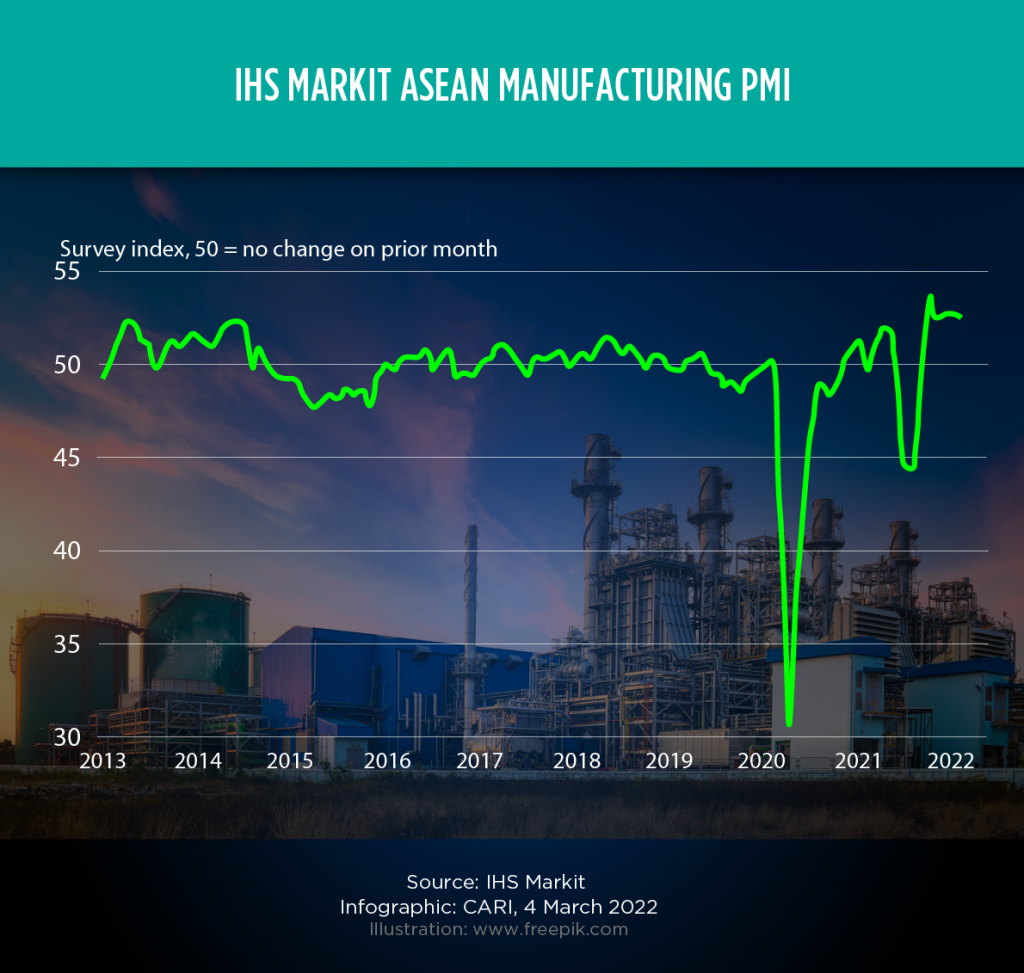
ASEAN manufacturing PMI remains resilient in February 2022 despite rising COVID-19 infections

(01 March 2022) Despite a broad increase in the number of COVID-19 infections across ASEAN, the ASEAN manufacturing PMI as measured by IHS Markit remained resilient in February 2022. ASEAN manufacturing PMI in February was little changed at 52.5, down from 52.7 in January 2022. Readings above 50.0 signals an improvement or increase on the previous month, and February’s reading was the fourth strongest in the nine-year history of the ASEAN PMI. The growth in ASEAN manufacturing output has been attributed to improving new orders performance. According to data collected by IHS Markit, five of the seven ASEAN constituent nations reported new orders growth. However, it was noted that supply constraints continued to present itself as a key hindrance to better manufacturing output performance, with suppliers’ delivery times across the ASEAN region continuing to lengthen at a rate faster than the series average in February. This has been attributed to input shortages, transportation delays and manpower issues, and is expected to prolong upward price pressures.

MALAYSIA
Malaysia to benefit from higher oil and gas prices caused by Ukraine conflict

(03 March 2022) Malaysia is expected to benefit from higher oil and gas prices caused by Russia’s invasion of Ukraine. As a net oil and gas exporter, Malaysia is expected to benefit from the price increase, as long-term liquefied natural gas (LNG) prices are normally linked to crude oil contracts. Specifically, higher oil and gas prices are expected to be beneficial both due to the taxes collected from the oil extracted in the country, as well as greater profits for state-owned oil and gas multinational Petronas, which can then trickle down to the government. The effects of higher fuel prices at the pump will be dependent on whether the Malaysian government agrees to absorb the difference through fuel subsidies. However, this spike in energy prices is expected to be short-lived, especially if a prolonged war leads to another global recession that dents demand for fuel and leads to lower prices down the line.

SINGAPORE, RUSSIA
Singapore to apply sanctions against Russia, including financial measures and export controls

(28 February 2022) The Singaporean government announced on 28 February 2022 that it will apply sanctions against Russia in protest of the latter’s invasion of Ukraine last week. Singapore’s foreign minister announced that among the sanctions that Singapore would impose on Russia include export controls on items that could be used by Russia against Ukrainians. As well, Singapore will block certain Russian banks and financial transactions connected to Russia. The Foreign Minister stated that specific measures were being worked out and would be announced shortly. This announcement is unprecedented by Singapore, who rarely issues sanctions of its own against other countries, and is the first among its regional neighbors and comes independent of ASEAN, which on 26 February called for a de-escalation of the conflict and for dialogue and respect of international law and U.N. commitments.

INDONESIA  
Inflation in February 2022 lower than expected due to government subsidies cushioning blow of surging commodity prices

(01 March 2022) Inflation in Indonesia in February 2022 was weaker than expected, as government subsidies helped cushion the blow of surging commodity prices. Consumer prices rose 2.06% year-on-year in February, below the median estimate of 2.2% in a Bloomberg survey of economists. Prices also shrank by 0.02% on a monthly basis, due to price caps on cooking oil and a surplus of poultry and eggs production which tamed food inflation. However, core inflation, which strips out government-controlled and volatile prices, stood at 2.03%, rising at its fastest pace since August 2020. Core inflation was within the central bank’s target range of 2%-4%, and indicated that domestic demand in Indonesia remained resilient despite surging COVID-19 cases. It is believed that inflation could soon accelerate to 3%. The government is considering raising retail gasoline prices now that oil has breached US$100 a barrel in order to ease the burden of subsidies on the budget.

THE PHILIPPINES   
Philippines government agrees to include nuclear power into country’s energy mix

(03 March 2022) On 28 February Philippines President Rodrigo Duterte signed an executive order to include nuclear power in the country’s energy mix, as the Philippines seeks to phase out its coal-fired power plants amid seasonal power outages and high electricity prices. The executive order also directs an inter-agency panel to look into reopening the abandoned Bataan Nuclear Power Plant (BNPP), which was built in 1984 but abandoned two years later due to safety concerns. The BNPP plant has operated as a tourist attraction since 2009 in order to defray maintenance costs. The Philippines Energy Undersecretary said a regulatory framework for nuclear power still required legislation and its future also hinged on the agenda of the next administration, which will be formed following elections in May 2022.

THAILAND
Thailand to ease requirements for its quarantine-free entry program starting on 01 March 2022  
(28 February 2022) Thailand will ease its requirements for its quarantine-free entry program starting on 01 March 2022, despite fighting its largest infection rate since the pandemic began. Under the new requirements, visitors to the country must take a PCR test upon entry then perform a self-test with an antigen kit on the fifth day of their stay. Previously, travelers had to take a PCR test on the first and fifth day, show proof of a hotel reservation, then wait at the hotel throughout the first five days pending test results. From March onwards, only proof of accommodation for the first day is required. As well, mandatory insurance for foreign visitors will be reduced from US$50,000 to US$20,000. International visitors to the country must still present proof of vaccination at least 14 days prior to departure, as well as proof of a negative PCR test taken no more than 72 hours before traveling to the country. The government projects growth of 3.5% to 4.5%, but this will depend on whether its crucial tourism sector will recover.

VIET NAM
Vietnam moots cut on environmental tax on fuel due to soaring global energy prices

(03 March 2022) Viet Nam’s Finance Ministry stated they would propose to the government to cut its environmental tax on fuel due to soaring global energy prices. The ministry is seeking approval to lower the tax by 25% on gasoline to US$0.13 per litre, while also reducing the tax on diesel fuel and lubricants to US$0.09 per litre. Tax on kerosene would be cut by half to US$0.02 per litre. Domestic gasoline prices rose in line with global energy prices, and has caused inflationary pressures which has impacted businesses and people’s purchasing power. Viet Nam’s consumer price index in the first two months of 2022 rose 1.68% from a year earlier, led by an increase in transport costs, with gasoline prices up 45.3%. Viet Nam plans to keep inflation below 4% in 2022, and believes that with a cut in effect from April to year-end, the CPI would drop by 0.67%.


RCEP Monitor


JAPAN
Japan to ease COVID-19 border controls further from 14 March onwards, to prioritize students

(04 March 2022) Japan will ease its COVID-19 border controls further from 14 March onwards, raising the daily cap on entrants from overseas to 7,000 from the current 5,000. Prime Minister Fumio Kishida introduced a new scheme to give priority to some 150,000 overseas students currently waiting to enter Japan following roughly two years of COVID-19-related restrictions. Under the new scheme, foreign students will be allowed to enter Japan using vacant seats on flights when there aren’t many business travelers. In response to the Omnicron variant, Japan effectively enforced an entry ban on nonresident foreign nationals in late November 2021. As of now, up to 5,000 people, including Japanese nationals overseas, are currently allowed to enter Japan daily. Thirty one of Japan’s 47 prefectures are currently under a quasi-state of emergency to contain the Omnicron variant.

AUSTRALIA
Australia’s stock benchmark outperforming developed peers in terms of profit outlook

(04 March 2022) Australia’s stock benchmark, the S&P/ASX 200 Index, is outperforming those of developed peers in terms of profit outlook, with profit estimates by analysts having jumped nearly 10% in 2022, about triple the increases for the S&P 500 Index and Japan’s Topix. This follows a strong corporate results season, including excellent results from market stalwarts including mining giant Rio Tinto Group and lender Commonwealth Bank of Australia. Materials and energy producers were among companies that surpassed analysts’ expectations. While mining companies benefited from a resurgence in iron ore prices due to an improved outlook for Chinese demand and global concerns about commodities supply due to Russia’s invasion of Ukraine, Australian banks benefited from treasury revenues. The prospect of rising U.S. interest rates and war in Eastern Europe significantly influenced share prices this season, although it was noted that the country’s benchmark fell by just 3.9% this year, less than half the drops seen in U.S. and European benchmarks.

NEW ZEALAND
Reserve Bank projects growth of 2.9% for year through March 2023

(04 March 2022) The Reserve Bank of New Zealand has projected growth of 2.9% for the year through March 2023, compared with the Treasury Department’s December 2021 projection of 4.7%. Daily cases of the Omnicron variant have surged above 20,000 and officials expect the peak of the wave will hit New Zealand later in March 2022. Cost of living is also increasing rapidly, with inflation currently running at 5.9%. The Reserve Bank predicts that inflation will accelerate to 6.6% in the first quarter of 2022 before gradually receding. The central bank has raised the official cash rate three times thus far, taking it to 1%, and signaled ongoing tightening that will take the benchmark above 3% in 2023. The government recently relaxed restrictions on citizens returning home, and signaled that foreign visitors may be allowed to enter sooner than previously indicated.

CARI Captures Issue 542: Singapore announces 2022 budget proposals


SINGAPORE
Singapore announces 2022 budget proposals

(21 February 2022) Singapore’s finance minister announced the country’s 2022 budget proposals in parliament on 18 February 2022 which included a slew of tax hikes as the country expects government expenditures to increase to over 20% of GDP by 2030. The bulk of the increase in spending is expected to go to healthcare as the country maintains a “multi-layer public health defence” against COVID-19. The proposal also includes a US$372.61 million jobs and business support package, as well as allocations for infrastructure improvements, digital upskilling, and co-funded wage increases for lower-wage workers between 2022 and 2025.

SINGAPORE
Singapore unveils major tax measures to fund spending needs

(19 February 2022) Singapore’s finance minister announced a slew of tax measures during his budget presentation in parliament last week which includes the implementation of a long-delayed goods and services tax increase from 7 to 8% starting in 2023 then from 8 to 9% in 2024, an increase in personal income taxes for high-income individuals, an increase in property tax rates for high-end properties and non-owner-occupied residential and investment properties, an increase in taxes on luxury cars, and an increase in taxes on carbon emissions.

SINGAPORE, INDIA
Singapore, India to boost cooperation in science and technology

(23 February 2022) India and Singapore signed a memorandum of understanding to boost collaborations in research and development in fields of mutual interest. Singapore shared three areas where the countries could “push the boundaries” through cooperation: (i) DeepTech, particularly artificial intelligence and the internet of things especially in the construction and built environment sector, (ii) CleanTech, in line with both countries’ carbon mitigation goals, with a focus on greening the power and transportation sectors, especially in aviation and maritime transport, and (iii) genome and bioinformatics research.

THAILAND  
Thailand to ease COVID-19 requirements for international travellers

(23 February 2022) The Thai government will further relax requirements for fully vaccinated international visitors beginning 1 March 2022. Visitors will only need to take one reverse transcription-polymerase chain reaction (RT-PCR) test 72 hours before leaving for Thailand, one more RT-PCR test upon arrival, and one more self-administered test five days after arrival. Visitors need only spend their first night upon arrival in quarantine at a hotel or an approved quarantine facility. The government previously required visitors to spend their fifth day after arrival at a pre-booked accommodation to undergo a second RT-PCR test. The required travel insurance coverage has also been lowered from US$50,000 to US$20,000.

VIETNAM  
Vietnam hit by fuel shortages as hundreds of retailers run dry

(23 February 2022) Some 300 petrol stations in Vietnam were forced to halt sales due to fuel shortages caused by the rally in crude oil prices as well as labour shortages as workers throughout the supply chain contract COVID-19. Fuel supplies were also impacted as the country’s largest refinery reduced its capacity in mid-January due to financial constraints. The Vietnamese government has directed its ministries to propose adjustments to taxes on petrol and oil products and announced plans to auction around 102 million litres of its RON-92 petrol from national reserves.

MYANMAR, EU
EU sanctions Myanmar oil firm for providing resources to junta 
(22 February 2022) The European Union sanctioned another 22 individuals linked to Myanmar’s military regime as well as four entities known to be providing the regime with “substantive resources”. This includes Myanma Oil and Gas Enterprise, a state-owned oil and gas company and a partner of Thailand’s PTT. So far, TotalEnergies SE, Chevron Corp, and Mitsubishi Corp have announced that they were withdrawing from energy projects in the country. PTT, however, remains unfazed and has offered to acquire TotalEnergies and Chevron’s combined 59.5% stake in Myanmar’s Yadana gas field project.

ASEAN, CANADA
ASEAN-Canada trade volume reached US$19.9 billion in 2020

(19 February 2022) Trade between the ASEAN bloc and Canada came in at around US$19.9 billion in 2020, down 2.4% from 2019’s despite the pandemic. The figures were shared during the Prep SEOM-Canada Consultation held on 17 February 2022 via videoconference. Foreign direct investment from ASEAN to Canada also took a slight 0.9% year-on-year dip totalling US$1.2 billion in 2020, though foreign direct investment from Canada to ASEAN rose by 11.7% reaching US$12.5 billion. Both sides also discussed preparations for the negotiation of the ASEAN-Canada Free Trade Agreement (ACFTA).


RCEP Monitor


THE PHILIPPINES
Philippines’ ratification of the RCEP remains uncertain

(24 February 2022) The Filipino Senate appears unlikely to give its concurrence to the Regional Comprehensive Economic Partnership (RCEP) when it reconvenes on 23 May 2022 as senators remain unconvinced of the country’s need for the trade deal. According to local reports, several senators wished to see more support from the government for the RCEP and some have expressed doubts that the RCEP will be accepted if deliberations are based on the same factors. The Senate will have six days to discuss the RCEP when it resumes in May and should it fail to pass again, the executive branch will need to resubmit it to the Senate when it meets again in July.

HONG KONG
Hong Kong applies to join the RCEP

(22 February 2022) Hong Kong has submitted its application to join the RCEP and could become a member of the trade pact 18 months from now, according to the region’s director-general of trade and industry. According to him, joining the RCEP could boost the island’s re-industrialisation, expand its supply of raw materials, and provide Hong Kong goods with a wider market. Trade between Hong Kong and RCEP members currently totals US$962.6 billion, of which trade in services accounts for US$103 billion.

CHINA
Tesla plans new Shanghai plant to more than double China’s capacity

(24 February 2022) Tesla will reportedly start construction on a new plant in Shanghai next month to double its production capacity in China and produce up to another two million cars per year. The new plant would make China the company’s main export hub when combined with its existing plant which is on track to produce around 22,000 cars a month or 1.1 million cars in a year, subject to the availability of car parts. Neither Tesla nor the Shanghai city government responded to media requests for comment.

CARI Captures Issue 541: 30.1% of Southeast Asian public figures confident US will provide leadership in championing global free trade


ASEAN
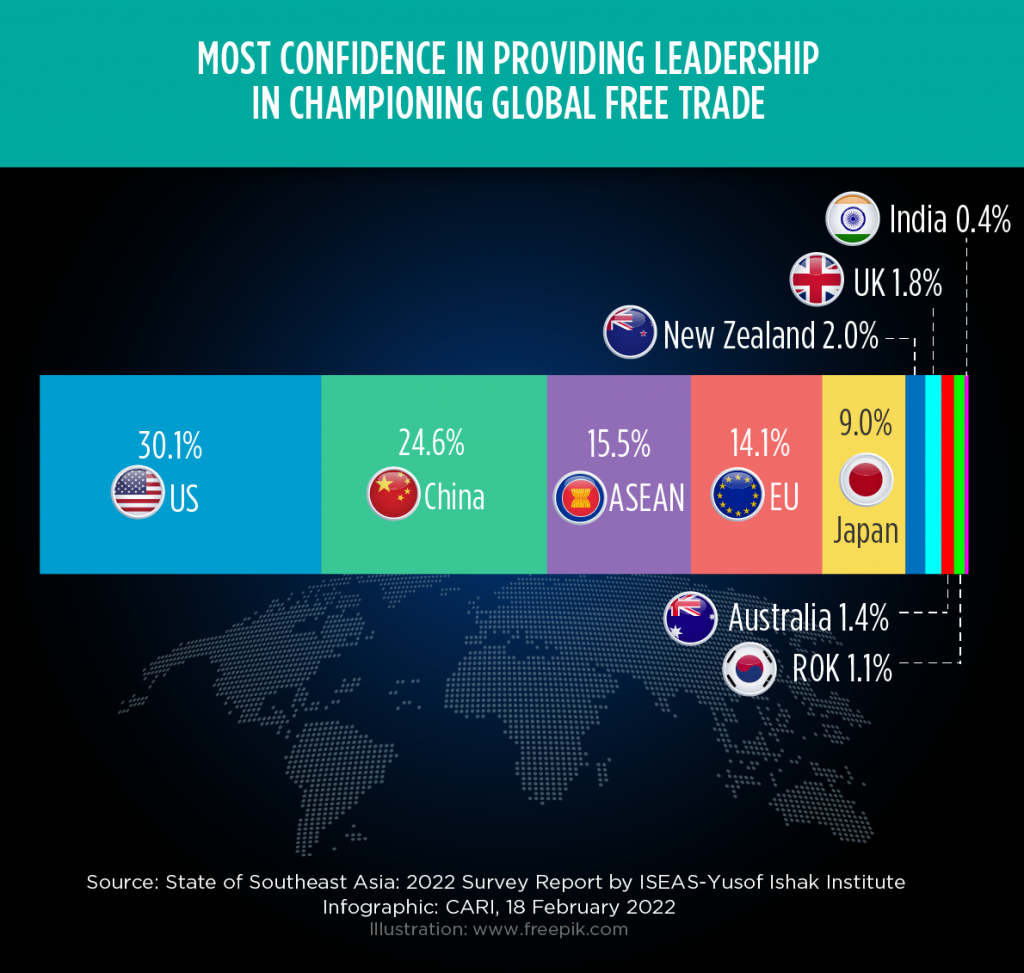
30.1% of Southeast Asian public figures confident US will provide leadership in championing global free trade

(16 February 2022) According to the State of Southeast Asia: 2022 Survey Report released by the ISEAS-Yusof Ishak Institute in Singapore, 30.1% of Southeast Asian public figures, including policymakers, academics, researchers, and civil society activists, were confident in the US providing leadership in championing global free trade, followed by China (24.6%) and ASEAN (15.5%). This was a jump from the 19.7% who expressed confidence in the US in the 2021 survey. However, an overwhelming 76.7% of respondents believed that they regarded China as the most influential economic power in Southeast Asia, while only 9.8% thought the same of the United States. In a question about the potential impact of China’s membership of the Comprehensive and Progressive Trade Agreement for Trans-Pacific Partnership (CPTPP) free trade agreement, 53.2% of respondents believed that it would create economic and political benefits to China, the US and other CPTPP members, including reducing economic tensions and allowing China to undergo domestic reforms. A further 46.8% of respondents believed that the US’ absence from the CPTPP would facilitate the rise of China’s influence in the region.
 

SINGAPORE
Senior executives in Singapore real estate firms flag rising inflation and interest rates as top risk

(17 February 2022) According to the most recent quarterly Real Estate Sentiment Index (RESI) by the National University of Singapore Real Estate (NUS+RE), nine out of ten senior executives in Singapore-based real estate companies flagged rising inflation and interest rates as the top potential risk factors which might adversely impact market sentiments in the next half of 2022. 73.3% of senior execs identified rising building costs as a key risk, while 65.8% of respondents selected tightening of financing and liquidity in debt markets. Inflation and interest rates topped concerns over rising construction costs, which had topped the list in the previous questionnaire. Meanwhile, the proportion of respondents who indicated "government intervention to cool the market" as a potential risk dropped to 39.5% from the previous 62.8%. The RESI study’s composite sentiment index, an indicator for overall real estate market sentiment, also fell for the third straight quarter to 5.4 in the fourth quarter from 6.6 in the third quarter, although the index stayed above 5, indicating overall sentiment on the property market's current and future conditions remained positive.
 

MALAYSIA
Daily COVID-19 cases in Malaysia hits record high of 27,831 due to Omnicron variant

(16 February 2022) Malaysia’s new COVID-19 cases reached a record high on 16 February 2022, with 27,831 cases recorded. This new wave has been driven by the more transmissible Omnicron variant, data from the health ministry showed. Malaysia now joins Singapore and Indonesia in dealing with the worst daily COVID-19 caseloads of the pandemic to date. However, hospital occupancy rates remain manageable, due to Malaysia’s high vaccination rate, with nearly 80% of the total population having completed their regime and more than half the adults having received booster shots. Instances of serious illnesses and deaths are also lower than in last year’s Delta wave, when the country’s health services were pushed to the brink. Almost 99% of daily cases as of now involve patients who show mild or no symptoms, according to data from the health ministry. Authorities believe that the omicron wave is expected to peak in the second half of March 2022.
 

INDONESIA  
Indonesia considering lifting all quarantine requirements for inbound travelers in April 2022

(14 February 2022) Indonesian authorities are considering lifting all quarantine requirements for inbound travelers in April 2022, as hospitalizations and fatality rates remain under control despite a resurgence in cases. As of now, the quarantine time for travelers with a third dose of vaccines will be reduced from five days to three starting on the week of the 21 February 2022. Indonesia is currently opening its borders more freely to those who are eligible, in line with neighboring countries. The government is also easing capacity restrictions to improve mobility, including increasing office capacity to 50% or more from the currently stipulated 25%. Authorities stated they intend to keep monitoring the COVID-19 situation with the intention to loosen curbs further.
 

THAILAND  
Cabinet approves package of financial incentives to encourage drivers and automakers to switch to electric vehicles

(18 February 2022) The Thai cabinet approved a package of financial incentives to encourage drivers to adopt electric vehicles, as well as for automakers to start manufacturing electric vehicles within the kingdom. The measures for 2022 and 2023 approved by the cabinet include subsidies of between US$2,200 and US$4,600, depending on the model and battery capacity, according to local media. The excise tax on these vehicles will also be cut to 2% from the usual 8%, while import duties will be lowered by between 20% and 40%. Automakers benefiting from the program will be required to start making electric vehicles in Thailand by 2024. Thailand is aiming to have electric vehicles account for 30% of production by 2030. Mercedes-Benz is set to become the first major automaker to manufacture electric vehicles in 2022, while Mitsubishi Motor and SAIC plan to start in 2023.
 

THE PHILIPPINES
Philippines central bank maintains accommodative policy stance for 10th straight meeting 
(17 February 2022) The Philippines central bank maintained its accommodative policy stance for the 10th straight meeting on 17 February 2022, indicating it would start exiting its pandemic support measures when the economic recovery has become sustainable or inflation risks have risen significantly. The Bangko Sentral ng Pilipinas left the benchmark rate at 2% on 17 February, its last rate move was a 25-basis point cut in November 2020. The Philippines is among other Asian economies such as India and Malaysia that have yet to adopt rate hikes in the face of rising inflation globally. The economy grew more quickly than forecast last quarter, underscoring expectations that output will return to pre-pandemic levels in 2022. Inflation slowed 3.0% year-on-year in January 2022, within the bank’s 2% – 4% target range. On Thursday, the bank raised its forecast for average inflation for 2022 to 3.7%, from the 3.4% it forecast in December.
 

VIET NAM
Samsung adds US$920 million to its investment in Viet Nam to produce circuit boards and camera modules

(17 February 2022) Samsung adds US$920 million to its investment in Viet Nam to produce circuit boards, camera modules and other parts. The Vietnamese province of Thai Nguyen stated that it had granted Samsung Electro-Mechanics Vietnam a certificate to increase capital to a total of US$2.27 billion, with the additional investment to be used to make mobile components including touch sensor modules, linear motors and lenses. Samsung is Viet Nam’s largest foreign investor and exporters, with factories across the country supplying Apple phones, fridges and washing machines. Samsung employs some 6,585 people in Thai Nguyen province, and will use the additional capital to fund housing and other construction.


RCEP Monitor


JAPAN
Japanese sovereign bond yields rise as buyers hesitate to buy due to market downturn

(16 February 2022) Longer-maturity yields on Japanese bonds have surged in 2022 in contrast to the flattening trend seen in other major government bonds such as US Treasuries and German bunds. This is set to continue as the big institutions that traditionally dominate purchases of super-long maturities stick to the sidelines, hurt by the recent downturn in global stocks and bonds caused by expectations of monetary tightening in the near future. The gap between Japan’s benchmark 10-year bond yield and its 30-year equivalent has widened to a three-year high, climbing more than 10 basis points in a little over two weeks. While bond investors around the world are being impacted by hawkish central banks, Japanese investors still operate under the super-easy policy of the Bank of Japan, who seem content for now in allowing longer-dated maturities to rise further. It is believed that life insurers may not even have the funds to take advantage of the rise in yields, thanks to sluggish business trends and a faster pace of purchases earlier.
 

SOUTH KOREA
South Korea added 1.14 million jobs year-on-year in January 2022, the most since March 2000

(16 February 2022) South Korea added 1.14 million jobs year-on-year in January 2022, the most jobs added since March 2000. This was the 11th straight month of gains. The jobless rate declined to 3.6% from 3.8% in December 2021. The gains in jobs adds to the view that the economy will be able to withstand another interest rate hike, as the Bank of Korea seeks to rein in inflation and normalize monetary policy. It also suggests that Koreans have adjusted to living with the virus, even as the country experiences record high daily COVID-19 cases. However, there are concerns the labor market may change due to ongoing restrictions to contain the Omnicron variant of COVID-19. The Finance Ministry has pledged to implement the supplementary budget as quickly as possible once approved.
 

CHINA
Inflation slows in January 2022, giving central bank more room to cut interest rates to prop up economy

(16 January 2022) China’s inflation slowed in January 2022, giving the central bank more room to cut interest rates and pump liquidity into the financial system to support a slowing economy. The producer price index rose 9.1% from a year earlier, down from 10.3% in December 2021, while consumer-price growth slowed to 0.9%. China’s government has shifted towards a pro-growth policy in late 2021, as the economy reels from a property market slump and repeated COVID-19 outbreaks. Prices of coal, steel and other industries fell in January 2022, driving down the overall cost of industrial products. Although producer price inflation will continue to soften in 2022, oil prices remain uncertain due to ongoing geopolitical tensions. Consumer inflation stayed subdued in January 2022, despite a seasonal spike in demand around the Lunar New Year holidays, which began on the last day of January.

CARI Captures Issue 540: Cambodia ratifies free trade agreement with South Korea


CAMBODIA, SOUTH KOREA
Cambodia ratifies free trade agreement with South Korea

(4 February 2022) Cambodia’s King Norodom Sihamoni ratified the Cambodia-Korea Free Trade Agreement (CKFTA) on 29 January 2022, paving the way for the agreement to come into force within 60 days. The agreement was previously finalised in October 2021, after which it sailed through the country’s legislative bodies in December 2021. Trade between the countries came in at around US$965 million in 2021, up 9% year-on-year, with Cambodian imports from South Korea worth US$623 million and exports worth US$341 million. The CKFTA is expected to boost Cambodia’s exports to South Korea, which mostly comprise garments and textiles, footwear, bags, electronics, spare parts, rubber and agricultural products.

CAMBODIA, JAPAN
Cambodia and Japan mull the possibility of a bilateral FTA

(4 February 2022) Cambodia and Japan are discussing the possibility of a bilateral free trade agreement to boost the flow of trade, services and investment between the countries, according to Cambodia’s commerce minister who shared that his ministry was discussing the matter with the Japan-Cambodia Association. JETRO data found that trade between the countries totalled US$2.33 billion in 2021, up almost 11% year-on-year. Cambodian exports accounted for US$1.75 billion of the sum, while its imports from Japan accounted for US$1.72 billion. However, preliminary data from Cambodia’s Ministry of Commerce showed that bilateral trade came in at around US$1.70 billion in 2021, with exports to Japan at US$1.09 billion and imports at US$0.49 billion.

ASEAN
Myanmar to send non-political representative to upcoming meeting

(5 February 2022) Cambodia has asked Myanmar to send a “non-political entity” to represent it at the ASEAN Foreign Ministers’ Retreat to be held on 16-17 February 2022, citing a lack of progress in carrying out the five-point consensus laid out by the bloc. The statement published by Cambodia’s Ministry of Foreign Affairs on 2 February 2022 also reiterated ASEAN Member States’ concerns regarding the deteriorating humanitarian situation in Myanmar. Myanmar has reportedly agreed to send its Permanent Secretary for Foreign Affairs to the ministerial retreat.

ASEAN  
ASEAN-6 car sales rise for first time in three years

(7 February 2022) Sales of new cars in the ASEAN-6 (Indonesia, Thailand, Malaysia, Vietnam, Singapore and the Philippines) totalled 2.79 million units in 2021, up 14% year-on-year, but still around 20% less than in 2019. Indonesia led the way with a 67% jump as it overtook Thailand to become the top market for new cars in the region for the first time in two years thanks to tax breaks introduced by the government in March 2021. New car sales in both Thailand and Malaysia declined by 4%, while sales in Vietnam and the Philippines rose for the first time in two years at 3% and 16% respectively.

INDONESIA  
Indonesia to present carbon neutrality plan at G20 forum

(4 February 2022) The Indonesian government will use its G20 presidency to share its national energy transition plan and the roadmap it hopes to use to achieve net-zero emission by 2060. To this end, the government will develop a 100% renewable energy mix comprising solar power, hydroelectric power, wind power, nuclear power, bio-energy power, geothermal power and ocean power. The government will also phase out its use of electric steam, steam and gas power plants, and additional power generation after 2030 will only be sourced from renewable energy.

INDONESIA
Bali reopens to foreign travellers from all countries  
(4 February 2022) Indonesia’s Bali island has reopened its borders to foreign visitors from all countries and international direct flight arrivals for the first time since the pandemic started two years ago. Foreign visitors will need to show their COVID-19 vaccination certificates issued at least 14 days before departure and negative RT-PCR test results from their country of origin taken no more than 48 hours before departure. Foreign visitors must also undergo quarantine upon arrival in a hotel or on a certified liveaboard boat — five days for the fully vaccinated and seven days for those with only one dose.

THE PHILIPPINES
THE PHILIPPINES

(10 February 2022) The Philippines this week reopened its borders to foreign visitors for the first time in almost two years. Starting 10 February 2022, foreigners from 157 countries with existing visa-free arrangements with the Philippines will be able to enter the country without having to undergo quarantine. However, visitors will need to show proof that they have been fully vaccinated and that they have tested negative for COVID-19. The Philippines had earlier planned to reopen its borders to tourists on 1 December 2021 but this was postponed due to the emergence of the omicron variant.


RCEP Monitor


THE PHILIPPINES
Senators go on break without approving RCEP
(4 February 2022) The Philippines’ Senate adjourned for the election break without giving its concurrence to the Regional Comprehensive Economic Partnership (RCEP) agreement’s ratification. Nevertheless, the country’s trade secretary said that he was optimistic that the Senate would eventually do so when it resumes on 23 May 2022 despite continued opposition from certain farmer groups. He reiterated that the government expects the RCEP to drive GDP expansion above 6%, FDI growth to 49%, and export growth up to 15%.

SOUTH KOREA
RCEP takes effect on 1 February 2022

(3 February 2022) The RCEP entered into force in South Korea on 1 February 2022, 60 days after it submitted its instrument of ratification. South Korea’s trade ministry expects the pact to help expand market access for key exports such as steel and cars, as well as service sectors such as online gaming, animation, film and music. The ministry also noted that the RCEP provides South Korea’s entertainment content even greater access than the ASEAN-Korea Free Trade Agreement does, particularly to the Philippines, Thailand and Indonesia. The pact is the first free trade agreement between South Korea and Japan.

AUSTRALIA
Australia to reopen borders to international travel

(7 February 2022) Australia will fully reopen its borders to vaccinated travellers starting 21 February 2022. Anyone entering the country will need to provide proof that they have been “double vaccinated”, while those who are unvaccinated will need to apply for a travel exemption and have a valid medical reason. If such an exemption is approved, the unvaccinated person will be quarantined at a hotel upon arrival. Australia’s borders have been in full lockdown since March 2020, with only certain groups of international students and skilled migrants allowed to enter since December 2021.

CARI Captures Issue 539: PETRONAS Retains Title As Most Valuable ASEAN Brand In 2022


ASEAN
PETRONAS Retains Title As Most Valuable ASEAN Brand In 2022

(28 Jan 2022) Petronas has maintained its position as the most valuable ASEAN brand in the Brand Finance Global 500 2022 report with a brand value of US$13.6 billion, which is 13% higher than the previous year. Energy demand is rising as the economy recovers from the impact of the pandemic, which has allowed Petronas to bounce back this year from the challenges that the oil and gas industry had to face in 2020.

ASEAN
Nikkei: ASEAN Start up Fundrasing more than doubled in 2021

(31 Jan 2022) Southeast Asian startups raised a record US$25.7 billion in funding last year, more than double the previous year as cash-rich global investors seek to tap the region’s potential amid digitalization driven by the COVID-19 pandemic. With private equity and venture capital firms looking for investment opportunities to deploy capital they raised over the past year, experts say the Southeast Asian “gold rush” will continue in 2022, stoking momentum in the region’s startup ecosystem. But a recent tech sell-off in public markets globally highlights a changing environment, potentially affecting the valuation of growth-driven startups.

LAOS PDR
Laos undergoes leadership reshuffle

(4 Feb 2022) Laos has announced a high-level reshuffle of its leadership, less than one year after the new government assumed office last March. This is the first reshuffle of leadership since the National Assembly approved the new cabinet members last year. The change took place after the government announced the need to implement two national agendas to address economic and financial difficulties and drug trafficking. The reshuffle is aimed at strengthening administrative and government agencies in response to the changing needs of the nation to overcome challenges triggered by the COVID-19 pandemic.

MALAYSIA  
Foreign buying picks up on Bursa Malaysia

(31 Jan 2022) The pace of foreign buying on Bursa Malaysia accelerated with RM116.45mil net of equities purchased over the past trading week. According to a MIDF Research data, this was an improvement over RM11.35mil net bought over the week before. Foreign investors recorded growing interest in Malaysian equities with the largest net buying recorded on Tuesday to the tune of RM89.04mil.

SINGAPORE  
Singapore retail sales up 11.1% in 2021 after year-end rise in December.

(4 Feb 2022) Singapore retail sales surged by 11.1% year on year in 2021, reversing the previous year’s 15.3% decline and snapping a 3-year losing streak. Excluding motor vehicles, retail sales were up by 10.5% for the year. The rebound was helped by a year-end shopping spree, as retail sales expanded by 6.7% year on year in December, picking up from the 2.2% rise in the month before.

THAILAND
Thailand follows ASEAN peers in applying cryptocurrency controls 
(3 Feb 2022) Thailand’s central bank is falling in with its regional peers after announcing tougher regulation of cryptocurrencies and limiting their use for payments to ensure they can only be traded as assets on licensed platforms. The Bank of Thailand (BoT) said on Jan. 25 that it was drafting regulations to prevent Bitcoin and other cryptocurrencies from being used to make payments because the volatility of digital tokens would create risks and losses for both buyers and sellers. Other members of the Association of Southeast Asian Nations (ASEAN), including Brunei, Indonesia and Malaysia, have announced similar rules in recent years. Even in some countries where Bitcoin is popular, such as Singapore and Vietnam, the central banks do not allow crypto payments.

VIETNAM
Vietnam’s leather and footwear industry set export target of US$25 billion for 2022

(4 Feb 2022) Vietnam’s export of leather, footwear and bags this year will likely increase 10-15% year-on-year to about US$23-25 billion, the Vietnam Leather, Footwear and Handbag Association (Lefaso) has forecast. The prediction was delivered by Lefaso based on the world economic outlook and developments, control of the COVID-19 pandemic as well as several orders businesses inked for 2022. Last year, the export turnover of leather, footwear and handbags saw a modest yearly increase of 4.6% to reach US$20.78 billion. In which, footwear exports hit US$17.77 billion, up 6.1% while export of suitcase and bag products topped nearly US$3.01 billion, down 3.2%.


RCEP Monitor


ASEAN, JAPAN, CHINA, SOUTH KOREA   
ADB to Develop Prototype for Cross-Border Securities Transaction System Using Blockchain | Asian Development Bank

(26 Jan 2022) The Asian Development Bank (ADB) has launched a project to make cross-border securities transactions in Asia and the Pacific more efficient and secure through the use of blockchain technology. Working with leading blockchain companies, ADB will seek to develop ways to directly connect central banks and securities depositories in the ASEAN+3 region within a blockchain network. The region consists of the Association of Southeast Asian Nations plus Japan, the People’s Republic of China, and the Republic of Korea. The project will be carried out in 2 phases: a designing phase, to be completed by the end of March 2022, and a prototyping phase, scheduled for the second quarter of 2022.

CHINA, LAOS PDR
More goods are being shipped between China and ASEAN through the China-Laos Railway

(2 Feb 2022) Business operators from Cambodia , Thailand, Vietnam, and Myanmar are now using the China-Laos Railway to import and export goods to and from China and beyond, according to Vice President of the Lao National Chamber of Commerce and Industry, Daovone Phachanthavong. The China-Laos Railway has so far transported more than one million passengers and 500,000 tons of cargo including 100,000 tons of cross-border goods since it became operational in December 2021.

SOUTH KOREA
ASEAN youths pick south Korea as the most trustworthy country

(30 Jan 2022) The survey by The ASEAN-Korea Centre showed that 93.6% of ASEAN youth and 96.7% of ASEAN youth residing in Korea responded that they trust Korea the most. For the same question, Japan (92%) came in second and Australia (87.6%) third. Participating ASEAN young people residing in Korea answered Australia (91.7%) and Japan (88.2%) as countries they trust. Meanwhile, Korean young people picked the United States (82.7%) as the most trustworthy country, followed by Australia (80.1%) and ASEAN (64.4%). They thought ASEAN countries would be the second most helpful member state in the future, while the US came first.

CARI Captures Issue 538: Singapore, Indonesia sign extradition, airspace and defence agreements


INDONESIA, SINGAPORE
Singapore, Indonesia sign extradition, airspace and defence agreements

(25 January 2022) Indonesia and Singapore signed three agreements resolving longstanding bilateral issues on the occasion of the 5th Singapore-Indonesia Leaders’ Retreat held in Bintan. Under the first agreement, both countries agreed to realign their respective flight information region boundaries and continue delegating the management of parts of Indonesia’s airspace to Singapore’s air traffic controllers, though these arrangements will need to be approved by the International Civil Aviation Organisation. The second agreement provides further guidelines and safeguards for the extradition of fugitives, while the third agreement promotes closer interaction between Singapore and Indonesia’s armed forces.

INDONESIA, SINGAPORE
Indonesia opens quarantine-free travel corridor to Singapore

(24 January 2022) Travellers from Singapore can visit Nongsa in Batam and Lagoi in Bintan beginning 24 January 2022 without undergoing quarantine, though they will need to limit their activities within these locations and are not permitted to go beyond Nongsa and Lagoi. Travellers must have received two rounds of vaccinations and have a negative PCR test taken three days before travelling. They will also be tested again upon arrival, after which they will head directly to their hotel to await the test results which should be out within an hour. Travellers will also need to use the Indonesian COVID-19 tracing applications and have travel insurance.

INDONESIA, TAIWAN
Indonesia partners with Foxconn to develop electric vehicles

(24 January 2022) The Indonesian government and Taiwanese chipmaker Foxconn signed a memorandum of understanding to develop a “new energy ecosystem” and build up Indonesia’s electric vehicle industry. The Indonesia Battery Corporation, energy company PT Indika Energy, and Taiwanese electric scooter company Gogoro were also involved in the agreement. According to Foxconn, the partnership includes the development of supporting industries such as energy storage systems, battery exchange stations, battery recycling capabilities, as well as an open platform that provides electric vehicle hardware and software services. The move comes as Foxconn aims to serve 10% of the world’s electric vehicle component and services market by 2025 to 2027.

MYANMAR  
TotalEnergies and Chevron exit Myanmar gas project

(21 January 2022) Oil giants TotalEnergies and Chevron Corp announced that they have decided to withdraw from the Yadana gas project, a joint venture that the companies were involved in alongside Thailand’s PTT Exploration and Production (PTTETP) and Myanmar’s state-owned oil and gas company MOGE, citing deteriorating human rights conditions in Myanmar following last year’s military coup. The Yadana fields produce gas for power plants in Thailand and Myanmar, with 70% of it going to Thailand where it is sold to PTT. TotalEnergies’ spokesperson says that PTTEP would be the “natural” choice for its assets while PTTEP, which holds a 25.5% stake in the joint venture, says that it is “carefully considering” its next steps.

MYANMAR  
Junta backs Telenor unit sale after M1 pairs with local firm

(21 January 2022) Myanmar’s military government has reportedly approved the takeover of Norwegian telco Telenor’s local business by a joint venture between Myanmar’s Shwe Byain Phyu Group and Lebanon’s M1 Group, with the former holding the majority stake. The government previously rejected Telenor’s sale of its Myanmar business to Beirut-based M1 Group as it allegedly favoured a local buyer. Shwe Byain Phyu is a group with interests in gem mining and petrol stations, though its chairman is also a director of a consortium that holds a stake in military-owned telco Mytel. All parties either declined to comment on or were not reachable by Reuters.

CAMBODIA, VIETNAM
Cambodia-Vietnam trade reached nearly US$10 billion in 2021 
(24 January 2022) Bilateral trade between Vietnam and Cambodia rose by 75% year-on-year to reach US$9.3 billion in 2021 despite the pandemic and both sides have agreed to aim to cross the US$10 billion mark in 2022. Vietnamese businesses also invested in four new projects in Cambodia worth around US$88.9 million, bringing its total investment in the country to around US$2.84 billion and making Vietnam one of Cambodia’s top five foreign investors. These figures were revealed during a meeting between Prime Minister Hun and Vietnam’s foreign minister, where both sides also discussed plans to develop a rail connection between the two countries.

ASEAN
ASEAN looks to market Southeast Asia as a single tourism destination

(25 January 2022) The bloc’s new tourism campaign to market Southeast Asia as a single destination under the tagline “A Destination For Every Dream” was launched at this week’s ASEAN Tourism Forum held in Sihanoukville, Cambodia. The forum also saw the approval of new hygiene and safety guidelines for professionals in the region’s tourism industry, as well as the launch of the ASEAN Safe Travel Stamp which can be used by tourism industry players to assure travellers of their hygiene and safety standards. Preliminary data shared during the forum found tourism receipts in the region to have dropped by around 94% and international tourism arrivals by around 90%, while the average hotel occupancy rate across nine member states came in at around 27.5%.


RCEP Monitor


MALAYSIA   
Malaysia ratifies the RCEP, entry into force in March 2022

(22 January 2022) Malaysia submitted its Instrument of Ratification of the Regional Comprehensive Economic Partnership (RCEP) agreement to the ASEAN Secretariat on 17 January 2022, paving the way for the agreement’s entry into force in the country on 18 March 2022. Analysts expect the RCEP to grow Malaysia’s trade by one to two percentage points in the medium term, with wider benefits in the long term particularly due to the further easing of supply chain issues and access to new markets under the RCEP. Malaysia will be the 12th country to ratify the RCEP following Singapore, China, Japan, Brunei, Cambodia, Laos Thailand, Vietnam, Australia, New Zealand and South Korea.

THE PHILIPPINES
Trade ministry warns of impact of RCEP ratification delay

(25 January 2022) The Philippines’ trade minister called on the country’s Senate to pass the RCEP bill by 4 February 2022 before the lawmakers go on break for the election period. Failure to do so, he said, could hurt economic activity and job creation as trade and investments are diverted to other countries that have ratified the agreement. The bill was approved by President Rodrigo Duterte on 2 September 2021 and has been awaiting the Senate’s approval since. The RCEP continues to be opposed by farmer groups in the Philippines who feel that more safeguards for vulnerable sectors should be put in place before the bill is passed and that existing trade deals already provide adequate market access.

SOUTH KOREA
South Korea’s GDP growth reached an 11-year high in 2021

(25 January 2022) South Korea’s economy grew by 4.0% last year, its fastest pace in 11 years despite the pandemic thanks to a spike in export demand. Exports new by 4.3% quarter-on-quarter in the fourth quarter, while construction investment grew by 2.9% and private consumption by 1.7%. The economy expanded a seasonally adjusted 1.1% in the fourth quarter, up from the 0.3% expansion in the third quarter. Growth in annual terms in the fourth quarter came in at 4.1%. Analysts expect this uptrend to continue as Korean-made goods continue to drive economic growth and as social distancing measures are eased.

CARI Captures Issue 537: Taiwan seeking to deepen economic ties with Southeast Asia as part of “New Southbound Policy”


ASEAN, TAIWAN
Taiwan seeking to deepen economic ties with Southeast Asia as part of “New Southbound Policy”

(18 January 2022) Taiwanese President Tsai Ing-wen is seeking to expand economic ties with Southeast Asia as part of the “New Southbound Policy” (NSP), which seeks to reduce Taiwan’s trade dependence on China by focusing on Southeast Asia, South Asia, and Australasia. The NSP was launched in 2016, and is composed of four elements, including economic and trade cooperation, talent exchanges, resource sharing and regional connectivity. In the first 11 months of 2021, 37% of Taiwan’s total foreign direct investment went to Southeast Asia, compared with around 33% for China. In recent years, partnerships between Taiwan and Southeast Asian countries have developed in fields including agriculture, health care, tourism, education and other fields. Mutual understanding has also been fostered through the presence of Southeast Asian workers in Taiwan – there were an estimated 675,672 foreign workers in Taiwan as of the end of November 2021, mostly found in industries such as manufacturing and social care. Most foreign workers come from Indonesia, Vietnam, the Philippines and Thailand.

MALAYSIA
Malaysian civil aviation regulator approves two new airlines in 2021

(17 January 2022) Malaysia’s civil aviation industry regulator Mavcom granted approval for an air service licence (ASL) for two new airlines in 2021. These two airlines include ultra-low cost carrier MYAirline Sdn Bhd and SKS Airways Sdn Bhd. MYAirline was granted conditional approval for an ASL by the commission on 22 December, 2021. The license is valid for 12 months from 01 January to 31 December, 2022. SKS Airways was also granted an ASL on 22 December, which lasts for three years from 01 January, 2022 to 31 December, 2024. MYAirline plans to build an airline business in Malaysia and compete with Air Asia for dominance. It is reportedly a good time to build a new airline business as leasing rates for aircraft are super cheap right now, while retrenched pilots and air crews can also be hired at reasonable rates. Meanwhile, SKS Airways will focus on domestic short-range flights to island-based and coastal resorts from major cities within Peninsular Malaysia.

MALAYSIA
Palm oil prices climb to record high due to contracting supply in Malaysia

(21 January 2022) Palm oil prices in Malaysia climbed to a record high and headed for its longest streak of weekly gains since July 2021 due to contracting supply in Malaysia. Futures for palm oil for April 2022 jumped by as much as 1.3% to MYR 5,256 (US$1,256) a ton, an intraday all-time high, before trading at MYR 5,244 ringgit by 2:42 PM in Kuala Lumpur. Prices have advanced 5.8% this week, a fifth straight weekly gain for the most-active contract. Palm oil supply is expected to remain tight in the first quarter of 2022, as the country faces ongoing labor shortages. Output is expected to drop by 18% in the first 20 days of January from a month earlier. Palm oil prices are also benefiting from an overall rally in vegetable oils prices. Crude palm oil production fell by 11.3% month-on-month to 1.45 million tons in December 2021, the smallest since March and the biggest drop in 11 months due to labor-related issues and floods in some key-growing areas. Production is expected to recover in the longer term.

INDONESIA  
Indonesia announces new capital to be built in Borneo to be called Nusantara

(19 January 2022) Indonesia has announced that its new capital, to be built on the island of Borneo, will be called “Nusantara”, which means Archipelago in Bahasa Indonesia. This announcement came as its parliament approved a bill to relocate the capital from Jakarta, which is both overcrowded and sinking rapidly. The capital will be built in the province of East Kalimantan, which is mineral rich and home to a population of only 3.7 million people. The move of the capital will cost the country an estimated US$32.4 billion, and will be one of the biggest infrastructure projects ever undertaken by its government. Critics have argued that the move of the capital may have negative environmental impacts on the jungle-rich island of Borneo. Indigenous groups have also voiced their concerns.

INDONESIA  
Indonesian e-commerce firm PT Bukalapak.com loses more than half its value since IPO in August 2021

(19 January 2022) Indonesian e-commerce firm PT Bukalapak.com has lost more than half its value since raising US$1.5 billion in Indonesia’s biggest public offering. Shares closed at a record low IDR 352 on 18 January, 2022, pushing its market value below US$2.6 billion. That’s a decrease of 66% from the US$7.6 billion market capitalization recorded on its first trading day in August 2021. Concerns have been raised that Bukalapak’s IPO flop bodes poorly for upcoming tech listings that are expected to propel the Indonesian stock market to another year of record deals. This includes the planned listings of tech start-up GoTo Group and e-commerce platform Blibli, which both plan to go public in 2022. According to one observer, investors plan to focus on tech companies that will be able to report positive earnings within three to six months after their IPO. As well, the flop of Bukalapak.com’s IPO may be due to specific challenges facing the company, including its chief executive officer recently leaving to join the public sector.

SINGAPORE
Cryptocurrency ATMs halted in Singapore after authorities clamp down on marketing  
(19 January 2022) Cryptocurrency ATMs have halted operations in Singapore after being requested by the Monetary Authority of Singapore (MAS), which seeks to limit consumer marketing of cryptocurrencies. Singapore’s biggest operator of the ATMs, Daenerys & Co., ceased its services to comply with an MAS request. The five machines, mostly located in malls around Singapore, offered people a convenient way to buy tokens like Bitcoin and Ether using fiat currency. The MAS claimed that such services could encourage consumers to trade ‘on impulse’, which they believe could be dangerous given the volatile nature of cryptocurrencies. Bitcoin has recently dropped by some 40% from a peak in November 2021. Regulators in other countries such as the UK and Spain have also sought to clamp down on the consumer marketing of cryptocurrencies.

THAILAND
Thailand to resume quarantine-free travel for vaccinated arrivals from 01 February onwards

(20 January 2022) Thailand will resume its quarantine-free travel programme for vaccinated individuals from 01 February onwards, with the scheme having been suspended only a month ago after only seven weeks due to fears of the Omnicron variant. Under the “Test & Go” quarantine waiver, visitors are required to to test on arrival and again five days later, while agreeing to have their whereabouts tracked. Authorities also extended the hours restaurants are allowed to serve alcohol to 11 PM from 9 PM. Thailand’s government has also agreed to expand its other quarantine-waiver programme, the “Sandbox”, to include popular eastern beach destinations Pattaya and Koh Chang. The programme, which requires vaccinated tourists to stay in one location for a week, is currently operating in Phuket and Koh Samui.


RCEP Monitor


NEW ZEALAND    
New Zealand rules out lockdown measures in case of community-transmission of Omnicron variant

(20 January 2022) New Zealand ruled out imposing lockdown measures in the event of a community-transmission of the Omnicron variant of COVID-19. Although the country remains free of the variant within the community, many cases have been reported at quarantine facilities at the border. Within 24 to 48 hours of Omnicron being detected in the community, a “red” traffic light setting would be imposed which would include mask mandates and limits to public gatherings. About 93% of New Zealand’s population over the age of 12 are fully vaccinated and about 20% have had booster shots. The country’s borders have remained closed to foreigners since March 2020, and plans for a phased reopening have been pushed from mid-January 2022 to the end of February. Arrivals to the country currently have to apply for a place at state-managed quarantine facilities.

JAPAN
Japanese imports and exports hit record highs in terms of value in December 2021

(20 January 2022) Japan’s exports and imports hit record highs in December 2021 by value denominated in yen, amid easing supply chain bottlenecks and inflationary pressures. A persistent semiconductor shortage remains an issue (including for the automaker Toyota), alongside uncertainties caused by the Omnicron variant of COVID-19. Yen-denominated exports and imports hit records of JPY 7,881.4 billion (US$69 billion) and JPY 8,463.8 billion (US$74.15 billion) respectively, the biggest since comparable data became available in January 1979. By volume, exports in December 2021 rose by 17.5% from a year earlier, according to data by the Ministry of Finance. Japan recorded a trade deficit of US$5.09 billion in December 2022, while for the full year of 2021 it recorded a trade deficit of JPY 1,472.2 billion yen (US$12.90 billion), the first in two years and following a JPY 388.3 billion (US$3.40 billion) surplus in 2020, amid higher fuel import costs.

AUSTRALIA
Australia’s unemployment rate drops to lowest point in 13 years in December 2021

(20 January 2022) Australia’s unemployment rate dropped to its lowest point in 13 years in December 2021, as the economy benefited from a post-lockdown boom in late 2021. The economy added 64,800 jobs in December, lowering the unemployment rate to 4.2% from a previously reported 4.6% in November. This was according to data released by the Australian Bureau of Statistics, which captured data from the period of 28 November – 11 December 2021. National figures were boosted by the recovery in New South Wales and Victoria, with employment in these two states increasing by 32,000 and 25,000 people between November and December. The economic recovery was aided by huge fiscal stimulus by states and the federal government, household savings topping $200 billion, and record-low official interests rates. However, the Omnicron variant has disrupted supply chains and prevented thousands from being able to work. Westpac bank has brought forward its timing of when it expects the central bank to first start raising interest rates, from a previous expectation of it happening in February 2023 to now occurring in August 2022.

CARI Captures Issue 536: Japan to push for a new chapter of Japan-ASEAN economic relations


ASEAN, JAPAN
Japan to push for a new chapter of Japan-ASEAN economic relations

(12 January 2022) Japan is looking to bring its economic relationship with ASEAN to the next level to tap into the region’s growing middle class and digital economy, said Japanese trade minister Koichi Hagiuda during his visit to the region. According to him, Japan-ASEAN economic relations has historically centred on manufacturing and this new chapter will be built on three principles: (i) localised solutions for each ASEAN country, (ii) private sector innovation for a sustainable society, as well as (iii) collaboration between local businesses and the Asia-Japan Investing in the Future Initiative. Over 14,000 Japanese companies currently operate in ASEAN. Japan exports to ASEAN grew by 24.9% on the year in the first 11 months of 2021 to reach US$103.7 billion, while imports rose 13.2% to US$102.9 billion.

ASEAN, JAPAN
Japan to help Indonesia, Singapore and Thailand cut carbon emissions

(10 January 2022) Japanese trade minister Koichi Hagiuda signed a slew of agreements during his tour of the region, most notably agreements to help ASEAN countries lower their carbon emissions and develop their green sectors per Tokyo’s Asia Energy Transition Initiative which it launched last year. Thailand and Japan launched a framework for policy dialogues and projects to promote decarbonisation as both countries aim for net-zero greenhouse gas emissions by 2050, Singapore and Japan will cooperate on carbon capture technology and on transitioning to low-emission energy, while Indonesia will adopt Japanese power generation, carbon recycling and carbon dioxide storage technologies.

CAMBODIA, JAPAN
Cambodia to be an international logistics hub for Japan’s Aeon

(10 January 2022) Japanese supermarket operator Aeon announced plans to build a 30,000 square mater logistics hub in Sihanoukville Special Economic Zone with the Japanese government’s backing. The new logistics hub will be operational by 2023, serving Aeon’s chain of shopping malls, providing cross-border online retail services, and connecting Japanese consumer product makers to the Cambodian market. The hub will also be the country’s first bonded warehouse where Aeon can import, store and withdraw goods for low-to-no tariffs. The move comes as Aeon aims to reach US$860 million in operating profit in Asia outside Japan through 2025.

ASEAN  
Cambodia postpones ASEAN foreign ministers’ meeting

(12 January 2022) Cambodia, which holds the ASEAN Chairmanship in 2022, announced this week that the ASEAN Foreign Ministers’ Meeting (AMM) Retreat which was initially scheduled to be held in Siem Reap on 19 January 2022 has been postponed due to scheduling conflicts. A new date was not mentioned. While Malaysia’s foreign minister confirms that he would not have been able to attend the meeting, diplomatic observers say that some countries could be avoiding the meeting as a way to protest Cambodia’s decision to invite Myanmar’s junta foreign minister. Indonesian premier Joko Widodo also reiterated the country’s stance on Myanmar’s exclusion until there is significant progress on the five-point consensus peace plan.

INDONESIA  
Indonesia relaxes export ban to allow 37 coal vessels to depart

(13 January 2022) Indonesia lifted its ban on coal exports which was first put in place at the start of the year due to concerns of critically low coal supplies at domestic power plants which could lead to widespread power outages. The ban was lifted following the national electricity company’s announcement that it has procured sufficient coal to last 15 days. The shortage was caused by coal miners neglecting the Domestic Market Obligation (DMO) which requires them to sell 25% of their output domestically with a price cap of US$70 per tonne for power plants. A recent study estimated that 490 of Indonesia’s 631 coal miners, who represent around 35-40% of total production, have yet to meet the DMO requirement.

VIETNAM
Vietnam approves US$15.4 billion economic stimulus package  
(11 January 2022) Vietnamese lawmakers passed a US$15.4 billion stimulus package for the 2022-2023 period aimed at supporting those impacted by the COVID-19 pandemic. The package includes allocations for healthcare, rent subsidies and infrastructure, as well as measures to reduce value-added tax by 2.0 percentage points and loan interest rates by 0.5-1.0 percentage points. Vietnam expects GDP to grow by 6-6.5% in 2022, up from 2021’s 2.58%. The government also expects exports to grow by 6-8% this year and is targeting industrial output growth of 7-8%, up from last year’s 4.8%.

THAILAND
Thailand’s stock exchange unveils 2022-2024 strategy

(12 January 2022) The Stock Exchange of Thailand (SET) announced its 2022-2024 plan this week under the theme “Connecting Opportunities x Transforming Possibilities” that aims to create a modern capital market for businesses and investors across all segments. This will include the launch of a funding platform for startups and small businesses in the first quarter of the year, as well as the launch of the Thai Digital Assets Exchange (TDX) in the third quarter of the year to cater to the growing interest in digital assets. The SET also plans to create more avenues for local investors to invest in foreign stocks and develop a funding platform for social enterprises.


RCEP Monitor


THAILAND, SOUTH KOREA   
Thai exports to South Korea set to rise under RCEP
(10 January 2022) Thailand’s trade authorities expect South Korea to be one of the country’s top trading partners in 2022 as exports to the republic continue to accelerate. Thailand currently enjoys zero tariffs on 90.6% of its exports under the ASEAN-South Korea Free Trade Agreement (AKFTA) which covers goods such as automobiles, electrical appliances, rubber, plastic products and raw sugar. This list is set to expand under the Regional Comprehensive Economic Partnership (RCEP), with tariffs on Thai fruits such as durian and papaya to be zeroed by 2031, canned goods such as sardines and pet food by 2036, and tapioca exports by 2041.

SOUTH KOREA
South Korea to deploy Pfizer COVID-19 pills as Omicron wave looms

(13 January 2022) South Korea has approved the use of Pfizer’s antiviral pills and will begin using them to treat COVID-19 patients this week in hopes that the medication could help restrain the number of patients who develop critical symptoms. Around 1,000 patients will be treated with the medication each day, with priority going to senior citizens and the immunosuppressed. Pfizer claims that its pill is almost 90% effective in preventing hospitalisations and deaths among high-risk groups and that it is equally effective against the Omicron variant. 90% of South Korean adults are fully vaccinated and 55% have received a booster shot as of 12 January 2022.

CHINA
China unveils five-year digital economy plan

(13 January 2022) China wants the output of core industries in its digital economy to account for 10% of the country’s GDP by 2025, up from 7.8% in 2020, according to its 14th five-year plan on the “digital economy” which was made public this week. Other targets under the plan include an increase in the number of Chinese households with access to broadband of at least 1 gigabyte per second from 6.4 million in 2020 to 60 million by 2025, an increase in the number of residents registered for online government services with their real identity from 400 million in 2020 to 800 million by 2025, and an increase in Chinese industrial enterprises connected to “industrial internet platforms” from 14.7% to 45% by 2025.

CARI Captures Issue 535: RCEP mega-free trade agreement comes into effect on 1 January 2022


ASEAN
RCEP mega-free trade agreement comes into effect on 1 January 2022

(01 January 2022) On 01 January 2022, the Regional Comprehensive Economic Partnership (RCEP) entered into force. The RCEP agreement represents 30% of the world’s GDP and population, and initially takes effect among the 10 members that completed ratification earlier: including China, Japan, Australia, New Zealand, Brunei Darussalam, Cambodia, Lao PDR, Singapore, Thailand and Viet Nam. South Korea will follow on 01 February 2022. The remaining four countries which have yet to ratify the agreement include Indonesia, Malaysia, Myanmar and the Philippines. According to a recent report by UNCTAD published in mid-December 2021, within ASEAN Malaysia is expected to be the largest beneficiary of the RCEP agreement in terms of gains in exports, with a projected US$0.2 billion increase. On the other hand, Vietnam and Indonesia are likely to see adverse effects — a net loss of US$1.5 billion and US$0.3 billion, respectively — due to trade diversion within the region.

SINGAPORE
Singapore economy rebounds to 7.2% in 2021, due to export demand and vaccine rollout

(03 January 2022) The Singaporean economy expanded by 7.2% in 2021, on the back of export demand and a fast rollout of vaccines. By end-2021, some 87% of the population had been fully vaccinated. 2021’s growth rate is the fastest since 2010, when the economy expanded by 14.5% following the global financial crisis. Singapore’s manufacturing sector expanded by 12.8% in 2021 due to global demand for electronics components, while the services and construction sectors rebounded by 5.2% and 18.7% respectively. For the October to December quarter, GDP expanded by 5.9% year on year, slower than the 7.1% growth recorded in the July to September period. The government has projected a GDP growth in the range of 3% to 5% for 2022, with a key measure to supporting growth including rolling out booster shots. However, some warn that the omicron variant could force authorities to reimpose restrictions, which would delay the recovery in private consumption and investments.

MALAYSIA
Malaysia’s manufacturing PMI expanded 5.9% year on year in December 2021

(05 January 2022) Malaysia’s manufacturing Purchasing Managers’ Index (PMI) expanded slightly to 52.8 in December 2021 compared to 52.3 in November, its highest level since April 2021. This signalled a continued recovery in manufacturing conditions in line with a relaxation of COVID-19 restrictions and rapid vaccine rollout. New orders in December 2021 rose to an eight-month high, underpinned by stronger consumer confidence in both domestic and international markets. Optimism is driven by hopes that the COVID-19 pandemic is receding and a broad recovery in supply chains and the overall economy is in effect. However, backlogs of work expanded, reflecting ongoing raw material and labor shortages. Kenanga Investment Bank Bhd forecast GDP growth of between 3.5% to 4.0% in 2021, and 5.5% to 6.0% in 2022. However, their forecasts are subject to downside risks including the omnicon COVID-19 variant, as well as raw material and labor shortages.

INDONESIA  
Indonesia to subsidize 1.2 billion litres of cooking oil in bid to rein in inflation

(05 January 2022) The Indonesian government will subsidize 1.2 billion litres of cooking oil, in a bid to rein in inflation. The government is planning on spending some US$250.78 million on the subsidy, which will be funded through a levy on palm oil exports. Under the plan, the government will sell cooking oil at US$0.97 a litre. Cooking oil prices have jumped significantly, due to an uptrend in palm oil prices. High cooking oil prices, alongside rising egg and chilly prices, have been the main drivers of inflation. December’s 1.87% inflation rate was the highest recorded in 18 months. The government is concerned that high inflation could disrupt Indonesia’s economic recovery from COVID-19. Authorities stated that 70 cooking oil producers will be involved in the cooking oil subsidy programme.

VIET NAM  
Vietnamese prime minister warns that Viet Nam’s economy to continue facing pandemic-related risks

(06 January 2022) Viet Nam’s prime minister Pham Minh Chinh warned that Viet Nam’s economy will continue to face pandemic-related risks in 2022, including a widening state budget deficit to rising bad bank debts. Among the difficulties facing the economy include struggling businesses, disbursement of public investments at a multi-year low, the state budget’s increasing non-recurring revenue, and the pandemic’s effects on efforts to restructure the economy. Viet Nam’s Finance Ministry estimated that the 2021 state budget deficit was below 4% of GDP. State budget revenues for 2021 was estimated to be at 1,563 trillion dong, or 16% higher than planned, while state spending was estimated at 1,879 trillion dong, an 11% increase from the government’s plan.

THAILAND
Thailand imposes three-month export ban of live pigs to cool rally in prices
(06 January 2022) Thailand has imposed a three-month export ban of live pigs to cool a rally in prices amidst a meat shortage. Overseas shipments will be prohibited until 05 April 2022, and the Commerce Ministry will monitor the situation to assess whether the ban needs to be extended any further. It is believed that domestic pork prices may double from an average of THB 150 (US$7.5) a few months ago to around THB 300 (US$8.94) baht per kilogram ahead of Lunar New Year celebrations, when traditionally demand for pork rises. Thailand exports about 5% of its live pigs annually to neighboring countries including Cambodia, Viet Nam, Lao PDR and Myanmar. The spike in pork prices is due to limited supply and high feed costs. While the export ban is expected to balance supply with demand, in the longer term the government will promote raising more pigs and producing more feed locally.

THE PHILIPPINES
Inflation rate reaches three-year high of 4.5% in 2021, tempering consumer spending

(05 January 2022) In 2021 the Philippines reached a three-year high inflation rate of 4.5%, creating faster-than-manageable price hikes which tempered consumer spending at a time when it was needed to promote an economic recovery. This was the highest average rate of increase in the prices of basic commodities since 2018, when the inflation rate reached 5.2%. Headline inflation eased to 3.6% in December 2021 — the year’s lowest monthly rate — but the full-year average remained above the central bank’s 2% to 4% target band of price increases deemed conducive to economic growth. Official data showed that areas outside Metro Manila posted a 3.9% year-on-year inflation rate in December, down from 4.5% in November but a faster pace than the 2.8% in NCR. The spike in the inflation rate in 2021 was due to both food inflation as well as higher oil prices.


RCEP Monitor


AUSTRALIA   
Citigroup Inc. warns of slowdown in Australia’s growth driven by record-breaking daily COVID-19 cases

(06 January 2022) Citigroup Inc. has warned of a slowdown in Australia’s growth as the country reels from record-breaking daily COVID-19 cases. Economists project a major hit to first-quarter growth that could cap expansion at 1.3%, down from a previous forecast of 2.3%. Despite the fact that authorities have not announced any new significant restrictions, it is believed the record cases will impact economic activity, as consumers choose to stay at home. A nationwide shortage of rapid COVID-19 test kits, coupled with long waits at testing clinics, could also deter people from participating in economic activity for the next month or two. Citigroup expects the Reserve Bank of Australia will start to lift its cash rate in early 2023 from the record low of 0.1%.

NEW ZEALAND   
Average home prices in New Zealand exceeded NZ$1 million for the first time in 2021

(05 January 2022) In the final quarter of 2021, New Zealand’s housing market saw record calendar-year price growth and average home prices that exceeded NZ$1 million for the first time. Home prices rose 1.9% in December 2021 from November to a record NZ$1.006 million (US$686,000). Year-on-year, prices surged 27.6%, exceeding the 24.4% increase seen in 2003. Housing prices have soared due to historically-low interest rates and a lack of new construction. However, it is believed that tax changes, regulatory changes, and a gradual tightening of monetary policy will cool the market in 2022. While monthly price increases remain around 2%, the annual rate of growth dropped for the second month in a row after peaking at 28.8% at the end of October 2021, before easing to 28.4% in November.

JAPAN
Japan’s household spending posted an annual drop for the fourth consecutive month in November 2021

(07 January 2022) Household spending in Japan posted an annual drop for the fourth consecutive month in November 2021. Household spending fell 1.3% year-on-year in November. On a month-on-month basis, housing expenditure saw a 1.2% drop, weaker than the forecast of a 1.2% gain. These weak figures have thrown into doubt hopes of a consumer-led recovery, as the economy struggles with higher import costs due to a rise of raw material prices that has fuelled global inflation. As well, inflation-adjusted real wages dropped 1.6% year-on-year in November, falling for the third straight month and again posings risks to an economic recovery. Japan’s economy is expected to have grown sharply in the October-December quarter as COVID-19 cases declined, although inflationary pressures and the recent omicron variant poses downside risks to this outlook.