CARI Captures Issue 554: US makes US$150 million commitment to ASEAN leaders


ASEAN, UNITED STATES
US makes US$150 million commitment to ASEAN leaders

(13 May 2022) ASEAN leaders were hosted by US President Joe Biden at the White House last week for a special two-day US-ASEAN summit, during which President Biden made a US$150 million pledge to help develop the region. Of the sum, US$40 million will go to infrastructure to help decarbonise the region’s power supply, US$60 million to maritime security, US$15 million to help with the early detection of COVID-19 and other respiratory pandemics, and the rest to help ASEAN countries develop digital economy and artificial intelligence laws. The US will also deploy a coast guard ship to help local fleets counter illegal fishing activity by Chinese fishermen in the region’s waters.

THE PHILIPPINES
Ferdinand Marcos Jr set to succeed President Rodrigo Duterte

(16 May 2022) Ferdinand “Bongbong” Marcos Jr is set to become President of the Philippines following a landslide win, with incumbent President Rodrigo Duterte’s daughter Sara Duterte set to become Vice President. While not much is known about his economic policies, Marcos Jr has said that he wishes to continue with President Duterte’s “Build, Build, Build” infrastructure program, channel part of the Internal Revenue Allocation to small and medium enterprises, not impose new taxes that would affect consumers who are still recovering from the pandemic, suspend the oil excise tax to tame the rise of fuel prices, and provide financial assistance to hog raisers to lower pork prices and increase supply.

INDONESIA
Indonesia relaxes mask mandate and border entry requirements

(17 May 2022) Indonesia has made the wearing of face masks outdoors optional and scrapped the COVID-19 test requirement for fully vaccinated travellers from overseas effective May 18. The country previously lifted the testing requirement for fully vaccinated domestic travellers in March. Indonesia also announced that mask-wearing is no longer needed in outdoor areas that are not crowded, though it is still required in crowded outdoor areas, indoors and on public transportation. Those who exhibit flu symptoms, have underlying health conditions or are elderly were also encouraged to continue wearing masks.

CAMBODIA
Cambodia announces US$150 million tourism recovery support

(17 May 2022) The Cambodian government has announced a US$150 million pandemic recovery co-financing scheme to address the lack of financing available for tourism-related businesses. Half of the loans will be disbursed through the state-run SME Bank, while the other half will be disbursed through commercial banks and microfinance institutions. The loans can go up to US$400,000 disbursed in either riel or US dollars, with a maximum interest rate of 6.5% per annum, loan terms of up to seven years, and a 12-month grace period. Over 20,000 tourism sector workers are still unable to return to pre-pandemic employment arrangements as of March 31, and 97% of tourism businesses reported cash flow problems.

THAILAND
APEC meeting to focus on free trade, food security and digitalisation

(13 May 2022) The Asia Pacific Economic Cooperation (APEC) Ministers Responsible for Trade Meeting held in Bangkok this week will focus on eight areas including the Free Trade Area of the Asia Pacific (FTAAP), preparations for future pandemics, the reopening of borders for travel, and support for rules-based multilateral trading. The meeting will be chaired by Thai commerce minister Jurin Laksanawisit and attended by members of 21 economic areas. Thailand hopes to play a role in helping the APEC transition to the FTAAP by 2040. If successful, the new free trade area will be the world’s biggest, representing 62% of the world’s GDP.

MALAYSIA, SINGAPORE
Johor-Singapore rail link to absorb at least 35% of causeway traffic

(18 May 2022) The Johor Bahru-Singapore Rapid Transit System (RTS) Link is projected to absorb at least 35% of road traffic between the checkpoints in Singapore and Johor Bahru as it will be able to transport 10,000 people per hour in each direction, according to MRT Corp, the developer of the Malaysian section of the project. MRT Corp is aiming for “five, five, five” when it comes to travel time: five minutes to clear immigration, five minutes of waiting time and travel, and five minutes to move out of the Woodlands North side. The US$2.35 billion project is scheduled to be completed by December 2026 with Singapore bearing 61% of the cost.

SINGAPORE, INDONESIA
Only two Asia Pacific markets are in positive territory so far this year 
(18 May 2022) Singapore’s Straits Times Index and Indonesia’s Jakarta Composite have outperformed their peers across the region and are the only two indexes in the Asia Pacific that are “in positive territory” so far in 2022, according to CNBC. Analysts say that this could be due to factors such as the reopening of the region’s economies, markets in Indonesia and Malaysia benefiting from high commodity prices, and lower exposure to geopolitical risks since ASEAN equities have lower trade linkages to the rest of the world. China’s Shenzhen Component is currently in last place having plunged by over 24% since the start of the year.


RCEP Monitor


JAPAN
Japan to allow limited foreign package tours as an experiment
(17 May 2022) Japan will start allowing small groups of tourists on package tours from Australia, Singapore, Thailand and the US to enter the country later this month as an experiment — the first time the country is opening up to foreign tourism since it closed its borders due to the pandemic. Each group can have a maximum of four people and they must have tour guides and fixed itineraries. A total of 50 tourists are expected to join the experiment and these participants will be issued special visas, not tourist visas. All participants must be triple-vaccinated. Japan currently allows up to 10,000 international arrivals per day though it is still closed to tourists.

NEW ZEALAND
New Zealand announces US$630 million in temporary stimulus
(19 May 2022) The New Zealand government has allocated some US$630 million in its annual budget to help low and middle-income households cope with the rising cost of living. A large part of this will be a ~US$17 (NZ$27) per week direct cash payment to 2.1 million people earning less than ~US$44,440 (NZ$70,000) a year, starting on August 1 for three months. The government will also extend fuel tax reductions and half-price public transport for another two months. New Zealand’s inflation rate is presently at its highest in three decades at 6.9%.

NEW ZEALAND
New Zealand to speed up electric car adoption to cut emissions

(16 May 2022) New Zealand announced its first emissions reduction plan this week and said that it will allocate some US$1.84 billion (NZ$2.9 billion) from its new US$2.83 billion climate response fund over four years to fund a range of initiatives. This includes funds to invest in electric vehicle (EV) charging infrastructure and make EVs more accessible, especially to low and medium-income households. The government has also committed to investigating hydrogen as an alternative energy source, reducing landfill waste by increasing access to curbside food waste collection, banning new low and medium-temperature coal boilers, and planting more trees to boost carbon sequestration.

CARI Captures Issue 553: ASEAN leaders and US President Joe Biden meet in Washington for US-ASEAN Special Summit


ASEAN, UNITED STATES
ASEAN leaders and US President Joe Biden meet in Washington for US-ASEAN Special Summit

(11 May 2022) Southeast Asian leaders have traveled to Washington D.C. to attend the US-ASEAN Special Summit being hosted by US President Joe Biden on 12-13 May. The ASEAN leaders are expected to participate in a number of events hosted by Biden and other U.S. government officials during the two-day summit, in addition to other engagements on the sidelines. Among the latter include a meeting between ASEAN leaders, the US Chamber of Commerce, the US-ASEAN Business Council, and key stakeholders from the U.S. government including U.S. Secretary of Commerce Gina Raimondo, Special Presidential Envoy on Climate Change John Kerry, and U.S. Trade Representative Katherine Tai. This is the second-ever standalone meeting of ASEAN leaders on American soil since the ASEAN-U.S. Special Leaders’ Summit hosted by President Barack Obama in February 2016. Myanmar’s military junta has been excluded from this event, while Philippines President Rodrigo Duterte has opted not to attend. Prior to the special summit, engagement between the United States and ASEAN had been found wanting. While a number of US senior officials had been dispatched to the region – notably Vice President Kamala Harris, Defense Secretary Lloyd Austin, Secretary of State Antony Blinken, and Daniel Kritenbrink, the State Department’s top diplomat for East Asia and the Pacific – direct contacts between national leaders had been infrequent.

VIET NAM, UNITED STATES
Hanoi claims it is interested in Washington’s Indo-Pacific economic framework, but needs time to study details

(12 May 2022) Viet Nam’s Prime Minister Pham Minh Chinh stated on 11 May that Hanoi was interested in helping the United States realize the aims of its proposed economic framework for the Indo-Pacific, but would need time to study the details. Chinh had mentioned that he had had discussions on Biden’s Indo-Pacific Economic Framework (IPEF) with U.S. officials earlier on 11 May, and that Viet Nam was interested in working with the US in realizing its four pillars. These four pillars included supply-chain stability, digital economy, the fight against climate change and a fourth related to labor, tax and combating corruption. Chinh noted that the concrete elements of the initiative had yet to be clarified. The US has yet to provide detailed plans for its economic engagement with Asia since former president Donald Trump had removed the US from the CPTPP regional trade agreement. At a virtual summit with ASEAN in October 2021, Biden stated that Washington would start talks about developing IPEF, which aims to set regional standards for cooperation

INDONESIA
Indonesia’s economy maintains growth for fourth straight quarter in first quarter of 2022

(09 May 2022) Indonesia’s economy maintained growth for the fourth straight quarter in the first quarter of 2022, helped by a historic rise in global commodity prices as well as a relaxation of COVID-19 rules. The Indonesian economy grew by 5.01% in the January-March period compared to the same period last year, in comparison to the 5.02% measured in the October-December period of 2021. A surge in global prices of coal, palm oil and nickel contributed to record high trade surpluses for Indonesia, a major supplier of these resources. A relaxation of COVID-19-related restrictions imposed earlier in 2022 also led to a strong pick up in economic activity. Tail risks for Indonesia’s economy include geopolitical risks, China’s economic slowdown and rising global inflation that has prompted tightening of global monetary policy. In April 2022, Indonesia’s central bank lowered its growth outlook for 2022 to between 4.5% to 5.3%.

INDONESIA
Singapore’s tech giant Sea prepares move into Indonesia’s insurance sector

(11 May 2022) Singaporean tech giant Sea prepares to move into Indonesia’s insurance sector as it battles other regional “super app” competitors, such as Grab and Goto, for dominance in Southeast Asia’s largest market. Sea is reportedly planning to acquire an Indonesian insurance company, with the likely target to be Asuransi Mega Pratama, a group recently acquired by one of Sea’s business partners. This acquisition would pave the way for Sea to enter a general insurance market worth more than US$5 billion. It would also allow Sea to better compete with rivals Grab and GoTo, who both aim to provide a one-stop shop of financial and technology services to millions of users. Both rival companies already offer insurance to users and ride-hailing drivers through partners. Sea, in some countries, also allows insurers to sell policies on its ecommerce platform. The company expects its digital financial services arm to achieve positive cash flow by 2023.

SINGAPORE, GERMANY
Singaporean carbon exchange teams up with Germany’s main bourse to launch futures trading for carbon offsets

(09 May 2022) A Singapore carbon exchange, AirCarbon Pte, is teaming up with Germany’s main bourse to launch futures trading for carbon offsets as early as 2022. This is in order to meet the growing demand from companies to hedge their risks from greenhouse gas emissions. The futures contracts would be created by Deutsche Boerse AG using carbon credits sourced by AirCarbon Pte, which would then be traded on the European Energy Exchange. Companies are using offsets to balance their emissions as they strive to meet net-zero or other carbon-reduction targets. The futures contracts would allow these companies and investors to mitigate future price risks for these offsets. The AirCarbon Exchange was set up in 2019 and began trading in 2021. Targeted at companies and accredited investors, the exchange has more than 120 active firms, and has seen more than 10 million carbon credits transacted, with about 1 million swapped over the past two months.

MALAYSIA
Malaysia unexpectedly raises interest rates in order to head off price pressures

(11 May 2022) Malaysia’s central bank raised its overnight policy rate by 25 basis points to 2%, as it seeks to head off price pressures that risk hurting demand in the economy. With Malaysia’s economic recovery set to strengthen this year due to the easing of COVID-19-related restrictions, Bank Negara Malaysia (BNM) was able to raise rates fairly early. While headline inflation at 2.2% has stayed benign and is the lowest rate in Southeast Asia, core inflation (which strips out volatile food and fuel costs) rose 2% in March 2022 year-on-year – a level last seen in August 2019. Food inflation jumped 4% year-on-year, the most since December 2017. The decision by BNM caught the market by surprise, given its previous announcements about the lack of necessity to react to supply-driven inflationary pressures.

THAILAND
Thai baht falls to weakest rate against the US Dollar on 12 May, being monitored by central bank 
(12 May 2022) The Thai Baht fell to its weakest rate against the US Dollar on 12 May, with the Bank of Thailand arguing that the movement of the baht has had limited impact on inflation and the economy. The central bank claimed it was closely monitoring the situation, and argued that it was not necessary to use interest rates to manage the baht since it was moving in line with other regional currencies. The Bank of Thailand intends to relax rules for foreign exchange service for non-banks to help companies more efficiently hedge and manage risks. The measures will come into effect on 13 May, and will help make overseas transactions easier while simplifying hedging for businesses so there can be more efficient risk management. More measures will come into effect over the next few years, with a focus on services for non-banks.


RCEP Monitor


AUSTRALIA
Rising wages puts further pressure on Reserve Bank of Australia to raise interest rates

(10 May 2022) Rising wage growth is expected to put further pressure on the Reserve Bank of Australia (RBA) to raise interest rates, after its first rate rise last week since 2010. The National Australia Bank’s (NAB) monthly business survey showed business conditions booming, albeit with greater inflationary pressures due to the higher cost of materials and labour. According to the NAB, labour cost growth hit a record 3% in quarterly terms in April, the highest since records began in 1997. The RBA forecasts inflation to peak around 6% later in 2022. According to Peter Tulip, chief economist at the Centre for Independent Studies and a former RBA official, a jump in wage growth from 2% to 5% would suggest the labor market is too tight, and that fiscal and monetary policy would need to be tightened ‘very severely’. The RBA now predicts wage to grow at 3% by the end of 2022, six months earlier than it forecast in February 2022 – and reach 3.7% in the forecast period to June 2024.

CHINA
China’s export growth slows to single digits in April 2022 amidst tighter COVID-19 curbs

(09 May 2022) China’s export growth slowed to 3.9% in April 2022 year-on-year, in comparison to the 14.7% growth reported in March 2022. The growth was the slowest since June 2020. Imports were unchanged year-on-year in April, improving slightly from a 0.1% fall in March 2022. China posted a trade surplus of US$51.12 billion in the month, compared to the US$47.38 billion surplus recorded in March. Very stringent restrictions imposed to contain China’s largest COVID-19 outbreak in two years have led to severe supply chain disruptions, including clogged highways and ports and factories being forced to suspend operations, as well as restricted economic activity in dozens of cities including the commercial hub of Shanghai. Growth is also being weighed down by heightened risks from the Ukraine war, persistently soft consumption, and a prolonged downturn in the property market. China’s unemployment rate has neared a two year high, with authorities promising more help to shore up confidence and ward off further job losses. Some analysts have even warned of rising recession risks, arguing that policymakers must provide more stimulus support unless Beijing eases its zero-COVID-19 policy.

SOUTH KOREA
South Korea pledges additional US$230,000 to global COVID-19 response initiative

(12 May 2022) South Korea’s new president Yoon Suk-yeol pledged on 12 May to provide an additional $300 million won (US$232,744) to a global initiative to fund COVID-19 tests, treatments and vaccines for poorer countries. His funding pledge would bring South Korea’s total donations to the Access to COVID-19 Tools Accelerator (ACT-A), sponsored by the World Health Organization (WHO) and other aid groups, to US$510 million. Yoon stated that South Korea would help secure sufficient supplies of vaccines for those countries in urgent need, and their safe, rapid administration. Yoon also expressed support for the establishment of a financial intermediary fund, a global project pushed by the United States and Indonesia to boost pandemic preparedness. The ACT-A program is seeking a US$23.4 billion budget for its work until September 2022, but leaders of the initiative stated in February that only US$814 million had been pledged.

CARI Captures Issue 552: Three global summits to be held in ASEAN in November


ASEAN
Three global summits to be held in ASEAN in November

(4 May 2022) Southeast Asia is set to host three major global meetings back-to-back in November: Cambodia will host the ASEAN and Related Summits on November 11-13 under the theme “ASEAN ACT: Addressing Challenges Together”, Indonesia will host the G20 Summit on November 15-16 under the theme “Recover Together, Recover Stronger”, and Thailand will host the APEC Economic Leaders’ Meeting on November 18-19 under the theme “Open. Connect. Balance”. The three hosts issued a joint statement this week highlighting their “shared commonalities” and reaffirming their “spirit of cooperation”. Indonesia confirmed last week that it has invited the leaders of both Russia and Ukraine to attend the G20 Summit.

VIETNAM, JAPAN
Japan and Vietnam agree to boost trade and security ties

(1 May 2022) Vietnam and Japan agreed to enhance cooperation in areas of mutual interests during Japanese Prime Minister Fumio Kishida’s official visit to the country, which saw Vietnam pledging to donate US$500,000 in humanitarian aid to Ukraine. Japan agreed to help elevate Vietnam’s maritime and cyber security, establish a website for Vietnamese citizens to obtain technical training and employment in Japan, as well as improve Vietnam’s disaster management capabilities. Vietnam was the second stop on Prime Minister Kishida’s five-country trip following Indonesia and before Thailand, Italy and Britain.

THAILAND, JAPAN
Japan and Thailand announce enhanced cooperation agreements

(2 May 2022) Thailand and Japan signed several agreements during the Japanese premier’s official visit to the country. This included a new defence deal, a US$384 million (50 billion yen) loan to help with the country’s pandemic recovery, as well as pledges to establish more Japanese technical colleges in Thailand and invest up to US$728 million in Thailand’s Eastern Economic Corridor this year. The countries also announced that they are working on a new five-year economic cooperation plan that will be launched at another meeting in Japan later in the year.

THAILAND, JAPAN
Toyota’s Thai unit agrees to boost EV incentives

(29 April 2022) Toyota Motor Thailand has signed on to the Thai government’s electric vehicle (EV) support scheme, availing itself of tax breaks, subsidies and other incentives aimed at making EVs cheaper in the country. Toyota is the third automaker to sign on to the scheme after China’s Great Wall Motor and SAIC-CP Motor, with at least five more automakers expected to sign on this year. Thailand is currently the largest automobile manufacturer in ASEAN and the 11th largest worldwide, and the Thai government hopes to produce 725,000 EV units per year—or 30% of global output—by 2030.

MYANMAR
Malaysia, Thailand, Japan withdraw from Myanmar gas project

(2 May 2022) Malaysia’s Petronas, Thailand’s PTTEP and Japan’s ENEOS announced that they are pulling out from Myanmar’s Yetagun natural gas project. While Petronas cited techno-commercial reasons and PTTEP said that it hopes to refocus on projects to ensure Thailand’s domestic energy security, ENEOS went a step further by citing “social issues” in addition to commercial reasons. The future of the nearly-depleted field remains unknown. Other international companies who have withdrawn from Myanmar include US’ Chevron, France’s Total Energies and Voltalia, Norway’s Telenor, Britain’s British American Tobacco, and Japan’s Kirin.

MALAYSIA
Malaysia awards digital bank licences to five groups

(29 April 2022) Malaysia’s central bank awarded digital banking licences to five groups of companies after reviewing the 29 applications it received for the licences. The awardees were Axiata’s fintech arm Boost and RHB Bank, Sea and YTL Digital Capital, Grab and Singtel’s GXS Bank, as well as two consortia led by Aeon Financial Service and KAF Investment Bank which will be licensed under Malaysia’s Islamic Financial Services Act. The five groups will be required to go through a 12 to 24-month period of operational readiness audited by the central bank before operating commercially.

THAILAND, SINGAPORE
ThaiBev renews plan for IPO of regional beer assets in Singapore 
(5 May 2022) Thai Beverage Plc announced that it is looking to sell up to a 20% stake in its regional beer business BeerCo through a Singapore initial public offering (IPO). While ThaiBev declined to comment on the amount it wishes to raise, the Bangkok Post’s source says that the company is looking to raise around US$2 billion, while sources quoted by The Straits Times said that the amount would be closer to US$800 million or US$1 billion. ThaiBev is one of the largest drinks producers in Southeast Asia with a market valuation of around US$12.76 billion.


RCEP Monitor


SOUTH KOREA, INDONESIA
Hyundai expands its market share in Indonesia with EVs

(5 May 2022) Hyundai Motor sold 605 Ioniq 5s and Kona SUVs in Indonesia in 2021, accounting for 87% of the country’s all-electric vehicle market which accounts for less than 0.1% of the country’s total car sales. Nevertheless, the South Korean carmaker is optimistic about the headway it has made in this segment, especially with a new EV battery factory in Indonesia set to commence operations in 2024. Japanese carmakers have traditionally dominated Southeast Asian markets, with Toyota, Mitsubishi, Suzuki, Isuzu and Honda accounting for 94% of Indonesia’s car market share in 2021.

SOUTH KOREA, LAOS
More Lao nationals find employment in South Korea

(5 May 2022) An increasing number of Lao citizens are finding employment in South Korea’s industries sector and small and medium enterprises (SMEs) with workers earning a minimum of US$1,600 to US$2,000 a month plus social welfare benefits. Some 500 Lao citizens are selected for employment each year after they pass competency and Korean language tests, though those who wish to work in the country’s agriculture sector need not undergo such tests. Korea mostly hires workers from Vietnam, the Philippines and Indonesia, while Lao citizens mostly find work in Thailand.

CHINA
China factory activity falls to lowest in two years

(30 April 2022) Factory activity in China reached its lowest in two years in April 2022 due to COVID-19 outbreaks and the country’s zero-COVID policy. The Chinese government’s manufacturing purchasing managers’ index declined to 47.4 points from the previous month’s 49.5 points, while its non-manufacturing index plunged to 41.9 points from the previous month’s 48.4. The sharp decline in activity was attributed to the lockdowns affecting large swaths of the population which led to a drop in consumer spending, logistics bottlenecks and mobility curbs, and outbreaks that have forced companies to reduce or stop production.

CARI Captures Issue 551: Japan’s Prime Minister Fumio Kishida visiting Indonesia, Viet Nam and Thailand from 29 April onwards


ASEAN, JAPAN
Japan’s Prime Minister Fumio Kishida visiting Indonesia, Viet Nam and Thailand from 29 April onwards

(28 April 2022) Japan’s Prime Minister Fumio Kishida will be visiting Indonesia, Viet Nam and Thailand from 29 April onwards. Kishida intends to discuss cooperation in response to several global issues, including the war in Ukraine, the East and South China seas, North Korea and Myanmar. Kishida will first visit Indonesia, who is hosting 2022’s Group of 20 summit in November. He will proceed to visit Viet Nam, where he will meet Prime Minister Pham Minh Chinh and President Nguyen Xuan Phuc, before heading for Thailand, 2022 host of the APEC forum summit, where Kishida is scheduled to meet with Prime Minister Prayut Chan-o-cha. Japan and Thailand will be marking the 135th anniversary of diplomatic ties this year, and will sign an agreement on the transfer of defense equipment and technology to strengthen cooperation in the security field. Prime Minister Kishida previously visited Cambodia in late March 2022.

MALAYSIA
Malaysian bond yields rise due to outflows in anticipation of rate hikes

(28 April 2022) Malaysian short-tenor bonds have seen their yields rise due to outflows as investors anticipate rate hikes later in 2022. Malaysia’s three-year bond yields have risen by 79 basis points in April, set for the biggest monthly gains in more than five years. According to Australia & New Zealand Banking Group Ltd (ANZ), yields have moved towards a multi-year resistance zone of around 3.8%. Short-term yields in Southeast Asia have widened above benchmark policy rates in recent weeks, suggesting that traders increasingly believe that long-held-off interest rate increases are inevitable as inflation starts to pick up in the region. Economists expect that Bank Negara Malaysia will start hiking rates in the second half of 2022 from the record low policy rate of 1.75%. Markets are expected to stabilize when portfolio outflows and global inflation expectations start to ease. Inflation in Malaysia in April rose by 2.2%, compared with expectations of 2.3%.

INDONESIA
Indonesia to ban export of all derivatives of palm oil starting on 28 April 2022

(27 April 2022) Indonesia has banned the export of all derivatives of palm oil starting on 28 April 2022. While the government had previously announced that the export ban would only cover refined, bleached and deodorized palm olein (RBD olein), on 27 April the coordinating minister for the economy announced that the ban would now also cover crude palm oil (CPO), red palm oil, palm oil mill effluent and used cooking oil. The move to ban exports is intended to ensure the availability of bulk cooking palm oil at low prices for Indonesian consumers, especially at traditional markets and for small-and-medium enterprises. Indonesia is the world’s largest producer and exporter of palm oil, and the export ban is expected to cause the price of global edible oil to rise.

INDONESIA
State-owned oil and gas company Pertamina launches commercial flights under brand Pelita Air

(28 April 2022) Indonesian state-owned oil and gas company Pertamina launched commercial flights on 28 April under the brand Pelita Air. Pelita Air’s first commercial flight took off from Jakarta and landed on the resort island of Bali. The airline will also cover the Jakarta-Yogyakarta route. Pelita Air currently operates two Airbus A320s for its commercial flights but is planning to increase the fleet to six aircraft by the end 2022, and to 20 by the end of 2023. Established in 1970, Pelita Air has long offered chartered flights, and will focus exclusively on serving domestic routes. Through Pelita Air, Indonesia’s government has promised affordable domestic air services, while hoping to avoid the mismanagement and debt issues that have plagued state-owned Garuda Indonesia. Garuda is currently reeling from significant pandemic losses, aggravated by debt and corruption problems that have dogged it for years.

THAILAND, VIET NAM
Prices of Thai rice exports rise this week due to increased demand from the Middle East

(28 April 2022) Prices of rice exported from Thailand rose this week due to increased demand from the Middle East. Thailand’s 5% broken rice prices were quoted at US$432-US$435 per tonnes, up from US$410-US$414 last week. This rise in prices was caused by an uptick in demand from markets in Iraq and Iran, as well as improved relations with Saudi Arabia. Higher freighter costs have not impacted Thailand’s rice exports in this case, as Middle Eastern buyers have sent their own freights for rice purchases. A weaker Baht against the US Dollar has also contributed to the rise in rice prices. Meanwhile, Viet Nam’s 5% broken rice was offered at US$415 per tonne on 28 April, unchanged from last week. However, Vietnamese rice prices could rise in the coming weeks as supplies were running low with the winter-spring harvest almost over, causing traders to become hesitant to sign new export contracts and instead wait for prices to rise further.

VIETNAM
Viet Nam experiences ‘moderate’ recovery of inbound travel demand in March 2022 after travel restrictions eased

(27 April 2022) Viet Nam experienced a ‘moderate’ recovery of inbound travel demand in March 2022 after travel restrictions were eased, according to search volumes from Google. Data from Google searches showed inbound travel demand into Viet Nam in March stood at 55% of pre-pandemic levels, lower than that of the Philippines (104%), Indonesia (94%) and Singapore (64%). Search volumes for inbound tourism into Viet Nam between 27 March and 02 April grew by 84% compared to the same period in 2019. Google’s internal data further revealed a 40% share of inbound tourism from the U.S. and Canada went to the Philippines and Viet Nam. According to Google, staycations and traveling to meet loved ones have driven travel growth in Southeast Asia. Hanoi and Ho Chi Minh City were the most searched tourist destinations in Viet Nam. Viet Nam had initially reopened to international tourism in November 2021, but only allowed quarantine-free entry and resumed its visa exemption policy from 15 March.

THE PHILIPPINES
Philippines central bank may consider raising interest rates in June 2022  
(26 April 2022) The Philippines central bank, the Bangko Sentral ng Pilipinas, may consider raising its key interest rate in June 2022. Policymakers may wait for another cycle after a meeting on 19 May if the country’s economy expands by 6-7% in the first quarter of 2022. The bank’s governor, Benjamin Diokno, previously stated that the central bank may begin rate hikes in the second half of 2022, and that an increase to 2.5%-2.75% as part of a normalization process would be “reasonable.” The Philippines’ central bank has continued to remain fairly dovish, in contrast to the global rate hike cycle led by the US Federal Reserve. While the central bank has begun withdrawing some pandemic-era accommodation, it has maintained that raising the benchmark rate isn’t the appropriate tool to address what it considers supply-driven price pressures. Consumer prices in March 2022 rose 4% — the upper end of the central bank’s 2%-4% target band. The bank has kept interest rates at a record-low 2% since November 2020 in order to support the economy.


RCEP Monitor


AUSTRALIA
Core inflation in Australia accelerates to 3.7%, fastest pace since 2009

(27 April 2022) Core inflation in Australia accelerated to 3.7%, according to government data released on 27 April 2022. This is the fastest pace since 2009, and has prompted traders to price in a 15-basis-point hike at the Reserve Bank of Australia’s (RBA) 03 May meeting, with a 25% chance of a 40-basis-point move. The central bank, which targets consumer prices of 2-3%, signaled earlier in April 2022 that a hike would likely come soon, while suggesting it wanted to see the report released on 27 April and wages data on 18 May. The RBA is under pressure to initiate rate hikes ahead of a general election to be held on 21 May, with costs of living and concerns that mortgage repayments will soon rise hitting consumer sentiment. Inflationary pressures worldwide have been impacted by Russia’s invasion of Ukraine and its impact on global energy and commodity prices.

SOUTH KOREA

South Korea’s economic recovery slows in first quarter of 2022 due to worries of lockdowns in China

(26 April 2022) South Korea’s economy slowed in the first quarter of 2022 due to worries of persistent inflation and weakening demand in China due to lockdown measures implemented in the latter. GDP expanded by 3.1% on an annualized basis in the first quarter, down from 4.2% in the last quarter of 2021. South Korea is the world’s seventh largest export market, and serves as a bellwether for demand in China, South Korea’s biggest market for outbound trade. Exports increased by 4.1% compared to the previous quarter thanks to strong demand from the US, Europe and Vietnam, although exports fell in early April because of weak Chinese demand. The COVID-19 pandemic and the war in Ukraine has impacted Korean domestic consumption and investment, although exports remained strong, driving growth in the first quarter. Inflation in South Korea hit 4.1% in March, more than double the Bank of Korea’s target range and up from 3.7% in February.

CHINA
Hainan’s transformation into a free trade port will open new opportunities with trade with ASEAN

(27 April 2022) The Chinese government plans to transform Hainan island into the world’s largest free trade port by 2035, using lower taxes to attract investors, businesses and individuals, as well as looser visa requirements to lure foreign tourists and talent. It is believed that Hainan’s transformation into a free trade port will open new opportunities for trade with ASEAN, as ASEAN companies will be incentivised to invest in Hainan, especially in the service sector. Hainan also plans to insert itself into the traditional travel route between Singapore, Malaysia and Thailand for Chinese tourists. Tourists from Southeast Asia may also be inclined to visit Hainan before touring mainland China. In 2019, tourist trips between China and Asean topped 65 million, with nearly 4,500 flights, up from 57 million trips and 4,000 flights in 2018. Chinese investors will also be encouraged to register in Hainan, as their overseas spending will receive an income tax exemption.

CARI Captures Issue 550: AMRO forecasts 5.1% growth for ASEAN as growth normalises


ASEAN
AMRO forecasts 5.1% growth for ASEAN as growth normalises

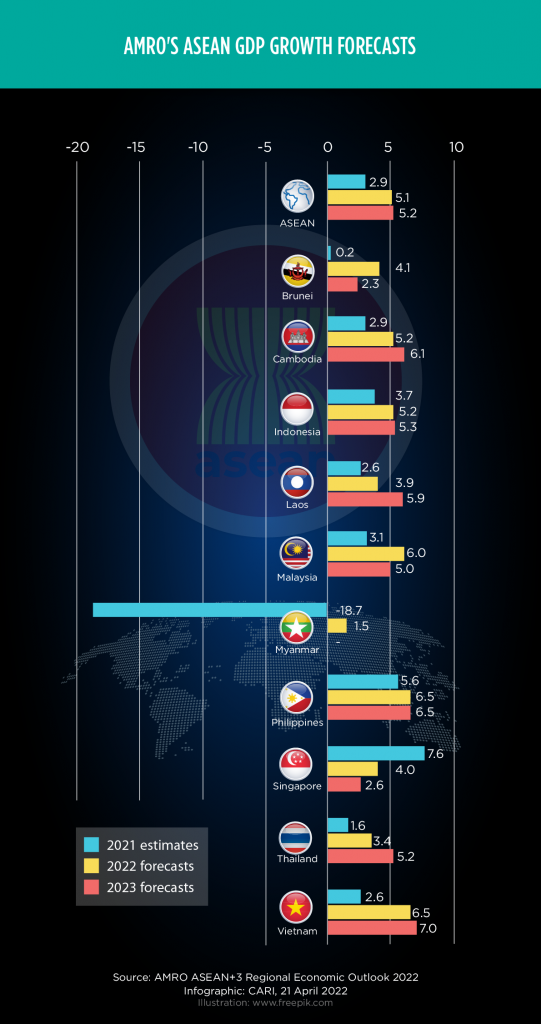
(18 April 2022) The ASEAN+3 Macroeconomic Research Office (AMRO) expects ASEAN to grow by 5.1% in 2022 and 5.2% in 2023 as the region’s economies move towards a fuller opening up in parallel with their rising vaccination rates. However, AMRO notes that this does not take into account the impact of the Russia-Ukraine conflict since the conflict’s impact on ASEAN remains limited for now. All ASEAN countries, especially the Philippines (6.5%), Vietnam (6.5%), and Malaysia (6.0%), are expected to see firmer growth this year, with Singapore being the only exception where growth is expected to moderate from 7.6% in 2021 to 4.0% in 2022.

INDONESIA
Indonesia’s exports hit an all-time high in March

(18 April 2022) Indonesia’s exports saw a 44.36% year-on-year spike in March 2022, reaching US$26.5 billion, its highest export total ever since the Indonesian government began recording such data in 1993. The country’s imports also saw a 30.85% year-on-year spike to US$21.97 billion and its trade surplus also reached a six-month high of US$4.53 billion. The surge in exports was driven by coal, metals and crude palm oil, while the surge in imports was due to an increase in raw materials and capital goods. This uptrend is expected to continue as Indonesia benefits from increased commodity prices due to global shortages and the Russia-Ukraine conflict.

SINGAPORE
Singapore’s air passenger traffic at 31% of pre-pandemic numbers

(18 April 2022) Singapore’s air passenger traffic reached 31% of pre-pandemic levels and is expected to reach 50% this year, according to the country’s civil aviation agency. The number of passenger flights has also achieved 38% of pre-pandemic levels, with robust growth in traffic volume to and from Australia, Malaysia, Indonesia and Thailand. Meanwhile, Singapore Airlines Group — which operates both Singapore Airlines and Scoot — recorded a nearly nine-fold increase in passengers in March 2022, with passenger capacity reaching 51% of pre-pandemic levels. The group expects this figure to reach around 61% by May 2022.

SINGAPORE
Singapore approves second oral antiviral drug for COVID-19

(19 April 2022) Singapore has approved the use of Molnupiravir, an oral antiviral drug developed by MSD that goes by the brand name Lagevrio, for treating adult COVID-19 patients. According to the government, the drug can reduce the risk of severe COVID-19 by 30% through a mechanism that “causes the machinery that reproduces the virus’s genetic material to make mistakes, thereby rendering the copies defective”. Separately, Singapore’s health ministry said that more clinics would soon be authorised to prescribe Pfizer’s Paxlovid pill — the first oral COVID-19 antiviral drug it approved — for those at risk of severe disease.

CAMBODIA
Cambodia delays capital gains tax to 2024

(16 April 2022) Cambodia has postponed the implementation of its amended capital gains tax to 1 January 2024 to give the private sector more time to recover from the pandemic. Capital gains received by residents and non-residents are taxed at a rate of 20%, with “capital” encompassing immovable property, investment assets, foreign currencies, intellectual property, leases, and goodwill. While the tax is not new, the 2024 version will also apply to individuals buying and selling real estate. Only properties that have served as an individual’s primary residence for five years before the sale will be exempted from the tax.

THAILAND, VIETNAM
Thailand, Vietnam aim for US$25 billion in bilateral trade

(21 April 2022) Vietnam and Thailand have agreed to aim for US$25 billion in bilateral trade by 2025, up from the US$19.5 billion recorded in 2021. Thailand’s exports to Vietnam saw a 12.3% increase last year totalling US$12.5 billion, while its imports from Vietnam grew by 27.6% to reach US$6.93 billion. Vietnam was also Thailand’s sixth-largest trading partner last year, after China, Japan, the United States, the European Union, and Malaysia. The new bilateral trade target was announced following a meeting held between the countries’ trade ministers in Bangkok this week.

ASEAN, UNITED STATES
US government to probe solar imports from Southeast Asia 
(18 April 2022) The US commerce department has opened an investigation to find out if the solar products that the US imports from Cambodia, Malaysia, Thailand and Vietnam are actually goods produced in China that are then shipped to Southeast Asia for minor processing and exporting in order to skirt US solar duties. Southeast Asia has been the US’ number one source of solar panel imports for the past five years, with 85% of imports in 2021 coming from the four countries. Separately, the White House announced that the US-ASEAN Special Summit would be held in Washington, DC, on May 12-13.


RCEP Monitor


NEW ZEALAND, SINGAPORE
NZ and Singapore to partner on climate change and green economy

(19 April 2022) Singapore and New Zealand announced that they would further enhance their bilateral relationship through cooperation in several areas, most notably through the establishment of a new “climate change and green economy” pillar under the existing Singapore-New Zealand Enhanced Partnership. This will include working together to develop a sustainable aviation ecosystem focusing on low and zero-emission fuel solutions. The announcements were made on the occasion of Prime Minister Jacinda Ardern’s three-day visit to Singapore, her first official trip abroad since early 2020.

SOUTH KOREA, CAMBODIA
Cambodia-Korea bilateral trade jumps 22.8% in Q1
(20 April 2022) Trade between Cambodia and South Korea grew by 22.8% year-on-year to reach US$234.4 million in the first quarter of 2022. Cambodia’s exports to South Korea saw a 22.2% increase during the period reaching US$61.3 million, while its imports from South Korea rose by 23.1% to reach US$173 million. Cambodia mainly imports cars, machinery, textiles, and agricultural and marine products from South Korea and exports textile-based goods and agricultural products to them. Both countries expect this uptrend to continue with the Cambodia-Korea free trade agreement on the way.

SOUTH KOREA
South Korea lifts most COVID-19 curbs

(15 April 2022) South Korea lifted most of its pandemic-related restrictions on April 18 as it attempts to return to normalcy. The restrictions removed include a midnight curfew on restaurants and other businesses, the 10-person private gathering limit, and the 70% capacity limit at religious facilities. Rallies and other events with 300 or more people will also be allowed. Nevertheless, Prime Minister Kim Boo-kyum said that the indoor mask mandate would likely remain in place for the foreseeable future, though the government will review the outdoor mask-wearing mandate again in two weeks.

CARI Captures Issue 549: 78% of Middle Eastern companies view Malaysia as top ASEAN market for expansion


ASEAN
78% of Middle Eastern companies view Malaysia as top ASEAN market for expansion

(12 April 2022) According to a survey recently commissioned by Standard Chartered entitled ‘Borderless Business: Middle East-ASEAN Corridor’, 78% of Middle Eastern companies view Malaysia as their top ASEAN market for expansion. This is followed by Singapore (69%) and Indonesia (67%). Greater participation of Middle Eastern companies in Southeast Asia has been enabled by multiple regional and country-level alliances. In particular, the report said the ASEAN-GCC Joint Vision has served as the foundation for pursuing closer economic and cultural cooperation between the regions. The report noted that key growth sectors in Malaysia attractive to Middle Eastern companies include refining and petrochemicals, renewable energy, and retail and consumer goods. Not only has Malaysia established integrated petrochemical zones, it has also emerged as a major hub for solar photovoltaic (PV) production and is a key market for halal goods.

ASEAN
ASEAN nations to utilize economic recovery momentum to push for financial stability and integration

(11 April 2022) ASEAN nations agreed to utilize economic recovery momentum to push for financial stability and integration during the 8th Joint Meeting of the ASEAN Finance Ministers and Central Bank Governors (AFMGM). It is believed that greater financial integration would mitigate economic risks and challenges during the post-COVID-19 era, including from climate change, digital disruptions, and geopolitical tensions. Among the priority areas identified was encouraging further integration in the regional financial services sector. The ASEAN member states also welcomed the resolution of the study on ASEAN member states entitled Financial Landscape Toward Furthering ASEAN Banking Integration in the Digital Era. They also welcomed the Cross-Border QR Code Payment Linkages initiative and the issuance of ASEAN Taxonomy Version 1. There was also support for the ASEAN central bank initiative to strengthen the sustainable finance agenda through the formation of two work streams under the Senior Level Committee Task Force (SLC-TF).

INDONESIA
Indonesian sovereign wealth fund agrees to invest US$2.7 billion in toll roads on Java and Sumatra

(14 April 2022) The Indonesia Investment Authority, a sovereign wealth fund, has agreed to provide around US$2.7 billion to invest in toll roads on the islands of Java and Sumatra. The deals are with Hutama Karya, the Indonesian state-owned construction company that is building the Trans-Sumatra toll road, and Waskita Toll Road, which is developing the Trans-Java toll road and is a subsidiary of another state builder. Indonesian President Joko Widodo stated that the agreements are expected to help domestic and international investors gain trust in the way the fund, also known as the INA, manages its money. As part of Joko Widodo’s mass infrastructure program, Indonesian state contractors have been accumulating massive amounts of debts. Some of these companies are now seeking to divest some of their assets. Apart from turnpikes, the INA plans to invest in geothermal infrastructure, ports, and the health care sector.

MALAYSIA
Malaysia expected to hire nearly 180,000 migrant workers over the next six weeks to ease labor-crunch

(14 April 2022) Malaysia is expected to hire nearly 180,000 migrant workers over the next six weeks in order to ease a pandemic-driven labor crunch, which has choked its key plantation and manufacturing industries. Malaysia froze the hiring of foreign workers in the past two years to stem the spread of COVID-19, leading to an acute labor shortage, especially in the economically crucial palm oil plantation sector. Although various business associations had urged the freeze to be lifted sooner, the government first ensured that locals didn’t want those jobs. Reportedly, many locals shunned those types of jobs, preferring to work as e-hailing drivers due to the higher income. There are only about 1.17 million registered foreign workers in Malaysia, down from 1.7 million before the outbreak of COVID-19. As of 7 April, the Ministry of Human Resources has received 519,937 applications from employers across various industries.

SINGAPORE
Singapore’s GDP growth slows to 3.4% year-on-year in first quarter of 2022

(14 April 2022) According to Singapore’s Ministry of Trade and Industry (MTI), Singapore’s economy grew 3.4% year-on-year in the first quarter of 2022. This is a slowdown from the 6.1% growth recorded in the previous quarter. On a quarter-on-quarter seasonally adjusted basis, Singapore’s GDP grew 0.4% in the first quarter, slower than the 2.3% recorded in the preceding quarter. The slowdown in the first quarter was largely due to the manufacturing sector coming off a high base, as the sector failed to grow at the same pace observed over the last two years due to Singapore facing capacity constraints. Moving forward, the easing of COVID-19 restrictions will support economic activity in the coming quarters. However, Singapore will be vulnerable to slowdowns in economic activity in either the United States or China. Authorities project growth of between 3% to 5% in 2022, and preliminary GDP estimates for the first quarter of 2022 will be released by MTI in May.

THE PHILIPPINES
Fintech company Voyager Innovations reaches unicorn status after raising US$210 million in latest funding round

(12 April 2022) Philippine fintech company Voyager Innovations stated it had reached unicorn status after raising US$210 million in their latest funding round. The company’s valuation had reached US$1.4 billion following the latest funding round, which was led by new investor SIG Venture Capital. Existing shareholders U.S. fund KKR, Chinese tech titan Tencent, World Bank affiliate IFC and PLDT, the Philippines’ largest telecom, also participated. The company operates a payments app called Paymaya, which serves some 47 million users. The company said it will use the fresh funds to launch Maya Bank, a new digital bank that targets consumers and small enterprises. The company said it will also continue to expand Paymaya’s products and services, including cryptocurrency, micro-investments and insurance. With one of Southeast Asia’s largest unbanked populations, there is fierce competition among the Philippines’ upcoming digital banks to provide financial services to millions of Filipinos who traditionally lack access to them.

VIET NAM
Viet Nam plans to raise minimum wage by 6% from July 2022 to help workers deal with impact of COVID-19  
(12 April 2022) Viet Nam plans to raise its minimum wage by 6% from July 2022 onwards to help workers weather the impact of COVID-19. Under the plan, the minimum monthly wage would be raised to between US$142.00 and US$204.47. This will be the first minimum wage hike in two years, as a large proportion of the population is facing hardships due to the COVID-19 pandemic. In response, Viet Nam’s Chamber of Commerce and Industry, which represents businesses in the country, said firms would try to increase their productivity to help fund the wage hike. Viet Nam recorded GDP growth of 5.03% in the first quarter of 2022, beating the 4.72% expansion recorded in the first quarter of 2021 but down from the 5.22% recorded in the fourth quarter.


JAPAN
Japan expected to announce strongest annual inflation since 1992 outside tax hike years

(15 April 2022) The Bank of Japan (BOJ) is widely expected to announce Japan’s strongest annual inflation since 1992 outside tax hike years. Surveyed economists predict key consumer prices to grow by 1.8% in the year that started in April, compared with the BOJ’s current forecast of 1.1%. This is fueling expectations that the BOJ will have to upgrade its quarterly projections for price gains well beyond the 1.2% level that marks the strongest price gains in 30 years after excluding the impact of sales tax increases in 1997, 2014 and 2019. The BOJ will release its forecasts on April 28 after a two-day policy meeting. Despite the upgrade of its inflation target, the BOJ is expected to maintain with its stance that the economy needs stimulus. The BOJ fears that any tightening of policy will weigh negatively on the economy by causing a “considerable” negative impact on corporate profits, employment and wages.

SOUTH KOREA
South Korea ramps up fight against rising inflation with surprise rate hike

(15 April 2022) South Korea’s central bank ramped up its fight against rampant inflation with a surprise rate hike. On 14 April, the central bank raised its benchmark rate to the highest since August 2019, with an increase of a quarter of a percentage point to 1.5%. The central bank warned that price growth is likely to top 4% for a while, up from its February forecast of 3.1%. The Bank of Korea now projects South Korea’s economic growth to be below the February forecast of 3%. At the same time, inflation in South Korea is expected to hold at decade-highs as Russia’s invasion of Ukraine causes a spike in global commodity prices. Most analysts see South Korea’s policy rate reaching 2% by the end of 2022.

NEW ZEALAND, SINGAPORE
New Zealand Prime Minister Jacinda Ardern to visit Singapore as part of trade mission

(12 April 2022) New Zealand’s Prime Minister Jacinda Ardern will visit Singapore as part of a trade mission later in April 2022. This will be her first official overseas engagement since the start of the COVID-19 pandemic, and she will be accompanied by the Minister for Trade and Export Growth Damien O’Connor and as well as business leaders in the dairy, food and beverage, healthcare, aviation, tourism, supply chain and energy sectors. The trade mission will leave New Zealand on 18 April. Singapore has been identified as one of New Zealand’s closest and most important strategic economic partners. The delegates are expected to use the trip to sign partnerships and memorandums of understanding that strengthen bilateral collaboration and innovation. Singapore is New Zealand’s fifth-largest trading partner with US$4.47 billion in two-way trade in the year ended December 2021.

CARI Captures Issue 548: World Bank shaves 2022 growth projections for Southeast Asia


ASEAN
World Bank shaves 2022 growth projections for Southeast Asia

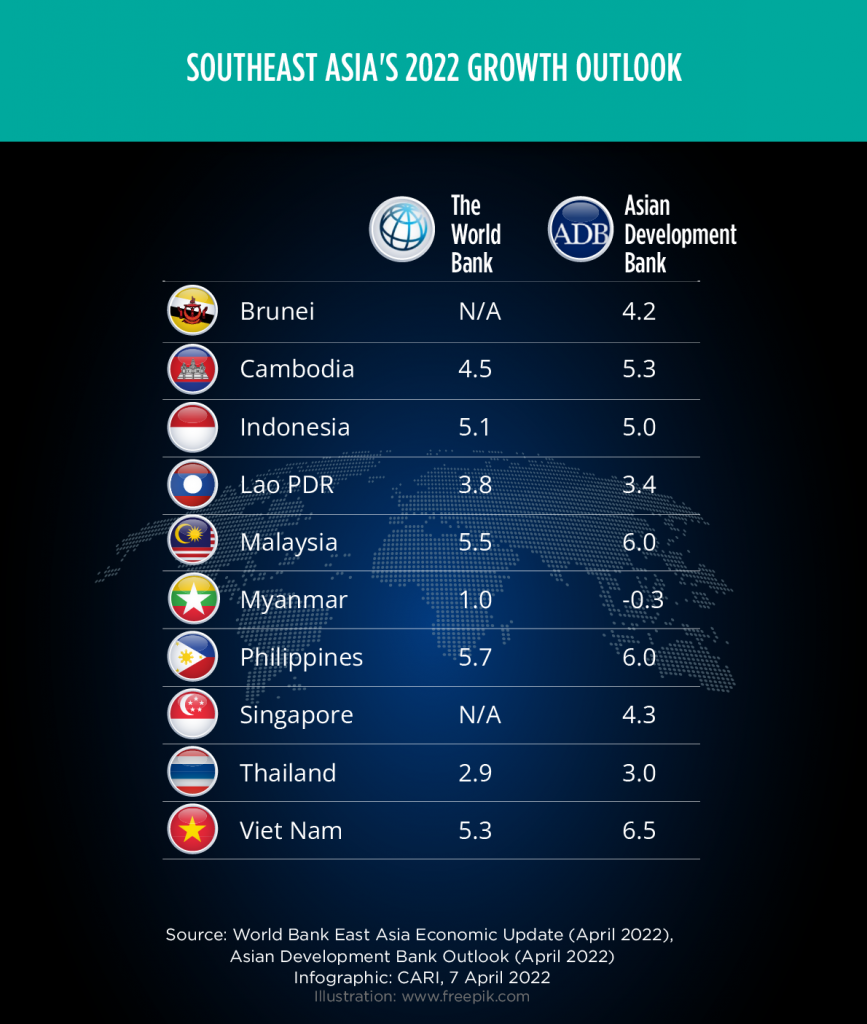
(6 April 2022) The World Bank has downgraded its growth projections for East Asia and the Pacific in 2022 in its latest economic outlook from last October’s 5.4% to 5%, with a worst-case scenario forecast of 4% growth, due to slowing growth in China, monetary tightening in the United States, and the impacts of the war in Ukraine. The report, which does not provide data on Singapore and Brunei, expects to see the most growth in the Philippines this year (5.7%), followed by Malaysia (5.5%), Vietnam (5.3%), Indonesia (5.1%), Cambodia (4.5%) and Laos (3.8%). The World Bank expects Thailand’s growth (2.9%) to be hardest hit due to the COVID-19 situation in China and Russian sanctions affecting pivotal tourist inflows, and Myanmar’s growth to come in at 1% due to its domestic issues.

ASEAN
ADB trims Southeast Asia’s growth outlook in 2022

(6 April 2022) The Asian Development Bank (ADB) has adjusted its full-year growth projection for Southeast Asia (including Timor Leste) from 5.1% to 4.9% due to the Omicron variant’s effect on the region in early 2022, particularly in tourism-reliant Thailand. The ADB also expects the region’s growth to hit 5.2% in 2023, though it noted that downside risks remain and that its projections do not take into account the latest COVID-19 situation in China. Five Southeast Asian countries are expected to outperform the region’s 4.9% growth rate this year: Vietnam (6.5%), Malaysia (6.0%), the Philippines (6.0%), Cambodia (5.3%), and Indonesia (5.0%).

ASEAN
Wall Street says Indonesia is the region’s top market in 2022

(3 April 2022) Analysts from JPMorgan and Goldman Sachs picked Indonesia, Vietnam and Singapore as their Southeast Asian markets of choice for 2022, with Indonesia being the top pick for both banks. Goldman believes that the region’s stocks have largely flown under the radar in the last decade, while JPMorgan feels that the region is relatively insulated from the rising geopolitical tensions in Europe. Among JPMorgan’s reasons for banking on Indonesia is the significant percentage of the country’s population that remains underbanked, the emergence of digital economy firms being listed, and an economy that is set to recover from pandemic-related setbacks and policies.

MALAYSIA, INDONESIA
Bilateral agreement on Indonesian domestic helpers signed

(2 April 2022) Indonesia and Malaysia signed a memorandum of understanding (MoU) on the recruitment and protection of Indonesian domestic helpers in Malaysia on 1 April 2022. The MoU included provisions for implementing a single entry system agreed upon by both countries, an e-wages system to ensure that payments are made before the 7th of each month, and a mandatory induction course to help workers understand their rights and responsibilities. Among other provisions, the MoU also states that domestic helpers will serve a maximum of six people per household, receive Social Security Organisation (SOCSO) contributions, and have access to a mobile application to submit complaints.

THAILAND
Government preps incentives for four new economic corridors

(4 April 2022) Thailand is finalising investment incentives for four new economic corridors in four regions to complement its flagship Eastern Economic Corridor (EEC) and other special economic zones, with each new corridor promoting specific industries. The new Southern Economic Corridor will promote a palm oil-based bio-economy, the new Northeastern Economic Corridor will focus on manufacturing bio-economy related products for the EEC and China, the Northern Economic Corridor will encourage tourism and products for export, and the Western Economic Corridor will link the EEC and Myanmar’s Dawei port.

THAILAND
Thailand approves enhanced incentives to boost EV use

(7 April 2022) Thailand’s investment board has approved additional incentives to accelerate the expansion of electric vehicle (EV) infrastructure and consumer adoption of EVs to meet its goal of having EVs account for 30% of total automotive production output by 2030. Smaller charging stations will be eligible for three-year tax benefits under the revised incentives, in addition to the existing five-year corporate income tax exemption available to charging stations with at least 40 charges. The board has also scrapped the need for ISO certification, and investors will no longer be barred from receiving benefits from other government agencies.

ASEAN, US
US plans trade meetings with ASEAN as it retools Indo-Pacific strategy 
(7 April 2022) The United States is renewing its efforts to engage Southeast Asian countries with several meetings in 2022 and the development of an Indo-Pacific Economic Framework (IPEF) that focuses on trade, supply chain, infrastructure, and clean energy. This includes a summit with ASEAN leaders in the coming months, the planned signing of an agreement on supply chain resilience with Malaysia in May, the US undersecretary of commerce for international trade’s clean energy mission to Indonesia, Vietnam and possibly the Philippines in June, as well as the G20 Leaders’ Summit in Bali in October.


RCEP Monitor


CHINA, NEW ZEALAND
China to cut tariffs on New Zealand wood and paper exports

(7 April 2022) China will phase out import tariffs on New Zealand wood and paper products over the next decade starting on 7 April 2022, which marks the 14th anniversary of the signing of the China-New Zealand Free Trade Agreement. Under the upgraded free trade agreement, tariffs on 99% of New Zealand’s wood and paper exports to China will gradually reduce until it reaches zero. This will start with the reduction of tariffs on products like toilet or facial tissue stock from 7.5% to 6.8% and on paper used for writing from 5% to 4.5%.

INDONESIA, AUSTRALIA
Australia and Indonesia face limits in coal exports to Europe

(6 April 2022) Coal exporters in Indonesia and Australia say that they will not be able to meet Europe’s coal needs if the European Union (EU) decides to go ahead with its ban on Russian coal imports. EU member states rely on Russia for approximately 45% of their coal imports, and European buyers have been looking for alternative coal sources even before the EU’s proposed ban. Coal output in Indonesia and Australia has been affected by wet weather in recent months, in addition to regulatory restrictions and pandemic-related constraints.

AUSTRALIA
Australia and India sign interim trade deal in a virtual ceremony

(2 April 2022) Australia and India inked an interim bilateral trade agreement last week, with both sides expressing their intention to work towards a full free trade agreement. The new deal will see India removing tariffs on 85% of its imports from Australia — said to be worth around US$9.4 billion — and cover almost 91% of imports in a decade. This includes tariffs on copper, coal, alumina, wool, and some critical minerals and non-ferrous metals. At the same time, Australia will remove tariffs on 96% of its imports from India.

CARI Captures Issue 547: India calls for more regional cooperation at Bimstec summit, which includes Thailand and Myanmar


ASEAN
India calls for more regional cooperation at Bimstec summit, which includes Thailand and Myanmar

(30 March 2022) India called for greater regional cooperation among the member states of the Bay of Bengal Initiative for Multi-Sectoral Technical and Economic Cooperation (Bimstec), which comprises countries which border the Bay of Bengal, including the Southeast Asian states of Thailand and Myanmar. Other member states include Bangladesh, Bhutan, India, Nepal, and Sri Lanka. Officials stated that India would also take charge of matters related to the ‘security pillar’, which includes maritime security. India has been keen to push Bimstec as the core regional grouping in an effort to fortify its presence in the region. During the summit, India pledged US$1 million to the grouping’s budget, and also highlighted the need for a coastal shipping ecosystem among the members. India also pitched a free trade agreement for the group. A Master Plan for Transport Connectivity among the countries was also announced.

ASEAN, UNITED STATES
United States mulling tariffs on solar panels imported from Malaysia, Thailand, Viet Nam and Cambodia

(29 March 2022) US trade officials stated they would launch an investigation into solar panels imported from four Southeast Asian countries, namely Malaysia, Thailand, Viet Nam and Cambodia. The investigation was launched after a California-based solar manufacturer claimed that Chinese solar panel manufacturers had shifted production to Southeast Asia to avoid paying U.S. duties in place for nearly a decade on Chinese-made solar goods. According to the American Clean Power Association industry group, imports from these four ASEAN countries accounted for 80% of the panels expected to be installed in the United States in 2022. Solar industry trade groups in the US warned that the investigations alone would immediately hamstring project development and harm U.S. progress in addressing climate change.

INDONESIA
Government revokes forest concession permits covering 482,198.72 hectares of forests

(30 March 2022) The Indonesian government has revoked forest concession permits from 15 companies, covering 482,198.72 hectares of forests, in an effort to improve governance and transparency in its natural resources sector. In January 2022, Indonesian President Joko Widodo announced more than 2,000 mining, plantation and forest-use permits had been revoked due to non-compliance or because they had remained unused. According to Indonesia’s investment ministry, the permits were revoked based on a recommendation from the forestry ministry, and that the companies had been given time to clarify and verify the status of their operations before the permits removal became permanent. Among the companies which had their permits revoked included those which operated palm and timber plantations as well as logging operations across Sumatra, Kalimantan and Papua.

THE PHILIPPINES   
The Philippines central bank considers raising policy rate to between 2.5% to 2.75% as reasonable

(30 March 2022) According to the governor of the Philippines’ central bank, Benjamin Diokno, raising the key policy rate to between 2.5% to 2.75% as part of an exit from the bank’s COVID-19 accommodative stance would be “reasonable and consistent”. Diokno stated that the bank would begin the normalization process in the second half of 2022, and that reaching a 2.75% key policy rate might be reached by 2023. Last week, the central bank maintained its interest rates steady at a record low 2%. While authorities see inflation averaging above its 2%-4% target in 2022, it expects consumer-price increases to be within the goal in 2023. The Philippines’ central bank has refrained from the global rate-hiking cycle, choosing to focus instead on nurturing the economic recovery.

SINGAPORE, CHINA
More wealthy Chinese seeking to move their assets to Singapore via the family office structure

(29 March 2022) More and more wealthy Chinese are reportedly seeking to park their money in Singapore via the family office structure, owing in part to Singapore’s large Mandarin Chinese-speaking community and lack of a wealth tax. The trend reportedly picked up in 2021 after China’s sudden crackdown on the education sector and newfound focus on ‘common prosperity’, which is focused on redistributive policies. A family office is a privately held company that handles investment and wealth management for an affluent family. In Singapore, setting up a family office typically requires at least US$5 million in assets. China’s tight capital controls, which limits overseas foreign exchange to US$50,000 a year, limits the ability of wealthy Chinese to move money out of the country. Wealthy Chinese are also investing into Singapore to apply for permanent residency. However, the ongoing war in Ukraine has caused some wealthy Chinese to reconsider their plans to open a family office in Singapore.

VIET NAM
Viet Nam’s economy grows by 5.03% year-on-year in first quarter of 2022  
(29 March 2022) Viet Nam’s economy expanded by 5.03% year-on-year in real terms in the first quarter of 2022. Growth in the January-March period slowed from the 5.22% recorded in the preceding three months. Viet Nam’s export turnover in the first quarter of 2022 was estimated at US$88.58 billion, an increase of 14% from the same period in 2021. The United States was the country’s largest export market, accounting for US$25.2 billion of shipments. Vietnam’s retail sales, including service sales, grew 4.4% in the first three months of 2022 year-on-year. The ongoing war in Ukraine is expected to have an impact on Viet Nam’s economy in terms of a spike in material prices. Rising energy prices are also expected to have a negative impact on Viet Nam’s economy. In December 2021, the Asian Development Bank predicted Viet Nam’s economy to expand by 6.5% in 2022.

BRUNEI DARUSSALAM, UNITED ARAB EMIRATES
Brunei signs MoU with UAE to help expand and develop Bruneian maritime industry in terms of human resources

(30 March 2022) A Memorandum of Understanding (MoU) was signed on 29 March between the governments of Brunei Darussalam and the United Arab Emirates, and took place on the sidelines of Sultan Hassanal Bolkiah’s working visit to Dubai. The MoU on the Recognition of Certificate Issued under the Provisions of the International Convention on Standards of Training, Certification and Watch Keeping for Seafarers, 1978 as amended is to help expand and develop the Bruneian maritime industry in terms of human resources. The MoU formalizes Emirati recognition of the competency certificates of Bruneian seafarers, thus opening up employment opportunities on merchant ships registered under Brunei and the UAE. The maritime institutions of the two countries will be able to be co-recognised by each other.


RCEP Monitor


JAPAN
Japan’s long-term government debt may have topped US$8.2 trillion for first time at end of March 2022

(01 April 2022) Japan’s long-term government debt balance may have topped 1,000 trillion yen (US$8.2 trillion) for the first time at the end of March 2022. This indicates the country’s fiscal health, already the worst among the major developed economies, has further deteriorated on swelling social security costs as a result of an aging population, falling tax revenues and emergency spending in response to the COVID-19 pandemic. Growing interest payments on the accumulated debt following a recent uptrend in bond yields would cause further pressure for the Japanese government. The long-term debt balance, which excludes some types of bonds, is likely to have reached 1,030 trillion yen on 31 March 2022, the last day of fiscal 2021. It increased 1.5 times over the past 10 years. For the fiscal year 2022, the government plans to spend over 107 trillion yen in the initial budget, largely on snowballing welfare costs. The government also plans to issue supplementary budgets to counter the COVID-19 pandemic as well as the recent oil and commodity hikes.
 

AUSTRALIA
Home prices in Sydney fall for second consecutive month, indicating cooling housing market

(01 April 2022) Home prices in Sydney fell for the second consecutive month, signaling a broader cooling in Australia’s housing market. Sydney recorded a 0.2% drop in March 2022, while prices in Melbourne slipped 0.1%. Although prices are still advancing across the country, the 0.3% monthly gain for the country’s eight major cities was the lowest since October 2020. New home loan commitments dropped by 3.7% to US$24.2 billion, down from a record high the previous month. Australia’s property market saw a boom during the pandemic as the central bank cut rates to near zero to prop up the economy. But rising expectations of policy tightening in the months ahead is beginning to cool buyer sentiment. Housing unaffordability has become a major issue in Australia, with income growth trailing well behind property-price gains.
 

SOUTH KOREA
Factory activity in South Korea slows down in March 2022, with output and export orders shrinking

(01 April 2022) Factory activity in South Korea slowed in March 2022, due in part to the ongoing war in Ukraine as well as supply chain disruptions and inflationary pressures. The IHS Markit purchasing managers’ index (PMI) fell to 51.2 in March 2022 from 53.8 in February, standing above the 50-mark threshold that indicates expansion in activity. It was the 18th straight month of expansion, although it was the lowest in four months. South Korean manufacturers pointed to sharp price rises and sustained supply chain disruptions that had hindered production and demand at the end of the first quarter of 2022, while economic sanctions on Russia and the ongoing war in Ukraine further impacted international demand. New export orders contracted in March 2022, while output also shrank (the first contraction in three months). New orders also barely grew, with the sub-index standing at 50.4.

CARI Captures Issue 546: Singapore to reopen borders, retire VTLs on April 1


SINGAPORE
Singapore to reopen borders, retire VTLs on April 1

(24 March 2022) Singapore will reopen its borders and simplify entry procedures for fully vaccinated travellers starting 1 April 2022, nullifying existing vaccinated travel lane (VTL) arrangements that it has with other countries. Under the new framework, fully vaccinated travellers under the general travel category arriving by air and sea will only have to take a pre-departure test two days before departing for Singapore with no on-arrival test or quarantine period, while unvaccinated travellers under this category will be quarantined for seven days upon arrival. Travellers under the restricted category will still be subjected to these requirements.

MALAYSIA, SINGAPORE
Singapore-Malaysia land border to reopen in April

(24 March 2022) Malaysia and Singapore have agreed to fully reopen the land border between the countries in line with both countries’ plans to lift travel restrictions and transition towards living with COVID-19. Both countries will allow all fully vaccinated travellers and non-fully vaccinated children aged 12 and below crossing the causeway to enter the country without having to take pre-departure and on-arrival tests or undergo quarantine. However, those driving vehicles not registered in Singapore will need to apply for a vehicle entry permit and collect their permits in Johor Bahru before heading for the checkpoint.

INDONESIA
No more quarantine for air travellers arriving in Indonesia

(23 March 2022) Foreign travellers entering Indonesia by air will no longer need to go through a quarantine period upon arrival, though a polymerase chain reaction (PCR) test will still be required. It remains unclear if the new requirements will also apply to those arriving by land and sea, or if a pre-departure test will still be needed. The announcement follows a successful two-week quarantine-free trial in Bali, Batam and Bintan, and ahead of the upcoming Hari Raya festivities. Indonesians who have taken their booster shot will be allowed to participate in Hari Raya trips and gatherings this year.

VIETNAM  
Vietnam’s vaccine certificates now accepted in 17 countries

(21 March 2022) Vietnam has so far formed agreements with 17 countries to mutually recognise each other’s vaccine passports and allow the holders of such passports to be held to the same medical requirements as vaccinated locals. The 17 countries include the United States, United Kingdom, Japan, Australia, India, New Zealand, South Korea, Singapore, Cambodia and the Philippines. Vietnam also announced a three-year visa waiver for citizens of 13 countries for visits of up to 15 days. The countries are Germany, France, Italy, Spain, the UK, Russia, Japan, the Republic of Korea, Denmark, Sweden, Norway, Finland, and Belarus.

THAILAND
Thailand scraps pre-travel COVID-19 test to boost tourism
(22 March 2022) Travellers visiting Thailand will no longer have to take a pre-departure test starting 1 April 2022 though they will still be tested on arrival as the government looks to further relax restrictions to revive its tourism industry. Thailand’s tourism ministry says that it aims to remove all restrictions by 1 June 2022 if the situation continues to improve. This would include the removal of existing Test & Go, Sandbox and quarantine programmes. The ministry also hopes to lower entry restrictions on 1 May 2022 if there is no spike in COVID-19 cases after Songkran.

SINGAPORE
Singapore announces relaxation of COVID-19 measures 
(24 March 2022) Singapore announced a slew of changes to its COVID-19 measures that will come into effect from 29 March 2022. This includes allowing groups of 10 people to gather and dine in up from the current maximum of five, allowing the sales and consumption of alcohol after 10.30 pm, resumption of live performances and large scale social gatherings, as well as increasing the capacity limit for events of over 1,000 and workplaces from 50% to 75%. While mask-wearing outdoors will be optional, masks will still be required indoors and there is still a one-metre distancing measure in settings without masks.

THAILAND
Government bars the use of cryptocurrencies for payment
(23 March 2022) Thailand announced that it will ban the use of cryptocurrencies as a method of payment beginning 1 April 2022 alongside a slew of new restrictions for businesses operating in the digital asset industry. Under the new regulations, businesses operating in the digital asset space must not advertise or suggest that digital assets can be used to pay for goods and services and they must not facilitate the use of digital assets for such purposes. Businesses will be given until the end of April to comply with the new regulations.


RCEP Monitor


MALAYSIA
RCEP comes into force in Malaysia
(18 March 2022) The Regional Comprehensive Economic Partnership (RCEP) entered into force in Malaysia on 18 March 2022 and the country is expected to be the largest beneficiary of the trade pact among ASEAN countries in terms of export gains according to the country’s trade ministry as it projects a US$200 million increase in exports under the pact. All ASEAN Member States except Myanmar, Indonesia and the Philippines have ratified the RCEP thus far. Malaysia’s external trade development agency expects the country to benefit from a diversion in trade due to ongoing volatility and geopolitical tensions.

NEW ZEALAND
New Zealand to drop COVID-19 restrictions in April
(23 March 2022) New Zealand will relax its pandemic restrictions in early April on the back of high vaccination rates and following the peak of the country’s Omicron wave. Starting 4 April 2022, there will no longer be capacity limits in outdoor settings and the limit for indoor gatherings will be increased from 100 to 200 people. People will not need to use the COVID-19 tracing app or show their vaccine passes when entering premises and venues, and there will no longer be a vaccine mandate for those working in education, police and defence.

AUSTRALIA
Australia bans alumina exports to Russia

(20 March 2022) Australia expanded its sanctions against Russia as it imposed an immediate ban on all exports of alumina and aluminium ores to the country. The move is expected to impact Russia’s ability to produce aluminium — a key export for the country — as it relies on Australia for 20% of its alumina needs. Australia will also donate 70,000 tonnes of thermal coal to Ukraine in addition to other forms of humanitarian and defensive military assistance. Australia has imposed sanctions against 476 Russian individuals and institutions, and approved almost 5,000 humanitarian visas for Ukrainian refugees so far.

CARI Captures Issue 545: COVID-19 pandemic pushes 4.7 million more people into extreme poverty in 2021


ASEAN
COVID-19 pandemic pushes 4.7 million more people into extreme poverty in 2021

(17 March 2022) The COVID-19 pandemic pushed 4.7 million more people into extreme poverty – defined as those living on less than US$1.90 per day – in 2021 as compared to 2020, and erased another 9.3 million jobs across the region. This is according to a report recently released by the Asian Development Bank (ADB). The pandemic has impacted the region’s labor market, leading to widespread unemployment, worsening inequality, and rising poverty levels. Although the ADB projects growth of 5.1% in 2022 due to higher vaccination rates, it warned that the new Omicron variant could cut growth by as much as 0.8%. The ADB noted that the region’s crucial tourism sector will gradually begin to recover this year as borders begin to reopen. The ADB also called upon Southeast Asian governments to invest more into their healthcare systems to ensure future resilience. It predicted that the region’s economic growth could increase by 1.5% if health spending in the region reaches about 5% of GDP, compared with 3% in 2021.

MALAYSIA
Government allows Malaysians to make another withdrawal from Employees Provident Fund

(16 March 2022) The Malaysian government announced that they will allow Malaysians to make a withdrawal of up to MYR 10,000 (US$2,383.13) from their savings at the Employees Provident Fund (EPF), a state-owned pension fund which manages the pension savings of private workers in Malaysia. The government had previously allowed the withdrawal of EPF contributions through three schemes, namely i-Lestari, i-Sinar and i-Citra, which amounted to US$24 billion being withdrawn, involving 7.34 million contributors since the COVID-19 pandemic hit the country two years ago. The government stated that further details concerning the withdrawal will be revealed by the EPF in the near future, as well as the necessary measures to address the issue of declining EPF members’ retirement funds. Malaysia’s Finance Minister had recently revealed that the EPF’s recently announced dividend rate of 6.1% should have been higher at 6.7% if there had been no outflows of savings by its members. He also cautioned that the EPF may be forced to dispose of more of its overseas investments and halt domestic investments to fund these withdrawals.

SINGAPORE
Number of expatriate white-collar workers in Singapore fall to lowest number in more than a decade

(16 March 2022) The number of expatriate white-collar workers in Singapore fell to its lowest number in more than a decade in the year ending December 2021. According to the Ministry of Manpower, the number of Employment Pass holders – a type of visa issued to foreign professionals, managers and executives earning at least US$3,300 per month – fell by 9% to 161,700. That is the lowest number since 2010, when there were 143,300 in the country. This has been attributed to both concerns by local Singaporeans that foreigners are taking their jobs, as well as restrictions on travel due to the pandemic. There has also been a drop in the number of technicians and laborers in the construction sector, causing delays in housing projects and other building projects. The total number of foreign workers in the city-state stood at 1.2 million at the end of 2021, well below the 1.43 million that Singapore hosted in 2019.

INDONESIA  
Government removes export volume restrictions on palm oil products, raises export levy instead

(17 March 2022) The Indonesian government recently announced they will remove export volume restrictions on palm oil products and raise its export levy instead. This was a surprise policy U-turn by the government just a week after it had further tightened its export curbs. Under the so-called domestic market obligation (DMO), the government had required companies to sell 30% of their planned export volume of palm oil products domestically, up from 20% imposed in January 2022. This had been to ensure local supply amidst soaring cooking oil prices. The Indonesian Trade Minister had recently announced that the policy had resulted in supply scarcity, and that the DMO would be withdrawn. Instead, the government will raise the ceiling of palm export tax and levy, from a combined maximum of US$375 per tonne to between US$575 to US$675 per tonne. Global prices of crude palm oil, which Indonesians uses for cooking oil, have surged to historic highs in 2022, amid rising demand and weak output from top producers Indonesia and Malaysia, plus Indonesia’s export limits.

THAILAND, MALAYSIA   
Malaysia lifts ban on import of cattle and buffaloes from Thailand with immediate effect

(16 March 2022) On 16 March 2022, Malaysia lifted the ban on the import of cattle and buffaloes from Thailand with immediate effect. According to Malaysia’s Veterinary Services Department (DVS), the decision came following an agreement with the Thai Department of Livestock Development (DLD) on measures to control Lumpy Skin Disease (LSD). Malaysia had suspended the import of cattle and buffaloes from Thailand on 8 June 2021 after assessing the risk of LSD, which was reported to be contagious in more than 41 provinces in the country. The decision by DVS was made following several improvements in import rules and procedures, and also took into account mitigation measures that can be taken in Thailand to control the spread of LSD. The DVS stated it expects the supply of buffalo and cattle to remain sufficient ahead of the Hari Raya Aidilfitri celebration in May 2022.

THE PHILIPPINES
Authorities mull four-day working week to reduce fuel costs on Filipino businesses and workers  
(16 March 2022) In the face of rising energy costs, Filipino authorities have rejected calls by lawmakers and transport groups to suspend excise taxes on petroleum products, instead suggesting alternative solutions including more subsidies for affected sectors as well as a four-day working week. The government is expecting to collect US$2.5 billion in 2022 from excise taxes on fuel, and it is believed that suspending the excise tax would cut government revenue this year by 0.5% of GDP. A three-month wage subsidy has also been proposed by the labor department. The Finance Secretary also said that suspending the excise tax on fuel will increase this year’s deficit to 8.2% of GDP from a projected 7.7%, and the debt ratio to 61.4% of GDP from a 60.9% estimate.

VIET NAM
Coal-fired power plants in Viet Nam face shortage of coal supplies due to COVID-19 disruptions

(17 March 2022) Coal-fired power plants in Viet Nam are currently facing a shortage of coal supplies as COVID-19 impacted the operations of local miners, as well as due to the high global cost of importing the fuel. In February 2022, power plants operated by state utility EVN only received 69% of coal agreed in contracts with state-run miners Vinacomin and Dong Bac. Vinacomin stated that its operations had been impacted by a shortage of miners due to the COVID-19 pandemic. The ongoing war in Ukraine has also pushed up prices for oil, gas and coal in international markets. The country’s coal imports in the first two months of 2022 fell 17.9% from a year earlier to 3.89 million tonnes, though the value more than doubled to US$859 million. Viet Nam’s Ministry of Industry and Trade has said Vietnam would limit its coal exports to 2 million tonnes in 2022.


RCEP Monitor


JAPAN
Japan’s GDP contracts by 1.4% month-on-month in January 2022 due to spread of Omicron variant

(14 March 2022) Japan’s inflation-adjusted GDP fell by 1.4% month-on-month in January 2022 due to the spread of the Omicron variant, according to research by the Japan Center for Economic Research. It is Japan’s first contraction after expanding steadily for the final quarter of 2021. For the October-December quarter, Japan recorded annualized growth of 5.4%. The January contraction was mainly precipitated by sluggish household consumption, which fell 0.4% from December 2021, the first drop in four months. Disruptions in the supply chains also affected the manufacturing sector. However, corporate capital investment rose 0.6% in January, the fourth straight month of month-on-month growth. Private housing investment also grew 0.6% over the month. Exports of goods and services also contracted 2.3% while imports jumped by 3.4%.

SOUTH KOREA
South Korea becomes world’s biggest COVID-19 hotspot as daily cases top 400,000

(17 March 2022) South Korea has become the world’s biggest COVID-19 hotspot as daily cases topped 400,000. On 15 March a total of 400,741 infections were confirmed, up roughly 20% from a week prior. South Korea has also averaged 230 deaths a day in the past week while recording 1,244 cases with severe symptoms on 15 March — both at or near record highs. South Korea currently accounts for about 20% of new COVID-19 cases worldwide, more than any other country. The recent surge in cases is attributed to large-scale political rallies leading up to its presidential election on 9 March. Despite the increasing cases, the government has been easing curbs, in part responding to business owners. The government has stated that they believe the Omicron wave is at its peak and that infections will start to fall soon.

AUSTRALIA
Unemployment rate falls to more than decade low as hiring exceeds expectations

(17 March 2022) Australia’s unemployment rate fell to a more than a decade low as hiring exceeded expectations in February 2022. Unemployment fell to 4%, a level unseen since August 2008, while labor-market participation hit a fresh record. This increase in employment was largely underpinned by a surge in full time positions. The stronger-than-expected data saw the Australian Dollar rise, while yields on benchmark three-year bonds also increased to 1.88%. The improving job market has emboldened hawks who predict that the Reserve Bank of Australia (RBA) will begin its tightening cycle as early as June 2022, although most believe it will start in August 2022. Inflationary pressure caused by the recent Russian invasion of Ukraine on global energy prices is likely to create more pressure on the RBA to begin raising rates.