Singapore: February 2018 trade


HIGHLIGHTS

February 2018 trade

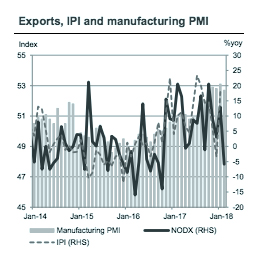
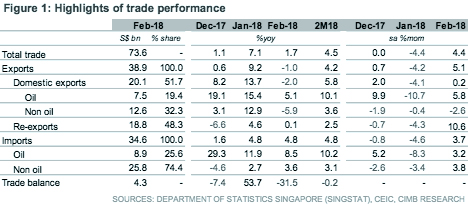
  • Non-oil domestic exports (NODX) declined in Feb (-5.9% yoy vs. +12.9% yoy in Jan) on the back of weaker electronics and non-electronics shipments.
  • Spillovers from US tariffs are contained so far, but broader threats aimed at China are a significant risk to Singapore, especially if they target key electronics clusters.
  • Until these risks materialise, Singapore’s economic outlook remains intact, providing a sufficient base for MAS to allow a greater appreciation bias for the S$ NEER in Apr.

img-sg2-1

Sequential NODX declines are a slight concern
Non-oil domestic exports (NODX) declined 5.9% yoy in Feb, significantly below expectations of gains (CIMB: +3.0% yoy; Bloomberg consensus: +4.8% yoy; Jan: +12.9% yoy). Export activity declined in both the electronics sector (-12.3% yoy vs. -3.9% yoy in Jan) and non-electronics sector (-3.4% yoy vs. +20.7% yoy in Jan). Seasonal distortions from the Chinese New Year (CNY) break may have skewed exports to the downside, but we are monitoring signs of more persistent weakness in exports, as the seasonally adjusted NODX has registered three months of sequential contractions (-2.6% mom in Feb vs. -0.4% mom in Jan).

Third consecutive month of contraction in electronics exports
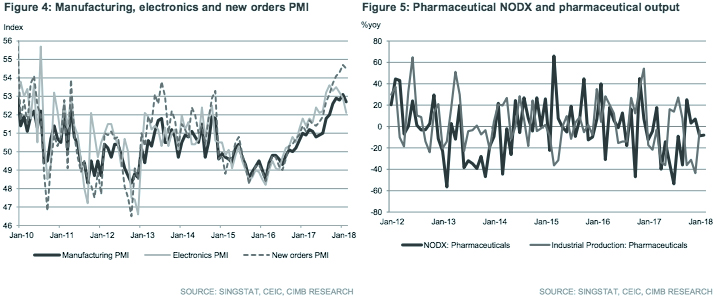
Drags to the electronics cluster were broad-based as the collective exports of the five largest electronics items fell 10.6% yoy in Feb (-4.5% yoy in Jan): integrated circuits (- 11.4% yoy vs. -10.2% yoy in Jan), PC parts (-48.1% yoy vs. -31.4% yoy in Jan), diodes and transistors (-25.6% yoy vs. +0.4% yoy in Jan), and telecom equipment (-13.4% yoy vs. +24.8% yoy in Jan). Only the PC segment recorded gains in Feb (+17.7% yoy vs. +30.9% yoy in Jan). Non-electronics NODX were hit by volatility in contributions from petrochemical shipments (-12.9% yoy in Feb vs. +11.3% yoy in Jan) and the pharmaceutical segment (-8.0% yoy in Feb vs. -8.7% yoy in Jan).

PMI indicates slower expansion in manufacturing sector
Singapore’s official manufacturing PMI fell 0.4 pts to 52.7 in Feb (53.1 in Jan) due to slippages in output, new orders, new export orders, imports, employment and order backlogs. The electronics PMI decreased 0.8 pts to 52.1 in Feb (52.9 in Jan), the lowest level in eight months, as the sub-indices for production and new orders declined further.

Activity dropped as Asia celebrated the new lunar year
Singapore saw a sharp dip in exports to a number of key trading partners that broke for recess over CNY in Feb: China (-23.6% yoy), Taiwan (-18.6% yoy), Hong Kong (-14.7% yoy), Thailand (-13.0% yoy), Malaysia (-5.7% yoy) and Indonesia (-4.4% yoy). The exceptions – Japan, South Korea and the US – were driven by higher non-electronics NODX, which is typically less exposed to the Asian manufacturing supply chain.

Global trade outlook tainted by Trump tariff talk…
We are cognisant of the downside risks posed by a more protectionist US trade stance. US President Donald Trump recently threatened to impose tariffs on up to US$60bn of Chinese imports targeting the technology, consumer electronics and telecommunications sectors. This would have significant ramifications on Singapore’s trade outlook if they come to pass as electronics account for about 30% of NODX.

… but not enough to deter MAS normalisation process
Despite increasingly feisty exchanges between the major trade nations, spillovers have so far been contained. We maintain our NODX forecast of 6.7% for 2018F, and Singapore’s economic growth prospects remain intact. We continue to expect the Monetary Authority of Singapore (MAS) to tweak its policy stance to allow for more S$ nominal effective exchange rate (NEER) appreciation at its policy review next month.

img-sg2-2

img-sg2-3

img-sg2-4

img-sg2-5


Originally published by CIMB Research and Economics on 16 March 2018.

Indonesia: February 2018 trade


HIGHLIGHTS

February 2018 trade

  • The trade deficit narrowed to US$116m in Feb on the back of stronger export growth (+11.8% yoy in Feb vs. +8.6% yoy in Jan).
  • Mining was the key driver of Feb’s export performance whereas the decline in palm oil exports may have been affected by India’s CPO import duty hike.
  • Import growth remained strong across all segments as domestic activity gained traction.
  • No change to our 2018 trade forecasts (exports: +5.2% yoy; imports: +6.9% yoy; trade balance: +US$11.3bn).

img-ind8-1

Trade deficit narrowed in Feb on stronger export growth
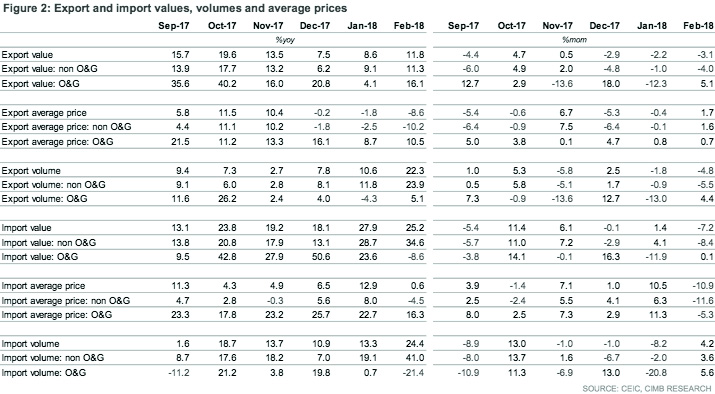
The trade deficit narrowed to US$116m in Feb (-US$756m in Jan, CIMB forecast: – US$437m; Bloomberg median consensus: -US$124m) as the recovery in export expansion to a three-month high (+11.8% yoy in Feb vs. +8.6% yoy in Jan; CIMB forecast: +12.1% yoy; Bloomberg median consensus: +12.4% yoy) was accompanied by a slight moderation in import growth momentum (+25.2% yoy in Feb vs. +27.9% yoy in Jan; CIMB forecast: +28.3% yoy; Bloomberg median consensus: +26.0% yoy). The non O&G trade surplus widened (+US$754m in Feb vs. +US$180m in Jan) while the improvement in the O&G trade deficit was marginal (-US$870m in Feb vs. -US$936m in Jan).

Mining sector was the key driver of stronger export growth
Resource-based segments, such as O&G (+16.1% yoy in Feb vs. +4.1% yoy in Jan), nickel (+41.2% yoy vs. -10.0% yoy in Jan), iron and steel (+121.4% yoy vs. +103.1% yoy in Jan), tin (+110.2% yoy vs. -72.3% yoy in Jan) as well as ores, slag and ash (>1,000% yoy vs. 20.5% yoy in Jan) propelled the stronger export performance. The lifting of the mineral ores ban in the previous year supported nickel shipments whereas the decline in palm oil exports may have been affected by an import duty hike on crude palm oil (CPO) by India, the largest consumer of Indonesia’s CPO, as well as festive holidays in China, which led to fewer working days.

Strong momentum across all import components
All import segments continued to grow at a strong pace. Investment activity, supported by ongoing infrastructure projects, continued to underpin strong imports of capital goods (+32.2% yoy in Feb vs. +30.2% yoy in Jan). As rolling stocks are expected to be delivered for railway projects (i.e. Jakarta MRT, Palembang LRT) over the next few months, we expect the growth momentum to be sustained. Imports of consumer goods accelerated further (+55.3% yoy in Feb vs. +34.0% yoy in Jan) as the government resorted to importing about 346,000 tonnes of rice between late-Jan and 28th Feb to curb soaring prices due to domestic supply shortages.

Manufacturing PMI in Feb rose to the highest level in 20 months
Imports of raw materials grew 20.7% yoy in Feb (+26.7% yoy in Jan), in line with Indonesia’s manufacturing Purchasing Managers’ Index (PMI) survey, which indicated that purchasing activity improved as production levels and new orders rose amid higher domestic demand. The manufacturing PMI improved to 51.4 in Feb from 49.9 in Jan.

Stable inflation in other CPI components
Slower core inflation was contributed by a milder increase in clothing price (3.9% yoy in Feb vs. 4.1% yoy in Jan), while healthcare and education, recreation and sports inflation were unchanged at 2.8% and 3.4%, respectively.

Maintain 2018 export growth forecast at 5.2% for 2018
The imposition of tariffs on imports of solar panels, washing machines, steel and aluminium by the US is expected to have a minimal impact on Indonesia, whose main exports to the US are apparel, rubber products and footwear. Indonesia, nonetheless, will not be spared as the impact of the trade war spills over to the rest of the world. We maintain our forecasts for export growth of 5.2% and trade surplus of US$11.3bn for 2018.

img-ind8-2

img-ind8-3

img-ind8-4

img-ind8-5


Originally published by CIMB Research and Economics on 16 March 2018.

Malaysia: Mar Monetary Policy Committee meeting – A dovish posture


HIGHLIGHTS

Mar Monetary Policy Committee meeting – A dovish posture

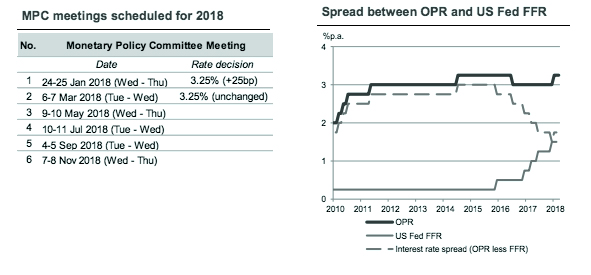
  • Malaysia’s Overnight Policy Rate (OPR) was left unchanged at 3.25% on 7 March 2018, following the 25bp hike in Jan.
  • BNM remained upbeat about Malaysia’s outlook in 2018 but flagged heightened global risks, citing the resurgence of market volatility and bubbling trade tensions.
  • We expect BNM to be nimble in reacting to signs of overheating, but a lack of inflation catalysts advocates staying neutral, amid greater external unpredictability.
  • We maintain our end-2018 OPR forecast of 3.25%, implying no further rate hikes this year.

img-my4-1

BNM keeps the OPR unchanged at 3.25%
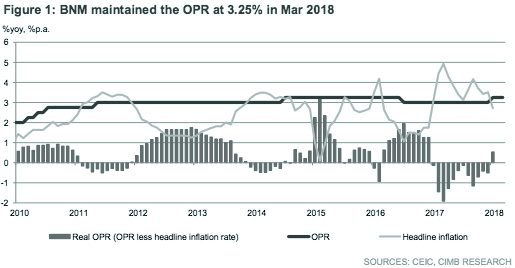
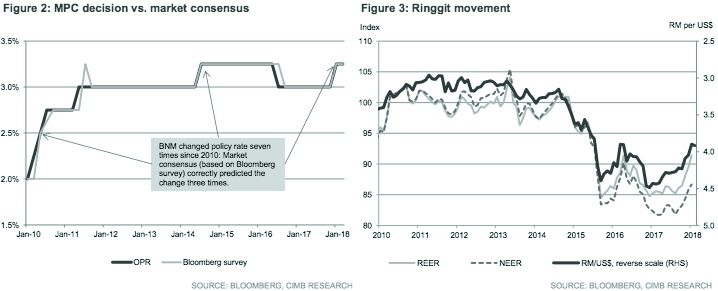
Bank Negara Malaysia’s (BNM) Monetary Policy Committee (MPC) maintained the Overnight Policy Rate (OPR) at 3.25%, following a 25bp hike at the previous meeting in Jan. The decision was in line with our forecast and widely expected by the markets.

Risks to the external outlook loom
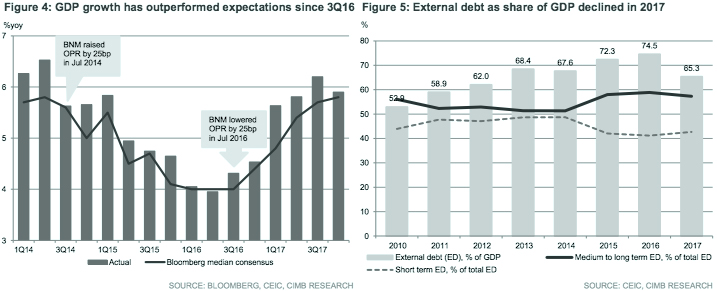
BNM maintained an upbeat assessment of Malaysia’s economic outlook in 2018, supported by firm domestic demand and a supportive external environment. While the central bank expects the global economy to strengthen, it removed a reference to the growth being “entrenched and synchronised”. Moreover, BNM flagged the recent financial market volatility and bubbling trade tensions as potential risks to the global outlook. We expect Malaysia’s economy to grow 5.2% in 2018, while BNM is set to release its forecasts alongside the BNM Annual Report 2017 at the end of Mar.

Core inflation kept in line by productivity and supply-side gains
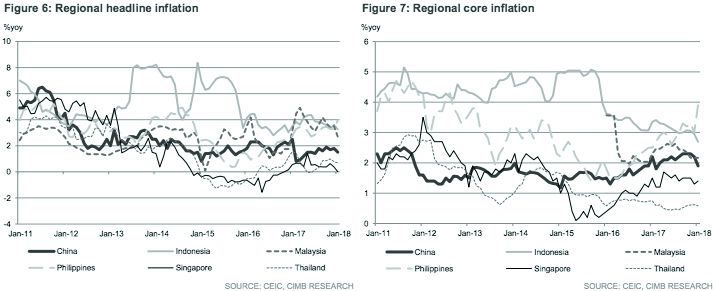
Headline inflation moderated to 2.7% yoy in Jan, while core inflation was steady at 2.2% yoy. The central bank expects external drivers of inflation to ease in 2018 (CIMB: +2.9%), helped by meeker commodity price gains and a stronger ringgit. It was of interest to us that BNM felt core inflation remained in check due to “improving labour productivity and ongoing investments for capacity expansion”, as slack in the economy keeps the risks of overheating under wraps.

US becoming a source of uncertainty rather than stability
A hawkish testimonial by new Federal Reserve chairman Jerome Powell hinting at upside risks to the US growth and inflation outlook, following the passage of tax reforms, led to speculation that Fed monetary policy normalisation may be more aggressive than the official guidance of three rate hikes this year, which triggered volatility in the financial markets. We expect the US Federal Reserve to deliver another 25bp hike in the Federal Funds Rate (FFR) to 1.75% when it meets on 20-21 Mar, which would narrow the interest rate differential with Malaysia’s OPR to 150bp

More dovish than the previous MPC statement
We think MPC statement on 7 March 2018 leans more dovish than the previous statement in Jan due to the emergence of adverse risks to the global economy, tighter monetary conditions from a stronger ringgit, muted core inflation readings and the removal of a reference to preventing the buildup of risks from low interest rates, which suggest to us that for now, BNM is willing to tolerate the costs of keeping monetary policy accommodative. We reiterate our end-2018 OPR forecast of 3.25%, implying no further hikes this year; however, a nimble BNM means a second rate hike in 2H18 still cannot be ruled out if justified by an overshoot in price pressures.

img-my4-2

img-my4-3

img-my4-4

img-my4-6


Originally published by CIMB Research and Economics on 28 February 2018.

Indonesia: February 2018 CPI inflation


HIGHLIGHTS

February 2018 CPI inflation

  • Headline inflation eased slightly in Feb (3.2% yoy vs. 3.3% yoy in Jan) as higher
    volatile food prices were mitigated by a moderation in administered price inflation.
  • Rice imports helped to contain the acceleration in food prices, and the price pass-through from raw food to prepared food inflation were relatively muted.
  • After three rounds of electricity tariff hikes in 1H17, the government plans to keep electricity tariffs unchanged until end-2019.
  • Our inflation and policy rate forecasts for 2018 remain unchanged at 3.7% yoy and 4.25% p.a. respectively.

img-ind7-1

Headline inflation eased slightly in Feb
Headline inflation decelerated marginally in Feb (3.2% yoy vs. 3.3% yoy in Jan; CIMB forecast: 3.2%; Bloomberg median consensus: 3.3%). Core inflation, which excludes volatile food and administered price components, also eased in tandem (2.6% yoy in Feb vs. 2.7% yoy in Jan). On a month-on-month basis, consumer price index (CPI) rose 0.2%, a significant slowdown compared to 0.6%/0.7% mom gains in Jan 2018/Dec 2017, thanks to easing food price pressures.

Higher volatile food inflation …
Volatile food inflation accelerated on an annual basis (3.1% yoy in Feb vs. 2.6% yoy in Jan), but mom gains eased to 0.1% (vs. 2.6% mom in Jan 2018) as rice imports in Feb alleviated the upside pressures. The annual price gains in other food components i.e. meat, fresh fish, bean and nuts, as well as eggs, have been on a rising trend since mid2017, and could accelerate further approaching the Lebaran celebration in Jun. Nonetheless, the pass-through of higher raw food prices to prepared food has been relatively muted so far, with prepared food inflation unchanged at 4.1% yoy.

… offset by lower administered price inflation
The administered price inflation in Feb halved from the peak of 10.6% yoy in Jun 2017 (5.3% yoy in Feb vs. 5.8% yoy in Jan) on the back of progressively higher base effects due to three rounds of electricity tariff hikes in 1H17. The government plans to keep electricity tariffs at current levels until end-2019, ensuring that inflation remains manageable to enhance household purchasing power. This would be supported by fixing purchase price of coal for PLN, which the government would unveil in a Presidential Regulation (Perpres) this month.

Higher non-subsidised fuel price amid stronger oil price
Meanwhile, subsidised fuel prices (i.e. Premium gasoline and Solar diesel) are still subject to quarterly review. State-owned oil giant Pertamina has raised prices for nonsubsidised fuel (i.e. Pertalite, Pertamax, and Pertamina Dex) by 1.3-13.6% between Dec 2017 and Feb 2018, amid higher oil prices and the weaker local currency

Stable inflation in other CPI components
Slower core inflation was contributed by a milder increase in clothing price (3.9% yoy in Feb vs. 4.1% yoy in Jan), while healthcare and education, recreation and sports inflation were unchanged at 2.8% and 3.4%, respectively.

Maintain inflation forecast of 3.7% yoy for 2018F
Our average inflation forecast for 2018 remains unchanged at 3.7% yoy (3.8% yoy in 2017), but we note the risks of imported inflation led by a depreciating rupiah. We expect Bank Indonesia (BI) to keep its policy rate unchanged at 4.25% in 2018. The next MPC meeting will be held on 21-22 Mar 2018.

img-ind7-2

img-ind7-3

img-ind7-4

img-ind7-5


Originally published by CIMB Research and Economics on 1 March 2018.

CARI Captures 350

c350_graphic


ASEAN

Singapore ranks first while Vietnam comes in last for the best countries in ASEAN for startups
(17 March 2018) Based on a survey conducted by Value Penguin, Singapore and Malaysia came in as the top two friendliest ASEAN countries for business startups. According to the survey, the low unemployment rate, good internet accessibility, availability of tax incentives for small businesses and high education rates are among the crucial traits that make Singapore a great place for startups to grow their businesses. On the other hand, Philippines and Vietnam came in as the bottom two ASEAN countries in the list due to the country’s unfavourable business climate issues, including the ease of starting a business and trust in public institutions as well as low labour force quality.

ASEAN

ASEAN market sentiment weighs down as US and China trade war heightens
(23 March 2018)The ASEAN market sentiment was weighed down by the heating tense of a trade war between the US and China following the US’ threats against China’s steel and aluminium exports in addition to its sanction on China for intellectual-property theft. Markets across Southeast Asia generally closed lower on 23 March 2018 following the escalating tensions between China and the US, as investors remain cautious and wary of the impact. Morgan Stanley analysts noted that the rising concerns over trade wars have become a more prominent risk to the global economic outlook. State Street’s Head of Policy and Research Elliot Hentov also pointed out that this round of trade tensions could have significant and lasting implications for companies in China, certain sectors in the US and global investor portfolios.

CAMBODIA

Cambodian economy projected to grow by 7 percent in 2018
(20 March 2018) According to the latest forecast by the International Monetary Fund (IMF), the Cambodian economy is projected to grow by 7 percent this year. The IMF’s forecast is slightly higher than the figure released by the Cambodian government, which set the growth rate at 6.9 percent.The higher growth rate projection came after the release of data which recorded higher public spending and robust economic activity in the construction and tourism sectors in the country. During a forum on the national budget for the year 2018 held in January, Vong Seyvisoth, Secretary of State at the Ministry of Economy and Finance said that with strong economic growth, the country’s dependency on foreign nations will be reduced, which will in turn, help the country to attain full control of its economy.

INDONESIA

Indonesia central bank keeps policy rate unchanged
(22 March 2018) During its monetary policy meeting held on 22 March 2018, Indonesia’s central bank voted to keep its policy rate unchanged at 4.25 percent. Spokesman Agustus from the Bank Indonesia(BI) said BI’s decision is consistent with its efforts to maintain stability and to push the country’s domestic economic recovery. Meanwhile, the bank remains aware of the increased risk from the uncertainty of the global financial market and will keep taking further actions to stabilize the exchange rate in accordance with its fundamental value while maintaining market mechanisms. BI also noted that the US$3.9 billion drop in Indonesia’s foreign exchange reserves in last February was mainly due to the intervention to prevent the rupiah from weakening too sharply.

MALAYSIA

Malaysian small businesses to create more jobs in 2018
(21 March 2018) According to CPA Australia’s Eight Annual Asia- Pacific Small Business Survey, small businesses in Malaysia are experiencing positive conditions with many of the businesses creating more jobs in 2018 and making more technological investments.The survey revealed that in 2017, 27.5 percent of Malaysia’s small businesses have contributed to the country’s job creation, which reflects the strong growth of many small businesses in Malaysia. Despite reporting a weaker business growth in 2017 compared to 2016, small enterprises in Malaysia are still experiencing positive growth and was a strong job creator in 2017.

VIETNAM

Vietnamese firms to expand business occupancy in foreign markets
(19 March 2018) Vietnamese firms have nearly 1,200 investment projects in over 70 countries with total pledges in foreign investment reaching an estimated value of US$22 billion. A survey by Vietnam Report found out that in 2016, almost 45 percent of the 500 largest Vietnamese companies have said that they will make an investment abroad over the next five years. The Vietnam Ministry of Planning and Investment said the Vietnam government resolution in August 2016 which details the regulations on Vietnamese investment in foreign countries has provided a boost in Vietnamese outbound investment.

BRUNEI

China and Brunei to boost economic ties
(20 March 2018) Brunei’s concerns about having to quickly diversify its sources of income within a short-term are seen as an opportunity by China to do investment in Brunei to expand its pool of Belt and Road partners. Furthermore, China also sees Brunei as the potential prospect to help the country pursue its interests in the South China Sea dispute. Generating total investments of US$4.1 billion to Brunei in 2017, China is currently Brunei’s largest foreign investor with the biggest investment project in Brunei comprising of a US$3.4 billion oil refinery and complex in Pulau Muara Besar Island. Aside from this, several Chinese firms have also invested in Brunei’s transport and telecommunications sectors.

CAMBODIA, THAILAND

Programs and initiatives by the Cambodian government to focus on its crop zoning and agriculture project
(22 March 2018) Cambodia Minister of Agriculture Veng Sakhon has requested Asian Development Bank to consider a new project to assist the country’s agriculture sector with crop zoning and climate change projects, as the two projects would be important in attracting investment and enhancing management and development of crops. Additionally, in effort to attract more attention to the country’s agriculture sector, Cambodia has also proposed the establishment of a government-private sector working group between its country and Thailand to tackle export issues surrounding the sector such as prices, market access, and infrastructure. With the establishment of the government-private sector working group, the Cambodia Agriculture ministry hopes that the suggested solution will be able to solve the outstanding issues and drive the agriculture export with Thailand forward.

SINGAPORE

Strong global trade outlook reignite Singapore firms’ interest to ASEAN
(21 March 2018) The stronger global trade outlook is reigniting Singapore companies’ interest in doing business with their overseas counterparts, especially in the ASEAN region. According to the Singapore Commercial Credit Bureau (SCCB), in 2017, overseas credit searches by local businesses rose by 3.04 percent, with ASEAN accounting for the highest proportion of overseas credit searches by Singapore firms for the fifth consecutive year, followed by East Asia and Europe. The proportion of credit searches made on ASEAN companies rose slightly from 27.17 percent in 2016 to 27.74 percent in 2017 with Malaysia, Indonesia, and Thailand topping the list.

INDONESIA

Indonesia welcomes Australia into ASEAN
(18 March 2018) Indonesian President Joko Widodo has expressed that he is keen to have Australia as a full ASEAN member, as the country plays a crucial regional role in defence, trade and security matters with the other ASEAN countries. Joko Widodo said the economic and political stability of ASEAN region will be better off by the joining of Australia in the bloc. Since 1974, Australia has been a great dialogue partner of ASEAN, including the recent ASEAN-Australia Special Summit that was held in mid-March 2018 where issues related to regional security, economic relations to enhance trade liberalisation, as well as counter-terrorism measures were discussed.

Thailand: January macro snapshot


HIGHLIGHTS

January macro snapshot

  • Manufacturing activity took a breather in Jan (+3.4% yoy) after strong gains in Dec, but the opposite was true for export growth, which romped to a five-year high.
  • A strong external sector casts the more subdued gains in domestic demand in starker light, prompting government action to boost consumption and investment.
  • With the domestic recovery far from assured and inflation well below the policy target of 1-4%, BOT will be in no hurry this year to raise the policy rate, currently at 1.50%.

img-thai1-1

Manufacturing activity drifts lower
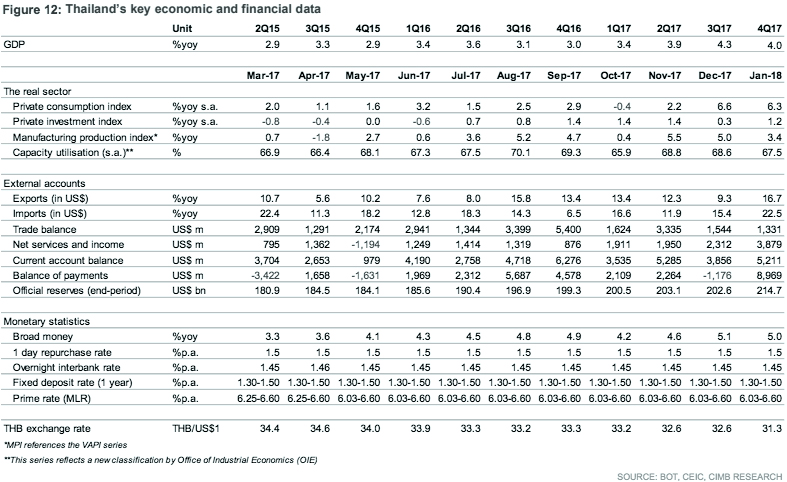
The expansion in the manufacturing production index (MPI) moderated to 3.4% yoy in Jan (+5.0% in Dec), with a broad swath of industries, including autos, rubber & plastics and hard disk drives, hitting a bumpy patch. The seasonally-adjusted capacity utilisation in the manufacturing sector moved down a rung to 67.5% in Jan, from 68.6% in Dec.

Goods and services buoy external sector
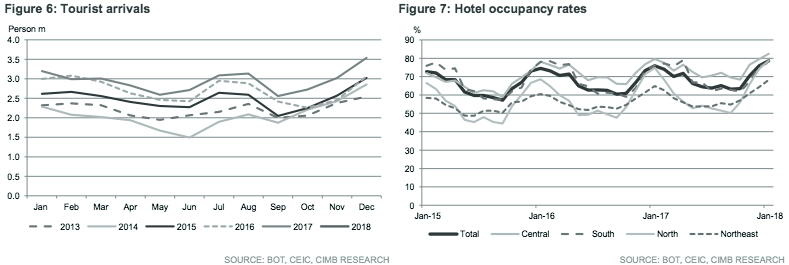
Exports, on the other hand, enjoyed a rebound to 16.7% yoy in US$ terms (+9.3% yoy in Dec), spurred by increased pre-Lunar New Year shipments, higher commodity prices and FX translation gains as the THB strengthened 2.3% mom against US$ in Jan. We remain optimistic Thailand will achieve an export growth of 9.4% in 2018 (9.7% in 2017). The growth in tourist arrivals moderated to 10.9% yoy in Jan to 3.5m (vs. +15.5% yoy in Dec), but we expect Feb numbers to improve as Lunar New Year beckons more inbound travel.

External financing conditions improve
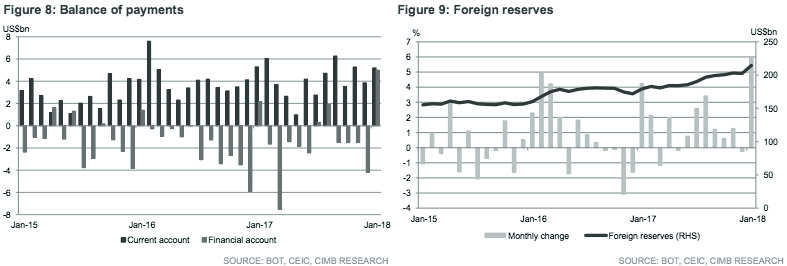
Thailand’s current account recorded a larger surplus of US$5.2bn in Jan (+US$3.9bn in Dec) on the back of higher net inflows from the services and income accounts (+US$3.9bn vs. +US$2.3bn in Dec). The trade surplus was flat at US$1.3bn in Jan (+US$1.5bn in Dec). Deficits gave way to a surplus in the financial account, (+US$5.0bn in Jan vs -US$4.2bn in Dec), thanks to positive net inflows of direct and portfolio investments.

Diffusing gains to broader economy is still a work in progress
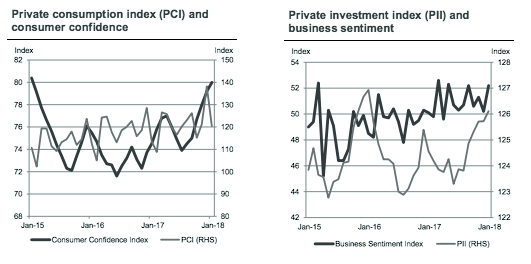
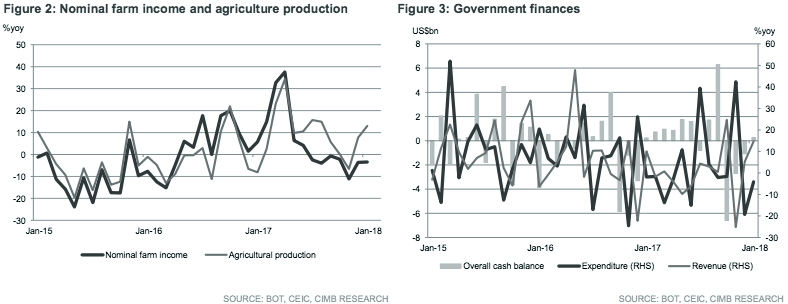
Consumer confidence improved in Jan (80.0 vs. 79.2 in Dec), but hard indicators were less upbeat. The private consumption index weakened in Jan, while farm incomes (-3.4% yoy in Jan) were set back by a decline in agriculture prices. The government has stepped up efforts at lifting household purchasing power, particularly among the low-income, with recent announcements to 1) regulate non-bank finance and reduce punitive interest rates to indebted households, 2) amend banking agent regulations to improve banking access in remote areas, and 3) speed up farm sector reforms, particularly in rice and rubber.

Approval of Eastern Economic Corridor bill
In Feb, the Eastern Economic Corridor (EEC) Act received legislative approval, which is expected to eventually attract a new wave of foreign investments via perks such as: 1) personal income tax reductions of up to 15% for local and foreign investors, 2) 0% corporate tax for up to 15 years, 3) 99-year land leases, and 4) 5-year work permit visas for foreign workers. The EEC Committee has also greenlighted a THB200bn high-speed rail project connecting key airports, which is expected to begin the tender process in Apr, with contract signings targeted for Dec.

Too early to stop the monetary medicine
Headline inflation drifted lower to 0.7% yoy in Jan (+0.8% yoy in Dec) owing to muted gasoline inflation and depressed meat and egg prices. Inflation is expected to reach an inflection point in 2Q18, accelerating to 1.5% in 2018 (+0.7% in 2017), but not enough to warrant a tighter monetary policy stance by the Bank of Thailand (BOT), even as the government steps up fiscal support. As such, we expect BOT to maintain the one-day repurchase rate at the current level of 1.50% throughout 2018 to facilitate the recovery in domestic demand.

img-thai1-2

img-thai1-3

img-thai1-4

img-thai1-5

img-thai1-6

img-thai1-7

img-thai1-8


Originally published by CIMB Research and Economics on 28 February 2018.
Malaysia: January 2018 consumer price inflation


Originally published by CIMB Research and Economics on 28 February 2018.


HIGHLIGHTS

January 2018 consumer price inflation

  • Headline inflation eased sharply to 2.7% yoy in Jan (+3.5% yoy in Dec) largely due to lower fuel and food inflation.
  • Our inflation outlook remains unchanged (+2.9% in 2018 vs. +3.7% in 2017), though risks are skewed to the upside.
  • We expect no further OPR hikes this year if core inflation remains subdued, though a second hike in 2H18 cannot be ruled out if demand-pull price pressures surface.

img-my3-1

Headline inflation moderated to 13-month low in Jan
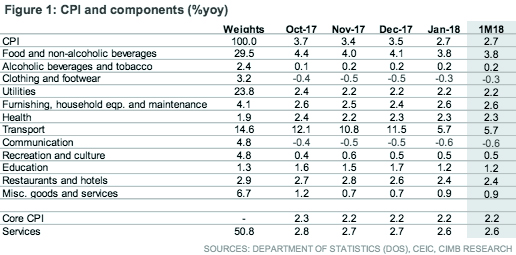
Malaysia’s consumer price inflation eased sharply in Jan to 2.7% yoy (CIMB: +2.9% yoy, Bloomberg consensus: +2.8% yoy, +3.5% yoy in Dec). The moderation stemmed from currency gains and a higher base, as fuel prices and electricity tariffs were raised a year ago. Sequentially, headline inflation gained 0.3% in Jan (+0.1% mom in Dec). Underlying price pressures remained well contained, as core inflation plateaued at 2.2% yoy in Jan. CPI weights were tweaked slightly, with spending on transport, furnishing & household, health, recreation and education gaining a larger share of the consumption basket.

Uptick in global oil prices masked by ringgit strength
Transport inflation tumbled to 5.7% yoy in Jan (+11.5% yoy in Dec) despite a monthly rise in the fuel index (+0.5% mom), as this paled against a 10.2% mom fuel price hike in Jan 2017. We expect fuel inflation to subside further in Feb (-1.1% mom) as Brent oil prices fell by 4.8% mom in Feb after seven straight months of gains totaling 45.3% in Jul 2017- Jan 2018. Fluctuations in retail fuel prices have been less volatile amounting to just 12.9% over that period, partly cushioned by the appreciation in the ringgit against US$.

More modest food inflation ahead of CNY
Food inflation drifted lower despite the proximity to the festive season (+3.8% yoy in Jan vs. +4.1% in Dec), reflecting weaker price gains in meat, fish & seafood and fruit categories. Vegetable prices spiked (+7.6% yoy vs. +2.5% yoy in Dec) due to high demand, and a drop in supply arising from labour shortages and inclement weather. The cost of food imports was buffered by a strong currency, a reversal of the situation in early 2017 when the ringgit weakened precipitously.

Stretching the buck on education, communications and hotels
Households got a reprieve from rising costs as Jan saw milder school fee increases, discounts for smartphones & communication equipment and cheaper hotel rates. Lower home maintenance costs offset an upward revision in natural gas tariffs for the non-power sector, which kept housing & utilities inflation unchanged at 2.2% yoy.

Inflation poised to moderate in 2018, but risks skewed to the upside
Our inflation outlook remains unchanged (+2.9% in 2018 vs. +3.7% in 2017). Risks to the price outlook include:

  1. higher retail fuel prices due to an increase in global oil prices,
  2. higher electricity tariffs in 2H18 via the imbalance cost pass through (ICPT) mechanism,
  3. tightening labour market conditions and strong demand growth stimulating core inflation, and
  4. employers passing on higher costs from foreign worker levies and the implementation of the Employee Insurance Scheme (EIS).

Monetary policy on hold for now
The next Monetary Policy Committee (MPC) convenes on 6-7 Mar, where we expect BNM to maintain the Overnight Policy Rate (OPR) at 3.25%, following the 25bp hike in Jan. We reiterate our end-2018 OPR forecast of 3.25%, implying no further interest rate increases this year, on the condition that the core inflation outlook remains benign.

img-my3-2

img-my3-3

img-my3-4

img-my3-5


Singapore: Budget FY2018 – Playing the long game


Originally published by CIMB Research and Economics on 20 February 2018.


HIGHLIGHTS

Budget FY2018: Playing the long game

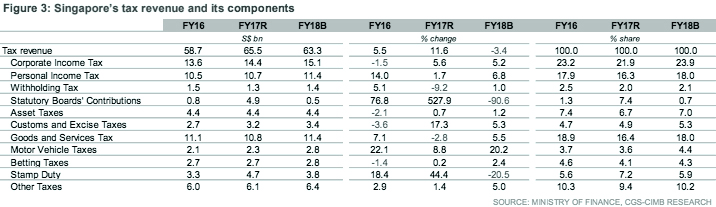
  • A widely anticipated GST hike is likely to occur sometime in 2021-25, which would lift the rate by 2% pt, from 7% currently to 9%, yielding revenue of 0.7% of GDP.
  • Other tax changes include GST on imported services, carbon taxes of S$5/tonne, 1% hike in the top rate for homebuyer stamp duty and a 10% rise in tobacco excise duty.
  • Additional social safety net enhancements offered to households to cope with higher living costs, elderly, healthcare, education, as well as a one-off S$100-300 ‘hongbao’.
  • The juggling act between phased-in tax hikes and rising government spending keeps fiscal sustainability intact with an overall deficit target of 0.1% of GDP.

img-sg1-1

Creating bandwidth to tackle long-term structural challenges
Singapore’s Budget FY2018 has sought to expand measures to address longstanding challenges that include “future-proofing” the economy, a rapidly-ageing population and ensuring fiscal sustainability. The government said it has sufficient resources to meet planned spending until 2020, and hence, the announcement of pre-emptive steps to bridge the growing gap in spending needs was made with the next decade in mind.

2% hike in GST proposed for ‘sometime’ in 2021-2025
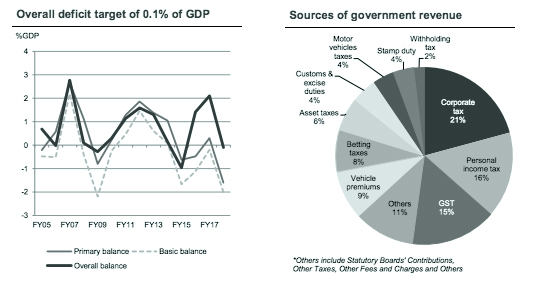
Subject to prevailing economic conditions, the government has proposed to raise the goods and services tax (GST) progressively by 2% sometime in the earlier part of 2021 to 2025, which skirts around the next election due in Jan 2021. This would be the first GST hike since 2007, when the rate was increased from 5% to 7%, and adds 0.7% of GDP annually to the fiscal coffers. Mitigating measures include: 1) absorption of GST on public healthcare and education, 2) top up of GST voucher fund, and 3) a GST offset package.

Taxes shape incentives on the environment, equitability and health
The Budget Speech revealed details of a S$5/tonne carbon tax on facilities with emissions exceeding 25,000 tonnes in 2019 to 2023, after which the rate is up for review, with an end target of S$10-15/tonne by 2030. To expand the tax base and level the playing field, the government imposed GST on imported services effective 1 Jan 2020, though these exclude e-commerce. In a nod to progressive taxation, the government will raise the top marginal Buyers Stamp Duty, which applies to residential properties above S$1m, from 3% to 4%. Lastly, the government raised the tobacco excise duty by 10%.

Financing an ageing population and infrastructure upgrades
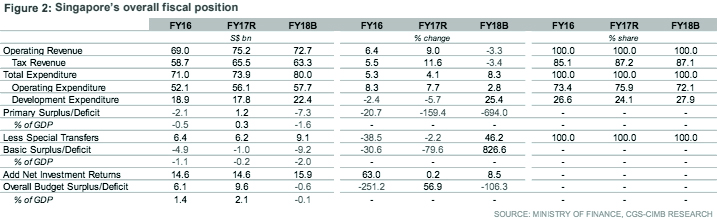
The demographic shift to an ageing population is increasing the strains on public spending, the government said. Predictably, Budget FY2018 devoted ample resources to helping households cope with the costs associated with elderly care, healthcare and education. A higher-than-estimated budget surplus of S$9.6bn in FY2017 (vs. forecast of S$1.91bn) also allowed the government to set aside funds for rail infrastructure (S$5bn), health subsidies (S$2bn) and dole out a one-off SG Bonus of S$100 to S$300 to Singaporeans aged above 21 tiered by accessible income in YA2017 totaling S$700m.

Future-proofing Singapore…
Talk of the future was not limited to life, death and taxes, as Budget FY2018 also ruminated on themes from recent Budgets centered on establishing a vibrant and innovative economy. Policies included extensions of the Wage Credit Scheme, the corporate income tax rebate, the Career Trial Scheme, Productivity Solutions Grant, tax deductions on licensing payments and R&D, and were particularly targeted at SMEs.

… without breaking the bank
Officials expect the economy to grow 1.5-3.5% in 2018 (+3.6% in 2017), with operating revenue projected to fall 3.3% to S$72.7bn against total spending of S$80.0bn (+8.3%), yielding a primary deficit of S$7.3bn or 1.6% of GDP. After factoring in NIR and Special Transfers, Singapore’s budget deficit is estimated at S$0.6bn or 0.1% of GDP in 2018. To maintain prudence, the government will also cap the growth in ministries’ block budgets to 0.3x of GDP growth in FY2019 from 0.4x in FY2018.

img-sg1-2

img-sg1-3

img-sg1-4

img-sg1-5


Indonesia: February 2018 Bank Indonesia meeting


Originally published by CIMB Research and Economics on 19 February 2018.


HIGHLIGHTS

February 2018 Bank Indonesia meeting

  • Bank Indonesia left the 7-day Reverse Repo Rate unchanged at 4.25% and reiterated that the previous rate cuts were adequate to keep the growth recovery going.
  • Recent volatility in the currency and financial markets has had the central bank shifting the policy focus towards ensuring macroeconomic stability.
  • Citing volatile food prices as the key inflation risk, BI continues to foster closer policy coordination with the government to address supply-driven inflationary pressure.
  • We maintain our year-end policy rate forecast of 4.25%.

img-ind6-1

Policy rate at status quo
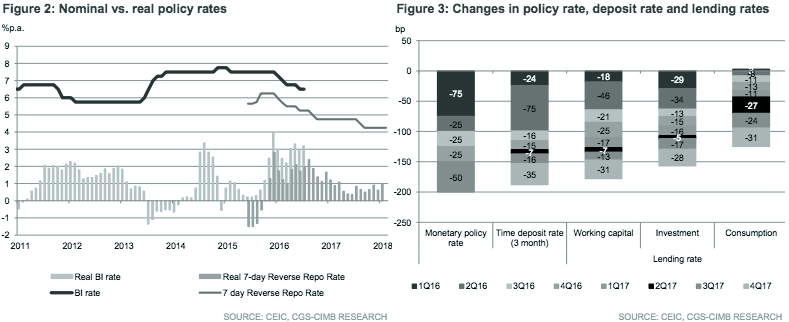
As widely expected, Bank Indonesia (BI) maintained the 7-day Reverse Repo Rate (7DRRR) at 4.25%. The Deposit Facility Rate and Lending Facility Rate were also left unchanged at 3.50% and 5.00%, respectively. Reiterating that previous rate reductions were adequate to support the ongoing recovery in domestic economic growth, BI added that “maintained economic stability will be the backbone of stronger and more sustainable economic growth.”

Recovery momentum reflected in better 4Q17 GDP growth
The improvement in GDP growth for the past two quarters (5.2% yoy in 4Q17 vs. 5.1% yoy in 3Q17) lifted full-year growth to a four-year high of 5.1% yoy in 2017 and removed the need for further easing after an aggressive 200bp reduction in the past two years. Growth in the past year has been supported by rising investment activity, in tandem with continuous infrastructure development and FDI inflows, whereas exports were boosted by rising commodity prices and stronger global growth. BI envisages the aforementioned factors will continue to spur economic expansion at a rate of 5.1-5.5% in 2018 (vs. CIMB forecast of 5.3% yoy).

Cautious on rising external uncertainty
Against the backdrop of improving GDP growth, ensuring currency stability will be BI’s main focus. Recently, anticipation of more interest rate increases by the Fed (vs. official projection of three hikes) amid the faster-than-expected wage growth and inflation triggered volatility in global financial and currency markets. Portfolio outflows in the bond and equity markets led to a depreciation in the rupiah by 1.3% between 1 and 15 Feb, reversing all the gains in Jan and prompting the central bank to intervene by using foreign exchange reserves to stabilise the currency movement. As foreign holdings of government bonds (41.3% as of Jan 2018) remains high compared to its regional peers (29.3% for Malaysia and 15.7% for Thailand), currency volatility remains sensitive to reversals in portfolio flows.

Inflation risks stem from volatile food components
Inflation risks have arisen from volatile food components (CPI weight of 17.5%) given soaring rice prices in recent months on the back of supply shortages. Nonetheless, the inflation rate should remain manageable, in our view, cushioned partly by the base effect from the step-up in administered price inflation in 1H17. The base effect has kept headline inflation at the start of the year (3.3% yoy in Jan) under control and within the BI’s target range of 2.5-4.5%.

Reiterate our year-end policy rate forecast of 4.25%
With rising uncertainty in the global financial markets and BI’s outright statement indicating that the rate cut cycle is over, we reiterate our year-end policy rate forecast of 4.25%.

img-ind6-2

img-ind6-3

img-ind6-4

img-ind6-5


Indonesia: 4Q17 balance of payments


Originally published by CIMB Research and Economics on 19 February 2018.


HIGHLIGHTS

4Q17 balance of payments

  • The current account deficit (CAD) widened to US$5.8bn or -2.2% of GDP in 4Q17 as lower primary income deficits were not sufficient to offset a smaller trade surplus.
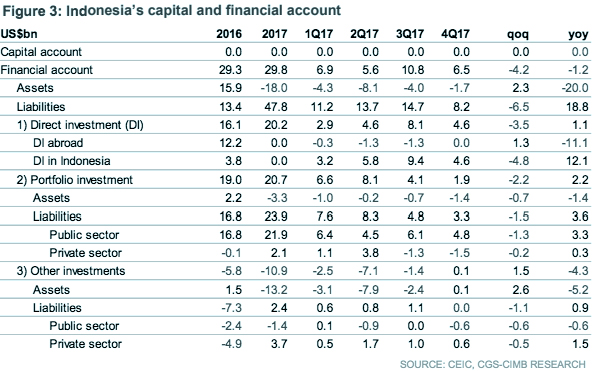
  • The surplus in the financial account narrowed amid FDI outflows in the O&G sector and smaller portfolio inflows in government bonds.
  • High foreign holding of government bonds (41.3% as of Jan 2018) may present a risk to BOP and currency when capital flows reverse.
  • We maintain our CAD forecast at -1.8% of GDP for 2018. We expect higher inbound tourist receipts to mitigate the narrower trade surplus and rising interest payment.

img-ind5-1

CAD in 4Q17 at 3-year high…
The current account deficit (CAD) widened to US$5.8bn or -2.2% of GDP in 4Q17 (US$4.6bn or -1.7% of GDP in 3Q17), matching our forecast. The financial account (FA) surplus narrowed to US$6.5bn or 2.5% of GDP (US$10.8bn or 4.1% of GDP in 3Q17) but was more than enough to offset the CAD. As a result, the balance of payment (BOP) remained in surplus (US$1bn or 0.4% of GDP vs. US$5.4bn or 2.0% of GDP in 3Q17) and the international reserves rose US$0.8bn qoq to US$130.2bn at end-2017.

… primarily led by lower trade surplus
The higher CAD was mostly driven by a lower surplus on the goods account (US$3.2bn in 4Q17 vs. US$5.3bn in 3Q17). Weaker expansion of manufactured exports contributed to a lower non-O&G surplus whereas rising oil prices drove O&G deficits to a 3-year high. The deficit in the services account rose slightly (US$2.3bn in 4Q17 vs. US$2.1bn in 3Q17) amid underperformance of travel receipts as tourism activities were disrupted by Mt. Agung’s eruption. Travel service exports accounted for 25% of the annual total in 4Q17 vs. 27-28% in 4Q of 2010-2016.

Deficit in primary income were lower but…
The deficit in the primary income improved US$1.1bn qoq to US$7.8bn or 3% of GDP amid a lower interest payment on debt (typically higher in 1Q and 3Q). Nonetheless, interest payment will rise further on the back of continued government bond issuance to finance fiscal deficits as well as high foreign shareholding in government debt. As the government welcomes more foreign direct investments (FDIs), net income payment on direct investment (which exceeded US$5bn in the 3Q17 and 4Q17) may also increase.

FA surplus narrowed on lower DI and portfolio inflows
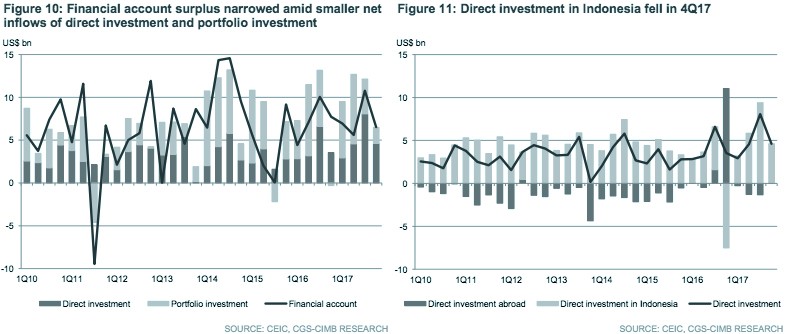
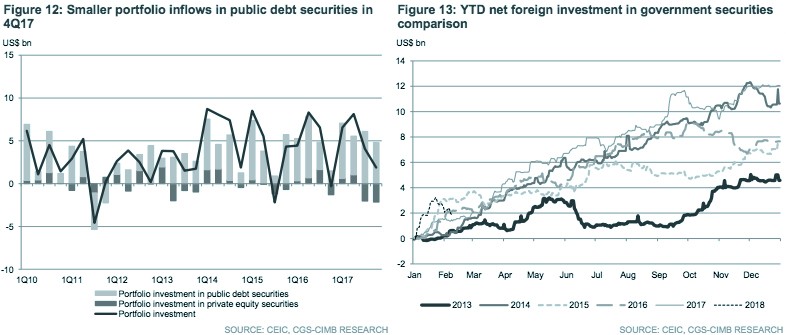
Net direct investment inflows were lower (US$4.6bn or 1.8% of GDP in 4Q17 vs. US$8.1bn or 3.1% of GDP in 3Q17) amid FDI outflows in the O&G sector. Lower foreign inflows into government bonds and continued outflows in the equity market led to smaller net inflows in portfolio investment (US$1.9bn or 0.7% of GDP in 4Q17 vs. US$4.1bn or 1.5% of GDP in 3Q17). High foreign shareholding of government bonds (41.3% as of Jan 2018) could be a risk to BOP and the rupiah exchange rate as it is sensitive to the direction of global monetary policy and market sentiment.

Maintain 2018 CA deficit forecast at -1.8% of GDP
We maintain our CAD forecast at US$19.7bn or -1.8% of GDP for 2018 (vs. deficit of US$17.3bn or -1.7% of GDP in 2017). We expect higher travel surpluses, led by higher tourist arrivals and travel spending during the Asian Games, to mitigate the impact of primary account deficits amid rising interest payment as well as a lower trade surplus, driven by stronger import expansion relative to exports.

img-ind5-2

img-ind5-3

The current account deficit rose to a 3-year high of US$5.8bn in 4Q17 as a lower deficit in the primary income was not sufficient to offset the smaller trade surplus.

The goods account recorded a lower surplus on the back of slower manufactured exports whereas rising oil prices led to higher O&G trade deficits (Indonesia is a net O&G importer).

The deficit in the services account rose US$0.2bn in 4Q17. Travel service exports, typically the highest in 4Q (about 27-28% oftotal in 2010-2016), were disrupted by Mt. Agung’s eruption.

The lower deficit in the primary income account (US$7.8bn in 4Q17 vs. US$8.9bn in 3Q17) coincided with lower debt interest payments (typically higher in 1Q and 3Q).


img-ind5-4

The financial account recorded a lower surplus in 4Q17 (US$6.5bn vs. US$10.8bn in 3Q17) due to lower net inflows in direct investment and portfolio investment.

Net direct investment inflows declined on the back of lower FDI inflows in the manufactured sector and FDI outflows in the O&G sector.

Net inflows in portfolio investment more than halved to US$1.9bn (vs. US$4.1bn in 3Q17) amid lower foreign investment inflows to government bonds during the quarter.


img-ind5-5

img-ind5-6

img-ind5-7

img-ind5-8

img-ind5-9

img-ind5-10