Indonesia: March 2018 trade


HIGHLIGHTS

March 2018 trade

  • Trade balance surprised on the upside in March, as import growth moderated at a faster pace compared to export expansion.
  • O&G was a drag on exports, whereas slowdown in import growth was across the board after strong gains in January-February.
  • A lower quarterly trade surplus suggests that the current account deficit may widen further to 2.5% of GDP in 1Q18F, in our view.
  • We keep our 2018 trade forecasts unchanged (exports: +5.2% yoy; imports: +6.9% yoy; trade balance: +US$11.3bn).

img-ind11-1

Trade balance swings back into surplus in March
Indonesia’s trade balance unexpectedly swung back into surplus in March after three consecutive months of deficits (+US$1,092m in March vs. -US$53m in February; CIMB forecast: -US$351m; Bloomberg median consensus: -US$89m). The positive surprise was due to moderation in imports expansion (+9.1% yoy in March vs. +24.9% yoy in February; CIMB forecast: +16.7% yoy; Bloomberg median consensus: +13.5% yoy) that was steeper than that of export growth (+6.1% yoy in March vs. +12.0% yoy in February; CIMB forecast: +3.2% yoy; Bloomberg median consensus: +3.0% yoy). The pullback in non-O&G imports lifted non-O&G trade surplus to US$2,016m (+US$791m in February), while O&G deficit was marginally higher at US$925m (US$844m deficits in February).

Contraction in O&G shipments the key driver of slower exports
The contractions in O&G exports (-11.5% yoy in March vs. +16.1% yoy in February) was the key contributor to a slower export expansion, weighed down by base effects due to a brief surge in crude oil shipments in February 2017. Non-O&G commodity exports delivered mixed performances — palm oil and tin exports contracted, whereas exports of iron and steel, nickel, ores, slag and ash continued to expand. Ongoing expansion in global economic activity underpinned the 8.1% yoy gain in export volume in March, in line with the average growth in the past 1.5 years.

Broad-based slowdown across main import categories
The slowdown in imports was broad-based, with imports of consumer goods contracting in March after two months of exceptionally strong gains (-9.5% yoy in March vs. +55.0% yoy in February), whereas imports of raw materials recorded a milder gain of 9.0% yoy in March (+20.5% yoy in February). Imports of capital goods remained strong at 21.6% yoy (32.2% yoy in February), indicating that investment activity remained supportive of GDP growth.

Higher current account deficit projected for 1Q18F, at 2.5% of GDP
The surprise turnaround in March kept Indonesia’s 1Q18 trade balance in a surplus position (+US$283m vs. +US$997m in 4Q17). Nonetheless, as the quarterly trade surplus was at its smallest level since 4Q14, we expect the current account deficit (CAD) to widen to US$6.3bn, or 2.5% of GDP in 1Q18F (US$5.8bn, or -2.2% of GDP in 4Q17). Meanwhile, the trade surplus in volume terms grew 14.2% yoy in 1Q18 (+2.8% yoy in 4Q17), suggesting a potentially positive net trade contribution to GDP growth.

No change in our 2018 gross export forecast of 5.2% yoy
Given the relatively small trade exposure (42% of GDP in 2017) and low exposure to electrical and electronics (E&E)/machinery exports, Indonesia is relatively insulated from US-China trade tensions compared to other key ASEAN countries, we think. Hence, we maintain our gross export forecast of 5.2% yoy for 2018F.

img-ind11-2

img-ind11-3

img-ind11-4

img-ind11-6

 
Originally published by CIMB Research and Economics on 16 April 2018.

Singapore: MAS monetary policy review


HIGHLIGHTS

MAS monetary policy review

  • MAS has shifted to an appreciation bias for the S$NEER by increasing the slope of the policy band slightly but retaining its width and mid-point.
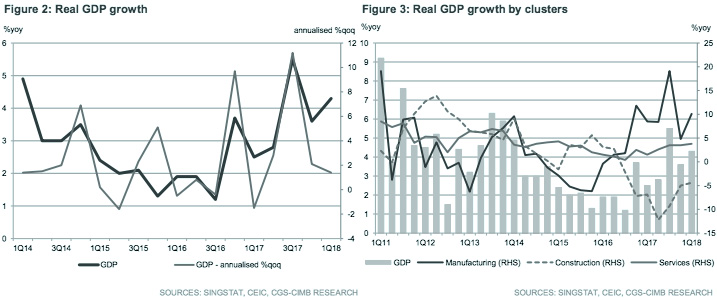
  • Flash GDP estimates showed Singapore’s economy registering an expansion of 4.3% yoy in 1Q18, led by the manufacturing and services clusters.
  • Following the adjustments made on 13 April 2018, MAS is likely to adopt a prudent stance in view of heightened uncertainties surrounding the global trade environment.
  • We expect monetary settings to remain on hold at the next scheduled policy review in October.

img-sg3-1

MAS adopts tighter stance by raising slope of S$NEER policy band
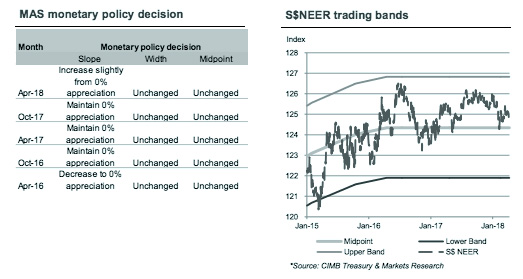
At its bi-annual monetary policy review, the Monetary Authority of Singapore (MAS) increased the slope of its policy band, advocating a “modest and gradual appreciation” of the S$ nominal effective exchange rate (NEER) but left the other two parameters – the width and the mid-point of the policy band – unchanged. 16 of 24 forecasters surveyed by Bloomberg had forecast the decision, including us. The decision marks the first shift in its exchange rate policy stance since Apr 2016 and the first tightening since Apr 2012. Policymakers cited improving economic and labour market conditions as well as budding inflation as factors in favour of the decision.

Modest and gradual appreciation
CIMB Treasury & Market Research’s proprietary S$NEER has generally trended 0-1% above the mid-point in the past three months, reflecting optimism of a turnaround in Singapore’s growth prospects and broad US$ weakness. Going forward, we expect the pace of appreciation to remain gradual. Our base case expects the S$NEER to continue trading 0-1% above the mid-point in the next six months.

GDP growth accelerates to 4.3% yoy…
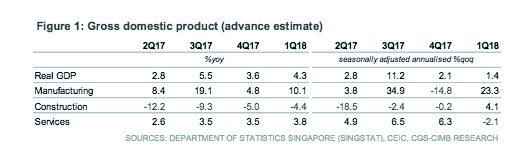
The policy decision came alongside the release of advanced estimates of Singapore’s real GDP growth by the Ministry of Trade and Industry (MTI), which showed the economy expanding by a healthy 4.3% yoy in 1Q18 (CIMB: +4.5% yoy, Bloomberg consensus: +4.3% yoy, 4Q17: +3.6% yoy). On a qoq seasonally adjusted annual rate (SAAR) basis, real GDP growth advanced 1.4% qoq SAAR (CIMB: +1.8% qoq, Bloomberg consensus: +1.2% qoq, +2.1% qoq in 4Q17). We have tweaked our full-year GDP growth forecast to 3.2% for 2018F (from 3.6% earlier), in line with MAS’ expectations that growth will land towards the top half of its forecast range of 1.5% to 3.5%.

… on the back of gains in manufacturing and services
The manufacturing sector expanded 10.1% yoy in 1Q18 (+4.8% yoy in 4Q17), driven by the electronics and precision engineering segments. The services sector expanded 3.8% yoy in 1Q18 (+3.5% in 4Q17), primarily led by the finance & insurance and wholesale & retail trade segments. The construction sector remained a drag on headline growth, contracting 4.4% yoy in 1Q18 (-5.0% yoy in 4Q17), pulled down by a decline in both private sector and public sector construction.

Inflation has bottomed out
Headline (+0.5% yoy in Feb) and core inflation (+1.7% yoy in Feb) have gradually strengthened on the back of higher imported cost pressures, a recovery in domestic demand and a tightening labour market. We forecast headline inflation to trend higher to 1.4% in 2018F (+0.6% in 2017), ahead of MAS’ expected range of 0% to 1%.

External uncertainties gives MAS pause for thought
Following the adjustments made on 13 April 2018, MAS is likely to adopt a prudent stance in view of heightened uncertainties surrounding the global trade environment amid US-China tariff skirmishes and tightening financial conditions brought on by a further three interest rate hikes by the US Federal Reserve in 2018, while awaiting for more evident signs of accelerating wage and core inflation. Therefore, we expect monetary settings to remain on hold at the next scheduled policy review in October.

img-sg3-2

img-sg3-3

img-sg3-4

img-sg3-5


Originally published by CIMB Research and Economics on 13 April 2018.

Malaysia: February 2018 industrial production


HIGHLIGHTS

February 2018 industrial production

  • Malaysia’s Feb IPI expansion of 3.0% yoy missed forecasts, but Jan’s manufacturing output numbers were revised sharply higher due to the rebasing of the index.
  • Output growth moderated broadly across the domestic and export-oriented sectors.
  • Upward revisions in Jan and a modest slowdown in Feb suggest that industrial activity remains supportive of our GDP growth forecast of 5.2% in 2018.

img-my8-1

Feb IPI growth lags forecasts but Jan’s data revised sharply higher
Industrial production index (IPI) growth slipped to 3.0% yoy in Feb, below our and market forecasts of stronger growth (CIMB: +3.5% yoy, Bloomberg consensus: +3.3% yoy). Strikingly, Jan’s expansion was revised higher to 5.4% yoy from 3.0% yoy, due to sharp upward alterations to the manufacturing sector, bringing industrial activity closer in line with the strong export figures in Jan. The seasonally-adjusted IPI contracted sharply by 4.4% mom in Feb, but Jan’s initially reported decline of -1.0% mom was revised to an increase of +5.2% mom.

Business activity winds down over CNY break…
Manufacturing activity took a breather (+4.7% yoy in Feb vs. +6.9% yoy in Jan) as businesses wound down during the Chinese New Year celebrations. The mining production index fell 1.6% yoy in Feb (+1.5% yoy in Jan), while the electricity index rose 2.8% yoy in Feb (+4.3% yoy in Jan).

…in export- and domestic-oriented industries
Broad-based moderation in output gains were recorded across the export- and domestic-oriented sectors in Feb, such as electric & electronic products, wood & paper, rubber & plastics, and textiles. Growth in the food, beverages and tobacco segment slipped sharply (+2.1% yoy in Feb vs. +16.1% yoy in Jan) as the vegetable and animal oils & fats eased (+1% yoy vs. +33.8% yoy in Jan) on high base effect, while production of transport equipment sank 2.0% yoy (+3.5% yoy in Jan) on the back of lower production of passenger cars, ships and floating structures.

Malaysia manufacturing PMI slips to 5-month low
Malaysia’s manufacturing PMI declined to 49.5 pts in Mar from 49.9 pts in Feb. Weaker output and order book visibility resulted in lower backlog, greater destocking and slower purchasing activity among firms surveyed. Some respondents reported higher cost pressures from rising raw material costs, which was partly defrayed by moderately rising average selling prices.

Falling natural gas output weighs on mining production
Upstream O&G production declined in Feb largely due to the natural gas segment (-3.5% yoy vs. +1.5 yoy in Jan). Output of petroleum was also subdued, rising 0.5% yoy in Feb (+1.6% yoy in Jan). However, we expect gains in the downstream O&G sector (+7.7% yoy in Feb vs. +6.7% yoy in Jan) to be sustained as capacity gradually comes onstream in projects like Pengerang.

Industrial sector faring better than expected after data revisions
The upward revisions to the IPI data in Jan and moderate slowdown in Feb indicate that economic momentum in the industrial sector is keeping pace (+4.3% yoy in 2M18 vs. +3.5% in 4Q17), rather than decelerating. We reiterate our real GDP growth forecast of 5.2% in 2018 (BNM: 5.5% to 6.0%). Key risks to the outlook include: 1) escalating global trade tensions, 2) slower-than-expected growth in G3 and China, 3) tightening global financial conditions, and 4) spillovers from increased volatility in the financial markets.

img-my8-2

img-my8-3

img-my8-4

img-my8-5


Originally published by CIMB Research and Economics on 11 April 2018.

Myanmar Monitor


Photo

Photo credit: Myanmar Business Today

Economy, Investment and Trade

New Yangon City to create economic growth, homes, and jobs
(9 April 2018) On March 31st, Myanmar Chief Minister of Yangon Regional Government, H.E. U Phyo Min Thein announced the launch of New Yangon Development Company Ltd. (NYDC), which aims to create economic growth, homes, and jobs through the development of land to the west of Yangon River. The New Yangon City is expected to create two million jobs, support local businesses and attract international companies. This project will also see the development of a world-class sustainable and reliable infrastructure, which includes an integrated and an affordable living for all segments of the community. The New Yangon City will be primarily based on a Public-Private Partnership model, where the private sector will play a significant role together with equity investments.
Read More >

Western sanction risk in Myanmar to affect FDI inflows
(5 April 2018) According to International Monetary Fund, despite a rebounding economic growth in Myanmar, foreign investors’ confidence is deteriorating due to the possibility of facing Western sanctions following the ongoing Rohingya refugee issue. Since September 2017, leading economic indicator such as the amount of FDI projects approved by Myanmar’s government has shown “a marked slowdown”. The IMF said that preliminary data reviewed by the institution has identified some of the foreign investors have postponed the final approval for the project until further clarity is provided regarding the effects of the sanctions as well as Myanmar’s plans on overcoming the problem. Overall, the IMF sees Myanmar’s economic growth to accelerate toward an estimated potential rate of 7 to 7.5 percent, after lower-than-expected growth of 5.9 percent in 2016/2017 fiscal year.
Read More >

Myanmar state-owned company to build first modern oil refinery
(11 April 2018) Myanmar state-owned company Myanma Petrochemical Enterprise (MPE) is planning to build a new oil refinery infrastructure near an existing state-run facility in Magwe Region. This project will be implemented in cooperation with the private sector through the Public-Private Partnership. Generating 2 million tonnes capacity per year, the new modern oil refinery will be using a crude oil feedstock from the South East Asia crude oil pipeline, which was first developed by the China National Petroleum Corporation. Myanmar Ministry of Electricity and Energy (MOEE) are currently in the process of conducting the necessary environment and social impact assessments for the construction of the refinery in order to meet the local demand for reasonably-priced quality fuels, with the construction of the new refinery is expected to take between 3 and 5 years.
Read More >

Kyat remains resilient despite developing US-China trade war
(6 April 2018) In recent weeks, despite a developing trade war between the US and China that had led to volatile swings in global currencies, the Myanmar kyat remained steady versus the US dollar. The Myanmar central bank’s reference rate is now set at K1,332 against the dollar, not far from its highest level of K1,340 in January. Sean Turnell, economic adviser to the Myanmar government said that the looming US-China trade war will not disturb the stability of the Kyat currency. However, U San Thein, a former central banker in Myanmar believes that the emerging trade war will have a “negative impact” on both the dollar and the renminbi, Myanmar’s two main trading currencies.
Read More >

Myanmar experience an increase in its growth domestic product
(12 April 2018) Asian Development Bank (ADB) in its Asian Development Outlook 2018 report, mentioned that in 2017, Myanmar experienced a stellar growth for its domestic product (GDP) at 6.8 percent from 5.9 percent in 2016. ADB further added that, in the next period, Myanmar’s growth will be boosted by the production of agriculture products, industry expansion, stronger demand for tourism and IT related services as well as stronger domestic demand driven by foreign direct investments (FDI) and improving global conditions. According to Asian Development Bank, Myanmar’s youthful labour supply will continue to attract FDI to labour-intensive and export-oriented industries, despite also voicing concerns for the country’s restrictive regulations when compared to other regional economies.
Read More >

CARI Captures 353

c350_graphic


SINGAPORE

Singapore tops talent competitiveness and development for five consecutive years
(11 April 2018) Results from the Global Talent Competitiveness Index 2018, compiled by French business school Insead, had ranked Singapore as the top country in Asia-Pacific for the fifth year, and no 2 globally in drawing talent. The index measures the ability of 119 countries to lure, develop and retain talented people and underscored the significant value of diversity to build innovative teams and to provide organizations with the capacity to address the demands of markets and operations in a multicultural environment. Two other ASEAN countries that were also included in the global talent index competitiveness are Malaysia and Thailand, which came in at 27th and 70th position respectively.

ASEAN

Finance ministers and central bank governors of ASEAN reaffirm commitment to international trade and investment
(6 April 2018) A joint statement released after the ASEAN Finance Ministers Meeting in Singapore on the 6th of April said ASEAN finance ministers and central bankers have reaffirmed their commitment to international trade and investment. Fostered by 2017 strong economic growth of 5.1 percent, the ministers and central bank governors expect the region to be able to support and sustain its growth momentum in 2018. Several factors that led to this economic growth momentum include the recovery of the broad-based global economic, global trade expansion, sustained private consumption and the advancement in infrastructure investment.

CAMBODIA, JAPAN

Cambodia and Japan ink agreement for economy and infrastructure development
(8 April 2018) On 8 April, Japan has signed a grant and a loan agreement worth a combined total of US$90 million (¥ 9.6 billion) with Cambodia for the economic and electricity transmission projects in Cambodia. Advisor of Cambodia Prime Minister Eang Sophalleth said Japan will be assisting Cambodia in becoming an upper middle-income country by 2030, which were followed by Prime Minister Hun Sen’s praise for Japan for its financial assistance to his country.

THAILAND

Thailand economy to grow by 4.1 percent in 2018
(10 April 2018) According to the World Bank, Thailand’s economy is forecasted to grow by 4.1 percent in 2018, the fastest pace since 2012. The World Bank in a statement said that in addition to rapid expansion of exports, the country’s economic growth is also driven by recovery of domestic demand with an increase in capacity utilization and import acceleration. Furthermore, Thailand’s regulatory changes and political stability also contribute to the country’s improvement in business sentiment. World Bank Director for Thailand Ulrich Zachau added that with intensifying structural reforms the country is undergoing, Thailand has the potential to boost its country economic capacity and grow faster over the medium term. Last year, Thailand’s economy expanded 3.9 percent, the fastest pace in five years.

PHILIPPINES

Philippines promotes partnerships between local and foreign companies
(10 April 2018) At Boao Forum for Asia in Hainan, China, President Rodrigo Duterte promoted greater collaboration between domestic and foreign-based companies in order to create more opportunities for the people of Philippines, as well as to bring about economic progress that the country aims for. In addition, the president also remarked that with good governance as a fundamental basis, the Philippines will increase investments for the development of the country, especially in infrastructure, innovation and interconnectivity.

MALAYSIA

Digital transformation to improve the Malaysian economy
(10 April 2018) According to Malaysia Digital Economy Corp (MDEC), by the year 2025, the digital transformation impact on the Malaysian economy is expected to increase by US$103.25 billion (RM400 billion). MDEC also noted that the biggest challenges in digital readiness of Malaysia key industries are the lack of structured approach, unavailable or no prioritised budget, lack of digitally skilled workforce, and a perception that digital transformation is too fast-paced and complex. In order to gradually overcome these key challenges, a strategic partnership initiative conducted by Malaysian Investment Development Authority (MIDA) and MDEC called Digital Transformation Acceleration Programme (DTAP) was established for large corporations and mid-tier companies to provide them with a structured approach to digital transformation. In 2016 alone, the digital economy contributed about 18.2 percent to Malaysia’s gross domestic product (GDP).

CAMBODIA

Cambodia’s economic outlook remains positive
(11 April 2018) According to report released by Asian Development Bank (ADB), Cambodia’s economic outlook remains positive with its economy forecasted to grow at 7 percent in 2018 and 2019. The report outlined that the growth in the next two years will be mainly driven by robust exports, strong foreign direct investment, growing tourist arrivals and increasing domestic demand. Spokesman at the Cambodia Ministry of Commerce Seang Thay said that ADB’s economic outlook reflects the positive improvement of Cambodia’s economy, albeit cautioning that in order to maintain competitiveness, the country has to further reforms its economic strategy.

INDONESIA

Indonesia to regulate prices on non-subsidised vehicle fuels to control inflation
(10 April 2018) According to Indonesia’s Deputy Energy Minister Arcandra Tahar, as part of Indonesia initiatives to control inflation and boost the purchasing power of its people, the country is planning to better regulate the prices of non-subsidised vehicles fuels. While making reference to the fuel prices adjustment excluding aviation fuel and industrial fuel made by retailers, he further explained that the plans came about following concerns for the country’s rising inflation rate. Non-subsidised fuel prices are currently set by retailers, but under a planned regulation the government would have the right to decide whether retailers can change fuel prices.

VIETNAM

Vietnam key participant in Greater Mekong Subregion (GMS) trade and investment collaboration
(10 April 2018) Over the past 25 years, Vietnam has proactively participated in trade and investment cooperation activities in the Greater Mekong Subregion (GMS), with the country holding key positions in three GMS economic corridors, which are the Southern Coastal Corridor (GMS-SCC, the East-West Economic Corridor (EWEC), and the North-South Economic Corridor (NSEC). The country worked effectively in implementing 10 FTAs that are currently in effect and accelerated negotiations for the Regional Comprehensive Economic Partnership (RCEP) and other agreements. According to the World Bank (WB), in 2017, Vietnam’s Ease of Doing Business Index (DB) jumped 14 places to 68th among 190 economies, while the World Economic Forum (WEF) ranked Vietnam’s Global Competitiveness Index (GCI) at 55th out of 137 countries, five places higher than the year before. Prime Minister Nguyen Xuan Phuc said these achievements have shown that Vietnam has gained the trust of investors.

ASEAN

ADB raise its growth estimate for developing Asia
(11 April 201) The Asian Development Bank has raised its growth estimate for developing Asia from 5.8 percent to 6 percent in 2018. Despite citing solid demand for exports, ADB said that the US-backed protection measures and their retaliatory measures could affect performance of trade in the region. In the 2018 Asian Development Review, it is highlighted that growth in Asia is forecasted to decline slightly to 5.9 percent in 2019. Another downside risk identified that may affect Asia’s growth is reduction in capital inflow, which will take effect if the US Federal Reserve raises interest rates faster than the expectations of the markets.

China-ASEAN Monitor


China-ASEAN Monitor

Photo Credit: Reuters


Economy, Investment and Trade

China and Singapore signs MoU for greater collaboration
(9 April 2018) According to Singapore Foreign Minister Vivian Balakrishnan during the signing of a Memorandum of Understanding (MOU) between Singapore and China, the relationship and ties between the two countries are built on a strong foundation. The MoU was signed with aims to promote greater collaboration between Singapore and Chinese companies in third-party markets along the Belt and Road. Under the MOU, the Ministry of Trade and Industry (MTI), NDRC (China’s lead agency for BRI) and Enterprise Singapore will form a working group to identify sectors and markets of mutual interest and organise business matching activities and forums to facilitate third-party market cooperation between Singapore and Chinese companies.
Read more>>

China and Myanmar sign agreement on strategic cooperation framework
(7 April 2018) Strategic Cooperation Framework Agreement has been signed between the Investment and Trade Promotion Committee of the Republic of the Union of Myanmar Federation of Chambers of Commerce and Industry (UMFCCI) and CCPIT Yunnan Sub-Council, which aims to create links between local and foreign businesses. In addition, UMFCCI is also making effort to speed up trade between Myanmar and China’s Yunnan Province, have cooperation in hosting trade fairs and promote legal services and investment. According to UMFCCI, Myanmar-China Business Council will be established this April in order to allow business in Myanmar to participate in the China-Myanmar Economic Corridor of One Belt One Road (OBOR).
Read more>>

China aims to fund airport project in the Philippines
(4 April 2018)The Philippines National Economic and Development Authority said China is interested to finance an airport project in the Philippines. According to President Rodrigo Duterte, China plays a significant role in the government’s “Build, Build, Build” program. The program, which is among Duterte administration’s landmark schemes, aims to boost the country’s economy and investments through big-ticket infrastructure project. Following the approval for San Miguel Corp.’s proposal to build a US$13.47 billion (P700 billion) airport in Bulacan by the National Economic and Development Authority’s Investment Coordination Council (NEDA-ICC), the project will next be expected to receive approval from the Philippines president. In addition, Philippines’ Department of Finance in March commented that the Philippine and the Chinese governments are set to sign the loan agreements for three big-ticket infrastructure projects to be financed by China under its “first basket” of projects.
Read more>>

Malaysia’s economy to be uplifted by The East Coast Rail Link (ECRL)
(6 April 2018) The East Coast Rail Link (ECRL) will be among key factors that will help propel the economic growth of Malaysia. According to Malaysia-China Silk Road Business Chamber, the ECRL will provide Malaysia with a competitive edge, as well as attract foreign investments, especially from China. Former Transport Minister Tan Sri Ong Tee Keat said, with Malaysia’s participant in China’s Belt and Road Initiative (BRI), the ECRL would provide a bigger opportunity for the economic growth of the country, especially for the east coast states of Peninsular Malaysia in addition to boosting the tourism sector of the country. The revenue from the ECRL operations is projected to be obtained through a transportation ratio of 30 percent passengers and 70 percent freight. According to statistics from the Malaysia Ministry of International Trade and Investment, China remains as Malaysia’s largest trading partner for the ninth consecutive year since 2009. The ECRL that would connect Port Klang in Selangor to Pengkalan Kubor in Kelantan is scheduled for completion in 2024.
Read more>>

China and Cambodia discuss ways to increase trade
(11 April 2018) Cambodia’s Ministry of Agriculture and Chinese company Hun Ty recently met to discuss ways to increase exports of Cambodian products to the Chinese market. According to the ministry, the meeting aims to study the mechanism of exporting Cambodian agriculture products to China in a fast and efficient approach in order to meet the demand of the Chinese market, while focusing on quality, safety and value generation. Tain Jin Free Trade Zone’s director, Wong Yung said Cambodia has a huge potential in agriculture and therefore, the country has to take advantage of the US-China trade war to strengthen its trade ties with other potential East Asian countries. Further to this, Mr. Wong said the ministry is eyeing to invest in a processing plant for agriculture products in Preah Sihanouk, which will allow Cambodia to meet the Chinese market demand primarily for fish, rice, and mango products.
Read more>>

CARI Captures 352

c350_graphic


MALAYSIA

Malaysia to benefit from China’s Belt and Road Initiative
(3 April 2018) Malaysia’s International Trade and Industry Minister Datuk Seri Mustapa Mohamed said Malaysia has the best opportunities to benefit from China’s Belt Belt and Road Initiative (BRI). According to the minister, with the main focus being the reduction of barriers to international relations while improving the air, land and sea infrastructures, Malaysia stands to reap benefits from the connectivity between the two nations. One of the benefits expected to be received by Malaysia from China is the completion of the local industrial supply chain ecosystem, as it would attract new investment projects and opportunities to local industries in terms of supply chain management. Currently, China is one of the leading sources of foreign tourists into Malaysia, promising to bring extensive economic benefits to the country especially through the tourism sector.

ASEAN, CHINA, US

ASEAN has more to win than to lose from an escalating trade war between China and US
(5 April 2018) According to CIMB Reseach, with regards to the rising trade war between US and China, there will be more winners than losers in ASEAN. On 4 April, China announced new tariff of 25 percent on US$50 billion worth of US imports, targeting 106 products including soybeans, automobiles, chemicals, and aircraft, in response to the United States’ proposed duties on some 1,300 Chinese exports worth US$50 billion. ASEAN countries particularly Malaysia, Singapore, and Thailand are well positioned to benefit from the displacement of demand for product categories in which it competes with China and US. Indonesia is relatively insulated from US-China trade tensions due to its low exposure to E&E and machinery exports. China is the biggest trading partner for Malaysia while the US is the third. Malaysia, the largest photovoltaic exporter to the US, with a market share of 30 percent, Malaysia has requested to be exempted from the US-imposed steel and aluminium tariff.

SINGAPORE

Singapore manufacturing expands for 19 consecutive months
(3 April 2018) Singapore manufacturing saw its 19th straight month of expansion in March, with the Purchasing Managers’ Index (PMI) edging up to 53.0 from an earlier 52.7. According to Singapore Institute of Purchasing and Materials Management (SIPMM), the latest PMI reading was attributed largely to the rapid growth in factory output, higher new orders and new exports. DBS Bank economist Irvin Seah said the outlook for the manufacturing sector has remained positive on the back of a synchronised global recovery while adding that any further growth in the manufacturing sector would have to be driven by investment in production capacity.

INDONESIA

Indonesia aims to improve its rank in the Global Footwear Industry
(4 April 2018) Indonesia is targeting for the third position in the global footwear industry by improving its 4th position after China, India, and Vietnam. With main export destinations including Europe and the United States, Indonesia`s footwear production has reached 1.1 billion pairs per year, of which 800 million pairs are allocated for domestic use. Indonesia Industry Ministry`s Small and Medium Industries for Fashion and Crafts said 86 percent of the footwear in the world is produced by Asian countries, where China takes 80 percent of the total production, followed by 6 percent is produced by India, and other 14 percent by Vietnam, and Indonesia. Through the Indonesian Footwear Industry Development Center (BPIPI), the government seeks to increase the skills of national shoe craftsmen.

VIETNAM

Vietnam plans to raise taxes on fuels to reduce pollution and pay debt
(4 April 2018) According to Vietnam’s Finance Ministry, the country is planning to increase taxes of fuel starting this July in fight against pollution and to pay off public debt, though analysts caution that the increase in fuel taxes could increase inflation and affect businesses in the country. Vietnam will also increase the environment tax on gasoline by 33.3 percent to US$0.1754 (4,000 dongs) per litre. Vietnam Deputy Finance Minister said the plan to increase taxes is part of the move to restructure the state budget with an objective to ensure the safety and stability of the national financial system, which is part of the country’s strategy to reduce products that cause pollution.

LAOS

Growth in energy and mines industry to boost Laos’ economy
(2 April 2018) Laos has 53 hydropower plants that are able to produce 37,028 million kilowatt hours (kWh) of electricity in a year. According to the Laos Energy and Mines Minister Dr Khammany Inthirat, there are 47 plants that are still under construction or about to start construction, which all are expected to be operating by 2020-2021. Following this, Laos will then have 100 hydropower plants that will be able to generate 66,944 million kWh a year, with approximately 85 percent of those expected to be exported and only 15 percent will be for domestic use. Laos has agreed to sell its electricity to its neighbouring countries including Thailand, Vietnam, Cambodia, Myanmar and Malaysia. Dr Khammany further explained that the country’s mines sector is also developing following effective green and sustainable policies implemented in Laos. In 2017, ore production from mining investment projects reached 10 trillion kip or approximately THB39 billion, representing an increase of 6 percent from 2016’s production.

ASEAN, US

ASEAN, US affirm plans to bolster economic ties
(4 April 2018) 10 ASEAN member states and the United States have reiterated commitment to enhance economic cooperation at a dialogue session co-chaired by the US and Malaysia on 3 April. According to the US embassy, participants of the dialogue session looked forward to bolstering economic ties with the US through the US-Asean Connect, the US-Asean Trade and Investment Framework Arrangement and other capacity building programmes. The dialogue session was co-chaired by Ramlan Ibrahim, secretary general of Malaysia’s Ministry of Foreign Affairs, and Susan Thornton, acting assistant secretary of Bureau of East Asian and Pacific Affairs.

PHILIPPINES

The Philippines to become an upper middle-income nation by 2019
(3 April 2018) According to a report released by the Philippines National Economic and Development Authority (NEDA), the Philippines could reach the upper middle-income country status earlier than the initial target of 2022 by end of 2019. The country’s strong economic growth performance in 2017, driven by President Duterte administration’s ambitious infrastructure program enabled the Philippines to achieve gross national income per capita growth rate of 4.8 percent, higher than the target of 4.5 percent. The government aims to spend US$160 billion (PHP8.4 trillion) on infrastructure until 2022 to boost its country economic growth to 7 to 8 percent starting this year. Although GDP growth in 2017 only grew 6.7 percent, slower than 2016’s 6.9 percent, Philippines GDP in 2018 is still targeted to grow within the government’s 6.5 to 7.5 percent target.

MYANMAR, THAILAND

Myanmar investment foresees significant business prospect with Thailand
(3 April 2018) Myanmar investment body foresees a significant inflow of Thailand investment over the next few years. In the 2017/2018 fiscal year ending in March 2018, Myanmar has received a total US$123 million (THB3.84 billion) worth of Thai investments. Aung Naing Oo, Secretary of Myanmar Investment Commission and Director-General of the Directorate of Investment believed that in 2018, Myanmar will receive more investment from Thailand with manufacturing and food processing being two of the most attractive sectors for Thai investors. In addition to interest in investing in major cities of Myanmar such as Yangon, Mandalay, and Nay Pyi Taw. Thai investors are also seeking opportunities in the less developed Tanintharyi Region.

VIETNAM

Vietnam imports of complete built-up (CBU) cars to increase in volume and value
(2 April 2018) The General Statistics Office of Vietnam (GSO) estimated that imports of completely built-up cars in April will likely increase in both volume and value compared to the previous month of March. The hike in imports showed that importers have found alternatives to fully meet the requirements of Decree 116. In March, the GSO reported that approximately 5,000 cars worth US$115 million were imported to Vietnam, showing an increase of 25 percent in volume and 8.2 percent in value as compared with February 2018. In October 2017, the Vietnamese Government issued Decree, which set down the conditions for production, assembly, import and business of automobile warranty and maintenance services, which auto importer in Vietnam sees as an obstacle.

Malaysia: February 2018 trade


HIGHLIGHTS

February 2018 trade

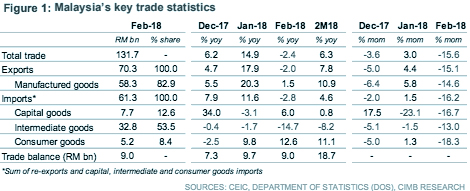
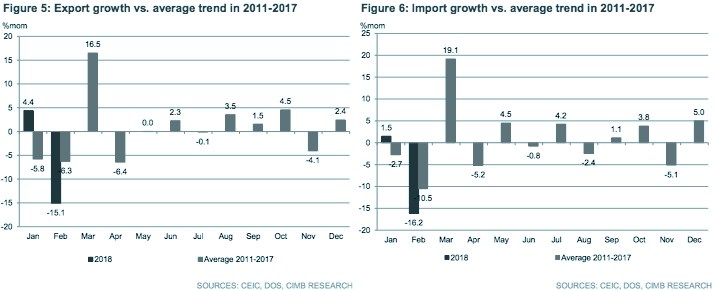
  • Malaysia’s trade surplus narrowed to RM9.0bn in Feb as exports (-2.0% yoy) and imports (-2.8% yoy) recorded the first contractions in 16 months.
  • While seasonal shutdowns and a high base for commodity prices had exaggerated Feb’s deterioration in exports, underlying trends in external demand growth are easing.
  • Our export growth forecast of 9.8% for 2018F is unchanged assuming that US-China trade tensions de-escalate and a compromise is reached on the announced tariffs.

img-my7-1

Trade surprises on the downside
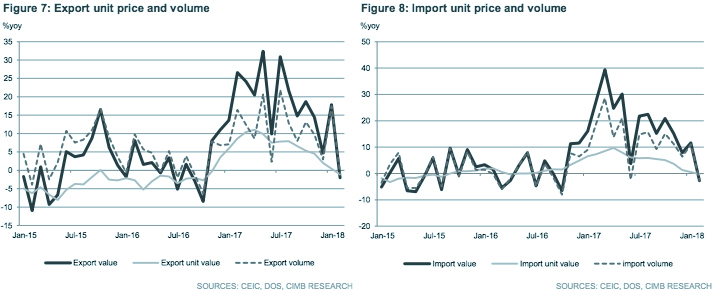
Total trade activity in Feb surprised on the downside (-2.4% yoy vs. +14.9% yoy in Jan), as the seasonal impact of a shorter working month was more pronounced than expected. Gross exports fell 2.0% yoy (CIMB: +4.2% yoy, Bloomberg consensus: +8.0% yoy; Jan: +17.9% yoy), the first decline in 16 months, but milder than the 2.8% yoy decline in gross imports (CIMB: +4.5% yoy, Bloomberg consensus: +7.1% yoy, Jan: +11.6% yoy). A smaller gap in the growth rates between the two led to a narrower trade surplus of RM9.0bn in Feb (CIMB: +RM8.9bn, Bloomberg consensus: +RM8.5bn, Jan: +RM9.7bn).

Second-worst performer among the Asian countries
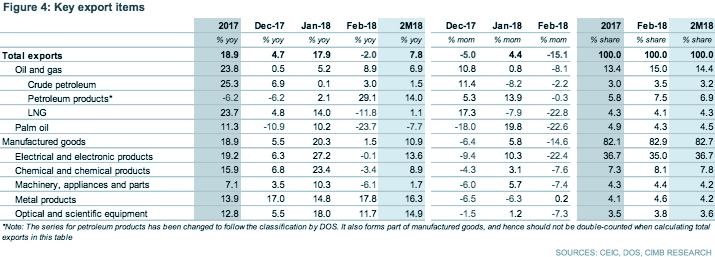
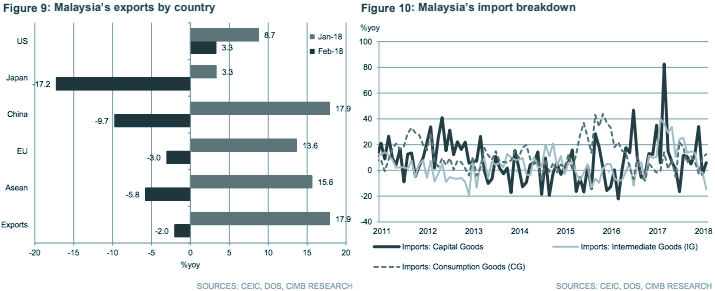
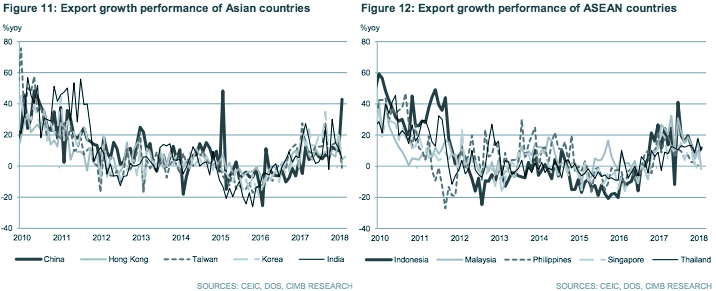
Malaysia’s export deterioration was sharper than those of its Asian peers, led by a slowdown in the manufactured segment, of which about 60% of sub-segments recorded negative growth in Feb: electrical and electronics (E&E, -0.1% yoy in Feb vs. +27.2% yoy in Jan), chemicals (-3.4% yoy vs. +23.4% yoy in Jan) and machinery (-6.1% yoy vs. +10.3% yoy in Jan). That said, Malaysia was one of the better-performing exporters in Jan.

Non-oil commodity exports dragged down by weaker prices
Furthermore, weaker volumes and prices dragged down palm oil (-23.7% yoy in Feb vs. +10.2% yoy in Jan), liquefied natural gas (LNG) (-11.8% yoy vs. +14.0% yoy in Jan) and natural rubber (-40.1% yoy vs. -26.0% yoy in Jan) shipments. On the bright side, strong oil price continued to support export performance of crude petroleum (+3.0% yoy in Feb vs. +0.1% yoy in Jan) and refined petroleum products (+29.1% yoy vs. +2.1% yoy in Jan). As the gains in oil exports dominated those of gas, oil and gas (O&G) exports accelerated further in Feb (+8.9% yoy vs. +5.2% yoy in Jan).

First dual contraction in export prices and volumes since Oct 2016
Declines in the export unit value (-1.1% yoy) and volume indices (-0.8% yoy) weighed on Feb exports. Export prices declined yoy in Feb on weaker non-oil commodity prices, while the volume contraction coincided with seasonal downtime for large swathes of Asia’s supply chain over the Chinese New Year. We are not overly concerned about the export contraction as we expect seasonal effects to fade in Mar. Nonetheless, YTD export growth, which smoothens out the seasonal distortions, indicates momentum is slowing (+7.8% yoy in 2M18 vs +12.4% yoy in 4Q17). Malaysia’s manufacturing PMI declined to a 5-month low of 49.5 pts in Mar (49.9 pts in Feb), reflecting weaker output and new orders. The new export orders index fell further in Feb to a 15-month low, reinforcing recent trends of moderating external demand growth.

We expect calmer heads to prevail in US-China trade conflict
We maintain our 2018F export growth forecast of 9.8% (+18.9% in 2017) on the basis of: 1) moderating global demand growth for electronics, 2) commodities’ terms of trade headwinds, 3) normalisation of plantation crop production growth, and 4) the translation effects of a stronger ringgit. Trade tensions between the US and China is a possible downside risk, although Malaysia’s diversified export structure offers some degree of protection against targeted tariffs. Our base case scenario assume that the US and China will reach a compromise, resulting in a de-escalation of tariff threats.

img-my7-2

img-my7-3

img-my7-4

img-my7-5

img-my7-6

img-my7-7

img-my7-8


Originally published by CIMB Research and Economics on 05 April 2018.

Economic Focus: Trade tensions escalate with tit-for-tat tariffs


HIGHLIGHTS

Trade tensions escalate with tit-for-tat tariffs

  • The US proposal of 25% tariffs on 1,333 types of imports from China worth US$50bn has been met by retaliatory duties from China on 106 products from the US.
  • We count more winners than losers in MIST, as exporters are well placed to benefit from displacement of demand for categories in which it competes with China/US.
  • Some sectors face supply chain disruptions for intermediate/capital goods that it exports directly or via other countries to China and eventually destined for the US.
  • Indonesia is relatively insulated from US-China trade tensions due to low exposure to E&E and machinery exports.
  • We expect the near-term impact on MIST to be limited and for a compromise to be reached. However, trade tensions may spiral if tit-for-tat US-China tariffs intensify.

img-ecofocus1-1

US levies 25% tariffs on US$50bn of China imports
The US Trade Representative’s office (USTR) has proposed a 25% tariff on 1,333 types of imports from China worth US$50bn – equivalent to 2.1% of total US imports – in retaliation for what it alleges to be the “forced transfer of US technology and intellectual property” by China. The proposal was not a major surprise, as President Trump had ordered remedial action to counter China’s trade practices on 22 Mar and subsequently issued threats on twitter to levy tariffs on up to US$60bn worth of imports from China. Markets are bracing for further sanctions as the US Treasury is due to revert in the coming weeks on 1) measures to address investments by China in ‘sensitive’ industries or technologies, and 2) whether to label China a currency manipulator.

China retaliates with new tariffs on 106 US products worth US$50bn
Several hours after the USTR’s tariff announcement, China unveiled its own retaliatory tariffs of 25% targeting 106 types of US imports totaling US$50bn (2.7% of China’s total imports), including soybeans, automobiles, chemicals and aircraft. Officials indicated that the timing of China’s duties will coincide with the implementation of US tariff measures.

Rational end game is a compromise…
The tariffs are unlikely to go into effect until late May at the earliest, as the USTR allows a 30-day period for public comments, and a hearing on the proposal has been scheduled for 15 May. We suspect that, like in previous sanctions against washing machines, solar panels, steel and aluminium, the provisions in this proposal will likely be watered down. Rather, this may be a bargaining chip to negotiate for reduced tariffs and non-tariff trade barriers in China to US exports and improved market access for US companies.

…as no one wins in a trade war
IMF estimates that a 10% rise in import tariffs applied by the US and the rest of the world would depress global trade by 1% and world GDP by 0.5%, i.e. tit-for-tat protectionism is a negative-sum game. Financial markets have reacted adversely to the prospects of escalating trade tensions that may trigger contagion effects, tighten global financial conditions and erode tailwinds from last year’s trade-led, synchronised recovery.

Potential winners and losers in ASEAN
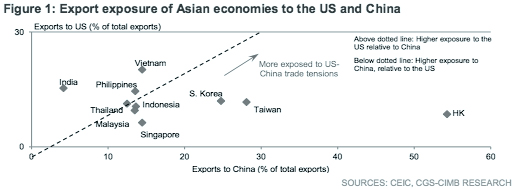
If the tariff measures are implemented to the letter, we think exporters, particularly in Malaysia, Singapore and Thailand, are well placed to benefit from the displacement of demand for product categories in which it competes with China/US (E&E, machinery, chemicals, aircraft parts, rubber tyres and medical equipment). However, some sectors will also face disruptions in the supply chain for intermediate/capital goods that it exports directly or via other countries to China and eventually destined for the US (TVs, PCs, HDDs). Among MIST, Indonesia is relatively insulated from US-China trade tensions due to its low exposure to E&E and machinery exports. Meanwhile, Indonesia and Malaysia are well-placed to take advantage of China’s proposed tariff on soybean imports from the US (US$13.8bn in 2016) as the two largest exporters of palm oil, which is a substitute for edible oil.
img-ecofocus1-2

US-China trade tensions

US levies 25% tariffs on US$50bn of China import
The US Trade Representative’s office (USTR) has proposed a 25% tariff on 1,333 types of imports from China worth US$50bn “in response to China’s policies that coerce American companies into transferring their technology and intellectual property to domestic Chinese enterprises” [link to tariff list]. The proposal, which resulted from an investigation under Section 301 of the 1974 US Trade Act [link to report and fact sheet], is part of a set of recommended remedial actions to address China’s ‘unfair trade practices’:

  • Tariffs. The USTR will propose additional tariffs on certain products from China with an annual trade value commensurate with the harm caused to the US economy resulting from China’s unfair trade practices. After a period of notice and comment, the Trade Representative will publish a final list of products and tariff increases.
  • WTO dispute. At the direction of the President, pursue a dispute settlement in the World Trade Organization (WTO) to address China’s discriminatory technology licensing practices.
  • Investment restrictions. Address concerns about investment in the US directed or facilitated by China in ‘sensitive’ industries or technologies deemed important to the US.

Section 301 is a key enforcement tool that allows the US to address a wide variety of unfair acts, policies, and practices of US trading partners. The investigation of China’s Acts, Policies, and Practices Related to Technology Transfer, Intellectual Property, and Innovation addresses four categories of acts, policies, and practices of the Government of China that unfairly result in the transfer of technologies and intellectual property from US companies to China. These policies harm US businesses and workers and threaten the long-term competitiveness of the US.

img-ecofocus1-3

img-ecofocus1-4

China retaliates with new tariffs on 106 US products
The US proposal was met with resistance by China, with its embassy in the US stating that: “The Chinese side strongly condemns and firmly opposes the unfounded Section 301 investigation and the proposed list of products and tariff increases based on the investigation. As the Chinese saying goes, it is only polite to reciprocate. The Chinese side will resort to the WTO dispute settlement mechanism and take corresponding measures of equal scale and strength against U.S. products in accordance with Chinese law.”

Several hours after the USTR’s tariff announcement, China unveiled its own counter tariffs of 25% targeting 106 types of US imports totaling US$50bn, including soybeans, automobiles, chemicals and aircraft. Officials indicated that the timing of China’s duties will coincide with the US implementing its set of tariffs. The latest salvo follows an earlier implementation of duties by China’s government on imports from the US totaling US$3bn effective 2 Apr 2018, covering 1) pork products and aluminium scrap (tariffs of 25%) and 2) fresh fruit, dried fruit and nut products; wine; modified ethanol; ginseng; and seamless steel pipe (tariffs of 15%).

End game is a compromise as no one wins in a trade war
An IMF working paper estimates that a 10% increase in import tariffs in both the US and the rest of the world would result in a 1% decline in global trade and a 0.5% fall in world GDP i.e. tit-for-tat protectionism is a negative-sum game. The sensitivities estimated by the IMF assume that other countries do not raise tariffs vis-à-vis each other. Hence, if US vs. rest of world tensions spill over to other trade relationships, the drag on global trade activity and GDP growth would be larger.

The Trump administration is clearly cognisant of the negative implications on the US economy from import tariffs, having chosen product categories that exerted pressure on China exports, but limited the damage to US consumers. This resulted in a US tariff list that skewed towards capital and intermediate goods but excludes retail mainstays such as shoes, clothing, mobile phones and furniture. Nonetheless, higher costs of industrial inputs may still result in producers passing on costs to consumers or create disruptions in the US supply chain, given China’s dominant position in segments like consumer electronics and semiconductors. Likewise, China has played hardball by directing its trade riposte to important US export segments and key Trump support bases (soybeans, raw cotton, beef, motor vehicle and aircraft exports) but in turn these tariffs may increase consumer and producer price inflation, especially as soybean, which is a key ingredient for cooking oil and animal feed.

There is still time to avert the escalating trade confrontation between the US and China. The proposed US tariffs are unlikely to go into effect for several weeks, as the USTR allows a 30-day period for public comments and a hearing on the proposed tariffs has been scheduled for 15 May. After the completion of this process, USTR will issue a final determination on the products that will be subject to additional tariffs.

Likewise, China officials have indicated that its implementation of retaliatory tariffs will depend on when the US enacts its trade tariffs after a period of public consultation. We suspect that, like in previous US sanctions against washing machines, solar panels, steel and aluminium, the provisions in this proposal will likely be watered down. Rather, this may be a ‘Trumpian’ negotiation tactic to reduce tariff and non-tariff trade barriers to US exports and improve market access for US companies. We expect near-term impact to MIST to be limited and a compromise to be reached. However the willingness of the US and China to engage in tit-for-tat tariffs raises the risks of escalating trade tensions. Markets are bracing for further sanctions as the US Treasury is due to revert in the coming weeks on 1) measures to address investments by China in ‘sensitive’ industries or technologies, and 2) whether to label China a currency manipulator.

Potential winners and losers in MIST

If the tariff measures are implemented to the letter, due to complex trade linkages, it is unclear at this juncture whether, on an aggregate basis, Malaysia, Indonesia, Singapore and Thailand may:

  • Benefit from the displacement of demand for product categories in which it competes with China/US (electric and electronics products, machinery, chemicals, aircraft parts, rubber tyres and medical equipment), or
  • Face disruptions in the supply chain for intermediate products that it exports directly or via other countries to China and eventually destined for the US (TVs, PCs, hard-disk drives and storage).

Nonetheless, we think there are sectors that stand to gain more than others under certain conditions. We classify potential winners as sectors that meet the following conditions:

  1. China exports to the US market are sizeable (large market share for grab), and
  2. MIST’s exports to the US market by components are high (strong position to win market share), and
  3. MIST’s indirect exports to the US via China are low (low exposure to China supply chain/independent trade ecosystem).

We classify potential losers as sectors that meet the following conditions:

  1. China exports to the US market are sizeable (vulnerable to market share erosion), and
  2. MIST’s exports to the US market by components are low (weak position to win market share or not an exporter of the finished good to the US), and
  3. MIST’s indirect exports to the US via China are high (high exposure to China supply chain/dependent trade ecosystem).

Based on a study of each country exposures to key export categories affected by the US tariffs, we count more winners than losers in MIST, as exporters are diversified, competitive and well placed to capitalise on the potential re-routing of trade resulting from the US and China tariffs. Among the MIST countries, we think Indonesia is the most insulated from US-China trade tensions due to its low exposure to E&E and machinery exports.

MALAYSIA

Potential winners are:
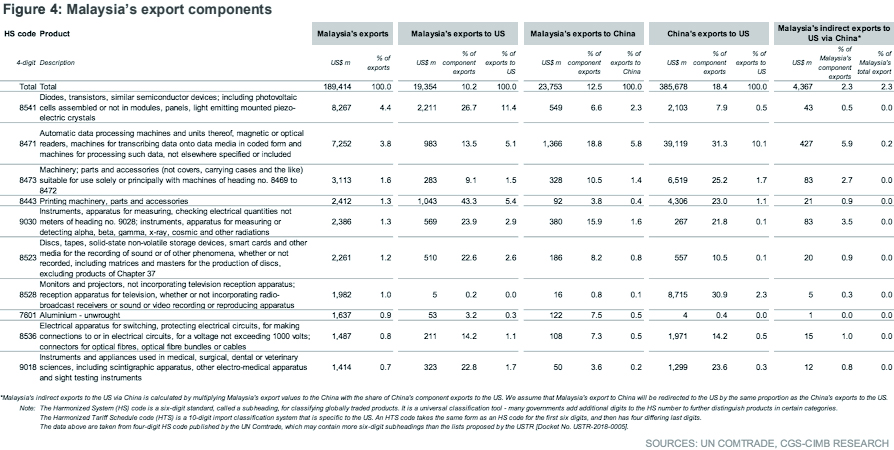
Malaysia exporters that compete directly with China for the US export market including semiconductors (HS code 8541), printers (8443), measurement instruments (9030), HDDs and storage (8523), medical equipment (9018), and electrical apparatus (8536), which cumulatively total US$4.9bn and account for 25.2% of Malaysia’s total exports to the US. Malaysia’s well-developed auto industry may also benefit from China’s tariffs on US motor vehicles and parts.
Edible oil substitutes. Malaysia is well-placed to take advantage of China’s proposed tariff on US soybean imports as the second largest producer of palm oil, which is a substitute edible oil.

Potential losers are:
Malaysia exporters of intermediate and capital goods to China destined for the US market including automatic data processors (8471) and machinery parts (8473), which cumulatively total US$1.3bn and account for 6.5% of Malaysia’s total exports to the US.
img-ecofocus1-5

INDONESIA

Potential winners are:
Indonesian exporters that compete directly with China for US export market including pneumatic tyres (HS code 4011), printers (8443), monitors and projectors (8528), seats (9401), and wires and cables (8544), which cumulatively total US$1.8bn and account for 11.2% of Indonesia’s total exports to the US.
Edible oil substitutes. Indonesia is well-placed to take advantage of China’s proposed tariff on US soybean imports as the largest producer of palm oil, which is a substitute edible oil.

Potential losers are:
Indonesian exporters that export intermediate and capital goods to China destined for the US market are relatively limited due to its low exposure to E&E and machinery exports.

img-ecofocus1-6

SINGAPORE

Potential winners are:
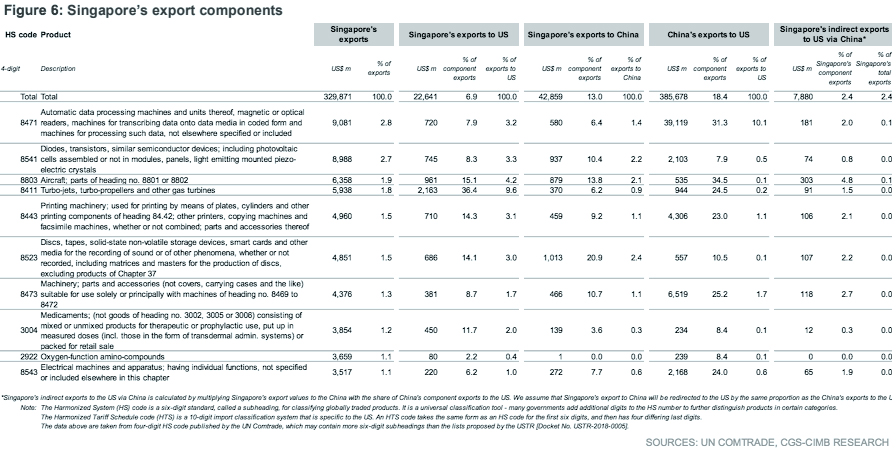
Singapore exporters that compete directly with China for US export market including automatic data processors (HS code 8471), aircraft parts (8803), turbojets, propellers and other gas turbines (8411), printing machinery (8443), and medicaments (3004), which cumulatively total US$5.7bn and account for 25% of Singapore’s total exports to the US.

Potential losers are:
Singapore exporters of intermediate and capital goods to China destined for the US market including semiconductors (8541), HDDs and storage (8523), and machinery parts (8473), which cumulatively total US$1.8bn and account for 8.0% of Singapore’s total exports to the US.
img-ecofocus1-7

THAILAND

Potential winners are:
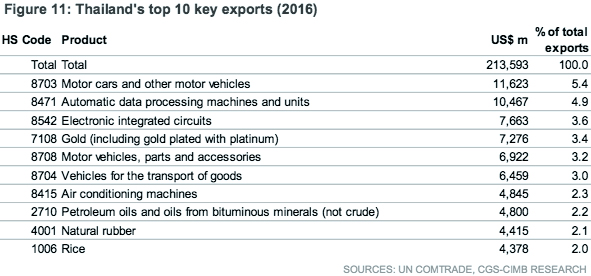
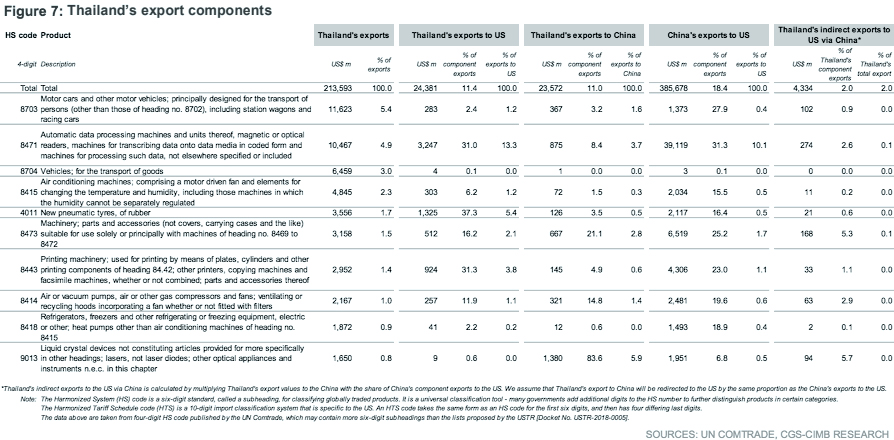
Thailand’s exporters that compete directly with China for US export market including automatic data processors (HS code 8471), air conditioning machines (8415), pneumatic rubber tyres (4011), and printing machinery (8443), which cumulatively total US$5.8bn and account for 23.8% of Thailand’s total exports to the US.

Potential losers are:
Thailand’s exporters of intermediate and capital goods to China destined for the US market including liquid crystal devices (9013), machinery parts (8473), motor vehicles (8703) and air or vacuum pumps/fans/compressors (8414) which cumulatively total US$1.1bn and account for 4.3% of Thailand’s total exports to the US.
img-ecofocus1-8

APPENDIX – Top 10 export items in MIST
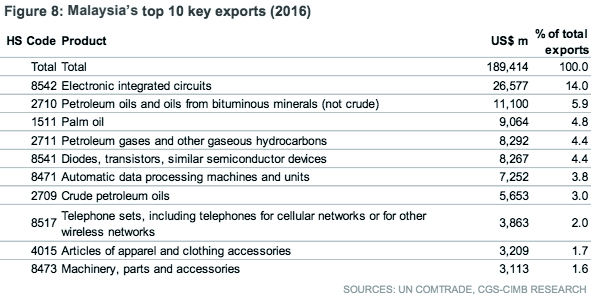
 
img-ecofocus1-9

img-ecofocus1-10

img-ecofocus1-11

img-ecofocus1-12
 

Originally published by CIMB Research and Economics on 05 April 2018.

 

Myanmar Monitor


Photo

Photo credit: The Myanmar Times

Economy, Investment and Trade

Myanmar to promote its local stock exchange to Japanese investors
(29 March 2018) The Government of Myanmar intends to attract investors from Japan by promoting its local stock exchanges in Tokyo before the country enforces a new law on foreign ownership by local firms. In order to provide more active foreign investment into Myanmar businesses, the new Myanmar Companies Law exempts foreign firms from various regulations unless they hold a stake of over 35 percent in local companies. U Maung Maung Win, Chair of Myanmar Securities and Exchange Commission cum Myanmar Deputy Minister of the Planning and Finance Ministry said Myanmar authorities target to vitalise the struggling bourse by increasing trade-matching sessions from the current two times to four times daily. In December 2015, with a capital investment of US$24 million (K32 billion), the first modern stock exchange in the emerging economy was established with Myanmar Economic Bank holding a 51 percent interest, Daiwa Securities 30.25 percent and Japan Exchange Group 18.75 percent.
Read More >

IMF embraces Myanmar’s economic recovery but cautions on downside risk
(29 March 2018) The International Monetary Fund (IMF) released the findings of its Article IV consultation with Myanmar, in which it welcomes the country’s economic recovery but warns about downside risks. Among the risks identified by IMF are the need for Myanmar’s banking sector to adjust to important new prudential regulations after a period of rapid credit growth, the humanitarian crisis in Rakhine state, commodity prices, potentially volatile global financial markets, exposure to spillovers from China, and the risk of natural disasters. In addition to expressing IMF’s strong concern, the findings also highlighted that in order to improve conditions in affected areas and to realize Myanmar’s strong potential for inclusive growth, there is a need for early and tangible progress toward peace and regional inclusion. Nevertheless, IMF said the medium-term macroeconomic outlook in Myanmar remains good with growth projection coming in at 6.7 percent in 2017/2018, predominantly due to recovering agriculture sector and exports.
Read More >

Myanmar’s lack of reform turns investors away
(30 March 2018) Two years after Myanmar leader Aung San Suu Kyi took office, the enthusiasm that greeted Myanmar’s transition to democratic rule and positive prospect for the country’s economy seems to gradually decline as much work still need to be done on the economic front. According to Myanmar Investment Commission, the approved volume of foreign direct investment between April 2017 and February stood at US$5.3 billion, but the figure for the 12 months through March 2018 is projected to be smaller than the previous year’s US$6.6 billion, a second consecutive year of decline. Adding to that, Colliers International, a real estate information company said that with foreign companies losing interest, office rent in Yangon is falling down with average monthly rent per square meter of floor space valued at US$44 in 2017, a drop of 31 percent since 2013.
Read More >

Business leaders question Myanmar government’s role in “new city” development project
(2 April 2018) Yangon’s government has formed a company to develop a landmass twice the size of Singapore as a re-launch of the “new city” development project abandoned in 2017. The development for New Yangon City will be primarily based on a Public-Private Partnership model, with businesses contributing to equity investments. On March 31, the regional government launched the New Yangon Development Company (NYDC), which is incorporated under the Special Companies Act with 100 percent ownership by the regional government. This has led business leaders to question the involvement of Myanmar government in the commercial activities of the project, as they believe the cooperation involving the government will eventually turn NYDC into entities like Myanmar Economic Corporation (MEC) and Union of Myanmar Economic Holdings (UMEHL), which are criticised by many people for monopolising many areas of businesses, trade, and industries in the country. According to NYDC, the project planners for the “new city” development aspire to rival the likes of Shenzhen, South Korea’s Incheon and Malaysia’s Iskandar.
Read More >

New 2018 report on Myanmar focuses on the country’s reform program and infrastructure pipeline
(2 April 2018) A new report from global research and consultancy firm Oxford Business Group (OBG) explores Myanmar’s efforts to enhance its investment environment and stimulate growth through a series of wide-ranging reforms. The report documents the impact of efforts to create regulatory certainty for investors through landmark legal developments and in reducing its infrastructure gaps in order to improve national productivity and galvanize the construction, logistics, trade, and tourism sectors. Key issues examined include the steps being taken to tap a broader range of financing mechanisms. With Myanmar proving to be an attractive draw for international manufacturers, the report highlights the policies that have been devised to promote the development of industrial clusters, increase competitiveness and expand capacity.
Read More >