Singapore: March 2018 industrial production


HIGHLIGHTS

March 2018 industrial production

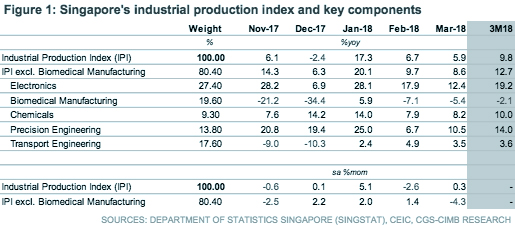
  • IPI growth eased to 5.9% yoy in March, shy of our forecast due to disappointments in semiconductor and pharmaceutical production.
  • The pharmaceutical sector saw unusually large revisions in its February data, as an initial reading of a 15.2% yoy increase was revised to a decline of 7.4% yoy.
  • The sharper-than-expected moderation in external demand had led us to revise our projections of Singapore’s GDP growth to 3.2% in 2018 from 3.6%.
  • We expect MAS to maintain its current monetary settings at the Oct policy review.

img-sg5-1

IPI growth corrects following February surge, but still ahead of forecasts
Expansion in the manufacturing sector, as measured by the industrial production index (IPI), moderated to 5.9% yoy in March (CIMB: +6.2% yoy, Bloomberg consensus: +5.7% yoy), following a downwardly revised increase of 6.7% yoy in February. IPI excluding the volatile biomedical sector increased 8.6% yoy (+9.7% yoy in February). On a sequential basis, the manufacturing sector notched a 0.3% mom gain in seasonally adjusted terms; however, Feb’s decline was revised significantly lower to -2.6% mom from an initial reading of -0.5% mom.

Electronics output moderates as smartphone cycle peaks
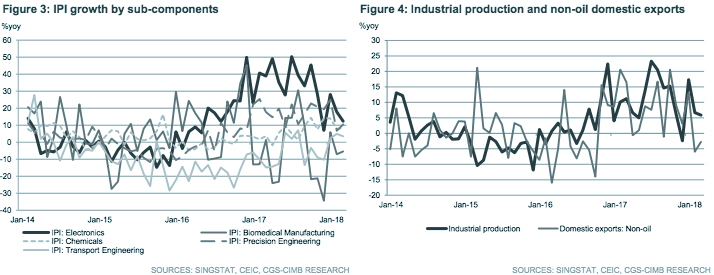
Production of electronics expanded by a slower 12.4% yoy in March (+17.9% yoy in February), on moderating growth for semiconductors (+18.8% yoy vs. +27.4% yoy in February), amid softening demand for smartphones. Output growth for computer peripherals remained stagnant (+0.2% yoy vs. +0.9% yoy in February) while contractions persisted in the data storage (-19.0% yoy vs. -21.8% yoy in February), consumer electronics (-7.7% yoy vs. -9.1% yoy in February) and other components (-0.5% yoy vs. -24.5% yoy in February).

Major revisions in pharma drags down headline IPI readings
Activity in biomedical manufacturing turned out to be weaker than expected in March, contracting 5.4% yoy on the back of declines in pharmaceuticals (-7.2% yoy) and medical technology (-0.4% yoy). Notably, February’s biomedical manufacturing data saw unusually large downward revisions, from an increase of 8.4% yoy to a decline of 7.1%, principally due to adjustments made to pharmaceutical output from an increase of 15.2% yoy to a decline of 7.4%.

Return from holidays spurs factories into action
The return from the CNY break spurred production across many sectors, including chemicals, precision engineering, transport engineering, F&B, apparel and basic metals. Meanwhile, general manufacturing activity contracted for a second consecutive month due to printing and miscellaneous industries.

Slower export and manufacturing activity dims our growth outlook
The sharper-than-expected moderation in external demand had led us to revise our projections of Singapore’s GDP growth recently. We now expect the Singapore economy to expand by 3.2% in 2018 against an initial forecast of 3.6% and at the upper end of the Ministry of Trade and Industry’s (MTI) estimated range of +1.5-3.5%.

Catalysts for further policy tightening still out of sight
Following the decision to tighten monetary policy by raising the slope of the S$NEER policy band on 13 April to allow for a ‘modest and gradual appreciation’, we expect the Monetary Authority of Singapore (MAS) to tread more cautiously due to heightened trade tensions between the US and China, the tightening of global financial conditions arising from expectations of further US interest rate hikes, the still-nascent recovery in the domestic economy and tepid core inflation. Hence, we maintain expectations for monetary settings to remain on hold at the next scheduled policy review in October.

img-sg5-2

img-sg5-3

img-sg5-4

img-sg5-5


Originally published by CIMB Research and Economics on 26 April 2018.

Myanmar Monitor


Photo

Photo credit: The Myanmar Times

Economy, Investment and Trade

Foreigners can now invest in Myanmar’s private education sector
(23 April 2018) The Notification 7/2018 issued by the Myanmar Investment Commission (MIC) on 20 April 2018 has given the permission to foreign investors to make full capital investments in Myanmar’s private schools. Foreigners can now fully own and run private schools with a teaching curriculum provided by the Myanmar Ministry of Education (MOE) or an international curriculum syllabus. International service providers can now pump in investments in basic education schools, technical, vocational and training schools, higher education institutions, subject-based schools and private schools appointed by the MOE. According to Myanmar Teachers Federation (MTF), as there are no effective educational laws in the country yet, Myanmar education law should be revised to incorporate rules on the new foreign private investment. Currently, private education in Myanmar is governed by the 2011 Private School Registration Act.
Read More >

Myanmar to establish new industrial zone for Korean companies
(25 April 2018) To draw further foreign direct investments (FDI) into Myanmar, the country’s Minister of Commerce has welcomed South Korea to set up industrial zones in the country. The Myanmar-Korea industrial zone’s focus will be to set up an automotive hub to manufacture and assemble Korean vehicles for export purposes. The new Myanmar – Korea industrial zone project is expected to be completed by 2025 and will attract investments of up to US$200 million. Korea is the sixth largest foreign investor in Myanmar and according to official government statistics, South Korea’s total investments in Myanmar between 1988 and December 2017 amounted to US$ 3.8 billion. Currently, The Korea Land & Housing Corporation (LH), in partnership with the Ministry of Construction, is already building a $120 million, 2.4 square metre industrial complex in Hmawbi township and there are six Korean companies that have set up their factories at the Thilawa Special Economic Zone (SEZ).
Read More >

Myanmar government to fund telecommunications in rural areas via tax collection

(24 April 2018) Myanmar government will be raising funds from a tax on telecommunications operators to expand the country’s telecommunication network to remote areas that do not have coverage beginning June 2018. The Telecommunications Law, section 54 states that the Ministry of Transport and Communications can establish and supervise a Universal Service Fund to fulfil basic telecommunication services in the public interest in any location by implementing universal service plans. The ministry has targeted for 94 percent communication coverage for the population by the first quarter of 2019 and then further increase to 99 percent through the Universal Service Fund. Myanmar’s Department of Post and Telecommunication expects the Universal Service Fund to collect 2 percent from operators income. Currently, nearly 90 percent of the country’s population has access to telecommunication networks.
Read More >

Myanmar and Vietnam set target to increase bilateral trade by 2020

(24 April 2018) Myanmar and Vietnam have negotiated to raise bilateral trade exceeding US$1 billion in trading value by 2020. Currently, Vietnam is the ninth largest trading partner to Myanmar and according to the Ministry of Commerce (MOC), bilateral trade between Myanmar and Vietnam has reached US$830 million in the fiscal year of 2017-18, representing a 50 percent increase from the previous year. In addition to that, a memorandum of understanding has been inked between MOC and the Vietnam Ministry of Agriculture and Irrigation to raise exports of Myanmar agricultural product to Vietnam. Under the MOU, Vietnam will now buy Myanmar’s beans and pulses, rubber and corn.
Read More >

Yangon looks to Foreign investors to develop New Yangon City project
(24 April 2018) The Yangon Region Government is now courting foreign direct investments to develop the New Yangon City project. Encompassing Phase 1 and Phase 2, the total area of New Yangon City will cover 1,500 square kilometre, by which the infrastructure works related to Phase 1 of the New Yangon City project are expected to exceed US$1.5 billion. There have been proposals to construct two bridges, new roads in the city and a request to lease over 2,000 acres of land for development within the new city. When complete, the new city will help sustain Yangon’s growing population and solve important issues such as employment and housing. On 31 March 2018, the Yangon government launched the New Yangon Development Company (NYDC) to develop the project. Development will be based on the Public-Private Partnership model, with businesses contributing in equity investments. The project planners aim to rival the likes of China’s Shenzhen, South Korea’s Incheon and Malaysia’s Iskandar.
Read More >

China-ASEAN Monitor


China-ASEAN Monitor

Photo Credit: The Nation


Economy, Investment and Trade

Alibaba Group pours billions into Thai economy
(20 April 2018) Chinese E-Commerce conglomerate Alibaba Group has pledged to invest a combined amount of US$349 million (THB11 billion) in Thailand’s Eastern Economic Corridor (EEC) and a related “Smart City” project. This move will benefit small farmers and rural enterprises in Thailand as the e-commerce group will enable low income farmers to use their digital platform to market Thai products. Alibaba demonstrated their e-commerce prowess when its online platform T-Mall sold 80,000 “Golden Pillow” Durians in just one minute. Other Thai products will also be sold on T-Mall, China’s largest online marketplace which is used by more than 1.4 billion consumers. Alibaba’s co-founder and executive chairman Jack Ma was in Bangkok to sign four Memorandum of Understandings (MoUs). Part of the collaboration with Thailand also involves two digital campaigns, “Go to China”, which brings Thai local farm goods to the Chinese market and “Go to Thailand”, which will bring more Chinese travellers to Thailand. Thailand’s Industry Ministry will also work with Alibaba Business School to train budding Thai entrepreneurs.
Read more>>

Thailand medical tourism industry to benefit from China’s lack of reproductive health clinics
(20 April 2018) The lack of reproductive health clinics in China will benefit Thailand, one of the biggest reproductive health markets in the world, as older Chinese couples are looking to conceive a second child after the Chinese government ended the one child policy on 30 October 2015. This development will likely benefit Thailand’s medical tourism industry, which will gain approximately US$6 billion on the undersupply of reproductive health clinics in China. Thailand has been developing this market for more than 10 years with an eye on boosting their medical tourism market. Cost of doing IVF procedure in Thailand ranges from US$15,913.43 to US$38,000 (THB500,000 to THB1.2 million), which is 35 percent cheaper than Singapore and Hong Kong, and 45 percent cheaper than the United States. Given Thailand’s volume of health professionals and facilities, the country is expected to serve about 1 million couples. China is the world’s most expensive IVF market, followed by the United States, Hong Kong and Singapore.
Read more>>

China and Laos sign partnership agreement on medicinal plants research
(17 April 2018) A Memorandum of Understanding (MoU) on medicinal plants research cooperation was signed on 17 April 2018 between China and Laos to carry out a medicinal resource census in Laos. The census aims to connect the economic and medicinal values of Laos’ special botanical resources. China and Laos will jointly set up a traditional medicine research centre in Laos in order to conduct comparative studies on Chinese and Lao medicinal plants, train Lao medicinal plant resources researchers, and effectively improve medicinal plant resources exploration and application. Adding to that, the Traditional Medicine Research Institute under the Laos Ministry of Public Health said the signing of the MoU is a concrete demonstration that traditional Chinese medicine is benefiting the Belt and Road Initiative, and will significantly promote traditional medicine partnership between China and Laos.
Read more>>

China imposes temporary anti-dumping measure on selected type of synthetic rubber imported from US, EU and Singapore
(20 April 2018) China’s Ministry of Commerce announced that starting from 20 April 2018, the country will impose temporary anti-dumping measures on a certain type of synthetic rubber imported from the United States, the European Union and Singapore. According to the Ministry, the three countries that were selling halogenated butyl rubber at a discount to appropriate price is impacting China’s domestic industry. The Ministry will also hold a hearing on the anti-dumping investigation on 3 May 2018 and stakeholders are allowed to submit written representation to the officials within 10 days of the announcement. The temporary anti-dumping measures that was imposed are based on the preliminary findings from an anti-dumping investigation launched by the Chinese authorities in August 2017.
Read more>>

China and Cambodia ink partnership agreement on new Kampot port construction
(25 April 2018) Try Pheap Group, Cambodian high-profile luxury timber exporter inked a partnership agreement with China’s Guangxi Beibu Gulf International Port Group to run a feasibility study on the deep-sea port construction in Kampot province. The proposed new port will be able to manage large vessels, including ships that will be able to transport up to 30,000 tonnes of cargo and is expected to create 500 new jobs during the first phase of construction, generating an additional 1,500 over the next three years. Cambodia Prime Minister Hun Sen said the relationship between China and Cambodia is at its strongest, adding that the new port will be a significant element of China’s Belt and Road Initiative. In 2016, Chinese investors invested a total of US$5.1 billion in key Cambodian economic sector, namely manufacturing, textile, and electricity.
Read more>>

Indonesia: April 2018 Bank Indonesia meeting


HIGHLIGHTS

April 2018 Bank Indonesia meeting

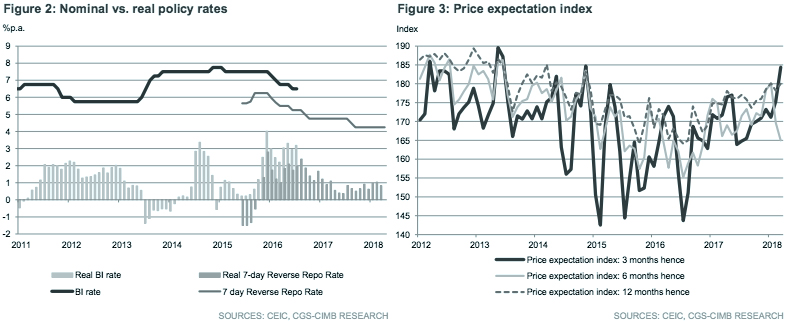
  • Bank Indonesia (BI) maintained its 7-day Reverse Repo Rate at 4.25%, as widely expected.
  • The central bank has turned more cautious about external uncertainties and the impact on the rupiah.
  • BI reiterates its expectation of stronger GDP growth in 1Q18 vs. 1Q17 and downplayed inflation as domestic risk.
  • No change in our year-end policy rate forecast of 4.25%, implying that BI will hold the rate through 2018.

img-ind13-1

7-day Reserve Repo Rate kept at 4.25%
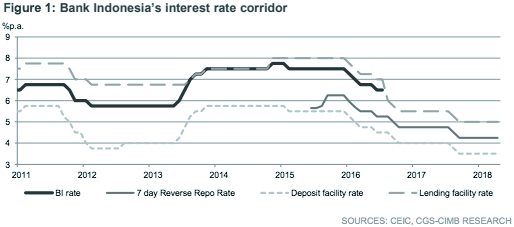
Bank Indonesia’s (BI) decision to maintain its 7-day Reverse Repo Rate (7DRRR) at 4.25% was widely anticipated by the market, including us. Correspondingly, the Deposit Facility Rate and Lending Facility Rate were left at 3.50% and 5.00%, respectively.

Turning more cautious about external risks
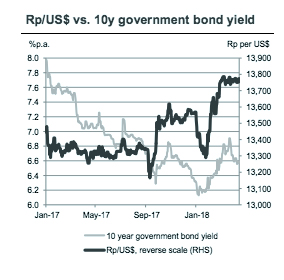
We think the central bank has turned more cautious about external risks, where it highlighted “external pressures begin to build.” Key risks arise from a potential escalation in US-China trade tensions, after both countries proposed to slap tariffs on the other’s imports earlier this month, as well as on expectations of further interest rate hikes by the US Federal Reserve, which could impact risk sentiment as well as exchange rate movements. The rupiah stabilised below Rp13,800 per US$ in the first half of April but at the expense of foreign exchange reserves, which fell further in March (-1.6% mom to US$126bn), amid continued intervention by BI to stabilise the currency.

Striking a more positive tone on private consumption
BI reiterated its expectation of stronger GDP growth in 1Q18 compared to 5.0% yoy in 1Q17. We concur with its expectation given improving domestic demand and resilient growth in the trade volume surplus (+14% yoy in 1Q18 vs. +12% yoy in 1Q17) despite a significantly narrower trade value surplus (US$0.3bn in 1Q18 vs. US$4.1bn in 1Q17). Encouragingly, the central bank’s tone on private consumption has turned more positive as it now expects private consumption to increase amid improving household purchasing power, compared to “stable private consumption is backed by maintained public purchasing power” in its previous statement.

No change in its CAD projection
While ongoing infrastructure projects and non-building investments will continue to drive import growth, BI maintained its current account deficit (CAD) projection at 2.0-2.5% of GDP for 2018 as higher imports are expected to be accompanied by stronger exports. Commodities exports are the key driver, alongside stronger outbound manufacturing shipments spurred by sustained global economic growth momentum. We had expected 1Q18 CAD to widen to 2.5% of GDP and we reckon our full-year projection of 1.8% of GDP might be too low.

Inflation rate to remain under control
BI did not highlight inflation pressure as a domestic risk. Policy adjustments, like the coal price cap at US$70 per metric tonne and the imposition of an approval process to raise non-subsidised fuel prices, have reduced upward price pressures and hence inflation expectations remain stable.

No change in our year-end policy rate forecast of 4.25%
Despite its cautious tone amid external uncertainties, we expect BI to leave the policy rate unchanged to ensure continued recovery in economic growth momentum. Hence we reiterate our policy rate forecast of 4.25% until end-2018.

img-ind13-2

img-ind13-3

img-ind13-4

img-ind13-5


Originally published by CIMB Research and Economics on 20 April 2018.

Belt and Road Initiative: Is it all about China?

Belt and Road Initiative: Is it all about China?
Originally published in TheEdge Malaysia, 23 – 29 April 2018 edition.

img-tsmm-theedge-230418

The answer to this question is, it will be if there is no constructive engagement but instead an adversarial attitude and response to all of China’s policies and initiatives.

It would, of course, have been less complicated to embrace the expanding Asian economy had it not been accompanied by the changing geopolitical realities of a more Asia-centric world, particularly the rise of China.

Indeed even Asian countries in the sweep of that expansion, long comfortable with a Western affinity, find China’s ways clumsy, even threatening, and support a balancing presence against China’s rise.

In the event, complicated tensions have developed. The US especially feels challenged by China, but there are other middle powers – Australia, India, Japan and Indonesia – who find China’s rise foreboding. They say they are not anti-China. However, they clearly are disturbed by, even suspicious of, some of China’s utterances and actions.

China, too, says it is not anti-West or America or the existing world order, but in some of its non-negotiable stances since emerging from its century of shame, it exhibits that heavy-handed great power iron fist which lends support to fear of things to come.

Yet, should opportunities that China is able to offer, like the breathtaking Belt and Road Initiative (BRI), be shunned when other major powers largely attend to problems back home or when the US is turning its back on the world?

Indeed, to mix metaphors, should everyone else look at China through the prism of geopolitical change just because its rise is the bone in America’s throat?

Adapting to change is a challenge but it will have to happen one way or another sooner or later. Graham Allison of Harvard, in his book Destined for War, concludes that, despite some equivocation, conflict between the incumbent and rising power is almost inevitable.

But that conflict may not come to the ultimate end of global war. Meanwhile, as different stances are taken, there does not need to be a polarisation among all other states in between. Actually, those states do have a role in moderating potential conflict through engagement and socialisation. Asean is one such group of states.

While I have been critical of China, particularly on the South China Sea disputes, and of Asean, especially in its failure to take a clear and united stand also on the South China Sea, I have always supported engagement with China for economic development.

With respect to the BRI, apart from the obvious infrastructure developmental impact, I have advocated that a process of engagement that is robust and professional, would also expose China to other dimensions in development – such as recipient country’s needs and fiscal capabilities, global measures in standards of project performance and environmental protection.

I have spoken at a number of conferences in Malaysia and abroad to our own, Indian, European (Swedish), and Australian businessmen on the BRI. I have also spoken to American academics (from Stanford) seeking to position the US in a world of new geopolitical balance. I have said initiatives such as the BRI (and the AIIB – Asian Infrastructure Investment Bank) represent an epochal opportunity from which good would come if there was a convergence of cooperation in a positive spirit.

Screen Shot 2018-04-23 at 9.56.17 AM

The Americans find it most difficult to adjust in a new world that is emerging, most of all one in which US dominance would no longer be overwhelming. Thus, the Americans find it difficult to come to terms with the AIIB, which is dominated by China even if by persuasion the US can muster a majority against it. It lends support to a suspicion America cannot countenance any change which subtracts from its remit in the Breton Woods system.

Thus, America’s allies are discouraged from engaging with China in its far-reaching initiatives. Japan, along with the US, stayed out of the AIIB. India did not need much persuading from viewing the BRI as a poisoned chalice, given its unresolved border issues and great suspicion of China. Australia is in two minds about China, complicated now by an unpredictable and perhaps unreliable America, as openly recognized in its foreign policy white paper last year.

In the upshot what is precisely feared about the BRI may indeed occur – a one-sided relationship with weaker participant countries which get not the best infrastructure at exorbitant cost ultimately not financially sustainable. If there was third-party expertise and involvement in BRI projects, standards could be achieved that would preserve the interests of those weaker participating states which the US and its allies say they so want to protect.

Indeed, this is what Singapore is doing, although to serve rather more its interests than those of third countries. Nevertheless, this is the kind of engagement which will keep China honest and help ensure participating BRI countries are protected from their enthusiasm.

Singapore signed a memorandum of understanding (MoU) with China April 8 to promote greater collaboration between companies from both countries in third-party markets along the BRI routes. A working group comprising the ministry of trade and industry, China’s Development and Reform Commission and Enterprise Singapore has been formed for this purpose.

Its objective is to identify sectors and markets of mutual interest, organize business-matching activities and forums to facilitate third-party market cooperation between Singapore and Chinese companies under the BRI.

If the BRI is said to be China’s geopolitical tour de force, the MoU is Singapore’s strategic lift for its companies, consultants, experts and other firms in BRI projects.

This is something Malaysia, with its close relationship with China, should have done. Bear in mind Singapore came from behind, after its traumatic time with China in 2016-2017, to forge the MoU. Other countries such as Australia, Sweden and even the US – with their technical and financial expertise – should also be involved and engaged with the BRI.

Malaysia particularly should ensure that its relationship with China does not develop in a one-sided manner, by not just being defensive about it but also by inviting third country expertise and engagement in its BRI projects as well as by involvement in other countries’ BRI projects.

After all, China’s President Xi Jinping has said: “China’s Belt and Road Initiative is based on the historic roots of the Silk Road, is focused on Asia, Europe and African continents, and is open to all friends.” The Chinese ambassador to Malaysia declared in February that Beijing initiatives are based on “shared development, progress, safety and prosperity”

All countries should make sure these are not empty words. Involve and engage in the prospect of what the managing director of the Monetary Authority of Singapore sees this way: “The Belt and Road’s potential scope for connectivity is perhaps unmatched in human history.”

Geographically, in Asia, there is a wide canvas of regions and countries which are increasingly being interconnected. Southeast Asia is a great platform, if far from being perfect. There is the great promise of the Asean Economic Community and Regional Comprehensive Economic Cooperation the promise of Asean and Asean Plus. China , on the other hand, is the largest growing consumer market in the world, the largest economy in terms of purchasing power parity.

Technology is further going to drive growth everywhere, especially in Asia. China is highly innovative. It would be a mistake to under-rate China. Digital Asean is on the rise, with estimated addition to regional economy of US$1 trillion by 2025, even if there are challenges with regard to employment and skills, particularly in its less developed member states.

Infrastructure development is going to be breathtaking. The BRI, first mentioned by Xi Jinping in 2013, is already being rolled out, while Trans Pacific Partnership (despite TPP 11), pursued by Barack Obama from 2010, has fallen back as Trump retreats from American global leadership to America first.

The AIIB started operation in December 2015, has over 60 members, a capital of US$100 billion and has begun to finance a few projects.

The unfulfilled promise of change in world economic management and the Bretton Woods institutions, made upon the establishment of G20 at the height of the global financial crisis of 2008, has been realised in Asia, a strategic foothold that portends the future.

Denial will not work and could become a costly opportunity cost. Engage, involve and participate. Many opportunities beckon. There are many values to inculcate. Otherwise, the fear of China’s domination will truly become a self-fulfilling prophecy. The issue is not about the decline of America but the rise of China and Asia.

CARI Captures 354

c354_graphic


ASEAN

ASEAN-5’s GDP to grow by 5.3 percent in 2018
(18 April 2018) The latest World Economic Outlook report released by the International Monetary Fund (IMF) reported that the combined GDP of ASEAN-5 (namely Philippines, Vietnam, Indonesia, Thailand and Malaysia) may grow by 5.3 percent and 5.4 percent in 2018 and 2019 respectively. Over the next two years, the Philippines is expected to be the fastest growing economy in Southeast Asia and second fastest in the world with a GDP growth of 6.7 percent for 2018 and 6.8 percent for 2019, followed by Vietnam with projected growth of 6.6 percent in 2018 and 6.5 percent in 2019. Strong global growth of 3.9 percent for 2018 and 2019 would also provide a favourable external environment for the Southeast Asian region.

ASEAN

ASEAN explores alternative funding sources besides China for infrastructure and economic development
(17 April 2018) ASEAN policymakers are looking beyond China to fund infrastructure projects and this was evident during a recent discussion by ASEAN’s top financial officials in Singapore. During a World Bank sponsored panel discussion in Singapore on 5 April 2018, policymakers discussed ideas to attract alternative financing. Myanmar which already has three special economic zones, plans to enlarge government bond issuance; Indonesia in the past required insurer and pension funds to hold 30 percent in government bonds but now this can be government bonds or infrastructure-related securities. About 30 percent of Thailand’s US$80 billion infrastructure projects needs private financing and to do so, the government plans to open an infrastructure fund to investors in the next couple of months. Also, Vietnam is eyeing the green bond market while Singapore is setting up a new government led infrastructure office to serve as a regional centre to provide financing for innovation projects. Asian Development Bank estimates that ASEAN needs about US$2.8 trillion on projects such as roads, bridges, ports, and railways from 2016 to 2030 to maintain economic growth and reduce poverty.

INDONESIA, MALAYSIA

Indonesia gears to boost exports in biodiesel, Malaysia brace for slowdown in market share
(19 April 2018) The removal of anti-dumping duties by European Union (EU) on shipments from some Indonesian producers will boost the country’s biodiesel export but this will lead to a slowdown in Malaysian market share. In March 2018, EU removed duties on biodiesel imports for 13 Indonesian and Argentine producers that had been in place since 2013. Following this development, Indonesia is expected to ship around 432,000 tonnes of biodiesel to the EU in 2018. It is still far lesser than the 1.4 million tonnes exported in 2016 before the EU duties were introduced. In 2017, the country did not ship any biodiesel due to the anti-dumping duties. Prices of Malaysian palm methyl ester, the bio component of biodiesel that comes from palm oil, was traded at US$747 a tonne on 19 April 2018, versus US$711 in Indonesia. According to Malaysia Biodiesel Association (MBA), the removal of EU exports would see biodiesel production in Malaysia fall to 500,000 tonnes in 2018 from 720,000 tonnes in 2017, lowering plant utilisation rates from current levels of around 30 percent.

VIETNAM

World’s top share markets fueled by Vietnam’s ‘mini-China’ story
(18 April 2018) Analysts say investors are drawn to Vietnam’s “mini-China” story, where a communist state embraces the private economy, integrates itself into the global trading system, and positions itself as a hub for foreign manufacturing. Vietnam equities have racked up the best gains in Asia in the year to date, making the Ho Chi Minh Stock Exchange one of the world’s best performing bourses. As part of a diversification out of China, Korea and Japan too have shifted a lot of production to Vietnam. For instance, companies that have set up factories in Vietnam are now contributing to Vietnam trade balance. Vietnam’s economy grew 7.4 percent at an annualised rate in the first quarter of this year and its exports now has exceeded Indonesia.

LAOS

Laos could see itself removed from least developing country list by 2024
(18 April 2018) Laos could see its status as one of the world’s least developing countries removed as early as 2024. According to the United Nation’s Economic and Social Council Committee for Development Policy (CDP), Laos had met two of three criteria of Gross National Income (GNI) per capita and for the Human Assets Index (HAI), while The Economic Vulnerability Index (EVI), which measures resilience to shocks and stability, is still to be met by the country. The CDP found the GNI per capita of Laos had reached US$1,996 in 2018, surpassing the threshold of US$1,230 or more, while the HAI had reached 72.8, compared to a threshold of 66 or more. Laos Vice-Minister of Information, Culture and Tourism Savankhone Razmountry said Laos aims to achieve an upgrade from LDC status to a middle-income country by 2030 by strengthening international economic partnerships, including the promotion of tourism in various countries. Laos has set a target to move away from LDC status during the period from 2025 to 2030 on the back of tourism as the government plans to increase the number of foreign visitors from around 4 million to 6 or 7 million in the coming years.

VIETNAM, INDONESIA

Vietnam reopens its market for Indonesia automotive products
(17 April 2018) During the Third Joint Commission for Bilateral Cooperation of Indonesia-Vietnam (RI-Vietnam JCBC) in Hanoi, Vietnam agreed to reopen its market for Indonesia`s automotive products. Indonesia will be able to continue its automotive products exports to Vietnam after the Indonesian government agreed to comply with Vietnam’s policy on imports of motor vehicles. In November 2017, the Vietnamese government issued decree No. 116/2017/ND-CP on car manufacturing, assembly, importation and warranty offering, a move that tightened car imports from Jan 1, 2018, onwards, which affected Indonesia’s automotive exports. According to Indonesia’s Minister of Foreign Affairs Retno Marsudi, in 2017, the export of automotive products to Vietnam reached a total amount of US$293 million. Indonesia and Vietnam`s trade continued to increase after the two countries established a strategic partnership in 2013. In 2017, the trade value between Indonesia and Vietnam reached US$6.8 billion, increasing 8.64 percent from 2016.

INDONESIA

Indonesia shares react positively to trade data
(16 April 2018) Indonesian shares reacted positively to trade data released on 16 April 2018 by Indonesia’s Statistics Agency (BPS). Indonesian shares closed 0.3 percent higher after data showed the country’s economy in March posted its biggest trade surplus in six months. Indonesia’s Finance Minister Sri Mulyani Indrawati said the country’s first quarter GDP was likely to be 5.2 percent, which would be an improvement of the 2017 growth, which recorded 5.01 percent. The Indonesia Investment Coordinating Board (BKPM) targets to attract Rp 795 trillion (US$58 billion) in 2018 from both foreign and domestic investments, a 10.4 percent increase compared to the figures in 2017.

CAMBODIA

ADB forecasts Cambodia’s economic outlook to remain positive
(13 April 2018) The Asian Development Bank (ADB)’s annual economic publication, Asian Development Outlook (ADO) 2018 said Cambodia’s economic outlook remains positive and the economy is forecasted to grow at a robust 7 percent in 2017 and 2018. Growth in exports, strong foreign direct investments, growing tourist arrivals and increasing domestic demand should promote strong growth for the next two years. The positive economic outlook, however is subject to downside risks, increased by the vulnerability of Cambodia’s financial sector to global financial volatility traceable to an almost doubling bank credit-to-gross domestic product ratio over the past 5 years to 76 percent in 2017.

THAILAND

Thailand to offer tax incentives to encourage the country’s commercial banks
(17 April 2018) Thailand’s cabinet accepted a scheme to offer tax incentives to encourage mergers among the country’s commercial banks. The incentives include tax breaks for shareholders with stakes in commercial banks to help the country’s commercial banks to challenge other larger ASEAN rivals. Thailand’s five biggest lenders are Bangkok Bank, Krung Thai Bank, Siam Commercial Bank, Kasikornbank and Bank of Ayudhya. In June 2017, Thailand’s Central Bank said it it would relax the country’s foreign exchange rules, including allowing more Thai people to directly invest abroad and added that Thailand’s commercial banks would also be allowed to lend baht currency to non-residents for investment.

SINGAPORE

New Singapore high-tech national job portal to improve prospects for job seekers
(17 April 2018) A high-tech national jobs portal was launched to better match local job seekers with employers in Singapore. Called MyCareersFuture.sg, the portal developed by Workforce Singapore (WSG) and the Government Technology Agency (GovTech) enables users to prioritise search results according to the relevance of the jobseeker’s skills. It replaces the interface of the existing Jobs Bank for users, and WSG said it aims to roll out the function for employers to post jobs by the end of this year. The portal went live in January 2018 and as of first week April 2018, it has received 280,000 visitors. The Jobs Bank was introduced in July 2014 as part of the Fair Consideration Framework to improve employment prospects for Singaporean professionals, managers, executives and technicians (PMETs).

Indonesia: 3M18 fiscal realisation


HIGHLIGHTS

3M18 fiscal realisation

  • Indonesia’s fiscal deficit was lower yoy at -0.58% of GDP in 3M18, boosted by higher tax and non-tax revenue collection.
  • Greater tax compliance raised non-O&G income tax revenue whereas improving consumption and investment drove VAT and import duties higher.
  • Rising oil prices lifted both O&G revenue (+26% yoy) and subsidy spending (+105% yoy). O&G fiscal balance recorded a surplus of Rp14tr in 3M18 (vs. Rp19tr in 3M17).
  • We maintain our GDP growth forecast at 5.3% yoy for 2018.

img-ind12-1

Fiscal deficit at -0.58% of GDP in 3M18
Indonesia posted a fiscal deficit of Rp86tr, or -0.58% of GDP, in 3M18, lower than Rp104tr, or -0.76% of GDP in 3M17. The improvement was driven by higher tax (+10% yoy) and non-tax (+22% yoy) revenue collection. Comparatively, overall government expenditure growth was more restrained at 4.9% yoy over the same period.

Tax revenue lifted by greater tax compliance and domestic demand
A better formal compliance ratio (64% in 3M18 vs. 59% in 3M17) has resulted in higher personal income tax collection (+16% yoy in 3M18 vs. +8% yoy in 3M17). Improvements in consumption and investment were evident from higher VAT (+15% yoy; 18% of APBN 2018) and import duties (+10% yoy; 24% of APBN 2018). Higher cigarette excise taxes lifted excise tax revenue (+16% yoy; 5% of APBN 2018).

Higher commodity prices raised non-tax revenue…
A conservative oil price assumption of US$48 per barrel under the state budget provided upside to O&G revenue collection as the realised Indonesian Crude Price (ICP) in 3M18 was 31% higher at US$63 per barrel. 39% of the non-tax revenue was contributed by O&G receipts (+43% yoy to Rp28tr; 35% of APBN 2018) whereas higher coal prices lifted mining receipts (+21% yoy to Rp7tr; 39% of APBN 2018).

… as well as subsidy spending
The downside from rising oil and coal prices was higher subsidy expenditure amid the government’s decision to maintain subsidised energy prices. The government spent Rp16tr in fuel subsidies in 3M18 (33% of APBN 2018), the majority of which we believe went to LPG subsidies given its variable subsidy mechanism. Rp10tr was disbursed as electricity subsidies in 3M18 (20% of APBN 2018).

Fiscal reforms and prudent policy credited for rating upgrades
A lower fiscal deficit as a share of GDP in 3M18 (vs. 3M17/16) reflects the government’s commitment to fiscal prudence. This, together with improving external balances, was rewarded with rating upgrades by international rating agencies. The upgrade to Indonesia’s sovereign rating by Moody’s last Friday (to Baa2) represents the third upgrade within a year, after similar moves by S&P in May 2017 and Fitch in Dec 2017.

Reiterate our 2018 GDP growth forecast of 5.3%
Despite increasing yoy, 3M18 tax revenue accounted for 16% of APBN 2018, still lower than the average of 19% realised in the past four years (Fig 7), suggesting more efforts are still needed to meet the state budget target. Government revenue has missed the target in the past six years. We nonetheless take note of positive developments, such as greater tax compliance after the tax amnesty programme, the implementation of electronic submissions as well as the tax authority’s plans to adopt new technology, which could boost efficiency and tax-to-GDP ratio gradually. Positively, higher non-tax revenue, which will likely exceed the government’s target, may provide some cushion against the negative fiscal impact of a higher subsidy bill (especially on LPG). We maintain our 2018 GDP growth forecast at 5.3% yoy.

img-ind12-2

img-ind12-3

Tax revenue grew 10% yoy in 3M18, supported by non-O&G income tax, VAT, excise tax and international tax. Greater compliance post-tax amnesty programme (Sep 2016-Mar 2017) lifted personal income tax revenue (part of non-O&G income tax). Higher VAT and import duties were supported by domestic demand. Excise tax revenue was mainly contributed by higher tobacco tax (+18% yoy to Rp7tr), as the effective cigarette excise tax rate was higher at 11.68% in 3M18 (vs. 9.8% in 3M17).

img-ind12-4

Higher non-tax revenue was driven primarily by receipts from natural resources, on the back of stronger commodity prices.​

img-ind12-5

Higher social disbursement and subsidy spending lifted central government expenditure in 3M18. With unchanged fuel and electricity prices in a rising oil price environment, spending on energy subsidy was higher. The fuel subsidy amounted to Rp16tr (33% of APBN 2018) while the electricity subsidy amounted to Rp10tr (20% of APBN 2018). Greater social spending was driven by conditional cash assistance to poor households (Programme Keluarga Harapan, PKH).

img-ind12-6

img-ind12-7

img-ind12-8

img-ind12-9


Originally published by CIMB Research and Economics on 19 April 2018.

Myanmar Monitor


Photo

Photo credit: The Myanmar Times

Economy, Investment and Trade

Asian Development Bank (ADB) expects further economic growth for Myanmar in 2017-2018 FY
(12 April 2018) Myanmar economy is on target for further growth in 2017-2018 fiscal year (FY) if the country manages its public finances cleverly and allows a stable flow of foreign direct investments (FDI). According to the Asian Development Bank (ADB), growth forecasts for the country is expected to hit 6.8 percent in 2017-18 compared to 5.9 percent during the previous FY. Growth will be driven by improvements in the agriculture, industry and tourism sector. ADB added that growth is expected to continue at current levels in 2018-19 before hitting 7.2 percent in 2019-2020. ADB also noted that government expenditure increased as the fiscal deficit has increased rapidly to around 3.5 percent of GDP from 2.5 perfect before due to higher spending on infrastructure and social services. Despite the fact that there is more robust growth and spending, Myanmar’s inflation slowed to estimated 5.3 percent in 2017-2018 from 6.8 percent in the previous year. However, ADB predicted that inflation will likely rise to 6.2 percent in 2018-19 before dropping to 6 percent in 2019-20 on the back of stronger growth, additional government spending and oil prices trending up.
Read More >

Myanmar’s insurance industry looks set for reform
(12 April 2018) Myanmar government is looking to liberalise the insurance sector by enabling global insurance providers to tap into the country’s insurance market. According to State-owned Myanma Insurance, the country insurance penetration stands at just 0.07 percent of the GDP showing that the insurance market in the country is hugely untapped. According to the Central Bank of Myanmar, total gross written premiums (GWP) amounted to approximately US$25.5 million (K33.9 billion) in the first quarter of 2017, with Myanmar Insurance accounting for 45.5 percent of the total. Currently, there are 12 private insurance firms with licenses to operate in Myanmar. While private insurers are still restricted with as to what services they can render, foreign insurers are unable to conduct business. Once foreign insurance companies are allowed to penetrate into Myanmar’s market, the government will focus on the sustainability of local players by providing opportunities for local companies to work with global insurance firms.
Read More >

Economic zone in the works for China and Myanmar
(19 April 2018) The Department of Trade under Myanmar’s Ministry of Commerce have confirmed that negotiations are underway between Myanmar and China for the construction of a Chinese Economic Zone to promote the Myanmar’s manufacturing and tourism sector. In 2017, both countries signed a memorandum of understanding (MoU) to develop the zone and are currently identifying potential locations in China before discussing how and when to implement the project. The new economic zone will differ from the Muse border trade gate in Myanmar. The new zone will offer a larger scope for bilateral trade cooperation including plans to invest in factories and mills and develop tourism sector. The economic zone is also expected to help reduce the country’s gaping trade deficit. In 2017-18, Myanmar registered a trade deficit of US$3.8 billion. During the year, the total volume of foreign trade amounted to US$33.3 billion.
Read More >

Myanmar government eyes rail to reduce logistics costs
(18 April 2018) Myanmar government is looking to switch to rail to reduce the country’s increasing logistic costs. Over the years, the country has relied on vehicles for logistics and never utilised the railroads even though there are major railroad systems around the country. Myanmar had 4720 kilometres of rail lines in 2015-2016 FY and increased by 11.2 kilometres in 2016-2017 FY. According to the country’s Planning and Finance Ministry, trains transported 1.98 million tonnes of cargo in 2015-2016 FY and 1.75 million tonnes in 2016-2017 FY. The ministry also noted that the number of passengers increased from 42.05 million in 2015-2016 FY to 42.32 million in 2016-2017 FY.
Read More >

Myanmar’s largest Trade Union opens women workers’ centre to empower female workers
(17 April 2018) The Confederation of Trade Unions in Myanmar (CTUM) has opened a women workers’ centre in Hlaing Thair Yar township of Yangon region to assist women in generating income to support their families. This is in line with union’s bid to reduce the country’s poverty rate, which is at 37.5 percent. The centre opens daily to provide women workers with essential knowledge to improve work productivity. The centre is free of charge for all women, with 24-hour hotline support and pre-arranged legal counselling services. CTUM was established in July 2015, representing 745 registered trade unions in nine different sectors, and has a membership of over 65,000 workers in Myanmar.
Read More >

China-ASEAN Monitor


China-ASEAN Monitor

Photo Credit: CGTN.com


Economy, Investment and Trade

China and ASEAN launch joint science laboratory program to enhance sci-tech cooperation
(12 April 2018) China’s Ministry of Science and Technology and ASEAN have launched a joint laboratory program to strengthen innovation cooperation between the country and the bloc. China’s Science and Technology Minister Wang Zhigang said the joint laboratories program will include the China-Indonesia high-temperature gas reactors laboratory, China-Thailand rail system joint research centre, China-Laos new and renewable energy laboratory, and China-Myanmar radar and satellite communications laboratory. To date, China has collaborated with 158 countries and regions in science and technology projects and engaged with more than 200 sci-tech international organisations.
Read more>>

China overtakes United States as top export market for Vietnam
(18 April 2018) For 15 years, United States were the top buyers of Vietnamese goods but a recent International Monetary Fund’s (IMF) data shows that it has been overtaken by China in 2017. Vietnam’s exports to China jumped about 15 times to US$50.6 billion in the decade through 2017, compared with a quadruple increase to the United States to US$46.5 billion. Vietnam has depended on the United States to offset its reliance on China but with the United States turning to trade protectionist policies, China is taking advantage of the United States’ inward-looking stance by conducting more trade in Southeast Asia.
Read more>>

Indonesia and China sign five contracts worth US$23.3billion
(14 April 2018) Five projects valued at US$23.3 billion have been signed by Indonesia and China as part of China’s ambitious Belt and Road Initiative (BRI). The contracts were signed by companies from both countries in Beijing on 13 April 2018. The projects are the US$2 billion hydropower plant in Kayan, North Kalimantan, a US$700 million contract to develop facilities to convert coal to dimethyl-ether, a US$1.6 billion joint venture to build a power plant in Bali, US$1.2 billion to develop a steel smelter and a US$17.8 billion joint venture to build a hydropower plant on the Kayan river.
Read more>>

Chinese firms sign letters of intent to invest in the Philippines
(10 April 2018) Several Chinese firms have signed letter of intent to invest in Philippines in sectors including energy, tourism, infrastructure, agriculture and health. This development may create more than 10,000 jobs and if the companies’ plans materialise, they will generate US$9.5 billion in new investments. On 10 April 2018, The Philippines President Rodrigo Duterte was in Hainan, China to witness the signing of the letters of by Chinese companies that are keen on exploring business opportunities in the Philippines.
Read more>>

China dominates the Philippines’ import market in February
(11 April 2018) The Philippine Statistics Authority (PSA) has announced that China was the country’s largest source of imports in February 2018. According to a report published by PSA, import bills from the top 10 countries for imports for February amounted to US$6.08 billion or 78.7 percent share. China was the country’s biggest source with 19.9 percent share in February 2018 and their import payments to the Philippines stood at US$1.54 billion. It was an increase of 57.7 percent from US$977.17 million in February 2017.
Read more>>

Singapore: March 2018 trade


HIGHLIGHTS

March 2018 trade

  • The contraction in non-oil domestic exports (NODX) tapered in Mar (-2.7% yoy) due to shallower declines in electronics and non-electronics shipments.
  • Export momentum is likely to accelerate in April, as the forward-looking manufacturing PMI points upwards and festive distortions fade.
  • US-China trade tensions may deter MAS from tightening monetary policy again in October, following last week’s decision to steepen the slope of the S$NEER policy band.

img-sg4-1

Fourth consecutive month of sequential declines
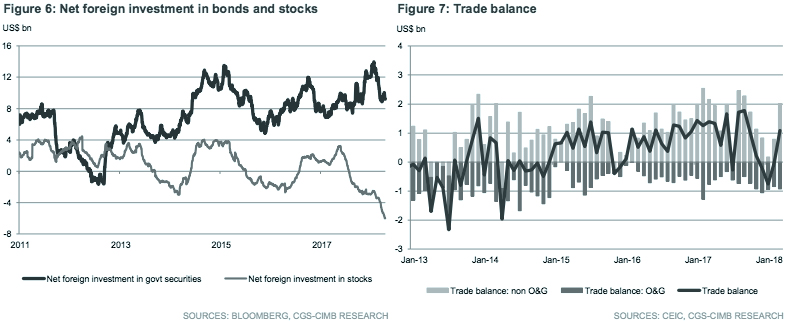
NODX declined 2.7% yoy in March, eluding expectations of a slight gain (CIMB: +0.9% yoy; Bloomberg consensus: +1.2% yoy; February: -6.0% yoy), as exports fell in the electronic (-7.1% yoy vs. -12.7% yoy in February) and non-electronic segments (-1.3% yoy vs. -3.3% yoy in February). The seasonally-adjusted NODX contracted for a fourth straight month in sequential terms (-1.8% mom in March vs. -2.7% mom in February).

Electronic NODX was still a drag
The collective exports of the five largest electronic items fell 7.2% yoy in March (-11.0% yoy in February), weighed down by declines in integrated circuits (-6.3% yoy vs. -12.1% yoy in February), PC parts (-51.2% yoy vs. -48.1% yoy in February), as well as diodes and transistors (- 24.6% yoy vs. -25.6% yoy in February). On the other hand, exports recovered in the telecom equipment (+6.3% yoy vs. -13.4% yoy in February) and PC segments (+24.4% yoy vs. +17.7% yoy in February).

Reversal in chemical exports trims non-electronic NODX slippage
Non-electronics NODX shrank by a smaller margin in March, as exports of chemicals rebounded (+3.4% yoy vs. -7.2% yoy). The contraction in pharmaceutical (-1.8% yoy in March vs. -8.0% yoy in February) and petrochemical shipments (-1.4% yoy in March vs. -12.9% yoy in February) narrowed while external demand for other chemical preparations expanded.

Weak trade flows to Asia offset by G3
Outward shipments grew in the G3 markets – the US (+32.6% yoy), Japan (+21.6% yoy) and the EU (+11.3% yoy) – and Indonesia (+17.3% yoy), buoyed by robust demand for non-electronic NODX. However, exports to Asia were subdued, especially to Hong Kong (-20.9% yoy), China (-12.2% yoy), Thailand (-10.6% yoy), and Malaysia (-3.1% yoy).

Export momentum to pick up as PMI inches higher in March
Singapore’s official manufacturing PMI rose 0.3pt to 53.0 in March (52.7 in February), contributed by pick-up in production, new orders, supplier deliveries, new export orders, imports, stocks of finished goods and order backlogs. The electronics PMI increased 0.3pt to 52.4 in March (52.1 in February), as most sub-indices improved except input prices and employment.

NODX forecast remains unchanged pending US-China tariff spat
We maintain our NODX forecast of 6.7% for 2018F, as the tit-for-tat tariffs between the US and China are unlikely to take effect until Jun, pending public feedback. Nonetheless, the US’ threat to levy up to US$150bn in tariffs on China exports and potential retaliation from Beijing, threatens Singapore’s entrepot economy, of which trade is 371% of GDP.

MAS highlights trade tensions as a risk to the economic outlook
Last Friday, the Monetary Authority of Singapore (MAS) increased the slope of the S$NEER policy band to allow for ‘modest and gradual appreciation’. At the same time, it sounded its concerns over external developments, in particular, the risk of trade tensions between the US and China generating negative spillovers. Looking ahead, we think these concerns will lead MAS to err on the side of caution, by maintaining its current monetary policy stance at the next scheduled review in October.

img-sg4-2

img-sg4-3

img-sg4-4

img-sg4-5


Originally published by CIMB Research and Economics on 17 April 2018.