China-ASEAN Monitor


China-ASEAN Monitor

Photo Credit: AP


Economy, Investment and Trade

New Malaysian government will review agreements with China
(2 May 2018) Chinese investments are trending in Indonesia as the country has received large investments from firms based in (17 May 2018) Newly minted Malaysian Prime Minister Tun Dr Mahathir Mohamad has stated his intention to review Chinese investments in Malaysia but also said he would respect all agreements with the country. On 17 May 2018, Tun Mahathir made it clear that his administration will study all the contracts signed in 2016 that are costly as the government might sustain debts that the country may not be able to settle. One project that is under scrutiny for the US$13.84 billion East Coast Rail Link project. The rail project was one of the US$36 billion worth of deals signed by former Malaysian Prime Minister Datuk Seri Najib Tun Razak during his bilateral visit to Beijing in 2016. The Chinese embassy in Malaysia issued a statement stating that its ambassador Bai Tian hopes to meet Dr Mahathir to further promote cooperation between both nations as soon as possible. In his statement, Bai Tian said China fully respects the will of the people and is looking forward to working closely with the newly-elected government. He added that China is willing to make concerted efforts to bring its relationship with Malaysia to new heights.
Read more>>

China and Indonesia vow to protect free trade
(8 May 2018) Indonesia and China will protect rule-based multilateral trading structure and free trade to boost economic recovery, investment assistance and trade liberalization. Premier Li Keqiang in a meeting with Indonesia’s President Joko Widodo on 7 May 2018 said both nations will also collaborate for regional stability and peace in the South China Sea, while Indonesia is required to play a key role in China’s relations with ASEAN. Li said trade between China and ASEAN surpassed US$500 billion and more than 50 million people travelled between China and ASEAN nations. China hopes to see breakthroughs in Regional Comprehensive Economic Partnership (RCEP) negotiations and wants to work with ASEAN to build innovation and encourage innovation-driven development. During the meeting between both leaders, both nations sealed a number of Memorandum of Understandings (MoU), which includes dam projects in Sulawesi and South Kalimantan.
Read more>>

15th China Asean Expo to promote the China-ASEAN Free Trade Agreement and business opportunities
(26 April 2018) The 15th China ASEAN Expo (CAEXPO) will be held from 12 to 15 September 2018 in Nanning, China, with the theme focusing on building the 21st Century Maritime Silk Road and forging a China-ASEAN Community of innovation, which includes Thailand, Japan, South Korea, Malaysia, Indonesia and Vietnam as the key destinations. The event aims to promote the China-ASEAN Free Trade Agreement (CAFTA) and business opportunities for local companies to enter the China market. Malaysia External Trade Development Corporation (MATRADE) said 179 companies including six government agencies from Malaysia joined the initiative in 2017, generating sales worth US$103.15 million (RM405 million). China’s statistics stated the bilateral trade between China and ASEAN in 2017 stood at US$95.61 billion (RM375.4 billion), an increase of 10.5 percent from year 2016.
Read more>>

Laos and China will expand bilateral trade value
(13 May 2018) Laos and China will use proactive measures to further develop bilateral trade volume between both nations. China wants to expand the demand of import from Laos and provide Laos support and convenience to be part of the first Chinese International Import Expo, which will be held from 5 November to 10 November 2018 in Shanghai. In the ninth meeting of the China-Laos economic and trade cooperation committee on 11 May 2017 in Vientiane, both nations came to a consensus to improve large infrastructure project collaborations in the Belt and Road Initiative (BRI) framework, coordinate smooth construction of China-Laos railway construction and further develop China-Laos economic corridor construction. China’s is Laos’ biggest investor as the country provided US$800 million worth of foreign development assistance for projects in Laos. Some of the large cooperation projects are the Mohan-Boten Economic Zone, Saysettha Comprehensive Development Zone, Vientiane-Vangvieng Expressway, Contemporary Agricultural Cooperation Demonstration Park and potash mines.
Read more>>


Malaysia: 1Q18 GDP and current account


HIGHLIGHTS

1Q18 GDP and current account

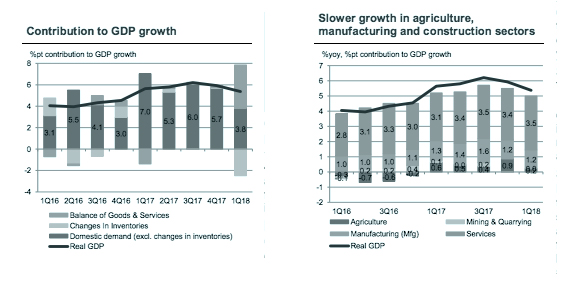
  • Malaysia’s economy expanded by 5.4% yoy in 1Q18 (+5.9% yoy in 4Q17), on the back of weaker growth in government consumption and investments.
  • The policy environment has altered following Pakatan Harapan’s victory in GE14.
  • A bias for fiscal expansion is seen as positive for growth prospects but may prompt BNM to reassess the impact of its monetary policy stance on the country’s policy mix.
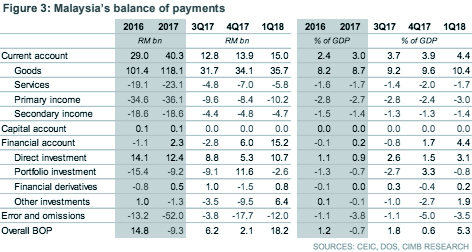
  • External financing conditions improved as both the current account and financial account surpluses widened.

img-my9-1

GDP growth moderates to 5.4% yoy in 1Q18
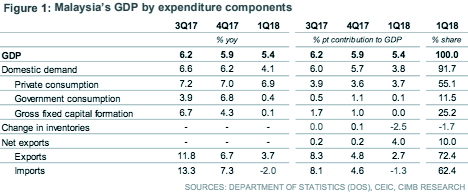
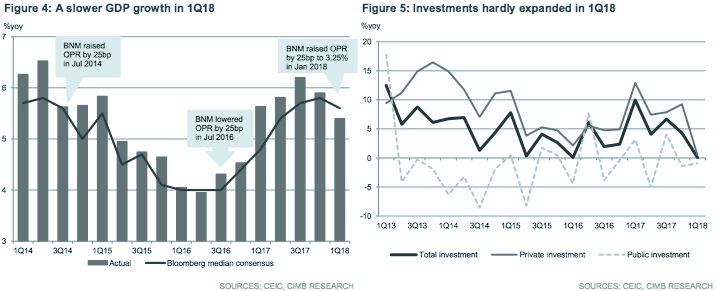
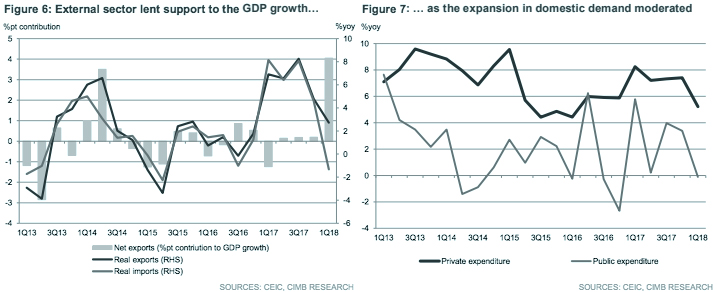
Malaysia’s GDP rose 5.4% yoy in 1Q18 (CIMB: +5.6%, consensus: +5.6%, 4Q17: +5.9%), on the back of slower domestic demand (+4.1% yoy in 1Q18 vs. +6.2% yoy in 4Q17), particularly government consumption (+0.4% yoy in 1Q18 vs. +6.8% yoy in 4Q17) and investments (+0.1% yoy in 1Q18 vs. +4.3% yoy in 4Q17). The bigger contribution from net trade in 1Q18 made a key difference to the topline, along with a sharp decline in imports.

Drag from agriculture masks resilience in other sectors
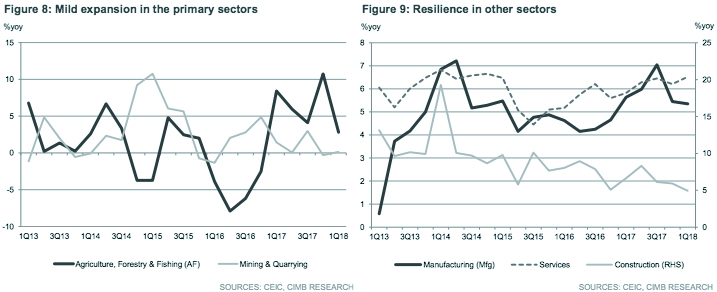
Growth in agriculture buckled under the weight of a lofty benchmark in 2017, when palm oil and rubber production staged strong recoveries following El Nino in 2015-16. Contributions to headline growth were broadly similar in the other segments, suggesting that the economy is not losing steam, merely casting off the one-off boost from plantation crops in 2017. The service sector grew at a faster pace (+6.5% yoy in 1Q18 vs. +6.2% yoy in 4Q17) thanks to a pickup in the insurance sector.

Strong trade position lifts current account
The current account (CA) surplus widened markedly to RM15.0bn or 4.4% of GDP in 1Q18 (+RM13.9bn in 4Q17) due to a higher goods surplus and a narrower services deficit. The financial account more than doubled qoq (+RM15.2bn in 1Q18 vs. +RM6.0bn in 4Q17) due to an influx of net direct investment and other investment. Conducive global market conditions encouraged Malaysians to invest overseas, which sank the portfolio account to a deficit of -RM2.6bn in 1Q18 (vs. +RM11.6bn in 4Q17).

Sea change after GE14
Following the upheaval in GE14, when Pakatan Harapan (PH) usurped Barisan Nasional, the only political coalition to have governed Malaysia since independence, the dust is settling on a changed policy landscape. On 16 May 2018, the Ministry of Finance announced the reduction of the Goods and Service Tax (GST) from 6% to 0%, and followed up with a statement on 17 May 2018 indicating that the Sales and Service Tax (SST) will be re-introduced, in addition to other revenue and expenditure measures which will be announced in due course. “Fiscal responsibility, transparency and governance will be a paramount consideration in the rolling out of fiscal reform,” said the ministry.

Macro forecasts unchanged while awaiting policy clarity
While awaiting the government’s announcements of further fiscal reforms, we maintain our 2018 GDP growth forecast of 5.2%. The GST cut is likely to shift inflation onto a shallower upward trajectory in 2H18, and reinforces our expectations for the OPR to remain unchanged at 3.25% in 2018. We are also keeping an eye out for the budget-balancing policies. If the government’s fiscal policy stance skews towards being too expansionary, Bank Negara Malaysia (BNM) may need to reassess the impact of its monetary policy stance on the country’s policy mix.

img-my9-2

img-my9-3

img-my9-4

img-my9-6

img-my9-7

img-my9-8

img-my9-9

img-my9-10

img-my9-12


Originally published by CIMB Research and Economics on 17 May 2018.

Myanmar Monitor


Photo

Photo credit: Frontier Myanmar

Economy, Investment and Trade

Myanmar allows foreign firms to invest in wholesale and retail trade
(14 May 2018) Myanmar’s Ministry of Commerce will open its wholesale and retail trading sector to foreign companies. Notification 25/2018 allows companies and joint ventures from other nations to trade any commodity produced in Myanmar or imported from overseas. In the past, overseas traders were reduced to dealing with fertilizers, seeds, pesticides, agricultural equipment, hospital appliances and construction materials. The ministry stated that the decision to open the market is to ensure consumers have more choices and pay less due to competition between local and international companies. The directive, which was released on 9 May 2018, contains several requirements, including a minimum capital requirement of US$5 million for foreign-based wholesaler and US$3 million for overseas retailers, excluding the value of land rental. For joint ventures, wholesale traders must give at least 20 percent share to a local partner and minimum US$2 million in capital, while joint-venture retailers are required to have at least US$700,000. There will be no capital requirements for local wholesale and retail traders.
Read More >

Rakhine government is the majority stakeholder of Maung Daw Economic Zone
(10 May 2018) The Rakhine State government will hold 65 percent stake in the construction of Maung Daw (Kanying Chaung) Economic Zone, while Kanying Chaung Economic Development Company, a joint venture between two Myanmar based firms, hold the remaining 35 percent. The administration and the company signed a Memorandum of Understanding (MoU) for the economic zone project, which will be built along the Rakhine State border. The project started in 2017 and will be developed over three stages. So far, a total of US$1.62 million (K2,200 million) has been issued to stage 1. Around 50 acres of land will be constructed during the project’s first stage and will be increased each year to reach 100 acres in the second stage and 200 acres in the final stage. The zone is intended to create job opportunities, improve the economic state of Rakhine and gain regional stability in the future.
Read More >

Yangon looks for world recognition through international-standard exhibition halls
(14 May 2018) Yangon’s will increase its endeavour to enhance tourism and encourage investments to improve its image in the eyes of the world. The construction of new MICE (Meeting, Incentive, Conference, and Exhibition) venues similar to Singapore’s Marina Bay Sands Convention Centre or the Hong Kong Convention and Exhibition Centre will help Yangon exhibit domestically-produced goods and services. Yangon Chief Minister U Phyo Min Thein said the bad international press on the Rakhine issue has affected some industries in the country, especially tourism. He said to address that problem, the state will look to building modern, international-standard exhibition halls.
Read More >

Yangon lays out economic visions for city’s development
(10 May 2018) Yangon will focus economic growth in 2018 and to do so, the city has laid out a five-point vision for urban development. Yangon Chief Minister U Phyo Min Thein pledged to open up more investment opportunities in industry, trade and logistics, transportation, energy and sustainable urban development. Some projects that are being developed in the region include a new deep-sea port and special economic zone; new industrial zones in the city’s rural areas and improving power supply, infrastructure, waste management, transport system and city expansion. For years, lack of clear policies, bureaucracy, limited infrastructure, constant power cuts and exorbitant land prices have hampered Yangon’s business opportunities but U Phyo Min Thein said those challenges were investment opportunities in themselves. However, his administration will minimise red tape when it comes to trade and investment in the city.
Read More >

Foreign Affairs

India intensifies efforts to strengthen ties with Myanmar
(15 May 2018) India’s External Affairs Minister Sushma Swaraj’s visit to Myanmar was more than just a visit as the country looks to accelerate implementation of agreements signed during Prime Minister Narendra Modi’s visit to Myanmar in 2017. One project India wishes to accelerate is the execution of the India-Myanmar-Thailand highway, which will ease trade of goods among the three nations, as well as other countries in the region. During her visit, seven agreements were also signed with Myanmar’s administration, including a border agreement which would allow people from both nations to travel across the border with passports and visas for accessing health, education services, pilgrimage and tourism. In 2014, Narendra Modi changed India’s approach from ‘Look East’ policy to ‘Act East’ during ASEAN-India summit in Myanmar. The country wants to strengthen its ties with ASEAN as it looks to compete with China’s economic impact in the region.
Read More >

Tan Sri Dr. Munir Majid co-chaired the Commonwealth CEOs Forum session at the Commonwealth Business Forum


Tan Sri Dr. Munir Majid co-chaired the Commonwealth CEOs Forum session at the Commonwealth Business Forum

1

Tan Sri Dr. Munir Majid, Chairman of CARI, co-chaired the Commonwealth CEOs Forum, held in conjunction of the Commonwealth Business Forum at the Mansion House, Walbrook in London recently.

2

He co-chaired the forum with Jonathan Bewes, Vice-Chairman of Standard Chartered and discussed with various CEOs around the Commonwealth region on the Commonwealth Advantage and the challenges and opportunities they see across Commonwealth markets.

The forum focused on identifying opportunities to promote the ease of doing business and to develop sustainable supply chains across the Commonwealth.

3

The forum was part of the Commonwealth Business Forum. The 11th edition of the forum addressed Commonwealth Heads of Government, 800 CEOs and board members of leading global companies and Commonwealth trade delegations.

The forum this year discussed on various key themes including accessing modern financial services, easing the pathway for business and growth, harnessing Commonwealth technology and innovation; creating a new attitude to sustainable business, mobilising an export economy and attracting inward investment.

Indonesia: April 2018 CPI inflation


HIGHLIGHTS

April 2018 CPI inflation

  • Headline inflation was stable at 3.4% yoy in April, a tad above our expectation but lower than market consensus.
  • The stable reading was aided by balancing forces between volatile food (lifted by low base effect) and administered price inflation (weighed down by high base effect).
  • As food inflation is expected to tick higher, the government’s commitment to keep fuel prices unchanged will be key for inflation rate to stay within the official target.
  • We keep our average inflation forecast at 3.4% for 2018F, and expect Bank Indonesia to maintain its policy rate at 4.25% at its next meeting on 16-17 May.

img-ind15-1

Stable headline inflation in April
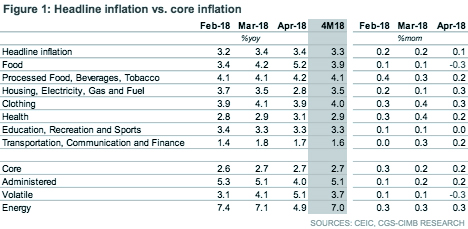
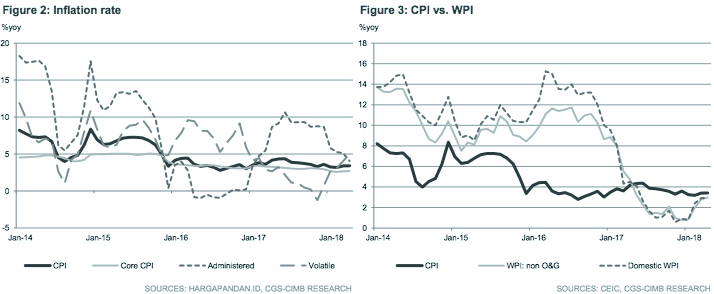
Headline inflation stood steady at 3.4% yoy in Apr (+3.4% yoy in Mar; CIMB forecast: 3.3%; Bloomberg median consensus: 3.5%), as the 0.1% mom increase in consumer price index in Apr 2018 matched that of Apr 2017. Furthermore, core inflation was unchanged at 2.7% yoy in Apr, as milder administered price inflation (+4.0% yoy in Apr vs. +5.1% yoy in Mar) removed the effect of higher volatile food inflation (+5.1% yoy in Apr vs. +4.1% yoy in Mar).

Food price pressures eased month-on-month
The acceleration in annual food inflation, despite a 0.3% mom decline, was the result of a low base effect, which is likely to drive the yoy change higher until year-end given an extremely benign price pressure during most of 2017. Nonetheless, the sequential mom decline implied easing price pressures, coming from rice, red chilies, pepper, and fresh & preserved fish. Rice prices have declined for two consecutive months as harvest season and rice imports relieve inflationary pressures triggered by supply shortage.

Step-up in base effect sent administered price inflation lower
Easing administered price inflation was led by waning electricity and water services inflation (+4.9% yoy in Apr vs. 8.4% yoy in Mar) due to a step-up in base effects arising from a second upward adjustment of postpaid 900VA electricity tariffs in Apr 2017. Transport inflation was unchanged at +2.5% yoy in Apr, as the government extended fuel price controls to non-subsidised fuels and required fuel retailers to seek approval on future fuel price adjustments. These measures were introduced to mitigate the risk of rising global oil prices on consumer inflation. We estimate that every 1% increase in global oil prices and/or 1% depreciation in Rp/US$ would raise market prices by an average of 0.92% for solar diesel, and 0.87% for premium gasoline.

Balancing clothing and health inflation kept core inflation in check
Among the core inflation components, declining inflation rate for clothing (+3.9% yoy in Apr vs. +4.1% yoy in Mar) cancelled out a sharper increase in health costs (+3.1% yoy vs. +2.9% yoy in Mar), while education, recreation and sports costs rose at a stable pace of 3.3% yoy.

Maintain average 2018 inflation forecast at 3.4% yoy
Balancing forces between volatile food and administered price inflation again kept overall inflation stable in Apr. Given that food price pressures are expected to rise as the festive season approaches, the government’s policy of not changing the fuel price will be crucial in keeping the inflation rate within the central bank’s target range of 2.5-4.5%. We maintain our forecast for average inflation to moderate to 3.4% yoy in 2018F (+3.8% yoy in 2017).
 

img-ind15-2

img-ind15-3

img-ind15-4

img-ind15-6


Originally published by CIMB Research and Economics on 2 May 2018.

CARI Captures 356

c354_graphic


SINGAPORE

Singapore’s strong overall job performance still suffer from large engagement deficit
(2 May 2018) Eventhough Singapore’s overall job performance is stronger compared to other countries, it still suffers from a large engagement deficit. While 37 percent of Singapore’s adult population has full-time employment, only 11 percent of the population of adults fit the description of “full-time employment that engages workers”. Singapore has emerged as the top Asian country in adult full-time employment, excluding those self-employed, with 48 percent of adults having this type of work. The Gallup’s 2018 Global Great Jobs Briefing shows the distribution of high-quality jobs around the globe and how those jobs improve work and life outcomes for businesses and employees alike. Other ASEAN nations with workers that are engaged at work are the Philippines at nine percent, Malaysia at seven percent, Indonesia at four percent, Myanmar and Cambodia with three percent each and Vietnam with one percent. The research shows that across industries and countries, teams with highly engaged members are 17 percent more productive than those with lower average engagement. Gallup added that the engagement deficit has negative impacts on employers and employees in Singapore as it can lower productivity and retention as well as affecting workers’ well-being.
ASEAN

Asean growth to remain stronger in the coming years
(3 May 2018) A report released by the Singapore based Asean+3 Macroeconomic Research Office (AMRO) stated that growth in ASEAN is expected to remain robust in the coming years. AMRO in its report mentioned that growth in the region is expected to be sustained at a level of mid-5 percent, set to grow at 5.4 percent in 2018 and 5.2 percent in 2019. The report also acknowledges two crucial key risks to growth which are the rise in the interest rates by the United States Federal Reserve and the escalation of global trade tensions particularly between the US and China. The report also noted that the fiscal policy could also have a bigger role to play in supporting growth in the country. AMRO also noted that robust global growth has assisted the region to build up buffers against potential external shocks. Regional exchange rates have also become more fluid in recent years, and have played a pivotal role as a shock absorber.

SINGAPORE

Singapore to promote green financing in ASEAN and help create sustainable business culture
(30 April 2018) Singapore Finance Minister Heng Swee Keat said the country is able to promote green financing thanks to its firm finance regulatory environment and ability in creating a business culture of sensible practices through its own expertise in the field. He stated that Singapore has substantial resources that it can allocate to ASEAN when it comes to building knowledge and talent. Citing the example of the Association of Banks in Singapore, which introduced guidelines for responsible financing in 2015, Heng said Singapore is well positioned to improve green financing efforts in ASEAN. As such, the Singapore Sustainable Blueprint, the ratification of the Paris Agreement and the passing of the Carbon Pricing Bill during Singapore’s 2018 budget shows that the government is committed to the sustainability effort.

INDONESIA

Indonesia manufacturing sector recorded its fastest growth in April
(2 May 2018) The Nikkei-Markit manufacturing purchasing managers’ index for Indonesia has stated that the country’s manufacturing sector earned its fastest growth in 22 months in April 2018 thanks to improving domestic demand output. In April, the index hiked nearly to 51.6-point, pushing further above the 50-point line that separates growth from contraction and touching its highest level since June 2016. With a sub-index for production touching its highest level since July 2014, companies surveyed for the gauge pointed stronger demand as the reason behind a third straight month of rising output. Since June 2016, in spite of weak demand from overseas and with a sub-index for new export orders registering sharper contraction in April, new orders increased quickly. However, inputs expenditures continued to increase at a slower pace as firms believe that the US dollar’s strength against Rupiah is the reason why cost for imported materials are increasing. Besides that, worries over a potential slowdown affected companies’ confidence, with an index tracking output expectations over the next 12 months dipping to its lowest level since December 2012.

PHILIPPINES, SINGAPORE

Firms from the Philippines and Singapore sign US$186.7 million worth of joint venture projects
(29 April 2018) Firms from Singapore and the Philippines penned a deal worth US$186.7 million of joint venture projects in a meeting held between Philippine and Singaporean firms in Singapore on 28 April 2018. Among the agreements signed was the letter of intent for the development of 25 new Jollibee outlets in Singapore over a period of five years by the Jollibee Worldwide Pte. Ltd. and Golden Beeworks Pte. Ltd. This joint venture is expected to create over 1,920 jobs, especially for Filipino workers. The Philippines president Rodrigo Duterte was in Singapore to witness the ceremony and welcomed foreign investors to his country as long as investors pay taxes and follow the country’s regulation, including the environmental requirements. He also assured the Singaporean and Filipino businessmen of his personal backing in the fight against corruption that has been discouraging investors from coming into the country.

PHILIPPINES

Philippines inflation to ease once lawmakers approve a measure to increase rice imports
(2 May 2018) Inflation in the Philippines will slow down from a five-year high once the country’s lawmakers officially agree to a measure that will allow more rice imports, giving authorities the opportunity to delay increase in interest rate. The Philippines Economic Planning Undersecretary Rosemarie Edillon said once a law limiting overseas purchases of the nation’s staple grain is revised by Congress by the end of the first half of 2018, the country’s inflation which has hiked to 4.3 percent in March will cool by at least one percentage point. Philippines President Rodrigo Duterte said the removal of import limits on the grain will help to increase the country’s depleted stockpiles. Currently, the Philippines has limited its rice imports to a volume that is given by the country’s National Food Authority, which prioritises local farmers. The arrangement, which the World Trade Organization (WTO) had been pushing to end, not only limits rice supply but also boosts domestic prices. Edillon said by enabling a market-driven importation slapped with at least 35 percent in tariff, it will boost the supply of the grain and cut retail prices by as much as US$0.14 (7 pesos) per kilogram from US$0.85 (44 pesos) a kilogram.

MALAYSIA

Malaysia launches Unsold Property Enquiry System to provide information to market players
(3 May 2018) The National Property Information Centre (NAPIC) has introduced a new system called the Unsold Property Enquiry System (UPESM), which helps market players such as developers, local authorities, buyers and other interested parties to view detailed information on properties. The system, which was developed in 2017 and launched in April 2018, shows the type of overhang properties, location and type. The complimentary service is limited to datas from 2016 and 2017 because of the high level of overhang. For the first half of 2017, UPESM showed that the completed-but-unsold residential units ballooned to US$3.12 billion (RM12.26 billion) from about US$2.18 billion (RM8.56 billion) at the same period in 2016. Known as an “overhang”, total unsold completed units increased to 20,876 in 2017, compared with 14,792 at the end of 2016, most of the overhang properties are high-rise residentials units costing US$127,097 (RM500,000) and above. NAPIC’s overhang figure is lower than Bank Negara’s figure of more than 140,000 units because it includes serviced apartments and launched units but unsold after a certain period.

VIETNAM

Vietnam makes trade surplus of US$3.39 billion in the first four months of 2018
(2 May 2018) Vietnam General Statistic Office reported that the country has made a trade surplus of US$3.39 billion in the first four months in 2018, in which the foreign direct investment (FDI) sector, including fuel, led the way with US$11.7 billion. The country’s export turnover expanded by 19 percent year-on-year to US$73.76 billion in the first four months of this year, of which the domestic-invested sector reached US$20.28 billion, up to 17.9 percent, while FDI sector earned US$53.48 billion, rising by 19.4 percent and occupying 72.5 percent of the country’s total exports. In terms of imports, the country forked out US$70.37 billion to import goods from January to April, up 10.1 percent year on year. Imports increased due to the expansion of several commodities, including electronics and computers worth US$13.4 billion, up 22.3 percent; mobile phones and components, which were valued at US$4.4 billion, up 9.8 percent; and petrol and oil worth US$2.8 billion, up 31.6 percent. Growing 11.7 percent year-on-year, the Vietnam Ministry of Agriculture and Development forecast that the country spent US$9.5 billion on purchasing foreign agro, forestry and fishery product in the four-month period in 2018.

CAMBODIA

Cambodian agriculture sector show a sign the sector is on the right track
(2 May 2018) Cambodia’s Ministry of Agriculture said the country’s agriculture sector was on the right track as the total export of agriculture products were 5.13 million tonnes in 2017, a hike from 4.7 million tonnes in 2016. According to the 2017 annual report released by the ministry, rice exports grew by 17.3 percent to reach 635,679 tonnes in 2017, while rubber expanded by 30.14 percent to reach 188,832 tonnes during the year. While, the export of cashew nuts grew up to 20 percent in 2017 to 87,853 tonnes. However, rampant smuggling continues to plague the country’s agricultural trade as more than 40 percent of Cambodia’s rice exports go through informal channels while rubber plantations and processing companies have lamented that small-scale farmers get higher prices for their crops by selling to Vietnamese brokers instead of following Cambodia’s tax laws.

THAILAND

Growth in exports and tourism sector improve Thailand’s economic recovery
(30 April 2018) Thailand’s economy has bounced back in the first quarter of 2018 thanks to healthy growths in the export and tourism sectors. Bank of Thailand stated that exports in the first three months jumped 11.4 year-on-year, representing a seven-year high and a driving force in the country’s economy in 2018. Tourist arrivals hitting 10 million is one of the aspects helping Thailand’s economy in the latter half of 2018. For March 2018, the merchandise exports reached US$22.363 billion thanks to steady economic growth seen in Thailand’s trade partners. Thailand’s think tank Kasikorn research centre stated that the country’s favorable performance in oil-related shipment is due to rising global crude oil prices and accelerated electronics imports by China and the U.S. before the U.S. enforces import tariffs on Chinese-made products.

Indonesia: 1Q18 direct investments


HIGHLIGHTS

1Q18 direct investments

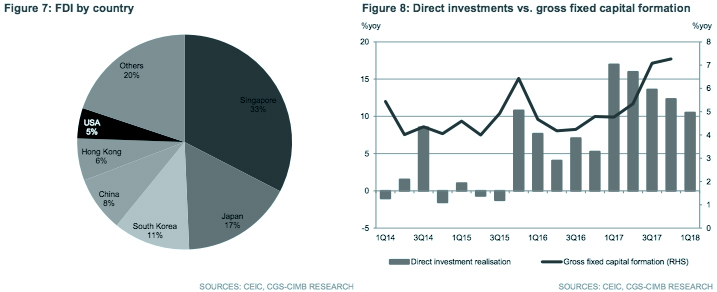
  • Direct investments (DI) rose 10.5% yoy to US$13.8bn in 1Q18, led by FDI (+11.5% yoy to US$8.1bn) and followed by DDI (+9.1% yoy to US$5.6bn).
  • The key growth driver was the tertiary sector (utilities, construction and real estate).
  • DI in the secondary sector contracted at a milder pace on the back of improving FDI, while DI in the mining sector took a back seat after strong realisations in 2017.
  • Aided by a recovering investment climate, we project GDP to expand 5.2% yoy in 1Q18, and reiterate our 2018 GDP growth forecast at 5.3% yoy.

img-ind14-1

1Q18 direct investment realisation supported by FDI…
Total direct investments (DI) rose 10.5% yoy to US$13.8bn in 1Q18 (+12.3% yoy to US$13.4bn in 4Q17). Foreign direct investments (FDI), which accounted for 59% of DI, grew 11.5% yoy to US$8.1bn in 1Q18 (+11.4% yoy to US$8.4bn in 4Q17), whereas domestic direct investments (DDI) gained 9.1% yoy to US$5.6bn (+14.0% yoy to US$5.0bn).

… and led by investments in tertiary sectors
DI in tertiary sectors remained strong (+44% yoy to US$6.7bn in 1Q18 vs. +69% to US$6.4bn in 4Q17), and accounted for 48% of total DI, on the back of government’s infrastructure projects and power capacity expansion plans. The key drivers included real estate (FDI +141% yoy / DDI -28% yoy), utilities (FDI +22% / DDI +5%), and construction (FDI +592% / DDI +1,124%). DI in the mining industry (ex O&G) was weighed down by a strong expansion last year (-40% yoy to US$1.1bn in 1Q18 vs. -8% yoy to US$1.2bn in 4Q17). DI in the mining industry in 2017 was the highest since 2013, fostered by the lifting of mineral export ban in Jan 2017 and improving commodity prices.

Contraction of DI in secondary sectors eased amid improved FDI
The pace of contraction of DI in secondary sectors eased in 1Q18 (-12% yoy to US$4.7bn vs. -23% yoy to US$4.6bn in 4Q17), led by stronger FDI in machinery & electronics (FDI +73% yoy / DDI -20% yoy), wood (FDI +22% / DDI +48%), and chemical & pharmaceutical (FDI +9% yoy / DDI -15% yoy). DDI rose strongly in the motor vehicle & other transport equipment (FDI -56% / DDI +87%), and non-metallic mineral sectors (FDI -49% yoy / DDI +117% yoy). Singapore remained the largest source of FDI in 1Q18 (33% of FDI), followed by Japan (17%), South Korea (12%) China (8%) and Hong Kong (6%), which together contributed three-quarters of FDI.

More regulations to improve investment climate
The government’s push for a better investment climate has seen DI growing at a doubledigit pace in each of the past five quarters, with the share of new projects rising to 80- 83% in 2017-1Q18 from 63-70% in 2013-2014. The drive to spur more investment continued with recently issued regulations to simplify the tax holiday requirement and application process for investments worth at least Rp500bn (MOF Regulation No.35 of Year 2018), as well as a simpler application process for skilled foreign workers (Presidential Regulation No.20 of Year 2018).

Inflation rate to remain under control
BI did not highlight inflation pressure as a domestic risk. Policy adjustments, like the coal price cap at US$70 per metric tonne and the imposition of an approval process to raise non-subsidised fuel prices, have reduced upward price pressures and hence inflation expectations remain stable.

GDP growth of 5.2% yoy projected for 1Q18
Taking into account the latest DI readings, we expect 1Q18 GDP to grow 5.2% yoy, and reiterate our GDP growth forecast of 5.3% for 2018. The GDP reading for 1Q18 will be released on 7 May 2018.


img-ind4-2

img-ind14-3

img-ind14-4

img-ind14-5

img-ind14-6

img-ind14-7


Originally published by CIMB Research and Economics on 2 May 2018.

Myanmar Monitor


Photo

Photo credit: The Myanmar Times

Economy, Investment and Trade

MADB to enable more farmers to receive funds by revising its group-based lending system
(1 May 2018) Moving away from the current group-based lending system, Myanmar Agriculture Development Bank (MADB) said they will start disbursing loans on an individual basis. The new system enables farmers to provide their own guarantees. This will be different from the old system, which provides loans to groups of three farmers who guarantee each other. Based on the old system, if two farmers in a group have not settled their dues, the one farmer in that group is unable to apply for fresh loan until the two pay off their debts. Currently borrowers also experienced delays in receiving loans and have to pay high interest rates under the two-step loan system, in which funds from Myanma Economic Bank are extended to borrowers. However, according to the Myanmar Union Minister for Planning and Finance U Kyaw Win, starting May, efforts will be made to lower interest rates at the MADB so that it is able to support the farmers in the country. He added that, arrangements are being made for interest rates to be reduced further by involving private banks in the processing of loan to borrowers. In 2017, the MADB, which was formerly under the Myanmar Ministry of Agriculture, Livestock and Irrigation (MOALI), was moved under the purview of the Myanmar Ministry of Planning and Finance (MOPF) by which under the supervision of the ministry, loans were given out to farmers at an interest rates of 8 percent per month.
Read More >

Myanmar launches its new Port Electronic Data Interchange (Port EDI) system to modernise its trade competitiveness
(1 May 2018) Myanma Port Authority, under the Myanmar Ministry of Transport and Communications inaugurated its Port Electronic Data Interchange (Port EDI) system on 30 April 2018. The execution of the new system was backed by the Japanese government and Japan International Cooperation Agency (JICA) since 2015. The adoption of Port EDI system will computerise the entire system and enhance the efficiency of trade and logistics in the coastal ports. The system consists of six system functions and system infrastructure in which the system functions provide the port clearance procedures system, berth allocation system, invoice issuing system, statistics management system, logistics monitoring system and terminal operation system. With the new systems, port-related procedures, collection of port charges, management of port statistics and terminal operation management handled by paperwork and rudimentary way of data processing can be replaced and streamlined with technology. Maritime trade for Myanmar accounts for 85 percent of its national trade and this reformation is essential in modernising Myanmar trade competitiveness.
Read More >

Yangon, Myanmar inks agreement with China to carry out necessary move for new city project
(2 May 2018) New Yangon Development Company (NYDC) signed a framework agreement with China Communications Construction Company (CCCC) under which two Chinese companies will carry out surveys and studies that is necessary to develop the new city project in Yangon. NYDC is supported by the Yangon Regional Government, while CCCC is one of the biggest international construction companies in the world. Partnership between NYDC and CCCC is expected to improve relationship between Myanmar and China and contribute to Myanmar’s GDP through the creation of jobs. Yangon Chief Minister U Phyo Min Thein said investors from China, South Korea and countries from ASEAN are keen on the project and they have received proposals to build two bridges, which provide access to the new city and also link the city with other main roads that connect with the rest of Yangon. Some prospective investors have also proposed to build new roads in the city, and a request to lease over 2,000 acres of land for development within the new city. The total area of New Yangon City, surrounding Phase 1 and Phase 2, will cover 1,500 square kilometers. Under Phase 1, NYDC will develop 20,000 acres of land west of central Yangon across from Kyeemyindaing into an urban industrial district. Meanwhile, Phase 2 will stretch across from Dala to the Gulf of Martaban. Infrastructure works related to Phase 1 of the New Yangon City project are expected to amount to a sum in excess of $1.5 billion.
Read More >

Myanmar Asia World Port Terminal invests in 14 new port equipments
(30 April 2018) Myanmar Asia World Port Terminal (AWPT) has invested in 14 new pieces of port equipment for its long-term port operations. This includes nine SANY Rubber Tyred Gantries, one Mobile Harbour Crane (MHC) from Konecranes Gottwald, two Reach Stackers (RS) and two Empty Container Handlers from SANY. AWPT, which is managed and operated by Asia World Port Management Company (AWPM), has managed almost up to 40 percent of the country’s total in 2017 and the terminal is preparing for a greater demand in the next few years. This is the single largest investment in technology AWPT has made in recent years. The new additions is expected to boost AWPT’s overall operating capacity by 33 percent and containers can be stacked up to 7 high as opposed to 5 high. Yangon Region has few international ports, namely AWPT, Hteetan Port Terminal, Myanmar Industrial Port, Ahlone International Port Terminal and Myanmar International Terminal Thilawa (MITT) by which in 2018, these ports total combine capacity generated over one million containers, which is more than 90 percent of the total capacity in Myanmar.
Read More >

Myanmar needs to create clear and transparent regulatory environment to attract investment
(28 April 2018) Myanmar’s ambition of becoming Asia’s last frontier market can only be realized if the government creates an explicit and transparent regulatory environment. According to the Oxford Business Group (OBG), if the Myanmar administration is able to come up with such an environment, more investors would come and invest in the country. In the “Business Barometer: OBG in ASEAN CEO Survey’, it was found that top executives from Myanmar were among the most downbeat about the domestic tax environment background. Similar to the perception of those from Vietnam, they were most unfavourable with the degree of business transparency in Myanmar. Myanmar must also take advantage of its position between two economic superpowers, China and India, without becoming too dependent to either. However, OBG noted that Myanmar is still on track to become the fastest-growing economy in ASEAN, despite some challenges.
Read More >

China-ASEAN Monitor


China-ASEAN Monitor

Photo Credit: The Nation


Economy, Investment and Trade

Large Chinese investments make their presence felt in Indonesia
(2 May 2018) Chinese investments are trending in Indonesia as the country has received large investments from firms based in China. According Indonesian Investment Coordinating Board’s (BKPM), data from January to March 2018, investment from China was valued at US$676.2 million, an increase of 12.78 percent from US$599.57 million the same quarter in 2017. BKPM said the ongoing smelter projects which are controlled by Chinese investors, especially the projects in Sulawesi, were among the most stable investments for Indonesia. The board added that in April, five contracts worth US$23.3 billion, which consist of several infrastructure projects such as a hydropower plant development and a facility to convert coal into dimethyl ether has been signed between both countries as part of the initiative to absorb large amount of capital investment to Indonesia. China investment to Indonesia has experienced a significant increase from US$2.66 billion in 2016 to US$3.36 billion in 2017, and was ranked as the country with the third-largest foreign investment in Indonesia. The Indonesian administration has set an investment target of US$54.77 billion (Rp 765 trillion) for 2018. In the January-March 2018 period, the BKPM recorded US$13.26 billion (Rp 185.3 trillion) in investments, or 24 percent of the target.
Read more>>

Zhejiang province and Singapore to deepen partnership in innovation and urban solutions
(26 April 2018) Singapore and China’s province Zhejiang will work together to look for prospects under the Belt and Road Initiative and deepen cooperation in areas such as innovation and urban solutions. Singapore Senior Minister for Trade and Industry Sim Ann said these include encouraging more Chinese firms to tap Singapore companies’ network and experiences in South-east Asia to cooperatively expand in the region. Fourteen project collaborations were signed on 26 April 2018 between Singapore and Zhejiang companies in sectors such as urban solution, e-commerce, wholesale trade and logistics, which shows Singapore’s continued strong interest in the province. Among them is a joint venture between Anacle, a Singapore software company, and Enjoytown, a Zhejiang real estate developer, to co-develop and provide smart city and township management solutions. Being one of the wealthiest provinces in China, Zheijiang’s gross domestic product stands at US$1.08 trillion, which is three times the size of Singapore’s economy. Trade between Singapore and Zhejiang almost doubled in the past decade by which in 2007, bilateral trade was at US$2.7 billion, and in 2017, it reached US$5.2 billion, 24 percent hike from 2016. Singapore companies have also penetrated into the province with a total investment of $7.2 billion with 1,201 projects in the province.
Read more>>

15th China Asean Expo to promote the China-ASEAN Free Trade Agreement and business opportunities
(26 April 2018) The 15th China ASEAN Expo (CAEXPO) will be held from 12 to 15 September 2018 in Nanning, China, with the theme focusing on building the 21st Century Maritime Silk Road and forging a China-ASEAN Community of innovation, which includes Thailand, Japan, South Korea, Malaysia, Indonesia and Vietnam as the key destinations. The event aims to promote the China-ASEAN Free Trade Agreement (CAFTA) and business opportunities for local companies to enter the China market. Malaysia External Trade Development Corporation (MATRADE) said 179 companies including six government agencies from Malaysia joined the initiative in 2017, generating sales worth US$103.15 million (RM405 million). China’s statistics stated the bilateral trade between China and ASEAN in 2017 stood at US$95.61 billion (RM375.4 billion), an increase of 10.5 percent from year 2016.
Read more>>

U.S.-China trade conflict a concern for ASEAN
(28 April 2018) Singapore’s Prime Minister Lee Hsien Loong said a mounting trade spat between the United States and China was one of the most critical concerns for Southeast Asian nations. On behalf of the ASEAN chair during the 32nd ASEAN Summit, he said that the bloc is deeply concerned over the rising sentiments on protectionism and anti-globalisation between both the economic superpowers. Lee also stated that the political mood in many countries has shifted against free trade and the open and rules-based multilateral trading system seems to be under scrutiny in the region. The United States administration led by Donald Trump has threatened to impose tariffs on up to US$150 billion of Chinese imports, and Beijing has vowed retaliation against American exports. ASEAN is also working on initiatives to cooperatively tackle the threat of extremism and cyber-attacks, as well as to further advance the trade and cross-border e-payment systems.
Read more>>


Foreign Affairs

The Philippines looks to offer 60-40 deal to China in South China Sea joint exploration
(28 April 2018) The Philippines might create a 60-40 sharing scheme in the joint exploration plan with China in the South China Sea. On 26 April 2018, the Philippines President Rodrigo Duterte said rather than go to war over the disputed territory which would only result in the loss of Filipino lives; he suggested improving ties between the Philippines and China by offering a better deal with China to obtain 40 percent of the stake on the joint sea exploration. Insisting that war over the territorial dispute was not an option, President Duterte emphasised that he prefers to fortify the economic and security partnership with China. In recent years, the Philippines were disputing with China over some areas in the South China Asia. However, those tensions were quelled when both countries pursued bilateral talks on territorial conflict while improving bilateral links with China on trade, investment and tourism.
Read more>>

CARI Captures 355

c354_graphic


ASEAN

FinTech to play a significant role in ASEAN cooperation
(26 April 2018) Financial technology (FinTech) is expected to play a significant role in ASEAN partnership as the regional bloc looks to come out with new and innovative answers to solve problems of financial inclusion. In the Asian Development Bank (ADB) report titled “Accelerating Financial Inclusion in Southeast Asia with Digital Finance”, digital finance can hasten the access to financial services in the region. Globally, there has been a growth in financial inclusion. New technologies such as 3D printing, artificial intelligence and robotics, the Internet of Things (IoT), big data, mobile and cloud technology are some of the driving changes that advance financial inclusion in the region. A report by Temasek and Google said ASEAN digital economy is forecast to hit US$200 billion by 2025. In 2017, International Finance Corporation (IFC), a member of the World Bank Group, and Monetary Authority of Singapore (MAS) inked a memorandum of cooperation to form and advance the Asean Financial Innovation Network (AFIN) which allow banks and FinTech to expand, test and process digital finance and inclusion solutions. They will also be able to disseminate their services to financial institutions in multiple authorities.

VIETNAM

Three Vietnamese cities to be part of the proposed ASEAN Smart Cities Network (ASCN)
(26 April 2018) Singapore Prime Minister Lee Hsien Loong said three cities in Vietnam namely Hanoi, Ho Chi Minh City and Da Nang will be part of the ASEAN network of smart cities. As the chair of ASEAN in 2018, Singapore’s idea of the smart cities network is to enhance connection on digital infrastructure and services such as e-payments across ASEAN. ASEAN Member States have nominated a total of 26 cities for the ASCN. This is envisioned as an all-in platform for ASEAN cities to share best practices, come up with city-specific action plans, and attract bankable smart city projects in cooperation with the private sector and ASEAN’s external stakeholders, including China. In line with each city’s local and cultural context, ASCN was designed to allow ASEAN member states to emphasise on fields and areas that matter to them. ACSN will look at various sectors such as transport, water quality, energy, healthcare, education, public services and information and communications technology.

PHILIPPINES

Russia and China are the new promising destinations for Filipinos looking for job abroad
(24 April 2018) Russia and China are some of the prospective destinations for Filipinos searching for jobs abroad as the Philippines intends to cut its dependency on the Middle East. According to the Philippine Overseas Employment Administration, for the first time ever, Russia is opening its market to the Philippines and following the footsteps of China, the country is also requesting for a government-to-government deployment scheme from the Philippines government. Russia is now recruiting skilled workers in construction and services while China is requesting the Philippines to send over 2,000 English teachers in 2018. For decades, the Philippines has depended on money sent home by millions of Filipinos working abroad to boost the country’s economy and sustain the currency. In 2017, World Bank estimated the funds to be around US$33 billion last year, which is about 10 percent of the total gross domestic product of the Philippines and it is the country’s biggest source of foreign exchange after exports.

INDONESIA

Indonesian motorcycle taxi drivers push for an end to low online fares
(23 April 2018) Thousands of Indonesian motorcycle taxi drivers that work for start-ups such as Grab and Go-Jek called for an end to low online fares and urged tighter regulations on the ride-hailing companies. Both startups have engaged in price wars to snatch market share in Southeast Asia’s biggest economy. The taxi drivers demanded for a standard fare of US$0.28 to US$0.38 (3,000 to 4,000 rupiah) per kilometre. They also urged for legal and social protection for online ‘ojek’ drivers as part of the national workforce. To seize the market share in the country, startups like Grab and Go-Jek have reduced the prices for its car rides, motorcycle trips and other services. While the move taken by the Indonesia Transport Ministry to classify Grab and Go-Jek as transportation instead of technology firms might cause the firms to encounter higher costs and scrutiny, the ministry further added that the levies that yet to be implemented depend on the consideration of the companies. Nevertheless, both Grab and Go-Jek have yet to make significant changes to their tariff fares.

CAMBODIA

Cambodian government reveals new blueprint for the country’s budgetary policy
(23 April 2018) Cambodia Prime Minister Hun Sen announced the new plan for budget reformation that focuses on intensifying the management quality of public funds. The Budget System Reform Programme for 2018-2025 is the new blueprint for the country’s budgetary policy which emphasises on boosting the effectiveness of the multi-year budgeting. Cambodia’s Prime Minister Hun Sen said since the launch of the budget reform programme 14 years ago, the government has made enormous progress, including achieving macroeconomic stability, building trust on the national budget and implementing financial information management systems (FIMS), a reform initiative that is specifically designed to enhance the governance and transparency of national budget management. In 2017, FMIS was implemented in ten government ministries after a successful application of the scheme at the National Treasury Department. In 2018, it will be used by 25 new provincial treasury departments and ten additional ministries.

INDONESIA

Indonesia to conclude RCEP negotiations by 2018
(24 April 2018) Indonesia Trade Ministry said the government is planning to finalise negotiations over the Regional Comprehensive Economic Partnership (RCEP) by 2018. Currently, negotiations progress is at 80 percent. The RCEP involves 10 ASEAN countries and six ASEAN partner countries – Australia, China, India, Japan, South Korea and New Zealand. The Ministry emphasised the importance of ASEAN countries coming to a firm agreement over certain matters before the negotiations end. Meanwhile, Coordinating Ministry of Economic Affairs highlighted the importance of speeding up the RCEP negotiations, which started in 2012. Following the withdrawal of the United States from the Trans-Pacific Partnership (TPP) agreement, the ministry said the RCEP would become the largest trading group in the world in terms of the number of members and trade value.

THAILAND

Thailand firms to invest in Indian infrastructure projects
(23 April 2018) Thailand companies operating in India see a good opportunity to invest an approximate value of almost US$3 billion in the areas of green and brownfield projects including energy, infrastructure and metals sectors over the next three years. Thailand Trade Centre said the entity is eyeing India with great interest for the past seven decades and plans to strengthen the two-way trade thanks to the favourable approach from both governments. Over the decades, nearly 30 Thai firms are active in the field of infrastructure, real estate, food processing, chemicals, hotel and hospitality sectors in India. The Thai administration has also called Indian firms to invest in Thailand and at present, around 40 Indian companies have invested around US$2 billion, namely in the areas of software, agriculture chemicals and electric car development in the country. Since 2000, bilateral trade between the two countries has multiplied eight times to reach US$10 billion in 2017. Thai trade centre said it is vital for both countries to encourage private sectors to make investments in infrastructure and manufacturing in each other’s country.

VIETNAM

Steel sector has the potential for 22 percent growth
(24 April 2018) Vietnam steel industry is in the making to reach a growth in production at 22 percent and develop export markets in 2018. According to the Vietnam Steel Association (VSA), this projection will only be achievable if it overcomes the constraints particularly in trade defence lawsuits and high imports. In 2017, the sector faced a total of 30 trade defence lawsuits from other countries and some of them have not been solved or settled.These include anti-dumping cases for cold-rolled stainless steel, steel plates, H-shaped steel, trade defence cases related to pig iron, long steel and colour-coated steel sheet. As of March 2018, Vietnam had exported 446,000 tonnes of steel products reaching US$321 million. Nevertheless, Vietnamese steel has managed to meet the demand of big markets, such as the United States, Australia and Europe due to its quality steels.

CAMBODIA

E.U and the US reluctant to remove preferential trade access for Cambodia’s vital garments sector
(24 April 2018) The Fitch’s BMI research unit said the European Union and the United States are hesitant to remove preferential trade access for Cambodia garments which indicate that the worst-case-scenario of major industry disturbance and factory closures is less conducive. Rights groups and the opposition have continuously called on the United States and others to force targeted sanctions in the wake of a wide-ranging crackdown on political disputes in Cambodia. However, industry insiders opposed any cut to trade preferences, saying it would hurt garment workers the most. According to the World Bank, Cambodia has been the sixth fastest-growing economy in the world over the past two decades, with an average GDP growth rate of 7.6 percent, thanks largely to garment exports. The Garment Manufacturers Association of Cambodia (GMAC), which represents 600 factories expects exports to grow 3 to 4 percent in 2018.

MALAYSIA

Malaysia’s to grow the fastest in Southeast Asia after the Philippines in Q1
(20 April 2018) Economists predict Malaysia to develop at the fastest pace in Southeast Asia region after the Philippines in the first quarter of 2018. Malaysia is forecast to reach 5.6 percent growth in gross domestic product (GDP) for the quarter, higher than emerging economies’ GDP growth expectation of 5.4 percent. According to Bloomberg’s data, Malaysia is expected to position the country as the third fastest growing economy among emerging economies, after the Philippines. JP Morgan Chase, in its latest report, said Malaysia’s economy in the first quarter is expected to have strong projection in economic growth, thanks to growing manufacturing exports. The American financial services firm changed the GDP growth forecast upward to seasonally adjusted annual rate of 6.5 percent quarter-on-quarter from 5.5 percent previously.However, the firm maintained Malaysia’s overall GDP growth year-on-year at 5.8 percent.