CARI Captures Issue 524: ASEAN tech giants competing with large conventional banks over digital banking services market


ASEAN
ASEAN tech giants competing with large conventional banks over digital banking services market

(15 October 2021) Southeast Asia’s tech giants such as ‘superapp’ providers GoTo and Grab are competing with established conventional banks for the burgeoning digital banking services market in Southeast Asia. This is expected to benefit the long-neglected rural populations of Southeast Asia, who generally lack access to financial services. According to research conducted by Google and Temasek Holdings, about half of Southeast Asia's nearly 400 million adults do not have a bank account, while over 90 million more are 'underbanked', meaning they hold a bank account but lack sufficient access to investment products, insurance or credit. In Indonesia, Goto plans to offer fully integrated banking services in partnership with Bank Jago. In Singapore, Singaporean tech giants Sea and Grab plan to roll out digital banking services in the city-state in early 2022. Meanwhile, large incumbent banks such as UOB and DBS have also had a head start in providing digital banking services within the region, with UOB launching digital bank TMRW in Thailand in 2019, and in Indonesia in 2020.
 

SINGAPORE
Singapore’s central bank tightens its monetary policy for the first time in three years

(14 October 2021) Singapore’s central bank tightened its monetary policy for the first time in three years on 14 October 2021, as the country seeks to reopen its economy and manage inflationary pressure. The city-state also recorded a 6.5% increase in GDP for the July-September quarter. The last round of monetary tightening for Singapore was in October 2018. Recent inflation was a major factor in the decision to implement monetary tightening this time, according to the Monetary Authority of Singapore (MAS). While some industries continue to suffer from COVID-19's effects, Singapore's overall consumer price index rose 2.4% on the year in August 2021, due to a confluence of factors including normalizing demand, supply chain problems, rising energy prices, a foreign manpower crunch due to border closures, and domestic policy-driven cost pressures such as the government’s plans to increase wages in lower-paid sectors. Singapore authorities are concerned that the city state’s planned reopening could be hindered if consumers are hit by rising costs.
 

MALAYSIA
Malaysia ranks among top ten largest furniture exporters in the world

(15 October 2021) Malaysia now ranks among the top 10 largest exporters of furniture in the world, with about 80% of its production delivered abroad, according to the Malaysia External Trade Development Corporation (Matrade). Matrade stated this was because the local furniture industry had kept abreast of technological advances and global changes in consumer tastes, and had shifted from being original equipment manufacturers (OEM) to original design manufacturing (ODM) or original brand manufacturing (OBM). In 2020, the industry saw exports valued at MYR 12.86 billion, or a double-digit increase of 15.5% compared with the previous year. Malaysian furniture are exported to over 160 countries and comprise mainly bedroom, living room and kitchen furniture made from wood as well as seats and furniture components made from other materials.
 

THAILAND  
Thailand approves plan to end quarantine for vaccinated travellers from certain countries

(15 October 2021) The main Thai COVID-19 task force approved a plan to end quarantine requirements for vaccinated travellers from certain countries starting in November 2021 in bid to rescue the struggling tourism sector ahead of the year-end holiday season. Under the new rule, air travellers from the US, UK, China, Germany and Singapore will be exempted from quarantine on arrival starting 01 November 2021. More countries may be added to the list after due diligence. The task force also shortened a night curfew by two hours to between 11 PM and 3 AM starting on 16 October, while also reducing the number of provinces deemed at the highest risk of COVID-19 to 23 from 29. But the task force retained Bangkok, a gateway for tourists, in the highest-risk category because of the high number of new cases.
 

VIET NAM  
Manufacturers in Ho Chi Minh City struggling with workers shortage following easing of lockdown measures
 
(14 October 2021) Manufacturers in Ho Chi Minh City are currently struggling with a shortage of workers following the easing of COVID-19-related lockdown measures. Suppliers of garments, textiles, footwear, furniture and other products to global brands ranging from Ikea and Walmart to Nike and Adidas, were having trouble resuming normal work because so many workers had left for their home provinces after the city had lifted its lockdown at the end of September 2021. Companies are now struggling to lure workers back because many do not have the money, the means of transport or the COVID-19 vaccination papers needed to return. This comes as overseas demand has spiked at the moment. Viet Nam, one of Asia’s few economies to grow in 2020, reported a 6% drop in GDP, the sharpest on record, in the third quarter of 2021, which coincided with the lockdown. The Vietnamese government is now focused on ensuring migrant workers are able to return to work.
 

THE PHILIPPINES, UNITED STATES
United States provides an additional 1.84 million Pfizer vaccines to the Philippines through COVAX facility
(14 October 2021) The United States provided an additional 1,842,750 doses of the Pfizer-BioNTech COVID-19 vaccine to the Philippines through the COVID-19 Vaccines Global Access (COVAX) facility. The vaccines were delivered in two separate shipments to Manila on 10 and 11 October 2021, and followed another 5.57 million doses of Pfizer vaccine doses delivered the previous week. The United States has facilitated the delivery of more than 24.3 million COVID-19 vaccine doses to the Philippines via the COVAX facility, including more than 16.4 million doses directly provided by the American public. COVAX is a global initiative to support equitable access to COVID-19 vaccines.
 

INDONESIA
Indonesia plans to eventually stop all crude palm oil exports in favor of refined products instead

(13 October 2021) Indonesia plans to eventually stop the export of all crude palm oil in favor of shipping refined products instead, the latter of which would include cosmetics, margarine, biodiesel and other processed products. This was stated by Indonesian President Joko Widodo in an official video. Indonesia plans to rise up the commodities value chain, and had already banned the export of unrefined copper and later nickel ores while requiring miners to invest in local smelters instead. The European Union has sought to challenge the export restrictions of unrefined copper and nickel ores at the World Trade Organization, and President Widodo stated that Indonesia should prepare for any legal repercussions should it ban crude palm oil. Indonesia is currently the largest producer of crude palm oil in the world.


RCEP Monitor


JAPAN 
Prime Minister Fumio Kishida dissolves parliament ahead of general election on 31 October

(14 October 2021) Prime Minister Fumio Kishida dissolved parliament ahead of a general election on 31 October 2021 as the lower house comes to the end of its four-year term. The ruling Liberal Democratic Party (LDP) and its junior coalition partner, Komeito, are seeking to maintain their dominance in the Diet despite political headwinds, including a sluggish economy amidst the COVID-19 pandemic. There are 465 seats up for grabs in the lower house in this election, the more powerful chamber of Japan's bicameral parliamentary system. Both the incumbent and opposition parties are emphasizing economic redistribution over implementing economic reforms and promoting growth, with the LDP promising "a new capitalism," which includes pay raises for essential workers such as nurses and caregivers, and a tax cut for businesses aimed at lifting wages. Although the LDP is expected to maintain their majority, there is little expectation of a landslide victory.
 

AUSTRALIA  
Qantas Airways plans to sell US$595 million worth of land to cushion blow of COVID-19
 
(15 October 2021) Australia's Qantas Airways Ltd said on Friday it had agreed an US$595 million deal to sell land near Sydney Airport to a consortium led by LOGOS Property Group to reduce its debts, as the carrier seeks to recover from the global COVID-19 pandemic. Settlement of most of the lots is expected by the end of the second half of 2021. Qantas said it had also entered talks with LOGOS about potential future development options for the sites being sold, including a dedicated precinct for the airline and the sale of additional land near the lots being sold. Should an agreement on these proposals be reached, it would raise the total value of the deal to more than AUD 1 billion. Qantas has stated it is expected to complete the evaluation of those proposals in early 2022.
 

NEW ZEALAND
New Zealand posts smaller budget deficit than forecasted for 2020-21 fiscal year
 
(12 October 2021) The New Zealand government posted a smaller budget deficit than previously forecasted for the 2020-21 fiscal year. According to financial statements released by the Treasury Department, the final deficit for the year to 30 June was NZ$4.6 billion (US$3.2 billion), some NZ$10.6 billion less than forecasted in the May budget and down from a NZ$23.1 billion deficit in 2020. Net debt was 30.1% of GDP compared with the 34% forecasted in May 2021. This was due in part to a strong economic rebound from the recession recorded in 2020, which helped boost government tax revenues. With net debt relatively low compared to other developed economies, the government has more room to continue supporting the economy if required.
 

CARI Captures Issue 523: Southeast Asian countries begin reopening process


ASEAN
Southeast Asian countries begin reopening process

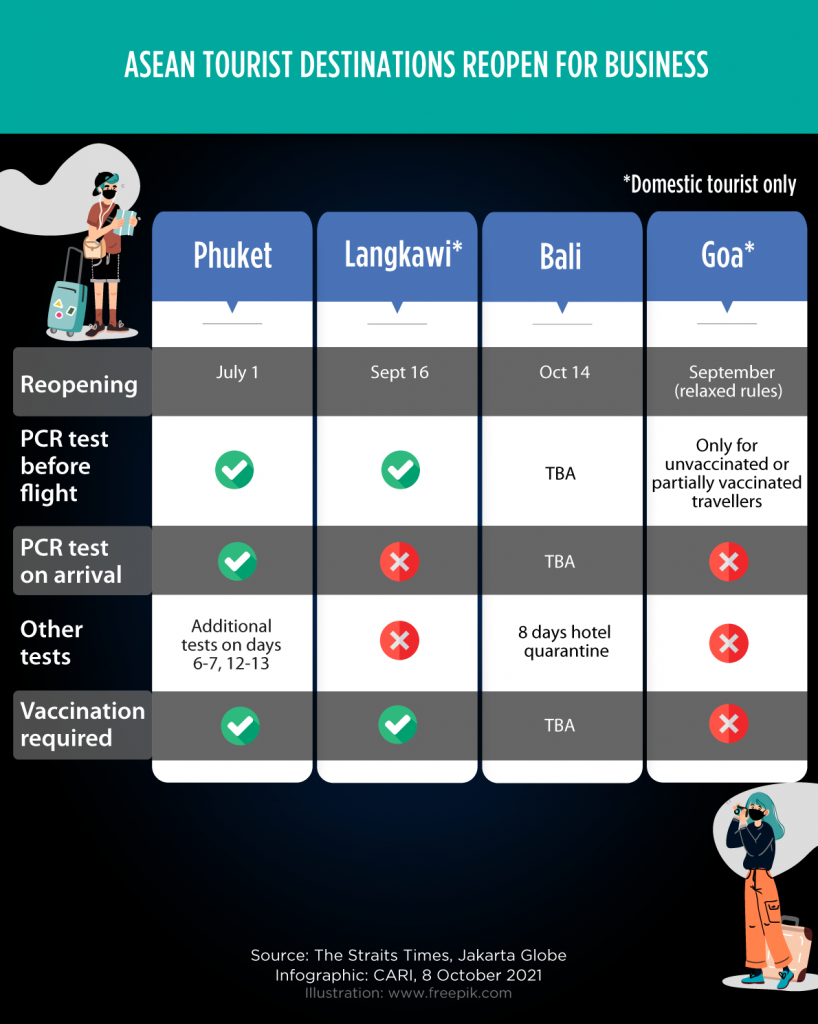
(2 October 2021) More ASEAN countries have started reopening tourism hotspots to foreign tourists following Thailand’s successful reopening of Phuket island to vaccinated foreign arrivals in July. The “Phuket Sandbox” generated US$48.1 million in revenue and attracted 38,289 international arrivals as of September 29, out of which only 0.3% tested positive for COVID-19. Vietnam hopes to emulate this success in Phu Quoc island, where foreign arrivals from lower-risk countries will be allowed to return in phases during a trial period beginning November 20. Meanwhile, Indonesia announced that it will begin receiving international tourists from a handful of countries from October 14, though a minimum eight-day hotel quarantine will be mandatory for such visitors.

ASEAN
Indonesian Minister calls for standardized ASEAN travel and health protocols
(6 October 2021) Indonesian health minister Gunadi Sadikin called for ASEAN to establish a common health passport or digital platform—such as Singapore’s TraceTogether app—to standardize health and travel protocols in the region. The minister also highlighted the need to reform the global health ecosystem and shared the country’s aim to have 300 million citizens vaccinated by the end of 2021. Panellists at the Special Ministerial Conference for ASEAN Digital Public Health also discussed the need to reduce over-concentration by leveraging neighbouring economies in the wider region and ramp up digitalization throughout the supply chain to enhance the region’s capacity to deal with and mitigate future shocks.

ASEAN
Southeast Asian countries lead the global Islamic fintech sector

(4 October 2021) Malaysia (1st), Indonesia (4th), Singapore (12th) are among the top 20 Islamic fintech hubs in the world according to the 2021 Global Islamic Fintech Report which measured a hub’s maturity model based on its market and ecosystem, talent, regulations, infrastructure, and capital. Malaysia has identified the digital economy and Islamic finance as key thrusts in its Shared Prosperity Vision, while Indonesia has been developing its Shariah economy under its National Shariah (Islamic law) Economy Plan. Both countries are Muslim-majority nations, making them ideal springboards for Islamic fintech companies looking to tap into the underserved 1.8 billion global Muslim market.

ASEAN
Over 1,000 startups founded by alumni of ASEAN tech giants

(4 October 2021) A new report by Bain & Co and Grab’s new think tank the Tech for Good Institute found that the first generation of Southeast Asia’s homegrown technology platforms has employed over 120,000 employees since their inception, many of whom have gone on to create and lead over 1,000 startups in the region. Eight platforms were covered in the study, which found that 480 Lazada alumni were now founders or chief executives of startups, followed by Sea with 346, Grab with 307, Zalora with 235, Gojek with 225, Tokopedia with 126, Bukalapak with 74, and Ovo with 51.

ASEAN  
Southeast Asia sees a sharp decline in education satisfaction

(4 October 2021) Satisfaction with the local educational system and schools in Southeast Asia fell from 85% in 2019 to 63% in 2020, according to the latest Gallup World Poll results, representing the largest decline by region when compared globally. Indonesia and the Philippines led the way with the former seeing a drop from 89% to 56% and the latter going from 82% to 55%, attributable to the limited access to devices and infrastructure for remote learning particularly among those from lower socioeconomic backgrounds.

ASEAN, EU
ASEAN, EU to resume free trade agreement negotiations

(1 October 2021) ASEAN and the European Union (EU) have agreed to prepare to resume negotiations for a free trade agreement between the two blocs, according to Thai commerce vice-minister Sansern Samalapa who acted as chief negotiator at the ASEAN Economic Ministers (AEM) meeting with the EU, United Kingdom (UK), Switzerland and Russia held in early September. The meeting also saw the approval of a joint ministerial declaration on future economic cooperation between ASEAN and the UK in 11 areas and agreements to proceed with discussions for further plans for cooperation.

ASEAN, QATAR
ASEAN, Qatar trade volume reached US$9 billion in 2020
(5 October 2021) Trade between ASEAN countries and Qatar totalled US$9 billion last year, primarily with Singapore (US$4.3 billion), Thailand (US$2.32 billion), Indonesia (US$895 million), Vietnam (US$500 million), Malaysia (US$480 million), the Philippines (US$233 million), and Brunei (US$48 million). According to the ASEAN Committee in Doha, Qatar is a “key investor in ASEAN”, with investments in Singapore estimated at around US$1.5 billion, major investments in Vietnam such as a US$300 million seaport project in Quang Ninh province, and eminent Qatari companies such as Ooredoo establishing a presence in Indonesia. Around 300,000 ASEAN citizens have also made Qatar their second home.


RCEP Monitor


AUSTRALIA 
Australia urged to keep ASEAN onside while building new alliances

(7 October 2021) A new bipartisan report tabled by the Australian Foreign Affairs, Defense and Trade Committee urged the government to “remain fully engaged with ASEAN” and deepen cooperation with countries in the region while it pursues new security architectures like AUKUS with the UK and United States (US) or the Quad with India, Japan and the US. The report noted that while ASEAN was “a slow-moving, consensus-based organisation”, Australia nevertheless shares the bloc’s agenda for a “peaceful, inclusive and resilient region of sovereign states” and that the relationship should continue to be invested in.

SOUTH KOREA
South Korea starts accepting booster shot appointments
(4 October 2021) South Korea began accepting appointments for COVID-19 booster shots this week as the country continues to cope with the spread of the delta variant, rising breakthrough infections, and declining effectiveness of basic shots. High-risk groups COVID-19 health care workers, people over the age of 60, and workers at senior care facilities will be given priority when the government starts administering booster shots on October 25. The country’s vaccination committee currently recommends getting booster shots six months after the individual is first fully vaccinated.

NEW ZEALAND
New Zealand raises interest rates for the first time in seven years
(6 October 2021) The Reserve Bank of New Zealand raised its cash rate by a quarter of a percentage point to 0.5% as the central bank prepares to gradually remove more stimulus measures as the economy continues to recover. The hike puts New Zealand alongside a handful of developed economies including Norway, South Korea, and the Czech Republic that have raised borrowing costs in recent weeks as central banks look to wind back emergency measures that were first put in place as countries went into lockdowns.

CARI Captures Issue 522: Southeast Asian tech startup deals hit record numbers in first half of 2021


ASEAN
Southeast Asian tech startup deals hit record numbers in first half of 2021

(27 September 2021) The number of investments by venture backers in Southeast Asian tech startups hit a record number in the first half of 2021, although the value of those deals declined as investors focused on early stage deals in the region’s burgeoning digital market. There were 393 investments across the region in the first half of 2021, topping the previous record of 375 in the first half of 2019. Total capital raised however reached US$4.4 billion, down from US$5.8 billion a year earlier. The fall is mainly attributable to less outsized fundraising by unicorns such as Grab Holdings Inc. that dominated the region’s capital raising in the past but are now seeking to go public. The average deal size fell to US$11.2 million from US$17.7 million a year earlier, as investors focused on early-stage investments. Indonesia was the top destination for investment in Southeast Asia.

MALAYSIA
Malaysian government to consider allowing fully vaccinated Malaysians to travel abroad

(28 September 2021) The Malaysian government is to consider allowing fully vaccinated Malaysians to travel abroad, as well as to allow tourists to enter the country. The National Recovery Council chairman stated that the matter would be brought to the prime minister and an announcement would be made soon. This comes as the Council was informed that 90% of the adult population would be fully inoculated by early October, paving the way for the resumption of inter-state travel by mid-October. The Council was also informed that the rate of ICU bed utilization was also showing a reduction.

THE PHILIPPINES  
Filipino economy expected to take more than a decade to recover from COVID-19

(30 September 2021) The Philippines economy is expected to take more than a decade to recover from COVID-19, according to the Economic Planning Secretary. The Secretary stated that the ‘long run total cost of Covid and the quarantine both to the present and future society’ will reach an estimated US$810 billion. This figure is more than twice the Philippines’ GDP in 2020, which was estimated to be around US$361.5 billion. The economy is expected to take 10 years before it reaches its pre-pandemic growth, which averaged 6.4% in the 10 years before COVID-19 hit. Nearly 70% of the economy, including some 23.3 million workers, remain under “heightened quarantine” restrictions. Social distancing rules means that consumption, investment and tax revenues would struggle to recover.

VIET NAM
Viet Nam’s GDP dropped by 6.17% year-on-year in the July-September period due to lockdown measures

(29 September 2021) Viet Nam’s GDP fell by 6.17% year-on-year in the July-September period due to ongoing lockdown measures in key economic regions including Ho Chi Minh City. This is the country’s first decline on a quarterly basis since 2000. The economy contracted during the third quarter after recording 6.57% growth in the previous three months. Viet Nam’s economy had grown by 2.69% in the third quarter of 2020. Viet Nam’s GDP grew by only 1.42% in 2021 though September. Final consumption, which accounts for about 70% of Vietnam’s GDP, fell 2.83% in the third quarter due to severe travel restrictions. However, exports grew by 5.2% in the third quarter. The Vietnamese government slashed its growth forecasts for 2021 to a range of 3.5% to 4% on 14 September. The Asian Development Bank likewise in September lowered its 2021 growth forecast for Vietnam to 3.8% from 6.7% in April.

INDONESIA  
Indonesia’s parliament approves US$190 billion state budget for 2022

(30 September 2021) Indonesia’s parliament approved a US$190 billion state budget for 2022 on 30 September 2021. The 2022 budget also set an economic growth forecast of 5.2% for 2022, while reducing its budget deficit to 4.85% of GDP from a projected 5.8% in 2021. Earlier in the same day, a parliamentary commission approved a tax reform proposal that will introduce a carbon tax policy, overhaul the VAT system, expand income tax brackets, and offer another round of tax amnesty program. The tax reform bill will next be deliberated at the plenary level so it can be passed into law. This bill is expected to help Indonesia fund its spending and cut its reliance on debt markets. The Indonesian government has pledged to bring its budget deficit back to 3% of GDP by 2023 by streamlining spending and expanding revenue sources.

SINGAPORE  
Singapore’s central bank expected to leave monetary policy on hold at its October review

(30 September 2021) Singapore’s central bank is expected to leave its exchange-rate based policy settings unchanged at its October review. The review will be held on or before 14 October. The central bank is expected to leave monetary policy on hold as the city-state is currently dealing with a deteriorating COVID-19 situation. Singapore’s economy is expected to grow by 6% to 7% in 2021. The city-state had recently implemented restrictions which are expected to hit recovery in consumer-facing sectors such as aviation, food and beverage, hospitality, and retail. Singapore’s core inflation rate hit a two-year high in April 2021, but economists expect inflation to remain benign in the short term and then rise gradually.

THAILAND, INDIA
Thailand looking to attract tourists from India during Diwali holiday season in November
(28 September 2021) Thailand will seek to attract Indian tourists during the Diwali holiday season in November 2021. This is expected to coincide with the planned waiver of quarantine for vaccinated visitors from 01 November onwards. Tourists from India are expected to make up for the expected absence of Chinese tourists, and Indian nationals composed the third largest group of visitors to Thailand before the global pandemic, behind the Chinese and Malaysians. Almost 2 million Indian tourists visited Thailand in 2019, when the country welcomed some 40 million tourists and generated more than US$60 billion in revenue. Thailand saw foreign tourist arrivals plunge to 73,932 in the first eight months of 2021.


RCEP Monitor


JAPAN 
Former foreign minister Fumio Kishida set to become next prime minister of Japan
(29 September 2021) Former foreign minister Fumio Kishida won a four-way race to become the next leader of the ruling Liberal Democratic Party (LDP) in Japan. He will be formally elected as prime minister in a parliamentary session scheduled to begin on 04 October. Kishida will lead the LDP in lower house elections in the autumn, as well as upper house elections in the summer. Kishida promised to compile an economic stimulus package worth hundreds of billions of dollars by the end of 2021, realize the vision of a free and open Indo-Pacific, make Japan an important international player through helping tackling important global issues such as global warming, and create a ‘new capitalism’ for the people which would tackle issues of inequality.

CHINA  
Chinese manufacturing activity contracts in September 2021, with power cuts threatening further damage

(30 September 2021) China’s manufacturing purchasing managers index fell to 49.6 in September 2021, marking the gauge’s first drop below the 50 mark that separates an expansion of activity from contraction since February 2020, when the city of Wuhan and surrounding Hubei province were shut down to contain the COVID-19 outbreak. The gauge fell from a reading of 50.1 recorded in August 2021. This contraction in manufacturing activity comes as the Chinese economy is experiencing several issues which have beseted its initially strong economic recovery, including regional COVID-19 outbreaks, a global semiconductor shortage, port shutdowns and supply-chain disruptions, a widening regulatory campaign against the country’s tech sector, and rising commodity prices. Recent concerns about power outages and a possible downturn in the real estate market is expected to further add pressure on China’s economic growth moving forward.

AUSTRALIA
Australia to remove ban on international travel in November 2021

(01 October 2021) Australia will remove its restrictions on international travel in November 2021, one month ahead of schedule. The government will allow states that have reached 80% vaccination rate to welcome immunized overseas visitors, while Australians will be able to travel abroad with no restrictions on destination. The current cap on the number of arrivals allowed into the country will be removed, and returning Australians will only have to undergo a shortened seven days of home quarantine. The country has been subject to some of the strictest controls on overseas travel since the pandemic first broke out in March 2020, but with vaccination rates climbing there is an increasing push to wind down COVID-19-related restrictions.

CARI Captures Issue 521: Low vaccination rates are hurting Southeast Asia’s economy


ASEAN
Low vaccination rates are hurting Southeast Asia’s economy

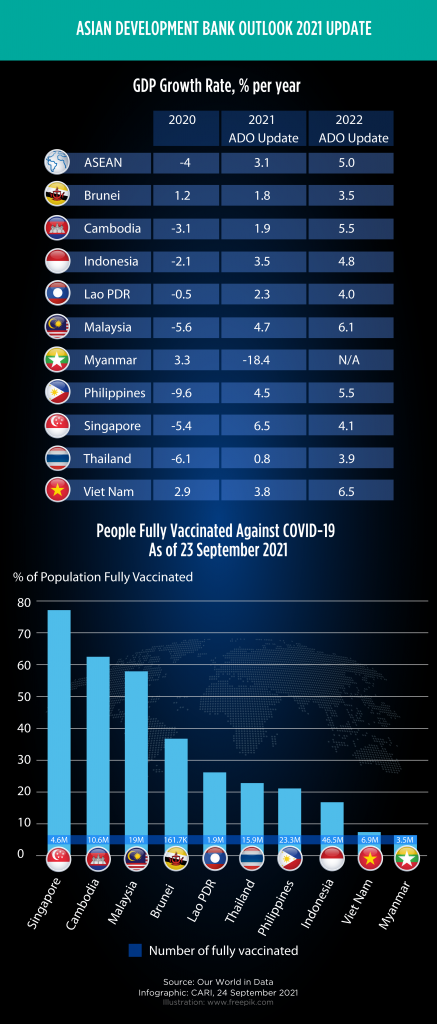
(22 September 2021) The Asian Development Bank (ADB) downgraded its growth projections for Southeast Asia (including Timor-Leste) from 4.4% to 3.1% for 2021 and 5.1% to 5.0% for 2022 as it expects the region to “recover at a much slower pace than projected” due to lockdowns and restrictions caused by recurring COVID-19 outbreaks and uneven vaccination rollouts. Thailand, Indonesia, Malaysia and Vietnam are expected to be the hardest hit due to the pandemic, while Myanmar’s outlook was downgraded from a 9% contraction to an 18.4% contraction due to its political climate. Singapore is the only country to receive an upgrade as it has fully vaccinated 75% of its population.

ASEAN
Privatized vaccination schemes gain traction in Southeast Asia

(20 September 2021) ASEAN governments have been turning to the private sector to supplement national vaccine supply and distribution efforts following the COVAX program’s failure to secure adequate vaccines for developing countries. Indonesia’s private vaccination scheme, which was launched in February 2021, received over 10 million employee registrations from over 22,000 companies within three months. Most of these private schemes, which focuses on on-site employees and their immediate families, are utilizing Sinopharm vaccines since—according to the Philippines’ vaccine czar—Pfizer, Sinovac, and Sputnik V prioritize government orders while Moderna, Johnson & Johnson, and AstraZeneca do not accept private vaccine orders.

ASEAN 
Southeast Asia-focused private equity funds raise US$1 billion in H1 2021

(17 September 2021) ASEAN-focused private equity funds raised US$1 billion in dry powder in the first half of the year, up from US$1 billion raised in all of 2020 and US$1.3 billion in 2019, according to a recent DealStreetAsia report. Asia Partner’s debut US$384 million fund and Mekong Capital’s US$246 million fifth fund accounted for the bulk of the sum. Another 28 ASEAN-focused private equity funds are currently in the market to raise US$6.8 billion, with Navis Capital Partners leading the way in the second half of the year with its US$900 million eighth fund and US$450 million continuation fund.

INDONESIA
Inclusivity and sustainability among Indonesia’s G20 presidency priorities

(23 September 2021) Indonesia’s priorities when it assumes the G20 presidency in 2022 will include inclusiveness, a sustainable green economy, climate resilience, and “vulnerable groups that must be prioritized”, according to Indonesian President Joko Widodo’s recorded statement to the UN General Assembly. The premier called for countries to work together to reorganize global health security resources to better facilitate funding and vaccines, and establish a standardized global health protocol for travel. He also stressed that “concerns on the marginalization of women and violence in Afghanistan, Palestine’s elusive independence, and the political crisis in Myanmar must be our common agenda.”

INDONESIA  
Ooredoo and CK Hutchison join forces in US$6 billion telco merger

(20 September 2021) Qatar’s Ooredoo and Hong Kong’s CK Hutchison have agreed to merge their respective Indonesian telecommunications businesses—Indosat and Hutchison 3 Indonesia—in a US$6 billion deal to form Indosat Ooredoo Hutchison. The deal, which is expected to close by year-end, would make the new entity the second-largest telecommunications operator in the country with annual revenue of around US$3 billion and cost savings of approximately US$300 to US$400 million to be realized over three to five years. Ooredoo Hutchison Asia will retain a controlling 65.6% stake in the merged entity and will remain listed on the Indonesian Stock Exchange.

THAILAND  
PTT and Foxconn to begin manufacturing electric vehicles by 2024

(20 September 2021) Taiwanese electronics contract manufacturer Foxconn and Thai state-owned oil company PTT have formed a joint venture to produce electric cars in Thailand as part of the country’s hopes to become an electric vehicle hub. According to Foxconn, production is expected to commence in two to three years with initial output of 50,000 vehicles per year and 150,000 vehicles per year later on. The Eastern Economic Corridor (EEC) is said to be a potential location for the planned production plant, which will house “the entire electric vehicle value chain” from research to battery production and vehicle assembly.

MALAYSIA
Domestic capital market totalled US$813 billion in 2020
(21 September 2021) Malaysia’s domestic capital market grew from approximately US$574 billion (RM2 trillion) in 2011 to US$813 billion (RM3.4 trillion) in 2020 with over 900 listed companies and the third-largest bond market in Asia, according to the Securities Commission Malaysia’s Capital Market Masterplan 3 (CMP3) launched this week. The CMP3 outlined six key pillars for the 2021 to 2025 period which include Sustainable and Responsible Investment, Islamic Capital Market, as well as greater use of regulatory technology and supervisory technology. The country’s domestic economy expanded at an average rate of 5.1% annually from 2011 to 2019 before contracting by 5.6% in 2020.


RCEP Monitor


MALAYSIA, VIETNAM, THE PHILIPPINES  
ASEAN countries aim to ratify RCEP by the end of 2021

(21 September 2021) Malaysia aims to ratify the Regional Comprehensive Economic Partnership (RCEP) by mid-December, Vietnam aims to do so before November, while the Philippines hopes to do the same by the end of the year according to the countries’ respective trade leaders. Cambodia, Thailand, Singapore, Japan and China have ratified the agreement so far. The RCEP will come into force 60 days after at least six countries within ASEAN and three outside ASEAN have submitted the instruments of ratification to the ASEAN Secretariat. ASEAN Member States aim to bring the RCEP into force on 1 January 2022.

CAMBODIA, CHINA  
Cambodia ratifies RCEP and bilateral free trade agreement with China

(21 September 2021) The Cambodian Senate passed two bills on September 20 authorizing the ratification of the RCEP and the Cambodia-China Free Trade Agreement (CCFTA). The government expects the RCEP to expand its GDP by an additional 2%, grow exports by an extra 7.3%, increase investments by another 23.4%, and signal Cambodia’s support for a “multilateral free trade system based on legal principles”. The CCFTA is expected to expand Cambodia’s agricultural export market as well as increase jobs, investments and knowledge sharing with China while providing greater clarity on bilateral trade rules and customs.

CHINA
China files formal application to join the CPTPP

(21 September 2021) China submitted its application to join the Comprehensive and Progressive Agreement for Trans-Pacific Partnership (CPTPP) last week following the United Kingdom’s application to the same in February. According to CPTPP procedures, members will decide “whether to commence the accession process with the aspirant economy within a reasonable period” once a formal application has been made. Malaysia and Singapore responded warmly to China’s announcement, while New Zealand, Japan, Mexico, and Australia stressed the need to ensure that prospective candidates are committed to meeting the standards stipulated in the agreement. China’s announcement was followed by Taiwan’s, which submitted its application to join the CPTPP this week.

CARI Captures Issue 520: Viet Nam leads average daily rise in COVID-19-related deaths in ASEAN despite lockdowns


ASEAN
Viet Nam leads average daily rise in COVID-19-related deaths in ASEAN despite lockdowns

(13 September 2021) According to government data compiled by Bloomberg, Viet Nam was leading the average daily rise in COVID-19-related deaths in ASEAN despite lockdown measures implemented by the authorities. This comes as many Southeast Asia countries seek to reopen their economies amidst some of the world’s worst COVID-19 outbreaks, with state finances in many countries have been pushed to the brink due to recurrent rounds of stimulus measures. Factory shutdowns caused by restrictions have caused global supply chain shortages, and some countries like the Philippines and Viet Nam are looking to apply more localized restrictions in hot spots instead of national or regional lockdowns. Countries like Malaysia, Thailand, and Indonesia are also seeking to emulate Singapore’s strategy of treating the virus as endemic.
 

SINGAPORE
Government and state investment firm Temasek Holdings to set up US$1.1 billion fund to help boost Singapore stock market

(17 September 2021) The Singaporean government is looking to set up a US$1.1 billion fund backed by state investment fund Temasek Holdings Pte to help boost the Singaporean stock market. The fund will invest in high-growth companies and initial public offerings. Separately, the Economic Development Board’s investment arm will start a Growth IPO Fund worth as much as S$500 million initially to invest in companies that are technological innovators and two or more funding rounds away from listing publicly, with a view towards an eventual IPO in Singapore. Singapore’s bourse has struggled in recent years with tepid listings and low equity trading liquidity, and these plans by the government aims to make Singapore a more attractive location for capital raising for local and regional companies.
 

INDONESIA 
Indonesia to allow foreign visitors holding more types of visas to enter the country

(16 September 2021) Indonesia will allow foreigners holding more types of visas, including visitor permits for tourism and education, to enter the country as long as they are fully vaccinated against COVID-19. Among the non-Indonesians who will be able to enter the country include those with visitor visas, those holding the Asia-Pacific Economic Cooperation business travel cards, permits to stay for diplomatic and work purposes, as well as permanent or limited rights to stay. Indonesia has been shut to most foreign travellers since April 2020, only allowing certain visitors to enter for business essential purposes. The country has considered reopening its borders multiple times due to the border closures’ effects on the country’s tourism industry. Indonesia will require proof of full vaccination in visa applications.
 

THAILAND
Thailand to woo wealthy foreigners to stay long term in the country over the next five years

(15 September 2021) The Thai cabinet has given its green light in principle to a series of measures to attract wealthy foreigners to stay long term in the country over the next five years. The plan aimed to draw four groups – wealthy global citizens, pensioners from overseas, those wanting to work in Thailand and highly skilled professionals. Among the measures proposed to attract wealthy foreigners include exemptions and benefits during their stay (such as not having to report to the authorities every 90 days), as well as amendments to laws and regulations relating to land holding, work management and permission for foreign nationals to work for employers in and outside the country, exemption from regulations on employment of foreign and Thai employees, and tax exemptions.
 

THE PHILIPPINES, UNITED STATES  
United States to ship 2.58 million more doses of COVID-19 vaccines to the Philippines through Covax programme

(17 September 2021) The United States will ship 2.58 million more doses of the Pfizer COVID-19 vaccines to the Philippines on 17 September 2021 through the COVAX global distribution programme. This brings the total number of vaccines sent to the Philippines to just over nine million. Last week, the US’ national security adviser Jake Sullivan met with the foreign and defence ministers of the Philippines during their visit to Washington to mark the 70th anniversary of the two countries’ Mutual Defense Treaty, during which Sullivan announced that the US would provide an additional US$11.3 million in COVID-19-related assistance to the Philippines, bringing the total US COVID-19 assistance to the Philippines since the start of the pandemic to US$37 million, in addition to the millions of vaccine doses donated.
 

VIET NAM, CHINA  
China temporarily halts imports of dragon fruit from Viet Nam due to COVID-19 risks
 
(17 September 2021) China halted the import of Vietnamese dragon fruits for a week (starting on 15 September 2021) after traces of COVID-19 were found on the packaging and cardboard boxes of dragon fruit imported from Quang Ninh province. China remains the top destination for Viet Nam’s dragon fruit, representing over 80% of total shipments and amounting to $1 billion a year. The Vietnamese fruit trade with China has already been struggling due to land transport congestion, tighter border controls and increased domestic plantings in China. Chinese officials stated that the dragon fruit halt will be extended for another week if COVID-19 is detected again, using the PCR testing method, on the packaging of dragon fruits or any products shipped from Viet Nam.
 

CAMBODIA
Secondary schools in Cambodia begin to reopen as COVID-19 vaccinations approach targets
(15 September 2021) Secondary schools in Cambodia began to allow in-person classes again as the country’s vaccination rates approach national targets. Many of the almost 140,000 pupils in Phnom Penh sat for in-person lessons at both public and private schools that had been certified as safe by the Ministry for Education. Teachers and school staff were required to undergo COVID-19 tests prior to returning to school, while students and staff were also required to show proof of vaccination before entering campus, while masks were mandatory to wear. Since the global pandemic began, schools in Cambodia have been shut down for almost 200 days, facing tougher restrictions than restaurants, bars and many businesses. The government has set targets of inoculating 10 million adults and 2 million children aged 12 to 18. As of last weekend, more than 8.5 million adults had already received double doses.


RCEP Monitor


SOUTH KOREA  
Jobless rate falls to 2.8% in August 2021, at lowest level since March 2021

(15 September 2021) South Korea’s unemployment rate fell to 2.8% in August 2021, a significant drop from the 3.3% measured in July 2021 and its lowest level since March 2021. However, this was largely due to the fact that the ongoing COVID-19 pandemic actively discouraged people to look for work and for companies to hire. Overall, the economy added some 518,000 positions from the slump a year earlier, marking a sixth straight month of gains, with half of the jobs created since February coming from government-funded programs. Tighter restrictions on public activity have made it difficult for people to go out in search for jobs, while private businesses are also cutting back on regular hiring as the pandemic drags on.
 

JAPAN  
Japan’s benchmark stock index hit its highest level in 31 years, spurred by hopes of new prime minister
 
(14 September 2021) Japan’s benchmark stock index, the Nikkei Stock Average, hit its highest level in 31 years on 14 September 2021, spurred by gains in U.S. shares and hopes that Japan's next prime minister will spend big to boost the economy. The Nikkei Stock Average closed at its highest point since August 1990, with electronics, automotive and chemicals stocks leading the gains. Japanese equities showed strong momentum in their recovery from the COVID-19-induced global market downturn in 2020, however, the spread of the contagious delta variant in the summer of 2021 and its impact on the economy had dampened investor sentiment. With the vaccine rollout accelerating, expectations for an economic reopening are on the rise, with the government set to ease domestic travel restrictions and to allow indoor dining once again.
 

AUSTRALIA, NEW ZEALAND
New Zealand to delay the reopening of its trans-Tasman travel bubble by at least eight weeks
 
(17 September 2021) New Zealand will delay its reopening of its trans-Tasman travel bubble by at least eight weeks, due in part to COVID-19 case numbers in Australia rising and numbers in New Zealand continuing to drop. The ongoing pause in the quarantine-free travel between both countries had been set to expire next week. Daily case numbers in New Zealand had been trending downwards recently, while states in Australia such as New South Wales and Victoria continue to record new cases. As of date, just over 35% of New Zealand’s eligible population is now fully vaccinated, while more than three million people having had their first dose.
 

CARI Captures Issue 519: ASEAN’s private equity and venture capital industry doubles in five years

ASEAN
ASEAN’s private equity and venture capital industry doubles in five years

(7 September 2021) Southeast Asia has been attracting large amounts of private equity and venture capital investments amid growing demand for capital in these asset classes despite the pandemic, according to a recent Preqin report. ASEAN-focused private equity and venture capital funds have seen rapid growth since 2017, bringing in US$9.6 billion in 2019 alone and reaching US$37 billion under management as of December 2020 — more than double the US$17 billion under management in 2015. These funds have also seen strong performance, with the median net internal rate of return for 2009-2018 ASEAN-focused fund vintages reaching 22%, compared with 14% for other Asian funds.

ASEAN
ASEAN’s food delivery market to reach US$28 billion by 2025

(3 September 2021) Southeast Asia’s food delivery market is expected to grow by at least three times from US$9 billion in transactions in 2020 to US$28 billion by 2025 with Myanmar, Vietnam, and the Philippines leading the way, according to a recent report by Grab and Euromonitor International. The surge in demand for food delivery services can be attributed to social distancing measures imposed in the past year, with one in four customers ordering meals online for the first time during the pandemic. This spike in the use of food delivery services is expected to be sustained, with 87% of users saying that they will likely continue using such services even after pandemic restrictions are lifted.

CAMBODIA, VIETNAM 
Bilateral trade passes US$6 billion in the first seven months of 2021

(3 September 2021) Trade between Cambodia and Vietnam totalled US$6 billion between January and July 2021, representing a 106% year-on-year increase. This puts the countries on track to reach their US$10 billion bilateral trade target—which they had aimed to achieve in 2023—in 2021. Cambodia’s exports to Vietnam rose by 452% on the year, reaching US$3.3 billion, while its imports from Vietnam rose by 18.3% to US$2.8 billion during the same period. According to data from the Vietnamese government, Cambodia overtook Russia earlier this year to become the second-largest recipient of Vietnamese investment behind Laos. Vietnamese investments in Cambodia currently totals US$2.85 billion.

INDONESIA, CHINA
Indonesia and China begin using local currencies in bilateral transactions

(7 September 2021) The Bank of Indonesia and the People’s Bank of China officiated their framework for using local currencies for bilateral trade settlement and direct investment with the implementation of a transaction on September 6 between banks in both countries using the Indonesian Rupiah and Chinese Yuan. The framework was finalized earlier in September 2020 through a memorandum of understanding between the central banks and is part of China’s larger efforts to promote yuan internationalization. 12 banks in Indonesia and eight banks in China have been selected and authorized to transact under the local currency framework.

LAOS  
World Bank expects Laos’ GDP to grow by 4.5% in 2022

(9 September 2021) The World Bank’s latest Lao Economic Monitor projects Laos’ full-year GDP growth to come in at 3.6% in 2021 and remain below pre-pandemic levels at 4.5% in 2022. The World Bank expects the country’s recovery to be supported by external demand, buoyed by its participation in the Regional Comprehensive Economic Partnership and trade benefits on 97% of its exports to China under China’s Generalised Scheme of Preferences. The US$5.9 billion Laos-China railway project is also expected to open in December 2021, paving the way for the development of secondary infrastructure along the railway corridor and other infrastructure projects such as an expressway at the Laos-China border.

MALAYSIA 
Malaysia to start treating COVID-19 as endemic in Q4 2021

(9 September 2021) Malaysia aims to have 80% of its adult population vaccinated by the end of September 2021 and plans to start treating COVID-19 as endemic the following month once said population is fully vaccinated. Malaysia is currently administering around 400,000 vaccines daily, though hospital and ICU capacity remains high. The country’s central bank recently revised its 2021 growth forecast to between 3% and 4%, while the World Bank and International Monetary Fund place the country’s full-year growth at 5% and 6% respectively.

THAILAND
Thailand approves incentives to support carbon reduction
(6 September 2021) Thailand’s Board of Investment approved several measures to encourage investments in its Bio, Circular and Green (BCG) economy and promote sustainable development. This includes a three-year tax break for machinery upgrades aimed at reducing greenhouse gas emissions, as well as three to eight-year corporate income tax exemptions for investments in the upgrading or introduction of equipment or facilities that help reduce environmental impact. The investment board also approved tax incentives for the promotion of electric bicycles and an enhanced investment promotion policy for the development of shared platforms for electric vehicle production.


RCEP Monitor


AUSTRALIA 
Australia to launch vaccine passports for overseas travel next month

(9 September 2021) Australia will begin rolling out its international COVID-19 vaccine passport system in October 2021 as the government prepares for the reopening of borders. Australians will soon be issued a vaccine certificate—available on their phones and in printed form—to show as proof of their vaccination status when they go overseas. Around 39% of the Australian population over the age of 16 has been fully vaccinated and the government expects overseas travel to resume once 80% of the overall population have been fully vaccinated. Right now, anyone arriving in Australia is required to undertake a two-week hotel quarantine regardless of vaccination status.

JAPAN  
Japan upgrades Q2 GDP on stronger business spending

(8 September 2021) Japan revised its growth in the second quarter of the year from 1.6% to 1.9% on the back of unexpectedly brisk business spending following Prime Minister Yoshihide Suga’s announcement that he was stepping down to pave the way for the ruling party’s presidential elections to take place on September 29. The second quarter’s 1.9% expansion translates to a quarter-on-quarter expansion of 0.5%. Meanwhile, private consumption—which accounts for more than half of Japan’s GDP—grew by 0.9% quarter-on-quarter. Nevertheless, July’s household spending data suggests that the resurgence of COVID-19 in the country will hamper consumer activities in the third quarter of 2021.

CHINA
BlackRock’s China unit raises US$1 billion in maiden mutual fund

(8 September 2021) BlackRock, the first foreign-owned company to operate a wholly-owned business in China’s mutual fund industry, has set up its first fund in the country after raising US$1.03 billion from over 111,000 investors. The fund was launched on August 30 and closed fundraising a week ahead of its planned deadline. Other asset managers have also been looking to set up funds in the country ever since the Chinese government lifted the sector’s foreign ownership cap in April 2020. Fidelity International is in the process of setting up a mutual fund subsidiary, while Neuberger Berman Schroders and VanEck have also applied to set up local units to sell retail funds.

CARI Captures Issue 518: Southeast Asia region added 70 million new online consumers since start of COVID-19 pandemic

ASEAN
Southeast Asia region added 70 million new online consumers since start of COVID-19 pandemic

(31 August 2021) According to a recently published report by Facebook and Bain & Co, the Southeast Asia region added a total of 70 million new online consumers since the start of the COVID-19 pandemic. Surveying some 16,000 people across Singapore, Malaysia, the Philippines, Indonesia, Thailand and Vietnam, they projected that by the end of 2021 each of these countries will have 70% or more of its adult population as digital consumers. Online spending per person in 2020 was US$238, and is expected to reach US$381 by the end of 2021. 22% of respondents cited social video as their top channel for discovery. Internet and tech startups grew to dominate venture capital and private equity funding in ASEAN, commanding 88% of deals by value in the first quarter of 2021, up from 75% a year earlier. Financial technology, or fintech, was the dominant sub-category, composing 56% of tech funding and spanning such services as buy-now-pay-later, peer-to-peer lending, digital wallets and cryptocurrency.

ASEAN
Southeast Asia projected to lose US$28 trillion over next 50 years if it fails to act on climate change

(02 September 2021) A recent report by Deloittes has projected that Southeast Asia could lose some US$28 trillion in present value terms over the next 50 years if it fails to act on climate change. Should the region fail to act in reducing its carbon emissions significantly, it could also reduce GDP growth by an average of 7.5% each year in the same period. The consultancy projected that a failure to act could see the region’s services industry lose US$9 trillion, its manufacturing sector lose US$7 trillion, and its retail and tourism sector lose US$5 trillion. However, Deloittes also argued that should Southeast Asia step up efforts on climate change and rapidly reduce its carbon emissions, it could achieve economic gains of US$12.5 trillion in present value terms — with an average GDP growth of 3.5% each year for the next 50 years.

MALAYSIA 
Malaysia plans to reopen resort island of Langkawi to locals under travel bubble plan

(02 September 2021) The Malaysian government plans to reopen the resort island of Langkawi to locals under a travel bubble plan from 16 September 2021 onwards. Other destinations in Malaysia will be allowed to reopen once their local vaccination rate reaches 80%. Despite being Southeast Asia’s COVID-19 hotspot, the virus’ effective reproduction rate, or R-naught, has fallen below 1 nationwide for the first time in a few months due to high vaccination rates. 64% of Malaysia’s population have been fully vaccinated, and the average vaccination rate among adults in each state in Malaysia is expected to reach 80% by the end of September 2021. Melaka state will move into the second phase, and Negeri Sembilan into the third stage of the national recovery plan starting on 04 September 2021.

INDONESIA
Indonesia’s central bank to require lenders to disburse at least 30% of their loans to small companies by 2024

(02 September 2021) Indonesia’s central bank will require Indonesian lenders to disburse 30% of their loans to small companies by 2024, as part of a broader effort to revive slow credit growth within the country. Banks will be required to allocate 20% of their total loans to micro, small and medium enterprises next year, with the proportion gradually increasing to 25% in 2023 and to 30% in 2024. The central bank also intends to broaden the types of loans that banks can disburse to small companies, including direct lending, supply-chain financing or securities purchases. Banks will be able to meet their threshold by lending money to non-MSME and non-financial institutions that will subsequently channel the funds to their MSME partners. The new rules are effective 31 August. Loan-growth in Indonesia in July 2021 was only 0.5% year-on-year, despite record-low interest rates.

THE PHILIPPINES  
Grab Holdings to set up online supermarket in the Philippines to boost user growth

(03 September 2021) Grab Holdings Inc is set to launch an online supermarket in the Philippines to boost user growth, as the company seeks to capture broader opportunities in the food services market. Grab plans to allow consumers in the Metro Manila region to be able to order vegetables, meat, seafood and other groceries via the Grab app for next day delivery. The company already provides online grocery services in Malaysia and Singapore, and plans to enter Thailand in 2021. The online grocery market in Southeast Asia is expected to almost triple to US$11.9 billion in 2025 from US$4.1 billion in 2020. Southeast Asia’s online meal delivery services are also expected to triple, reaching US$28 billion by 2025.

THAILAND, CAMBODIA 
First 7-11 opens in Phnom Penh as Thai retailer CP All seeks new markets beyond Thailand

(01 September 2021) Cambodia’s first 7-11 convenience store has opened in Phnom Penh, as Thai retailer CP All seeks new markets beyond Thailand. CP All, which is the Bangkok-listed retail arm of Charoen Pokphand Group, Thailand’s biggest conglomerate, is the sole operator of 7-Eleven stores in its home country, operating more than 12,000 stores. CP All seeks to open several more 7-11 stores in Cambodia by the end of 2021. The company is also planning on expanding into Laos by around 2022. Cambodia currently represents a frontier market within Asia with faster economic growth than its neighbours. The company stated that they hope that the new 7-11 store chain will contribute to skill-building and entrepreneurship for a more dynamic Cambodian economy.

BRUNEI DARUSSALAM
Brunei Darussalam to remain in semi-lockdown until 03 October 2021 due to ongoing COVID-19 situation
(02 September 2021) Brunei Darussalam is to remain in semi-lockdown until 03 October 2021 due to the ongoing COVID-19 situation, which has not yet been brought under control. This is the second time that the semi-lockdown has been extended, more than three weeks after reporting its first locally transmitted cases in 15 months. Brunei has tallied a total of 2,621 coronavirus cases in its ongoing second wave, making up 88.5% of Brunei’s overall COVID-19 tally. As well, the Bruneian government also stated that from 06 September 2021 onwards, COVID-19 patients who have recovered 14 days after their diagnosis will no longer be required to undergo home isolation for 21 extra days. However, COVID-19 patients who were discharged before the end of their 14-day isolation must complete their quarantine period at home.


RCEP Monitor


JAPAN 
Japan’s Prime Minister Yoshihide Suga to resign in end-September 2021 ahead of lower house elections

(03 September 2021) Japan’s Prime Minister Yoshihide Suga is set to resign by September 2021, ahead of upcoming lower house elections. On 03 September 2021, Suga informed executives of the ruling Liberal Democratic Party (LDP) that he would not run in the LDP’s upcoming presidential election, which will take place on 29 September 2021. This election will install a new leader who will face the lower house election expected in October or November 2021. Suga’s decision not to contest in the upcoming presidential election comes after slumping approval ratings, with the latest Nikkei poll showing only 34% support. Current contenders for the new president of the LDP (and thus Prime Minister) include Fumio Kishida, a former LDP policy chief who has announced that he will run, and ex-Internal Affairs Minister Sanae Takaichi.

AUSTRALIA, INDONESIA  
Australia to deliver 500,000 COVID-19 vaccine doses to Indonesia as part of strategic partnership

(03 September 2021) Australia will be delivering 500,000 COVID-19 vaccine doses to Indonesia as part of Canberra’s strategic partnership with the latter. These vaccine doses are the first installment of Australia’s commitment to share 2.5 million AstraZeneca doses with Indonesia in 2021, and are an important component of Australia’s larger health response package for Indonesia (announced in July 2021), adding to the 1,000 ventilators, 700 oxygen concentrators and 20,000 rapid antigen tests already delivered. To date, Australia has shared over 2.5 million doses with the Indo-Pacific region, as part of a total commitment to share 20 million doses by mid-2022. In addition, Australia is also providing US$101.9 million to support Indonesia’s national vaccine rollout through the US$523 million regional Vaccine Access and Health Security Initiative.

SOUTH KOREA
South Korea to maintain aggressive fiscal spending in proposed budget for 2022

(31 August 2021) South Korea’s government has proposed a budget for 2022 that would maintain aggressive fiscal spending in order to deal with the fallout caused by the COVID-19 pandemic. The finance ministry proposed spending US$523 billion in 2022, a rise of 8.3% from 2021 that would increase government debt to 50.2% of GDP, from 36% in 2017. The proposed record spending comes as the government struggles to rein in surging household debt and rising income inequality, with South Korea recently becoming the first big Asian economy to raise interest rates since the start of the pandemic. Many self-employed people, which make up almost a third of the Korean workforce, are under mounting financial pressure after tougher coronavirus restrictions, including tighter social-distancing measures, slashed their incomes.

COVID-19 Pandemic and Climate Crisis: Opportunities for ASEAN to build back safer, stronger and greener


Image Source: TheEdge Malaysia, 29 August 2021


The US and Singapore have announced important climate partnerships during Vice President Kamala Harris’s visit to Singapore. The US will work closely with Singapore to tackle climate change by leveraging the financial sector; collaborating to promote green building standards in ASEAN, and incorporating climate and environmental sustainability into a longstanding program between the U.S. and Singapore1.

Back home in Malaysia, Bank Negara Malaysia (BNM) assistant governor Adnan Zaylani Mohamad Zahid was quoted as saying supply chain pressure by trade partners that require sustainability preconditions to trade would potentially put US$65.3 billion worth of annual export revenue at stake if Malaysia did not transition towards a low carbon and climate resilient economy by 2025. He argued that sustainability is no longer a nice-to-have but imperative for long-term business survival2.

Encouraging developments barely making the headlines as the nation goes through unending political turmoil.

Climate Crisis Overshadowed

Indeed, ASEAN celebrated its 54th anniversary on the 8th of August but there is much to spoil the party. There is an alarming existential threat overshadowed by the raging COVID-19 pandemic that shows no sign of slowing down while the legitimacy of Myanmar military power continues to test ASEAN’s effectiveness.

The sixth report of the most scientifically informed assessment on climate change just published in early August by the Intergovernmental Panel on Climate Change (IPCC) Working Group I of the United Nations3 casts a damning outlook for the planet.

Scientists now confirm human actions unequivocallcaused the fastest global warming in the atmosphere, ocean and land within the span of two thousand years and every of the last four decades has been successively warmer than any decade that preceded it since 1850.

Climate change’s borderless impact is already affecting all inhabited regions across the world. Evidently, the month of July this year was the earth’s hottest month on record4 with extreme weather anomalies wreaking havoc in Canada, China, Germany, Turkey and Greece5.

Image Source: CARI

Produced by 234 authors from 66 countries and further approved by 195 member governments, the IPCC report warns that we may be approaching the point of no return if drastic changes are not made.

Drastic measures needed for 1.5 celcius goal

Reducing greenhouse gases is the only pathway to reverse this course towards catastrophe. This means a drastic and complete overhaul of the energy landscape and ditching fossil fuels.

The bad news is the world’s actions have fallen short of global commitments. In fact, since the United Nations Framework Convention on Climate Change (UNFCCC) was signed, the global CO2 emissions have increased by 60%6, while ASEAN’s CO2 emissions per capita are projected to rise 140% between 2015 and 20407.

The International Energy Agency (IEA) warns that the pathway to carbon neutrality by 2050 is narrow8. In order to achieve the Paris agreement goals to limit global warming to 1.5oC and net-zero by 2050, there are more than 400 drastic milestones that will need to be reached in 30 years.

Green Agenda in ASEAN

ASEAN member states are all parties to the Paris Climate Agreement and have committed to a shared goal of carbon reduction and neutrality by 2050 or beyond.

The good news is the green agenda is gaining momentum in various policy discussions in ASEAN. The ASEAN Economic Community pillar that drives the region’s economic ambition is embracing this agenda, which had long been nestled under the ASEAN Socio-Cultural Community Pillar, more actively.

Particularly in 2021, rising awareness and interest have been observed across ASEAN. The public sector and policy stakeholders began to highlight green measures, reducing carbon footprints, and more aggressive climate actions.

The ADB rolled out the ASEAN Catalytic Green Finance Facility (ACGF) in 2019 to encourage private participation in green infrastructure projects and reduce the perceived high risk of such ventures through co-financing with public financing.

ASEAN is also currently finalising a framework on circular economy as one of the Priority Economic Deliverables (PEDs) of Chair Brunei while the ASEAN Taxonomy Board (ATB) is developing a multi-tiered ASEAN Taxonomy for Sustainable Finance (ASEAN Taxonomy) that will serve as the overarching guide for all ASEAN Member States (AMS).

In the private sector, large corporations are the early movers in exploring ESG practices, investment, reporting and disclosure standards as foreign investment demands have driven the shift to adopt the green agenda.

Last chance for reset: actions for green recovery

COVID-19 pandemic is considered a last-chance window for a fundamental reset of our economic growth model. As governments utilise fiscal policy tools for recovery, there is a window of opportunity for the green agenda to be incorporated in the areas of stimulus spending, national budget, taxation, investment and green jobs.

CARI had submitted a list of 21 Actions for a Greener ASEAN to ASEAN Chair Brunei highlighting various short-, medium- and long-term measures to be taken based on four CARI policy papers9 that found minimal climate mitigation measures in 2020.

Short-term measures such as providing financial assistance for green business and allocation for green infrastructure; upskilling for the renewable energy sector; allocation for sustainable and climate-resilient infrastructure; include green measures in government bailout or lending have been proposed.

Some other longer term policy options such as study and phase in carbon and environmental taxes; reform of fossil fuel subsidy schemes; work towards a common minimum Corporate- Income-Tax (CIT) standard for the region to increase fiscal space needed for the climate agenda; study the possibility of an ASEAN carbon market such as the EU-Emissions Trading System (ETS) are among the policy directions that ASEAN should take.

Developed countries must walk the talk

Crucially, in getting ASEAN to take heed of the green agenda, the developed countries must walk the talk.

The collective commitment to jointly mobilise USD 100 billion per year by 2020 pledged by developed countries to address the needs of developing countries – have fallen short and even the United Nations has urged the developed countries to make good their promise in a recent meeting.

It’s not hard to see why countries such as fossil fuel reliant countries China, Russia, India, Turkey and Saudi Arabia failed to agree on the wording of key climate change related to phasing out coal and the 1.5-degree goal commitments at a recent G20 meet in July.

UN Secretary General António Guterres calls out the G7 and G20’s leadership to deliver the commitments as countries are “way off track”. All eyes are now on the United Nations general assembly in September if the UN is able to achieve substantial climate progress before the 26th UN Climate Change Conference of the Parties (COP26) between 31st October to 12th November.

Rebuilding safer, stronger, greener

ASEAN’s developmental gaps and political economy are sentiments that need sensitive consideration in transition to a low carbon economy. Some may even view the politics of climate change with a lens of scepticism.

We can however count on the openness of experts and policymakers in ASEAN who generally showed a consensus that a greener ASEAN is a goal that must be pursued alongside economic recovery and not at the expense of economic stability. The question is then – how to translate that openness to concrete actions.

ASEAN must not waste the opportunity presented by the pandemic to achieve just that as governments inject fiscal spending to stimulate economic growth. This is the time to mobilize a whole-of-community effort to ensure that this richly endowed region does not lose its shine.


1 FACT SHEET: Strengthening the U.S.-Singapore Strategic Partnership, The White House
2 Malaysia critically needs trade-based solutions, says Bank Negara, FMT
3 Climate Change 2021 The Physical Science Basis, IPCC,
4 National Oceanic and Atmospheric Administration (NOAA)
5 Burning villages, orange skies: Greece fires
6 Net Zero by 2050, IEA
7 “The ASEAN climate and energy paradox,”
8 Net Zero by 2050, IEA
9 Sustainable ASEAN, CARI

CARI Captures Issue 517: Lockdowns in ASEAN affect global automotive supply chains

ASEAN, JAPAN
Lockdowns in ASEAN affect global automotive supply chains

(23 August 2021) COVID-19 lockdowns across the region continue to have a ripple effect on global automotive supply chains, with Japan’s Toyota Motor announcing last week that it would cut September’s targeted production volume by 40% due to a shortage of auto parts from Southeast Asian suppliers. The ongoing on-and-off factory shutdowns and production restrictions in the region—which houses some 30% of Japan’s auto parts manufacturers—is expected to cause the country’s automotive production to shrink by 30,000 to 40,000 units between August and September, and fall by around 19% to 25% year-on-year. The lockdowns have also affected automakers in the United States, China, and other regions.

ASEAN, INDIA
India’s exports to ASEAN expected to reach US$46 billion in FY22

(26 August 2021) India expects to export US$46 billion worth of goods to ASEAN countries in its fiscal year 2021-2022 fiscal year ending in March 2022, according to Indian commerce and industry minister Anupriya Patel. The minister also highlighted the potential for India and ASEAN to enhance their trade and investment partnership, since both sides have a large number of skilled workers, many complementary sectors and products, and a combined GDP of approximately US$5.8 trillion. ASEAN is also the third-largest recipient of Indian engineering product exports after the European Union and North America.

ASEAN, UNITED STATES 
ASEAN finalizes trade facilitation initiatives with the US

(25 August 2021) ASEAN economic officials have finalized the 2021-2022 ASEAN-US Trade and Investment Framework Arrangement (TIFA) and the Expanded Economic Engagement (E3) Work Plan during a recent consultation with Deputy Assistant US Trade Representative for Southeast Asia and the Pacific Marta Prado. These instruments help guide trade and economic cooperation between the US and ASEAN, and cover areas such as the digital economy, MSMEs (micro, small and medium enterprises), and sustainable development. The TIFA was first concluded in 2006 and is reviewed annually, while the E3 will be submitted for ministerial endorsement in September 2021.

ASEAN, UNITED STATES
US offers to host APEC meeting in 2023

(24 August 2021) US Vice President Kamala Harris extended an offer to host the Asia Pacific Economic Cooperation (APEC) in the United States in 2023 to further deepen the US’ trade with ASEAN as she noted the region’s economic importance as the US’ fourth-largest export market. Harris also announced a slew of new bilateral partnerships on the occasion of her first stop in Asia, including agreements on cybersecurity, sustainable financing, as well as R&D for disease detection and treatment. Harris then made her first official visit to Vietnam, where she announced nearly US$100 million in official development assistance (ODA) for the country through the US Agency for International Development (USAID).

ASEAN, MEKONG 
ASEAN to boost cooperation with the Mekong River Commission

(24 August 2021) The inaugural ASEAN-Mekong River Commission (MRC) Water Security Dialogue which was held last week concluded with both sides agreeing to cooperate in the areas of water resource planning, pollution management, and the establishment of an early forecasting system for water levels. According to Phonepaseuth Phouliphanh, acting chairperson of the MRC joint committee for 2021, ASEAN could help the MRC by contributing technical and financial support to help boost the protection of the Mekong River — a vital source of income for over 70 million people. The second ASEAN-MRC water security dialogue is slated for 2023 and will likely focus on policy discussions.

ASEAN  
Economists downgrade ASEAN’s annual growth outlook

(25 August 2021) Weaker social safety nets, a less mature banking system hindering the injection of cash relief, as well as “growing discontent with job losses and officials’ handling of the pandemic” resulting in political instability and delayed investments could continue to derail ASEAN’s recovery from the pandemic, according to Moody’s Analytics. As such, the agency has downgraded the 2021 GDP forecast of the region’s economies, with Malaysia and Vietnam expected to be the worst hit. Moody’s sentiments were echoed by the latest survey results compiled by Bloomberg, which saw economists downgrading Malaysia’s growth outlook by 1.4 percentage points.

MALAYSIA
Malaysia gets a new Prime Minister and a new cabinet
(27 August 2021) Malaysian prime minister Ismail Sabri Yaakob unveiled the country’s new cabinet line-up this week following his swearing-in as the country’s new leader on 21 August. Most economic portfolios remained unchanged with the re-appointments of finance minister Tengku Zafrul Tengku Aziz, international trade and industry senior minister Mohamed Azmin Ali, minister in the prime minister’s department (economy) Mustapa Mohamed, domestic trade and consumer affairs minister Alexander Nanta Linggi and transport minister Wee Ka Siong. Meanwhile, entrepreneur development and cooperatives will now be helmed by Wan Junaidi Tuanku Jaafar, and plantation industries and commodities by Zuraida Kamaruddin.


RCEP Monitor


THE PHILIPPINES, CHINA 
PH seeks US$1.9 billion in loans from China for infrastructure projects

(25 August 2021) The Philippines is seeking US$1.9 billion in loans from the Export-Import Bank of China to fund four infrastructure projects, said finance undersecretary Mark Dennis Joven. The four projects are the Davao-Samal bridge project, Mindanao flood control project, Subic-Clark Railway project, and three bridges under the Metro Manila project. According to Joven, China disbursed US$620 million in ODA last year out of its US$4.6 billion in existing projects. Separately, the Philippines’ transport department announced that it has awarded the joint venture between China Railway Design and Guangzhou Wanan Construction Supervision a contract to manage the US$1.6 billion Mindanao railway project.

THAILAND, CHINA 
Thailand, China to intensify cooperation through the EEC and GBA

(25 August 2021) Thai industry minister Suriya Jungrungreangkit and Guangdong governor Ma Xingrui announced the launch of the Thailand-Guangdong Cooperation project to promote greater bilateral cooperation, particularly through Thailand’s Eastern Economic Corridor (EEC), China’s Greater Bay Area (GBA), and the Guangdong Pilot Free Trade Zones. The five agreed-upon areas of collaboration are (i) new energy and smart vehicles, (ii) digital and 5G, (iii) health-related industries, (iv) smart city, and (v) green and circular economy-related industries. The EEC is Thailand’s flagship technology hub that targets the development of three clusters with net zero-emission, i.e. digital and 5G, smart logistics, and health and wellbeing.

SOUTH KOREA
South Korea raises interest rates for the first time in three years
(26 August 2021) The Bank of Korea announced this week that it has raised its policy rate by 25 basis points to 0.75% for the first time in almost three years, making it the first major Asian economy to do so since the COVID-19 pandemic began. The move comes as the central bank looks to tame financial risks pressuring the economy such as rising household debt and inflation. Fellow RCEP member New Zealand was expected to be the first to increase rates in the Asia Pacific region but that changed when Prime Minister Jacinda Ardern imposed a nationwide lockdown the day before the announcement was to be made.

CARI Captures Issue 516: EU, Japan, and the United States remained ASEAN’s three largest investors over past two decades

ASEAN
EU, Japan, and the United States remained ASEAN’s three largest investors over past two decades

(13 August 2021) A report recently published by the Australia National University (ANU) found that despite widespread media attention on Chinese investments into Southeast Asia, China has not in fact been the region’s largest investor over much of the past two decades. Instead, the EU, Japan, and the United States have remained Southeast Asia’s three largest investors within the period. China made it into the top three investors only twice over that period – specifically in 2012 and 2018. It is believed that the discrepancy between perceptions of China being the dominant investor in Southeast Asia and reality is due to the high visibility and intense global scrutiny over Chinese infrastructure projects, including the slow pace of certain projects and fears of debt entrapment for the host countries. Indonesia, Malaysia, and Singapore are listed as the top three destinations for Chinese investments into Southeast Asia during the period, together accounting for 57% of total investments.

ASEAN, UNITED STATES
US Vice-President Kamala Harris to visit Singapore and Viet Nam starting on 22 September 2021

(20 September 2021) On 22 September 2021, US Vice-President Kamala Harris will begin her first visit to Asia with a stop to Singapore, before visiting Viet Nam on 24 September. She will be expected to discuss security and economic matters with the leaders of both countries, as well as COVID-19 recovery efforts. Both countries are important to the American economy, with Singapore hosting the Asia headquarters of major US tech multinationals, while Viet Nam is an important node in global supply chains, including that of semiconductors. While it is unlikely that the US will rejoin the Trans-Pacific Partnership free trade agreement (now known as the CPTPP), of which Singapore and Viet Nam are signatories, Singapore’s foreign minister hopes that there will be progress on digital trade, such as on cross-border data flows and e-payments.

THAILAND 
Thailand’s GDP grows 7.5% year-on-year during the three months to June 2021

(16 August 2021) Thailand’s GDP grew by 7.5% year-on-year in the three months to June 2021, marking the first expansion in six quarters. The economy had shrunk by 2.6% in the first quarter compared with 2020. Although Thailand had been battling a third wave of the pandemic during the entire second quarter, the government did not implement lockdown measures until late June. Private consumption rose 4.6%, jumping from a 0.3% contraction in the first quarter, while the exports of goods surged 30.7%, extending the 3.2% growth recorded in the first quarter. On a seasonally adjusted basis, the economy grew by 0.4% compared to the previous quarter. The overall outlook of the economy for 2021 remains poor, with authorities now projecting growth of 0.7- 1.2%.

INDONESIA
Indonesian central bank keeps its benchmark interest rate at record low of 3.5% amidst weak growth outlook

(19 August 2021) Indonesia’s central bank kept its benchmark interest rate unchanged at the record low of 3.5% amidst weak growth projections during the pandemic. Interest rates have been on hold since February 2021’s 25-basis point reduction, and are widely expected to stay at this level throughout 2021. The governor of the central bank stated that monetary policy will remain loose and accommodative in order to maintain the exchange rate and financial system amid low inflation, and to facilitate an economic recovery. The central bank is also keen to protect the rupiah amidst the risk that any potential future U.S. monetary policy tightening could spark a sell-off of emerging-market assets. The Indonesian government expects the economy to grow by 3.7%-4.5% in 2021.

MALAYSIA, INDONESIA  
Malaysian bonds lag Indonesian debt as Malaysian fiscal outlooks deteriorates and political uncertainty increases

(19 August 2021) Malaysian ringgit bonds have lagged Indonesian bonds as the former’s fiscal outlook deteriorates and political uncertainty increases. Benchmark 10-year Malaysian debt has underperformed Indonesian securities, with the extra yield on the latter shrinking to 305 basis points, nearing its lowest in over three years. A worsening outlook for Malaysian bonds could hamper the Malaysian government’s efforts to plug its budget shortfall ahead of a possible general election in 2022, while the Indonesian government’s commitment to fiscal consolidation (sticking to its 2021 budget deficit target of 5.7%) has helped anchor confidence in rupiah notes. While benchmark yields on 10-year ringgit securities have fallen two basis points since end-June 2021 to 3.27%, yields on rupiah notes due in a decade slid almost 30 basis points this quarter to 6.32%.

THE PHILIPPINES  
President approves easing of COVID-19 related restrictions in capital region from 21-31 August 2021

(19 August 2021) Philippines President Rodrigo Duterte on 19 August 2021 approved a loosening of COVID-19 related restrictions in the capital region from 21-31 August 2021. The capital region, which has a population of more than 13 million people, will be placed under the second- strictest level of coronavirus restrictions, after being on tight lockdown since 6 August 2021. It is unknown if these looser restrictions will be continued after 31 August. The looser restrictions will include allowing higher operating capacity in some businesses, but indoor and al fresco dining services and religious gatherings will still be prohibited. The latest two-week lockdown implemented in the capital region prompted the government to cut its GDP target for 2021 to between 4.0% and 5.0%.

SINGAPORE, GERMANY, BRUNEI DARUSSALAM
Singapore to pilot quarantine free travel-lanes for vaccinated passengers from Germany and Brunei Darussalam in September 2021
(19 August 2021) Singapore will pilot quarantine free travel lanes for passengers from Germany and Brunei Darussalam starting from 8 September 2021. Travellers from Germany and Brunei Darussalam will be able to enter Singapore from 8 September onwards without the need to have a purpose for visiting as well as a controlled itinerary or sponsor requirements. Singapore will also be easing restrictions on travel from Hong Kong, but will not be going ahead with plans for an air travel bubble as previously mulled. Passengers from Germany and Brunei Darussalam who are not vaccinated will not be allowed to visit Singapore for a short visit. The travel lane will also not be extended for children too young for the vaccine. In addition to the travel pilot, Singapore also eased strict work-from-home rules for companies.


RCEP Monitor


JAPAN 
Japan’s GDP rebounds in second quarter of 2021 with 1.3% annualized growth

(16 August 2021) Japan’s economy grew by 0.3% in the April-June period compared to the previous quarter, equal to an annualized pace of 1.3%. This was due to corporate capital spending turning positive despite sluggish consumer spending. This first turnaround in two quarters coincided with states of emergencies declared in the cities of Tokyo, Osaka and other areas, when measures such as curbing outings, shortening restaurant hours, and closing large commercial facilities were implemented. Japan saw negative growth in the April-June quarter of 2020, when a state of emergency was declared for the first time after the outbreak of COVID-19.

AUSTRALIA 
Australia’s labor market softens in July 2021 due to outbreaks of COVID-19 in east coast

(19 August 2021) Australia’s labor market softened in July 2021 due to outbreaks of the Delta-variant of COVID-19 on the east coast of Australia, forcing lockdowns and curtailing economic activities in the country’s most populous region. Although the unemployment rate fell to its lowest level since 2008 (falling to 4.6%), this was largely due to a fall in the participation rate. Hours fell and the underemployment rate climbed, reflecting the pressures that work-from-home orders are beginning to have on the labor market. A slow vaccine rollout in Australia remains the biggest obstacle to the economy returning to normalcy and reopening the country’s borders.

NEW ZEALAND
New Zealand placed under nationwide lockdown due to single case of COVID-19 in Auckland
(17 August 2021) Prime Minister Jacinda Ardern has put New Zealand under a strict nationwide lockdown starting on 17 August 2021 after the country’s first COVID-19 case since February 2021 was detected in Auckland. Adopting a ‘go hard, go early’ strategy, all of New Zealand will undergo the toughest, level-four lockdown for at least three days from 18 August, while Auckland and Coromandel, a coastal town where the infected person also spent time, will be in lockdown for seven days. Under the new restrictions, schools, offices and businesses will close and only essential services will be operational. Citizens in the country have been living without restrictions since February 2021, although borders remain closed.