Thailand: 2Q18 GDP


HIGHLIGHTS

2Q18 GDP

  • Thailand’s economy expanded by 4.6% yoy in 2Q18 after an upwardly-revised GDP growth reading of 4.9% yoy in 1Q18.
  • Domestic demand rebounded strongly, led by private consumption and investments.
  • Subdued inflation, ample FX reserves and orderly THB adjustments had underpinned our view that BOT may delay increasing the policy rate until early-2019.
  • However, our upgraded 2018 GDP growth forecast (+4.5%) suggests output gap is fast narrowing which could compel BOT to speed up a rate hike if growth outperforms.

img-th4-1

GDP growth eases but still ahead of expectations
Thailand’s real GDP grew 4.6% yoy in 2Q18 (CIMB: +4.3% yoy, Bloomberg consensus: +4.4% yoy), while growth in 1Q18 was bumped up to 4.9% yoy from an initial estimate of 4.8% yoy. On a seasonally adjusted basis, the economy expanded by 1.0% qoq (+2.1% qoq in 1Q18). Domestic demand accounted for 3.5% pts or 91.7% of headline GDP growth in 2Q18 (+2.8% pts or 84.1% in 1Q18), the highest ratio since 2Q16, due to the progressive recovery in private consumption and investments.

Recovery in consumer spending augmented by surge in car sales
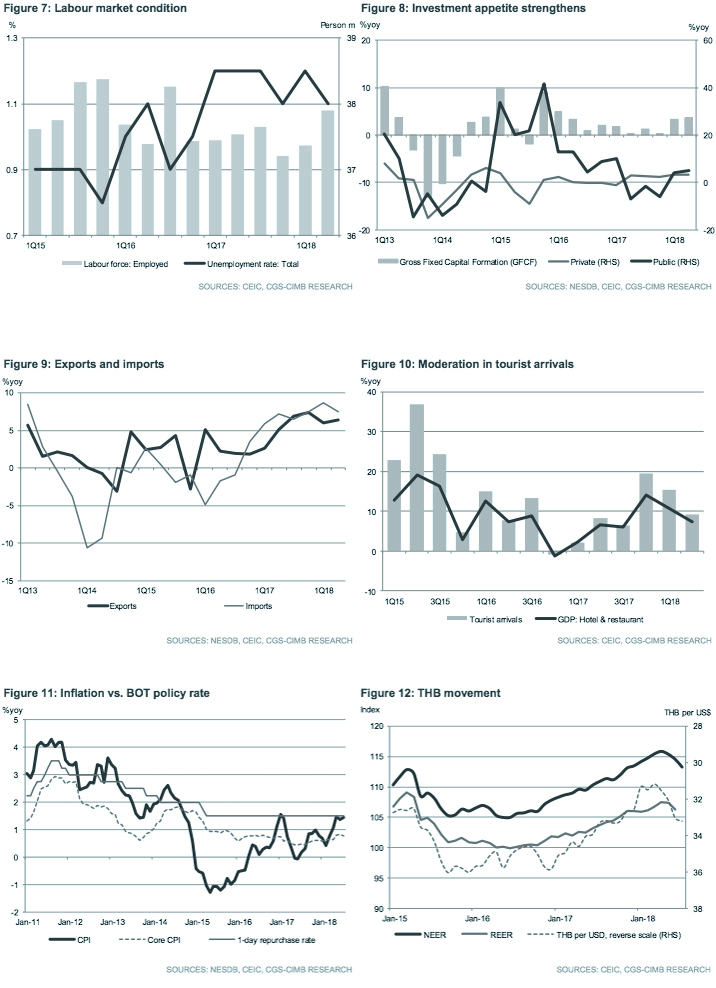
The recovery in private consumption extended to 4.5% yoy in 2Q18 (+3.7% yoy in 1Q18) due to sustained increases in household purchasing power, government transfers, a nascent turnaround in farm incomes (+6.1% yoy vs. -2.3% yoy in 1Q18), and consumer confidence reaching a 13-quarter high. In a sign household finances are on a firmer footing, demand for durable goods rose, particularly car purchases, which surged following the end of the 5-year ownership requirement under the first car buyer scheme. However recent floods in Thailand may disrupt the income recovery in agriculture-based regions if farm property and produce are damaged.

Investment appetite strengthens
The erosion of producer spare capacity, new measures to spur the SME sector, Eastern Economic Corridor (EEC)-centric investments and a ramp-up in government development expenditure are key factors supporting gross fixed capital formation (+3.6% yoy in 2Q18 vs. +3.4% yoy in 1Q18). The pipeline of investments in Thailand remains strong, with the value of projects approved by the Board of Investment (BOI) reaching THB118bn. Recently, the government lifted the year-long freeze on electric vehicle (EV) applications with the approval of THB30bn EV investments to be located in the EEC.

External sector weighed down by services deficit
Net exports declined for the second consecutive quarter (-0.2% pts in 2Q18 vs. -0.9% pts in 1Q18), albeit a shallower contraction on the back of an improved goods trade surplus. The external sector was weighed down by a trade deficit in services due to a moderation in tourist arrivals (+9.1% in 2Q18 vs. +15.4% yoy in 1Q18), which corresponded with slimmer gains in the hotel & restaurant sector. The Phuket boat accident in Jul that claimed the lives of 41 Chinese nationals may dampen tourist sentiment in the near term but we expect Thailand’s resilient tourism sector to eventually weather the storm.

Positive growth surprises may accelerate timing of policy rate hike
We revise our GDP growth forecast for the second successive quarter to 4.5% in 2018 (from 4.3%), which is the midpoint of the National Economic and Social Development Board’s (NESDB) 4.2-4.7% range. External trade uncertainty, subdued inflation, ample FX reserve buffers and the orderly manner of THB depreciation had underpinned our expectations that the Bank of Thailand (BOT) would not be rushed into an interest rate increase this year; however, back-to-back GDP outperformance suggests that the output gap in Thailand is fast narrowing. Hence, while we still expect the BOT to begin normalising monetary policy in early-2019, we would not rule out a potential policy rate hike in end-2018 if the growth trajectory continues to gather steam.

img-th4-2

img-th4-3

img-th4-5

img-th4-6


Originally published by CIMB Research and Economics on 8 August 2018.

Malaysia: 2Q18 GDP and current account


HIGHLIGHTS

2Q18 GDP and current account

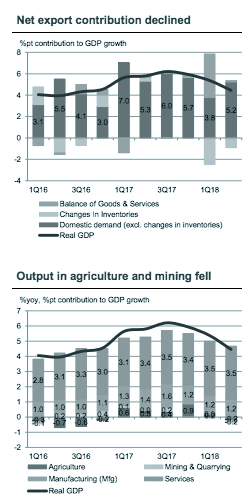
  • Malaysia’s economy expanded by 4.5% yoy in 2Q18, the weakest since 4Q16, partly due to supply shocks in agriculture (palm oil and rubber) and mining (natural gas).
  • We downgrade our forecast for GDP growth to 4.7% in 2018 (vs. +5.2% previously), which is lower than BNM’s revised estimate of 5.0% (vs. 5.5-6.0% previously).
  • Fiscal and monetary options are constrained, putting the onus on the government to provide policy clarity and accelerate reforms to stimulate the economy.

img-my19-1

A big miss in 2Q18 GDP growth
2Q18 GDP growth upended market expectations at 4.5% yoy (CIMB: +4.9%, consensus: +5.2%, 1Q18: +5.4%), the slowest pace since 4Q16. The contribution of net exports narrowed sharply (+0.1% pt in 2Q18 vs. +4.0% pts in 1Q18) as imports rebounded to meet stronger domestic demand (+5.2% yoy in 2Q18 vs. +3.8% yoy in 1Q18). Improvements in private consumption and investments were reflected by sustained growth in the domestic-oriented manufacturing and services sectors. While election spending boosted public consumption, public investment stalled as several large projects neared completion while development expenditure and megaprojects stalled post GE14.

Supply shocks to plantation crop and O&G sector
Supply disruptions in agriculture and mining dented contributions from the primary industries in 2Q18. In the agriculture sector, production of palm oil and rubber fell by 6% yoy and 20% yoy, respectively, due to supply bottlenecks, shortage of workers and adverse weather. Weak palm oil output also cascaded down to the downstream edible oil manufacturing segment. Meanwhile, the oil and gas (O&G) sector was hit by natural gas production outages in East Malaysia.

Stronger imports narrow the current account surplus
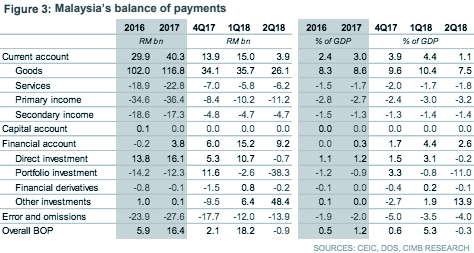
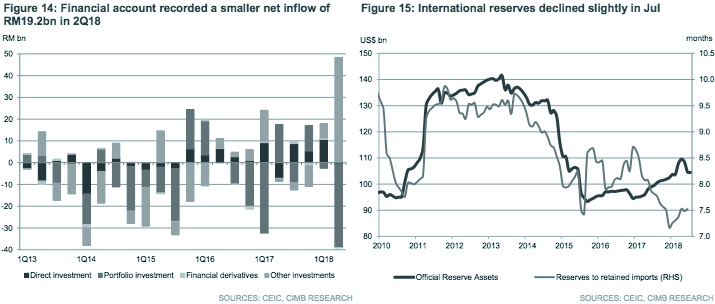
The pick-up in domestic demand resulted in the current account (CA) surplus falling sharply to RM3.9bn or 1.1% of GDP in 2Q18 (+RM15.0bn or 4.4% of GDP in 1Q18) on the back of a narrowing goods surplus and higher deficits in the services and primary income accounts. The financial account also recorded a smaller surplus (+RM9.2bn in 2Q18 vs. +RM15.2bn in 1Q18) as higher placements of currency and deposits with domestic financial institutions offset large net foreign portfolio outflows.

Growth trajectory slowing more than initially anticipated
Benefiting from a temporary tax holiday and labour market improvements, consumers are poised to take over the economic mantle as other growth engines lose velocity, particularly in the public sector. Apart from revenue forgone due from the Goods and Services Tax (GST), government spending will be further curtailed by recent revelations of unpaid GST claims to businesses amounting to RM19.4bn, which the Ministry of Finance has deferred until 2019. Moreover, supply disruptions in agriculture and mining are expected to linger for the rest of the year while the manufacturing outlook is clouded by external headwinds. To reflect these adverse developments, we have downgraded our GDP growth forecast to 4.7% in 2018 from 5.2% previously, shy of Bank Negara Malaysia’s (BNM) revised estimate of 5.0% (vs. 5.5-6.0% previously).

Tough choices lie ahead as policy space constrained
To maintain macroeconomic stability, BNM’s preference likely tilts to keeping the Overnight Policy Rate (OPR) unchanged for an extended period. Unless inflation remains weak, we think room for BNM to loosen monetary policy to stimulate demand is constrained by the uptrend in US interest rates and lower market tolerance for deteriorating current accounts. Fiscal options to stimulate Malaysia’s economy are limited amid budgetary constraints, placing greater urgency on the government to provide policy clarity and accelerate meaningful reforms to unleash productivity growth.

img-my19-2

img-my19-3

img-my19-4

img-my19-5

img-my19-6

img-my19-7


Originally published by CIMB Research and Economics on 3 August 2018.

Mekong Monitor


IMG-MM-160818

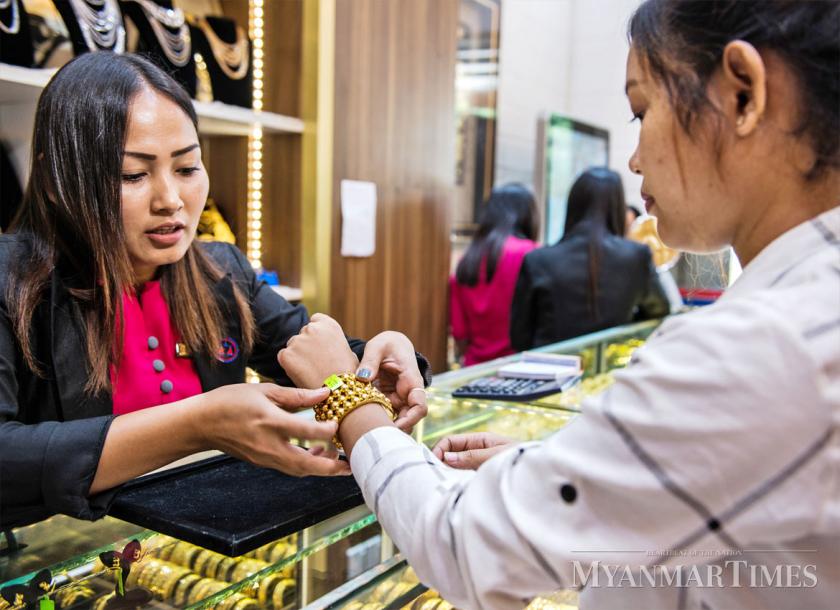
Photo Credit: Myanmar Times


TRADE, ECONOMY, AND INVESTMENT


CAMBODIA

Cambodia becomes the largest importer of Vietnam’s steel thanks to booming construction sector
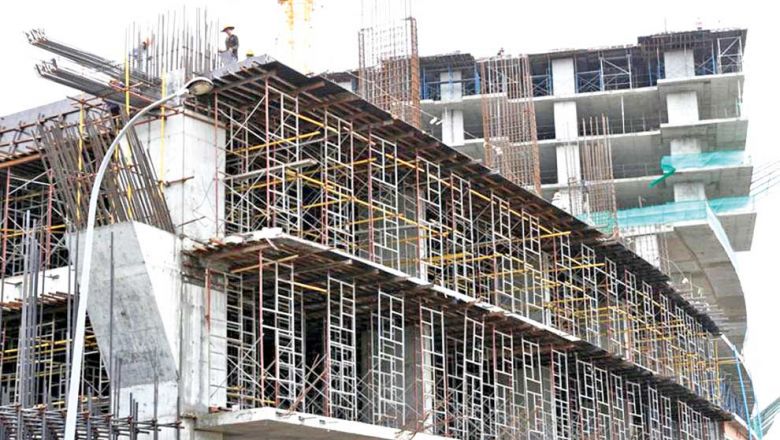
(23 August 2018) A boom in the construction sector has propelled Cambodia to become the largest importer of Vietnamese steel, accounting for 37 per cent of Vietnam’s total steel exports. The growth of high rise developments was behind this increased demand. According to an official from the Ministry of Land Management, Urban Planning and Construction, the ministry had approved 1,643 projects worth US$2.15 billion in total for the first half of 2018. For the first half of 2018, Cambodia imported 717,572 tonnes of steel from Vietnam, far greater than other major importers; U.S (532,779 tonnes), Malaysia (391,607 tonnes) and Indonesia (372,514 tonnes). The period between January and July this year saw a strong growth of 48 per cent in the volume of imported steel into the Kingdom, while its value shot up by 77.9 per cent, coming in at US$462.73 million.
Read more>>

MYANMAR

Myanmar considers holding tax rates to constant amidst currency pressure
(20 August 2018) Myanmar’s public accounts joint committee has proposed the government to maintain the current tax rates for 2018 amid the appreciation of the US dollar. The government is considering other revenue streams to the economy such as raising tariffs at the border, strengthening the enforcement of commercial tax and a special commodities tax. Apart from that, tax revenue can be raised by making it easier for the people to pay taxes and increasing tax compliance by providing incentives. Currently, banks and mobile service operators are jointly developing an online platform that will allow tax payments through mobile banking. Total tax revenue as a percentage of Myanmar’s GDP is the lowest in the region, with a forecasted tax-to-GDP ratio of 7 per cent for 2018-2019. Thailand is the most efficient tax collector in the ASEAN region, it’s total tax revenue is 17 per cent of its GDP. This is followed by Malaysia with 15.5 per cent.
Read more>>

VIETNAM

Vietnam’s local automotive market regains momentum
(20 August 2018) Regulatory changes introduced by the Vietnamese government, such as Decree 116 on the manufacturing, assembly and imports of automobiles, automobiles warranty and maintenance services, have resulted in a sharp decline in the number of imported cars into Vietnam. This is occurring despite import tariffs having been cut to zero on vehicles originating from the neighbouring ASEAN countries, in accordance to the implementation of the Vietnamese Government’s Decree 125. The number of imported cars into Vietnam for the first half of 2018 was 12,380 units at US$329 million, shrinking by 75.7 per cent in quantity and 68.3 per cent by value compared to the same period last year, according to the General Department of Vietnam Customs. Meanwhile, the volume of locally-produced and assembled cars for the first half of 2018 has seen a strong rebound, rising by 15.5 per cent year-on-year to 114,600 units. Nevertheless, the rise in the local car production failed to offset the decrease in the Vietnamese auto market as the total sales of Vietnam automotive market for the first half of this year fell by 6 per cent.
Read more>>

VIETNAM

Vietnam must overcome M&A bottlenecks in order to continue attracting foreign investors
(18 August 2018) Vietnam’s Merger and Acquisition (M&A) market has been a stellar performer in the eyes of foreign investors, but that growth may be coming to a halt. Vietnam has been urged to overcome bottlenecks hindering the growth of Vietnam’s M&A market as the value of M&A is forecasted to fall to US$6.5-6.9 billion in 2018 from last year’s US$10 billion. There are large disparities in the time taken for the completion of an M&A deal in Vietnam compared to others nations. The duration for a successful M&A deal takes only 3-6 months in other countries, while the process in Vietnam can take a whole year, at times even extending as long as 2-3 years to be executed. Apart from that, hurdles like an incomplete legal system pushes up transaction costs, and further delay the already onerous process. According to experts, there are numerous obstacles to be overcome during the legislative process such as developers being only allowed to sell projects after securing land use rights certificates for all or part of the projects.
Read more>>

THAILAND

EEC emerges as a new engine for Thailand’s economic growth
(19 August 2018) Thailand’s Eastern Economic Corridor (EEC), the country’s largest-ever infrastructure and industrial scheme along three provinces; Chonburi, Rayong and Chachoengsao, is emerging as Thailand’s new economic growth engine in 2018. An official from the EEC Office of Thailand stated the EEC is projected to generate US$3.05 billion in terms of tax revenue and generate more than US$13.7 billion in terms of revenue to the local community. The EEC project is seen as a suitable platform to turn these provinces into a hub for technological manufacturing and services with a strong connectivity to its neighbouring countries. As part of the EEC, Thailand has identified 10 industries, with an emphasis on developing new technologies such as next-generation automotive and smart electronic manufacturing, medical tourism and aerospace.
Read more>>


mekong-monitor-map

About Greater Mekong Subregion (GMS)

The Greater Mekong Subregion (GMS) Economic Programme was launched by the Asian Development Bank in 1992 connecting five developing ASEAN countries, namely Cambodia, Laos, Myanmar, Vietnam and Thailand, and Chinese provinces of Yunnan and Guangxi Zhuang Autonomous region. The region has some of the most robust economies sharing the Mekong River Basin thanks to its reform and liberalisation. The subregion is growing at a faster pace than the whole of East Asia and the Asia Pacific as the GDP growth rate for 2017 was at 6.4 percent, according to the World Bank. The population at the subregion as of 2016 is at 340 million while the GDP at PPP is at US$3.1 trillion in 2016. In 2015, trading within the region was at US$444 billion.

China-ASEAN Monitor


img-ca-210818.jpg

Photo credit: Vietnamnet


Economy, Investment and Trade

Vietnam’s Investment Ministry expresses wariness over China’s ODA loans
(19 August 2018) Vietnam’s Ministry of Planning and Investment (MPI) has expressed concerns over Official Development Assistance (ODA) loans from China amongst Vietnam’s group of ODA participants. A report from the ministry indicated that the annual interest rate of China’s ODA loans is at 3 per cent, much higher than that of Japan (0.4-1.2 per cent), South Korea (0-2.0 per cent) and India (1.75 per cent). Moreover, Chinese loans are subject to a 0.5 per cent commitment fee, as well as a 0.5 per cent administration fee. The lending terms and grace period of the Chinese ODA loans are also shorter than those of other donors by about 15 years and 5 years respectively. In addition, the MPI also stated that several projects using funding and equipment executed by Chinese contractors have recorded slow progress, are of poor quality and suffer cost overruns.
Read more>>

China’s largest insurer launches in Indonesia
(15 August 2018) Chinese insurance giant, China Life Insurance (Overseas) Company Limited launched its first operations in Indonesia, becoming the first life Chinese insurer in the archipelago. The state-run company is a subsidiary of China Life Insurance (Group) Company, has chosen Indonesia due to the country’s strategic position in southeast Asia. According to the Organisation for Economic Co-operation and Development (OECD), the life insurance penetration rate for Indonesia in 2016 is only 1.3 per cent.
Read more>>

Singaporean agribusinesses reap profits from U.S.-China Trade War
(17 August 2018) The recent trade spat between China and U.S. has benefited Singaporean agribusiness companies as they took advantage of plummeting soybean prices. Soybean prices plunged as China retaliated with its own tariffs against U.S. agricultural products. Wilmar International, the leading business group in the region, announced its net profit in the period of April-June skyrocketed to US$316 million, more than fivefold year-to-year growth. Olam International, another Singapore based agri-commodity business, also demonstrated a 52 per cent increase in volume of soybean sales for the first half of the year. Both companies reaped the benefits of lower material costs. However, there are fears that these short term profits will be negated by the longer term effects of the conflict. Wilmar has stated that it intends to hedge against this by sourcing alternative oils, such as Canola, in the place of Soybean.
Read more>>

Proton, Geely ink JV agreement to penetrate Chinese market
(18 August 2018) Chinese automaker, Zhejiang Geely Holding Group Co Ltd (Geely) has signed a Heads of Agreement to form a Joint Venture (JV) with Proton Holdings Bhd, with both companies taking up equal equity in the new entity. The new JV will open doors for Proton to set up a production facility to assemble and market its cars into the lucrative Chinese market. Using the existing Geely’s platform technologies, the designs of the vehicles will be developed by Proton. Additionally, some vendors of Proton parts might come under consideration as suppliers to the JV. Both companies target to incorporate JV within the first half of 2019, subject to acquiring all approvals. The new joint venture follows Geely’s investment in Proton in 2017, which saw Geely obtaining a 49.9 per cent equity stake in Proton Holdings Bhd.
Read more>>

Singapore Airlines, Alibaba tie-up to penetrate lucrative Chinese travel market
(21 August 2018) The flag national carrier airline of Singapore, Singapore Airlines (SIA) will be leveraging on Alibaba’s vast digital and logistics networks to increase it’s penetration of the travel market in China, one of the largest in the world. SIA will be partnering up with Alibaba in areas such as ticket sales, loyalty programmes, marketing initiatives, cloud services and logistics. Alibaba’s e-commerce platform will offer SIA access to more than 600 million mobile users. Apart from that, SIA will cooperate with Alibaba Cloud, the cloud computing arm of Alibaba Group to conduct a study on how the its IT ecosystem from web hosting to apps and membership items can benefit from Alibaba’s Cloud global network.
Read more>>


Indonesia: 2Q18 direct investments


HIGHLIGHTS

2Q18 direct investments

  • Direct investments (DI) grew 0.6% yoy to US$12.9bn in 2Q18 as gains in DDI (+25.9% yoy to US$5.8bn) offset the decline in FDI (-13.5% yoy to US$7.1bn).
  • The key growth drivers were mining (ex O&G), transport, storage & communications, real estate and utilities.
  • Falling capital investments from Japan, China, South Korea, Hong Kong and the US contributed to the decline in FDI.
  • No change to our 2018F GDP growth forecast of 5.3%.

img-ind24-1

Mildest annual increase since 3Q15
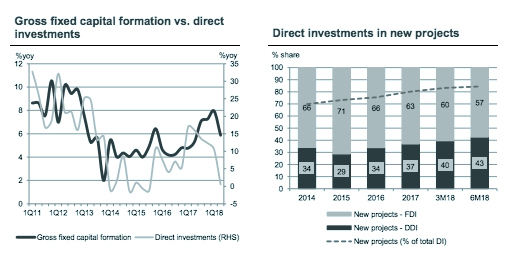
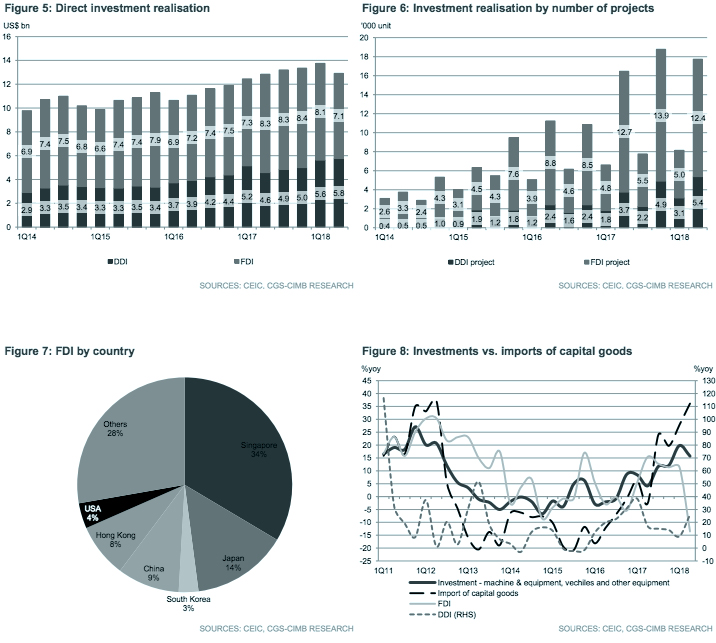
Total direct investments (DI) grew 0.6% yoy to US$12.9bn in 2Q18 but was 6.1% qoq lower compared to US$13.8bn in 1Q18. The slower growth in DI coincided with the moderation in gross fixed capital formation (+5.9% yoy vs. +7.9% yoy in 1Q18). Domestic direct investments (DDI) increased 25.9% yoy to US$5.8bn (+9.1% yoy to US$5.6bn in 1Q18). Foreign direct investments (FDI), however, fell 13.5% yoy to US$7.1bn in 2Q18 (+11.5% yoy to US$8.1bn in 1Q18), for the first time since 4Q16.

Record capital outlays in mining industry
Of the three sectors, DI in the primary sector recorded the strongest growth in 2Q18 (+22% yoy to US$2.9bn in vs. -4% yoy to US$2.4bn in 1Q18) as improving commodity prices attracted investment in mining (FDI -1% yoy/DDI +90% yoy). The quarterly capital outlays in mining (ex O&G) industry exceeded the US$2bn mark for the first time ever.

DDI supports investments in tertiary sector
Within the tertiary sector (+20% yoy to US$5.7bn in 2Q18 vs. +44% yoy to US$6.7bn in 1Q18), DI in transport, storage & communications (FDI +148% yoy/DDI +272% yoy) took the lead, supported by the government’s infrastructure projects, which also spurred imports of capital goods during the quarter. Other drivers included real estate (FDI +145% yoy/DDI +2% yoy) and electricity, gas & water supply (FDI -9% yoy/DDI +44% yoy).

Decline in FDI and DDI drags investment in secondary sector
The pace of contraction of DI in secondary sectors deepened in 2Q18 (-24% yoy to US$4.3bn vs. -12% yoy to US$4.7bn in 1Q18), dragged by weaker investments in metal, machinery & electronic (FDI -31% yoy/DDI unchanged yoy), chemical & pharmaceutical (FDI -33% yoy/DDI +36% yoy) as well as food (FDI -49% yoy/DDI +24% yoy).

FDI from East Asia and the US declined
34% of FDI came from Singapore, followed by Japan (14%), China (9.4%), Hong Kong (8%) and Malaysia (5%). Nonetheless, in terms of growth, capital investments from Japan, China, South Korea, Hong Kong and the US declined during the quarter amid the escalating US-China trade war and weakening rupiah.

No change to our 2018F GDP growth forecast of 5.3%
Investments in new projects continued to increase (84.4% of DI in 2Q18 vs. 83.2% in 1Q18) on the back of improving ease of doing business. Looking ahead, we expect investment growth to be supported by ongoing infrastructure projects. The Committee for Acceleration of Priority Infrastructure Delivery (KPPIP) has estimated that 13 projects worth Rp46.8tr and 25 projects worth Rp118.8tr will be completed in 2018 and 2019, respectively. We maintain our GDP growth target of 5.3% for 2018F.


img-ind24-2

img-ind24-3

img-ind24-4

img-ind24-6


Originally published by CIMB Research and Economics on 15 August 2018.

ASEAN Roundtable Series: What Lessons Learned from Financial Crises of Recent Times

Published on 20 August 2018

img-rtroundup-rt12.jpg

img-text-speakers.jpg

David Marsh

David Marsh

Chairman and Co-Founder,OMFIF

Read more

David Marsh is Chairman and Co-Founder of OMFIF. He is Senior Adviser to asset management company Soditic. Previously, he worked for City merchant bank Robert Fleming, corporate finance boutique Hawkpoint and German management consultancy Droege. Marsh took over the chairmanship from John Plender on 1 January 2018 having been Managing Director since 2014.

Marsh is a Board Member of Henderson Eurotrust and the British Chamber of Commerce in Germany, and visiting Professor at Sheffield University and King’s College London. He is former co-founder, chairman and deputy chairman of the German-British Forum. He was made Commander of the British Empire in 2000 and was awarded the German Order of Merit (Bundesverdienstkreuz) in 2003.

He started his career at Reuters in 1973 having graduated with a BA in chemistry from The Queen’s College Oxford. Between 1978 and 1995 he worked for the Financial Times in France and Germany, latterly as European Editor in London. Marsh has written six books: Six Days in in September – Black Wednesday, Brexit and the Making of Europe (2017, with William Keegan and Richard Roberts); Europe’s Deadlock: How the Crisis Could Be Solved – And Why It Won’t Happen (2013); The Euro – The Politics of the New Global Currency (2009 – re-released in 2011 as The Battle for the New Global Currency); Germany and Europe – The Crisis of Unity (1994); ‘The Bundesbank – The Bank that Rules Europe’ (1992); and Germany – Rich, Bothered and Divided (1989 – re-released in 1990 as The New Germany.

He is a frequent media commentator in Europe and the US.

Tan Sri Andrew Sheng

Tan Sri Andrew Sheng

Honorary Advisor,CIMB ASEAN Research Institute

Read more

Andrew Sheng is Distinguished Fellow of Asia Global Institute, The University of Hong Kong. He is Chief Adviser to China Banking Regulatory Commission, Chairman of Khazanah Research Institute, a Board Member of Khazanah Nasional Berhad and a member of the international advisory councils of China Investment Corporation, China Development Bank, China Securities Regulatory Commission, Securities and Exchange Board of India and Bank Indonesia Institute.

Previously, he was a Chairman of the Securities and Futures Commission of Hong Kong and a central banker with Hong Kong Monetary Authority and Bank Negara Malaysia.

He writes regularly on international finance and monetary economics, financial regulation and global governance for Project Syndicate, AsiaNewsNet and leading economic magazines and newspapers in China and Asia. His latest book is “Shadow Banking in China: An Opportunity for Financial Reform,” with Ng Chow Soon (2016, John Wiley).


Foong Chee Keong

Dr. Ho Ee Khor

Chief Economist, ASEAN+3 Macroeconomic Research Office (AMRO)

Read more

Dr. Khor is the Chief Economist of AMRO responsible for overseeing and developing the work on macroeconomic and financial market surveillance on East Asia and on the member economies in the region. He is also a member of the senior management team responsible for setting the strategic direction and management of AMRO.

Prior to joining AMRO, Dr. Khor was a Deputy Director of the Asia and Pacific Department (APD) at the International Monetary Fund (IMF), responsible for overseeing the surveillance work on six ASEAN and twelve Pacific Island countries. Dr Khor started his career as an economist at the IMF in 1981 and had worked on a wide range of economies in the Western Hemisphere and Asia and Pacific departments. He was the IMF Deputy Resident Representative in China from 1991- 1993.

From 2009-2010, Dr. Khor was Head of Economic Development and Chief Economist at the Abu Dhabi Council for Economic Development (ADCED).

Dr. Khor joined the Monetary Authority of Singapore (MAS) in July 1996 and was Assistant Managing Director from 2001 to 2009 where he was responsible for economic research, monetary policy, macro-financial surveillance, and international relations.

Dr. Khor obtained his Bachelor’s Degree in Economics/Mathematics from the University of Rochester and a Ph.D. in Economics from Princeton University.

Dr. Sufian Jusoh

Frank Scheidig

Global Head of Senior Executive Banking, DZ BANK

Read more

Frank Scheidig, Deputy Chairman of the OMFIF Advisory Board, is Global Head of Senior Executive Banking at DZ BANK in Frankfurt. He has extensive experience in working with public sector institutions and asset managers worldwide.

Previously, Scheidig was Head of Fixed Income International Sales at DZBANK and a member of the Board of Managing Directors at Deutsche Asset Management International, following posts as Managing Director and Global Head of Central Bank Sales at Deutsche Bank.

Prior to this, he worked as a trader for German government bonds at Suedwest-LB and Bayerische Vereinsbank, in Frankfurt.

Between 1993 and 2000, Scheidig worked in fixed income sales at Bayerische Landesbank and held several senior sales positions in global market divisions at Dresdner Bank.


Dr. Sufian Jusoh

Dr. Hans Genberg

Executive Director of the South East Asian Central Banks (SEACEN) Research and Training Centre

Read more

Dr. Hans Genberg joined SEACEN on March 3, 2014 as Adviser in the area of Macroeconomics and Monetary Policy Management (MMPM) on secondment from Bank Negara Malaysia.

Prior to joining SEACEN, Dr. Genberg was Assistant Director at the Independent Evaluation Office of the International Monetary Fund where he led evaluations of International Reserves: IMF Concerns and Country Perspectives and IMF Forecasts: Process, Quality, and Country Perspectives. Between 2005 and 2009 he was Executive Director, Research at the Hong Kong Monetary Authority and Director of the Hong Kong Institute for Monetary Research after which he spent one year as Visiting Advisor at the Representative office for Asia and the Pacific of the Bank for International Settlements. Before joining the HKMA he was Professor of international economics at the Graduate Institute of International Studies in Geneva, Switzerland. A Swedish national, Dr. Genberg holds a Ph.D. degree in Economics from the University of Chicago.

Dr. Genberg has written widely on issues dealing with international finance, monetary economics and macroeconomics. His publications include Asset Prices and Central Bank Policy; Official Reserves and Currency Management in Asia: Myth, reality and the Future; and The Banking Sector in Hong Kong as well as numerous articles in major professional journals such as Econometrica, the Journal of Monetary Economics, Journal of Money Credit and Banking, and the Journal of International Economics.


Chair

TSMM

Tan Sri Dr. Munir Majid

Chairman, CIMB ASEAN Research InstitutePresident, ASEAN Business Club

Read more

Tan Sri Dr. Munir is currently Chairman of CIMB ASEAN Research Institute, of Bank Muamalat Malaysia Berhad, of the Financial Services Professional Board, of ASEAN Business Advisory Council, Malaysia, as well as President of the ASEAN Business Club. He also sits on the board of the Institute of Strategic and International Studies (ISIS) Malaysia and on the Financial Services Talent Council of Bank Negara Malaysia.

He has an extensive experience and is well known in the Malaysian corporate world. He had been the Group Editor of the New Straits Times, first executive chairman of CIMB and founding chairman of the Malaysian Securities Commission. After stepping down from the Securities Commission, he became Independent Non-Executive Director of Telekom Malaysia Berhad, Chairman of Celcom (Malaysia) Berhad and Non-Executive Chairman of Malaysian Airline System Berhad. He was Founder President of the Kuala Lumpur Business Club, established in 2003 and is a member of the Court of Fellows of the Malaysian Institute of Management.

Tan Sri Dr. Munir obtained a B.Sc (Econ) and Ph.D in International Relations from the London School of Economic and Political Science (LSE) in 1971 and 1978. He is an Honorary Fellow of LSE and continues the long association with his alma mater as Visiting Senior Fellow at the Centre of International Affairs, Diplomacy and Strategy. Tan Sri Dr. Munir is an associate of Southeast Asia Centre (SEAC) at LSE.


INTRODUCTION

CARI’S ASEAN Roundtable series on the 18th July 2018 brought together a panel of eminent speakers who dissected the probability of a new financial crisis in Asia, as well as the direct and indirect effects of any fallout.

Titled “What Lessons Learned from Financial Crises of Recent Times”, the panel speakers considered very carefully the parallels with past upheavals such as the Asian Financial Crisis (AFC) and the Global Financial Crisis (GFC) within their contextual applicability to the current scenario. Globalisation, which was in its nascent stages when the first crisis hit, has matured rapidly in the intervening period. The result is that the world has moved from a unipolar to a multipolar environment.

The evolving global landscape means that global trade and economic development does not just center around two biggest world economies such as the United States and China, but involves a whole belt of countries like Indonesia, moving through to India and incorporating the African continent.

These nations are expanding a swathe of population into middle income status, and are keen for most part for the presence of free markets to grow wealth and opportunities.

ASEAN Roundtable Series

Tan Sri Dr. Munir Majid, who chaired the panel, led the speakers in addressing questions over whether the world is facing a perfect storm of factors that would trigger a global recession, or even a depression. Some of the headwinds can already be seen. For example, public debt in European countries such as Italy and Greece are increasing and the political will to address the problem of being highly leveraged has been diverted by partisan politics.

Most importantly, they postulated the measures that could be taken by ASEAN nations through domestic policies and their sovereign regulatory institutions, such as Central Banks, to mitigate the worse effects of the storm and weather it. In addition, they highlighted the silver lining in this dark cloud, that there may short term opportunities arising from this disruption to institute fundamental structural changes that could ensure long term prosperity.

However, burning questions remained over the future of the openness of global trade, as well the roadmap to regional economic integration. The effects on current account balances and domestic demand form two crucial points of concern

 
THE ASIAN FINANCIAL CRISIS: A SERIES OF MISMATCHES

The Asian Financial Crisis of 1997-98 could be largely attributed to a series of mismatches leading to a perfect storm that culminated in a series of precipitous events for the region.

The first was a maturity mismatch, in which the majority of borrowing was on a short-term tenor, but used to invest in assets with a longer repayment schedule, such as real estate. This created a gapping issue which increased short term interest costs for borrowers, particularly when creditors became nervous.

Secondly, there were significant instances of foreign currency mismatches, involving ASEAN countries borrowing in US Dollars to finance loans in local currency, by means of a currency swap generally.

When local currencies started depreciating under heavy speculative selloffs, these loans resulted in heavy foreign exchange losses, as well as increased interest repayment costs as defaults spiraled.

 
POST AFC: ASEAN RISES FROM THE ASHES

In the last two decades, ASEAN has resurrected itself remarkably from the depths of the Asian Financial Crisis (AFC) in the 90’s to become a significant economic trade and power bloc in regional Asia.

It has benefited greatly from regulatory policies which favored an open trade environment with minimum barriers, most notably from the World Trade Organisation (WTO) and intra-regional Free Trade Agreements.

The permissive environment has been very conducive for ASEAN, so much so that intermediate goods now account for one-third of exports in the region, and three-fifths of imports. ASEAN Goods are now very much an integral part of the global supply chain process.

However, recent escalations in trade and geopolitical tensions between the U.S and the rest of the world, notably China and the EU have threatened to disrupt this narrative of free and open trade among developed and developing nations.

The resumption of protectionist policies, as demonstrated by punitive tariffs levied primarily by the United States and China has caused its fair share of uneasiness among those who fear a new financial crisis in Asia.

The latter, to a degree, was fairly well insulated from the effects of the Global Financial Crisis that hit the U.S and Europe in 2008. In fact, the region benefited greatly from enhanced liquidity flows as a result of the U.S Federal Reserve and European Central Bank’s (ECB) Quantitative Easing (QE).

This time around, tariffs under the Trump administration targeting the world’s second largest economy, China, as well as major players like Japan and South Korea means that ASEAN will be less shielded from the shocks of these weapons of open trade destruction.

 
GLOBAL FINANCIAL CRISIS: THE AFC ON STEROIDS

While ASEAN was the main focus, there were comparative lessons that were learnt from the later GFC that followed in 2008, as well as being aware of the differences between the two. In leading this discussion, Tan Sri Andrew Sheng believes that the GFC contained the same maturity and FX mismatches that characterized the AFC, with an additional Debt/Equity mismatch thrown in for good measure.

The added involvement of exotic financial derivatives that were not around at the time of the AFC, such as Credit Default Swaps (CDS), was another distinction. Lastly, the term ‘Global’ may have turned out to be a slight misnomer, as the detrimental effects were mainly confined to the U.S and Europe.

As a result, Europe was divided into winners and losers. The latter consisted of mainly the Southern European countries that went by the less salubrious acronym; PIGS (Portugal, Ireland, Greece and Spain).

The events that followed the GFC have been described as a ‘transition game’ from the richer Northern European nations to rescue their less well off Southern cousins. However, credit flows to the PIGS were eventually stopped and the ECB refused to print more Euros. The compounded detrimental effects on these overleveraged countries were severe, and are still felt to this day.

The Net foreign liabilities incurred by the PIGS such as Spain, Portugal and Greece back in 2008-10 exceeded 100% of their GDP. In contrast, during the AFC, the negative net foreign liabilities borne by a number of Asian economies never went past 50% of GDP.

In conclusion, the viewpoint of Andrew Sheng was that we needed to keep an eye on the net foreign liabilities and be cognisant of the fact that the current high debt levels of those European nations that took a hit in 2008 are still in the danger zone.

img-series-textheader.jpg


1. ASEAN IS BETTER PLACED TO WEATHER POTENTIAL CRISIS BUT VIGILANCE IS CRUCIAL

ASEAN Roundtable Series

Dr. Ho Ee Khor from ASEAN+3 Macroeconomic Research Office (AMRO) discussed a recent simulation that his organisation ran with regards to the effects of a large scale global tariff war on the ASEAN region. The results were cautiously optimistic, indicating that such an event would shave off only 0.1% to 0.4% of regional GDP growth.

In contrast, the AFC had longer and larger scale effects. Growth in general for ASEAN nations ranged between 8 to 10% before that crisis. Since then, normative GDP growth has been lower overall, and now ranges between 5 to 6%.

On the whole, Asian nations have demonstrated greater resiliency than where they were in 1997 by taking initiatives to strengthen their macroeconomic fundamentals over that intervening period.

They are now wary of the pitfalls of being over leveraged and their Central Banks have become more proactive in smoothing out fluctuations. Dr. Khor maintained that ASEAN is on a whole, better placed to handle a new crisis due to the Chiang Mai Initiative Multilateralisation (CMIM) Facility.

The establishment of the CMIM in 2010 meant that countries such as Malaysia and other ASEAN nations could draw on funds up to US$23 billion each from this currency swap agreement.

By building on the Chiang Mai initiative back in 2000, the established pool now stands at US$240 billion and allows countries facing a short-term liquidity shortage to borrow from a reservoir of foreign-exchange reserves.

One of the questions asked by some of the panel speakers was whether the quantum of the CMIM was sufficient.

Fortunately, in addition to the swap line above, ASEAN countries have relatively large Foreign Exchange reserves to draw on if another financial crisis hit the region (Table 1 below).

ASEAN Roundtable Series

Apart from ASEAN, Frank Scheidig highlighted that China has an immensely large amount of Foreign Exchange reserves but needed to liberalise their legal system and open their currency to a free float without needing an offshore mechanism.

Table 1: Foreign Exchange Reserves of China and ASEAN: 2017

Name

FX Reserves (USD Billions)

FX Reserves as a % of GDP

CHINA

4,000.0

33%

ASEAN

August 2014

August 2017


Singapore

273.0

273.0

83%

Thailand

167.5

196.9

62%

Malaysia

137.5

100.2

35%

Indonesia

111.2

128.8

12%

Philippines

80.9

81.5

47%

Vietnam

34.6

28.6

21%

Cambodia

5.6

10.0

41%

Myanmar

3.9

5.2

8%

Laos

0.7

0.9

7%

Source(s): Trading Economics, Aseantoday; taken from here

 
As such, AMRO’s recommendation was that policymakers needed to continue the process of being vigilant through surveillance, thereby negating the need to draw on the facilities provided by the measures above.

It is hoped that by utilising policies drawn from the fiscal, monetary and macroprudential spheres, maintaining a balance between growth and stability can be achieved.


2. USE OTHER POLICY TOOLS BESIDES MONETARY POLICY

Governments and policy makers should not over rely on monetary policy at the expense of the many other policy tools available.

ASEAN Roundtable Series

According to Tan Sri Dr. Andrew Sheng, there are essentially six (6) policy tools available to governments to deal with disruptions:

  • Monetary Policies
  • Regulatory Policies
  • Fiscal Policies
  • Structural Policies
  • Bureaucratic/ Governance Policies
  • Trade/ Foreign Policies

The over reliance on monetary policy tools, such as reducing interest rates and QE is due to the reluctance on the part of governments to use fiscal policies as it transfers the risk from the savers to the borrowers, according to one panel speaker.

Governments generally prefer using monetary policy as it has less severe political repercussions as opposed to direct fiscal policies. The problem with this approach is that it negates the occasional approach of more effective solutions to solving the issues at hand.

The fear of the cascading effect of mass defaults and the possible plunge into a painful and prolonged period of recession has resulted in an overuse of monetary policy. While this has generated a surge of prosperity in the ASEAN region, an assertion is made that this consists of asset bubbles that may burst when the next crisis hits.


3. CENTRAL BANK’S OVERSTRETCHED MANDATE POSES CHALLENGES IN DEALING WITH THE NEXT FINANCIAL CRISIS

ASEAN Roundtable Series

Dr. Hans Gensberg touched on the expanding mandates of Central Banks (CB) in the ASEAN region. He believes that CBs should be tasked with what they are good at, and that governments need to exercise some measure of fiscal policy in order to address systemic and non-systemic economic and financial shocks.

The expanded role of CB’s beyond governance comes with two main risks, in his opinion.

  1. Risk Shifting
  2. By directing macroprudential policies at regulatory institutions, the latter can be overly restricted in terms of their operations and effectiveness. In contrast, the institutions that are not regulated are more prone to being affected by financial shocks.

  3. Targeting Individual Sectors
  4. CBs can be used to target individual sectors, which means they play a major role in directing credit – something they are not traditionally tasked with. What this does is hampering efficiencies and involvement in regulatory agencies.

During the Asian Financial Crisis, the role and activities of Central Banks entered the public consciousness through their willingness to use their country’s foreign exchange reserves to defend currency values by smoothing out fluctuations.

As a result of that experience, three outcomes have emerged with regards to how CB’s operate:

  • CB’s are now more likely to intervene in the open markets to smooth out what they see as misalignments in exchange rates
  • CB’s in the Asian region are quite clear about their objective in engendering price stability. They are single minded about targeting inflationary expectations. To that end, CB’s are making greater usage of capital account measures to attain this.
  • Lastly, CB’s and regulatory authorities have improved their surveillance systems with regards to financial disruptions and are more willing to use policies of macro intervention.

Presently, CB’s need to address not just issues of money supply and price stability, but in addition, areas such a financial inclusion, regulation, income inequalities and exchange rate management policies.

In summary, Dr. Gensberg believes that culmination of expanded roles will mean CB’s have entered into territories that lack democratic accountability by co-opting mandates that should be within the scope of political authorities instead.

Two other points of note that came up during the roundtable session:

  1. THE NEXT GFC MIGHT BEGIN IN EUROPE
  2. ASEAN Roundtable Series

    David Marsh expressed concern over a number of Southern European nations which still had very high levels of negative liabilities, and this was expected to the one of the triggers for a future economic crisis and the fulcrum for larger imbalances in Europe.

    Arguably, European banks are in a more vulnerable position this time around and are less likely to be a buffer between the government and the real economy. Mr. Scheidig described those financial institutions are more like ‘melting ice in the sun’ as the buffer now has significantly thinned compared to previous times.

    Germany’s role will be crucial in mitigating such adverse effects but the prevailing question was whether they would be willing to do so in order keep the debtor countries operating.

    As a result of the last GFC, they have already chalked up high levels of net foreign assets and will insist on some debt restructuring on behalf of those delinquent nations in its role as prime creditor.

    Given that the Germans have reduced their own debt to GDP ratio to less than 60% as per the requirements of the Maastricht treaty, they would justifiably hold the high moral ground in this scenario.

    David Marsh’s prevailing fear is that there are two main trigger points that will trip a new GFC, that will have its genesis in Europe this time around:

    The first are rising Target2 balances, which are the claims and liabilities of euro area National European Central Banks (NCBs) against the ECB that arise from cross border payment flows. The euro crisis of 2011-2012 saw sharply rising Target balances and were thought to be a sign of stress in the system, as well as an indication of the risks creditor countries were running.

    Another round of ECB Quantitative Easing (QE) could spike their figure up even higher for Germany, propelling it to around EUR 1 trillion, or a third of its GDP.

    Default events will bring up another potential wave of systemic shocks as the events of non-payment reverberate. Hence, Germany will be watching this metric with great concern.

    The second trigger could be the failure of the ECB to elect a German national as the next head of the ECB. A majority of Germans hope to see the current President of the Bundesbank, Jens Weidmann, as the future President of the ECB.

    David Marsh felt that the next president of the ECB is likely to be a French national, and the resulting political backlash could influence the degree of assistance that Germany might be willing to offer to struggling countries in the next Eurocentric crisis.

  3. MULTILATERAL TRADE DEALS SAN THE U.S. LIKELY TO THRIVE DUE TO TRADE FLOWS REALIGNMENT DESPITE RISING PROTECTIONISM
  4. A working definition of ‘America First’ mean that the U.S will actively cease to subsidise Global Public Goods (GBG) by transferring risk to other parties instead of sharing it. This was the view of Andrew Sheng. These are goods with benefits and/or costs that potentially extend to all countries, people, and generations.

    While this is a rude awakening for all other nations, it might spur them to negotiate free trade agreements on a bilateral or multilateral basis apart from the U.S. One such example is the continued interest in the Comprehensive and Progressive Trans Pacific Partnership (CPTPP) even though the Trump administration has renounced it.

    This means that even with rising protectionism, ASEAN can insulate itself by realigning trade flows and increasing intra-bloc transfers regardless of what the U.S may decide to do in the future. It is a win-win scenario as even if the U.S reverts back to an open trade policy, ASEANs intra-trade links are an additional buffer to future shocks. This means that ASEAN nations have to be proactively, and urgently negotiating these multilateral deals now.

    Another interesting recent event was the signing of an FTA between the EU and Japan in 2018, called the EU-Japan Economic Partnership Agreement. This deal, would reduce $1.2 billion worth of tariffs for EU based exporters and approximately double that amount for their Japanese counterparts.

    This is significant as the EU and Japan together account for one-third of the world’s GDP.

    If the new normal is a continual resumption of ‘America first’ policies, then the positive silver lining might be a realignment of trade flows and growth areas. More importantly, it would continue the practice of reducing barriers to trade in other regions as an antagonist to U.S protectionism.

img-textconclusion.jpg


The default paradigm throughout recent history in which American trade policy was a stabilizer is seriously being challenged. Rather, it has become a disruptor, rudely rattling the rest of the world which has accepted Neo-Liberal open trade policies as the status quo.

Andrew Sheng suggested that new paradigms needed to be embraced in this multipolar world; one that wasn’t beholden to the U.S and its policies.

This involves other countries and blocs, like ASEAN, undertaking a long-term commitment to support the multilateral global system. Of course, this is easier said than done as the U.S remains the world’s largest economy and premier consumer of exports.

However, the general consensus among the panel speakers was that they were not expecting external demand to collapse again. In the interim, there might a series of intermediate shocks to the financial system, such as global interest rates rising rapidly, or heavy selloffs in asset markets.

There are grounds to be optimistic. Asia and ASEAN have enough capacity to rewrite the narrative of intra-regional trade according to their dictated. Because of these disruptions, a more united market might emerge, focusing on breadth and depth that shifts the loci of trade focus to the EU and Asia.

For the moment, the trend now is to enact trade policies from a solely national viewpoint, to operate in SILOs. The irony is that the longer the U.S chooses this path, they may irrevocably transform from being the one ton gorilla in the room to becoming a lightweight among the primates in the jungle of global trade.

 
ASEAN Roundtable Series

ASEAN Roundtable Series

ASEAN Roundtable Series

ASEAN Roundtable Series

ASEAN Roundtable Series

ASEAN Roundtable Series

ASEAN Roundtable Series: Closing the Talent and Skills Gap in ASEAN

Published on 20 August 2018

img-viewpoints-rt10.jpg

img-text-speakers.jpg

Puan Shareen Shariza

Puan Shareen Shariza Binti Dato’ Abdul Ghani

Chief Executive Officer, TalentCorp Malaysia

Read more

Shareen Shariza Dato’ Abdul Ghani has over 20 years of experience in various industries including retail, capital markets, social and humanitarian sectors as well as in the corporate sustainability space. Before joining TalentCorp, she was the Director of Corporate Responsibility at Khazanah Nasional Berhad (Khazanah), where she helped shape Khazanah’s Corporate Responsibility strategy and established initiatives such as PINTAR, Yayasan Sejahtera and GEMS Malaysia. Prior to that, Shareen was Chief Operations Officer at MERCY Malaysia, where she served in humanitarian missions to Darfur, Sri Lanka, Iran, Aceh, and remote areas throughout Malaysia.

Shareen has been part of TalentCorp since its early years, in her capacity as Khazanah’s representative on the board of directors of GEMS Malaysia, the TalentCorp subsidiary responsible for upskilling Malaysian graduates through the Graduate Employability Management Scheme (GEMS). She was appointed the Chief Executive Officer of TalentCorp on 1 June 2016.

Shareen was a former board member of the Humanitarian Accountability Partnership and a recipient of the Pingat Darjah Paduka Mahkota Perak for her contributions towards humanitarian efforts. She holds a Master of Studies in Sustainability Leadership from Cambridge University and Master in Public Policy from University Malaya.

Mr. Chua Soon Ghee

Mr. Chua Soon Ghee

Partner, Head of Southeast Asia, A.T. Kearney, Singapore

Read more

Soon Ghee is a Partner with A.T. Kearney in Singapore, and is the Head of the Southeast Asia unit. He has over 20 years of experience in both consulting and industry across Asia. He is the author of “Asian Mergers & Acquisitions: Riding the Wave” which touches on M&A and post-merger integration in the Asian context, “Lifting the Barriers to E-Commerce in ASEAN”, and “The ASEAN Digital Revolution” white papers. He is also a regular speaker on CNBC, BBC, ChannelnewsAsia, and many regional conferences on topics related to digital, transformation and global trends.


Dr. Shu Tian

Dato’ CM Vignaesvaran Jeyandran

Chief Executive, Human Resources Development Fund (HRDF), Malaysia

Read more

As Chief Executive of the Human Resources Development Fund (HRDF), Dato’ Vicks (as he is fondly known) is one of Malaysia’s most vocal advocates of human capital development, catalysing the up-skilling, re-skilling & multi-skilling of the local workforce and ensuring relevance to industry.

He holds a Bachelor of Business Studies, Administration & Management – Marketing (Universiti Kebangsaan Malaysia), ASEAN CEO Leadership Programme (Oxford University, UK), ASEAN CEO Programme (Cranfield University, UK); Professional Certification of Human Resource Management (Cambridge University, UK); Professional Certification on Big Data Analytics (Harvard University, USA).

Dato’ Vicks also sits on the Boards of HRDF, the Penang Skills Development Centre (PSDC), the Malaysia Convention & Exhibition Bureau (MyCEB), the ICLIF Leadership Energy Awards 2017 (Advisory Council) and is the President-Elect for the International Federation of Training and Development (IFTDO).

Dato’ Hamidah Naziadin

Dato’ Hamidah Naziadin

Group Chief People Officer, CIMB Group
Chief Executive Officer, CIMB Foundation

Read more

Dato’ Hamidah Naziadin has 30 years’ experience in HR in the financial industry, of which 27 were with CIMB. She provides overall strategic leadership for HR across ASEAN to develop an agile, high-performing regional workforce.

She has led HR’s transformation from an administrative function into a key business enabler, contributing to CIMB’s rapid growth into the leading ASEAN financial institution that it is today. She strategised the resource integration in successful mergers and acquisitions over the years, within Malaysia and across ASEAN and APAC regions. She has also implemented strategic HR programmes that have earned peer and industry recognition through numerous awards.

She continuously strengthens workplace culture and compliance through employee engagement, and has developed workplace wellness policies and programmes towards sustaining a productive and inspiring work environment.

On top of that, she also spearheads CSR in community development, sports and education initiatives with diversity and inclusion as the guiding principles, to deliver sustainable benefits for the communities in the region. She is passionate about championing thought leadership through industry talks and publications on issues around women empowerment, and education/development for youths and graduates. She is a member of the Board of Directors at Maxis Berhad and holds a Bachelor of Laws from the University of Wolverhampton, UK.


Chair

TSMM

Tan Sri Dr. Munir Majid

Chairman, CIMB ASEAN Research InstitutePresident, ASEAN Business Club

Read more

Tan Sri Dr. Munir is currently Chairman of CIMB ASEAN Research Institute, of Bank Muamalat Malaysia Berhad, of the Financial Services Professional Board, of ASEAN Business Advisory Council, Malaysia, as well as President of the ASEAN Business Club. He also sits on the board of the Institute of Strategic and International Studies (ISIS) Malaysia and on the Financial Services Talent Council of Bank Negara Malaysia.

He has an extensive experience and is well known in the Malaysian corporate world. He had been the Group Editor of the New Straits Times, first executive chairman of CIMB and founding chairman of the Malaysian Securities Commission. After stepping down from the Securities Commission, he became Independent Non-Executive Director of Telekom Malaysia Berhad, Chairman of Celcom (Malaysia) Berhad and Non-Executive Chairman of Malaysian Airline System Berhad. He was Founder President of the Kuala Lumpur Business Club, established in 2003 and is a member of the Court of Fellows of the Malaysian Institute of Management.

Tan Sri Dr. Munir obtained a B.Sc (Econ) and Ph.D in International Relations from the London School of Economic and Political Science (LSE) in 1971 and 1978. He is an Honorary Fellow of LSE and continues the long association with his alma mater as Visiting Senior Fellow at the Centre of International Affairs, Diplomacy and Strategy. Tan Sri Dr. Munir is an associate of Southeast Asia Centre (SEAC) at LSE.


This roundtable discussed the need to liberalise ASEAN labour mobility in the near term, as well as execute urgent education reforms and the reskilling of its workforce to fill the skills gaps in the region, underlined by the requirements of Industry 4.0.

Although the ASEAN Economic Community (AEC) has envisioned for the free movement of skilled labour and business visitors within the bloc, there is a deficit in the supply of needed workforce skill sets within the ASEAN region that goes beyond solely addressing the issue of labour mobility.

There is an urgent need to address the paradigm shifts that ASEAN’s labour force will need to face from technological changes. A McKinsey report highlighted that by 2030, 800 million jobs will be lost to automation. Locally, a Khazanah paper concluded that 54 per cent of all jobs in Malaysia were at high risk of being displaced in the next 20 years. Low-skilled jobs were particularly vulnerable, with as many as 80 per cent classified as high risk.

To discuss the issue, four panel speakers, Dato’ Hamidah Naziadin, Group Chief People Officer of CIMB Group; Shareen Shariza Dato’ Abdul Ghani, CEO of TalentCorp Malaysia; Chua Soon Ghee, Partner, Head of Southeast Asia of A.T. Kearney, Singapore; and Dato’ CM Vignaesvaran Jeyandran, former Chief Executive of Human Resources Development Fund (HRDF) of Malaysia debated on ways to close the talent and skills gap in the region.

img-series-textheader.jpg


1. There is a Deficit of Skills in ASEAN

Removal of Protectionism will enhance talent mobility in ASEAN

Despite the aspirations of ASEAN to improve skill mobility within the region, there seem to be barriers that hamper the movement of professionals within the area and utilising skill sets of these people.

One such example was the issue of a gap in being able to source the right talents in financial institutions, which was highlighted by Dato’ Hamidah. In Malaysia, specialised skills in the areas of risk, audit and compliance were in short supply. In addition, talent with specialities in FinTech and Digital banking technology needed to be recruited outside ASEAN. It was hoped that over time, these foreign talents with global exposure and experiences would impart their technical ability and knowledge to the local workforce.

ASEAN Roundtable Series

However, regulatory restrictions on labour mobility is hampering this process. Puan Hamidah felt that 1) labour mobility is restricted to particular levels and positions and 2) local graduates enjoy a positive bias as opposed to foreign ones.

However, in trying to source talent from other ASEAN countries, the financial institutions faces regulatory restrictions on mobility. Dato’ Hamidah said that labour mobility is not totally free as most countries restrict entry of foreign talent in order to protect the local workforce. Hence, this has led to a situation where regulations relating to the entry of foreign professionals in the financial industry was not uniform across the region.

The consensus among the panellists was that one immediate solution to this shortage of skills in the region is to have less inhibited movement of talent.

ASEAN Roundtable Series

Puan Shareen said that Malaysia is addressing talent mobility through TalentCorp by looking into importing skills from other countries in ASEAN and also exporting its own skilled labour from Malaysia to ASEAN countries. TalentCorp has established talent mobility programs such as the MyASEAN internship and MyAPEC Youth Connect to promote intra-ASEAN mobility. However, TalentCorp has experienced difficulties sending local talents to some ASEAN countries, where they have implemented policies to protect their domestic job markets.

In her presentation, a World Economic Forum (WEF) report titled Future of Jobs showed that 54% of businesses surveyed in ASEAN support talent mobility programmes, followed by initiatives to attract foreign talent and investment into reskilling its current employees.

Mobility opportunities are now considered an essential element in attracting, retaining, developing and engaging talent, especially for the millennials. Shareen shared a PwC’s 2012 study on global talent mobility, which found that 71 percent of millennials expect an overseas assignment during their career.


2. Industry 4.0 necessitates educational reform and workforce reskilling

Another critical trend discussed was the impact of industry 4.0 on ASEAN economies and their respective workforces. Four paradigm shifts are expected as a result of its arrival:

  1. Global value chains (GVC) are shifting geographical locations of production to ASEAN
  2. The movement of geographical markets of consumption to ASEAN as the middle class expands
  3. ASEAN will need to move from a low-cost labour framework to one that relies on technological upgrades to increase productivity
  4. Manufacturing will need to adapt to increasing automation

Chua Soon Ghee, Partner and Head of Southeast Asia, A.T. Kearney believes that ASEAN countries are unprepared in term of human capital to address these new paradigms.

ASEAN Roundtable Series

He said that jobs now require workers with stronger cognitive and complex problem-solving skills. There is a big gap between the skill-sets needed and what the workforce is currently capable of providing. Thus, ASEAN countries need to boost the percentage of the highly skilled labour component of their total workforce. Currently, Singapore is the only country in the bloc above 50 per cent (See Table 1 below)

Table 1

Country

High-skilled employment share

Singapore

56.2%

Malaysia

26.0%

Philippines

24.8%

Myanmar

21.9%

Thailand

14.3%

Vietnam

11.2%

Indonesia

10.2%

Source: WEF – Global Human Capital Report 2017, International Labour Organization – Modelled Estimates 2017, A.T. Kearney

 
To address that deficit, a transformation of the education system and government-employer-employee relationship are required. Increasing labour mobility, from outside and within ASEAN are short term solutions.

In the long run, ASEAN nations should overhaul its education systems and workforce retraining programs, by emphasising on technology, digital and higher-order cognitive skills. The subsequent failure to address these structural changes will have material impacts on ASEAN countries in terms of their GDP growth.

This is solution echoed by Dato’ CM Vignaesvaran Jeyandran, former Chief Executive, Human Resources Development Fund (HRDF) which is tasked with reskilling Malaysia ’s workforce through training programs.

ASEAN Roundtable Series

Vignaesvaran called for reforms in technical and vocational education, as he believes that some educational institutions are still using an obsolete syllabus. In addition, he contends that there is a lack of cooperation between businesses in Malaysia and these institutes, unlike the situation in China and Taiwan.To sustain industry 4.0, HRDF is working with Ivy League universities around the world namely, such as Harvard, to create thinkers that would lead to a better future for Malaysia.

One worrying trend according to HRDF is that while productivity has increased (according to them, 80 per cent in some cases after training), commensurate wage growth has only gone up 2 per cent. Employers seem reticent to raise salaries in an effort to keep labour costs down.

Swedish ambassador to Malaysia His Excellency Dag Juhlin-Dannfelt, who was also present at the roundtable, described a different relationship between employers and their relationship to training. He said that Swedish companies continuously invest in its employees through upskilling.

Chua said that the ASEAN labour force should be looking at lifelong employability rather than permanent employment in one job. This can be done by equipping students or workers with the right set of skills to meet the demands of Industry 4.0.

img-textconclusion.jpg


In conclusion, ASEAN cannot afford to be protectionist when it comes to cross-border labour mobility. The potential economic growth that ASEAN Economic Community can only be realised with true and meaningful skilled labour mobility.

Cross border mobility of skilled labour will result in the transference of technical knowledge and ability in the near term. For the medium term, the upskilling of a country’s workforce is necessary to prepare for the industrial revolution, while for the long term, serious reforms in ASEAN educational institutions need to catch up with the speed of Industry 4.0. Failing which, the golden opportunity to reap from ASEAN’s collective demographic dividend will be lost due to the lack of skilled labour to realise its economic potential.

ASEAN Roundtable Series

ASEAN Roundtable Series

ASEAN Roundtable Series

ASEAN Roundtable Series

ASEAN Roundtable Series

CARI Captures 368

c368_graphic


THAILAND

Thailand’s ageing demographics: A threat to its economy
(16 August 2018) As Thailand population ages, the Bank of Thailand projects that this trend will shave 1.5 percentage points of its annual GDP growth rate over the next 10 years. The central bank predicts that Thailand will become an aged society in a decade, a faster pace compared with other developing countries. By then, Thais who are over 65 will make up 14 per cent of the population. The demographic shift will shrink the labour growth rate from 5 per cent to 3.5 per cent, which may lead to a shortage of labour, constraining future economic expansion. Among the ASEAN nations, Singapore has the highest 60+ population at 20 per cent, followed by Thailand (17 per cent), Vietnam (11 per cent), Malaysia (10 per cent), Indonesia and Myanmar (9 per cent each).

PHILIPPINES

Philippines inflation spurs highest interest rate hike in a decade
(10 August 2018) The Philippines central bank hiked interest rates by 50 basis points, its highest margin in 10 years, effectively raising its overnight purchase rate to 4.0 per cent. This surprise move came even as the government announced the economy expanded by 6.0 per cent in April-June, well below the 6.5 per cent of its 10 consecutive quarters. The Monetary Board blamed the lower-than-expected GDP figures on policy decisions, including the temporary closure of Boracay Island, which generates US$1 billion to the government per year. Central bank governor, Nestor Espenilla deemed stronger monetary action to be necessary to rein in inflation, which in July, shot up to an annual 5.7 per cent, the highest in more than five years. The central bank raised its inflation forecasts to 4.9 per cent in 2019 from 4.5 per cent in 2018 and the 2019 projection to 3.7 per cent from 3.3 per cent.

MALAYSIA

Malaysia to establish a single system to hire foreign workers
(16 August 2018) Malaysia’s government seeks to establish a single system to hire foreign workers without differentiating the country of origin, in an effort to open competition to more recruitment agencies and stem the flow of illegal foreign workers. This comes after the suspension of 10 recruitment agencies processing prospective Bangladeshi workers due to the unreasonable hike in the cost of processing fees break the monopoly by the authorised recruitment agencies. Instead, the country will open up the recruitment to all agencies to break the monopolistic situation. Since 2016, more than 10,000 Bangladeshi workers have been recruited under the past system, with a backlog of more than 100,000. Apart from that, an independent task force will be formed and chaired by the highest-ranking civil servants to deal with the number of foreign workers and their legal status.

CAMBODIA

Cambodia’s export value marked at US$6.2 billion in the first half of 2018
(16 August 2018) Under the Generalized System of Preferences, Cambodia’s total exports increased from US$5.3 billion to US$6.2 billion in the first half of 2018, a rise of 15 per cent year-on-year driven by an increase in the exports of travel goods. The U.S had granted Cambodia with duty-free benefits for exports of travel goods like luggage, backpacks, handbags and wallet which saw the number of factories making these good increase by 60 over the last two years. More than US$11 billion of goods were exported from the country under the GSP in 2017. GSP is a U.S. trade program designed to promote economic development by eliminating duties on thousands of goods from 129 countries.

INDONESIA

Indonesia to potentially substitute 500 imported consumer products with local products
(15 August 2018) Indonesia’s Finance Ministry, in a joint effort with Indonesia’s Industry Ministry and Trade Ministry, will review more than 500 imported consumer goods that could potentially be substituted with the local products. Those imported goods might then be levied with additional duties or taxes. In the first half of 2018, the value of Indonesia’s imported consumer goods rose by 21.64 per cent year-on-year to US$8.18 billion. Imported consumer goods account for a relatively small share of the country’s total import, at 9.19 per cent. Nevertheless, Indonesia is trying to address it’s rising current account deficit, which soared from US$8 billion in the second quarter from this year, in comparison to the previous quarter’s figure of US$5.7 billion.

MYANMAR

Myanmar inks deals with Thailand on aviation sector, shrimp breeding
(15 August 2018) Myanmar has signed several agreements with Thailand to amend the existing rules governing the airline industry and to modernize a shrimp farming zone in western Myanmar. The agreement between the two nations, signed on the August 15, will see Thailand providing financial assistance to revamp a shrimp breeding centre and restore economic development in Myanmar’s western Rakhine region. Both nations also agreed to work together to double their current bilateral trade volume by 2022. Currently, it stands at US$6 billion. Thailand is Myanmar’s second largest trading partner, after China. The agreement strengthens ties between the two nations since the establishment of diplomatic ties in 1948.

THAILAND

Thai PM encourages development of a digital trade ecosystem for CLMVT region
Thailand’s Prime Minister Prayut Chan-o-cha called for the development of a digital trade ecosystem to service the CLMVT region, which comprises Cambodia, Laos, Myanmar, Vietnam and Thailand. If implemented, the system would incorporate existing e-commerce platforms, provide for the efficient movement of cross-border transport, as well as promoting common standards of interoperability. The CLMVT region is a popular destination for investment flows and trade, resulting in an average GDP growth for the group of 6.28 per cent in 2017. With an estimated 150 million internet users distributed among the five nations, the digital trade ecosystem forms part of a strategy to leverage on the benefits of information technology in the grouping’s pursuit towards a digital based economy.

VIETNAM

Vietnamese plastic recycling industry fears bankruptcy as government imposes ban on scrap imports
(16 August 2018) Plastic recycling companies in Vietnam might be forced into bankruptcy after 4,000 tonnes of imported plastic scrap, a raw material used in their production, have been accumulating for months at the ports. The government recently tightened its own rule on scrap imports into Vietnam, fearing the country will become the new dumping ground for growing piles of garbage after China banned the entry of several types of wastes. The new regulations incited widespread criticisms among the plastic manufacturers due to the lack of well-defined guidelines. China was the world’s top destination for recyclable trash for years.

ASEAN

Malaysia seeks 10-fold increase in Singapore water rates
(13 August 2018) Prime Minister Tun Dr. Mahathir Mohamad has announced that Malaysia is seeking to raise the price of water sold to Singapore by more than 10 times from the rate. Currently, Malaysia sells untreated water to Singapore at 3 sen (0.7 U.S. cents) per thousand galloons and buys it back at 50 sen (12.0 U.S. cents). The Malaysian government now believes that there are certain terms in the 1962 Johor-Singapore water agreement which must be updated, in particular, to reflect the cost of living. The pricing of water has been a bone of contention between the two countries, along with the cost of the High Speed Rail (HSR) project, as the Malaysian government seeks ways to reduce its debt obligations.

ASEAN

Alibaba offers cloud computing for Southeast Asia’s retailers to embrace digitisation
(17 August 2018) Alibaba Cloud, the cloud computing arm of Chinese e-commerce giant Alibaba Group, is expanding their e-commerce services into Southeast Asia to help retailers digitise their operations. This initiative has already taken off in China where the company aims to integrate online and offline shopping experience. Alibaba is keen to extend the concept across Southeast Asia, a market of roughly 655 million people, by offering its latest suite of computing, ranging from cloud architecture and machine learning to the internet of things (IoT). Alibaba aims to serve 2 billion customers by 2036, handling US$144.6 billion in gross merchandise volume

Indonesia: 2Q18 balance of payments


HIGHLIGHTS

2Q18 balance of payments

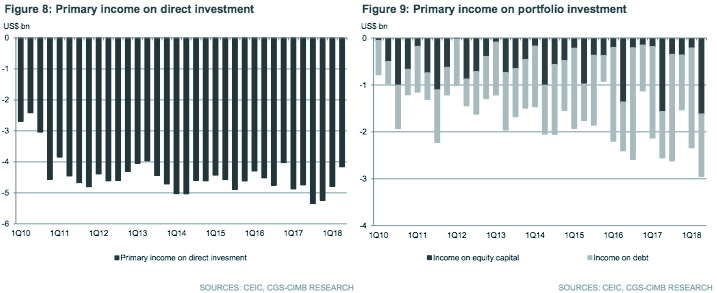
  • The 2Q18 current account deficit (CAD) hit a four-year high of -US$8.0bn or -3.0% of GDP, led by the trade account slipping into deficit and higher dividend repatriations.
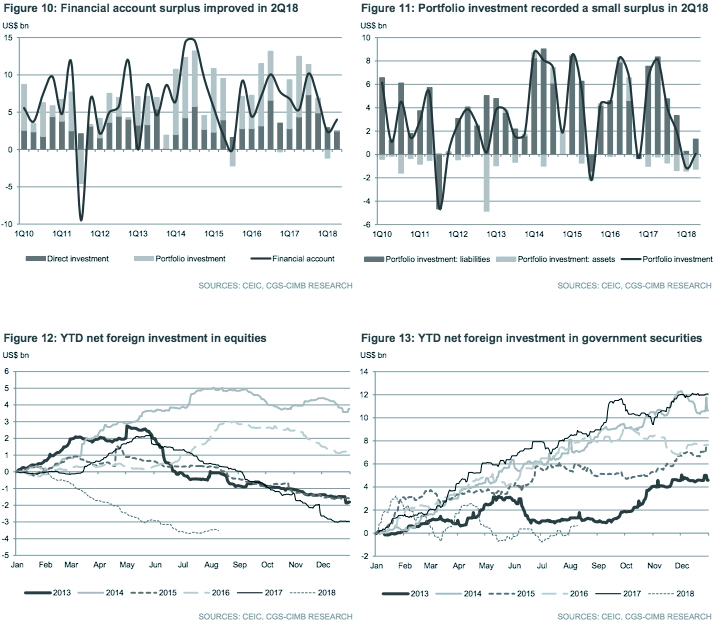
  • The BOP remained in deficit as the financial account surplus was only sufficient to finance 50% of the CAD.
  • Net portfolio investments recorded a small surplus (vs. a deficit in 1Q18), supported by the issuance of foreign currency-denominated bonds in April-May 2018.
  • We maintain our CAD forecast at -US$26.6bn or -2.5% of GDP for 2018.

img-ind23-1

2Q18 current account deficit worsened to -US$8.0bn (-3.0% of GDP)
Indonesia’s current account deficit (CAD) widened more than expected to a four-year high of -US$8.0bn or -3.0% of GDP in 2Q18 (CIMB: -US$6.7bn; Bloomberg consensus: – US$7.8bn; 1Q18: -US$5.7bn or -2.2% of GDP). The increase in CAD outpaced the improvement in financial account (FA) surplus (+US$4.0bn or +1.5% of GDP in 2Q18 vs. +US$2.4bn or +0.9% of GDP in 1Q18). As a result, the balance of payments (BOP) deficit widened to -US$4.3bn or -1.6% of GDP (-US$3.9bn or -1.5% of GDP in 1Q18), leading to a decline in international reserves of US$6.2bn qoq to US$119.8bn at end 2Q18.

CA: higher imports and seasonal dividend payments
The higher CAD coincided with a smaller surplus in the goods account to +US$0.3bn in 2Q18 (+US$2.3bn in 1Q18) as stronger GDP growth of 5.3% yoy in 2Q18 spurred higher imports of raw materials, capital goods and O&G. This has also resulted in the quarterly trade balance turning into a deficit for the first time since 4Q14. Meanwhile, a higher primary income deficit (-US$8.2bn in 2Q18 vs. -US$7.9bn in 1Q18) was led by seasonally higher dividend payments, which typically takes place in 2Q. The long holiday associated with Lebaran celebrations fuelled higher overseas travel by Indonesians, resulting in a wider services account deficit (-US$1.8bn vs. -US$1.6bn in 1Q18) while higher secondary income was contributed by inward remittances of overseas Indonesian migrant workers.

FA: a marginal net inflow in portfolio investment
Given that higher investment abroad offset the increase in foreign direct investment in Indonesia, direct investment recorded a smaller inflow of US$2.5bn in 2Q18 (vs. +US$2.9bn in 1Q18). As a result, the basic balance (sum of the current account balance and net direct investment) fell deeper into negative territory as net direct investment inflows were only sufficient to finance 31% of the CAD in 2Q18 (vs. 51% in 1Q18). On a positive note, portfolio investments recorded a net inflow of US$0.1bn in 2Q18 (vs. -US$1.2bn in 1Q18) following the issuance of foreign currency-denominated bonds in April-May 2018 although foreign selling of rupiah-denominated government bonds continued during the quarter.

Higher cash transfers to boost low-income household consumption
Currently, the flat rate cash transfer of Rp1.89m p.a. is equivalent to 83% of the minimum monthly wage in Indonesia, relatively low compared to 120% in Malaysia. Higher allocations to the conditional cash transfer programme (Rp31tr in 2019F vs. Rp17tr in 2018F) through the adoption of a variable rate of cash transfers depending on the burden of low-income family should help boost low-income household consumption.

No change to our 2018F CAD forecast of -US$26.6bn (-2.5% of GDP)
The 1H18 CAD of -US$13.7bn (-2.6% of GDP) accounted for 52% of our annual CAD forecast of -US$26.6bn (-2.5% of GDP) for 2018, which was in line compared to an average of 51% in 2012-2017. Hence, we make no changes to our CAD forecasts. Our forecasts take into account higher travel receipts into the country during the Asian Games 2018, as well as a potentially milder yoy increase in primary income deficit, as we expect weaker foreign portfolio inflows into bond market so far this year to translate into smaller increase in interest payment outflows to foreign holders of Indonesian government bonds.


img-ind23-2

img-ind23-3

img-ind23-4

img-ind23-6

img-ind23-7

img-ind23-8


Originally published by CIMB Research and Economics on 13 August 2018.

Mekong Monitor


IMG-MM-160818

Photo Credit: Myanmar Times


TRADE, ECONOMY, AND INVESTMENT


MYANMAR

Myanmar to liberalise its gold market after five decades
(15 August 2018) Myanmar’s Ministry of Commerce (MOC) aims to remove gold from its restricted commodities and exports list in an effort to liberalise the country’s gold market. At the moment, the exports of gold are forbidden by MOC. By opening its gold market for international trade, Myanmar could combat the growing illicit gold trade to the China and Thailand through the Myanmar border which has resulted in lost taxation opportunities. Myanmar will establish a service centre near Yangon to permit the legal trading of gold. A pick-up in legal gold exports will generate tax revenue directly to the government and increase the supply of U.S. dollars into the country, helping to stabilise the exchange rate and increase foreign currency reserves.
Read more>>

LAO PDR

Laos’s decision to halt new dams welcomed by Mekong River Commission
(15 August 2018) A decision by Laos to suspend new hydropower investments and review existing projects was applauded by the Mekong River Commission, after a deadly dam collapse swept away the entire village last month. The US$1.2 billion Xe-Namnoy dam, a joint effort between South Korea, Thai and Laotian firms collapsed on the July 23 after heavy rains, killing at least 39 people. Laos supplies electricity to Thailand, Vietnam, Cambodia and Myanmar accounting for 30 per cent of its total exports. Laos is currently operating 46 hydropower plants, with 54 more planned or under construction. The country has long announced its quest to become the “Battery of Southeast Asia” by selling power to neighbouring countries.
Read more>>

VIETNAM

Vietnam’s economic growth losing steam
(13 August 2017) Vietnam’s economy cooled in the second quarter of this year, although GDP growth came in at 6.79 per cent according to the National Centre for Socio-economic Information and Forecast (NCIF). This was down from the 7.38 per cent that was registered in the first quarter of 2018, the highest first-quarter growth rate recorded in the last decade. Vietnam’s economy is showing signs of cooling further with projected growth rate of 6.72 per cent and 6.56 per cent in the third quarter and fourth quarter respectively. The economy is projected to moderate due to a fall in the growth of the manufacturing and processing sectors. This slowdown is attributed to the appreciating U.S. dollar and the possibility of two interest hikes by the U.S. Federal Reserve from now to the end of the year.
Read more>>

CAMBODIA

US-China trade war may benefit Cambodian travel goods exporters
(13 August 2018) The ongoing trade dispute between the United States and China is yielding more opportunities for Cambodia to increase exports of travel goods. The Trump administration is considering increasing the rate of tariffs on Chinese travel goods to 25 per cent from the current 10 per cent. This would affect the US$5 billion worth of travel goods that China exports to the U.S.annually. The new tariffs will affect Chinese goods such as handbags, travel items and other accessories. Any hike in tariffs will impact investors’ confidence in China as a manufacturing base for travel goods and which will open doors to Cambodia to be the production hub for those items.
Read more>>

THAILAND, VIETNAM

Thailand to push Vietnam for Mutual Recognition Agreement on automotive industry standards
(12 August 2018) Thai Commerce Minister, Sontirat Sontijirawong stated the country will send delegates to negotiate for a Mutual Recognition Agreement (MRA) with Vietnam’s Transport Ministry in the hope of minimizing the cost and delivery time for Thailand’s automotive exporters. They also hope to remove overlapping testing processes which has been problematic for Thailand’s automotive industry. The move was prompted by Vietnam’s new regulation (Decree 116) on automotive imports announced this year which has hindered the flow of imported cars. Decree 116 aims to protect the local automotive assembly industry in Vietnam. According to Vietnam Automobile Manufacturers’ Association (VAMA), the sales of imported cars plummeted by 45 per cent whereas the sales of locally assembled cars chalked up by 12 per cent last year.
Read more>>


mekong-monitor-map

About Greater Mekong Subregion (GMS)

The Greater Mekong Subregion (GMS) Economic Programme was launched by the Asian Development Bank in 1992 connecting five developing ASEAN countries, namely Cambodia, Laos, Myanmar, Vietnam and Thailand, and Chinese provinces of Yunnan and Guangxi Zhuang Autonomous region. The region has some of the most robust economies sharing the Mekong River Basin thanks to its reform and liberalisation. The subregion is growing at a faster pace than the whole of East Asia and the Asia Pacific as the GDP growth rate for 2017 was at 6.4 percent, according to the World Bank. The population at the subregion as of 2016 is at 340 million while the GDP at PPP is at US$3.1 trillion in 2016. In 2015, trading within the region was at US$444 billion.