Singapore: 2Q18 GDP (revised)


HIGHLIGHTS

2Q18 GDP (revised)

  • The revised 2Q18 GDP data was marginally higher at 3.9% yoy on improved growth in the export-oriented manufacturing sector.
  • Domestic demand strengthened on account of higher capex in transport equipment and stable consumer spending.
  • We reaffirm our annual GDP forecast of 3.2% in 2018, which falls within the official MTI forecast range of 2.5% to 3.5%.
  • Uneven gains in domestically-oriented services sector and risks to the external outlook suggest that MAS will maintain a “gradual and modest” S$NEER appreciation.

img-sg8-1

Marginal upward revision to 2Q18 GDP growth
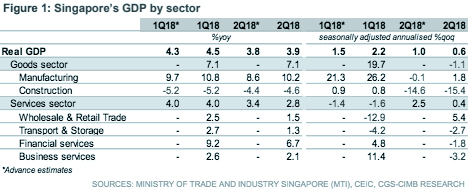
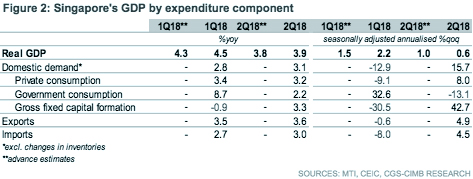
Revised data from the Ministry of Trade and Industry (MTI) revealed that Singapore’s economic expansion in 2Q18 was slightly better than initial estimates, as real GDP growth was revised higher to 3.9% yoy from an advance reading of 3.8% yoy (CIMB: 3.8% yoy, Bloomberg: +4.1% yoy). 1Q18 GDP growth was bumped up to 4.5% yoy from 4.3% yoy, following an upward adjustment in 1Q18 sequential growth to 2.2% qoq seasonally adjusted annual rate (SAAR) (advanced: +1.5% qoq SAAR) and consequently a downward revision in 2Q18 to 0.6% qoq SAAR (advanced: +1.0% qoq SAAR).

Transport equipment capex spur investments
Domestic demand was more robust in 2Q18 (+3.1% yoy vs. +2.8% yoy in 1Q18) principally driven by a surge in investments (+3.3% yoy vs. -0.9% yoy in 1Q18). The private sector was responsible for much of the rise (+5.6% yoy vs. -0.4% yoy in 1Q18), lifted by higher capex in transport equipment, with increased activity in hangars and shipyards complemented by upgrades to the local transport system.

Households and external demand chip in with solid outturns
Private consumption growth moderated slightly to 3.2% yoy in 2Q18 (+3.4% yoy in 1Q18) supported by a recovery in motor vehicle sales and broader retail segment as a healthier labour market and wage gains improved household purchasing power. However government consumption eased in 2Q18 (+2.2% yoy vs. +8.7% yoy in 1Q18) as outlays for defence and national development tapered. External demand, as measured by net export growth, softened slightly (6.8% yoy vs. +8.0% yoy in 1Q18) due to a pick-up in import growth.

Growth outlook still hinged on export-driven manufacturing sector
Upward revisions to the growth contribution from the manufacturing sector in 2Q18 (+10.2% yoy vs. +8.6% yoy in advance estimate) stemmed from gains in the biomedical (+15.5% yoy) and transport engineering segments (+11.7% yoy), and were sufficient to offset weaker services and construction growth. The services sector grew at a slower pace in 2Q18 (+2.8% yoy vs. +3.4% yoy in advance estimate) due to slower growth in all segments except accommodation and food services (see table to the left). Construction activity contracted in 2Q18 (-4.6% vs. -4.4% yoy in advance estimate), due to a pullback in the public sector. We expect property cooling measures unveiled in July to interrupt the recovery in residential construction, which posted a less severe contraction in 2Q18.

MAS policy stance likely on hold
We reaffirm our annual GDP forecast of 3.2% in 2018, which falls within the official MTI forecast range of 2.5% to 3.5%. Uneven gains in the domestically-oriented services sector and risks to the external outlook suggest that MAS will likely retain a cautious stance on monetary policy. We expect MAS to maintain a “gradual and modest” pace of appreciation for the S$NEER at the Oct 2018 monetary policy meeting. CIMB Treasury and Markets Research expects the Singapore dollar to depreciate to S$1.37 per US dollar in 3Q18 and appreciate to S$1.36 per US dollar in 4Q18.

img-sg8-2

img-sg8-3

img-sg3-4

img-sg8-5

img-sg8-6


Originally published by CIMB Research and Economics on 13 August 2018.

China-ASEAN Monitor


img-ca-150818.jpg

File Photo


Economy, Investment and Trade

Thailand’s economy minimally impacted by US-China Trade War
(13 August 2018) The present trade tensions between the US and China are not expected to have a significant overall impact on Thailand’s GDP growth according to an unnamed source at Thailand’s Finance ministry. The source was quoted as saying that the net effect on Thai economic growth would shave off a mere 0.03 percent of a forecasted GDP growth of 4.5 percent in 2018. While Thailand’s exports to China are expected to be hit hard, with a negative impact of 0.11 percent to the GDP forecast, it could be offset by a positive growth of 0.08 percent in the event Chinese investors choose Thailand as a production hub for exports to the U.S. This is based on the rationale that Chinese investors will shift production facilities to places in South-East Asia like Thailand in order to avoid the U.S tariffs. Another possible positive outcome could see Thai farm products, such as animal feed and pork, substituting for Chinese products as exports to the U.S.
Read more>>

China to impose anti-dumping duty on US, EU and Singapore rubber
(10 August 2018) China plans to impose anti-dumping duties starting from 23.1 percent to 75.5 percent on halogenated butyl rubber from the U.S, EU and Singapore starting from 20 August. The 75.5 percent tariff will be imposed on U.S. rubber produced by Exxon Mobil and other U.S. companies. The tariff rate of 23.1 percent will be levied on Arlanxeo Singapore, while other Singaporean firms would be hit with a higher rate of 45.2 percent. In April of this year, China had already imposed a temporary anti-dumping measure on halogenated butyl rubber, which was sold at a discount to appropriate prices, hurting China’s domestic industry.
Read more>>

Malaysia aims to withdraw project concessions from China
(13 August 2018) Malaysia’s Prime Minister, Tun Dr. Mahathir Mohamad aims to back away from the multibillion-dollar Chinese infrastructure projects previously endorsed by former premier Datuk Seri Najib Abdul Razak. Top of that list would be the centrepiece of China’s infrastructure push in Malaysia, the US$20 billion East Coast Rail Link Project and energy pipeline projects. Malaysia would like to drop the two projects as they are not seen as cost-beneficial to the country’s interests and would increase the country’s debt, stated Tun Dr Mahathir on Monday. In spite of that, he welcomes Chinese investments as long as there are benefits to Malaysia and intends on maintaining a cordial bilateral relationship with the Middle Kingdom. Since coming to power, Tun Dr. Mahathir has been critical on the benefits of the Chinese projects to Malaysia, suspending work on a number of projects, as well as urging cuts to what he sees as runaway costs.
Read more>>

Chinese company builds biggest commercial complex in Cambodia as part of Belt and Road Initiative
(14 August 2018) Yunnan Shengmao Investment has started the building of a US$1 billion commercial complex situated in Boeung Salang village, Phnom Penh. This is a project that aligns with China’s strategic Belt and Road Initiative (BRI). Slated for completion in 2019, it will be the biggest commercial centre in Cambodia, connecting the country to the rest of the world through the BRI. The project, called the Triumph Financial Centre, will turn idle land leased by Phnom Penh Autonomous Port (PPAP) into an international commercial and tourism centre, which is expected to become the biggest central business district in Cambodia. According to the director of Yunnan Shengmao Investment, the construction of the commercial complex will bring in 10,000 companies with 100,000 types of goods.
Read more>>

Thailand properties in high demand as Chinese parents turn to more affordable international schools in Thailand
(14 August 2018) The ballooning tuition fees of international schools in mainland China has made Chinese parents turn to Thailand for what they see as better and cheaper options for their children’s education. According to the International Schools Database, the monthly tuition fees of US$2,744 at Shanghai international schools are the world’s highest, followed by Beijing at US$2,519. In comparison, the fees at Bangkok international schools are at US$1,032. The increasing demand from the Chinese parents has bolstered the local property market. The volume of queries for Thai properties in the first half of 2018 has exceeded the total volume in 2017, making Thailand the top destination for Chinese buyers, according to a Chinese international real estate website. Since the beginning of 2017, the online website has received US$962.2 million worth of purchase enquiries to date.
Read more>>


Press Release: ASEAN must uphold rules-based free markets for trade and investment as a bloc in spite of potential short-term opportunistic benefits brought on by the U.S.-led trade wars


ASEAN must uphold rules-based free markets for trade and investment as a bloc in spite of potential short-term opportunistic benefits brought on by the U.S.-led trade wars

Kuala Lumpur, 14 August 2018 – While ASEAN member states typically will respond to the United States-China trade war on the basis of individual national interests, it is also in the member states’ national interest to collectively make ASEAN economic integration and beyond more real in order to position the East Asian Region as the bedrock of future expansion and prosperity.

img-rt13

(From left) Roberto Benetello, Chief Executive Officer of the European Union (EU) – Malaysia Chamber of Commerce and Industry; Siobhan M. Das, Executive Director of the American Malaysian Chamber of Commerce (AMCHAM); Tan Sri Dr. Munir Majid, Chairman of CIMB ASEAN Research Institute and President of the ASEAN Business Club; Dr. Donald Hanna, Group Chief Economist of CIMB Group and Dato’ Muhamad Noor Yacob, Board Member of the Malaysia Productivity Corporation (MPC) and Former Ambassador/Permanent Representative of Malaysia to World Trade Organisation (WTO) pose for the cameras after the ASEAN roundtable series titled “Trade War and Its Impact of ASEAN”, organised by CARI, in collaboration with ASEAN Business Club in Kuala Lumpur today.

“Structural market interventions by the U.S. have occurred before. The 1985 Plaza Accord which forced the revaluation of the Yen (and the Deutschmark) had resulted in dramatic increase in Japanese investment in Southeast Asia. The U.S.-led trade war on China may cause regional industrial restructuring but investment flows must not be blocked and free trade must stand. This is the regional challenge, and the challenge for ASEAN – to be part of an economic regional bloc to generate growth and to compensate for a more protected US$19 trillion American market,” said Tan Sri Dr. Munir Majid, Chairman of CIMB ASEAN Research Institute.

img-pr-rt13-2

He made this remark at the ASEAN Roundtable Series on “Trade War and Its Impact on ASEAN” organised by CIMB ASEAN Research Institute (CARI) today at Menara CIMB in Kuala Lumpur. The roundtable brought together a panel of speakers, namely, Dr. Donald Hanna, Group Chief Economist, CIMB Group; Dato’ Muhamad Noor Yacob, Board Member, Malaysia Productivity Corporation (MPC) and Former Ambassador and Permanent Representative of Malaysia to World Trade Organisation (WTO); Roberto Benetello, Chief Executive Officer, European Union (EU) – Malaysia Chamber of Commerce and Industry, and Siobhan Das, Executive Director, American Malaysian Chamber of Commerce (AMCHAM).

The U.S. has already imposed 25 per cent tariffs on US$34 billion worth of Chinese goods while an additional US$16 billion will come into effect on 23 August 2018. The Trump administration had warned a further 25 per cent tariff on the next US$ 200 billion of Chinese imports.

Dr. Donald Hanna warned that with the scale of retaliation, the worst may yet to come. Higher tariffs would not only hurt growth in the U.S. and China, but would also curb global growth should it escalate into a full-blown trade war. ASEAN will suffer chiefly through financial effects and trade diversion to ASEAN is unlikely to outweigh the sheer trade losses from higher U.S. tariffs.

“China’s exports, while having a high share of foreign value added (FVA), get a fairly small portion of that from ASEAN. The highest impact will be in the electronics sector in Malaysia and Singapore; food products in Indonesia, Malaysia and Thailand; and wood products in Indonesia and Thailand. The sheer magnitude of trade and the importance of finance in Singapore will experience the largest hit to its GDP from a trade war, especially one that implies higher U.S. bond prices. While Indonesia comes next, hurt both by the higher value added share in China’s exports, by its trade deficit and by the 42 per cent of the domestic bond market held by foreigners,” said Dr. Hanna.

Dato’ Muhamad Noor Yacob echoed the view that trade wars can undermine global economic growth and employment. It is in the mutual interest of all countries to avoid resorting to protectionist measures.

He said, “The multilateral trading system as embodied in the World Trade Organisation (WTO) and its predecessor, the General Agreement on Tariffs and Trades (GATT), was born out of a desire to establish a rules-based system, drawing lessons from actions by countries during the Great Depression of the 1920s that exacerbated the situation. It is imperative to adhere to the rules as negotiated and adopted by members.”

The EU business community based in Malaysia stressed the importance of trade stability and business environment predictability for the benefit of the EU investors in Malaysia and the economy as a whole.

“What emerged from our extensive research conducted recently is a scenario of uncertainty which may bring challenges and opportunities. It also depicts a picture of extremely complex interconnectedness in the world and regional trade. Any disruption to such complex system bears many and unexpected repercussions,” said Roberto Benetello.

This is the 13th edition of the CARI ASEAN Roundtable Series.

Event update for ASEAN Roundtable Series on Trade War and Its Impact of ASEAN>>

Thailand: August MPC meeting


HIGHLIGHTS

August MPC meeting

  • The BOT left the benchmark interest rate intact at 1.50% by a vote of six to one.
  • Official GDP forecasts continue to rise amid strong data in 1H18, with the MOF and BOT upgrading their 2018 GDP growth estimates to 4.5% and 4.4% respectively.
  • We expect BOT to be more dovish than its peers as inflation expectations remain low while external trade uncertainty could stifle contributions to growth in 2H18.
  • BOT has a window to wait and see while keeping the interest rate unchanged in 2018, before beginning monetary policy normalisation in 1H19.

img-thai3-2

Interest rate maintained at 1.50%
The Bank of Thailand’s (BOT) Monetary Policy Committee (MPC) voted six to one in favour of keeping the benchmark interest rate unchanged at 1.50% for the 26th consecutive meeting. One vote of dissent persisted from the Jun meeting, advocating a 25bp rate hike, which suggests that the broad consensus in the MPC still favours a patient approach to policy normalisation. The decision was widely anticipated, in line with our forecast and all analysts surveyed by Bloomberg.

Growth prognosis looking up but still dependent on external drivers
The Ministry of Finance (MOF) upgraded its 2018 GDP growth forecast to 4.5% (from 4.2% previously), which exceeds BOT’s in-house forecast of 4.4% (CIMB: +4.3%), driven by strong external demand, robust tourist arrivals, a more competitive baht, improving labour market conditions and accelerated disbursements of development expenditure. Economic expansion could be boosted by the government’s stimulus measures. Nonetheless, the growth prognosis remains reliant on external drivers, particularly trade and tourism, as the recovery in domestic demand remains uneven.

Liquidity conditions continue to normalise as G3 returns to health
The US Federal Reserve voted unanimously on 1 August to keep the target Fed Funds rate at 1.75-2.00%, though we expect two more policy rate hikes by end-2018. The European Central Bank (ECB) will maintain its benchmark interest rates at least until summer 2019 while winding down its bond purchase programme. Market expectations of a pivot in policy communication were met with slight disappointment as the Bank of Japan (BOJ) balanced adjustments to the yield curve control policy with a dovish message to keep interest rates low “for an extended period of time”.

Policy divergence at regional central banks
The People’s Bank of China (PBOC) cut its reserve requirement ratio (RRR) for banks by 50bp to cushion against downside risks to growth from tightening trade conditions and to facilitate deleveraging efforts. In contrast, central banks grappling with twin deficits have less policy space. The Reserve Bank of India (RBI) just raised interest rates by 25bp to 6.50% for the second straight meeting while the Philippine central bank could add to the 50bp increases this year with another hike at its upcoming Aug meeting. Bank Indonesia (BI) hit the pause button on the 7-day repo rate on 19 July, having raised it by 100bp to 5.25% in quick succession since mid-May.

BOT to normalise interest rates more cautiously
We expect BOT to be more dovish than its peers this year despite the MPC statement highlighting that Thailand was at “full potential economic growth” and devoting more lines to addressing financial stability risks. Inflation expectations remain low while external uncertainty arising from the commencement of tariffs between the US and China could stifle contributions from trade in 2H18. We think the window to keep the benchmark interest rate unchanged will remain until end-2018, and expect the BOT to begin normalising monetary policy in 1H19.

img-thai3-3

img-thai3-1


Originally published by CIMB Research and Economics on 8 August 2018.

CARI Captures 367

c367_graphic


ASEAN

Singapore has the best e-governance in Southeast Asia
(8 August 2018) A survey conducted by the United Nations (UN) Data Centre showed that Singapore is most effective in e-governance in Southeast Asia with an index of 0.88. According to the report, the country’s usage of smart technology to disseminate environmental data with the public and government are one of the many e-governance programs that led to it being the best in Southeast Asia and seventh best in the world. The survey identifies e-government effectiveness in public services and monitors patterns in e-government development and performance. Malaysia is ranked second among Southeast Asian nations with a score of 0.71 and ranked 48th in the world. Brunei showed significant improvement as the nation improved its ranking of 83 in 2016 to 59 in the world with an index score of 0.69. Thailand is next with an index score of 0.65 followed by the Philippines, also with 0.65. Index scores for Vietnam and Indonesia were 0.59 and 0.53 respectively, while Cambodia’s index was 0.38. Myanmar and Laos were the lowest ranked in the list with an index of 0.33 and 0.30 respectively. According to the report, utility payment, submitting income taxes and filing on new businesses are the most used online services in 2018.

PHILIPPINES-INDONESIA

The Central Bank of the Philippines and Bank Indonesia (BI) cooperate to combat financial crimes
(6 August 2018) The central bank of the Philippines, Bangko Sentral Ng Pilipinas (BSP) and Bank Indonesia (BI) inked an agreement to fight terrorism financing and money laundering in both countries recently. The agreement was signed by BI Governor Perry Warjiyo and BSP Governor Nestor A.Espenilla Jr. as both banks work together to integrate policies to execute the anti-money laundering and terrorist financing regulations in both countries, in particular for payment systems and financial transactions. The cooperation between the two countries will take place in the form of policy dialogues, information and data exchange, in addition to human resource development.

INDONESIA

Robust consumption lifts Indonesia’s growth of GDP to 5.27 percent in the second quarter of 2018
(6 August 2018) Indonesia’s economy grew to 5.27 percent in the second quarter of 2018, an increase of 0.21 percent from the growth rate in the first quarter of 2018, the country’s Central Statistics Agency (BPS) data showed on 6 August 2018. The steady growth of private consumption played an integral role in boosting the GDP growth rate. Household consumption, which accounts for more than half of the gross domestic product, saw a rise from 4.95 percent in the first quarter to 5.14 percent in the second quarter of 2018. Investment is Indonesia’s second growth engine, and it already slowed down significantly to 5.86 per cent in the second quarter, after posting over 7 per cent growth rate in the previous three quarters.

VIETNAM

Vietnam seafood exports rake in US$4.63 billion in the first seven months of 2018
(5 August 2018) Vietnam’s Ministry of Agriculture and Rural Development (MARD) announced that the country’s export value rose 6.3 percent compared to the same period in 2017, recording exports worth US$4.63 billion in the first seven months of 2018. Countries, namely the United States, Japan, China and South Korea were the biggest importers, accounting for 53.5 percent of the total value. According to the ministry’s Department of Produce Processing and Market Development, the US’ decision to impose 10 percent tariff on all Chinese exports and China’s response to enforce a 25 percent tariff on aquatic products from the US will allow Vietnam to increase its exports to both these countries. MARD reported that Vietnam’s total seafood output in 2016 was more than 7.2 million tonnes.

CAMBODIA

Cambodian rural area to be revolutionised by India’s digital village
(8 August 2018) India will promote technology and improve the agricultural sector in Cambodian rural areas by establishing a digital village. India’s Ambassador to Cambodia Manika Jain announced the initiative after a discussion with Cambodia’s Minister of Post and Telecommunications Tram Iv Tek. India’s Telecommunications Consultants India Limited (TCIL) will supervise the project, and the firm has chosen Traing district in Takeo for the project. TCIL will build an ICT centre in the district for people to look for the latest information on agriculture and farming tips. Traing will be the pilot project and expansion to other areas will rely on the progress of the pilot project.

MYANMAR

Myanmar government urges tourism investors to tap the country’s improving tourism sector
(6 August 2018) Myanmar’s Union Minister of Hotels and Tourism U Ohn Maung said the nation is looking to expand its tourist attractions and is willing to work with any investors, who have feasible and valuable ideas. He said the country’s new investment laws have been relaxed and some countries are benefiting from the ease of Visa regulations by Myanmar. According to the Union of Myanmar Travel Association, the country is projecting a further 22 percent increase in international arrivals in 2018, from 3.4 million visitors in 2017. Known for its cultural heritage tourism, Myanmar now intends to tap into community-based tourism and ecotourism, and under the country’s Tourism Master Plan 2013-2030, it looks to focus on sustainable development by preserving environmentally-sensitive places, and encourage tourists to respect ethnic groups.

SINGAPORE

State-linked attackers behind SingHealth cyber attack
(6 August 2018) Singapore’s Minister for Communications and Information S. Iswaran in a statement to the country’s parliament said the attack on SingHealth’s IT database in June was made by advanced persistent threat (APT) group who are usually state-linked. The attack billed as the worst breach of personal data in the country’s history, is not the only APT attack Singapore has seen as there was an attack on the National University of Singapore (NUS) and Nanyang Technological University (NTU) in 2017. The Cyber Security Agency of Singapore (CSA) conducted a thorough analysis of the cyber attack and found that an APT group is behind the attack. According to Iswaran, the attacker utilised advanced tools, which includes customised malware, to breach SingHealth antivirus software and security tools. Singapore government is taking precautionary measures to improve its cybersecurity defences, and it has notified 11 key sectors to solidify security around its networks.

LAOS

Disasters have cost Laos US$55.3 billion in the last eight years
(8 August 2018) A report from the National Ad Hoc Committee in charge of dealing with the aftermath of the deadly flood in Sanamxay district, Attapeu province revealed that various disasters in Laos have seen 108 deaths and the country’s infrastructure losses amounted to US$55.3 billion from 2010 to 2018. The committee recorded disasters such as storms, flooding, drought, fires, disease and insect outbreaks damaging plants in the country. The committee acknowledged that the impact of global climate change has led to several natural disasters in the country. In 2018, Laos were impacted by storms especially tropical storm Son-tinh, which ravaged 11 provinces in July and caused flooding in nine areas. The collapse of the dam in Sanamxay district in Attapeu province on 23 July 2018 flooded 12 villages, with six communities wiped out.

MALAYSIA

Malaysia to search for new markets for palm oil
(7 August 2018) Malaysia’s Ministry of Primary Industries is looking for new markets for palm oil through good relations with several countries as the country aims to counter anti-palm campaigns. Malaysia is looking to penetrate into the Philippines, Iran, Turkey and West African nations and also maintain its existing relations with primary markets through the Malaysian Palm Oil Council (MPOC). The industry has been criticised due to its links to deforestation and haze in Southeast Asia. The European Parliament also came up with a non-binding resolution in April 2018, which would only permit imports of environmentally sustainable palm oil into the European Union after 2020.

THAILAND

GISDA assures that purchase of THEOS-2 satellite is transparent
(8 August 2018) Thailand’s Geo-Informatics and Space Technology Development Agency (GISDA) said there are no irregularities in the purchase of Thailand Earth Observation Satellite (THEOS) 2 satellite, The agency dispelled the rumour and told the public that the purchase was conducted transparently. The acquisition of the satellite was made through International Competitive Bidding (ICB), which gives an equal chance to all bidders. THEOS 2 will be replacing the Thaichote, Thailand’s first ever earth observation satellite. The Thaichote, also known as the first THEOS satellite, was launched into space in 2018 and will be deactivated soon.

Indonesia: Consumers to reap the benefits of a (likely) people centric budget


HIGHLIGHTS

Consumers to reap the benefits of a (likely) people centric budget

  • Consumers stand to gain the most from the shift in budget focus to favour boosting household purchasing power during an election year.
  • The biggest increases are slated to come from energy subsidies, which benefit households of all segments, and conditional cash transfers to vulnerable households.
  • We make no changes to our forecasts for GDP growth (2018F: 5.3%; 2019F: 5.2%) and inflation (2018F: 3.4%; 2019F: 3.7%).

Shifting budget priorities ahead of Presidential Election
As the Presidential Election draws closer, the budget focus has shifted in favour of supporting household purchasing power, diverging from infrastructure development in the first three years of Jokowi’s administration. In fact, the state budget’s priorities took a Uturn as early as 2H17, when the government kept fuel prices unchanged despite a recovery in global oil prices, reversing from earlier moves to follow a more market-based mechanism. More pro-consumer policy doses were injected in 2018, with greater disbursements of targeted cash transfers and food aid, as well as allowances and bonuses for civil servants. These measures will most likely continue in an election year. The 2019 State Budget will be unveiled on 16 August.

Energy subsidy and social assistance to rise to 5-year high in 2019
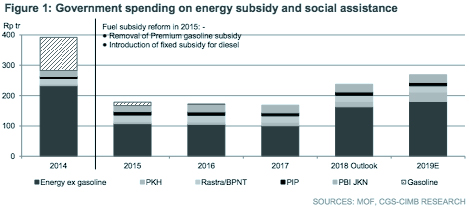
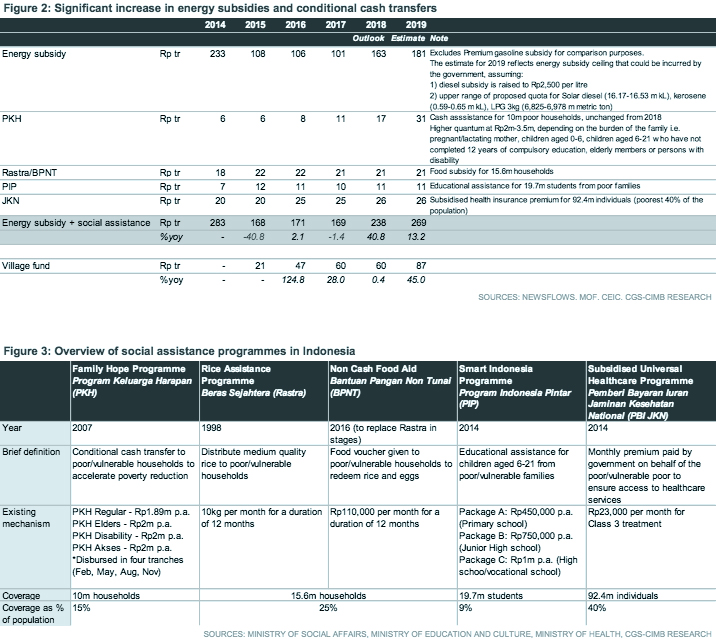
We estimate that government expenditure on energy subsidies and social assistance could increase as much as 13% to Rp269tr in 2019, after a projected 41% increase to Rp238tr in 2018. The bulk of the increase in these two years come from energy subsidies, following the government’s commitment to keep fuel prices unchanged, as well as conditional cash transfers (PKH) to poor and vulnerable households.

Unchanged fuel and electricity prices to keep inflation rate low
Collectively, fuel and electricity expenditure accounted for a sizeable 8.6% of average monthly expenditure per capita as at September 2017, rising from 7.4% as at September 2016 following electricity tariff hikes in 1H17. We expect the decision to maintain fuel and electricity prices to dampen inflation risks until 2019, implying that the inflation rate is likely to stay within Bank Indonesia’s target range of 2.5-4.5%. We reiterate our average inflation forecast of 3.4% for 2018F and 3.7% for 2019F, respectively.

Higher cash transfers to boost low-income household consumption
Currently, the flat rate cash transfer of Rp1.89m p.a. is equivalent to 83% of the minimum monthly wage in Indonesia, relatively low compared to 120% in Malaysia. Higher allocations to the conditional cash transfer programme (Rp31tr in 2019F vs. Rp17tr in 2018F) through the adoption of a variable rate of cash transfers depending on the burden of low-income family should help boost low-income household consumption.

2018-19 vs. 2013-14: no déjà vu?
In addition to a more consumer-centric budget this time around, the recovery in selected commodity prices (such as coal) and easing macroprudential measures in the property sector should help to support the country’s economic growth. This is in stark contrast to 2013-14, when monetary policy tightening by Bank Indonesia (BI) was accompanied by a more stringent macroprudential policy in the property and automotive sectors, as well as upward adjustments in fuel prices. We reiterate our GDP growth forecasts of 5.3% for 2018F and 5.2% for 2019F, respectively.
 

img-ind22-1
 

Consumers to reap the benefits of a (likely) people-centric budget


Shifting budget priorities ahead of Presidential Election

Energy subsidy and social assistance to rise to 5-year high in 2019
As the Presidential Election draws closer, the budget focus has shifted in favour of supporting household purchasing power, diverging from infrastructure development in the first three years of Jokowi’s administration.

We estimate that government expenditure on subsidy and social assistance could increase by as much as 13% to Rp269tr in 2019, after a projected 41% increase to Rp238tr in 2018. The bulk of the increase in these two years come from energy subsidies, following the government’s commitment to keep fuel prices unchanged, as well as conditional cash transfers (PKH) to poor and vulnerable households.
img-ind22-2

Unchanged fuel and electricity prices to keep inflation rate low
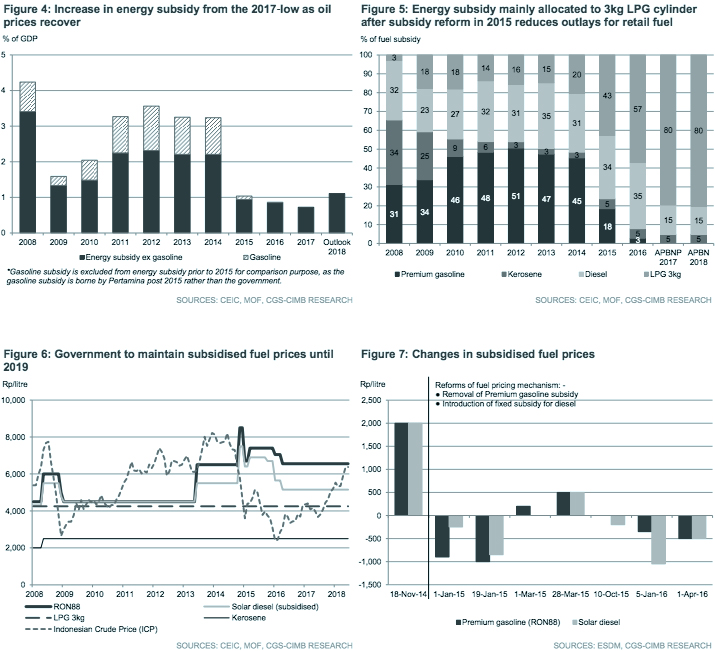
Several changes have been announced to support this pro-consumer policy. They include 1) a price cap on domestic sales of coal to PLN, where coal accounts for about 55% of PLN’s electricity supply costs; 2) a mandate for Pertamina to supply Premium gasoline in Java, Madura, and Bali areas; and 3) a fourfold increase in diesel subsidy from Rp500 per litre to Rp2,000 per litre for the rest of 2018, which is higher than the initial plan of Rp700-1,000 per litre, as well as plans to raise it further to Rp2,500 per litre in 2019.

These changes aim to re-shuffle the subsidy burden between the government, state-owned enterprises (Pertamina and PLN) as well as coal miners. The Ministry of Finance (MOF) revised the allocation for fuel subsidies to a four-year high of Rp163.5tr in 2018, up 73% from Rp94.5tr in the State Budget 2018, after taking into account a higher oil price assumption of US$70 per barrel and a rupiah exchange rate of close to Rp14,000 per US$ (vs. US$48 per barrel and Rp13,400 per US$ under the State Budget 2018).
img-ind22-3

An overhaul of the fuel subsidy mechanism in 2015 was intended to reduce the massive fuel subsidy spending by linking retail fuel prices to oil price movements in the market. While the government has been quick in passing the savings to households when oil prices were declining in 2015-2016, the subsequent recovery in oil prices has not been followed by a commensurate upward adjustment in pump prices. As a result, Premium gasoline and Solar diesel pump prices were last adjusted downwards in April 2016, when oil prices were still declining. At Rp6,450 per litre and Rp5,150 per litre respectively, current Premium gasoline and Solar diesel pump prices are 31-49% below market prices, based on our estimates.

The downward adjustments of subsidised fuel prices in 2015-16 resulted in falling fuel expenditure from 5.1% of average monthly expenditure per capita as at March 2015 to a low of 3.9% as at September 2016, before rising to 4.5% as at September 2017. On the other hand, the increase in electricity tariffs in 1H17 lifted electricity expenditure by 32.9% yoy and raised its share of overall expenditure by 0.6% pt yoy to 3.0% as at September 2017. Collectively, fuel and electricity expenditure accounted for a sizeable 8.6% of average monthly expenditure per capita as at September 2017, compared to 7.4% as at September 2016. Unchanged fuel and electricity prices significantly remove inflation risk (and hence improve the cost of living) until 2019, implying that the inflation rate is likely to stay within BI’s target range of 2.5-4.5%. We reiterate our inflation forecast of 3.4% and 3.7% for 2018 and 2019, respectively.

img-ind22-4

Higher cash transfer to boost low-income household consumption
The budget allocation for Family Hope Programme (PKH) could be raised by as much as 79% yoy to Rp31tr in 2019 (vs. Rp17tr in 2018) in a bid to support consumption among the low-income households. Studies have shown that the Family Hope Programme (PKH), launched by the government in 2007, plays a significant role in reducing poverty. The country’s poverty rate declined to 9.82% (25.95m people) as of Mar 2018, the first single-digit rate since the Asian Financial Crisis (AFC).

According to the Ministry of Social Affairs, the number of beneficiary families is expected to remain at 10m in 2019, but the quantum of cash transfers will be adjusted higher to Rp2m-3.5m per annum. The quantum will vary according to the burden of the family, after taking into account non-income indicators such as pregnant/lactating mother, the number of children aged 0-6, children aged 6-21 who have not completed 12 years of compulsory education, elderly family members, as well as persons with disability. The approach differs from other countries in the region (such as Malaysia and Singapore) which mainly utilise income indicators like household income, as the verification of household income can be difficult in Indonesia given the prevalence of the informal sector. Currently, the flat cash transfer of Rp1.89m p.a. is equivalent to 83% of minimum monthly wage in Indonesia. Raising the quantum to Rp2m-3.5m per
annum translates to 88-154% of minimum monthly wage, on par with the 120% in Malaysia.

img-ind22-5

img-ind22-6

2018-19 vs. 2013-14: no déjà vu?
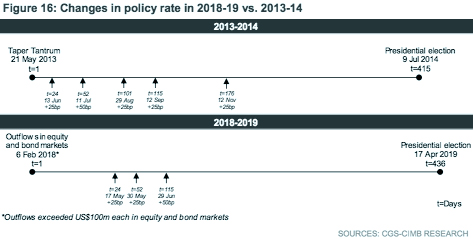
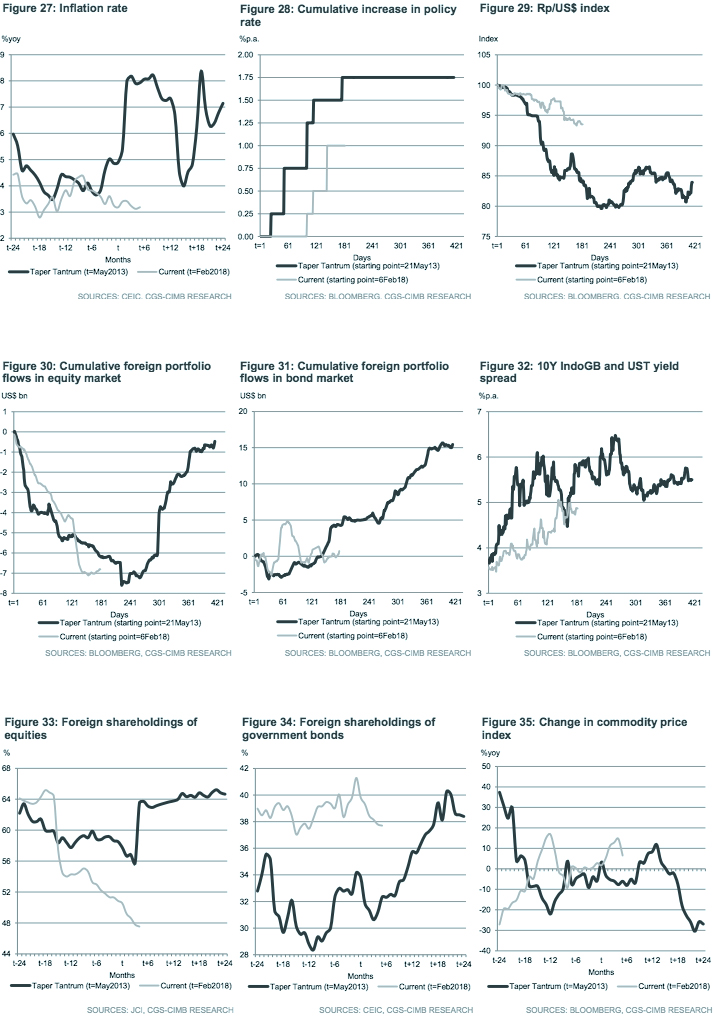
Improved fiscal buffers since its flagship subsidy reform in 2015 (at the expense of SOEs) have enabled the government to raise its subsidy and social assistance spending to mitigate the impact of rising interest rates in response to external risks, just as the Presidential Election draws closer in 2019. This is in stark contrast to 2013-14, when monetary policy tightening by Bank Indonesia was accompanied by a more stringent macroprudential policy in the property and automotive sectors, as well as upward adjustment in fuel prices to rectify a worsening twin deficit position, as unsustainable subsidy bills heightened the risks of the fiscal deficit breaching the 3% constitutional limit. In both cases, an externally-driven capital rout, rupiah weakness and eventually tighter monetary policy started around 14 months before the Presidential Election.
img-ind22-7

In addition to a more consumer-centric budget this time around, the recovery in selected commodity prices (such as coal) and easing macroprudential measures in the property sector should help to support the country’s economic growth. The government’s plan to expand the B20 biodiesel usage to all diesel-engine vehicles in Sep, if successfully implemented, should help lift demand for palm oil and work to boost CPO prices, hence boosting household incomes in the rural areas. Currently, the B20 biodiesel is only mandatory in the public service obligation (PSO) segment i.e. subsidised diesel.

img-ind22-8

Household consumption growth on equipment and leisure has steadily improved from a trough of 4.1% yoy in 1Q17 to a 3.5-year high of 4.8% yoy in 2Q18, whereas consumption growth on apparels, footwear, and maintenance was stronger at 4.5% yoy in 1H18 compared to an average expansion pace of 3.2% yoy in 2016-2017. Meanwhile, F&B consumption growth was little changed, expanding in the range of 5.1-5.4% yoy in the past three years, hinting at a preference towards discretionary spending relative to staple consumption as income improves and inflation remains stable. We reiterate our GDP growth forecasts of 5.3% for 2018F and 5.2% for 2019F, respectively.

img-ind22-9

img-ind22-10


Originally published by CIMB Research and Economics on 08 August 2018.

Mekong Monitor


image

Photo Credit: Myanmar Times


TRADE, ECONOMY, AND INVESTMENT


MYANMAR

Illegal trade on the rise across Myanmar due to corruption
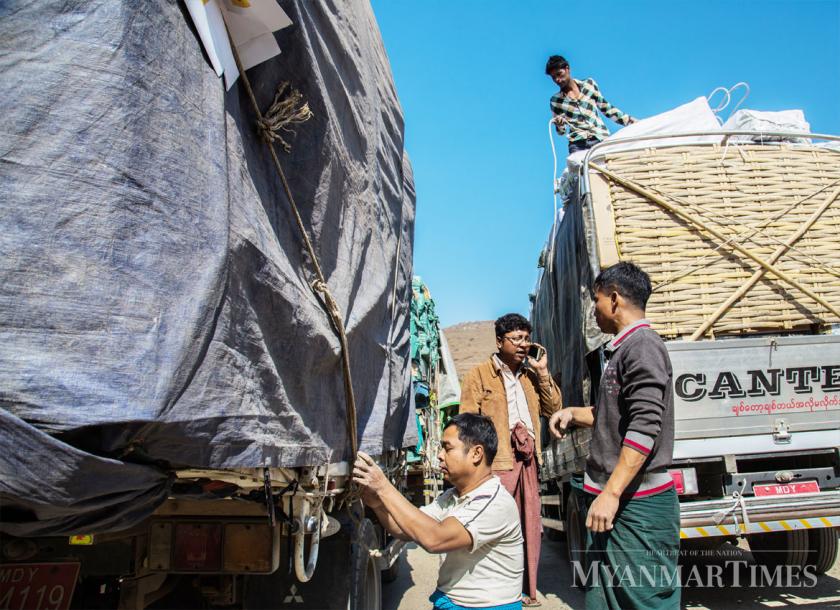
(2 August 2018) Illegal trade has been on the rise although Myanmar government has taken efforts to reopen some of the border gates, claimed the legal taxation team for the Shan border gates in Myanmar. Currently, most of the goods illegally transported to Myanmar were from Thailand. The traders also smuggled goods to China via Naung Cho feeder road and Kyaing Tong-Mine. Beer, textiles, electrical appliances, crops and wildlife are amongst the products illegally traded. Illicit trade threatens government’s tax collection, for instance while there is a 40 percent tax on locally produced beer, illegal imported beers got away without any tax. Corruption has been the principal factor of this pervasive black market.
Read more>>

CAMBODIA

Cambodia’s export to Japan rebounds to 19 percent amid the political instability
(2 August 2018) Cambodia’s level of export to Japan reached a double-digit growth of 19 percent for the first half of 2018, compared to single-digit growth in 2017. The period between January and June in 2017 saw an increase in Cambodia’s exports to Japan by 4.5 percent, while it grew by 4.6 percent for the whole year. Ever since the financial crisis in 2008, Cambodia’s exports to Japan remained relatively constant at single-digit growth. Cambodia imported goods from Japan worth US$191 million for the first half of 2018, marking an increase of 9.1 percent over the same period in 2017. Cambodia’s major exports to Japan are garments and shoes, while the supply of electrical parts and bags are growing. According to the Council for the Development of Cambodia (CDC), Japan’s foreign direct investment in Cambodia was US$822 million in 2016.
Read more>>

VIETNAM

CPTPP and the EVFTA have benefited Vietnam’s garment-textile industry
(7 August 2018) Vietnam’s garment-textile sector has attracted US$2.8 billion of foreign direct investment into the country during the first half of 2018, making the country’s total foreign direct investment valued at US$17.5 billion. Free trade agreements, in particular, the Comprehensive and Progressive Agreement for Trans-Pacific Partnership (CPTPP) and the EU-Vietnam Free Trade Agreement (EVFTA) have benefited the country by attracting foreign investors. Vietnam’s exports to the European Union are expected to increase following the implementation of CPTPP whereby the current tariffs of 10 to 12 percent will be reduced to zero. Despite the success, the government is wary of the adverse environmental effects of the industry especially the dyeing sector.
Read more>>

LAOS PDR

Thilawa Special Economic Zone in Myanmar attracts 89 investors from 17 countries
(30 July 2018) The Thilawa Special Economic Zone, located at the outskirts of Yangon, is the first Special Economic Zone (SEZ) built in Myanmar. The megaproject has attracted 89 investors from 17 countries, with over US$1.374 billion invested in Zone A. The development of Zone B is underway and will be completed in 2018. According to the Thilawa SEZ Management Committee, Japan and Singapore are among the most prominent investors for this project, accounted for over 60 percent of the total investment. Permits have been issued to 86 businesses for Zone-A, and seven for Zone-B.
Read more>>

FOREIGN AFFAIRS

GREATER MEKONG SUBREGION

Mekong countries and India to cooperate on human resource development, tourism and agriculture
(6 August 2018) Mekong countries and India have mutually agreed to work with a focus on three sectors; human resource development, tourism and agriculture during the 9th Mekong-Ganga Cooperation Ministerial Meeting which was held in Singapore last Tuesday. India will be offering scholarships to students from Cambodia, Laos, Myanmar, Thailand and Vietnam as part of the human resource development programme. Apart from that, Myanmar will be working together with India to print tourist handbooks with main attractions in Mekong-Ganga countries to boost the tourism industry in the region. India also pushed for the first meeting on agriculture working group in New Delhi this November.
Read more>>


mekong-monitor-map

About Greater Mekong Subregion (GMS)

The Greater Mekong Subregion (GMS) Economic Programme was launched by the Asian Development Bank in 1992 connecting five developing ASEAN countries, namely Cambodia, Laos, Myanmar, Vietnam and Thailand, and Chinese provinces of Yunnan and Guangxi Zhuang Autonomous region. The region has some of the most robust economies sharing the Mekong River Basin thanks to its reform and liberalisation. The subregion is growing at a faster pace than the whole of East Asia and the Asia Pacific as the GDP growth rate for 2017 was at 6.4 percent, according to the World Bank. The population at the subregion as of 2016 is at 340 million while the GDP at PPP is at US$3.1 trillion in 2016. In 2015, trading within the region was at US$444 billion.

Indonesia: 2Q18 GDP growth: Better-than-expected


HIGHLIGHTS

2Q18 GDP growth: Better-than-expected

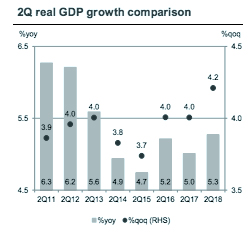
  • 2Q18 GDP came in above expectations at 5.3% yoy, the strongest pace since 4Q13.
  • Seasonal factors i.e. delay in harvest season to 2Q18 and the Eid al-Fitr celebrations, as well as regional elections contributed to higher economic growth in 2Q18.
  • Stable inflation rate and higher income through 13th month salaries and conditional cash transfers helped to lift household consumption during the Eid al-Fitr celebrations.
  • We reiterate our GDP growth forecast of 5.3% for 2018 and 5.2% for 2019, respectively (+5.1% yoy in 2017).

img-ind21-1

Strongest pace of expansion since 2013
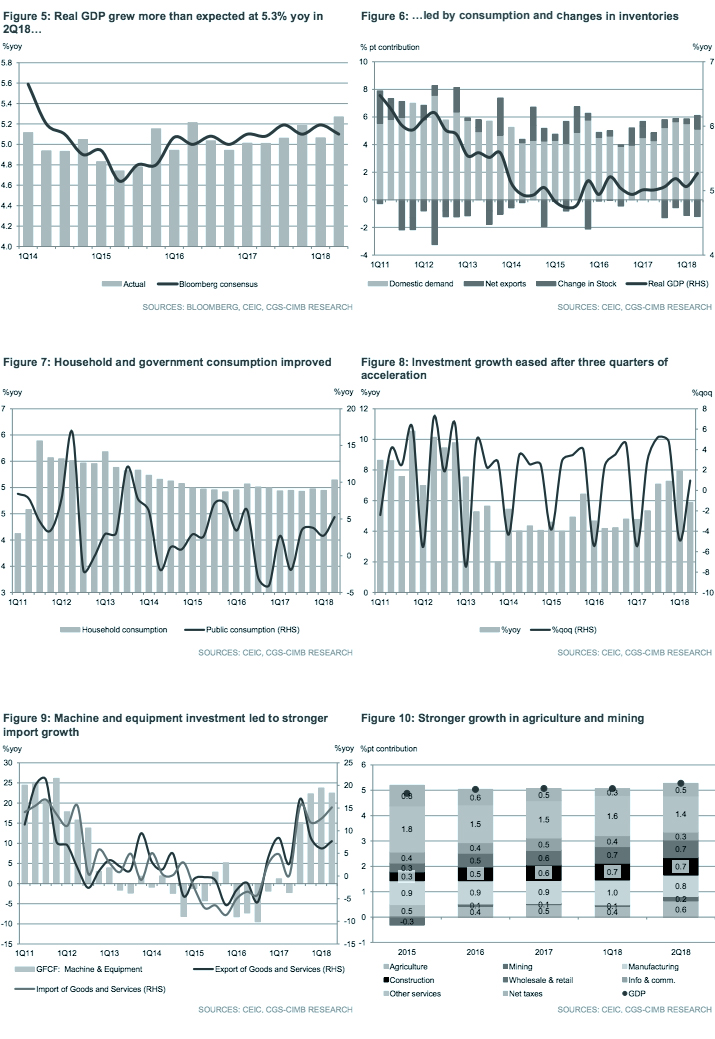
2Q18 real GDP growth quickened more than expected to a 4.5-year high of 5.3% yoy (CIMB: +5.2% yoy; Bloomberg median consensus: +5.1% yoy; 1Q18: +5.1% yoy). On a quarterly basis, GDP grew 4.2% qoq (-0.4% qoq in 1Q18), compared to an average expansion rate of 3.9% in the corresponding quarter in 2011-2017.

Seasonality at play
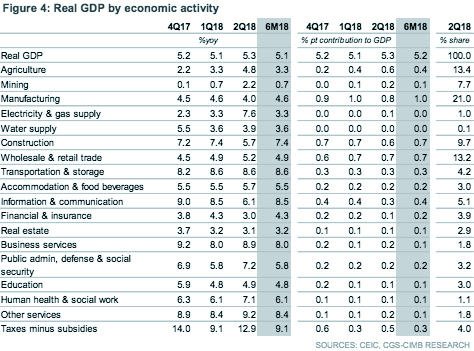
Seasonality could be at play in the latest GDP reading. First of all, a late harvest season lifted agriculture output growth from +3.3% yoy in 1Q18 to +4.8% yoy in 2Q18. Secondly, we think the long festive holiday in Jun may have affected activities in the manufacturing (+4.0% yoy vs. +4.6% yoy in 1Q18), construction (+5.7% yoy vs. +7.4% yoy in 1Q18), and financial & insurance (+3.0% yoy vs. +4.3% yoy in 1Q18) industries, all of which saw moderation in growth rates. Thirdly, the Eid al-Fitr celebration and regional elections spurred private consumption (+5.2% yoy in 2Q18 vs. +5.0% yoy in 1Q18), which in turn lifted the wholesale and retail trade, F&B, as well as transport sectors.

Private consumption growth at a four-year high
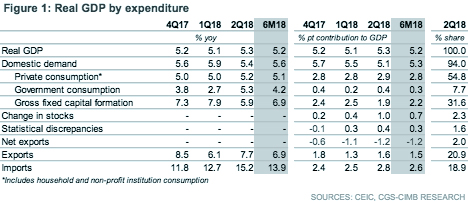
By expenditure, the key surprise came from the stronger contribution of inventory accumulation to GDP growth (+1.0% pt in 2Q18 vs. +0.4% pt in 1Q18), which may be driven by businesses stockpiling in anticipation of higher costs due to rupiah weakness, a trend that is unlikely to sustain towards the end of the year. On a positive note, household spending on F&B, equipment, transport & communication as well as restaurant & hotel was stronger during the quarter, whereas non-profit institution consumption was lifted by regional election spending. The recovery in household consumption was supported by a stable inflation rate and improved purchasing power following the 13th month salaries and allowances to civil servants, as well as conditional cash transfers from the government.

Investment growth takes a backseat after three quarters of acceleration
Government spending growth doubled to 5.3% yoy (+2.7% yoy in 1Q18) on higher social assistance expenditure and the low base effect last year, when the disbursement of 13th month salary to civil servants was delayed to 3Q17. Investment growth eased to 5.9% yoy in 2Q18 after three quarters of acceleration beyond 7% yoy, on the back of slower growth in buildings & structures, vehicles and other equipment. However, outlays on machine & equipment remained strong (+22.7% yoy vs. +23.5% yoy in 1Q18), in line with the delivery of train sets for infrastructure projects which also spurred import expansion.

No change to our GDP growth forecast
Real GDP grew 5.2% yoy in 1H18 (+5.1% yoy in 4Q17). We expect economic activity to improve further in 2H18, supported by 1) 18th Asian Games from 18 Aug to 2 Sep; 2) annual IMF-World Bank meeting in Bali in Oct; and 3) low and stable inflation rate until 2019. Hence, we reiterate our GDP growth forecast of 5.3% for 2018 and 5.2% for 2019, respectively. Key downside risks include a tighter monetary policy by Bank Indonesia (BI) which could dampen consumption desire.


img-ind21-2
 

img-ind21-3
Household consumption expanded 5.1% yoy in 2Q18, the fastest pace since 2Q14, as seasonal festivities that were accompanied by the long holiday, 13th month salary and allowances as well as low inflation boosted spending on F&B, equipment, transport & communication as well as restaurant & hotel, whereas regional elections raised non-profit institution consumption growth. The surge in government consumption was partly lifted by the low base effect last year, when the disbursement of the 13th month salary to civil servants was delayed.


img-ind21-4
Investment growth eased to 5.9% yoy in 2Q18 after three quarters of acceleration beyond 7% yoy. Outlays were weaker in buildings & structures, in line with weaker construction growth during the quarter. Capital expenditure on machine & equipment remained resilient (+22.5% yoy in 2Q18 vs. +23.7% yoy in 1Q18).


img-ind21-5
A late harvest season lifted agriculture growth to +4.8% yoy from +3.3% yoy in 1Q18. Mining activity was supported by O&G and metal ores on the back of rising global commodity prices. The long holiday in Jun contributed to slower expansion in manufacturing, construction, financial & insurance industries. Stronger consumption and festive celebration lifted the output growth in wholesale and retail trade, accommodation and food & beverage, as well as transport sectors.


img-ind21-6


Originally published by CIMB Research and Economics on 06 August 2018.

China-ASEAN Monitor


img-ca-080818

File Photo


Economy, Investment and Trade

Indonesia remains committed to anti-dumping measures with China, amid accusations from Chinese steel manufacturers
(5 August 2018) Indonesian Ambassador to China, Djauhari Oratmangun claimed Indonesia abides by the steel export procedures to China. The statement was made in response to China’s anti-dumping probe against stainless steel imports from the European Union, Japan, South Korea and Indonesia recently. In 2016, Indonesia started to export its stainless steel worth US$14.2 million to China. In a year, the export value shot up to US$689 million. The value of Indonesian steel exports to China is the highest compared to other 19 countries from the European Union plus Korea and Japan.
Read more>>

Malaysia could use US-China Trade War to its advantage
(4 August 2018) Malaysia could benefit from the ongoing trade war between the United States and China by attracting foreign investors, according to Malaysia’s Prime Minister, Tun Dr Mahathir Mohamad. Malaysia would provide a good alternative for foreign investors to invest since the country is not directly involved in the trade war. He said Malaysia is prepared to receive an influx of investors and is always ready for foreign investments. The escalating trade war between the US and China increased on 1 August 2018 when president Donald Trump’s administration announced another 25 percent tariff on China’s imports valued at US$200 billion.
Read more>>

Thai’s tourism sector could lose 670,000 Chinese visitors within the second half of 2018 due to Phuket boat tragedy
(2 August 2018)Thailand’s Ministry of Tourism and Sports reported that the country’s projected number of Chinese tourists for July-December could be reduced by almost 670,000 to 5.1 million following the Phuket boat tragedy which had killed nearly 50 people last month. Many of the passengers aboard were Chinese tourists. Economists claim that the incident could cost Thailand’s economy almost US$1 billion in 2018. The primary factor for the significant reduction in the number of Chinese tourists is due to calls from Chinese people to boycott Thailand.
Read more>>

Myanmar withdraws visa requirement to present US$1000 upon arrival
(3 August 2018) Myanmar has removed one of its new visa requirements which demands Japanese, Chinese and South Koreans to possess US$1,000 in cash upon arrival, a week after the immigration ministry issued the policy. The new system was suspended following widespread criticisms made by industry players, claiming the new policy will hinder tourists from coming to Myanmar. Hotel and tourism minister, U Ohn Maung stated most travellers use credit cards instead of cash, and it would be difficult for families to show US$1,000 for each person. The immigration department currently issues visa on arrival (VOA) to tourist from China, Hong Kong and Macau as an initiative to boost the tourism industry wheareas visa exemptions are given to Japanese and South Koreans.
Read more>>

Foreign Affairs

ASEAN, China launches the first maritime exercise in Singapore
(4 August 2018) The first ASEAN-China Maritime Exercise, a two-day tabletop exercise was held on Thursday at RSS Singapura-Changi Naval Base amid the lingering maritime disputes in the South China Sea. Hosted by the Republic of Singapore Navy (RSN), more than 40 officers from 10 ASEAN members and China, came together to develop plans to tackle simulated scenarios to be used during the ASEAN-China Maritime Field Training Exercise which will be held in China this October. Code for Unplanned Encounters at Sea, which was already adopted by ASEAN Defence Ministers’ Meeting-Plus countries in 2017, will be a part of the plans for the field exercise.
Read more>>


Malaysia: June 2018 trade


HIGHLIGHTS

June 2018 trade

  • Trade surplus surprised on the downside on strong acceleration in gross import growth, and weaker-than-expected expansion in gross exports.
  • Taxable goods and services shrink from 60% of CPI basket under GST to 38%.
  • We expect 2Q18 GDP growth to ease further to 5.2% due to stronger pick-up in import volume.
  • Regional trade performance in 2H18 will be key to watch out for with the start of US-China tariffs in July and companies mulling factory relocation out of China.

img-my18-1

Growth in imports outperformed exports for the first time in 2018
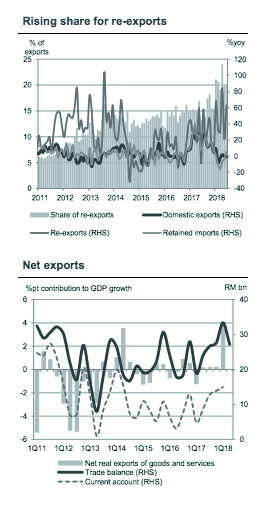
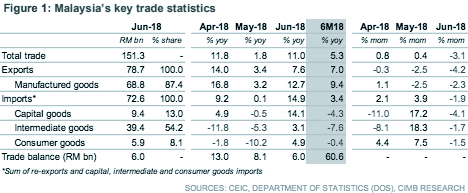
Trade surplus narrowed surprisingly to a 13-month low of RM6.0bn in June (CIMB: RM11.1bn, Bloomberg consensus: RM9.3bn; RM8.1bn in May), as gross imports outperformed gross exports for the first time this year. Import growth quickened to +14.9% yoy (CIMB: +7.1% yoy, Bloomberg consensus: +15.3% yoy; May: +0.1% yoy), double the +7.6% yoy pace for gross exports (CIMB: +7.8% yoy, Bloomberg consensus: +10.3% yoy; May: +3.4% yoy). Re-exports have been the key driver of trade performance in 2018, without which the performance of domestic exports (-0.8% yoy in June vs. -0.3% yoy in May) and retained imports (+6.2% yoy vs. -4.6% yoy in May) is more subdued.

Moderating O&G exports the key drag on export performance…
O&G export growth (+7.6% yoy in June vs. +26.6% yoy in May) was dragged by 31.2% yoy decline in LNG exports (+61.0% yoy in May) due to technical issues at Petronas’s LNG facility in Bintulu. Shipments of crude petroleum and refined petroleum products collectively rose 35.4% yoy (+18.9% yoy in May) on the back of higher oil prices. We expect O&G exports to pick up in the coming months on 1) the commencement of LNG deliveries to a Japanese company under a 10-year agreement in August, and 2) the resumption of Bentara crude exports after field upgrade which bumps up production from 50,000bpd in 2015 to 150,000bpd currently.

… but manufacturing exports came to rescue
Stronger growth in key industries helped to lift manufacturing export growth (+12.7% yoy in June vs. +3.2% yoy in May): E&E (+6.9% yoy vs. +2.1% yoy in May), chemicals (+31.6% yoy vs. +14.6% yoy in May), machinery, appliances and parts (+10.4% yoy vs. – 12.2% yoy in May), as well as optical and scientific equipment (+30.9% yoy vs. +13.4% yoy in May).

Broad recovery in end-use imports after the tumble in May
End-use import demand improved broadly on the back of festive celebrations and zerorated Goods and Services Tax (GST). The growth was led by capital goods (+14.1% yoy vs. -0.5% yoy in May), consumption goods (+4.9% yoy vs. -10.2% yoy in May), and intermediate goods (+3.1% yoy vs. -5.3% yoy in May).

Real GDP likely received less support from net exports in 2Q18
The positive contribution of net exports to GDP growth likely eased in 2Q18 (+4.0% pts in 1Q18) as the increase in 2Q18 trade surplus (+12.9% yoy to RM27.2bn) paled in comparison to 1Q18 (+76.8% yoy to RM33.4bn). We expect GDP growth to ease further to 5.2% (+5.4% yoy in 1Q18). National accounts and balance of payments data for 2Q18 are due to be released on 16 August.

No de-escalation in US-China trade tension yet
Global trade tensions are heating up with the US now studying the possibility of raising the proposed import tariffs on US$200bn worth of Chinese goods from 10% to 25%. Given the start of US and China tariffs on 6 July, we are watching out for July’s regional trade performance to ascertain the degree of trade disruption or whether there are potential winners from the displacement of demand in the targeted goods.

img-my18-2

img-my18-3

img-my18-4


Originally published by CIMB Research and Economics on 3 August 2018.