Tan Sri Dr. Munir Majid shares his views on the 25th ASEAN Regional Forum outcome on Bloomberg Asia

06 August, 2018
Appeared in ‘Bloomberg Daybreak: Asia’ Full Show

img-bloomberg-tsmm(Interview starts at time code 1:20:18)

Tan Sri Dr. Munir Majid, chairman of the CIMB ASEAN Research Institute (CARI) speaks with Bloomberg Asia on the recent ASEAN Foreign Ministers’ Meeting in Singapore and also his concerns over the Trade Wars between China and the United States. He also addressed the importance of regional economic integration and fast-tracking the Regional Comprehensive Economic Partnership (RCEP).

Indonesia: July 2018 CPI inflation


HIGHLIGHTS

July 2018 CPI inflation

  • Headline inflation edged up to 3.2% yoy in July, as accelerating food and core inflation was mitigated by the slower gain in administered prices.
  • Rising input costs as a result of currency weakness has yet to significantly affect overall consumer prices.
  • Our average inflation forecast of 3.4% for 2018 remains intact.

img-ind20-1

A slight increase in headline inflation to 3.2% yoy in July
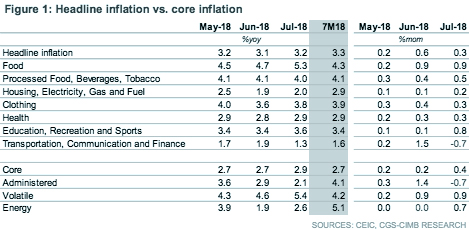
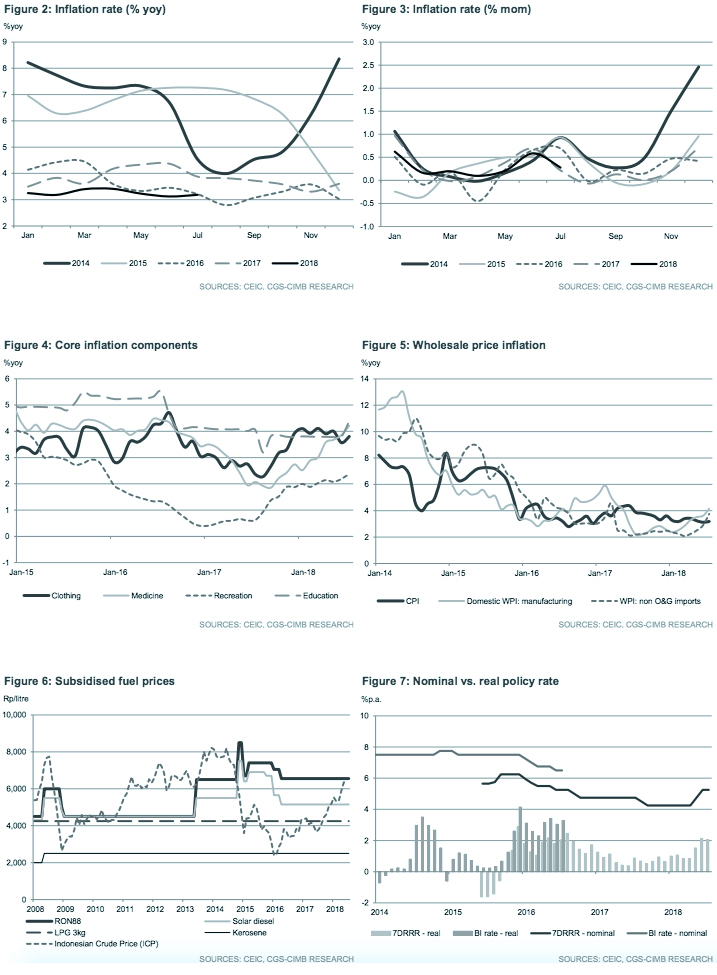
Headline inflation rose slightly to 3.2% yoy in July (CIMB forecast: +3.3% yoy; Bloomberg consensus: +3.2% yoy; Jun: +3.1% yoy), whereas core CPI, which strips out volatile food and administered price items, accelerated to 2.9% yoy after a stable 2.7% gain in the previous four months. On a month-on-month basis, the gain in consumer price index eased to 0.3% mom (+0.6% mom in June) on the back of declining administered price inflation (-0.7% mom vs. +1.5% mom in June).

Higher food inflation…
The monthly increase in food prices was sustained at 0.9% mom (+0.9% mom in June), as higher demand during the month-long Lebaran celebration and FIFA World Cup season exerted pressure on certain food prices, such as eggs, chicken and vegetables. Higher consumption and the low-base effect in 2H17 lifted annual food inflation to 5.3% yoy in July (+4.7% yoy in June), while annual prepared food inflation was little changed (+3.6% yoy in July vs. +3.7% yoy in June).

… was mitigated by lower transport inflation
Transport inflation eased sharply (+1.3% yoy in July vs. +2.7% yoy in Jun) as the normalisation of airfares, train and intercity transport tariffs post the long holiday season in Jun offset higher non-subsidised gasoline prices i.e. Pertamax. Fuel, electricity and water inflation stabilised (+0.9% yoy in July vs. +1.0% yoy in June) as the base effect of electricity tariff hikes in 1H17 dissipated.

Core inflation nudged up by communication and education costs
Among the core inflation components, communication & delivery inflation rebounded 0.8% yoy/ 1.1% mom in July (-0.3% yoy/0.0% mom in Jun) as a mobile service provide raised headline tariffs, whereas education costs picked up (+4.4% yoy/+1.3% mom in July vs. +3.8% yoy/0.0% mom in June) on the back of the new school year. Higher core inflation in July was also contributed by medicines (+4.2% yoy vs. +3.9% yoy in June), clothing (+3.8% yoy vs. +3.6% in Jun), and recreation (+2.4% yoy vs. +2.2% yoy in June).

The missing link between producer and consumer inflation
The weakening rupiah (-6% vs. US$ YTD) has exerted some pressure on input costs, as reflected in domestic manufacturing wholesale inflation (+4.2% yoy/+0.4% mom in July vs. +3.6% yoy/+0.2% mom in June) and non-O&G import inflation (+3.8% yoy/+0.8% mom in July vs. +2.9% yoy/+0.4% mom in June). Nonetheless, businesses remain wary of passing on the higher costs to price-sensitive consumers, according to a PMI survey by Markit; hence the reason why consumer price inflation remains stable at this juncture.

We reiterate our 2018 average inflation forecast of 3.4%
Another key contributory factor to price stability is the government’s decision to leave subsidised fuel prices unchanged until 2019, which removes significant inflationary risk. With 7M18 inflation rate at 3.3% yoy, our 2018 inflation forecast of 3.4% yoy remains intact. Given the recent rupiah stability, we expect Bank Indonesia (BI) to keep its policy rate unchanged at 5.25% at the next MPC meeting on 14-15 August 2018.


img-ind20-2

img-ind20-3


Originally published by CIMB Research and Economics on 23 July 2018.

CARI Captures 366

c366_graphic


VIETNAM

Vietnam Manufacturing Purchasing Index hits one of the highest records since 2011
(1 August 2018) A study by Nikkei showed that Vietnam had achieved one of the highest Manufacturing Purchasing Managers’ Indexes or PMI since 2011 amid a slight fall from 55.7 to 54.9 in July. Vietnam maintained its lead in the ASEAN manufacturing PMI rankings, registering another substantial improvement in its goods-producing sector in July. The Philippines moved up to the second place, followed by Indonesia and Singapore. The survey indicates a rebound in the growth of new export orders, which leads to higher staffing levels and increased purchasing activity. The level of confidence in the sector can be seen by firms building inventory reserves to respond better and quicker to new orders from consumers.

MALAYSIA

Malaysia seeks to protect the interest of national carmakers
(31 July 2018) The Pakatan Harapan government led by Malaysian Prime Minister Tun Dr Mahathir Mohamad might resort to protectionist measures on foreign car imports to protect its own automotive industries. National carmaker Perusahaan Otomobil Nasional, or better known as Proton, suffered a significant drop in its domestic market share to around 14 percent in 2017 due to lower-standard cars, limited after-sale services and stiff competition from foreign automakers such as Honda Motor Co, Toyota Motor Corp and Nissan Motor Co. In 1994, Proton was in its glory days with 74 percent domestic market share. Perusahaan Otomobil Kedua Sendirian Berhad (Perodua) was the local market leader in 2017, with a market share of 40 percent.

ASEAN

ASEAN must press on economic integration and innovation- Singapore’s Prime Minister
(2 August 2018) Singaporean Prime Minister Lee Hsien Loong expressed his support to narrow the development divide and to accelerate economic integration in ASEAN at the opening ceremony of the 51st ASEAN Foreign Ministers’ Meeting on Thursday. He addressed two areas where the region can prioritise – economic integration and technology adoption. Amid the ongoing trade disputes between major economies, he urged all ASEAN member states to reaffirm the centrality of the rules-based, non-discriminatory multilateral trading system and to enable technology and innovation to deepen the bloc’s web cooperation. Three initiative for ASEAN Integration (IAI) centres in Vietnam, Cambodia and Laos will be enhanced to Singapore Cooperation Centres (SCC), which will have a bigger range of technical aid and latest modalities for capacity building.

MYANMAR

Japanese and South Koreans will be granted visa-free travel to Myanmar from October 1 onwards
(1 August 2018) Japan and South Korea visitors with valid travel documents will soon be able to make official and social visits to Myanmar without requiring a visa starting on 1 October 2018 for a one-year trial. However, travellers from mainland China, Hong Kong and Macau will still have to pay US$50 for visas upon arrival. Despite the fee, Myanmar’s government will simplify visa requirements for Chinese tourists to attract more visitors from Asia, which accounted for 70 percent of total visitors to the country. In 2017, the number of Japanese visitors to Myanmar increased by 0.7 percent year-on-year to a total of 101,500. Following the visa relaxation, the government projected a 50 percent growth of Japanese visitors to Myanmar

CAMBODIA

Cambodia’s construction industry attracts US$2.15 billion investment in the first half of 2018
(26 July 2018) The improving construction industry in Cambodia has attracted US$2.15 billion investment in the first half of 2018. China, South Korea and Japan are among the most prominent investors in Cambodia’s construction and real estate industry. An official from the Ministry of Land Management, Urban Planning and Construction attributed the high level of investments in Cambodia to the political stability, favourable law and incentive policy to the investors. From January till June this year, the ministry had issued 1,643 licenses to the construction projects. The construction industry contributed about 29 percent of the country’s GDP, followed by agriculture and tourism for 25 percent and 13 percent respectively. The garment sector is the main contributor to Cambodia’s economy, accounting for more than 30 percent of the GDP.

THAILAND

Consumer Confidence Index in Thailand hits the highest level in 62 months
(3 August 2018) Thai’s consumer confidence index peaked at 82.2 in July, climbed from 81.3 in June and 80.1 in May, representing the highest rate for the past five years and two months since June 2013 according to the latest study by the University of Thai Chamber Commerce (UTTC). The increase in consumer confidence in areas such as the economy, job opportunities and future income signalled a higher purchasing power in the country. According to the director of the Economic and Business Forecast Centre of UTTC, the centre projected the growth of the country’s GDP to reach 4.5-5.0 percent in 2018 due to the strong performance of export and tourism industries. If the government expedites budgetary spending and push for investments in the Eastern Economic Corridor (EEC) infrastructure projects, Thailand’s GDP growth rate could reach 5-7 percent.

THE PHILIPPINES

House Committee on Ways and Means gives the green light for the Tax Reform for Acceleration and Inclusion (TRAIN-2)
(2 August 2018) The second package of the Tax Reform for Acceleration and Inclusion (TRAIN-2) which aims to lower corporate income tax from 30 percent to 25 percent has been approved by the Philippines’ House Committee on Ways and Means on 2 August 2018. Senate President, Vicente Sotto III filed the bill for the second tranche of tax reform to remove the tax benefits on industries which are underperforming or not part of the government’s strategic investment priorities plan. Rationalized incentives will be used to offset the lower corporate income taxes. However, according to an independent research, while the proposed tax reforms may be fiscally prudent, it will make the Philippines less competitive compared to its regional peers and slow down investment growth as the proposed conditional corporate tax reduction and repealing of fiscal incentives create uncertainties for business.

INDONESIA

Indonesia to open bidding for the development of new oil and gas blocks
(31 July 2018) Indonesia will open bidding for three onstream blocks in Makassar Strait, Selat Panjang and South Jambi B in the first week of August. The current contracts for Makasar and South Jambi B are set to expire in 2020 while Selat Panjang will expire in 2021. American multinational energy company, Chevron Corporation is currently operating the Makassar Strait Block but does not intend to extend its contract as it found the block to be uneconomical if it was part of the Indonesia Deepwater Development (IDD) mega gas project. PetroChina, a Chinese oil and gas state-owned firm had decided to withdraw from the South Jambi B block. For Selat Panjang, its existing operator Petroselat Ltd had filed for bankruptcy.

ASEAN

ASEAN benefits from ties with China, says AMRO report
(2 August 2018) ASEAN+3 Macroeconomic Research Office (AMRO) reported that China’s economic ties with ASEAN had benefited ASEAN through various channels such as goods and services trade, investments and financial markets. In its report, ASEAN’s exports to China has risen to more than 12 percent in 2016 compared to just 2 percent in 1990. Exports to China accounted 18 percent of Vietnam’s GDP, 17 percent of Malaysia’s GDP, 9 percent for both Singapore and Lao. ASEAN’s imports from China also increased due to growing demand and expansion of regional production networks. Chinese banks have been a vital funding hub to ASEAN economies especially through the Belt and Road Initiative (BRI).

Tan Sri Dr. Munir Majid talks about hopes and fears for ASEAN in a less benign cycle of the world economy

Tan Sri Dr. Munir Majid talks about hopes and fears for ASEAN in a less benign cycle of the world economy

Tan Sri Dr. Munir Majid, chairman of the CIMB Asean Research Institute, speaks with OMFIF Chair David Marsh. They discuss the changing dynamics of the Association of Southeast Asian Nations under Singapore’s chairmanship as well as barriers to business and trade in the region, including issues around corruption. They also speak about mounting pressure on Germany to support further economic and political European integration and what Asean can learn from Europe’s experience with its single currency.

Mekong Monitor


image

Photo Credit: EPA


TRADE, ECONOMY, AND INVESTMENT


CAMBODIA

EU and US threaten economic sanctions after Cambodia’s Ruling Party claims victory in elections with no viable opposition
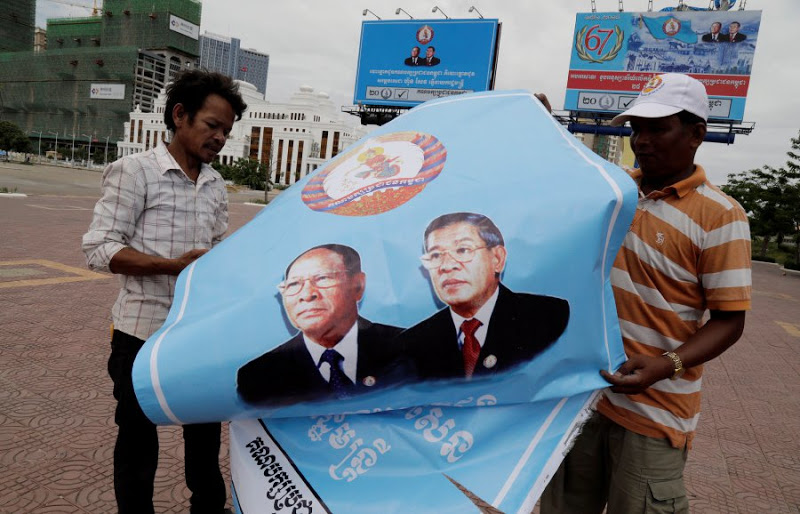
(30 July 2018) The conclusion of the Cambodian elections has seen the European Union (EU) and the US threatening economic sanctions against the country in response to the Cambodian government’s repression against press and political opposition. With an annual growth of seven percent, Cambodia’s growth is one of the highest in ASEAN and if sanctions are imposed, it would affect the country’s tariff-free entry in the west. Cambodia’s garment sector would be affected as Cambodian factories send some US$6.7 billion worth of garments to fashion companies around the globe, with 45 percent of it going to the European Union and 23 percent to the US. The ruling Cambodian People’s Party (CPP) won Cambodia’s sixth national assembly elections amid claims by rights groups that the polls was not free and fair due to the absence of any prominent challenger to Prime Minister, Hun Sen. In 2017, the main opposition party, Cambodia National Rescue Party (CNRP) was dissolved and its leader, Kem Sokha was jailed on treason charges. According to the country’s National Election Commission, more than 82 percent of registered voters came out to vote.
Read more>>

VIETNAM

Enterprises foresee brighter prospects in Mekong Delta
(26 July 2018) Business firms in the Mekong Delta are confident with its business outlook for the first half of the year, according to a survey carried out by Vietnam Chamber of Commerce and Industry (VCCI). The results of the study indicate that more than 83 percent of the companies operating in the Mekong Delta had a stable production of output in the first half of the year. Of the 83 percent, 41.9 percent of the enterprises responded by stating that business performance is better than the previous years, with 45.2 percent remaining the same and 12.9 percent worsening. However, most of the businesses agreed the price fluctuation of imported raw materials made it difficult since these firms are reliant on those goods.
Read more>>

THAILAND

Thai trade delegation to Vietnam looks to lift NTB on Thai vehicles
(27 July 2018) Thailand’s Commerce Minister, Sontirat Sontijirawong will attend the third meeting of the Thailand-Vietnam Joint Trade Committee (JTC), takes place from 2 to 3 August 2018. Lifting non-tariff barriers on Thai built vehicles imposed by Vietnam’s government will run high on the agenda, and the ministry also intends to increase bilateral trade value with Vietnam to US$20 billion in 2020. Recently, Thai exporters have suspended car shipments after Vietnam imposed non-tariff barriers on entirely built-up cars from Thailand which was deemed as discriminatory practices towards Thai exporters. Vietnam is Thailand’s second biggest trading partner in the region, and in the last five years, trade between Thailand and Vietnam was about $13.14 billion, with a growth of 9.7 percent every year.
Read more>>

MYANMAR

Thilawa Special Economic Zone in Myanmar attracts 89 investors from 17 countries
(30 July 2018) The Thilawa Special Economic Zone, located at the outskirts of Yangon, is the first Special Economic Zone (SEZ) built in Myanmar. The megaproject has attracted 89 investors from 17 countries, with over US$1.374 billion invested in Zone A. The development of Zone B is underway and will be completed in 2018. According to the Thilawa SEZ Management Committee, Japan and Singapore are among the most prominent investors for this project, accounted for over 60 percent of the total investment. Permits have been issued to 86 businesses for Zone-A, and seven for Zone-B.
Read more>>

LAOS

Plans underway to build the Sixth Lao-Thai Friendship Bridge across Mekong River
(25 July 2018) Arrangements are being made to build the sixth Lao-Thai Friendship Bridge over the Mekong River between the Saravan province in Lao and Ubon Ratchathani province in Thailand. Both countries will begin raising funds once the designing phase is completed. An official from the Ministry of Public Works and Transport Road said the construction phase is expected to start in 2020. Currently, four Lao-Thai bridges are in operation, linking the two neighbouring countries while the fifth bridge that costs US$110 million has yet to commence. The bridge will permit accessibility between the north-eastern region of Thailand to central Vietnam via Laos which will boost trade, investment and tourism sector for both countries.
Read more>>


mekong-monitor-map

About Greater Mekong Subregion (GMS)

The Greater Mekong Subregion (GMS) Economic Programme was launched by the Asian Development Bank in 1992 connecting five developing ASEAN countries, namely Cambodia, Laos, Myanmar, Vietnam and Thailand, and Chinese provinces of Yunnan and Guangxi Zhuang Autonomous region. The region has some of the most robust economies sharing the Mekong River Basin thanks to its reform and liberalisation. The subregion is growing at a faster pace than the whole of East Asia and the Asia Pacific as the GDP growth rate for 2017 was at 6.4 percent, according to the World Bank. The population at the subregion as of 2016 is at 340 million while the GDP at PPP is at US$3.1 trillion in 2016. In 2015, trading within the region was at US$444 billion.

Thailand: Macro snapshot


HIGHLIGHTS

Macro snapshot

  • Despite strong current account gains due to healthier net inflows in the services and income accounts in June, overall BOP weakened due to greater financial outflows.
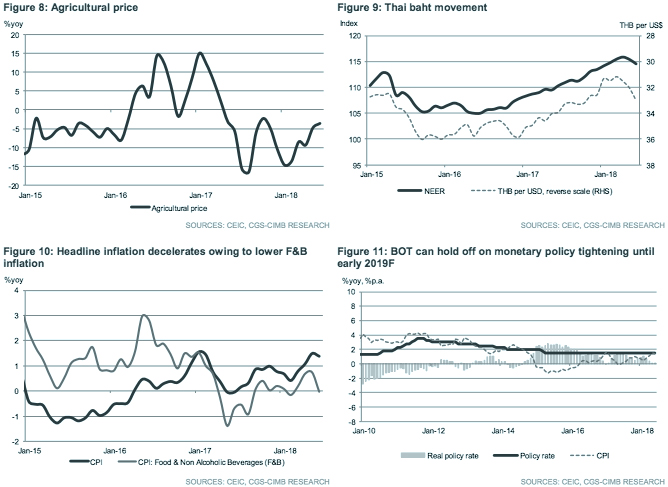
  • Farm incomes grew at a slower pace in June due to contraction in agricultural prices and lower agricultural production.
  • With June’s inflation at the low end of BOT’s target range, it can afford to hold off monetary policy tightening until early 2019F, in our view.
  • We expect the policy rate to remain at 1.50% through end-2018F.

img-th2-1

Exports moderating but manufacturing sector is improving
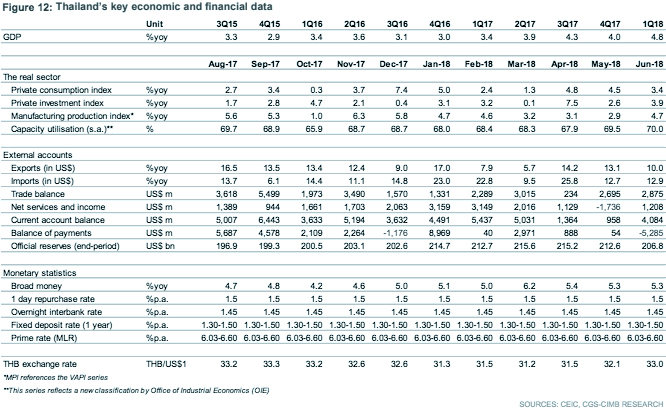
Export growth softened in June (+10.0% yoy vs. +13.1% yoy in May), mainly due to moderation in automotive shipments from an elevated level (+7.0% yoy vs. +19.6% yoy in May). Conversely, import growth strengthened slightly to 12.9% yoy in June (+12.7% yoy in May), primarily supported by fuel imports (+62.5% yoy vs. +26.2% yoy in May). Manufacturing activity picked up, with the Value Production Index (VAPI) rising 4.7% yoy (+2.9% yoy in May), buoyed by food & beverages, rubbers & plastics as well as cement & construction. Seasonally-adjusted capacity utilisation in the manufacturing sector also improved to 70.0% in June from 69.5% in May.

Current account thrives but financial outflows weaken BOP
Thailand’s current account improved significantly in June, registering a surplus of US$4.1bn (+US$1.0bn in May) on the back of higher net inflows from services and income accounts (+US$1.2bn vs. -US$1.7bn in May). Tourist arrivals rose 11.6% yoy in June to 3.0m. However, the nation’s financial account worsened to a deficit of US$7.0bn (+US$0.1bn in May) due to net outflows by Thai equity portfolio investors and ‘other investments’, resulting in a deterioration of the overall balance of payment (BOP) position (-US$5.3bn vs. +US$0.1bn in May).

Farm incomes to watch out for given the heavy downpours
Nominal farm incomes rose at a slower pace in June (+4.3% yoy vs. +8.0% yoy in May), dragged down by the persistent weakness in agricultural prices (-3.6% yoy vs. -4.8% yoy in May) and the slowdown in agricultural production growth (+8.2% yoy vs. +13.5% yoy in May). While the peak harvest season remains a few months away, the country’s provinces have been warned to brace for heavy downpours and flood risks.

Courting investments in the EEC
Thailand recently sought Chinese investment via the Belt and Road Initiative to help fund a five-year development plan worth THB1.7tr in the Eastern Economic Corridor (EEC). In 1Q18, the value of foreign direct investment applications from China approved by the country soared 1,482.2% yoy to THB14.3bn. Another initiative was signed by Thailand and the Japanese prefecture of Mie to establish the Mie-Thai agro-industrial cooperation centre at the EEC of Innovation (EECi) in Rayong, focusing on advanced food and food processing.

Policy rate to hold as inflation remains at low-end of target range
The Bank of Thailand’s (BOT) Monetary Policy Committee (MPC) voted 5-1 to leave the policy rate unchanged at its MPC meeting on 20 June, when the committee had its first extensive discussion on the conditions and timing for monetary policy normalisation. Inflation decelerated slightly in June (+1.4% yoy vs. +1.5% yoy in May), primarily owing to lower food inflation. Yet, it remains at the low end of BOT’s target range of 1-4%, suggesting that the central bank can hold off on monetary policy tightening until early 2019F. We reiterate our forecast that the policy rate will remain at 1.50% through to the end of 2018F.

img-th2-2

img-th2-3

img-th2-4

img-th2-5


Originally published by CIMB Research and Economics on 31 July 2018.

China-ASEAN Monitor


img-ca-200718

File Photo


Economy, Investment and Trade

Thailand to protect local industries by curbing bypass practices from foreign firms
(30 July 18) Thai trade officials will meet the United States customs to discuss ways to thwart bypass methods used by Chinese exporters who direct goods to Thailand in order to avoid higher US tariffs. Both parties will work together to outline Thai goods that will soon face levies from US tariffs imports and the quantities of the products exported every year. Recently, the Foreign Trade Department cooperated with the Customs Department to implement stricter imports and export controls especially on goods which are subject to high US tariffs. The move is to prevent Thailand from becoming a dumping ground for Chinese goods subjected to US tariffs hikes and anti-dumping measures which could harm local industries. An official from the Thailand’s Foreign Trade Department claimed that the US is concerned that certain foreign enterprises may shift its production bases to Thailand and re-export to the US due to President Trump’s’ decision to impose a 25 percent tariff on steel and 10 percent tariff on aluminium imports into the US on 8 March 2018.
Read more>>

Myanmar hopes for progress as China-backed Kyaukphyu megaproject negotiations resume
(30 July 2018) According to Myanmar’s deputy finance minister, an agreement has been made to scale down the China-backed Kyaukphyu megaproject from over US$7 billion to a projection of under US$1 billion. The implementation of the project will be supervised by Chinese consortium company, CITIC Group in the Rakhine State. The deep-sea port project which has been put on hold for more than three years has been heavily criticised because of its potential to put Myanmar heavily indebted to China with the unfair contractual agreement, that is 15 percent share for Myanmar and 85 percent on the CITIC-led group. The current government of Myanmar insisted on a 30 percent share which was then agreed by the Chinese consortium. The agreements are expected to be signed soon.
Read more>>

Vietnam surpasses Malaysia, becomes China’s biggest trade partner in ASEAN bloc
(29 July 2018) Among the ASEAN member states, Vietnam has taken the top spot as China’s largest trading partner for the first time from Malaysia. China-Vietnam revenue in June is US$11.2 billion, surpassing China-Malaysia revenue of US$9.3 billion. Malaysia was China’s largest trading partner from 2008 till 2015 and 2017. In the first half of the year, trade between China and Vietnam increased by 28.8 percent compared with the same period last year, 13.3 percent higher than the trade between Malaysia and China. Chinese Embassy in Vietnam said it is working together with the border provinces’ authorities to enhance the process of import of Vietnamese agricultural produce into China due to overwhelming growth of commodity exchange between the two countries.
Read more>>

Alibaba launches second availability zone to meet increasing demand in Malaysia
(30 July 2018) Alibaba Cloud, a subsidiary of Alibaba Group Holding Limited, has set up a second availability zone in Malaysia (Availability zone B) to expand its cloud data centre footprints as the regional demand for the digital services boom. Alibaba Cloud would further invest in Malaysia to set up the first cloud-based Anti-DDoS Scrubbing Centre in August. The new centre will offer new services to protect businesses from cyber threats and safeguard its customers’ information. Availability Zone B also will provide payment hardware security modules (HSM), elastic computing, database, networking and monitoring services which are certified for SAP hosting.
Read more>>

Philippines banks work with Bank of China to launch peso-renminbi spot market
(24 July 2018) Bank of China will ink a memorandum of understanding (MOU) with 15 local banks to ease the exchange and transactions of RMB into pesos vice versa without pegging to the US Dollar. Peso-renminbi spot market called the Philippine-RMB Community will be set up in the third quarter of the year. The Head of Bank of China, Deng Jun, said the RMB Community would open doors to trade and investment opportunities between China and Philippine. Currently, financial transactions between Filipino and Chinese businesses need to convert to US dollar rate which increases the marginal cost by one to two percent.
Read more>>


Singapore: June industrial production


HIGHLIGHTS

June industrial production

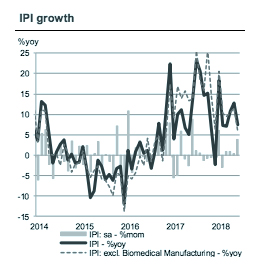
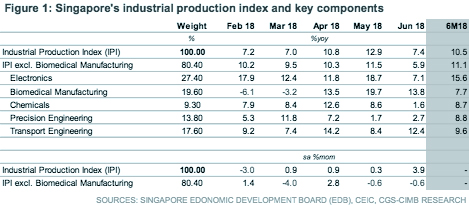
  • IPI expanded at a slower pace of 7.4% yoy in June, due to subdued growth in the electronics, chemicals and biomedical clusters.
  • Cumulative manufacturing growth (+10.2% yoy in April-June vs. +11.8% yoy in April May), suggests minor tweaks to the advanced GDP growth of 3.8% yoy in 2Q18.
  • While external developments have not significantly dented the manufacturing sector, global trade tensions remain a risk to the medium-term outlook.

img-sg7-1

Slower IPI expansion, but ahead of forecasts
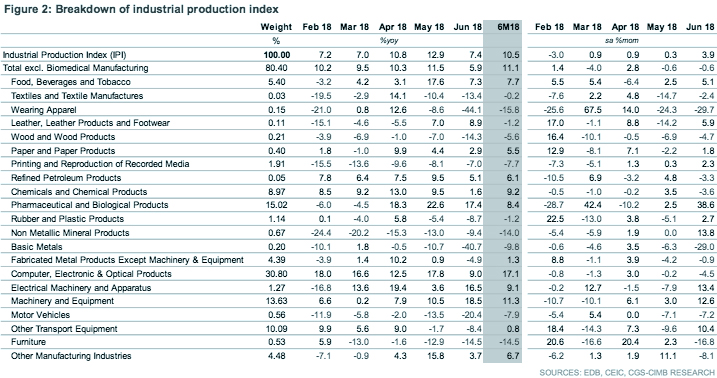
The industrial production index (IPI) expanded by a slower pace of 7.4% yoy in June, ahead of expectations (CIMB: +5.4% yoy, Bloomberg consensus: +3.3% yoy), and following an upward revision to growth in May of 12.9% yoy. Manufacturing activity excluding the volatile biomedical sector mirrored the headline trend, growing at a slower pace of 5.9% yoy in Jun (+11.5% yoy in May). On a seasonally-adjusted basis, the IPI expanded 3.9% mom (+0.3% mom in May).

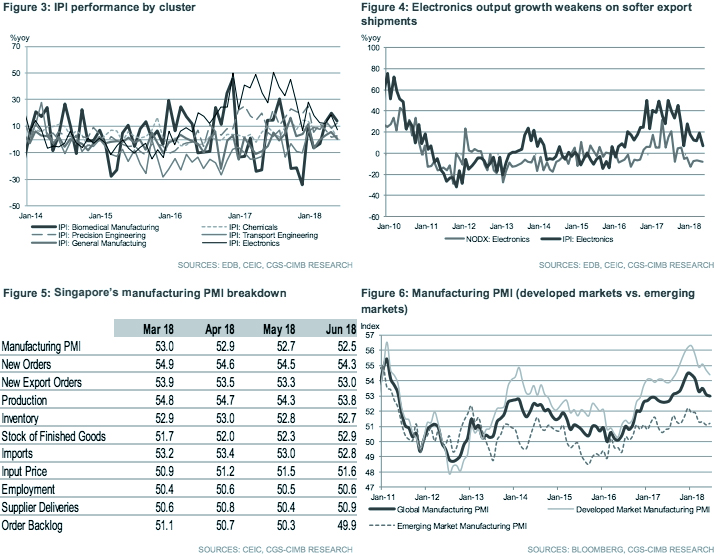
Electronics output growth weakens on softer export shipments
Electronics output growth moderated significantly to 7.1% yoy in June (+18.7% yoy in May), amid broader demand weakness for Singapore’s electronics exports (-7.9% yoy in June). Weighing on the sector were subdued semiconductor output growth (+10.2% yoy vs. +29.0% yoy in May), declines in the computer peripherals (-10.1% yoy vs. -12.0% yoy in May) and data storage segments (-9.9% yoy vs. -2.4% yoy in May). A pick-up in consumer electronics (+5.4% yoy vs. -24.6% yoy in May) and electronic modules output (+9.2% yoy vs. -10.9% yoy in May) were insufficient to counter wavering demand elsewhere.

Chemicals sector expansion more muted in June
Expansion in the chemicals sector lost pace in Jun (+1.6% yoy vs. +8.6% yoy in May) due to slower demand growth for petrochemicals and petroleum. The specialty chemicals segment continued to contract by 2.6% yoy in Jun (-1.2% yoy in May) and production of ‘other chemicals’ plummeted by 6.2% yoy (+11.9% yoy in May). However, transport engineering recorded robust growth (+12.4% yoy vs. +8.4% yoy in May), primarily led by the marine & offshore engineering segment. Furthermore, precision engineering also grew by 2.7% yoy in June (+1.7% yoy in May), helped by the precision modules & components segment.

Biomedical sector contribution moderates
The prognosis for the biomedical manufacturing cluster was less rosy in June (+13.8% yoy vs. +19.7% yoy in May) due to more subdued increases of pharmaceutical drugs production (+17.4% yoy vs. +22.6% yoy in May). The medical technology segment also experienced toned down gains of 1.9% yoy (+13.1% yoy in May).

Manufacturing outlook still clouded by global trade developments
Growth in the manufacturing sector broadly held up last quarter (+10.2% yoy in April – June vs. +11.8% yoy in April – May), suggesting only minor tweaks to the advanced GDP growth reading of 3.8% yoy in 2Q18, when the revised reading is released in Aug. While external risks have yet to significantly dent Singapore’s near-term manufacturing outlook beyond the anticipated cyclical slowdown in demand, trade relations between the US and China remain uncomfortably tense, particularly as the US prepares to raise the ante with at least US$400bn of additional tariffs on Chinese exports to the US.

img-sg7-2

img-sg7-3

img-sg7-4


Originally published by CIMB Research and Economics on 26 July 2018.

Malaysia: Dusting off the old playbook for SST 2.0


HIGHLIGHTS

Dusting off the old playbook for SST 2.0

  • Sales Tax rates of 5% and 10%, and Service Tax of 6% proposed under SST 2.0.
  • Taxable goods and services shrink from 60% of CPI basket under GST to 38%.
  • Households are clear winners in the GST-SST trade-off while businesses selectively benefit from lower compliance costs and boost to consumer demand.
  • On the other hand, government finances remain a concern as the replacement of GST with SST 2.0 entails a revenue shortfall of RM23bn (~1.6% of GDP).
  • We reiterate our GDP growth (+5.2% in 2018) and inflation forecasts (+1.3% in 2018), which had already been adjusted to reflect the reinstatement of SST 2.0.

img-my17-1

SST 2.0 borrows heavily from previous SST regime
The Sales and Services Tax (SST) will make a comeback on 1 September 2018 in a familiar fashion, with proposed rates of 5% and 10% for the Sales Tax, and 6% for the Service Tax – similar to the previous SST regime that was retired after 2015. While a separate tax schedule will be released later for petroleum and petroleum products, specific provisions were not made for tobacco and liquor, which incurred sales tax rates of 25% and 20% respectively under the SST 1.0, implying either the tax rate has not been finalised or a standard-rated sales tax of 10% applies. The new SST bill will be tabled soon and is expected to be passed before the end of the current parliamentary session in mid August. SST 2.0, alongside the GST zerorisation on 1 June, brings one of the new government’s core election promises closer to realisation.

Tweaks to improve efficiency of SST and minimise profiteering
We understand that improvements are being considered to the new SST Bill to address criticisms of the old SST like double taxation, incomplete tax relief for exports outside designated/special areas, and efficiency of collection. The Royal Malaysia Customs Department (RMCD) is also in consultation with the Finance Ministry and the Domestic Trade and Consumer Affairs Ministry to monitor and prevent unjustified profiteering during the SST 2.0 implementation.

Fulfilling pro-consumer election promise
Households are the clear winners in this trade-off, receiving additional disposable income through reduced tax collection. While goods without exemptions such as passenger vehicles, selected building materials, processed F&B and services (Fig 4) are poised for price increases after the GST tax holiday, SST 2.0 covers a narrower basket of goods and services (38% of CPI basket vs. 60% under the GST as cited by Finance Minister Lim Guan Eng), curtailing the inflationary impact to consumers. We retain our inflation forecast of 1.3% in 2018, which already assumes the reintroduction of the SST.

Lower administrative and compliance burden on businesses
SST 2.0 and the proposed abolishment of the GST Act relieves many businesses from the onerous reporting requirements, with the RMCD estimating that less than 100,000 businesses will be affected by SST 2.0 vs. 472,000 under GST. FM Lim contends that delayed GST refunds had tied up operating cash flows and raised costs for businesses. RMCD plans to help reduce administrative burden via automatic registration of eligible businesses (annual turnover >RM500,000) and digitising submissions of SST returns. RMCD will begin nationwide engagement with stakeholders on SST 2.0 from 23 July.

Government to tighten belt after picking up the tab
The government expects to collect RM21bn p.a. from the SST, vs. RM44bn p.a. under the GST regime estimated in Budget 2018 before it was abolished on 1 June, leaving a shortfall of RM23bn p.a. (~1.6% of GDP). While higher oil-related revenues provide a fortuitous temporary buffer, maintaining fiscal discipline hinges on the new government’s ability to rapidly rationalise unproductive expenditures and reduce revenue leakages. Alongside these fiscal reforms, we believe a comprehensive tax reform over the medium term, which helps simplify tax structures and broaden the tax base, is equally critical to ensuring fiscal and debt sustainability.

img-my17-2

img-my17-3

img-my17-4


Originally published by CIMB Research and Economics on 20 July 2018.

Indonesia: No revision to State Budget 2018 (APBN 2018)


HIGHLIGHTS

No revision to State Budget 2018 (APBN 2018)

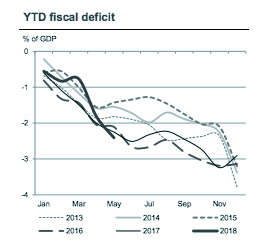
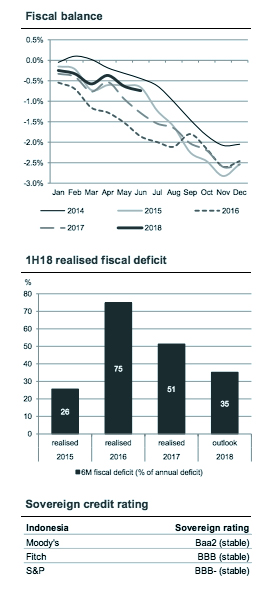
  • With 1H18 fiscal deficit remaining healthy at -0.75% of GDP (vs. full-year target of 2.19% of GDP), the government has decided not to revise its State Budget 2018.
  • Redirecting additional revenue to fund higher energy subsidy and social assistance implies current account deficit (CAD) remains a risk to rupiah and monetary policy.
  • No change to our 2018 forecasts for inflation (+3.4%) and GDP growth (+5.3%).
img-ind19-1

Fiscal deficit at -0.75% of GDP in 1H18
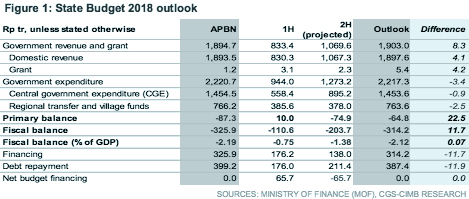
1H18 fiscal deficit came in at Rp111tr, or -0.75% of GDP, the smallest level in three years, as a result of stronger growth in government revenue and grant (Rp833tr, 44% of APBN, +16% yoy) relative to government expenditure (Rp944tr, 43% of APBN, +6% yoy). Given the healthy deficit position, government decided not to revise the State Budget 2018, although its estimates on macroeconomic assumptions have changed.

Outlook on macroeconomic assumptions
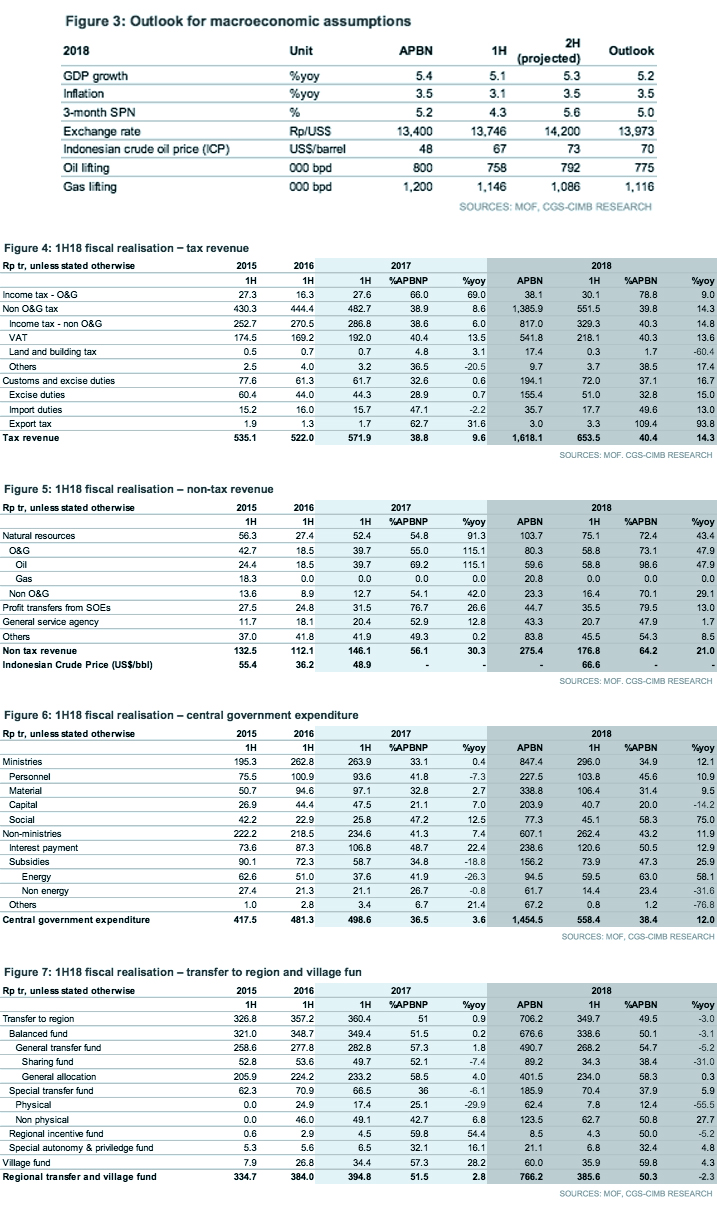
The government now expects GDP growth to come in at 5.2% in 2018 (vs. 5.4% in APBN), based on an oil price assumption of US$70 per barrel (vs. US$48 per barrel in APBN) and an exchange rate close to Rp14,000 per US$ (vs. Rp13,400 per US$ in APBN). The inflation outlook remains at 3.5% as prices remained under control in 1H18.

Revenue boosted by rising commodity prices and trade activity
Higher-than-expected commodity prices, in particular oil and coal, raised resource-related revenue collection in 1H18, such as O&G income tax (Rp30tr, 79% of APBN, +9%) and natural resources receipts (Rp75tr, 72% of APBN, +43%). Stronger trade activity, especially import growth, lifted import duties (Rp18tr, 50% of APBN, +13% yoy) and, partly, VAT (Rp218tr, 40% of APBN, +14% yoy).

Higher energy subsidy and social assistance…
The revenue windfall was redirected to fund higher energy subsidy (Rp60tr, 63% of APBN, +58% yoy) and social assistance (Rp45tr, 58% of APBN, +75% yoy), which collectively accounted for ~19% of central government expenditure. Capital spending took a backseat (Rp41tr, 20% of APBN, -14% yoy). To maintain subsidised fuel prices at current levels until 2019 and alleviate subsidy burden on Pertamina, the government announced in June that diesel subsidy would be raised from Rp500 per litre to Rp2,000 per litre. Taking into account the impact of higher oil prices on LPG subsidy, as well as higher allocation for electricity subsidy, the Ministry of Finance (MOF) projects energy subsidies to go up to Rp164tr in 2018, Rp69tr higher than APBN 2018.

…to support household purchasing power
The subsidy allocation is likely to remain elevated, as there are plans to raise diesel subsidy further to Rp2,500 per litre in 2019. We are not overly concerned about the government’s ability to absorb the additional energy subsidy, given that it could partly be compensated by higher O&G revenue, as we have highlighted in our previous report. The cumulative O&G fiscal balance (O&G revenue less energy subsidy) increased to Rp29tr in 1H18 compared to Rp14tr in 3M18.

No change to our inflation and GDP growth forecast
Channeling extra revenue to finance government spending, rather than lowering fiscal deficit, may keep pressure on the current account deficit (CAD) position; hence, we expect currency or monetary policy tightening risks to persist until 2019. As fiscal focus is diverted towards supporting household purchasing power from infrastructure development previously, we expect consumption growth to improve in 2H18, but investment growth could still be backed by ongoing infrastructure projects. We reiterate our inflation forecast of +3.4% and GDP growth projection of +5.3% for 2018.
 

img-ind19-2

img-ind19-4

img-ind19-3


Originally published by CIMB Research and Economics on 23 July 2018.