Indonesia: June 2018 trade


HIGHLIGHTS

June 2018 trade

  • Total trade growth eased in June on the back of fewer working days, while moderating import growth brought the trade balance back to a surplus of US$1.7bn.
  • Export growth was supported by stronger volume growth, whereas price effect was the key driver of import expansion.
  • With a quarterly trade deficit of US$1.3bn, we expect current account deficit to widen to US$6.7bn, or 2.6% of GDP in 2Q18.
  • We project 2Q18 GDP growth to be a tad higher at 5.2% yoy, supported by positive contribution in net export volumes and stronger consumption.

img-ind17-1

Indonesia posted a trade surplus of US$1.7bn in June
Indonesia’s trade balance swung back to a surplus of US$1.7bn in June (CIMB forecast: +US$546m; Bloomberg consensus: +US$968m; May: -US$1.5bn) on the back of much subdued gross import growth at +12.7% yoy (CIMB forecast: +23.6% yoy; Bloomberg consensus: +29.1% yoy; May: +28.2% yoy). Gross exports grew +11.5% yoy during the month (CIMB: +10.6% yoy; Bloomberg consensus: +15.6% yoy; May: +13.1% yoy).

Weaker trade expansion due to a shorter working month…
In contrast to the Lebaran month in 2012-2017 which saw trade declining, total trade activity continued to expand in June 2018, on the back of resilient global trade activity and recovering domestic demand. The pace of expansion nonetheless eased (+12.0% yoy vs. +20.5% yoy in May) due to a shorter working month, as the government declared extra holidays surrounding the Lebaran festive season. There were 20% yoy fewer working days in June 2018 (12 vs. 15 in June 2017).

… but export volume growth quickened
Nonetheless, export volume growth accelerated despite fewer working days (+24.1% yoy in June vs +17.5% yoy in May). The acceleration may have been partly supported by a weaker currency, which improves export competitiveness, whereas higher O&G production in the country lifted O&G exports. On the flip side, the import growth was mainly led by price effects (+21.8% yoy in June vs. +17.0% yoy in May), compensating for the decline in import volume (-7.5% yoy vs. +9.7% yoy in May).

Imports of capital goods supported by delivery of train sets
By category, imports of consumption goods took a backseat at the end of 2Q18 after two months of robust growth (-9.5% yoy in June vs. +34.3% yoy in May), whereas imports of raw materials rose 14.6% yoy (+24.7% yoy in May). Imports of capital goods sustained their double-digit growth (+19.9% yoy vs. +43.1% yoy in May) due to the arrival of six train cars from South Korea for Jakarta LRT.

Trade deficit to translate into higher current account deficit
The large trade surplus in June was not sufficient to offset the deficit in Apr-May, resulting in a quarterly trade deficit of US$1.3bn in 2Q18 (+US$314m in 1Q18). Hence, we expect the current account deficit to widen to US$6.7bn, or 2.6% of GDP in 2Q18 (vs. deficit of US$5.5bn, or 2.1% of GDP in 1Q18). Meanwhile, net export volumes expanded 19.7% yoy in 2Q18 (+14.8% yoy in 1Q18), pointing to a potential positive contribution to GDP growth. Coupled with stronger retail and auto sales, we expect 2Q18 GDP growth to accelerate to 5.2% yoy. The 2Q18 GDP growth data will be released on 6 Aug 2018, and balance of payment on 10 Aug 2018.

img-ind17-2

img-ind17-3


Originally published by CIMB Research and Economics on 16 July 2018.

China-ASEAN Monitor


img-ca-200718

Photo Credit: The Financial Express


Economy, Investment and Trade

China is ASEAN’s largest trading partner for the ninth year in a row
(18 July 2018) China’s vice-minister of commerce Gao Yan said that China remains ASEAN’s largest trading partner for the ninth year in a row with the trade volume between the bloc and country at US$514.82 billion in 2017. It was 6.6 percent higher than the trade volume in 2003, when both sides first established a strategic partnership. For 2018, China and ASEAN saw a trade increase of 18.9 percent in the first five months, up to US$232.64 billion. According to Gao, Investment between both sides over 15 years was more than US$200 billion and more than 4,000 firms had been set up through direct investment, generating over 300,000 jobs for local people in the ASEAN region.
Read more>>

China-ASEAN Investment Cooperation Fund (CAF) to step up investments in Southeast Asia
(16 July 2018) China-ASEAN Investment Cooperation Fund (CAF) will invest another US$3 billion after successfully deploying US$1 billion of capital to infrastructure projects in Southeast Asia over the past eight years. According to CAF, investment activity in the energy, transportation and telecommunication sector were the primary drivers of strong investment flows. The USD-denominated offshore quasi-sovereign equity fund also added that the move of Malaysia’s Finance Ministry to halt work on East Coast Railway Link (ECRL) and two pipeline projects did not act as a deterrence for further investment in Malaysia.
Read more>>

Thai government eyes investments from China to boost its development plan
(13 July 2018) The Thai government is looking to bolster its five year-development plan worth US$50.8 billion for its eastern seaboard by attracting Chinese investors to the country. Thailand’s military junta sees the Eastern Economic Corridor (EEC) project as a linkage to China’s Belt and Road Initiative (BRI). Thailand’s Prime Minister Prayuth Chan-Ocha said China’s BRI policy would pave the way for connectivity within Asia and around the world. The five-year plan, which is from 2017 to 2021 will encompass provinces of Rayong, Chachoengsao and Chonburi and it promotes industries such as biotechnology, robotics and aircraft maintenance. China’s Alibaba Group Holding Ltd is one of the investors for the corridor as the e-commerce conglomerate pledged about US$350 million to build a distribution hub in the region.
Read more>>

China is a key contributor to Cambodia’s agriculture sector
(15 July 2018) Cambodian Minister of Agriculture, Forestry and Fisheries, Veng Sakhon said China had been a significant contributor in developing agriculture sector in Cambodia. Since 2009, the two countries have signed over 60 memorandums of understanding, agreements and protocols covering a wide range of cooperation in the agriculture sector. Agriculture is the backbone of Cambodia’s economy as the kingdom earned US$5.5 billion in 2017, accounting for 25 percent of the country’s GDP. Cambodia’s primary crops are rice and cassava as the state generated 10.5 million tonnes of paddy rice and 14 million tonnes of cassava tubers in 2017. In 2017, China acquired about 200,000 tonnes of milled rice and is expected to purchase up to 300,000 tonnes of rice in 2018.
Read more>>

Philippines-China maritime dispute could cost Philippines economic development
(16 July 2018) China’s continuous blocking of oil and gas drilling on Reed Bank in the West Philippine Sea may bring long-term economic consequences to the Philippines, a maritime law expert warned. The Reed Bank is earmarked as a possible substitute to the nation’s leading source of natural gas, the Malampaya field, which will be depleted in less than a decade. Expert warned that the Philippines’s plan for economic development would be affected if the Malampaya field ran out of oil and gas. The substitute for Malampaya would be more expensive and would take at least 10 years of lead time in pursuing natural gas and petroleum energy projects.
Read more>>


Singapore: 2Q18 GDP growth (advance estimates)


HIGHLIGHTS

2Q18 GDP growth (advance estimates)

  • Singapore’s economy lost speed in 2Q18, expanding 3.8% yoy (+4.3% yoy in 1Q18) and 1.0% qoq SAAR (+1.5% qoq SAAR in 1Q18).
  • While manufacturing remains a key engine of growth, we see headwinds gathering in 2H18 amid easing electronics demand and retaliatory tariffs by the US and China.
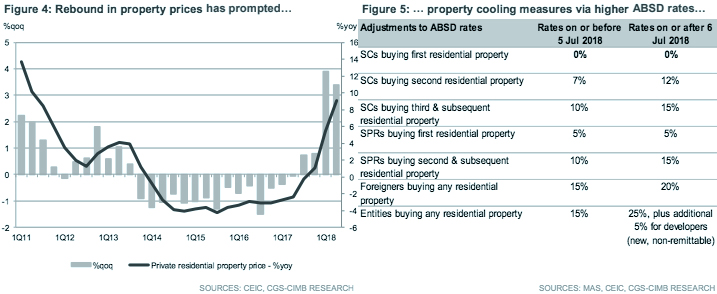
  • Property cooling measures are a setback to our expectations of a quicker recovery in the construction sector, which extended its contraction streak to 8 straight quarters.
  • Risks to the outlook are global trade tensions, tighter global financial conditions, slower growth in G3 and China as well as geopolitical uncertainty.
  • We retain our forecast for MAS to maintain its current monetary policy stance, advocating a “gradual and modest” pace of appreciation for the S$NEER.

img-sg6-1

GDP growth slims down, marginally below expectations
Singapore’s economic expansion moderated to 3.8% yoy in 2Q18, based on the advance estimate from the Ministry of Trade and Industry (CIMB: +4.0% yoy, Bloomberg consensus: +4.1% yoy; +4.3% yoy in 1Q18). On a qoq seasonally adjusted annual rate (SAAR) basis, real GDP growth rose at a slower pace of 1.0% qoq, following a more robust reading of 1.5% qoq SAAR in the previous quarter.

and services sectors remain resilient
Production of electronics expanded by a slower 12.4% yoy in March (+17.9% yoy in February), on moderating growth for semiconductors (+18.8% yoy vs. +27.4% yoy in February), amid softening demand for smartphones. Output growth for computer peripherals remained stagnant (+0.2% yoy vs. +0.9% yoy in February) while contractions persisted in the data storage (-19.0% yoy vs. -21.8% yoy in February), consumer electronics (-7.7% yoy vs. -9.1% yoy in February) and other components (-0.5% yoy vs. -24.5% yoy in February).

Major revisions in pharma drags down headline IPI readings
Growth in the manufacturing sector remained healthy, albeit slower (+8.6% yoy vs. +9.7% yoy in 1Q18), on the back of strong performance in all segments within the sector, particularly led by electronics and biomedical manufacturing. Growth in the services sector eased to 3.4% yoy in 2Q18 (+4.0% in 1Q18), where momentum continued to be buttressed by wholesale and retail trade as well as the financial and insurance segments.

Property cooling measures to dampen construction turnaround
In contrast, the construction sector remained the underperformer as the sector contracted for the eighth consecutive quarter (-4.4% yoy vs. -5.2% yoy in 1Q18), weighed down by private sector construction activity due to the contraction in contracts awarded, which fell 67.5% yoy in May (+39.1% yoy in Apr). In a setback for the residential construction segment, the government recently announced property cooling measures, namely adjustments in the Additional Buyer’s Stamp Duty (ABSD) rates and Loan-to-Value (LTV) limits following a sharp rebound in land prices and en-bloc sales. Particularly for the developers, the additional 5% ABSD rate could raise the cost of land acquisition and reduce the bullishness of tender bids.

Growth outlook remains positive but downside risks gather
Singapore’s economy remains on track to meet our 3.2% GDP growth forecast for 2018, which is broadly in line with the Ministry of Trade and Industry’s (MTI) projection of 2.5% to 3.5%. We are wary of risks arising from disruptions to the trade cycle from incoming tariffs by the US and China, increased protectionist policies by major trade nations, higher interest rates and tighter financial conditions as a result of global monetary policy normalisation, geopolitical uncertainty, and a sudden loss of momentum in the advanced economies and China.

MAS to maintain monetary policy stance
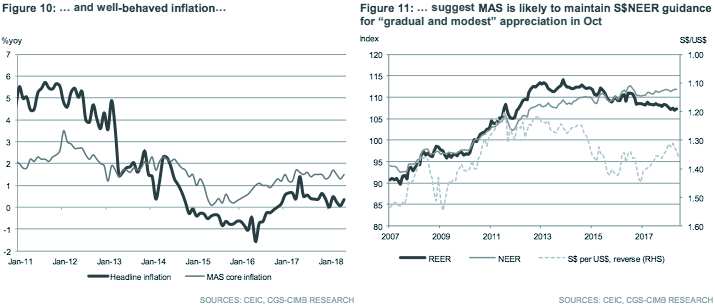
Price pressures remain non-threatening as we forecast headline inflation to moderate to 0.6% in 2018F (+0.6% in 2017), aligned with MAS’s expected range of 0% to 1%. Headline inflation edged up to 0.4% yoy in May (+0.1% yoy in April) due to higher food prices as well as healthcare and education costs. As the balance of risks has tilted towards downside to growth, we expect MAS stay the course on its current guidance for a “gradual and modest appreciation” of the S$NEER at the upcoming Oct policy review. However, if global trade momentum slows sharply as the US and China step up trade threats, we expect MAS to stand ready to recalibrate policy settings to support the economy.

img-sg6-2

img-sg6-3

img-sg6-4

img-sg6-5

img-sg6-7

mg-sg6-8


Originally published by CIMB Research and Economics on 13 July 2018.

Press Release: Holistic policy approach and adequate safety nets imperative to withstand possible crisis in ASEAN while structural reform is key to long term financial resilience


Holistic policy approach and adequate safety nets imperative to withstand possible crisis in ASEAN while structural reform is key to long term financial resilience

Kuala Lumpur, 18 July 2018 – Experts cautioned that the escalating trade conflict between the U.S. and its major trading partners coupled with the strengthening of the U.S. dollar are putting pressure on the short-term macroeconomic outlook, as well as posing significant policy challenges on Asian emerging markets economies, including ASEAN. ASEAN policymakers must pursue holistic policy mix to prepare the region for potential near-term economic and financial hazards, given its high exposure to global and regional trade.

img-pr-rt11

(From left) Dr. Hans Genberg, Executive Director of the South East Asian Central Banks (SEACEN) Research and Training Centre; Frank Scheidig, Global Head of Senior Executive Banking of DZ BANK; Tan Sri Andrew Sheng, Honorary Advisor of CARI; Tan Sri Dr. Munir Majid, Chairman of CIMB ASEAN Research Institute (CARI) and President of ASEAN Business Club (centre), David Marsh, Chairman and Co-Founder of Official Monetary and Financial Institutions Forum (OMFIF); Dr. Hoe Ee Khor, Chief Economist of the ASEAN+3 Macroeconomic Research Office (AMRO), and Stephen Hill, Strategic Advisor, World Reserve Trust pose for the cameras after the ASEAN roundtable series titled “What Lessons Learned from Financial Crises of Recent Times”, organised by CARI, in collaboration with ASEAN Business Club and OMFIF in Kuala Lumpur today.

Regional experts weighed in on the preparedness of ASEAN in facing a potential financial crisis at the ASEAN Roundtable Series titled “What Lessons Learned from Financial Crises of Recent Times”, which was organised by CIMB ASEAN Research Institute (CARI) today, in collaboration with the ASEAN Business Club and The Official Monetary and Financial Institutions Forum (OMFIF).

The roundtable was chaired by Tan Sri Dr. Munir Majid, Chairman of CARI and President of the ASEAN Business Club. The panel of speakers at the roundtable were Tan Sri Andrew Sheng, Honorary Advisor of CARI; David Marsh, Chairman and Co-Founder of OMFIF; Dr. Hoe Ee Khor, Chief Economist of the ASEAN+3 Macroeconomic Research Office (AMRO); Frank Scheidig, Global Head of Senior Executive Banking of DZ BANK and Dr. Hans Genberg, Executive Director of the South East Asian Central Banks (SEACEN) Research and Training Centre.

Panelists of the roundtable voiced concerns whether a “perfect storm” is in the making with increased uncertainties and potential spillover effects on the financial markets due to the U.S. led trade wars.

“President Trump’s “America First” policy is causing global instability, in geopolitics, economies and trade. The U.S. Fed is also showing less concern than ever for the impact of its monetary policies on non-American economies. The so-called normalization of central bank monetary management, in Europe as well, has seen outflows from ASEAN capital and financial markets, the additional factor that public debt in European economies such as Greece and Italy pose a huge default risk in the banking system,” said Tan Sri Dr. Munir Majid.

Learning from the Asian Financial Crisis (AFC), the ASEAN+3 Macroeconomic Research Office (AMRO)’s Chief Economist Dr. Khor said that the AFC has taught policymakers’ important lessons on crisis management and resolution.

“With robust monetary policy framework and strengthening the regulatory oversight of the financial sector, economies battered by the AFC were able to weather the Global Financial Crisis (GFC) unscathed. The outlook for the region remains challenging, given the tension between short-term growth and financial stability objectives. This comes at a time when policy space has generally narrowed. In the medium term, it is important to strengthen regional financial safety net, while accelerating the structural reform agenda for a continuous income convergence in the longer term,” said Dr. Khor.

Tan Sri Andrew Sheng emphasized that the true lessons from the Asian Financial Crisis (AFC) and the Global Financial Crisis (GFC) are flawed theory that failed to see the real causes of crises. However, there is political expediency to over-use monetary policy and financial regulations.

“Democratic politics refused the use of painful structural reforms and taxation (fiscal tools) to address structural imbalances and social inequalities. The choice was made to over-use monetary policy and complex financial regulations that led to even more capture and concentration within the system, namely growing income and wealth inequalities, because the super-rich gained excessively at the expense of the less rich. Policy-making needs a holistic view that recognises and responds to the six mega trend shifts: Geopolitics, Geography, Gender, Geo-Climate Change, Generational and G5 Technology. These led to major, complex disruptions aggravating inequality and social losses, resulting in populist discontent.” he said.

Over the past 20 years, ASEAN central banks have built up ‘buffers’ against financial crises in the form of much higher foreign exchange reserves, increased flexibility and depth of regional capital markets and lowered vulnerability to dollar-priced debt through a rise in local currency borrowing. However, with ASEAN countries at different stages of development, a major preoccupation is how to set up appropriate multi-pronged mechanisms to respond to crises ahead of time.

“Irrespective of geography, policy makers must be cautious of the trigger points for crises, including political developments which are not within the purview of central banks. It is prudent to have in place contingency plans for emergency action on multiple fronts. Never overestimate a nation’s abilities to overcome its difficulties by itself – it will almost certainly need international support and lining up such action in advance can be crucial”, said David Marsh. This roundtable is the 12th edition of the ASEAN Roundtable Series.

Event update for ASEAN Roundtable Series on What Lessons Learned from Financial Crises of Recent Times>>

Malaysia: 2019 Budget Consultation


HIGHLIGHTS

2019 Budget Consultation

  • Fiscal reforms in Budget 2019 are aimed at promoting sustainable, equitable and inclusive growth while ensuring credibility, accountability and transparency.
  • Cost cutting is not the government’s only focus, as economic expansion and wage gains for the B40 and M40 households are deemed equally crucial policy goals.
  • The pro-consumer agenda and fiscal constraints mean businesses will have to play a key role in improving productivity and lowering costs in the economy.
  • The government appears optimistic that the pain of reform adjustments can be shared without sacrificing economic growth (MOF: 5.0-5.5% in 2019 vs. CIMB: +5.0%)
  • Delays in implementation and productivity gains may entail a trade-off between 1) economic growth, 2) near-term fiscal discipline or 3) a pared down reform agenda.

img-my15-1

Fiscal reset to achieve sustainable and equitable growth
We attended the 2019 Budget Consultation today at Putrajaya, chaired by Finance Minister YB Lim Guan Eng (FM). Fiscal reforms in Budget 2019 are part of policies aimed at promoting sustainable, equitable and inclusive growth while ensuring credibility, accountability and transparency.

Key focus areas for reforms
The government’s top structural challenges were 1) incomprehensive social safety nets and rising costs of living, 2) stagnant productivity growth and low returns to labour, 3) insufficient high-skill, high income jobs for locals and a need for the labour force to adapt to technological disruptions and 4) non-inclusive and unbalanced economic development.

Government remains upbeat on economic prognosis
The FM believes robust economic growth provides the fiscal room for reforms. At this juncture, the FM expects Malaysia’s economic expansion to sustain at a pace of 5.5-6.0% in 2018 (CIMB: +5.2%) and 5.0-5.5% in 2019 (CIMB: +5.0%), though he acknowledged that the forecasts may be refined along the way up to the tabling of Budget 2019, tentatively slated for 2 November 2018. In particular, the government is monitoring external developments such as the global trade tensions, geopolitical uncertainty as well as volatile movements in the financial and commodity markets.

Room to manoeuvre limited by fiscal constraints
The FM intends to maintain fiscal discipline with the budget deficit to “remain low” without providing a target, and was keen to manage expectations on additional fiscal space for government expenditure. Public procurement processes would be improved to stem leakages and government tenders would be judged by financial viability. The government would consider projects that are not financially viable if they produce large positive externalities for the economy, but only under rigorous cost controls. The government expects to retain its credit rating and would engage with ratings agencies to explain the scope of its policies.

Boosting labour’s share of income alongside cost of living cuts
A recurring theme during the event was the need to raise Malaysia’s labour share of income, which stood at 35% of GNI (vs. ~40% in advanced economies). In the FM’s view, reforms are needed to improve income growth for the B40 and M40 groups as the trickledown economics approach of the previous regime has worked too slowly. However, he acknowledged that wage growth has to go hand-in-hand with higher productivity. Addressing market inefficiencies and distortions such as monopolies, price floors/ceilings or government subsidies were also means to reducing the cost of living.

Squaring the circle via productivity growth and private sector
With government finances pinched, the FM said the onus falls on greater efficiency and productivity from the corporate GLC and private sector to drive the economy. Participants from the floor raised concerns that businesses are bearing the burden of economic adjustments through higher costs of doing business and domestic policy uncertainty, particularly surrounding tax and foreign labour. Inevitably, reducing market distortions and improving the cost of living requires both lower deadweight losses and compressed producer surpluses.

Achieving ideal outcome rests on implementation
The Budget Consultation did not reveal further details on specific policies, which is understandable as many Cabinet ministers have only recently taken over their portfolios. Proposals are likely to crystallise as the budgetary process continues in the next three months. Our key takeaway is that the government appears optimistic that the pain of adjustments to reforms can be shared without sacrificing growth. If implementation timelines slip or reforms take longer to bear the fruits of productivity gains, then policymakers may have to be prepared to sacrifice 1) economic growth, 2) near-term fiscal discipline and the budget deficit target or 3) pare down its reform agenda.


Originally published by CIMB Research and Economics on 12 July 2018.

US-China: Not a trade war, more an ice age

Originally published in TheEdge Malaysia, 16-22 July 2018

img-pauline-180718

The festering hostilities between China and the United States have finally boiled over.

What’s next is not so much a trade war or even a cold war as the dawn of an Ice Age in relations between China and the United States.

Quarrels over exports and tariffs have morphed into a race for global dominance. This is now about growing American perceptions of China as an all-round threat rather than just a rules-bending competitor in trade and commerce.

From building military air strips in disputed areas in the South China Sea to Chinese pressure on foreign airlines to label Taiwan as a part of China, the relationship between the world’s two biggest economies is tilting from greed to fear.

Mutual interest had kept relations manageable. American businesses have been and are still eager to break into China’s massive market of 1.4 billion people. And Chinese industries continue to be keen on obtaining American technology and to break into the US-dominated global financial system.

But fear is catching up with greed.

The fear of a swaggering China with the wherewithal at last to successfully push its agenda – on trade, investment, market access, on redefining freedom of navigation in the South China Sea, on naval patrols which of late have become a regular sight in waters close to Taiwan, maybe even on who has what rights in the Arctic Ocean – is definitely concentrating minds in Washington.

Note that the confrontation with China, which goes back to the Obama days, has bilateral support in the US Congress. Objections are not about confronting China. Objections are about tactics – whether imposing aggressive tariffs work.

China for its part has always feared that the US will try to contain its rise. But Beijing is aware that it would not be to the nation’s advantage to play hardball at this juncture with its own economy going through a rough patch and with key financial metrics remaining stressed or are deteriorating.

MONEY TALKS

The renminbi will be the first to grab headlines. It has already shed about 3.3% of its value against the dollar in June – and is off nearly 6% from its peak in late March in the biggest monthly fall on record. The outlook is for continued weakness punctuated by the occasional volatility-driven bounce.

But the culprit is not Beijing. Speculation that China is “weaponizing” its currency to retaliate against Washington by deliberately engineering devaluation is way off the mark.

While China would not be averse to a softer renminbi, a significant fall in valuation is not in its interests. Apart from other considerations, such a move would lead to major clashes with its other trade partners. These are markets China would not want to antagonise at such a delicate moment with a provocative devaluation.

None of the sweet talk over the Belt-Road investments earmarked for ASEAN would count for much if a substantial renminbi devaluation puts Southeast Asian exporters out of work through currency-driven price cutting.

But the drama over US tariffs and the uncertainties posed by escalating US-China tensions are only part of the renminbi’s woes.

Downward pressures on the Chinese currency have been building for some time as the economic environment shifted. And the recent strength of the greenback has not helped.

What will not change overnight regardless of the presidential tweet or threats by China’s patriotic press:

  • Widening interest rate gap. The US is moving towards higher interest rates and tighter monetary policy while China is lowering its interest rates and maintaining an “accommodative” monetary policy. The rates gap is bad news for renminbi valuation.
     
  • Falling foreign investment. Even before the latest tariffs drama and talk of trade war, foreign investment into China has been slowing. First-quarter FDI increased by a marginal 0.5% yoy to US$36 billion. But despite Xinhua's claim of "steady growth," investment actually fell when adjusted for inflation.

    China’s domestic market has become increasingly unattractive. Problems range from rising land and labour costs, forced transfer of technology, perceived discrimination against foreign invested enterprises and slowing domestic growth which reduces profitable investment opportunities.

    Further dampening investor enthusiasm is China’s recent clampdown on foreign exchange outflows, including legal repatriation.
     

  • Slowing GDP growth. Headline numbers should still be respectable in the second quarter as Chinese exporters had worked overtime to speed up shipments and maximize sales before tariffs hit. The resulting boost to net trade will flatter GDP numbers.

    But by the third quarter, it will be clear who’s been swimming naked. Even without the headwinds from US tariffs, the Chinese economy has been struggling to maintain growth. Better-than-expected performance in 2017 was greatly helped by a big turnaround in the GDP deflator driven by commodity prices.

    But exports in the coming quarters are going to be lacklustre as sales to its other markets are unlikely to make up for the expected contraction in sales to the United States.

    More crucially, there are no new growth drivers. Exports are sputtering. Consumption driving GDP is a fantasy supported by data that’s been cherry picked. The investment engine may still be puffing along but only just.
     

MONEY WALKS

Currency is a core asset class. A weakening currency is often a symptom of waning confidence. And nothing says waning confidence like capital flight or – in the terminology preferred in more polite circles – outflow pressures.

How much pressure? The best yardstick is not a number. Statistics, as folks everywhere have always known, belongs with lies and damned lies.

The Rosetta Stone, in our view, is the government’s policy response. Beijing has essentially resorted to the brute force of an administrative firewall to keep money from leaving. Controls are being applied to even routine cash management by corporate treasurers and to the retail use of foreign-currency denominated credit cards. These are not the actions of a government responding to cyclical outflows.

Whatever the next policy move by Washington or Beijing, a fundamental resolution of differences in the near term is highly unlikely. US China relations are about to enter an ice age in trade, investment, market access and perhaps even academic exchanges. Investors should position themselves accordingly.

Malaysia: July MPC meeting: Staying the course


HIGHLIGHTS

July MPC meeting: Staying the course

  • The Overnight Policy Rate (OPR) was held at 3.25% for the third meeting in a row, policy continuity was signalled under new BNM governor Datuk Nor Shamsiah.
  • The MPC statement was broadly neutral with a dovish tilt in a nod to domestic policy uncertainty and external risks from global trade tensions and rising global yields.
  • The anticipated inflation slippage over the short term, resulting in widening real policy rate spreads with the US, has given BNM the policy space to remain accommodative.
  • We maintain an end-2018 OPR forecast of 3.25%, implying no further hikes this year.

img-my14-1

OPR left unchanged at 3.25%
The Monetary Policy Committee (MPC), chaired by new Bank Negara Malaysia (BNM) Governor Datuk Nor Shamsiah Mohd Yunus, extended the pause in Overnight Policy Rate (OPR), which remained at 3.25% for the third straight meeting. The decision was well anticipated by us and all analysts surveyed by Bloomberg.

Policy continuity under new Governor
It was a homecoming for the new Governor who will serve a term of five years until 30 Jun 2023 as she was previously the BNM Deputy Governor responsible for areas including banking, insurance, and Takaful supervision, financial intelligence and enforcement until her departure in November 2016. She signalled no dramatic departures from the monetary policy stance pursued by predecessor Tan Sri Muhammad Ibrahim.

Slight caution on growth outlook from external risks
BNM maintained its assessment of Malaysia’s economic outlook for 2018, following the raft of policy reforms introduced by the new Pakatan Harapan government. BNM expects Malaysia to remain on a steady growth path (CIMB: +5.2% yoy in 2018F), which will be further supported when the government provides greater certainty in domestic policy in the coming months. The MPC statement reflected the central bank’s view that economic and financial conditions remain supportive in the post-election environment. Nonetheless, BNM cautioned against downside external risks, particularly the escalating trade tensions and ongoing monetary policy normalisation.

Reduction in inflation risks…
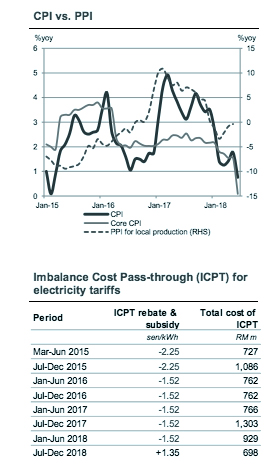
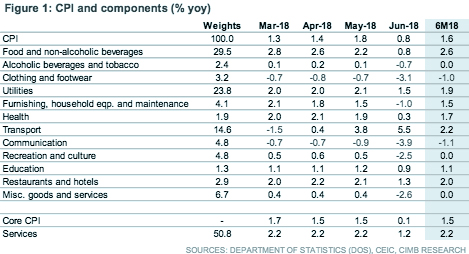
BNM expects headline inflation to trend below its earlier forecast range of 2.0% to 3.0% in 2018 (CIMB: +1.3%), following the reduction in the Goods and Service Tax (GST) rate and fixing of RON95 and diesel fuel prices. The central bank expects headline inflation to turn negative in some months and remain low in 1H19 as a result of the aforementioned policy measures, and normalise once the transitory effects lapse. In May, headline inflation ticked higher to 1.8% yoy while core inflation was steady at 1.5% yoy.

… creates policy space to keep the OPR on hold
Regionally, interest rate cycles are turning positive to keep up with the US Federal Reserve’s policy rate hikes. Despite narrowing nominal policy rate spreads, the slowdown in Malaysia’s short-term inflation outlook has increased the real spread between the OPR and US Fed Funds rate, allowing BNM to keep policy rates accommodative until next year, in our view. While OPR cuts are an option, it would mean swimming against the tide of regional central banks and potential spillovers to the currency, unless the GDP growth and inflation outlooks deteriorate more sharply. We expect BNM to tread with caution and reiterate our end-2018 OPR forecast of 3.25%, implying no further hikes this year, with the next OPR hike anticipated in 2H19F.

img-my14-2


Originally published by CIMB Research and Economics on 11 July 2018.

CARI Captures 364

c363_graphic


ASEAN

Singapore reaches top five in Global Innovation Index
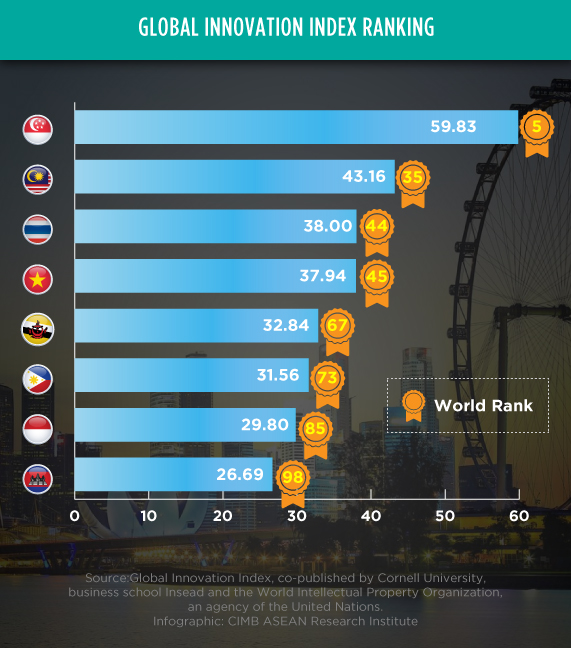
(11 July 2018) Singapore broke into the top five list of the Global Innovation Index 2018 for the first time after its seventh ranking in the 2017 index. The index, calculated from 80 different indicators, exhibits each country’s expertise to innovate new technologies, and put them to use. The report was co-published by Cornell University, business school Insead and United Nations’ agency, the World Intellectual Property Organization. The country’s rankings improved after scoring high in indicators such as government effectiveness and foreign direct investment outflows. The index shows ASEAN nations have improved in innovation and socio-economic development indicators. Malaysia and Vietnam moved up two positions from the previous index to 35th and 45th respectively while Thailand showed great progress going seven spots to reach 44th in 2018. Malaysia showed significant improvement in most indicators namely human capital and research, infrastructure and business sophistication. Among all the countries in the region, Vietnam was ranked first in expenditures on education and trademarks by origin while Thailand topped the high tertiary enrollment indicator.

SINGAPORE

The Competition and Consumer Commission of Singapore (CCCS) proposes fines and cancelling Grab’s acquisition of Uber
(6 July 2018) The Competition and Consumer Commission of Singapore (CCCS) threatened to hit penalties on cab-sharing providers Grab and Uber after the commission deemed that Grab’s acquisition of Uber is a breach of competition laws. CCCS also said the merger could be cancelled as the alliance has brought down competition and led to increased fares. The watchdog also said that both entities did not inform authorities about the merger. Uber and Grab have 15 working days to submit proposals to settle the issue to the CCCS. However, Grab has said that the company opposed the commission’s statement and would appeal the measures proposed by the watchdog.

INDONESIA

Indonesia to send a team to Washington to continue GSP Facility
(9 July 2018) The Indonesian government will send a group of lobbyist to Washington in response to the United States’ decision to review the eligibility of the Generalised System of Preference (GSP) facilities on the country in April. Oke Nurwan, director general for foreign trade at Indonesia Trade Ministry said that the team will negotiate for the imposition of the GSP facility to be continued. Indonesian exports to the United States comprises of textile, furniture and timber which altogether stands at about US$17.8 billion annually.

VIETNAM

Vietnam’s export reliance on Chinese market rising
(8 July 2018) The Chair of Vietnam Association of Seafood Exporters and Producers (VASEP), Truong Dinh Hoe said that the country exported US$2.5 billion worth of seafood in the first four months of the year, an increase of 14 percent compared to the same period in 2017. The four biggest markets include the US and Japan which accounted for 15 percent of the total, while EU and China at 14 percent. With the highest growth rate of 37 percent, China will exceed other markets to become the biggest seafood importer of Vietnam. This development has raised concern over the heavy reliance on the Chinese market not only as the biggest consumer of Vietnam’s export of raw products but also dependence on China as the biggest supplier of input materials.

MALAYSIA

Malaysia likely to miss CPTPP deadline
(11 July 2018) Malaysia may not be able to meet the February 2019 ratification deadline for Comprehensive and Progressive Agreement for Trans-Pacific Partnership (CPTPP), said the International Trade and Industry Minister, Darell Leiking. The ministry may need more time to assess the necessary laws in CPTPP, and Prime Minister Tun Dr Mahathir Mohamad will be briefed about the pact. Nevertheless, Leiking assured that Malaysia can still ratify and enforce CPTPP after the stipulated deadline. Mexico was the first country to approve the trade agreement, which replaced the now-defunct Trans-Pacific Partnership Trade agreement due to the withdrawal of the United States from the trade pact.

THE PHILIPPINES

The Philippines to borrow US$22.4 billion to finance 2019 Budget
(9 July 2018) The government plans to borrow US$22.4 billion from external sources and domestic market, partly to finance next year’s budget, said National Treasurer, Rosalia de Leon. She then added the borrowing program will be 20 percent higher than 2018. Also, de Leon told reporters that the Bureau of the Treasury was considering its first Euro bonds issuance in the European market. The government has promised to maintain its aggressive spending strategy which helped the domestic economy to continue at a 6.8 percent annual growth in the first quarter until 2022.

MYANMAR

Central Bank of Myanmar to monitor the acquisition of stake by foreign banks in local banks
(11 July 2018) Myanmar’s Directorate of Investment and Company Administration (DICA) stated that the country’s central bank will scurtinise acquisitions of 35 percent stake by foreign banks in local banks. According to the Myanmar Companies Act, foreign investors are permitted to obtain stakes up to 35 percent in local establishments. However, the central bank will scurtinise the purchases as it is in charge of monitoring and scrutinising all banks. Also, the central bank will determine how to authorise foreign investors to take stakes of up to 35 percent.

THAILAND

Thai government calls for faster public investment as growth is slowing
(11 July 2018) Thailand’s military-led government is pushing to accelerate public investment spending which has missed expectations following the adoption of stricter procurement rules, said Deputy Prime Minister, Somkid Jatusripitak. About US$8.2 billion was spent for investment projects for the first nine months of the current fiscal year or less than half of the total budget of US$20.4 billion. The rules were introduced in the second half of 2017 to stamp out corruption in the country, which has made it difficult for bureaucrats to spend. Analysts forecast the growth for Southeast Asia’s second-largest economy to slow down from the first quarter’s figure of 4.8 percent, the best in five years.

CAMBODIA

US EXIM Bank intends to work with Cambodian Companies
(10 July 2018) Export-Import Bank of the United States (EXIM) said they anticipated to cooperate with Cambodian companies by facilitating purchases of equipment and business deals with the United States. EXIM is interested in working with Cambodia’s banking sector and bankable corporates for projects in Cambodia’s agricultural, renewable energy and healthcare industries. EXIM is a government agency that provides loan, guarantee and insurance products to aid the export of American goods. EXIM has assisted more than US$600 billion in US exports in vital industries in the US namely aviation, oil and gas exploration and heavy equipment.

CAMBODIA

Vietnam and Cambodia to expand economic growth and bilateral trade
(10 July 2018) Vietnam and Cambodia agreed for a comprehensive cooperation to expand their economic growth and bilateral trade to US$5 billion in the coming years. The bilateral trade turnover between Cambodia and Vietnam in 2017 reached about US$3.8 billion, a robust increase of 25 percent from 2016. Cambodia’s export to Vietnam reached US$1 billion, with a year-on-year increase of 40.6 percent mainly consisting timber, wood products, cashews and rubbers while Vietnam’s export to Cambodia stood at US$2.7 billion, an increase by 26.1 percent which includes of steel, iron products, oil and petrol.

Myanmar Monitor


Photo

Photo credit: Photostock

Economy, Investment and Trade

Chin State government is developing two major cities in Chin into industrial zones
(6 July 2018) The Chin State of Myanmar will be developing industrial zones in Hakha and Paletwa, two major cities in Chin State and the state welcomes local and foreign investments. Huge projects that exceed the government’s budget will be proposed to developers via public-private partnership (PPP) system. Yangon Bus Public Company (YBPC) is an example of a PPP project, in which the government invested US$7.15 million (K10 billion) while five private firms spent US$1.76 million (K2.5 million). At the same time, the state government is facing a rising unemployment issue in Chin State and aims to solve this issue by allowing private sector to invest in Chin State and create employment opportunities.
Read More >

Australian mineral miner receives licenses to mine gold and copper in Myanmar
(2 July 2018) Myanmar’s Directorate of Investment and Company Administration (DICA) will issue the new Companies Law regulations, namely on electronic registration, capital structures and company constitutions before it takes effect on 1 August 2018. DICA has presented the provisions to the government’s economic committee, and once it is approved, the government investment body will publish the regulations on its website. The Companies Law will replace and incorporate components of the 1914 Companies Act and 1950 Special Companies Act. The new law will ease procedures for foreigners to invest in local companies and ensure business regulation becomes more efficient and effective. According to the government investment body, there are more than 50,000 local companies and 7,000 foreign companies currently registered in Myanmar.
Read More >

The government allows exports from private raw timber producers
(9 July 2018) The government recently permitted the exportation of raw timber manufactured from private forest plantations in Myanmar. Since April 2014, Myanmar’s Resources and Environmental Conservation Ministry suspended the exportation of raw wood produced from natural forests. Although the development allows exports from private raw timber producers, firms must follow the official procedures to gain permission to export. Out of a total of 1.4 million acres of private forest plantations in Myanmar that have teak, hardwood, rubber, palm and industrial crop plantations, nearly half of these plantations are dormant and seized by the State.
Read More >

Yangon Elevated Expressway project receives more than 50 Expression of Interest
(5 July 2018) Myanmar government received 53 Expressions of Interest (EoI) for the Yangon Elevated Expressway project from local and global corporations, mainly from Asia. This expressway project intends to solve the severe traffic congestion in Yangon. The Ministry of Construction invites global developers to construct up to 47.5km of expressway under a public-private partnership (PPP) to link downtown Yangon, Yangon Port, Yangon International Airport, Mingalardon Industrial Park and the Yangon-Mandalay Highway. The International Finance Corporation (IFC), a member of World Bank Group has estimated that the expressway project will cost from US$350 to US$400 million of private investment in Yangon’s road infrastructure.
Read More >

Foreign Affairs

Myanmar and India improve marine security and economy cooperation
(6 July 2018) Myanmar and India have agreed to enhance political and security cooperation as well as strengthen the economic corridor in three primary focus areas namely trade, connectivity and culture. The Minister for External Affairs of India Sushma Swaraj expressed that ASEAN is the focal point of India’s foreign policy and all efforts will be made to boost physical and digital connectivity between ASEAN and India. Myanmar and India have agreed to cooperate in three areas including maritime security cooperation during President of Myanmar, U Htin Kyaw’s visit to India in 2017. India is a negotiating country of the Regional Comprehensive Economic Partnership and has signed the Treaty of Amity and Cooperation in 2003.
Read More >

Press Release: Review of trade and investment policies imperative to creating an inclusive ASEAN digital economy


Review of trade and investment policies imperative to creating an inclusive ASEAN digital economy

Kuala Lumpur, 12 July 2018 – Despite the projection that the digital economy will add US$1 trillion to ASEAN GDP by 2025, there are policy hurdles that must be overcome by ASEAN to realise the digital economy potential for the region which now has a combined GDP of over US$2.6 trillion.

WhatsApp Image 2018-07-12 at 5.23.44 PM

(From left) Dr. Sufian Jusoh, Senior Fellow of CARI; Richard Bolwijn, Head of Investment Research Branch, Division of Investment and Enterprise (DIAE), UNCTAD; Tan Sri Dr. Munir Majid, Chairman of CARI and President of the ASEAN Business Club; Dr. Deborah Elms, Executive Director of Asian Trade Centre and Foong Chee Keong, Group Head of Regulatory Affairs, Axiata Group Berhad pose for the cameras after the ASEAN Roundtable Series on ASEAN Digital Economy: Investment, Gaps, and Policy Implications at Melia Hotel in Kuala Lumpur on 12 July 2018.

Among others, ASEAN needs to relook at its various policy initiatives including trade and investment policies in response to the transformative digital economy that is not only impacting international production, trade, services and investment flows, but also changing the rules of world trade. Apart from that, addressing the challenges in digital and telecommunications infrastructure investment is fundamentally crucial in helping the micro, small and medium sized enterprises (MSMEs) of ASEAN integrate with global value chains.

These issues were highlighted during a business roundtable titled, “ASEAN Digital Economy: Investments, Gaps and Policy Implications” which was organised by CIMB ASEAN Research Institute (CARI) today, in collaboration with the ASEAN Business Club and United Nations Conference on Trade and Development (UNCTAD).

 
AAM_3148 copy

The roundtable was chaired by Tan Sri Dr. Munir Majid, Chairman of CARI and President of the ASEAN Business Club. The panel of speakers comprised of Richard Bolwijn, Head of Investment Research Branch, Division of Investment and Enterprise (DIAE), UNCTAD; Dr. Deborah Elms, Executive Director of Asian Trade Centre; Foong Chee Keong, Group Head of Regulatory Affairs, Axiata Group Berhad and Dr. Sufian Jusoh, Senior Fellow of CARI.

Globally, investment in digital economy has been on an upward trend. According to Richard Bolwjin, telecom companies continue to invest in coverage, in upgrading networks to 4G, and increasing capacity to cope with explosive growth of demand. However, such investment should not be limited to telco players.

“Investment in the digital economy is not just about CAPEX by the Telecom companies. Digital industry firms also need to invest, and firms in traditional industries need to invest in the adoption of digital technologies. Also, investment policies play a key role in digital development. The industries most affected by the internet are often also those where foreign investment is most neglected, such as transportation and pooled services,” said Richard Bolwijn.

While regional companies have increased their investment in digital capabilities, there has not been sufficient review of existing investment policies to address the needs of the digital economy.

“Although the underlying principles and aspirations toward embracing the digital revolution have been outlined in the ASEAN Economic Community (AEC) Blueprint 2025, many aspects of the digital economy are not addressed when it comes to international trade and investment policymaking. For ASEAN, it should look at AEC 2025 blueprint whether it is able to meet the challenges of the digital economy,” said Dr. Sufian.

ASEAN aims to enhance the implementation of the ASEAN Comprehensive Investment Agreement (ACIA) to create an open, transparent investment destination. ACIA aims to progressively liberalise the existing investment restrictions in manufacturing, agriculture, fishery, forestry and mining and the services incidental to these sectors. It also envisions to significantly strengthen investment protection; as well as ensure transparency of investment laws, regulations and administrative guidelines.

In reviewing ASEAN policy initiatives, ASEAN must also address the potential impact of digital inequality as a result of digital divide among ASEAN member states, as well as among the peoples of ASEAN.

“The digital economy is transformative. We must, however, make sure it is also inclusive. Don’t forget globalisation too was transformative. But it left many people behind in terms of income and employment, polarising societies in so many countries,” said Tan Sri Dr. Munir Majid who chaired the roundtable.

From the telecommunications industry standpoint, Foong Chee Keong said the bloc should look at the current regulatory framework to strike a balance between ensuring that broadband connectivity is accessible to consumers and the sustainability of telco industry.

“Good broadband connectivity is now an economic ‘must-have’. In developing markets in ASEAN, mobile broadband is important due to the lack of widespread fixed infrastructure. However, the exponential rise of demand for mobile broadband, steep declines in retail prices caused by severe competition, although good for consumers, has created an unsustainable industry structure. Therefore, Governments should review current regulatory frameworks and policies, amending them to be ready for the ASEAN Digital Economy,” said Foong.

Event update for ASEAN Roundtable Series on ASEAN Digital Economy: Investment, Gaps, and Policy Implications>>