Indonesia: 3Q18 direct investments


HIGHLIGHTS

3Q18 direct investments

  • Direct investments (DI) fell 5.7% yoy to US$12.5bn in 3Q18 due to a deeper contraction in foreign direct investments (FDI) of 20.2% yoy to US$6.6bn.
  • DI in manufacturing sector was the key laggard. DI in utilities, transportation and construction were supported by government’s national strategic projects.
  • Falling FDI, softer exports and volatile portfolio flows put a greater burden on reducing imports to lower current account deficit and ease rupiah weakness.

img-ind31-1

First contraction in total direct investments in three years
Total direct investments (DI), which exclude the O&G and banking sectors, declined by 5.7% yoy/3.6% qoq to US$12.5bn in 3Q18 due to a sharper contraction in foreign direct investments (FDI) by 20.2% yoy to US$6.6bn, the lowest level since 4Q12 (-13.5% yoy to US$7.1bn in 2Q18). Domestic direct investments (DDI) rose by 19.2% yoy to US$5.8bn in 3Q18 (+25.9% yoy to US$5.8bn in 2Q18).

Lower capital outlays in manufacturing and mining sectors…
Investment in mining industry took a backseat (-15% yoy in 3Q18 vs. -32% yoy in 2Q18) following record-high capital outlays exceeding US$2bn in 2Q18. Investments in the manufacturing sector (-30% yoy in 3Q18 vs. -24% yoy in 2Q18) were dragged lower by the non-metallic mineral, rubber & plastics, chemical & pharmaceutical, paper & printing, wood and apparels industries.

…offset investment driven by national strategic projects
Investment in the tertiary sector (+12% yoy vs. +20% yoy in 2Q18) continued to be supported by the government’s national strategic projects in transport, storage & communications (+158% yoy), construction (+35% yoy), as well as electricity, gas and water supply (+25% yoy) industries.

Lower FDI from Singapore, China, US and South Korea
External uncertainties and rupiah volatility dampened FDI from Singapore (-33%), China (-38% yoy), US (-38% yoy) and South Korea (-53% yoy), which collectively accounted for 41% of FDI in 3Q18. FDI from Japan (+18% yoy), Hong Kong (+55% yoy) and Malaysia (+132% yoy) increased.

We expect 3Q18 real GDP to expand 5.2% yoy
Declining FDI implies a shortage of stable, long-term sources of financing to fund the country’s current account deficit (CAD). Furthermore, it increases the country’s reliance on portfolio flows to bridge the savings-investment gap at a time of tightening global trade and liquidity conditions, and is a continuing source of pressure on the rupiah, which plays a shock absorber during periods of external funding shortfalls. To ease the pressure on the rupiah, the government has introduced several import-reduction measures to curb the CAD, with the postponement of import-intensive projects among the more effective, in our view. Falling direct investments and the project delays present some downside risk to the growth outlook. We expect real GDP to expand 5.2% yoy in 3Q18.
 

img-ind31-2

img-ind31-3

img-ind31-4


Originally published by CIMB Research and Economics on 31 October 2018.

CARI Captures 378

c378_graphic


ASEAN

AI businesses on the rise in ASEAN
(29 October 2018) The Fourth Industrial Revolution offers expansive opportunities for artificial intelligence (AI) businesses in the region, who are racing to tap into this global market. The Singaporean government alone has committed nearly US$14 billion to research and development under its 2016-2020 national innovation plan. According to Statista, the AI market in Asia Pacific was worth US$450 million in 2017. Further, research firm IDC ranked Indonesia as the leading country in AI adoption, with 24.6% of organisations in the country adopting AI. Indonesia is followed by Thailand, Indonesia, Singapore and Malaysia in terms of AI adoption.

INDONESIA

Indonesia plans US$10 billion waterfront airport
(30 October 2018) Despite opening a third terminal in 2016 with a fourth terminal expected in 2020, the Indonesian government is now laying plans for a new airport, which it seeks to fund through public-private partnerships. The new facility will be located around 15 kilometres north of the Soekarno-Hatta International Airport and is expected to comprise two runways, a passenger terminal and an aircraft maintenance centre. Soekarno-Hatta received 63 million passengers throughout 2017, up by 8% from 58.2 million in 2016. The International Air Transport Association (IATA) projects a rise to 242 million airline passengers in 2035.

ASEAN

Pacific trade pact to take off in December
(31 October 2018) The Comprehensive and Progressive Agreement for Trans-Pacific Partnership (CPTPP), once known as the Trans-Pacific Partnership, will come into force on 30 December 2018. Australia is the latest nation to announce its ratification of the trade agreement following Canada, Japan, Mexico, New Zealand and Singapore. With six countries on board, the pact will provisionally go into effect. The other five of the eleven countries involved are Malaysia, Vietnam, Brunei, Peru and Chile. The CPTPP is expected to lower tariffs, unify rules for business and provide greater market access for its member nations.

MALAYSIA

Malaysia approves investments worth US$19.2 billion
(30 October 2018) Investment in Malaysia’s services, manufacturing and primary sectors were up 17.7% in the first half of 2018 according to the Malaysian Investment Development Authority (MIDA). The agency approved US$19.2 billion worth of direct investments for 2,346 projects that are expected to generate 60,181 jobs. The services sector continued to account for the largest share of approved investments, contributing 63.5% through 2,025 projects which would create more than 33,970 jobs. The healthcare services subsector notably recorded a 282.5% spike in investment to US$263 million from US$70.5 million in the same period in 2017.

PHILIPPINES

Philippine portal to eliminate trade data discrepancies
(28 October 2018) TradeNet, the Philippines’ national single window system for trade data, will become fully operational this December. According to its Department of Finance (DOF), automation of trade processes through the platform which will go live then will further reduce trade data discrepancy, improve revenue collectors’ capabilities and facilitate trade. According to the Philippine Statistics Authority, trade data discrepancy in the country declined to 33.1% in 2017 from 40.8% in 2015. The platform, which was initially launched in December 2017, aims to connect 66 trade regulatory agencies and 10 economic zones.

ASEAN

ASEAN endorses energy investment roadmap
(29 October 2018) ASEAN’s energy demand is expected to rise by nearly two-thirds from 2018 to 2040, and its member countries will require at least US$2.7 trillion of cumulative investment to meet this demand. To this end, ASEAN Member States inked a commitment to step up cooperation at the recent 36th ASEAN Ministers on Energy Meeting (AMEM) held in Singapore. The ministers also endorsed further developments in the areas of green building and natural gas. Further, ASEAN will work with the International Renewable Energy Agency (IRENA) to enable more renewable energy investment and deployment in the region as it pursues a target of 23% of primary energy from renewables by 2025.

INDONESIA, VIETNAM, PHILIPPINES

Billions of coal assets in Indonesia, Vietnam and the Philippines risk being stranded
(29 October 2018) A report by Carbon Tracker concluded that it would be cheaper to build renewable energy plants in Indonesia, Vietnam, and the Philippines by the end of the next decade rather than continue operating existing coal-fired power plants. The London-based think tank said that as much as US$60 billion of coal power assets could be stranded in the next decade across the three countries as it foresees environmental policies tightening and the cost of renewable energy decreasing in the region. According to the International Energy Agency, coal is the fastest-growing energy source in Southeast Asia through 2040.

MYANMAR

Myanmar businesses concerned by potential EU GSP withdrawal
(30 October 2018) Business groups in Myanmar expressed concerns over the European Union’s potential revocation of the country’s access to the Generalised Scheme of Preferences (GSP). The country currently benefits from the EU’s Everything But Arms (EBA) scheme, part of the bloc’s GSP. Six European trade groups co-signed a joint statement saying that the GSP withdrawal would greatly affect Myanmar’s garment sector, diminishing the livelihoods of nearly 400,000 women. According to U Ye Min Aung, vice chair of the Union of Myanmar Federation of Chambers of Commerce and Industry (UMFCCI), Myanmar would not be able to compete with other countries without the trade privileges.

LAOS

Laos to offer incentives to attract investment in SEZs
(31 October 2018) The Lao government has directed its Ministry of Planning to improve business conditions and formulate better incentives to attract investments in its special and specific economic zones (SEZs). This comes after a study conducted by the Lao National Economic Research Institute (NERI) suggested that while Laos had the advantage of being strategically located in the centre of the region, it should strive to provide greater incentives to businesses in order to compete with special economic zones in neighbouring countries. The 12 SEZs currently operating in Laos has thus far attracted 503 local and foreign companies with a registered capital of over US$8.4 billion.

MALAYSIA

Malaysia launches national policy on Industry 4.0
(31 October 2018) Prime Minister Mahathir Mohamad launched the National Policy on Industry 4.0 (Industry4WRD), a four-pronged strategy to position Malaysia’s manufacturing sector as a key player in the fourth industrial revolution. The Industry4WRD carries four specific goals, i.e. increase the manufacturing industry’s productivity level, elevate the manufacturing sector’s absolute contribution to the economy, strengthen the country’s innovation capacity and capability as reflected in Malaysia’s standing in the Global Innovation Index, and increase the number of high-skilled workers in the manufacturing sector.

CARI Captures 377

c377_graphic


ASEAN

E-investment matching platform attracts US$12billion for ASEAN enterprises
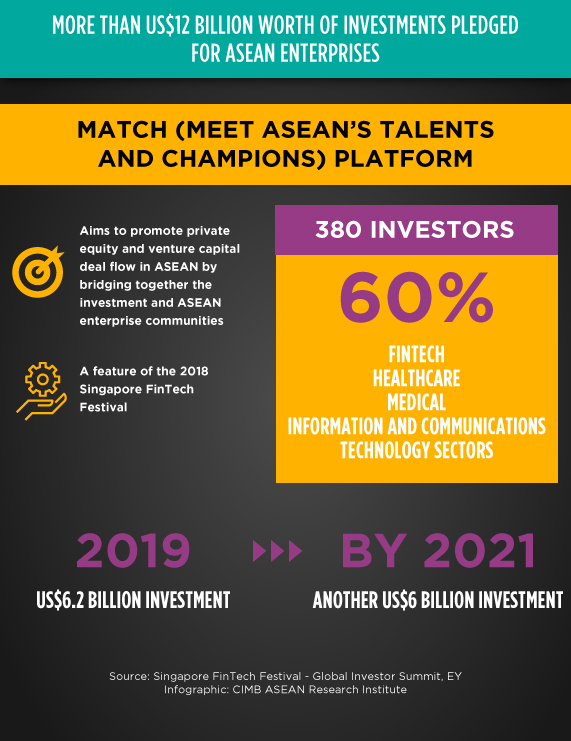
(22 October 2018) The Monetary Authority of Singapore (MAS) has announced that through the MATCH (Meet Asean’s Talents and Champions) platform, 380 investors have expressed interest to invest up to US$6.2 billion in ASEAN enterprises in 2019, with another US$6 billion earmarked over the next two years. According to MAS, about 60% of intended investment in 2019 would be mostly in the FinTech, healthcare, medical, information and communications technology sectors. Powered by EY, the MATCH platform is a feature of the 2018 Singapore FinTech Festival that matches ASEAN enterprises with sources of global private equity and venture capital. The matching exercise which was conducted from May to September 2018, generated 17,000 matches between 380 investors and 840 enterprises.

THAILAND

Thai government is positive about the 2018 export demand for milled rice
(25 October 2018) Despite the decline in demand in September 2018, the Thai government remains optimistic about achieving 11 million tonnes of milled rice exports in 2018. The Director-general of the Foreign Trade Department Adul Chotinisakorn noted that the prospects for rice exports have been positive for the last quarter, particularly with government-to-government (G2G) deals with China, the Philippines and Japan. Data from the Foreign Trade Department showed that from 1 January to 19 October 2018, rice exports totalled 8.93 million tonnes, a rise of 2.71% from the same period in 2017.

MALAYSIA

Malaysia is on track to achieve 3.7% productivity growth by 2020
(24 October 2018) According to Malaysia Productivity Corporation (MPC) director-general Datuk Mohd Razali Hussain, based on the 2017 labour productivity performance, Malaysia is on track to achieve productivity growth of 3.7% by 2020. He asserted that productivity is an essential element of the 11th Malaysia Plan that would drive Malaysia’s development towards that of an advanced economy and inclusive nation. The MPC will collaborate with the Economic Planning Unit (EPU), lead ministries and agencies to monitor the progress of productivity in Malaysia.

SINGAPORE

Singapore poised to achieve Industry 4.0 vision
(24 October 2018) To realise its Industry 4.0 vision, Singapore has acted swiftly and systematically by creating the necessary soft and hardware infrastructure. Senior Minister of State at Singapore’s Ministry of Trade and Industry Koh Poh Koon said Singapore has strong tri-party cooperation among government, business and trade unions in moving towards this direction such as by having substantial consultations on how to move Singapore’s economy up the value chain of global production. The minister added that the government is working closely with trade unions to reskill and upskill workers. Trade union leaders play a key role in encouraging workers to participate in upskill programmes or training for new jobs.

INDONESIA

Creative industries to contribute more than US$73 billion to Indonesia’s 2018 GDP
(24 October 2018) Indonesia’s Creative Economy Agency (Bekraf) reported that the creative industry would contribute US$73.74 billion to Indonesia’s 2018 GDP. Bekraf Head Triawan Munaf stated that Indonesia’s creative industries’ contribution to GDP growth has been increasing annually from US$56.13 billion in 2015, US$60.75 billion in 2016, and more than US$65.85 billion in 2017. Triawan also noted that exports from creative industries contributed US$19.3 billion in 2015, US$19.99 billion in 2016 and US$21.5 billion in 2017.

CAMBODIA

Cambodian garment export potential to increase by 10.73% in the first half of 2018
(24 October 2018) The Cambodian Ministry of Commerce reported that the country’s garment exports grew by 10.73% in the first half of 2018 and that export potential would remain strong despite EU’s threat to withdraw duty-free trading access. Cambodia exported US$3.2 billion worth of garments in the first half of 2018, compared to US$2.9 billion in the same period in 2017. The garment industry is Cambodia’s largest employer, with exports accounting for around 40% of its economy.

ASEAN

ASEAN firms confident in digital transformation but the rate of tech adoption is still low
(25 October 2018) A report commisioned by Nasdaq-listed technology firm Cisco stated that more than 9 in 10 firms in Southeast Asia are optimistic in the competitive advantage of its digital transformation plan. According to the report, the level of confidence among participants from six ASEAN nations is at 94%, which is better than the rest of Asia Pacific, which were 84% confident of their digital strategy. However, the survey also found that technology adoption rates are low in the region and it is due to budget constraints, lack of adequate talent and limitations of information technology (IT) infrastructure. Cloud services were widely used in ASEAN as it recorded an average adoption rate of 60% while cybersecurity and big data analytics were at 59% and 55% respectively. The study surveyed 1,325 senior IT managers from prominent companies across six sectors in Australia, China, India, Japan, South Korea, Indonesia, Malaysia, the Philippines, Singapore, Thailand and Vietnam.

ASEAN

Malaysian and Thai Prime Ministers voiced commitment for a stronger ASEAN
(24 October 2018) Malaysia’s Prime Minister Tun Dr Mahathir Mohamad has called on ASEAN leaders to leverage on the economic potential of the regional population of 630 million. The Prime Minister who was on a two-day official visit to Thailand said that leaders in the region want to see ASEAN become a strong regional organisation. Likewise, Thai Prime Minister Prayut Chan-o-cha said that ASEAN needs to come together and exercise utmost prudence in managing challenges in order to stay united and maintain Asean’s centrality. Thailand will be the next Chair for ASEAN in 2019.

VIETNAM

Vietnam is the third largest exporter of shoes and leather in the world
(24 October 2018) According to Vietnam’s Ministry of Industry and Trade (MOIT), the country exported shoes and leather products worth US$11.7 billion in the first nine months of 2018, thus making it the third largest global exporter of these goods. The MOIT also highlighted the challenges faced by the Vietnamese footwear industry such as rising labour costs and low productivity. The ministry added that Vietnam’s imminent signing of the various free trade agreements is expected to open further opportunities for its footwear exports to the member states in the European Union (EU) and Comprehensive and Progressive Agreement for Trans-Pacific Partnership (CPTPP).

MALAYSIA

Malaysia’s economic growth is expected to slow down from December 2018 to February 2019
(24 October 2018) According to a report released by the Malaysian Department of Statistics, Malaysia’s economic growth is expected to slow down from December 2018 to February 2019. In the report titled the “Malaysian Economic Indicators: Leading, Coincident and Lagging Indexes August 2018”, Chief Statistician Datuk Seri Dr Mohd Uzir Mahidin said the annual change of the Leading Index (LI) decreased 0.9% in August 2018. The LI indicates the country’s economic direction for an average of four to six months ahead. The department reported that the Coincident Index (CI), a measure of overall current economic performance, fell 0.3% in August 2018 with Capacity Utilisation in the manufacturing sector (-0.3%) as the main component of the decline.

Mekong Monitor


IMG-MM-011118

File Photo


TRADE, ECONOMY, AND INVESTMENT


VIETNAM

Vietnam lags in intra-ASEAN exports
(26 October 2018) Vietnamese companies are struggling to sell their products to ASEAN member countries despite the abolition of intra-ASEAN tariffs. The overriding cause appears to be a lack of product differentiation combined with limited market know-how. According to Vietnam’s Central Institute of Economic Management (CIEM), the country’s intra-ASEAN exports accounted for only 11% of the country’s exports in 2017 compared to an estimated average of 24% (based on 2016 data) for other ASEAN members. Pham Thiet Hoa, director of the Ho Chi Minh City Investment and Trade Promotion Centre (ITPC) stressed the need for trade envoys to facilitate Vietnamese firms’ entry into foreign markets as small companies in particular would find it very difficult to identify foreign business partners and distribution chains. He also stressed the need for companies to participate in trade events in their target markets to study competitors and ensure that they have done their due diligence on consumer preferences before venturing into a new market.
Read more>>

CAMBODIA

Minimum wages rise across Southeast Asian countries
(28 October 2018) As the region looks to raise its standard of living, ASEAN governments face a mounting challenge to balance the need to increase wages while losing its edge as a low-cost production hub especially for labour-intensive sectors. Cambodia, whose minimum wage is up 11.1% from last year, aims to raise its minimum wage to US$250 per month by 2023. Laos raised its minimum wage by 22% to around US$130 a month this year. Further, Myanmar raised its minimum wage by 33% in March 2018 to around US$3 per day. Vietnam, however, has slowed its rapid wage increase in order to maintain its production cost advantage over China. Malaysia’s wage floor is also expected to increase by 43% within five years.
Read more>>

VIETNAM

Vietnam seeks to reduce dependency on US and China amid trade war
(28 October 2018) Trade policy and diversification was a highlight during Vietnam’s National Assembly as the country’s legislative body seeks to cushion its economy from the impact of the US-China trade war. A report by Vietnam’s National Center for Socio-Economic Information and Forecast (NCIF) published in August 2018 forecasted a 0.03% drop in Vietnam’s GDP in 2018, a 0.09% drop in 2019 and a 0.12% drop in 2020 and 2021 due to the trade war. Nonetheless, Ha Sy Dong, a deputy from Quang Tri Province, said that Vietnam could also benefit from the tensions by increasing its exports to the U.S. and attracting more foreign direct investment as companies leave China. Vietnam’s footwear industry for example, has benefited from the trade war as companies such as Adidas and Brooks Running has announced moving various aspects of their operations from China to Vietnam to avoid high US tariffs.
Read more>>

THAILAND

EXIM Thailand provides financing boost for Thai businesses’ overseas expansion
(29 October 2018) The Export-Import Bank of Thailand (EXIM Thailand) reported a rise in profits and outstanding loans, saying that it has met its target for the first three quarters of 2018 in its support for Thai entrepreneurs’ global expansion through its loans. The bank, a state-owned financial institution under the supervision of the Ministry of Finance, continues to push for the expansion of Thai businesses in new markets especially in the CLMV (Cambodia, Lao PDR, Myanmar, Vietnam) countries. The bank’s president Pisit Serewiwattana said that business turnover in this period amounted to almost US$4 billion, of which more than half came from small and medium enterprises. The bank intends to open more representative offices in the CLMV countries in addition to existing international representative offices in Yangon and Vientiane.
Read more>>

CAMBODIA

Inside Cambodia’s financial revolution
(30 October 2018) In an interview with GovInsider, Chea Serey, assistant governor and director general of the National Bank of Cambodia, shared the bank’s vision for the future of finance in Cambodia and how it intends to provide greater access to financial services to ensure an inclusive economy. For example, the bank intends to leverage on the country’s widespread mobile connectivity—the highest in Southeast Asia—to reach the country’s population especially those living in rural areas. This is done through innovative methods such as mobile payment applications which allow users to make transactions without an official bank account. The push for digital payments is also key to tackling corruption as electronic transactions allow institutions to track the flow of money thus enabling early detection of potential fraud.
Read more>>


mekong-monitor-map

About Greater Mekong Subregion (GMS)

The Greater Mekong Subregion (GMS) Economic Programme was launched by the Asian Development Bank in 1992 connecting five developing ASEAN countries, namely Cambodia, Laos, Myanmar, Vietnam and Thailand, and Chinese provinces of Yunnan and Guangxi Zhuang Autonomous region. The region has some of the most robust economies sharing the Mekong River Basin thanks to its reform and liberalisation. The subregion is growing at a faster pace than the whole of East Asia and the Asia Pacific as the GDP growth rate for 2017 was at 6.4 percent, according to the World Bank. The population at the subregion as of 2016 is at 340 million while the GDP at PPP is at US$3.1 trillion in 2016. In 2015, trading within the region was at US$444 billion.

China-ASEAN Monitor


352807_China-Trade

File Photo


Economy, Investment and Trade

Bright prospects for China-ASEAN economic ties in the next 20 years
(26 October 2018) China’s economic boom and increasing income levels augur well for its ASEAN partners according to a recent report by the ASEAN+3 Macroeconomic Research Office (AMRO). The AMRO research team described China and ASEAN as “natural partners” and said that there are good prospects for broader and deeper integration in the next two decades. The AMRO report also indicated that trade in goods between China and ASEAN would continue to thrive. This development is due to increase in market size on both sides, greater cooperation in trade facilitation, enhanced connectivity and continued relocation of labour-intensive and other types of manufacturing activities from China to ASEAN.
Read more>>

Chinese investors need more precise rules on financial incentives in order to invest in the Philippines
(25 October 2018) Philippine Economic Zone Authority (PEZA) Director-General Charito Plaza said Chinese firms are looking to shift operations to the Philippines amidst increasing tariffs following the trade conflict between China and the United States. According to Plaza, at least three groups of Chinese investors have expressed their intent to invest in the Philippines. However, these investors are holding off their commitment due to the uncertainties of the TRAIN-2 (second package of Tax Reform for Acceleration and Inclusion) or the TRABAHO bill (Tax Reform for Attracting Better and High-Quality Opportunities). Plaza further elaborated that the main reason for these firms to invest in the Philippines is the competitive financial incentives provided by PEZA but with the rationalisation of fiscal incentives under the TRABAHO bill, some of these incentives might be neutralized.
Read more>>

Renminbi and Peso trading platform formally launched in the Philippines
(30 October 2018) The Bank of China Manila Branch, together with 13 Philippine banks, jointly ratified the launch of the Philippine Renminbi (RMB) Trading Community, a platform to improve trading and monetary transactions between China and the Philippines. Following the signing of the Memorandum of Agreement (MOA) on 30 October 2018, the Philippines business environment would see the establishment of a fair, transparent and robust domestic RMB market. Head of the Bank of China Manila Branch Deng Jun, said the platform would allow for the efficient and cost-effective clearing and settlement of the renminbi for Philippine firms that intend to access the Chinese market and enhance their business relationships with Chinese firms. The platform would reduce foreign exchange risks and conversion fees which would lead to about 3% savings in transaction costs.
Read more>>

BRI is a positive contribution to the world economy, says Singaporean Minister
(27 October 2018) Singapore’s Minister for Trade and Industry Chan Chun Sing said that the Belt and Road Initiative (BRI) is a significant contribution to the world economy. In an interview with visiting reporters from China, he said the success of the BRI would rely on how the partners and stakeholders cooperate to shape the initiative going forward. Chan said efforts should be made to upgrade the World Trade Organisation (WTO) provisions of the multilateral system given the realities of current global realities. Chua further stressed that nations around the world should collaborate to integrate production and value chains rather than resort to protectionist measures which would only result in fragmentation and isolation of production and value chains.
Read more>>

Singapore aims to help emerging Asian nations with BRI contract signings
(25 October 2018) Singapore, through the Infrastructure Asia program, will be assisting emerging Asian countries with banking and legal services for infrastructure projects. The move is meant to make Singapore a vital player in agreements related to the Belt and Road Initiative (BRI). The Infrastructure Asia program aims to back infrastructure projects such as roads, harbours, airports, railroads and power stations. The program realises Singapore’s financial and professional sectors playing various roles in projects such as the planning stage, evaluating initial budget, estimating construction time and ensuring that the costs do not exceed the budget. Singapore intends to introduce planners to Singaporean banks, insurers and investment funds, and will also collaborate with the World Bank, the Asian Development Bank (ADB) and the Chinese-led Asian Infrastructure Investment Bank (AIIB). According to ADB, developing countries in Asia only invest about US$881 billion a year on infrastructure, well below an estimated annual need of US$1.34 trillion from 2016 through 2020.
Read more>>


Press Release: ASEAN and China must collaborate closely to ensure the success of the Belt and Road Initiative (BRI) in the region


ASEAN and China must collaborate closely to ensure the success of the Belt and Road Initiative (BRI) in the region

cari-pr

(From left) Professor Christopher Coker, Director of LSE IDEAS; Tan Sri Dr. Munir Majid, Chairman of CIMB ASEAN Research Institute (CARI), Visiting Senior Fellow of LSE IDEAS and President of the ASEAN Business Club; Dato’ Abdul Majid Khan, President, Malaysia-China Friendship Association, and Dr. Tang Siew Mun, Head of ASEAN Studies Centre, ISEAS-Yusof Ishak Institute sharing their thoughts during the ASEAN Roundtable Series on “Making BRI Inclusive-Are there opportunities for all?”, while Pauline Loong, Senior Fellow of CIMB ASEAN Research Institute joined the discussion from Hong Kong via Skype. The panel discussion was organised by CARI on 30 October 2018 supported by CIMB.

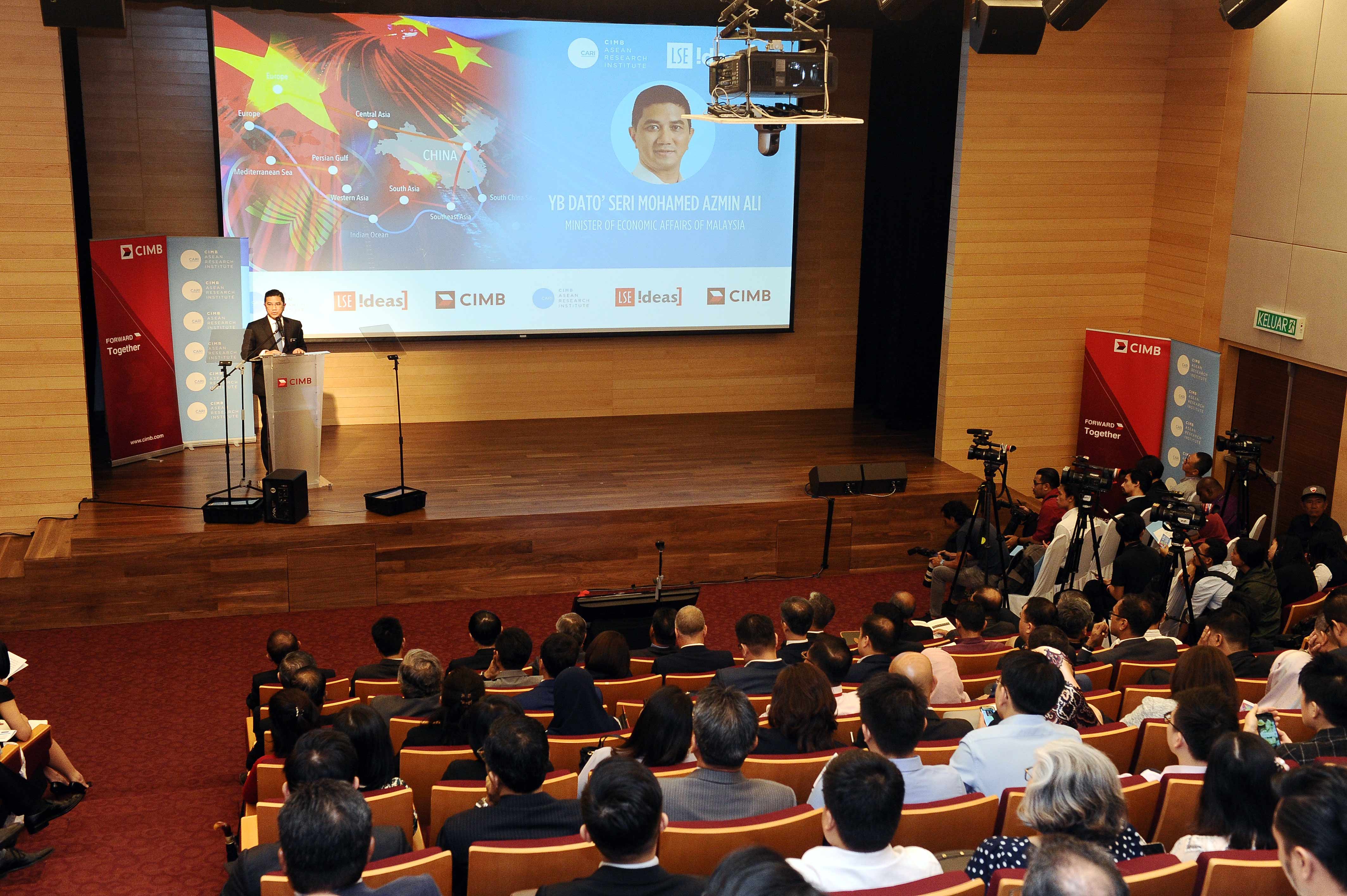
Kuala Lumpur, 30 October 2018 – ASEAN and China must collaborate closely to ensure the success of the Belt and Road Initiative (BRI) in the region. CIMB ASEAN Research Institute (CARI) Chairman Tan Sri Dr. Munir Majid emphasised this view in the panel discussion after the launch of a joint report by CARI and LSE IDEAS (Centre for International Affairs, Diplomacy and Strategy). The report entitled, “The BRI and Southeast Asia” was launched by Malaysia’s Minister of Economic Affairs Dato’ Seri Mohamad Azmin Ali today.

img-launch

Dr. Munir proposed that a joint task force be established by ASEAN and China comprising official and private sector representatives to establish high-level guidelines on principles and practices in regional BRI projects whose detailed terms will be up to individual states to determine. This task force should also work to align the Master Plan for ASEAN Connectivity (MPAC) 2025 with the BRI so that regional infrastructure development takes place in an orderly manner without waste and costly white elephants.

He noted: “ASEAN-China economic relations are extremely strong and well-founded. The trade and, increasingly, investment numbers speak for themselves. At the 21st ASEAN-China Summit in Singapore next month, the ASEAN-China Strategic Partnership Vision 2030 will be adopted which will further cement the close economic relations first formalised in Bali in 2003 when China became ASEAN’s first dialogue partner to have a strategic partnership.

“Collaboration on BRI should be a part of the ASEAN-China Strategic Partnership Vision 2030 to ensure its resounding success and to address kinks in BRI roll-out as have become evident. Objective, expert and professional project terms and execution will anticipate and remove problems that should not be allowed to puncture the visionary BRI – whose potential for connectivity are considered unmatched in human history.”

The CARI Chairman observed that the five guiding principles of MPAC 2025 – sustainable infrastructure, digital innovation, seamless logistics, regulatory excellence and people mobility – could be brought to the highly imaginative BRI in the process of lifting the region to a new level of infrastructure development.

Sustainable infrastructure, for instance, Dr. Munir noted, seeks to coordinate existing resources to deliver support across the full life cycle of infrastructure projects, including project preparation, infrastructure productivity and capability building.

Taking another example, regulatory excellence points to good regulatory practice in the preparation, adoption and implementation of rules, regulations and procedures in the region through standards harmonisation, mutual recognition and technical regulations.

Pointing to more specific situations, Dr. Munir identified Singapore’s MOU with China signed in Beijing last April to promote greater collaboration between Singapore and Chinese companies in third-party markets under the BRI. In this arrangement, a joint working group is to be formed to identify sectors and markets of mutual interest, and to organise business matching activities and forums to facilitate third-party market cooperation.

While commercial in nature, there is no gain saying principles, standards and procedures from Singapore’s well developed legal, financial and project management infrastructure will be brought to BRI projects. In a not unconnected development, Dr. Munir drew attention during the discussion to Singapore’s announcement earlier this month of the establishment of a new government agency called Infrastructure Asia to help structure projects to make them more “bankable.”

Dr. Munir quoted Singapore’s Second Minister for Finance: “So if you’re able to structure it right such that the income stream, the revenue that comes in, enables you to pay off your loan or whatever financing you’ve taken, then the project will be fine and it’s a win-win for all.”

Dr. Munir ended his opening statement at the panel discussion: “There already are parameters and specific initiatives that can be made to coalesce with China’s BRI to achieve a rousing success in Southeast Asia that would cause the world to sit up and notice, and in the process marginalise notions of the BRI being nothing more than China’s grand design to dominate the world.”

Earlier, Dato’ Seri Azmin Ali who launched the joint publication said that notwithstanding the US-China trade war, strategic interests in the South China Sea must be a collective concern for Malaysia within the context of ASEAN. The Belt and Road Initiative is conceptually sound and good, but nations involved must have their sovereignty protected at all times.
aa

A discussion moderated by Dr. Munir followed with a panel comprising internationally renowned war scholar and military conflict expert, Professor Christopher Coker, who is Director of LSE IDEAS. The panel was also joined by acclaimed policy expert on China and TV commentator Pauline Loong, who is also Senior Fellow, CIMB ASEAN Research Institute; Dr. Tang Siew Mun, Head of ASEAN Studies Centre, ISEAS-Yusof Ishak Institute; and Dato’ Abdul Majid Khan, President of the Malaysia-China Friendship Association and a former Malaysian envoy to China.

As a former envoy to China, Dato’ Abdul Majid acknowledged that ASEAN relations with China are asymmetrical and complex, thus, the bloc needs to identify and consolidate its common core interests and concerns as the basis of negotiations with China.

“ASEAN should be encouraged to develop such a strategy. Individual ASEAN member states also need stronger leadership, effective regulatory mechanism and processes, to protect its sovereignty while pursuing the economic benefits, said Dato’ Abdul Majid.

“ASEAN must also recognise the importance of China as the driver for regional and global growth. Participating countries must devise their projects strategically, by making sure they conform to their needs and affordability to mutually benefit from the vast opportunities the Belt and Road Initiative can offer,” continued Dato’ Abdul Majid during the discussion.

Going forward, Dato’ Abdul Majid asserted that the BRI should not only focus on infrastructure development but should also embrace China’s other strengths, such as digital technology to support countries who want to be part of the 4IR agenda.

A keen analyst on China’s strategic and economic policies, Pauline Loong reminded participants of the roundtable that the BRI does not lend itself to multilateral negotiations, but it is a broad concept of China introducing projects to different countries and offering various forms of financing that range from direct investment to loans.

“The main benefit is access to financing not otherwise available for worthwhile projects. Costs arise from the lack of careful assessment of the risks versus the ultimate benefit of each project for the country. Growth opportunities for any nation, including ASEAN countries, depend on choosing very carefully the aspects of the BRI that match the domestic need of the nation involved,” she said.

An expert in security and globalisation, Professor Christopher Coker noted that the BRI initiative is one of the most important developments of this era or any other decade. However, he raised questions over the challenges that lie ahead for China and countries which are part of the initiative.

“It is important to acknowledge the challenges ahead. Will Chinese bodies such as the State Administration of Foreign Exchange (SAFE) and State-owned Assets Supervision and Administration Commission of the State Council (SASAC) as well as the country’s financial industry regulators which are responsible for setting the actual parameters such as budgets and standards of operationalisation be up to the job? Will the contracting countries be able to avoid over-indebtedness and will the governance regime be able to deal with problems like insider dealings? Finally, will the big infrastructure projects be on budget and on time? History would suggest we be cautiously optimistic,” said Professor Christopher Coker.

Dr. Munir concluded by saying that the panel discussion, as indeed does the joint publication of CARI-LSE IDEAS, highlights the complexity of the issues. But he underlined the need to also provide a distillation, a possible policy direction – which think-tanks such as CARI and LSE IDEAS are committed to doing.

In this regard, he reiterated his opening points as a means to break down problematic matters at both general policy and specific BRI project levels. Dr. Munir concluded the panel discussion by stating: “The great and historic opportunities of the BRI must not be passed up. The challenges must be creatively resolved.”

Mekong Monitor


img-mm-2871218

Photo credit: The Korea Herald


TRADE, ECONOMY, AND INVESTMENT


MYANMAR

Myanmar Investment Commission (MIC) promotes the country’s investment prospects in Hong Kong
(22 October 2018) The Myanmar Investment Commission (MIC) held a second Myanmar Investment Promotion Seminar in Hong Kong following the Myanmar government’s recent announcement of the 20-year foreign investment promotion plan. Hong Kong is one of the largest investors in Myanmar. More than 150 Hong Kong firms and Hong Kong SAR’s Secretary of Commerce and Economic Development Edward Yau attended the seminar. During the event, MIC chairman U Thaung Tun said the commission is working towards implementing measures including regulatory initiatives that could support Myanmar as an investment-friendly destination. According to data provided by the Directorate of Investment and Company Administration (DICA), Hong Kong is the fourth largest investor in Myanmar after China, Singapore and Thailand. As of 30 September 2018, Myanmar attracted US$7.87 billion from Hong Kong investors, which makes up 10% of total permitted foreign investment in Myanmar. To satisfy its infrastructure needs, Myanmar requires US$320 billion investments by 2030 and the Myanmar Investment Promotion seminar was held to intensify efforts to get more investments from East Asian countries.
Read more>>

CAMBODIA

EU’s investment to decline with the revoking of Cambodia’s “Everything but arms” status
(22 October 2018) Credit Rating agency Moody’s reported that the recent withdrawal of duty-free trading access on Cambodian imports by the European Union (EU) would have a negative impact on European investments in Cambodia. EU, which is Cambodia’s biggest export market, revoked Cambodia’s “Everything but Arms (EBA)” status due to the country’s human rights record. Moody’s said that the loss of preferential trade access to the EU is credit negative for Cambodia. Due to the withdrawal of the EBA, the imposition of tariffs will increase the cost of Cambodian-made goods in Europe. This situation would lead to undermining the price competitiveness of Cambodia’s garments unless there are productivity gains to offset the loss. According to the EU, Cambodia’s exports to the EU were worth US$5.8 billion in 2017.
Read more>>

MYANMAR

Myanmar is looking to East Asia to power its long-term investment needs
(19 October 2018) Under the Myanmar Investment Promotion Plan (MIPP), Myanmar is looking to attract more foreign direct investments (FDI) from East Asia in the next 20 years. Deputy director general of the Directorate of Investment and Company Administration (DICA) U Than Aung Kyaw said while Myanmar is enhancing its trade ties with ASEAN, it is also looking to attract FDI from East Asian including South Korea, Japan and Greater China under the MIPP. The oil and gas sector is expected to receive larger volumes of FDI in 2019. Over the next 20 years, DICA projected that Myanmar’s total FDI would reach US$220 billion under the MIPP.
Read more>>

VIETNAM

Vietnam looks to improve its general business environment including for EU companies
(18 October) Vietnamese Prime Minister Nguyen Xuan Phuc said his government is enhancing Vietnam’s general business environment including for European firms during the Việt Nam EU-Belgium Business Forum which was organised by among others, the Việt Nam Chamber of Commerce and Industry (VCCI) and the Belgian Vietnamese Alliance. He also emphasised the importance of the Europe-Việt Nam free trade agreement (EVFTA) which is expected to provide further opportunities for collaboration among business stakeholders. Nguyen Xuan Phuc hoped that the European business association especially Belgian firms would push for the signing of the agreement.
Read more>>

THAILAND

Thailand aims to tap new export markets amid US-China trade war
(24 October 2018) The escalating trade war between the United States and China has led the Thai Commerce Ministry to look for new export markets. Thailand is eyeing exports to the United States through food diplomacy and increasing its food and agricultural exports to Cambodia, Laos, Myanmar and Vietnam. The target for the 2018 export growth rate is 8%. According to the Director-General of the Commerce Ministry’s Trade Policy and Strategy Office Pimchanok Vonkorpon, the US-China trade war has both direct and indirect negative impact on Thai exports. There has been a contraction of exports by 5.2% year-on-year to US$20.699 billion in September 2018. However, there are also indirect benefits such as the opening of new markets for Thai products following the loss of market share by Chinese goods due to the imposition of higher US tariffs.
Read more>>


mekong-monitor-map

About Greater Mekong Subregion (GMS)

The Greater Mekong Subregion (GMS) Economic Programme was launched by the Asian Development Bank in 1992 connecting five developing ASEAN countries, namely Cambodia, Laos, Myanmar, Vietnam and Thailand, and Chinese provinces of Yunnan and Guangxi Zhuang Autonomous region. The region has some of the most robust economies sharing the Mekong River Basin thanks to its reform and liberalisation. The subregion is growing at a faster pace than the whole of East Asia and the Asia Pacific as the GDP growth rate for 2017 was at 6.4 percent, according to the World Bank. The population at the subregion as of 2016 is at 340 million while the GDP at PPP is at US$3.1 trillion in 2016. In 2015, trading within the region was at US$444 billion.

China-ASEAN Monitor


img-ca-241018

Photo credit: New Mandala


Economy, Investment and Trade

China to expand trade and investment relations with Vietnam and Cambodia
(19 October 2018) China will enhance cooperation in areas such as trade and investment with Vietnam and Cambodia, according to Chinese Premier Li Keqiang in a meeting with Cambodian Prime Minister Samdech Techo Hun Sen and Vietnamese Prime Minister Nguyen Xuan Phuc at the 12th Asia-Europe Meeting (ASEM) Summit. For Cambodia, Li called upon China and Cambodia to enhance cooperation in development strategies and improve bilateral trade. He stated that China is looking to continue its import of agricultural products from Cambodia and will persuade Chinese firms to invest in Cambodia. Hun Sen said Cambodia is willing to enhance practical cooperation with China in economy, trade and agriculture and is looking forward to seeing more Chinese businesses investing in Cambodia. In the case of Vietnam, China will collaborate with the country to promote collaborative production initiatives that meet environmental standards and benefit Vietnam’s industrialisation needs.
Read more>>

BRI nations to further capacity cooperation initiatives with China
(22 October 2018) The Forum on Global Production Capacity and Business Cooperation witnessed 65 capacity cooperation initiatives worth US$20.6 billion signed in Hubei, China. More than 2,500 participants from 94 countries which are mainly part of the Belt and Road Initiative (BRI) were part of the event. Malaysia’s special envoy to China and head of the Malaysia-China Business Council Tan Kok Wai, who was there for the event, said Malaysia has always promoted low-carbon development and energy conservation. Thus, he noted that hydropower, wind power and solar power would be the highlight of Malaysia-China cooperation in the field of new energy. According to China’s Ministry of Commerce, over the past five years, China’s total trade with countries that are part of the Belt and Road Initiative has exceeded US$5 trillion, with a yearly average growth rate of 1.1%. During the period, China’s combined direct investment in these countries has grown by a yearly average of 7.2%.
Read more>>

More than 80 Singaporean companies to participate in the Chinese import expo
(17 October 2018) More than 80 Singaporean firms led by Singapore Business Federation (SBF) will be participating in the China International Import Expo in Shanghai from 5 November to 10 November 2018. More than 2,800 companies from over 130 countries are participating in the expo. The Shanghai event comes after Chinese President Xi Jinping announced in May 2017 that China will hold an import expo for the first time, to underscore its commitment to further open its market and promote international trade. According to the organisers of the expo, Singapore exhibitors will be utilising 1,425 sqm of space at the fair, the largest of any ASEAN country. Exhibitors from Singapore will be showcasing goods and services in sectors such as logistics and transportation, finance and banking, education, healthcare, and food and beverage.
Read more>>

Myanmar and China to boost the development of bilateral tourism industry
(20 October 2018) Tourism authorities from China and Myanmar discussed measures to promote the development of tourism between both nations. Myanmar’s Ministry of Hotels and Tourism Deputy Director-general U Aung Aye Han said the Myanmar government had allowed visa-on-arrival for Chinese tourists since 1 October 2018 to further attract Chinese visitors. Meanwhile, Chairman of China Tourism and Service Association in Myanmar Luo Jun, urged Myanmar tourism authorities to enhance the safety of tourists, quality of services as well as to upgrade infrastructure to attract more foreign visitors to the country. According to Xinhua, about 400,000 Chinese travellers visit Myanmar annually.
Read more>>

Foreign Affairs

China and ASEAN nations participate in inaugural maritime field training exercise in Zhanjiang, Guangdong
(22 October 2018) Eight naval ships participated in the inaugural ASEAN-China Maritime Field Training Exercise in Zhanjiang in China’s Southern Guangdong province on 22 October 2018. Singapore and China are co-organise the six-day drill, which will see helicopter cross-deck landings and a joint search and rescue operation. The ships involved in the event came from China, Singapore, Brunei, the Philippines, Thailand and Vietnam. Cambodia, Indonesia, Malaysia and Myanmar sent observers. Singapore chief of navy, Rear-Admiral Lew Chuen Hong, noted that Asean defence ministers had reaffirmed the Asean-China Maritime Exercise as an important confidence-building measure at the 12th Asean Defence Ministers’ Meeting in Singapore last week. Chinese Vice-Admiral Yuan Yubai said the drill was an essential step towards regional security, collaboration and confidence-building.
Read more>>


Malaysia: Economic Focus


HIGHLIGHTS

Striking the right balance

  • Key elements to watch in Budget 2019: Detailed fiscal framework, spending adjustments and revenue enhancements, like asset sales and taxes.
  • Budget deficit to widen to 3.5-3.7% of GDP in 2018-19 due to one-off tax refunds, which mask sustained fiscal consolidation from expected cost cuts.
  • Fiscal constraints are transitory, as budget deficit set to narrow briskly after 2020 (11MP target: -3.0% of GDP) if fiscal adjustments are implemented.
  • 11MP GDP growth target revised lower but still-resilient at 4.5-5.5% in 2018- 20 as government maintains pro-growth policy stance.

img-ef-1

Budget 2019 to reflect dual priorities of fiscal discipline and growth
Budget 2019, the first under the new Pakatan Harapan (PH) government, will be tabled on 2 November 2018. While billed as a “difficult budget”, the Ministry of Finance (MOF) has stated that the government in not pursuing austerity and is maintaining a pro-growth stance, which it aims to achieve by balancing cost reductions with more targeted spending, efficiency gains and governance reforms. Detailed adjustment plans backed by a strong fiscal framework can instil market confidence that government will remain financially disciplined. Markets are also watching for potential revenue enhancements, including asset sales and new taxes.

Fiscal space can be created through determined spending cuts
In our view, the government has room to make fiscal adjustments via spending cuts without hurting growth prospects unduly if wastages and leakages are curbed. We think operating and development expenditures can be trimmed by RM7bn in Budget 2019 due to tighter procurement procedures, zero-based budgeting, reviews or deferment of infrastructure projects, more targeted subsidies and cash transfers, and revisions in supply and services contracts, which could limit the need for aggressive revenue-raising measures and steeper cuts to productive areas of spending.

Don’t miss the forest for the trees
GDP growth prospects, despite being lowered to 4.5-5.5% in 2018-2020F in the MTR (CIMB: +4.7% in 2018 and 2019) remain supportive of economic activity and labour market conditions. We argue that near-term fiscal adjustments should not detract from the reforms undertaken to reduce total public debt, strengthen government finances and address structural bottlenecks that form the basis of sustainable long-term growth.


img-ef-2

GOVERNMENT FINANCE


Bracing for a difficult Budget 2019
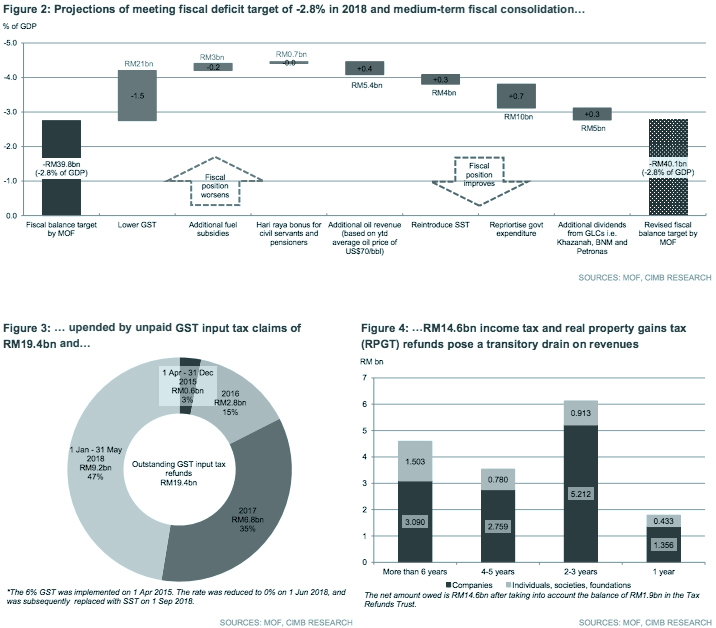
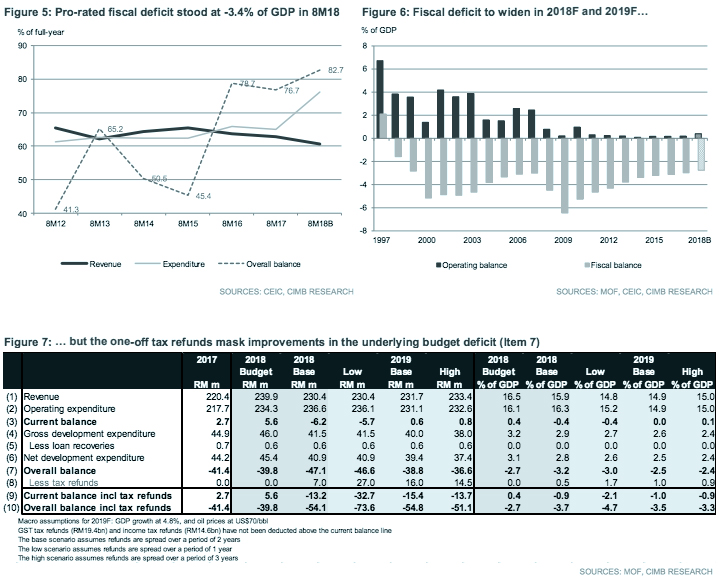
Budget 2019, the first under the new Pakatan Harapan government, will be tabled on 2 November 2018 in what the Minister of Finance Lim Guan Eng has billed a “difficult budget”, as the Ministry of Finance (MOF) normalises government finances a period of two to three years. The MOF may miss initial projections in May to maintain the 2018 budget deficit target of -2.8% of GDP, which were based on the assumptions that additional oil-related revenue, higher GLC dividends, proceeds from the Sales and Service Tax and expenditure cuts would offset the impact from the zero-rating of the GST, petrol subsidies and the Hari Raya Special Assistance (see Fig 2). The pro-rated fiscal deficit as at 8M18 stood at -3.4% of GDP (82.7% of 2018B target) as revenue collection had fallen behind projections (60.6% of 2018B target) while reducing operating expenditure has proven tricky in the short term (76.1% of 2018B target). Barring a sharp reversal in 4Q18, divergent revenue and operating expenditure trends may cause the current balance to dip into a deficit in 2018.


img-ef-3

Our base case scenario projects the budget deficit widening to -3.7% of GDP in 2018F and -3.5% of GDP in 2019F, due principally to the post-GST revenue adjustments and the recognition of one-off GST and income tax refunds.

  • The zero-rating of the Goods and Services Tax (GST) on 1 Jun 2018 will slash fiscal revenue collection by RM21bn in 2018. The introduction of the Sales and Services Tax on 1 Sep is expected to result in the collection of RM4bn. In 2019, we estimate the shortfall between GST and SST revenue to be RM22bn.
  • GST input tax refunds of RM19.4bn spread over 2-3 years.
  • Corporate, personal income and real property gains tax refunds totaling RM14.6bn as at end-May 2018. The Ministry of Finance has allowed applications for the claims to be offset against income tax payable in FY2018, reducing tax collection in 2018F and 2019F.


img-ef-4


The temporary deviation has been necessary to repair public finances and should not be mistaken as a sign of profligacy. In fact, if the tax refunds were excluded, our estimates suggest that the government would have adhered to its fiscal rule of running a positive current balance in 2019F (item 3 in Fig 7), while curtailing the budget deficit to -3.2% of GDP in 2018F and -2.5% of GDP in 2019F (item 7 in Fig 7). In particular, our projections for Budget 2019 assume:

  • Opex rationalisation (-RM5.5bn in 2019F), which we expect to materialise more prominently in 2019 following the implementation of zero-based budgeting, tighter procurement procedures, more targeted subsidies and cash transfers, and revisions in supply and services contracts. Efficiency gains and lower fiscal leakages would diminish the need for aggressive revenue-raising measures and steep cuts to productive areas of spending. The Public Finance Committee (PFC), consisting of Minister of Finance Lim Guan Eng, Minister of Economic Affairs Datuk Seri Azmin Ali and BNM Governor Datuk Nor Shamsiah, has been tasked with steering the medium term fiscal consolidation effort.
  • Lower development expenditure (-RM1.5bn in 2019F). Under the MTR, the government has cut the development expenditure budget by RM40bn to RM220bn in 2016-2020. The delays or cancellations of infrastructure projects are likely to reduce development expenditure. Allocations are likely to skew in favour of policies promoting inclusive income growth, welfare spending, affordable housing, infrastructure upgrades, healthcare and education.
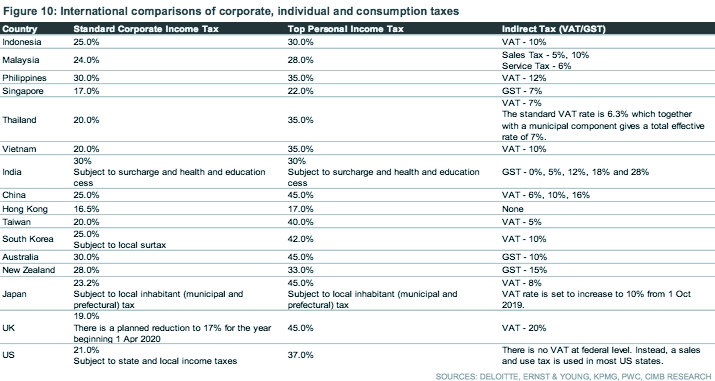
  • Revenue optimisation and taxes (+RM3.0bn in 2019F). Our projections suggest that oil-related revenue (based on a Budget 2019 oil price assumption set at US$70/bbl), GLCs dividends, and asset monetisation can make up a large portion of the revenue shortfall from the GST rollback. However, to create revenue contingencies, the government may opt to introduce certain types of taxes to align industry incentives or even the playing field (digital or e-commerce tax) or promote desired social and economic outcomes (sin taxes, soda or sugar tax, carbon or congestion tax). In our view, other taxes aimed at facilitating income redistribution (inheritance tax, property taxes, and income tax hikes for the rich and capital gains tax) may be more appropriately considered as part of a holistic tax reform under the Tax Reform Committee (TRC), to ensure such taxes do not reduce the incentives to invest, create wealth, and promote entrepreneurship in Malaysia. The TRC Tax Reform Committee has been tasked to review and reform Malaysia’s tax regime into a more efficient, neutral and progressive system.


img-ef-5

img-ef-6

img-ef-7

The revenue-expenditure projections suggest that a budget deficit target of – 3.0% of GDP in 2020, recently revised in the 11MP Mid-term Review (MTR), and subsequent fiscal consolidation are achievable, in our view. Importantly, debt dynamics remain favourable, with the public debt to GDP ratio expected to gradually decline over the long term, even if federal net borrowing increases in 2018F and 2019F, as the growth rate of contingent liabilities is likely to moderate amid ongoing reviews of off-balance sheet financing in government-initiated projects.

img-ef-8


MID-TERM REVIEW OF 11TH MALAYSIA PLAN


Key takeaways

  • Downward revision in 2018 growth targets to 4.5-5.5% in 2018-2020F from original target of 5.0-6.0% in 2016-2020 (CIMB: +4.7% in 2018 and 2019), due to lower contributions from private investments and the public sector, which were partly offset by higher projections for household consumption. By industries, growth forecasts were downgraded across all sectors, except the consumer-driven wholesale and retail trade, accommodation and restaurants.
  • Capital contribution to growth expected to decline, partly offset by labour and multifactor productivity.
  • Development expenditure. Government to build 200,000 affordable homes, and upgrade education and healthcare facilities. Upgrading 1,500km of rural roads. More allocation to promote development in Sabah, Sarawak, Kelantan, Terengganu, Kedah and Perlis. Proposal to establish National Healthcare Policy, including Healthcare Financing Scheme for B40 group.
  • National Policy Framework on Fourth Industrial Revolution (4IR) to increase productivity and competitiveness of manufacturing sector.
  • Government to improve market efficiency by streamlining state-owned enterprises and monopoly entities.
  • Governance reforms. Two-term limit on Prime Minister, Chief Minister and Menteri Besar to deter excessive concentration of power. Lowering of voting age to 18 from 21. Separation of Attorney General’s office from Public Prosecutor’s office to strengthen jurisprudence. Ombudsman Malaysia to be established to independently investigate complaints against government agencies.
  • Human capital. Reduce dependency on foreign workers via automation and multi-tiered levies. Reviewing National Policy on Science, Technology and Innovation. Increase women’s participation in workforce.


img-ef-9

img-ef-10

img-ef-11

img-ef-12

img-ef-13

Originally published by CIMB Research and Economics on 19 October 2018.

Singapore: September 2018 trade


HIGHLIGHTS

September 2018 trade

  • NODX jumped to 8.3% yoy in September after a slower gain of 5.0% yoy in August due to sturdier growth in pharmaceuticals and narrower contraction in electronics.
  • MAS raised the slope of the S$NEER policy band last week, confident that the economy is well-placed to weather bumpier external conditions.
  • We expect a slight bias for tighter monetary settings at the April policy review.

img-sg12-1

MAS steepens S$NEER slope
The Monetary Authority of Singapore (MAS) increased the slope of the S$ nominal effective exchange rate (NEER) slightly, while keeping the width and centre of the policy band unchanged, marking a second successive tightening of monetary policy following its April review.

NODX regains momentum in September
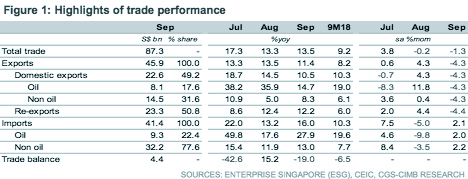
Non-oil domestic exports (NODX) expanded at a more robust pace of 8.3% yoy in September (+5.0% yoy in August), driven by faster non-electronics NODX growth (+11.9% yoy in September vs. +7.8% yoy in August), which offset the continued contraction in electronics NODX (-0.9% yoy in September vs. -1.5% yoy in August). The seasonally-adjusted NODX declined 4.3% mom (+0.4% mom in August).

Integrated circuits’ exports break 9-month streak of declines
The collective exports of the five largest electronic items improved by 0.5% in September (-1.2% yoy in August) largely contributed by a jump in growth of integrated circuits (ICs) segment (+11.7% yoy in September) after a 9-month decline. This was sufficient to offset the declines in disk drives (-36.0% yoy), PCs (-22.7% yoy), PC parts (-18.9% yoy), parts of ICs (-41.7% yoy), consumer electronics (-17.9% yoy) and diodes & transistors (-22.5% yoy).

Pharmaceuticals and organic chemicals jump in to the rescue
Healthy non-electronics NODX growth reflected a strong uptick in the chemicals segment (+23.3% yoy), led by strong bump up in pharmaceutical (+67.5% yoy in Sep vs. +33.4% yoy in August) and organic chemical shipments (+63.3% yoy in September vs. +17.7% yoy in August), offsetting a contraction in petrochemical exports (-1.5% yoy in September vs. +3.4% yoy in August).

External demand still driven by advanced economies
The main contributors to NODX in September were the US (+41.5% yoy), the EU (+21.6% yoy) and Thailand (+46.8% yoy). On the other hand, shipments to China weakened (-17.8% yoy), as did exports to regional economies like South Korea (-10.9% yoy), Malaysia (- 4.6% yoy), Taiwan (-4.2% yoy), Hong Kong (-1.1% yoy) and Japan (-1.5% yoy).

Softening external demand may not deter MAS tightening in April
External demand conditions are softening as trade conditions enter a period of uncertainty amid unresolved trade conflicts between the US and China. The SIPMM PMI gauge of the manufacturing and electronics sector decreased by 0.2pt and 0.6pt to 52.4 and 51.4 respectively in September. An alternative Nikkei Singapore PMI fell even more sharply by 1.5pt in September to 49.6, the lowest reading in over two years, weighed down by declines in output, new orders and export sales. The data outturn is in line with our view that Singapore’s GDP growth is likely to slow from an estimate of 3.2% in 2018 to 2.6% in 2019. Nonetheless, the growth and inflation outlook may still nudge the Monetary Authority of Singapore (MAS) into another round of slight S$NEER policy tightening in April 2019.

img-sg12-2

img-sg12-3

Originally published by CIMB Research and Economics on 17 October 2018.