CARI Captures 376

c376_graphic


ASEAN

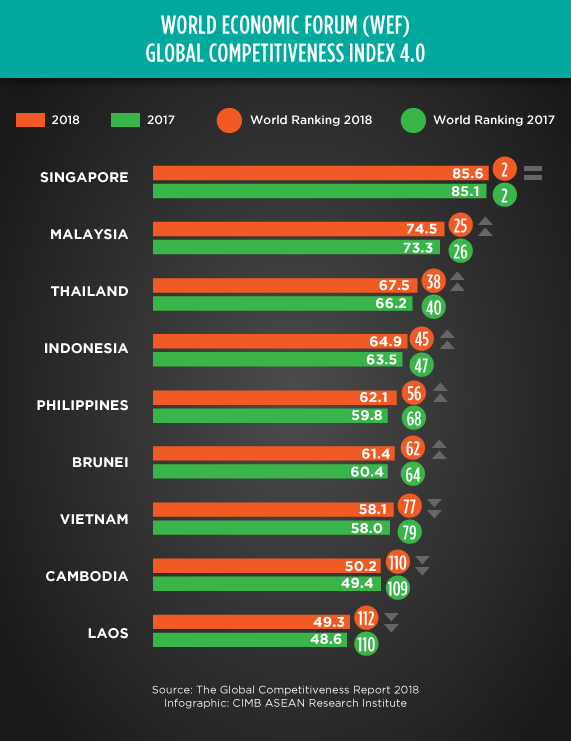
Singapore ranked second in global competitiveness while Malaysia’s standing improves
(17 October 2018) Singapore is the top-ranked ASEAN nation in the World Economic Forum (WEF)’s Global Competitiveness Report 2018 while Malaysia improved considerably to be the second top ASEAN nation in the rankings. Out of 140 countries, Singapore was second with 85.6 points while Malaysia was ranked 25th with 74.4 points. The 2018 report introduces the new Global Competitiveness Index 4.0, by including the advent of the Fourth Industrial Revolution (4IR) into the definition of competitiveness. The report, which was published on 16 October 2018, tabulates the scores for each nation according to its 12 pillars of competitiveness. The 12 components are institutions, infrastructure, ICT adoption, macroeconomic stability, health, skills, product market, labour market, financial system, market size, business dynamism and innovation capability. The ranking for the other ASEAN nations are: Thailand(38), Indonesia(45), the Philippines(56), Brunei Darussalam(62), Vietnam (77), Cambodia(110) and Laos(112). The report mentioned that Malaysia was one of the three non-high-income countries that were featured in the top 40.

VIETNAM

Vietnam to open public procurement market to foreign investors for the first time
(17 October 2018) The European Union (EU) – Vietnam Free Trade Agreement (EVFTA) which is due to be ratified next year, will open up for the first time, Vietnam’s government procurement markets to foreign investors. Under the EVFTA agreement, European firms will be allowed under certain conditions, to bid for public procurement contracts in Vietnam according to the same regulations as Vietnamese businesses. A recently released guide to the EVFTA states that Vietnam is one of the nations with the highest ratios of public investment to GDP in the world. This ratio has remained at over 39% annually since 2995, with a large part invested in infrastructure projects. In 2017, the rate was 35.7% (or US$26.45 billion) of total development investment capital. The right to bid for Vietnam’s public tenders will initially be limited to relatively high-value contracts such as those worth at least US$2.1 million or US$4.2 million depending on the procurement agency.

MALAYSIA

MITI receives 14 proposals for third national car project
(17 October 2018) Malaysia’s Ministry of International Trade and Industry has received 14 bids from private sectors and also individuals on the new national car plan that was announced by Prime Minister Tun Dr Mahathir Mohamad. Deputy Minister of International Trade and Industry Dr Ong Kian Ming said that the government would take into consideration the National Automotive Policy (NAP) and identify the national automotive industry’s direction holistically before studying the economic impact of a third national car. He said the project is expected to be predominantly private sector driven while the government would only assist in terms of facilities and other forms of specific assistance. Addressing the parliament, Dr. Ong said that the automotive industry and other automotive-related sectors employed more than 700,000 people and contributed almost 4% to the national gross domestic product. He added that the automotive industry is a strategic component of the Malaysian manufacturing sector and that the project is expected to boost national growth as well as improve Malaysia’s engineering and technological capabilities.

THE PHILIPPINES

Trabalho Bill could generate 1.4 million jobs by 2029
(17 September 2018) According to the Philippines’ Department of Finance (DOF), if the Tax Reform for Attracting Better and High-Quality Opportunities (Trabaho) bill is implemented, around 1.4 million jobs would be created between 2021 and 2029. The bill strives to cut the country’s corporate income tax (CIT) by a third to 20% and give out financial incentives to “deserving” industries. The DOF projected an increasing trend in employment for every 2% drop in the CIT rate. The agency also emphasized that 90,000 small and medium enterprises (SMEs) and hundreds of thousands more micro-enterprises would benefit from the increased opportunities accorded by the reduction in CIT rates.

THAILAND

Thailand to intensify FTA talks in the coming months
(16 October 2018) Thai negotiators are intensifying free trade discussions with dialogue partners for the remaining months of 2018 and look set to continue talks with the EU and join the Comprehensive and Progressive Agreement for Trans-Pacific Partnership (CPTPP) next year. The CPTP is a newly formed bloc of 11 Pacific Rim nations which excludes the US. Trade Negotiations Department Director-General Auramon Supthaweethum said Thailand is expected to hold the third round of free trade talks with Sri Lanka in December 2018. The two nations aim to finish negotiations in 2020. In July 2018, Thailand inked a memorandum of understanding (MoU) with Sri Lanka on a strategic economic partnership that included 10 sectors, with an aim to increase bilateral trade which would reach US$1.5 billion by 2020. Furthermore, Thailand will hold the fourth round of talks with Turkey in December 2018. Ongoing efforts are being undertaken to address mutually-agreed commitments on tariff reduction for goods. The talks are expected to conclude by 2019 or 2020.

ASEAN

ASEAN committed to substantially conclude RCEP negotiations by the end of 2018
(14 October 2018) At the 6th Regional Comprehensive Economic Partnership (RCEP) Inter-sessional Ministerial Meeting in Singapore, the ministers of the participating nations reaffirmed their resolve to bring negotiations to a substantial conclusion and reiterated that the completion of the package by the end of 2018 is an important milestone, particularly at the time of uncertainties in global trade. The meeting reviewed the developments since the 6th RCEP Ministerial Meeting in Singapore in end-August. The RCEP comprises the 10 ASEAN countries plus India, China, Japan, South Korea, Australia and New Zealand. Earlier in October 2018 in Bali, ASEAN leaders pledged to remain committed to upholding an open and rules-based multilateral trading system that has long underpinned the region’s economic growth.

MYANMAR

Myanmar’s economy affected by illegal trade, government to draft policies
(17 October 2018) The Union of Myanmar Federation of Chambers of Commerce and Industry (UMFCCI) noted that smuggling and illegal trade continue to be significant obstacles for the country’s economy. According to the Business Sentiment Survey issued by UMFCCI, illegal trade stands at sixth among the top 10 issues hampering the country’s economy. Illegal trade hinders economic development as a result of money flowing to non-state groups; disruption of the economic model; and loss of tax revenue for the state. A pressing problem is the illegal export of local rice to China, which has increased over the last three years. While the Myanmar government permits controlled exports of rice to China, the amount being smuggled is believed to be expanding. Myanmar Minister of Finance and Planning U Soe Win cautioned that prevention policies are being studied to ensure that illegal trade in every state and region is stopped.

CAMBODIA

Cambodia plans to impose regulations on imported cars
(18 October 2018) The Cambodian Government plans to regulate the import of automobiles especially second-hand vehicles to ensure the quality of cars and safety of end-users. Cambodia’s Ministry of Public Works and Transport Secretary of State Pov Maly said that until now, the government has yet to set stipulations on the import of second-hand cars and engines despite the constant influx of these vehicles. He said the ministry is preparing a set of standards and cooperating with the Ministry of Industry and Handicrafts and the Institute of Standards to address the matter. Maly added that Cambodia must adhere to the ASEAN standardisation efforts which are targeted for 2023. With this initiative, standards which are set by all ASEAN members for imported vehicles must comply with international regulations.

SINGAPORE

Singapore and Austria to work closer on digital collaboration
(18 October 2018) Singapore’s Communications and Information Minister S. Iswaran and Austria’s Federal Minister of Digital and Economic Affairs Margarete Schrambock signed a pact to increase cooperation in digitalisation and information and communications technology. This development which took place during Singapore Prime Minister Lee Hsien Loong’s official visit to Austria, will see both countries exchanging ideas and know-how on their experiences navigating the digital economy and in areas such as digital government, e-commerce and emerging technologies like artificial intelligence. The MOU will focus on the exchange of information and best practices in four areas: digital economy and digitalisation strategies, including helping small and medium-sized enterprises and promising start-ups; digital government, including digital national identities and Smart Nation applications; electronic commerce and digital trade; and emerging technologies such as blockchain, Internet of Things and artificial intelligence, as well as regulatory approaches. According to Lee, there are 220 Austrian companies totalling investments of more than US$2 billion in Singapore.

INDONESIA

Indonesia’s budget position is forecasted to improve in 2018
(17 October 2018) Indonesia’s Finance Minister Sri Mulyani Indrawati forecasts that by the end of 2018, Indonesia’s budget deficit will stay below 2% or in the range of 1.83-2.04% which is lower than the 2.19% that was projected earlier in the state budget. She said the lower-than-expected projected budget deficit is a result of good fiscal management. Accounting for 1.35% of the national GDP, Indonesia’s budget deficit was at US$13.2 billion as of 30 September 2018, which is lower than the US$17.9 billion in the same period last year.

Mekong Monitor


img-mm-181018

Photo Credit: Vietnam Plus


TRADE, ECONOMY, AND INVESTMENT


VIETNAM

Mekong Delta Ports requires better connectivity to enhance efficiency
(14 October 2018) River and sea ports in the Mekong Delta system of Group 6 ports are capable of handling a large volume of goods, but according to the Vietnamese News Agency (VNA), 70% of goods in the Mekong region are still being transported by road to Ho Chi Minh City. According to the Vietnam Maritime Administration, about 85 million tonnes of goods are being docked at ports in the Mekong every year but these seaports only handle 20-25% of the total cargo shipped by sea in the region, and the remaining is sent to ports in Southeastern Mekong. The Planning and Investment Department in Vietnam’s Ministry of Transport’s believed that this is happening due to inefficiency and poor management of the subsisting ports. Data provided by VNA showed that transportation of goods through Cai Cui, Hoang Dieu and Tra Noc ports in Can Tho city reached 2.11 million tonnes in 2015, 1.04 million tonnes in 2017, and 0.54 million tonnes in the first three months of 2018. Vietnam’s Minister of Transport Nguyen Van The stated that the planned logistics centre at Cai Cui port in Can Tho city should act as a key logistics centre in the delta and an international trading and transhipment hub in the Mekong Delta. VNA in its report stated that preferential policies on charges are needed to boost container ships to carry goods directly to Mekong Delta ports.
Read more>>

VIETNAM

Vietnamese Prime Minister urges Austrian businesses to invest in Vietnam
(16 October 2018) Vietnamese Prime Minister Nguyen Xuan Phuc encouraged Austrian companies to invest in Vietnam during the Vietnam-Austria Business Forum in Vienna on 15 October 2018. He said there is investment potential in the high-tech agriculture, processing and manufacturing industries, high-tech zones, infrastructure development and tourism. Furthermore, the Prime Minister provided assurance that Vietnam would create optimal conditions for Austrian investors to buy equity in State-owned enterprises. He further cited the various factors that would render Vietnam as an attractive investment destination: a large market with a population of almost 100 million; predominantly young workforce, rising middle class and the increasing number of internet and smartphone users. He said economic conditions are also favourable and that Vietnam’s GDP is projected to increase by about 7% in 2018. He also said that trade turnover between Vietnam and Austria is expected to reach approximately US$4.5 billion in 2018 though two-way capital flows worth US$200 million, were average in value.
Read more>>

MYANMAR

Myanmar’s trade deficit from April to September 2018 narrows by US$1.3 billion compared to 2017
(15 October 2018) According to Myanmar’s Ministry of Commerce (MOC), Myanmar’s total trade volume between April and September 2018 was US$18 billion which was an excess of US$2 billion compared to the same period in 2017. Data provided by the MOC indicated that exports totalled US$8.5 billion within the same duration, which is less than imports worth US$9.8 billion. The resultant trade deficit of US$1.3 billion was lower than the trade deficit of US$1.8 billion in the same period in 2017. The manufacturing sector was the highest contributor of Myanmar’s exports while international demand for agriculture and mineral products has also helped improve export income. According to the Myanmar Department of Trade Director-General U Yan Naing Tun, businesses would need to import the necessary equipment and materials as part of Myanmar’s push to promote investment opportunities for foreign investors, thus creating the trade deficit.
Read more>>

THAILAND

Thailand’s commerce attachés around the globe told to prepare for trade war
(16 October 2018) Thailand’s Commerce Minister Sontirat Sontijirawong has alerted the commerce attachés in 64 countries to prepare for the global trade war which is expected to intensify in 2019. Sontirat said that as a result of this development, there could be benefits for Thailand such as an increase in inward foreign investments and exports. He urged the attaches to adapt to the repercussions of the trade war for example, by promoting local products in the global market. Thailand’s Commerce Ministry expects exports to increase by 8% in 2018. Its data showed that Thai exports reached US$169 billion in the first eight months of 2018, a 10% increase compared to the same period in 2017.
Read more>>

THAILAND

Thai exporters improve usage of FTAs and GSPs by 10% in 2018
(17 October 2018) Thai exporters are better utilising the free trade agreement (FTA) privileges and the Generalized System of Preferences (GSP), with Thailand’s Commerce Ministry expecting utilization of the schemes to reach US$70.8 billion by the end of 2018, up 10% from 2017. Thailand’s Foreign Trade Department Director-General Adul Chotinisakorn said that Thai exporter’s usage of FTAs and GSP privileges reached US$49.9 billion in the first eight months of 2018, an increase of 19.1% compared to the same period in 2017. The highest volume of FTA use came from the ASEAN FTA, which recorded exports worth US$17.85 billion.
Read more>>


mekong-monitor-map

About Greater Mekong Subregion (GMS)

The Greater Mekong Subregion (GMS) Economic Programme was launched by the Asian Development Bank in 1992 connecting five developing ASEAN countries, namely Cambodia, Laos, Myanmar, Vietnam and Thailand, and Chinese provinces of Yunnan and Guangxi Zhuang Autonomous region. The region has some of the most robust economies sharing the Mekong River Basin thanks to its reform and liberalisation. The subregion is growing at a faster pace than the whole of East Asia and the Asia Pacific as the GDP growth rate for 2017 was at 6.4 percent, according to the World Bank. The population at the subregion as of 2016 is at 340 million while the GDP at PPP is at US$3.1 trillion in 2016. In 2015, trading within the region was at US$444 billion.

Indonesia: September 2018 CPI inflation


HIGHLIGHTS

September 2018 trade

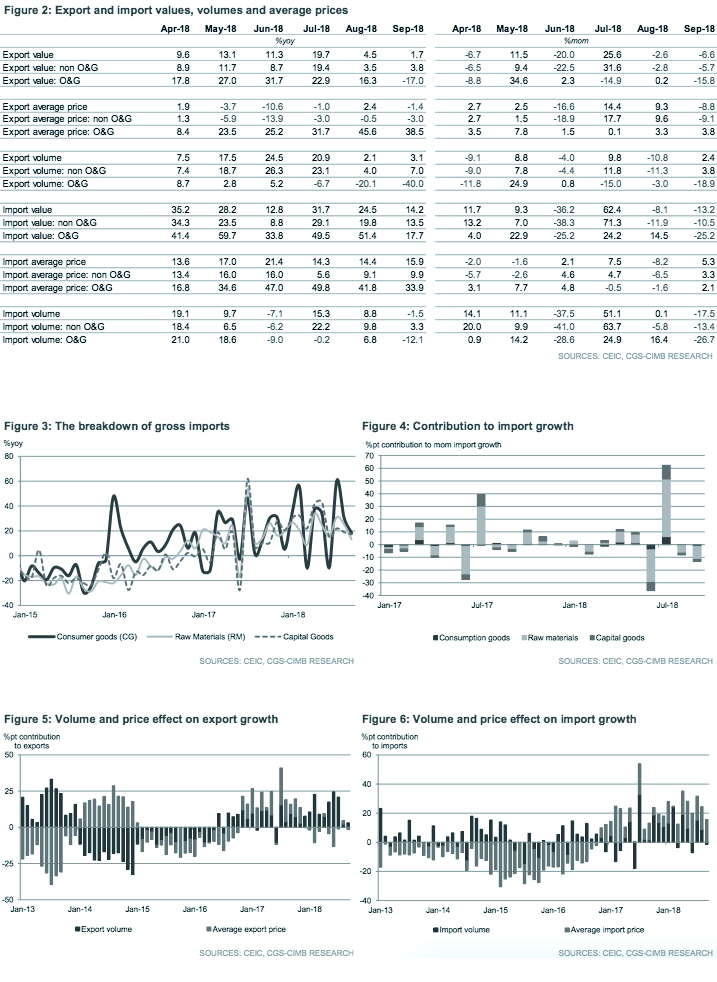
  • Steeper moderation in import growth led to the turnaround in trade balance to a surplus of US$227m in September, but 3Q18 trade deficit rose to a 5-year high.
  • Weakening Rp/US$ and the government’s measures to curb imports saw month-on-month contraction across all three import categories in September.
  • We estimate a smaller current account deficit (CAD) for 3Q18 at US$7.2bn (2.8% of GDP) due to higher travel surplus and lower dividend payments.

img-ind29-1

The rebound in September’s trade balance…
The trade balance rebounded to a surplus of US$227m in September (-US$994m in August), supported by a wider non-O&G trade surplus (+US$1.3bn vs. +US$667m in August) and a smaller O&G trade deficit (-US$1.1bn vs. –US$1.6bn in August). The turnaround was in line with our expectation (albeit weaker than expected) as well as the trend observed in 1H18.

… tracks the trend of goods surpluses in March and June
In 2018, the trade balance has tended to rebound in the final month of each quarter on the back of more subdued import growth (+14.2% yoy in September vs. +24.5% yoy in August). This trend may indicate that authorities are actively managing downside risks to the quarterly current account. Nonetheless, given that export growth in September was weakerthan-expected (+1.7% yoy in September vs. +4.5% yoy in August), the trade surplus recorded in September was considerably lower than in March and June.

Commodities the key drag on underperforming exports
The regulation by Ministry of Energy and Mineral Resources requiring all O&G producers to sell crude oil to Pertamina may have been the reason for the decline in O&G export and import volumes. Weaker aggregate export prices (-1.4% yoy in September vs. +2.4% yoy in August), particularly from lower palm oil and rubber prices, offset stronger export volumes (+3.1% yoy vs. +2.1% yoy in August) from the non O&G segment, sending overall export growth to a 15-month low.

Milder expansion across all three import categories
Import growth of consumer goods (+18.3% yoy in September vs. +30.3% yoy in August), raw materials (+13.1% yoy vs. +25.0% yoy in August) and capital goods (+17.1% yoy vs. +18.9% yoy in August) all eased in September. Moreover, all three key import categories have seen month-on-month declines for the second consecutive month in September, potentially reflecting weaker demand as a result of the weakening rupiah as well as the government’s measures to curb import growth.

3Q18 CAD may improve to 2.8% of GDP despite higher trade deficit
The quarterly trade deficit widened to US$2.7bn in 3Q18 (-US$1.4bn in 2Q18), the highest in five years. Nonetheless, we estimate a smaller current account deficit at US$7.2bn, or 2.8% of GDP in 3Q18 (-US$8.0bn, or -3.1% of GDP in 2Q18), due to lower dividend payments abroad and a higher travel surplus.


img-ind29-2

img-ind29-3


Originally published by CIMB Research and Economics on 15 October 2018.

China-ASEAN Monitor


img-ca-171018

Photo credit: iStock Photo


Economy, Investment and Trade

ASEAN countries to benefit from US$7.2 billion Silk Road Development Fund of the Belt and Road Initiative (BRI)
(16 October 2018) Southeast Asian nations are set to benefit from the initial US$7.2 billion Silk Road Development Fund of the Belt and Road Initiative (BRI). The BRI is an investment backed trade link that China aims to redevelop in linking the old trade routes that span Asia, Africa, Middle East and Europe. Silk Road Chamber of International Commerce Lu Jianzhong announced the establishment of the Silk Road Development Fund at the 2018 Silk Road Business Summit on 16 October 2018. He said the fund has a seed capital of approximately US$7.2 billion, which will be used over the next seven years and US$1.5 billion would be made available in November 2018. The Philippines is expected to be one of the primary beneficiaries of the fund which will be used to boost tourism, cultural-related and environmental protection projects.
Read more>>

Malaysia needs to weigh the benefits of investments from China thoroughly
(15 October 2018) A research Institute under Malaysia’s sovereign wealth fund Khazanah has reported that it is crucial for Malaysia to evaluate investments from China carefully, especially projects related to the Belt and Road Initiative (BRI). According to Khazanah Research Institute’s report titled “State of Household 2018: Different Realities Report”, Malaysia would benefit from long-standing good relations with China. However, it is important to ensure that Malaysia continues to receive mutually equitable trade arrangements and be fully aware of the potential socio and geopolitical repercussions of over-reliance on any one country. The report reminded that the BRI can change global trade patterns by providing an alternative economic development platform for many countries while exposing them to the risk of carrying sizable debt burden.
Read more>>

Cambodia records higher number of Chinese tourists in 2018
(15 October 2018) The Cambodian Tourism Ministry reported that the number of Chinese tourists to Cambodia during the first eight months of 2018 was 1.27 million people, 72% higher than the same period last year and even exceeding the full-year 2017 record. According to the Ministry’s report, from January to August 2018, there were more than 1.27 million Chinese tourists equivalent to 32.4% of international arrivals to Cambodia. The country is projected to attract at least 1.7 million Chinese tourists in 2018 and up to 2.5 million in 2020. Cambodian Tourism Minister Thong Khon attributed the increase in Chinese tourists to Cambodia’s close ties with China, the rise in Chinese middle class, Cambodia’s attractive tourist sites and the increase in direct flights between the two countries.
Read more>>

Indonesian government to take part in China’s Singles’ Day sales on Tmall
(14 October 2018) The Indonesian government will be participating in the 2018 Singles’ Day sales on Tmall. Introduced by Alibaba in 2009, the online shopping festival on Singles’ Day which is on 11 November, is on par with the US’ “Black Friday” when most retailers offer promotions online or offline. During a meeting with Alibaba, Indonesian Coordinating Minister for Economic Affairs Darmin Nasution said the Indonesian government would prepare two videos to introduce and promote Indonesian products on Tmall during the annual online shopping spree. Also, Indonesia’s Chamber of Commerce and Industry will deploy a study tour to Hangzhou, where Alibaba is headquartered, to better understand Tmall’s operational and logistics during the festival.
Read more>>

US-China trade war has intensified RCEP negotiations
(11 October 2018) According to Malaysia’s International Trade and Industry (MITI), the trade conflict between the US and China has led to increasingly intense negotiations of the Regional Comprehensive Economic Partnership (RCEP). Speaking at the South China Morning Post China Conference, Deputy Secretary-General Dato’ Norazman Ayob stated that the conflict between the US and China would provide the impetus for an early conclusion of the RCEP. When asked about the possibility of the Comprehensive and Progressive Agreement for Trans-Pacific Partnership (CPTPP) and RCEP existing together, Norazman said the RCEP is of prime focus because it is ASEAN-driven. International Trade and Industry Minister Darell Leiking stated that there is momentum to complete the negotiations by the end of 2018 as the RCEP’s integrated market of 3.5 billion people would provide significant trade and investment opportunities.
Read more>>


Singapore: MAS monetary policy review


HIGHLIGHTS

MAS monetary policy review

  • MAS steepened the slope of the S$NEER slightly, while maintaining the width and centre of the policy band, signaling further tightening of monetary policy.
  • The policy decision was underpinned by better-than-expected GDP growth in 3Q18 (+2.6% yoy) and upward revisions in 1H18 (+4.4% yoy vs. +4.2% yoy).
  • Growth projections keep core inflation on track to reach 2% in the coming months, which may validate a further strengthening of the S$NEER.
  • Hence we expect a slight bias for tighter monetary settings in April, predicated on the materialisation of MAS’s positive outlook on growth and core inflation.

img-sg11-1

MAS steepens S$NEER slope
The Monetary Authority of Singapore (MAS) increased the slope of the S$ nominal effective exchange rate (NEER) slightly, while keeping the width and centre of the policy band unchanged, marking a second successive tightening of monetary policy following its April review.

Policymakers remain upbeat over growth and inflation prospects
Heading into today’s decision, market expectations were split between maintaining the status quo and a tighter stance. We had anticipated an unchanged position given risks to the global outlook arising from the US-China trade dispute. However, MAS was upbeat that Singapore’s growth trajectory would keep “output slightly above potential”, putting “modest but continuing pressures” on core inflation. Policymakers expect GDP growth to moderate slightly in 2019F from this year’s “upper half of the 2.5-3.5% range” estimate, while forecasting core inflation to quicken to 1.5-2.5% in 2019F from 1.5-2.0% in 2018.

Advance estimates underpin MAS’s decision to tighten policy
The optimism was not unwarranted as advance GDP estimates indicated that growth slowed less than expected to 2.6% yoy in 3Q18. Sequentially, GDP growth accelerated to 4.7% qoq seasonally adjusted annual rate (SAAR) in 3Q18 (+1.2% qoq SAAR in 2Q18). Moreover, the estimate for 1H18 was also revised higher to 4.4% yoy from 4.2% yoy previously.

Resilient services sector compensates for manufacturing weakness
Sluggish external demand weighed on the manufacturing sector’s growth, particularly in electronics following the peak of the tech cycle. Construction activity remained tepid, following property cooling measures announced in July and tapering projects in the public sector. Services sector’s growth remained steady, driven by finance & insurance, business services, and wholesale & retail trade segments.

Slight bias for further policy tightening in April 2019F
We expect MAS’s next move to be data-dependent, and the positive tone struck in the policy statement on the outlook for economic growth and inflation suggests that policymakers retain an appetite for another slight increase in the S$NEER slope at the April 2019 policy review. CIMB Treasury and Markets Research have maintained their mildly positive view of USD/SGD, with forecast of 1.37 by end-2018F and 1.35 by mid2019F.

img-sg11-2

img-sg11-3

Originally published by CIMB Research and Economics on 17 October 2018.

CARI Captures 375

c375_graphic


THAILAND-ASEAN

ASEAN is Thailand’s biggest export market especially for Thai auto parts
(8 October 2018) Thailand’s Department of Foreign Trade reported that vehicles, auto parts and accessories were the highest exports to ASEAN countries in the first eight months of 2018, with exports valued at US$5 billion. The top five exports from Thailand to the region came from the auto, fuels, plastics, chemical products and machinery and parts sectors. The department’s director Adul Chotinisakorn stated that ASEAN is now Thailand’s biggest export market as up to 26.52% of Thailand’s total exports were shipped to ASEAN in the first seven months of 2018. From January to August 2018, Thai exports to ASEAN grew by 9.04% compared to the same period in 2017 with US$44.2 billion in total value. Thailand will host two ASEAN summits next year, aiming to further develop and improve Thai-Asean trade relations.

MALAYSIA

Malaysian Prime Minister expresses support for the SDGs and for ASEAN to assume a bigger role
(11 October 2018) Malaysian Prime Minister Mahathir Mohamad expressed his concerns over megatrends involving the trade war between global powers. Speaking at the ASEAN Leaders Gathering in Bali which was held on the sideline of the International Monetary Fund (IMF)-World Bank annual meetings: “Achieving Sustainable Development Goals (SDG) And Overcoming Development Gap Through Regional and Global Collaborative Actions”, the Prime Minister said that the escalating trade war between China and the United States is neither going to benefit the countries involved nor the rest of the world. While underlining that Malaysia was dedicated to sustainable development growth, the Prime Minister also said that he was counting on other ASEAN countries to collaborate to achieve their respective SDG targets. He added that he would like to see ASEAN assume a bigger role than before and hoped for renewed support from the IMF, World Bank and the United Nations for ASEAN and this region.

SINGAPORE

ASEAN remains committed to supporting a robust multilateral trading system amid global trade tension
(11 October 2018) At the ASEAN Leaders Gathering on the sideline of the IMF-World Bank annual meetings in Bali, Singaporean Prime Minister Lee Hsien Loong stressed that ASEAN would remain “steadfast” in upholding an open and rules-based multilateral trading system. He said the bloc reiterated its international cooperation, amidst the growing trade crisis between the United States and China. He underscored that ASEAN is intensifying its efforts to the Regional Comprehensive Economic Partnership (RCEP) and believed that a substantial conclusion could be reached by the end of 2018. Singapore is the current chair of ASEAN.

VIETNAM

Positive outlook for Vietnam’s economy in the short term though longer term risks remain
(10 October 2018) Vietnam’s GDP is forecasted to exceed 6.8% in 2018, but according to the Vietnam Institute for Economic and Policy Research (VEPR), internal and external risks will impact the country’s long-term prospects. Specifically, the US-China trade war and the devaluation of the Chinese yuan (CNY) would materially impact Vietnam, a country which is highly dependent on FDI to sustain the growth of its export-dependent economy. The VEPR said that Vietnam’s inflation target of 4% in 2018 can be achieved if there are no significant changes in energy prices during the fourth quarter. However, it could increase by 1.6% point if Vietnam increases the environmental tax protection on fuels by US$0.043. Vietnam’s economy in the third quarter expanded 6.88% year-on-year, which led to a growth rate of 6.98% from January to September 2018. This growth rate has been touted as the best nine-month performance since 2011. The VEPR indicated that the country is set to reach the National Assembly’s growth target of 6.7% for 2018.

INDONESIA

Indonesia’s inflation rate expected to be 3.4% in 2018
(10 October 2018) Indonesia’s Bank Indonesia (BI) predicts that inflation will be 3.4% in 2018, lower than 3.61% in 2017 and within the central bank’s target range. At a central banks forum in Bali, BI Governor Perry Warjoyo said that while BI has set an inflation target rate of 2.5-4.5%, he was optimistic that the actual rate would go lower than the mid-rate of 3.5%. He added that joint efforts by the Central Bank and the government to maintain administered prices and the prices of primary commodities have helped to reduce inflation. Previously, Statistics Indonesia (BPS) reported a 0.18% reduction in consumer prices in September 2018.

INDONESIA

State-owned Indonesian companies to diversify infrastructure-related funding sources
(9 October 2018) State-owned Indonesia firms will be inking agreements to push ahead the country’s planned infrastructure projects worth US$13.6 billion. Minister of State-Owned Enterprises Rini Soemarmo said that these collaborative efforts can help the country to deleverage and secure more equity-based financing thus diversifying its funding sources. Improving Indonesia’s leverage position is necessary as state companies which are major players in President Joko Widodo’s ambitious infrastructure push have borrowed extensively in order to meet financing needs of these projects. The Minister said that there would be over 20 deals signed by more than 12 state companies, including one by energy firm Pertamina and Taiwan’s CPC Corporation for a joint petrochemical business worth US$6.5 billion.

SINGAPORE, INDONESIA

Singapore and Indonesia seal US$10 billion swap agreement
(11 October 2018) Bank Indonesia (BI) and Monetary Authority of Singapore (MAS) inked a deal to open a line for US$10 billion equivalent local currency swap and the United States Dollar repurchase agreement. The move is intended to enhance liquidity management, assist financial market deepening and stabilise the Indonesian and Singaporean economy. The agreement was signed during the ASEAN Leaders’ Meeting in Bali, and it was witnessed by Singaporean Prime Minister Lee Hsien Leong and Indonesian President Joko Widodo. The Indonesian and Singaporean government also signed various agreements on tourism promotion, protection of foreign investment and FinTech cooperation.

THAILAND

Japan pledges to continue spearheading free trade with Thailand
(9 October 2018) Japanese Prime Minister Shinzo Abe and Thailand Prime Minister Prayuth Chan-ocha pledged to cooperate in promoting free trade, with Thailand willing to join the Japan-led Trans-Pacific Partnership involving 11 countries. Abe also said that Japan agreed with Thailand, which leads the economic development in the Mekong region, to conclude the Regional Comprehensive Economic Partnership (RCEP) as early as possible. The countries part of the trade deal, namely Australia, China, India, Japan, New Zealand and South Korea plus the 10 members of the Association of Southeast Asian Nations is aiming for a broad agreement by the end of 2018. Both Thai and Japan leaders held the talks before the Mekong-Japan Summit Meeting in Tokyo on Oct 9.

THE PHILIPPINES

Philippines’ trade deficit widens to US$18.94 billion in the first half of 2018
(10 October 2018) According to the Philippine Statistics Authority (PSA), the country’s trade deficit expanded to US$18.94 billion in the first six months of 2018 as imports continued to outpace exports significantly. The PSA reported that imports rose 13.2% to US$51.84 billion in 2018 from US$45.78 billion in 2017. Conversely, exports declined to $32.89 billion in 2018 from US$34.04 billion in 2017. This development brought the Philippines’ balance of trade in goods to a deficit of US$18.94 billion, higher than the US$11.75 billion deficit in 2017. Electronic products continued to bring in the most revenue i.e., $18.33 billion in the first six months of 2018, up 5.4% from $17.40 billion in 2017.

ASEAN

Singapore, Malaysia, Thailand and The Philippines are the first ASEAN countries to lift barriers to cross-border investment advisory
(11 October 2018) ASEAN financial regulators have consented to permit cross-border investment advisory services and manage standards for social and sustainability bonds. The agreement was announced during the ASEAN Capital Markets Forum (ACMF) in Singapore. The forum launched a framework to ease cross-border movement of investment advisers to allow investors within the ASEAN member states better access to professional services. The first phase of the plan will introduce the “ACMF Pass”, which grants licensed professionals of participating ASEAN jurisdictions to provide advisory services with faster registration and no additional licensing requirements. The first four participating countries of the initiative are Malaysia, the Philippines, Singapore and Thailand.

Mekong Monitor


img-mm110818

Photo Credit: The Straits Times


TRADE, ECONOMY, AND INVESTMENT


JAPAN-MEKONG

Japan and Mekong countries to assume new three-year strategy on quality infrastructure
(9 October 2018) Japanese Prime Minister Shinzo Abe promised to stimulate quality infrastructure projects in the five countries namely Thailand, Vietnam, Cambodia, Laos and Myanmar during the 10th Mekong-Japan Summit in Tokyo. The Japanese government pledged to help countries in the Mekong region in at least 150 projects under a new blueprint called the Tokyo Strategy 2018 for Mekong-Japan Cooperation, which runs from 2019 to 2021. These projects will focus on three areas namely building effective connectivity, building people-centred societies and environment and disaster management. The annual Mekong-Japan Summit has been held since 2009, and it aims to achieve sustainable development in the area and to narrow the development gap in the Mekong. Abe acknowledged that in the last three years, investment by Japanese firms in the Mekong region surpassed US$17.7 billion.
Read more>>

VIETNAM

EVFTA to enhance Vietnam’s national competitiveness
(10 October 2018) According to a European Chamber of Commerce (Eurocham) report titled “The EU – Vietnam Free Trade Agreement: Perspective from Vietnam”, the implementation of the European Union (EU) and Vietnam Free Trade Agreement (EVFTA) would help improve Vietnam’s competitiveness. The report found that 80% of 132 respondents, comprising 10% of Eurocham’s membership, agreed that the EVFTA would very likely or likely to enhance Vietnam’s competitiveness compared to other countries such as China, Japan, Korea and the US. About 72% of respondents were favourable that the EVFTA would enable Vietnam to become the hub for EU companies to access the ASEAN market. Once the EVFTA is ratified and implemented, it is expected that there would be a reduction of 99% of tariffs across a range of products. Vietnam’s exports to the EU are expected to be 50% higher in 2020, with imports also seeing significant growth, according to the report. The report also revealed that businesses believed that apart from economic benefits, the trade deal would have a positive impact on a range of social and environmental issues such as welfare and environmental protection, knowledge transfer and workers’ rights. According to Vietnam’s Ministry of Planning and Investment, the EU was the fifth-largest foreign investor in Vietnam with almost 2,500 projects worth around US$44 billion as of 2017.
Read more>>

MYANMAR

MIPP aims to attract US$200 billion worth of investments in 20 years
(9 October 2018) The Myanmar Investment Commission (MIC) launched a significant investment promotion plan, which seeks to attract more than US$200 billion and address the significant decline in foreign direct investment (FDI). Specifically, the Myanmar Investment Promotion Plan 2018 (MIPP) maps out three strategic periods to attract FDI. With this plan, it expects to receive FDI worth US$8.5 billion in the first four-year phase starting from the 2021/2022 fiscal year, US$12.3 billion in the next four years from 2026/2027 to 2030/2031 and US$17.6 billion in the third phase from 2031/2032 to 2035/2036. Through the MIPP which was jointly formed by the MIC and the Japan International Cooperation Agency (JICA), the Myanmar government pledges to enact policies that support macroeconomic stability and the establishment of reliable laws and regulations and stable financial systems. According to the Directorate of Investment and Company Administration (DICA), FDI in Myanmar reduced from US$$9.5 billion in the 2015/2016 fiscal year to US$6.6 billion in 2016/2017 due to the Rohingya crisis. For the 2018/2019 fiscal year, DCA said the Myanmar government expects to receive US$5.8 billion.
Read more>>

MYANMAR-CAMBODIA

Cambodia to lose special access to EU, Myanmar being considered for sanctions
(5 October 2018) The European Union (EU) will withdraw Cambodia’s “Everything but Arms” (EBA) status due to the country’s poor progress in improving its human rights record. The EBA status allows the world’s poorest countries to sell any goods tariff-free into the EU, except weapons. EU’s trade chief Cecilia Malmstrom said the EU had initiated a six-month review of its duty-free access to the EU, meaning Cambodian sugar, garments and other exports could face tariffs within 12 months under EU rules. Cambodia’s export to EU countries was reportedly worth US$5.8 billion in 2017. Likewise, the EU is also considering similar trade sanctions for Myanmar, as part of its efforts to toughen its policy on human rights in Southeast Asia. However, the European Commission, which handles EU trade policy, is split between supporting the development of Myanmar’s oil-and-textile economy and sanctioning the country. The EU will send a team to monitor the extent of the rights abuses and the Myanmar government’s willingness to change course.
Read more>>

THAILAND

Thailand’s Ministry of Commerce mulls blockchain for copyright, agriculture and trade finance
(9 October 2018) Thailand’s Commerce Ministry has launched a feasibility study to apply public blockchain solutions to copyright management, with plans to expand to agriculture and trade finance to boost the country’s competitiveness. Pimchanok Vonkorpon, Director-general of the Trade Policy and Strategy Office (TPSO) under the Commerce Ministry, said the office has the support of the British Embassy in Bangkok to implement two feasibility studies for using blockchain on IP registration and trade finance, which are expected to be completed in February 2019. Blockchain will help with traceability, digital IDs, company and IP registration management, and trade financing to improve transparency, enhance operational efficiencies and reduce the costs of business operations. The TPSO plans to introduce blockchain projects on a small scale initially to see which pressing matters should be prioritized.
Read more>>


mekong-monitor-map

About Greater Mekong Subregion (GMS)

The Greater Mekong Subregion (GMS) Economic Programme was launched by the Asian Development Bank in 1992 connecting five developing ASEAN countries, namely Cambodia, Laos, Myanmar, Vietnam and Thailand, and Chinese provinces of Yunnan and Guangxi Zhuang Autonomous region. The region has some of the most robust economies sharing the Mekong River Basin thanks to its reform and liberalisation. The subregion is growing at a faster pace than the whole of East Asia and the Asia Pacific as the GDP growth rate for 2017 was at 6.4 percent, according to the World Bank. The population at the subregion as of 2016 is at 340 million while the GDP at PPP is at US$3.1 trillion in 2016. In 2015, trading within the region was at US$444 billion.

China-ASEAN Monitor


img-ca-101018

Photo credit: The Straits Times


Economy, Investment and Trade

Leaders of Singapore and China exchanged diplomatic letters to mark 15th anniversary of partnership
(9 October 2018) Singapore Prime Minister Lee Hsien Loong and Chinese Premier Li Keqiang exchanged letters to mark the 15th anniversary of the Asean-China Strategic Partnership for Peace and Prosperity, which includes political-security, economic and socio-cultural pillars. China has been ASEAN’s top trading partner for eight consecutive years and is also ASEAN’s third-largest source of foreign direct investment. Lee noted that the ASEAN-China Free Trade Agreement (ACFTA) which was signed in 2010 and upgraded in 2015, has played a key role in ASEAN’s economic integration agenda. He also cited the shared commitment by ASEAN and China to substantially conclude negotiations on the Regional Comprehensive Economic Partnership by the end of this year. In addition, both sides are exploring ways to enhance connectivity through synergies between the Master Plan on Asean Connectivity 2025 and China’s Belt and Road Initiative as well as working towards full liberalisation in the Asean-China Air Transport Agreement. Furthermore, he mentioned that the adoption of the Asean-China Strategic Partnership Vision 2030 statement at the 21st Asean-China Summit in November 2018 in Singapore, will chart the strategic direction of ASEAN-China cooperation going forward.
Read more>>

Cross-border e-commerce surged between ASEAN and China
(3 October 2018) Cross-border e-commerce trade between China and ASEAN will see year-on-year growth of 50% in 2018, according to Zhao Ping, Director of the International Trade Research Department of the Academy of China Council for the Promotion of International Trade. Future prospects for cross-border e-commerce between China and ASEAN look promising as many firms benefit from lower or zero tariffs under free trade agreements. According to a recent survey, Chinese consumers look for fruits, seafood and other products from five sectors from the ASEAN region. Both China and ASEAN are establishing industrial parks and improving logistics networks to enhance better business environment for smoother cross-border e-commerce. The logistics network provided by the China-Singapore (Chongqing) Connectivity Initiative-also called the Southern Transport Corridor- is now a vital pathway for China-ASEAN trade.
Read more>>

China and ASEAN manufacturers could be affected by USMCA
(3 October 2018) Asian manufacturers could find it harder to sell their products in American markets and risk long-term isolation in key industries under the United States-Mexico-Canada Agreement (USMCA). In particular, tighter rules of origin and labour standards for car and garment industries would mean that the production of these goods could shift back to North America. For instance, stringent rules for garment manufacturing stipulating that raw materials must be sourced from suppliers from one of the three signatory countries, are likely to negatively impact Vietnamese manufacturers of sewing thread. Furthermore, the agreement states that 40% to 45% of car parts purchased by signatory nations must have been produced by workers making at least US$16 an hour. This provision is likely to see the car manufacturing base moving back to the US and Canada from Asia and Mexico.
Read more>>

Local businesses encouraged to invest in China-Myanmar economic zones
(3 October 2018) Myanmar’s Union Minister for Commerce Dr Than Myint has called for local entrepreneurs to invest in economic zones in the China-Myanmar border. During Myanmar State Counsellor Aung San Suu Kyi’s tour to China last year, a contract was signed to establish trading and processing zones in Kachin, Shan and Yunnan Province which are situated on the China-Myanmar border. A central working committee will soon be carrying out the implementation of the Myitkyina Economic Development Zone and the Kanpiketi Border Development Zone.
Read more>>

China-Vietnam meter-gauge railway records increase in goods
(9 October 2018) According to China Railway Kunming Group Co Ltd, more than 400,000 tonnes of freight have travelled across the border on the meter-gauge railway connecting China and Vietnam in 2018. Out of the 400,000 tonnes, 250,000 tonnes were exported from China, a year-on-year increase of 13.26%. The China-Vietnam meter-gauge railway, which was established in 1910, is an important China-ASEAN transportation route. After a series of negotiations, a regular freight train was launched in December 2017 between southwest China’s Kaiyuan County and Vietnam’s coastal city of Haiphong, to meet increasing freight demand. Goods, such as chemical fertiliser, coke, fodder and seamless steel tube, have been transported on the 615km long railway route.
Read more>>


Malaysia: August 2018 trade


HIGHLIGHTS

August 2018 trade

  • Trade surplus sank to a 46-month low of RM1.6bn due to weaker non-oil commodity exports and E&E shipments
  • Our 2018 export forecast is lowered to 6.5% to reflect challenging trade conditions and import growth lifted to 6.2% boosted by private consumption.
  • We maintain Malaysia’s GDP growth forecast at 4.7% in 2018, as the scope for upside surprises is hampered by fading external tailwinds.

img-my21-1

Underperforming export growth weighs on trade surplus
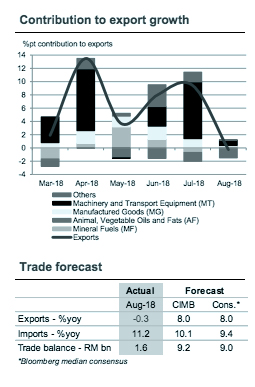
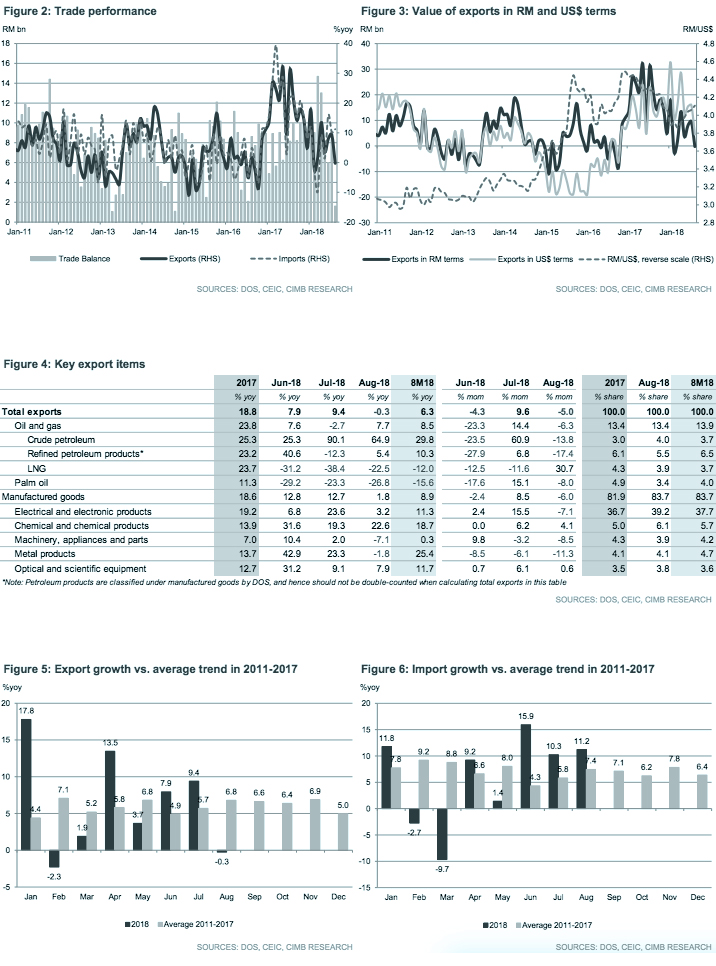
The trade surplus shrank to RM1.6bn in August (RM8.3bn in July) as global trade tensions took a toll on Malaysia’s export performance with a surprise 0.3% yoy decline in August (+9.4% yoy in July). The expansion of imports remained steady (+11.2% yoy vs. +10.3% yoy in July) on the back of resilient domestic demand in the final month of tax holiday. Total trade growth eased to 5.1% yoy (+9.8% yoy in July).

Supply shocks still a drag to commodity exports
The shipments of LNG (-22.5% yoy in August vs. -38.4% yoy in July) and palm oil (-26.8% yoy vs. -23.3% yoy in July) remained the weak spots in commodity segments. The global oil price uptrend was a boon to exports of crude oil (+64.9% yoy in August vs. +90.1% yoy in July) and refined petroleum products (+5.4% yoy vs. -12.3% yoy in July).

Manufactured exports floored by E&E and machinery
Manufactured export growth decelerated to a six-month low of 1.8% yoy (+12.7% yoy in July), particularly in E&E (+3.2% yoy vs. +23.6% yoy in July), machinery, appliances and parts (-7.1% yoy vs. +2.0% yoy in July) and manufacture of metals (-1.8% yoy vs. +23.3% yoy in July).

Exports to China and the US decelerate sharply ahead of Sep tariffs
Shipments slowed to China (+4.5% yoy vs. +37.5% yoy in July) and the US (-2.0% yoy vs. +6.7% yoy in July) after strong upticks in July, suggesting that manufacturers may have built inventories pre-emptively ahead of China’s Golden Week and additional tariffs levied by Beijing and Washington in August and September. There were pockets of weakness in export demand from the EU (-8.9% yoy), Japan (-22.9% yoy) and Singapore (-2.2% yoy).

Shopping spree ahead of the imposition of SST on 1 September
Domestic demand remained strong before the reintroduction of Sales and Service Tax (SST) on 1 September, as reflected in all three import categories: consumption goods (+14.2% yoy in August vs. +11.1% yoy in July), capital goods (+25.3% yoy in August vs. +4.6% yoy in July) and intermediate goods (+4.3% yoy vs. -0.1% yoy in July).

Wind knocked from export sails
Barring a strong reversal in September, net export contribution to headline GDP growth likely moderated further in 3Q18 from +0.1% pt in 2Q18. We tweak our 2018 forecast for gross exports from 7.7% to 6.5% and for gross imports from 5.5% to 6.2%. Hampered by external tailwinds, Malaysia is leaning more heavily on domestic demand, particularly private consumption, to drive growth, suggesting that GDP growth is unlikely to accelerate significantly in 2H18. We maintain our 2018 GDP growth forecast at 4.7%.

img-my21-2

img-my21-3

img-my21-4


Originally published by CIMB Research and Economics on 5 October 2018.

CARI Captures 374

c374_graphic


MALAYSIA

Malaysia’s economic growth rate is expected to slow down due to lower public investment
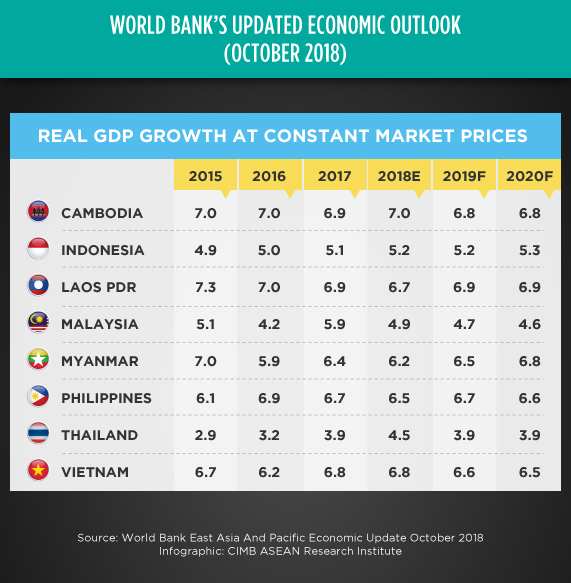
(4 October 2018) The latest World Bank Economic Outlook report issued on 4 October 2018 projected that Malaysia’s economic growth would slow down from 2018 to 2020. Specifically, economic growth is expected to moderate to 4.9% in 2018, 4.7% in 2019, 4.6% in 2020 compared to 5.9% in 2017. Malaysia’s gross fixed capital formation is forecasted to increase modestly as export growth slows, and public investment is lower following the cancellation of two major infrastructure projects. Nevertheless, the report acknowledged that Malaysia’s economic growth is supported by strong private consumption and that its external sector will benefit from the rebound in global investment and manufacturing activity, although this cycle is beginning to mature.

SINGAPORE

Trade war spurs Singapore firms’ aggressive overseas acquisitions
(4 October 2018) Singaporean companies announced overseas deals worth US$91billion from January to September 2018. This quantum is more than double the US$41.9billion during the same period in 2017. According to the data compiled by Bloomberg, the reasons for this development could be firms adopting a more aggressive stance amid the US-China trade tension and Singapore’s economy that is expected to expand next year at the slowest pace since 2016. Firms from Singapore have been involved in 68 acquisitions of Chinese companies so far this year, with transactions volume increasing from US$3.8 billion the same period of 2017 to US$19.5 billion.

THAILAND

New tourism development scheme devised for EEC
(3 October 2018) The Thai government has created a tourism development scheme for the Eastern Economic Corridor (EEC) with a five-year public-private budget of about US$6.1 billion. The scheme will be implemented based on provincial strength and uniqueness. The Board of Trade of Thailand chairman Kalin Sarasin said tourist numbers to Thailand are expected to increase by 1.5 times within 2021. In the first eight months of 2018, Thailand recorded a 9.9% rise in the number of foreign tourists, totalling 25.89 million. Total investment in the EEC is estimated at US$52 billion. The EEC is expected to see the number of tourists increase 1.5 times to 46.72 million by 2021, with revenue expected to hit US$16.1 billion. At the moment, the EEC attracts 29.89 million visitors, gaining about US$8.7 billion in income.

VIETNAM

E-commerce giants look to attract Vietnamese sellers
(3 October 2018) E-commerce firms Amazon and Alibaba are looking to penetrate the Vietnamese market by signing up Vietnamese sellers for their online marketplace. According to Vietnam’s Ministry of Industry and Trade, around 200 businesses from Vietnam are selling on Amazon. It is reported that Alibaba sees Vietnam as a diverse manufacturer and looks to open Vietnam’s door to over 200 markets around the world. According to the Vietnam E-commerce Association (VECOM), Vietnam’s e-commerce market rose by 25% in 2017, and the association predicts this rate to continue until 2020.

MYANMAR

European Union mulling trade sanctions on Myanmar due to Rakhine crisis
(3 October 2018) The European Union is looking to place trade sanctions on Myanmar due to the Rohingya crisis. According to a report by Thomson Reuters, three EU officials stated that the bloc could strip Myanmar’s tariff-free access to the EU. The sanctions, which are being discussed at the European Commission, could be placed on Myanmar’s lucrative textile industry and it would potentially put thousands of jobs in Myanmar at risk. Myanmar’s exports to the EU was recorded at US$1.81 billion in 2017, nearly 10 times the value in 2012, after which EU provided Myanmar “Everything But Arms” trade status. That status means Myanmar can sell any goods tariff-free to the EU, except weapons. The EU is Myanmar’s sixth-largest trading partner.

INDONESIA

BI governor hints at possible interest rate hike ahead of similar move by US Federal Reserve
(3 October 2018) Indonesia’s Central Bank governor Perry Warjiyo has stated that Indonesia must increase its interest rate ahead of the United States Federal Reserve to withstand drastic capital outflows. His statement raises the possibility for the Indonesian interest rate to rise before mid-December when the Fed is expected to increase U.S. rates for the fourth time in 2018. Bank Indonesia (BI) has increased interest rates five times since May 2018 by a total of 150 basis points and intervened in the currency market to support the rupiah and to reduce volatility. Warjiyo’s statements came on 3 October 2018 after the rupiah hit 15,090 a dollar, its weakest in over 20 years.

MALAYSIA, INDONESIA

Malaysia and Indonesia aerospace industry associations seal MoU to enhance human capital development
(3 October 2018) The Malaysia Aerospace Industry Association (MAIA) and Indonesia Aircraft Component Manufacturer Association (Inacom) are cooperating to improve human capital development to gain more job opportunities from leading aviation companies such as Airbus, Boeing and Rolls Royce. Both associations signed a memorandum of understanding (MoU) during the 3rd Kuala Lumpur International Aerospace Business Convention (KLIABC) 2018. Malaysia’s aerospace manufacturing exports are expected to reach US$2.2 billion in 2018 compared to US$2.05 billion in 2017 due to increase in the order for aircraft components. In 2017, Malaysia’s aerospace export surged 54 per cent to US$2.05 billion from 2016, with main exports being parts and components, particularly for wings, empennage and aircraft fuselage.

THAILAND

Thailand to establish cooperation between Japan and Mekong sub-region
(3 October 2018) Thailand will be working on developing a cooperation framework between the Mekong sub-region and Japan in the 10th Mekong-Japan Summit which will be held from 8 to 9 October 2018. Thailand’s Prime Minister Prayut Chan-o-cha is expected to attend the summit and will discuss collaborations with Japan on development projects in the sub-region. Thailand is interested to collaborate on connectivity development plans, the enhancement of the ASEAN community, and the development of human resources. Japan is interested to support development projects in infrastructure, connectivity, logistics and the services sectors.

THAILAND, VIETNAM

Thailand and Vietnam’s bilateral trade is expected to reach US$20 billion by 2020
(28 September 2018) Thailand and Vietnam have set target for bilateral trade to reach US$20 billion by 2020 from US$16 billion in 2017. Thailand-Vietnam Business Council’s president Sanan Angubolkul said to achieve the target, the Thai-Vietnam Business Council together with Thailand’s Ministry of Commerce have discussed with the Vietnamese government to reduce several trade barriers to ease trade flows between Thailand and Vietnam. Thailand exported up to US$11 billion worth of products to Vietnam while Vietnam exported US$5 billion to Thailand. From January to August 2018, trade value between Thailand and Vietnam was recorded at US$12 billion, an increase of 14.9% from the same period in 2017.

CAMBODIA

Cambodian government mulls tax on e-commerce sales and designing policies
(27 September 2018) The Cambodian government is looking to implement a tax on e-commerce sales and creating policies to help aid expansion of the sector in Cambodia. Cambodia’s Finance Minister Aun Pornmoniroth acknowledged an increase in the use of technology across most business sectors in Cambodia as consumers are taking advantage of the digital economy by using online payments. According to a statement issued by Cambodia’s Ministry of Economy and Finance (MEF), Cambodia has no actual mechanism to collect fiscal revenue from e-commerce operations. The MEF did not detail what type of online business is defined as e-commerce, or what kind or size of a business transaction would be subject to tax obligations in the future. According to a United States Department of Commerce report, Cambodians are adopting e-commerce both as consumers and merchants, and there is significant untapped market potential in the sector fueled by exploding internet access, high smartphone penetration and a young, growing middle class. The report stated that in just eight years, the number for active internet users has risen from 28,000 to 7.1 million while the number for social media users has reached 4.9 million.