Mekong Monitor


img-mm-221118

Photo credit: The Straits Times


TRADE, ECONOMY, AND INVESTMENT


THAILAND

Thailand assumes ASEAN chairmanship amid challenges
(16 November 2018) Thailand unveiled the theme of its ASEAN chairmanship—Advancing Partnership for Sustainability—at the closing ceremony of the 33rd ASEAN Summit in Singapore. Thai Prime Minister Prayut Chan-o-cha acknowledged that while ASEAN is recognized internationally, much remains to be done as it still faces many challenges such as trade and political competition, disruptive technologies and transnational crime. Thailand’s priorities as the 2019 chair will include boosting infrastructure connectivity, rules and regulations, and people-to-people links to create a seamless ASEAN. He also promised to put sustainability at the centre of all issues and elevate ASEAN’s role in addressing global issues such as climate change.
Read more>>

MYANMAR

Myanmar forms new investment ministry
(20 November 2018) Myanmar’s Union Parliament approved the establishment of a new Ministry of Investment and Foreign Economic Relations on November 19. According to Myanmar Attorney-General Tun Tun Oo, the new ministry will be a merger between the Foreign Economic Relations Department and the Directorate of Investment and Company Administration (DICA), both of which are presently under the Ministry of Planning and Finance. Further, the new ministry aims to bolster domestic and foreign investment and ensure that investments are socially and environmentally responsible. The new ministry will include solutions to enhance the flow of investment-related information and dispute resolution mechanisms for investors. Myanmar President U Win Myint also appointed the incumbent national security advisor and government office minister U Thaung Tun as the new ministry’s head.
Read more>>

VIETNAM

Vietnam and Russia aim to nearly triple trade to US$10 billion by 2020
(20 November 2018) Vietnamese Prime Minister Nguyen Xuan Phuc and Russian Prime Minister Dmitri Medvedev announced several agreements to enhance bilateral cooperation during a meeting in Hanoi on November 19. The leaders agreed to increase bilateral trade to US$10 billion by 2020 from US$3.55 billion in 2017 and cooperate more closely to ensure more effective implementation with the Russian-led Eurasian Economic Union. Further, the two countries will facilitate bilateral trade in farm produce, seafood, and joint energy investment projects. Russia is Vietnam’s biggest weapons supplier and Russian companies are involved in numerous Vietnamese energy projects. Additionally, Vietnam was the fourth largest importer of Russian wheat after Egypt, Turkey and Bangladesh in the 2017/2018 marketing season.
Read more>>

THAILAND

Thailand plans to link EEC with southern corridor
(16 November 2018) Plans for a Southern Economic Corridor (SEC) to be connected to Thailand’s existing Eastern Economic Corridor (EEC) and form a massive trade hub linking the Pacific and Indian oceans, is in the works. According to minister in the Thai Prime Minister’s Office Kobsak Pootrakool, approval for a US$606 million investment package will be sought from the Cabinet for the project which will cover the four provinces of Chumphon, Ranong, Surat Thani and Nakhon Si Thammarat, plus a link to the EEC. The proposed development will comprise a seaport in Ranong province, double-track rail linking Chumphon and Ranong provinces, as well as road investments. The proposed investment budget will be submitted for Cabinet approval by early December. Meanwhile, the draft city plan for the EEC will also be ready for public input in early December.
Read more>>

CAMBODIA, LAOS, MYANMAR

Study to shed light on air connectivity in the Mekong region
(19 November 2018) A study on air connectivity between Cambodia, Laos, Myanmar and China will be carried out under the Mekong Lancang Cooperation Framework. According to the Cambodian State Secretariat for Civil Aviation (SSCA), the study will strengthen knowledge base on the Mekong region’s air transport industry thus helping industry players to enhance air connectivity and airport facilities which in turn, will boost economic and sectoral (such as tourism) growth. Cambodia’s three international airports received 8.5 million passengers—a 22% increase—from January to October 2018, with expectations of reaching 10 million visitors by year-end. According to the Pacific Asia Travel Association, the number of air links in the Mekong region is very limited and it hopes that the study will improve the current situation.
Read more>>


mekong-monitor-map

About Greater Mekong Subregion (GMS)

The Greater Mekong Subregion (GMS) Economic Programme was launched by the Asian Development Bank in 1992 connecting five developing ASEAN countries, namely Cambodia, Laos, Myanmar, Vietnam and Thailand, and Chinese provinces of Yunnan and Guangxi Zhuang Autonomous region. The region has some of the most robust economies sharing the Mekong River Basin thanks to its reform and liberalisation. The subregion is growing at a faster pace than the whole of East Asia and the Asia Pacific as the GDP growth rate for 2017 was at 6.4 percent, according to the World Bank. The population at the subregion as of 2016 is at 340 million while the GDP at PPP is at US$3.1 trillion in 2016. In 2015, trading within the region was at US$444 billion.

Why all the talk of IR4.0 when so much of ASEAN is pre-industrial on an industrial scale?

Originally published in TheEdge Malaysia, 19th – 25th November 2018 edition.

Screen Shot 2018-11-21 at 6.00.58 PM

The “Fourth Industrial Revolution” or IR4.0 was a central theme in the World Economic Forum on ASEAN last September. But if ASEAN is to create a prosperity for the majority that is realistic, fair and not marked by sharp inequalities, this excitement surrounding IR4.0 amongst elites and those who live in the tech bubble may not be as well-founded.

The rhetoric of IR4.0 revolves around using new technologies like drones, 3D printing and automation. The use of these technologies such as delivering medicine with drones or providing internet through balloons, may seem a tad sensationalised. What is imagined is some social good that will be spread by these technologies, giving the proponents of these ideas some legitimacy while avoiding the more unsexy realities and priorities on the ground.

In actual fact, no one is certain how IR4.0 will improve the situation but we are aware of one way it would exacerbate it: automating manufacturing and services could threaten the jobs of hundreds of millions of ASEAN citizens. Why would a region with a growing youth population and low wages want robots?

These boundary-pushing concepts, when they work, can be valuable, but the obsession with technological leapfrogging should be refocused to something more pragmatic: using technology to address the serious regional basic infrastructure gaps. Leapfrogging is indeed essential to address basic needs. However, this cannot be achieved by simply hardwiring digital technology into disenfranchised societies and packaging it with a fancy label. We need a more honest discussion.

Swathes of ASEAN are still pre-industrial: 66 million people are without electricity1, nearly 71 million do not have access to safe drinking water, and more than 173 million don’t even have basic sanitation2. And these numbers concern basic access: millions more do not have access to the same standards that those promoting IR4.0 are used to.

Neglecting housing, water, sanitation, education, electricity and healthcare in favour of accelerated e-commerce would be a misplaced economic decision. It might be the flavour of the month, but it does not tackle structural issues. It is no surprise that millions of people without access to basic services can impose a huge cost on a national economy. Previous studies by the World Bank estimated that a loss of US$448 million per year was caused by poor sanitation and water supply in Cambodia3 (In India, this estimated loss was a staggering US$53.8 billion). This amounted to 7.2% of GDP at the time, equivalent to Cambodia’s entire fishery industry. Unsurprisingly, a major component of the economic burden came from health costs, totalling US$187 million. As utilitarian as it sounds, if people of working age fall ill repeatedly, productivity falls. Replacing them with robots is certainly not the answer.

Providing access to basic needs such as sanitation has positive multiplier effects on both social and economic dimensions. Conversely, not providing these necessities has equally serious repercussions in the opposite direction. The World Bank’s Water and Sanitation Program expected returns on investments in Cambodian sanitation to be as high as 2:1 for every US$1 invested4, and a report this year by WaterAid identified Cambodia as a good example of positive change5: the country has improved access to clean drinking water from 52% in 2000 to 75%. This translates to preventing the loss of around US$200 million annually, or nearly the entire contribution of Cambodian forestry to its GDP. As a case study in developmental investment, it should inspire countries like Indonesia, which incurred an estimated loss of US$6.3 billion due to poor sanitation infrastructure, to rapidly scale up their sanitation standards. A bare 5% of the archipelago’s human waste is suitably collected and processed, and a shocking 50 thousand child deaths are believed to be caused by inadequate sanitation.

Meeting ASEAN’s basic needs is essential if the region really is to be “owned by the people and run for their benefit” as the ADB IR4.0 paper suggests6. This demand will only grow and become costlier as the population of the region reaches a billion by 2050. Socially, meeting basic needs improves lives and grows communities by uplifting societies from the drudgery of life on the poverty line. Economically, it provides a workforce with the health and education to compete on the global stage. Politically, working to provide basic needs for ASEAN’s citizens will reveal the potential of a connected AEC. In contrast, pouring capital into niche technological developments will not improve life for the many “people of ASEAN”, but for the few that have the resources for these technologies, or who have capabilities to harness it for e-commerce and other related businesses.

A vision of IR4.0 readiness should not widen social inequality, nor distract from the infrastructure projects that form the backbone of a connected ASEAN; the Singapore-Kunming Rail Link, Trans-ASEAN Gas Pipeline, and the ASEAN Power Grid to name a few. There are many opportunities for different technologies to support these projects, and the incorporation of technologies like high-voltage direct current energy transmission or geographical information systems for subterranean mapping. The Power Grid is an example of a contemporary infrastructure deficiency that the AEC has worked together to address with appropriate application of advanced technology. In 2017, the Philippines lost a weighted value of 10.3% of electricity in transmission, whilst Singapore lost only 0.5%7. In May of this year, the Power Grid Summit saw progress towards including the Philippines in the grid to address this. The grid mitigates these losses in transmission, and, more importantly, it redirects power from countries with a surplus to those with a deficit. This has the potential to benefit nations on the economic periphery with excess electricity, like Laos.

If governments are not going to actively create this infrastructure, then they must generate incentives to make it commercially attractive for the private sector. The revenue flows of infrastructure programmes are sometimes not sufficiently stable for the private sector, so public-private partnerships (PPPs) were set up across the AEC to mitigate the risk of uncertain revenue flows. PPPs created to fulfil basic needs have seen success outside of the AEC such as in India, where construction of 50 million affordable houses is underway with support from the private sector. India provides other lessons too. For every urban bank branch opened, there must be a matched branch in rural areas: a smart policy in a country where almost 200 million are still unbanked. India now has the most bank branches in the world and views its rural bank branches as the precursor to rural development9.  Why can’t this model – led and potentially subsidised by the government – also be applied to small healthcare facilities, road construction, or water delivery in ASEAN?

Approaches like these should not be side-lined because of distraction over IR4.0. The responses to IR4.0 have produced forward-thinking pipeline concepts, and new technology does have the potential to enhance ASEAN performance. But IR4.0 readiness will only be useful for development and equality in ASEAN if the AEC channels it towards investment in basic needs.

IR4.0 may make us “question what it is to be human”, but it shouldn’t make us question what it is to be humane.


1 IEA Publications. 2017. Energy Access Outlook 2017. Electronic dataset. International Energy Association. Viewed 18 October 2018.
2
WHO/UNICEF JMP. 2017. Progress on Drinking Water, Sanitation and Hygiene: 2017 Update and SDG baseline. Electronic dataset.
UNICEF. . Viewed 18 October 2018.
3
Water and Sanitation Program. 2007. Economic Impacts of Sanitation in Cambodia. World Bank
.. Viewed 18 October 2018.
4 Hutton, G; Napitupulu, L; Thang, P;
Kiv, P; Rodriguez, E, U. 2007. Economic Impacts of Sanitation in Southeast Asia: Summary. Water and Sanitation Program.
5
WaerAid. 2018. The Water Gap: The State of the World’s Water 2018. WaterAid.
6 World Economic Forum; Asian Development Bank. 2017. ASEAN 4.0: What does the Fourth Industrial Revolution man for regional economic integration? Asian Development Bank.
Infrastructure Investor. 2018. ASEAN: An Intelligence Report. [online] PEI Ltd. Accessed 16 October 2018
8
Amit Chawla. 2018. Affordable Housing: Is PPP model best way forward to make Housing for All a reality? Financial Express. 18 October 2018.
9
Mahima Jain. 2016. Infographic: Little known facts about India’s banking network. The Hindu Business Line. 18 October 2018.

China-ASEAN Monitor


img-ca-211118

Photo credit: People’s Daily Online


Economy, Investment and Trade

Strategic partnership vision 2030 hailed as milestone in China-ASEAN relations
(15 November 2018) China and ASEAN Member States adopted the China-ASEAN Partnership Vision 2030 on November 14 at the 21st ASEAN-China Summit held on the sidelines of the 33rd ASEAN Summit in Singapore. The agreement charts a medium and long-term plan for continued mutually-beneficial cooperation between ASEAN and China in three key areas i.e. political and security cooperation, economic cooperation and socio-cultural cooperation. ASEAN and China will also intensify their efforts to meet the target of US$1 trillion in trade volume and US$150 billion in investments by 2020, consistent with the ASEAN-China Free Trade Area (ACFTA) and the ACFTA upgrading protocol. ASEAN Secretary-General Lim Jock Hoi said that the vision will pave the way for a solid partnership between the two sides in the coming decades.
Read more>>

President Xi Jinping’s state visit to the Philippines
(19 November 2018) Chinese President Xi Jinping’s two-day state visit to the Philippines—the first visit by a China head of state in 13 years—began on November 20. The trip comes as President Rodrigo Duterte looks to Beijing for investments in the Philippines, with a focus on trade, infrastructure, tourism and telecommunications. China was both the Philippines’ top export destination and source of imports as of August this year. 972,550 Chinese tourists arrived in the Philippines in the first nine months of 2018, a 34.9% increase compared to the same period in 2017. Priorities during President Xi’s visit include the joint oil and gas exploration in the South China Sea, China Telecom’s bid for a telecommunications license, Bank of China’s partnership with 13 Filipino banks to encourage yuan transactions and other major infrastructure developments.
Read more>>

China and Brunei strengthen cooperative relations
(20 November 2018) Chinese President Xi Jinping met with Brunei’s Sultan Haji Hassanal Bolkiah in Bandar Seri Begawan on November 19 where they reaffirmed their commitment to enhance China-Brunei ties. In their joint statement, both parties committed to enhance cooperation in areas such as trade, investment, defense, security and law enforcement. The leaders also agreed to further synergize their national development strategies and maintain frequent high-level exchanges. Further, they expressed their satisfaction with their ongoing cooperation in the energy sector and agreed to continue their support for enterprises in the maritime oil and gas resources, in accordance with the principles of international law and the principle of mutual respect, equality and mutual benefit.
Read more>>

Singapore and Jiangsu to drive more opportunities with the signing of 13 MOUs
(20 November 2018) 13 MOUs were signed during the 12th Singapore-Jiangsu Cooperation Council meeting in Singapore on November 20 to enhance economic partnership and advance China’s Belt and Road Initiative (BRI). The initiatives included the development of new industrial parks by Sembcorp Development and China-Singapore Suzhou Industrial Park Development, a new petrochemical plant to promote international trade in chemicals and an innovation centre for smart drone surveying technology for environment protection. In addition, the MOUs also covered a partnership to develop third-party market collaboration along the Belt and Road Initiative (BRI) as well as agreements to promote collaborations in fintech and facilitate investments into Singapore and Jiangsu. Singapore was Jiangsu’s third-largest investor in 2017 with bilateral trade that grew at 15.7% year-on-year, reaching US$11.3 billion.
Read more>>

Cambodia looks to BRI for e-commerce and e-trade
(16 November 2018) The Cambodian Minister of Public Works and Transport Sun Chanthol said the Cambodian government is committed to fostering an investor-friendly ecosystem to promote e-commerce and cross-border trade, evident through the recent creation of a National Logistics Council where it will study the country’s logistics sector and address the issue of high costs to promote the efficient flow of exports. He was quoted at the #ConnectCambodia forum organised by the United Nations Development Program (UNDP) that aims to explore opportunities arising from the China-proposed Belt and Road Initiative (BRI) by showcasing how regional integration, technologies and innovations have created new development opportunities to advance cross-border trade in Cambodia.
Read more>>


CARI Captures 380

img-c380


ASEAN

ASEAN ministers sign first e-commerce agreement
(13 November 2018) The ASEAN Agreement on Electronic Commerce was inked after 9 rounds of negotiations ahead of the ASEAN Economic Community (AEC) Council meeting at the 33rd ASEAN Summit in Singapore. The agreement includes provisions to encourage cooperation on policies and legal frameworks related to consumer protection, e-payment, intellectual property rights and cyber security; promote paperless trading between businesses and government; enhance e-commerce data protection and dispute resolution mechanisms; and enable businesses to access and move data across borders more easily subject to appropriate safeguards. ASEAN is the world’s fastest-growing internet market with 330 million users online, but e-commerce adoption in the region represented only 2% of total retail sales in 2017, compared with 20% in China and 12% in the US. The pact aims to bolster trust and confidence of ASEAN consumers and businesses in e-commerce and accelerate digital connectivity in the region.

ASEAN

ASEAN leaders committed to achieving a modern, comprehensive, high-quality and mutually beneficial RCEP despite failing to conclude
(14 November 2018) Heads of state and government of the Regional Comprehensive Economic Partnership (RCEP) Participating Countries gathered for the 2nd RCEP Summit on 14 November, held on the sidelines of the ASEAN Summit. Seven chapters of the RCEP has been concluded so far, with 11 chapters still in negotiation. According to the group, substantial progress has also been made in market access negotiations, though due consideration will need to be given to existing sensitivities, gaps and agreements between the many RCEP Participating Countries (RPCs). However, the group reaffirmed their commitment in ensuring that the agreement will be both relevant to current realities and adaptable to future developments to allow RPCs the flexibility to respond to challenges arising from their diverse circumstances. The group aims to conclude negotiations in 2019.

ASEAN

ASEAN Connectivity 2025 Master Plan moves forward with priority deliverables
(13 November 2018) The ASEAN Coordinating Council (ACC) launched three priority deliverables for the Master Plan on ASEAN Connectivity (MPAC) 2025 and the ASEAN Connectivity microsite at the 22nd ACC Meeting held on the sidelines of the 33rd ASEAN Summit. The MPAC 2025 is a multi-year roadmap that aims to integrate ASEAN countries in five strategic areas, namely sustainable infrastructure, digital innovation, seamless logistics, regulatory excellence and people mobility. The key deliverables are: (i) the establishment of a rolling priority pipeline of ASEAN infrastructure projects to attract more public and private infrastructure investments, (ii) the development of a sustainable urbanisation strategy for ASEAN which is tailored for cities to use as a template to mitigate urban challenges, (iii) a study of methods to help micro, small and medium-sized enterprises (MSMEs) to better adopt digital technology and amplify their reach in preparation for the fourth industrial revolution.

ASEAN

ASEAN leaders commit to promote green jobs
(13 November 2018) The ASEAN Declaration on Promoting Green Jobs for Equity and Inclusive Growth was adopted by heads of state at the 33rd ASEAN Summit. The declaration is a result of extensive discussions and information sharing during the regional workshop organized by the Malaysian Ministry of Human Resource in December 2017. The declaration provides that ‘green jobs’ shall be defined as ‘decent jobs in economic sectors which reduce negative environmental impacts’. Further, the declaration emphasized the importance of promoting green jobs especially in the renewable energy, agriculture, construction, energy, forestry, manufacturing, transport, waste management, urbanisation, tourism, industry and technology sectors. ASEAN Labour Ministers will convene in Kuala Lumpur on 28 November 2018 to deliberate next steps.

SINGAPORE

Singapore and China sign upgraded FTA
(12 November 2018) Premier Li Keqiang’s began his first official visit to Singapore by inking an upgraded China-Singapore free trade agreement (FTA). Under the agreement, Singapore will gain greater access to China’s legal, maritime and construction services sectors, while China will gain greater access to Singapore’s air transport, courier and environmental sectors. Further, Singapore will be ensured greater protection for their investments in China, while a third Chinese bank will be granted full bank privileges in Singapore. The upgraded FTA also encompasses improvements to customs procedures and trade facilitation and includes new chapters on competition, e-commerce and the environment.

ASEAN

Southeast Asia’s venture capital and private equity landscape boom will likely persist
(13 November 2018) Southeast Asia continues to be a magnet for venture capital and private equity investments according to a report by Bain & Company. The study indicated that total contractual value over the next five years will likely reach US$70 billion, double the value of the previous five years. Over 1,300 companies in Southeast Asia received their first round of seed funding since 2011, 261 of which was secured in 2017 which was five times the level of 2011. Technology companies reaped the major share of the fresh capital, accounting for 40% of the deal count in 2017 from 20% in 2014. Further, since 2012, the region has produced 10 unicorns (companies with a market value of US$1 billion or more), and Bain projects that at least 10 new unicorns will emerge by 2024.

c380_graphic

ASEAN

24th ASEAN Transport Ministers Meeting
(9 November 2018) The 24th ASEAN Transport Ministers (ATM) Meeting which was chaired by Thailand was held on November 8 in Bangkok. According to the joint ministerial statement, numerous agreements were signed and initiatives adopted during the meeting. This included the signing of a protocol to strengthen the ASEAN Single Aviation Market (ASEAN-SAM), ratification of protocols to advance seamless cross-border movement of passengers and goods, intensification of efforts to realize the ASEAN Single Shipping Market (ASSM), and adoption of documentation to enable the establishment of sustainable transportation practices. The 25th ASEAN Transport Ministers Meeting will be held in Vietnam in 2019.

SINGAPORE

Singapore unveils US$5 billion fund to boost private market activities
(14 November 2018) The Monetary Authority of Singapore (MAS) launched a US$5 billion fund to encourage global private equity and infrastructure fund managers to start business in the island country. In order to access this resource, fund managers must either commit to grow their existing presence in Singapore or establish a significant one. The move comes as Singapore looks to position itself as the hub of choice for private equity, venture capital and infrastructure investments through the strengthening of its fund management ecosystem. Under its Financial Services Transformation Map, Singapore has also passed legislation to enable the establishment of a new class of entity known as the Variable Capital Company which allows funds to be managed from and anchored in Singapore. According to the chairman of the Singapore Venture Capital and Private Equity Association (SVCA), the fund will have a ripple effect not only in the private equity fund management industry but also in the financial, professional and legal services industries.

PHILIPPINES

OECD cuts growth forecasts for the Philippines
(12 November 2018) The Organisation for Economic Cooperation and Development (OECD) adjusted downward its projected growth forecast for the Philippines in a bi-annual report on the region’s economic outlook published this week. The OECD projects that the Philippine economy will grow 6.4% and 6.5% in 2018 and 2019 respectively, down from the 6.7% previously forecasted for both years. The report attributed this outlook to the country’s high inflation rate in the second half of 2018, as well as the high economic costs of natural disasters such as the recent typhoon Mangkhut. However, OECD still expects the economy to sustain a healthy performance over the next five years.

ASEAN

The future of ASEAN-UK relations post-Brexit
(14 November 2018) The Minister of State for Asia and the Pacific at the UK’s Foreign & Commonwealth Office (FCO) Mark Field spoke about the country’s ongoing and future efforts to strengthen relations with ASEAN during his recent visit to the region. According to the minister, UK-ASEAN trade is worth US$47.16 billion at present, and US$29.94 billion worth of foreign direct investment flows from the UK to ASEAN every year. Further, 42,000 students from Southeast Asia attend UK universities each year. Also, the UK contributes up to US$23.43 million per year to scientific partnerships in the region and that there are government programmes in a wide range of areas that will total around US$885 million by 2020. The minister stressed that the UK has always had deep ties with countries in the region and it intends to continue building on these ties in the coming years.

Mekong Monitor


img-mm-081118

Photo credit: Real Estate


TRADE, ECONOMY, AND INVESTMENT


CAMBODIA

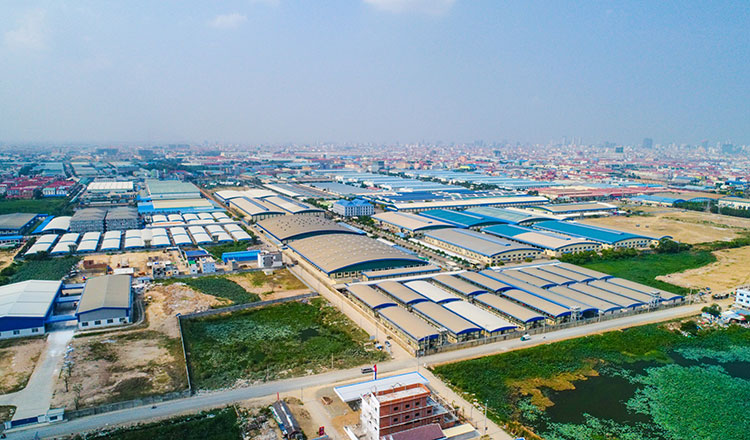
EBA withdrawal could affect Cambodia’s real estate sector
(7 November 2018) The potential discontinuation of the European Union’s duty-free trade privileges under its Everything But Arms (EBA) pact has led to concerns over whether Cambodia’s real estate sector will be impacted in the coming months. The country’s real estate sector is largely driven by its tourism, agriculture and manufacturing sectors. Its industrial sector employs nearly one million workers, the majority of whom work in garment factories. According to the head of a real estate portal, the manufacturing sector has a big impact on real estate growth since property demand grows as people seek accommodation and other services in the vicinity of factories.
Read more>>

LAOS, THAILAND

China to create free trade zone with Thailand and Laos
(13 November 2018) As the US-China trade war escalates, China looks to mitigate the fallout by boosting economic ties with countries in the Mekong region by setting up a free-trade zone on the border between Thailand and Laos. According to Thai Commerce Minister Sontirat Sontijirawong, Thailand will arrange for talks between China and Laos to finalize a framework for the project which it expects to be completed in the next few years. According to the director-general of Thailand’s Negotiation Department, the free trade zone will cover an area stretching from the southern Chinese border district of Mohan to Chiang Khong in the far north of Thailand. Mekong countries also hope to profit from China’s Belt and Road Initiative (BRI) by exporting to the European market via China’s border with Kazakhstan.
Read more>>

MYANMAR

Myanmar eases restrictions on foreign bank lending
(9 November 2018) According to a written announcement which was signed by Myanmar deputy governor Soe Thein on November 8, the country will now allow foreign banks to provide financing to local businesses. This measure is aimed at injecting much needed capital into the country’s economy as local banks have previously lent largely on preferential terms to well-connected customers. An economic advisory to the State Counsellor indicated that the lack of access to capital has long been ranked in surveys as the leading problem faced by Myanmar businesses. Till now, foreign banks which are currently operating in Myanmar—namely Australia’s ANZ Bank, Singapore’s United Overseas Bank and Malaysia’s Maybank—can only provide loans to foreign entities in foreign currencies or to local firms via intermediaries. Despite the easing of restrictions, foreign banks are still barred from offering retail banking services.
Read more>>

VIETNAM

Vietnam ratifies Trans-Pacific trade pact
(12 November 2018) Vietnam’s legislative body has unanimously ratified the Comprehensive and Progressive Agreement for Trans-Pacific Partnership (CPTPP), making it the seventh country to do so. The government stated that the CPTPP was not merely a trade agreement but also a catalyst to greater change in the areas of legislation, government administration and social governance. According to the International Labour Organization (ILO), the pact includes specific requirements that will help Vietnam advance labour reforms and modernize its industrial relations system. Most significantly, taxes on nearly half of Vietnam’s garment exports to Canada will be removed immediately after the agreement takes effect, and 100% after four years. Its footwear and seafood industries will also benefit from the agreement.
Read more>>

THAILAND

Thailand gets ready to take ASEAN chair
(13 November 2018) Thailand has been getting its house in order in anticipation of its impending chairmanship of ASEAN. The country, which will take over the ASEAN chair from Singapore on November 15, has plans to address several domestic institutional hurdles in the next few months to ensure the smooth transition to its new role. According to the Bangkok Post, the 34th ASEAN Summit is scheduled for the third week of June 2019, while the 52nd ASEAN Ministerial meeting is set for the end of July 2019. Further, the 35th ASEAN Summit and the 14th East Asia Summit will be held in Bangkok in the first week of November 2019. According to the director-general of the Thai Department of ASEAN Affairs, Thailand will focus on three pillars during its chairmanship, i.e. a people-centred community, leaving no one behind, and looking ahead beyond 2040. As ASEAN coordinator on issues of sustainable development, Thailand is expected to link the ASEAN agenda with the United Nations’ Sustainable Development Goals 2030.
Read more>>


mekong-monitor-map

About Greater Mekong Subregion (GMS)

The Greater Mekong Subregion (GMS) Economic Programme was launched by the Asian Development Bank in 1992 connecting five developing ASEAN countries, namely Cambodia, Laos, Myanmar, Vietnam and Thailand, and Chinese provinces of Yunnan and Guangxi Zhuang Autonomous region. The region has some of the most robust economies sharing the Mekong River Basin thanks to its reform and liberalisation. The subregion is growing at a faster pace than the whole of East Asia and the Asia Pacific as the GDP growth rate for 2017 was at 6.4 percent, according to the World Bank. The population at the subregion as of 2016 is at 340 million while the GDP at PPP is at US$3.1 trillion in 2016. In 2015, trading within the region was at US$444 billion.

China-ASEAN Monitor


img-ca-141118

File Photo


Economy, Investment and Trade

17th ASEAN-China Transport Ministers Meeting
(8 November 2018) The Seventeenth ASEAN and China Transport Ministers Meeting (17th ATM+China) was co-chaired by the Thai transport minister and Chinese transport vice minister. The joint ministerial statement commended ASEAN and China’s 15-year transport cooperation and expressed appreciation for the progress made in numerous major joint projects and activities. Further, the ministers adopted in principle the 2018-2020 Action Programme of the Revised Strategic Plan for ASEAN-China Transport Cooperation which aligns ASEAN’s goals and actions in the Kuala Lumpur Transport Strategic Plan 2016-2025 with China’s vision for its Belt and Road Initiative (BRI). The Eighteenth ASEAN and China Transport Ministers Meeting (18th ATM+China) will be held in Vietnam in 2019.
Read more>>

Thailand-China economic cooperation to be upgraded
(8 November 2018) Thailand and China inked an agreement to further enhance trade and economic cooperation, with the aim to double bilateral trade to US$140 billion by 2021. Trade between the two countries in the first nine months of 2018 reached US$45.71 billion, up 11.6% from the same period in 2017. According to Thai Commerce Minister Sontirat Sontijirawong, the cooperation will cover seven key areas namely trade, investment, science and technology, digital tourism, finance and regional economic cooperation. Collaborative initiatives included providing support to Thai entrepreneurs’ in their involvement in the China International Import Expo (CIIE) every year, promoting cooperation on farm products and the organizing of regular joint working meetings.
Read more>>

China and Myanmar ink Kyaukphyu SEZ deal
(8 November 2018) The Kyaukphyu Special Economic Zone (SEZ) Management Committee and China International Trust and Investment Corporation (CITIC) signed a framework agreement to develop Rakhine State’s Kyaukphyu SEZ. Located strategically between China, India and ASEAN, the project will enable China to access the Bay of Bengal to further enhance Beijing’s reach in the region through its Belt and Road Initiative (BRI). The first phase of the project which involves the construction of two jetties that cost up to US$1.3 billion, will commence after environmental and social impact assessments are conducted. According to the framework agreement, a joint Myanmar-Chinese consortium will hold the rights to operate the port.
Read more>>

More development aid is expected during Chinese President’s next visit
(9 November 2018) Chinese President Xi Jinping is expected to visit the Philippines after November 18, his first of such visit since the election of Philippine President Rodrigo Duterte in 2016. High on the agenda is cooperation to further President Duterte’s five-year ‘Build, Build, Build’ policy. This includes commitments to help build a US$3.3 billion railway line from Manila to the Bicol Peninsula and a US$606 million railway line in Mindanao. Further, the governments are expected to discuss cooperation for joint oil or gas exploration off the coast of Palawan, as the Philippines looks to develop undersea fuels to reduce dependency on costly imports. The two presidents last met in 2016 in Beijing where China pledged US$24 billion in development aid and investment for the Philippines.
Read more>>

ASEAN sec-gen lauds cooperation with China
(11 November 2018) Ahead of the 33rd ASEAN Summit, ASEAN Secretary-General Lim Jock Hoi lauded relations between ASEAN and China in a written interview with media portal Xinhua. According to Lim, China has been ASEAN’s largest trading partner since 2009, accounting for 17.1% of its total trade in 2017, and that cooperation between both parties have expanded and deepened over the years. Further, he looked forward to ASEAN and China making greater strides in several areas of cooperation such as in the implementation of the China-ASEAN FTA and the ‘Declaration on the Conduct of Parties in the South China Sea’ as well as in the pursuance of mutually beneficial initiatives to address traditional and non-traditional security challenges.
Read more>>


Indonesia: 3Q18 GDP growth – In line with expectation


HIGHLIGHTS

3Q18 GDP growth: In line with expectation

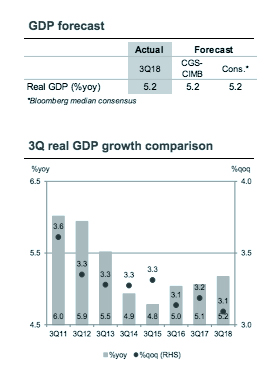
  • 3Q18 real GDP growth of 5.2% yoy was supported by investment activity and public consumption whereas net exports remained a drag on GDP growth.
  • We revise our 2018 GDP growth forecast lower by 0.1% pt to 5.2% on account of softer global growth, a weaker rupiah and tighter monetary policy.

img-ind31-1

3Q18 GDP growth eased to 5.2% yoy, as expected
3Q18 real GDP growth was in line with expectation at 5.2% yoy, easing from the 4.5-year high of 5.3% yoy in 2Q18. On a quarterly basis, GDP rose 3.1% qoq (+4.2% qoq in 2Q18).

The drag from net exports extended into fourth quarter
The contribution of net exports remained a drag on GDP growth (-1.1% pt vs. -1.2% pt in 2Q18) as import growth stood resilient to meet expanding domestic demand (+5.8% yoy in 3Q18 vs. +5.4% yoy in 2Q18) while moderation in export performance due to lower O&G exports was mitigated by a bump up in exports of services as a result of increased tourist spending during the Asian Games.

Sports event supported discretionary spending
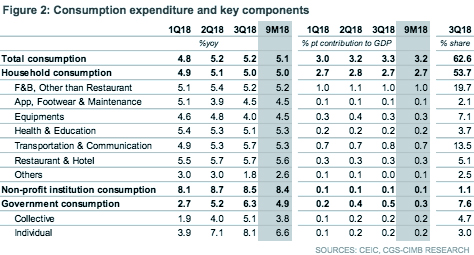
The Asian Games also boosted household spending on apparel, footwear & maintenance, restaurant & hotel, as well as transport & communication, which at the same time was driven by higher car sales. Nonetheless, selected school closures during the Asian Games impacted education consumption whereas F&B consumption normalised post the Lebaran celebration. As a result, household consumption growth marginally eased to 5.0% yoy in 3Q18 (+5.1% yoy in 2Q18).

Public consumption growth at 11-quarter high
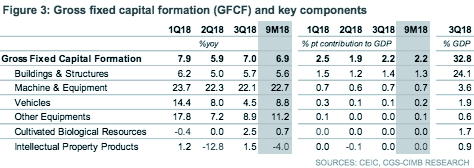
Public consumption growth strengthened to 6.3% yoy (+5.2% yoy in 2Q18), the strongest expansion since 2015, on the back of higher spending on personnel, materials and subsidies. Investment momentum recovered in 3Q18 (+7.0% yoy vs. +5.9% yoy in 2Q18) as the growth in buildings & structures picked up the slack from the long festive holiday in 2Q18, which in turn also supported construction activity (+5.8% yoy vs. +5.7% yoy in 2Q18). Investment in machine & equipment remained resilient due to the delivery of rolling stocks that are expected to continue into 4Q18.

2018 GDP growth revised lower to 5.2%
We revise our 2018 GDP growth forecast lower by 0.1% pt to 5.2% (vs. +5.3% previously) as we think economic activity is unlikely to improve significantly in 4Q18 (+5.2% yoy in 9M18) on the back of 1) a weaker global growth outlook amid US-China trade tension, 2) a softer rupiah, and 3) a tighter monetary policy after Bank Indonesia’s (BI) 150bp rate hikes to maintain macroeconomic stability. We expect BI’s monetary policy to remain guided by the need to maintain attractive yield differentials and a manageable current account deficit (CAD). As such, we anticipate another 25bp hike by the central bank in December, lifting the policy rate to 6.00% by end-2018.


img-ind31-2

img-ind31-3

Household consumption growth eased slightly to 5.0% yoy in 3Q18 as F&B consumption normalised post the Lebaran celebration. The Asian Games boosted household spending on apparel, footwear & maintenance, restaurant & hotel, as well as transport & communication, which was at the same time driven by higher car sales. Nonetheless, selected school closures during the Asian Games impacted education consumption.

img-ind31-4

Investment momentum picked up in 3Q18 (+7.0% yoy vs. +5.9% yoy in 2Q18) on the back of stronger outlays in buildings & structures and other equipment. Capital expenditure on machine & equipment remained resilient, expanding 22.1% yoy (+22.3% yoy in 2Q18).

img-ind31-5

Agriculture output growth weakened in 3Q18 due to slower expansion in food crop and CPO production. Coal mining single-handedly lifted mining growth as O&G output declined. Stronger manufacturing activity was supported by transport equipment, tobacco processing, basic metals, textiles & wearing apparel as well as paper and printing. Construction activity was supported by ongoing infrastructure projects as part of the government’s national strategic projects. The Asian Games lifted activities in the wholesale & retail trade, accommodation, food & beverages as well as information & communication segments.

img-ind31-6


Originally published by CIMB Research and Economics on 6 November 2018.

CARI Captures 379

c379_graphic


ASEAN

ASEAN manufacturing sector PMI falls below the no-change level in October 2018
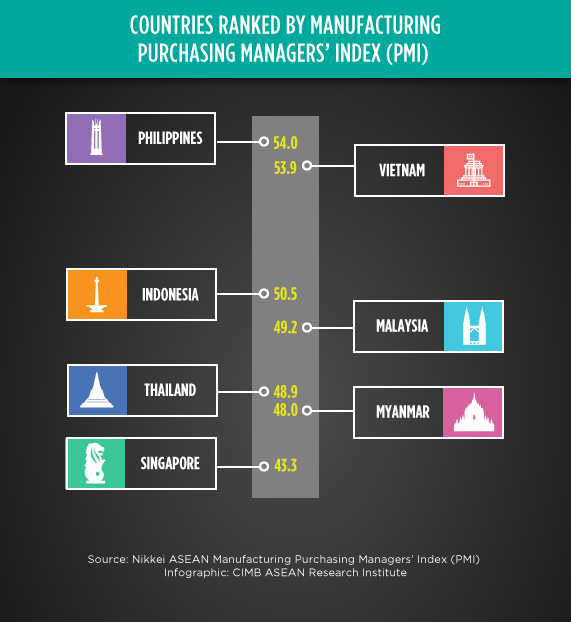
(5 November 2018) The region’s manufacturing performance dipped to its lowest in 15 months from 50.5 in September to 49.8 in October according to data from Nikkei’s ASEAN Manufacturing Purchasing Managers’ Index (PMI) due to among other reasons, inflationary pressures. This marks the first time since December 2017 that PMI posted below the no-change 50.0 level. The Philippines topped the ranking with a PMI of 54.0, followed by Vietnam and Indonesia. Despite the drop in October, IHS Markit economist David Owen said that the outlook for ASEAN manufacturing businesses remained positive for the coming year.

ASEAN

Leaders gear up for the 33rd ASEAN Summit
(7 November 2018) ASEAN leaders will convene in Singapore on November 13 to 15 for the 33rd ASEAN Summit. High on the agenda are regional economic integration, cybersecurity cooperation and finalization of the Regional Comprehensive Economic Partnership (RCEP) trade agreement. The ASEAN Plus Three Summit, East Asia Summit and ASEAN Business and Investment Summit (ABIS) will also run parallel to the main summit. Organized by the ASEAN Business Advisory Council (ASEAN-BAC), this year’s ABIS will revolve around the theme ‘Building Tomorrow, Connecting Today’ which encapsulates the ASEAN-BAC’s goal of being forward-looking in approach and innovative in building towards a resilient ASEAN. At the end of the ASEAN Summit and related meetings, Singapore will hand over the ASEAN chairmanship to Thailand.

ASEAN

The case for RCEP as Asia’s next trade agreement
(6 November 2018) The 16 negotiating parties—including 10 ASEAN Member States—involved in the Regional Comprehensive Economic Partnership (RCEP) are racing to reach a conclusion by the end of the upcoming ASEAN Summit. Once finalized, the RCEP will provide a free trade area that covers 3.6 billion people and a GDP of US$25 trillion. Subsequently, global trade is expected to rise by 1.9% while global real incomes will increase by an estimated US$286 billion per year. However, much remains to be done given that only four of 21 chapters have been finalized thus far. Furthermore, the US-China trade war could complicate RCEP negotiations. Many Asian countries appreciate the need for strong coalitions to counter US dominance while there are also concerns that the conflict could shift Chinese exports towards the various Asian markets.

ASEAN

Korean SMEs eye Southeast Asian market
(7 November 2018) The Korean government has allocated US$13.4 million to help Korean small and medium enterprises (SMEs) break into the Southeast Asian market. Korea’s presidential adviser for economic affairs Kim Hyun-chul referred to the region as “a blue ocean” in his announcement of the proposed financial support. A task force comprising state-led banks and commercial banks will be formed before seeking parliamentary approval for the proposal. According to Korea’s presidential office, trade volume between Korea and ASEAN countries is expected to reach an all-time high at US$160 billion by the end of 2018.

MYANMAR

Myanmar looks east for investments
(5 November 2018) Myanmar has established a 20-year investment promotion plan which centres on attracting foreign investment from Asian countries. According to Myanmar Investment Commission (MIC) head Thaung Tun, this “Look East Policy” is aimed at Japan, Korea, Hong Kong, Southeast Asia and India. Myanmar attracted a total of US$6.1 billion in FDI in 2017. The government has forecasted that this figure will reach US$220 billion in the next 20 years under the new Myanmar Investment Promotion Plan (MIPP) and has prioritized export and domestic import substitution businesses to alleviate the trade deficit.

SINGAPORE

SingPost launches new logistics platform to facilitate e-commerce
(5 November 2018) Singapore’s postal services (SingPost) announced two new digital platforms to enhance postal operations and provide seamless e-commerce transactions across the ASEAN region. The first platform (SmartPost) will digitalize the company’s postal operations by equipping its postal distribution workforce with a mobile application. Further, Near Field Communication (NFC) tags will also be used to help track and confirm receipt of registered mail. The second platform (LaMP) is an integrated last-mile platform which integrates courier services, parcel lockers and collections. This platform will provide customers with the option of receiving parcels through any last-mile delivery node in the network in any Southeast Asian country. According to SingPost’s chief digital officer, the company aims to be the last-mile delivery and urban logistics solution of choice for the region.

SINGAPORE, INDONESIA

Central banks set up US$10 billion bilateral financial arrangement
(5 November 2018) The Monetary Authority of Singapore (MAS) and Bank Indonesia agreed to form a US$10 billion bilateral financial arrangement that will enable both sides to access foreign currency liquidity from each other. The agreement, which will be in place for a year, allows for the exchange of local currencies of up to US$7 billion and an enhanced bilateral US dollar repurchase arrangement of US$3 billion. According to Bank Indonesia governor Perry Warjiyo, the arrangement reflects the strengthened bilateral monetary and financial cooperation between Singapore and Indonesia, and indicates the commitment of the authorities of both countries to maintain financial stability amid uncertainties in the global financial market. MAS managing director Ravi Menon added that the arrangement will instil confidence among investors.

MALAYSIA

US$720 million budget for Industry 4.0 initiatives
(6 November 2018) Malaysia announced an allocation of US$720 million for an Industry Digitalization Transformation Fund established to accelerate the development of the country’s digital economy. The fund includes US$50 million to help businesses migrate to Industry 4.0 through a Readiness Assessment Programme. Also notable was a US$240 million allocation for a National Fibre Connectivity Plan, a five-year plan to enhance connectivity in rural areas. Finance Minister Lim Guan Eng hopes the fund will help expedite the adoption of smart technologies such as robotics and artificial intelligence in Malaysia.

CAMBODIA

Cambodia to boost clean energy use alongside coal
(7 November 2018) According to the World Bank, only 16% of the Cambodian population had access to power back in 2000 compared to 87% of villages and 73% of households that have access today. The country intends to ensure that by 2020, everyone is connected to the grid through hydropower, coal or solar energy. According to its Ministry of Mines and Energy, the government plans to adopt solar power systems to reach communities in remote areas. For example, a 10 megawatt solar plant was activated this year and a larger-scale 60 megawatt solar plant will be completed by the end of 2019.

VIETNAM

Vietjet’s market capitalization exceeds that of AirAsia
(8 November 2018) Vietnam’s largest budget carrier Vietjet Aviation is now the second most valuable airline by market capitalization in Southeast Asia behind Singapore Airlines. The airline, which has routes to destinations in nine countries and territories, is currently deliberating additional routes to India, Russia, Australia and Europe. It also overtook Vietnam Airlines in domestic traffic in 2017. According to Vietjet head Nguyen Thi Phuong Thao, Japan Airlines will play a central role in its global expansion. Both airlines started code sharing domestic flights in October and are working on a code share arrangement for long-haul flights to the US.

Mekong Monitor


img-mm-081118

Photo credit: Real Estate


TRADE, ECONOMY, AND INVESTMENT


CAMBODIA

EBA withdrawal could affect Cambodia’s real estate sector
(7 November 2018) The potential discontinuation of the European Union’s duty-free trade privileges under its Everything But Arms (EBA) pact has led to concerns over whether Cambodia’s real estate sector will be impacted in the coming months. The country’s real estate sector is largely driven by its tourism, agriculture and manufacturing sectors. Its industrial sector employs nearly one million workers, the majority of whom work in garment factories. According to the head of a real estate portal, the manufacturing sector has a big impact on real estate growth since property demand grows as people seek accommodation and other services in the vicinity of factories.
Read more>>

LAOS

Chinese dams ramp up Lao external debt
(2 November 2018) As Laos’ ambitions to become the “battery” of Southeast Asia rises, so does its external debt. Laos’ external debt portfolio amounted to US$13.6 billion as of the end of 2017, with much of it borrowed from China. Public debt in Laos now accounts for nearly 70% of its annual GDP, and almost half of its borrowings come from China. Analysts have advised caution as Laos deepens its dependence on China. The country, which recently announced a US$2.1 billion hydropower project financed with a US$1.7 billion loan from China’s Export-Import Bank, expects 50 hydropower projects to be completed by 2025.
Read more>>

MYANMAR, THAILAND

Myanmar, Thailand to jointly upgrade highway to Dawei SEZ
(6 November 2018) Myanmar and Thailand will work together to upgrade a highway to link the planned deep-sea port at the Dawei Special Economic Zone (SEZ) in Myanmar with Thailand. Myanmar’s Construction Minister U Han Zaw said that the highway will encourage travel between the two countries, facilitate the transportation of raw materials for the construction of Dawei SEZ, and bolster economic development through increased seafood exports from southern Myanmar to Thailand. Through the agreement, Thailand’s Neighbouring Countries Economic Development Cooperation Agency (NEDA) will undertake survey and design work for the highway.
Read more>>

VIETNAM

Vietnam’s GDP to reach US$2.5 trillion in 2045
(2 November 2018) Prime Minister Nguyễn Xuân Phúc stated during a speech to Vietnam’s National Assembly that the country’s GDP is expected to reach US$2.5 trillion by 2045, with per capita income of US$18,000. The projection is based on Vietnam’s average yearly growth of over 6% and the economy expanding 17.4 times in the past three decades. However, the country will need to overcome great challenges in order to meet its target, especially given declining labour productivity in recent years. The head of state stressed that labour productivity must be improved through innovation and the application of science and technology.
Read more>>

THAILAND

Thailand looks to Alibaba for tourism push
(7 November 2018) Thailand will tap on Alibaba’s upcoming Singles’ Day campaign on November 11 to attract Chinese tourists to its country. According to Deputy Prime Minister Somkid Jatusripitak, Alibaba chairman Jack Ma agreed to the collaboration recently and invited them to screen a 20-second video during the campaign which will be viewed by 800 million Chinese citizens. Alibaba also affirmed its commitment to build a logistics hub in Thailand’s Eastern Economic Corridor (EEC) and provide logistics development training to officials from the Thai commerce, interior and agriculture ministries.
Read more>>


mekong-monitor-map

About Greater Mekong Subregion (GMS)

The Greater Mekong Subregion (GMS) Economic Programme was launched by the Asian Development Bank in 1992 connecting five developing ASEAN countries, namely Cambodia, Laos, Myanmar, Vietnam and Thailand, and Chinese provinces of Yunnan and Guangxi Zhuang Autonomous region. The region has some of the most robust economies sharing the Mekong River Basin thanks to its reform and liberalisation. The subregion is growing at a faster pace than the whole of East Asia and the Asia Pacific as the GDP growth rate for 2017 was at 6.4 percent, according to the World Bank. The population at the subregion as of 2016 is at 340 million while the GDP at PPP is at US$3.1 trillion in 2016. In 2015, trading within the region was at US$444 billion.

China-ASEAN Monitor


img-ca-071118

Photo credit: CGTN


Economy, Investment and Trade

English language Smart FTAX to help facilitate trade
(5 November 2018) The English language version of China’s Smart FTAX System was launched on the sidelines of the China International Import Expo (CIIE) on November 5. The system, described as the “international” version of the existing Smart FTAX, was created to enable Chinese and ASEAN small and medium enterprises (SMEs) to access information related to free trade agreement (FTA) policies, Most Favoured Nation (MFN) tariffs and other complex regulations. Chinese Vice Minister of Commerce Wang Shouwen stressed that the development of FTAs remained a national priority, while Malaysian Minister of International Trade and Industry Datuk Darell Leiking said that the English version Smart FTAX System will enable SMEs to better access and leverage the FTA’s benefits.
Read more>>

E-commerce sites gear up for Alibaba’s Singles’ Day
(5 November 2018) November 2018 will see the 10th anniversary of Alibaba’s annual shopping festival Singles’ Day. The festival, created in 2009, is considered to be Asia’s Black Friday. According to AdTech company Criteo, Singles’ Day broke online sales records across Southeast Asia in nearly every retail category last year. The sale is expected to continue to snowball across the region this year, what with Alibaba’s export-oriented e-commerce platform AliExpress and Alibaba’s Southeast Asian e-commerce platform Lazada participating in the festival. According to a study by Google and Temasek, Southeast Asia’s e-commerce market will be worth US$88.1 billion by 2025.
Read more>>

Philippines and China ink deals to further economic cooperation
(2 November 2018) China’s State Councilor and Foreign Minister Wang Yi led a delegation to Davao City to firm up agreements to further strengthen economic cooperation between the two countries. Three bilateral agreements were signed by ambassadors from the respective countries to confirm a feasibility study of the Davao River Bridge project, a supply of law enforcement equipment to the Philippines, and a grant for Typhoon Vinta victims. The meeting is a precursor to Chinese President Xi Jinping’s visit to the country later in November, where at least five more agreements are expected to be signed.
Read more>>

China firm to build US$1.92 billion resort near Labuan
(1 November 2018) A Chinese investor has committed US$1.92 billion to transform Kuraman Island into an international island resort. The project, which will comprise several hotels, residential and commercial projects, is expected to create 10,000 jobs and attract at least 800,000 tourists to Labuan every year. According to Labuan Corporation Chairman Datuk Seri Amir Hussien, the 10-year development which commences in 2019 will have trickle-down effects on Labuan’s local economy. Further, three man-made islands will be built around the existing Kuraman Island, culminating in a grand four-island resort which he compared to Mexico’s premiere coastal destination Cancun.
Read more>>

Singapore and Chongqing enhance regional collaboration
(2 November 2018) The inaugural China-Singapore Connectivity Initiative Financial Summit held in Chongqing saw 10 memorandum of understanding (MOUs) inked to promote cooperation between Singapore and western China. The MOUs signed included agreements to help develop Chongqing’s fintech industry, enhance support for the Southern Transport Corridor (STC) and help microfinance companies issue debt overseas. Further, OCBC Bank, Xiaomi Inc and Hanhua Financial Holding Co will explore fintech collaboration in the areas of retail and institutional financial services in China. The summit is a signature event under the China-Singapore (Chongqing) Demonstration Initiative on Strategic Connectivity (CCI).
Read more>>