CARI Captures Issue 727: Private funding for ASEAN’s digital economy lags global growth rate


Captures has widened its scope to include news related to all the members of the Regional Comprehensive Economic Partnership (RCEP) agreement which was signed towards the end of 2020. Besides the ASEAN Member States, this includes Australia, New Zealand, China, Japan, and South Korea. The other weekly newsletters under CARI, China-ASEAN Monitor and Mekong Monitor will also be consolidated into the Captures newsletter. We hope this new version of Captures will serve you better and look forward to providing a curation of stories relevant to ASEAN and its trading partners.

ASEAN
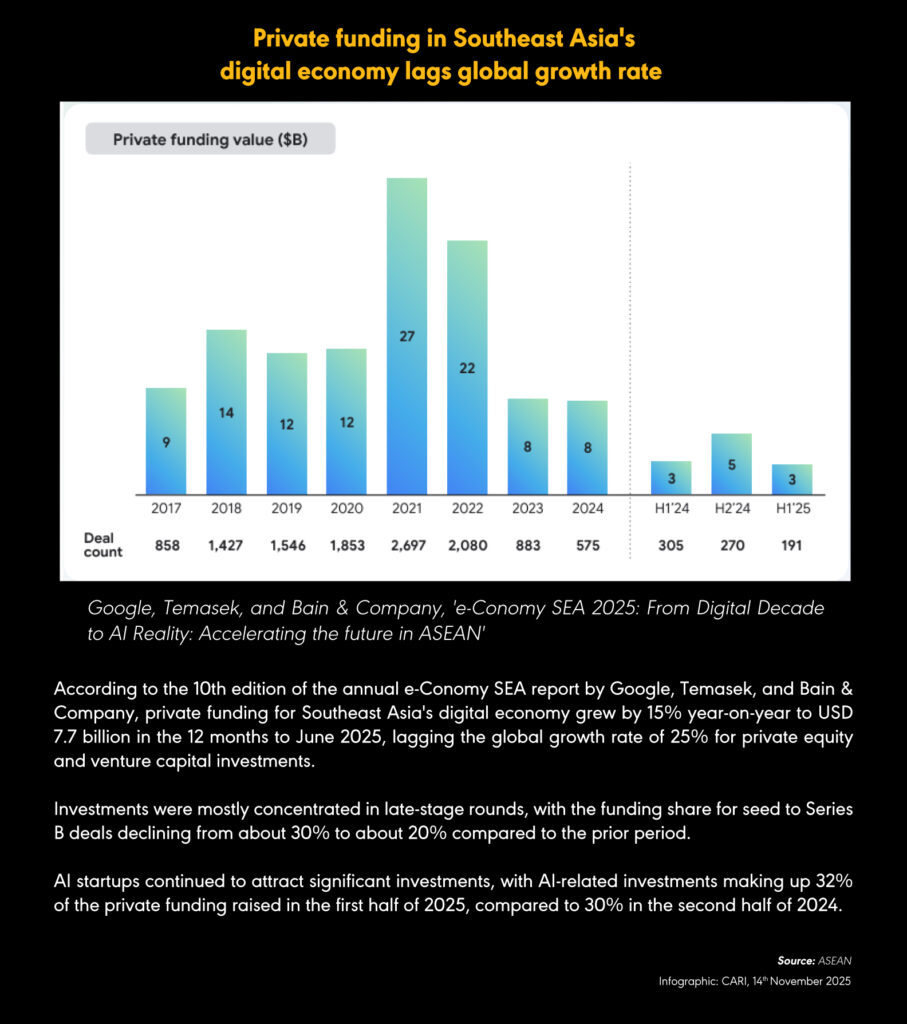
Private funding for ASEAN’s digital economy lags global growth rate
(11 November 2025) Private funding for Southeast Asia’s internet economy increased 15% year-on-year to USD 7.7 billion in the 12 months to June 2025, remaining about 70% below the 2021 peak of USD 27 billion and below the global private equity and venture capital growth rate of 25%, according to a report by Google, Temasek, and Bain. The report noted a shift toward late-stage investments, with seed-to-Series B funding falling from roughly 30% to about 20% over the period. For the first time, the report expanded its market coverage to include Brunei Darussalam, Cambodia, Lao PDR, and Myanmar. AI-related funding accounted for 32% of private capital raised in the first half of 2025 versus 30% in the second half of 2024, with over 680 AI startups securing more than USD 2.3 billion in the year to June, including more than 495 based in Singapore. The report highlighted accelerated data centre expansion, projecting Southeast Asia’s capacity to increase 2.8-fold once planned projects are completed, compared with 2.2-fold growth for the broader Asia-Pacific region. It cited major commitments such as TikTok’s nearly USD 4 billion data hosting plan in Thailand and further planned investments by Google and Amazon of USD 1 billion and USD 5 billion, respectively. Malaysia is expected to lead regional capacity growth with 2,415 MW of planned additions out of the region’s 4,620 MW total, supported by investments from Microsoft, Amazon, Google, Tencent, Huawei, and Alibaba, driven by favourable land and electricity costs and strong projected AI demand.

VIET NAM
Auto sales rise by 24% month-on-month in October 2025
(13 November 2025) Vietnam Automobile Manufacturers Association (VAMA) members sold 37,910 vehicles in October, a 24% month-on-month increase driven by stronger consumer demand, improved supply, and year-end promotional programmes. The sale of passenger cars rose 33% to 27,246 units, while those of commercial vehicles rose 6.6% to 10,162 units, and those of special-purpose vehicles declined by 15% to 502 units. Sales of locally assembled vehicles increased 19% to 17,129 units, while completely built-up imports rose 28% to 20,781 units, reinforcing the popularity of SUVs, sedans, and MPVs. Experts cited aggressive promotions, better supply chains, eased consumer credit, lower interest rates, rising urban demand, and the rollout of new Japanese, Korean, Chinese, and European models as key drivers. For the first ten months, VAMA members recorded 289,331 units sold, up 9.5% year-on-year, with domestic assembly up 2% and imports up 18%, signalling stronger demand for imported vehicles with broader design and technology options. VAMA data, however, exclude major brands such as VinFast and Hyundai. VinFast delivered a record 20,380 electric vehicles in October and 124,264 units in the first ten months of 2025, marking the highest-ever volume for a Vietnamese automaker and reinforcing its position in the domestic EV segment.

THAILAND
Government offering domestic travellers tax deductions of up to THB 30,000
(11 November 2025) Thailand’s government is offering domestic travellers tax deductions of up to THB 30,000 between 29 October and 15 December to stimulate the economy and support second-tier provinces such as Trang, but local businesses report limited impact due to the short programme window, weak economic conditions, and high household debt. Trang operators cite muted demand, with November–December reservations down about 50% year-on-year, despite 1.3 million Thai visitors in the first nine months of 2025 generating THB 6.7 billion in revenue. Hotel and tour operators note slow business onboarding into the deduction scheme and limited appeal among lower-income travellers who fall outside taxable brackets. The tax incentive forms part of broader government measures, including a THB 60 billion plan to purchase bad debt benefiting two million borrowers and efforts to attract more Chinese tourists. Bank of Thailand economists estimate that second-tier provinces account for about 13% of national tourism income, but the weak economic environment, recent flooding, and tensions from the Thai-Cambodian military clash are weighing on domestic travel sentiment. In Ubon Ratchathani, officials expect hotel occupancy to remain below 40% in the final two months of 2025. Restaurants are seen as the likely beneficiaries of the rebate, which can also be used for food purchases without travel.

THAILAND
BOI approves first phase of FastPass system to accelerate permit and approval processing times
(10 November 2025) The Thai Board of Investment (BOI) approved the first phase of its FastPass system on 10 November 2025, aiming to accelerate “Quick Big Win” investments by integrating seven key agencies — BOI, Department of Industrial Works, IEAT, ONEP, Immigration Bureau, Department of Employment and the EEC Office — to cut permit and approval processing times by 20%–50%. A new Investment Acceleration Subcommittee will oversee implementation and expand FastPass to cover all major business licensing procedures. The BOI meeting also reviewed progress on resolving three structural bottlenecks: electricity supply, where the Energy Regulatory Commission is fast-tracking a network usage guarantee mechanism and plans to finalise UGT2 and Direct PPA criteria and fees by end-2025; land provision, where the Department of Public Works, EEC and IEAT are revising town planning, expediting industrial land EIAs and addressing public thoroughfare issues; and visas and work permits, where e-Visa processing for BOI-approved personnel will be shortened to 1–5 working days, OSS Centre capacity will increase from 200 to 500 queues per day, and technical integration issues in the e-Work Permit system are being resolved.

MALAYSIA
GDP grows 5.2% year-on-year in third quarter of 2025, fastest pace in four quarters
(14 November 2025) Malaysia’s GDP grew 5.2% year-on-year in the third quarter, up from 4.4% in the previous quarter and the fastest pace in four quarters, supported by sustained domestic demand and higher net exports, according to Bank Negara Malaysia’s quarterly report. Services expanded 5.0%, driven by wholesale and retail trade, transportation, food and beverages, and accommodation, while manufacturing grew 4.1% on stronger output in electrical, electronic, and optical products, food processing, and non-metallic mineral and metal subsectors. Mining and quarrying rebounded 9.7% after a 5.2% contraction in the second quarter due to higher natural gas and crude oil production, and construction recorded 11.8% growth, led by civil engineering, specialised construction, and non-residential building activity. The central bank maintained its policy rate this month after cutting it from 3% to 2.75% in July to mitigate external risks and trade uncertainties. Government forecasts place GDP growth at 4%–4.8% in 2025 and 4%–4.5% in 2026, compared with 5.1% in 2024, while the World Bank projects 4.1% growth in both 2025 and 2026 amid expectations of slower medium-term momentum.

INDONESIA
Indonesia plans to commercialise palm oil-derived aviation fuel within two to three years
(14 November 2025) Indonesia is testing palm oil–derived sustainable aviation fuels (SAF) with plans to commercialise them within two to three years, part of a broader effort to reduce energy imports, expand biodiesel use, and increase value-added activities in the palm oil sector. Pertamina is conducting SAF trials with Pelita Air, Garuda Indonesia, and Citilink, claiming potential emissions reductions of up to 84%, with its Cilacap refinery able to produce about 238,000 kilolitres annually and another refinery in South Sumatra able to shift capacity if needed. Current tests involve used cooking oil and palm oil mill effluent after earlier palm kernel oil–based attempts proved too costly. Garuda has trialled palm oil–based jet fuel on Jakarta–Amsterdam flights with stable results, while Airbus Indonesia noted SAF’s compatibility with existing aircraft and airport infrastructure. The government is seeking investment from Danantara, the sovereign wealth fund, to scale SAF production. In parallel, Indonesia plans to raise its biodiesel mandate from 40% to 50% next year, with B50 road tests scheduled for December across six sectors, though officials acknowledge challenges from stagnant palm oil output. To address supply constraints, the Ministry of Agriculture aims to open 600,000 hectares of new oil palm plantations starting next year.

MALAYSIA
Malaysia, Singapore, and Indonesia mull trilateral cooperation under JS-SEZ
(13 November 2025) Malaysia, Singapore, and Indonesia have begun preliminary discussions on potential trilateral cooperation under the Johor-Singapore Special Economic Zone (JS-SEZ), with Malaysia’s Investment, Trade, and Industry Minister stating that senior officials from all three countries will conduct a detailed study following talks held with Singapore’s Deputy Prime Minister and Indonesia’s Coordinating Minister for Economic Affairs at the ASEAN Summit. The exploration marks the first comprehensive assessment of a concept previously raised but not formally evaluated. Malaysia’s Investment, Trade, and Industry Minister said the JS-SEZ is progressing well and that a tripartite expansion could offer additional benefits, though formal engagement will depend on the study’s findings. Singapore’s Deputy Prime Minister earlier disclosed that Singapore is considering collaboration involving both the JS-SEZ and Indonesia’s Batam, Bintan, and Karimun (BBK) region, where Singapore is a major investor. The JS-SEZ currently spans around 357,128 hectares across Iskandar Malaysia, Forest City, the Pengerang Integrated Petroleum Complex, and Desaru.


RCEP Monitor


SOUTH KOREA
South Korea to raise passenger electric vehicle subsidies by 20% in 2026
(14 November 2025) South Korea will raise passenger electric vehicle subsidies by 20% to KRW 936 billion in 2026, up from KRW 780 billion this year, as part of a support package designed to mitigate risks from U.S. tariffs and bolster domestic EV demand. The package includes policy finance exceeding the KRW 15 trillion provided to auto parts suppliers in 2025 and expanded guarantee programmes offering long-term, low-interest loans to parts makers operating overseas, including in the United States and Mexico. The auto sector exported USD 70.8 billion in 2024, representing over 10% of South Korea’s total exports, with Hyundai Motor and Kia facing a 25% U.S. tariff that was reduced to 15% under a recent bilateral agreement. However, the lower tariff has not yet taken effect because both countries have yet to issue the joint fact sheet required to formalise the agreement, despite its announcement more than two weeks ago by U.S. President Donald Trump and South Korean President Lee Jae Myung.

AUSTRALIA
Home loans reach record high in third quarter, reinforcing RBA’s pause
(12 November 2025) Australian Bureau of Statistics data show new residential lending reached a record high in the third quarter, with investor loans rising 13.6% over the September quarter to their strongest level since early 2022 and lifting total dwelling finance to a new peak; investor lending now accounts for about 40% of new loans. Owner-occupier lending also increased in both number and value. ABS attributed the trend to lower borrowing costs and tight rental markets. The data indicate that the Reserve Bank of Australia’s three rate cuts this year have eased financial conditions while inflation remains above target, supporting the RBA’s decision to keep the cash rate at 3.6% and signal a prolonged pause. Commonwealth Bank assessed the lending increase as evidence of a sustained cyclical upturn and as marginal support for the RBA’s stance against additional near-term cuts. The lending figures follow consumer sentiment data showing optimism for the first time in almost four years, while labour market data due Thursday are expected to show unemployment declining to 4.4% in October.

AUSTRALIA
Consumer confidence rise 12.8% in November, marking first return to net optimism since February 2022
(11 November 2025) Australia’s consumer confidence rose 12.8% in November to 103.8, according to Westpac, marking the first return to net optimism since February 2022 and ending a 44-month period dominated by pessimism; Westpac cited strengthening domestic demand and housing activity as key drivers. The Reserve Bank maintained the cash rate at 3.6% last week and indicated limited scope for near-term easing despite three cuts earlier this year. Households’ assessment of their financial position improved, with the family finances next-12-months sub-index up 12.3% to 109.1, though households with mortgages recorded a 0.3% decline in expectations. Labour-market concerns increased, with the Westpac–Melbourne Institute Unemployment Expectations Index rising 9.3% to 139.5. NAB’s October business survey showed declining business confidence but stronger conditions, supported by gains in profitability and trading, while employment was stable. Consumer sentiment toward major purchases strengthened sharply, with the time-to-buy-a-major-item index up 14.9% to 111.6, though the family-finances-vs-a-year-ago sub-index remained in pessimistic territory at 85.2. Homebuyer sentiment was little changed, with the time-to-buy-a-dwelling index down 0.1% to 96.4, while house-price expectations increased 0.3% to 172.4, reaching a new cycle high.

15 participating countries

20 chapters

2.2 billion

US$26.2 trillion

28%

ASEAN member states, Australia, China, Japan, South Korea, New Zealand trade in goods and services, investment, intellectual property, e-commerce, competition, SMEs, economic and technical cooperation, and government procurement combined population, 30% world’s population combined GDP, 30% global GDP global trade (based on 2019 figures)

CARI Captures Issue 726: The Philippines submits application to join CPTPP amidst growing trade protectionism


Captures has widened its scope to include news related to all the members of the Regional Comprehensive Economic Partnership (RCEP) agreement which was signed towards the end of 2020. Besides the ASEAN Member States, this includes Australia, New Zealand, China, Japan, and South Korea. The other weekly newsletters under CARI, China-ASEAN Monitor and Mekong Monitor will also be consolidated into the Captures newsletter. We hope this new version of Captures will serve you better and look forward to providing a curation of stories relevant to ASEAN and its trading partners.


THE PHILIPPINES
The Philippines submits application to join CPTPP amidst growing trade protectionism
(03 November 2025) The Philippines submitted an application in August 2025 to join the 12-member Comprehensive and Progressive Agreement for Trans-Pacific Partnership (CPTPP), according to Japanese government sources. The submissions, sent to New Zealand as the bloc’s administrative hub, are the first since Indonesia’s in September 2024. Other pending applicants include China, Taiwan, Ecuador, and Uruguay. The CPTPP currently comprises Viet Nam, Singapore, Brunei Darussalam, Malaysia, Australia, New Zealand, Japan, Canada, Mexico, Peru, Chile, and the U.K., with Costa Rica in accession talks. Accession negotiations require unanimous consent from existing members, and a decision on new applicants could be made at the upcoming ministerial meeting later this year. The U.K.’s accession took over two years to conclude. The Philippine Chamber of Commerce and Industry described Manila’s application as a “strategic move” to safeguard its economic future amid growing global trade protectionism. Japan has called the Philippines a “promising candidate,” noting its closer economic and security ties with Tokyo, including a reciprocal access agreement that took effect last year. Japan’s 2017 estimates projected CPTPP membership could raise its GDP by 1.5%, with the 12 current members representing about 15% of global GDP.

THAILAND
Total car production in September up 14.01% month-on-month and 4.77% year-on-year
(05 November 2025) Thailand’s Automotive Industry Club of the Federation of Thai Industries reported that total car production in September 2025 reached 128,104 units, up 14.01% month-on-month and 4.77% year-on-year, mainly driven by higher output of electric vehicles (EVs) and pickup passenger vehicles (PPVs), while pickup truck production declined due to economic pressure and tighter lending. Exports accounted for 85,625 units or 66.84% of production, down 2.33% year-on-year, with January–September exports totalling 708,694 units, a decline of 8.46% from 2024. Domestic sales-related production totalled 42,479 units, a 22.73% year-on-year increase, while cumulative domestic production for January–September rose 3.75% to 367,107 units. Domestic car sales reached 48,350 units, up 1.53% from August and 23.82% from September 2024, led by EVs, though pickup truck sales fell 4.00%. Exports of finished cars reached 86,056 units, up 20.90% month-on-month and 7.23% year-on-year, supported by new PPV and EV exports, while internal combustion engine exports fell 16.97%. Export growth was noted in markets including Australia, the Middle East, Africa, Europe, and Central and South America.

THAILAND
Household debt reaches 88.2% of GDP in Q1 2025, ranking seventh globally
(04 November 2025) Thailand’s household debt reached 88.2% of GDP at the end of Q1 2025, ranking seventh globally, according to Trading Economics, and remains above the Bank for International Settlements’ sustainable threshold of 80%, which the country surpassed in 2012. The ratio peaked at 94.6% in 2021 and has since declined slowly, while the National Statistical Office reported average household debt of THB 144,871 as of June 2025, down from THB 197,000 in 2023. The International Monetary Fund forecasts GDP growth of 2% in 2025 and 1.6% in 2026, with weakening consumer confidence reflected in stagnant housing markets, declining restaurant activity, and slow automotive recovery after a 26% contraction in 2024. Rising consumption-driven debt and tightened lending conditions have strained households across income groups, with pawnshops and informal lenders widespread. Krungsri Auto offers loans of up to 80% of a used vehicle’s value, while banks have increased collateral requirements. Farmers remain heavily indebted to banks and agro-industrial firms, with cassava and rice producers among the most affected by price drops. The Ministry of Social Development and Human Security reported over THB 20 billion in state pawnshop loans in 2024, primarily for gold and mobile phones. Prime Minister Anutin Charnvirakul, who took office last month, has pledged debt relief subsidies of up to THB 100,000 per person and THB 1 million for small and medium enterprises to improve liquidity. The Bank of Thailand aims to reduce household debt to 80% of GDP within five years, though analysts warn that many households will remain burdened without stronger financial literacy and structural reforms.

MALAYSIA, UNITED STATES
Malaysian government defends reciprocal trade agreement with the United States
(04 November 2025) Malaysia’s Ministry of Investment, Trade and Industry stated on 03 November 2025 that the country’s sovereignty remains intact under its new reciprocal trade agreement (ART) with the United States, asserting that Malaysia is not bound by US sanctions and need not amend its existing laws to join the pact. The clarification followed criticism from former prime minister Mahathir Mohamad, who called for Prime Minister Anwar Ibrahim’s resignation, alleging that the deal subordinates Malaysia to US interests. Lawmakers also raised concerns over clauses enabling Washington to impose new tariffs or influence Malaysia’s trade alignment. The ministry said Malaysia would act only on matters involving mutual economic or security interests, subject to consultations and cost-benefit evaluations. The Attorney-General’s Chambers stated separately that Malaysia retains the unilateral right to terminate the agreement, emphasising that all safeguards are designed to preserve national sovereignty and protect national interests.

MALAYSIA
Ringgit edges higher after Bank Negara Malaysia maintains rate at 2.75%
(06 November 2025) The ringgit closed higher on Thursday at 4.1820/1845 against the US dollar, up 70 pips from 4.1890/1925 the previous day, following Bank Negara Malaysia’s decision to maintain the Overnight Policy Rate at 2.75% in its final Monetary Policy Committee meeting of 2025. Bank Muamalat Malaysia said the unchanged rate is ringgit-positive and likely to persist as inflation remains moderate, while IPPFA Sdn Bhd said the move underscores policy stability and confidence in domestic demand resilience amid contained inflation. He added that the ringgit’s gains aligned with broader Asian currency appreciation, noting that the US dollar rally appears to be weakening. The ringgit also rose against the yen to 2.7202/7220, the Singapore dollar to 3.2034/2055, the Indonesian rupiah to 250.3/250.6, and the Philippine peso to 7.09/7.10, but declined against the British pound to 5.4696/4729, the euro to 4.8143/8172, and the Thai baht to 12.9178/9311.

VIET NAM
Trade surplus narrows for second consecutive month in October
(06 November 2025) Viet Nam’s trade surplus narrowed for a second consecutive month in October to USD 2.6 billion from USD 2.85 billion in September, as both exports and imports undershot expectations, according to the National Statistics Office. Exports rose 17.5% year-on-year to USD 42 billion versus forecast growth of 19.5%, while imports climbed 16.8%, below the 19.3% estimate. The S&P Global manufacturing PMI increased to 54.5 from 50.4, marking the strongest expansion in a year. Ho Chi Minh City Securities said exporters had secured sufficient orders ahead of tariffs but projected export growth to slow to 7–8% in 2026 due to the full effect of US tariffs. In the first ten months of 2025, Viet Nam’s trade surplus with the US reached USD 111 billion, up 28.2% from a year earlier, driven by frontloaded orders before tariff implementation. The US initially threatened a 46% levy, later reduced to 20%, slightly above rates imposed on neighbouring ASEAN countries. Under a framework announced on 27 October, Vietnam will grant preferential access to US industrial and agricultural exports, while the US will eliminate tariffs on selected products, though definitions of “transshipped” goods—subject to a 40% tariff—remain pending. Viet Nam’s trade deficit with China widened 38.6% to USD 93.9 billion in the same period. Consumer prices rose 3.25% in October, below the 3.5% forecast. The government targets annual GDP growth of at least 10% over the next five years, following an 8.2% expansion last quarter, the fastest in three years.

SINGAPORE
Singapore blocks 3% of 1,300 applications for family offices over past three years
(05 November 2025) Singapore blocked 3% of 1,300 applications over the past three years to establish tax-exempt family offices, and revoked tax incentives for two family offices linked to the Prince Group, the Deputy Chair of the Monetary Authority of Singapore told parliament. The Prince Group was sanctioned by the US and UK in October for operating scam centres using trafficked workers, with Singapore police seizing over SGD 150 million in related assets, including six properties, bank and securities accounts, and cash. The Deputy Chair said family offices connected to money laundering account for less than 1% of the total sector. The number of family offices rose to over 2,000 by end-2024 from 700 in 2021. Following the SGD 3 billion money laundering case in 2023—Singapore’s largest—tax incentives were withdrawn from six implicated family offices. Financial institutions have since tightened due diligence and closed some client accounts as part of enhanced scrutiny measures.


RCEP Monitor


SOUTH KOREA
Consumer price index increases by 2.4% year-on-year in October 2025
(04 November 2025) South Korea’s consumer price index increased by 2.4% year-on-year in October 2025, the highest level since July 2024 and above both September’s 2.1% and analysts’ expectations of 2.1%, according to government data. On a monthly basis, prices rose 0.3%, exceeding forecasts of no change. The acceleration strengthens the case for maintaining current monetary policy, with the Bank of Korea keeping its benchmark rate unchanged for the third consecutive month in October amid rising property prices and currency volatility. The Bank of Korea governor stated that most of the seven-member board remains open to a possible rate cut within three months, though analysts suggest the easing cycle has effectively ended at 2.50%. Citigroup projected short-term deflationary pressures in agricultural and service prices following the holiday season, while the market median expects one additional rate cut in November before a prolonged pause.

AUSTRALIA
Home prices rise 1.1% in October, fastest monthly increase since June 2023
(02 November 2025) Australian home prices rose 1.1% in October, the fastest monthly increase since June 2023, with both national and capital city indices reaching new records, according to property consultancy Cotality. Perth recorded the highest rise at 1.9%, followed by Brisbane at 1.8%, Darwin at 1.6% and Sydney at 0.7%. The increase came ahead of the Reserve Bank of Australia’s expected decision to keep rates unchanged at 3.6%, after three rate cuts since February. Cotality attributed the upturn to lower borrowing costs and expanded first home buyer incentives, noting that middle and lower-priced housing segments drove most gains as affordability constraints shifted demand. The upper quartile segment showed the weakest growth across major cities. National home sales are tracking 3.1% above the five-year average, while listings over the four weeks to 26 October were 18% below average, indicating continued supply shortages. Median dwelling value in Sydney reached AUD 1.26 million, about 11 times the median household income. Gross rental yields fell to 3.4%, the lowest since October 2022, as rents rose but housing values climbed faster. Bloomberg Economics’ said the RBA’s rate cuts in February, May and August are supporting demand amid tight housing supply.

NEW ZEALAND
Unemployment rate rises to 5.3% in third quarter of 2025
(05 November 2025) New Zealand’s unemployment rate rose to 5.3% in the third quarter from 5.2% in the previous quarter, reaching its highest level since late 2016, according to Statistics New Zealand. Employment was flat quarter-on-quarter, missing expectations for a 0.1% increase, and total employment remained 45,000 below its late-2023 peak. The labour force participation rate declined to 70.3%, the lowest since 2020, while annual wage inflation eased for the tenth consecutive quarter, with non-government ordinary time wages up 2.1% year-on-year versus 2.2% previously. The Reserve Bank of New Zealand has cut the Official Cash Rate by 300 basis points since August 2024 to 2.5% and is expected to reduce it by a further 25 basis points to 2.25% at its 26 November meeting, following weaker-than-expected job creation. ASB Bank said further monetary easing may be needed if the economic recovery remains subdued. The New Zealand dollar fell to 56.43 US cents and reached a 12-year low against the Australian dollar, reflecting policy divergence as the Reserve Bank of Australia kept its cash rate at 3.6%.

15 participating countries

20 chapters

2.2 billion

US$26.2 trillion

28%

ASEAN member states, Australia, China, Japan, South Korea, New Zealand trade in goods and services, investment, intellectual property, e-commerce, competition, SMEs, economic and technical cooperation, and government procurement combined population, 30% world’s population combined GDP, 30% global GDP global trade (based on 2019 figures)

CARI Captures Issue 725: Trade takes center stage at recent ASEAN Summit held in Kuala Lumpur, Malaysia


Captures has widened its scope to include news related to all the members of the Regional Comprehensive Economic Partnership (RCEP) agreement which was signed towards the end of 2020. Besides the ASEAN Member States, this includes Australia, New Zealand, China, Japan, and South Korea. The other weekly newsletters under CARI, China-ASEAN Monitor and Mekong Monitor will also be consolidated into the Captures newsletter. We hope this new version of Captures will serve you better and look forward to providing a curation of stories relevant to ASEAN and its trading partners.


ASEAN
Trade takes center stage at recent ASEAN Summit held in Kuala Lumpur, Malaysia
(27 October 2025) ASEAN leaders agreed to upgrade the ASEAN Trade in Goods Agreement (ATIGA) during the recent ASEAN Summit held in in Kuala Lumpur, Malaysia, with the upgraded agreement to expand the number of tariff-free goods, streamline customs procedures, and reduce nontariff barriers. The move, described by Malaysian Prime Minister Anwar Ibrahim as a “decisive step forward,” seeks to strengthen intraregional trade and reduce reliance on the U.S. and China amid global trade tensions driven by U.S. President Donald Trump’s tariffs. The original ATIGA removed around 98% of tariffs within the bloc, but the value of intra-ASEAN trade fell from 25% of total trade in 2010 to 21% in 2024. A draft chairman’s statement affirmed ASEAN’s commitment to an open, rules-based trading system. Leaders also discussed the ASEAN Digital Economy Framework Agreement to establish regional rules for e-commerce, logistics, and data industries. In parallel, the 15-member Regional Comprehensive Economic Partnership (RCEP) held its first summit since taking effect in 2022. Among other things, the bloc committed to advance the accession process of applicants. Thus far, Bangladesh, Sri Lanka, Hong Kong, and Chile have expressed interest in joining the trade bloc. China is promoting participation in multilateral trade frameworks such as the RCEP to counter the effects of U.S. tariffs. ASEAN and China also signed the upgraded ASEAN-China Free Trade Area 3.0, with the deal expanding cooperation into new areas, including the digital and green economies, supply chain resilience, consumer protection, and support for MSMEs.

UNITED STATES, MALAYSIA, THAILAND, CAMBODIA, VIETNAM
Trump signs trade agreements with Malaysia and Cambodia and frameworks with Thailand and Viet Nam
(28 October 2025) US President Donald Trump announced trade agreements with Malaysia and Cambodia and frameworks with Thailand and Vietnam during his visit to Kuala Lumpur, described by the White House as “historic.” The deals remove several tariff and non-tariff barriers on US exports and include Southeast Asian commitments to purchase about USD 150 billion of American semiconductor, data centers, and aerospace equipment. However, they do not lower the 19–20% tariffs initially imposed by the US, and the benefits to ASEAN countries remain limited. Barclays Plc estimated that tariff exemptions granted to Malaysia cover around USD 12 billion of exports, but only about USD 1 billion, or 0.2% of GDP, would effectively be zero-rated due to restrictions. Malaysia’s Trade Minister said the deal includes exemptions for palm oil, cocoa, and pharmaceuticals, and Prime Minister Anwar Ibrahim noted the US was open to semiconductor tariff negotiations. Analysts described the deals as one-sided, with unclear reciprocal benefits and unresolved issues over “transshipped” goods that could attract 40% tariffs. Cambodia sought further exemptions for garments and footwear, while Thailand’s Commerce Minister Suphajee Suthumpun said detailed negotiations will conclude by year-end. Economists from HSBC and Bloomberg Economics said the agreements may offer ASEAN short-term relief from tariffs but at the cost of increased market access for US products. The ASEAN bloc also signed an upgraded free trade agreement with China during the same summit.

THE PHILIPPINES
Peso reaches record low against US Dollar in late October due to concerns over corruption
(30 October 2025) The Philippine peso reached a record low against the US dollar in late October, reflecting investor concerns following revelations of large-scale corruption in government flood control projects. The currency has fallen over 2% since July, when President Ferdinand Marcos Jr.’s State of the Nation address exposed the schemes, triggering congressional probes, protests, and a net foreign investor outflow of USD 127 million from the stock market. The Bangko Sentral ng Pilipinas (BSP) has cut policy rates by 175 basis points since August 2023 to offset the resulting slowdown and may reduce rates by another 25 basis points in December, with further easing possible in 2025, according to Monetary Board member Benjamin Diokno. The US imposition of a 19% tariff on Philippine goods since August has added pressure on exports and manufacturing. The government lowered its 2025 growth target to 5.5–6.5% from 6–8%. While a weaker peso could lift remittance values, household consumption, and outsourcing competitiveness, it risks higher import and fuel costs, with potential inflationary effects. The Department of Budget and Management estimated each one-peso depreciation could add PHP 9.3 billion (USD 158 million) in tax revenue in 2026. The BSP Governor said intervention would occur only if depreciation became sharply inflationary, noting the central bank’s USD 109 billion in reserves provides flexibility to stabilise the peso. Officials have signalled a preference for market-driven exchange rates and prioritising growth over currency support, with inflation remaining within the 2–4% target range.

THAILAND
Finance Ministry raises 2025 growth forecast to 2.4% from 2.2%
(30 October 2025) Thailand’s Finance Ministry raised its 2025 GDP growth forecast to 2.4% from 2.2%, citing stronger-than-expected exports and the impact of government stimulus measures. Export growth for 2025 is now projected at 10%, up from 5.5%, as Thailand’s shipments in September recorded their fastest expansion in over three years despite higher US tariffs under President Donald Trump. Officials said fourth-quarter GDP growth could exceed 1%, compared with the earlier 0.3% estimate. The ministry expects consumer prices to fall 0.2% in 2025, reversing an earlier forecast of a 0.4% increase, due to lower oil prices and ongoing energy subsidies. Prime Minister Anutin Charnvirakul’s USD 1.36 billion stimulus programme, which subsidizes food, goods, and services, is aimed at supporting consumption constrained by high household debt and weak income growth. Export resilience has been supported by firm demand in key markets and regional tariff parity, with Thailand and Viet Nam benefitting from supply chain shifts away from China. The Bank of Thailand recently kept its policy rate unchanged and slightly reduced its 2025 growth forecast to 2.2% from 2.3%.

THAILAND
Exports rise 19% year-on-year in September to USD 30.9 billion
(27 October 2025) Thailand’s exports rose 19% year-on-year in September to USD 30.9 billion, the strongest increase in 42 months and well above the projected 5%–6% growth, according to the Commerce Ministry. The Trade Policy and Strategy Office attributed the performance to higher demand from the United States following a reduction in the reciprocal tariff rate to 19% from 36%, aligning Thailand with ASEAN peers. Exports to the US grew 35.3%, driven by shipments of telecommunications equipment, electronics, and computer parts linked to AI and telecom demand. Imports increased 17.2% to USD 29.7 billion, producing a trade surplus of USD 1.2 billion for the month. From January to September 2025, exports totalled USD 254.1 billion (up 13.9%) while imports reached USD 254.6 billion, leaving a USD 429 million deficit. Exports to Russia, Latin America, and South Asia rose 32.5%, 31.7%, and 28.6% respectively. The ministry expects export values of USD 25 billion–USD 26 billion per month in the fourth quarter, projecting full-year growth of 9.4%–10.4%, exceeding the previous 2%–3% target.

CANADA, ASEAN
Canada seeks to expand energy investments and trade with ASEAN
(27 October 2025) Canadian Prime Minister Mark Carney, during bilateral talks with Malaysian Prime Minister Datuk Seri Anwar Ibrahim at the 47th Asean Summit in Kuala Lumpur, reaffirmed Canada’s intent to expand energy investment in Southeast Asia under a newly signed Letter of Intent covering liquefied natural gas, oil, nuclear, and renewable energy. The Prime Minister’s Office said the LoI aligns with Canada’s Indo-Pacific strategy to enhance energy security and economic resilience through trade diversification. Carney stated Canada aims to double non-US exports within ten years and identified Malaysia and ASEAN as central to this objective. He also advanced negotiations on a Canada-ASEAN free trade agreement, backed by a USD 25 million technical assistance package. In addition, he met with leaders of Lao PDR, the Philippines, Viet Nam, and the European Council, and visited Canadian firm CAE’s training facility, where Malaysia Airlines agreed to purchase a Canadian-built flight simulator. Carney also met the Petronas president and group chief executive to discuss collaboration related to the LNG Canada project in Kitimat, British Columbia. Canada further committed CAD 226,000 to expand the BlackBerry Cybersecurity Centre of Excellence in Cyberjaya into an international innovation hub.

INDONESIA
Indonesian equities recorded their steepest decline in over six months over potential index re-weighting
(27 October 2025) Indonesian equities recorded their steepest decline in over six months after MSCI Inc. issued a consultation paper proposing revisions to how the free float of Indonesian securities is calculated, raising concerns about potential index re-weighting. The Jakarta Composite Index fell up to 3.8%, its largest drop since 8 April, with PT Dian Swastatika Sentosa and PT Barito Renewables Energy among the main drags; the latter was identified as one of the firms likely to be affected. MSCI’s paper, dated September 2025, proposes broadening the definition of free float, which could reduce index weightings under its free float-adjusted methodology. Indonesian stocks currently account for 1.1% of the MSCI Emerging Markets Index. The consultation reignited investor concerns over low free-float ratios, as Indonesia has the region’s highest share of benchmark-listed firms with less than 10% of shares freely traded. Analysts said the paper, reportedly circulated to investors only on Monday, triggered profit-taking after the Jakarta index had its best week since August. Market participants cited uncertainty, particularly around tycoon-linked firms such as Barito Renewables, as a factor behind the sell-off, reflecting persistent volatility in Indonesia’s equities market.


RCEP Monitor


SOUTH KOREA, UNITED STATES
South Korea and the United States reach trade deal at APEC Summit
(29 October 2025) South Korea and the United States have reached terms on a trade deal under which Seoul will invest USD 350 billion in the US, including USD 200 billion in cash. The agreement, discussed during the Asia-Pacific Economic Cooperation forum in Seoul, provides for South Korea to invest up to USD 20 billion annually in exchange for the US lowering tariffs on South Korean goods to 15%. The deal builds on a July framework announced after President Lee Jae Myung’s meeting with US President Donald Trump in Washington, though no written document or final timeline has yet been confirmed. Disagreements persist over payment terms, with Trump demanding an upfront contribution and Seoul warning this could destabilize its currency. Both leaders reiterated their commitment to economic cooperation, with Lee pledging expanded US-based investment to support American manufacturing. Trump described South Korea as a key partner in shipbuilding and broader industrial collaboration. Public opposition remains high: a Realmeter–Economy Business Newspaper poll found 80.1% of South Koreans view the USD 350 billion demand as unfair. Frictions were heightened by the recent arrest of hundreds of South Korean workers at a Hyundai–LG Energy Solution battery factory in Georgia. Lee acknowledged remaining “sticking points” but said the pact must not create “catastrophic consequences” for South Korea, while Trump said the deal was “pretty close to being finalised.”

AUSTRALIA
Consumer price index rises 3.2% year-on-year in third quarter, fastest pace in over a year
(28 October 2025) Australia’s consumer price index rose 3.2% year-on-year in the third quarter, its fastest pace in over a year and above both the 2.1% recorded in the previous quarter and the 3% forecast by economists, according to the Australian Bureau of Statistics. The largest increases were in housing, recreation and culture, and transport. The trimmed mean inflation rate climbed to 3% from 2.7%, marking its first rise since December 2022. The data placed headline inflation above the Reserve Bank of Australia’s 2%–3% target range for the first time since mid-2024. Analysts said the figures would likely delay expectations of interest rate cuts, with AMP forecasting that the RBA will hold its 3.6% cash rate through November and December. The RBA had previously warned inflation could be higher than expected, citing persistent price pressures in housing and market services. The RBA governor acknowledged that inflation was slightly above expectations but said it was not “running away.” Recent monthly CPI readings of 2.8% in July, 3% in August, and 3.5% in September reflected steady upward momentum. The Australian dollar strengthened 0.21% to 0.6596, while the S&P/ASX 200 fell 0.76% following the release. Australia’s economy grew 1.8% in the second quarter, above both the 1.6% forecast and 1.3% recorded previously.

CHINA
Industrial profits rise 21.6% year-on-year in September, sharpest increase since November 2023
(27 October 2025) Profits at Chinese industrial enterprises rose 21.6% year-on-year in September, the sharpest increase since November 2023 and the second consecutive monthly gain, following a 20.4% rise in August, according to National Bureau of Statistics data released on 27 October. Cumulative profits for the first nine months of 2025 increased 3.2%. The growth exceeded Bloomberg Economics’ forecast of 3.9%, driven by higher factory and mining output, slower declines in producer prices, and government measures to reduce overcapacity. NBS attributed the rebound to more active macroeconomic policies and growth in high-tech and equipment manufacturing. The improvement, however, reflects a low base from 2024 when profits had fallen sharply for four straight months through November. Surveys by the People’s Bank of China indicated stronger corporate loan demand and improved business conditions in the third quarter, alongside rising raw material and sales prices, suggesting the impact of recent “anti-involution” policy efforts. Nonetheless, domestic demand remains weak, with households showing reduced confidence in employment and consumption. The Communist Party, in an October 23 communiqué, reaffirmed its commitment to meeting the 2025 growth target by stabilising jobs, firms, markets, and expectations, and signalled readiness to enhance macroeconomic support if required. Authorities have recently unveiled funding measures totalling one trillion yuan to bolster investment and local government finances.

15 participating countries

20 chapters

2.2 billion

US$26.2 trillion

28%

ASEAN member states, Australia, China, Japan, South Korea, New Zealand trade in goods and services, investment, intellectual property, e-commerce, competition, SMEs, economic and technical cooperation, and government procurement combined population, 30% world’s population combined GDP, 30% global GDP global trade (based on 2019 figures)

CARI Captures Issue 724: Thailand to introduce incentives to boost domestic travel amidst sluggish tourism


Captures has widened its scope to include news related to all the members of the Regional Comprehensive Economic Partnership (RCEP) agreement which was signed towards the end of 2020. Besides the ASEAN Member States, this includes Australia, New Zealand, China, Japan, and South Korea. The other weekly newsletters under CARI, China-ASEAN Monitor and Mekong Monitor will also be consolidated into the Captures newsletter. We hope this new version of Captures will serve you better and look forward to providing a curation of stories relevant to ASEAN and its trading partners.


THAILAND
Thailand to introduce incentives to boost domestic travel amidst sluggish tourism
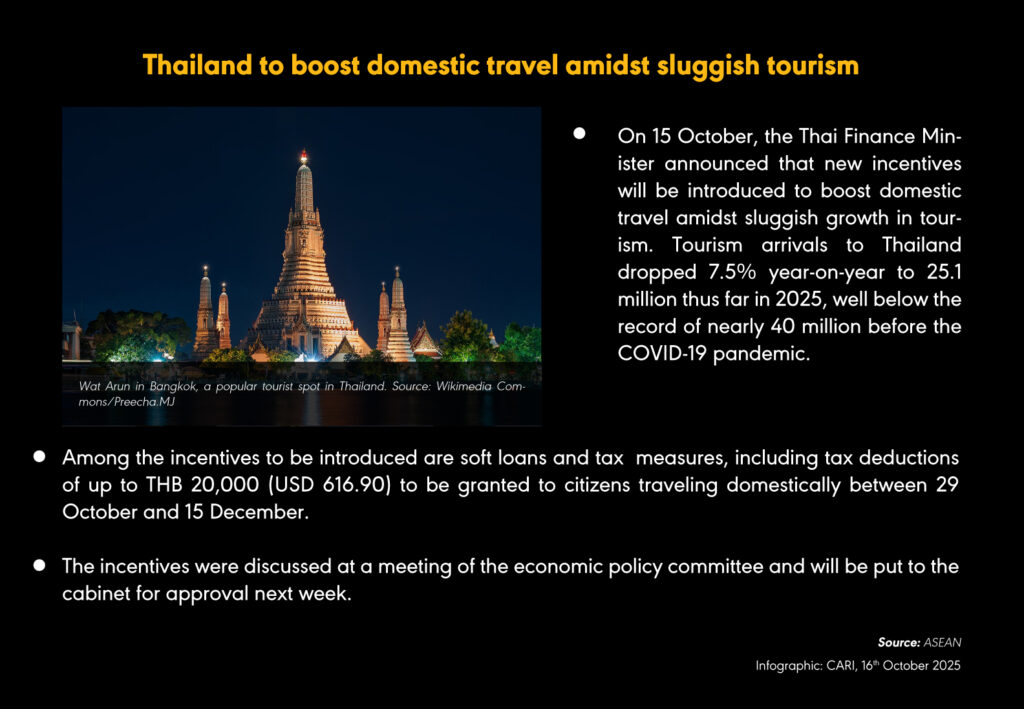
(15 October 2025) Thailand’s Finance Minister announced on 15 October that new incentives to stimulate domestic travel, including soft loans and tax measures, will be proposed to the cabinet next week. Citizens travelling domestically between 29 October and 15 December will be eligible for tax deductions of up to THB 20,000 (USD 616.90). The measures form part of a broader stimulus package aimed at achieving 2.2% GDP growth in 2025. Other ongoing initiatives include a USD 1.4 billion co-payment scheme covering living costs for 20 million people, a USD 49 billion state enterprise investment budget projected to add 0.3 percentage points to GDP, and a planned USD 307 million purchase of bad debt. Tourist arrivals have declined 7.5% year-on-year to 25.1 million, compared to nearly 40 million before the pandemic. The Federation of Thai Industries reported the first rise in industrial sentiment in seven months in September, citing confidence in policy execution, while forward sentiment for the next three months remains positive. The National Economic and Social Development Council projects 2025 GDP growth between 1.8% and 2.3%, with potential slowdown in the second half due to U.S. tariffs, high household debt, weak consumption, and a strong baht. Prime Minister Anutin Charnvirakul’s administration faces a limited timeframe to deliver economic outcomes before parliament dissolution by end-January and elections scheduled by April.

THAILAND, UNITED STATES
Thailand projected to overtake China as leading air conditioner exporter to the US
(16 October 2025) Thailand is projected to overtake China as the leading exporter of air conditioners to the United States in 2025, with exports expected to rise by 36% year-on-year, or about USD 651 million, before the enforcement of a 19% reciprocal tariff on 1 August 2025. Data from the Kasikorn Research Center indicate that 59% of Thailand’s air conditioner exports in the first seven months of 2025 were shipped to the US, mainly self-contained (window-type) units, which account for over 95% of total US imports. Over 97% of Thai exports to the US fall under two major categories in which Thailand already holds the largest market share. The new tariffs, along with a 50% duty on steel components under Section 232, are expected to increase production costs, yet Thai air conditioners will remain 13%–23% cheaper than Chinese units after the tariff, compared to being 3%–18% more expensive previously. Exporters are anticipated to accelerate shipments before August 2025, after which exports may decline by around 70% due to the new tariff and seasonal effects. The relocation of Chinese manufacturers to Thailand and the country’s favourable tax environment are expected to reinforce Thailand’s long-term role as a key production and export base for air conditioners bound for the US.

MALAYSIA, SINGAPORE
Malaysia and Singapore announce new measures to accelerate investments into JS-SEZ
(14 October 2025) Malaysia and Singapore announced new measures to accelerate investment activity in the Johor-Singapore Special Economic Zone (JS-SEZ), with Singapore-based firms having committed over SGD 5.5 billion (USD 4.23 billion) since January 2024. At the 2nd Johor-Singapore SEZ Joint Investment Forum on 14 October, the Malaysian Investment, Trade and Industry Minister said manufacturing licences for non-sensitive industries in designated sectors will be approved within seven working days, with Johor’s “no objection letter” issued in the same timeframe. Budget 2026 provides an additional MYR 200 million (USD 47.3 million) under the Strategic Co-Investment Fund to support Malaysian SMEs in the JS-SEZ and MYR 650 million through the Skills Development Fund Corporation for talent training benefiting 25,000 trainees in AI, electric vehicles, and semiconductors. These funds complement tax incentives and the Invest Malaysia Facilitation Centre launched in February 2025, and the multiple-entry Investor Pass introduced in April. Singapore’s Deputy Prime Minister said the JS-SEZ, covering 3,571 sq km and nine flagship areas, has made “good headway” and identified priorities including flagship projects, ease of doing business and SME inclusion. He confirmed the establishment of a Joint Johor-Singapore SEZ Project Office involving Singapore’s MTI, EDB and Enterprise Singapore to coordinate regulatory processes.

VIET NAM
Viet Nam’s Communist Party targets annual growth of at least 10% for 2026-2030
(15 October 2025) Viet Nam’s Communist Party has proposed in a draft congress document to target annual economic growth of at least 10% for 2026–2030, up from the 6.5%–7.0% range set for 2021–2025, despite warning of “severe” challenges ahead. The draft, published on the party’s website ahead of its upcoming congress expected after the parliament’s mid-December session, also sets a goal of raising GDP per capita to USD 8,500 by 2030, compared with a target of USD 4,700–US$5,000 for 2021–2025 and an achieved level of USD 4,700 in 2024. The party cited risks including 20% US tariffs on Vietnamese exports, accelerated population ageing, technological lag, corruption, climate change and natural disasters. It plans to adopt a growth model positioning the private sector as the “driving force” and the state as the “leading role”. To support expansion, the government intends to raise public investment in infrastructure and development projects, maintaining a fiscal deficit of about 5% of GDP, higher than the 3.1%–3.2% range in the current plan. The document forms the basis for policy direction and economic strategy decisions to be finalised at the next party congress.

INDONESIA, UNITED STATES
Shrimp exports to the US to resume following radiation scare
(15 October 2025) Indonesia’s Marine Affairs and Fisheries Ministry confirmed that shrimp exports to the United States can resume for producers in Java and Lampung that obtain certificates verifying absence of Caesium-137 contamination, following the US Food and Drug Administration’s (FDA) detection of the isotope in products from Bahari Makmur Sejahtera (BMS) in August. The certification requirement affects 35 processing units in Java and six in Lampung, with the certificates integrated into the FDA system to expedite customs clearance. Exports from other provinces remain unaffected. Indonesia has suspended scrap metal imports, identified as the source of contamination near BMS’s factory in Serang, where nine of 1,591 nearby residents tested positive for low-level radiation exposure. The FDA also detected Cs-137 traces in Indonesian cloves, traced to a plantation in Lampung. The Shrimp Club Indonesia reported that 439 containers of shrimp were rejected by the US, with one of 32 returned containers testing positive for Cs-137, causing total losses of about IDR 1 trillion (USD 60.2 million) and threatening 7,000 jobs in an industry employing one million workers. Domestic shrimp prices have fallen by up to 30%, and importers from other countries now demand similar safety assurances. Industry leaders have urged a global campaign to restore Indonesia’s reputation and diversify markets to Japan, South Korea, Europe, China, and Gulf states, while warning that diversification will be constrained by market preferences and required reinvestment. In 2024, Indonesia exported 214.5 million kg of shrimp worth USD 1.68 billion, with 63% going to the US, 15% to Japan, and 6% to Southeast Asia and China.

INDONESIA
Indonesia reopens carbon credit market to foreign buyers
(15 October 2025) Indonesia has reopened its carbon credit market to foreign buyers under a presidential decree signed on 10 October, allowing credits from domestic projects to be sold internationally for voluntary emissions offsetting. The offsets must be verified by accredited bodies under international standards and may count toward Indonesia’s national climate targets. The new regulation resolves years of policy uncertainty following the suspension of new foreign sales during a government review of carbon credit utilisation. President Prabowo Subianto, who has identified carbon credits as a potential revenue source, has sought to revitalise the sector amid broader fiscal expansion plans. Although Indonesia reopened its domestic carbon exchange to foreign participation earlier in 2025, international transactions remained limited pending regulatory clarity. The decree is expected to re-engage global investors after earlier disruptions, including the 2024 revocation and subsequent reinstatement of PT Rimba Raya Conservation’s licence, one of the world’s largest offset projects.

INDONESIA
Plan to join BRICS-led New Development Bank draws scrutiny over fiscal feasibility
(15 October 2025) Indonesia’s plan to join the BRICS-led New Development Bank (NDB) has drawn scrutiny over its fiscal feasibility amid limited state budget capacity to finance President Prabowo Subianto’s domestic priorities. Prabowo confirmed Indonesia’s decision to join the NDB on 25 March 2025 after meeting NDB chairwoman Dilma Rousseff, with the government agreeing to meet all requirements, including a paid-in capital contribution in seven instalments. Indonesia’s Chief Economic Minister said Indonesia had received approval to proceed with the payment but did not disclose the amount. Officials stated that joining the NDB aimed to reduce reliance on the IMF and World Bank and strengthen multilateral cooperation among developing economies. However, economists warned that Indonesia’s debt ratio, at nearly 40% of GDP, and its limited fiscal space could make the membership financially burdensome. It has been argued that the paid-in capital could divert funds from domestic programmes and increase debt servicing costs, even with lower interest rates from NDB loans. He suggested focusing on foreign direct investment from BRICS members instead. It has been noted that while NDB’s project funding aligns with Indonesia’s infrastructure and clean energy goals, governance, transparency, and due diligence will be critical to avoid cost overruns similar to the Jakarta–Bandung high-speed rail project. He also cautioned that NDB membership entails geopolitical risks, as the bank functions partly as a political instrument of BRICS, requiring Indonesia to maintain its non-aligned foreign policy stance.


RCEP Monitor


JAPAN
Japanese retailers record profit jump amidst price increases for daily essentials
(16 October 2025) Eighty-three listed Japanese retailers recorded flat total sales of JPY 11.75 trillion (USD 77.52 billion) for the June–August period but achieved a 7% year-on-year rise in combined operating profit to JPY 558.5 billion, driven by price increases for daily essentials. About 70% of companies posted higher revenue in this segment, supported by a 6.5% year-on-year rise in processed food prices in August, marking 11 consecutive months of acceleration. Life Corp.’s same-store sales rose 3%, aided by higher food prices, while department store J. Front Retailing reported record sales from high-income clients benefiting from a “wealth effect” tied to strong stock prices. However, real wages remained negative for eight consecutive months, constraining consumer purchasing power and reducing the number of items bought per customer. Discount retailers benefited, with Can Do’s operating profit rising sixfold and Watts’ doubling, while Aeon posted a 20% profit increase after expanding its low-cost My Basket chain and cutting private-label prices. In contrast, Seven & i revised its 7-Eleven domestic profit forecast down by JPY 30 billion, citing intensified competition from drugstores and discount food sellers. Drugstore operator Create SD reported a 7% rise in food division profit, reflecting consumer shifts toward lower-priced essentials. Aeon executives observed rising demand for substitutes such as noodles and bread amid high rice prices. Analysts expect inflation to moderate next year if the yen stabilises, while others warned that slowing wage growth could dampen consumption if inflation persists.

AUSTRALIA
Unemployment rate rises to 4.5% in September, above market expectations
(16 October 2025) Australia’s unemployment rate rose to 4.5% in September, the highest since November 2021 and above market expectations of 4.3%, as the labour force expanded by 48,800 people, according to Australian Bureau of Statistics data. Net employment increased by 14,900, below forecasts of a 20,000 rise, with full-time jobs up 8,700 and part-time positions up 6,000, while total hours worked grew 0.5%. Employment growth has slowed to 1.3% year-on-year from 3.5% in January. The weaker labour market data prompted investors to increase the probability of a Reserve Bank of Australia (RBA) rate cut in November to 72%, from 40% previously, pushing three-year bond futures up 10 ticks to 96.62 and the Australian dollar down 0.2% to USD 0.6497, while the stock benchmark hit a record high. The RBA last held rates at 3.60% in September, following three cuts earlier in the year, with core inflation easing to 2.7% in the second quarter but showing signs of stalling in recent months. Economists said the RBA faces policy tension between persistent inflation and weaker labour conditions, noting that the bank had not projected unemployment reaching 4.5% in its forecasts through 2027. A 3.3% fall in September job ads, the sharpest since early 2024, further indicated labour market cooling. Policymakers, including Governor Michele Bullock, signalled that upcoming third-quarter inflation data at the end of October will be key to determining whether a rate cut in November is warranted.

CHINA
Household savings increases by RMB 2.96 trillion in September, highest monthly rise since March
(16 October 2025) Chinese household savings increased by RMB 2.96 trillion (USD 415.5 billion) in September, the highest monthly rise since March and above last year’s level, according to data from the People’s Bank of China. The acceleration in savings reflects reduced household participation in equities amid renewed US–China trade tensions, with deposits at non-bank financial institutions — often used for margin trading — falling for the first time in three months. Analysts noted that the shift from deposits to riskier assets has slowed, likely tempering recent stock market gains. China’s benchmark index has retreated from its highest point since 2022, while bond yields have eased as risk appetite declines. GF Securities analysts attributed part of the decline in non-bank deposits to temporary cash holdings as savers seek higher-yielding alternatives, while a government proposal to revise mutual fund fee structures may have further deterred short-term investors. Credit Agricole CIB said households are likely to remain cautious on new equity investments given tariff risks and the recent market rally.

15 participating countries

20 chapters

2.2 billion

US$26.2 trillion

28%

ASEAN member states, Australia, China, Japan, South Korea, New Zealand trade in goods and services, investment, intellectual property, e-commerce, competition, SMEs, economic and technical cooperation, and government procurement combined population, 30% world’s population combined GDP, 30% global GDP global trade (based on 2019 figures)

CARI Captures Issue 723: Startup funding landscape stages impressive comeback in September 2025


Captures has widened its scope to include news related to all the members of the Regional Comprehensive Economic Partnership (RCEP) agreement which was signed towards the end of 2020. Besides the ASEAN Member States, this includes Australia, New Zealand, China, Japan, and South Korea. The other weekly newsletters under CARI, China-ASEAN Monitor and Mekong Monitor will also be consolidated into the Captures newsletter. We hope this new version of Captures will serve you better and look forward to providing a curation of stories relevant to ASEAN and its trading partners.


ASEAN
Startup funding landscape stages impressive comeback in September 2025
(07 October 2025) According to Tracxn data, startup funding in Southeast Asia rose 125.6% month-on-month in September 2025 to USD 231 million, up from USD 84 million in August, and 58.7% higher year-on-year. The rebound indicates renewed investor confidence after months of subdued activity, with capital flowing into fewer but larger deals, reflecting a shift toward conviction-based investments in startups demonstrating resilience and scalability. Established regional funds such as Gobi Partners and returning global investors participated in the month’s transactions, suggesting a recalibration rather than withdrawal of capital. The surge also points to a potential transition toward a more disciplined and sustainable funding environment, driven by an investor focus on profitability and clear growth paths rather than speculative expansion, though volatility earlier in the year tempers expectations of a full recovery.

MALAYSIA
Malaysia proposes 2026 federal budget of MYR 419.2 billion, a 1.7% year-on-year increase
(10 October 2025) Malaysia has proposed a 2026 federal budget of MYR 419.2 billion (USD 99.24 billion), a 1.7% increase from the revised MYR 412.1 billion in 2025, comprising MYR 338.2 billion in operating expenditure and MYR 81 billion in development spending. Fiscal and economic outlook reports show revenue rising 2.7% year-on-year to MYR 343.1 billion, with the fiscal deficit expected to narrow to 3.5% of GDP from 3.8% in 2025. State energy firm Petronas will contribute a MYR 20 billion dividend, its lowest since 2017, reflecting lower crude prices and output. Subsidies and social assistance are projected to decline 14.1% to MYR 49 billion, in line with efforts to improve targeting and reduced commodity prices. Economic growth for 2026 is forecast at 4%–4.5%, while this year’s projection was revised down to 4%–4.8% amid U.S. tariff uncertainties, including a 19% levy on most Malaysian exports. Inflation is expected between 1.3% and 2% in 2026, compared with 1%–2% in 2025. Prime Minister Anwar Ibrahim said ongoing fiscal reforms—including selective subsidy removal, minimum wage increases, and an expanded sales tax—are necessary to maintain fiscal discipline and resilience against external risks. Bank Negara Malaysia maintained its policy rate at 2.75% in September after a July rate cut, with the government noting that monetary policy remains supportive of stable growth.

THAILAND, THE PHILIPPINES
Benchmark price of Thai white rice falls to ten-year low as the Philippines curbs imports
(09 October 2025) The benchmark price of Thai white rice 5% broken fell 1.9% to USD 355 per tonne on Wednesday, the lowest level since September 2015, according to the Thai Rice Exporters Association. The decline follows improved global supply conditions, with the UN Food and Agriculture Organization projecting record global rice production of 556.4 million tonnes in the 2025–26 season, leading to higher stockpiles. Prices have been easing from a 15-year peak in 2024, driven by strong demand and supply concerns. Above-average monsoon rainfall in India, the world’s largest rice exporter, has improved harvest prospects, and the government has lifted export restrictions to avoid domestic oversupply. The Philippines, the top global rice importer, plans to extend import curbs to support local farmers, although cheaper exports from Thailand and other suppliers may gradually lower retail prices in import-dependent economies across Asia, Africa, and the Middle East.

THE PHILIPPINES
Philippine Stock Exchange warns flood-control corruption scandal driving away investors
(06 October 2025) Philippine Stock Exchange President and CEO called for a “swift, credible and comprehensive” investigation into corruption allegations linked to government flood-control spending, warning that continued uncertainty was driving foreign investor withdrawals and weighing on market performance. Foreign investors have withdrawn approximately USD 684 million from the market this year and have been net sellers for six consecutive days as of Friday. The benchmark Philippine Stock Exchange Index has fallen over 8% year to date, among the weakest in Asia, while the peso declined 0.8% against the US dollar on Monday. President Ferdinand Marcos Jr. has formed an independent commission to investigate the allegations, though Senate hearings were left uncertain following Senator Panfilo Lacson’s resignation as committee chair. Religious leaders cautioned against any whitewash. The Economic Planning Secretary said governance reforms were being considered to improve public spending transparency. The Stock Exchange CEO cited the upcoming initial public offering of Maynilad Water Services Inc. as a potential positive for investor sentiment. Severe weather and natural disasters, including a September super typhoon and a magnitude 6.9 earthquake in Cebu, have also contributed to recent market volatility.

THE PHILIPPINES
Bangko Sentral ng Pilipinas unexpectedly cuts rate by 25 basis points to 4.75%
(09 October 2025) The Bangko Sentral ng Pilipinas (BSP) cut its benchmark overnight reverse repurchase rate by 25 basis points to 4.75% on Thursday, marking its lowest level since September 2022 and extending cumulative rate cuts since August 2024 to 175 basis points. Only seven of 26 economists surveyed by Bloomberg had predicted the move, as most expected a pause amid peso weakness. The BSP governor indicated potential further easing this year, citing a weaker economic outlook stemming from reduced business confidence following a government graft scandal involving flood-control projects. The central bank said governance concerns and slower public infrastructure spending have dampened domestic growth prospects. The peso fell 0.5% to 58.235 against the US dollar and has declined about 2% over the past month, while Philippine stocks were the worst performers in the Asia Pacific. Remolona stated the BSP would defend the peso if depreciation became inflationary and did not rule out capital controls. Inflation has remained below the 2%–4% target since March, providing room for policy easing, with the BSP now viewing its “Goldilocks” rate as lower than the previous 5%. Analysts expect another 25 basis-point cut at the next meeting, bringing the rate to 4.50%. The BSP said a favourable inflation outlook and moderating domestic demand support continued monetary accommodation, while maintaining price stability. Policymakers acknowledged that the corruption scandal and tighter fiscal policy could slow state spending, which accounts for about one-fifth of GDP, and weigh on growth amid weaker exports and global trade uncertainty.

MALAYSIA, SINGAPORE
Johor-Singapore SEZ draws new investors with 2-in-1 appeal
(09 October 2025) Panellists at the Asia Future Summit highlighted the Johor–Singapore Special Economic Zone (JS-SEZ) as an emerging regional investment hub drawing firms that might not have considered either market individually. The director of the Economic Development Board’s JS-SEZ Programme Office said the initiative has broadened investor engagement opportunities, attracting companies from previously untapped sectors and markets. Johor’s investment, trade, consumer affairs, and human resources committee chairman reported MYR 56 billion in investments in the first half of 2025, driven largely by JS-SEZ projects, and expressed confidence in achieving MYR 100 billion by end-2025. The OCBC Malaysia CEO said 50% of interested firms in the zone are from China, citing its proximity to Singapore as a major advantage. The Q&M Dental Group CEO announced a SGD 130 million capital raise to expand operations in Singapore, Johor, and China, noting that Q&M runs 37 clinics in Malaysia, including nine in the JS-SEZ. The Johor state economic adviser said the zone enables multinational firms to locate headquarters and R&D functions in Singapore while maintaining manufacturing in Johor. Teo added that the Invest Malaysia Facilitation Centre–Johor is streamlining regulatory processes, while collaboration with Malaysian agencies aims to strengthen the local talent pipeline.

THAILAND
Bank of Thailand governor states that central bank retains room for further rate cuts
(10 October 2025) The Bank of Thailand Governor said the central bank retains room to further reduce its benchmark interest rate, currently at 1.5%, one of the lowest globally, to support growth and bring inflation back within the 1%–3% target range. Speaking ten days into his tenure, the governor stated the bank remains “ready to ease” if economic conditions warrant, noting that the full effects of previous rate cuts have yet to materialise. At the most recent policy meeting, the Monetary Policy Committee held rates steady, with only two of seven members voting for a cut. Thailand’s headline inflation has been negative for six consecutive months, but the governor said there are no signs of deflation, with prices expected to normalise in the medium term. He also announced plans to purchase bad debts from over 2 million borrowers as a complementary measure to monetary easing. On the currency front, the governor attributed the baht’s recent appreciation to a weaker US dollar and capital inflows, adding that the central bank is monitoring movements for irregularities. He said online gold trading had increased currency volatility, prompting coordination with the finance ministry and traders to assess potential measures limited to online transactions. He also reiterated the importance of central bank independence in maintaining monetary stability.


RCEP Monitor


CHINA
China increases enforcement of import restrictions on US-made semiconductors
(10 October 2025) China has increased enforcement of import restrictions on US-made semiconductors, including Nvidia’s artificial intelligence chips, by deploying customs officials to major ports to conduct stringent inspections, according to the Financial Times. The checks, which initially targeted Nvidia’s H20 and RTX Pro 6000D models designed to comply with US export controls, have reportedly expanded to cover all advanced chips potentially breaching US curbs. The move reflects Beijing’s focus on strengthening domestic semiconductor production amid ongoing US-China technology tensions. Earlier reports indicated around USD 1 billion worth of Nvidia’s high-end AI chips were smuggled into China between May and July, though this has not been independently verified. Nvidia’s RTX6000D chip, created for the Chinese market, has experienced weak demand, with some major firms avoiding new orders. Chinese authorities have previously accused Nvidia of breaching anti-monopoly law and instructed technology companies to suspend purchases of its AI chips. Despite progress by domestic chipmakers such as Huawei, industry engineers report Nvidia’s chips continue to outperform Chinese alternatives.

CHINA
China announces new port fees on US vessels as countermeasure to forthcoming US port charges
(10 October 2025) China’s Ministry of Transport announced new port fees on vessels owned, operated, or built by U.S. firms or flying the U.S. flag, effective 14 October, as a countermeasure to forthcoming U.S. port charges on China-linked ships. The fee will start at CYN 400 yuan (USD 56.13) per net tonne per voyage and rise to VYN 640 in April 2026, CYN 880 in April 2027, and CYN 1,120 (USD 157.16) in April 2028. The move follows a U.S. Trade Representative probe and new American fees on Chinese vessels—potentially exceeding USD 1 million for ships carrying over 10,000 containers—intended to bolster U.S. shipbuilding and limit China’s maritime dominance. Chinese vessels calling at U.S. ports will also face a flat fee of USD 80 per net tonne. China’s counter-tariff is expected to have a smaller economic impact on the United States due to its limited commercial fleet; Chinese shipyards produced over 1,000 commercial vessels last year, compared with fewer than 10 in the U.S. The escalation comes amid renewed U.S.-China trade tensions, with both sides in a temporary 90-day tariff truce ending around 9 November. Presidents Donald Trump and Xi Jinping are expected to discuss the issue at the APEC summit in South Korea at the end of October.

AUSTRALIA
Reserve Bank of Australia Governor states that economy is “in a pretty good spot”
(10 October 2025) The Reserve Bank of Australia (RBA) Governor told a parliamentary committee that the economy is “in a pretty good spot,” with inflation within the 2%–3% target range, a strong labour market, and rising household consumption offsetting weaker public demand. The RBA maintained its policy rate at 3.6% last month after three cuts since February, citing stronger household spending, housing market resilience, and sustained labour tightness as reasons to hold. Economists expect another rate reduction following the 3–4 November meeting, contingent on the 29 October third-quarter inflation report and September jobs data, which is forecast to show unemployment at 4.3%. The governor noted that while overall inflation is now inside target, services inflation remains persistent. The RBA’s policy stance contrasts with regional peers, as Indonesia and New Zealand continue to ease rates while Thailand, Malaysia, and Australia remain on hold. She also highlighted external risks from protectionist U.S. trade policies, geopolitical tensions, and softer Chinese demand, though she said Australia avoided worst-case tariff outcomes, receiving the baseline global rate of 10%.

15 participating countries

20 chapters

2.2 billion

US$26.2 trillion

28%

ASEAN member states, Australia, China, Japan, South Korea, New Zealand trade in goods and services, investment, intellectual property, e-commerce, competition, SMEs, economic and technical cooperation, and government procurement combined population, 30% world’s population combined GDP, 30% global GDP global trade (based on 2019 figures)

CARI Captures Issue 722: Central bank announces that new family of banknotes to be introduced in first half of 2026


Captures has widened its scope to include news related to all the members of the Regional Comprehensive Economic Partnership (RCEP) agreement which was signed towards the end of 2020. Besides the ASEAN Member States, this includes Australia, New Zealand, China, Japan, and South Korea. The other weekly newsletters under CARI, China-ASEAN Monitor and Mekong Monitor will also be consolidated into the Captures newsletter. We hope this new version of Captures will serve you better and look forward to providing a curation of stories relevant to ASEAN and its trading partners.


BRUNEI DARUSSALAM
Central bank announces that new family of banknotes to be introduced in first half of 2026
(22 September 2025) Brunei Darussalam Central Bank (BDCB) announced that a new family of banknotes will be introduced in the first half of next year, standardising the use of “Brunei Dollars” in place of “Ringgit” in line with the Currency Order 2004. The series will include five denominations — BND1, BND5, BND10, BND100 and BND500. BDCB stated that the banknotes will carry enhanced security features to strengthen protection against counterfeiting and to align with international standards in currency technology. The central bank emphasised that the initiative ensures currency integrity while supporting Brunei Darussalam’s gradual transition towards a digital economy. It added that all current banknotes will remain legal tender and circulate alongside the new series.

MALAYSIA, CHINA
Malaysia and China to hold preliminary talks on rare earth processing projects
(02 October 2025) China and Malaysia are holding preliminary discussions on a rare earths processing project that would involve Malaysia’s sovereign wealth fund Khazanah Nasional partnering with a Chinese state-owned company to build a refinery in Malaysia, with Beijing prepared to exchange its processing technology for access to Malaysia’s estimated 16.1 million metric tons of reserves. Khazanah confirmed rare earths are among the industries under study but said talks were at an early stage, while Chinese officials have not commented due to the National Day holiday. The refinery, expected to process both light and heavy rare earths, would represent a policy shift for China, which has previously banned exports of processing technology. Potential obstacles identified include concerns over Malaysia’s ability to provide sufficient raw materials, environmental risks, and regulatory hurdles, as mining requires multiple state and federal approvals, with bans on extraction in protected areas. Malaysia prohibits raw rare earths exports, except for a pilot mining project approved in 2022 to establish operating guidelines. China’s willingness to provide technical support was confirmed by Malaysia’s natural resources minister in August, who added that President Xi Jinping had limited cooperation to state-linked firms to protect trade secrets. The proposed joint venture is also seen as a move to counter Australian company Lynas Rare Earths, which already operates a processing plant in Pahang and signed a supply deal with Kelantan in May. A deal would make Malaysia one of the few countries with access to both Chinese and non-Chinese processing technologies.

THAILAND, MALAYSIA
Thailand forecasts 24 percent decline year-on-year in Chinese tourist arrivals in 2025
(01 October 2025) Thailand forecasts about 200,000 Chinese tourist arrivals during the 27 September–8 October Golden Week, a 24 percent decline from 2024, with tourism revenue expected to fall 17 percent year-on-year to THB 9.1 billion. The Tourism Authority of Thailand attributed the decline to persistent safety concerns despite Thailand’s visa exemption, while competitors Malaysia and Viet Nam reported stronger demand due to lower costs and improved perceptions of safety. Outbound bookings from China rose 28 percent this year with international flight capacity up 10 percent, but Thailand did not rank among the top 10 destinations, which included Ho Chi Minh City, Kuala Lumpur, Hanoi, Denpasar, and Singapore. Malaysia registered 1.8 million Chinese arrivals in the first five months of 2025, boosted by visa waivers and tourism campaigns, and expects Golden Week arrivals to at least match last year’s levels. Chinese tourists in Thailand are projected to stay six to eight nights with daily spending of around THB 6,600, primarily travelling from Beijing, Guangzhou and Chengdu, with additional demand from second-tier cities including Shenzhen and Xi’an.

THAILAND
Strong baht impacting exports, tourism, and household spending
(01 October 2025) Thailand’s baht has appreciated over 8 percent against the US dollar this year, strengthening from 34 on 01 January to 31.70 on 09 September before easing to about 32.40, pressuring exporters, tourism operators, and households. Export margins have narrowed, with US tariffs of 19 percent compounding difficulties, while business owners reported reduced competitiveness and uncertainty in long-term contracts. Tourism arrivals fell 7.52 percent year-on-year between January and September to nearly 24 million, with Malaysia the largest source market and China contributing 3.38 million. The Tourism Authority of Thailand expects Chinese arrivals during Golden Week to drop 24 percent from last year’s 262,001, causing tens of millions of dollars in lost revenue for tourism businesses. Prime Minister Anutin Charnvirakul, facing an economy forecast to expand just 1.8 percent in 2025, has pledged stimulus measures to ease household debt, lower living costs, and provide small-business credit. Thailand’s Finance Minister said he asked the central bank to limit baht volatility, rejecting speculation that gold exports were the main driver of the currency’s strength, despite shipments of 88.4 tonnes worth USD 8.73 billion this year. Ratings agencies have downgraded Thailand’s outlook, with factory output contracting 4 percent in August and exports slowing to 5.8 percent growth, the weakest in almost a year. For individuals earning in US dollars, the stronger baht has reduced take-home pay in local currency, further weighing on household consumption.

THE PHILIPPINES
Massive corruption scandal and resultant unrests darkens growth outlook
(02 October 2025) A corruption scandal involving billions of dollars in fraudulent flood-control allocations in the Philippines has triggered mass protests, weakened investor sentiment, and pressured financial markets, with congressional hearings alleging collusion among lawmakers, public works officials, and contractors to divert funds into ghost projects and padded contracts, while audits revealed non-existent or substandard works. Witness testimonies of cash deliveries to politicians have intensified public backlash, leading tens of thousands to protest in major cities since President Ferdinand Marcos Jr. disclosed in July that budgets were being looted. Economists have cut growth forecasts, with Security Bank lowering their second-half estimate to 5.5 percent from 5.8 percent and full-year projection to 5.5 percent, the bottom of the government’s target, while Sun Life reduced their outlook to mid-5 percent and warned growth could drop to 4.3 percent if spending stalls. The peso was Asia’s worst performer in September and the stock index posted its longest losing streak this year as offshore investors retreated, while the central bank cautioned of weaker investment inflows and service exports. Moody’s Ratings warned that prolonged unrest could dampen growth and delay fiscal consolidation, though it maintained that political risk and institutional strength remain broadly in line with peers. S&P Global Ratings projects GDP growth of 5.6 percent in 2025 and 6.3 percent on average over the next three years, supported by investment-grade ratings, corporate tax cuts, and business incentives.

INDONESIA, CHINA
China requests Indonesia to guarantee long-term supply of resources
(01 October 2025) China has formally requested Indonesia to guarantee long-term supplies of crude palm oil (CPO), natural rubber, and edible bird’s nests to meet rising domestic demand, according to Indonesia’s Deputy Agricultural Minister, who said the request was conveyed by China’s Deputy Minister of Agricultural and Rural Affairs. Indonesia recorded a USD 1.77 billion agricultural trade surplus with China in 2024, led by palm oil exports worth USD 2.72 billion, followed by edible bird’s nests at USD 428 million, rubber at USD 363 million, coconut at USD 270 million, and cacao at USD 218 million. The Deputy Agricultural Minister noted that China is seeking supply certainty as its demand for palm oil increases, while Indonesia, the world’s largest producer, is simultaneously expanding domestic use under its biodiesel programme. The country is currently implementing B40, requiring a 40 percent palm oil blend in diesel, with plans to raise this to B50 next year. He added that Indonesia is working to strengthen palm oil productivity to ensure both domestic energy requirements and secure export commitments can be met.

VIET NAM
Property damage from Typhoon Bualoi estimated at VND 8 trillion
(01 October 2025) Viet Nam’s government estimated property damage from Typhoon Bualoi at VND 8 trillion as of 1 October, with nearly 170,000 houses damaged or inundated, at least 29 fatalities and 22 people missing. The storm, which made landfall on 29 September in northern central Viet Nam, caused widespread damage to infrastructure, including roads, schools, offices and power grids, leaving tens of thousands without electricity. More than 34,000 hectares of rice and other crops were destroyed, though no major damage to industrial facilities was reported despite the presence of large factories operated by Foxconn, Formosa Plastics, Luxshare and Vinfast in affected areas. Flooding spread into northern provinces and Hanoi, disrupting flights, train services and forcing school closures, while many homes were inundated. The disaster management agency’s preliminary report underscored severe agricultural and residential impacts but excluded large-scale industrial losses.


RCEP Monitor


CHINA
China launches K visa for foreign science and technology professionals
(02 October 2025) China’s new K visa for foreign science and technology professionals, announced in August and effective 2 October, has sparked intense domestic backlash after Indian media likened it to the US H-1B visa. The scheme, open to STEM graduates of recognised universities and research institutions in China or abroad, as well as those teaching or conducting research, allows multiple entries and longer stays without requiring local employer sponsorship. However, authorities have not clarified whether it permits employment in China, with state media stressing it is “not a simple work permit” and “should not be equated with immigration.” The controversy escalated after concerns were raised online about competition in a weak job market, leading to xenophobic comments, particularly targeting Indian nationals. State outlets including the Global Times and People’s Daily have defended the visa as a tool to attract global talent, positioning China as an alternative to the US, where H-1B fees have risen under Donald Trump. Official statements frame it as facilitating exchanges in education, science, technology, culture, entrepreneurship, and business. The Ministry of Foreign Affairs has promised further details from embassies and consulates, without a set timeline. Experts note that while the visa aligns with China’s broader push to draw in talent as the US becomes more restrictive, its success may be constrained by language barriers, domestic scepticism, and limits imposed by China’s controlled political environment.

NEW ZEALAND
House prices rise 0.1 percent month-on-month in September, first increase in six months
(02 October 2025) New Zealand house prices rose 0.1 percent in September from August, the first increase in six months after a revised 0.4 percent decline the previous month, though values remain 0.2 percent lower than a year earlier, according to Cotality’s home value index. The rebound follows a two-year low in August and coincides with falling mortgage interest rates, now at their lowest in three years after the Reserve Bank of New Zealand cut the official cash rate to 3 percent in August from 5.5 percent in July 2023, with guidance suggesting a possible fall to 2.5 percent by year-end. Despite this, Cotality’s chief property economist cautioned that the September uptick was marginal and unlikely to indicate a sustained recovery, as buyer caution and a high housing supply remain. House prices fell 1.6 percent in the five months to August, and values may remain weak through 2025 amid subdued growth, with the RBNZ projecting a 0.3 percent contraction this year and economists expecting minimal expansion. The economy shrank 0.9 percent in Q2 2025, unemployment is at a five-year high, though improving consumer spending is expected to support a second-half rebound. Cotality added that further mortgage rate cuts could support borrowers refinancing fixed-term loans, with scope for house values to rise more consistently from 2026, though a sharp boom is unlikely given the slow recovery in the economy and labour market.

AUSTRALIA
Household spending rises 0.1 percent in August, below expectations of 0.3 percent growth
(02 October 2025) Australia’s household spending rose 0.1 percent in August, below expectations of 0.3 percent and following a downwardly revised 0.4 percent gain in July, according to Australian Bureau of Statistics data, with annual growth at 5 percent against forecasts of 5.2 percent. The report showed services spending increased 0.5 percent while goods spending declined 0.2 percent, with the largest category falls in recreation and culture and in alcoholic beverages and tobacco, both down 0.9 percent, while airline travel and accommodation bookings increased. ABS noted spending has risen in 10 of the past 12 months, though the August rise was modest. The data add to the case for the Reserve Bank of Australia to resume rate cuts, with economists expecting a move in November and money markets fully pricing one by March, after the central bank held the cash rate at 3.6 percent earlier this week. The RBA’s governor cited stronger-than-expected household consumption supported by real income growth, rising property prices and a tight labour market, with unemployment at 4.2 percent. Household spending, which accounts for about half of GDP, has been constrained by high debt levels, elevated borrowing costs and inflation, though improving incomes have provided support.

15 participating countries

20 chapters

2.2 billion

US$26.2 trillion

28%

ASEAN member states, Australia, China, Japan, South Korea, New Zealand trade in goods and services, investment, intellectual property, e-commerce, competition, SMEs, economic and technical cooperation, and government procurement combined population, 30% world’s population combined GDP, 30% global GDP global trade (based on 2019 figures)

CARI Captures Issue 721: Viet Nam pursuing new trade deals to mitigate US tariffs


Captures has widened its scope to include news related to all the members of the Regional Comprehensive Economic Partnership (RCEP) agreement which was signed towards the end of 2020. Besides the ASEAN Member States, this includes Australia, New Zealand, China, Japan, and South Korea. The other weekly newsletters under CARI, China-ASEAN Monitor and Mekong Monitor will also be consolidated into the Captures newsletter. We hope this new version of Captures will serve you better and look forward to providing a curation of stories relevant to ASEAN and its trading partners.


VIET NAM
Viet Nam pursuing new trade deals to mitigate US tariffs
(24 September 2025) Vietnamese Prime Minister Pham Minh Chinh said Hanoi is pursuing new trade agreements this year to counter U.S. tariffs on Vietnamese exports, which the United Nations Development Programme estimated could cut shipments to the U.S. by up to 20%, making Viet Nam the most affected country in Southeast Asia. Chinh forecast export growth above 12% in 2025, with exports reaching USD 325.3 billion by 15 September, a 15.8% increase year-on-year. To mitigate tariff impacts, Vietnam aims to conclude free trade agreements with Mercosur and the Gulf Cooperation Council by year-end, while continuing negotiations with Washington after the Trump administration’s 20% tariff on most Vietnamese goods. The White House has also imposed a 40% tariff on goods deemed transshipped through Vietnam, a risk compounded by Vietnam’s reliance on Chinese components. Chinh instructed officials to intensify enforcement against imports violating international copyright or origin standards, issues repeatedly raised by U.S. counterparts.

THE PHILIPPINES, MALAYSIA, THAILAND, EU
EU trade negotiations with Thailand, the Philippines, and Malaysia expected to be finalised by 2026
(25 September 2025) EU Trade Commissioner Maros Sefcovic said negotiations on free trade agreements with Thailand, the Philippines and Malaysia are advancing and expected to be finalised and signed by 2026. Speaking at a meeting between ASEAN economic ministers and the EU in Kuala Lumpur, he noted that the agreements would add to existing EU FTAs with Singapore, Viet Nam and Indonesia, the latter concluded this week after nine years of negotiations. Sefcovic described the bilateral deals as a “building block” towards a future EU–ASEAN region-to-region free trade agreement.

INDONESIA, EU
Indonesia and the EU sign Comprehensive Economic Partnership Agreement
(23 September 2025) Indonesia and the European Union signed the Comprehensive Economic Partnership Agreement (CEPA) in Bali after nearly a decade of negotiations, marking the EU’s third such deal in Southeast Asia after Singapore and Viet Nam. Signed by EU Trade Commissioner and the Indonesian Minister of Economic Affairs, the pact opens investment in electric vehicles, electronics and pharmaceuticals, and is projected to save EU exporters GBP 600 million (USD 708 million) annually in duties. Around 80% of Indonesian exports to the EU, including palm oil, footwear, textiles and fisheries, will become tariff-free once the deal takes effect, expected by 2027 following legal checks, translations and ratifications. Bilateral trade reached USD 30.1 billion in 2024, and the agreement gives the EU access to Indonesia’s 280 million-strong market. Negotiations were delayed by disputes over palm oil and deforestation but gained urgency from U.S. tariff policies under Donald Trump. A protocol on palm oil was included, though details remain undisclosed, with th EU reportedly offering “special treatment” on the EU’s deforestation regulation for signatory partners. The regulation, postponed to end-2025, bans imports of products from land deforested after December 2020. Activists, including Greenpeace Indonesia, warned the agreement could spur further deforestation. Indonesia described the CEPA as a “ten-year journey” aimed at mitigating risks from global tariff wars, while analysts said both sides sought alternative markets to counter protectionism.

INDONESIA, CANADA
Canada and Indonesia sign Comprehensive Economic Partnership Agreement (CEPA)
(26 September 2025) Canada and Indonesia signed a Comprehensive Economic Partnership Agreement (CEPA) that will remove or reduce tariffs on over 95% of Canadian exports, including wheat, potash, timber and soybeans, and more than 90% of Indonesian exports, such as garments and leather goods. Canadian Prime Minister Mark Carney described the deal as timely, while Indonesian President Prabowo Subianto called it a historic first agreement with an ASEAN member state. The CEPA is aligned with Canada’s Indo-Pacific strategy and strengthens Ottawa’s trade presence in the region. Alongside the trade pact, both governments signed a defence cooperation agreement covering military training, maritime security, cyber defence and peacekeeping.

THAILAND
Foreign visitor revenue to fall 20.2% in 2025 below pre-pandemic levels
(26 September 2025) The Tourism Council of Thailand (TCT) projects foreign visitor revenue in 2025 will fall 20.2% below pre-pandemic levels to THB 1.52 trillion, compared with THB 1.91 trillion in 2019, despite an expected 33.14 million arrivals, down 17% from 2019 and 6.7% lower than 2024. The sharper revenue decline reflects reduced spending per visitor, driven by a drop in high-spending Chinese tourists, a rise in lower-spending Malaysian visitors, and growth in budget-conscious Free Independent Travellers and backpackers. The Q3/2025 Tourism Business Confidence Index fell to 66 from 68 a year earlier, with businesses citing domestic deflation, global economic slowdown, currency appreciation, safety concerns, the Thai-Cambodia conflict, and flooding as key negative factors. Average industry revenue in Q3/2025 was 44% of 2019 levels, compared with a peak of 64% in Q1/2023. Regional data show the South as most resilient, with revenues at 50% of 2019 levels and occupancy at 62%, while the North recorded the lowest average revenue at 39%. Bangkok showed the most volatility. Sector-specific results highlight weak performance for tour operators and souvenir shops, while entertainment venues reported higher confidence. Employment has recovered to 87% of pre-pandemic levels, outpacing revenue recovery and raising concerns over profitability. Looking ahead, confidence is forecast to improve to 72 in Q4/2025, with the North expected to post the largest surge (Index 80), followed by Bangkok (75) and the South (74).

THAILAND
Fitch Ratings downgrades Thailand’s credit rating outlook from stable to negative
(24 September 2025) Fitch Ratings downgraded Thailand’s credit rating outlook from stable to negative while affirming its long-term foreign-currency issuer default rating at “BBB+,” citing rising fiscal risks from political uncertainty and weak growth. Gross general government debt reached 59.4% of GDP in August, close to the ‘BBB’ median, after years of stimulus and delayed fiscal consolidation. The move follows Moody’s downgrade and poses challenges for new Prime Minister Anutin Charnvirakul, who took office after Paetongtarn Shinawatra was ousted by court ruling. Thailand’s economy is projected to expand around 2% in 2025, about half the pace of Indonesia and the Philippines, pressured by a 19% U.S. tariff, weak tourism, high household debt and a strong baht. Fitch highlighted risks from continued large stimulus, uncertain fiscal strategy and demographic pressures. It warned Anutin’s pledge to call elections within four months could fuel spending, with fiscal deficits expected at 4.6% of GDP this year and 4.3% next year. The baht traded near a two-week low against the U.S. dollar, though it remains almost 7% stronger year-to-date after hitting a four-year high earlier in the month.

LAO PDR
Lao PDR seeking to develop carbon credit market and clean energy
(25 September 2025) Lao PDR’s Ministry of Agriculture and Environment hosted the Carbon Markets and Clean Energy Conference 2025, bringing together government officials, development partners and private sector representatives to advance carbon market readiness and clean energy integration. The two-day meeting focused on establishing a carbon credit trading system, identifying policies to strengthen the market, and sharing best practices for climate adaptation. Participants discussed investment barriers, emphasising the role of the private sector in mobilising financial support for carbon and energy projects. The conference was positioned as a step towards developing Lao PDR carbon credit market and supporting national clean energy objectives.


RCEP Monitor


SOUTH KOREA, JAPAN, UNITED STATES
Trump declares that South Korea will provide USD 350 billion in “upfront” investments
(25 September 2025) U.S. President Donald Trump said South Korea would provide USD 350 billion in “upfront” investments in U.S. projects, despite Seoul warning that such a commitment without safeguards could trigger a financial crisis. Trump compared the pledge to Japan’s USD 550 billion investment formalised earlier this month alongside a trade deal that lowered U.S. tariffs on Japanese automobile imports and other goods. South Korea maintains the negotiations are at a deadlock, with President Lee Jae Myung stating that safeguards such as a currency swap are necessary, though analysts consider such an arrangement unlikely. Seoul is pressing for most of the funds to be structured as loans rather than direct investments and for mechanisms ensuring project viability, while resisting U.S. demands for control over the funds. A South Korean government official reiterated the principle that any deal must meet national interests and be commercially feasible. Trump’s insistence on “upfront” payments has heightened political uncertainty, raising investor concerns that Seoul could face an unfavourable deal or no agreement at all.

SOUTH KOREA
Samsung Electronics and SK Hynix add over USD 100 billion in market value in September
(26 September 2025) South Korea’s two largest chipmakers, Samsung Electronics and SK Hynix, have added over USD 100 billion in market value in September, driven by rising demand for high-bandwidth memory (HBM) chips used in AI applications and growing expectations of a broader semiconductor recovery. SK Hynix has surged on its dominance in HBM, while Samsung is catching up, with analysts from 20 firms including JPMorgan, Citigroup and Nomura forecasting its share price could surpass the 2021 record of KRW 91,000 within 12 months. Samsung shares have rallied 24% this month, their best performance since 2001, while SK Hynix is up 33%, yet both trade at lower forward price-earnings ratios (14x and 7x respectively) compared to U.S. peers at 26x. Foreign investors are on track for their largest-ever monthly inflows into the two firms in over 13 years, though overseas ownership of Samsung remains seven percentage points below its peak of 58%. Analysts, including Morgan Stanley, project a memory “supercycle” in 2026 as supply shortages emerge in DRAM and NAND due to production shifts towards HBM, reversing earlier pessimism about “legacy” chips. Overseas funds see further upside, citing cheaper valuations relative to U.S. chipmakers, interest rate cuts by the U.S. Federal Reserve, and rising AI-driven capex by U.S. hyperscalers and Chinese firms. Nvidia remains the largest buyer of HBM, with AMD and Broadcom also expected to increase purchases as their AI accelerators gain traction. CLSA forecasts SK Hynix will retain its lead in high-margin HBM, while Samsung, benefiting from expanded HBM business with Nvidia, is now seen as well-positioned for sustained foreign inflows and revenue growth.

CHINA, MEXICO
China launches investigation into Mexico’s planned tariffs and other trade restrictions
(26 September 2025) China’s commerce ministry has launched an investigation into Mexico’s planned tariffs and other trade restrictions on Chinese exports, alongside an anti-dumping probe into Mexican pecan nuts, signalling one of Beijing’s strongest responses to deter countries from aligning with U.S. tariff policies. Mexico recently proposed a 50% tariff on Chinese cars and levies on about 1,400 products, including textiles and steel, affecting all non-free trade partners. The Chinese probe will cover both the new measures and earlier restrictions, citing risks to Chinese companies’ trade and investment interests. The move comes as Mexico prepares for a 2026 review of the US-Mexico-Canada Agreement and faces U.S. pressure to curb China’s economic role, with Washington accusing Beijing of using Mexico to bypass tariffs. President Claudia Sheinbaum has said the tariffs aim to protect domestic industries, not escalate tensions with China. In 2024, Mexico exported USD 5.7 billion to China while importing USD 115 billion, with copper and minerals accounting for over 40% of exports. The pecan anti-dumping probe alleges sales below market value caused rising import volumes and falling prices, with a conclusion expected within 12 months, extendable by six. China has warned that Mexico’s unilateral measures would damage third-party trade interests, while signalling readiness to use indirect tools, such as rare earths export controls, to exert pressure.

15 participating countries

20 chapters

2.2 billion

US$26.2 trillion

28%

ASEAN member states, Australia, China, Japan, South Korea, New Zealand trade in goods and services, investment, intellectual property, e-commerce, competition, SMEs, economic and technical cooperation, and government procurement combined population, 30% world’s population combined GDP, 30% global GDP global trade (based on 2019 figures)

CARI Captures Issue 720: Changing political fortunes in Thailand and Indonesia affect investor sentiments


Captures has widened its scope to include news related to all the members of the Regional Comprehensive Economic Partnership (RCEP) agreement which was signed towards the end of 2020. Besides the ASEAN Member States, this includes Australia, New Zealand, China, Japan, and South Korea. The other weekly newsletters under CARI, China-ASEAN Monitor and Mekong Monitor will also be consolidated into the Captures newsletter. We hope this new version of Captures will serve you better and look forward to providing a curation of stories relevant to ASEAN and its trading partners.


THAILAND, INDONESIA
Changing political fortunes in Thailand and Indonesia affect investor sentiments
(14 September 2025) Foreign investors have withdrawn USD 653 million from Indonesia’s stock market in September, the steepest outflow since April, amid violent protests and President Prabowo Subianto’s abrupt replacement of finance minister Sri Mulyani Indrawati with Purbaya Yudhi Sadewa, unsettling markets given Indrawati’s credibility with global investors. Indonesia plans to inject IDR 200 trillion (USD 12 billion) from its IDR 400 trillion reserves into state banks to support lending, with finance minister Purbaya pledging more if needed, alongside a central bank burden-sharing scheme. Concerns, however, persist over fiscal direction, populist spending measures, and economic weakness. Bond yields show the steepest curve in over two years, while the rupiah has lost over 1.5% this year against the dollar, ranking as Asia’s second-weakest currency. In contrast, Thailand’s SET Index has risen over 4% this month to a seven-month high, buoyed by political stabilisation under new prime minister Anutin Charnvirakul, while foreign equity outflows slowed to USD 21 million in September after USD 670 million in August. The baht has strengthened about 2% against the dollar, the best performance among Asian currencies, with projections that the SET Index could reach 1,340 by year-end.

INDONESIA
Bank Indonesia unexpectedly cuts rate by 25 basis points to 4.75%
(18 September 2025) Bank Indonesia unexpectedly cut its benchmark seven-day reverse repurchase rate by 25 basis points to 4.75% on 17 September, marking its sixth reduction since September 2024 and bringing borrowing costs to their lowest since late 2022, against expectations from all 31 economists surveyed by Reuters of no change. Governor Perry Warjiyo signalled scope for further easing, citing below-capacity growth and weak credit demand, while urging commercial banks to lower lending rates, which have only fallen 7 basis points this year despite BI’s 150 basis points of cuts. The rupiah, down 2% against the US dollar in 2025, firmed slightly after the move, and the stock market hit a record high, though investor concerns persist over fiscal discipline, central bank independence, and recent political instability, including protests and the dismissal of finance minister Sri Mulyani Indrawati. Parliament is considering amendments to a Bill that could both reinforce BI’s growth-support mandate and empower lawmakers to recommend the governor’s removal. New Finance Minister Purbaya Yudhi Sadewa has criticised BI for keeping liquidity “dry” and shifted over USD 12 billion of government funds from the central bank to commercial banks to spur lending, alongside a new USD 1 billion stimulus package. Warjiyo countered that liquidity was ample, citing IDR 2,372 trillion in approved but unused loan commitments.

MALAYSIA, SINGAPORE
Johor-Singapore Special Economic Zone (JS-SEZ) to strengthen both countries’ investment environment
(18 September 2025) Singapore’s Minister of State for Trade and Industry said on 18 September that the Johor-Singapore Special Economic Zone (JS-SEZ) is positioned to strengthen both countries’ ability to compete for global investment amid a precarious global economic environment, citing Singapore’s 11.3% decline in non-oil domestic exports in August following front-loaded shipments ahead of US tariffs. He emphasised Singapore’s advantages in political stability, rule of law, and finance, contrasted with Johor’s land and natural resources, as complementary strengths for the zone. Illustrating this, Paris Baguette established its halal manufacturing plant in Johor and its regional headquarters and innovation centre in Singapore, while Agrocorp International partnered with Japan’s Megmilk Snow Brand in 2023 to form Agro Snow, developing a protein extraction facility in Johor using technology created in Singapore with the Singapore Institute of Technology. The minister highlighted that such arrangements allow manufacturing in Johor alongside R&D and IP protection in Singapore. At the same event, KPMG said the JS-SEZ could reshape competitiveness in sectors including advanced manufacturing, data centres, oil and gas, speciality chemicals, food processing, and green solutions, supported by five key building blocks: talent mobility, enhanced infrastructure, aligned regulations, streamlined customs, and transparent governance. He noted that multinational corporations setting up in the zone can integrate SMEs into their supply chains through component manufacturing, precision engineering, logistics, and other support services, creating opportunities for smaller firms to scale and access regional markets.

THAILAND
Active users of ChatGPT in Thailand increases more than fourfold over past year
(16 September 2025) OpenAI reported that weekly active users of ChatGPT in Thailand have increased more than fourfold over the past year, with growth driven mainly by users aged 18–24 applying the tool for translation, how-to guidance, personal development, tutoring, self-care, and personal writing. The data was presented at the first OpenAI Forum in Thailand, “AI LEAP: Turning Today’s Disruption into Tomorrow’s Advantage,” attended by over 100 business leaders in Bangkok and featuring Jason Kwon, OpenAI’s chief strategy officer, on his first visit to the country. Kwon emphasised that optimism and adaptability are Thailand’s competitive edge in global AI adoption, noting applications across education, healthcare, creativity, and entrepreneurship. The KBTG group chairman highlighted AI’s role in inclusion and democratisation of access, stressing its potential to reduce gaps and empower youth. The speakers underlined Thailand’s reputation as a fast adopter of technology, creative strength, and potential to pioneer new AI-driven industries such as personalised filmmaking. The forum also identified strong governance, inclusion, and early adoption as key foundations for developing a sustainable AI ecosystem in Thailand.

SINGAPORE, CHINA
Applications from Chinese clients to open family offices falls by 50% in 2025
(17 September 2025) Applications from Chinese clients to establish family offices in Singapore have reportedly fallen by 50% compared with 2022, according to data cited by CNBC, amid concerns over stricter anti-money-laundering checks, tighter permanent residence rules, and reduced tax incentives, with alternatives such as Hong Kong, Dubai, and Japan seen as easier jurisdictions. Despite this, official figures show the number of single-family offices in Singapore rose above 2,000 in 2024, up more than 40% from 1,400 in 2023 and 1,100 in 2022, though no origin data is available. The decline follows the SGD 3 billion money-laundering scandal in 2023 involving 10 Chinese nationals, which prompted the Monetary Authority of Singapore to expand due diligence requirements and appoint external firms to conduct checks. KGP Legal said Chinese clients were abandoning projects due to frustration with the onboarding process, which in the short term reduces tax revenue and fees for local service providers, though they argued Singapore must strike a balance between compliance and business efficiency. In contrast, Shook Lin & Bok said their firm had seen fewer Chinese inquiries after the scandal but noted returning business with wealthier, longer-term clients attracted by Singapore’s political stability, independent judiciary, and strong financial ecosystem. Rajah & Tann stated that Singapore’s restrictions align with those in Britain, Switzerland, and Hong Kong and are intended to ensure both compliance and efficiency. Some have argued that tighter scrutiny strengthens Singapore’s position by attracting sustainable and higher-quality wealth, even at the expense of losing opportunistic investors.

LAO PDR
Lao PDR moving to channel hydropower surplus into cryptocurrency mining
(17 September 2025) Lao PDR, burdened by mounting debts from decades of dam construction, is moving to channel its surplus hydropower into cryptocurrency mining, with policymakers highlighting “digital asset mining” as a long-term economic opportunity, according to the state-run Vientiane Times. Electricity made up 26% of exports in 2024, but limited transmission infrastructure has constrained sales abroad, while financing from Chinese loans and foreign firms has left the country heavily indebted, the IMF noted. Lao PDR has begun licensing local crypto trading and mining platforms, aiming to tax and regulate an industry that has previously attracted Chinese miners operating illegally since Beijing’s 2021 ban. The shift comes amid high domestic inflation, a kip that has halved in value against the US dollar in five years, and a new 40% US tariff on Laotian exports. Hydropower output remains seasonal, forcing Laos to buy electricity from Thailand in dry months despite its wet-season surplus. Environmental groups, including the Mekong Energy and Ecology Network and International Rivers, argue the policy worsens displacement, harms agriculture and fisheries, and fails to deliver promised prosperity for affected communities. Critics link the move to crypto directly to debt repayment pressures rather than internal demand, while supporters point to the IMF’s assessment that monetising unused power holds economic logic. Lao PDR aims to build a digital economy by 2030 and is set to exit the UN’s “least developed” status next year, but the IMF warned in November that debt and inflation trends under current policies risk intensifying, weighing on medium-term growth.

VIET NAM
Draft decree issued requiring police approval for certain investment projects
(18 September 2025) Viet Nam’s Public Security Ministry has issued a draft decree that would require police approval for investment projects across sectors including energy, telecommunications, construction, ports, oilfields, nuclear power, satellite services, industrial parks, and golf courses, expanding its role from consultant to gatekeeper on national security grounds. The proposal, open for ministerial comment until 22 September before possible approval by the Prime Minister, states that “security must be ensured, without sacrificing national interests, for economic benefits.” The reform would significantly increase the ministry’s authority over foreign-invested projects, giving it power to vet compliance with yet-to-be-defined security conditions and supervise foreign aid projects. The explanatory text links the move to intensifying global strategic competition. The police, already influential in lawmaking and the economy, are led by To Lam, now Communist Party chief and Viet Nam’s most powerful figure. The decree would affect both critical infrastructure and less essential projects, with implications for foreign firms including SpaceX and Amazon planning satellite services, and multinational manufacturers such as Samsung, Honda and Intel, which have previously raised concerns about slow approvals. Legal experts warn the decree could increase compliance costs, delay projects, and effectively hand the police veto power. The draft follows a narrower 2019 decree focused on defence, but this proposal grants broader oversight, with national and local police tasked to inspect and appraise the security, social and safety impacts of investments in key areas.


RCEP Monitor


CHINA
Youth unemployment rate rises to 18.9% in August 2025
(18 September 2205) China’s National Bureau of Statistics reported that the unemployment rate for individuals aged 16 to 24 rose to 18.9% in August, up 1.1 percentage points from July and surpassing the previous record of 18.8% in August 2024, marking the highest level since university students were excluded from the survey in December 2023. This rate contrasts with 7.2% for those aged 25 to 29, 3.9% for those aged 30 to 59, and an overall unemployment rate of 5.3%. The surge is partly linked to the graduation of a record 12.22 million undergraduate and graduate students in June, about 40% higher than five years earlier, increasing the pool of job seekers amid limited demand. Private-sector investment declined 2.3% year-on-year between January and August, dampening hiring appetite among companies that traditionally employ new graduates. The statistics bureau noted youth unemployment tends to rise in summer as fresh graduates are unable to secure jobs are counted as unemployed, adding pressure on labour markets and potentially weighing on consumer spending recovery given young people’s spending patterns.

HONG KONG
Minimum threshold for residential property purchases for investor visa reduced
(17 September 2025) Hong Kong Chief Executive John Lee announced that under the New Capital Investment Entrant Scheme, the minimum threshold for residential property purchases by investor visa applicants has been reduced from HKD 50 million to HKD 30 million, while the overall investment requirement remains at HKD 30 million across eligible assets including equities, debt securities, and property. As of April, the scheme had received 1,257 applications, with 512 approved, representing more than HKD 37 billion in expected investment. The cap on the amount of residential real estate that can be counted toward the total capital investment remains unchanged at HKD 10 million. The adjustment is aimed at stimulating demand in the high-end property market, though oversupply and weak economic conditions continue to suppress home prices, which remain near their lowest since 2016 despite earlier measures such as property tax cuts and looser mortgage rules.

NEW ZEALAND
GDP contracts by 0.9% in second quarter of 2025, exceeding forecasts
(18 September 2025) New Zealand’s GDP contracted by 0.9% in the second quarter of 2025, exceeding the Reserve Bank of New Zealand’s and analysts’ forecast of a 0.3% fall, with year-on-year GDP down 0.6% against expectations of no change, according to Statistics New Zealand data. The decline marks contraction in three of the last five quarters, with construction, manufacturing output, and professional services identified as the weakest areas. The release triggered a 0.9% fall in the New Zealand dollar to USD 0.5912 and a 0.5% drop to 1.3195 per Singapore dollar by 10:50. Market pricing for rate cuts increased, with expectations rising from 48 to 58 basis points and a 20% probability of a 50 basis point cut in October. The economy had entered a technical recession in the third quarter of 2024, with only modest growth in the following two quarters. In August, the central bank signalled two further rate cuts in 2025, citing constrained household and business spending due to employment declines, higher costs for essentials, and falling house prices.

15 participating countries

20 chapters

2.2 billion

US$26.2 trillion

28%

ASEAN member states, Australia, China, Japan, South Korea, New Zealand trade in goods and services, investment, intellectual property, e-commerce, competition, SMEs, economic and technical cooperation, and government procurement combined population, 30% world’s population combined GDP, 30% global GDP global trade (based on 2019 figures)

CARI Captures Issue 719: Cabinet reshuffle sparks concerns over Indonesia’s future fiscal credibility


Captures has widened its scope to include news related to all the members of the Regional Comprehensive Economic Partnership (RCEP) agreement which was signed towards the end of 2020. Besides the ASEAN Member States, this includes Australia, New Zealand, China, Japan, and South Korea. The other weekly newsletters under CARI, China-ASEAN Monitor and Mekong Monitor will also be consolidated into the Captures newsletter. We hope this new version of Captures will serve you better and look forward to providing a curation of stories relevant to ASEAN and its trading partners.


INDONESIA
Cabinet reshuffle sparks concerns over Indonesia’s future fiscal credibility
(09 September 2025) Indonesian President Prabowo Subianto on 09 September announced a cabinet reshuffle that removed several officials, most notably Finance Minister Sri Mulyani Indrawati, The move was prompted by recent nationwide protests over lawmakers’ housing allowances, economic inequality, and rising living costs, with the unrest resulting in 10 people being killed and five remaining missing. Sri Mulyani was one of Indonesia’s longest-serving finance ministers and was highly regarded by investors for her prudent fiscal policy. This reportedly put her into conflict with Prabowo’s costly welfare policies, most notably a plan to provide free meals for 83 million children and pregnant women. Sri Mulyani had reportedly previously offered her resignation after Prabowo had instituted cuts of up to USD 48 billion in government spending to fund his populist agenda. New finance minister Purbaya Yudhi Sadewa, previously head of the Indonesia Deposit Insurance Corporation, drew criticism after remarks downplaying the recent protests and asserting that 6–7% growth would end the unrest, before apologising and reaffirming confidence in Prabowo’s 8% growth target within two to three years. Sri Mulyani’s departure has sparked concerns about Indonesia’s future fiscal credibility, with Prabowo having voiced his desire to remove a legal deficit ceiling of 3% of GDP for the annual budget.

INDONESIA
New finance minister announces USD 12 billion cash injection to boost lending
(11 September 2025) Indonesia’s new finance minister Purbaya Yudhi Sadewa announced a USD 12 billion cash injection to boost lending, transferring IDR 200 trillion—half of the IDR 400 trillion in government reserves held at the central bank—to state-owned banks, with instructions not to use the funds for government debt purchases but to accelerate loan growth, currently at a three-year low. Sworn in on Monday after Sri Mulyani Indrawati’s removal, Purbaya told lawmakers he aims to “rev up the monetary and fiscal engines” and pledged to drive growth above 6% towards President Prabowo Subianto’s 8% target, citing financial “drought” from slow spending and weak money supply. He said the transfer, drawn from underspent reserves, would not be inflationary, as inflation in August was 2.31%, below the 6.5% growth threshold that might trigger risks. The move follows a smaller IDR 16 trillion transfer earlier this year for low-cost housing and village cooperatives, and contrasts with Indrawati’s reluctance to release reserves at this scale. Markets reacted with Jakarta’s benchmark index rising for a second day, led by financials, though the rupiah remained 1% weaker and bond yields were stable, with investor sentiment still cautious after Indrawati’s exit. Purbaya said budget absorption, particularly for large allocations such as free school meals, will be monitored more closely, while Bank Indonesia has cut its policy rate by 125 basis points since September and reduced SRBI issuance to expand liquidity.

MALAYSIA, VIET NAM
Elevation of Malaysia-Viet Nam relations to strengthen economic, cultural, and educational cooperation
(10 September 2025) Malaysia’s Consul General in Ho Chi Minh City said on 10 September that the elevation of Malaysia–Viet Nam relations to a Comprehensive Strategic Partnership (CSP) in November 2024 would strengthen cooperation in economic, cultural, and educational sectors. Bilateral trade in 2024 reached USD 18.14 billion, with more than 700 Malaysian projects registered in Viet Nam, while the number of Vietnamese students in Malaysia rose by over 340% between 2022 and 2024. The High Commissioner highlighted Malaysia’s ASEAN chairmanship in 2025 under the theme “Inclusivity and Sustainability,” focusing on regional integration, digital transformation, and coordinated responses to global challenges. The remarks were delivered during Malaysia’s 68th National Day and 62nd Malaysia Day celebration in Ho Chi Minh City, attended by the Vice Chairman of the city’s People’s Committee, diplomats, and members of the Malaysian community.

MALAYSIA
Malaysia slows data centre expansion amid electricity and water constraints
(12 September 2025) Malaysia is slowing its data centre expansion amid power grid and water resource constraints and growing U.S. pressure to prevent Chinese firms from using the country as a channel to access U.S.-made AI chips under export controls. More than two-thirds of Southeast Asia’s data centre capacity under construction is committed in Malaysia, with Johor emerging as the hub, hosting 12 operational sites totalling 369.9 MW and 28 planned projects adding 898.7 MW, representing 78.6% of national IT capacity and MYR 164.45 billion in approved investments by Q2 2025. In July, Malaysia mandated permits for all exports, trans-shipments and transits of high-performance U.S. chips, such as Nvidia’s, though rules still allow Chinese data centres to import chips for in-country use. Washington has raised concerns that such facilities could train AI models for Chinese military purposes, adding sensitivity as Malaysia negotiates a trade deal with the U.S. Chinese operators, including GDS Holdings, have adjusted by spinning off overseas units such as DayOne, citing regulatory divergence and trade tension. Johor’s vetting committee for new projects, introduced in 2024, initially rejected about 30% of applications over sustainability concerns, though approval rates have since risen. Despite political momentum under Xi Jinping’s Belt and Road Initiative, including pledges on AI and 5G cooperation after his April visit to Malaysia, analysts warn scrutiny and tariffs could curb Chinese data centre expansion in Southeast Asia.

SINGAPORE
Inland Revenue Authority reports tax collection of SGD 88.9 billion for April 2024-March 2025 period
(11 September 2025) Singapore’s Inland Revenue Authority (Iras) reported tax collection of SGD 88.9 billion for April 2024–March 2025, a 10.7% increase from SGD 80.3 billion the previous year, representing 76.9% of government operating revenue and 12.2% of GDP. Corporate income tax rose 6.7% to SGD 30.9 billion, remaining the largest contributor at 34.8% of collections, though down from 36.1% previously. Goods and services tax increased to SGD 20 billion, or 22.6% of revenue, driven by higher spending and a GST rate adjustment. Individual income tax rose to SGD 19.1 billion, while property tax and stamp duty each grew to SGD 6.6 billion, up from SGD 5.9 billion and SGD 5.8 billion respectively. Tax enforcement actions involved over 8,600 cases, yielding SGD 507 million in recovered taxes and penalties, down from SGD 857 million recovered from 9,590 cases a year earlier. Iras disbursed more than SGD 1.3 billion to around 127,500 businesses under schemes including the Progressive Wage Credit Scheme and Senior Employment Credit. Digital services were enhanced through the expansion of eGiro from two to seven banks and its rollout to corporate taxpayers, alongside upgrades to the myTax Portal with simplified navigation and centralised notifications.

THAILAND
Public debt stands at 67.9% of GDP, among highest in ASEAN
(12 September 2025) Thailand’s public debt stands at 67.9% of GDP, among the highest in ASEAN, and is projected to rise to 68.9% by 2028, with recurring expenditures exceeding 70% of total spending and supplemented by short-term stimulus and tax relief measures. The IMF on 11 September urged prudent fiscal management and consolidation to build buffers, highlighting Thailand’s relatively higher debt compared with regional peers. The Fiscal Policy Office data show Thailand’s fiscal deficit has widened across administrations: –0.8% of GDP in the Thaksin–Surayud era, –2.2% under Abhisit–Yingluck, –2.7% in early Prayut years, –3.9% during Covid-19, and –4.0% under Srettha–Paetongtarn. Economists are questioning the feasibility of reviving the Khon La Khrueng (Half-Half) Co-payment Scheme, warning that limited fiscal space—less than THB 5 billion available—requires reallocations and a clear redesign to balance between supporting small shops and stimulating consumption. The IMF is monitoring political uncertainty and border tensions, with updated economic forecasts to be released in October.

VIET NAM
Government warned that rapid credit expansion may fuel inflation and asset bubbles
(11 September 2025) Vietnamese academics warned lawmakers on 5 September that rapid credit expansion risks fuelling inflation and asset bubbles as the government pursues 8.3%–8.5% GDP growth, well above external forecasts, despite new U.S. tariffs on exports. One economist highlighted that Viet Nam’s money supply growth has led to the region’s highest credit-to-GDP ratio, with loans in 2024 reaching 136.4% of GDP (USD 476 billion), over three times the median for emerging markets. Bank credit expanded 19.3% in H1 2025, exceeding the central bank’s 16% full-year cap and well above the 14% average of the past five years, with much directed to real estate, creating “ghost cities” and pushing up prices. Tthe credit surge has been linked to a stock market rally, with margin debt exceeding USD 11 billion in Q2, about 5% of market capitalisation, while bad debt rose to 5.3% of loans by February from 5% last year. The World Bank noted banks’ capital buffers have nearly halved in three years, raising vulnerability. Despite inflation at 3.2% in August, the government has not indicated plans to slow credit growth and intends to remove credit caps from 2026, a move Fitch Ratings warned could escalate systemic risks without tighter prudential controls.


RCEP Monitor


SOUTH KOREA, UNITED STATES
US and South Korea remain in deadlock over USD 250 billion investment fund
(09 September 2025) The US and South Korea remain in deadlock over a USD 350 billion investment fund central to their July trade deal, with South Korea’s director of national policy at South Korea’s presidential office warning on 10 September that even the Make American Shipbuilding Great Again (MASGA) project may not proceed without agreement. Washington has presented Seoul with draft terms similar to Japan’s USD 550 billion pledge finalised last week, but Seoul has rejected this, citing differences in economic scale, foreign exchange market risks, and the yen’s reserve currency status. Kim stressed that beyond governance and profit-sharing issues, the core challenge is securing and managing USD 350 billion in foreign exchange, adding that South Korea intends the pledge to be structured mainly as loan guarantees rather than capital injections. The fund is tied to the preservation of a 15% tariff on South Korean imports, while US auto tariff cuts for Seoul have not yet been implemented by executive order, leaving working-level talks ongoing. Additional tension stems from a US immigration raid on a Hyundai–LG Energy battery plant in Georgia, where hundreds of South Koreans were detained, raising concerns over Korean firms’ willingness to invest in the US. Kim cautioned that while tariff reductions for autos are significant, the scale of the investment fund risks destabilising South Korea’s economy if rushed.

AUSTRALIA
Future Fund’s valuation reaches AUD 252 billion as of 30 June
(09 September 2025) Australia’s Future Fund reported on 10 September that its valuation reached AUD 252 billion (USD 166.22 billion) as of 30 June, delivering a 12.2% annual return, more than double its 6.1% mandated target, while shifting allocations away from the US towards Germany and Japan. Investments in developed markets rose to AUD 65.13 billion, up from AUD 46.83 billion in 2024, representing a quarter of total assets, while Australian equities increased to AUD 27.2 billion from AUD 23.1 billion. Future Fund’s CEO said the US remained the fund’s largest international recipient but cited tariff changes, taxation adjustments, political uncertainty and fiscal imbalance as reasons for reducing exposure. Property holdings declined to AUD 11.1 billion from AUD 12 billion, and credit investments fell to AUD 22.4 billion from AUD 24.82 billion, while allocations to developed market currencies and commodities, including gold, were raised. Arndt highlighted Germany’s fiscal stimulus measures and Japan’s relative equity market value as driving factors for the diversification.

CHINA
Exports rise 4.4% year-on-year in August 2025, weakest pace in six months
(08 September 2025) China’s exports rose 4.4% year-on-year in August, the weakest pace in six months and below July’s 7.2% growth, while imports increased 1.3% compared with 4.1% the previous month, according to customs data released on 9 September. Exports to the US fell 33% amid ongoing trade tensions, while shipments to south-east Asia rose 22.5% and to the EU 10%, contributing to a trade surplus of USD 102.3 billion, up from USD 98.2 billion in July. Goldman Sachs noted August weekly container throughput dipped but was 5.6% above 2024 levels by month-end. Capital Economics’ attributed the slower export growth partly to a higher base effect, cautioning that fading benefits from the US-China trade truce and Washington’s higher tariffs on rerouted goods could pressure exports further. HSBC analysts said the August slowdown had not yet fully reflected tariff shifts on other trading partners. China’s export growth continues despite domestic weakness in consumer demand and housing, with policymakers last September introducing supportive measures, including stock market support, as trade talks with the US proceed under an extended 90-day tariff truce.

15 participating countries

20 chapters

2.2 billion

US$26.2 trillion

28%

ASEAN member states, Australia, China, Japan, South Korea, New Zealand trade in goods and services, investment, intellectual property, e-commerce, competition, SMEs, economic and technical cooperation, and government procurement combined population, 30% world’s population combined GDP, 30% global GDP global trade (based on 2019 figures)

CARI Captures Issue 718: Universities in Europe and Asia look to attract Southeast Asian students


Captures has widened its scope to include news related to all the members of the Regional Comprehensive Economic Partnership (RCEP) agreement which was signed towards the end of 2020. Besides the ASEAN Member States, this includes Australia, New Zealand, China, Japan, and South Korea. The other weekly newsletters under CARI, China-ASEAN Monitor and Mekong Monitor will also be consolidated into the Captures newsletter. We hope this new version of Captures will serve you better and look forward to providing a curation of stories relevant to ASEAN and its trading partners.


ASEAN
Universities in Europe and Asia look to attract Southeast Asian students
(08 August 2025) Australia will raise its cap on foreign students by 9% to 295,000 with priority for Southeast Asian applicants. Japan and South Korea are targeting 400,000 and 300,000 by 2033 and 2027 respectively, and Taiwan plans to attract 25,000 Southeast Asian students annually. Education consultancy Acumen reported in 2023, 132,000 Vietnamese were studying abroad (representing nearly 40% of Southeast Asian overseas students); Malaysia and Indonesia had each sent over 50,000, and Thailand 32,000. In total, Southeast Asia contributed 350,000 overseas students in 2022. European universities, facing underfunding, are increasingly targeting Southeast Asia: Germany launched a “career truck” in Hanoi in June, French President Emmanuel Macron promoted study opportunities during a Hanoi visit in May, and Indonesian President Prabowo Subianto urged more Indonesians to study in Europe in July. Despite such efforts, Southeast Asians remain underrepresented, with only 7,060 Vietnamese undergraduates in Germany, out of 1.66 million international students across the EU. Experts highlighted visa complexity, lack of funding, and limited scholarships as barriers, while Norway recently eased language and employment rules and adjusted tuition fees, and the European Commission launched the EUR 500 million “Choose Europe Initiative” in May to attract researchers. However, Southeast Asian students are increasingly choosing East Asia, with Japan hosting more Vietnamese students than any English-speaking country, and 23 East Asian universities ranking in the 2024 QS global top 100, up 35% since 2015. Meanwhile, restrictive US policies under the Trump administration, including cuts to Fulbright grants, USD 1.2 billion in funding reductions for Columbia and Johns Hopkins, and reported revocation of tens of thousands of visas, may open opportunities for European institutions to recruit from Southeast Asia and China.

MALAYSIA
Malaysia unveils its first edge AI processor to join global AI race
(25 August 2025) Malaysia-based SkyeChip has launched the MARS1000, the country’s first edge AI processor, unveiled at an industry association event attended by senior government officials. The Malaysia Semiconductor Industry Association described it as a chip designed to power devices such as cars and robots, though it remains less advanced than Nvidia’s data centre processors. The government, under Prime Minister Anwar Ibrahim, has committed at least MYR 25 billion (USD 6 billion) to strengthen domestic capabilities in chip design, wafer fabrication, and AI data centres, with recent investments from Oracle and Microsoft supporting this strategy. Malaysia is already a major global player in semiconductor packaging and manufacturing for suppliers such as Lam Research. However, SkyeChip has not disclosed manufacturing plans for the MARS1000. The US Trump administration has proposed restrictions on AI chip flows to Malaysia and Thailand over concerns about transshipment to China, a risk Kuala Lumpur has sought to counter by tightening export controls and declaring its opposition to illicit trading activities.

INDONESIA
Indonesia must accelerate clean energy transition to ensure industrial competitiveness
(27 August 2025) The deputy chair of Indonesia’s National Economic Council (DEN) stated at the Indonesia Summit 2025 that the country’s industrial competitiveness is constrained by the limited availability of clean and affordable energy, stressing that reliance on fossil fuels undermines the credibility of export-oriented products such as electric vehicle batteries. She cited textiles, glass, EV batteries and data centres as energy-intensive sectors requiring accelerated clean energy adoption. The deputy chair identified pending priorities, including the ratification of the Renewable Energy bill, reforms in state electricity company PLN, and the enforcement of new waste-to-energy regulations. She also highlighted Indonesia’s underutilised geothermal potential and warned that without a sufficient clean energy supply, domestic industries risk losing competitiveness in meeting global demand for green products.

THAILAND
Thailand to allow foreign tourists to convert digital assets into baht
(18 August 2025) Thailand will launch the TouristDigipay programme in the fourth quarter with an 18-month trial under a regulatory sandbox, allowing foreign tourists to convert digital assets into baht for spending in the country. The scheme, aimed at supporting tourism and innovation, permits only conversions into baht, with merchants receiving payments solely in local currency. Spending will be capped at BHT 500,000 per month, with transactions required to go through licensed digital-asset operators and e-money providers, alongside strict account and e-wallet verification measures to curb money laundering. The initiative follows a 33% decline in Chinese tourist arrivals in the first half of 2025, partly due to safety concerns, and a reduction in the annual foreign tourist forecast to 33 million from 37 million. As of 10 August, arrivals stood at 20.2 million, down 6.9% year-on-year, in a sector contributing about 12% of GDP. The government is targeting more visitors from the Middle East and Southeast Asia to offset the fall in Chinese travellers.

SINGAPORE
Headline and core inflation eases in July, below forecasts
(25 August 2025) Singapore’s headline inflation eased to 0.6% in July, below both June’s 0.8% and the 0.7% expected by a Reuters poll, while core inflation fell to 0.5% against forecasts of 0.6%. The Monetary Authority of Singapore (MAS) attributed the slowdown to weaker retail and goods prices and a 5.6% year-on-year fall in electricity and gas costs, offset slightly by a 2.1% rise in private transport from higher car prices. The MAS projected core inflation to average 0.5%–1.5% in 2025, down from 2.8% in 2024, citing easing global oil prices, contained food commodity costs, slower nominal wage growth, and weaker productivity gains reducing unit labour costs. The central bank left monetary policy unchanged in July after earlier easings in January and April, but warned of weaker growth from global trade downshifts and tariff tensions. Analysts noted that July’s figures strengthen the case for a potential policy loosening in October, with eToro suggesting inflation is no longer a constraint, while DBS said the MAS has preserved policy flexibility to respond to future shocks. On 30 July, the MAS forecasted slower economic growth in the second half of 2025, despite robust first-half GDP, while Singapore also faces a baseline 10% reciprocal tariff on exports to the US imposed by the Trump administration, with no agreement yet reached.

VIET NAM
Viet Nam ends state monopoly on gold bullion imports, exports, and bar production
(27 August 2025) Viet Nam has ended the state monopoly on raw bullion imports, exports, and bar production, shifting to a regulated market in which licensed companies and commercial banks can participate, according to government decrees and statements. The State Bank of Vietnam will issue licences for raw gold imports and overseas bar trade, while businesses require registered capital of at least VND 1 trillion and banks VND 50 trillion to qualify. Imported raw gold must be at least 99.5% pure and used for approved purposes such as jewellery and bar production. Saigon Jewelry Co., previously the sole legal bar producer, reported local prices of VND 128 million dong (USD 4,857) per tael, equal to USD 4,028 per troy ounce, compared with the global spot price of USD 3,377. The disparity between domestic and international rates has persisted despite repeated stabilisation efforts. Communist Party chief To Lam in May criticised the rigid domestic system for harming the economy and urged reforms to expand supply and curb smuggling. Consumer demand for gold in Vietnam rose to 55.3 tons in 2023 from 39.8 tons in 2020. Gold’s international price reached a record in April, strengthening demand across Asia. SSI Securities described the shift as a transition from state control to a regulated competitive market designed to improve transparency and efficiency.

VIET NAM
Viet Nam’s richest man to expand ride-hailing service across Southeast Asia
(25 August 2025) Viet Nam’s richest man Pham Nhat Vuong’s Green & Smart Mobility JSC (GSM), also known as Xanh SM, is expanding its ride-hailing operations beyond Viet Nam into Lao PDR, Indonesia, the Philippines, and potentially India, where VinFast has recently opened an EV factory. Vuong, who holds a 95% stake in GSM, is using the venture to promote VinFast globally, with GSM ride services accounting for 21% of VinFast’s Q1 car sales. In Viet Nam, GSM held a 40% ride-hailing market share in Q1 compared with Grab’s 32% and BE Group’s 6%, though Rakuten Insight data puts Grab at 55% and GSM at 35%. GSM plans to invest USD 1 billion in the Philippines over three years, having deployed 2,500 vehicles in Manila, and aims to introduce 10,000 EV taxis in Indonesia by year-end, with projections of 6–12% market share by 2026–27 if the fleet reaches 16,000–35,000 vehicles. Maybank Securities analysts estimate Grab and GoTo could see sales from on-demand services decline by 1% and 3%, respectively, by 2027 due to GSM competition.GSM’s current fleet is smaller than rivals with millions of vehicles across Southeast Asia, and Bloomberg Intelligence noted limited overseas presence and industry-thin margins may constrain growth. The CEO of GSM Global indicated future expansion into intercity transport, premium rides, delivery and corporate services as part of Vingroup’s broader strategy.


RCEP Monitor


SOUTH KOREA, UNITED STATES
Trump confirms that July trade agreement with South Korea to remain unchanged
(25 August 2025) President Donald Trump confirmed that the July trade agreement with South Korea, which set a 15% tariff on Korean goods and included USD 350 billion in US investment commitments, will remain unchanged despite lobbying from President Lee Jae Myung during their first in-person meeting. Trump said South Korea would honour the deal, adding that Korean Air Lines plans to purchase over 100 Boeing jets and South Korean private sector firms are preparing around USD 150 billion of additional investment in the US. Trump and Lee highlighted cooperation on North Korea, defence, and shipbuilding, with Seoul pledging increased defence spending for advanced assets and Trump proposing US-based Korean shipbuilding projects. GSM-related tariffs left South Korea aligned with Japan but still exposed to future US levies on chips and batteries. Lee sought to use the summit to ease tensions and emphasised progress on the Korean peninsula, while Trump reiterated his interest in another meeting with Kim Jong Un. The talks followed pre-summit friction after Trump accused Seoul of political instability on Truth Social, referencing raids on churches and unrest tied to former President Yoon Suk Yeol’s ousting, but tensions eased during the meeting as Trump described Lee as a strong representative of South Korea. Trump congratulated Lee on his election victory and confirmed US support, while Lee reaffirmed commitment to defence cooperation and economic engagement.

JAPAN, UNITED STATES
Top trade negotiator cancels planned visit to US after unresolved technical issues over trade deal
(28 August 2025) Japan’s top trade negotiator Ryosei Akazawa cancelled a planned trip to Washington after unresolved technical issues emerged over the implementation of the July US-Japan trade deal, according to Chief Cabinet Secretary Yoshimasa Hayashi, who said discussions will continue at the administrative level. Hayashi stated Japan will press the US to amend its presidential order on reciprocal tariffs and issue a written order lowering tariffs on automobiles and parts to 15% from 25%, matching the baseline tariff rate already set at 15%. Akazawa previously said the US had pledged to include a “no-stacking” clause similar to the EU arrangement, preventing tariffs from exceeding 15%. Reuters cited a government source saying Akazawa could travel to Washington as early as next week once issues are resolved. The Bank of Japan warned that despite the agreement, Japan’s exports, industrial production and corporate profits, particularly in manufacturing, face short-term declines due to US tariffs and overseas economic slowdown. Outstanding points also involve written confirmation of Japan’s USD 550 billion investment package in the US, agreed in July in exchange for reduced tariffs, with the US Commerce Secretary signalling an announcement soon. Akazawa previously rejected claims that Japan was simply handing over the USD 550 billion, stating that returns will be shared between both countries in proportion to contributions, while acknowledging the US intends to commit a larger share.

CHINA
Five largest banks expect to report further deterioration in second-quarter results
(29 August 2025) China’s five largest banks, with combined assets exceeding RMB 190 trillion (USD 26.5 trillion), are expected to report further deterioration in second-quarter results, with rising consumer loan delinquencies, declining profitability, and worsening credit quality. Analysts forecast the average net interest margin will fall to a record low of 1.29%, extending a three-and-a-half-year decline from above 2% in 2021, as low deposit and lending rates of around 3% squeeze returns. Industrial and Commercial Bank of China recorded over RMB 10 billion of non-performing consumer loans in March, more than double the previous year, with a ratio of 2.39% that likely rose further, while China Construction Bank and Agricultural Bank of China reported their third straight quarterly increase in bad debt ratios. Combined consumer loans in default at the three lenders have more than doubled since end-2023. Retail banks sold RMB 37 billion of bad debt in Q1, eight times higher year on year, with over 70% tied to consumer loans. Weak household demand persists, with short-term loans for small purchases falling to RMB 9.8 trillion in July after four consecutive monthly declines, as stagnant real wages, up only 1.7% in 2024 at non-state companies, and the property downturn erode borrowing appetite. Moody’s said mortgages and retail debt now carry higher credit risks than corporate loans, reversing traditional risk patterns, while Morgan Stanleym warned bad loan ratios would worsen further before stabilising, with banks retreating from new lending due to elevated risks. Policymakers, seeking to balance growth and financial stability, have slowed rate cuts and opted to subsidise borrowers’ interest payments rather than pressuring banks with further aggressive easing.

15 participating countries

20 chapters

2.2 billion

US$26.2 trillion

28%

ASEAN member states, Australia, China, Japan, South Korea, New Zealand trade in goods and services, investment, intellectual property, e-commerce, competition, SMEs, economic and technical cooperation, and government procurement combined population, 30% world’s population combined GDP, 30% global GDP global trade (based on 2019 figures)