


CARI Captures Issue 729: Several Southeast Asian countries impacted by severe flooding
Captures has widened its scope to include news related to all the members of the Regional Comprehensive Economic Partnership (RCEP) agreement which was signed towards the end of 2020. Besides the ASEAN Member States, this includes Australia, New Zealand, China, Japan, and South Korea. The other weekly newsletters under CARI, China-ASEAN Monitor and Mekong Monitor will also be consolidated into the Captures newsletter. We hope this new version of Captures will serve you better and look forward to providing a curation of stories relevant to ASEAN and its trading partners.
ASEAN
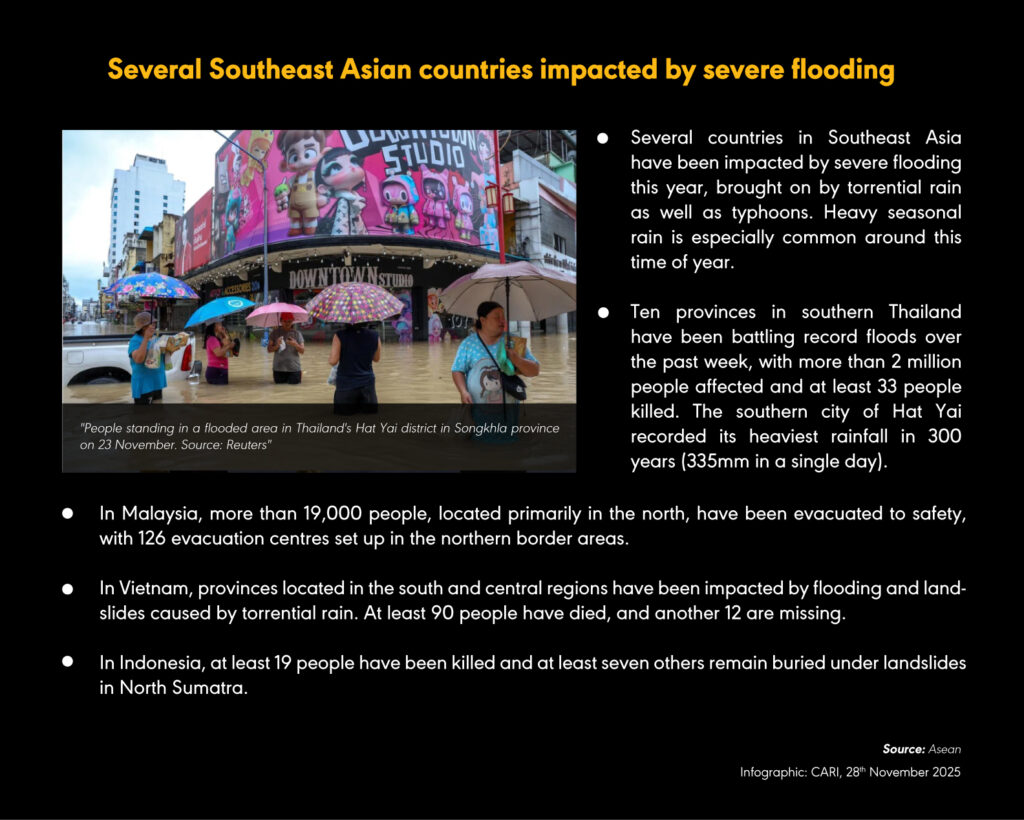
Several Southeast Asian countries impacted by severe flooding
(26 November 2025) Parts of southern Thailand have recorded record flooding over the past week, resulting in at least 33 deaths and affecting more than 2 million people. Hat Yai city reported 335mm of rainfall in a single day, described as its heaviest in 300 years, leaving vehicles and homes submerged and residents stranded on rooftops. Only 13,000 people have been moved to shelters, with the majority cut off from assistance. The Thai military has assumed operational control and is preparing to deploy an aircraft carrier, 14 boats carrying relief supplies, and field kitchens capable of producing 3,000 meals per day. The navy stated that the aircraft carrier could be converted into a floating hospital if required. Additional evacuation assets, including boats, high-clearance trucks and jet skis, have been deployed in Songkhla province. The cabinet has designated Songkhla a disaster zone to release relief funding. Regional impacts include 98 deaths in Viet Nam, more than 19,000 evacuees in Malaysia, and at least 19 deaths with seven missing following landslides in North Sumatra, according to the Indonesian National Search and Rescue Agency. A Thai volunteer group, the Matchima Rescue Center, reported receiving thousands of evacuation requests over the past three days.
CHINA, MALAYSIA, CAMBODIA|
China raises formal concerns with Malaysia and Cambodia on US trade deals
(28 November 2025) China raised formal concerns with Malaysia on 25 November regarding portions of the US–Malaysia trade agreement signed in October, stating it has “grave concerns” and urging Malaysia to handle the matter in line with its long-term interests. Chinese officials received clarifications from Malaysia’s Ministry of Investment, Trade and Industry, though no details were disclosed. A similar meeting between China and Cambodia saw the Chinese trade envoy request that Phnom Penh address Beijing’s concerns, with Cambodian officials also providing unspecified clarifications. The complaints relate to US–Malaysia and US–Cambodia agreements that include commitments to align with Washington on national security matters such as export controls, sanctions, investment screening, and restrictions on sensitive technologies. Malaysia’s agreement includes preferential access for US goods and services, exemptions from the US 19% reciprocal tariff, and obligations to follow US trade restrictions, adopt US-aligned export controls and sanctions, prevent circumvention, and explore investment-review mechanisms covering critical minerals and infrastructure. Cambodia’s pact commits to removing tariffs on US food, agricultural, and industrial goods in exchange for exemptions from the 19% tariff, while requiring compliance with the US export control regime, adherence to the entity list, cooperation on third-country investment information and strengthened defence trade and transshipment controls. The agreements were signed during President Donald Trump’s visit to Malaysia and form part of a series of October pacts with regional economies including Vietnam and Thailand.
THE PHILIPPINES
Economic growth could recover to 5.5% by first quarter of 2026
(27 November 2025) The Philippines’ Finance Secretary said economic growth could recover to 5.5% by the first quarter of next year as government spending returns to pre-scandal levels following a halt linked to corruption in flood control projects. He described the pause as necessary to address leakages in infrastructure spending, with the former finance chief previously estimating that 25%–70% of flood control budgets were lost, costing up to USD 2 billion annually from 2023 to 2025. The new finance secretary said reforms, prosecutions, and efforts to recoup stolen funds would support a rebound, alongside improved external conditions such as the US-China trade truce and recent investment commitments, including Samsung Electro-Mechanics’ USD 860 million expansion. Third-quarter GDP growth fell to 4%, the weakest since the pandemic, with the central bank expecting corruption-related effects to persist into next year and forecasting a return to the 6%–7% target only in 2027. The finance secretary plans to convene multiple departments next week to prioritise easily deployable or near-completion projects to offset underspending. He noted that government expenditure accounts for nearly 17% of GDP but ruled out a major stimulus, emphasising fiscal discipline and targets to narrow the budget deficit to 5.5% of GDP in 2024 and 5.3% in 2026.
INDONESIA, UNITED STATES
Indonesia rejects US demands for “poison pill” clauses in reciprocal tariff trade deal
(28 November 2025) Indonesia has rejected US demands to include “poison pill” or “loyalty” clauses in the reciprocal tariff trade deal currently under negotiation, with officials stating the terms excessively constrain economic sovereignty and are too one-sided. The clauses, which Washington imposed on Malaysia and Cambodia in agreements signed last month, would allow the US to terminate a deal if a partner signs a pact deemed harmful to US interests, and would require alignment with US sanctions, restrictions, and digital tax rules. Indonesia’s pushback emerged as the two sides work to finalise a July preliminary deal that imposed a 19% reciprocal tariff on Jakarta, with Indonesian officials emphasising concerns about losing autonomy over relations with other countries. Analysts said Indonesia’s larger economic scale, including USD 28 billion in goods exports to the US in 2024 versus Malaysia’s USD 53 billion, has strengthened its negotiating leverage, though the ultimate balance of power remains uncertain. The resistance underscores challenges for the US in persuading Southeast Asian partners to limit China’s role in regional trade and supply chains, with Beijing remaining a dominant trading partner and top investor in sectors such as nickel in Indonesia. The Malaysian deal has stirred controversy domestically, with critics warning it compromises sovereignty. Indonesia’s economic ministry has said negotiations are ongoing and may conclude this year, while a US Trade Representative official said Washington aims to expand bilateral trade while recognising each country’s sovereign rights over economic security.
SINGAPORE
China, United States, and Malaysia are top overseas postings for Singapore workers
(28 November 2025) China, the United States and Malaysia accounted for 18.3%, 13.6% and 10.1% of overseas postings for Singapore resident employees respectively, but only 3.1% of the resident labour force – about 76,000 people – had worked abroad full-time for at least six months, according to new data released by the Ministry of Manpower (MOM). Overseas experience was most common among workers in their 40s (4.6%) and 50s (4.5%), with over half taking their first posting between ages 25 and 34, while the incidence among those aged 25 to 29 was 0.5%. Senior roles showed higher exposure, with 7.7% of managerial employees having worked abroad, and overseas experience increased with income, rising to 16.8% among those earning SGD 30,000 or more per month compared with 10.6% for those earning SGD 15,000–SGD 19,999 and about 3% for those earning SGD 5,000–SGD 9,999. Outward-oriented sectors recorded higher overseas exposure at 3.8% versus 2.2% in domestic-focused industries, with professional services (4.7%), information and communications technology (4.6%), finance and insurance (4.2%) and wholesale trade (3.8%) showing the highest levels. Workers with overseas stints were predominantly professionals (45.2%) and managers (30.7%), with manufacturing, finance and ICT the most common sectors for postings.
CAMBODIA
IMF projects Cambodia’s growth to slow to 4.8% in 2025 and 4.0% in 2026
(27 November 2025) The IMF’s 2025 Article IV Consultation projects Cambodia’s growth to slow to 4.8% in 2025 and 4.0% in 2026, down from 6.0% in 2024 and an estimated 6.2%in the first half of 2025, as trade disruptions, border tensions and weak credit growth dampen investment and household spending. The IMF attributes the downgrade to declining remittances, softening tourism, tariff effects and margin pressures on manufacturers, alongside “anemic” domestic credit growth. Inflation is expected to rise modestly in 2025 before easing in 2026, with risks tilted to the downside due to vulnerabilities in garments and footwear exports, border-related impacts on tourism, and elevated private debt and rising non-performing loans. The Fund highlights additional concerns over high real estate indebtedness and governance risks but notes potential upside from deeper regional integration and the reintegration of returning migrant workers. Executive Directors describe the recovery as uneven and increasingly fragile, urging temporary fiscal support for vulnerable groups, gradual fiscal consolidation, agile monetary policy and the phased restoration of reserve requirements. They identify urgent financial-sector reforms, including ending forbearance by end-2025, strengthening supervision, improving stress testing, enhancing asset-quality reporting, developing crisis-management and insolvency frameworks, and establishing deposit insurance while addressing AML/CFT gaps. Structural reforms to diversify exports, raise productivity, improve competitiveness and strengthen governance are deemed essential.
VIET NAM
Viet Nam awards multiple 5G equipment contracts to Huawei and ZTE in 2025
(28 November 2025) Viet Nam has awarded multiple 5G equipment contracts to Huawei and ZTE in 2025, including a USD 23 million Huawei-linked consortium deal in April and at least two ZTE antenna contracts worth over USD 20 million, with one secured last week and the first publicly disclosed in September. These awards followed the White House’s imposition of tariffs on Vietnamese goods, though no link has been established. Procurement data indicates that while Ericsson, Nokia and Qualcomm continue to supply Viet Nam’s 5G core infrastructure, Chinese firms have recently secured smaller tenders with state-owned operators. The contracts have triggered concern among Western officials, who view the historical exclusion of Chinese firms from Viet Nam’s digital infrastructure as a precondition for support in advanced technologies. Western governments citing national security risks have banned Huawei and ZTE from their telecom networks, and the new Vietnamese contracts were discussed in two recent meetings among senior Western officials in Hanoi, including warnings from a US official about risks to network trust and access to US technology. Discussions have also covered whether sections of the Vietnamese network using Chinese technology could be isolated, though experts note that equipment suppliers could still gain access to network data. Additional developments include a June agreement on 5G technology transfers between Huawei and Viettel, according to Viet Nam’s defence ministry, with one Viettel source citing lower Chinese costs. The recent wins come as Viet Nam–China ties deepen, supported by progress on rail links and special economic zones near the border.
RCEP Monitor
SOUTH KOREA
Central bank keeps its policy rate at 2.5% over concerns of rising home prices and foreign exchange vulnerability
(27 November 2025) South Korea’s central bank kept its policy rate at 2.5%, matching forecasts from six economists citing the need to contain housing-market borrowing and manage financial stability risks. The decision follows the Bank of Korea’s last cut in May, when the rate was lowered by 25 basis points, and the board’s previous hold, which highlighted concerns over rising household debt and exchange rate volatility. The government has introduced loan-to-value limits under President Lee Jae Myung to reduce household exposure to real estate and support consumption. South Korea’s Finance Minister described the economy as being at a “turning point” and called for stronger backing of artificial intelligence, autonomous vehicles and other emerging industries. The meeting was the first rate decision since Seoul and Washington agreed a USD 350 billion investment arrangement, including a USD 20 billion annual cap on South Korea’s US investment to limit won depreciation risk. The easing of trade tensions with the US, a key market for semiconductor and auto exports, has strengthened expectations of improved growth. The economy expanded 1.2% quarter-on-quarter in Q3 after 0.7% growth in Q2, following a 0.2% contraction in Q1. BNP Paribas expects the BOK to revise its GDP forecast to 1% for 2025 from 0.9%, and to 1.6% from 0.9% for 2026, citing stronger semiconductor demand and expansionary fiscal policy.
SOUTH KOREA
South Korean equities retreat from early gains on steady rates
(27 November 2025) South Korean equities retreated from early gains after the Bank of Korea kept its policy rate at 2.50%, with the market closing 0.7% higher after rising up to 1.6%, while the won strengthened 0.2% despite an 8% decline in the second half of the year. Pantheon Macroeconomics said stronger growth expectations, reduced trade risks, and higher inflation linked to exchange rate passthrough likely push a potential rate cut from January to February, adding that the governor’s comment that rates are “near neutral level considering financial stability” signals limited remaining room for easing. Risk appetite across emerging Asia improved as US rate futures priced in an over 80% probability of a Federal Reserve cut next month. MUFG said easing external pressures, including lower oil prices and prospects of further US cuts, may support global sentiment ahead of year-end. Asian currencies were mostly steady, with slight appreciation in the rupiah and Malaysian ringgit.
AUSTRALIA
Core inflation rises to 3.3% in October, exceeding central bank’s target band
(26 November 2025) Australia’s core inflation rose to 3.3% in October, exceeding forecasts of 3% and surpassing the Reserve Bank of Australia’s 2–3% target band, while headline CPI reached 3.8%, driven by housing, food, and recreation and culture. Non-tradables prices rose 4.8%, tradables 2%, services 3.9%, discretionary goods and services 3.2%, and non-discretionary items 4.3%, reflecting persistent domestic price pressures. The data prompted gains in the Australian dollar (+0.6%) and a 14-basis-point increase in three-year government bond yields, and shifted market expectations toward a potential RBA rate hike in 2026 rather than a cut. Economists at UBS and Barrenjoey anticipate the first increase may occur in May 2026, potentially followed by further rises to 4.1% by August, though the bar for action remains high. The report was the first release of Australia’s new monthly inflation measure, though the RBA continues to focus on the quarterly trimmed-mean CPI, which excludes volatile items and better reflects domestic demand. Labor market tightness persists, with unemployment falling to 4.3% in October and annual wage growth remaining elevated, supporting inflationary pressures. The Assistant Governor noted the labor market is slightly beyond sustainable levels for inflation at target. The RBA is expected to leave rates unchanged at 3.6% at its 8–9 December meeting. Analysts emphasise that ongoing inflation pressures and the unwinding of government energy subsidies may require tighter policy before any cuts are considered, contrasting with US Fed easing and New Zealand’s recent 25-basis-point reduction.
|
15 participating countries |
20 chapters |
2.2 billion |
US$26.2 trillion |
28% |
| ASEAN member states, Australia, China, Japan, South Korea, New Zealand | trade in goods and services, investment, intellectual property, e-commerce, competition, SMEs, economic and technical cooperation, and government procurement | combined population, 30% world’s population | combined GDP, 30% global GDP | global trade (based on 2019 figures) |