CARI Captures Issue 717: Chinese EV manufacturers significantly expand presence in Southeast Asia


Captures has widened its scope to include news related to all the members of the Regional Comprehensive Economic Partnership (RCEP) agreement which was signed towards the end of 2020. Besides the ASEAN Member States, this includes Australia, New Zealand, China, Japan, and South Korea. The other weekly newsletters under CARI, China-ASEAN Monitor and Mekong Monitor will also be consolidated into the Captures newsletter. We hope this new version of Captures will serve you better and look forward to providing a curation of stories relevant to ASEAN and its trading partners.


ASEAN, CHINA
Chinese EV manufacturers significantly expand presence in Southeast Asia
(19 August 2025) Chinese electric vehicle (EV) manufacturers have significantly expanded their presence in Southeast Asia, with EV sales in the region increasing 79% year-on-year in H1 2025, driven by aggressive pricing, local assembly, and expanded model availability. Chinese original equipment manufacturing (OEMs) accounted for over 57% of EV sales, up 67% year-on-year, with BYD, GAC Group, Chery, SAIC, Wuling, Changan, and Great Wall Motor leading. In Thailand, EVs reached 18% of vehicle sales in the first seven months of 2025, while in Viet Nam, VinFast sold 67,569 units, tripling year-on-year and outpacing Chinese brands. BYD became the top-selling brand in Singapore, surpassing Toyota. Chinese EVs are often discounted by 8–20%, mirroring domestic price strategies, with some units sold as demo cars or post-motor-show stock at up to 27% off. Industry concerns include sustainability, resale value, and after-sale service reliability, especially for weaker players like Neta, which has cut operations in Thailand. Despite these issues, Chinese exports remain profitable, with China shipping 3.68 million vehicles abroad in the first seven months of 2025, one-third of which were EVs. Several Chinese manufacturers are scaling up production in Southeast Asia, including BYD’s USD 1.3 billion plant in Indonesia and new facilities by Changan and GAC in Thailand. Analysts note that early adopters are driving Chinese EV uptake due to tech appeal, but charging infrastructure and brand support remain gaps. AlixPartners projects only 15 of China’s 129 EV brands will remain viable by 2030 despite expected global growth.

MALAYSIA, UNITED STATES
Malaysia subject to 19% US tariff due to refusal to accept certain conditions during negotiations
(18 August 2025) Malaysia is subject to a 19% US tariff—down from the initially scheduled 25%—due to its refusal to accept certain conditions in negotiations, according to Malaysia’s Investment, Trade and Industry Minister. He cited Malaysia’s adherence to “red lines,” including policies like the Bumiputera policy, as the basis for not meeting all US demands. While affirming that Malaysia will not retaliate, he underscored the importance of the US as a key investor and export destination. Prime Minister Anwar Ibrahim reiterated Malaysia’s position against external pressure that could compromise national policy. The Trade Minister also noted that US semiconductor tariffs remain at 0%, but warned that potential hikes—such as the 300% duties proposed by Donald Trump—would significantly impact Malaysia and ASEAN’s integrated supply chains. On trade diversification, he confirmed Malaysia has concluded a trade deal with South Korea, targeted for signing at APEC or a leaders’ summit. Negotiations with the EU have resumed after a 2012 stall, and engagement with the Gulf Cooperation Council has begun. Malaysia is also working to upgrade trade agreements with India and China, incorporating green and digital provisions. An Asean Digital Economy Framework Agreement, to be discussed on 28 August in Malaysia, aims to enhance intra-regional trade and SME participation, addressing the current intra-Asean trade level of under 25%.

MALAYSIA, SINGAPORE
Malaysia expresses interest in establishing cross-border ride-hailing services with Singapore
(19 August 2025) Malaysia has reiterated its interest in establishing cross-border ride-hailing services with Singapore to improve bilateral transport connectivity, but Malaysia’s Transport Minister stated that implementation must be mutually agreed and cannot proceed unilaterally. Discussions were previously raised with the former Singapore’s Transport Minister, but Singapore was not prepared to proceed at the time. The Johor Chief Minister has also advocated for such services, including through talks with Grab to revise the Cross-Border Travel Agreement ahead of Visit Johor 2026. While Singapore’s Land Transport Authority (LTA) confirmed discussions took place on 01 August, it clarified that there are no current plans to liberalise cross-border point-to-point transport via ride-hailing, although it is exploring options to enable bookings for licensed taxis via apps and expanding boarding/alighting points. Only 300 licensed cross-border taxi drivers currently operate under the scheme, which restricts pick-ups and drop-offs to designated terminals, limiting user uptake. Recent enforcement actions by both countries have targeted illegal ride-hailing activities by foreign drivers; Malaysia’s Road Transport Department detained four Singaporean private-hire drivers operating illegally in Johor since 09 August, while Singapore’s LTA impounded 19 vehicles for similar offences. Malaysia described these actions as reciprocal, acknowledging that both countries are enforcing existing laws, but emphasised the need for a more sustainable solution through bilateral agreement. It has been noted that enabling cross-border ride-hailing would require complex legal harmonisation. In response to crackdowns, Johor ride-hailing drivers are planning to form an association to seek government engagement.

INDONESIA
Bank Indonesia unexpectedly cuts its benchmark rate by 25 basis points
(20 August 2025) Bank Indonesia cut its benchmark BI-Rate by 25 basis points to 5% on Wednesday, marking a second consecutive monthly reduction and signalling potential for further easing, despite stronger-than-expected GDP growth in Q2. The decision, predicted by only 9 of 39 economists surveyed by Bloomberg, was justified by a stable rupiah, subdued inflation forecast of 1.5%–3.5% for 2025–2026, and a need to support economic expansion. The Bank Indonesia Governor noted the central bank now expects 2024 growth to exceed the midpoint of its 4.6%–5.4% range. The rupiah remained stable, bond yields fell to 6.41%, and equities gained up to 1% following the announcement. The move aligns monetary policy more closely with fiscal priorities, including President Prabowo Subianto’s proposed higher spending and a 2026 growth target of 5.4%. Domestic demand remains weak, with manufacturing contraction, sluggish consumption, and July lending growth slowing to 7.03%, the lowest since March 2022. The Governor reiterated calls for commercial lenders to reduce borrowing costs in line with the central bank’s rate cuts. The rupiah has appreciated over 1% against the US dollar in August, supported by foreign inflows. July inflation rose to 2.4% but remains within target.

VIET NAM
Viet Nam announces USD 48 billion worth of projects to support economic growth
(19 August 2025) Viet Nam announced that approximately 250 projects worth around USD 48 billion (MYR 202.82 billion), or roughly 13% of national GDP, are being implemented to support economic growth. Of these, 129 state-funded projects—covering sectors such as urban development and transportation—account for about VND 478 trillion (USD 18 billion), while 121 projects valued at USD 30.5 billion are funded through other sources, including select foreign investors. Key initiatives include the Rach Mieu 2 Bridge, Saigon Marina International Financial Center, Viettel Group’s R&D Centre, and Vingroup’s National Exhibition and Convention Center in Hanoi. Viet Nam’s Prime Minister stated these projects aim to overhaul the country’s strategic infrastructure and reaffirmed his 2024 GDP growth target of 8.3%–8.5%, despite headwinds from a pending US trade deal that could impose a 20% tariff on Vietnamese exports. The Prime Minister has called for both immediate and structural economic measures to meet these growth objectives.

VIET NAM
Viet Nam introduces visa and labour reforms to boost competitiveness
(21 August 2025) Viet Nam has introduced several new measures aimed at improving its attractiveness to foreign investors, including Decree No. 219 on foreign workers, Decree No. 221 on visa exemptions for individuals contributing to socio-economic development, and Decree No. 229, which extends visa-free stays to 45 days for citizens from 12 countries. These changes are intended to address labour shortages, particularly in high-tech sectors, amid a decline in the proportion of FDI sector workers with degrees or certificates, which dropped from 25.5% in 2021 to 21.7% in 2024. Business leaders view Decree 219 as a key improvement, citing benefits such as faster processing, broader exemptions, and enhanced HR efficiency. Some commentators emphasised the need for immediate foreign expertise to support Viet Nam’s digital and economic transformation. However, experts also called for further reforms, including long-term residence permits for major investors. Concerns were raised over restrictive implementation, such as the narrow eligibility for the Special Visa Exemption Card (SVEC), with some urging flexibility to maximise national benefit. Clearer guidelines and consistent enforcement were also highlighted as essential to maintain investor confidence and support Viet Nam’s regional competitiveness.

LAO PDR
Bank of Laos reduces base interest rate by 0.5 percentage points to 9.0% per annum
(21 August 2025) On 15 August 2025, the Bank of Laos reduced its base interest rate by 0.5 percentage points to 9.0% per annum, following a Monetary Policy Committee meeting. The decision aims to stimulate economic activity and stabilise the financial system amid ongoing domestic and international challenges. Inflation showed a declining trend, averaging 10.18% from January to July, with July’s figure falling to 5.30% from 8.3% in May. The Lao kip depreciated marginally by 0.11% against the US dollar and 1.19% against the Thai baht, while the gap between commercial bank and market rates widened. Despite this, M2 money supply grew 11.92% year-on-year, indicating sustained banking activity. Foreign reserves remained sufficient to cover 4.91 months of imports. However, the economy continues to face structural risks including high import dependency, external debt pressures, and global commodity price volatility. The bank reaffirmed its commitment to a market-based exchange rate regime, maintaining the reference rate at 6.5, and announced accompanying policy measures including improved foreign exchange management, centralisation of government deposits, modernisation of payment systems, and enhanced debt oversight. It also plans to implement new credit and lending strategies to increase access to finance and support economic growth.


RCEP Monitor


SOUTH KOREA
Bank of Korea flags elevated uncertainty due to trade and financial risks
(19 August 2025) The Bank of Korea Governor stated that while South Korea’s economy rebounded in Q2, elevated uncertainty—particularly from US trade negotiations and financial stability risks—continues to weigh on monetary policy considerations ahead of the 28 August policy meeting. He cited rising delinquency rates among small businesses and regional developers, as well as persistent volatility in the won, which has fluctuated in the mid-1,300 range against the US dollar. Although housing debt growth has slowed following mortgage caps, property prices in parts of Seoul remain elevated. The benchmark interest rate currently stands at 2.5%, following a cumulative 1 percentage point reduction since October, with the last cut in May. While four board members were previously open to another rate cut within three months, the resolution of some US tariff issues has reduced immediate downside risks, softening expectations for further easing in August. Rhee indicated that policy decisions will continue to be based on evolving conditions in growth, inflation, and financial stability. Inflation is expected to remain near the 2% target, supported by stable energy prices and subdued demand, though food prices may rise due to poor weather. Growth momentum is anticipated to continue in H2, aided by a supplementary budget, but external risks, particularly from Washington’s ongoing trade negotiations with countries including China, remain significant.

CHINA
Approvals for overseas IPO slow to trickle despite strong demand
(21 August 2025) Between 01 July and 15 August 2025, China’s securities regulator, the CSRC, approved only three public offerings in Hong Kong, a sharp decline from the 52 approvals granted in the first half of the year, contributing to growing uncertainty around Hong Kong’s IPO revival. The slowdown contrasts with strong demand, with 76 new companies applying for clearance in the same period, pushing the backlog to 240. Despite earlier commitments from the CSRC Vice Chairman to accelerate overseas listing approvals, the regulator maintains full discretion over timing. Under a 2023 rule, Chinese firms must file with the CSRC within three days of a foreign listing application, although foreign exchanges impose no such requirement. It was found that direct Hong Kong listings had the shortest average approval time (182 days) in H1 2025. Amid lower regulatory barriers, Shein reportedly pivoted to a Hong Kong IPO after failing to secure approval for a London listing. Meanwhile, PwC forecasts HKD 200 billion in IPO proceeds on HKEX in 2025. HKEX announced record H1 2025 results, with 34% growth in core revenue and a near doubling of daily turnover to HKD 220.3 billion, led by a 154% increase in Southbound Stock Connect volumes. The number of A-to-H listings has surged, including from CATL and smaller firms, although state media reported the CSRC is considering raising the minimum market capitalisation for such listings to RMB 20 billion. Analysts suggest regulators may be shifting focus to quality control, curbing speculative activity, and strengthening the domestic capital market, as reflected in guidance from July’s Politburo meeting and commentary from Jefferies.

JAPAN, UNITED STATES
Japanese exports to the US declines by 10.1% year-on-year in July 2025
(21 August 2025) Japan’s exports to the United States declined by 10.1% year-on-year in July to JPY 1.73 trillion, marking the fourth consecutive monthly drop, primarily due to a 28.4% decrease in auto shipments following a 25 percentage point increase in vehicle tariffs imposed by President Donald Trump. As a result, Japan’s trade surplus with the US narrowed by 23.9% to JPY 585.1 billion, while imports from the US fell 0.8% to JPY 1.14 trillion. Although a reduction in the tariff rate to 15% was agreed in late July, its implementation timeline remains unspecified. Other US-bound exports such as auto parts and semiconductor-making equipment declined by 17.4% and 31.3%, respectively. Vehicle export volume to the US fell 3.2%. Globally, Japan’s trade deficit in July shrank by 81.3% to JPY 117.5 billion due to falling import values, especially in crude oil and coal. Overall exports fell 2.6% to JPY 9.36 trillion, while imports dropped 7.5% to JPY 9.48 trillion. Japan’s trade deficit with China stood at JPY 609.2 billion for the 52nd consecutive month, with exports down 3.5% and imports down 3.9%. Conversely, Japan’s trade surplus with the rest of Asia rose 3.6-fold to JPY 478.5 billion, remaining positive for a sixth consecutive month. The trade deficit with the EU totalled JPY 278 billion, continuing an 18-month run in negative territory.

15 participating countries

20 chapters

2.2 billion

US$26.2 trillion

28%

ASEAN member states, Australia, China, Japan, South Korea, New Zealand trade in goods and services, investment, intellectual property, e-commerce, competition, SMEs, economic and technical cooperation, and government procurement combined population, 30% world’s population combined GDP, 30% global GDP global trade (based on 2019 figures)

CARI Captures Issue 716: Viet Nam and South Korea commit to expand bilateral trade to USD 150 billion


Captures has widened its scope to include news related to all the members of the Regional Comprehensive Economic Partnership (RCEP) agreement which was signed towards the end of 2020. Besides the ASEAN Member States, this includes Australia, New Zealand, China, Japan, and South Korea. The other weekly newsletters under CARI, China-ASEAN Monitor and Mekong Monitor will also be consolidated into the Captures newsletter. We hope this new version of Captures will serve you better and look forward to providing a curation of stories relevant to ASEAN and its trading partners.


VIET NAM, SOUTH KOREA
Viet Nam and South Korea commit to expand bilateral trade to USD 150 billion
(13 August 2025) Vietnamese President To Lam’s four-day state visit to South Korea marked the start of President Lee Jae-myung’s ASEAN policy, with both leaders committing to expand bilateral trade to USD 150 billion by 2030 from USD 86.8 billion. Lam led a high-level delegation including ministers of trade, industry, technology and foreign affairs. Ten memorandums of understanding were signed, covering nuclear and renewable energy, financial policy, and scientific innovation. Lee highlighted the contribution of approximately 10,000 Korean firms operating in Viet Nam and prioritised joint development in semiconductors. Lam requested expanded cooperation in training Vietnamese talent in AI, biotech and shipbuilding. Both sides pledged to strengthen defence-industrial collaboration, including a potential USD 300 million deal for K9 howitzers, though a technology transfer agreement for local production remains pending. Defence ministers agreed to revise existing cooperation frameworks. Analysts noted the strategic backdrop of US tariffs—15% on South Korean and 20% on Vietnamese goods—and the broader US-China rivalry, driving Seoul and Hanoi to seek economic and military diversification. The summit outlined plans for cooperation in maritime security, demining, UN peacekeeping, and strategic information exchange. South Korean firms are expected to increase investments in high-tech sectors, digital infrastructure, and smart cities in Vietnam.

VIET NAM
Viet Nam undergoing one of the fastest demographic ageing transitions globally
(13 August 2025) Vietnam is undergoing one of the fastest demographic ageing transitions globally, with the proportion of citizens aged 60 and above increasing from 8.7% in 2009 to 14.2–16% by early 2024. Projections show Vietnam will enter the ‘aged population’ phase between 2036 and 2038 and become a super-aged society by 2050—achieving in 17–20 years what took France 115 years. The country currently has around 16.1 million elderly, expected to rise to 18 million or 20% of the population by 2045. This demographic shift stems from a postwar baby boom followed by a sharp decline in birth rates, leading to low replacement fertility. Key risks identified include increased numbers of elderly without family support, rising caregiving burdens (especially on women), labour shortages, and escalating healthcare and social welfare pressures. Most elderly care is informal, with fewer than 1% accessing public nursing homes, and Vietnam faces a severe shortage of trained caregivers. The WHO recommends 5,000 care workers per 100,000 people aged 65 and above, a target Vietnam is far from meeting. Non-communicable and age-related diseases, such as cardiovascular conditions, cancer, dementia, and depression, are prevalent and strain healthcare resources.

THAILAND
Bank of Thailand reduces policy rate by 25 basis points to 1.50%
(13 August 2025) The Bank of Thailand’s Monetary Policy Committee unanimously reduced the policy rate by 25 basis points to 1.50%, effective immediately, marking the lowest level in two years. The MPC Secretary stated that while economic growth projections for 2025 and 2026 remain broadly unchanged, the current policy shift is driven by the need to address increasing structural challenges and weakened competitiveness resulting from recent US trade measures. Headline inflation remains subdued, and small and medium-sized enterprises are identified as particularly vulnerable. The MPC concluded that more accommodative monetary policy is necessary to maintain supportive financial conditions and ease the burden on affected sectors.

SINGAPORE
Number of million-dollar flat sales hit record in Q2 2025, reflecting 75.8% year-on-year increase
(13 August 2025) A record 415 public housing units in Singapore were resold for SGD 1 million or more in Q2 2025, reflecting a 75.8% year-on-year increase, according to OrangeTee Group. Combined with 348 such transactions in Q1, high-value sales in H1 2025 now represent nearly 75% of the total for 2024, positioning the market to surpass last year’s full-year record of 1,035 million-dollar units. The highest-priced resale in the quarter was a 122 sqm unit sold for SGD 1,658,888. Overall resale prices rose 0.9% quarter-on-quarter, marking the 21st consecutive quarterly increase but the smallest since Q2 2020. OrangeTee forecasts a full-year public housing resale price increase of 4% to 5.5%, citing stable economic fundamentals and declining interest rates. The government had previously implemented borrowing restrictions to moderate housing demand. On 12 August, following stronger-than-expected H1 performance, Singapore raised its 2025 GDP growth forecast to 1.5%–2.5%, up from 0.0%–2.0%, reversing a prior downgrade prompted by US tariffs.

MALAYSIA
Proportion of Malaysians holding at least MYR 1 million in wealth to double over next decade
(13 August 2025) HSBC Bank projects that the proportion of Malaysians holding at least USD 250,000 (MYR 1.18 million) in financial wealth will double over the next decade, driven by the country’s expanding economy. This projection was disclosed by HSBC’s head of international wealth and premier banking Asia, during the launch of the bank’s updated HSBC Premier offering targeting affluent and high-net-worth clients. The country head of international wealth and premier banking at HSBC Malaysia noted a growing demand among affluent Malaysians for investment solutions that support both wealth accumulation and lifestyle protection. Separately, a 2023 Knight Frank report indicated that the number of Malaysians with wealth exceeding USD 1 million (MYR 4.6 million) is expected to increase from over 85,000 in 2022 to more than 164,000 by 2027.

MALAYSIA
Foreign outflows from Malaysia’s bond market to ease due to Fed rate cut bets
(12 August 2025) Convera Singapore anticipates a potential easing of foreign outflows from Malaysia’s domestic bond market, following renewed expectations of US Federal Reserve rate cuts. In July, global funds withdrew USD 1.2 billion from Malaysian sovereign debt, the highest outflow since October, amid a strengthening US dollar. However, weaker-than-expected US nonfarm payroll data has led swap markets to price in at least two rate cuts in 2025, improving sentiment toward emerging-market assets. Malaysian bonds may benefit from this shift, supported by moderating domestic inflation, with June’s price increase marking the slowest since February 2021. Convera’s FX and macro strategist noted that outflow pressures may have peaked, while the bond market outlook for the remainder of the year will depend on emerging market risk appetite, US monetary policy trajectory, and domestic policy clarity.

SINGAPORE
Limited exposure to US economy shields Singapore from economic turbulence
(14 August 2025) Singapore Prime Minister Lawrence Wong warned of significant global challenges during the country’s 60th independence anniversary, citing an “unravelling” of the international order that had supported its growth. Despite this, investor sentiment remains positive, with the iShares MSCI Singapore ETF rising nearly 30% year-to-date and the Singapore dollar appreciating 7% against the US dollar. Financial institutions dominate the local stock market, with DBS, OCBC, Keppel, and Sea Ltd comprising key holdings, bolstered by defensive characteristics and strong dividend yields. Trade concerns appear muted as the US accounted for only 10% of Singapore’s merchandise trade in 2024, with Asia remaining its primary trading partner. Strategic investments, including a SGD 1 billion AI initiative launched in 2019, have positioned Singapore for growth in sectors such as data centres and pharmaceuticals. Singapore Telecommunications has benefited, with its stock rising 33% this year. Bain & Co. notes Singapore’s increasing prominence in global pharma due to innovation and IP protection, while HSBC highlights its recent rise as Asia’s top destination for medical tourism. Domestically, challenges persist, including income inequality and housing shortages, despite a high per capita GDP of USD 93,000 and limited progress on social welfare. Nonetheless, investors view Singapore as well-placed to lead regionally in a multipolar world.


RCEP Monitor


SOUTH KOREA
Government to announce restructuring plan for petrochemical sector
(14 August 2025) South Korea’s government will unveil a restructuring plan for the petrochemical sector in August 2025, responding to what the country’s Industry Minister described as a “grave” situation driven by global oversupply and sustained weak demand. The sector is currently operating at only 80% of total capacity, reflecting a 20% excess, with margins sharply compressed due to capacity expansion, particularly in China. Drawing on the precedent of the late-2010s shipbuilding sector overhaul, the Industry Minister urged petrochemical firms to voluntarily adjust facilities. Yeochun NCC Co (YNCC), facing KRW 180 billion (USD 130 million) in loans maturing at end-August, has received a KRW 150 billion (USD 108.38 million) loan from DL Chemical, a subsidiary of DL Holdings and major YNCC shareholder. Analysts see YNCC’s difficulties as a potential catalyst for broader industry consolidation. President Lee Jae Myung, elected in June, has pledged tax incentives for mergers and acquisitions and temporary antitrust exemptions to facilitate restructuring. South Korea’s petrochemical exports fell 11.1% year-on-year in H1 2025 to USD 21.7 billion; total exports in 2024 were USD 48 billion, making petrochemicals the country’s fifth-largest export category.

SOUTH KOREA
Potential 10-day public holiday in October drives 28.7% year-on-year surge in overseas travel bookings
(13 August 2025) A potential 10-day public holiday in South Korea this October, contingent on the government designating 10 October as a temporary holiday, has driven a 28.7% year-on-year surge in overseas travel bookings for the 3–9 October period, according to Kyowon Your Travel Easy. Airlines including Jeju Air, Jin Air, T’way Air, Eastar Jet, and Air Busan are adding capacity, with Jeju Air alone scheduling 234 additional international flights. Airfares have risen significantly, with Seoul–Da Nang tickets now priced between KRW 600,000 and KRW 1.2 million, and Seoul–New York flights at around KRW 3 million. Domestic hotel bookings in Jeju and other key locations have exceeded 90% occupancy. Incheon International Airport Corp forecasts international passenger traffic during this period may surpass the previous record of 2.14 million set in January 2025. However, Statistics Korea reported a 34% week-on-week fall in domestic credit card spending during the six-day Seollal holiday in January, despite a 7.3% rise in outbound travellers to 2.97 million. The National Assembly Research Service found limited impact of previous temporary holidays on domestic demand, with concerns over reduced production and exports. Equity issues are also noted, as businesses with fewer than five employees—covering 35% of the workforce—are not mandated to observe temporary holidays. Schools may also face midterm exam scheduling conflicts. The government has yet to announce an official position on the proposed holiday.

JAPAN
Nikkei 225 index hits all time high following stronger-than-expected US inflation data
(13 August 2025) Japan’s Nikkei 225 index surpassed 43,421 points on Wednesday, marking a second consecutive all-time high following stronger-than-expected US inflation data and reduced US–China trade tensions. The increase followed Tuesday’s record breach of the 42,999-point level. US inflation rose by 2.7% year-on-year in July, below market expectations, leading to increased expectations of a rate cut by the Federal Reserve at its September meeting. The CME Group’s FedWatch tool placed the probability of a September rate cut at 96.4%, up from 85.9% a day earlier. The S&P 500 and Nasdaq Composite rose 1.13% and 1.39% respectively on Tuesday, reaching new highs. Investor sentiment was also supported by US President Trump’s announcement of a 90-day extension of the tariff pause on Chinese imports. Other Asian markets also saw significant gains on Wednesday, with the Hang Seng Index up approximately 2.5% and South Korea’s KOSPI gaining 1%. Trump renewed pressure on Fed Chair Jerome Powell to cut rates, criticising the central bank’s reluctance to act sooner, citing negative economic impact. A rate cut would reduce borrowing costs and potentially stimulate the US economy, which remains a key driver of global growth.

15 participating countries

20 chapters

2.2 billion

US$26.2 trillion

28%

ASEAN member states, Australia, China, Japan, South Korea, New Zealand trade in goods and services, investment, intellectual property, e-commerce, competition, SMEs, economic and technical cooperation, and government procurement combined population, 30% world’s population combined GDP, 30% global GDP global trade (based on 2019 figures)

CARI Captures Issue 715: US reduces tariffs on Malaysia, Thailand, and Cambodia to 19%


Captures has widened its scope to include news related to all the members of the Regional Comprehensive Economic Partnership (RCEP) agreement which was signed towards the end of 2020. Besides the ASEAN Member States, this includes Australia, New Zealand, China, Japan, and South Korea. The other weekly newsletters under CARI, China-ASEAN Monitor and Mekong Monitor will also be consolidated into the Captures newsletter. We hope this new version of Captures will serve you better and look forward to providing a curation of stories relevant to ASEAN and its trading partners.


THAILAND, CAMBODIA, MALAYSIA, UNITED STATES
US reduces tariffs on Malaysia, Thailand, and Cambodia to 19%
(01 August 2025) The United States has reduced tariff rates for Malaysia, Thailand, and Cambodia to 19% following a ceasefire between Thailand and Cambodia brokered with Malaysian mediation and US support, enabling President Donald Trump to claim a peacekeeping success. The reductions, confirmed in an executive order issued on 01 August and effective from 7 August, followed trade talks in which all three countries offered concessions to the US, including increased market access and, in Malaysia’s case, the elimination of tariffs on selected US agricultural products and facilitation of halal meat imports. Malaysia had previously faced a 25% rate, Cambodia 49% (then 36%), and Thailand 36%. Malaysia’s Investment, Trade and Industry Minister stated the ceasefire discussions between Prime Minister Anwar Ibrahim and Trump contributed to the revised rate, though Malaysia maintained firm positions on excise duties on alcohol, tobacco, and automotives, foreign equity caps, and digital laws. The Philippines, Indonesia, and Viet Nam had earlier secured rates of 19–20%, while Singapore, Brunei Darussalam, Lao PDR, and Myanmar saw no change. Analysts said the tariff reductions were influenced by both geopolitical considerations and reciprocal trade liberalisation. Experts highlighted that the timing, regional diplomacy, and transactional trade approach were central to the outcome, with Washington aiming to counter China’s influence in the region. Cambodian leaders publicly credited Trump’s intervention for averting industry collapse, while Thai officials emphasised the deal’s role in sustaining export competitiveness.

INDONESIA
Economy expands by 5.12% year-on-year in Q2 2025, surpassing expectations
(05 August 2025) Indonesia’s economy expanded by 5.12% year-on-year in Q2 2025, surpassing both the previous quarter’s 4.87% and Q2 2024’s 5.05%, and exceeding the 4.8% median forecast of 26 economists polled by Reuters. Growth was driven by a 10.67% surge in exports—mainly palm oil, iron and steel, electronic equipment and vehicles—attributed in part to frontloading ahead of anticipated U.S. tariffs, and an 11.65% rise in imports, largely of capital goods and raw materials. Government expenditure increased 30.37% due to infrastructure projects across regions. Household consumption grew 4.97%, supported by Eid-ul-Fitr-related spending, though concerns remain over declining purchasing power. Bank Indonesia cut its policy rate by 25 basis points to 5.25% in July, signalling potential further easing to support consumption amid slow retail sales growth. Analysts warned that U.S. tariff hikes, despite recent reductions from 32% to 19%, could negatively affect labour-intensive export sectors and employment. Indonesia’s shrinking middle class—down from 21.4% of the population in 2019 to 17.1% in 2024—is also seen as a constraint on domestic demand. Goldman Sachs revised its 2025 GDP forecast to 5.0%, expecting another 50 basis points in rate cuts by Q1 2026. Economists from Permata Bank and Panin Sekuritas project 2025 growth in the range of 4.7% to 5.1%, citing persistent global trade tensions and domestic inflation pressures.

THE PHILIPPINES
Economy grows by 5.5% year-on-year in Q2 2025, above forecast
(07 August 2025) The Philippine economy grew 5.5% year-on-year in Q2 2025, marginally above the 5.4% forecast in a Bloomberg survey, driven by a 14-year high in farm output and strong household consumption, which accounts for over 70% of GDP. Growth was supported by improved rice and corn harvests, easing inflation, and previous interest rate cuts, although industry, investment, and export growth slowed due to global trade uncertainty linked to US tariffs. The peso rose 0.3% to 57.33 against the dollar following the data release, while the stock index declined slightly. The Economic Planning Secretary attributed the performance to coordinated inflation management, and maintained the government’s revised 2025 GDP growth target of 5.5%-6.5%, down from the earlier 6%-8% goal. Achieving the lower end requires 5.6% growth in H2. The Governor of the Bangko Sentral ng Pilipinas signalled potential for two further 25bp rate cuts this year, with more easing possible in 2026. Bloomberg forecast a 25bp cut at the 28 August policy meeting, citing muted inflation and trade risks. US tariffs of 19% on Philippine goods, equal to regional peers, take effect later on 07 August, but officials downplayed their impact given the economy’s limited export reliance.

SINGAPORE
Singapore accounts for over 50% of ASEAN’s GSSSL bonds and loans in 2024
(07 August 2025) Singapore accounted for over 50% of ASEAN’s green, social, sustainability, and sustainability-linked (GSSSL) bonds and loans in 2024, according to the Monetary Authority of Singapore’s (MAS) sustainability report released on 09 July. GSSSL bond issuance volumes in Singapore rose nearly 80% to USD 13.3 billion in 2024, recovering from two years of decline but still below the 2021 peak of USD 14.4 billion, with green bonds increasing their share. Transition bonds remained a small but growing subset. GSSSL loans originated in Singapore reached over USD 48 billion, marking a seventh consecutive annual high, with sustainability-linked loans the dominant category since 2021. MAS supports sustainable financing through two grant schemes: the Sustainable Bond Grant Scheme and the Sustainable Loan Grant Scheme, both of which provide up to USD 125,000 to offset costs for external reviews or sustainability validation. Lower caps of USD 100,000 apply for issuers not aligned with recognised disclosure standards such as TCFD, ISSB, or ESRS. Bonds must have a minimum issuance or programme size of USD 200 million and at least one-year tenure, while qualifying loans must be at least USD 20 million in size and three years in tenure. Both schemes are valid through 2028 and allow multiple applications.

INDONESIA, UNITED STATES
Indonesian copper exports to the US to face zero percent import tariff
(07 August 2025) Indonesia’s Investment and Downstreaming Minister confirmed that Indonesian copper exports to the United States will face a zero percent import tariff, following trade negotiations under the Indonesia-US agreement concluded in July. Talks with the United States Trade Representative are ongoing to extend tariff reductions to other commodities, including nickel, palm oil, rubber, shorea wood, and copper derivatives. While nickel may not receive full exemption, Roeslani indicated that the current 19% tariff could be lowered further. The zero-tariff status is also being sought for commodities not produced in the US. The tariff on several Indonesian goods was previously reduced from 32% to 19% under a revision of the Trump-era trade measure. In return, Indonesia has pledged to purchase USD 15 billion in US energy products and USD 4.5 billion in US agricultural products, as announced by the US president on 16 July. Additionally, Indonesia plans to procure 50 Boeing aircraft, primarily Boeing 777 passenger jets, though specific buyers were not disclosed.

VIET NAM
Viet Nam’s exports rise 16% year-on-year in July 2025 to USD 42.3 billion
(06 August 2025) Viet Nam’s exports rose 16% year-on-year in July 2025 to USD 42.3 billion, exceeding the 14% forecast, as buyers accelerated purchases ahead of a 20% US import tariff effective 07 August. Imports increased 17.8% to USD 40 billion, surpassing the 15.2% forecast, resulting in a trade surplus of USD 2.27 billion, down from USD 2.83 billion in June. The tariff, originally proposed at 46%, was reduced to 20%, aligning closely with rates imposed on other Southeast Asian exporters. Net exports to the US constitute around 20% of Viet Nam’s GDP, raising concerns about tariff-related factory risks. The government confirmed ongoing trade negotiations with Washington and stated plans to diversify exports to the Middle East and India while promoting domestic consumption. Industrial production rose 8.5% year-on-year and 0.5% month-on-month, while consumer price inflation slowed to 3.19%, below both the June rate (3.57%) and market estimate (3.40%). Coffee exports increased 34.6% to 103,000 tonnes. Viet Nam’s GDP grew 7.96% in Q2 2025, with an official full-year target of 8%, though the impact of new US tariffs remains uncertain.

MALAYSIA, RUSSIA
Number of Malaysian tourists visiting Russia doubles in Q1 2025 year-on-year
(07 August 2025) Russia’s Economic Development Minister stated that the number of Malaysian tourists visiting Russia doubled in Q1 2025 compared to the same period in 2024. The announcement followed President Vladimir Putin’s meeting with Malaysia’s King, Sultan Ibrahim. The Russian Economic Development Ministry also reported that Russian tourist arrivals to Malaysia in 2024 exceeded pre-pandemic 2019 levels by 64%. In July 2025, the validity of Russia’s electronic visa was extended from 60 to 120 days, and the maximum stay increased from 16 to 30 days, with approximately 5,000 users to date. Malaysian citizens were the first to trial Russia’s new “tourist card” system, enabling remote top-ups for payments covering transport, accommodation, and other travel-related expenses.


RCEP Monitor


SOUTH KOREA, CHINA
South Korea announces temporary visa-free entry for Chinese tourist groups
(06 August 2025) South Korea announced a temporary visa-free entry programme for Chinese tourist groups from 29 September 2025 to June 2026 to stimulate inbound tourism and support domestic economic recovery ahead of the Asia-Pacific Economic Cooperation (APEC) summit. The measure follows China’s November decision to exempt South Koreans and others from visa requirements and precedes China’s October holiday period. The initiative was confirmed by South Korea’s tourism ministry after a policy meeting and coincides with improving bilateral relations under President Lee Jae Myung. The APEC summit, scheduled for 31 October to 1 November in Gyeongju, may also feature bilateral meetings involving Chinese President Xi Jinping and U.S. President Donald Trump. Following the visa-free announcement, shares of tourism-related South Korean firms rose sharply: Hyundai Department Store gained 7.1%, Hotel Shilla increased 4.8%, Paradise casino operator rose 2.9%, and Hankook Cosmetics surged 9.9%.

SOUTH KOREA
Finance Ministry to aid companies cope with increased US tariffs
(05 August 2025) South Korea’s Finance Ministry announced the formation of a task force to develop economic policy measures under President Lee Jae Myung’s administration, focusing on helping companies cope with increased US tariffs and expand into new markets. Following a trade agreement with the United States that set a 15% tariff on South Korean exports—above the 10% baseline and significantly higher than near-zero levels under the Korea-US FTA—the ministry plans short-term domestic demand stimulus and long-term financial support for technology development. The agreement, finalised shortly before President Trump’s 25% tariff deadline, leaves unresolved issues that may resurface during the upcoming summit between Trump and President Lee, including defence spending, corporate investments, non-tariff barriers, and currency concerns. The ministry emphasised that the agreement reduces trade uncertainty and includes a USD 350 billion investment package expected to open business opportunities, enhance bilateral economic cooperation, and stabilise supply chains. Policy initiatives will also target growth in artificial intelligence, semiconductors, and globally successful “K-contents” sectors, with strategies and budget plans to be announced later in August. Regulatory reforms are also planned to encourage business activity. Despite South Korea’s fastest quarterly growth in over a year, driven by consumer demand and tech exports, the IMF revised its 2025 GDP growth forecast for the country down to 0.8% from 1.0%, citing ongoing tariff-related trade risks.

JAPAN
Japan to encourage increased domestic cultivation of rice to meet production shortfalls
(05 August 2025) The Japanese government will announce a reversal of its longstanding rice production adjustment policy that curbs output, with Prime Minister Shigeru Ishiba set to confirm the shift toward encouraging increased rice cultivation at a ministerial meeting on 05 August. The change follows recent production shortfalls, including a 320,000-tonne deficit in 2024 and a cumulative shortfall of 980,000 tonnes from 2021–2024, which have driven up table rice prices and exposed weaknesses in the existing supply-demand balancing policy. The revised approach aims to boost rice output for both domestic use and export, ensure supply stability, and support farmers’ incomes, particularly through large-scale and corporate farming. Japan’s Agriculture Minister will present an analysis attributing price surges primarily to supply shortages rather than distribution issues. Current subsidies that incentivise shifts from table rice to feed rice or other crops like wheat and soybeans may be revised, along with a broader review of paddy and field policies scheduled for fiscal 2027. The Ministry of Agriculture will prepare an updated policy outline by summer 2026. Environmentally friendly initiatives such as “dry direct seeding” and terraced field maintenance will also be promoted in response to growing heat and water scarcity risks. Ishiba is expected to advocate for a flexible production support system, while addressing challenges related to abandoned farmland and intergenerational farm transfer.

15 participating countries

20 chapters

2.2 billion

US$26.2 trillion

28%

ASEAN member states, Australia, China, Japan, South Korea, New Zealand trade in goods and services, investment, intellectual property, e-commerce, competition, SMEs, economic and technical cooperation, and government procurement combined population, 30% world’s population combined GDP, 30% global GDP global trade (based on 2019 figures)

CARI Captures Issue 714: Thailand estimates over USD 300 million in economic damages from conflict with Cambodia


Captures has widened its scope to include news related to all the members of the Regional Comprehensive Economic Partnership (RCEP) agreement which was signed towards the end of 2020. Besides the ASEAN Member States, this includes Australia, New Zealand, China, Japan, and South Korea. The other weekly newsletters under CARI, China-ASEAN Monitor and Mekong Monitor will also be consolidated into the Captures newsletter. We hope this new version of Captures will serve you better and look forward to providing a curation of stories relevant to ASEAN and its trading partners.


THAILAND, CAMBODIA
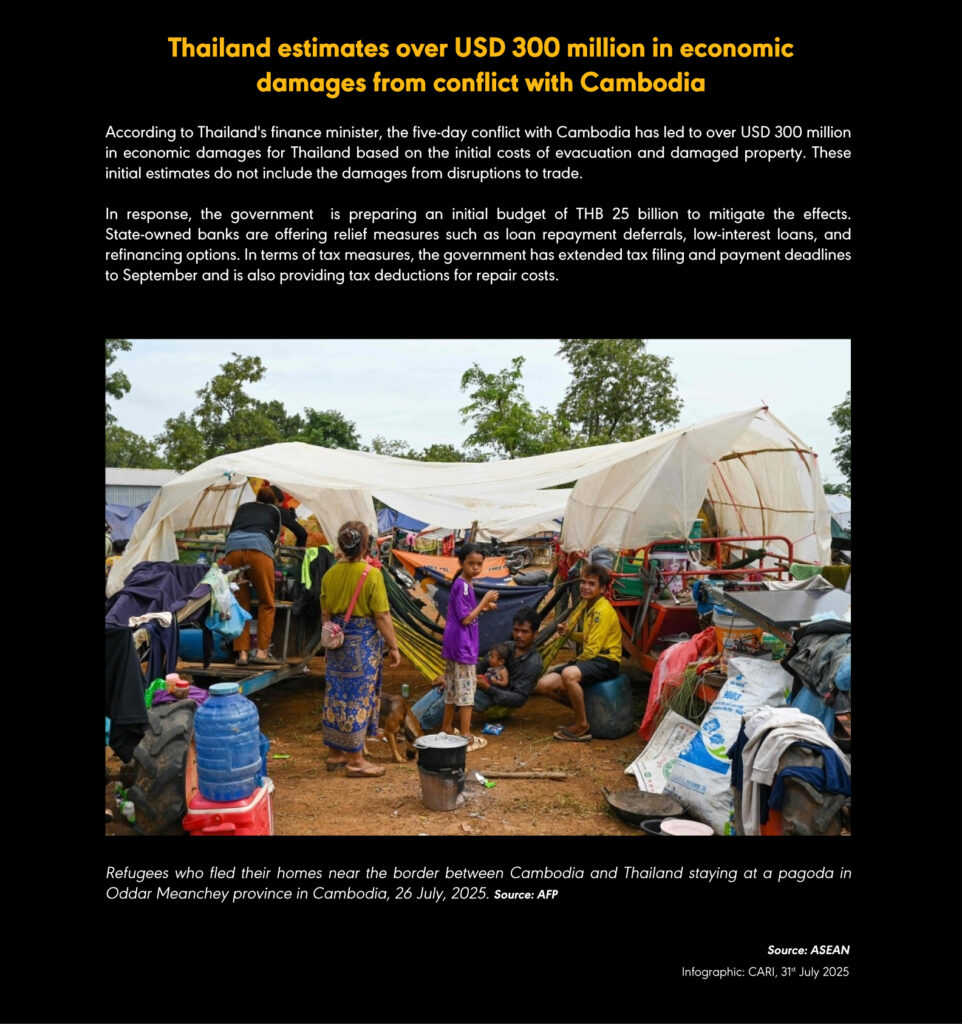
Thailand estimates over USD 300 million in economic damages from conflict with Cambodia
(29 July 2025) Thailand’s Finance Minister stated on 29 July that the initial costs of evacuation and property damage following the five-day border conflict with Cambodia exceed THB 10 billion (USD 300 million), with broader economic impacts expected. The government is preparing a THB 25 billion budget to support reconstruction and stimulate the economy, including support for repairing infrastructure and housing. The Finance Minister noted this figure may be revised upward, particularly once trade disruption costs are fully accounted for. Relief measures being offered by state-owned banks include loan repayment deferrals, low-interest financing, refinancing schemes, and exemptions from banking fees. Tax relief includes extended filing and payment deadlines until September and deductions of up to THB 100,000 for home repairs and THB 30,000 for vehicles. Additionally, THB 100 million has been allocated to each affected province to address local needs, with the possibility of further disbursement.

THAILAND
Finance Ministry revises its 2025 GDP growth forecast to 2.2% from 2.1%
(30 July 2025) Thailand’s finance ministry revised its 2025 GDP growth forecast to 2.2% from 2.1%, supported by strong first-half performance, though it warned of potential deceleration due to U.S. tariffs ranging from 15% to 36%. Export growth is now projected at 5.5%, up from 2.3%. The Bank of Thailand recently adjusted its own growth forecast to 2.3%, near last year’s 2.5%. The Fiscal Policy Office indicated the economic impact from the Cambodian border conflict is minimal, with border trade comprising just over 1% of total exports, though the labour market may be affected due to the 12% share of Cambodian migrant workers. The Industry Ministry estimated exports to Cambodia could decline by THB 60 billion, noting most Cambodian workers in Thailand are unregistered. The Finance Minister confirmed the conflict has not disrupted trade negotiations with the U.S., with a final trade proposal expected to be submitted by 30 July. The Finance Minister expressed hope for a reduced tariff rate, citing lower negotiated levels by Vietnam (20%) and Indonesia (19%). The finance ministry also reduced its 2025 foreign tourist arrival forecast to 34.5 million, down from 36.5 million, compared to the pre-pandemic peak of nearly 40 million in 2019.

SINGAPORE
Straits Times Index marks its longest losing streak in five weeks
(30 July 2025) Singapore’s Straits Times Index declined for the fourth consecutive session on 30 July, falling 0.2 per cent to 4,219.41, marking its longest losing streak in five weeks amid slower second-quarter employment growth. Advance estimates from the Ministry of Manpower showed total employment rising by 8,400, down from 11,300 in the same period last year, with softness noted in outward-oriented sectors. DBS cautioned that labour market conditions may deteriorate further in the second half due to weakening demand in trade-exposed industries. The Monetary Authority of Singapore left monetary policy settings unchanged at its quarterly meeting but warned that global growth momentum is expected to slow through the remainder of 2025 as front-loaded activity wanes and deferred tariffs take effect. Market breadth was negative, with 342 losers versus 222 gainers, and SGD 2.1 billion worth of securities traded. Singapore Airlines led STI losses, falling nearly 2% to SGD 6.90, while Yangzijiang Shipbuilding rose 3.6% to SGD 2.62. Among local banks, DBS declined 0.7% to SGD 48.26, UOB dropped 0.8% to SGD 36.52, and OCBC was unchanged at SGD 17.04.

INDONESIA
Indonesia preparing third stimulus package in 2025 amidst slowing economy
(29 July 2025) Indonesia is preparing a third stimulus package in 2025 aimed at supporting regional economies, domestic tourism, and transportation, with full details to be released by the Coordinating Ministry for Economic Affairs. Indonesia’s Finance Minister reaffirmed the government’s commitment to maintaining GDP growth near 5%, though DBS and other analysts project growth easing to 4.8% this year, citing weaker consumption, falling foreign direct investment, and global trade risks, including U.S. tariffs. The stimulus will exclude wage subsidies, which end in August, and DBS warns this could blunt its impact, especially for low-income households. The economy grew 4.87% in Q1, the slowest first-quarter growth in over three years, and FDI dropped 6.95% year-on-year in Q2 to IDR 202.2 trillion—the sharpest decline in five years. Bank Indonesia cut rates by 75 basis points so far this year and plans further measures to boost liquidity, though economists argue monetary easing alone is insufficient. President Prabowo is targeting 8% growth through programmes including 3 million homes annually and free school meals, supported by extended property tax breaks. However, economists warn that fiscal constraints, limited stimulus coverage, and structural challenges such as regulatory uncertainty and high logistics costs are dampening investment and household spending. Proposals involving state-directed lending and subsidised housing loans risk undermining financial stability.

MALAYSIA
US to announce trade deals with Malaysia, Thailand, and Cambodia
(31 July 2025) Prime Minister Anwar Ibrahim stated that Malaysia is awaiting an official announcement from U.S. President Donald Trump on 01 August regarding the country’s tariff rate under ongoing trade negotiations, which must be finalized before higher tariffs take effect on 01 August. Anwar confirmed he spoke directly with Trump, who commended Malaysia’s involvement in mediating the recent Thai-Cambodian conflict. Malaysia, previously facing a 25% tariff, has concluded negotiations, and a joint statement is expected from the U.S. Trade Representative and Malaysia’s Ministry of Investment, Trade and Industry. Trade Minister Zafrul Aziz confirmed the deal is finalised pending Trump’s formal response. The U.S. has agreed to 19% and 20% tariffs with the Philippines and Viet Nam respectively, while transshipped goods face a 40% levy. Cambodia and Thailand also reached agreements following ceasefire talks, though Cambodia’s Deputy Prime Minister denied knowledge of a final deal. Singapore will face a 10% baseline tariff with no sectoral exemptions, which Prime Minister Lawrence Wong described as manageable. Trump has confirmed attendance at the ASEAN Summit in Kuala Lumpur in October, which Malaysia will chair.

MALAYSIA, SINGAPORE
Johor town Kluang eyes spillovers in investments and businesses from Johor-Singapore Special Economic Zone (SEZ)
(31 July 2025) Since the Johor-Singapore Special Economic Zone (SEZ) was formalised in January, Kluang—located over 100km from Johor Bahru—has seen a 30% rise in investor and business enquiries, especially in manufacturing, logistics and tourism. Businesses such as Kluang Coffee Powder Factory and logistics firm SSAT are expanding capacity and projecting sales increases of up to 50% and 15% respectively. Local authorities have identified Kluang as a potential satellite city to the SEZ, with infrastructure upgrades including the Gemas-Johor Bahru Electrified Double Track Project and RTS Link expected to enhance connectivity and position Kluang as a logistics hub. Land costs in Kluang remain competitive at MYR 158 per sq ft compared to MYR 393 in Johor Bahru. However, business leaders have warned of potential infrastructural strain and called for comprehensive zoning and infrastructure planning. Agro-tourism operators such as Zenxin Organic Park and UK Farm anticipate long-term gains if the SEZ incorporates agritechnology and food production. Other Johor districts such as Muar, Batu Pahat, and Segamat are yet to see significant spillover but have been identified as potential secondary beneficiaries depending on transport connectivity and local sector strengths. Johor recorded MYR 30.1 billion in approved investments in Q1 2025, the highest in Malaysia, and the state government continues to emphasise equitable development across all 10 districts.

INDONESIA
Trade surplus projected to decline to USD 3.45 billion in June 2025
(31 July 2025) Indonesia’s trade surplus for June is projected to have declined to USD 3.45 billion from USD 4.3 billion in May, according to a Reuters survey of 17 economists. The anticipated narrowing is attributed to a 6.5% year-on-year increase in imports, up from 4.14% in May, alongside a continued rise in exports, which are expected to have grown 10.41% in June, compared to 9.68% the previous month. The country has maintained a monthly trade surplus since 2020, though the surplus has been gradually moderating amid weakening global demand. The official figures, along with July’s consumer price index data, will be released by Indonesia’s statistics bureau on Friday.


RCEP Monitor


CHINA
Private home prices remained effectively flat in June 2025
(30 July 2025) Hong Kong private home prices remained effectively flat in June, rising 0.03% month-on-month following an identical increase in May, according to the Rating and Valuation Department. This follows a 0.5% rise in April, which ended a four-month decline. Year-to-date, prices have fallen 0.9%, reaching their lowest level since 2016 and reflecting a nearly 30% drop from the 2021 peak. The recent stabilisation is attributed to more affordable mortgage rates, with the one-month HIBOR falling below 1.2% since May, down from over 3.5% during the past two years. Despite the removal of property purchase restrictions and relaxed down payment rules in 2023, demand has remained subdued amid a weak economic outlook and emigration of professionals. Brokerages such as Morgan Stanley and HSBC forecast a market bottom, while realtor JLL maintains a negative outlook, projecting a 5% decline in mass residential prices this year and no sustained recovery until 2026, when housing inventory is expected to normalise. Market forecasts for 2025 remain mixed, with potential price movements of ±5% depending on interest rate trends and U.S.-China trade tensions.

CHINA
China’s manufacturing sector contracts for fourth consecutive month in July
(31 July 2025) China’s manufacturing sector contracted for the fourth consecutive month in July, with the official Purchasing Managers’ Index (PMI) falling to 49.3 from 49.7 in June, below the 50-point threshold indicating growth, and underperforming Bloomberg’s forecast. The National Bureau of Statistics attributed the decline to seasonal factors and adverse weather, including floods and high temperatures, while Capital Economics highlighted softening demand and falling new export orders, citing renewed tariff pressures. Domestic demand also showed signs of weakness amid persistent challenges such as low consumption, youth unemployment, and a property sector debt crisis. The manufacturing slowdown coincided with stalled trade negotiations between China and the US, as a 90-day tariff truce nears expiry on 12 August without a new agreement in place.

SOUTH KOREA, UNITED STATES
US announces trade agreement with South Korea with 15% tariffs set on Korean exports
(30 July 2025) U.S. President Donald Trump announced a “Full and Complete” trade agreement with South Korea that sets a uniform 15% tariff on South Korean exports to the U.S., including a reduction from the previously threatened 25% on auto exports. As part of the deal, Trump stated South Korea would provide USD 350 billion for U.S.-owned and controlled investments, although Seoul described this as a facilitation fund for Korean firms entering U.S. sectors such as shipbuilding, semiconductors, batteries, biotechnology, and energy. Of the total, USD 150 billion is earmarked for shipbuilding cooperation. U.S. Commerce Secretary Howard Lutnick claimed 90% of the investment’s profits would benefit Americans. The agreement follows a similar investment-based deal with Japan, which remains under dispute. South Korea resisted U.S. demands to open its beef and rice markets but did not secure concessions on steel or semiconductors. Additionally, Seoul agreed to purchase USD 100 billion in U.S. LNG and energy products. Trump confirmed U.S. exports to South Korea would remain tariff-free. The deal raises questions over the relevance of the existing U.S.-South Korea FTA, which had already eliminated most tariffs. South Korea’s goods trade with the U.S. in 2024 totalled over USD 197 billion, with a USD 66 billion U.S. trade deficit. South Korea’s Kospi index rose 0.5% following the announcement.

15 participating countries

20 chapters

2.2 billion

US$26.2 trillion

28%

ASEAN member states, Australia, China, Japan, South Korea, New Zealand trade in goods and services, investment, intellectual property, e-commerce, competition, SMEs, economic and technical cooperation, and government procurement combined population, 30% world’s population combined GDP, 30% global GDP global trade (based on 2019 figures)

CARI Captures Issue 713: Donald Trump announces trade deals with Indonesia and the Philippines


Captures has widened its scope to include news related to all the members of the Regional Comprehensive Economic Partnership (RCEP) agreement which was signed towards the end of 2020. Besides the ASEAN Member States, this includes Australia, New Zealand, China, Japan, and South Korea. The other weekly newsletters under CARI, China-ASEAN Monitor and Mekong Monitor will also be consolidated into the Captures newsletter. We hope this new version of Captures will serve you better and look forward to providing a curation of stories relevant to ASEAN and its trading partners.


INDONESIA, THE PHILIPPINES, UNITED STATES
Donald Trump announces trade deals with Indonesia and the Philippines
(23 July 2025) President Donald Trump announced on 22 July that the United States has reached separate trade agreements with the Philippines and Indonesia, imposing a 19% tariff on goods imported from both these countries while American exports are largely exempted from tariffs from either. The Philippine agreement was reached during a bilateral meeting with President Ferdinand Marcos Jr. at the White House, making him the first Southeast Asian leader to visit Trump in his second term. Trump stated on social media that the Philippines would move towards an open market and zero tariffs on US goods, with Finance Secretary Ralph Recto indicating Manila’s willingness to reduce tariffs on select American products and suggesting zero tariffs on US automobiles. The US imported USD 14 billion in goods from the Philippines in 2024, primarily electronics, processed foods, machinery and apparel, and exported USD 9 billion. The Indonesia deal, formally detailed in a joint statement, also includes commitments to remove taxes on US digital services, eliminate pre-shipment inspections on US goods, accept US motor vehicle safety standards, and lift export restrictions on critical minerals. Indonesia previously faced a 32% tariff in April, later reduced to a 10% rate pending the 01 August deadline. In 2024, the US imported USD 28 billion in goods from Indonesia, mainly apparel and footwear, and exported USD 10 billion, chiefly oilseeds, grains, oil and gas. Both agreements deviate from higher tariff threats Trump issued earlier this year and come amid his administration’s shift in focus from quantity to quality of trade deals.

INDONESIA
Toyota Motor announces plan to begin producing electric vehicles in Indonesia in 2025
(23 July 2025) Toyota Motor announced it will begin producing electric vehicles in Indonesia this year, making Indonesia the third manufacturing base for its bZ4X SUV after Japan and China. The company plans to leverage its over-30% market share in Indonesia to expand EV sales and confirmed this marks its first EV production in the country, complementing its existing hybrid vehicle production. Toyota-Astra Motor stated the move aligns with Toyota’s “multi-pathway strategy” toward carbon neutrality by adding EVs to its portfolio of environmentally friendly vehicles. The company also plans to start producing EV pickup trucks in Thailand by year-end. Indonesia’s government offers reduced VAT of 1% and exemption from luxury tax for EVs with at least 40% local content, while vehicles below that threshold face an 11% VAT. Companies with local production commitments also qualify for exemptions on import tariffs and luxury tax under the incentive scheme introduced in 2023.

MALAYSIA
Malaysia announces revised support package on 23 July in support of consumer spending
(23 July 2025) Malaysia announced a revised support package on 23 July, reducing the RON95 petrol price for citizens from MYR 2.05 to 1.99 per litre while maintaining plans for targeted fuel subsidies to be detailed by end-September. The package also includes a one-time cash handout of MYR 100 to all Malaysians aged 18 and above. Fitch Ratings estimates the package will cost MYR 2.3 billion, equivalent to 0.1% of GDP, and remains within the 2025 budget deficit target of 3.8%, though Fitch cautioned that delays in subsidy reform could jeopardise the goal of cutting the deficit to 3% by 2028. The measures aim to offset higher living costs linked to the expanded sales and service tax effective 01 July and respond to criticism of insufficient support. Opposition groups plan a protest in Kuala Lumpur on Saturday, expected to attract 10,000–15,000 participants, with 2,000 police officers deployed. Market reaction was muted, with the stock index up 0.3% and the ringgit steady. Analysts noted the package reflects counter-cyclical policy following Bank Negara Malaysia’s 25-basis-point rate cut on 09 July, with fiscal space from earlier consolidation enabling the measures, which are expected to support consumer spending amid external risks, including a potential 25% US tariff on Malaysian exports.

MALAYSIA
Malaysia resists key US demands during trade negotiations
(22 July 2025) Malaysia is aiming to reduce impending US tariffs, set at 25% from 01 August, to approximately 20%, but is resisting key demands from the Trump administration, including extended tax exemptions for US-made electric vehicles, easing foreign ownership restrictions in power and finance, and subsidy cuts for local fishermen. Prime Minister Anwar Ibrahim has maintained that trade negotiations will not compromise national policies, particularly preferential treatment for Malays and indigenous groups. While Malaysia has addressed concerns over AI chip transshipment to China by requiring export permits and disclosure of potential misuse, it has not agreed to US requests tied to broader policy changes. Minister Zafrul Aziz has indicated progress but warned of risks from poorly-structured deals, stating some demands may be unfair. Malaysia is unwilling to extend its EV tax exemption beyond December due to implications for equal treatment of all foreign manufacturers. With nearly half of EV registrations in H1 2025 coming from Chinese firms, the rationale for special treatment of US EVs is unclear. US pressure on fishing subsidies is politically sensitive due to the sector’s ethnic Malay voter base. The US trade deficit with Malaysia was USD 24.8 billion in 2024. The tariff level will influence Malaysia’s revised 2025 GDP growth forecast, currently set between 4.5% and 5.5%. Negotiations continue amid regional uncertainty, following Viet Mam’s unexpected acceptance of 20% tariffs earlier this month.

SINGAPORE
Core inflation remains at 0.6% year-on-year in June 2025, unchanged from May
(23 July 2025) Singapore’s core inflation rate remained at 0.6% year-on-year in June, unchanged from May and below the 0.7% median forecast, according to the Department of Statistics. Headline inflation was 0.8%, also below the 0.9% estimate. Recreation prices declined 2.6% in June, following a 2% drop in May, while food inflation stood at 1% and healthcare costs rose 2.8%. The Monetary Authority of Singapore’s next policy review is scheduled for 30 July, with official projections keeping core inflation between 0.5% and 1.5% for 2025. Economists at Bank of America, Goldman Sachs and Barclays expect monetary policy to ease given subdued price pressures, while Citigroup assigns a 60% probability to policy settings remaining unchanged. The inflation data follow GDP figures released last week showing Singapore avoided a technical recession, supported by manufacturing and services exports amid anticipation of higher US tariffs.

VIET NAM
Ho Chi Minh Stock Index rises to 19% year-to-date, approaching January 2022 record high
(23 July 2025) Viet Nam’s Ho Chi Minh Stock Index has risen 19% year-to-date, approaching its January 2022 record high, driven by the government’s largest administrative overhaul in decades and the implementation of a US trade deal cutting tariffs on Vietnamese goods from 46% to 20% since April. The Vietnamese Prime Minister reforms aim to streamline bureaucracy, cut costs, and redirect spending to development projects, targeting over 8% GDP growth in 2025 and high-income status by 2045. The economy grew 7.52% in H1 2025, supported by strong manufacturing. Foreign investors posted net inflows of USD 411 million into Vietnamese equities in July, while continuing to exit Malaysia, Indonesia and the Philippines. Major index gainers include Vingroup JSC, Vietnam Joint Stock Commercial Bank for Industry and Trade, and Hoa Phat Group JSC. Market participants anticipate a potential FTSE Russell reclassification of Viet Nam to emerging-market status as early as September, which could attract up to USD 6 billion in additional capital. Risks to the outlook include weaker global growth in H2 and uncertainty over a proposed 40% US tariff on transshipped goods.

THE PHILIPPINES
Philippines bonds positioned for rebound from Asia’s lowest ranks due to rate cuts
(24 July 2025) Philippine bonds are positioned for a rebound from the lowest ranks in Asian debt performance, supported by Bangko Sentral ng Pilipinas’ (BSP) capacity to implement further rate cuts beyond the 125 basis points already made in the past year. Real interest rates in the Philippines are currently the highest among emerging Asian economies, with the inflation rate remaining below BSP’s 2–4% target for four consecutive months, allowing a policy rate buffer of 385 basis points. Benchmark 10-year Philippine bond yields have risen 10 basis points this year to 6.28%, diverging from regional peers that saw declines, largely due to concerns over budget deficits and previous oil price increases. However, market forecasts suggest yields may decline to 5.67% by year-end, a level last observed in October 2024. Investor interest is increasing due to the bonds’ low correlation (0.10 over 120 days) with US Treasuries, which face volatility from US fiscal concerns and uncertain Federal Reserve policy. T Rowe Price cited inflation dynamics and de-correlation from Treasuries as key attractions. Additional upside could stem from potential inclusion in JPMorgan’s local-currency emerging-market debt index, while Citigroup highlighted index inclusion and disinflation as supporting a long, currency-hedged position in 10-year peso bonds.


RCEP Monitor


JAPAN
Trump announces trade agreement with Japan including 15% reciprocal tariffs
(22 July 2025) President Donald Trump announced a trade agreement with Japan that includes a 15% reciprocal tariff on Japanese exports to the US, down from the previously threatened 25%, with auto tariffs also reduced to 15%. Trump stated the deal would involve USD 550 billion in Japanese investment in the US, with the US receiving 90% of the profits, and predicted the creation of “hundreds of thousands” of jobs. Japan agreed to expand market access for US cars, trucks, rice, and agricultural goods. Japanese Prime Minister Shigeru Ishiba confirmed the auto tariff reduction, which affects a sector that accounted for 28.3% of Japan’s exports in 2024. The deal follows a sharp year-on-year decline in Japanese auto exports to the US in May (−24.7%) and June (−26.7%). Trump also referenced a separate liquefied natural gas deal and further upcoming trade talks. The agreement comes amid political uncertainty in Japan, where Ishiba faces pressure following his coalition’s upper house election loss and is reportedly considering resignation. Analysts view the deal as politically significant for Ishiba, with HSBC suggesting it could help him avoid internal challenges. Wisdomtree highlighted that the market had grown overly pessimistic on negotiations and noted the broader strategy behind these deals, including large-scale US investments by SoftBank, OpenAI, and Oracle totalling up to $500 billion in AI infrastructure.

SOUTH KOREA
South Korea preparing for high-level trade talks with the US
(23 July 2025) South Korea is preparing for high-level trade talks with the United States, aiming to match or improve upon the 15% tariff rate secured by Japan to avoid reciprocal 25% tariffs by the 01 August deadline. South Korea’s Industry Minister confirmed Seoul would study the US-Japan agreement closely, with emphasis on enhancing industrial and energy cooperation. The Ministry of Trade, Industry and Energy is prioritising alternative concessions, such as increasing imports of US crops like corn for bioethanol, while explicitly excluding rice and beef market liberalisation from negotiations. President Lee Jae Myung stated that South Korea would not accept a deal significantly inferior to Japan’s, and analysts noted that Seoul may need to expand imports of farm goods and energy and boost US investment to reach a comparable outcome. The KOSPI rose 0.2% following the Japan-US announcement, with Hyundai and Kia shares climbing 7.3% and 7.6%, respectively. The US-Japan deal includes USD 550 billion in Japanese investment and preferential treatment on tariffs for sectors like chips and pharmaceuticals. South Korea has been asked by Washington to establish a large-scale investment fund to assist in US manufacturing reconstruction, and areas of potential cooperation include semiconductors and shipbuilding. South Korea remains cautious about joining the proposed USD 44 billion Alaska LNG pipeline project, citing feasibility concerns.

AUSTRALIA
Australia announces full lifting of restrictions on US beef imports
(24 July 2025) Australia has announced the full lifting of restrictions on US beef imports following a review by its agriculture department, which concluded that recent improvements in US cattle tracing protocols sufficiently mitigate biosecurity risks. While Australia technically ended the ban in 2019, continued restrictions on Canadian and Mexican cattle had effectively kept US beef out due to integrated supply chains. The decision follows US pressure, including the imposition of at least 10% tariffs on Australian exports in April, which the White House linked to the beef restrictions. US Agriculture Secretary Brooke Rollins labelled the restrictions “absurd”, and called the decision a “major trade breakthrough”. Australia’s Agriculture Minister stated the decision was based strictly on science, not trade pressure, while an opposition leader raised concerns that the change may have been politically motivated to appease the Trump administration. Industry body Cattle Australia expressed support for the decision. The US is Australia’s largest beef export destination, valued at AUD 14 billion in 2024. Despite US tariffs, a Meat and Livestock Australia report released in June indicated that beef trade between the two countries had increased by approximately one-third year-to-date.

15 participating countries

20 chapters

2.2 billion

US$26.2 trillion

28%

ASEAN member states, Australia, China, Japan, South Korea, New Zealand trade in goods and services, investment, intellectual property, e-commerce, competition, SMEs, economic and technical cooperation, and government procurement combined population, 30% world’s population combined GDP, 30% global GDP global trade (based on 2019 figures)

CARI Captures Issue 712: Chinese consumer brands increasing their presence in Southeast Asia


Captures has widened its scope to include news related to all the members of the Regional Comprehensive Economic Partnership (RCEP) agreement which was signed towards the end of 2020. Besides the ASEAN Member States, this includes Australia, New Zealand, China, Japan, and South Korea. The other weekly newsletters under CARI, China-ASEAN Monitor and Mekong Monitor will also be consolidated into the Captures newsletter. We hope this new version of Captures will serve you better and look forward to providing a curation of stories relevant to ASEAN and its trading partners.


ASEAN, CHINA
Chinese consumer brands increasing their presence in Southeast Asia
(16 July 2025) Chinese consumer brands are increasing their presence in Southeast Asia through acquisitions, product innovation, and use of online sales platforms, with these brands gaining shares in home appliance and cosmetics markets previously dominated by Japanese, South Korean and European firms. Euromonitor data show China’s share in Southeast Asia’s consumer appliances market rose from 3.6% in 2015 to 8.6% in 2024, with sharper gains in specific categories such as vacuum cleaners (22.9%), washing machines (20.4%) and microwave ovens (18.2%). Haier has expanded via local production, acquisitions and AI-enabled products, projecting Thai sales of THB 14 billion in 2025, up 28% year-on-year. Deerma, after acquiring Philips’ water purification business and listing in 2023, now leads Southeast Asia’s vacuum cleaner market with competitively priced products sold via e-commerce. Chinese brands’ share of Southeast Asia’s air conditioning market rose from 9% in 2015 to 25% in 2024, while Japanese brands lost 7 points. Growth has been supported by platforms like TikTok Shop, offering incentives to Southeast Asia-focused merchants, and Shopee, which manages Chinese merchants’ operations. In cosmetics, Chinese mass skin care brands posted 115% average annual growth from 2019–2024, increasing colour cosmetics market share in Indonesia from 2% to 15%. However, Chinese brands remain weak in food categories due to persistent safety concerns and localisation challenges. China’s exports to ASEAN reached USD 322.5 billion in H1 2025, up 13% year-on-year and exceeding exports to the EU and U.S., while imports grew just 1% to USD 188.4 billion, raising competitiveness concerns for Southeast Asia’s local industries.

SINGAPORE
Singapore’s economic growth expected to slow in second half of 2025
(16 July 2025) The Monetary Authority of Singapore (MAS) stated that Singapore’s economic growth is expected to slow in the second half of 2025 despite second-quarter GDP growing 4.3% year-on-year, supported by front-loaded exports ahead of US tariffs. The Ministry of Trade and Industry’s GDP forecast for 2025 was downgraded in April to 0–2% from 1–3%, reflecting weaker global demand and policy uncertainty. The MAS highlighted risks surrounding US tariff measures, noting that Singapore has not yet received formal notification of additional tariffs beyond the 10% baseline announced in April. He projected softer consumption and investment in the coming months. MAS reported a net profit of SGD 19.7 billion for FY2024/25 and assets under management rising 12.2% year-on-year to over SGD 6 trillion. The MAS emphasised Singapore’s position as a regulated and trusted wealth management hub.

SINGAPORE
Luxury condos market faces uphill struggle in attracting wealthy homebuyers
(17 July 2025) The W Residences Marina View in Singapore’s central business district recorded only two units booked out of 683 during its pre-sale weekend, despite preview prices starting at SGD 3,200 per square foot and one-bedroom units priced from SGD 1.8 million, with five-bedroom units at SGD 11.6 million and above. The 99-year leasehold project, developed by Malaysia’s IOI Properties Group for SGD 1.5 billion and managed by Marriott International, comes amid weak demand in the prime city centre, partly due to higher taxes on foreigners and a shift in local preference toward suburban homes. In contrast, LyndenWoods, a mass-market project located 9km away, sold over 94% of its 343 units at an average SGD 2,450 per square foot in one day. Apartment prices in the core central region have increased about 19% over five years, compared to a 40% rise across the broader private home market. Skywaters Residences nearby, backed by Alibaba Group and Perennial Holdings, has sold only two of 190 units since launch, priced at SGD 47.3 million and SGD 30.9 million respectively. City Developments Ltd has yet to announce a launch date for its Newport Residences project in the same area. IOI Properties claimed strong interest during private previews and described buyer caution as expected given the surge in new launches. Analysts suggested developers may slow land acquisitions and avoid price wars, though they continue to target wealthy residents eligible for lower levies rather than offering deep discounts.

INDONESIA, UNITED STATES
US announces trade agreement with Indonesia reducing US tariff rate to 19%
(15 July 2025) U.S. President Donald Trump announced a trade agreement with Indonesian President Prabowo Subianto reducing the threatened U.S. tariff rate on Indonesian goods from 32% to 19% in exchange for Indonesia committing to purchase USD 15 billion in U.S. energy, USD 4.5 billion in agricultural products, and 50 Boeing aircraft, mainly 777s, for Garuda Indonesia. Trump claimed the deal ensures U.S. exports face no Indonesian tariffs or nontariff barriers and grants full access to Indonesia’s market of 280 million people. The U.S. goods trade deficit with Indonesia was USD 17.9 billion in 2024, with bilateral trade totalling USD 38.3 billion. Trump also highlighted Indonesia’s copper reserves as a point of U.S. interest. Indonesian officials expressed confidence that tariff-free U.S. imports were manageable, though analysts in Jakarta noted risks to sectors such as poultry and corn. The Indonesian Employers Association advised caution, noting ongoing regional negotiations could shift competitiveness. The Indonesian Palm Oil Association welcomed the deal, citing potential to raise U.S. palm oil imports to 3 million metric tonnes in coming years. The agreement follows similar U.S. deals with Viet Nam, the U.K., and China, and analysts suggested the inclusion of critical minerals like copper could set a precedent for future trade agreements.

INDONESIA
Indonesia targeting up to USD 2 billion from US dollar-denominated sukuk issuance
(16 July 2025) Indonesia is targeting up to USD 2 billion from a US dollar-denominated sukuk issuance launched on Wednesday, comprising a five-year sukuk with initial price guidance of 4.85% and a 10-year green sukuk at 5.5%. The issuance, through Perusahaan Penerbit SBSN Indonesia III with the government as obligor, will be listed on the Singapore Exchange and Nasdaq Dubai and is rated Baa2 (Moody’s), BBB (S&P) and BBB (Fitch). Proceeds will fund general financing needs and eligible green expenditures. The sukuk follows a U.S.-Indonesia trade deal announced Tuesday reducing proposed U.S. tariffs on Indonesian goods from 32% to 19%, which Indonesian officials described as the result of difficult negotiations. Indonesian equities reached a one-month high after the deal and ahead of the sukuk, outperforming regional peers amid weaker global sentiment. Bank Indonesia cut rates for the fourth time since September, citing the revised U.S. tariffs as supportive amid slowing trade and domestic demand, with the rupiah remaining stable.

VIET NAM, UK
UK announces agreement with Viet Nam to remove pharmaceutical trade barriers
(14 July 2025) Britain announced an agreement with Viet Nam to ease the sale of UK-manufactured medicines and vaccines in the Vietnamese market, as part of its new trade strategy focused on sector-specific deals. Viet Nam will expedite the registration process for new pharmaceuticals and accept approvals from additional regulators, including the UK’s Medicines and Healthcare products Regulatory Agency. The agreement, expected to be confirmed on Monday, is projected to generate GBP 250 million (USD 337 million) for the UK pharmaceutical industry over five years. The UK-Vietnamese Joint Economic and Trade Committee will also meet in London to discuss financial services and renewable energy. While prioritising life sciences under its new industrial strategy, Britain is simultaneously imposing a new quota regime to restrict steel imports from Viet Nam. The industrial strategy has faced delays due to ongoing disputes over drug pricing between the government and the pharmaceutical industry regarding fair valuation of medicines and payments to the health service. Trade Minister Douglas Alexander described the Viet Nam agreement as evidence of early progress under the revised strategies.

MALAYSIA
BMI projects Malaysia will miss its 2024 fiscal deficit target of 3.8%
(17 July 2025) BMI, a Fitch Solutions company, projects Malaysia will miss its 2024 fiscal deficit target of 3.8% of GDP, with the deficit narrowing only to 4%, delaying the government’s aim of reducing it to 3% by 2028. BMI attributes this to higher-than-planned spending and weaker revenue, forecasting 2025 revenue at 16.4% of GDP, down from 16.8% in 2024, due to subdued economic activity limiting tax collection. Petroleum-related revenue is expected to fall short of budget expectations, while economic growth is forecast at 4.2% for 2024, below the official 4.5–5.5% target currently under review. BMI anticipates continued pressure on public finances from the 01 July electricity tariff hike of 14%, which could drive additional utility subsidies, and notes the government has yet to provide clarity on planned RON95 fuel subsidy cuts. It also expects policymakers to exceed planned expenditure in 2025, as seen in previous years. S&P Global Ratings has separately warned of rising risks to Asia-Pacific sovereign ratings from tariffs and trade tensions, underscoring the fiscal challenges for Malaysia despite its relatively strong credit standing in the region.


RCEP Monitor


AUSTRALIA
Unemployment rate rises to 4.3% in June, highest since 2021
(17 July 2025) Australia’s unemployment rate rose to 4.3% in June, the highest since 2021, as net employment grew by only 2,000 against forecasts of 20,000, while the number of unemployed increased by 33,600 and youth unemployment climbed to 10.4% from 9.5%. The weaker-than-expected labour data has raised questions about the Reserve Bank of Australia’s recent decision to hold rates steady at 3.85% despite market expectations of a further cut, with the Australian dollar falling by half a cent after the release on expectations of a rate cut in August. Oxford Economics attributed weak hiring partly to firms’ caution amid global trade uncertainties and noted the slowdown was particularly evident among youth, often the most marginal workers. Langcake and Westpac both cautioned that while headline employment growth has remained solid over the past year, largely due to state-funded hiring in sectors like health and education, recent trends may indicate the start of a broader weakening in labour demand as private sector restraint emerges. Prime Minister Anthony Albanese’s government, elected in May on cost-of-living pledges, plans to convene a productivity-focused roundtable next month to address economic challenges amid easing inflation and slowing jobs growth.

NEW ZEALAND, MALAYSIA
Malaysia aims to serve as halal hub in ASEAN for New Zealand products
(16 July 2025) Malaysian Deputy Prime Minister Zahid Hamidi announced that Malaysia will serve as a halal hub in ASEAN for New Zealand products, following recognition of two New Zealand organisations by the Malaysian Islamic Development Department (Jakim). Speaking at the Malaysia-New Zealand Halal Forum on 16 July, Zahid invited New Zealand halal industry players to participate in the Malaysia International Halal Showcase 2025, where plans for an ASEAN Halal Council comprising ASEAN and ASEAN Plus Plus nations will be announced. The council aims to standardise halal certification across the region, with the agenda to be raised at the ASEAN Summit in October. Zahid also noted discussions within the Gulf Cooperation Council to reactivate the World Halal Council to include Muslim and non-Muslim halal-exporting countries, in view of the global halal market’s projected growth from USD 1.3 trillion annually to USD 5 trillion by 2050, with Malaysia targeting a 5% share. New Zealand Biosecurity and Food Safety Minister Andrew Hoggard highlighted Malaysia as a key market for premium halal meat, with exports exceeding NZD 60 million, and ongoing facilitation of approvals for new halal-certified premises.

CHINA
Authorities call for stricter price oversights amidst deflation pressures
(17 July 2025) Chinese Premier Li Qiang, at a high-level meeting on Wednesday, called for stricter price regulation in the electric vehicle sector to address destructive price competition and deflationary pressures, urging automakers to improve cost oversight, make timely supplier payments, and enhance competitiveness through innovation and quality. Li also called for boosting domestic consumption by removing spending restrictions and optimising trade-in policies for consumer goods. Concerns over oversupply and price wars in sectors such as EVs, solar panels, and steel have intensified, with China’s industrial profits down 9.1% in May and producer prices falling 2.8% year-on-year in the first half. Chinese automakers’ profits fell 11.9% in May despite an 11.7% increase in sales, over half of which were new energy vehicles, prompting the industry association to urge a halt to “vicious competition.” The National Statistics Bureau noted some easing of price cuts in key industries without intervention. Economists, however, cautioned that addressing overcapacity through production cuts risks economic growth and employment, with Evercore ISI’s Neo Wang describing current measures as likely short-lived rather than substantive reform. China’s second-quarter GDP grew 5.2%, keeping it on track for the 5% full-year target, and analysts such as Tianchen Xu warned that firms may still undercut competitors despite calls for price discipline.

15 participating countries

20 chapters

2.2 billion

US$26.2 trillion

28%

ASEAN member states, Australia, China, Japan, South Korea, New Zealand trade in goods and services, investment, intellectual property, e-commerce, competition, SMEs, economic and technical cooperation, and government procurement combined population, 30% world’s population combined GDP, 30% global GDP global trade (based on 2019 figures)

CARI Captures Issue 711: Trump announces new series of tariffs on ASEAN countries, effective 01 August


Captures has widened its scope to include news related to all the members of the Regional Comprehensive Economic Partnership (RCEP) agreement which was signed towards the end of 2020. Besides the ASEAN Member States, this includes Australia, New Zealand, China, Japan, and South Korea. The other weekly newsletters under CARI, China-ASEAN Monitor and Mekong Monitor will also be consolidated into the Captures newsletter. We hope this new version of Captures will serve you better and look forward to providing a curation of stories relevant to ASEAN and its trading partners.


ASEAN
Trump announces new series of tariffs on ASEAN countries, effective 01 August
(09 July 2025) U.S. President Donald Trump announced new punitive tariffs effective 01 August on eight ASEAN economies, with rates of 36% on Thailand and Cambodia, 32% on Indonesia, 25% on Malaysia, 20% on the Philippines, 25% on Brunei Darussalam, and 40% on Lao PDR and Myanmar. Meanwhile, Viet Nam secured a reduced rate of 20% though transshipped goods through Viet Nam faces rates of 40%. ASEAN governments have so far achieved limited progress in negotiations despite offering to increase imports of U.S. goods, and Malaysia, Cambodia and Indonesia confirmed ongoing talks, emphasising a preference for diplomatic resolution. Cambodia noted its rate was already reduced from 49% in April, while Indonesia projected potential output losses of up to IDR 164 trillion (USD 10.1 billion, about 12% of 2024 GDP) if tariffs proceed, particularly impacting labour-intensive sectors. Analysts warned of increased regional uncertainty, adverse effects on industrial output due to dependence on Chinese inputs, and disincentives to investment in affected sectors. Firms are expected to re‑evaluate U.S. market reliance, while Viet Nam may gain short‑term advantage despite ongoing uncertainties in its agreement. Trump’s focus on transshipments aims to counter Chinese exporters’ use of ASEAN to bypass U.S. tariffs, prompting regional caution given China’s threat of retaliatory measures. Market observers noted the possibility of brinkmanship, with three weeks remaining for further negotiations before implementation.

ASEAN
Inflation across ASEAN continues to fall due to weaker demand
(09 July 2025) Inflation in several Southeast Asian economies continued to fall amid concerns over weakening consumer demand, political instability, and increased imports of low-cost Chinese goods. Thailand’s consumer price index declined 0.25% year-on-year in June, following a 0.57% fall in May, driven by lower food and energy prices due to favourable weather and higher agricultural supply, according to the Commerce Ministry. While Thai officials denied deflation risks, Moody’s Analytics identified Thailand as particularly vulnerable, citing a weak tourism recovery and political turmoil, including the 01 July suspension of Prime Minister Paetongtarn Shinawatra, which Maybank warned would dampen consumption and investor confidence into 2026. Singapore’s headline inflation fell to 0.8% in June, its lowest since early 2021, while Malaysia’s eased to 1.2% in May, a four-year low, with Maybank noting broad-based declines in categories like communication and clothing. Economists attributed regional disinflation partly to weaker demand amid economic uncertainty from U.S. tariffs, warning of risks if low inflation entrenches pessimistic expectations. China’s deflationary pressures and increased exports to ASEAN have intensified price competition, particularly in consumer goods and electronics.

MALAYSIA
Bank Negara Malaysia makes first rate cut in five years, marking first policy change in 25 months
(09 July 2025) Bank Negara Malaysia reduced its overnight policy rate by 25 basis points to 2.75% from 3% on Wednesday, marking its first rate cut in five years and its first policy change in 25 months, citing external uncertainties, notably U.S. President Trump’s upcoming 25% tariffs on Malaysian goods effective 01 August, as risks to growth. The rate had previously been raised by a cumulative 125 basis points between May 2022 and May 2023 before being held steady since July 2023. The central bank characterised the move as pre-emptive to support growth amid moderate inflation and geopolitical risks. Malaysia’s GDP growth slowed to 4.4% in Q1 while headline inflation fell to a 51‑month low of 1.2% in May, with core inflation at 1.8% and specific categories such as personal care, education and transport rising 3.7%, 2.2% and 2.1% respectively. A Reuters poll earlier this week showed a slim majority of economists had anticipated a 25‑basis‑point cut. Capital Economics forecast the policy rate to fall further to 2.50% by year‑end. Fitch BMI identified Malaysia, Thailand and Cambodia as among the most exposed to U.S. tariff increases, with Malaysian exports facing the full 25% levy. Despite these pressures, the ringgit has strengthened 5–6% year‑to‑date against the dollar, continuing its 2024 rally driven by favourable trade balances and weaker dollar conditions, with MIDF Research projecting an average exchange rate of 4.10 and a potential recovery to 3.90 by year‑end.

INDONESIA, CHINA
Chinese conglomerates investing billions into Indonesia’s aluminium sector
(10 July 2025) Chinese conglomerates, including Tsingshan Holding, China Hongqiao Group and Shandong Nanshan Aluminium, are investing billions of dollars into Indonesia’s aluminium sector, with Goldman Sachs projecting a fivefold increase in national production by 2030. The expansion follows Indonesia’s 2023 bauxite export ban and continuation of downstreaming policies under President Prabowo Subianto, aimed at fostering manufacturing growth and funding socio-economic programmes. CRU Group expects three new alumina refineries to commence operations in 2025 and at least three more by 2027, while Goldman Sachs projects four additional smelters by decade-end, adding to the two already running. Each refinery costs approximately USD 1 billion, with Chinese investors offering capital and equipment to Indonesian partners. Indonesia’s limited bauxite reserves compared to nickel may constrain growth, while reliance on coal-fired power raises concerns over electricity security and cost. Analysts have questioned whether planned projects will materialise given aluminium prices near USD 2,500/tonne and infrastructure risks, though others note China’s proven ability to scale industries. Indonesia’s bauxite ban has also pushed China to reduce reliance on Guinea, reinforcing its motivation to diversify supply chains through Southeast Asia.

INDONESIA
Increasing number of educated Indonesians migrating abroad for work
(08 July 2025) An increasing number of educated Indonesians are leaving to work abroad due to low domestic salaries, limited career prospects, and cuts to education budgets under President Prabowo Subianto’s administration. 2024 saw an 83% rise in migrant workers with diplomas (to 4,505) and a 2.3-fold rise among those with bachelor’s degrees (to 3,421), together making up 2.7% of emigrants, up from 1.4% in 2019. Tertiary enrolment has grown to 45%, yet unemployment among graduates remains higher (5.25%) than among junior high school leavers (4.11%), and 59% of workers are now in the informal sector. Social media campaigns such as “Just escape for now” and protests over tuition hikes highlight youth frustration. Indonesian firms such as GoTo, Mind ID, and BCA are investing in training and career development to retain talent, but private R&D spending remains low at 0.65% of GDP. Business leaders warn the talent drain threatens long-term competitiveness, while government officials urge returning migrants to contribute to national development.

VIET NAM
Viet Nam preparing stricter sanctions and inspection procedures to combat transshipments
(10 July 2025) Viet Nam is preparing a new government decree introducing stricter sanctions and inspection procedures to combat trade fraud and illegal transshipment, particularly of Chinese goods, in line with commitments under a preliminary tariff agreement reached with U.S. President Trump on 03 July. The agreement reduced proposed U.S. tariffs on Vietnamese imports to 20% from 46%, while maintaining a 40% levy on goods deemed illegally transshipped through Viet Nam. The draft decree mandates intensified inspections of exports to the U.S., with a focus on high‑risk categories such as wooden furniture, plywood, steel machine parts, bicycles, batteries, wireless headphones, and other electronics. It cites fraudulent practices such as forged origin certificates, fake documentation, and import of counterfeit goods, which have reportedly increased in recent years. The decree plans stricter oversight of self‑certified origin claims, enhanced on‑site inspections, and closer control over certificates of origin, though specific penalties are still under revision. The U.S. is also pressing Viet Nam to reduce dependence on Chinese components, particularly for electronics. Details on how Washington will define illegal transshipment, required domestic value‑added thresholds, and finalisation of the deal remain unclear. Bilateral trade data show Vietnam’s exports to the U.S. and its imports from China each totalled around USD 140 billion in 2024, reflecting the relocation of manufacturing since 2018 but also rising Chinese input reliance.

SINGAPORE
Singapore unveils grant to help SMEs brace for US tariff fallout
(10 July 2025) The Singapore Economic Resilience Taskforce (SERT) announced a Business Adaptation Grant to be launched by October 2025, capped at SGD 100,000 (MYR 331,000) per company, with more generous allocations for SMEs, which employ about two-thirds of the workforce. The grant will support companies exporting to or operating in overseas markets affected by tariffs, covering advisory services on free trade agreements, trade compliance, legal and contractual issues, supply chain optimisation, market diversification, and reconfiguration costs such as logistics and inventory. Manpower Minister Tan See Leng indicated further details will follow. Deputy Prime Minister and Trade and Industry Minister Gan Kim Yong said US tariffs will prolong uncertainty and reiterated Singapore’s exposure to a 10% baseline tariff. He urged continued negotiations to lower tariffs and announced plans to visit the US this month to discuss concessions on pharmaceutical tariffs and broader economic cooperation, noting semiconductor discussions will follow pharmaceutical talks. Gan added the economy should remain stable in the first half of the year but warned of slower growth in the next 6–12 months due to higher tariffs and reduced front-loading effects.


RCEP Monitor


AUSTRALIA
Australia announces AUD 1.28 billion development programme for ASEAN
(10 July 2025) Australian Foreign Minister Penny Wong announced an AUD 1.28 billion development programme for ASEAN to address needs arising from significant USAID funding cuts, including over AUD 1 billion dedicated to fostering economic prosperity, climate resilience, and regional stability. Speaking at an event organised by ISIS Malaysia and the Australian High Commission alongside the 58th ASEAN Foreign Ministers’ Meeting, Wong outlined allocations for humanitarian initiatives such as vaccination and HIV/AIDS programmes in the Philippines, and free meal schemes for children and pregnant women in Indonesia. Australia will also provide an additional AUD 16 million in humanitarian aid to Myanmar and Rohingya refugees, including in Bangladesh. The USAID cuts, announced in March and estimated by The Lancet to potentially result in 14 million avoidable deaths by 2030, prompted Australia to reaffirm its strategic partnership with ASEAN and the Indo‑Pacific, highlighting collective resilience, sovereignty, and integration over militarisation. Wong also underscored the value of middle‑power collaboration, referencing Malaysia as Australia’s largest source of international students and its fourth‑largest technology investment destination.

NEW ZEALAND
RBNZ maintains benchmark interest rate at 3.25%, signals further easing if inflation moderates
(09 July 2025) The Reserve Bank of New Zealand (RBNZ) kept its benchmark interest rate at 3.25% on Wednesday, pausing after 225 basis points of cuts since August 2024, and signalled it may ease policy further if inflation moderates as projected. Meeting minutes confirmed the decision aligned with the May projections, with the next cut likely in August given near-term inflation risks and trade tensions. Inflation stands at 2.5% and is expected to reach the top of the 1–3% target band in Q2 and Q3 2025. The RBNZ noted heightened global policy uncertainty, tariffs, and subdued global growth as headwinds to New Zealand’s recovery, which remains fragile despite lower rates and elevated export prices. The New Zealand dollar fell 0.3% to USD 0.5977, and markets pushed back expectations of further easing until August. Capital Economics projected the terminal rate at 2.5%, below the RBNZ’s implied 2.75%. The RBNZ had previously raised rates by 525 basis points from 2021–2023 to combat inflation, tipping the economy into recession, with growth still constrained by weak demand and tight fiscal policy. In contrast, the Reserve Bank of Australia left its rate at 3.85% this week, diverging from New Zealand’s sharper monetary easing path.

SOUTH KOREA
South Korea announces plans to intensify trade negotiations with the US
(08 July 2025) South Korea announced plans to intensify trade negotiations with the United States after receiving a letter from President Donald Trump on 07 July stating his intent to impose a 25% tariff on South Korean goods from 01 August, while framing the letter as an effective grace period to reach agreement. The Industry Ministry confirmed it would use the remaining time to pursue a mutually beneficial outcome, improve domestic systems addressing the US trade deficit, and advance industries through a manufacturing partnership. South Korea recorded a record USD 55.6 billion trade surplus with the US in 2024, up 25% year-on-year, mainly from car exports, while the US ran an USD 66 billion deficit with South Korea, its eighth largest. High-level talks have already taken place, with National Security Adviser Wi Sung-lac meeting US Secretary of State Marco Rubio in Washington, where both sides agreed a summit between President Lee Jae Myung and Mr Trump could advance cooperation. Mr Trump signalled openness to negotiation, saying the deadline was “firm, but not 100% firm”. South Korea, under a new administration since 04 June, acknowledged insufficient time to resolve all issues before high-level negotiations began. The US remains South Korea’s second-largest export market, worth USD 127.8 billion in 2024, accounting for 18.7% of exports, which in total represent over 40% of GDP, with semiconductors, smartphones, cars, and batteries central to global supply chains.

15 participating countries

20 chapters

2.2 billion

US$26.2 trillion

28%

ASEAN member states, Australia, China, Japan, South Korea, New Zealand trade in goods and services, investment, intellectual property, e-commerce, competition, SMEs, economic and technical cooperation, and government procurement combined population, 30% world’s population combined GDP, 30% global GDP global trade (based on 2019 figures)

CARI Captures Issue 710: Viet Nam merges provinces together to enhance foreign direct investment appeal


Captures has widened its scope to include news related to all the members of the Regional Comprehensive Economic Partnership (RCEP) agreement which was signed towards the end of 2020. Besides the ASEAN Member States, this includes Australia, New Zealand, China, Japan, and South Korea. The other weekly newsletters under CARI, China-ASEAN Monitor and Mekong Monitor will also be consolidated into the Captures newsletter. We hope this new version of Captures will serve you better and look forward to providing a curation of stories relevant to ASEAN and its trading partners.


VIET NAM
Viet Nam merges provinces together to enhance foreign direct investment appeal
(04 July 2025) On 30 June, Vietnamese localities implemented administrative unit mergers, reducing the number of provinces and centrally governed cities to 34 and consolidating resources to enhance foreign direct investment (FDI) appeal and socio-economic development. Ho Chi Minh City, which already leads in cumulative FDI at over USD 59.72 billion as of May 2025, has incorporated Binh Duong (USD 42.85 billion) and Ba Ria–Vung Tau (USD 38.19 billion), bringing its combined registered FDI to approximately USD 143.28 billion, or nearly 28% of Vietnam’s total. The first five months of 2025 saw Hanoi lead FDI inflows, followed by Bac Ninh, HCM City, and others, but post-merger rankings are expected to shift, with HCM City maintaining dominance. The merger of Hai Phong and Hai Duong increases Hai Phong’s total registered FDI to about USD 44.48 billion, positioning it near Hanoi’s USD 45.37 billion. Similarly, Bac Ninh and Bac Giang, which currently have cumulative FDI of USD 32.26 billion and USD 13.8 billion respectively, will together exceed USD 46 billion, surpassing several existing high-ranking provinces. Experts view these mergers as strategic steps to create larger, more connected economic zones capable of attracting greater FDI and fostering broader national growth.

VIET, CHINA
Chinese firms in Viet Nam view US-Viet Nam trade deal as manageable
(03 July 2025) On 3 July, the United States and Viet Nam concluded a trade agreement reducing US tariffs on Vietnamese goods to 20%, significantly lower than the previously proposed 46%, and imposing a 40% on goods deemed transshipped, with Vietnamese tariffs on US exports cut to zero. The deal followed three rounds of negotiations and was finalised shortly before the previous tariff pause expired on 09 July. The outcome was viewed as manageable by Chinese manufacturers operating in Vietnam, many of whom relocated production there to avoid earlier US tariffs on China. Ho Chi Minh-based factory owner Peng confirmed he would remain in Viet Nam and share costs with clients, despite stricter Vietnamese rules requiring at least 31% local value-added content. Consultant Liu Jie noted that the new measures primarily target simple transshipment operations, benefiting established manufacturers with substantive operations. US President Trump described the deal as mutually beneficial, though analysts like Mary Lovely argued the zero tariffs on US goods are unlikely to significantly impact Vietnam’s domestic industry due to limited market suitability. Vietnam’s trade surplus with the US rose 42% year-on-year to USD 12.2 billion in May, with US imports from Vietnam totalling USD 136.6 billion in 2024. The agreement has been welcomed by manufacturers as easing uncertainty and supporting continued operations in Vietnam while addressing US concerns over transshipment.

MALAYSIA, THE PHILIPPINES
Alibaba Group opens third data centre in Malaysia, will launch second in the Philippines
(02 July 2025) Alibaba Group has opened its third data centre in Malaysia and will launch a second in the Philippines in October, as part of its AI-driven global expansion strategy. The company also announced a global competency centre in Singapore to support AI adoption by over 5,000 businesses and 100,000 developers. CEO Eddie Wu confirmed plans to accelerate cloud network buildout across China, Japan, South Korea, Southeast Asia, the Middle East, Europe, and the Americas over the next three years, maintaining a commitment to invest more than USD 53 billion in AI infrastructure during this period. Recent investments have also been announced in Thailand, Mexico, and South Korea. Wu reiterated Alibaba’s strategic priority of achieving artificial general intelligence, following its development of standalone offerings based on its Qwen AI models and the continued expansion of its cloud services.

MALAYSIA, ITALY
Malaysia secures potential investments totalling MYR 8.13 billion during Italy trip
(04 July 2025) Malaysia secured potential investments totalling MYR 8.13 billion across petrochemical, machinery and equipment, electrical and electronics, services, and oil and gas sectors during Prime Minister Datuk Seri Anwar Ibrahim’s three-day official visit to Rome. Anwar also announced potential exports valued at MYR 425 million in oleochemicals, renewable energy, biofuel, feedstocks, animal feed additives, and food industries. The visit included meetings with over 100 business leaders and major companies, as well as discussions with Italian Islamic leaders and a gathering with 120 Malaysians based in Italy. Anwar extended an invitation to Italian Prime Minister Giorgia Meloni to visit Malaysia. Bilateral trade between Malaysia and Italy increased by 2% year-on-year to MYR 14.61 billion in 2024, with trade in the first five months of 2025 up 3.3% year-on-year to MYR 6.5 billion. Italy remained Malaysia’s fifth-largest trading partner and the third-largest importer of Malaysian palm oil within the EU in 2024.

MALAYSIA, FRANCE
Malaysia and France to bolster strategic partnership across several sectors
(04 July 2025) During his official visit to Paris, Prime Minister Datuk Seri Anwar Ibrahim outlined plans to deepen Malaysia–France cooperation in aerospace, semiconductors, renewable energy, artificial intelligence, defence, education, digital economy and trade, ahead of a bilateral meeting with President Emmanuel Macron at the Élysée Palace. He highlighted Malaysia’s growing role in global high-tech supply chains, noting local production of parts for Airbus and Boeing, and reaffirmed Malaysia’s position as a key destination for electrical and electronics investments. Addressing Malaysian students and professionals in France, he called for their return to support national development, emphasising youth as a cornerstone of Malaysia’s future competitiveness. Anwar was accompanied by senior cabinet ministers and reiterated the MADANI government’s reform agenda focused on inclusive growth, integrity, and social justice. In 2024, Malaysia–France bilateral trade reached MYR 15.95 billion, with MYR 6.26 billion recorded in the first five months. Separately, Anwar spoke with Canadian Prime Minister Mark Carney to reaffirm energy cooperation through Petronas’ participation in LNG Canada, support the CPTPP, and advocate concluding the ASEAN–Canada FTA negotiations. He also raised the possibility of reinstating visa-free entry for Malaysians and invited Carney for an official visit to Malaysia to advance bilateral ties.

THAILAND
Thailand appoints second interim prime minister this week amidst political instability
(03 July 2025) Thailand appointed its second interim prime minister this week after the Constitutional Court suspended Prime Minister Paetongtarn Shinawatra over allegations of breaching ministerial ethics in a leaked June phone call with Cambodia’s former leader Hun Sen about border tensions. Interior Minister Phumtham Wechayachai assumed caretaker duties on Thursday following cabinet approval, replacing Suriya Jungrungreangkit, who served in the role for one day. The Court accepted a petition from 36 senators claiming Paetongtarn violated the constitution by referring to Hun Sen as “Uncle” and criticising a Thai army commander. An investigation into the incident is under way. Paetongtarn, who was sworn in as culture minister on the same day despite suspension as premier, has seen her popularity decline from 30.9% in March to 9.2% in late June amid economic challenges. Meanwhile, her father, former premier Thaksin Shinawatra, faces a royal defamation case and a Supreme Court review this month of his prior hospital detention, which could lead to his return to jail.

INDONESIA, UNITED STATES
Indonesia to sign USD 34 billion pact with business partners to increase purchases from the US
(03 July 2025) Indonesia will sign a USD 34 billion memorandum of understanding with business partners on 7 July to increase purchases from and investments in the United States, including fuel imports and Indonesian investments in US energy and agriculture sectors, as part of efforts to secure a favourable trade deal with Washington ahead of the 9 July deadline. Chief Economic Minister Airlangga Hartarto stated the initiative involves government, regulators, state-owned enterprises and private sector players, aimed at improving the trade balance and mitigating the impact of a 32% US tariff on Indonesian goods. Indonesia recorded a USD 17.9 billion goods trade surplus with the US in 2024. Hartarto added that Jakarta is seeking better terms than the US–Vietnam agreement, after the US recently lowered the previously announced tariff from 46%. Separately, Garuda Indonesia is negotiating the purchase of up to 75 Boeing jets, including 737 Max 8 and 787 models, though it is unclear if this is linked to the trade talks. Garuda, recovering from pandemic losses, secured a USD 405 million loan in June from sovereign wealth fund Danantara Indonesia for fleet maintenance and repair.


RCEP Monitor


SOUTH KOREA
New measures announced to support currency trading during extended market hours
(04 July 2025) South Korea announced new measures to support currency trading during extended market hours, marking one year since reforms to open the onshore foreign exchange market, as part of efforts to improve market accessibility and achieve developed market status with MSCI. The finance ministry introduced an annual average transaction requirement of USD 100 million for registered foreign institutions (RFIs), subject to review every three years, and extended the exemption from reporting requirements for RFIs until year-end. Plans to enable algorithmic trading for domestic institutions during night-time hours and to simplify foreign exchange transactions for investors and customers were also outlined. A task force will be established to pursue MSCI’s upgrade, following MSCI’s decision in June to continue monitoring accessibility. To encourage participation, the ministry recognised five leading RFIs — Deutsche Bank London, KEB Hana Bank London, Standard Chartered London, and State Street Bank’s Hong Kong and London branches — with awards for active engagement in the extended market.

AUSTRALIA, UNITED STATES
Australia expected to remain subject to 10% baseline US tariff after 9 July
(04 July 2025) Australian Prime Minister Anthony Albanese stated on 4 July that Australia is expected to remain subject to the 10% baseline US tariff on exports after the 9 July expiry of the current 90-day pause in “reciprocal” tariffs announced by President Donald Trump, who has threatened to formally notify countries of applicable rates next week. Albanese said the US tariff deadline is not expected to materially impact Australia, noting no country currently enjoys a rate lower than 10%, but confirmed the government will continue to seek an exemption. He added that opportunities remain to engage with Trump later this year, after a planned bilateral meeting at the G7 summit was cancelled when Trump left early due to Middle East tensions.

CHINA, UNITED STATES
US lifts export restrictions on Chinese customers for chip design software developers
(03 July 2025) The United States has lifted export restrictions on Chinese customers of major chip design software developers Synopsys, Cadence Design Systems and Siemens, as well as rescinded licensing requirements for ethane producers exporting to China, signalling a de-escalation of trade tensions following Beijing’s concessions on rare earth exports. Siemens confirmed it resumed sales and support to Chinese clients after notification from the US Department of Commerce, while Synopsys expects full system restoration within three business days. These restrictions, initially imposed in response to China’s April suspension of rare earth exports, had threatened supply chains in key sectors and jeopardised a broader trade agreement. China’s commerce ministry announced that both sides agreed to a framework under which Beijing will review controlled export applications while Washington rolls back corresponding measures. The three software firms collectively control over 70% of China’s EDA market, making the relief significant for China’s chip design industry. It remains unclear if other US countermeasures, including those affecting GE Aerospace and nuclear equipment suppliers, have also been lifted.

15 participating countries

20 chapters

2.2 billion

US$26.2 trillion

28%

ASEAN member states, Australia, China, Japan, South Korea, New Zealand trade in goods and services, investment, intellectual property, e-commerce, competition, SMEs, economic and technical cooperation, and government procurement combined population, 30% world’s population combined GDP, 30% global GDP global trade (based on 2019 figures)

CARI Captures Issue 709: European leaders seeking deeper engagement with Southeast Asia


Captures has widened its scope to include news related to all the members of the Regional Comprehensive Economic Partnership (RCEP) agreement which was signed towards the end of 2020. Besides the ASEAN Member States, this includes Australia, New Zealand, China, Japan, and South Korea. The other weekly newsletters under CARI, China-ASEAN Monitor and Mekong Monitor will also be consolidated into the Captures newsletter. We hope this new version of Captures will serve you better and look forward to providing a curation of stories relevant to ASEAN and its trading partners.


EU, ASEAN
European leaders seeking deeper engagement with Southeast Asia
(16 June 2025) European leaders are seeking deeper engagement with Southeast Asia, hoping to position themselves as an alternative partner to the region’s traditional dependency on China and the U.S. amid renewed geopolitical and economic uncertainty. At the 2025 Shangri-La Dialogue, French President Emmanuel Macron urged stronger ties, citing mutual concerns over China’s military presence in the South China Sea and the global implications of Russia’s invasion of Ukraine. Despite these overtures, analysts noted persistent barriers to Europe’s influence, such as geographic distance, divergent political priorities, and stalled EU-ASEAN trade agreements. Europe currently maintains free trade agreements with only Singapore and Viet Nam, while its total 2024 goods trade with Southeast Asia (EUR 258.7 billion) lags behind China (USD 982.3 billion) and the U.S. (USD 476.8 billion). Experts argue that Southeast Asia remains primarily motivated by economic interests, and that without meaningful trade reform or market access Europe will struggle to compete. However, the EUISS suggested Europe can still play a strategic role by offering transparent, non-zero-sum partnerships in energy security, green infrastructure, and digital governance. These could help Southeast Asia diversify and resist hegemonic pressures, especially in territorial disputes with China, by raising diplomatic and reputational costs of escalation.

MALAYSIA, UK
UK eyes strengthening bilateral cooperation in semiconductors, clean energy, and education
(29 June 2025) Ajay Sharma, the United Kingdom’s new High Commissioner to Malaysia, has prioritised strengthening bilateral cooperation in semiconductors, clean energy, and education. He outlined plans to align UK efforts with Malaysia’s National Semiconductor Strategy by supporting integrated chip design and advanced manufacturing, noting SMD Semiconductor’s new facility in Wales as a case of Malaysian outbound investment. Sharma also proposed collaboration between universities to create specialised semiconductor courses, with the intention of expanding such programmes to Malaysia. In clean energy, he emphasised Malaysia’s potential in carbon capture, green technology, and energy transition, and expressed interest in boosting two-way investment in this sector. Citing examples such as YTL’s Brabazon project and Wessex Water, Sharma encouraged further Malaysian investment in the UK while aiming to raise UK business awareness of opportunities in Malaysia. On trade, he highlighted the importance of maximising benefits from the UK’s recent accession to the CPTPP and stressed simplifying administrative processes to ensure accessibility. With current UK-Malaysia trade at GPB 6 billion (MYR 34.8 billion), he sees significant room for expansion in sectors including technology, healthcare, life sciences, and defence. Sharma stated that a simplified, cooperative approach is essential to sustaining free trade amid global pressures on the WTO and rising protectionism.

MALAYSIA
Malaysia launches landmark lithium-ion battery separator facility in Penang
(30 June 2025) Malaysia has launched INV New Material Technology Sdn. Bhd.’s lithium-ion battery separator facility in Penang, marking the country’s first commercial operation of its kind and the largest in Southeast Asia. The MYR 3.2 billion investment, aligned with the New Industrial Master Plan 2030 and the Chemical Industry Roadmap 2030, will produce up to 1.3 billion square metres of wet-processed and coated separators annually, a critical input in electric vehicle battery manufacturing. The facility is expected to create over 2,000 jobs, including 550 high-skilled technical roles with starting salaries above MYR 3,000 per month. The project includes structured workforce training and collaboration with international experts to build domestic capacity in high-value sectors. According to the Malaysian Investment Development Authority, the facility strengthens Malaysia’s EV ecosystem and industrial transformation goals. The INV New Material Technology CEO emphasised the plant’s role in sustainability, innovation, and long-term talent development. Incorporating Industry 4.0 technologies such as automation and digital systems, the facility aims to enhance operational efficiency and environmental performance. The launch positions Malaysia as a regional leader in the EV supply chain and high-tech manufacturing.

THE PHILIPPINES
Tourist arrivals in 2024 falls short of government’s 7.7 million target
(30 June 2025) The Philippines ranked seventh in Southeast Asia for tourist arrivals in the first four months of 2024, attracting 2.1 million visitors, behind Malaysia (13.4 million), Thailand (12.09 million), and Viet Nam (7.67 million), according to Outbox Company and official data. The full-year total of 5.9 million arrivals fell short of the government’s 7.7 million target and trailed Cambodia’s 6.7 million, prompting public criticism over high travel costs, poor infrastructure, and weak internal and external connectivity. Visitor numbers from South Korea dropped 18 percent year-on-year to 468,337, while Chinese arrivals were significantly below the 2 million target, partly due to geopolitical tensions and the suspension of e-visas. Despite reduced volumes, tourism receipts reached an all-time high of PHP 760 billion (USD 13.2 billion) in 2024, reflecting a shift toward higher-value and sustainable tourism. Researchers have indicated the government is repositioning its strategy to focus on responsible and community-oriented tourism. Key challenges remain, including limited international and domestic flight capacity, inadequate airport infrastructure, and complex transit logistics. Experts stressed the need for systemic improvements in connectivity, destination management, and human capital to strengthen competitiveness and enable inclusive sectoral growth.

THE PHILIPPINES
Central bank revises its 2025 current account deficit forecast to 3.30 percent
(30 June 2025) The Philippine central bank has revised its current account deficit forecast to 3.30 percent of GDP in 2025 and 2.50 percent in 2026, down from the earlier projection of 3.90% for both years. The balance of payments deficit is now projected at 1.30 percent of GDP for 2025 and 0.50 percent for 2026, compared to the prior estimate of 0.80 percent for both years. These adjustments account for global uncertainties affecting investor confidence, although the bank maintains the country has adequate liquidity buffers. Gross international reserves are expected to decrease to USD 104 billion in 2025 from USD 106.30 billion in 2024, before rising to USD 105 billion in 2026. Forecasts for overseas remittances remain unchanged, with growth of 2.80 percent in 2025 to USD 35.50 billion and 3.00 percent in 2026 to USD 36.50 billion. Separately, the government has revised its GDP growth targets downward, now expecting 5.50–6.50 percent for 2025 (from 6–8 percent), and 6–7 percent for 2026 to 2028 (from 6–8 percent), citing geopolitical risks in the Middle East and changes in U.S. trade policies.

INDONESIA
Indonesia inaugurates USD 5.9 billion electric vehicle battery plant
(30 June 2025) On 29 June, Indonesian President Prabowo Subianto inaugurated a USD 5.9 billion electric vehicle battery plant project by Chinese-Indonesian consortium Contemporary Amperex Technology Indonesia Battery (CATIB) project in Karawang, West Java. The project is backed by China’s Contemporary Amperex Technology (CATL), and will see the establishment of a lithium-ion battery plant with an initial capacity of 6.9 GWh, targeted to begin operations by end-2026, and to expand to 15 GWh by 2028. The plant will supply battery cells for electric vehicles and energy storage systems, with 30 percent of production intended for export to Japan, the U.S., and India. The venture, part of China’s Belt and Road Initiative, also saw the launch of an integrated USD 4.7 billion battery industrial complex in East Halmahera, North Maluku, covering 3,023 hectares and set to include nickel mining, two smelters (completion by 2027–28), a 30,000-tonne NCM cathode factory (2028), and a 20,000-tonne battery recycling facility (2031). The North Maluku site will employ 10,000 workers and supply raw materials to Karawang until it reaches full operational capacity. Electricity supply issues that delayed construction have been resolved, with 24 MW of solar power for Karawang and 400 MW, including coal-fired plants, for North Maluku. Prabowo emphasised the project’s role in enhancing Indonesia’s EV value chain and economic growth through higher value-add compared to raw material exports.

INDONESIA
Indonesia to relax import restrictions on 10 groups of commodities
(30 June 2025) Indonesia will relax import restrictions and requirements on 10 groups of commodities, including fertilisers, forestry products and plastics, to improve business conditions and address regulatory overlap. The policy aims to reduce red tape and provide greater regulatory certainty, in response to longstanding concerns from traders and findings in a recent U.S. Trade Representative report. Indonesia’s Deputy Industry Minister stated the move will benefit industrial players seeking simplified access to raw materials. The announcement comes ahead of the 9 July deadline for U.S. tariff negotiations, following the imposition of a 32 percent tariff on Indonesian goods by the Trump administration. In 2024, the U.S. recorded a goods trade deficit of USD 17.9 billion with Indonesia.


RCEP Monitor


SOUTH KOREA
South Korea hopes to use trade talks with the US to establish broader framework for future cooperation
(28 June 2025) During his first official visit to Washington, South Korea’s new trade minister Yeo Han-koo met with U.S. Commerce Secretary Howard Lutnick, Trade Representative Jamieson Greer, and Interior Secretary Doug Burgum, alongside multiple lawmakers, to negotiate a mutually beneficial trade agreement ahead of the 9 July deadline to reinstate suspended 25 percent tariffs. Yeo presented President Lee Jae Myung’s trade policy and emphasised South Korea’s intention to use the talks to establish a broader framework for future cooperation. He highlighted the economic risks of renewed tariffs, particularly to key sectors such as semiconductors, cars and batteries, amid a slowing domestic economy and a recent downward revision of the 2025 GDP growth forecast from 1.5 percent to 0.8 percent by the central bank. Yeo also raised concerns about U.S. export controls affecting technology transfers. Lutnick stated the U.S. is aiming to finalise trade deals with 10 countries before the deadline but did not identify them, and mentioned that an extension by Trump is possible to allow negotiations to continue. However, South Korean officials confirmed they have received no assurance of such an extension and remain uncertain about the outcome.

NEW ZEALAND
Filled jobs rises marginally by 0.1 percent to 2.35 million in May 2025
(30 June 2025) New Zealand’s filled jobs rose marginally by 0.1 percent to 2.35 million in May 2025 but remained near the lowest levels since January 2023, reflecting continued employer caution amid global uncertainty. This follows economic indicators such as manufacturing contraction and declining consumer spending, leading economists to forecast higher unemployment in Q2 and Q3. ASB Bank projects weak hiring throughout 2025, citing ongoing global instability and lingering effects from last year’s recession, despite a 0.8 percent GDP growth in Q1. ASB forecasts Q2 GDP growth at 0.3 percent, while the Reserve Bank of New Zealand’s estimates 0.1 percent. New Zealand’s Finance Minister attributed declining business confidence and investment to trade tariff uncertainty and geopolitical instability. Despite a rebound in business confidence in June, ANZ Bank highlighted recent declines in actual activity and employment. Economists suggest easing wage pressures could support future rate cuts, though the RBNZ is expected to hold the Official Cash Rate at 3.25 percent on 9 July. Market data indicate a 25 basis-point cut in August is likely, but the probability of further reductions this year remains below 40 percent.

AUSTRALIA
Australian unicorns face funding shortfall compared to US and China
(29 June 2025) Australia has produced 1.22 unicorns per USD 1 billion invested since 2000 — the highest ratio globally and nearly double that of the US — yet continues to face a funding shortfall compared to the US and China, according to a report by Side Stage Ventures, Dealroom.co and Amazon Web Services. In 2024, Australian startups raised USD 3.4 billion, significantly below the 2021 peak of USD 6.5 billion, with only USD 1 billion directed toward early-stage firms. Software dominates the sector, with leading firms such as Canva, Atlassian, WiseTech Global and Afterpay achieving multibillion-dollar valuations. Growth areas include energy, health, and creative industries, supported by regional demand for renewables. Challenges include limited domestic capital and geographic isolation, with 39 percent of early-stage funding sourced internationally, compared to 21 percent in the US and 27 percent in Europe. Despite low capital availability, smaller fund sizes and valuations offer opportunities for investors, with industry leaders noting the shift in focus from startup survival to performance.

15 participating countries

20 chapters

2.2 billion

US$26.2 trillion

28%

ASEAN member states, Australia, China, Japan, South Korea, New Zealand trade in goods and services, investment, intellectual property, e-commerce, competition, SMEs, economic and technical cooperation, and government procurement combined population, 30% world’s population combined GDP, 30% global GDP global trade (based on 2019 figures)

CARI Captures Issue 708: Singapore leads ASEAN in total revenue generated on Fortune Southeast Asia 500 list


Captures has widened its scope to include news related to all the members of the Regional Comprehensive Economic Partnership (RCEP) agreement which was signed towards the end of 2020. Besides the ASEAN Member States, this includes Australia, New Zealand, China, Japan, and South Korea. The other weekly newsletters under CARI, China-ASEAN Monitor and Mekong Monitor will also be consolidated into the Captures newsletter. We hope this new version of Captures will serve you better and look forward to providing a curation of stories relevant to ASEAN and its trading partners.


ASEAN
Singapore leads ASEAN in total revenue generated on Fortune Southeast Asia 500 list
(18 June 2025) Singapore accounted for the highest total revenue generated among Southeast Asian nations on the Fortune Southeast Asia 500 list, with its 81 companies generating USD 637 billion in 2024—representing approximately one-third of the total USD 1.8 trillion revenue from all 500 firms. Although it ranked fourth in number of entries, Singapore surpassed Thailand, which ranked second by revenue with USD 352 billion. Trafigura Group, headquartered in Singapore, remained the region’s top earner for the second consecutive year with USD 243.2 billion in revenue, nearly quadruple that of Wilmar, the next largest Singaporean firm. Despite lower revenue figures, Singapore’s top three banks—DBS, OCBC and UOB—were identified as the region’s most profitable companies. The Southeast Asia 500 list, launched in 2024, includes firms headquartered in seven countries and encompasses publicly listed, private, and state-owned entities. The combined revenue of firms on the 2024 list rose by 1.7%, compared to the 4.1% GDP growth in the region. Fortune attributed the region’s rising global significance to shifts in global trade patterns and increased capital flows driven by manufacturing growth and post-tariff trade realignments. Singapore’s role as a regional hub continues to attract firms aiming to access neighbouring markets such as Malaysia and Indonesia.

MALAYSIA
Malaysian ports expected to sustain elevated container volumes due to US-China tariff war
(20 June 2025) Malaysian ports are expected to sustain elevated container volumes over the next two to three months due to spillover effects from US-China tariff tensions, with volumes rising from rerouted containers originally destined for the US. Analysts attributed this trend to cancellations or rejections by US SMEs unable to absorb tariff costs, causing containers to be redirected to countries like Malaysia. Many of these containers originate from intra-Asian trade via major Chinese ports. The ongoing 90-day grace period, expiring mid-August, is prompting frontloading of shipments, delaying a potential rebound in US-bound trade until late Q3 2025. It has been noted however that trade normalisation could reduce the current surge in throughput. It has also been noted that US efforts to re-shore production may shift supply chains away from Southeast Asia, potentially reducing US-bound cargoes at Malaysian ports. However, he identified opportunities for Malaysian exporters and logistics providers to climb the value chain and modernise infrastructure. National policies like the New Industrial Master Plan 2030 and the National Fourth Industrial Revolution Policy were cited as frameworks to drive transformation. Critical success factors include incentivisation, infrastructure upgrades, human capital development, and Industry 4.0 adoption. As ASEAN chair, Malaysia is also positioned to promote regional integration, FDI attraction, and regulatory harmonisation amid US-China decoupling pressures.

MALAYSIA
Expanded Sales and Services Tax (SST) to generate MYR 5 billion in additional revenue in 2025
(20 June 2025) Malaysia’s expanded Sales and Service Tax (SST), scheduled to take effect on 1 July 2025, is projected to generate MYR 5 billion in additional revenue in 2025 and MYR 10 billion by 2026, according to the Finance Ministry. The revised framework includes a 5–10% sales tax on non-essential goods such as salmon, king crab, imported fruits, and racing bicycles, while maintaining exemptions for essential items. A service tax of 6–8% will now apply to sectors including property leasing, construction, financial services, private healthcare, education, and beauty services, with exemptions for residential rentals and SMEs earning below MYR 500,000 annually. Industry groups including the Federation of Malaysian Business Associations and five other associations have urged a deferment, warning of increased costs, reduced investment, and risks to SMEs operating on thin margins. Concerns have been raised over cascading taxation, compliance burdens, and impacts on consumer demand and business expansion, particularly in the manufacturing and leasing sectors. Real estate consultancy Knight Frank noted that the 8% rental tax may trigger contract renegotiations or downsizing. While officials argue the tax reform is necessary to offset declining petroleum revenue and address Malaysia’s low tax-to-GDP ratio (below 13% versus OECD’s 34%), analysts recommend a phased or fine-tuned approach to limit economic disruption. Political implications are under scrutiny, especially among urban middle-income groups. Anwar Ibrahim, also finance minister, has defended the SST as a progressive alternative to GST, stating that implementation may be adjusted based on public feedback. The government has delayed enforcement penalties until 31 December 2025 to allow transition time.

CAMBODIA, THAILAND
Cambodia imposes ban on imports of Thai fruits and vegetables amidst border tensions
(19 June 2025) Cambodia has imposed a ban on imports of Thai fruit and vegetables effective Tuesday, escalating tensions linked to a renewed border dispute that intensified following a May military clash that killed a Cambodian soldier. This ban follows a warning by former leader Hun Sen demanding the removal of Thai border restrictions. Cambodia has also taken additional retaliatory steps including the closure of a border checkpoint, reduced internet bandwidth from Thailand, shortened visa durations, and banned Thai films from domestic broadcast. Cambodia has formally submitted the border dispute to the International Court of Justice, seeking a ruling on four contested areas, including the tri-border zone of Mom Bei and three ancient temples. Thailand has rejected ICJ jurisdiction and prefers bilateral negotiations. Both governments continue to frame their military actions as defensive. Prime Minister Hun Manet affirmed a commitment to territorial integrity while expressing a desire to maintain peaceful relations with Thailand. Thai Prime Minister Paetongtarn Shinawatra reaffirmed a stance on sovereignty protection and criticised Hun Sen’s social media remarks as unprofessional. The ongoing dispute has provoked strong nationalist sentiment and disrupted bilateral trade and diplomatic engagement.

INDONESIA, UNITED ARAB EMIRATES
Indonesia secures USD 2.3 billion investment from Dubai firm to develop data centre in West Java
(19 June 2025) Indonesia has secured a USD 2.3 billion investment from Dubai-based EDGNEX to develop a data centre on a 12-hectare site in Cikarang, West Java, with the first phase scheduled for completion in 2026 and full development extending to 2028. Minister of Communication and Digital Affairs Meutya Hafid stated that the project is a key component of Indonesia’s digital transformation strategy and reflects growing international investor confidence in the country’s digital ecosystem. National data centre capacity has reached 290 megawatts (MW) as of October and is projected to rise to 900 MW by end-2025. The government aims to position Indonesia as a regional digital data hub and will continue to facilitate new investment opportunities to support this objective.

INDONESIA
Electricity demand grew at average of 4% annually over past decade
(20 June 2025) The International Energy Agency (IEA) estimates that USD 25 trillion in global grid investment will be needed by 2050 to meet net-zero targets, with South-East Asia, particularly Indonesia, facing acute infrastructure challenges. Indonesia’s electricity demand grew at an average of 4% annually over the past decade, reaching 289 TWh in 2023, despite a reported electrification rate of 99.8%. The national grid remains inefficient due to the country’s archipelagic geography and a predominately radial network design, which limits resilience and impedes the integration of distributed renewables. The government plans to add 69.5 GW of capacity by 2034, with 60% from renewables, requiring substantial grid expansion. However, 40% of transformers are over 25 years old, constraining renewable deployment and electrification. A lack of a formal frequency control and ancillary services (FCAS) market puts grid reliability solely under state utility PLN. Infrastructure modernisation, including battery energy storage systems (BESS), is seen as essential for accommodating variable renewables and maintaining stability. Key obstacles include limited workforce and technical capacity, supply chain constraints, regulatory complexity, and local opposition. Disparities persist between oversupplied regions (Java, Sumatra, Bali) and underpowered outer islands. Capital investment pressures may lead to higher electricity tariffs and further strain financially vulnerable utilities. Indonesia’s ability to achieve its energy transition goals depends on accelerating grid development and overcoming systemic structural, financial, and regulatory barriers.

INDONESIA, RUSSIA
Russia announces readiness to supply oil and LNG to Indonesia
(20 June 2025) During President Prabowo Subianto’s first state visit to Russia, President Vladimir Putin announced Russia’s readiness to supply oil and liquefied natural gas (LNG) to Indonesia and reaffirmed support for the stalled Tuban refinery project, a joint venture between Rosneft and Pertamina. The Tuban refinery, initiated in 2017, is designed to process up to 300,000 barrels of crude oil per day and is projected to cost USD 23 billion following delays and cost overruns, up from the original USD 13.5 billion. A final investment decision is expected in Q4 2025. Putin also offered Russian participation in new offshore oil and gas developments and infrastructure upgrades to enhance output from Indonesia’s ageing oil fields. While Prabowo did not specifically comment on the oil supply proposals, he noted progress across multiple economic sectors. Indonesia, which joined the BRICS grouping earlier this year, has recently included Russian crude in its tenders, reflecting a shift towards discounted Russian oil amid ongoing Western sanctions.


RCEP Monitor


AUSTRALIA
Australia sees net employment decline of 2,500 in May 2025
(20 June 2025) Australia recorded a net employment decline of 2,500 in May 2025, contrary to expectations of a 21,200 increase, with all losses occurring in part-time roles while full-time jobs rose. The unemployment rate remained steady at 4.1% as the labour force participation rate fell slightly to 67%, indicating reduced job-seeking activity. Despite historically low unemployment, the rate has edged above 4% throughout the year. The Australian dollar and yields on three-year government bonds were largely unchanged following the data release. Money markets are now pricing in an 80% probability that the Reserve Bank of Australia will cut the cash rate from 3.85% to 3.6% at its 8 July meeting, with two additional reductions anticipated. The jobs data adds to a series of indicators suggesting subdued economic momentum following the RBA’s dovish stance in May. Global risks, including Middle East conflict, heightened oil prices, US tariffs, and slowing Chinese demand, are contributing to the uncertain outlook. Treasurer Jim Chalmers warned that Australia is exposed to global volatility despite being relatively well-positioned. The continued low unemployment has so far helped the federal government by reducing welfare liabilities and increasing tax revenues amid rising fiscal pressures.

CHINA, UNITED STATES
China’s holdings of US Treasuries fell to USD 757 billion in April 2025, lowest level since March 2009
(19 June 2025) China’s holdings of US Treasuries fell to USD 757 billion in April 2025, the lowest level since March 2009, marking a USD 8.2 billion decline from March and continuing a two-month downward trend amid escalating US-China trade tensions. This reduction follows China’s drop to the third-largest foreign holder of US debt, behind Japan and the United Kingdom. The trade conflict, reignited on 2 April with former President Trump’s “reciprocal tariffs,” prompted significant financial market volatility, including declines in US equities, Treasuries, and the dollar. Concerns have resurfaced over potential financial decoupling, with Chinese officials warning against the weaponisation of the US dollar and advocating for a multipolar financial system and yuan internationalisation. Despite China’s divestment, total foreign holdings of US Treasuries remained high at USD 9.01 trillion, with Japan, the UK, and Belgium increasing their positions. Net private investor sales of US bonds and notes amounted to USD 46.8 billion, driving the monthly overall decline, although official foreign holdings of longer-term Treasuries rose by USD 1.5 billion. Belgium’s holdings rose by USD 8.9 billion to USD 411 billion, some of which may include Chinese assets held via custodial accounts.

CHINA
China maintains its 1-year and 5-year loan prime rates at 3.0% and 3.5% respectively
(19 June 2025) China maintained its 1-year and 5-year loan prime rates at 3.0% and 3.5% respectively on Friday, following last month’s 10 basis point cut, as recent trade developments with the US alleviated some economic concerns. The decision, aligned with Reuters poll expectations, comes after prior easing steps including commercial bank deposit rate reductions to protect margins. The 1-year LPR impacts corporate and most household loans, while the 5-year LPR benchmarks mortgages. The rate hold reflects a moderated policy stance, with Nomura reducing its Q4 rate cut forecast to 10 basis points and maintaining a 50-basis-point reserve ratio cut outlook. Chinese policymakers appear satisfied with current monetary conditions and are expected to prioritise targeted support measures over broad stimulus in the near term. The PBOC Governor reaffirmed Beijing’s push for wider international use of the digital yuan and a multi-polar currency system. The trade agreement reached in Geneva in May, which suspended tariffs and resumed rare earth and tech trade, has contributed to a reduced sense of urgency for immediate fiscal expansion.

15 participating countries

20 chapters

2.2 billion

US$26.2 trillion

28%

ASEAN member states, Australia, China, Japan, South Korea, New Zealand trade in goods and services, investment, intellectual property, e-commerce, competition, SMEs, economic and technical cooperation, and government procurement combined population, 30% world’s population combined GDP, 30% global GDP global trade (based on 2019 figures)