


CARI Captures Issue 713: Donald Trump announces trade deals with Indonesia and the Philippines
Captures has widened its scope to include news related to all the members of the Regional Comprehensive Economic Partnership (RCEP) agreement which was signed towards the end of 2020. Besides the ASEAN Member States, this includes Australia, New Zealand, China, Japan, and South Korea. The other weekly newsletters under CARI, China-ASEAN Monitor and Mekong Monitor will also be consolidated into the Captures newsletter. We hope this new version of Captures will serve you better and look forward to providing a curation of stories relevant to ASEAN and its trading partners.
INDONESIA, THE PHILIPPINES, UNITED STATES
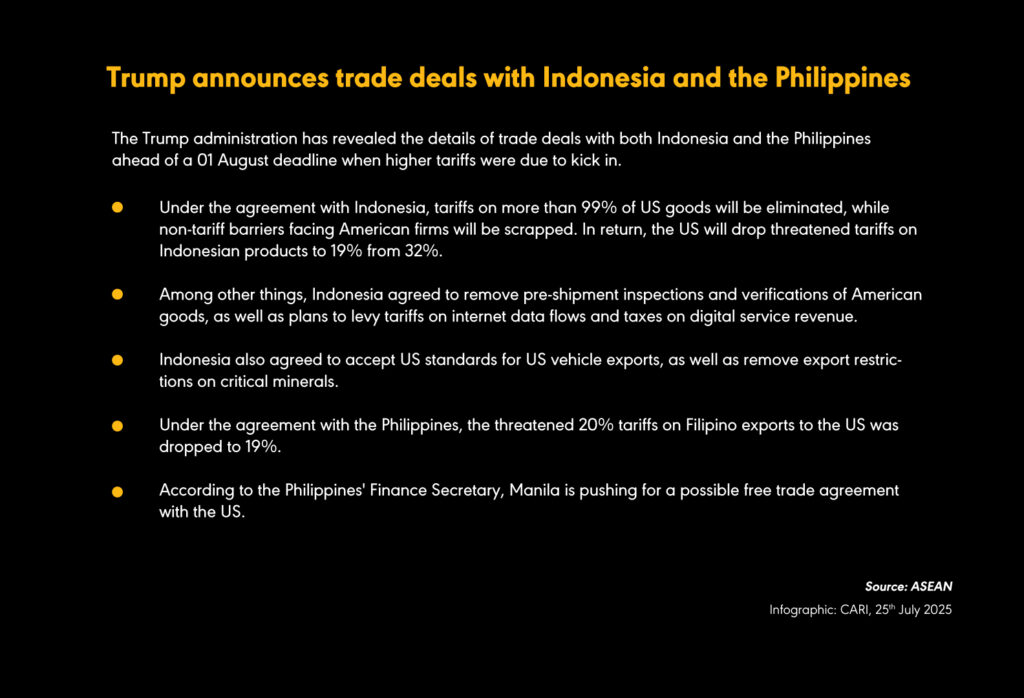
Donald Trump announces trade deals with Indonesia and the Philippines
(23 July 2025) President Donald Trump announced on 22 July that the United States has reached separate trade agreements with the Philippines and Indonesia, imposing a 19% tariff on goods imported from both these countries while American exports are largely exempted from tariffs from either. The Philippine agreement was reached during a bilateral meeting with President Ferdinand Marcos Jr. at the White House, making him the first Southeast Asian leader to visit Trump in his second term. Trump stated on social media that the Philippines would move towards an open market and zero tariffs on US goods, with Finance Secretary Ralph Recto indicating Manila’s willingness to reduce tariffs on select American products and suggesting zero tariffs on US automobiles. The US imported USD 14 billion in goods from the Philippines in 2024, primarily electronics, processed foods, machinery and apparel, and exported USD 9 billion. The Indonesia deal, formally detailed in a joint statement, also includes commitments to remove taxes on US digital services, eliminate pre-shipment inspections on US goods, accept US motor vehicle safety standards, and lift export restrictions on critical minerals. Indonesia previously faced a 32% tariff in April, later reduced to a 10% rate pending the 01 August deadline. In 2024, the US imported USD 28 billion in goods from Indonesia, mainly apparel and footwear, and exported USD 10 billion, chiefly oilseeds, grains, oil and gas. Both agreements deviate from higher tariff threats Trump issued earlier this year and come amid his administration’s shift in focus from quantity to quality of trade deals.
INDONESIA
Toyota Motor announces plan to begin producing electric vehicles in Indonesia in 2025
(23 July 2025) Toyota Motor announced it will begin producing electric vehicles in Indonesia this year, making Indonesia the third manufacturing base for its bZ4X SUV after Japan and China. The company plans to leverage its over-30% market share in Indonesia to expand EV sales and confirmed this marks its first EV production in the country, complementing its existing hybrid vehicle production. Toyota-Astra Motor stated the move aligns with Toyota’s “multi-pathway strategy” toward carbon neutrality by adding EVs to its portfolio of environmentally friendly vehicles. The company also plans to start producing EV pickup trucks in Thailand by year-end. Indonesia’s government offers reduced VAT of 1% and exemption from luxury tax for EVs with at least 40% local content, while vehicles below that threshold face an 11% VAT. Companies with local production commitments also qualify for exemptions on import tariffs and luxury tax under the incentive scheme introduced in 2023.
MALAYSIA
Malaysia announces revised support package on 23 July in support of consumer spending
(23 July 2025) Malaysia announced a revised support package on 23 July, reducing the RON95 petrol price for citizens from MYR 2.05 to 1.99 per litre while maintaining plans for targeted fuel subsidies to be detailed by end-September. The package also includes a one-time cash handout of MYR 100 to all Malaysians aged 18 and above. Fitch Ratings estimates the package will cost MYR 2.3 billion, equivalent to 0.1% of GDP, and remains within the 2025 budget deficit target of 3.8%, though Fitch cautioned that delays in subsidy reform could jeopardise the goal of cutting the deficit to 3% by 2028. The measures aim to offset higher living costs linked to the expanded sales and service tax effective 01 July and respond to criticism of insufficient support. Opposition groups plan a protest in Kuala Lumpur on Saturday, expected to attract 10,000–15,000 participants, with 2,000 police officers deployed. Market reaction was muted, with the stock index up 0.3% and the ringgit steady. Analysts noted the package reflects counter-cyclical policy following Bank Negara Malaysia’s 25-basis-point rate cut on 09 July, with fiscal space from earlier consolidation enabling the measures, which are expected to support consumer spending amid external risks, including a potential 25% US tariff on Malaysian exports.
MALAYSIA
Malaysia resists key US demands during trade negotiations
(22 July 2025) Malaysia is aiming to reduce impending US tariffs, set at 25% from 01 August, to approximately 20%, but is resisting key demands from the Trump administration, including extended tax exemptions for US-made electric vehicles, easing foreign ownership restrictions in power and finance, and subsidy cuts for local fishermen. Prime Minister Anwar Ibrahim has maintained that trade negotiations will not compromise national policies, particularly preferential treatment for Malays and indigenous groups. While Malaysia has addressed concerns over AI chip transshipment to China by requiring export permits and disclosure of potential misuse, it has not agreed to US requests tied to broader policy changes. Minister Zafrul Aziz has indicated progress but warned of risks from poorly-structured deals, stating some demands may be unfair. Malaysia is unwilling to extend its EV tax exemption beyond December due to implications for equal treatment of all foreign manufacturers. With nearly half of EV registrations in H1 2025 coming from Chinese firms, the rationale for special treatment of US EVs is unclear. US pressure on fishing subsidies is politically sensitive due to the sector’s ethnic Malay voter base. The US trade deficit with Malaysia was USD 24.8 billion in 2024. The tariff level will influence Malaysia’s revised 2025 GDP growth forecast, currently set between 4.5% and 5.5%. Negotiations continue amid regional uncertainty, following Viet Mam’s unexpected acceptance of 20% tariffs earlier this month.
SINGAPORE
Core inflation remains at 0.6% year-on-year in June 2025, unchanged from May
(23 July 2025) Singapore’s core inflation rate remained at 0.6% year-on-year in June, unchanged from May and below the 0.7% median forecast, according to the Department of Statistics. Headline inflation was 0.8%, also below the 0.9% estimate. Recreation prices declined 2.6% in June, following a 2% drop in May, while food inflation stood at 1% and healthcare costs rose 2.8%. The Monetary Authority of Singapore’s next policy review is scheduled for 30 July, with official projections keeping core inflation between 0.5% and 1.5% for 2025. Economists at Bank of America, Goldman Sachs and Barclays expect monetary policy to ease given subdued price pressures, while Citigroup assigns a 60% probability to policy settings remaining unchanged. The inflation data follow GDP figures released last week showing Singapore avoided a technical recession, supported by manufacturing and services exports amid anticipation of higher US tariffs.
VIET NAM
Ho Chi Minh Stock Index rises to 19% year-to-date, approaching January 2022 record high
(23 July 2025) Viet Nam’s Ho Chi Minh Stock Index has risen 19% year-to-date, approaching its January 2022 record high, driven by the government’s largest administrative overhaul in decades and the implementation of a US trade deal cutting tariffs on Vietnamese goods from 46% to 20% since April. The Vietnamese Prime Minister reforms aim to streamline bureaucracy, cut costs, and redirect spending to development projects, targeting over 8% GDP growth in 2025 and high-income status by 2045. The economy grew 7.52% in H1 2025, supported by strong manufacturing. Foreign investors posted net inflows of USD 411 million into Vietnamese equities in July, while continuing to exit Malaysia, Indonesia and the Philippines. Major index gainers include Vingroup JSC, Vietnam Joint Stock Commercial Bank for Industry and Trade, and Hoa Phat Group JSC. Market participants anticipate a potential FTSE Russell reclassification of Viet Nam to emerging-market status as early as September, which could attract up to USD 6 billion in additional capital. Risks to the outlook include weaker global growth in H2 and uncertainty over a proposed 40% US tariff on transshipped goods.
THE PHILIPPINES
Philippines bonds positioned for rebound from Asia’s lowest ranks due to rate cuts
(24 July 2025) Philippine bonds are positioned for a rebound from the lowest ranks in Asian debt performance, supported by Bangko Sentral ng Pilipinas’ (BSP) capacity to implement further rate cuts beyond the 125 basis points already made in the past year. Real interest rates in the Philippines are currently the highest among emerging Asian economies, with the inflation rate remaining below BSP’s 2–4% target for four consecutive months, allowing a policy rate buffer of 385 basis points. Benchmark 10-year Philippine bond yields have risen 10 basis points this year to 6.28%, diverging from regional peers that saw declines, largely due to concerns over budget deficits and previous oil price increases. However, market forecasts suggest yields may decline to 5.67% by year-end, a level last observed in October 2024. Investor interest is increasing due to the bonds’ low correlation (0.10 over 120 days) with US Treasuries, which face volatility from US fiscal concerns and uncertain Federal Reserve policy. T Rowe Price cited inflation dynamics and de-correlation from Treasuries as key attractions. Additional upside could stem from potential inclusion in JPMorgan’s local-currency emerging-market debt index, while Citigroup highlighted index inclusion and disinflation as supporting a long, currency-hedged position in 10-year peso bonds.
RCEP Monitor
JAPAN
Trump announces trade agreement with Japan including 15% reciprocal tariffs
(22 July 2025) President Donald Trump announced a trade agreement with Japan that includes a 15% reciprocal tariff on Japanese exports to the US, down from the previously threatened 25%, with auto tariffs also reduced to 15%. Trump stated the deal would involve USD 550 billion in Japanese investment in the US, with the US receiving 90% of the profits, and predicted the creation of “hundreds of thousands” of jobs. Japan agreed to expand market access for US cars, trucks, rice, and agricultural goods. Japanese Prime Minister Shigeru Ishiba confirmed the auto tariff reduction, which affects a sector that accounted for 28.3% of Japan’s exports in 2024. The deal follows a sharp year-on-year decline in Japanese auto exports to the US in May (−24.7%) and June (−26.7%). Trump also referenced a separate liquefied natural gas deal and further upcoming trade talks. The agreement comes amid political uncertainty in Japan, where Ishiba faces pressure following his coalition’s upper house election loss and is reportedly considering resignation. Analysts view the deal as politically significant for Ishiba, with HSBC suggesting it could help him avoid internal challenges. Wisdomtree highlighted that the market had grown overly pessimistic on negotiations and noted the broader strategy behind these deals, including large-scale US investments by SoftBank, OpenAI, and Oracle totalling up to $500 billion in AI infrastructure.
SOUTH KOREA
South Korea preparing for high-level trade talks with the US
(23 July 2025) South Korea is preparing for high-level trade talks with the United States, aiming to match or improve upon the 15% tariff rate secured by Japan to avoid reciprocal 25% tariffs by the 01 August deadline. South Korea’s Industry Minister confirmed Seoul would study the US-Japan agreement closely, with emphasis on enhancing industrial and energy cooperation. The Ministry of Trade, Industry and Energy is prioritising alternative concessions, such as increasing imports of US crops like corn for bioethanol, while explicitly excluding rice and beef market liberalisation from negotiations. President Lee Jae Myung stated that South Korea would not accept a deal significantly inferior to Japan’s, and analysts noted that Seoul may need to expand imports of farm goods and energy and boost US investment to reach a comparable outcome. The KOSPI rose 0.2% following the Japan-US announcement, with Hyundai and Kia shares climbing 7.3% and 7.6%, respectively. The US-Japan deal includes USD 550 billion in Japanese investment and preferential treatment on tariffs for sectors like chips and pharmaceuticals. South Korea has been asked by Washington to establish a large-scale investment fund to assist in US manufacturing reconstruction, and areas of potential cooperation include semiconductors and shipbuilding. South Korea remains cautious about joining the proposed USD 44 billion Alaska LNG pipeline project, citing feasibility concerns.
AUSTRALIA
Australia announces full lifting of restrictions on US beef imports
(24 July 2025) Australia has announced the full lifting of restrictions on US beef imports following a review by its agriculture department, which concluded that recent improvements in US cattle tracing protocols sufficiently mitigate biosecurity risks. While Australia technically ended the ban in 2019, continued restrictions on Canadian and Mexican cattle had effectively kept US beef out due to integrated supply chains. The decision follows US pressure, including the imposition of at least 10% tariffs on Australian exports in April, which the White House linked to the beef restrictions. US Agriculture Secretary Brooke Rollins labelled the restrictions “absurd”, and called the decision a “major trade breakthrough”. Australia’s Agriculture Minister stated the decision was based strictly on science, not trade pressure, while an opposition leader raised concerns that the change may have been politically motivated to appease the Trump administration. Industry body Cattle Australia expressed support for the decision. The US is Australia’s largest beef export destination, valued at AUD 14 billion in 2024. Despite US tariffs, a Meat and Livestock Australia report released in June indicated that beef trade between the two countries had increased by approximately one-third year-to-date.
|
15 participating countries |
20 chapters |
2.2 billion |
US$26.2 trillion |
28% |
| ASEAN member states, Australia, China, Japan, South Korea, New Zealand | trade in goods and services, investment, intellectual property, e-commerce, competition, SMEs, economic and technical cooperation, and government procurement | combined population, 30% world’s population | combined GDP, 30% global GDP | global trade (based on 2019 figures) |