


CARI Captures Issue 718: Universities in Europe and Asia look to attract Southeast Asian students
Captures has widened its scope to include news related to all the members of the Regional Comprehensive Economic Partnership (RCEP) agreement which was signed towards the end of 2020. Besides the ASEAN Member States, this includes Australia, New Zealand, China, Japan, and South Korea. The other weekly newsletters under CARI, China-ASEAN Monitor and Mekong Monitor will also be consolidated into the Captures newsletter. We hope this new version of Captures will serve you better and look forward to providing a curation of stories relevant to ASEAN and its trading partners.
ASEAN
Universities in Europe and Asia look to attract Southeast Asian students
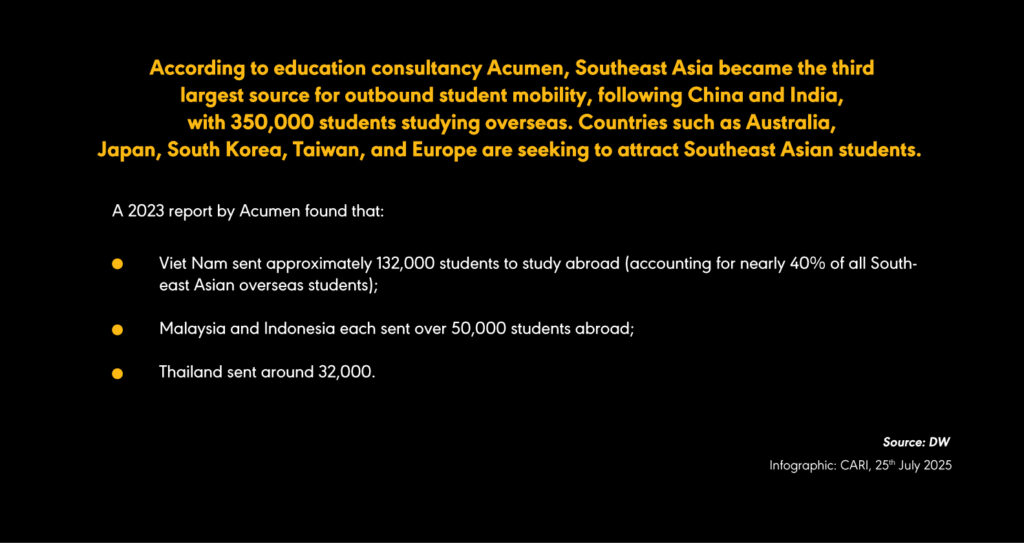
(08 August 2025) Australia will raise its cap on foreign students by 9% to 295,000 with priority for Southeast Asian applicants. Japan and South Korea are targeting 400,000 and 300,000 by 2033 and 2027 respectively, and Taiwan plans to attract 25,000 Southeast Asian students annually. Education consultancy Acumen reported in 2023, 132,000 Vietnamese were studying abroad (representing nearly 40% of Southeast Asian overseas students); Malaysia and Indonesia had each sent over 50,000, and Thailand 32,000. In total, Southeast Asia contributed 350,000 overseas students in 2022. European universities, facing underfunding, are increasingly targeting Southeast Asia: Germany launched a “career truck” in Hanoi in June, French President Emmanuel Macron promoted study opportunities during a Hanoi visit in May, and Indonesian President Prabowo Subianto urged more Indonesians to study in Europe in July. Despite such efforts, Southeast Asians remain underrepresented, with only 7,060 Vietnamese undergraduates in Germany, out of 1.66 million international students across the EU. Experts highlighted visa complexity, lack of funding, and limited scholarships as barriers, while Norway recently eased language and employment rules and adjusted tuition fees, and the European Commission launched the EUR 500 million “Choose Europe Initiative” in May to attract researchers. However, Southeast Asian students are increasingly choosing East Asia, with Japan hosting more Vietnamese students than any English-speaking country, and 23 East Asian universities ranking in the 2024 QS global top 100, up 35% since 2015. Meanwhile, restrictive US policies under the Trump administration, including cuts to Fulbright grants, USD 1.2 billion in funding reductions for Columbia and Johns Hopkins, and reported revocation of tens of thousands of visas, may open opportunities for European institutions to recruit from Southeast Asia and China.
MALAYSIA
Malaysia unveils its first edge AI processor to join global AI race
(25 August 2025) Malaysia-based SkyeChip has launched the MARS1000, the country’s first edge AI processor, unveiled at an industry association event attended by senior government officials. The Malaysia Semiconductor Industry Association described it as a chip designed to power devices such as cars and robots, though it remains less advanced than Nvidia’s data centre processors. The government, under Prime Minister Anwar Ibrahim, has committed at least MYR 25 billion (USD 6 billion) to strengthen domestic capabilities in chip design, wafer fabrication, and AI data centres, with recent investments from Oracle and Microsoft supporting this strategy. Malaysia is already a major global player in semiconductor packaging and manufacturing for suppliers such as Lam Research. However, SkyeChip has not disclosed manufacturing plans for the MARS1000. The US Trump administration has proposed restrictions on AI chip flows to Malaysia and Thailand over concerns about transshipment to China, a risk Kuala Lumpur has sought to counter by tightening export controls and declaring its opposition to illicit trading activities.
INDONESIA
Indonesia must accelerate clean energy transition to ensure industrial competitiveness
(27 August 2025) The deputy chair of Indonesia’s National Economic Council (DEN) stated at the Indonesia Summit 2025 that the country’s industrial competitiveness is constrained by the limited availability of clean and affordable energy, stressing that reliance on fossil fuels undermines the credibility of export-oriented products such as electric vehicle batteries. She cited textiles, glass, EV batteries and data centres as energy-intensive sectors requiring accelerated clean energy adoption. The deputy chair identified pending priorities, including the ratification of the Renewable Energy bill, reforms in state electricity company PLN, and the enforcement of new waste-to-energy regulations. She also highlighted Indonesia’s underutilised geothermal potential and warned that without a sufficient clean energy supply, domestic industries risk losing competitiveness in meeting global demand for green products.
THAILAND
Thailand to allow foreign tourists to convert digital assets into baht
(18 August 2025) Thailand will launch the TouristDigipay programme in the fourth quarter with an 18-month trial under a regulatory sandbox, allowing foreign tourists to convert digital assets into baht for spending in the country. The scheme, aimed at supporting tourism and innovation, permits only conversions into baht, with merchants receiving payments solely in local currency. Spending will be capped at BHT 500,000 per month, with transactions required to go through licensed digital-asset operators and e-money providers, alongside strict account and e-wallet verification measures to curb money laundering. The initiative follows a 33% decline in Chinese tourist arrivals in the first half of 2025, partly due to safety concerns, and a reduction in the annual foreign tourist forecast to 33 million from 37 million. As of 10 August, arrivals stood at 20.2 million, down 6.9% year-on-year, in a sector contributing about 12% of GDP. The government is targeting more visitors from the Middle East and Southeast Asia to offset the fall in Chinese travellers.
SINGAPORE
Headline and core inflation eases in July, below forecasts
(25 August 2025) Singapore’s headline inflation eased to 0.6% in July, below both June’s 0.8% and the 0.7% expected by a Reuters poll, while core inflation fell to 0.5% against forecasts of 0.6%. The Monetary Authority of Singapore (MAS) attributed the slowdown to weaker retail and goods prices and a 5.6% year-on-year fall in electricity and gas costs, offset slightly by a 2.1% rise in private transport from higher car prices. The MAS projected core inflation to average 0.5%–1.5% in 2025, down from 2.8% in 2024, citing easing global oil prices, contained food commodity costs, slower nominal wage growth, and weaker productivity gains reducing unit labour costs. The central bank left monetary policy unchanged in July after earlier easings in January and April, but warned of weaker growth from global trade downshifts and tariff tensions. Analysts noted that July’s figures strengthen the case for a potential policy loosening in October, with eToro suggesting inflation is no longer a constraint, while DBS said the MAS has preserved policy flexibility to respond to future shocks. On 30 July, the MAS forecasted slower economic growth in the second half of 2025, despite robust first-half GDP, while Singapore also faces a baseline 10% reciprocal tariff on exports to the US imposed by the Trump administration, with no agreement yet reached.
VIET NAM
Viet Nam ends state monopoly on gold bullion imports, exports, and bar production
(27 August 2025) Viet Nam has ended the state monopoly on raw bullion imports, exports, and bar production, shifting to a regulated market in which licensed companies and commercial banks can participate, according to government decrees and statements. The State Bank of Vietnam will issue licences for raw gold imports and overseas bar trade, while businesses require registered capital of at least VND 1 trillion and banks VND 50 trillion to qualify. Imported raw gold must be at least 99.5% pure and used for approved purposes such as jewellery and bar production. Saigon Jewelry Co., previously the sole legal bar producer, reported local prices of VND 128 million dong (USD 4,857) per tael, equal to USD 4,028 per troy ounce, compared with the global spot price of USD 3,377. The disparity between domestic and international rates has persisted despite repeated stabilisation efforts. Communist Party chief To Lam in May criticised the rigid domestic system for harming the economy and urged reforms to expand supply and curb smuggling. Consumer demand for gold in Vietnam rose to 55.3 tons in 2023 from 39.8 tons in 2020. Gold’s international price reached a record in April, strengthening demand across Asia. SSI Securities described the shift as a transition from state control to a regulated competitive market designed to improve transparency and efficiency.
VIET NAM
Viet Nam’s richest man to expand ride-hailing service across Southeast Asia
(25 August 2025) Viet Nam’s richest man Pham Nhat Vuong’s Green & Smart Mobility JSC (GSM), also known as Xanh SM, is expanding its ride-hailing operations beyond Viet Nam into Lao PDR, Indonesia, the Philippines, and potentially India, where VinFast has recently opened an EV factory. Vuong, who holds a 95% stake in GSM, is using the venture to promote VinFast globally, with GSM ride services accounting for 21% of VinFast’s Q1 car sales. In Viet Nam, GSM held a 40% ride-hailing market share in Q1 compared with Grab’s 32% and BE Group’s 6%, though Rakuten Insight data puts Grab at 55% and GSM at 35%. GSM plans to invest USD 1 billion in the Philippines over three years, having deployed 2,500 vehicles in Manila, and aims to introduce 10,000 EV taxis in Indonesia by year-end, with projections of 6–12% market share by 2026–27 if the fleet reaches 16,000–35,000 vehicles. Maybank Securities analysts estimate Grab and GoTo could see sales from on-demand services decline by 1% and 3%, respectively, by 2027 due to GSM competition.GSM’s current fleet is smaller than rivals with millions of vehicles across Southeast Asia, and Bloomberg Intelligence noted limited overseas presence and industry-thin margins may constrain growth. The CEO of GSM Global indicated future expansion into intercity transport, premium rides, delivery and corporate services as part of Vingroup’s broader strategy.
RCEP Monitor
SOUTH KOREA, UNITED STATES
Trump confirms that July trade agreement with South Korea to remain unchanged
(25 August 2025) President Donald Trump confirmed that the July trade agreement with South Korea, which set a 15% tariff on Korean goods and included USD 350 billion in US investment commitments, will remain unchanged despite lobbying from President Lee Jae Myung during their first in-person meeting. Trump said South Korea would honour the deal, adding that Korean Air Lines plans to purchase over 100 Boeing jets and South Korean private sector firms are preparing around USD 150 billion of additional investment in the US. Trump and Lee highlighted cooperation on North Korea, defence, and shipbuilding, with Seoul pledging increased defence spending for advanced assets and Trump proposing US-based Korean shipbuilding projects. GSM-related tariffs left South Korea aligned with Japan but still exposed to future US levies on chips and batteries. Lee sought to use the summit to ease tensions and emphasised progress on the Korean peninsula, while Trump reiterated his interest in another meeting with Kim Jong Un. The talks followed pre-summit friction after Trump accused Seoul of political instability on Truth Social, referencing raids on churches and unrest tied to former President Yoon Suk Yeol’s ousting, but tensions eased during the meeting as Trump described Lee as a strong representative of South Korea. Trump congratulated Lee on his election victory and confirmed US support, while Lee reaffirmed commitment to defence cooperation and economic engagement.
JAPAN, UNITED STATES
Top trade negotiator cancels planned visit to US after unresolved technical issues over trade deal
(28 August 2025) Japan’s top trade negotiator Ryosei Akazawa cancelled a planned trip to Washington after unresolved technical issues emerged over the implementation of the July US-Japan trade deal, according to Chief Cabinet Secretary Yoshimasa Hayashi, who said discussions will continue at the administrative level. Hayashi stated Japan will press the US to amend its presidential order on reciprocal tariffs and issue a written order lowering tariffs on automobiles and parts to 15% from 25%, matching the baseline tariff rate already set at 15%. Akazawa previously said the US had pledged to include a “no-stacking” clause similar to the EU arrangement, preventing tariffs from exceeding 15%. Reuters cited a government source saying Akazawa could travel to Washington as early as next week once issues are resolved. The Bank of Japan warned that despite the agreement, Japan’s exports, industrial production and corporate profits, particularly in manufacturing, face short-term declines due to US tariffs and overseas economic slowdown. Outstanding points also involve written confirmation of Japan’s USD 550 billion investment package in the US, agreed in July in exchange for reduced tariffs, with the US Commerce Secretary signalling an announcement soon. Akazawa previously rejected claims that Japan was simply handing over the USD 550 billion, stating that returns will be shared between both countries in proportion to contributions, while acknowledging the US intends to commit a larger share.
CHINA
Five largest banks expect to report further deterioration in second-quarter results
(29 August 2025) China’s five largest banks, with combined assets exceeding RMB 190 trillion (USD 26.5 trillion), are expected to report further deterioration in second-quarter results, with rising consumer loan delinquencies, declining profitability, and worsening credit quality. Analysts forecast the average net interest margin will fall to a record low of 1.29%, extending a three-and-a-half-year decline from above 2% in 2021, as low deposit and lending rates of around 3% squeeze returns. Industrial and Commercial Bank of China recorded over RMB 10 billion of non-performing consumer loans in March, more than double the previous year, with a ratio of 2.39% that likely rose further, while China Construction Bank and Agricultural Bank of China reported their third straight quarterly increase in bad debt ratios. Combined consumer loans in default at the three lenders have more than doubled since end-2023. Retail banks sold RMB 37 billion of bad debt in Q1, eight times higher year on year, with over 70% tied to consumer loans. Weak household demand persists, with short-term loans for small purchases falling to RMB 9.8 trillion in July after four consecutive monthly declines, as stagnant real wages, up only 1.7% in 2024 at non-state companies, and the property downturn erode borrowing appetite. Moody’s said mortgages and retail debt now carry higher credit risks than corporate loans, reversing traditional risk patterns, while Morgan Stanleym warned bad loan ratios would worsen further before stabilising, with banks retreating from new lending due to elevated risks. Policymakers, seeking to balance growth and financial stability, have slowed rate cuts and opted to subsidise borrowers’ interest payments rather than pressuring banks with further aggressive easing.
|
15 participating countries |
20 chapters |
2.2 billion |
US$26.2 trillion |
28% |
| ASEAN member states, Australia, China, Japan, South Korea, New Zealand | trade in goods and services, investment, intellectual property, e-commerce, competition, SMEs, economic and technical cooperation, and government procurement | combined population, 30% world’s population | combined GDP, 30% global GDP | global trade (based on 2019 figures) |