


CARI Captures Issue 723: Startup funding landscape stages impressive comeback in September 2025
Captures has widened its scope to include news related to all the members of the Regional Comprehensive Economic Partnership (RCEP) agreement which was signed towards the end of 2020. Besides the ASEAN Member States, this includes Australia, New Zealand, China, Japan, and South Korea. The other weekly newsletters under CARI, China-ASEAN Monitor and Mekong Monitor will also be consolidated into the Captures newsletter. We hope this new version of Captures will serve you better and look forward to providing a curation of stories relevant to ASEAN and its trading partners.
ASEAN
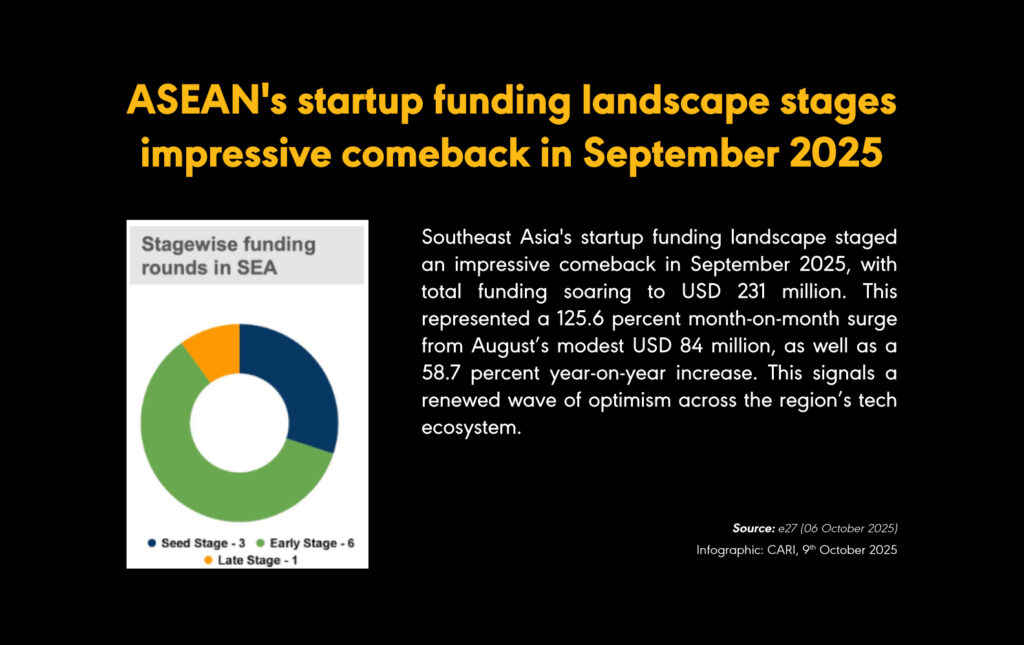
Startup funding landscape stages impressive comeback in September 2025
(07 October 2025) According to Tracxn data, startup funding in Southeast Asia rose 125.6% month-on-month in September 2025 to USD 231 million, up from USD 84 million in August, and 58.7% higher year-on-year. The rebound indicates renewed investor confidence after months of subdued activity, with capital flowing into fewer but larger deals, reflecting a shift toward conviction-based investments in startups demonstrating resilience and scalability. Established regional funds such as Gobi Partners and returning global investors participated in the month’s transactions, suggesting a recalibration rather than withdrawal of capital. The surge also points to a potential transition toward a more disciplined and sustainable funding environment, driven by an investor focus on profitability and clear growth paths rather than speculative expansion, though volatility earlier in the year tempers expectations of a full recovery.
MALAYSIA
Malaysia proposes 2026 federal budget of MYR 419.2 billion, a 1.7% year-on-year increase
(10 October 2025) Malaysia has proposed a 2026 federal budget of MYR 419.2 billion (USD 99.24 billion), a 1.7% increase from the revised MYR 412.1 billion in 2025, comprising MYR 338.2 billion in operating expenditure and MYR 81 billion in development spending. Fiscal and economic outlook reports show revenue rising 2.7% year-on-year to MYR 343.1 billion, with the fiscal deficit expected to narrow to 3.5% of GDP from 3.8% in 2025. State energy firm Petronas will contribute a MYR 20 billion dividend, its lowest since 2017, reflecting lower crude prices and output. Subsidies and social assistance are projected to decline 14.1% to MYR 49 billion, in line with efforts to improve targeting and reduced commodity prices. Economic growth for 2026 is forecast at 4%–4.5%, while this year’s projection was revised down to 4%–4.8% amid U.S. tariff uncertainties, including a 19% levy on most Malaysian exports. Inflation is expected between 1.3% and 2% in 2026, compared with 1%–2% in 2025. Prime Minister Anwar Ibrahim said ongoing fiscal reforms—including selective subsidy removal, minimum wage increases, and an expanded sales tax—are necessary to maintain fiscal discipline and resilience against external risks. Bank Negara Malaysia maintained its policy rate at 2.75% in September after a July rate cut, with the government noting that monetary policy remains supportive of stable growth.
THAILAND, THE PHILIPPINES
Benchmark price of Thai white rice falls to ten-year low as the Philippines curbs imports
(09 October 2025) The benchmark price of Thai white rice 5% broken fell 1.9% to USD 355 per tonne on Wednesday, the lowest level since September 2015, according to the Thai Rice Exporters Association. The decline follows improved global supply conditions, with the UN Food and Agriculture Organization projecting record global rice production of 556.4 million tonnes in the 2025–26 season, leading to higher stockpiles. Prices have been easing from a 15-year peak in 2024, driven by strong demand and supply concerns. Above-average monsoon rainfall in India, the world’s largest rice exporter, has improved harvest prospects, and the government has lifted export restrictions to avoid domestic oversupply. The Philippines, the top global rice importer, plans to extend import curbs to support local farmers, although cheaper exports from Thailand and other suppliers may gradually lower retail prices in import-dependent economies across Asia, Africa, and the Middle East.
THE PHILIPPINES
Philippine Stock Exchange warns flood-control corruption scandal driving away investors
(06 October 2025) Philippine Stock Exchange President and CEO called for a “swift, credible and comprehensive” investigation into corruption allegations linked to government flood-control spending, warning that continued uncertainty was driving foreign investor withdrawals and weighing on market performance. Foreign investors have withdrawn approximately USD 684 million from the market this year and have been net sellers for six consecutive days as of Friday. The benchmark Philippine Stock Exchange Index has fallen over 8% year to date, among the weakest in Asia, while the peso declined 0.8% against the US dollar on Monday. President Ferdinand Marcos Jr. has formed an independent commission to investigate the allegations, though Senate hearings were left uncertain following Senator Panfilo Lacson’s resignation as committee chair. Religious leaders cautioned against any whitewash. The Economic Planning Secretary said governance reforms were being considered to improve public spending transparency. The Stock Exchange CEO cited the upcoming initial public offering of Maynilad Water Services Inc. as a potential positive for investor sentiment. Severe weather and natural disasters, including a September super typhoon and a magnitude 6.9 earthquake in Cebu, have also contributed to recent market volatility.
THE PHILIPPINES
Bangko Sentral ng Pilipinas unexpectedly cuts rate by 25 basis points to 4.75%
(09 October 2025) The Bangko Sentral ng Pilipinas (BSP) cut its benchmark overnight reverse repurchase rate by 25 basis points to 4.75% on Thursday, marking its lowest level since September 2022 and extending cumulative rate cuts since August 2024 to 175 basis points. Only seven of 26 economists surveyed by Bloomberg had predicted the move, as most expected a pause amid peso weakness. The BSP governor indicated potential further easing this year, citing a weaker economic outlook stemming from reduced business confidence following a government graft scandal involving flood-control projects. The central bank said governance concerns and slower public infrastructure spending have dampened domestic growth prospects. The peso fell 0.5% to 58.235 against the US dollar and has declined about 2% over the past month, while Philippine stocks were the worst performers in the Asia Pacific. Remolona stated the BSP would defend the peso if depreciation became inflationary and did not rule out capital controls. Inflation has remained below the 2%–4% target since March, providing room for policy easing, with the BSP now viewing its “Goldilocks” rate as lower than the previous 5%. Analysts expect another 25 basis-point cut at the next meeting, bringing the rate to 4.50%. The BSP said a favourable inflation outlook and moderating domestic demand support continued monetary accommodation, while maintaining price stability. Policymakers acknowledged that the corruption scandal and tighter fiscal policy could slow state spending, which accounts for about one-fifth of GDP, and weigh on growth amid weaker exports and global trade uncertainty.
MALAYSIA, SINGAPORE
Johor-Singapore SEZ draws new investors with 2-in-1 appeal
(09 October 2025) Panellists at the Asia Future Summit highlighted the Johor–Singapore Special Economic Zone (JS-SEZ) as an emerging regional investment hub drawing firms that might not have considered either market individually. The director of the Economic Development Board’s JS-SEZ Programme Office said the initiative has broadened investor engagement opportunities, attracting companies from previously untapped sectors and markets. Johor’s investment, trade, consumer affairs, and human resources committee chairman reported MYR 56 billion in investments in the first half of 2025, driven largely by JS-SEZ projects, and expressed confidence in achieving MYR 100 billion by end-2025. The OCBC Malaysia CEO said 50% of interested firms in the zone are from China, citing its proximity to Singapore as a major advantage. The Q&M Dental Group CEO announced a SGD 130 million capital raise to expand operations in Singapore, Johor, and China, noting that Q&M runs 37 clinics in Malaysia, including nine in the JS-SEZ. The Johor state economic adviser said the zone enables multinational firms to locate headquarters and R&D functions in Singapore while maintaining manufacturing in Johor. Teo added that the Invest Malaysia Facilitation Centre–Johor is streamlining regulatory processes, while collaboration with Malaysian agencies aims to strengthen the local talent pipeline.
THAILAND
Bank of Thailand governor states that central bank retains room for further rate cuts
(10 October 2025) The Bank of Thailand Governor said the central bank retains room to further reduce its benchmark interest rate, currently at 1.5%, one of the lowest globally, to support growth and bring inflation back within the 1%–3% target range. Speaking ten days into his tenure, the governor stated the bank remains “ready to ease” if economic conditions warrant, noting that the full effects of previous rate cuts have yet to materialise. At the most recent policy meeting, the Monetary Policy Committee held rates steady, with only two of seven members voting for a cut. Thailand’s headline inflation has been negative for six consecutive months, but the governor said there are no signs of deflation, with prices expected to normalise in the medium term. He also announced plans to purchase bad debts from over 2 million borrowers as a complementary measure to monetary easing. On the currency front, the governor attributed the baht’s recent appreciation to a weaker US dollar and capital inflows, adding that the central bank is monitoring movements for irregularities. He said online gold trading had increased currency volatility, prompting coordination with the finance ministry and traders to assess potential measures limited to online transactions. He also reiterated the importance of central bank independence in maintaining monetary stability.
RCEP Monitor
CHINA
China increases enforcement of import restrictions on US-made semiconductors
(10 October 2025) China has increased enforcement of import restrictions on US-made semiconductors, including Nvidia’s artificial intelligence chips, by deploying customs officials to major ports to conduct stringent inspections, according to the Financial Times. The checks, which initially targeted Nvidia’s H20 and RTX Pro 6000D models designed to comply with US export controls, have reportedly expanded to cover all advanced chips potentially breaching US curbs. The move reflects Beijing’s focus on strengthening domestic semiconductor production amid ongoing US-China technology tensions. Earlier reports indicated around USD 1 billion worth of Nvidia’s high-end AI chips were smuggled into China between May and July, though this has not been independently verified. Nvidia’s RTX6000D chip, created for the Chinese market, has experienced weak demand, with some major firms avoiding new orders. Chinese authorities have previously accused Nvidia of breaching anti-monopoly law and instructed technology companies to suspend purchases of its AI chips. Despite progress by domestic chipmakers such as Huawei, industry engineers report Nvidia’s chips continue to outperform Chinese alternatives.
CHINA
China announces new port fees on US vessels as countermeasure to forthcoming US port charges
(10 October 2025) China’s Ministry of Transport announced new port fees on vessels owned, operated, or built by U.S. firms or flying the U.S. flag, effective 14 October, as a countermeasure to forthcoming U.S. port charges on China-linked ships. The fee will start at CYN 400 yuan (USD 56.13) per net tonne per voyage and rise to VYN 640 in April 2026, CYN 880 in April 2027, and CYN 1,120 (USD 157.16) in April 2028. The move follows a U.S. Trade Representative probe and new American fees on Chinese vessels—potentially exceeding USD 1 million for ships carrying over 10,000 containers—intended to bolster U.S. shipbuilding and limit China’s maritime dominance. Chinese vessels calling at U.S. ports will also face a flat fee of USD 80 per net tonne. China’s counter-tariff is expected to have a smaller economic impact on the United States due to its limited commercial fleet; Chinese shipyards produced over 1,000 commercial vessels last year, compared with fewer than 10 in the U.S. The escalation comes amid renewed U.S.-China trade tensions, with both sides in a temporary 90-day tariff truce ending around 9 November. Presidents Donald Trump and Xi Jinping are expected to discuss the issue at the APEC summit in South Korea at the end of October.
AUSTRALIA
Reserve Bank of Australia Governor states that economy is “in a pretty good spot”
(10 October 2025) The Reserve Bank of Australia (RBA) Governor told a parliamentary committee that the economy is “in a pretty good spot,” with inflation within the 2%–3% target range, a strong labour market, and rising household consumption offsetting weaker public demand. The RBA maintained its policy rate at 3.6% last month after three cuts since February, citing stronger household spending, housing market resilience, and sustained labour tightness as reasons to hold. Economists expect another rate reduction following the 3–4 November meeting, contingent on the 29 October third-quarter inflation report and September jobs data, which is forecast to show unemployment at 4.3%. The governor noted that while overall inflation is now inside target, services inflation remains persistent. The RBA’s policy stance contrasts with regional peers, as Indonesia and New Zealand continue to ease rates while Thailand, Malaysia, and Australia remain on hold. She also highlighted external risks from protectionist U.S. trade policies, geopolitical tensions, and softer Chinese demand, though she said Australia avoided worst-case tariff outcomes, receiving the baseline global rate of 10%.
|
15 participating countries |
20 chapters |
2.2 billion |
US$26.2 trillion |
28% |
| ASEAN member states, Australia, China, Japan, South Korea, New Zealand | trade in goods and services, investment, intellectual property, e-commerce, competition, SMEs, economic and technical cooperation, and government procurement | combined population, 30% world’s population | combined GDP, 30% global GDP | global trade (based on 2019 figures) |