


CARI Captures Issue 724: Thailand to introduce incentives to boost domestic travel amidst sluggish tourism
Captures has widened its scope to include news related to all the members of the Regional Comprehensive Economic Partnership (RCEP) agreement which was signed towards the end of 2020. Besides the ASEAN Member States, this includes Australia, New Zealand, China, Japan, and South Korea. The other weekly newsletters under CARI, China-ASEAN Monitor and Mekong Monitor will also be consolidated into the Captures newsletter. We hope this new version of Captures will serve you better and look forward to providing a curation of stories relevant to ASEAN and its trading partners.
THAILAND
Thailand to introduce incentives to boost domestic travel amidst sluggish tourism
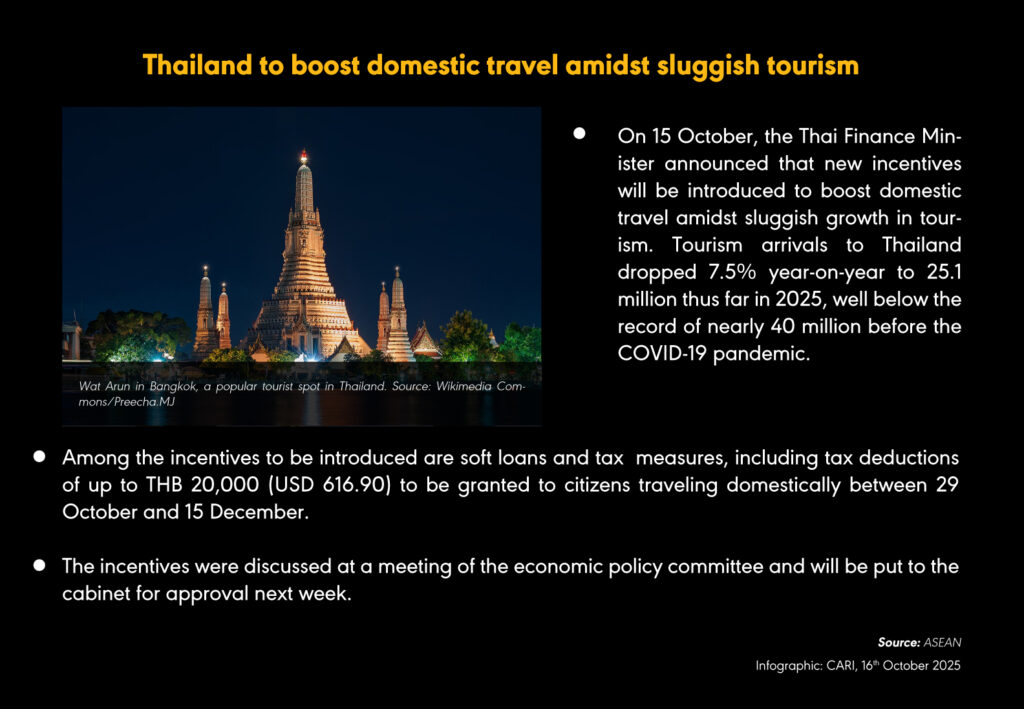
(15 October 2025) Thailand’s Finance Minister announced on 15 October that new incentives to stimulate domestic travel, including soft loans and tax measures, will be proposed to the cabinet next week. Citizens travelling domestically between 29 October and 15 December will be eligible for tax deductions of up to THB 20,000 (USD 616.90). The measures form part of a broader stimulus package aimed at achieving 2.2% GDP growth in 2025. Other ongoing initiatives include a USD 1.4 billion co-payment scheme covering living costs for 20 million people, a USD 49 billion state enterprise investment budget projected to add 0.3 percentage points to GDP, and a planned USD 307 million purchase of bad debt. Tourist arrivals have declined 7.5% year-on-year to 25.1 million, compared to nearly 40 million before the pandemic. The Federation of Thai Industries reported the first rise in industrial sentiment in seven months in September, citing confidence in policy execution, while forward sentiment for the next three months remains positive. The National Economic and Social Development Council projects 2025 GDP growth between 1.8% and 2.3%, with potential slowdown in the second half due to U.S. tariffs, high household debt, weak consumption, and a strong baht. Prime Minister Anutin Charnvirakul’s administration faces a limited timeframe to deliver economic outcomes before parliament dissolution by end-January and elections scheduled by April.
THAILAND, UNITED STATES
Thailand projected to overtake China as leading air conditioner exporter to the US
(16 October 2025) Thailand is projected to overtake China as the leading exporter of air conditioners to the United States in 2025, with exports expected to rise by 36% year-on-year, or about USD 651 million, before the enforcement of a 19% reciprocal tariff on 1 August 2025. Data from the Kasikorn Research Center indicate that 59% of Thailand’s air conditioner exports in the first seven months of 2025 were shipped to the US, mainly self-contained (window-type) units, which account for over 95% of total US imports. Over 97% of Thai exports to the US fall under two major categories in which Thailand already holds the largest market share. The new tariffs, along with a 50% duty on steel components under Section 232, are expected to increase production costs, yet Thai air conditioners will remain 13%–23% cheaper than Chinese units after the tariff, compared to being 3%–18% more expensive previously. Exporters are anticipated to accelerate shipments before August 2025, after which exports may decline by around 70% due to the new tariff and seasonal effects. The relocation of Chinese manufacturers to Thailand and the country’s favourable tax environment are expected to reinforce Thailand’s long-term role as a key production and export base for air conditioners bound for the US.
MALAYSIA, SINGAPORE
Malaysia and Singapore announce new measures to accelerate investments into JS-SEZ
(14 October 2025) Malaysia and Singapore announced new measures to accelerate investment activity in the Johor-Singapore Special Economic Zone (JS-SEZ), with Singapore-based firms having committed over SGD 5.5 billion (USD 4.23 billion) since January 2024. At the 2nd Johor-Singapore SEZ Joint Investment Forum on 14 October, the Malaysian Investment, Trade and Industry Minister said manufacturing licences for non-sensitive industries in designated sectors will be approved within seven working days, with Johor’s “no objection letter” issued in the same timeframe. Budget 2026 provides an additional MYR 200 million (USD 47.3 million) under the Strategic Co-Investment Fund to support Malaysian SMEs in the JS-SEZ and MYR 650 million through the Skills Development Fund Corporation for talent training benefiting 25,000 trainees in AI, electric vehicles, and semiconductors. These funds complement tax incentives and the Invest Malaysia Facilitation Centre launched in February 2025, and the multiple-entry Investor Pass introduced in April. Singapore’s Deputy Prime Minister said the JS-SEZ, covering 3,571 sq km and nine flagship areas, has made “good headway” and identified priorities including flagship projects, ease of doing business and SME inclusion. He confirmed the establishment of a Joint Johor-Singapore SEZ Project Office involving Singapore’s MTI, EDB and Enterprise Singapore to coordinate regulatory processes.
VIET NAM
Viet Nam’s Communist Party targets annual growth of at least 10% for 2026-2030
(15 October 2025) Viet Nam’s Communist Party has proposed in a draft congress document to target annual economic growth of at least 10% for 2026–2030, up from the 6.5%–7.0% range set for 2021–2025, despite warning of “severe” challenges ahead. The draft, published on the party’s website ahead of its upcoming congress expected after the parliament’s mid-December session, also sets a goal of raising GDP per capita to USD 8,500 by 2030, compared with a target of USD 4,700–US$5,000 for 2021–2025 and an achieved level of USD 4,700 in 2024. The party cited risks including 20% US tariffs on Vietnamese exports, accelerated population ageing, technological lag, corruption, climate change and natural disasters. It plans to adopt a growth model positioning the private sector as the “driving force” and the state as the “leading role”. To support expansion, the government intends to raise public investment in infrastructure and development projects, maintaining a fiscal deficit of about 5% of GDP, higher than the 3.1%–3.2% range in the current plan. The document forms the basis for policy direction and economic strategy decisions to be finalised at the next party congress.
INDONESIA, UNITED STATES
Shrimp exports to the US to resume following radiation scare
(15 October 2025) Indonesia’s Marine Affairs and Fisheries Ministry confirmed that shrimp exports to the United States can resume for producers in Java and Lampung that obtain certificates verifying absence of Caesium-137 contamination, following the US Food and Drug Administration’s (FDA) detection of the isotope in products from Bahari Makmur Sejahtera (BMS) in August. The certification requirement affects 35 processing units in Java and six in Lampung, with the certificates integrated into the FDA system to expedite customs clearance. Exports from other provinces remain unaffected. Indonesia has suspended scrap metal imports, identified as the source of contamination near BMS’s factory in Serang, where nine of 1,591 nearby residents tested positive for low-level radiation exposure. The FDA also detected Cs-137 traces in Indonesian cloves, traced to a plantation in Lampung. The Shrimp Club Indonesia reported that 439 containers of shrimp were rejected by the US, with one of 32 returned containers testing positive for Cs-137, causing total losses of about IDR 1 trillion (USD 60.2 million) and threatening 7,000 jobs in an industry employing one million workers. Domestic shrimp prices have fallen by up to 30%, and importers from other countries now demand similar safety assurances. Industry leaders have urged a global campaign to restore Indonesia’s reputation and diversify markets to Japan, South Korea, Europe, China, and Gulf states, while warning that diversification will be constrained by market preferences and required reinvestment. In 2024, Indonesia exported 214.5 million kg of shrimp worth USD 1.68 billion, with 63% going to the US, 15% to Japan, and 6% to Southeast Asia and China.
INDONESIA
Indonesia reopens carbon credit market to foreign buyers
(15 October 2025) Indonesia has reopened its carbon credit market to foreign buyers under a presidential decree signed on 10 October, allowing credits from domestic projects to be sold internationally for voluntary emissions offsetting. The offsets must be verified by accredited bodies under international standards and may count toward Indonesia’s national climate targets. The new regulation resolves years of policy uncertainty following the suspension of new foreign sales during a government review of carbon credit utilisation. President Prabowo Subianto, who has identified carbon credits as a potential revenue source, has sought to revitalise the sector amid broader fiscal expansion plans. Although Indonesia reopened its domestic carbon exchange to foreign participation earlier in 2025, international transactions remained limited pending regulatory clarity. The decree is expected to re-engage global investors after earlier disruptions, including the 2024 revocation and subsequent reinstatement of PT Rimba Raya Conservation’s licence, one of the world’s largest offset projects.
INDONESIA
Plan to join BRICS-led New Development Bank draws scrutiny over fiscal feasibility
(15 October 2025) Indonesia’s plan to join the BRICS-led New Development Bank (NDB) has drawn scrutiny over its fiscal feasibility amid limited state budget capacity to finance President Prabowo Subianto’s domestic priorities. Prabowo confirmed Indonesia’s decision to join the NDB on 25 March 2025 after meeting NDB chairwoman Dilma Rousseff, with the government agreeing to meet all requirements, including a paid-in capital contribution in seven instalments. Indonesia’s Chief Economic Minister said Indonesia had received approval to proceed with the payment but did not disclose the amount. Officials stated that joining the NDB aimed to reduce reliance on the IMF and World Bank and strengthen multilateral cooperation among developing economies. However, economists warned that Indonesia’s debt ratio, at nearly 40% of GDP, and its limited fiscal space could make the membership financially burdensome. It has been argued that the paid-in capital could divert funds from domestic programmes and increase debt servicing costs, even with lower interest rates from NDB loans. He suggested focusing on foreign direct investment from BRICS members instead. It has been noted that while NDB’s project funding aligns with Indonesia’s infrastructure and clean energy goals, governance, transparency, and due diligence will be critical to avoid cost overruns similar to the Jakarta–Bandung high-speed rail project. He also cautioned that NDB membership entails geopolitical risks, as the bank functions partly as a political instrument of BRICS, requiring Indonesia to maintain its non-aligned foreign policy stance.
RCEP Monitor
JAPAN
Japanese retailers record profit jump amidst price increases for daily essentials
(16 October 2025) Eighty-three listed Japanese retailers recorded flat total sales of JPY 11.75 trillion (USD 77.52 billion) for the June–August period but achieved a 7% year-on-year rise in combined operating profit to JPY 558.5 billion, driven by price increases for daily essentials. About 70% of companies posted higher revenue in this segment, supported by a 6.5% year-on-year rise in processed food prices in August, marking 11 consecutive months of acceleration. Life Corp.’s same-store sales rose 3%, aided by higher food prices, while department store J. Front Retailing reported record sales from high-income clients benefiting from a “wealth effect” tied to strong stock prices. However, real wages remained negative for eight consecutive months, constraining consumer purchasing power and reducing the number of items bought per customer. Discount retailers benefited, with Can Do’s operating profit rising sixfold and Watts’ doubling, while Aeon posted a 20% profit increase after expanding its low-cost My Basket chain and cutting private-label prices. In contrast, Seven & i revised its 7-Eleven domestic profit forecast down by JPY 30 billion, citing intensified competition from drugstores and discount food sellers. Drugstore operator Create SD reported a 7% rise in food division profit, reflecting consumer shifts toward lower-priced essentials. Aeon executives observed rising demand for substitutes such as noodles and bread amid high rice prices. Analysts expect inflation to moderate next year if the yen stabilises, while others warned that slowing wage growth could dampen consumption if inflation persists.
AUSTRALIA
Unemployment rate rises to 4.5% in September, above market expectations
(16 October 2025) Australia’s unemployment rate rose to 4.5% in September, the highest since November 2021 and above market expectations of 4.3%, as the labour force expanded by 48,800 people, according to Australian Bureau of Statistics data. Net employment increased by 14,900, below forecasts of a 20,000 rise, with full-time jobs up 8,700 and part-time positions up 6,000, while total hours worked grew 0.5%. Employment growth has slowed to 1.3% year-on-year from 3.5% in January. The weaker labour market data prompted investors to increase the probability of a Reserve Bank of Australia (RBA) rate cut in November to 72%, from 40% previously, pushing three-year bond futures up 10 ticks to 96.62 and the Australian dollar down 0.2% to USD 0.6497, while the stock benchmark hit a record high. The RBA last held rates at 3.60% in September, following three cuts earlier in the year, with core inflation easing to 2.7% in the second quarter but showing signs of stalling in recent months. Economists said the RBA faces policy tension between persistent inflation and weaker labour conditions, noting that the bank had not projected unemployment reaching 4.5% in its forecasts through 2027. A 3.3% fall in September job ads, the sharpest since early 2024, further indicated labour market cooling. Policymakers, including Governor Michele Bullock, signalled that upcoming third-quarter inflation data at the end of October will be key to determining whether a rate cut in November is warranted.
CHINA
Household savings increases by RMB 2.96 trillion in September, highest monthly rise since March
(16 October 2025) Chinese household savings increased by RMB 2.96 trillion (USD 415.5 billion) in September, the highest monthly rise since March and above last year’s level, according to data from the People’s Bank of China. The acceleration in savings reflects reduced household participation in equities amid renewed US–China trade tensions, with deposits at non-bank financial institutions — often used for margin trading — falling for the first time in three months. Analysts noted that the shift from deposits to riskier assets has slowed, likely tempering recent stock market gains. China’s benchmark index has retreated from its highest point since 2022, while bond yields have eased as risk appetite declines. GF Securities analysts attributed part of the decline in non-bank deposits to temporary cash holdings as savers seek higher-yielding alternatives, while a government proposal to revise mutual fund fee structures may have further deterred short-term investors. Credit Agricole CIB said households are likely to remain cautious on new equity investments given tariff risks and the recent market rally.
|
15 participating countries |
20 chapters |
2.2 billion |
US$26.2 trillion |
28% |
| ASEAN member states, Australia, China, Japan, South Korea, New Zealand | trade in goods and services, investment, intellectual property, e-commerce, competition, SMEs, economic and technical cooperation, and government procurement | combined population, 30% world’s population | combined GDP, 30% global GDP | global trade (based on 2019 figures) |