CARI Captures Issue 496: Southeast Asia on track to eradicate income poverty, but other SDG areas need work according to UN SDG progress report 2021


ASEAN 

Southeast Asia on track to eradicate income poverty, but other SDG areas need work according to UN SDG progress report 2021
(March 2021) The recently Asia and the Pacific SDG Progress Report 2021 released by UN ESCAP found that the South-East Asia region achieved significant progress on no poverty (Goal 1), zero hunger (Goal 2), good health and well-being (Goal 3), quality education (Goal 4), clean water and sanitation (Goal 6) and industry, innovation and infrastructure (Goal 9). According to the report, South-East Asia is on track to eradicate income poverty in terms of the population living below international or national poverty lines. However, progress toward no poverty (Goal 1) is negatively impacted by losses from natural disasters and the lack of spending on education and health services. Similarly, the region is on track for its 2030 targets for undernourishment and children affected by stunting or malnutrition, but overall progress on zero hunger (Goal 2) is with nearly 100 million people still affected by slow progress in eliminating food insecurity in the region.South-East Asia also needs to accelerate progress in bridging digital divides. While Internet users account for a large share of the population in some countries (Brunei Darussalam, 95%; Malaysia, 84.2%; and Singapore, 88.9%), they account for less than 30% of the population in other countries (Lao Peoples Democratic Republic, Myanmar and Timor-Leste). Slow progress is also observed in broadband subscriptions, especially 20 for higher speeds (more than 10Mbit/s) which stood at 5.4 per 100 population, less than half the world average.

MALAYSIA 
Moody’s revises Malaysian banks’ outlook from negative to stable 
(25 March 2020) Moody’s Investors Service has revised Malaysia’s banking system outlook to stable from negative to reflect an improving operating environment. In a research note today, Moody’s said operating conditions will improve as Malaysia’s real gross domestic product will expand 6.2% this year after contracting 5.6% in 2020, supported by the government’s fiscal spending and a recovery in global demand that will provide a boost to the country’s net exports. It said banks asset quality will remain stable despite the increase in non-performing loans (NPLs) when forbearance and support measures for borrowers end, on the back of proactive increases in loan-loss provisioning in 2020 which will enable banks to absorb anticipated new loan losses. “The banking system’s Common Equity Tier 1 ratio stood at 14.8 at the end of 2020, a sufficient buffer against unexpected risks,” it said.

SINGAPORE 
Star Alliance to establish Center of Excellence in Singapore
(22 March 2021) Star Alliance will establish a management office in the city-state of Singapore later this year. It considers a new centre of excellence will be an essential dimension for the alliance to deliver on its post-Coronavirus strategy and remain innovative, resilient and nimble. The Singapore office will complement the long-standing office in Frankfurt, Germany and will focus on progressing its strategy in digital customer experience. Two members of the Alliance, Lufthansa and Singapore Airlines, have established innovation hubs in the City, another benefit as the Alliance continues its ground-breaking digital customer experience innovations. Singapore was selected based on considered criteria, such as access to innovation and global competitiveness. Singapore has also been ranked highly for the ease of doing business by the World Bank consistently and has been ranked the most competitive country in the world on several occasions.

INDONESIA 
Indonesia updates patent compulsory licensing provisions; request to postpone the working requirement can no longer be filed after three years
(25 March 2021) Under the Indonesian Patent Law No. 13 (2016), the invention of the patent must have been implemented (worked) within three years of the date of grant. If the invention was not worked before this date, the invention may be subject to a compulsory licence by a third party. The law has recently changed so that under Indonesian Law No. 11 Year 2020 and the Ministerial Regulation No. 14 Year 2021, the request to postpone the working requirement can no longer be filed. Therefore, if an invention is not worked within three years of the date of grant, the patent may be subject to a compulsory licence by a third party. The amendments to the law were effective on 3 February 2021 and any requests to postpone filed after this date will not be processed or valid. There is no requirement for patentees or licensees to submit evidence of the working of the invention in Indonesia. However, if a third party requests a compulsory licence, the onus is on the patentee/licensee to provide evidence that the invention has been worked within the three years from the date of grant.

VIETNAM 
Mekong Delta needs $16.5b over 5 years to foster sustainable development
(22 March 2021) The Mekong Delta needs VNĐ338 trillion (US$16.5 billion) in the next five years to upgrade its traffic infrastructure, improve water storage and mitigate riverbank and coastal erosion. The major expressways with a total of over 1,000km including Cần Thơ – Cà Mau Expressway, Châu Đốc – Cần Thơ – Sóc Trăng Expressway, and Hà Tiên – Rạch Giá – Bạc Liêu Expressway will cost VND150 trillion ($6.49 billion), expected to improve connectivity in the region. Vietnam News reported that Prime Minister Nguyễn Xuân Phúc has instructed the Ministry of Transport to prioritise the Cần Thơ – Cà Mau Expressway in 2021-25 and solicit private investment for the HCM City – Trung Lương – Mỹ Thuận – Cần Thơ – Cà Mau highway. The Trung Lương – Mỹ Thuận Expressway should be completed this year and open to traffic, he said. Work to allow large ships to enter the Hậu River, a tributary of the Mekong, and developing logistics and waterways across southern Việt Nam are also priorities, he added. The region has more than 335,400 hectares of orchards (36.3%), with the major fruits being mango, orange, pomelo, rambutan, longan, durian, pineapple, and dragon fruit.

LAO PDR
Laos Government to address seven urgent issues to spur development
(24 March 2021) Newly-elected Prime Minister Phankham Viphavanh highlighted the seven concerns when presenting a draft of the 9th five-year National Socio-Economic Development Plan for 2021-25 and State Budget Plan for 2021-25 to the National Assembly. Phankham vowed to increase revenue and address the chronic public debt to boost economic growth and to incorporate an austerity policy into the national agenda. Secondly, the government will take strong action to counter social ills such as corruption, drug trafficking, and road accidents. Thirdly, the government will focus on economic recovery in the wake of the Covid-19 pandemic and create more job opportunities. In addition, the government will address the economic vulnerability, focusing on quality growth and reducing reliance on the ineffective extraction of natural resources to boost economic growth. Fifth, the government will reduce development disparities between urban and rural areas to allow more people to access basic public services, especially health and education. Sixth, the government will focus on human resource development, moving towards professionalism in response to the 4.0 digital age and new normal. Finally, issues relating to exchange rate fluctuations and depreciation of the kip will be addressed by boosting the production of goods for export and reducing imports. Over the past five years, the economy has grown at an annual average rate of 5.8%, lower than the 7.2% approved by the National Assembly.

MALAYSIA, THAILAND, PHILIPPINES
Malaysia, the Philippines & Thailand lose US$6bil in material value of plastics a year
(23 March 2021) More than 75% of recyclable plastics in Malaysia, Thailand and the Philippines are left to waste, representing a “significant untapped business opportunity” in the circular economy, according to the Plastic Circularity Market Study Series released by WorldBank on 23 March 2021. Thailand, which has the largest petrochemical sector in Southeast Asia, recycles the smallest portion of its plastic waste at less than 18%. In both Malaysia and the Philippines, major brands in the packaging and fast-moving consumer goods industries are opting for more recycled content in their products. However, most recyclable suppliers are small- and medium-sized enterprises that often don’t have the scale, management systems or technologies to meet the demand. “These studies show that there is an untapped opportunity to reap environmental and economic benefits with clear and complementary interventions from the private and public sector, ” said Ndiamé Diop, World Bank country director for Brunei, Malaysia, Philippines and Thailand. Setting recycled-content targets, mandating “design for recycling” standards, and imposing waste-collection requirements per industry can unlock additional material value for Southeast Asia.

CAMBODIA
Cambodia extends tax holidays for airlines, tourism-related businesses for another 3 months
(25 March 2021) On Thursday, the Cambodian government extended tax breaks for airline companies and tourism-related businesses for another three months from April to June 2021 to help offset losses caused by the COVID-19. “The extended measures aim to mitigate the impact of the Feb. 20 community outbreak of COVID-19 on the socio-economic situation and to continue supporting businesses in the context of COVID-19,” the government said in a press statement. The Southeast Asian nation has been enduring the third community COVID-19 outbreak since Feb. 20. In a bid to stem the virus, the kingdom has shut down all schools, sports facilities, museums, cinemas and entertainment venues nationwide. The kingdom launched an anti-COVID-19 vaccination drive with China’s Sinopharm vaccine on Feb. 10 and with the Indian-made AstraZeneca vaccine on March 4. According to a government report, some 342,000 people in priority groups had been vaccinated against the virus as of Wednesday.


RCEP Monitor


RCEP 
China pushing for early implementation of RCEP trade deal
(25 March 2021) China is encouraging the early implementation of the Regional Comprehensive Economic Partnership (RCEP), and members of the Asia-Pacific trade pact are aiming for it to take effect from January 1, 2022, China’s Vice-Commerce Minister Wang Shouwen said on March 25. China has already ratified the agreement and is actively preparing for its implementation, said Wang, noting that 87% of the binding obligations involving China under the RCEP have already been arranged. All 15 members of the RCEP have agreed to ratify the deal within the year and push for it to become effective on January 1, 2022, said Wang. Ratifications from at least six ASEAN member countries and three non-ASEAN member countries are needed for the agreement to take effect in these countries. 

NEW ZEALAND 
28th ASEAN-New Zealand Dialogue to begin; ASEAN, New Zealand forge stronger cooperation under new plan of action 

The 28th Association of Southeast Asian Nations (ASEAN)-New Zealand Dialogue took place virtually on 23 March 2021. The dialogue builds upon the ASEAN-New Zealand collaboration by continuing the implementation of the ASEAN-New Zealand Strategic Partnership for 2021-2025. The meeting identified a number of key areas in the new Plan of Action, where ASEAN and New Zealand could enhance their collaboration, such as maritime security, fight against illegal, unreported and unregulated (IUU) fishing, sustainable development, marine sustainability, trade, investment and economic recovery plan, renewable energy, disaster risk management, settlement of climate change, healthcare, human capital development, education, and people-to-people connection. In advancing economic cooperation, both sides look forward to the upgrade negotiations of the Agreement Establishing the ASEAN-Australia-New Zealand Free Trade Area (AANZFTA), as well as the conclusion of the negotiation of the Regional Air Services Agreement between ASEAN and New Zealand. The meeting exchanged views on regional and international issues of common interest, highlighting the importance of ASEAN-led mechanisms and ASEAN’s centrality in maintaining peace, security and stability in the region.

CARI Captures Issue 495: Singapore-based Sea Ltd share price rises 395% in 2020, making it biggest public company in Southeast Asia

ASEAN 
Singapore-based Sea Ltd share price rises 395% in 2020, making it biggest public company in Southeast Asia
(17 March 2021) Singapore-based Sea Ltd has emerged as Southeast Asia’s largest public company, with its share price on the New York Stock Exchange has risen by 395% in 2020. Sea Ltd’s valuation was measured at US$120 billion in 2020, trumping the valuations of regional tech rivals such as Grab and Gojek, which measured at US$14 billion and US$10 billion respectively. This was largely based on significant gains in its core businesses in gaming,e-commerce and digital payments in 2020 due to the conditions set by the COVID-19 pandemic. According to digital research firm iPrice, Sea Ltd’s unit Shopee became the most visited e-commerce platform in Indonesia in 2020, while in Thailand and the Philippines Shopee topped Alibaba Holdings-backed Lazada in monthly website visits in the second and third quarters of 2020 respectively. Sea Ltd’s success has also been attributed to its status as a Southeast Asian tech company being listed in a Western market, giving investors access to Southeast Asia’s rapidly expanding digital economy. Sea Ltd was able to raise nearly US$3 billion in December 2020 through new share offerings. 


INDONESIA 
Indonesia’s central bank keeps key rates steady in order to maintain rupiah stability 
(18 March 2021) Indonesia’s central bank kept its key interest rate steady amidst global market uncertainty. The benchmark 7-day reverse repurchase rate was left unchanged at 3.50%, with the bank’s governor stating the need to maintain rupiah stability amidst rising uncertainty in global financial markets. Policymakers are concerned that further monetary easing could weigh on the rupiah, which is already under pressure due to capital outflows. The rupiah fell by more than 3% in the past month. Indonesia’s central bank stated they had been ‘aggressive’ in its monetary easing in 2020, having cut rates by a total of 150 basis points since the COVID-19 pandemic started in early 2020. The governor stated they would boost efforts to stabilize the currency through a ‘triple intervention’ in the spot foreign exchange, domestic non-deliverable forward, and bond markets.


INDONESIA 
Indonesian government mulls allowing foreign tourists to visit Bali as soon as June 2021 
(18 March 2021) The Indonesian tourism ministry is mulling allowing foreign tourists to visit Bali as soon as June 2021 under a travel corridor program to help economic recovery. The travel corridor arrangement will be offered to countries deemed successful in their vaccination program and in containing the spread of the virus. Certain holiday spots in Bali such as Ubud, Sanur and Nusa Dua are to be included in a pilot program to begin receiving foreign travellers in mid-June or July 2021 under strict health protocols. As many as 2 million Bali residents will have to be vaccinated before the pilot program can begin. The government is also considering allowing chartered flights to bring in overseas travellers under the pilot program. 


THE PHILIPPINES 
The Philippines will close its borders to foreigners and restrict the number of Filipinos as daily cases hit seven months high 
(17 March 2021) The Philippines will close its borders to foreigners and restrict the number of Filipinos able to enter the country to 1,500 a day. The ban on overseas travel was announced on 16 March 2021 by the country’s COVID-19 task force and will take effect on 20 March 2021. These latest restrictions came after the number of daily cases hit a seventh-month high of 5,404 on 15 March 2021, with experts predicting the number could double by the end of March. Authorities have blamed poor compliance with health protocols, such as wearing face masks and face shields in public, as well as more contagious variants of the virus. The government aims to vaccinate 1.7 million medical staff by mid-April 2021. 


THAILAND 
Thai pork exports rise by 69% in 2020 due to African swine flu impacting many Asian countries
(15 March 2021) Thailand’s pork exports have risen by 69% in 2020. Thailand is one of the few Asian countries that hasn’t reported an outbreak of the African swine flu, which has killed millions of hogs in the region. Asia accounted for 82% of all swine losses globally between 2016 and 2020, surpassing losses in Europe and Africa. Thai shipments of live pigs rose by 339% in value in 2020, while exports of chilled, frozen and processed pork were up 69%. This is despite the drop in Thailand’s overall exports in 2020, falling by 6% amid the COVID-19 pandemic. Pig and pork exports represent 0.3% of Thailand’s total exports and are expected to continue growing in 2021.


SINGAPORE, NEW ZEALAND 
Singapore and New Zealand discuss mutual recognition of each country’s digital health and COVID-19 vaccination certificates
(18 March 2021) The foreign ministers of Singapore and New Zealand discussed the possibility of mutual recognition of each country’s digital health and COVID-19 vaccination certificates in order to facilitate the resumption of international travel. This comes as both countries are embarking on their respective vaccination programmes. In February 2021, the Singapore government announced that through the usage of blockchain technology, Singapore had developed a ‘globally interoperable' standard for cross-border verification of health documents such as digital certificates for COVID-19 test results and vaccination status. Both Singapore and New Zealand also agreed to strengthen their Enhanced Partnership established in 2019, as well as to cooperate in digital economy, climate change, and the post-COVID-19 recovery.


VIET NAM 
Viet Nam begins first-phase clinical trials for second domestically developed COVID-19 vaccine candidate Covivac
(19 March 2021) Viet Nam has begun first-phase clinical trials for its second domestically developed COVID-19 vaccine candidate Covivac. The Phase 1 trials will conclude by 20 April 2021, with an interim report due in July. All trials are expected to be finished by the end of 2021. Viet Nam’s first COVID-19 vaccine candidate, Nanocovax, started Phase 2 trials in late February 2021. If proven effective, it could receive emergency approval by the government as early as May. While Nanocovax was developed by startup Nanogen Pharmaceutical Biotechnology in collaboration with Vietnam Military Medical University, an institution under the Defense Ministry, Covivac was developed by the Institute for Vaccines and Medical Biologicals. Viet Nam started its mass vaccinations on 8 March using the AstraZeneca vaccine.               


RCEP Monitor


AUSTRALIA 
Unemployment rate drops to 5.8% month-on-month in February 2021
(18 March 2021) Australia’s unemployment rate fell by 5.8% in February 2021 from a revised 6.3% in January 2021. Employment jumped by 88,700 in February, compared with an expected 30,000 gain. The workforce participation rate was unchanged at 66.1%. The Australian central bank projects the jobless rate falling to around 6% by the end of 2021, and 5.5% by the end of 2022. Under an optimistic scenario for unemployment, the rate would drop to 4.75% by end-2022. Australia’s strong employment growth was fueled by rising sentiment from a vaccine rollout combined with fiscal and monetary stimulus measures. The central bank in February 2021 extended its quantitative easing program by a further US$78 billion and reiterated that it does not expect to increase interest rates until 2024.


JAPAN 
State of emergency in Tokyo area set to end on 21 March 2021
(18 March 2021) The Japanese government is set to end the state of emergency in the Tokyo area by 21 March 2021, after claiming that targets for relieving strain on the health care system had been reached. The emergency measure had been in place for around two months and impacted Tokyo and the adjoining prefectures of Kanagawa, Saitama and Chiba. Under the emergency measure, local governments instructed bars and restaurants to close by 8 p.m. and advised people to avoid going out unnecessarily. The Japanese government plans to put in place measures to continue financial support for bars and restaurants. The lifting of the emergency measure comes days before the torch relay begins on 25 March 2021 for the Tokyo Olympics, scheduled to start in July 2021. 


AUSTRALIA, NEW ZEALAND 
Australia and New Zealand close to agreeing on terms for a quarantine-free travel corridor 

(18 March 2021) New Zealand’s Deputy Prime Minister stated that both New Zealand and Australia are close to agreeing to terms for a quarantine-free travel corridor. New Zealand media stated on 18 March 2021 that the New Zealand cabinet could decide as soon as next week to open the border to Australia from mid-April onwards. Plans for a so-called travel bubble between the neighbouring countries have been repeatedly pushed back as each country grappled with sporadic outbreaks. A resumption of cross-border travel would be a big boost for both countries ailing tourism industries. Outstanding issues which need to be resolved include what to do in the event of an outbreak.


CARI Captures Issue 494: RCEP and CPTPP expected to bring a total of US$333 billion economic gain by 2030 according to Asian Development Bank report


ASEAN
RCEP and CPTPP expected to bring a total of US$333 billion economic gain by 2030 according to Asian Development Bank report

(2021) The 15 nations in the Regional Comprehensive Economic Partnership Agreement (RCEP) account for 29% of global GDP, 25% of global trade, and a population of 2.3 billion, while the 11 nations in the Comprehensive and Progressive Agreement for Trans-Pacific Partnership (CPTPP) account for 13% of global GDP, 14% of global trade, and a population of 507.7 million. The recently released Asian Economic Integration Report 2021 by the Asian Development Bank found that while both are mega-trade deals, their breadth and depth are different. Overall, the degree of liberalization within RCEP is not as deep as in the CPTPP, and the coverage is less comprehensive. RCEP is expected to spur renewed momentum for intraregional trade and strengthen value chains among the +3 countries, as well as between them and other members. While RCEP is the first FTA covering China, Japan, and the Republic of Korea at the same time, it is also the first to include two of the world’s three largest economies. Unlike the CPTPP, RCEP does not include provisions to harmonize regulatory standards on the environment or labour markets. The CPTPP is estimated to increase world real income by US$147 billion by 2030 with RCEP adding US$186 billion. RCEP members are projected to gain US$174 billion in real income by 2030, equivalent to 0.4% of members’ aggregate GDP. The +3 countries will benefit the most, with likely gains of US$85 billion for China, US$48 billion for Japan, and US$23 billion for the Republic of Korea. Other significant RCEP gains will accrue to Indonesia, Malaysia, Thailand, and Viet Nam. RCEP will also create sizable new trade among the +3 countries.


ASEAN
New crime-fighting network to help ASEAN tackle cross-border cases; Japan and UN back effort to combat traffickers and cyberthieves in time of COVID

(12 March 2021) The ten ASEAN member states have established a new framework to fight cross-border criminal activity, from human trafficking to cybercrime, amid fears that COVID-19 has created more fertile ground for lawbreakers. The new South East Asia Justice Network (SEAJust) includes prosecutors, national police and other law enforcement authorities from nine members of the Association of Southeast Asian Nations — except Indonesia — and East Timor. Together, with help from Japan and the United Nations, they aim to lower the hurdles for pursuing justice. Human trafficking, drug smuggling, illegal wildlife trading, money laundering and cybercrime are all rampant in Southeast Asia. Judicial procedures on such transnational crimes require collecting evidence in multiple countries. But doing so only through traditional diplomatic channels is not easy: Differences in language, legal systems and practices can clog up the process and leave many requests for documentation unanswered for a long time. SEAJust, revealed on Tuesday at the 14th U.N. Congress on Crime Prevention and Criminal Justice in Kyoto, is designed to change that.


BRUNEI
Brunei announces entering New Normal after local Covid-19 outbreak under control

(7 March 2021) The Brunei government has announced a further reduction of social distancing measures and implementation of a new normal for major social activities including mass gathering starting from Monday (March 8). Brunei's Ministry of Health said that the COVID-19 pandemic in Brunei is currently under control as the last case of local infection was reported over 300 days ago. The changes include the implementation of a new normal for activities in places such as mosques, schools, museums, sports facilities, restaurants, cinemas, stalls and markets. Mass gathering limitations will also be expanded from 350 people to 1,000 people.


LAO PDR
Laos legislates penalties against illegal foreign workers, business operators

(10 March 2021) The government has imposed penalties on illegal foreign workers and businesses operators in a bid to regulate the issue and ensure that expatriates in Laos comply with the law. Any foreigner or stateless person who undertakes a job that is not legally permitted by the relevant authorities will be fined and further penalised. Those committing the first violation will be fined 2 million kip, according to Article 16 of Decree No. 21, which the government issued recently on fines and measures against individuals who violate the laws and regulations regarding exit and entry into Laos, and the management of foreigners in Laos. Repeated violations would incur a harsher penalty. Foreigners who unlawfully lease a business licence from another person, entity or organisation will also face legal action. A first offence will incur a fine of 5 million kip. The fine will increase to 10 million kip for a second infringement and the offender will be deported and banned from reentering Laos.


MALAYSIA
Malaysia’s manufacturing sales up 4.1pc in Jan 2021

(12 March 2021) Manufacturing sales grew to 4.1% year-on-year (y-o-y) to RM122.9 billion in January 2021, said the Department of Statistics Malaysia (DoSM). However, month-on-month, the sales value decreased by 1.4%. Chief statistician Datuk Seri Mohd Uzir Mahidin said the y-o-y increase for January 2021 was driven by the growth in food, beverages and tobacco products (7.7%), electrical and electronics products (6.4%) and transport equipment and other manufactured products (5.5%). He noted that the number of total employees engaged in the manufacturing sector decreased by 2.4%t y-o-y to 2.23 million persons, compared to 2.28 million persons previously.


SINGAPORE
Singapore trials autonomous robots in a pilot to facilitate on-demand food and grocery deliveries within a trial area comprising 700 residential households

(11 March 2021) Autonomous robots are hitting the streets of Singapore in a one-year pilot to facilitate on-demand food and grocery deliveries. The Singapore government hopes the trial will lead to a wider deployment of drones to provide consumers with more flexible delivery services. Perishables including food and flowers as well as some controlled items such as medicine could be delivered through the "robot couriers", according to a statement Thursday by Singapore's Infocomm Media Development Authority (IMDA), the government agency leading the initiative. The pilot also would be run in partnership with Housing & Development Board (HDB), Land Transport Authority (LTA), Urban Redevelopment Authority (URA), logistics service provider CM Logistics, supermarket chain NTUC FairPrice, and technology vendor OTSAW. Weighing 80kg each, the autonomous robot would be able to move faster than 5kmph and must be accompanied by a safety officer during the test period. LTA's chief innovation and transport technology officer Lam Wee Shann said the land authority would work with its partners to establish safeguards to ensure public safety during the pilot and tap the insights to improve future projects.


VIETNAM
Vietnam's wood products export surges in the first 2 months this year

(12 March 2021) Vietnam exported over US$2.4 billion worth of wood and wood products in the first two months of this year, surging 51% year on year, according to the country's General Statistics Office has announced. In February alone, the country earned US$1.1 billion from exporting wood and wood products, posting an increase of 42.1% year on year. The positive development of Vietnam's wood industry in recent years, even after the Covid-19 outbreak, was mainly attributable to the openness of domestic business regulations, as well as the effect of newly-signed trade pacts including the Comprehensive and Progressive Agreement for Trans-Pacific Partnership, the EU-Vietnam Free Trade Agreement and the Regional Comprehensive Economic Partnership, said the office.


RCEP Monitor


CHINA
China and the US move to set up a working group to ease tension in the global chips industry

(11 March 2021) The China Semiconductor Industry Association (CSIA), a state-backed association of 774 Chinese businesses in the chips industry, said on Thursday that it has set up a working group with United States technology companies to create an avenue for communication on issues such as “export controls, supply chain security”. The working group is aimed at promoting “deeper mutual understanding and trust” between the Chinese and US semiconductor industries to solve concerns through dialogue and cooperation, the Chinese association said in a statement on its website. The counterpart of the Chinese association is the Washington-based Semiconductor Industry Association (SIA). William Deng, an analyst at UBS in Hong Kong, said the working group could help improve communication in the semiconductor value chain in China and the US.


JAPAN, AUSTRALIA
Japan-Australia venture starts producing hydrogen from dirty coal

(12 March 2021) A Japanese-Australian venture has begun producing hydrogen from brown coal in a A$500 million (US$390 million) pilot project that aims to show liquefied hydrogen can be produced commercially and exported safely overseas. The plan is to create the first international supply chain for liquefied hydrogen and the next big step will be to ship a cargo of the world's first liquefied hydrogen carrier. Run by Kawasaki Heavy Industries and located in the state of Victoria, home to a quarter of the world's known brown coal reserves, the project is key to helping Japan meet its target of net-zero carbon emissions by 2050. Partners in the project include Iwatani Corp, Marubeni Corp, Sumitomo Corp and AGL Energy Ltd, whose mine is supplying brown coal.


NEW ZEALAND
IMF warns New Zealand property risks sharp correction, urges action

(12 March 2021) New Zealand’s “unsustainable” house price rises could trigger a pronounced correction, the International Monetary Fund (IMF) warned in its staff report. The country's success in managing COVID-19 has enabled a faster economic recovery than other countries, but a slew of monetary and fiscal stimulus measures has super-charged property market values. IMF's warning comes as median prices for residential property across New Zealand rose by a record 22.8% in February, according to the latest statistics from the Real Estate Institute of New Zealand (REINZ) released on Thursday. Median house prices in its biggest city, Auckland, increased by a record 24.3% to NZ$1,100,000 (US$794,750.00). The growing political pressure prompted the government last month to ask the Reserve Bank of New Zealand (RBNZ) to consider the impact on housing while formulating monetary policy decisions. The government is also expected to reveal other measures to temper the housing market later this month.

CARI Captures Issue 493: ASEAN plans to facilitate post-COVID travel with the use of digital vaccine certificates

ASEAN
ASEAN plans to facilitate post-COVID travel with the use of digital vaccine certificates
(3 March 2021) During the ASEAN Economic Ministers meeting that ended on 3 March 2021, a digital coronavirus vaccine certificate was mulled to resuscitate the intra-regional tourism market. Intra-ASEAN visitors stood at 51 million in 2019, accounting for around 36% of the bloc’s total, composing both tourists as well as business travellers. A digital coronavirus vaccine refers to smartphone-based proof of having been vaccinated, and other countries such as the European Union have mulled similar policies. Tourism is a major industry for many ASEAN countries, and has been severely damaged by prolonged border closures, affecting the overall regional economy. Thailand’s GDP shrank by 6.1% in 2020, while Singapore’s GDP shrank by 5.4%.

INDONESIA 
Indonesia’s manufacturing growth slows in February 2021 due to flooding and pandemic
(4 March 2021) Indonesia’s manufacturing growth slowed in February 2021 after hitting a six month high in January 2021 due to ongoing flooding and the COVID-19 pandemic. Indonesia’s PMI dropped to 50.9 in February 2021 from 52.2 in January 2021, according to recent data by IHS Markit. IHS Markit noticed that the manufacturing sector remained relatively resilient in February 2021, and is merely experiencing a slowdown in growth rather than outright contraction. Indonesia’s manufacturing sector was down from 3.14% year-on-year in the last quarter of 2020, according to data by Statistics Indonesia. IHS Markit reported that two-thirds of manufacturers surveyed said they expected a rise in production over the coming year, but still faced delays in delivery time and higher input costs due to COVID-19 restrictions and flooding. The Industry Ministry expects the manufacturing sector to grow by 4% in 2021.

INDONESIA 
The Indonesian government plans to regulate e-commerce to prevent predatory pricing 
(5 March 2021) The Indonesian government plans to introduce regulation on e-commerce platforms to prevent predatory pricing. Indonesia’s President Joko Widodo also called for Indonesians to prioritize Indonesian-made goods over imports. Widodo’s comments came after concerns that Chinese manufacturers were copying products designed by small-and-medium enterprises in Indonesia and selling them on e-commerce platforms at a fraction of the price. In 2020, Indonesia had lowered the threshold at which it begins to impose import taxes on consumer goods sold via e-commerce to reduce overseas shipments, including Chinese goods. China is Indonesia’s largest trading partner and major investor, with the latter constantly complaining of a persistently large trade deficit.

SINGAPORE 
Singapore to require foreign dependents to obtain their work passes
(3 March 2021) The Singaporean government plans to require foreign dependents who seek employment to obtain their work pass. Foreign dependents at this point merely require a letter of consent, with the majority of dependents do not work. These changes to their work status will start on 1 May. This comes as Singapore seeks to impose more constraints on foreign workers, a key issue in 2020’s general elections. Dependant’s Pass holders who have sought employment via a letter of consent currently make up only about 1% of all work pass holders, according to government estimates. In 2020, Singapore’s contraction in employment came almost entirely on the side of non-residents, with net employment among locals rising.

THE PHILIPPINES 
Consumer prices rose 4.7% year-on-year in February 2021, at the fastest pace since December 2018
(5 March 2021) Consumer prices rose 4.7% year-on-year in February 2021, at the fastest pace since December 2018. Higher food and beverage prices drove the increase, entrenching the country’s real interest rates in negative territory, with the central bank’s governor stating they are assessing how faster inflation would impact the price outlook. They stated that they believe the overall balance of risks to future inflation continues to lean towards the downside, owing mainly to continued uncertainty regarding the domestic and international economy due to the pandemic. The Philippines’ central bank kept its key rate steady at 2% in February 2021 in support of one of the hardest-hit economies in the region.

MALAYSIA
Malaysian Prime Minister calls for the country to break out of the middle-income trap.
(5 March 2021) The Malaysian Prime Minister stated during the virtual Youth Economic Forum 2021, themed “A Brave New World” held on 5 March 2021 that Malaysia needs to transform to break out of the middle-income trap. He stated that Malaysia needed to transform into a global exporting player, grow its manufacturing capabilities, and create its own home-grown multinational companies (MNCs). The Prime Minister stated that historically countries grew rich by learning how to produce new, high-value products for export. He observed that ‘based on the Economic Complexity Index, even a one standard deviation increase can elevate Malaysia’s GDP (gross domestic product) growth by between 0.7% and 1.6% a year.’ In terms of creating home-grown MNCs, he pointed to the example of South Korea as a country whose growth would be driven by domestic MNCs.

SINGAPORE, MYANMAR 
Central bank warns financial firms to monitor suspicious transactions or fund flows between Singapore and Myanmar
(4 March 2021) Singapore’s central bank issued a circular on 25 February warning Singapore’s financial firms to be vigilant against any suspicious transactions or fund flows between Singapore and Myanmar, noting the opportunities for financial crimes. In the circular, the central bank noted that the situation in Myanmar could give rise to money laundering, terrorism financing, and other financial crimes. Financial institutions in Singapore were urged to appropriate measures to manage any risks arising from their business activities and customer relationships, including reputational, legal and operational risks. Financial institutions were urged to file any suspicious transaction reports and inform authorities promptly.


RCEP Monitor


AUSTRALIA 
Australian house prices to rise by 10% in 2021, fueled by low-interest rates and improved sentiment
(5 March 2021) House prices in Australia are expected to advance 10% in 2021 according to Goldman Sachs, fueled by a low-interest-rate environment and improved consumer sentiment. Outlooks for residential construction and turnover have also strengthened in recent months. Goldman Sachs estimated that the housing industry’s overall impulse to annual GDP will be around +1% over the next few years. This projection is based on the assumption that immigration will normalize to pre-COVID levels in 2022, and that the central bank doesn’t hike interest rates until the second half of 2024. However, Goldman Sachs noted that prolonged border closures or an earlier-than-expected tightening in monetary policy pose downside risks. The consultancy firm pointed to the potential of the central bank to become hawkish over the next few years around rising housing debt levels and ‘macro stability risks.

SOUTH KOREA 
South Korea’s manufacturing activity expanded at fastest pace in a decade in February 2021
(2 March 2021) South Korea’s manufacturing activity expanded at its fastest pace in more than a decade in February 2021. According to a recently released report by IHS Markit, the purchasing managers’ index for Korean manufacturing jumped to 55.3 in February 2021. South Korea’s exports had expanded for the fourth straight month. Supporting South Korea’s recovery has been a global shortage of semiconductors, with soaring demand and tight supply benefiting companies like Samsung Electronics Co. which produce memory chips. A separate report from South Korea’s statistics agency showed industrial output growing by 7.5% in January 2021 year-on-year.

JAPAN 
Japan to extend the state of emergency in Tokyo area to 21 March 2021
(05 March 2021) The Japanese government plans to extend a state of emergency to combat COVID-19 for Tokyo and the three neighbouring prefectures of Chiba, Kanagawa and Saitama until 21 March 2021. This would extend the state of emergency for two weeks. Under the state of emergency, the government can request restaurants and bars to close by 8 PM and to stop them from serving alcohol an hour earlier. People will also be required to stay home after 8 PM unless for essential reasons. Media reports suggested that another extension until the end of March 2021 could not be ruled out. The government decided to extend the extensions since new COVID-19 cases had not fallen enough to meet targets.

CARI Captures Issue 492: Malaysia trails behind ASEAN neighbours in EV race, lack of incentives to blame


ASEAN, MALAYSIA
Malaysia trails behind ASEAN neighbours in EV race, lack of incentives to blame
(22 February 2021) Malaysia appears to be falling behind its regional counterparts in the electric vehicle (EV) race when compared to Thailand, Indonesia and Singapore. According to Maybank IB Research, “Thailand, Indonesia and Singapore are at the forefront, charging ahead with various incentives or taxes. Conversely, Malaysia and the Philippines appear to be trailing its regional peers in adopting the EV potential. Much of their focus is still internal combustion engine (ICE)-driven”.  The research arm also gathered that Thailand aims to make the country the EV hub for ASEAN by 2025 and has set a target to produce 250,000 EVs, 3,000 electric public buses and 53,000 electric motorcycles by then. Indonesia targets a minimum of 20% of its vehicles to be electric by 2025. Meanwhile, Singapore aims to phase out ICE vehicles by 2040. In contrast, both Malaysia’s National Automotive Policy and the Philippines are ambiguous on its EV roadmap (investment, incentives) and appears to be falling behind its regional counterparts. This has affected investments in the industry with investor focus shifting to Indonesia, Singapore and Thailand. Hyundai also recently announced the move of its Asia Pacific headquarters to Indonesia in favour of investment incentives offered for electric vehicles (EVs) development in the republic.

INDONESIA, THAILAND, VIETNAM
Traveloka targets Vietnam, Thailand for the launching of financial services ahead of possible IPO
(25 February 2021) Traveloka, Southeast Asia’s largest online travel startup, plans to launch financial services in Thailand and Vietnam as it eyes a U.S. listing through a blank-cheque company, its president said. The 9-year-old Indonesian company, which counts Expedia and China’s JD.com among its backers, is seeing a strong rebound in its business after the COVID-19 pandemic pummelled demand. Traveloka, which says it has 40 million active monthly users, is developing “buy now, pay later” services for Thailand and Vietnam markets. The company’s president, Caesar Indra, told Reuters that “we recently formed a joint venture with one of the largest banks in Thailand to collaborate in the fintech space”. Traveloka, which has smaller local rivals, is also talking to potential partners in Vietnam. Traveloka’s two-year-old equivalent service in Indonesia, launched after the firm realised that customers would wait until their paydays to book travel, has already facilitated more than 6 million loans, according to Indra. Traveloka, also backed by Singapore sovereign wealth fund GIC and Indonesian venture firm East Ventures, has grown its local lifestyle services in Indonesia, where it offers restaurant vouchers and a food delivery service, as well as a popular rapid COVID-19 testing.

LAO PDR
Laos issued new guidelines for managing hydropower dams aimed at minimizing water shortages and flooding
(26 February 2021) The government of Laos issued new guidelines for managing hydropower dams aimed at minimizing water shortages and flooding, state media reported on Thursday, amid debate on how its hydropower boom has altered the vital Mekong River. The new decree, effective March 4, requires all hydropower operators to notify authorities whenever dam reservoirs reach maximum storage or when river levels downstream fall to a critical level, the Vientiane Times reported. At least 50 dams have been built in the last 15 years on Laos’ hundreds of rivers and streams, with at least 14 new dams on the Mekong and its tributaries completed since 2018, according to the U.S.-funded Mekong  Infrastructure Tracker.

MYANMAR
Toyota delays opening of new Myanmar plant in wake of coup; Japanese carmaker fears backlash while street protests continue
(25 February 2021) Toyota Motor has decided to postpone the opening of a new plant in Myanmar amid heightened political uncertainty following the February 1 coup. The plant has been built in the south of Yangon, the country’s largest city, at a cost of 5.5 billion yen (US$52 million). It was supposed to produce Hilux pickup trucks with components imported from neighbouring Thailand and other countries. With a population of 50 million, Myanmar is widely seen as the last economic frontier of Southeast Asia. Among automakers, Japan’s Suzuki Motor and South Korea’s Hyundai Motor already have plants in Myanmar, and Toyota was trying to catch up with the launch of local production. Toyota is not alone facing challenges in doing business in Myanmar following the coup. Japanese brewer Kirin Holdings has faced criticism for running two beer joint ventures with Myanmar Economic Holdings, a company affiliated with the military, and has begun discussion to end the ventures.

SINGAPORE
Singapore debut Tech.Pass for talents that earn US$15,000 monthly, while tightening requirements on lower-tiered foreign workers<
25 February 2021) Singapore has debuted a work visa designed to attract top talent in technology fields, as the city-state reshapes its foreign workforce in hopes of developing into a tech hub. Applicants for the new Tech.Pass program must fulfil two out of three requirements to qualify, including providing proof of earning a monthly salary of at least SG$20,000 (US$15,145) over the past year. The visas last for two years before they need to be renewed. The government has opened applications for 500 spots since January 19. While regular professional visas restrict a person to designated employers, those in the new program can start businesses or become an employee or adviser to multiple companies. Meanwhile, Singapore is narrowing opportunities for lower-tiered foreign workers, saying last week that it will cut visa quotas for the manufacturing sector. Businesses have been able to draw 20% of employees from the S Pass, given to midtier workers. But that ratio drops to 18% in January 2022 and 15% in January 2023.

THE PHILIPPINES
Foreign investment pledges in the Philippines fell 71% in 2020
(26 February 2021)  foreign investors’ commitments to set up shop in the Philippines fell 71% to P112.1 billion in 2020. The foreign pledges approved by seven investment promotion agencies (IPAs) last year dropped from the record-high P390.1 billion, based on the Philippine Statistics Authority (PSA) data released on February 24. PSA data showed the total foreign investment approvals in 2020 was the lowest in three years, or since the P105.7 billion in 2017. In a statement, PSA said foreign investment commitments from the United States cornered 36.7% of the fourth-quarter haul, amounting to P13.4 billion. Forthcoming Taiwanese investments reached P4.4 billion, while those from Japan were worth P4.3 billion, the PSA said. For the entire 2020, the seven IPAs approved P1.14 trillion in new investments, down 13% from P1.31 trillion in 2019.

VIETNAM
Mitsubishi pulls out of Vietnam coal plant amid climate concerns

(25 February 2021) Mitsubishi Corp. decided Thursday to withdraw from the Vinh Tan 3 coal-fired power plant project in Vietnam amid growing international concern about climate change, according to Nikkei. Vinh Tan 3, planned for Binh Thuan Province in southern Vietnam, is scheduled to come online in 2024. The 2-gigawatt plant is expected to feature cutting-edge ultra-supercritical technology. OneEnergy, a joint venture of Mitsubishi and Hong Kong’s CLP Group, holds a 49% interest in the project. State-owned Electricity of Vietnam owns another 29%. Chinese companies are handling materials procurement, construction and equipment delivery. The banking consortium behind Vinh Tan 3 includes the Industrial and Commercial Bank of China. Standard Chartered and HSBC have pulled financing from the power plant. This marks Mitsubishi’s first time withdrawing from a coal plant project. The trading house has said it will not build any new facilities of this type after Vung Ang 2. It plans to contribute to the development of power projects that are less harmful to the environment, including liquefied natural gas and renewables such as solar.


RCEP Monitor


CHINA, THAILAND
Thailand and UAE join China’s global digital currency push
(25 February 2021) China’s central bank said Wednesday it has joined its counterparts in Thailand and the United Arab Emirates to study the use of digital currencies in cross-border payments, a move that puts it closer to setting the global rules for international transactions handled in national virtual currencies. This is an expansion of a testing project being conducted by the People’s Bank of China (PBOC) and the Hong Kong Monetary Authority, which is the territory’s central banking institution. The four participants will explore blockchain technology to build a system that will handle overseas transfers in digital currencies issued by central banks as well as perform transaction settlements. The PBOC has been calling on Asian central banks to join its digital currency project. In January, the PBOC formed a joint venture with the Society for Worldwide Interbank Financial Telecommunication, or SWIFT, the organization that handles international settlements. According to sources close to the project, a main objective of the joint venture is to research how international transfers are handled once digital currencies become commonplace. SWIFT’s systems can exchange electronic messages between banks when carrying out trade transactions and fund transfers.

JAPAN
Japan hopes to end the state of emergency for six prefectures this month

(26 February 2021) The Japanese government is looking to end a state of emergency in all but Tokyo and three neighbouring prefectures at the end of this month, a week earlier than scheduled, the minister in charge of coronavirus countermeasures said on Friday. Emergency coronavirus measures will be removed in Osaka, Kyoto, Hyogo, Aichi, Gifu and Fukuoka prefectures if an advisory panel approves the government’s proposal.

NEW ZEALAND, VIETNAM
New Zealand and Vietnam boost agricultural ties; signed an Agriculture Cooperation Arrangement at first New Zealand–Vietnam Agricultural Dialogue on 24 February 2021

(25 February 2021) New Zealand and Vietnam on February 24 added a new link to their flourishing agriculture relationship by signing an Agriculture Cooperation Arrangement at the first New Zealand–Vietnam Agricultural Dialogue. The dialogue was held virtually by Chief Executive of the New Zealand Ministry for Primary Industries, Ray Smith, and Deputy Minister of Agriculture and Rural Development (MARD) Lê Quốc Doanh. The Agriculture Cooperation Arrangement will enable both sides to advance their key agricultural interests in enhancing bilateral trade, reducing agricultural greenhouse gas emissions, promoting food safety, utilising agriculture research and technology, and in rural development. The two leaders confirmed their shared commitment to finalising new fruit access for each other this year so consumers can enjoy New Zealand strawberries and squash in Vietnam and Vietnam’s limes and pomelos in New Zealand. Vietnam is New Zealands’s 14th largest trading partner, with two-way trade valued at NZ$2 billion (US$1.47 billion), at year-end September 2020. While Covid-19 has posed some challenges, Vietnam remains a promising market for New Zealand and vice versa due to robust demand for key agricultural products.

CARI Captures Issue 491: Singapore government plans to issue green bonds on select public infrastructure projects


SINGAPORE
Singapore government plans to issue green bonds on select public infrastructure projects
(19 February 2021) Singapore’s government plans to issue green bonds to fund infrastructure projects as revealed in their latest Budget announced on 16 February 2021, with up to US$14.3 billion of public sector green projects already identified. The government announced that the issuance of green bonds will help spur the development of green bonds within the private sector, through the deepening of market liquidity, attracting green issuers, capital, and investors, and anchoring Singapore as a regional green finance hub. Green bonds issued by the government will encourage the development of the external reviewer market, and serve as a reference point for the Singapore dollar corporate green bond market, including through the standards and frameworks applied. Among the green projects to be financed by green bonds will be the Tuas Nexus integrated waste and water treatment facility.

INDONESIA
Indonesia’s central bank cuts its benchmark interest rate to a record low of 3.5%
(18 February 2021) On 18 February 2021, Indonesia’s central bank cut its seven-day reverse repurchase rate by 25 basis points to a record low of 3.5%. This comes amidst fears that a resurgence of COVID-19 cases and a reimposition of movement curbs in response will further stall Indonesia’s economic recovery. Recent economic indicators have shown marked declines in imports, retail sales and consumer confidence. The central bank also downgraded its growth projections for 2021 to 4.3% to 5.3%, from an earlier forecast of 4.8% to 5.8%. Bank Indonesia’s decision to cut its rates was based on forecasts of continued low inflation and the stability of the rupiah, as well as steps to boost the national economic recovery. Economists believe that with limited room for further cuts, moving forward the central bank will have to rely on alternative measures like quantitative easing and macroprudential policy to boost growth.

INDONESIA 
Indonesian government to allow private businesses to fund and distribute the COVID-19 vaccines

(18 February 2021) The Indonesian government is finalizing a plan to allow private businesses to fund and distribute COVID-19 vaccines to meet the target of vaccinating more than 180 million people by the end of 2021. The private campaign will use different types of vaccines and will remain free for Indonesians. According to the head of the Indonesian Chamber of Commerce and Industry, around 5,300 companies have signed up to take part in the program. The government will continue to hold control of the database and will be the sole regulator of the inoculation process. Private vaccinations will only take place after the first round to vaccinate health workers and public servants are completed. The private program is expected to start as soon as March 2021, or in the second quarter of 2021.

THE PHILIPPINES 
Philippines government negotiating for as many as 170 million COVID-19 vaccine doses

(16 February 2021) The Philippines government is currently negotiating for as many as 170 million COVID-19 vaccine doses, to reach its goal of vaccinating most of its population within 2021. A fourth of the vaccine doses will come from the World Health Organization-backed COVAX Facility, with first shipments expected later in February 2021. The Philippines’ other vaccine sources will include 30 million doses from Novavax Inc, 20 million doses from Moderna Inc., and 25 million doses from Sinovac Biotech Ltd. The Philippines is expected to experience difficulties in procuring doses in the first half of 2021. The country aims to vaccine up to 70 million adults in 2021 under its vaccine rollout.

THAILAND
Thai economy contracts by 6.1% in 2020, at worse performance since the 1997 Asian Financial Crisis
(15 February 2021) Thailand’s economy contracted by 6.1% in 2021, its worse performance since the 1997 Asian Financial Crisis, during which its economy had contracted by 7.6%. Officials have also downgraded the growth projections for the Thai economy in 2021 to between 2.5% to 3.5%, from a previous estimate of between 3.5% to 4.5%. This is despite a slight improvement in the final three months of 2020 due to government stimulus measures. Thailand’s contraction in 2020 was due to both the effects of the COVID-19 pandemic on its tourism industry, as well as political instability caused by the ongoing protests. In response to the pandemic slump, the government implemented a record US$59.7 billion stimulus package, cash handouts, and tax incentives.

VIETNAM 
Remittances to Ho Chi Minh City reach a record US$6.1 billion in 2020, up 12% year-on-year
(18 February 2021) Ho Chi Minh City received remittances worth US$6.1 billion in 2020, which was an increase of 12% year-on-year. Remittances are a major source of US dollars into Vietnam, alongside exports and foreign investments. The main sources of remittances for Vietnam in 2020 came from the United States, Australia, and Canada. According to the World Bank, total remittances to Vietnam reached US$15.7 billion in 2020. Remittance flows to the East Asia and Pacific region was projected to have fallen by 11% in 2020 to US$131 billion due to the effects of the COVID-19 pandemic.

VIETNAM 
Exports of textiles and garments in January 2021 reached US$2.6 billion, up 3.3% year-on-year

(18 February 2021) Exports of textiles and garments in January 2021 reached US$2.6 billion, up 3.3% from the same period in 2020. According to the Vietnam Textile and Apparel Association, the COVID-19 pandemic will be expected to continue affecting the sector until 2022. Revenue from Vietnam’s garment exports in 2020 was estimated at US$35 billion, and the country aims to export US$39 billion worth of garment products in 2021. The Ministry of Industry and Trade stated that the textile and garment industry can derive great development opportunities from recently signed free trade agreements, including in expanding exports to major markets. In particular, the Regional Comprehensive Economic Partnership (RCEP) signed in November 2020 is expected to create opportunities for Vietnam’s textile and apparel products, including through replacing other export markets.


RCEP Monitor


JAPAN
Japan’s economy grows by 12.7% in the final quarter of 2020 from the previous quarter, signalling economy’s resilience 
(15 February 2021) Japan’s GDP grew by annualised 12.7% quarter-by-quarter in the final three months of 2020, possibly signalling the potential for a more sure-footed recovery once Japan’s state of emergency ends. Japan’s economy contracted by 4.8% for the whole of 2020, bolstered by surging trade, gains in household spending, and outlays by businesses expanding at the fastest pace in more than five years. Economic prospects are expected to improve once Japan’s state of emergency ends, with some hopes that this will take place in some areas before 7 March. Although Japan’s economy minister noted that the results indicate the economy’s ability to recover, consumer expenditure remains below average, while exports could soften if the virus triggers more restrictions in Europe or other important markets. 


CHINA, UNITED STATES 
The United States to keep tariffs on Chinese goods in place, for now, to evaluate how to proceed 
(19 February 2021) The United States’ Treasury Secretary Janet Yellen stated that the Biden administration plans to keep tariffs placed on Chinese goods in place for now, and will evaluate what to do going forward. The American government had stated in January 2021 that it would review all national security measures put in place by former President Donald Trump, including an interim trade deal with China. Although the deal eased tensions between both countries, most tariffs by both countries remain in place. Although China had pledged to buy US$200 billion worth of American goods and services over the next two years under the deal signed in January 2020, it fell short by 42% of its target for 2020. 


AUSTRALIA 
Household expenditure rose by slower-than-expected pace in January 2021 due to lockdown in Queensland state 
(19 February 2021) Household expenditure in Australia rose by a slower-than-expected pace in January 2021 due to sharp lockdown measures implemented in Queensland state, which blunted a rise in retail sales in other states and territories. According to an Australian Bureau of Statistics report released on 19 February 2021, preliminary retail sales in January 2021 rose by 0.6% from December 2020, coming below the median estimate of a 2% gain. Queensland dropped by 1.5% in January 2021, while New South Wales rose by 1%. Australia’s relative success in handling its COVID-19 pandemic resulted in a rapid rebound in household and business sentiment, boosting economic activity and hiring. Unemployment fell from a peak of 7.5% during the pandemic to 6.4% in January 2021, due to fiscal and monetary stimulus measures.  

CARI Captures Issue 490: 45% of ASEAN’s population to be threatened by climate change by 2030.

ASEAN
45% of ASEAN’s population to be threatened by climate change by 2030
(7 February 2021) An estimated 90 million people will move to cities in Southeast Asia by 2030. Urban residents will compose 45% of ASEAN’s population, including millions of people living in vulnerable areas along river banks, canals and hillsides, where they will be exposed to the harmful effects of environmental damage. This vulnerable portion of the ASEAN population is expected to increase by 50% in the region’s major cities. In 2019, the United Nations (UN) Secretary-General issued work plans for infrastructure and cities to ensure carbon neutrality by 2050, decarbonisation of the transport sector, localised/decentralised finance, resilient and zero-carbon buildings standards and codes, and urban climate resilience for the most vulnerable. The UN Under-Secretary-General and Executive Secretary of the UN’s Economic and Social Commission for Asia and the Pacific (ESCAP) noted that “smart grids and district energy solutions, or real-time traffic management, to waste management and water systems, and smart technologies will enable our future cities to operate more effectively.” The ASEAN Smart Cities Network (ASCN), which is designed to mobilise smart solutions throughout Southeast Asia, currently consist of more than 20 cities, which are developing their own urban visions through smart technologies.

CAMBODIA, ASEAN
Cambodian Trade with ASEAN up by 22% in 2020 despite COVID-19; digitalisation of customs applications under the ASEAN Single Window (ASW) to further facilitate trade

(10 February 2021) The value of trade between Cambodia and other ASEAN Member States skyrocketed in 2020, hitting US$11.330 billion even with flight and border restrictions due to the COVID-19 pandemic. With neighbouring Thailand and Vietnam accounting for the largest trading partners, 2020’s total trade value saw a 22.42% increase from the US$9.254 billion posted in 2019. Exports comprised chiefly agricultural products such as paddy, cassava, corn and rubber, and imports generally consisted of foods and beverages, diverse consumer goods and construction materials. “While the country [Cambodia] is increasingly able to process a broad range of consumer goods, capacity is still limited, triggering a need for more imports, especially from neighbouring countries. We encourage more internationals to invest in the processing industry and improve domestic production capacity and ensure the quality to compete with imports and step up export,” said the Cambodia Chamber of Commerce vice-president. To further facilitate trade, the General Department of Customs and Excise of Cambodia (GDCE) said all Cambodian importers and exporters can now apply for ASEAN Customs Declaration Documents (ACDD) electronically through the ASEAN Single Window (ASW). The documents will be recognised by authorities of the 10 ASEAN Member States, helping facilitate trade and customs clearance in the region.

MALAYSIA, INDONESIA
Malaysia and Indonesia agree in principle on Reciprocal Green Lane to enhance bilateral trade

(6 February 2021) Malaysia and Indonesia have agreed in principle to implement the Reciprocal Green Lane (RGL) scheme or, as known in Indonesia, a corridor travel arrangement to enhance bilateral trade. Malaysia’s Foreign Affairs Ministry secretary-general  stated, however, that a follow-up was required to fine-tune the necessary standard operating procedures (SOPs). He said the RGL is reserved only to facilitate travel for government officials and investors from both countries, and to enhance trade particularly in regard to high-value dealers. Indonesia is Malaysia’s ninth-largest trading partner globally and the third largest among ASEAN countries. In 2020, total trade reached US$16.37 billion, while Malaysia’s total investment in Indonesia is the latter’s second largest at US$1.04 billion.

MALAYSIA, SINGAPORE
Malaysia’s first health passport, IMMUNITEE, accepted in Singapore and expected to be launched in March 2021

(10 February 2021) Malaysia’s Immunitee Health Passport has partnered with Affinidi to become the country’s first health passport to be accepted in Singapore, via Affinidi’s Unifier digital credential platform. The Immunitee Health Passport is a system designed to store personal immunisation records and vaccine data, which helps to facilitate users’ clearance at border health checkpoints, ensure data protection and security through blockchain, and verify the authenticity of Covid-19 tests and vaccines.  Immunitee said the Unifier platform provided interoperability, enabling the secure sharing of necessary data with the various national health check systems being put in place globally. The CEO of Immunity stated that Immunitee had worked with recognised laboratories to automatically store users’ test history and implement a secure vaccine tracking and tracing programme to ensure that the vaccine is both authentic and stored at the right temperature. “This verification is done within the Immunitee app where the vaccine is scanned by the user before it is administered. Only vaccines that have been registered and tracked on the Immunitee system can be administered,”he stated. Scheduled to be launched in March 2021, Immunitee would be provided as an open-source system at no charge to governments and organisations around the world, and users may download the app free of charge.

INDONESIA
Indonesian sovereign wealth fund, LPI, is expected to commence activities within Q1 2021

(7 February 2021) Indonesia has moved  closer to appointing the supervisory board members and unveiling the board of directors for its sovereign wealth fund LPI. LPI is wholly owned by the Indonesian government. On 2 November 2020, it was given special authority to manage the investments of the Indonesian central government under the Job Creation (Omnibus Law) passed in 2020. LPI, which is also referred to as “Indonesia Investment Authority” or INA, is expected to commence its activities within Q1 2021. To have LPI up and running, the government has issued two government regulations. The first concerns state participation in LPI’s capital, and the other one regulates governance and operational matters. The government will inject US$1.07 billion into LPI, with additional capital to follow until it reaches US$5.37 billion by the end of 2021

THE PHILIPPINES
Central Bank relaxes rules on professional investment services to encourage public participation in financial markets

(10 February 2021)  The Philippine central bank, Bangko Sentral, said on 10 February that it was relaxing rules to make it easier for the public to have investments managed by professionals, as it seeks to broaden participation in the country’s financial markets. Investor participation in the Philippines, particularly in the stock market, has been rising but still extends only to a tiny portion of the population. According to the central bank, this will also deepen the retail investor base in the securities markets with the guidance of professional investment managers. Bourse data showed that The Philippines had 1.23 million stock market accounts, or less than 1% of the population, as of the end of 2019. Retail investors accounted for half of stock market trades in January 2021, reversing the historical dominance of institutional accounts.

SINGAPORE
Singapore unveils Green Plan 2030, outlines green targets for the next 10 years
(10 February 2021) On 10 February, the Singapore government unveiled the Singapore Green Plan 2030, a “whole-of-nation movement” to advance the national agenda on sustainable development. The plan, spearheaded by the Ministry of Education (MOE), the Ministry of National Development (MND), the Ministry of Sustainability and the Environment (MSE), the Ministry of Trade and Industry (MTI) and the Ministry of Transport (MOT), charts Singapore’s green targets over the next 10 years. The plan follows the announcement by Senior Minister Teo Chee Hean in February 2020 that Singapore wanted to halve its 2030 peak greenhouse gas emissions by 2050, to achieve net-zero emissions “as soon as viable in the second half of the century”. Some new initiatives under the plan include requiring all new car registrations to be cleaner-energy models from 2030, and more than doubling the targeted number of electric vehicle charging points by 2030. The plan also builds on Singapore’s 2030 aim to reduce the waste sent to  landfills by 30%, aiming for a 20% reduction by 2026. The Green Plan will be a “living plan”, said the ministries in the release, evolving as they develop and refine Singapore’s strategies. It will take into account technological developments, and incorporate a “continuous national engagement” process. More details on the Green Plan will be released at the upcoming Budget announcement on 16 February, as well as during the Committee of Supply Debate in Parliament.


RCEP Monitor


JAPAN, MALAYSIA
Petronas and Japan’s Jera collaborate to produce ammonia for power
(9 February 2021) Petroliam Nasional Bhd (Petronas) and Japan’s largest power generation company, Jera, will be collaborating to produce ammonia for power. Both companies will work on producing ammonia through electricity generated from renewable energy such as hydropower to eliminate CO2 emissions. Nikkei Asia reported that the companies plan to begin a demonstration experiment in 2021 in which coal and ammonia will be mixed and used as fuel at a thermal power plant in Aichi Prefecture, located in central Japan. By the 2040s, Jera hopes to operate power generation equipment that will only need ammonia as fuel. Petronas also announced in November 2020 of its target to achieve net-zero carbon emissions by 2050. This is part of its holistic approach to sustainability that balances environmental, social and corporate governance considerations.

NEW ZEALAND
New Zealand seeking urgent clarification from China as seafood exports from two of its seafood facilities suspended
(10 February 2021) New Zealand said on 10 February that it was urgently seeking clarification from Chinese authorities after being informed that exports from two of its seafood facilities have been suspended. Exports from a Sanford facility that processes mussels and Sealord Group facility that processes finfish and fishmeal for animal feeds were suspended, New Zealand’s Ministry for Primary Industries (MPI) said in a statement. “This issue does not relate to COVID-19 transmission, but concerns matters raised following an audit of two processing premises,” said the Deputy Director-General Policy and Trade at MPI. New Zealand has taken strong measures to prevent the spread of COVID-19 and does not have community transmission, she stated . Ties with New Zealand have not been affected, and Beijing signed an upgraded free-trade deal with New Zealand in January 2021 that gave exports from the Pacific nation greater access to the world’s second-largest economy. China is now New Zealand’s largest trading partner, with annual two-way trade of more than US$21.58 billion. According to local media reports, around 35% of New Zealand’s seafood is exported to China.

SOUTH KOREA
South Korea unemployment rate hits 21-year high, jumping to 5.4% in January 2021
(9 February 2021)  South Korea’s jobless rate surged to its highest in more than two decades, raising concerns that the country’s export-driven recovery might be only surface level . The unemployment rate jumped to 5.4% in January 2021 from a revised 4.5% in December 2020,  hitting its highest level since the aftermath of the Asian financial crisis of 1998. Korea’s job market took a turn for the worse in December 2020 as the government tightened its social distancing rules as daily infection cases rose to above 1,000. More fiscal stimulus under consideration may backstop workers and companies that have suffered from forced restrictions. The government is in the process of handing out its third-round of cash support as part of its pandemic relief measures, and the possibility of a fourth-round has been floated.

Media Release: Completion of Sale of CIMB ASEAN Research Institute


Completion of Sale of CIMB ASEAN Research Institute

Kuala Lumpur: CIMB Group (“CIMB” or “the Group”) today announced the completion of the sale of its 100% equity interest in CIMB Southeast Asia Research Sdn. Bhd. (“CARI”). CARI was set up in 2011 to support the ASEAN economic integration agenda by way of policy research and policy advocacy. The new owner of CARI, Tan Sri Dr. Mohd Munir bin Abdul Majid, its current Chairman, intends to continue with the think tank’s research and advocacy work.

CARI publishes industry-focused policy and position papers providing policy recommendations aimed at narrowing policy gaps in ASEAN. Many of its papers have been submitted to ASEAN Leaders, Ministers and ASEAN bodies and included in official ASEAN documents. Based in Kuala Lumpur, it has a wide network of partners spanning across ASEAN, Asia Pacific, North America and Europe.

CARI has received recognition from cabinet ministers and heads of governments of ASEAN as well as dialogue partner countries with some of them contributing to its publications. In 2020 CARI was the knowledge partner in the publication of key policy recommendations in “A Pathway Towards Recovery and Hope for Asean” (Pathway 225), recognised in the ASEAN Chairman’s Statement in November.

Dato’ Abdul Rahman Ahmad, Group Chief Executive Officer of CIMB Group said, “Tan Sri Munir, has been a driving force in promulgating the ASEAN integration agenda and we are confident of the continued success of CARI under his leadership. We wish CARI all the best and look forward to future collaborations between CIMB Group and CARI.”

“I wish to thank CIMB for their past support. In the last ten years, CARI has established itself as a thought leader and knowledge partner in ASEAN. I look forward to leading CARI to new heights in the years ahead, which will see huge sustainability issues challenging economic and political development,” said Tan Sri Dr. Munir Majid.

CARI Captures Issue 489: The Philippines to cut corporate tax rate to 25% for big companies to aid COVID-19 recovery

THE PHILIPPINES 
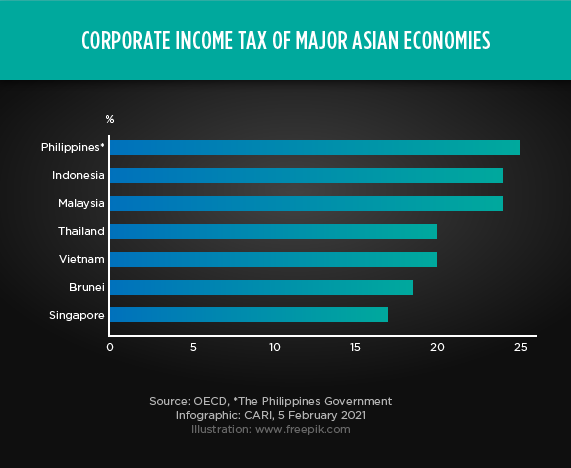
The Philippines to cut corporate tax rate to 25% for big companies to aid COVID-19 recovery
(03 February 2021) The Philippines will cut its corporate tax rate for big companies from 30% to 25%, and to 20% for smaller companies, to help the country recover from the COVID-19 pandemic. The House of Representatives ratified the final version of the Corporate Recovery and Tax Incentives for Enterprises Act (CREATE) on 03 February 2021, and it will be forwarded to President Rodrigo Duterte for signing after it is ratified by the Senate. An earlier version of CREATE had been filed in 2018, but its passage had faced difficulties amid opposition from foreign companies. The Philippines reported a contraction of 9.5% in 2020, making it one of the worse affected economies in the region. CREATE also grants longer tax holidays for businesses located outside Metro Manila, to encourage greater development outside the national capital region and economic centre.

INDONESIA 
Indonesia’s GDP in the final three months of 2020 fell by 2.19% year-on-year 
(05 February 2021) Indonesia’s GDP in the final three months of 2020 fell by 2.19% from a year earlier, while its GDP for the full year fell by 2.07%. As of 05 February 2021, Indonesia’s rupiah fell by 0.2% to the US dollar. A loosening of restrictions on movement during much of the fourth quarter failed to spur personal consumption. The government has scaled up its stimulus measures as it hopes to achieve 5% GDP growth in 2021. It has raised its economic recovery budget to US$44 billion, which will fund tax breaks, cash subsidies, and free vaccines. Bank Indonesia, meanwhile, has pledged to keep monetary policy loose, as it sees no ‘immediate’ concern over inflation.

SINGAPORE 
38% drop in Singaporean businesses venturing overseas in 2020 due to COVID-19 pandemic 
(05 February 2021) According to Enterprise Singapore, there was a 38% drop in Singaporean businesses venturing overseas in 2020, largely due to global travel restrictions caused by the global pandemic. The number of local businesses which ventured overseas dropped to 1,600, and they largely did so through virtual trade fairs and online networking events. They also tapped on e-commerce platforms to market and sell their products and solutions. China and Southeast Asia remained the top markets of interest for Singaporean firms. Enterprise Singapore also noted that 14,800 businesses embarked on projects to improve productivity and upgrade capability, a 78% increase from the previous year.

THAILAND 
Bank of Thailand holds benchmark interest rate steady to allow fiscal policies to lead the economic recovery 
(03 February 2021) On 03 February 2021, The Bank of Thailand had held its benchmark interest rate steady at an all-time low of 0.5% as Thailand allows fiscal policies to take the lead in the economy’s recovery from the global pandemic. The central bank is prepared to use additional monetary policy tools and is assessing the need for new measures in the foreign exchange market. Thailand is currently grappling with a new outbreak of COVID-19 which began in December 2020, forcing the Finance Ministry to cut its 2021 GDP growth forecast to 2.8% from the 4.5% growth it predicted in October 2020. In December 2020, the central bank also cut its GDP outlook for 2021 to 3.2%. The government unveiled a new series of stimulus measures in January 2021 to counter the outbreak.

VIETNAM 
The new five-year economic blueprint calls for private companies to account for more than half of the economy by 2025 
(31 January 2021) Vietnam’s recently concluded national party congress approved a new five-year economic blueprint which called for an increase of private companies ownership to account for more than half of its economy by 2025 (from 42% now). The new blueprint also plans to double per-capita GDP to US$4,700-US$5,000 by 2025, from US$2,750 at the end of 2020. Recently re-elected general-secretary of the Communist Party of Vietnam, Nguyen Phu Trong, stated that the country would continue its push for strong economic growth through further domestic business environment reforms, as well as maintaining its tough anti-corruption campaign. The government is also expected to continue to pursue open trade and investment policies.

CAMBODIA, MALAYSIA 
Malaysian exports to Cambodia drops 42% year-on-year in 2020 due to COVID-19 
(04 February 2021) Malaysian exports to Cambodia fell by 42% year-on-year in 2020 due to major disruptions to global supply chains caused by COVID-19. Malaysian exports to Cambodia in 2020 fell to US$368.5 million. Malaysian exports rebounded in the second half of 2020, with December 2020 recording the largest increase of the year. Cambodia’s largest import from Malaysia is mineral fuels, including coal, petroleum, and natural gas. As such, the drop in exports was attributed to the drop in fuel prices in 2020, with Malaysia’s total petroleum exports in 2020 falling by 22% year-on-year to US$135 billion. The drop in exports was also reportedly caused by a drop in Cambodia’s purchasing power, as the local economy struggled to deal with the economic strain caused by the pandemic, particularly to its tourism and manufacturing industries.

MALAYSIA 
Malaysian government to toughen enforcement of COVID-19 restrictions measures as Chinese New Year approaches 
(04 February 2021) The Malaysian government will toughen its enforcement of COVID-19-related restrictions as the country enters its fourth week of a six-week lockdown (referred to as a Movement Control Order, or MCO). Businesses which do not comply with health guidelines will be shut down, while the Malaysian Army will be provided with powers to make arrests and to help other agencies carry out operations against illegal immigrants and address breaches of COVID-19 SOPs. The government also plans to raise fines for repeat offenders of the lockdown, as well as imposing jail term for selected offences. The government announced more stringent protocols for the upcoming Chinese New Years holidays, including banning house-to-house visits and limiting prayers at temples.


RCEP Monitor


AUSTRALIA 
Australia to maintain its mandatory two-week quarantine for all overseas visitors 
(05 February 2021) Australia stated it will be maintaining its mandatory two-week quarantine for all overseas visitors to the country, despite the vaccine rollout taking place in February 2021. Australia has closed its borders from the rest of the world for almost a year, with most non-citizens barred from entering the county and strict caps implemented on the number of residents that are allowed to return each day. All arrivals to the country must undergo a two-week self-paid hotel quarantine. A few thousand short-term visitors now enter Australia monthly, down from more than one million before the COVID-19 pandemic began. Australia’s Chief Medical Officer noted that although preliminary data shows the AstraZeneca vaccine does reduce transmission of the virus, this was not enough for Australia to open its borders.

JAPAN, THAILAND  
Thai energy conglomerate PTT ships liquified natural gas to Japan for the first time in January 2021
(05 February 2021) Thai state-owned energy conglomerate PTT had shipped liquified natural gas (LNG) to Japan for the first time in January 2021. Thailand is currently experiencing a glut in LNG due to a lack of winter heating demand and the COVID-19 pandemic, the latter of which has impacted manufacturing. The Thai government is hoping to transform the country into an international LNG trading hub, and to re-export excess LNG to other countries such as Japan, South Korea, China, and Taiwan for when domestic demand is low. PTT buys LNG from Malaysia and Qatar mostly under long-term contracts. Projecting more domestic demand for electricity, Thailand plans to increase procurement and is expanding its import terminals, with a second facility slated for completion by 2022. 

SOUTH KOREA 
South Korea to partially lift restrictions on short-selling from 03 May onwards 
(03 February 2021) South Korea will partially lift its restrictions on short-selling from 03 May 2021 onwards. Following criticisms from hedge funds and other financial institutions against a year-long ban that is set to expire on 15 March, South Korea will now allow the short-selling of large-cap shares, including stocks on the KOSPI 200 Index and the junior KOSDAQ 150 Index. The local stock market had staged a strong recovery from 2020 and was trading at near-record levels on the back of heavy retail trading. Short selling for more than 2,000 companies listed on the market will continue to be prohibited. South Korea is only one of two major Asia-Pacific economies which restricts short selling, alongside Indonesia. Hedge funds claimed restrictions on short-selling made little sense as retail investors account for two-thirds of daily turnover on the country’s US$2 trillion stock market.

Media Release: Invest ASEAN: Italian Industry Expertise in Malaysia


ASEAN as an investment hub: Italian businesses in Malaysia eye Malaysia as the gateway to opportunities arising from Regional Comprehensive Economic Partnership (RCEP)

Kuala Lumpur, 27 January 2021 – CARI, which is focused on ASEAN Research and Advocacy, in partnership with ASEAN Business Club hosted a webinar under its flagship Invest ASEAN series on ‘Italian Industry Expertise in Malaysia’.

The session featured keynote speaker Dato’ Azman Mahmud, Chief Executive Officer of the Malaysian Investment Development Authority (MIDA); His Excellency Cristiano Maggipinto, Ambassador of Italy in Kuala Lumpur;  Luciano Pezzotta, Deputy Chairman of Eurocham Malaysia and Executive Board Member of the Italy Malaysia Business Association (IMBA); Lamberto Barbieri, Managing Director of CRIF Regional Headquarters (HQ) in Asia; Vincenzo Alaimo, President of the Italy Malaysia Business Association and Vice President of Asia Pacific, Global Sales of Leonardo (Helicopters Division); and Dr Luciano Giorgi, Country Manager (Malaysia) of Maire Tecnimont and Chairman of Allied Elite Limited.

Moderated by Tan Sri Dr. Munir Majid, Chairman of CARI, the discussion emphasised on the recently signed Regional Comprehensive Economic Partnership (RCEP) Agreement providing an outstanding platform for multinationals to tap into the regional trading area that represents 30% of the world’s GDP. Malaysia as a vibrant RCEP member provides significant trading and investment opportunities, including for the Italian businesses operating in the region.

Italian investments in Malaysia have ventured in various sectors as oil and gas, petrochemicals, aerospace, and the green and circular economy. Greater collaboration between Malaysia and Italy will further open Malaysia’s private sector to tap into Italy’s advanced technological expertise and expedite the momentum of Malaysia’s digital economy.

(In picture) Tan Sri Dr. Munir Majid, Chairman of CARI and President of ABC

ASEAN as a growing trade and investment hub


Tan Sri Dr. Munir stated in his opening statement that the Invest ASEAN series intends to provide an active forum for influential policymakers and corporate leaders to share and identify key opportunities for growth and development in the ASEAN region through an analysis on the emerging trends affecting global business and markets.

“Notwithstanding the COVID-19-induced global slowdown, ASEAN remains a dynamic region. With a combined GDP of US$3.2 trillion in 2019, ASEAN represented the fifth-largest economy in the world1.  As the central player of the RCEP Agreement, ASEAN provides a regional platform for external businesses to tap into the largest free trade agreement in the world. With 15 signatories, RCEP represents a market of 2.2 billion people and a combined GDP of US$26.2 trillion2, said Tan Sri Dr. Munir.

He added, “On the other side of the equation, many of us do not recognise Italy is well above the EU average in the production and use of industrial robots and in the adoption of Industry 4.0 technologies such as the cloud, IoT and M2M (machine to machine) communications. It is the second largest manufacturer in the EU, after Germany. Therefore, its strong industrial base and awareness of digitalisation are something which ASEAN countries would want to be engaged with.”

(In picture) H.E. Cristiano Maggipinto, Ambassador of Italy in Kuala Lumpur

Italy remains committed to Malaysia as trading and investment partner 


H.E. Cristiano Maggipinto stressed that Italy has pursued a strategy with the aim of strengthening relations with ASEAN, as demonstrated by the fact that, at the 53rd Session of the ASEAN Ministers of Foreign Affairs Summit, Italy’s candidacy as Development Partner of the Association was unanimously approved.

“This important outcome institutionalises political, economic and social ties grown over time, which give us a prominent role in Southeast Asia. In this framework, Italy has given new depth to the relations with Malaysia, which represents one of the most relevant actors in the area and offers a number of benefits not easily found in the region,” states Ambassador Maggipinto.

He points out that despite the COVID-19 pandemic, bilateral trade between Italy and Malaysia in the first seven months of 2020 remained at similar levels to 2019. Italian companies currently operating in Malaysia are found in a wide range of sectors including oil and gas, defense and aerospace, construction, automotive, and chemicals.

(In picture) Dato’ Azman Mahmud, Chief Executive Officer of MIDA

Government undertaking major initiatives to drive investments into Malaysia  


Dato’ Azman Mahmud shared that Malaysia continues to be a competitive investment destination despite the global uncertainties, with US$26.4 billion worth of approved investments in the overall economy in the first nine months of 2020. In fact, investments approved in the manufacturing sector for the period of January to September 2020 saw an increase of 16.6% in capital investments, compared to the corresponding period in 2019, with FDI recording an increase of 3.2%. The Malaysian government is undertaking additional initiatives to drive foreign investments, such as easing operating of businesses through digitalising selected government services, providing new tax incentives for the pharmaceutical and services sectors, as well as implementing a One Stop Centre (OSC) to facilitate the entry of business travellers into the country3.

“Malaysia’s economic structure and solid macroeconomic management continue to support the country’s economic fundamentals as we advance into the new normal. As we move towards strategic diversification, particularly in high-value products and high-end services, the country offers vast opportunities for Italian investments in high-quality machinery and equipment, aerospace, green technology, automotive technologies, and industrial design. MIDA is optimistic that more quality investment will be coming to Malaysia in the coming years,” said Dato’ Azman Mahmud.

Dato’ Azman also urged Malaysia’s private sector to leverage upon Italian technological expertise to help facilitate Malaysia’s own digital economy, which is projected to grow by 21% between 2020 and 2025, reaching an estimated US$30 billion gross merchandise value (GMV) by 20254.


1. ASEAN Secretariat, ‘ASEAN Key Figures 2020
2. KPMG, ‘Regional Comprehensive Economic Partnership – impacts for China and the Asia Pacific region’, November 2020
3. MIDA presentation, ‘MIDA-Spearheading Nation’s Investment Agenda’, January 2021
4. Google,  Temasek and Bain & Company, ‘e-Conomy SEA 2020’, November 2020