China-ASEAN Monitor


img-ca-110718.jpg

Photo Credit: TheEdge Markets


Economy, Investment and Trade

Malaysia investigates links between China-backed projects and 1MDB
(6 July 2018) Malaysian Finance Minister Lim Guan Eng announced an ongoing investigation on whether part of a loan from a Chinese state-owned bank for projects valued at US$2.3 billion was used to finance the debts of 1Malaysia Development Berhad (1MDB). Meanwhile, Malaysia is also seeking to collaborate with the Chinese government to investigate into the loan and exploring the possibility of recovering funds invested in pipeline projects namely the Multi-Product Pipeline and The Trans-Sabah Gas Pipeline. A settlement worth US$800 million owed to Abu Dhabi state fund IPIC was allegedly financed from a land sale deal with Bank Negara and sell-back shares of sovereign fund Khazanah Nasional Berhad.
Read more>>

Alibaba Group will continue investing in Malaysia
(9 July 2018) Chinese e-commerce giant Alibaba Group’s investments will not be affected by the review of China-related projects in Malaysia. Malaysia Digital Economy Corporation (MDEC) has assured that the Digital Free Trade Zone (DFTZ) project will continue. Alibaba Group has invested US$100 million (RM400 million) into the DFTZ project and launched the “Malaysia Week” campaign to promote Malaysian products and services. Malaysia’s Finance Ministry has issued a suspension notice for all agreements related to China-linked Multi-Product Pipeline, the Trans-Sabah Gas Pipeline and the East Coast Rail Link projects.
Read more>>

Lao-China Railway Project produced beams to support railway
(9 July 2018) About 800 pre-stressed concrete beams will be attached on the arches of the Laos-China High-Speed Railway project to create a stretch of the railroad on a flat Vientiane plain. The poles will be placed on arches to support the rails. The total budget of the whole project is estimated to be US$5.986 billion. This project is the first global rail route connecting Laos to China’s network, and once operational, it will also link to the railway network of Thailand, Malaysia and Singapore. The total length of the railway is approximately 414 km and expected to travel at the speed of 160 km/h. The construction of the railway will take five years.
Read more>>

China and Myanmar signed 15-point MoU on Economic Corridor
(6 July 2018) China and Myanmar have agreed to a 15-point Memorandum of Understanding (MoU) on the establishment of China-Myanmar Economic Corridor, which is part of China’s One Belt One Road Initiative. Under the MoU, both governments agreed to cooperate in sectors such as infrastructure, construction, manufacturing, agriculture, transport, finance, human resources development, telecommunications, and research and technology. The corridor will run from China’s Yunnan Province to Mandalay in central Myanmar, and then east to Yangon and west to the Kyaukphyu Special Economic Zone (SEZ). For the execution of the economic corridors, related ministries from both nations are required to establish a working group and joint committees to plan out infrastructure development plans. According to DICA, China is Myanmar’s biggest investment partner as the former invested US$20.01 billion in Myanmar between 1988 to May 2018.
Read more>>

The Philippines is looking to reduce visa processing time for Chinese tourists
(8 July 2018) The Philippines is looking to cut the time needed to process visa on arrivals for Chinese tourists to ease their entry into the country. The Philippines government is also considering to place Mandarin-speaking personnel in airports to communicate better with the arriving Chinese tourists. Visa-upon-arrival for Chinese visitors was allowed since August 2018 but only limited to those who are part of the tour groups approved by the Philippines Department of Tourism (DOT). Tourists should apply for the visa ten days before arrival with a fee of US$25.19. DOT’s data showed that Chinese tourists are the second top foreign visitors to the country. From January to May 2018, 559,289 Chinese visitors travelled to the Philippines, a 43.81 percent increase compared to 2017.
Read more>>


Malaysia: May 2018 trade


HIGHLIGHTS

May 2018 trade

  • Despite a sharp fall in total trade, the trade balance remained healthy at RM8.1bn
  • Trade activity likely suffered from a high base and the 14% yoy decline in working days due to GE14.
  • Headline imports eked out a marginal gain due to a sharp increase in imports for reexport purposes, in spite of the slump in end-use imports.
  • We forecast exports to grow 7.7% in 2018 but trade tensions, the start of US-China tariffs on 6 Jul, and a slowdown in China and the global manufacturing cycle are risks.

img-my13-1

The expansion of trade activity dulled in May
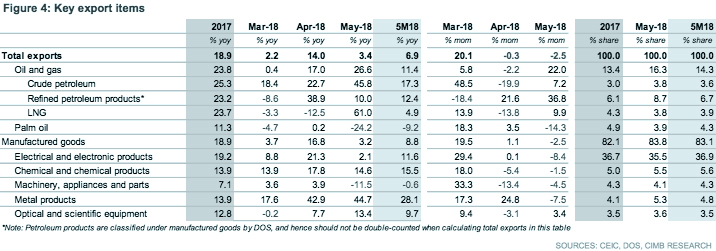
Total trade growth eased sharply to +1.8% yoy in May (+11.8% yoy in April), weighed down by 1) a high base effect, and 2) fewer working days during the election month. The expansion in gross exports came in weaker-than-expected at +3.4% yoy (CIMB: +7.0% yoy, Bloomberg consensus: +6.4% yoy; April: +14.0% yoy), but still outpaced the 0.1% yoy gain in gross imports (CIMB: +4.9% yoy, Bloomberg consensus: +0.2% yoy, April: +9.2% yoy). Hence, the trade surplus remained healthy at RM8.1bn (CIMB: RM7.4bn, Bloomberg consensus: RM10.5bn, RM13.0bn in April).

The surge in O&G exports…
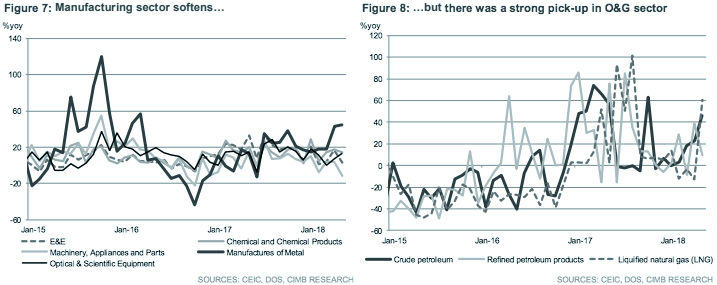
O&G exports (+26.6% yoy in May vs. +17.0% yoy in April) were the clear outperformer in May, with LNG exports rebounding 61.0% yoy (-12.5% yoy in April), after three months of declines, due to higher volumes (+68.7% yoy). Higher oil prices supported crude petroleum exports (+45.8% yoy vs. +22.7% yoy in April) and refined petroleum product (+10.0% yoy vs. +38.9% yoy in April). On the other hand, lower export volumes and CPO prices were a drag on palm oil exports (-24.2% yoy in May vs. +0.2% yoy in April).

… outshines manufacturing exports
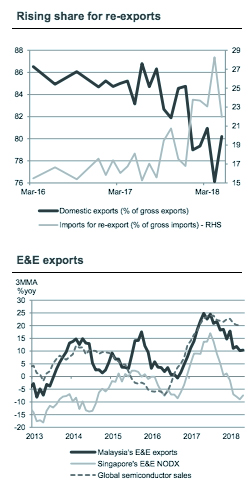
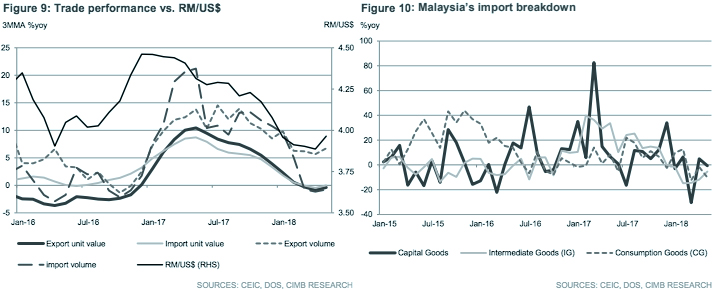
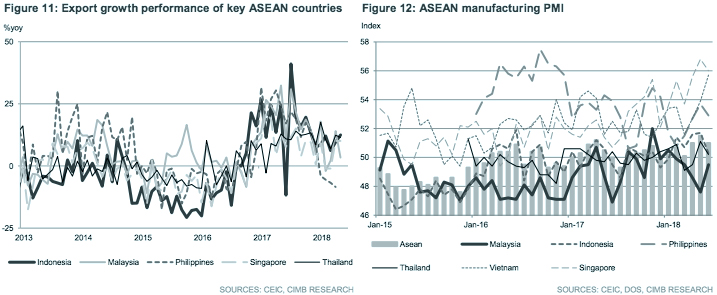
The expansion in manufacturing exports lost steam in May (+3.2% yoy vs. +16.8% yoy in April) amid weaker performance in key sectors such as E&E (+2.1% yoy vs. +21.3% yoy in April), machinery, appliances and parts (-11.5% yoy vs. +3.9% yoy in April), as well as chemicals (+14.6% yoy sv. +17.8% yoy in April). The moderation in Malaysia’s E&E exports tracked that of Singapore, despite continued double-digit growth in global semiconductor sales. We think the export values (in local currency terms) may have been eroded by the ringgit’s appreciation against the US$.

Import demand plagued by uncertainty on political landscape
All three import groups contracted during the start of the fasting month: intermediate goods (-5.3% yoy vs. -11.8% yoy in April), capital goods (-0.7% yoy vs. +4.9% yoy in April), and consumption goods (-10.2% yoy vs. -1.8% yoy in April). In May, there were 3 days or 14% fewer working days than the same month last year due to three public holidays declared during GE14, as well workers taking more time off to travel for the mid-week vote. The import declines may also reflect the more cautious sentiment among manufacturers and consumers after changes in the domestic political landscape and post-election uncertainty

Sharp rise in share of imports for re-export purposes since 2017
Despite the slump in end-use imports, headline gross imports still eked out a marginal increase due to the gain in imports for re-exports (+21.4% yoy vs. +84.3% yoy in April). The share of imports for re-exports has increased since mid-2017, suggesting that Malaysia was reaping the benefits from 1) the rise in global trade activity, and 2) perhaps playing a greater role as a regional distribution centre and a port for transshipments.

Global trade outlook clouded by mounting trade tensions
We maintain our 2018F gross export estimate at 7.7%. Risks to the downside include an escalation of trade tensions following the implementation of US$34bn tariffs effective 6 July, a sharper cyclical slowdown in the manufacturing cycle, and growth risks in China.

img-my13-2

img-my13-3

img-my13-4

img-my13-6

img-my13-7

img-my13-8

img-my13-9


Originally published by CIMB Research and Economics on 05 July 2018.

CARI Captures 363

c363_graphic


MALAYSIA

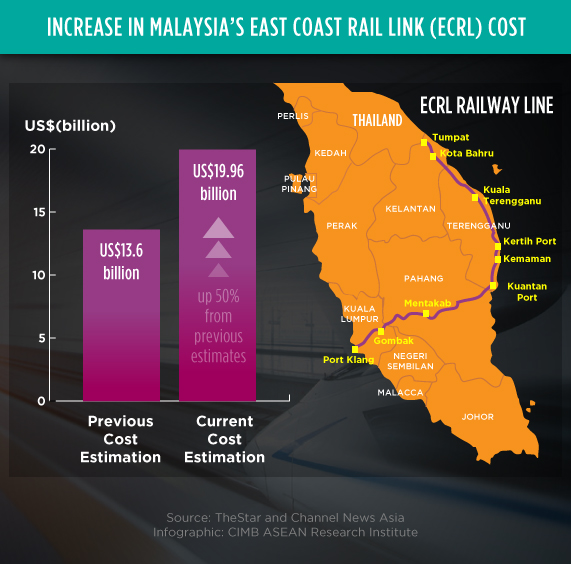
Malaysia’s East Coast Rail Link (ECRL) is expected to cost an additional 50 percent
(3 July 2018) Malaysian Finance Minister Lim Guan Eng revealed that the cost of completing Malaysia’s largest rail project could cost almost US$20 billion, which is 50 percent higher than the estimate made by the previous government. The 688 km East Coast Rail Link (ECRL) is a mainly driven by Beijing’s Belt and Road initiative to link the South China Sea in the east with the strategic shipping routes in the west. Malaysia intends to rearrange the terms of the agreement with its Chinese partners. The ECRL project, a rail line from Port Klang to Pengkalan Kubor, Kelantan, will cost US$19.96 billion (RM81 billion) after including the cost of land acquisition, interest, fees and other operating expenses from the basic cost of US$16.5 billion (RM67 billion). The project was estimated to cost US$13.6 billion (RM55 billion) initially. On 5 July 2017, the finance ministry confirmed that a work suspension order was issued to all contracts linked to the East Coast Rail Link (ECRL) and also the two pipeline projects under Suria Strategic Energy Resources Sdn Bhd (SSER).

INDONESIA

Indonesia to assess capital goods imports to control the current account deficit
(3 July 2018) As part of a series of coordinated policy measures to strengthen Indonesia’s financial market, the government intends to assess the import of capital goods for major government projects to control its current account deficit. Indonesia’s Finance Minister Sri Mulyani Indrawati explained that the current account deficit was due to negative sentiment of investors. Bank Indonesia announced that the current account deficit of Indonesia was at 1.7 percent of gross domestic product in 2017 and is expected to continue rising until it reaches 2.5 percent in 2018. According to Indonesia’s central bank data, to aid the government’s infrastructure push, Indonesia imported goods worth US$4.1 billion from January to May 2018 and also US$1.1 billion worth of defence equipment.

INDONESIA

Thailand seeking support worth US$40 billion for rail upgrade
(3 July 2018) Indonesia’s Industry Ministry estimates 10 million job opportunities will be created by 2030 due to the advent of Industry Revolution 4.0. The number of workers in Indonesia is also expected to increase up to 30 million by 2030. Therefore, it is crucial to embrace industrial revolution to overcome the issue of rising number of workers in Indonesia. Indonesia’s added value from the industry sector to gross domestic product (GDP) was ranked at fourth internationally with a contribution rate of 22 percent. The most significant contributor is South Korea with 29 percent.

MALAYSIA

Malaysian and Indonesia will join hands to fight against EU over CPO ban with Indonesia
(29 June 2018) Malaysia’s prime minister Tun Dr Mahathir Mohamad expressed the need for Indonesia and Malaysia to fight together against the European Union’s proposal to limit exports of crude palm oil (CPO) and its derivative products to the union’s member states. The reason for the restriction on CPO was due to environmental issues, and Dr Mahathir said he could not accept such an unfair policy. He believes the reason behind the ban is due to local vegetable oils namely soybean and rapeseed oil could not compete with CPO. President of Indonesia, Joko Widodo agreed to collaborate with Malaysia to fight against the issue.

ASEAN

RCEP looking for free trade deal by the end of 2018
(1 July 2018) Ministers from the 16 countries negotiating the Regional Comprehensive Economic Partnership (RCEP) are pushing for the conclusion of the free trade deal by the end of 2018 in order to counter protectionist policies implemented by the United States president Donald Trump as a united pact. The unilateral trade actions taken by the United States is fueling concerns about the global trade wars. The ministers are trying to narrow down unresolved points and link differences between countries which include tariff reductions, intellectual property protection, and cross-border e-commerce. RCEP negotiations started in 2013 but in the last five years, countries have only agreed two out of the 18 categories so far.

THAILAND

Thailand will circulate second batch of new banknotes in July
(3 July 2018) The central bank of Thailand will issue another batch of new banknotes since its first distribution on 6 April 2018. This second batch of new notes will use the picture of King Maha Vajiralongkorn, and it marks another step of transformation under his command since December 2016. Bank of Thailand’s governor announced that the circulation of the new 500 baht and 1,000 baht notes would commence after the king’s birthday, which is on July 28. The first batch of new notes was first circulated on 6 April 2018. The king’s late father King Bhumibol Adulyadej’s picture was on the country’s banknotes throughout his 70 years rule. Existing and previous series of banknotes remain legal tender.

THAILAND

Asian Development Bank (ADB) invests in Thai highways
(4 July 2018) The Asian Development Bank (ADB) and the Government of Thailand sealed a US$99.4 million loan deal to help Thailand enhance 125 kilometres of highways and enhance road safety management in the country’s northeastern region. The GMS Highway Expansion Phase Two project will convert Highway 22 and Highway 23 from two-lane expressways to four-lane expressways. Highway 22 is a road linking Nong Han to Phang Kon and Sakon Nakhon to Nakhon Phanom while Highway 23 is a section from Roi Et to Yasothon. In 2009, ADB assisted the phase one project, which enhanced 178 kilometres of an existing two-lane national expressway to a four-lane divided standard.

VIETNAM

Phu Quoc Island draws investments worth US$11.6 billion
(4 July 2018) Phu Quoc Island in Vietnam is a popular investment destination for investors as the island has drawn 279 investment projects with total area of 10,754 hectares. Phu Quoc Economic Zone (EZ) management board said that out of the 279 projects, 249 had received investment endorsements with an entire area of 9,000 hectares. The registered capital for the 249 projects is US$11.6 billion. Currently, 36 projects are in operation with a total investment capital of US$634 million. Some of the projects include real estate, tourism complex, cable car and a seaport. The island is a popular tourist spot as it welcomed 1.8 million tourists in 2017, of which 300,000 are foreigners.

CAMBODIA

Cambodians can soon fly to Indonesia directly
(4 July 2018) Cambodia’s Tourism Ministry said the country will have a direct air connection with Indonesia by 2019. The ministry and Indonesia’s ambassador to Cambodia agreed on a timeframe for the formation of the new flight, which will be operated by Indonesian airline Lion Air. Cambodia’s State Secretariat Civil Aviation and the airline had conducted talks to finalise a tentative date to launch the flight. However, a spokesperson from the state secretariat of Civil Aviation said the airline is still exploring the new route to make sure there is demand for the route.

SINGAPORE

Singapore positions itself as a gateway for Indian firms to invest in ASEAN
(29 June 2018) According to Singapore’s finance minister Heng Swee Keat, the country is a good transit point for Indian firms to conduct business with ASEAN. The minister, who spoke at an event organised by the Confederation of Indian Industry (CII) in New Delhi, hopes for an advanced review to enhance the India-Singapore bilateral free trade pact called Comprehensive Economic Cooperation Agreement (CECA). Signed by both nations in 2005, the pact has seen a significant boost for trade between both countries, as it has seen an increase from US$6.7 billion in 2005 to US$16.7 billion in 2017. The minister said there are 8,000 Indian entities based in Singapore and Singapore’s foreign direct investment (FDI) in India is around US$60 billion.

Myanmar Monitor


Photo

Photo credit: Myanmar Business Today

Economy, Investment and Trade

Myanmar government gives importance to import substitutions to lower trade deficit
(3 July 2018) Myanmar’s Directorate of Investment and Company Administration (DICA) said the country would place importance on import substitutions to bring down the country’s trade deficit. Import substitution is a measure which promotes the move to replace imports with domestic production. The action is meant to reduce Myanmar’s trade deficit while increasing exports. The government investment body said the move would not only minimise trade deficit but will generate more job opportunities for Myanmar workers. According to Myanmar’s Ministry of Commerce, from 1 April to 15 June 2018, Myanmar’s exports reached US$3.12 billion while the volume of imports was at US$4.25 billion.
Read More >

New companies law regulations to be released soon
(2 July 2018) Myanmar’s Directorate of Investment and Company Administration (DICA) will issue the new Companies Law regulations, namely on electronic registration, capital structures and company constitutions before it takes effect on 1 August 2018. DICA has presented the provisions to the government’s economic committee, and once it is approved, the government investment body will publish the regulations on its website. The Companies Law will replace and incorporate components of the 1914 Companies Act and 1950 Special Companies Act. The new law will ease procedures for foreigners to invest in local companies and ensure business regulation becomes more efficient and effective. According to the government investment body, there are more than 50,000 local companies and 7,000 foreign companies currently registered in Myanmar.
Read More >

Myanmar government will open tenders for the upgrade of two oil refineries
(29 June 2018) The Myanmar government will soon open bids for the construction of at least two oil refineries to cope with the rising demand and increased oil prices. The tender will be a joint venture agreement with the Myanmar government, and the government is currently reviewing terms and conditions for it. Once completed, the government will announce an open tender for the two facilities. Part of the bid will include the renovation of the Mann Thanbayarkan refinery in Magwe and Thanlyin refinery. The Mann Thanbayarkan refinery can process up to 26,000 barrels of oil per day, but it is not able to reach its full capacity due to its inland location. Thanlyin, which can process 50,000 barrels of oil per day, receives up to 2 million tonnes of crude oil through the China-Myanmar pipeline. The refineries have been inactive due to the government’s lack of budget to upgrade and run the refineries.
Read More >

A survey shows improving living conditions, but progress in education, sanitation, and housing in some areas is slow
(5 July 2018) The Key Indicators Report from the Myanmar Living Conditions Survey 2017 showed that living conditions in Myanmar have enhanced in the last decade. However, development in education, water and sanitation and housing is slow in some parts of the country. The survey outlines some significant changes in lighting, education, goods ownership, and technology usage but development in some parts of the nation is still slow. The public electrical grid grew from providing 34 percent of households in 2015 to 42 percent in 2017. In rural areas in the country, middle school admission increased from 47 percent to 68 percent between the year 2010 and 2017. The survey claims that significant changes are happening in rural areas, while the same shift in towns and cities is at a modest speed due to high rates of electrification in these areas. The Central Statistical Organisation, in collaboration with the UNDP and the World Bank, surveyed about 296 townships in Myanmar and interviewed about 13,730 households.
Read More >

Foreign Affairs

World Bank stops accepting projects for Myanmar due to Rohingya crisis
(2 July 2018) Bangladesh’s finance minister AMA Muhith said the World Bank has stopped accepting projects for Myanmar except for the ones for Rohingyas and distressed society in the country. The move is to push Myanmar to take back its Rohingya people from Bangladesh in a peaceful manner. Currently, Bangladesh is providing shelter for around 10 million Rohingyas, but it is only temporary. Bangladesh hopes that the United Nations will ensure that there would be a safe zone for the Rohingya community in Myanmar. The minister said the World Bank and the United Nations will provide grants worth US$480 million and US$50 million respectively to support the Rohingyas in Bangladesh. However, the World Bank has denied the claim and clarified that the body will continue supporting projects in Myanmar, especially in Rakhine.
Read More >

China-ASEAN Monitor


img-ca-060718.jpg

Photo Credit: AFP


Economy, Investment and Trade

Malaysian palm oil exporters encouraged to take advantage of the US-China Trade Dispute
(4 July 2018) Malaysia’s Primary Industries Minister said the country’s palm oil exporters would benefit from the United States and China trade dispute as there will be more opportunities to offer Malaysian palm oil products to the Chinese market. On 6 July 2018, China imposed a 25 percent tariff on 545 US products including soybean in retaliation to the higher duty imposed by the U.S government. As the third biggest buyer of Malaysian palm oil and palm oil-related products, China imported 1.92 million tonnes of palm oil from Malaysia in 2017. Agri-commodity-based products worth US$4.72 billion (RM19.1 billion) have been exported to China in 2017, increasing by 27 percent from US$3.71 billion in 2016.
Read more>>

Myanmar will request China to downscale Rakhine project
(4 July 2018) Myanmar will look to downsize the scale of a Chinese backed special economic zone project in Rakhine. The country’s planning and finance minister Soe Win said the project should be as small as possible by cutting unnecessary expenses. The minister said the more significant the plan, the bigger the responsibility to pay back and he hopes China will be reasonable during the negotiations. The economic zone is Located in Kyaukpu and the estimated cost for the project is at US$10 billion. Myanmar’s external debt at the end of 2017 was US$9.6 billion, of which the country owes China 40 percent.
Read more>>

China examining new possibility in the Philippines petroleum contracting round
(3 July 2018) China International Mining Petroleum Company Limited (CIMP) will explore a new opportunity in the Philippines petroleum contracting round after the success of its commercial oil extraction at the Alegria onfield oil shore in Cebu. However, the Chinese firm is currently looking at improving its petroleum service contract 70 in Central Luzon, which is under another associate firm Polyard Petroleum Philippines. CIMP will keep track of the policy developments on the removal of investment incentives that will influence the upstream oil and coal industry segments. The petroleum industry in the Philippines has appealed to the Department of Finance to eliminate the upstream petroleum sector from the coverage of tax structure modifications under the Tax Reform for Acceleration and Inclusion (TRAIN) Act.
Read more>>

China reduces tariff rates on five Asia Pacific member countries
(2 July 2018) China will reduce tariff rates on a range of imported goods coming from India, South Korea, Bangladesh, Laos and Sri Lanka, said the Customs Tariff Commission of the State Council. A total of 8,549 commodities such as soybeans, precision instruments, chemicals, agricultural products, clothing, steel, and aluminium products were being removed or reduced tariff rates since 1 July 2018. Such a move was made to strengthen the trade relations between China and the other five Asia Pacific member countries, including Laos under the Asia Pacific Trade Agreement (APTA). Recently, all member countries of Asia Pacific have decided to lower tariffs by an average of a third on at least 10,000 items.
Read more>>

Foreign Affairs

China will further support Myanmar on the Rakhine issue
(29 June 2018) China will further assist Myanmar and Bangladesh on the Rakhine issue by upgrading living conditions and resettlement of displaced people in the state. The support from China includes emergency material aid and construction of required facilities. Myanmar and Bangladesh agreed to improve the situation in Rakhine through discussion of a three-phase solution. The solution consists of an on-site ceasefire, repatriation, and development.
Read more>>


Economic Focus: 2H18 Outlook – A summer of discontent


HIGHLIGHTS

2H18 Outlook: A summer of discontent

  • The resilience of the global economy will be tested by tightening monetary conditions, risks of greater international trade and investment friction, and geopolitical uncertainty.
  • Markets have become attuned to risks of tighter global financing conditions and volatile FX adjustments to highly leveraged economies with large external imbalances.
  • We expect monetary policy divergence between countries subject to macro volatility (Indonesia) vs. highly leveraged and trade-exposed economies (Malaysia, Thailand).

img-ef-1

Global: Engines of growth tested by confluence of risks
The extended recovery means advanced economies have closed their output gaps and are reaching full employment, precipitating further withdrawal of monetary policy accommodation, particularly in the US and Eurozone, to prevent overheating. Other risks have surfaced or intensified in recent months that could derail growth prospects, including 1) a disorderly unwinding of global liquidity, 2) the erosion of rules-based global trade order, 3) elevated oil prices reducing real purchasing power, 4) geopolitical uncertainty and election cycles in the US, India, Indonesia and Thailand.

ASEAN: In for a bumpy ride
We expect some degree of policy divergence ahead as regional central banks balance the risks to growth with macro stability. Economies with more fragile external balances could come under sharper balance of payment and currency pressure, necessitating a policy response. This is particularly so for Indonesia, where we expect more hawkish biases to monetary policy. Highly-leveraged and trade exposed economies (Malaysia and Thailand) could pursue a more balanced policy mix to manage shocks to the economy.

Malaysia: When the going gets tough, the tough get going
The Pakatan Harapan government wasted little time in delivering its election promises, significantly repositioning Malaysia’s fiscal policy agenda. The growth outlook (+5.2% in 2018) remains intact as stimulus to consumers make up for the cutbacks in government spending and infra works. While implementation will be demanding, the government is likely to land within an acceptable range from the 2018 budget deficit target of 2.8% of GDP. Questions over longer-term fiscal sustainability, however, remain unanswered. External risks may delay the next Overnight Policy Rate (OPR) hike to 2019.

Indonesia: Sailing through a storm
The rupiah has come under pressure in recent months, plagued by volatility of capital flows amid rising external pressures. The currency weakness prompted a shift in Bank Indonesia’s (BI) monetary policy stance to a hawkish bias, which was followed by a swift cumulative 100bp rate hike in May/Jun, underscoring BI’s determination to arrest the slide of the rupiah. As the signs of external uncertainties abating are nowhere in sight, more rate increases could be on the table, depending on the rupiah’s movement. We expect the 7-day Reverse Repo Rate to increase to 5.75% by end-2019. On the growth front, we project the GDP to expand +5.3% yoy in 2018F and +5.2% yoy in 2019F, underpinned by robust investment activity, while private consumption growth is likely to remain steady.

Singapore: Guarded against external risks
Singapore’s growth trajectory remains strong, aided by the export-driven manufacturing, broadening gains in services and the bottoming of construction sector weakness. The Monetary Authority of Singapore (MAS) is adopting a prudent stance to head off risks from slowing external drivers, global trade tensions and tightening financial conditions. We maintain our expectations that MAS will keep its guidance for a “gradual and modest appreciation” of the S$NEER in Oct.

Thailand: Progress may be hindered
Thailand’s upgraded growth outlook (+4.3% in 2018), anchored by gains in both domestic and external demand, is balanced by greater concerns over the US-China trade spat. Markets may have to wait longer for domestic political uncertainty to clear, as the timeline for elections may be delayed again. Amid heightened uncertainties, we expect the policy mix to remain accommodative, and the BOT to keep the policy rate at 1.50% in 2018.

img-ef-2

GLOBAL OUTLOOK IN 2H18

Global economic momentum intact but brace for volatility
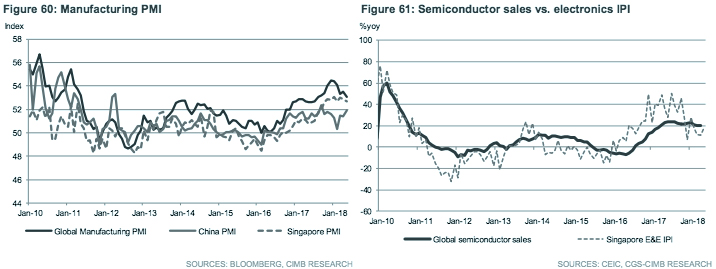
While data points tracking the expansion of global trade and industrial activity have corroborated with expectations of a moderation in momentum following last year’s acceleration, the external environment remained generally supportive of economic growth in both the advanced and developing economies in 1H18. Global indicators of trade and industrial activity remain robust, having rebounded after a patchy start to the year. Indicators of business sentiment, such as the global manufacturing PMI (53.1 in May), are down from a peak in 4Q17, but still above the 50-pt level that marks expansion, primarily boosted by robust growth in the industrial, technology, consumer and telecommunication sectors. PMI readings of the service sector globally also perked up in 1H18, as domestic drivers of growth become more entrenched. Legs in the cyclical upswing and fiscal stimulus in the US led the IMF to revise its forecast of global GDP growth higher to 3.9% in 2018 and 2019, from 3.7% previously.

Nevertheless, risks have surfaced or intensified in recent months that could derail growth prospects and disrupt financial markets, including:

  • Higher oil prices dampening purchasing power.
  • The erosion of rules-based global trade order amid the escalation of trade disputes between the US and major trading partners, principally China.
  • Geopolitical uncertainty arising from Brexit, election cycles and nuclear adversaries.
  • Disorderly unwinding of global liquidity and dislocation of capital exerting pressure on economies with debt and balance of payment fragilities.

img-ef-3

Crude oil prices have rallied in 1H18 (Brent: +17% YTD) due to higher petroleum products demand, a weaker than expected supply response by North American shale, and output losses in Iran, Libya and Venezuela. Oil prices are likely to remain above the US$70/bbl handle with risks to the upside as projections by the International Energy Agency indicate the global crude market appears balanced going into 2019 with limited spare capacity after the alliance of Opec and major non-Opec producers struck a deal on 22 Jun to increase production. The oil output agreement did not stipulate a specific target and country allocation for output expansion, and estimates have ranged from 0.6mbpd (Iran) to 1mbpd (Saudi). The alliance is managing the upward march in oil prices to prevent demand destruction, as higher oil prices are likely to raise headline inflation as energy prices are passed through to consumers.

img-ef-4

Trade tensions intensify. At the start of the year, we warned that the relative geopolitical calm that presided over 2017, following the string of surprises in 2016, such as Brexit, the election of Donald Trump to the US presidency and a surge in populist movements across Europe, should not be taken for granted. Trade was the first victim of the year as the US government announced on 22 Jan that it would impose safeguard tariffs of up to 30% on solar imports. President Trump followed that with duties on steel and aluminium imports including from key trade partners, the EU, Canada and Mexico, and sizeable tariffs on imports of autos and auto parts, aimed at the European and Asian carmakers

America First vs. Made in China 2025. The US’s muscular approach intensified when it imposed tariffs on US$50bn of imports from China, of which US$34bn covering 818 products will come into effect on 6 Jul, while another 284 items totaling US$16bn, including electronics and semiconductor imports, are subject to a period of public feedback before implementation. The US could potentially raise the tariff stakes by a further US$400bn if China retaliates, in order to stop what it alleges are unfair economic practices by China in the transfer of technology and intellectual property from US companies. China has promised to levy tariffs to match the US, while removing or lowering import tariffs for items targeted by the US that it sources from other trade partners. The riposte also nulls the agreement forged in high level trade talks in Beijing, in which China promised to cut its trade surplus with the US by US$70bn. More worryingly, President Trump tasked the US Treasury to draft a series of restrictions on inbound Chinese investments in US companies and startups in sectors identified in the Made in China 2025 plan, though he and other US officials later softened their stance by using existing laws that apply to all countries.

Brexit. The clock on Brexit has ticked down to 270 days, when the UK will leave the European Union at 11pm on 29 Mar 2019, fulfilling the outcome from the referendum of 23 Jun 2016. Despite the intervening two years since, the UK government remains far from agreeing to a resolution on the terms of its departure, in particular relating to immigration, trade access, financial regulation and the length of a transition plan, which could lead to the possibility of a ‘cliff edge’ departure next Mar.

European politics. In Italy, the anti-establishment Five Star Movement and League parties emerged from the 4 Mar 2018 election as a coalition to form government. While Prime Minister Conte has downplayed risks of Italy seeking a referendum for an exit from the EU, the coalition are likely to seek to widen the budget deficit to boost the Italian economy against EU fiscal compact and challenge the status quo on trade and immigration. Likewise, Spanish politics was upended in May when the Opposition Socialist party called a no-confidence vote against Prime Minister Rajoy. Parliament voted by a slim majority of 180-170 to replace Rajoy with Socialist leader Pedro Sanchez, who will lead a policy agenda to reverse social spending cuts and improve relations with Catalonia.

In 1H18, North Korea and Iran traded places as the US pulled out of the Iran nuclear deal on 8 May while President Trump met with North Korean leader Kim Jung Un at an historic summit in Singapore on 12 Jun to negotiate a nuclear armistice. Other key events on our watch list: US mid-term elections (6 Nov 2018), Brexit (29 Mar 2019), and general elections in Indonesia (17 Apr 2019), India (Apr-May 2019), and Thailand (by 5 May 2019).

Asset markets and the global economy have absorbed the geopolitical shocks so far as the global economy remains resilient. However, we expect news flow on trade and geopolitics to remain fluid in the coming months, with the potential to cause spikes in volatility in the financial markets, rising risk premiums, depress business sentiment and weigh on global growth, as increasingly fractious political environments may create conditions for escalation of protectionism and policy mistakes. Disunity at the G7 summit in Jun, in which President Trump broke ranks on a joint statement to temper protectionism, underlined frictions in the multilateral framework for safeguarding the existing order of international trade and capital flows.

Unwinding of global liquidity
The extended recovery means advanced economies have closed their output gaps and are reaching full employment, precipitating monetary tightening by central banks and the requisite warnings over volatility in late-stage cycles.

United States. By geography, growth momentum in advanced countries tilted to the US, which has benefited from an extended economic recovery and fiscal stimulus, offsetting the effects of higher commodity prices and interest rates. Tax cuts, which came into effect in Jan 2018, and additional spending passed in Feb 2018 are expected to drive US GDP growth higher, after cooling to 2.2% qoq saar in 1Q18 due to adverse weather. The latest ‘Nowcast’ models by the regional Federal Reserve Banks of Atlanta, New York and St Louis suggest the US economy grew between 2.8% to 3.8% qoq saar in 2Q18.

Despite indications that the US economy is bumping into capacity constraints, with unemployment rate falling further to 3.8% in May and capacity utilisation rising to 77.9% in May, inflation and wage growth remain unusually weak. Nonetheless members of the Federal Reserve FOMC have judged that faster GDP growth and building capacity constraints are sufficient to upgrade the FOMC’s median ‘dot plot’ forecast to four Fed Funds rate (FFR) hikes to 2.25- 2.50% in 2018, three hikes to 3.00-3.25% in 2019 and one hike to 3.25-3.50% in 2020. After the Federal Reserve voted for a second 25bp rate hike for the year on 13 Jun raising the FFR to 1.75-2.00%, two more 25bp rate increases are expected, at the Sep and Dec meetings.

img-ef-5

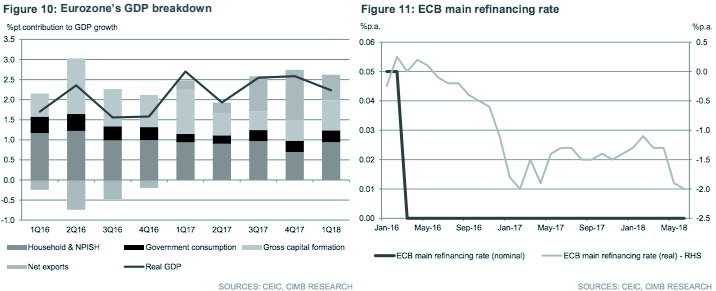
Eurozone. Economic growth in the Eurozone hit a speed bump in 1Q18, but we expect the blip to fade, with the currency area gradually recovering on the back of domestic demand anchored by loose monetary conditions and positive contributions from net exports. Progress on the growth front is likely to bring the Eurozone output gap to parity by this year, encouraging the European Central Bank (ECB) to end its bond purchase programme. On 14 Jun, the ECB announced that it would reduce monthly purchases by half to €15bn per month and conclude bond purchases by Dec. However ECB President Mario Draghi offered dovish forward guidance on the timing of interest rate hikes, which are expected in “summer 2019 at earliest”, reflecting the central bank’s unease with the softer data outturn and potential spillovers from global trade tensions.
img-ef-6

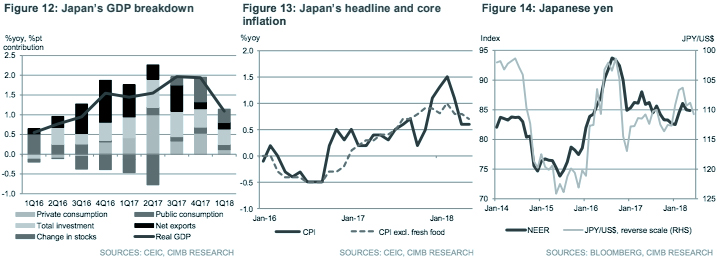
Japan. An eight-quarter run of growth came to a halt, as Japan’s economy contracted 0.6% qoq saar in 1Q18. While we think the weakness was probably overstated at the start of the year due to slippages in domestic demand and weakness in electronics demand, the slowdown is line with incoming headwinds emanating from higher oil prices, slowing gains in the labour market, and VAT hikes in 2019. Growth was not the only setback. Achieving a price stability target has been a more stubborn problem for the Bank of Japan (BOJ) than other central banks, despite a four year campaign to arrest deflation. Headline and core inflation trends have trailed expectations after a spike at the start of the year, leading the BOJ to downgrade its 2018 inflation forecast to 0.5-1.0% vs. “around 1.0%” earlier, and pushing the expected timeline for meeting the central bank’s mandate of 2% to after 2019.
img-ef-7

China. Following the National Party Congress in Mar, the government has set a growth target of 6.5% in 2018, unchanged from 2017, but omitted comments encouraging an overshoot, as policymakers balance growth targets with the need to safeguard financial stability, rebalance the economy and manage risks from trade tensions with the US, which have taken a turn for the worst in recent weeks. The People’s Bank of China (PBOC) has cut the reserve requirement ratio (RRR) twice, once in Apr (100bp) and another effective 5 Jul (50bp), taking the RRR for large commercial banks down to 15.5% and for smaller banks to 13.5% pt. Alongside the reduction, the most recent of which is expected to increase bank reserves by Rmb700bn (US$107bn). the PBOC has directed banks to channel the funds towards small and medium-sized enterprises and debt-for-equity swaps, in which banks retire debt to highly leveraged firms in return for equity stakes, as part of the authorities’ campaign to de-risk the financial system since 2016, which has taken on greater urgency in the face of downside risks to growth amid escalating protectionism with the US. It also offsets the impact of a credit crunch brought on by tighter financial conditions on investment spending and the property sector.

img-ef-8

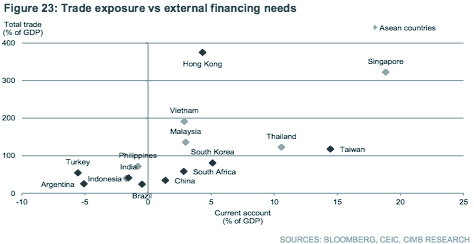
As policy normalisation accelerates in the advanced economies, tightening financial conditions have triggered bouts of bond yield spikes, wider credit spreads, a correction in asset prices and currency weakness in emerging markets. Markets have become more attuned to risks posed by a sharp squeeze in global financing conditions and volatile adjustments in the exchange rate to highly leveraged economies with large external financing requirements – the classic ‘impossible trinity’ dilemma. Rising oil prices add another layer of risk for oil importing economies with narrow current account buffers. Notably, portfolio outflows have been especially sharp in selected countries which are perceived to be exposed to such risks, like Argentina, Brazil and Turkey.

img-ef-9

Below, we compare a series of metrics to gauge which countries in Asia may be at risk. Generating economic expansion has generally not been an issue in Asia, with growth rates exceeding those recorded by advanced economies and emerging economies in other continents. Likewise, inflation dynamics have improved in recent years, suggesting that central banks have a good grip on price stability risks. Therefore, macro risks are concentrated in leverage and external balances. Total debt ratios have broadly risen across Asia in the last five years, with the sharpest increases occurring in China, Malaysia, Thailand, and South Korea (we exclude Hong Kong and Singapore as government debt issuances are not used to finance government spending), and echo similar increases in Turkey and Brazil. High leverage exposes economies to higher debt service charges and deterioration in balance sheets, magnifying the impact of macro and financial shocks to the real economy. China is particularly at risk for transmitting contagion to the rest of the region, due to the size of its corporate debt.

img-ef-10

img-ef-11

Countries that run current account deficits depend on offsetting inflows of capital that are generally sourced from foreign direct investment and portfolio flows. A sudden withdrawal of capital could trigger sharp increases in borrowing costs and currency depreciations with negative spillovers to the real economy. Among the countries above, India, Indonesia and the Philippines run twin deficits, though the current account and fiscal balance shortfalls are much narrower than those of Turkey, Argentina and Brazil. External debt exposures, which were a key fault line during the Asian Financial Crisis when regional currencies depreciated sharply, have risen in Malaysia, Taiwan, Thailand and Vietnam, mirroring the uptrend in Turkey (we exclude Hong Kong and Singapore as they are largely trade-finance related). To note, the increase in Malaysia’s external debt is exaggerated by a redefinition in 2014, which includes non-resident holdings of ringgit-denominated assets. International reserve buffers in Asia remain sufficient to tolerate transitory bouts of financial volatility. However, a disorderly and extended unwinding of capital flows would weigh more heavily on Malaysia and Indonesia than their peers due to: 1) lower levels of reserve coverage against import requirements and external debt, 2) Malaysia’s relatively large foreign ownership of government bonds, and 3) Indonesia high level of foreign currency bonds.

img-ef-12

The escalation of geopolitical and trade tensions therefore poses an acute policy challenge for countries running high levels of debt, twin deficits and at risk of portfolio outflows. Policymakers in economies where trade intensity (and therefore exposure to a trade war) is lower would likely prioritise macro stability. Therefore, we expect a stronger upward bias to policy rates in India, Indonesia and the Philippines. The case is less clear for countries in the middle of the pack (Malaysia, Vietnam, South Korea), as disruptions to global trade could prove sufficiently damaging to growth for central banks to consider not making sharp interest rate adjustments.
img-ef-13

ASEAN: Interest rate and currency forecasts

In ASEAN, we expect Bank Indonesia to lead the cycle of rate hikes with the policy rate increased to 5.75% by end-2019 due to vulnerabilities in its external financing requirements and rupiah fragility. Bank Negara Malaysia (BNM) and the Bank of Thailand are likely to follow with one upward policy rate adjustment in 2019. Singapore’s exposure to global trade and the ensuing uncertainty surrounding the trade outlook likely pushes back against further normalisation of monetary policy by the Monetary Authority of Singapore (MAS). Against this backdrop, CIMB Treasury FX Research is expecting the ASEAN currencies to appreciate against the US$ in 2H18, with the Malaysian ringgit forecast to see the largest gains among the four MIST economies under our coverage.

img-ef-14

img-ef-15

MALAYSIA

The newly elected Pakatan Harapan government wasted little time in getting to work on its list of election promises for the first 100 days and significantly repositioning Malaysia’s fiscal policy agenda. Cutbacks to government spending and infrastructure works mean risks to growth lie to the downside. Despite implementation risks, we think the government is likely to land within an acceptable range of the budget deficit target of 2.8% of GDP in 2018. Questions over longer-term fiscal sustainability, however, remain unanswered. External risks may delay the next OPR hike to 2H19.

GE14 ushers in a New Malaysia
The 14th General Elections (GE14) ushered in a watershed moment for Malaysia, as the incumbent Barisan Nasional government was unseated for the very first time since the country’s independence by Pakatan Harapan, a relatively new coalition of four political parties. Once established, the new government immediately introduced swift overhauls, as well as major changes to leadership positions in the government and public offices in a bid to strengthen governance and transparency in the public sector. The new government also appointed a Council of Eminent Persons, comprised of former senior public and government officials, to spearhead economic reforms and guide policy direction.

Economic impact of fiscal reforms
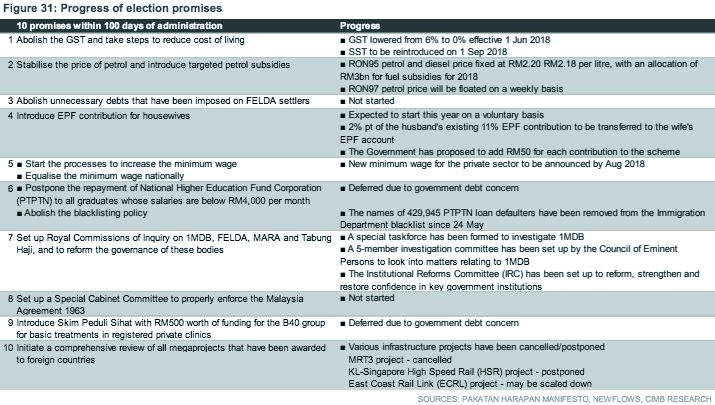
The Pakatan Harapan government wasted little time in getting to work on its list of election promises for the first 100 days and significantly repositioning Malaysia’s fiscal policy agenda. Among measures, we expect the reduction of the Goods and Services Tax (GST), the expected reintroduction of the Sales and Services Tax in Sep, the delays or cancellation of mega projects, rationalisation of government spending and fuel subsidies to wield the largest effects on growth and government finances. Cumulatively, we expect the cancellation of infrastructure projects to exert a drag on GDP growth of about 0.6-0.7% pt p.a in 2018 and 2019. We are maintaining our GDP forecasts of 5.2% in 2018 and 5.0% in 2019, as we expect the stimulus from the GST reduction (net of SST), fuel subsidies, cash handouts and bonuses for civil servants to offset the drag from government expenditure and mega project delays/cancellations.

  1. (MRT3) projects on our 2018 and 2019 GDP growth forecast is minimal as we had not factored in a significant boost from the HSR and MRT3 into our GDP growth forecast for 2018 given that construction works were only expected to commence in 2H19. Post-2020, we estimate that both projects would have added about 0.6% pt to headline GDP growth, offsetting the diminishing contributions from LRT3 and MRT2 which would have been reaching completion.
  2. Potential impact of ECRL to our 2018 and 2019 GDP growth forecasts is -0.2% pt p.a. As the project will likely face delays due to the government’s intention to renegotiate the terms of the project, we have removed the 0.2% pt contribution that had been headline GDP growth in 2018 and 2019.
  3. Potential downside of Pan Borneo to 2018 and 2019 GDP growth is – 0.2% pt. We think Pan Borneo has a strong development case for proceeding, perhaps with delays or a scaling down. In the worst case of cancellations or a construction halt, we would have to cut GDP growth contribution by about 0.1% pt in 2018 and 2019.
  4. Potential downside of fiscal cuts to 2018 and 2019 GDP growth is a cumulative -0.6% pt over the two years. We think it will be a challenge for the government to meet its RM10bn target for expenditure cuts to maintain the fiscal deficit target at 2.8% of GDP.
    We estimate that households will receive a stimulus from GST cuts net of SST, fuel subsidies and cash handouts in 2H18 that could boost private consumption’s contribution to GDP growth by about 0.3-0.7% pt in 2018 and 2019.

Balancing the fiscal impact of reforms
The policy changes have been viewed as ‘credit-negative’ for the fiscal position. The Ministry of Economic Affairs is due to unveil the mid-term review of the 11th Malaysia Plan on 18 Oct while the Budget 2019 will be tabled by the Finance Minister on 2 Nov. The former will address the Pakatan Harapan’s medium-term economic policy targets while the latter is expected to tackle concerns from markets and sovereign ratings agencies on how the government intends to manage the loss of a large government revenue base in the GST (RM21bn in 2018). Several fiscal offsets have been mooted to plug the shortfall. The government expects to collect RM4bn from the Sales and Service Tax (SST), which is expected to borrow heavily from the previous iteration that was retired in 2015. The government plans to cut RM10bn of government expenditure through rationalisation of spending, elimination of political appointees, consolidation of overlapping ministries and government agencies, and improvements in procurement and tender processes. With additional oil-related revenue and higher dividend payments from Government Linked Companies, we think the government could still meet the Budget 2018 deficit target of 2.8% of GDP.

Monetary policy mix to remain accommodative
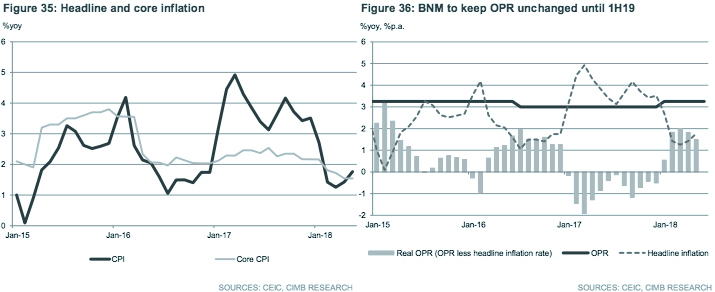
Adjusting for price changes from the GST cut, expected introduction of the Sales and Service Tax (SST) in Sep, fixed RON95 petrol and diesel prices, and subdued administrative price increases, we project headline inflation in 2018 to moderate sharply to 1.3% (+3.8% in 2017), undershooting Bank Negara Malaysia’s (BNM) policy target of 2-3%. With inflation subdued, and potential external shocks from global monetary policy tightening, trade tensions, and geopolitical uncertainty, we expect BNM to exercise restraint against raising the Overnight Policy Rate (OPR) again this year. We reiterate our forecast for the OPR to remain at 3.25% for the remainder of 2018F, and expect the next interest rate hike to be delayed to 2H19F.

img-ef-16

img-ef-17

img-ef-18

img-ef-19

img-ef-20

img-ef-21

img-ef-22

img-ef-24

img-ef-25

img-ef-26

img-ef-27

INDONESIA

Rupiah has come under pressure in recent months, plagued by the volatility of capital flows on the back of rising external pressures. The currency weakness prompted a shift in Bank Indonesia’s (BI) monetary policy stance to a hawkish bias, which was followed by a swift cumulative 100bp rate hike in May/Jun, underscoring BI’s determination to arrest the slide of the rupiah. As the signs of external uncertainties abating are nowhere in sight, more rate increases could be on the table, depending on the rupiah movement. We expect the 7-day Reverse Repo Rate to increase to 5.75% by end-2019. On the growth front, we project the GDP to expand +5.3% yoy in 2018F and +5.2% yoy in 2019F, underpinned by robust investment activity, while private consumption growth is likely to remain steady.

Growth momentum to pick up in the next few quarters
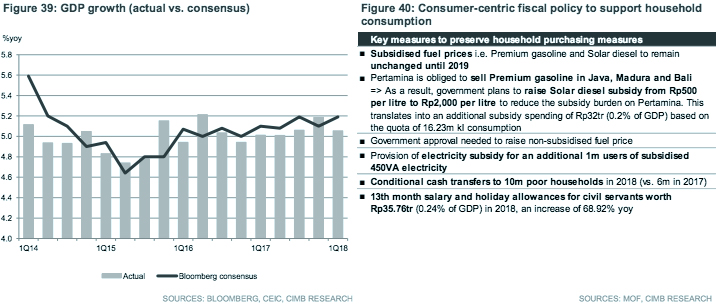
The Indonesian economy started the year 2018 with a lower-than-expected GDP growth of 5.1% yoy in 1Q18 (+5.2% yoy in 4Q17), amid slower public consumption growth. A much-anticipated recovery in private consumption growth did not materialise (+5.0% yoy in 1Q18 vs. +5.0% yoy in 1Q15-4Q17), as a delayed harvest season and shortage of fuel supplies dampened household spending in the F&B and transport & communication segments. On a different note, investment growth continued to shine (7.9% yoy in 1Q18 vs. 7.3% yoy in 4Q17), with outlay on machine, vehicle and equipment being the outperformer for the past three quarters.

Despite the lacklustre growth, we maintain our 2018 GDP growth forecast at 5.3% yoy, as we expect the growth momentum to pick up over the next few quarters. We expect consumption spending to improve via the following events: 1) the 18th Asian Games that will be held in Jakarta and Palembang from 18 Aug to 2 Sep; 2) the annual IMF-World Bank meeting in Bali in Oct; and 3) pre-election spending in the run-up to the regional elections (27 Jun 2018) and the Presidential election (17 Apr 2019).

Household consumption will also receive a boost from fiscal measures that have tilted towards maintaining household purchasing power ahead of the Presidential election. Policies such as unchanged subsidised fuel and electricity prices and food price ceilings will extend the low inflation environment, seen since 2016, well into next year, translating into better real wage growth. Income growth, especially among the low-income households, will also be complemented by budget measures such as conditional cash transfers to poor households (10m in 2018 vs. 6m in 2017) as well as provision of electricity subsidies to additional 1m households. The 13th month salary and holiday allowance for civil servants have been supportive of consumer spending during the Lebaran month.

We believe investment growth will remain the bright spot, supported by the government’s infrastructure projects as well as improving investment climate. Of the 222 projects and 3 programmes identified as National Strategic Projects (PSN), the Committee for Acceleration of Priority Infrastructure Delivery (KPPIP) has estimated that 13 projects worth Rp46.8tr and 25 projects worth Rp118.8tr will be completed in 2018 and 2019, respectively. This compares to 10 completed projects (Rp61.5tr) in 2017 and 20 completed projects (Rp33.3tr) in 2016.

Capital outlays will also be supported by the continuous efforts undertaken by the government to improve investment climate. These include the revision and expansion of tax incentives, income tax reduction for SMEs as well as the simplification of foreign worker visa application. Under the Jokowi administration, the realised foreign direct investments (FDI) rose from an average of 2.6% of GDP in 1Q10-3Q14 to 3.2% of GDP in 1Q14-1Q18, whereas the realised domestic direct investments (DDI) gained from 1.1% of GDP to 1.8% of GDP over the same period. With close correlation between growth rates in FDI, investments in machine & equipment and import of capital goods (Fig 43), import of capital goods is likely to rise in tandem as the government welcomes more FDI into the country.

Making room for more subsidy and social expenditure
As the Presidential election draws nearer, the fiscal policy will likely remain consumer-centric (Fig 40), in our view. This entails a higher subsidy bill and social expenditure through 2019. That said, we do not expect the subsidy policy to lead to a substantial increase in fiscal deficit position, as we expect the higher subsidy expenditure can be partly funded through the windfall of higher O&G revenue. In 5M18, subsidies and social assistances collectively accounted for more than a fifth of central government expenditure (21.9% vs. 16.3% in 5M17). Though subsidy reform has stalled, we view this as a strategic shift to improve Jokowi’s electability in exchange for policy continuity for the next five years. Against the backdrop of rising external uncertainties, we expect the government to maintain a prudent fiscal deficit target at well below its fiscal limit of 3% of GDP. Hence, this may come at the expense of other expenditure i.e. capital spending to make room for higher subsidy and social spending. The prudent approach has so far been reflected in a lower deficit position YTD (-0.64% of GDP in 5M18 vs. – 0.96% of GDP in 5M17) and a more conservative GDP growth target for draft State Budget 2019 (5.2-5.6% vs. 5.4-5.8% previously).

Price risks are contained, for now
The decision to keep fuel prices unchanged temporarily alleviates the inflationary pressure from oil price shock, whereas price ceilings and imports to tackle supply shortages have kept food inflation broadly under control. Hence, we expect the inflation rate to remain stable at 3.4% yoy in 2018 and 3.7% yoy in 2019 (3.3% yoy in 1H18), in line with Bank Indonesia’s target range of 2.5-4.5%. However, the widening gap between retail and market fuel prices indicates greater possibilities of larger price adjustments post-2019, implying the medium-term inflation outlook could potentially overshoot the BI’s inflation target of 2.0-4.0% for 2020-2021.

Higher CAD and external uncertainties heighten BOP risk
We expect the recovery of domestic demand and diminishing commodity terms of trade to depress the trade balance, hence leading to a wider current account deficit (-2.5% of GDP in 2018F and -2.3% of GDP in 2019F), hitting the upper limit tolerable by Bank Indonesia (BI). The CAD, nonetheless, still remains manageable compared to the peak of -3.2% of GDP in 2013.

A wider CAD makes Indonesia more dependent on external financing, whereas the relatively high foreign holdings of outstanding government bonds relative to other countries (Indonesia: 38.1%; Malaysia: 25.9%; Thailand: 15.6%) indicate greater vulnerability of the rupiah to the reversal of capital flows, which are a function of external developments. As heightening external uncertainties have prompted foreign portfolio outflows in the bond market, the Indonesian 10-year bond yield has increased ~148bp YTD. Nonetheless, the spread of ~494bp against the US Treasuries of similar maturity is still narrower compared to the 3- year average of about 555bp.

On a positive note, reserves remained ample at US$122.9bn in May, despite declining by US$7.3bn YTD. Based on our calculation, the reserve coverage ratio to potential short-term liabilities (calculated as the sum of short-term external debt by remaining maturity, outstanding foreign holdings of stocks and government bonds as well as non-residents’ deposits) was also higher at 63% compared to a trough of 48% during the 2013 taper tantrum and 5-year average of 59%.

A pre-emptive and ahead of the curve policy rate response
Rising rupiah vulnerability prompted a shift in Bank Indonesia’s (BI) monetary policy to a hawkish stance. Cumulatively, BI has raised the policy rate by 100bp in just six weeks, reversing half of the 200bp reduction delivered in 2016-2017. To mitigate the impact of rate increases on economic growth, BI loosened macroprudential policy for the property sector (see Fig 53). BI’s firm monetary policy stance to react pre-emptively and stay ahead of the curve to stem the depreciation of the rupiah suggests the possibility of more rate hikes, especially with the US Fed expected to continue to raise its policy rate. We expect the 7DRRR to increase to 5.75% by end-2019.
img-ef-28

img-ef-29

img-ef-30

img-ef-31

img-ef-31

img-ef-34

img-ef-36

img-ef-37

img-ef-38

img-ef-39

SINGAPORE

Singapore’s growth trajectory remains strong, aided by the externally-driven manufacturing sector and broadening gains in the services sector. Contraction in the construction sector has likely bottomed out as the property market recovers and higher oil prices support increased O&G capex. The Monetary Authority of Singapore (MAS) is adopting a prudent stance to head off risks from slowing external drivers, global trade tensions and tightening financial conditions. We maintain our expectations that MAS will keep its guidance for a “gradual and modest appreciation” of the S$NEER in Oct.

GDP growth forecast at 3.2% in 2018
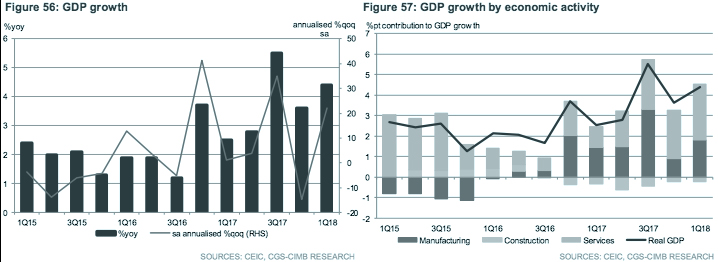
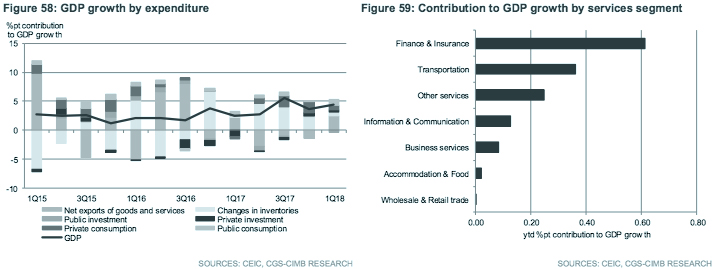
The growth trajectory remains strong as Singapore’s economy expanded 4.4% yoy in 1Q18 (+3.6% yoy in 4Q17) driven by broad-based gains in manufacturing activity as well in improvements in the services sector, particularly financial services and business services. The externally-driven manufacturing has been impressively strong, with the industrial production index up 9.8% yoy in 5M18, led by robust demand for electronics (+16.9% yoy in 5M18), despite a high base in 2017. While we expect the manufacturing sector to remain a key engine of growth this year, global demand for electronics is likely to moderate in 2H18 based on lower growth rates in global electronic shipments. Concerns on the trade front, with the US and China threatening to levy tariffs on a broad range of manufactured goods, would further dampen trade activity.

Construction activity could have bottomed out after the sector contracted 5.0% yoy in 1Q18 (-5.0% yoy in 4Q17), on the back of property market gains and higher oil prices. Sentiment in the property market is improving, with property prices rising for the fourth consecutive quarter (+3.4% qoq in 2Q18), strong demand from homebuyers, robust en-bloc activity and increased landbanking by developers. Meanwhile, the recovery in oil prices could spur higher capex and job tenders for the oil and gas industry.

Barring the materialisation of external shocks, we expect Singapore’s economy to register a 3.2% expansion in 2018, broadly in line with the upgraded official forecast by the Ministry of Trade and Industry (MTI) from 2.5% to 3.5%. Risks to the outlook include disruptions to the trade cycle from increased protectionist policies by major trade nations, tighter financial conditions arising from global monetary policy normalisation, geopolitical uncertainty, and a sudden loss of momentum in the economies of the US and China.

MAS unlikely to tighten monetary policy further
As expected, the Monetary Authority of Singapore (MAS) steepened the slope of the S$ nominal effective exchange rate (S$NEER) policy band at its policy review in Apr allowing for a “gradual and modest appreciation”, but keeping the width and centre of the band unchanged. MAS had last reduced the slope of appreciation in the S$NEER in Oct 2015 and Apr 2016 as inflationary pressures waned.

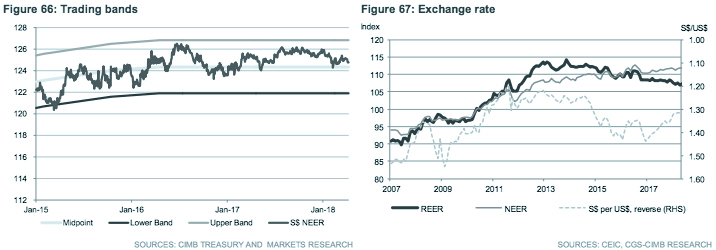
Going forward, we expect the Monetary Authority of Singapore (MAS) to adopt a prudent stance to head off risks from slowing external drivers, global trade tensions and tightening financial conditions. Given Singapore’s dependence on trade, we are watching the developments between US and China closely as they prepare to enact US$50bn of tariffs, set to take effect in stages from 6 Jul. A potential escalation of retaliatory duties of up to US$400bn as well as threats to impose selective restrictions on investments bode poorly for global trade and Singapore’s growth outlook. Meanwhile, inflation dynamics remain weak (+0.4% yoy in May) despite improvements in domestic labour market conditions. We maintain our expectations that MAS will stay put on a “gradual and modest appreciation” of the S$NEER in the Oct policy review. However, if the brinksmanship between the US and China causes global trade momentum to slow sharply, putting Singapore’s growth outlook at risk, we expect MAS to stand ready to recalibrate policy settings to support the economy. CIMB Treasury and Markets Research expect the Singapore dollar to appreciate to S$1.33 per US dollar by end-2018.
img-ef-40

img-ef-41

img-ef-42

img-ef-43

img-ef-44

img-ef-45

img-ef-46

img-ef-48

THAILAND

Thailand’s positive growth outlook, anchored by gains in both domestic and external demand, is balanced by greater concerns over the US-China trade spat. Additionally, markets may have to wait longer for domestic political uncertainty to clear, as elections in 2019 may be delayed again. Amid heightened external uncertainties, we expect the policy mix to remain accommodative, including for the BOT to maintain the policy rate at 1.50% in 2018.

External drivers tip the scales for Thailand in 2017
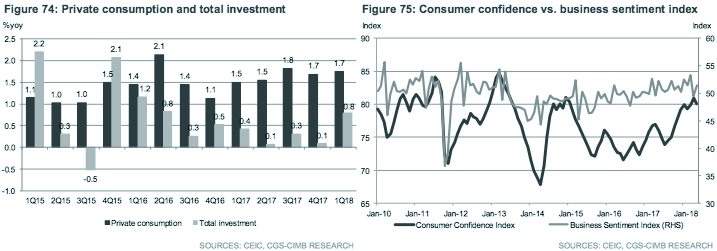
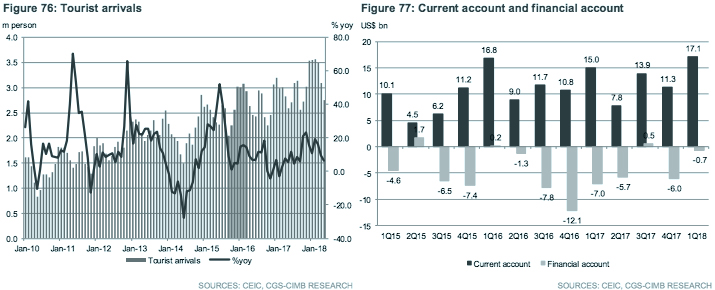
Coming off strong GDP growth of +4.8% yoy in 1Q18, Thailand’s economy is exhibiting signs of broadening growth drivers in the domestic sector. The external sector continue to anchor contributions to the economy, particularly core industries such as electronics, auto and auto parts, rubber and petrochemicals however export momentum slowed at the start of the year, leading us to dial down net export contribution. Weakness in the goods sector was offset by higher tourist arrivals, which have risen by 12.6% yoy in 5M18 to 16.5m, driving an increase in tourist receipts.

Improvements in public investments were anchored by the Eastern Economic Corridor (EEC). Since the approval of the EEC bill in Feb, the Board of Investment (BOI) has recorded significant progress on investment and infrastructure outlays in the EEC, with 81% of application values to the BOI in 1Q18 attributed to the EEC. The recovery in consumer spending is deepening, but gains in farm and rural household incomes continue to lag.

Government consumption, fuelled by the THB150bn supplementary budget passed in Mar, adds a layer of support for these lower-income households. Of the total fiscal stimulus, the government has allocated THB24bn to restructure parts of the agriculture sector suffering from depressed commodity prices and THB76bn for welfare transfers and job creation in the provincial regions. The Thai government has again delayed plans to raise the value-added tax rate from the current rate of 7% until the end of the next fiscal year in Sep 2019 to support the domestic economy.

The GDP growth forecast from the National Economic and Social Development Board (NESDB) for 2018 has been revised higher from 3.6-4.6% to 4.2-4.7% (CIMB: +4.3% in 2018) on the back of the upside surprise in 1Q18 GDP numbers.

Risks to Thailand’s macro outlook
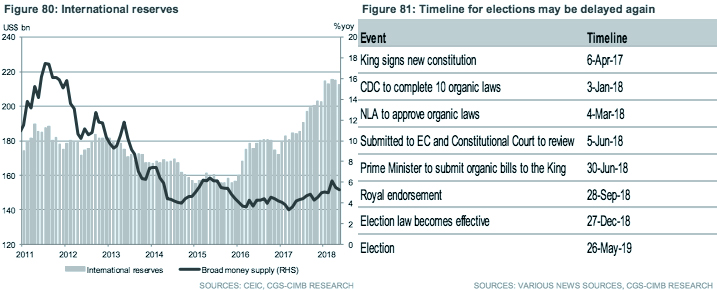
Protectionism poses adverse risks for Thailand, which has leaned on external demand to support growth. Threats by the US and China to levy tariffs on manufacturing goods and expand protectionism to non-tariff measures, such as investment restrictions, could dampen international trade and investment conditions, tilting the growth outlook to the downside. On the domestic front, political uncertainty may linger for a while longer, as the timeline for elections could be delayed again from the latest target of Feb 2019, after Deputy Prime Minister Wissanu Krea-ngam cited a time frame of 24 Feb to 5 May 2019 as possible polling dates to accommodate the completion of necessary constitutional and legislative procedures.

No rush to hike
Headline inflation accelerated further to 1.5% yoy in May, reflecting higher oil prices, while healthier private consumption lifted core inflation to 0.8% yoy in May. The Bank of Thailand (BOT) tweaked its headline inflation forecast higher to 1.1% in 2018 (from 1.0%) and its core inflation forecast to 0.9% in 2019 (from 0.8%), though the prognosis remains shy of the central bank’s price stability mandate.

The BOT is likely to extend its pause on the benchmark 1-day repurchase rate to support economic growth, manage risks to the buildup of household debt, and provide a buffer against escalating trade tensions. We reiterate our year-end policy rate forecast of 1.50%, implying no change to the policy rate in 2018.

img-ef-49

img-ef-50

img-ef-51

img-ef-52

img-ef-53

img-ef-54

img-ef-55

img-ef-56

Originally published by CIMB Research and Economics on 03 July 2018.

 

CARI Captures 362

Infographic


SINGAPORE

Singapore falls two places down in the 2018 Sustainable Trade Index
(27 June 2018) Singapore fell to the third place in the 2018 Hinrich Sustainable Trade Index, which was put together by the Economist Intelligence Unit, after topping in the same index in 2016. The Index looks at 24 indicators to evaluate the readiness of each economy to participate in global trade with regards to ways that create sustainable growth, encourage foreign direct investment, and attract funding and support from multilateral development agencies. Singapore’s ranking dipped due to low scores on the environmental pillar but topped the economic pillar scores. Singapore scored 71.4 points in the index and is ranked top among Southeast Asian countries. Vietnam was the second top ASEAN nation in the list with 51.7 followed by Philippines 51.2 in third. Malaysia is ranked fourth with 47.7. The latest trade index saw Hong Kong ranked first with 73.7 points followed by South Korea with 73.3.

JAPAN, INDONESIA

Japan plans to build Japanese industrial hub in Indonesia
(25 June 2018) Japan and Indonesia are in talks on the expansion of Indonesia as a Japanese industrial hub during the sixth Strategic Dialogue between both nations. Japan looks to explore the possibilities of Indonesia becoming a production base for Japanese products. At the same time, both parties signed the Exchange of Notes on Integrated Marine and Fisheries Centers and Fish Market to strengthen collaboration in expanding fishery centers in Indonesia. The ministries also promised to synergise Indonesia’s Indo-Pacific concept with the Free and Japan’s Open Indo-Pacific Strategy (FOIPS). Data from the Foreign Ministry showed that Japan was the second largest country to invest in Indonesia, with investments up to US$5 billion.

THAILAND

Thailand seeking support worth US$40 billion for rail upgrade
(25 June 2018) Thailand is seeking support worth US$40 billion from private investors to upgrade the country’s rail network to dual-track rails, as the nation looks to reduce logistics cost and improve its trade sector. Upgrades worth US$3.7 billion have been approved by the government while another nine upgrades worth US$12.2 billion will be approved in 2018. There is also a joint 672 km railway project with Japan, which will cost US$12.6 billion and the project is expected to start in 2020. There is also a 355 km high-speed rail link connecting central and northeastern Thailand with Laos plan, which will cost US$5.4 billion. The project was planned with China and tender process for it will take place before end of 2018.

VIETNAM

Export of forestry products hit US$4.15 billion in 2018
(25 June 2018) The export of forestry products from Vietnam rose about 8.4% in 2018, reaching 46% of the yearly target to hit US$4.15 billion. United States, China, Japan and the Republic of Korea were the largest importers of the products. The improvement is due to the restructuring of the forestry sector with a wide range of high-value production models as well as an expansion in the domestic wood market. Also, nearly 3,500 private and foreign direct investment businesses expanded its forestry products and exported to 100 different countries globally. In-depth cultivation models are being largely applied in Vietnam to boost the productivity and the quality of forests.

VIETNAM

FDI to Vietnam reach US$20.33 billion in six months
(27 June 2018) Foreign direct investment (FDI) reached US$20.33 billion in the first six months of 2018, up by 5.7% year-on-year. Vietnam’s Ministry of Planning and Investment stated that 1,366 new projects have been approved with total investment capital of US$11.8 billion. The ministry said that about 507 existing projects have injected an additional US$4.43 billion. In the first six months also, foreign investors pumped in US$4.1 billion in capital for 2,749 projects, which was up 82.4% year-on-year. Vietnam’s 17 fields and sectors saw foreign investments, in which manufacturing and processing attracted the most capital of US$7.91 billion.

INDONESIA

Travel ban lift by European Union will improve the tourism sector
(17 June 2018) Indonesia’s Chamber of Commerce welcomed the removal of travel ban for Indonesian airlines by European Union will have a positive impact on the aviation industry and ultimately improve the country’s tourism sector. The travel ban lift will improve connectivity and enable direct flights to Europe. Since mid-June 2018, European Commission lifted all Indonesian registered airlines from the European Union Air Safety List. The list contains the name of airlines that fail to fulfill international aviation safety standards. The removal of the travel ban is due to the recent improvements in Indonesian aviation safety aspects.

MYANMAR

Myanmar Investment Commission (MIC) to enhance procedures for conducting business in the country
(28 June 2018) The Myanmar Investment Commission (MIC) will apply a slew of changes to reduce red tape and encourage ease of conducting business in the country. Such changes include shorten the time taken for proposal submission and reduce the time spent by the commission to approve the proposals. At the same time, MIC will collaborate with the government in establishing standard operating procedures to reduce the time taken in approving new business permits. MIC intends to attract more foreign direct investments into the country through these executions.

MALAYSIA

Malaysia intends to rearrange the water supply agreement with Singapore
(25 June 2018) Malaysia will rearrange terms of the water supply agreement with Singapore as the selling price of 3 sen per thousand gallons is not justifiable. Malaysian prime minister Tun Dr. Mahathir Mohamad said the main reason why Malaysia wants to renegotiate terms with Singapore on the Kuala Lumpur-Singapore high-speed rail project and water supply issue is to lower the country’s debt and liabilities, which is more than US$251 billion. Responding to Dr. Mahathir’s statement, Singapore’s Ministry of Foreign Affairs (MFA) stated that both countries shall fully comply with the provision of the 1962 Water Agreement and the 1965 Separation Agreement.

MALAYSIA

Malaysia intends to replace the current currency notes
(27 June 2018) The Malaysian government intends to fight corruption by substituting the current currency notes or establishing a cashless society. Malaysia’s prime minister Tun Dr. Mahathir Mohamad said replacing current currency will demonetise ringgit and remove the status of ringgit as the medium of exchange. Generally, the move is taken to tackle hyperinflation, combat corruption, remove black economy, promote the cashless society and lower dependence on hard currency. The executive director of Socio-Economic Research Centre in Malaysia said that RM50 and RM100 notes cover 84.6% of the currency in the economy. However, Bank Negara will need to bear a high printing and minting cost if the country decides to issue new notes and coins.

CAMBODIA

Collection of tax revenue exceeds US$1 billion in the first five months of 2018
(25 June 2018) Cambodia’s General Department of Taxation (GDT) reported that the government has received a higher tax revenue by 12% in the first five months of 2018 compared to the same period in 2017. The reached value exceeded US$1 billion in the first five months of 2018. Amount of tax collection in May also increased by US$ 16 million from 2017 to US$134 million in 2018. GDT has collected US$1.04 billion up to May, reaching 54% of the country’s annual target in 2018 compared. In 2017, GDT collected US$1.93 billion in tax revenue. The increment is due to a series of refinements from Tax Department such as establishing online collection platform and oversee audits of local businesses.

BRUNEI, INDONESIA

Indonesia looks to strengthen trade ties with Brunei
(25 June 2018) Indonesia’s newly appointed ambassador to Brunei said his country aims to deepen economic cooperation with Brunei to stabilise the trade deficit between both nations. Both countries look to improve trade growth, better investment and enhance connectivity between the neighbouring states. One of the plans is to initiate direct shipping links to the sultanate for the export of Indonesian exports instead of the re-exporting goods from there to Brunei through Malaysia and Singapore. Both nations are also discussing ways to elevate air connectivity between both nations. To help aid the Sultanate’s vision of economic diversification, Indonesia said increased trade and mutual investment between both nations would help realise that bid. Oil and gas exports make up most of the trade volume between both nation but drop in global oil prices have seen a decline in volume and gap in the trade balance.

Myanmar Monitor


Photo

Photo credit: Flickr

Economy, Investment and Trade

Myanmar’s Yangon Parliament approves the development of industrial zones in townships outside Yangon city
(25 June 2018) Development of industrial zones in 11 townships outside Yangon city has been approved by Myanmar’s Yangon Parliament. The project is meant to plug the development gap between these 11 townships with other 33 townships administered by the Yangon City Development Committee (YCDC). Currently, 29 existing industrial zones in Myanmar, including Thilawa Special Economic Zone covers 53 percent of the country’s total industrial zones. Yangon region has attracted foreign investments worth US$20.2 billion from 845 enterprises until the fiscal year 2017-2018 since 1988-1989 fiscal year.
Read More >

New Myanmar Companies Law allows more foreign ownership in domestic firms
(25 June 2018) The announcement of new Myanmar Companies Law, effective 1 August 2018, will enable more foreign ownership in local companies. The new regulations imposed in December 2017 enable domestic businesses to expand by obtaining foreign capital and expertise through joint ventures as it allows foreign entities to own maximum 35 percent of stake in domestic firms while non-Myanmar customers can invest in Yangon Stock Exchange. All company registration and processes will be filed under the Myanmar Companies Online (MyCO), an electronic registry system. There will also be significant changes in the legal definition of foreign companies under Companies Law to allow foreign firms to trade without obtaining a permit.
Read More >

Myanmar exports gain more than US$3 billion within two months
(24 June 2018) Export of Myanmar products overseas between 1 April to 15 June 2018 in the six-month interim period of the current fiscal year recorded more than US$3 billion. Myanmar’s Ministry of Commerce said the country exported six main commodities such as agricultural products, fisheries, minerals, forest products, manufactured goods and animal goods to its trade partners. Myanmar received US$2.82 billion from the six major products and US$304 million in exports from other miscellaneous commodities. The export of six main commodities saw an increase of over US$630 million against the same period in the previous fiscal year while exports in miscellaneous commodities saw a decrease of US$91 million from the previous fiscal year.
Read More >

Restructuring of oil and gas sector may lead to investment opportunities
(27 June 2018) Myanmar’s Ministry of Electricity and Energy (MOEE) is studying the terms and conditions of the country’s current oil and gas Production Sharing Contracts (PSCs) to bring in new investments into the sector. Myanma Oil and Gas Enterprise (MOGE), which is under the ministry, said the contracts are being examined as there are possible tenders for up to 31 oil and gas blocks. The tenders will be open to local and foreign firms in the future. If the bidding happens within the next two years, the tender process will be done for the first under the current government. The last tender process took place in 2014 under the previous government led by former president U Thein Sein.
Read More >

Science and Technology

France and Myanmar collaborates for first Southeast Asian ancient DNA research
(21 June 2018) The archaeological collaboration project between France and Myanmar recently engaged in its first-ever whole-genome research on ancient Southeast Asian human DNA. Ancient DNA is seldom preserved in tropical climates and out of the hundreds being examined from recent excavations, only 18 individuals from Cambodia, Myanmar, Thailand, and Vietnam passed the strict screening process. This project was initiated in 2001 as a cooperation between the French National Centre of Scientific Research and the Department of Archaeology of the Myanmar Ministry of Religious Affairs and Culture. Researchers from Harvard University and the University of Vienna led the genetic research.
Read More >

China-ASEAN Monitor


img-ca-20618

Photo Credit: AFP


Economy, Investment and Trade

Southeast Asian property market attracts Chinese investors
(25 June 2018) The southeast Asian real estate market has successfully attracted at least US$2.5 billion during year end of 2017, four times higher than the figures in 2016. This is due to the rise in demand from Chinese investors. A report from Colliers International Group Inc, a real estate services company, showed that demand for purchasing real estate in Thailand by Chinese buyers hit the second peak in 2018 since its upward trend in 2015. The amount rose by 91 percent and 313 percent in 2018 compared to the same period in 2017 and 2016 respectively. Among the Southeast Asian countries, Singapore is popular among investors with investments worth US$2.1 billion, followed by Malaysia and Indonesia.
Read more>>

ASEAN and China aim to boost tourists arrivals
(20 June 2018) ASEAN and China aim to boost the country’s international tourism by increasing tourist arrivals in both markets. The China-ASEAN Centre reported that the number of Chinese tourists coming to ASEAN in 2016 hit 19.8 million, a year-on-year increase of 6.4 percent whereas the number of ASEAN’s tourists to China reached 10.34 million, an increase of 57.8 percent compared to 2015. The total amount of visitors between ASEAN and China has exceeded the 2020 target of 30 million with China being one of the largest tourism markets for ASEAN.
Read more>>

China-US trade may affect nearly 1,100 Thai industrial products
(25 June 2018) Federation of Thai Industries (FDI) is concerned that the trade war between China and United States will affect nearly 1,100 items of industrial products in the country. Since exports account for 70 percent of the country’s total revenue, FDI is making an assessment regarding possible effects on Thai industries from China-US trade war. Products from 45 industrial groups with 11,000 industrial operators that are related to exports to the United States and China might be affected while the US might also shift imports from China to Thailand.
Read more>>

Trade volume between Cambodia and China improves by 22 percent
(21 June 2018) Cambodia’s commerce ministry announced that its trading volume with China has increased by 22 percent from US$4.76 billion in 2016 to US$5.8 billion in 2017. In the past 10 years, the trade volume between Cambodia and China has improved with an average of 26 percent annually. Main exports item to China were milled rice, cassava, and apparels whereas most imports from China were garment raw materials, machinery, vehicles, foodstuffs, electronics, medicines, and cosmetics. China is also the biggest investor in Cambodia, with fixed asset investments worth US$12.6 billion from 1994 to 2017.
Read more>>

Foreign Affairs

ASEAN and China will meet to discuss South China Sea dispute
(23 June 2018) Member states of the ASEAN meet in China on 27 June 2018 to discuss the South China Sea dispute. The 15th senior officials’ meeting for the execution of the Declaration on the Conduct (DOC) of Parties in the South China Sea will also be held on the same day. Although China and ASEAN have signed a Declaration on the Code of Conduct (COC) of Parties regarding the South China Sea in 2002, there is no consent in implementation. Countries such as China, Taiwan, and ASEAN member states Philippines, Vietnam, Malaysia, and Brunei are competing for claims in the South China Sea.
Read more>>


CARI Captures 361

Infographic


MALAYSIA

Malaysian government to inject more funds to complete Tun Razak Exchange (TRX)
(21 June 2018) The Malaysian government will continue with the Tun Razak Exchange (TRX) development by injecting more funds to see through its completion. The Finance Ministry stated that the cabinet has decided to go ahead with the project to recover all embezzled funds, repay loans, recoup all funding investments and opportunity costs. The government funding is up to US$698 million (RM2.8 billion) and the ceiling cap will be valid until 2024. Upon completion, the Finance Ministry said the project could make a small profit return. The 70-acre project at the heart of Kuala Lumpur was originally a part of 1Malaysia Development Berhad (1MDB) but it was transferred to the Finance Ministry in 2017 as the 1MDB could not fulfill its debt obligations.

ASEAN, FRANCE

France aims to raise its competitiveness in ASEAN
(19 June 2018) French business entities are seeking opportunities to develop its technology and products in ASEAN. The country seeks to be more competitive in the region as it is currently being dominated by products from Japan, China and the Republic of Korea. According to the statistics of the French Treasury, ASEAN is France’s second largest trade partner in Asia with bilateral trade rising up to 5.9% year on year (yoy), worth US$35.83 billion (31 billion EUR) in 2017. At the same time, ASEAN is also one of the key locations for French investors after China and Japan, obtaining US$18.49 billion in 2017. Estimates from the Asian Development Bank show that ASEAN would need US$3.15 trillion for infrastructure development between 2016 to 2030.

VIETNAM

Vietnam aims to double beverage exports to US$900 million by 2035
(18 June 2018) Vietnam’s Ministry of Industry and Trade aims to reach US$450 million in beverage exports by 2020 with a total production of 4.1 billion litres of beer, 350 million litres of alcohol and 6.8 billion litres of non-alcoholic beverages before reaching US$900 million by 2035. The industry generates at least 50,000 jobs and occupies nearly 3 percent of the state budget with an expected average growth rate of 5.8 percent from the value-added of the whole industry from 2016 to 2020. Beer and non-alcoholic beverages have each formed about 20 percent of Vietnam’s FMCG sector in 2017, with total value growth of 10 percent and 7 percent respectively.

VIETNAM

Hanoi to subsidize licenses for 71 projects worth US$17 billion
(17 June 2018) The Hanoi government will subsidise investment licenses for 71 projects worth over US$17 billion and promises to provide more incentives in the administration’s bid to become more business-friendly. Out of all the projects, 11 projects worth US$5.4 billion are foreign-invested while other 60 projects worth US$11.6 billion are local-invested. As a result, Hanoi is now the second-largest city in Vietnam to attract foreign direct investment according to the city’s mayor. Projects that will be prioritised by the city includes high tech, new technologies, clean energy, waste treatment and strengthening regional connections.

THAILAND

Thailand leads Southeast Asian fund to avoid dependency on China
(16 June 2018) Thailand is leading a new Southeast Asian fund that focuses on infrastructure and development projects, as nations part of the fund look to overcome reliance on China. Thailand’s prime minister Prayuth Chan-ocha said the fund will be jointly managed with for other nations – Cambodia, Laos, Myanmar and Vietnam and is expected to operate in 2019. China has invested heavily in Southeast Asian under its Belt and Road initiative where almost US$12 billion has been spent in providing loans and grants in Laos, Myanmar, Thailand, Cambodia, and Vietnam. The new Southeast Asian fund will raise money via the sale of stocks and bonds by issuing debt for the projects and jointly managing the projects with Cambodia, Laos, Myanmar, and Vietnam.

INDONESIA

Travel ban lift by European Union will improve the tourism sector
(17 June 2018) Indonesia’s Chamber of Commerce welcomed the removal of travel ban for Indonesian airlines by European Union will have a positive impact on the aviation industry and ultimately improve the country’s tourism sector. The travel ban lift will improve connectivity and enable direct flights to Europe. Since mid-June 2018, European Commission lifted all Indonesian registered airlines from the European Union Air Safety List. The list contains the name of airlines that fail to fulfill international aviation safety standards. The removal of the travel ban is due to the recent improvements in Indonesian aviation safety aspects.

PHILIPPINES

President of Philippines signs new act to ease business activities
(28 May 2018) Philippines’ president Rodrigo Duterte signed into law Republic Act No. 11032 or the Ease of Doing Business and Efficient Government Service Delivery Act, which is an amendment from the Anti-Red Tape Act 2007 to ease the process of starting up and running a business in the country. According to the combined versions from the House and Senate bills and Duterte’s speech, the main features of the law includes standardizing deadline for government transactions, use single unified business application form and establishment of a business one-stop shop, automated electronic system, zero-contact policy, as well as central business portal and Philippines Business Databank. The law is aimed to resolve the bureaucratic red tape problems and reduce waiting time for businesses.

PHILIPPINES

Philippines’ Central Bank raises interest rates again due to inflation
(20 June 2018) The Bangko Sentral ng Pilipinas (BSP) increased interest rates again after inflation in the country spiked to 4.6 percent in May. The monetary board of BSP decided to increase the overnight reverse repurchase (RRP) rate by 25 basis points to 3.5 percent. BSP also pushed up interest rates on overnight lending and deposit facilities to 3 percent and 4 percent, respectively. The central bank said the increase would only lead to more savings in banks, thus easing inflation in the country, as well as discouraging taking up of bank loans. BSP had raised the interest rate for the first time in three years on 10 May 2018 by lifting the benchmark interest rate to 3.25 percent.

CAMBODIA

Cambodia’s low-hygiene standards a barrier to develop trade with China
(22 June 2018) The Chinese government said Cambodia’s poor hygiene and phytosanitary standards will be a barrier to achieving mutual trade ambitions between China and Cambodia, especially when it comes to agricultural goods. The China-Cambodia Trade and Economic Joint Committee acknowledged that steady progress has been made in trade between both nations but hygiene standards remain a technical barrier for Cambodia’s agricultural exports to the Chinese market, which includes fruits. However, the committee said China will consider increasing purchases of supplementary products from the kingdom such as rice to improve trade balance between both countries. In 2017, trade between Cambodia and China was worth US$5.8 billion, an increase of 21.8 percent year-on-year.

VIETNAM

Sóc Trăng to garner investments worth US$5.4 billion
(9 June 2018) Thai government’s welfare and subsidy plan for low-income people is expected to fall by 13 percent to US$1.25 billion in 2019 when the increased monthly living allowance paid to career training programme participants is discontinued. From October 2017 to May 2018, US$841 million (27 billion baht) of the budget was spent. Receivers with US$934 to US$3115 (30,000 to 100,000 baht) of yearly income will receive additional US$3.11 (100 baht) per month whereas receivers with annual income below 30,000 baht will get extra US$ 6.22 (200 baht) every month once people participate in the programme. From a total of 11.4 million of welfare and subsidy plan receivers, 6.4 million are registered to participate in the programme, where 3.1 million were receivers from annual income below the poverty line. Presently, the government is spending a total of around US$128 million a month to finance the welfare scheme.