Captures has widened its scope to include news related to all the members of the Regional Comprehensive Economic Partnership (RCEP) agreement which was signed towards the end of 2020. Besides the ASEAN Member States, this includes Australia, New Zealand, China, Japan, and South Korea. The other weekly newsletters under CARI, China-ASEAN Monitor and Mekong Monitor will also be consolidated into the Captures newsletter. We hope this new version of Captures will serve you better and look forward to providing a curation of stories relevant to ASEAN and its trading partners.

ASEAN
Five of ASEAN’s six largest economies report slower year-on-year GDP growth
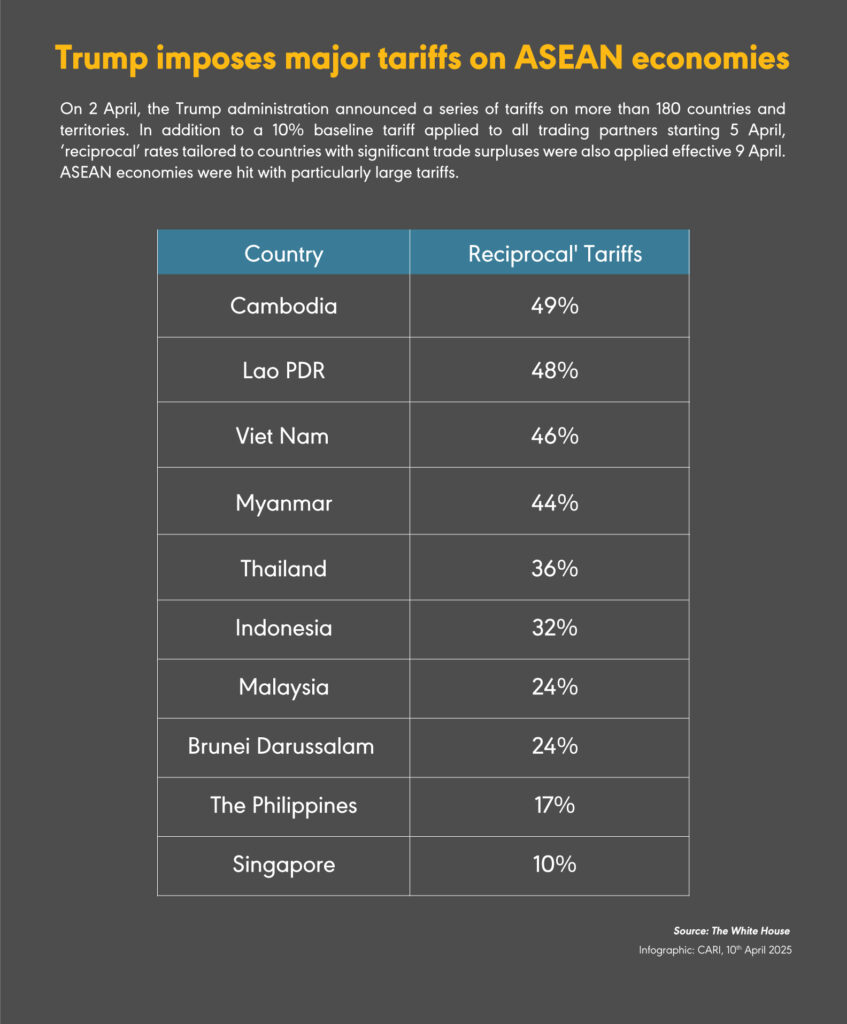
(19 May 2025) In Q1 2025, five of Southeast Asia’s six largest economies—Thailand, Indonesia, Malaysia, Singapore, and Viet Nam—reported slower year-on-year GDP growth, with only the Philippines recording a marginal increase to 5.4% from 5.3%. Thailand’s GDP growth decelerated to 3.1%, impacted by weak domestic consumption and high household debt; durable goods expenditure fell 1.4%, with vehicle purchases down 2.0%. Indonesia posted its weakest growth since Q3 2021 at 4.87%, while Malaysia (4.4%), Singapore (3.8%, preliminary), and Viet Nam (6.93%) all declined from the previous quarter. The downturn precedes the full impact of new U.S. tariffs announced in April—ranging from 10% to 46% across the region—which have already prompted revisions in national growth forecasts: Singapore lowered its projection to 0–2%, and Thailand’s NESDC downgraded its 2025 outlook to 1.3–2.3%. Thailand’s Kasikorn Research Center now estimates 1.4% growth for the year, down from 2.4%. Central banks in the Philippines, Singapore and Thailand eased monetary policies in response, while Malaysia held its rate at 3%. U.S. tariff reductions to 10% for 90 days (excluding China) have provided limited relief amid continued uncertainty, with analysts warning of export contraction later in the year due to global economic slowdown and reduced investment.
ASEAN
Malaysian Prime Minister calls for unified response to US tariffs
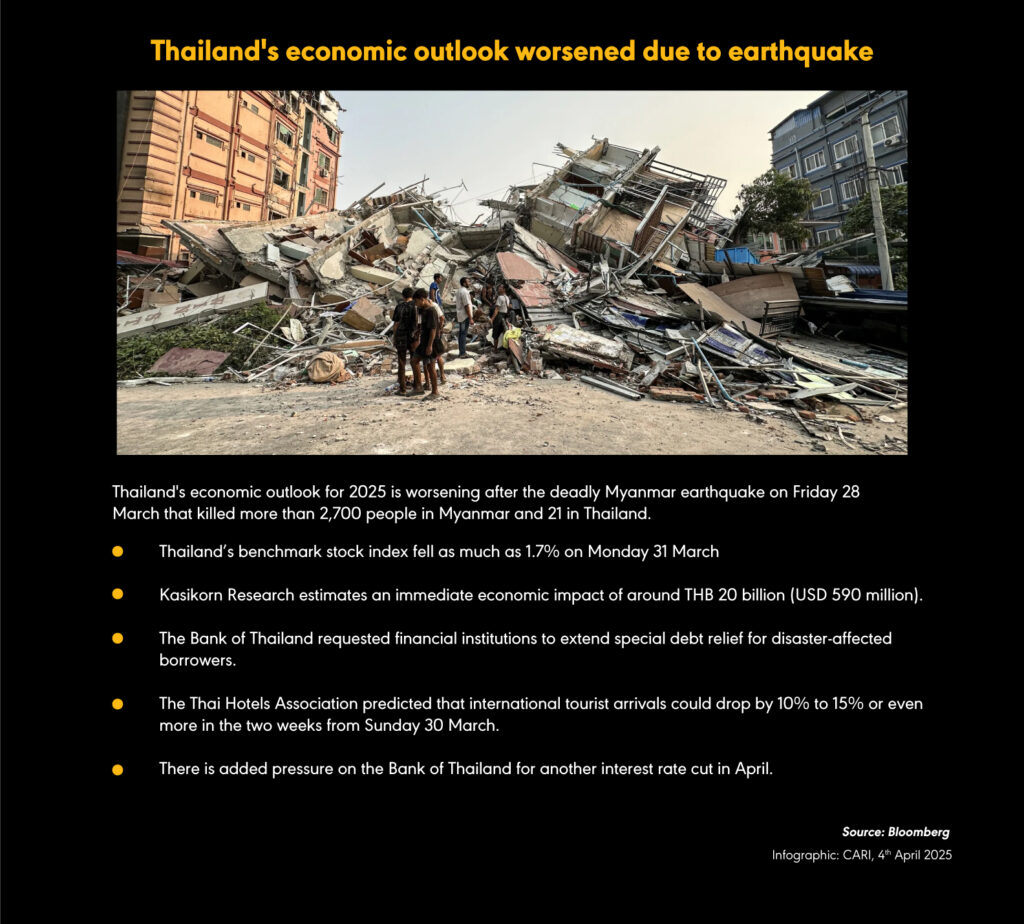
(22 May 2025) Prime Minister Anwar Ibrahim has called for ASEAN to aggressively diversify export markets and demonstrate unified economic relevance during upcoming tariff negotiations with the US, ahead of a summit in Kuala Lumpur. US President Donald Trump’s proposed tariffs—up to 49% on ASEAN states—have already disrupted trade and prompted member states to seek bilateral deals with Washington, including commitments to buy more US goods and curb transshipments of Chinese exports. Anwar stated that bilateral talks do not contradict ASEAN’s goal of maintaining a collective negotiating stance and called for stronger coordination and shared red lines. ASEAN’s USD 3.8 trillion economy and 670 million consumer base remain key leverage points, though internal fragmentation continues to limit negotiating cohesion. Strategic proposals include joint development in electric vehicles, semiconductors, and critical minerals to build cost-intensive value chains. Premier Li Qiang of China and Gulf state leaders will also attend the summit. On Myanmar, Anwar reported that junta leader Min Aung Hlaing gave verbal assurances of a ceasefire and aid access following the 28 March earthquake, but ongoing aerial attacks and plans for a flawed December election persist. ASEAN has yet to lift its ban on junta officials and is unclear on their summit participation.
MALAYSIA, UNITED STATES
United States to “sympathetically” review Malaysia’s appeal against tariffs
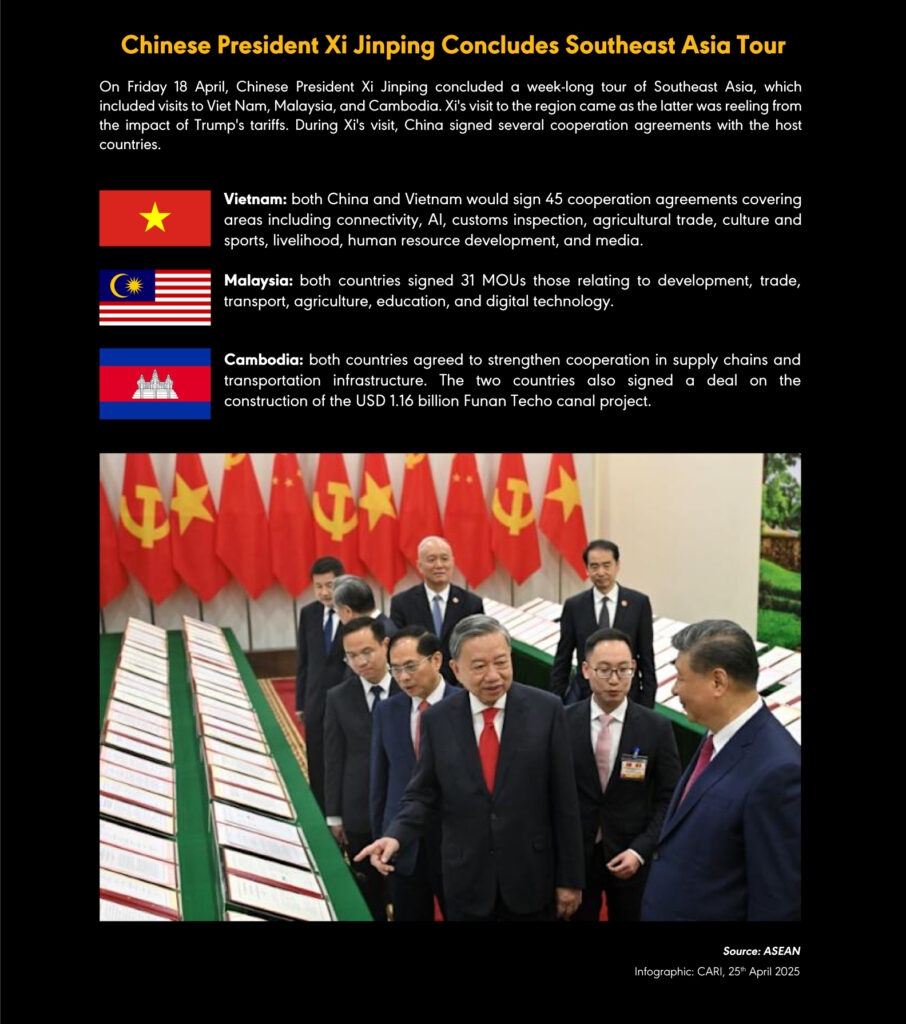
(22 May 2025) Prime Minister Datuk Seri Anwar Ibrahim stated that the United States has agreed to “sympathetically” review Malaysia’s appeal to reduce its 24% export tariffs, originally imposed under former President Donald Trump, with the aim of eventually eliminating them. In return, Washington has requested that Malaysia address trade imbalances, reduce non-tariff barriers, and prevent the redirection of US technology. Anwar confirmed the US has not objected to Malaysia strengthening relations with China, including a recent state visit by President Xi Jinping in April during which 31 bilateral agreements were signed, just ahead of trade talks with US representatives. Anwar also affirmed Malaysia’s independent foreign policy amid geopolitical tensions. The clarification followed a government announcement regarding a proposed AI initiative using Huawei chips, later attributed to a private-sector initiative by the Ministry of Investment, Trade and Industry. As ASEAN chair for 2025, Malaysia is preparing to host a summit with China and Middle Eastern partners next week, with Chinese Premier Li Qiang expected to attend.
MALAYSIA, THAILAND
Malaysia and Thailand to enhance cross-border power interconnection infrastructure
(22 May 2025) Malaysia and Thailand have agreed to upgrade their ageing cross-border power interconnection infrastructure, initially commissioned in the early 2000s, to improve reliability and support increasing integration of renewable energy. Malaysia’s Deputy Prime Minister stated that feasibility studies conducted by Tenaga Nasional Berhad (TNB) and the Electricity Generating Authority of Thailand (EGAT) have established a clear technical framework for the upgrade. The initiative aims to enhance secure electricity exchange and support the ASEAN Power Grid (APG) initiative. Malaysia also proposed purchasing up to 300 megawatts (MW) of firm electricity from Thailand to meet rising domestic demand and improve energy supply security. Malaysia indicated readiness to explore structured multilateral energy trading arrangements beyond traditional bilateral models. The proposals were discussed during the Malaysian Deputy Prime Minister’s official visit to Thailand, where he met with the Thai Deputy Prime Minister and Energy Minister and attended a briefing by Trans Thai-Malaysia, hosted by Petronas, to review operational developments and strategic direction.
THAILAND, UNITED STATES
Thailand aims to reduce trade deficit with United States by USD 15 billion
(23 May 2025) Thailand anticipates reducing its annual trade surplus with the United States by up to USD 15 billion, equivalent to approximately one-third of the USD 46 billion surplus recorded last year, through measures aimed at curbing the misuse of origin rules for exports, according to Thailand’s Deputy Prime Minister and Finance Minister. Speaking at the American Chamber of Commerce conference in Bangkok on 20 May, Pichai stated that the government is implementing anti-trade circumvention policies to support a long-term, balanced trade relationship with the U.S. Thailand has submitted a framework of proposals to the Trump administration to initiate formal negotiations and avoid a proposed 36% tariff on Thai exports, scheduled to take effect in early July. The proposals include actions against Chinese trade rerouting, reduction of tariff and non-tariff barriers, and increased Thai investment in the U.S. The President of the Thailand Trade Representatives indicated that Thai companies may soon invest at least USD 2 billion in the U.S. Additionally, Thailand has shown interest in participating in a major gas pipeline project in Alaska backed by President Trump.
INDONESIA
Indonesian rupiah remains outlier amongst strengthening Southeast Asian currencies
(23 May 2025) Southeast Asian currencies have rebounded following President Donald Trump’s 2 April tariff announcement, driven by US dollar weakness and expectations of rate cuts by the Federal Reserve; however, the Indonesian rupiah remains an outlier, reaching a record low of 16,970 per USD on 9 April and marking one of Asia’s worst-performing currencies year-to-date. Indonesia’s central bank intervened on 25 March, and capital outflows have continued, with non-residents selling USD 1.8 billion in stocks and bonds. The USD 16.9 billion 2024 trade surplus with the US is under pressure, particularly in palm oil, footwear, apparel, and electrical products, raising investor concerns over Indonesia’s growth outlook. Compounding external risks are domestic fiscal concerns under President Prabowo Subianto, whose increased social spending and controversial debt monetisation practices have raised questions about Bank Indonesia’s independence, with the central bank now holding 28% of outstanding government securities, up from 9% pre-pandemic. While current losses are milder than in 1998, potential competitive devaluation across Southeast Asia is a concern, though Indonesia’s relatively low manufacturing base limits regional spillover. Growth forecasts for 2025 have been revised down from 5.2% to 4.9%, but government-led social programmes may stabilise domestic demand. Long-term prospects hinge on structural reforms and private sector participation to boost productivity and investment.
VIET NAM
Viet Nam introduces new measures to strengthen rice exports through 2030
(23 May 2025) Vietnam’s Ministry of Industry and Trade (MoIT) has introduced a set of new measures aimed at strengthening rice exports through 2030, focusing on stricter regulatory oversight, accelerated implementation of the national export strategy, and expanded trade promotion. During a conference in Tien Giang, the MoIT’s Export-Import Department highlighted the need for expanded trade agreements, resolution of logistical bottlenecks, and value chain development among cooperatives and exporters. Enterprises were urged to invest in deep processing technologies to meet high-quality standards and diversify export markets to reduce reliance on traditional buyers. Tien Giang province, with 200 major milling and processing facilities producing three million tonnes of rice annually, was noted for its strategic location and infrastructure. The head of the provincial Department of Industry and Trade stressed the need for raw material zone development, factory upgrades, and enhanced brand identity. Vietnam exported over 3.43 million tonnes of rice in the first four months of 2025, earning nearly USD 1.8 billion—up 8.1% in volume but down 13.3% in value year-on-year, due to a 19.8% drop in average price to USD 515 per tonne. The Philippines remained the top buyer, accounting for 43.3% of volume and 45.5% of value.
RCEP Monitor
NEW ZEALAND
Revised “golden visa” programme receives 65 new applications within six weeks of implementation
(21 May 2025) New Zealand’s revised “golden visa” programme has received 65 new applications within six weeks of its April implementation, alongside 39 rolled-over applications, with 42 approvals to date, representing a minimum investment of NZD 620 million. The updated scheme, introduced by Prime Minister Christopher Luxon’s government, reduced the investment threshold for “growth” visas to NZD 5 million, removed English-language requirements, shortened the minimum residency requirement to 21 days, and accelerated application processing to 11 days on average. A higher-tier “balanced” visa, requiring NZD 10 million, permits investments in bonds, equities, and property development and includes family residency. Of the new applications, 55 originated from the US, with others from Hong Kong (15) and China (12). A former immigration minister attributed the spike in US interest to political uncertainty surrounding a potential Trump re-election and noted that New Zealand had benefited from the curtailment of golden visa schemes in the EU. From 2022 to 2025, only 115 applications had been submitted under the prior regime, with 46 approvals. Luxon’s administration is reversing several prior policies, including restrictions on foreign investment, aiming to stimulate an economy that grew just 0.7% in Q4 2024.
JAPAN
CPI rises 3.5% year-on-year in April 2025, accelerating from March’s 3.2%
(23 May 2025) Japan’s core Consumer Price Index (CPI) rose 3.5% year-on-year in April, surpassing the median market forecast of 3.4% and accelerating from March’s 3.2%, marking the fastest increase since January 2023 (4.2%). The measure excluding both fresh food and fuel, used by the Bank of Japan (BOJ) to assess demand-driven inflation, increased to 3.0% from 2.9% in March. These results keep core inflation above the BOJ’s 2% target for over three years. The primary inflation drivers remain elevated food costs. The BOJ, which raised short-term interest rates to 0.5% in January following the rollback of its ultra-loose monetary policy, faces challenges in determining further rate hikes. The central bank’s policy outlook is increasingly complicated by the external risks posed by US President Donald Trump’s tariff measures, which introduce uncertainty around global economic growth.
JAPAN
Inflation-adjusted real wages decline by 0.5% in fiscal year 2024
(22 May 2025) Japan’s inflation-adjusted real wages declined by 0.5% in fiscal 2024, marking the third consecutive annual decrease, despite nominal wages rising 3.0% to an average of JPY 349,388 per month—driven by the strongest wage growth in 33 years following the “shunto” spring negotiations and increases in minimum wages. However, this nominal growth was outpaced by a 3.5% rise in the consumer price index (excluding imputed rent), resulting in continued real wage contraction. A separate real wage index, calculated using CPI inclusive of imputed rent for international comparison, remained flat year-on-year, ending a three-year streak of negative growth. Food price increases and daily essentials continued to exert pressure on household purchasing power. The government recently set a target of 1% annual real wage growth through fiscal 2029, though its feasibility remains uncertain amid ongoing global economic risks linked to US President Donald Trump’s high tariff policy.
|
15 participating countries |
20 chapters |
2.2 billion |
US$26.2 trillion |
28% |
| ASEAN member states, Australia, China, Japan, South Korea, New Zealand | trade in goods and services, investment, intellectual property, e-commerce, competition, SMEs, economic and technical cooperation, and government procurement | combined population, 30% world’s population | combined GDP, 30% global GDP | global trade (based on 2019 figures) |