


CARI Captures Issue 698: Southeast Asian economies among hardest hit by Trump’s new tariffs
Captures has widened its scope to include news related to all the members of the Regional Comprehensive Economic Partnership (RCEP) agreement which was signed towards the end of 2020. Besides the ASEAN Member States, this includes Australia, New Zealand, China, Japan, and South Korea. The other weekly newsletters under CARI, China-ASEAN Monitor and Mekong Monitor will also be consolidated into the Captures newsletter. We hope this new version of Captures will serve you better and look forward to providing a curation of stories relevant to ASEAN and its trading partners.
ASEAN
Southeast Asian economies among hardest hit by Trump’s new tariffs
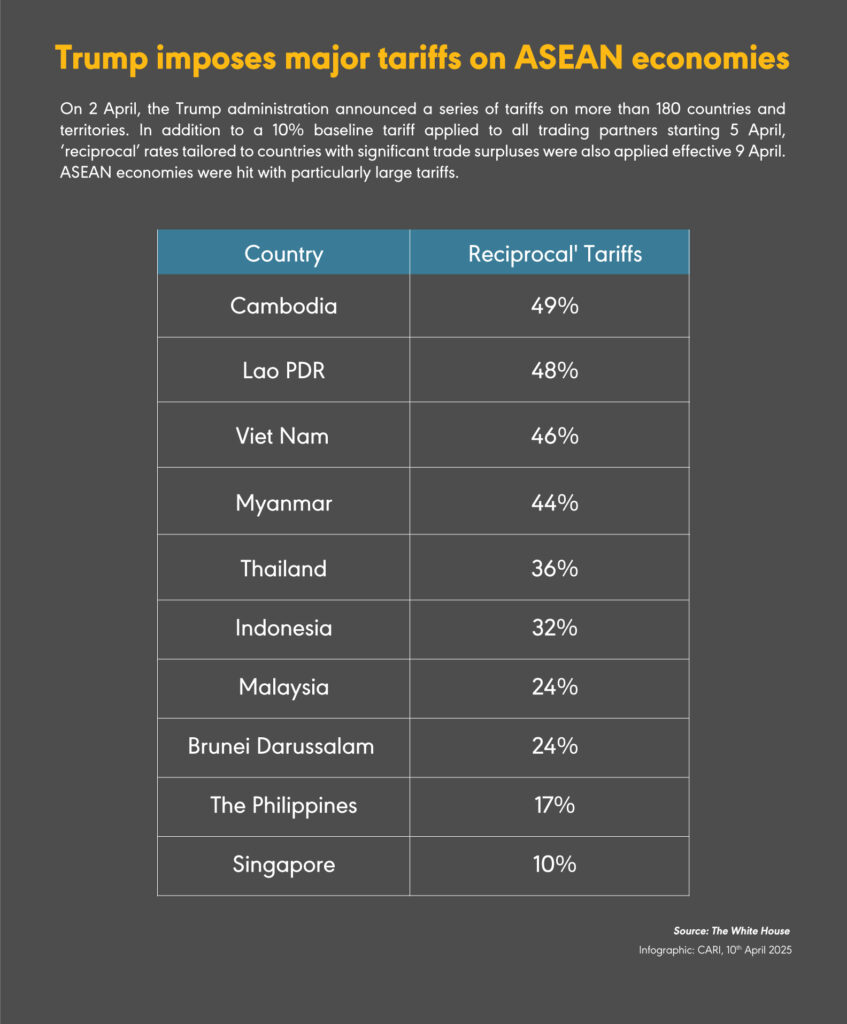
(03 April 2025) The United States has imposed unexpectedly high tariffs on six Southeast Asian countries, with Viet Nam and Cambodia receiving the highest rates at 46% and 49% respectively. Thailand was hit with a 37% tariff, exceeding the 11% it had anticipated. These tariffs, significantly above those for the EU (20%), Japan (24%), and India (27%), threaten regional economies that had benefited from the China+1 strategy. Viet Nam, where exports to the U.S. totalled USD 142 billion in 2024 (nearly 30% of GDP), has seen its stock index drop 6.7% and its currency reach an all-time low. Viet Nam’s Trade Minister sent a diplomatic note to the U.S. and is seeking talks, while Prime Minister Pham Minh Chinh convened an emergency cabinet meeting and launched a task force. ING estimates that 5.5% of Vietnam’s GDP is at risk. Thailand, facing 3% GDP exposure, has also committed to negotiations. Malaysia, facing a 24% rate, will likewise pursue dialogue without retaliatory measures. On 10 April, Trump announced a 90-day pause on ‘reciprocal’ tariffs on countries who had not retaliated in order to allow ongoing negotiations to continue. During this time, the universal baseline tariff of 10% will remain in place.
THAILAND
Bill legalising casinos to be delayed as opposition mounts
(08 April 2025) Thailand has delayed parliamentary debate on the integrated entertainment business bill, which includes legalising casinos, amid prioritisation of responses to the recent 36% U.S. tariff and last month’s earthquake in Bangkok. The bill, endorsed by the cabinet in March, limits casinos to 10% of integrated complex space and proposes entry restrictions for Thai citizens, including proof of THB 50 million in bank deposits. Opposition parties and civil groups have criticised the bill for favouring large corporations and bypassing sufficient public consultation. Thailand’s Prime Minister confirmed the bill will not be withdrawn but deferred to the next parliamentary session. She stated that casinos would only be located in approved resorts and that the government will continue public communication to address concerns. Finance ministry officials project each complex could attract THB 100 billion in investment and create 20,000 jobs, increasing foreign tourist spending by 40%.Licences would require THB 10 billion in paid-up capital, with a 30-year permit priced at five billion baht initially and one billion baht annually thereafter. Target locations for complexes include Bangkok, Chiang Mai, and Phuket.
VIET NAM, SPAIN
Viet Nam and Spain commits to strengthening economic cooperation amidst rising trade tensions
(09 April 2025) Viet Nam and Spain committed to strengthening economic and defence cooperation during Spanish Prime Minister Pedro Sanchez’s visit to Hanoi, as both countries face newly imposed U.S. tariffs—46% on Vietnamese exports and 25% on EU goods. Viet Nam’s Prime Minister Pham Minh Chinh expressed intent to elevate bilateral relations to a comprehensive strategic partnership. Both leaders emphasised support for multilateralism, rules-based international order, and opposition to trade conflicts. Spain signalled interest in expanding investment in Viet Nam, particularly in railway infrastructure, citing experience from its high-speed rail network. Vietnam is pursuing major railway projects, including a proposed 1,541 km high-speed line between Hanoi and Ho Chi Minh City, and connections to China.
INDONESIA, UNITED STATES
Indonesia announces series of import tax reductions on US goods
(08 April 2025) Indonesia has announced a series of import tax reductions on US goods—including steel, mining products, health equipment, electronics, mobile phones and laptops—as part of a broader effort to negotiate relief from a new 32% US tariff set to take effect on 09 April. Indonesia’s Chief Economic Minister, who will lead a high-level delegation to Washington next week, stated that Indonesia also plans to increase imports of US liquefied petroleum gas, liquefied natural gas, and soybeans. Indonesia’s Finance Minister confirmed reductions in US import tariffs to a 0–5% range from previous rates of 5–10%, and cuts in import tax on electronics from all countries to 0.5% from 2.5%. The measures were disclosed during a high-level policy meeting attended by President Prabowo Subianto, senior ministers, the central bank governor, and financial authorities. Indonesia recorded a USD 16.8 billion trade surplus with the US in 2024, with exports valued at USD 26.3 billion, primarily comprising electronics, apparel, and footwear. The Chief Economic Minister stated that the tariff impact on Indonesia would be limited, noting US exports represent only 2.2% of national GDP. He also suggested that Indonesia could replace Viet Nam and other Asian economies as a supplier to the US under the revised trade regime. President Prabowo remarked that the tariffs underscored the strategic need for national economic self-reliance. The government is also reviewing a potential reduction in local content requirements for US tech and communications firms and may increase US imports for an oil refinery project.
MALAYSIA
Malaysia announces commitment to develop border areas with Thailand and Indonesia
(08 April 2025) Malaysian Prime Minister Anwar Ibrahim announced commitments to develop border areas with Thailand and Kalimantan in Indonesia to strengthen ASEAN cooperation and stimulate cross-border economic activity, citing the Johor-Singapore Special Economic Zone (SEZ) as a model. Speaking at the ASEAN Investment Conference 2025, held alongside the 12th ASEAN Finance Ministers’ and Central Bank Governors’ Meeting, Anwar emphasised infrastructure investment as essential for regional resilience against climate change and natural disasters. He identified technologies such as carbon capture, circular production, and low-emission innovation as critical to ASEAN’s future industrial landscape.
THE PHILIPPINES
Bangko Sentral ng Pilipinas reduces key rate amidst slowing inflation
(10 April 2025) The Bangko Sentral ng Pilipinas reduced its target reverse repurchase rate by 25 basis points to 5.5% on 10 April, marking a resumption of monetary easing amid heightened global uncertainty linked to new US tariff policies. The decision, anticipated by 26 of 28 economists in a Bloomberg survey, follows a period of stability after three previous cuts. The move comes as US President Donald Trump imposed a 17% tariff on US imports from the Philippines—lower than the rates applied to Indonesia, Malaysia, and Viet Nam—before announcing a 90-day pause and setting a base tariff rate of 10% for most countries, while raising duties on China to 125%. The BSP cited increased uncertainty over global economic policies despite inflation in March easing to a five-year low. In March, the central bank also lowered banks’ reserve requirement ratio, releasing approximately PHP 300 billion (USD 5.2 billion) into the financial system. The April rate cut is intended to support market confidence and domestic growth against a volatile external backdrop.
LAO PDR
Lao PDR’s GDP forecast to grow by 4.0% in 2026 according to ADB
(10 April 2025) According to the Asian Development Bank, Lao PDR’s GDP is forecast to grow by 3.9% in 2025 and 4.0% in 2026, driven mainly by logistics and tourism services, while macroeconomic pressures persist. The kip stabilised in late 2024 following tightened monetary policy, with an annual depreciation of 5.4% against the US dollar and a 1.2% appreciation against the Thai baht. Inflation averaged 23.3% in 2024, driven by high food, alcohol, restaurant, and hotel prices, but is projected to ease to 13.5% in 2025 and 10.4% in 2026. Increased electricity tariffs from March 2025 are expected to exert upward price pressure. Export values in electricity, minerals, and agriculture are set to rise, though agriculture will face climate-related constraints and labour shortages. The 2025 budget targets a 1.0% GDP deficit, with revenue projected to grow 36% to LAK 68.1 trillion and expenditure by 19.1% to LAK 71.8 trillion, supported by tax reforms and administrative improvements. Foreign currency-denominated debt and US tariff hikes remain key external risks, potentially impacting Lao PDR directly and indirectly via neighbouring trading partners.
RCEP Monitor
JAPAN
Commodity-related stocks record steep losses amid concerns over global recession
(08 April 2025) Japan’s commodity-related stocks, particularly nonferrous metals and oil and coal product sectors, have recorded steep losses amid concerns over a global recession triggered by U.S. President Donald Trump’s new tariff regime. The Topix nonferrous metals index dropped 13% on Monday and remains over 10% lower than levels at the beginning of the month. The oil and coal sector index fell more than 20%, while banking stocks posted the second-largest decline, linked to expectations that the Bank of Japan may not proceed with further interest rate hikes. The broader Topix index declined 14% over the same period. Market rebound on 08 April partially recovered earlier losses, but analysts warned the recovery may be temporary. Under Trump’s new policy, a baseline 10% tariff was introduced on 05 April, with country-specific higher rates commencing 09 April. China has announced retaliatory tariffs of 34% beginning 10 April and threatened further escalation. In response, Malaysia is coordinating an ASEAN-level reaction. Defensive stocks in sectors such as land transport, food retail, and pharmaceuticals have shown relative resilience, each declining less than 10%.
CHINA
Onshore Chinese yuan falls to 19-month low after central bank set its reference rate weaker
(08 April 2025) The onshore Chinese yuan fell to 7.34 per U.S. dollar on 08 April, its weakest level since September 2023, following the People’s Bank of China’s (PBOC) decision to set its reference rate at 7.2038, compared to 7.198 the previous day. The offshore yuan dropped to approximately 7.352. The PBOC’s weaker fix signals a potential shift in policy to allow the currency to depreciate in response to rising U.S. tariffs. This follows U.S. President Donald Trump’s threat to impose an additional 50% tariff on China unless it withdraws retaliatory measures. Analysts view the move past the 7.2 threshold as a more proactive stance by the PBOC, although sharp depreciation is deemed unlikely due to capital outflow risks. The PBOC is expected to maintain currency stability while preparing for potential monetary easing. Analysts are monitoring for possible interest rate cuts and further easing to mitigate expected pressure on exports.
SOUTH KOREA
South Korea announces USD 2 billion emergency support package for automobile sector
(09 April 2025) South Korea has announced a USD 2 billion emergency support package in response to U.S. President Donald Trump’s imposition of a 25% tariff on South Korean automobiles and auto parts, a sector which accounted for USD 42.9 billion in exports to the U.S. last year. The government warned of significant impact on the auto industry and committed to “flexible action” based on evolving damage assessments. Key measures include a KRW 2 trillion expansion of low-cost financing for auto firms, a KRW 1 trillion support programme led by Hyundai Motor and financial institutions, and tax deferrals of up to nine months for affected companies. To strengthen the domestic market, the government will operate an electric vehicle subsidy system tied to manufacturer discounts and will raise its matching support ratio from 20–40% to 30–80%. The initiatives aim to safeguard the country’s manufacturing base amid reduced export volumes. Trump discussed the tariffs with South Korea’s acting president, but uncertainty persists over whether the tariffs are a permanent measure or a negotiating tactic. The U.S. trade deficit with South Korea in goods reached over USD 66 billion in 2024.
|
15 participating countries |
20 chapters |
2.2 billion |
US$26.2 trillion |
28% |
| ASEAN member states, Australia, China, Japan, South Korea, New Zealand | trade in goods and services, investment, intellectual property, e-commerce, competition, SMEs, economic and technical cooperation, and government procurement | combined population, 30% world’s population | combined GDP, 30% global GDP | global trade (based on 2019 figures) |