Malaysia: December 2018 consumer price inflation


HIGHLIGHTS

December 2018 consumer price inflation

  • Headline inflation was steady at 0.2% yoy in December, while 2018 inflation rose 0.8% yoy, the mildest since 2009.
  • We lower our 2019F inflation forecast from 2.7% to 1.8% in lieu of the downtrend in oil prices in the past two months.
  • Fiscal constraints are transitory, as budget deficit set to narrow briskly after 2020 (11MP target: -3.0% of GDP) if fiscal adjustments are implemented.
  • Coupled with a less hawkish Federal Reserve, we now project Bank Negara Malaysia (BNM) to leave Overnight Policy Rate at 3.25% throughout 2019.

img-my1-19-1

2018: Mildest gain in consumer prices in the past nine years
Headline inflation in December was in line with our expectation at a stable pace of 0.2% yoy (+0.2% yoy in November), while core inflation eased slightly to 0.4% yoy (+0.5% in November). The seasonally-adjusted headline CPI increased 0.1% mom in December (+0.2% mom in November). For the whole of 2018, price growth of 1.0% yoy was at its mildest since 2009 (+3.7% yoy in 2017), driven by changes in consumption tax policy.

img-food

Benign food and transport inflation
A five-day price control for 16 types of food commodities surrounding the Christmas season kept food inflation benign at 0.7% yoy in December (+1.1% yoy in November), while lower retail prices for diesel, RON95 and RON97 compared to December 2017 saw negative price growth in fuel and lubricants sub-index for the second consecutive month (-2.9% yoy vs. – 3.3% yoy in November).

Weekly fuel price adjustment reinstated
Following large declines in global oil prices, the government has opted to reinstate weekly fuel price adjustment to pass on lower fuel prices to consumers in a timely manner. The adjustment of retail fuel prices takes effect every Saturday. To curb price pressure in the event of climbing oil prices, the government imposed a ceiling price of RM2.20 per litre on RON95 and RM2.18 on diesel, until the roll-out of targeted fuel subsidy in mid-2019.

img-water

Potential water tariff hikes
According to Water and Land Natural Resources Minister Dr A. Xavier Jayakumar, water tariffs may increase in stages this year, in line with the government’s efforts to restructure the water supply services industry. While increases may vary across different states, we estimate that a blanket 10% increase could raise CPI inflation by 9bp, given that water tariffs currently account for 0.9% of the CPI basket.


img-my1-19-2

img-my1-19-3

Originally published by CIMB Research and Economics on 24 January 2019.

CARI Captures 389


c389_graphic


ASEAN

Vietnam, Indonesia and Cambodia lead ASEAN tourist arrival growth in 2018
(22 January 2019) The ASEAN Tourism Federation found tourist arrivals in the region to have grown by 7.4% in 2018, reaching a total of 129 million tourists. Thailand, Malaysia and Singapore saw the highest number of tourist arrivals; while Vietnam, Indonesia and Cambodia enjoyed the highest growth rate in arrivals in 2019 with Malaysia being the only country recording negatve growth in ASEAN. According to Cambodian tourism minister Thong Khon, the country welcomed 1.9 million Chinese nationals in 2018, representing a 70% increase in visitors from China. The minister further added that the government expects three million Chinese tourists, and a total of seven million international tourists per year by 2020. The Cambodia Association of Travel Agents attributed the sharp increase in Chinese tourists to the effective policies of the Ministry of Tourism and tour operators’ efforts in targeting Chinese tourists in recent years.

ASEAN

ASEAN ministers pledge to continue to push for regional tourism integration
(21 January 2019) The 38th ASEAN Tourism Forum held in Vietnam’s Ha Long city came to a close with the region’s tourism ministers pledging to work together to implement a range of measures to raise the countries’ tourism profiles, including a push for the institution of a single entry visa to boost regional cross-country travel and measures to tackle overtourism. Further, the group agreed to add two categories to the ASEAN MICE Venue Standard (AMVS), i.e. the meeting room category and exhibition venue category, as part of its efforts to ensure that MICE (meetings, incentives, conferences, exhibitions) venue standards in ASEAN matched global standards. The AMVS, which was modeled after Thailand’s MICE venue standards in 2016, has been adopted by all ASEAN countries as the region looks to attract more international trade fairs. According to a Hong Kong-based consulting firm, trade fair organisers were able to sell space at as many as 2,353 events in Asia in 2018.

ASEAN

Korea, Japan and China committed to facilitating tourism exchanges with ASEAN
(20 January 2019) South Korea, Japan and China reaffirmed their commitment to continue fine-tuning tourism policies between ASEAN and their countries during the ASEAN Plus Three (APT) Tourism Ministers Meeting held in Ha Long City on January 18. South Korea’s tourism industry policy head said that the country will continue developing their visa programme in ASEAN countries. For instance, the visa system in Vietnam will be improved through the issuance of short term multiple entry visas for residents of Hanoi, Ho Chi Minh City and Da Nang. He added that South Korea welcomed 2.3 million visitors from ASEAN countries in 2018, and that the government hopes to reach 15 million travellers between South Korea and ASEAN by 2020. Also at the meeting was Japan’s parliamentary vice minister of tourism, who said that Japan saw a record high of three million visitors from ASEAN in 2017 and that the country is committed to promoting outbound tourism by identifying new foreign destinations for Japanese travelers.

ASEAN

All Thai villages to have internet access by the end of 2019
(24 January 2019) Thailand will provide internet access to 50,000 villages in 2019 as it aims for full nationwide broadband coverage by year end, said Thai digital economy and society minister Pichet Durongkaveroj. The initiative comes under the government’s Village Broadband Internet (Net Pracharat) Project, which in 2017 identified 75,000 villages in the country without internet access and has since installed fibre cable networks in 25,000 of these villages. According to the minister, the digital economy ministers of ASEAN have agreed to cooperate on improving the region’s digital infrastructure by increasing information sharing between ASEAN government agencies. Also speaking at the ASEAN Digital Infrastructure seminar organized by the ASEAN Business Advisory Council-Thailand (ASEAN BAC-Thailand) was Thai Digital Government Development Agency (DGA) president Sak Segkhoonthod, who shared the administration’s plan to enable 300 government agencies to provide digital one-stop services and equip all three million government officers with digital skills within the next five years.

CAMBODIA, MYANMAR

ASEAN foreign ministers to raise collaborative efforts in developing the ASEAN Community
(19 January 2019) The ASEAN Foreign Ministers’ Retreat (AMM Retreat) held in Chiang Mai on January 18 concluded with ASEAN foreign ministers committing to advancing the ASEAN Community 2025 and Sustainable Development Agenda 2030. Also discussed at the meeting was the need to raise public knowledge of ASEAN. To that end, the ministers agreed to set up a Network of ASEAN Associations with the participation of academic and social institutions to improve public awareness of ASEAN in all member states. Indonesian Foreign Minister Retno L. P. Marsudi, in commenting on the matter, stressed the importance of including young people in the process of developing the ASEAN Community and used Indonesia’s annual election of an ASEAN Young Envoy as an example of such engagement.

ASEAN-EU

Foreign ministers of EU and ASEAN come to agreement in Brussels
(21 January 2019) Foreign ministers of the European Union (EU) and ASEAN Member States convened in Brussels, Belgium on January 21 for the 22nd EU-ASEAN Ministerial Meeting. In a joint statement released after the meeting, the ministers reaffirmed their commitment in implementing the EU-ASEAN Plan of Action 2018-2022 and 2030 Agenda for Sustainable Development. The ministers also agreed in principle to upgrade EU-ASEAN relations to a Strategic Partnership, subject to the ironing out of details. Further, the group also agreed to intensify cooperation to conclude the EU-ASEAN Free Trade Agreement and EU-ASEAN Comprehensive Air Transport Agreement. Also notable was the group’s agreement to establish a joint working group between the EU and relevant ASEAN Member States to discuss issues relating to palm oil.

VIETNAM

CPTPP Commission holds first meeting in Tokyo
(21 January 2019) The inaugural meeting of the Comprehensive and Progressive Agreement for Trans-Pacific Partnership (CPTPP) Commission held in Tokyo on January 19 culminated with the adoption of a joint statement by the partnership’s 11 member nations. The joint statement reaffirmed the member nations’ commitment to fully enforcing the CPTPP to advance trade liberalisation, foster economic growth, and set high and fair trade standards. Further, four key decisions were made; namely that of the Commission’s operating mechanisms; new member’s admission process, a state-to-state dispute arbitration tribunal, and a code of conduct for arbitrators in dispute settlements between a state and an investor.

SINGAPORE

Singapore releases governance framework for ethical and responsible use of AI in Davos
(23 January 2019) Singapore presented a framework for ethical and responsible use of artificial intelligence (AI) and welcomed industry input at the World Economic Forum (WEF) in Davos, Switzerland. According to Singapore’s Infocomm Media Development Authority (IMDA), the framework is the first in Asia to provide comprehensive guidelines that can be immediately adopted by private sector institutions using AI. Further, the framework is underpinned by two principles, i.e. AI solutions are human-centric, and decisions made by or with the help of AI shall be explainable, transparent and fair to consumers. Singapore communications and information minister S. Iswaran, who launched the framework in Davos, expounded on the country’s many AI initiatives which includes the formation of an Advisory Council on the Ethical Use of AI and Data chaired by a former attorney-general.

INDONESIA

Indonesia ‘strongly welcomes’ the global economic slowdown
(23 January 2019) Indonesia Investment Coordinating Board chair Thomas Lembong said in an interview on the sidelines of the WEF that the softening of global economic growth was a blessing and should be viewed favourably. Lembong argued that the previous economic boom was built on financial risks, particularly an “out-of-control shadow banking sector in China and a bubble in technology shares and investments.” As such, he likened Indonesia’s growth to that of a tortoise’s slow but steady progress, saying that in a volatile world, the country can be seen as a steady investment destination. According to CNBC, the Indonesian economy has grown at an average of approximately 5% per year in the last five years and a poll of analysts by Reuters projected a similar growth rate in 2018.

MALAYSIA-THAILAND

Malaysia and Thailand to test round-the-clock border trade
(20 January 2019) Thailand and Malaysia announced the extension of the Sadao-Bukit Kayu Hitam Customs, Immigration and Quarantine (CIQ) Checkpoint’s operating hours to 24 hours to ease border traffic. The new operating time will come into effect on April 1 and be tested for three months. The announcement was made by Malaysian foreign minister Dato Saifuddin Abdullah and Thai foreign minister Don Pramudwinai, who also added that this extension was one of many initiatives by the governments to promote seamless connectivity along the shared border. According to the Thai Ministry of Commerce, trade between the two countries grew at an average of 10.54% annually in the last five years. Malaysia is also Thailand’s largest trading partner in ASEAN, with cross-border trade in 2018 valued at US$26.5 billion, of which border trade accounted for over 60%.

Mekong Monitor


img-mm-240119

Photo credit: Vietnam Plus


TRADE, ECONOMY, AND INVESTMENT


VIETNAM, THAILAND

Hanoi wants to establish twinning ties with Bangkok
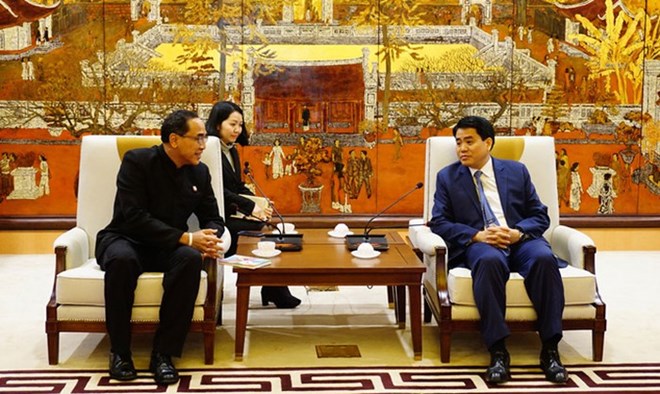
(22 January 2019) Hanoi wishes to establish twining ties with Bangkok, said the Hanoi People’s Committee chairman to the Thai ambassador to Vietnam during a reception for the ambassador in Hanoi on January 21. The chairman said that such a relationship would expand cooperation between the cities in many areas. He further committed to support cultural exchanges and investment between the cities, as well as promote Thai goods in Hanoi. In turn, the Thai ambassador shared the city’s plans to host several activities in Hanoi this year, such as the Thai cultural festival in Ly Thai To garden and the Thai film festival in Hanoi Opera House. He too expressed his wishes to see both sides work more closely together in future.
Read more>>

THAILAND, VIETNAM

Thailand organizes business matching event in Ho Chi Minh City to promote two major trade fairs
(19 January 2019) The Thai Ministry of Commerce hosted a business matching event with Vietnamese firms in Ho Chi Minh City on January 18 as part of a roadshow to promote two major trade fairs to be held in Bangkok later this year. 400 companies are expected to exhibit their products to over 14,000 visitors at the Bangkok Refrigeration, Heating, Ventilation and Air-Conditioner Fair (Bangkok RHVAC) and Bangkok Electric & Electronics Fair (Bangkok E&E) on September 25-28. According to a senior ministry official, Thailand is the second largest manufacturer of air conditioners and fourth largest manufacturer of refrigerators in the world. It mainly exports electrical and electronic products to Southeast Asia, while Vietnam mainly imports air conditioners from it.
Read more>>

MYANMAR

Yangon Stock Exchange records lusterless performance
(22 January 2019) The Yangon Stock Exchange (YSX), now three years old, remains quiet due to low daily trading volumes and few companies willing to go public. The YSX started in 2016 with only three firms listed, the number then rose to four in 2017 and five in 2018. Furthermore, the volume and value of trades executed declined last year, a phenomenon that Myanmar deputy finance minister U Maung Maung Thein said was “not a positive sign.” As such, the government will need to take steps to re-energise activity on the exchange. For instance, the Securities and Exchange Commission of Myanmar confirmed that regulations to allow foreigners to participate in the local stock market have been submitted to the Ministry of Planning and Finance and is near conclusion.
Read more>>

CAMBODIA, VIETNAM

Model market on Cambodian-Vietnam border to be completed by April 2019
(22 January 2019) The model market project on the Cambodia-Vietnam border known as the Da Market will be completed by April this year, according to the Cambodian Ministry of Commerce’s state secretary. The new marketplace, which was funded by a US$2 million grant from the Vietnamese government, will occupy over 19,500 square metres in the Thary Tbaung Khmum Special Economic Zone in the province of Tbaung Khmum. The model market is expected to facilitate trade between the two countries, help traders expand their network and reduce poverty on both sides of the border.
Read more>>

CAMBODIA

Cambodia to build up case against EU reimposing tariffs on rice exports
(21 January 2019) The European Union’s (EU) re-imposition of tariffs on Cambodia’s rice exports are neither a surprise nor a great concern to the Cambodian government, said the Cambodian Ministry of Commerce’s state secretary. His statement was made in response to the EU’s announcement last week that it would levy US$199.5 per tonne of imports of Cambodian rice in the first year, US$171 in the second year and US$142.5 in the third year. While such safeguard measures are common among World Trade Organisation (WTO) members who wish to protect local producers, the state secretary said that they are in the process of verifying the EU’s claims that their rice exports were indeed in direct competition with products in Italy and Spain. He further claimed that the EU’s decision was “not fully in agreement with international law and scientific proof, and does not accurately reflect social and economic realities.” As such, the Cambodian government is looking to build a case against the tariffs.
Read more>>


mekong-monitor-map

About Greater Mekong Subregion (GMS)

The Greater Mekong Subregion (GMS) Economic Programme was launched by the Asian Development Bank in 1992 connecting five developing ASEAN countries, namely Cambodia, Laos, Myanmar, Vietnam and Thailand, and Chinese provinces of Yunnan and Guangxi Zhuang Autonomous region. The region has some of the most robust economies sharing the Mekong River Basin thanks to its reform and liberalisation. The subregion is growing at a faster pace than the whole of East Asia and the Asia Pacific as the GDP growth rate for 2017 was at 6.4 percent, according to the World Bank. The population at the subregion as of 2016 is at 340 million while the GDP at PPP is at US$3.1 trillion in 2016. In 2015, trading within the region was at US$444 billion.

China-ASEAN Monitor


img-ca-230119

Photo Credit: Reuters


Economy, Investment and Trade


China pledges more aid and investment to Cambodia
(22 January 2019) China’s pledge of US$588 million in aid to Cambodia from 2019 to 2021 were among the highlights of Cambodian Prime Minister Hun Sen’s official visit to China. Other highlights, which were posted on the Prime Minister’s Facebook page, include China’s promise to import 400,000 tonnes of rice from Cambodia and push bilateral trade between the two countries to reach US$10 billion by 2023. China’s Foreign Ministry later released a statement saying that during the meeting, President Xi Jinping had expressed his interest in intensifying economic cooperation with Cambodia, and expediting the alignment of China’s Belt and Road Initiative (BRI) with Cambodia’s development strategy.
Read more>>

Chinese ambassador pushes for greater tourism cooperation between ASEAN Plus Three members
(18 January 2019) The Chinese ambassador to Vietnam made several recommendations on the way forward for ASEAN Plus Three (APT) tourism cooperation during the 18th Meeting of APT Tourism Ministers held on January 18 in Quang Ninh, Vietnam. ASEAN Plus Three is a forum composed of the 10 members of ASEAN, alongside China, South Korea, and Japan. Among the recommendations put forward were continued implementation of the APT Cooperation Work Plan 2018-2020, strengthening the sharing of best practices in using tourism for economic development, and adhering to the people-oriented principle through the sharing of data, expertise and resources. The Chinese ambassador also noted that the number of visitors from ASEAN countries to China in the first three quarters of 2018 saw a year-on-year increase of 21.4%, reaching 18.8 million. Further, the number of Chinese visitors to ASEAN countries crossed the 25 million mark in 2018 with a year-on-year rise of 20.4%.
Read more>>

Rise in number of Chinese students enrolling in Thai universities
(18 January 2019) 8,455 Chinese students enrolled in Thai universities in 2017, doubling the number of enrolments made in 2012, according to Thai government data. According to analysts, there are around 30,000 Chinese students in total currently enrolled in the country, most of which originate from rural provinces in southern China. These students move to Thailand in hopes of escaping the highly competitive but relatively poor education back home in China, and landing well-paying jobs in Thailand after graduation. An undergraduate business degree costs up to US$3,700 per year in Thailand, while it can range from US$8,000 in Singapore to US$60,000 per year in the US for the same degree. This greater affordability, coupled with friendlier visa regulations compared to countries like the US, are considered the key factors in the rise of Chinese enrolments in Thai universities in recent years. It was reported that Thai universities currently make twice the amount of tuition fees from Chinese tourists compared to locals.
Read more>>

Malaysia first Asian country outside China to initiate Alibaba Netpreneur Training Program
(18 January 2019) The education arm of Alibaba Group has selected Malaysia for its inaugural Alibaba Netpreneur Training Program, organized in collaboration with various Malaysian government agencies under the ongoing eWTP (electronic world trade platform) initiative in Malaysia. This makes Malaysia the first Asian country outside China to initiate the program. The 10-day program, held in Alibaba’s headquarters in Hangzhou, China, aims to equip Malaysian entrepreneurs and businesses in tackling the many challenges they face while adapting to digital era. The Malaysian Digital Economy Corporation (MDEC) applauded the program saying that it was yet another important step forward in “broadening the opportunities for Malaysian businesses and entrepreneurs to reap the benefits offered by the tremendous continued growth of eCommerce and the digital economy.”
Read more>>

China-Myanmar border trade dips dramatically
(19 January 2019) Border trade between China and Myanmar fell by US$562 million in the fourth quarter of 2018, according to Burmese state media. The publication attributed the decline to stricter border trade regulations imposed by China (including the suspension of certain agricultural imports from Myanmar), as well as the closure of a major trading post near Muse in Shan State. Nevertheless, the dip in border trade is unlikely to affect the planned China-Myanmar Economic Corridor (CMEC). According to the report, border trade in the fourth quarter of 2018 at Muse itself totaled US$1 billion, while Lweje recorded US$43.4 million, Chinshwehaw recorded US$163.6 million, Kanpiketee recorded US$28 million and Mong La-Kengtung recorded US$1 million.
Read more>>

CARI Captures 388


c388_graphic


ASEAN

Vehicle production rose in all ASEAN states except the Philippines in 2018
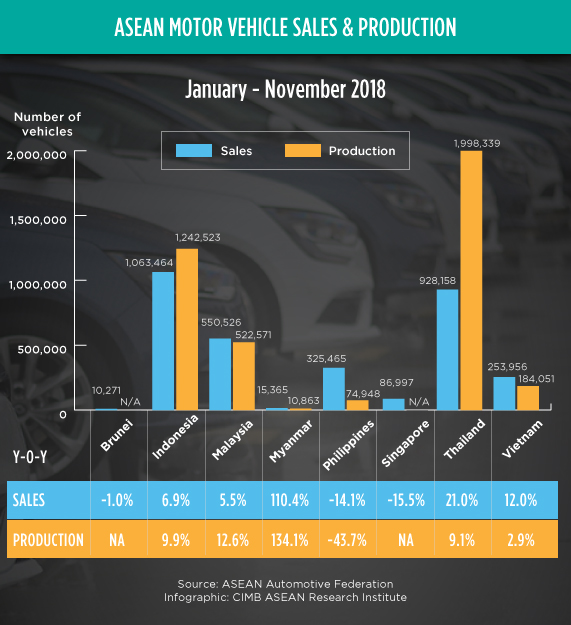
(16 January 2019) Data from the ASEAN Automotive Federation found that all countries in the region except the Philippines posted a year-on-year increase in motor vehicle production from January to November last year. Indonesia topped the list with vehicle output growing by 9.9% to reach 1.24 million units during the 11-month period, while Thailand came in second with a 9.1% increase to almost two million units. The Philippines, however, registered a 43.7% decline in output and a 14.4% decline in sales. Nevertheless, the Philippines Chamber of Automotive Manufacturers maintained an optimistic outlook for the year as it expects consumers to have adjusted to the higher car taxes imposed and as the industry benefits from election-related spending.

ASEAN

ASEAN tourism sector seeks to promote ASEAN as single tourist destination
(16 January 2019) The 38th ASEAN Tourism Forum (ATF) is underway in Vietnam’s northern Quang Ninh province with 200 delegates including leaders of national tourism organisations (NTOs) in attendance. Held under the theme ASEAN: The Power of One, the forum aims to intensify regional efforts to promote ASEAN as a single tourist destination for international visitors and intra-block tourism. The forum will also provide a platform for the sale of tourism products from ASEAN countries. According to the Vietnamese National Administration of Tourism, Vietnam welcomed around 15.5 million visitors in 2018, a 19.9% increase from 2017. Of the sum, most visitors came from South Korea (44.3%), Finland (24.9%) and China (23.9%).

ASEAN

Philippines expects completion of e-commerce provisions for RCEP by 2Q
(13 January 2018) The ASEAN Secretariat has instructed the drafting of the e-commerce provisions under the Regional Comprehensive Economic Partnership (RCEP) to be completed in the first half of 2019, according to the Philippines’ designated negotiator for the e-commerce chapter Maria Lourdes A. Yaptinchay. Yaptinchay, who is also a Director of the Philippines’ Department of Trade and Industry (DTI), said that the department’s position is that e-commerce lowers the barriers to entry and operating costs for businesses, especially for micro, small and medium enterprises (MSMEs), which make up 99.6% of all registered businesses in the Philippines. According to trade secretary Ramon M. Lopez, the deadline for the e-commerce chapter indicates that the RCEP can be completed by November.

ASEAN

Online retail in Southeast Asia to reach $53 billion by 2023 on back of growing economies and high smartphone penetration
(17 January 2019) The online retail sector in Southeast Asia will grow at a compound annual growth rate (CGAR) of 23% to reach US$53 billion in 2023, according to forecasts by Forrester. This growth will be fueled by growing economies, high smartphone penetration, a young population, and an undeveloped offline retail market with logistics costs that have resulted in Southeast Asia having one of the lowest levels of retail gross floor area and limited stock-keeping units. Indonesia leads the way with 41% of online retail sales in the region last year, and Forrester expects the country’s online retail market to grow at a CAGR of 19.6% from 2018 to 2023, reaching US$19 billion in 2023. Further, the report found that the Philippines has the most active social media users in the world, who spent an average of four hours a day on social media in 2017. As such, Forrester expects the Philippines’ online retail market to grow at a CAGR of 30.4% in the next five years as online retailers continue to penetrate the market.

CAMBODIA, MYANMAR

EU to impose tariffs on Myanmar and Cambodian rice for three years to protect domestic producers
(17 January 2019) The European Commission announced that the European Union (EU) will impose tariffs on rice from Cambodia and Myanmar for three years, effective January 18. The decision was made after investigations found that the 89% increase in imports of longer-grained Indica rice from the two countries in the past five rice-growing seasons reduced EU producers’ market share in Europe from 61% to 29%. As such, a duty of USD$200 per tonne of rice will be imposed in the first year, followed by US$171 in the second year and US$143 in the third year. The rice tariffs are separate from the EU’s Everything But Arms duty-free scheme which both countries also benefit from, but presently risk losing access to due to human rights issues.

PHILIPPINES

Philippines mulls safeguard measures on imported ceramic tiles
(15 January 2019) Likewise, the Philippines Department of Trade and Industry (DTI) opened an investigation into the country’s imports of ceramic floor and wall tiles from the year 2013 to 2017, after allegations that the significant rise in imports has harmed the local industry. According to the DTI, ceramic floor and wall tile imports increased from 6,000 tonnes in 2013 to one million tonnes in 2016. As such, the market share of imported ceramic tiles grew from 4% in 2013 to 88% in 2016. Consequently, the market share of domestic manufacturers declined from 96% in 2013 to 14% in 2017, thus leading to the DTI’s investigation and possible application of safeguard measures on such imports.

SINGAPORE

Singapore outlines vision for Land Transport Master Plan 2040
(12 January 2019) The Singapore’s land transport advisory panel put forward a proposal for the country’s Land Transport Master Plan 2040, touting its ‘45-minute city, 20-minute towns’ vision. This means that 9 out of 10 commuters during peak hours would need only 45 minutes to commute to work and 20 minutes to reach amenities within residential towns. The proposal comes as the Land Transport Authority (LTA) seeks public feedback on its masterplan, particularly on three board themes i.e. how to make public transport the preferred mode of travel, how to create more inclusive commutes, and how to improve quality of life through public transport. The LTA envisions a ‘walk-cycle-ride’ public transport system which would include buses, rail, taxis, private hire cars, as well as active mobility devices such as bicycles and e-scooters.

INDONESIA

Flexible working hours for women in Indonesia underway
(14 January 2019) The Indonesian government is planning to introduce new legislation to enable women to work more flexible hours in order to boost their participation in the labour market. According to manpower minister Hanif Dhakiri, as of August 2018, only 51.88% of women are represented in the country’s labour force as opposed to men at 82.69%. He attributed this to rigid regulations which provide that a worker who works a five-day work week must complete at least eight hours a day and 40 hours a week, which means that many women have to choose between caring for their families or pursuing their careers. As well, the ministry’s focus for 2019 will include promoting flexible work hours to meet industry changes, promoting the importance of social security of workers through the Workers Social Security Agency insurance scheme, as well as the competitiveness of Indonesia’s workforce.

PHILIPPINES

The Philippines pushes for expansion of ASEAN green bonds framework
(17 January 2019) The Philippines is looking to expand the coverage of the ASEAN Framework for Green Bonds to include sectors such as transportation, infrastructure and commercial banking. Philippines finance secretary Carlos G. Dominguez III noted that the government hopes to mainstream access to green financing through banks and microfinance institutions, while addressing the adverse effects of climate change. ASEAN Green Bonds are defined as bonds or Islamic bonds designed to finance or refinance green projects. He noted that the Securities and Exchange Commission’s (SEC) guidelines on issuing green bonds under the regional framework has helped provide a reference point for determining the eligibility of green projects, but more should be done given the Philippines’ vulnerability to the effects of climate change.

MYANMAR

Industry players remain optimistic about Myanmar’s economy in 2019 with more investments expected
(16 January 2019) Despite a decline in economic growth in 2018, several industry players interviewed by The Irrawaddy remained optimistic about the country’s economy in 2019. For instance, the head of Myanmar’s Directorate of Investment and Company Administration (DICA) expects the country to see more investments this year as it zeroes in on implementing the Myanmar Investment Promotion Plan (MIPP) that aims to attract over US$200 billion in investments in the next 20 years. Further, the vice president of the Union of Myanmar Federation of Chambers of Commerce and Industry (UMFCCI) also expressed confidence in the country’s “look east” policy (towards East Asia) and a more mature government which has now been in office for over two and a half years. Both representatives from DICA and UMFCCI also highlighted the upcoming Invest Myanmar Summit at the end of January as one of the government’s key investment initiatives for 2019.

Mekong Monitor


img-mm-170119

Photo credit: Khmer Times


TRADE, ECONOMY, AND INVESTMENT


CAMBODIA, THAILAND

Rail connection with Thailand to take place in March
(14 January 2019) Cambodia and Thailand’s railway networks will be connected in March, paving the way for greater trade connectivity between the two countries. Named the ‘western rail line’, the railroad will stretch over 386 kilometres and connect Phnom Penh and Poipet City in Cambodia to Thailand’s Arranyapratet province. Cambodian transport and public works minister Sun Chanthol said that tracks connecting both sides of the border have been completed and the final step will be signing a cross-border transport agreement with Thailand. Both governments have committed to reach US$15 million in bilateral trade by 2020.
Read more>>

LAOS, VIETNAM

Laos-Vietnam trade crossed the $1 billion mark in 2018
(11 January 2019) Combined trade volume between Laos and Vietnam surpassed US$1 billion last year. According to the Cambodian Ministry of Industry and Commerce, Laos’ exports to Vietnam was valued at approximately US$723.5 million, while it spent US$552.2 million on imports from Vietnam. As such, Vietnam remained Laos’ third largest trading partner in 2018, behind Thailand and China. Vietnam has also invested in 409 projects worth US$4.1 billion in Laos, mostly in hydropower, mining, transport, industrial tree plantations and services.
Read more>>

VIETNAM

CPTPP tariff cuts may not reduce auto prices
(16 January 2019) The Comprehensive and Progressive Agreement for Trans-Pacific Partnership (CPTPP) took effect in Vietnam on January 14 and with it came the country’s pledge to abolish tariffs for car imports from Japan and Canada in the seventh year from the date the agreement was signed and in the thirteenth year for new cars of all types. However, industry players say that the prices of imported automobiles is unlikely to reduce as much as expected as cars are still subjected to a special consumption tax and other fees. An official from the Ministry of Industry and Trade’s Multilateral Trade Policy Department was quoted anonymously saying that this was a matter of balancing infrastructure and the number of vehicles, and not a trade defence issue. According to the General Department of Customs, Vietnam’s car imports decreased by 16.1% in volume and 19.8% in value in 2018 due to stricter regulations imposed by the government across the board. However, according to the Vietnam Automobile Manufacturers’ Association, total sales in the Vietnamese market increased by 5.8% year-on-year in 2018 to 288,683 units.
Read more>>

THAILAND

Private, public sectors keen on new app to promote tourism
(11 January 2019) 30 private institutions and 19 state agencies will work together to establish a social enterprise called Thai Digital Platform Co to provide integrated tourism information on Thailand. The enterprise comes under the government’s Digital Tourism Platform initiative, which hopes to bring together tourism information and related services such as hotels, restaurants, tour operators and small businesses, within a single application. According to tourism and sports minister Weerasak Kowsurat, the new mobile application will feature information in Thai, English and Chinese, and will be fully operational in June. Thailand welcomed over 38 million tourist arrivals in 2018, up from 35 million in 2017. It foresees further growth this year due to the extension of the waiver on the visa-on-arrival fee for visitors from 20 countries and the upcoming ASEAN Summit.
Read more>>

MYANMAR, THAILAND

Myanmar-Thailand border trade crosses US$900 million in 1Q FY 2018-19
(12 January 2019) Border trade between Myanmar and Thailand reached US$937.4 million in the first three months of the current fiscal year 2018-2019 which started in October 2018. Myanmar’s exports to Thailand amounted to US$700 million, while imports were valued at US$237 million. Myanmar primarily exports agricultural and fishery products to Thailand, and imports cosmetics, machinery, food products and agricultural equipment from it. Bilateral trade between the two countries reached over US$5 billion in the last fiscal year.

Read more>>


mekong-monitor-map

About Greater Mekong Subregion (GMS)

The Greater Mekong Subregion (GMS) Economic Programme was launched by the Asian Development Bank in 1992 connecting five developing ASEAN countries, namely Cambodia, Laos, Myanmar, Vietnam and Thailand, and Chinese provinces of Yunnan and Guangxi Zhuang Autonomous region. The region has some of the most robust economies sharing the Mekong River Basin thanks to its reform and liberalisation. The subregion is growing at a faster pace than the whole of East Asia and the Asia Pacific as the GDP growth rate for 2017 was at 6.4 percent, according to the World Bank. The population at the subregion as of 2016 is at 340 million while the GDP at PPP is at US$3.1 trillion in 2016. In 2015, trading within the region was at US$444 billion.

China-ASEAN Monitor


img-ca160119

Photo Credit: Xinhua


Economy, Investment and Trade


China looks to intensify financial cooperation with ASEAN
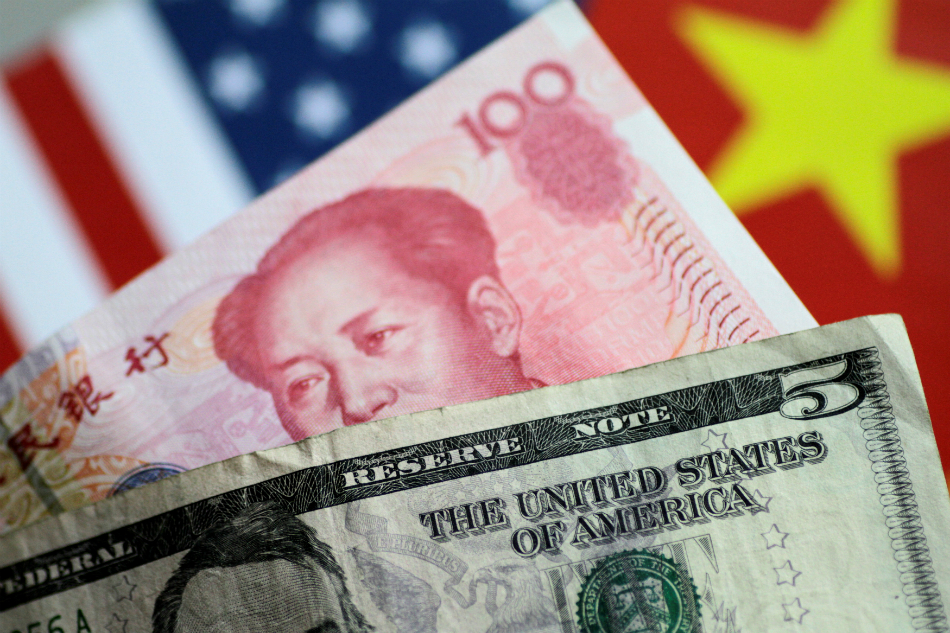
(12 January 2019) China’s central bank announced its plans to develop the Guangxi Zhuang autonomous region and turn it into a key channel for economic and financial cooperation between China and ASEAN. The central bank’s five-year development plan includes initiatives to encourage the promotion of the use of Chinese yuan in the region by allowing qualified issuers to issue yuan-denominated bonds in domestic markets and encouraging businesses from the region to purchase Chinese government bonds. Further, Guangxi will also serve as a pilot area for China’s Qualified Domestic Investment Enterprises initiative, which allows qualified institutions to invest funds raised domestically in overseas markets.
Read more>>

China tourism to ASEAN slowing
(15 January 2019) Most ASEAN countries saw a dip in the number of visitor arrivals from China in late 2018, according to a report by a regional financial institution. Singapore saw a decline of 12% in November, the Philippines by 3% in October, Vietnam by 2% in December and Thailand by 15% in November. This ease in Chinese tourists has been attributed to a slowing economy, a weaker yuan, and waning consumer confidence. The report also found China to be the largest contributor of tourists arrivals to four ASEAN countries, namely Vietnam (31%), Thailand (28%), Cambodia (22%) and Singapore (19%). Further, analysts expect ASEAN’s tourism outlook to remain bright in the long term, as it was noted that only 9% of Chinese citizens own a passport and China will have built 31 new airports by 2020.​
Read more>>

Cambodia looks to boost cultural and tourism exchanges with China
(15 January 2019) Meanwhile, Cambodian Prime Minister Hun Sen declared 2019 the ‘year of tourism exchange between Cambodia and China’ in conjunction with the 60th anniversary of diplomatic relations between the two countries. The Prime Minister added that Cambodia received 6.2 million international visitors in 2018, of which 1.6 million were Chinese tourists — thus making China the country’s largest source of tourists and biggest foreign investor. As such, the Prime Minister noted that tourism exchange between the two countries will be key to powering Cambodia’s economic growth, and the country aims to attract up to three million Chinese tourists in the next few years. These statements came as a prelude to Prime Minister Hun Sen’s official visit to China on January 20-23.
Read more>>

China was the Philippines’ top foreign investor in 2018
(11 January 2019) China topped the list of foreign investors in the Philippines in 2018 with investments worth US$930 million, of which a large part came from Hebei Iron & Steel Group’s investment in an integrated iron and steel plant in the southern Philippines. According to trade and industry secretary Ramon Lopez, foreign investment in the country reached US$2 billion last year. Other major foreign investors in the country were from Singapore, Indonesia, Japan and Malaysia.
Read more>>

Laos, Chinese firm cooperating in clean agriculture
(15 January 2019) The Lao government signed an agreement with a Chinese agriculture firm to develop clean agriculture projects in Vientiane and in provinces along the Laos-China railway line. Under the agreement, Meixiang Agriculture Development Co. will invest approximately US$13 million in the project over nine years. According to Lao agriculture and forestry deputy minister Phouangparisak Pravongviengkham, the project also aims to increase the capabilities of technical staff and farmers in the areas of green agriculture and the building of modern greenhouses, in hopes that this would enable them to export the produce to China. The project will commence with the building of five modern greenhouses as models, with each covering 3,000 square meters and producing 50,000 kg of 20 to 30 kinds of crops.
Read more>>

CARI Captures 387


c387_graphic


THAILAND

Thailand to host first Senior Economic Officials’ Meeting this month
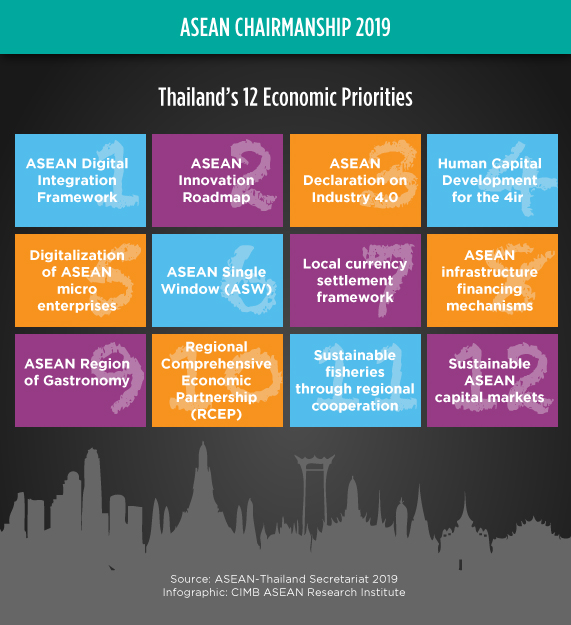
(8 January 2018) The Thai Ministry of Commerce will commence its term as the new ASEAN Chair with the first ASEAN Senior Economic Officials’ Meeting (SEOM) in Bangkok from 12-18 January. According to the director-general of its trade negotiations department Oramon Sapthaweetham, 12 economic priorities will be proposed during the meeting. The priorities include issues such as preparing the ASEAN workforce for the fourth industrial revolution, expanding the ASEAN Single Window Customs Systems to include all ASEAN Member States, and the promotion of sustainable tourism in the region. The meeting will also discuss ASEAN’s cooperation framework with its 11 dialogue partners and the finalization of the Regional Comprehensive Economic Partnership (RCEP), which is meant to conclude this year.

PHILIPPINES

Strong demand for Philippine global bond issue signals confidence
(8 January 2018) The Philippines raised US$1.5 billion in 10-year US dollar bonds to help fund its 2019 spending plan, making it the first emerging market to do so in the new year. According to its national treasurer Rosalia de Leon, the bonds carried a coupon of 3.75% and were priced at spread of US Treasuries plus 110 basis points, below guidance of plus 130 basis points amid strong demand. De Leon argued that this proved strong global investor confidence in the Philippine’s economic fundamentals. The move comes as the country looks to raise funds to support President Rodrigo Duterte’s infrastructure spending through bond offerings, which will include samurai and panda bonds.

INDONESIA

Indonesia mulling over electric car regime options
(9 January 2018) The Indonesian government is currently weighing regulatory options as it moves forward with plans to increase the adoption of green vehicles in order to reduce its reliance on fossil fuel imports. According to a government source, the administration intends to adopt either a pure electric vehicle regime from the outset or start first with hybrid electric vehicles (HEVs). The source claims that industry minister Airlangga Hartarto prefers a gradual shift by first using HEVs, as these vehicles do not require charging stations and would therefore place less of a financial burden on the government, while energy and mineral resources minister Ignasius Johan prefers outright adoption of pure electric vehicles. The government is expected to announce presidential regulations and tax incentives to encourage the sale of electric vehicles and the development of a domestic electric car industry.

CAMBODIA

Cambodia’s single window system still in test phase
(9 January 2019) Cambodia’s national single window system is currently in its trial phase. The country has thus far upgraded the system to allow export certificates to be signed and stamped electronically, and is currently testing the cargo clearance system. Joining the ASEAN Single Window system is a priority for the country, said the director of its export and import department, who did not provide a specific implementation timeline. Further, the Cambodia Chamber of Commerce extolled the country’s progress in adopting the system but expressed doubts that it will be fully adopted by all ASEAN Member States this year.

VIETNAM

Customs reforms and modernisation help boost cross-border trade
(10 January 2019) Vietnam is committed to reforming its cross-border trade mechanisms to ease the flow of goods and services across the border, said deputy director-general of general department of Vietnam customs in an interview with the Vietnam Economic Times. Touting the department’s modernisation initiatives, the senior official shared that the customs authority has continued to maintain stable operation of its e-Customs system, which has a 99.65% participation rate from enterprises currently working with customs agencies throughout the country. Furthermore, its national single window has processed over 1.6 million documents and attracted the participation of over 25,000 enterprises. Vietnam is also working with its ASEAN partners on the implementation and expansion of mechanisms under the ASEAN Single Window (ASW), especially in the exchange of certificates of origin.

SINGAPORE

Singapore announces new digital transformation initiatives
(9 January 2019) Singapore’s Infocomm Media Development Authority (IMDA) and Enterprise Singapore recently launched the Start Digital programme to accelerate the adoption of digital solutions among small and medium enterprises (SMEs). Under the programme, SMEs will gain access to two out of five foundational digital solutions related to core business functions — accounting, human resource management system and payroll, digital marketing, digital transaction, cybersecurity — with costs waived for at least six months. Two other initiatives were announced alongside the Start Digital programme, including the Pan-European Public Procurement Online (PEPPOL) e-invoicing standard which will enable companies in Singapore to exchange e-invoices via the network with other similarly-connected parties, and a data protection assurance certification called the Data Protection Trustmark (DPTM) that will help validate an organization’s data protection regime.

MALAYSIA

Malaysia’s cashless conundrum
(9 January 2019) A study by Nielsen found that while 63% of Malaysians have a debit card, most still prefer to use cash when making payments for daily expenses. Of those surveyed, 93% prefer cash when dining out, 90% use cash when buying groceries, 89% use cash for public transport, 81% use cash for petrol, 81% use cash for taxis, and only 8% of Malaysians have adopted mobile wallets. The study also revealed that Malaysians prefer the convenience offered by online banking when it comes to recurring expenses such as phone and internet bills (53%), utility bills (47%), car loan instalments (38%) and rent (37%). Further, the study found that the public’s three main concerns when it comes to digital money are security and fraud, control and overspending, as well as merchant acceptance of mobile payment wallets.

BRUNEI

Sluggish demand, tighter loan approvals weigh on Brunei property market
(7 January 2019) Prices of residential properties in Brunei are slipping due to lacklustre demand and increasingly stringent requirements for bank loans, say industry players. A recent report by Autoriti Monetari Brunei Darussalam (AMBD) found that Brunei’s Residential Property Price Index (RPPI) fell by 5.7% year-on-year to 85.5% in the third quarter of 2018, while it fell by 5.7% compared to the second quarter of 2018 on a quarter by quarter basis. AMBD also found that the median purchase price for all residential properties in the third quarter was US$183,000.

INDONESIA

Indonesia sees encouraging growth in horticultural exports
(9 January 2018) Indonesia saw a jump in exports of its horticultural commodities in 2018, with fruit exports increasing by 26.27% compared to the previous year. According to agricultural minister Amran Sulaiman, horticultural exports as a whole increased by 11.92% or US$355.71 million last year. Indonesia exports 42 types of horticultural commodities to 12 countries around the world, of which most is produced by farmers in West Java. The minister said that the government has thus far revoked 291 regulations to help expedite the licensing process for exports and it will continue to carry out reforms to increase agricultural exports.

PHILIPPINES-INDONESIA

Philippines seeks balance trade with Indonesia
(9 January 2019) The Philippines has asked Indonesia to adjust its trade protocols and allow greater market access for its exports, failing which it may have to impose stricter trade measures against its ASEAN neighbour. According to the Philippines’ agriculture secretary Emmanuel Pinol, Indonesia’s agricultural exports to the Philippines are worth US$1 billion, while the Philippines only exports US$50 million worth of agricultural products to Indonesia. As such, the Philippines government is now considering imposing quantitative restrictions and tariffs on Indonesia’s palm oil exports to balance the scale. However, the Philippines maintains that it still hopes to discuss the issue with Indonesia, despite disappointing results from a previous negotiation held in December 2018.

Mekong Monitor


thai-deputy-prime-minister-chatchai-sarikulya-with-eu-commissioner-of-environment--maritime-affairs-and-fisheries-karmenu-vella

Photo credit: Channel NewsAsia


TRADE, ECONOMY, AND INVESTMENT


THAILAND

Thailand welcomes EU decision to drop ‘yellow card’ warning overfishing practises
(9 January 2019) Thailand on 9 January 2019 welcomed the decision by the European Union to drop its ‘yellow card’ warning over its fishing practices. In 2015 Thailand was included in a list of countries as a warning over its unsustainable fishing practices, which carried the threat of a European ban on its exports. The EU Commission claimed that following the warning being issued, both Thailand and the Commission had been ‘engaged in a constructive process of cooperation and dialogue’ resulting in Thailand upgrading its fisheries governance in line with international standards. Among the reforms made included new vessels monitoring systems, satellite tracking of its fishing vessels, and tougher regulations with regards to human trafficking and ill-treatment of migrant workers in its fishing industry. Thai seafood exports rose to US$2.1 billion in 2017, recovering to its 2014 level after a drop to US$1.8 billion in 2015 following the EU warning. 9.9% of its seafood exports went to the EU in 2018, versus 10.3% in 2014.
Read more>>

CAMBODIA, MYANMAR

EU threatens to end trade preferences for Cambodia and Myanmar, spurring different responses
(8 January 2019) EU threatens to end trade preferences for both Cambodia and Myanmar over their human rights issues has spurred both countries to respond in different ways. In October, the European Commission declared that it was ready to terminate an arrangement granting both countries tariff-free access to the EU, pointing to alleged human rights abuses in both countries. Cambodia has reportedly sought to ease political restrictions, with its parliament in December passing a law which would allow members of the banned opposition party Cambodia National Rescue Party (CNRP) to return to politics. The CNRP had been disbanded by the Supreme Court in 2017 on accusations of attempting to seize power with the help of the US. In Myanmar, threats of EU sanctions following its perceived mishandling of the Rohingya issue has pressured the country to ease restrictions to foreign direct investment. Officials have announced moves to open the insurance market to foreign capital, as well as forming an interagency body tasked with drawing foreign investment. Both Cambodia and Myanmar operate under the EU’s Everything But Arms scheme, which allows both nations to export all goods except arms to the EU duty-free.
Read more>>

LAOS

Laotian authorities to continue documenting illegal foreign workers and providing them with work permits
(8 January 2019) Laotian authorities from different ministries and government bodies met on 7 January 2019 in Vientiane to discuss the draft of a labour regulation addressing the issue of foreign workers in Laos. The meeting was attended by the Ministers of Labor and Social Welfare and the Deputy Minister of Public Security. Over 42,000 foreign workers have registered in Laos, mainly from Vietnam, China, and Thailand. It was reported that the authorities will continue to register undocumented foreign workers and issue them with temporary work permits as had been done in 2018. Measures are also being taken to identify the number of illegal foreign workers in a bid to control undocumented migrant labour in the country.
Read more>>

CAMBODIA

Investment applications to Thailand top US$28 billion in 2018, exceeding official target
(9 January 2019) Thailand’s state investment agency on 9 January 2019 reported that Investment applications to Thailand reached a total of THB 902 billion (US$28.2 billion) worth of projects in 2018, 43% higher than in 2017 and beating the official target of THB 720 billion (US$22.53 billion). Thai and foreign governments submitted a total of 1,626 project applications in Thailand in 2018, with some THB680 billion (US$21.23 billion) focused on the Eastern Economic Corridor, a development corridor focused on high tech industries. The Board of Investment has set a target for THB750 billion (US$23.42 billion) worth of investment pledges for 2019, hoping to capitalize on companies shifting production out of China to Southeast Asia due to the ongoing trade war between the US and China.
Read more>>

VIETNAM, CAMBODIA

Vietnamese exports to Cambodia jump above US$3 billion in 2018, setting new record high in last decade
(8 January 2019) Vietnamese exports to Cambodia jumped above US$3 billion in 2018, setting a new record high in the last decade and opening new opportunities for Vietnamese firms to capitalize on the Cambodian market. In the last three years, the value of Vietnamese exports to Cambodia increased from US$2.2 billion in 2016 to US$2.8 billion in 2017, and measured at US$3.4 billion in the first 11 months of 2018. During the January to November period last year, steel, petroleum, and garment textile exports accounted for 49.63% of total exports to Cambodia. In 2018, the Cambodian government introduced the Rectangular Strategy-Phase 4, which prioritizes the boosting economic development via increasing business activities with major partners and foreign direct investment, as well as boosting international trade. It is reported that this will benefit Vietnamese firms seeking to invest in Cambodia. It was reported that as of November 2018, Vietnam has 210 investment projects in Cambodia with combined registered capital exceeding US$3 billion.
Read more>>


mekong-monitor-map

About Greater Mekong Subregion (GMS)

The Greater Mekong Subregion (GMS) Economic Programme was launched by the Asian Development Bank in 1992 connecting five developing ASEAN countries, namely Cambodia, Laos, Myanmar, Vietnam and Thailand, and Chinese provinces of Yunnan and Guangxi Zhuang Autonomous region. The region has some of the most robust economies sharing the Mekong River Basin thanks to its reform and liberalisation. The subregion is growing at a faster pace than the whole of East Asia and the Asia Pacific as the GDP growth rate for 2017 was at 6.4 percent, according to the World Bank. The population at the subregion as of 2016 is at 340 million while the GDP at PPP is at US$3.1 trillion in 2016. In 2015, trading within the region was at US$444 billion.

China-ASEAN Monitor


img-ca-090118

Photo Credit: ABS-CBN News


Economy, Investment and Trade


Southeast Asians wary of China’s Belt and Road Initiative projects
(7 January 2019) 70% of Southeast Asians believe their governments should be cautious when negotiating China’s Belt and Road Initiative projects, according to a recent survey released on 7 January 2019. The survey was carried out by the Singapore-based ISEAS-Yusof Ishak Institute, and polled 1,008 respondents from all ASEAN member states. The people polled came from government, academia, media, civil society, and business. 45% of those surveyed also believed that China sought to make Southeast Asia into its sphere of influence, while only 8.9% saw China as a ‘a benign and benevolent power’. China also topped the distrust ranking of major powers at 51.5%, while conversely Japan was considered the most trustworthy at 65.9%. The authors of the study noted that “This result … is a wake-up call for China to burnish its negative image across Southeast Asia despite Beijing’s repeated assurance of its benign and peaceful rise.”
Read more>>

East Coast Rail Link project in Malaysia may continue, awaiting report from contractors
(3 January 2019) China’s ambassador to Malaysia Bai Tian stated during a press conference in Perak, Malaysia, on 3 January 2019 that the China-backed East Coast Rail Link (ECRL) megaproject in Malaysia may be continued, and that Beijing and Kuala Lumpur are awaiting a report from the contractors from both sides before making any final decision. A report is due from the project owner Malaysia Rail Link and its main contractor China Communications Construction Company. Bai Tian stated that both countries have been in negotiation over continuing the project, and that they ‘are still optimistic about the outcome’. His comments follow comments made by Malaysian Prime Minister Mahathir Mohamad during an interview on 31 December 2018 that the project could possibly continue albeit on a smaller scale. The ECRL project had been scrapped shortly following Malaysia’s shock general election in May 2018, citing concerns over costs and high national debt.
Read more>>

Laos and China mull Visit Laos-China Year 2019
(4 January 2019) Laotian and Chinese authorities are mulling whether to launch the Visit Laos-China Year 2019 programme at the end of January or during Chinese New Year. According to news reports, Laotian Minister of Information, Culture and Tourism, Prof. Dr Bosengkham Vongdara, had signed the plan for the programme, which had been submitted to Laos Prime Minister Thongloun Sisoulith for consideration. Officials from both countries had agreed to the plan when they met in Hong Kong in December 2018. Both countries plan to hold a meeting on tourism management in June and -July in the Champassak province of Laos. The plan proposes that the opening ceremony be held in Vientiane featuring cultural shows by Chinese and Laos artists and food fairs. Lao Culture Weeks will also be held in the Chinese provinces of Hunan and Sichuan. In the plan, Dr. Bosengkham also suggested that the Lao government consider waiving the need for visas or reducing the visa fees for Chinese tourists in 2019, as well as making it easier for Chinese tourists to pass through immigration. Inappropriate charges and inspections along roads and tourist sites were also encouraged to be removed.
Read more>>

Singapore encourages more ASEAN countries to utilize new trade corridor to Western China
(8 January 2018) Singaporean Trade and Industry Minister Chan Chun Sing has urged officials from ASEAN to utilize the new land and sea corridor extending from Western China to Southeast Asia. Mr Chan made these comments during a forum on the new trade route held in Chongqing in China. Chan argued that the trade route is faster and costs less than the existing route along the Yangtze river. The corridor is composed of railway networks in Western China which end at Qinzhou port in Guangxi province and further connects to Southeast Asia. The networks are an expansion of the Chongqing Connectivity Initiative (CCI), a joint project between Singapore and China to develop China’s western provinces through better transport, financing, and data connectivity. A total of eight Chinese provinces have joined the network, including Chongqing, Guangxi, Guizhou, Gansu, Qinghai, Yunnan, Ningxia and Xinjiang. Mr Chan and Chongqing party boss Chen Min’er witnessed the signing of the pact in Chongqing on 7 January 2019.
Read more>>

Laotian villagers object to plans for Chinese-funded SEZ
(4 January 2019) Laotian villagers in the Vang Vieng region of Laos prevented attempts to survey their land in relation to a proposed Chinese-funded tourism project. The proposed special economic zone is called the Sustainable Tourism Development Project and is managed by Chinese firm Lao-Vang Vieng New Area Development Company. It will reportedly affect 22 villages in the region. The villagers fear being displaced from their homes, and the confrontation with the company employees attempting to survey the land took place near the end of December 2018, according to a Radio Free Asia report. The project was agreed upon in an MOU signed last year at a cost of US$ 5.5 billion. The project will last over 15 years and is estimated to create 50,000 jobs. Laos has become a huge destination for foreign direct investment over the years, especially from China.
Read more>>