CARI Captures 403


MALAYSIA-NORWAY

Malaysia’s Axiata and Norway’s Telenor plan one of Asia’s largest cross-border mergers
(6 May 2019) Malaysia’s Axiata Group and Norway’s Telenor Group announced on May 6 that the companies were in talks to merge their South and Southeast Asian operations. According to a Reuters source, the merged entity would be worth US$40 billion, making it one of the largest cross-border mergers Asia has seen. According to Axiata Group head Jamaludin Ibrahim, the deal would combine the scale and capabilities of both companies to drive growth in the highly competitive South and Southeast Asian markets. If merged, the joint entity will have almost 300 million existing customers with operations in nine countries, including Thailand, Malaysia, Indonesia, Pakistan and Bangladesh. Telenor will own 56.5% of the entity and Axiata will own 43.5%. The proposed deal is seen as beneficial to Malaysia, not least because the merged entity would be headquartered in Kuala Lumpur, be listed on the Malaysian stock exchange and come with a proposed regional innovation centre. According to the head of Axiata’s largest shareholder, Khazanah National Shahril Ridza Ridzuan, the innovation centre would create over 100 jobs and generate US$24.1 million in investments annually. The establishment of the merged entity, MergedCo, will reportedly happen by the third quarter of 2020.

CAMBODIA-UK

UK assures Cambodia of continued trade privileges post-Brexit
(8 May 2019) Trade between Cambodia and the UK has grown over the years as both countries enjoy ‘thriving’ trade relations, said Cambodian acting commerce minister Kem Sithan during his meeting with the UK’s air vice-marshal John Philliban on May 7. According to the acting minister, trade between the countries rose from US$500 million in 2012 to over US$1 billion in 2018. Of the sum, Cambodia exported US$500 million worth of goods to the UK in the first half of last year, and imported US$22 million worth of goods during the same period. Additionally, ministry spokesman Seang Thay said that once the UK leaves the EU, Cambodia will automatically lose its Everything But Arms (EBA) privileges that it enjoys when trading with the EU. However, he said, Cambodia will likely continue to enjoy preferential access to the UK based on World Trade Organization (WTO) regulations.

CAMBODIA-EU

Cambodia’s exports to the EU could fall by US$654 million annually if EBA suspended
(6 May 2019) Cambodia’s exports to Europe could decline by US$654 million per year if the European Union (EU) goes ahead with lifting the country’s tariff privileges under the bloc’s Everything But Arms (EBA) scheme, according to a World Bank report. The report further projects that if the privileges are withdrawn, tariffs on garment exports would increase by 12%, footwear exports by 16% and bicycle exports by 10%. This would, it notes, come in addition to the EU’s rice tariffs on Cambodian rice which came into force in January. Meanwhile, a group of European garment producers — which includes Nike, Adidas and Levi Strauss — sent a letter to Cambodian Prime Minister Hun Sen on May 2 urging him to take heed of the EU’s concerns and work with them to protect labour rights in the country.

INDONESIA, MALAYSIA, THAILAND

Leading palm oil producers take steps to boost palm oil consumption
(4 May 2019) Malaysian primary industries minister Teresa Kok is currently in the EU with representatives from key Malaysian palm oil agencies on a “palm oil economic and promotion mission” from May 3 to 13, according to a statement by her ministry. During the mission, Kok will visit key EU member states (UK, Belgium, Germany and Italy) to promote palm oil and palm-based products, address anti-palm oil sentiments, as well as engage key European palm oil stakeholders. Closer to home, the Indonesian Biodiesel Producers Association (APROBI) head M.P. Tumanggor told Reuters that the association hopes to expedite road tests for B30 biodiesel in order to increase domestic consumption of the product as soon as possible. According to APROBI, the B30 implementation could boost domestic consumption by up to 10 million kilolitres. Current regulations state that road vehicles will have to start using B30 fuel from 2020. Meanwhile, Thailand’s Energy Ministry has directed the state-owned Electricity Generating Authority of Thailand (EGAT) to purchase 200,000 tonnes of crude palm oil as part of its plan to increase domestic prices of fresh palm nuts and crude palm oil. According to energy minister Siri Jirapongphan, the first batch of 100,000 tonnes should be purchased by May 23.

THAILAND

Thailand aims to revive slumping exports caused by the prolonged trade war
(7 May 2019) Thailand’s Trade and Policy Strategy Office (TPSO) is currently developing plans to boost exports through different methods such as trade promotion activities, plans for market penetration by province/cities, and promotion of border activities, said TPSO head Pimchanok Vonkorpon. They also hope to finalise negotiations on the Regional Comprehensive Economic Partnership (RCEP) by the end of the year. According to Vonkorpon, the TPSO was greatly concerned by the recent drop in exports caused by the prolonged US-China trade war. Thai exports saw a 1.6% decline in the first quarter of 2019, led by a 9.2% drop in exports to China. Thai products that were directly impacted by the trade war include vehicles, computer parts, electrical appliances, tools and office supplies. However, Thai exports to the US saw a 32.2% increase during the same period, and Vonkorpon is optimistic that exports to the US will continue to grow as producers look to substitute Chinese goods.

THE PHILIPPINES

Trade deficit expands to US$9.8 billion in Q1 as exports slump
(9 May 2019) The Philippines’ trade-in-goods deficit expanded to US$9.8 billion in the first quarter of 2019, up 21% from US$8.1 billion in the same period last year, based on the latest data published by the Philippine Statistics Authority (PSA). According to the data, the widening deficit was caused by a decline in exports and increase in imports — exports in the first quarter saw a year-on-year 3.13% decline from US$16.9 billion to US$16.36 billion, while imports in the first quarter saw a year-on-year 4.68% increase from US$25 billion to US$26.17 billion. Commenting on the matter, president of the Philippine Exporters Confederation (Philexport), Sergio R. Ortiz-Luis Jr. said he does not see things improving for the export sector this year due to the ongoing US-China trade war, as well as other global and local economic factors. Trade secretary Ramon M. Lopez concurred with Ortiz-Luis, saying that the decline in exports can be attributed to supply-driven issues influenced by the trade war.

THE PHILIPPINES

Government-approved investments rose 46.5% in the first four months of 2019
(6 May 2019) Investment projects registered with the Philippines’ Board of Investments (BOI) saw a 46.49% jump reaching US$5.49 billion in the first four months of 2019, up from US$3.75 billion in the same period in 2018. Energy projects accounted for 64.66% of the total at US$3.55 billion, up 77.75% from US$2 billion in the first four months of 2018. According to trade undersecretary and BOI head Ceferino S. Rodolfo, the rise in green energy investment approvals was in line with the government’s commitment to developing “clean and green” infrastructure systems. He added that while green projects benefit from tax incentives, the companies had to apply for endorsements from the Department of Energy, Environment and Natural Resources before the projects were approved by the BOI. Meanwhile, investment pledges from local companies grew by almost 14% reaching US$4.2 billion, while foreign investment pledges reached US$1.28 billion.

SINGAPORE

Singapore manufacturing affected by skill shortages and labour curbs
(5 May 2019) Singapore is struggling to meet the country’s growing demands for highly skilled labour despite its ability to attract high-tech manufacturing investments, according to an AFP report. The report cited statistics from the Ministry of Manpower, which provides that one in three job openings in the country in 2018 was left unfilled for at least six months, with employers citing a “lack of candidates with the necessary specialised skills” as one of the key reasons for the slow filling of openings. Previously, the government responded to the public’s unease of the growing number of foreign workers by making it harder to hire in selected sectors and prioritising local recruitment. Furthermore, local education institutions may face an uphill challenge in adjusting their curricula to meet changing industry demands. Nevertheless, according to a Singaporean Institute of Policy Studies analyst, it would appear that, at least for now, Singaporeans have “accepted a trade-off of lower economic growth for a restrictive foreign labour policy, in favour of social considerations.”

ASEAN+3

ASEAN+3 finance officials agree to promote infrastructure finance and green bonds
(3 May 2019) The ASEAN+3 (China, Japan and South Korea) finance ministers and central bank governors shared their commitment to promote green bonds under a new initiative that they have dubbed the ASEAN Bond Market Initiatives (ABMI) Midterm Roadmap 2019-2022. According to the officials, the roadmap outlines the direction and key activities of the ABMI, aimed at advancing regional financial stability and integration. The ABMI will include the development of the ASEAN+3 Multi-Currency Bond Issuance Framework (AMBIF), as well as contributions to the capital increase proposal of the credit guarantee and investment facility. These initiatives come in addition to an earlier agreement between the officials to promote the use of local currencies in the region to lower financing costs and lessen the countries’ dependence on currencies from outside the region.

VIETNAM-SWEDEN

Swedish Crown Princess co-chairs bilateral business summit with Vietnamese Deputy Prime Minister
(7 May 2019) This is a “golden” era for bilateral economic, trade and investment cooperation between Sweden and Vietnam, said Vietnamese Deputy Prime Minister Pham Binh Minh during the Vietnam-Sweden Business Summit on May 7. The summit was held in conjunction with the Crown Princess of Sweden Victoria Ingrid Alice Desiree’s official visit to Vietnam on May 6 to 8 in celebration of the 50th anniversary of the countries’ bilateral ties. According to Pham, bilateral trade between Sweden and Vietnam reached US$1.5 billion in 2018. Sweden currently has 67 projects in Vietnam worth US$364 million. Crown Princess Victoria, for her part, expressed support for Vietnam’s continued commitment to the United Nations Sustainable Development Goals (SDGs) and looked forward to greater cooperation between firms in both countries.

Indonesia’s 1Q19 GDP growth of 5.1% slightly disappoints


HIGHLIGHTS

1Q19 GDP growth

  • 1Q19 real GDP growth came in slightly below expectation at 5.1% yoy on slowing investment activity and the drag from inventory contribution.
  • We raise our 2019 GDP growth forecast by 0.1% pt to 5.2% to account for stronger domestic demand.

Weaker-than-expected expansion at 5.1% yoy
1Q19 real GDP growth of 5.1% yoy slightly disappointed compared to our and market expectations of 5.2% yoy (+5.2% yoy in 4Q18). The key reason for the deviation from our forecast was a smaller-than-expected recovery in net export contribution (+1.2% pts in 1Q19 vs. -0.6% pt in 4Q18), which was offset by falling inventory (-0.3% pt in 1Q19 vs. +1.5% pts in 4Q18). Domestic demand growth eased to 5.2% yoy (+5.4% yoy in 4Q18) as investment activity lagged behind consumption.

Snag in capital outlays…
Investment growth eased to a two-year low of 5.0% yoy in 1Q19 (+6.0% yoy in 4Q18), weighed down by high base effects in machineries, vehicles and other equipment. Firms may have taken a wait-and-see approach ahead of the election. Ongoing infrastructure projects lifted spending in building and structures (+5.5% yoy in 1Q19 vs. +5.0% yoy in 4Q18), as reflected in the construction sector (+5.9% yoy in 1Q19 vs. +5.6% yoy in 4Q18).

… offset consumption boost
Higher personal and social spending and regional transfers lifted public consumption (+5.2% yoy vs. +4.6% yoy in 4Q18). Low-income households’ purchasing power was boosted by pre-election cash handouts, leading to strong consumption of staples, such as F&B and clothing, as well as healthcare and education. Nonetheless, household consumption growth eased slightly (+5.0% yoy vs. +5.1% yoy in 4Q18) as spending on transport took a backseat (see Fig 2). Faster demand growth of non-profit institutions serving households (+16.9% yoy vs +10.8% yoy in 4Q18) was led by election campaign spending.

Stronger services and construction activity
The consumption boost lifted performance in the services sector, in particular wholesale & retail trade (+5.3% yoy vs. +4.4% yoy in 4Q18), business services (+10.4% yoy vs. +8.9% yoy in 4Q18), and information & communication (+9.0% yoy vs. +7.2% yoy in 4Q18), while compensating for weaker growth in other sectors: agriculture (+1.8% yoy in 1Q19 vs. +3.8% yoy in 4Q18) and manufacturing (+3.9% yoy vs. +4.2% yoy in 4Q18).

Policy continuity post elections to support economic expansion
Despite missing expectations, 1Q19 GDP growth was the strongest compared to the same quarter in the past four years. We expect investment growth to pick up in the upcoming quarters, supported by stronger investor confidence with Jokowi likely to be reelected. Policies promoting consumer price stability, civil servants’ salary hikes and social assistance for low-income households should support consumption growth, leading us to tweak our 2019 GDP growth forecast up from 5.1% to 5.2%.


Stronger public consumption (+5.2% yoy in 1Q19 vs. +4.6% yoy in 4Q18) reflected elevated social spending, which, among other things, included a higher quantum of cash handouts for the low-income household group, contributing to stronger household consumption in F&B, clothing, health & education. Election campaign spending boosted consumption growth of non-profit institutions serving households (+16.9% yoy in 1Q19 vs. +10.8% yoy in 4Q18).


1Q19 investment growth of 5% yoy was the lowest in two years, partly due to high base effects in machineries, vehicles and other equipment, in tandem with falling imports of capital goods. National strategic projects continued to support building & structures spending (+5.5% yoy in 1Q19 vs. +5.0% yoy in 4Q18).


Agriculture GDP growth was at a three-year low of 1.8% yoy in 1Q19 amid lower production of farm food crops. Steady growth in the mining sector was supported by continued expansion in coal mining and a smaller decline in O&G mining.
Manufacturing GDP growth eased to 3.9% yoy (+4.2% yoy in 4Q18) as activity declined in the manufacture of transport equipment as well as the downstream commodity segment, i.e. O&G, coal, rubber, wood, non-metallic quarrying.
Construction activity (+5.9% yoy vs. +5.6% yoy in 4Q18) was stronger amid a pick-up in buildings & structure investment.
The services sector was supported by wholesale & retail trade, information & communication, finance & insurance, real estate, business services and education.


Originally published by CIMB Research and Economics on 7 May 2019.

Malaysia cuts OPR rate to 3.00% against expectations


HIGHLIGHTS

May Monetary Policy Committee – Overnight Policy Rate cut by 25bp

  • OPR cut by 25bp to 3.00% against our expectations of a hold in May.
  • Tightening domestic financial conditions and concerns over downside risks to the global economy prompted the pre-emptive monetary easing.
  • Having deployed policy buffers against downside risks to the economy, we expect BNM to stand pat on the OPR at 3.00% for the rest of 2019.

BNM cuts OPR rate by 25bp to 3.00%…
Bank Negara Malaysia’s (BNM) Monetary Policy Committee (MPC) has cut the Overnight Policy Rate (OPR) by 25bp to 3.00%, the first policy change in eight meetings, against our expectations of a hold. Forecasters were split ahead of the decision, with the Bloomberg consensus marginally skewed towards an OPR cut. The ceiling and floor rates of the OPR corridor were correspondingly reduced to 3.25% and 2.75%, respectively.


Despite acknowledging the resilience of domestic financial markets to bouts of volatility, the MPC statement pointed out BNM’s discomfort with signs of tightening in domestic financial conditions. Inflation undershot expectations again in March, keeping real interest rates at elevated levels. Commercial bank lending rates had been creeping higher (+10bp between September 2018 and March 2019) while loan growth slipped to a 10-month low of 4.9% yoy in March. The OPR cut was intended to maintain monetary accommodativeness in line with its price stability mandate, in light of the risks posed to BNM’s baseline GDP growth forecast of 4.3-4.8% in 2019 (CIMB: +4.7%).

… and “considerable downside risks” in the global economy
While BNM noted that the external environment turned out better-than-expected in 1Q19 and the squeeze in global financial conditions eased, the central bank placed emphasis on “considerable downside risks” to global growth arising from the trade spats and country-specific weakness. The negative turn of events in the US-China trade negotiations and re-escalation of tariff threats over the weekend may have also nudged policymakers in the direction of easing, as BNM had estimated that the US’s imposition of 25% tariffs on its remaining imports from China and blanket auto tariffs could shave 1% pt off Malaysia’s projected GDP growth.

One and done
Today’s interest rate cut should not be interpreted as the start of an extended cycle of policy easing. Since 2011, BNM has engaged in minor one-step tweaks in monetary policy, and this time should not be any different. We retain our year-end OPR forecast of 3.00%, implying no further policy rate changes in the second half of 2019. A developing risk to our call is the abrupt breakdown in the US-China trade talks and potential intensification of a tariff tit-for-tat.


IPI growth in 2M19 (+2.5% yoy) is tracking below 4Q18’s (+3.2% yoy). Unless mining output and factory activity accelerate sharply in March, the segment’s contribution to real GDP growth could weaken in 1Q19. Nonetheless, the downside is cushioned by a recovery in the agriculture sector, particularly palm oil production. We maintain our 2019 forecasts for IPI growth (+3.7%) and GDP growth (+4.7%).

Light emerging at the end of the tunnel
Malaysia’s manufacturing PMI rebounded from 47.2 in March to 49.4 in April after new export orders increased for the first time in five months. While exports contracted 1.5% yoy in 1Q19, we think progress on a US-China trade agreement and green shoots emerging in regional industrial indicators could presage a turnaround for manufactured goods exports in 2H19.

Originally published by CIMB Research and Economics on 7 May 2019.

This article has been edited to reflect its time-sensitivity.

Mekong Monitor


Photo credit: The Nation


TRADE, ECONOMY, AND INVESTMENT


THAILAND-CLMV

EXIM Thailand to continue supporting Thai SME expansion to CLMV markets
(3 May 2019) Export-Import Bank of Thailand (EXIM Thailand) president Pisit Serewiwattana reiterated the state-owned institution’s commitment to supporting Thai SME (small and medium enterprises) exports to neighbouring CLMV (Cambodia, Laos, Myanmar, Vietnam) markets, even if the bank has to continue shouldering a portion of the funding costs. Serewiwattana said that the bank was willing to do so as they were “optimistic” about the CLMV subregion’s economic outlook. Furthermore, Thailand’s exports to CLMV markets are projected to rise by double digits in 2019, building on its 16.6% growth momentum in 2018. According to Serewiwattana, capital goods such as mechanical devices and parts, agricultural machines and construction materials, and consumer goods such as garments, fruits and goods were earmarked as high-potential export goods to the CLMV region.
Read more>>

THAILAND

Thailand’s Q1 cross-border trade records 1.86% growth
(3 May 2019) Thai cross-border trade recorded an overall 1.86% increase in the first quarter of 2019, reaching US$10.76 billion, according to the country’s Department of Foreign Trade director-general Adul Chotinisakorn. Of the sum, its exports saw a 0.49% increase reaching US$6.04 billion, while its imports recorded a 3.66% increase amounting to US$4.72 billion. Furthermore, Thai border trade with Myanmar reached US$1.59 billion, US$1.51 billion with Laos, US$1.32 billion with Cambodia and US$588 million with Vietnam. Myanmar was Thailand’s second largest trading partner, behind Malaysia, which had a border trade value of US$4.39 billion. According to Chotinisakorn, the rise in border trade can be attributed to recent trade promotion activities such as the Four Border Regions Trade Expo to promote border and special economic zone trade, as well as SME business matching events in provinces along the Thai-Myanmar border.
Read more>>

CAMBODIA

Cambodia launches new version of trade strategy to strengthen its competitiveness
(5 May 2019) Cambodia’s Ministry of Commerce launched the fourth Cambodia Trade Integration Strategy (CTIS) for the 2019-2023 period recently. According to commerce minister Pan Sorasak, the new strategy aims to address all major issues in the trade sector, facilitate the country’s transition into a developed economy by strengthening the country’s competitiveness, and prepare the country for growth opportunities presented by the Fourth Industrial Revolution. Furthermore, all ministries are expected to participate in the new strategy in order to boost the country’s competitiveness, diversify its markets to increase exports, and help realise the government’s rectangular growth strategy.
Read more>>

LAOS

Laos posts US$5.41 billion in export earnings in 2019, with Thailand as largest trading partner
(6 May 2019) Laos’ overall export revenue totalled US$5.41 billion in 2018, according to the latest statistics published by the Laotian Ministry of Industry and Trade. Of the sum, US$1.31 billion were derived from exports traded under preferential trade frameworks such as the Generalised Scheme of Preferences (GSP) and other free trade agreements. According to the ministry’s statistics, Laos’ top export destinations in the Mekong subregion were Thailand (US$425.86 million) and Vietnam (US$332.85 million). Furthermore, Thailand was also the country’s top Mekong import source with US$329.04 million worth of goods imported last year, followed by China (US$79.58 million) and Vietnam (US$76.39 million). The country’s top exports were industrial goods, agricultural products, and minerals, while its imports were mainly machinery and parts, construction materials, and garments and home utensils.
Read more>>

MYANMAR

Myanmar’s overseas trade reaches US$19.9 billion in seven months of the 2018/2019 fiscal year
(4 May 2019) Myanmar’s overseas trade amounted to US$19.9 billion in the first seven months of the 2018/2019 fiscal year, an increase of almost US$700 million from the same period in the previous fiscal year, according to the latest figures published by its Commerce Ministry. Of the sum, exports accounted for US$9.6 billion while imports exceeded US$10.3 billion, resulting in a US$700 million trade deficit. More specifically, the country’s maritime trade accounted for US$13.9 billion of total trade, with exports transported over the sea reaching US$5.3 billion and imports amounting to US$8.65 billion. Myanmar’s border trade measured at US$5.99 billion in the same period. According to the ministry, the country’s key exports were agricultural, animal, fisheries, minerals and forest products, while its key imports were capital goods, intermediate goods and consumer goods.
Read more>>


mekong-monitor-map

About Greater Mekong Subregion (GMS)

The Greater Mekong Subregion (GMS) Economic Programme was launched by the Asian Development Bank in 1992 connecting five developing ASEAN countries, namely Cambodia, Laos, Myanmar, Vietnam and Thailand, and Chinese provinces of Yunnan and Guangxi Zhuang Autonomous region. The region has some of the most robust economies sharing the Mekong River Basin thanks to its reform and liberalisation. The subregion is growing at a faster pace than the whole of East Asia and the Asia Pacific as the GDP growth rate for 2017 was at 6.4 percent, according to the World Bank. The population at the subregion as of 2016 is at 340 million while the GDP at PPP is at US$3.1 trillion in 2016. In 2015, trading within the region was at US$444 billion.

China-ASEAN Monitor


Photo credit: Reuters


Economy, Investment and Trade


Cambodian rice exports to China rise following EU tariffs
(6 May 2019) Cambodian rice exports to China increased by 45.6% in the month of February as compared to the previous month, while its exports to the European Union (EU) reached 10,080 tonnes in the same month, a 57.5% decline from the previous month, according to the World Bank. Moreover, the rise in exports to China led to an overall 2% increase in Cambodian rice exports in the first two months of 2019 — despite the European Union’s imposition of safeguard tariffs on Cambodian rice to protect European producers. According to the World Bank, this indicates that the overall decline of Cambodia’s exports to the EU was “more than offset” by its increased exports to China.
Read more>>

Malaysia’s e-commerce platform to facilitate China-ASEAN commodities trading
(2 May 2019) Malaysia is well-placed to be the entry point for Chinese commodities entering the ASEAN region due to its strategic location and long-standing bilateral ties with China, said Malaysian Prime Minister Mahathir Mohamad. Mahathir’s remarks were made during the launch of Malaysia’s first commodities e-commerce trading platform BOCE Malaysia/ASEAN. The platform was launched by a Malaysian commodities trading company CGTSB, which owns the exclusive rights under the Bohai Commodity Exchange (BOCE) of China. According to CGTSB head Khairuddin Abu Hassan, the platform aims to be a one-stop centre for traders in China and ASEAN looking to venture into the other’s market.
Read more>>

Landmark China-Brunei joint venture begins trial operation phase
(4 May 2019) The Pulau Muara Besar (PMB) oil refinery and petrochemical plant officially commenced trial operations and production on May 3 after successfully unloading its first crude oil shipment the evening before, according to Hengyi Industries. The PMB joint venture between Zhejiang Hengyi Group and Damai Holdings is also the largest joint venture between China and Brunei to date. According to Hengyi Industries head Chen Liancai, the company has invested around US$3.45 billion in the project so far and it expects the plant to go into full operation in the third quarter of 2019. Meanwhile, Brunei’s energy, manpower and industry minister Haji Mat Suny said that the project will create over 1,600 jobs and increase the country’s GDP by US$1.33 billion in its first year. Hengyi’s investment into PMB is the largest Chinese FDI into Brunei thus far.
Read more>>

Indonesian-Chinese high-speed rail link expects US$18 billion from satellite towns
(2 May 2019) The high-speed rail link connecting the Indonesian capital Jakarta and textiles hub Bandung is projected to generate US$18 billion in revenue from the development of satellite towns and industrial centres along the line, according to state-owned construction firm Wijaya Kayra (WIKA), one of three companies forming the development consortium. This would include, for example, the transformation of an old tea plantation into a 5,000-hectare city with high-rise buildings and a new university campus. The other two companies involved are Indonesian state rail company KAI and the China Railway Engineering Corporation, with US$4.5 billion in financing from the Chinese Development Bank. According to WIKA CEO Tumiyana, the project is 15% completed and another 60% will be completed by the end of the year.
Read more>>

Thai real estate continues to attract Chinese investors
(5 May 2019) Chinese investors invested a record US$1.25 billion in Thai real estate in 2018, ahead of investors from the US, Singapore, Taiwan, the UK and Japan, according to the Bank of Thailand. Chinese investors were particularly interested in condominium units given the saturated local market, and projects marketed in the Chinese mainland often sold out before domestic sales even started, according to a real estate investment analyst. China’s biggest property website, Juwai, recorded the highest number of inquiries on and sales of Thai real estate in 2018. The key factors attracting Chinese investors to Thailand were its low prices and low taxes, complemented by the Bank of Thailand’s recent tightening of lending policies which led to lower local property sales and a bigger property glut.
Read more>>

Malaysia: March 2019 trade


HIGHLIGHTS

March 2019 trade

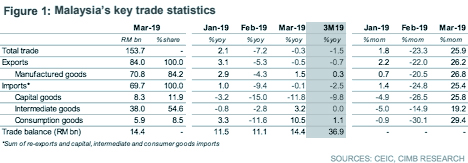
  • Trade performance in Mar exceeded expectations as milder-than-expected declines in exports and imports lifted the trade surplus to RM14.4bn.
  • A US-China trade deal, recovery in regional manufacturing activity, and stronger commodity shipments are catalysts for exports in 2H19.

Trade surplus hits five-month high of RM14.4bn
March’s trade readings outperformed our and the market’s expectations, with trade surplus rising to RM14.4bn (+RM11.1bn in February) as a result of milder-than-expected declines in trade (-0.3% yoy vs. -7.2% yoy in February). The contractions in both gross exports (-0.5% yoy in March vs. -5.3% yoy in February) and gross imports (-0.1% yoy in Mar vs. -9.4% yoy in February) eased.

Refined petroleum and LNG segments buoy O&G exports
The stellar rebound in exports of refined petroleum (+16.2% yoy in March vs. -30.9% yoy in February) and LNG (+17.2% yoy in March vs. +8.6% yoy in February) outstripped a steeper decline in crude petroleum shipments (-33.5% yoy vs. -21.8% yoy in February). While a fire in the Pengerang Integrated Complex (PIC) on 12 Apr could pose a near-term risk to exports pending investigations due by May, Petronas’ subsidiaries indicated that the incident was not expected to significantly impact operations. An extended shutdown could impact our GDP growth assumptions (+4.7% in 2019), which had factored in a gradual ramp-up of refined petroleum and petrochemical production at PIC beginning in 1Q19.

Green shoots emerging in manufacturing sector
While the E&E segment contracted in March (-1.9% yoy vs. +4.9% yoy in February), pockets of strength in optical & scientific equipment and electrical machinery may reflect a revival in external demand. The suspension of Malaysia’s CPO export duty until 31 December 2019 and China’s commitment to buy an extra 0.4m tons of CPO from Malaysia could prop up palm oil exports (-14.1% yoy in March vs. -11.4% yoy in February).

Imports of capital goods may recover with revival of mega projects
Imports of capital goods fell for the seventh month in a row (-11.8% yoy in March vs. -15.0% yoy in February) amid weak domestic appetite for capex. The revival of mega projects, including East Coast Rail Link (ECRL) and Bandar Malaysia could gradually stimulate demand for capital goods. Imports of intermediate goods and consumption goods rebounded following seasonal weakness in February. Iron and steel imports weakened (-18.1% yoy in March), following the introduction of anti-dumping duties on steel in March.

Downside to industrial sector cushioned by agriculture recovery
IPI growth in 2M19 (+2.5% yoy) is tracking below 4Q18’s (+3.2% yoy). Unless mining output and factory activity accelerate sharply in March, the segment’s contribution to real GDP growth could weaken in 1Q19. Nonetheless, the downside is cushioned by a recovery in the agriculture sector, particularly palm oil production. We maintain our 2019 forecasts for IPI growth (+3.7%) and GDP growth (+4.7%).

Light emerging at the end of the tunnel
Malaysia’s manufacturing PMI rebounded from 47.2 in March to 49.4 in April after new export orders increased for the first time in five months. While exports contracted 1.5% yoy in 1Q19, we think progress on a US-China trade agreement and green shoots emerging in regional industrial indicators could presage a turnaround for manufactured goods exports in 2H19.

Originally published by CIMB Research and Economics on 3 March 2019.

This article has been edited to reflect its time-sensitivity.

Indonesia: 1Q19 direct investment realisation


HIGHLIGHTS

1Q19 direct investment realisation

  • Total realised investments fell 2.8% yoy to US$13.4bn in 1Q19 as the gains
    in the tertiary sector were insufficient to offset declines in other sectors.
  • We expect investments to pick up in the following quarters on improving
    investor confidence with Jokowi likely to secure a second term.
  • We project 1Q19 economic growth to remain steady at 5.2% yoy, supported by consumption growth.

Realised investments fell for the third straight quarter
Total direct investments (DI), which exclude the O&G and banking sectors, contracted 2.8% yoy to US$13.4bn in 1Q19. The decline in foreign direct investments (FDI) extended into the fourth quarter, by 11.5% yoy to US$7.2bn, which was partially mitigated by the 9.7% yoy increase in domestic direct investments (DDI) to US$6.2bn in 1Q19.

DI in the tertiary sector continued to outperform
DI in the tertiary sector (+24% yoy in 1Q19 vs. +14% yoy in 4Q18) continued to outperform, led by sectors related to the government’s infrastructure focus, such as transport, storage & communication, electricity, gas & water supply as well as construction. DI in the agriculture, mining and manufacturing sectors declined. Capital outlays in ex-Java gained 8% yoy, as opposed to a 10% yoy decline in Java.

East Asia and Asean the top contributors of FDI
Despite a 35% yoy decline, Singapore remained the largest source of FDI into Indonesia, accounting for 24% of foreign investments. This was followed by China (16% of foreign investments, +71% yoy), Japan (16% share, -17% yoy), Malaysia (9.8% share, +157% yoy), and Hong Kong (8.1% share, +13% yoy).

Policy continuity to spur confidence and investment
While base effects could be at play as realised investments reached record highs in 1Q18, we think 1Q19 readings were also affected by investors taking a wait-and-see approach ahead of the presidential election in April. Based on unofficial results, Jokowi is likely to be re-elected for a second term, implying that National Strategic Projects will continue and more reforms rolled out to improve the investment climate. We think this should boost business confidence and expect investments to pick up in the next quarter.

1Q19 real GDP growth projected at 5.2% yoy
While real investment growth may ease, we expect 1Q19 GDP expansion to be supported by consumption as high social spending by the government has lifted retail sales (+8.1% yoy in 1Q19 vs. +0.7% yoy in 1Q18), motorcycle sales (+19.4% yoy in 2M19 vs. +4.0% yoy in 1Q18) and consumer confidence (125.0 in 1Q19 vs. 123.4 in 1Q18). We project real GDP growth to remain stable at 5.2% yoy in 1Q19 (+5.2% yoy in 4Q18). The 1Q19 GDP data will be released on 6 May.


Originally published by CIMB Research and Economics on 3 May 2019.

CARI Captures 402


ASEAN

ASEAN+3 economies expected to remain resilient amidst global headwinds
(1 May 2019) The ASEAN+3 economies comprising Southeast Asia, China, Japan and South Korea are expected to remain “resilient” in the face of “heightened global risks and stronger external headwinds” according to the latest ASEAN+3 Regional Economic Outlook (AREO) published on May 1. The outlook is published by the ASEAN+3 Macroeconomic Research Office (AMRO), a financial advisory unit under the Chiang Mai Initiative established by ASEAN+3 nations. According to the AREO, real GDP growth in the ASEAN+3 region is expected to ease to 5.1% this year from 5.3% last year, with the downtrend continuing into 2020 with projected growth at 5.0%. The report also found that economies in the region were in a good position to weather external risks as they had “adequate reserves and fiscal buffers”, with decent growth and inflation within the range projected. Furthermore, the report also indicated that the region’s rising middle class, rapid urbanisation and digitalisation potential were evidence of sound fundamentals in ASEAN+3 markets.

ASEAN

ASEAN manufacturing gauge improves in April
(2 May 2019) Manufacturing in Southeast Asian markets improved marginally to reach 50.4 in April — its highest reading in five months, based on the latest Nikkei-Markit manufacturing purchasing managers’ index (PMI). Of the seven Southeast Asian markets ranked on the PMI, Myanmar, Vietnam and Thailand reported the strongest expansion rate, with Myanmar leading the way at 53.7. On the other hand, the PMI in Malaysia and Singapore continued to contract, with the former recording a slower decline and the latter coming in with the weakest reading at 47.3. According to IHS Markit economist David Owen, the region’s overall manufacturing expansion in April was fuelled by new orders and output, and could also indicate that the impact brought about by global trade tensions was moderating.

MALAYSIA, INDONESIA

Governments ready interventions to support palm oil industry
(27 April 2019) The Malaysian government announced the establishment of a US$120 million soft loan fund for private oil palm smallholders to help bolster their businesses as palm oil prices remain low. According to finance minister Lim Guan Eng, the loans will be provided with a 2% annual interest rate, and it can be used to fund crop replanting. Lim also announced a US$24 million grant for entrepreneurs who obtain the Malaysian Sustainable Palm Oil Certification (MSPO). Meanwhile, the government has also launched a “Love My Palm Oil” campaign to promote the use and benefits of palm oil locally. The slew of announcements come as the EU’s palm oil restrictions look set to pass after the EU Parliament elections in May. Separately, the Indonesian Agriculture Ministry’s director-general of plantation Kasdi Subagyono admitted that the collapse of the palm oil industry would have “an extraordinary impact” on the country’s economy, but added that the government stands ready to protect the 16.2 million workers employed in the palm oil sector who would be affected if the EU goes ahead with its curbs on palm oil.

THAILAND, MALAYSIA

Revival of Thai-Malaysian train service proposed to boost trade ties
(30 April 2019) Thai Narathiwat province’s industry association proposed that the Thai and Malaysian governments revive the cross-border train route connecting Narathiwat and Kelantan in order to boost bilateral trade between the countries. According to the Narathiwat Provincial Chamber of Commerce president Kitti Wangthammang, such a service would also boost tourism in border towns in both countries. Wangthammang also proposed the creation of a train link between Pattani and Kuala Lumpur. According to reports, the proposal was well received by the Narathiwat train station head. The proposal follows earlier calls for greater economic cooperation between traders in southern Thailand and northern Malaysia, such as through a border trade fair.

THAILAND

Trilateral airport rail link project likely to be signed in mid-May
(30 April 2019) Thai deputy prime minister Somkid Jatusripitak said on April 30 that the State Railway of Thailand (SRT) and a consortium of nine companies led by the Charoen Pokphand Group will likely ink the agreement to move forward with the development of the three-airport rail project in mid-May. The US$6.9 billion high-speed railway will link Don Mueang airport in Bangkok with Suvarnabhumi in Samut Prakan and U-Tapao in Rayong. The nine-company consortium comprises companies from Thailand, China and Japan — which, according to Eastern Economic Corridor office (EECO) head Kanis Saengsupan — is also the first time China and Japan are jointly investing in a third country. He added that the Japanese side will fund the procurement of Hitachi trains, while the Chinese side will help fund the construction of the rail link. Furthermore, Saengsupan shared that the EECO inked an MoU with China’s Henan province on April 28 to develop a joint aviation hub and cooperate on trade and investment.

THE PHILIPPINES

Social and sustainability bond issuance guidelines approved
(1 May 2019) The Philippines’ Securities and Exchange Commission (SEC) approved on April 25 two sets of guidelines for the issuance of social bonds and sustainability bonds in line with regional standards. The social bonds issuance guidelines were developed in accordance with the ASEAN Social Bond Standards (SBS) — an alternative funding initiative by the ASEAN Capital Markets Forum, while the sustainability bonds issuance guidelines were developed in accordance with the ASEAN Sustainability Bond Standards (SUS). According to SEC commissioner Ephyro Luis B. Amatong, the social bonds are for projects with social benefits such as those providing “medical assistance, education, low-cost housing and water”, while sustainability bonds are for projects that not only have social benefits but are also environmentally-friendly. Therefore, he said, sustainability bond issuers will have to comply with the ASEAN SBS and ASEAN Green Bond Standards (GBS).

THE PHILIPPINES-EU

The Philippines launches safeguard probe on EU float glass imports
(1 May 2019) The European Union requested that the Philippines end its safeguard investigation on the bloc’s float glass exports during a World Trade Organization (WTO) Committee on Safeguards meeting on April 29. The EU’s request was made in response to Filipino trade secretary Ramon M. Lopez’s announcement in February that the country was initiating a preliminary investigation on whether safeguard measures were needed to regulate clear and tinted float glass imports. According to Lopez, the investigation was initiated based on a Department of Trade and Industry (DTI) report claiming that the significant rise in tinted float glass had greatly affected its sole local producer. The EU, however, said that a safeguard measure was “not appropriate” and that the Philippines should instead consider anti-dumping and countervailing measures since 85% of the country’s float glass imports came from one country (China), and other countries combined accounted for less than 5% of the imports.

THE PHILIPPINES-ROK

The Philippines hopes South Korea FTA will boost its e-vehicle industry
(28 April 2019) Filipino industry development and trade promotion undersecretary Ceferino S. Rodolfo recently revealed the government’s hopes that the bilateral free trade agreement (FTA) with South Korea will give the local electric vehicle industry a boost. Rodolfo said that the government hopes to catch up with investments that neighbouring Thailand, Indonesia and Vietnam have received to develop their e-vehicle industry. He added that the Philippines has been trying to get South Korea to set up an e-vehicle assembly plant in the country. To this end, the government is currently evaluating South Korea’s request for tariffs on completely built-up units (CBU) and parts to be lowered from the current 5% rate to zero. According to Rodolfo, electric vehicles are already exempted from excise taxes, and the government is also prepared to negotiate further on tariffs since charging stations infrastructure is a priority item under the country’s Investment Priorities Plan (IPP). In return, he said, the government is asking for greater market access for all Filipino agriculture products.

MALAYSIA-UK

Five UK technology firms to invest in Malaysia
(2 May 2019) Malaysian communications and multimedia minister Gobind Singh announced on May 2 that five technology companies from the UK have committed to investing in Malaysia. The announcements come on the back of Gobind’s visit to the UK in February. The five companies are (i) software management solution firm Ideagen who will establish a Centre of Excellence in Kuala Lumpur, (ii) artificial intelligence (AI) firm AuditXPRT who will make KL its Southeast Asian hub, (iii) software innovation firm Mitra Innovation who will help build the Malaysian AI ecosystem, (iv) BAE Systems Applied Intelligence who will develop its Global Engineering Centre in KL, and (v) Britain’s largest technology firm Sage who will deliver enterprise management solutions to small and medium enterprises. Furthermore, the Malaysia Digital Economy Corporation (MDEC) will also partner with Scottish Heriot-Watt University to establish a new three-year Data Futures Scholarship Programme to develop data professionals in Malaysia.

ASEAN

ASEAN and Japan to establish a disaster risk insurance facility
(1 May 2019) ASEAN nations and Japan are slated to sign a memorandum of understanding (MoU) for the establishment of the Southeast Asia Disaster Risk Insurance Facility (SEADRIF) during the upcoming ASEAN+3 finance and central bank deputies’ meeting in Fiji in May of this year, according to Filipino finance secretary Carlos Dominguez. His statement was made in response to Japanese deputy prime minister and finance minister Taro Aso, who urged the Philippines to join the six countries — Cambodia, Indonesia, Laos, Myanmar, Singapore, Japan — who have already signed the MoU. According to Aso, SEADRIF will serve as a regional catastrophe risk insurance programme that insures countries against natural disaster. The programme was first established in Laos and Myanmar with support from the World Bank.

Mekong Monitor


Photo credit: AFP


TRADE, ECONOMY, AND INVESTMENT


CAMBODIA, MYANMAR

Myanmar State Councillor visits Cambodia to boost bilateral ties
(1 May 2019) Myanmar State Councillor Aung San Suu Kyi arrived in Cambodia on April 29 for a three-day visit to boost bilateral ties between the countries. The State Councillor held meetings with senior Cambodian officials including Prime Minister Hun Sen, during which they discussed elevating cooperation in sectors such as economics, tourism and education. Furthermore, Hun Sen also announced 10 scholarships for Myanmar students in the coming academic year. According to tourism figures from the Cambodian government, the country saw an 18% increase year-on-year in Myanmar visitors last year, reaching 22,500 visitors. However, trade and investment between the countries remain relatively weak.
Read more>>

THAILAND, LAOS

Thailand, Laos governments sign MoC for development of BRI rail project
(26 April 2019) The Thai, Lao and Chinese governments inked a Memorandum of Cooperation (MoC) for the development of the Nong Khai-Vientiane rail line on the sidelines of the Belt and Road Forum (BRF) in Beijing. The rail line is part of China’s larger Belt and Road Initiative (BRI) and its rail bridge will be built near the existing Thai-Lao Friendship Bridge. According to Thai transport minister Arkhom Termpittayapaisith, Thailand and Laos will each bear 50% of the cost of constructing the bridge, while China will provide technical assistance for the construction. He added that they hope to complete the Thai-Lao rail bridge by 2023 so that it can be connected to the Sino-Thai high-speed railway’s Nakhon Ratchasima-Nong Khai route once the route is also completed.
Read more>>

LAOS

Lao government issues new law for railway development
(30 April 2019) Lao President Bounnhang Vorachit announced on April 30 a new Law on Railways to govern the development and management of railways in the country. The 50-page legislation outlines principles and regulations to encourage effective, efficient and environmentally-friendly railway development. The law includes provisions that encourage local and foreign investors to invest in railway infrastructure through public-private partnerships and concessions; pre-construction requirements for developers such as creating a feasibility study, survey and plans; the compensation processes for stakeholders affected by railway development; and regulations for the management of railway services and related logistics services.
Read more>>

THAILAND

Industry players predict a bleak 2Q 2019 for Thai exports due to external factors
(1 May 2019) Thailand’s trade-related authorities expect the country’s exports to slow in the second quarter of 2019 against a backdrop of external risks and uncertainties, according to a report on a joint meeting held on April 30 between the Thai International Trade Promotion Department (ITPD), Thai Board of Trade, and the country’s top 10 exporting groups. The Board of Trade expects the value per unit of exports to fall and overall shipments to grow only 2.1% this year. According to the board’s vice chair Sanan Angubolkul, Thailand’s export competitiveness will also suffer once the EU-Vietnam free trade pact takes effect this year and the US trims the list of products under its Generalized System of Preferences (GSP). According to the Commerce Ministry, Thai exports saw a 1.6% year-on-year contraction to US$61.98 billion in the first quarter of the year, while its imports fell 1.2% year-on-year reaching only US$59.98 billion.
Read more>>

VIETNAM

Vietnam’s April trade deficit estimated at US$700 million
(29 April 2019) The Vietnamese government’s General Statistics Office reported that the country recorded a US$700 million deficit in April, down from a US$1.63 billion surplus in March. According to the office, exports in April saw a 7.5% year-on-year increase reaching US$19.9 billion, while its imports during the same saw a 17.6% increase reaching US$20.6 billion. The country’s largest top export earners were smartphones, garments and electronic home appliances, while its key imports were electronics, machinery and fabrics. Meanwhile, the Vietnamese Foreign Investment Agency reported that Vietnamese firms invested almost US$150 million in 23 foreign markets in the first quarter of the year — the top investment destinations were Spain (US$59.8 million), Cambodia (US$37.9 million) and Malaysia (US$14 million).
Read more>>


mekong-monitor-map

About Greater Mekong Subregion (GMS)

The Greater Mekong Subregion (GMS) Economic Programme was launched by the Asian Development Bank in 1992 connecting five developing ASEAN countries, namely Cambodia, Laos, Myanmar, Vietnam and Thailand, and Chinese provinces of Yunnan and Guangxi Zhuang Autonomous region. The region has some of the most robust economies sharing the Mekong River Basin thanks to its reform and liberalisation. The subregion is growing at a faster pace than the whole of East Asia and the Asia Pacific as the GDP growth rate for 2017 was at 6.4 percent, according to the World Bank. The population at the subregion as of 2016 is at 340 million while the GDP at PPP is at US$3.1 trillion in 2016. In 2015, trading within the region was at US$444 billion.

CARI Briefing: ASEAN integration outlook with YB Dr. Ong Kian Ming

Published on 2 May 2019


SPEAKER

YB Dr. Ong Kian Ming

YB Dr. Ong Kian Ming

Deputy Minister, Ministry of International Trade and Industry of Malaysia

Read more

Ong Kian Ming obtained his PhD in political science from Duke University, where he was a Fulbright Scholar. He is currently the Member of Parliament for Bangi, representing the Democratic Action Party (DAP) which is part of the Pakatan Harapan (PH) federal government coalition. He is a 2nd term Member of Parliament.

He was the Head of the Penang Institute office in Kuala Lumpur from 2014 to 2018.

He was appointed as Deputy Minister, Ministry of International Trade and Industry of Malaysia on July 2018.

Prior to being elected into public office, he was a lecturer and policy analyst at UCSI University, a private university in Kuala Lumpur. He was also the director of the Malaysian Electoral Roll Analysis Project (MERAP). Prior to his PhD, he worked as a consultant with the Boston Consulting Group (BCG) in the KL office and as a policy analyst with two think thanks, the Institute of Strategic Analysis and Policy Research (INSAP) and the Socio-Economic Development and Research (SEDAR) Institute.

He holds a BSc in Economics from the London School of Economics (LSE) and an MPhil in Economics from the University of Cambridge. He completed his O levels and A levels in Raffles Institution and Raffles Junior College in Singapore under the ASEAN scholarship. He studied in La Salle PJ (Primary and Secondary) until Form 3.

CHAIR

TSMM

Tan Sri Dr. Munir Majid

Chairman, CIMB ASEAN Research Institute President, ASEAN Business Club

Read more

Tan Sri Dr. Munir is currently Chairman of CIMB ASEAN Research Institute, of Bank Muamalat Malaysia Berhad, of the Financial Services Professional Board, of ASEAN Business Advisory Council, Malaysia, as well as President of the ASEAN Business Club. He is a member of the Economic Action Council chaired by the Prime Minister of Malaysia. He also sits on the board of the Institute of Strategic and International Studies (ISIS) Malaysia. He is an active advocate of deeper ASEAN economic integration.

He has an extensive experience and is well known in the Malaysian corporate world. He had been the Group Editor of the New Straits Times, first executive chairman of CIMB and founding chairman of the Malaysian Securities Commission. After stepping down from the Securities Commission, he became Independent Non-Executive Director of Telekom Malaysia Berhad, Chairman of Celcom (Malaysia) Berhad and Non-Executive Chairman of Malaysian Airline System Berhad. He was Founder President of the Kuala Lumpur Business Club, established in 2003 and is a member of the Court of Fellows of the Malaysian Institute of Management.

Tan Sri Dr. Munir obtained a B.Sc (Econ) and Ph.D in International Relations from the London School of Economic and Political Science (LSE) in 1971 and 1978. He is an Honorary Fellow of LSE and continues the long association with his alma mater as Visiting Senior Fellow at the Centre of International Affairs, Diplomacy and Strategy. Tan Sri Dr. Munir is an associate of Southeast Asia Centre (SEAC) at LSE.


Malaysia committed to expediting the economic integration of ASEAN

The second CARI Briefing of 2019 featured an exclusive dialogue with the Deputy Minister, Ministry of International Trade and Industry Malaysia (MITI) YB Dr. Ong Kian Ming, where he presented the progress made thus far with regards to the ASEAN economic integration, and the steps being taken by the Ministry of International Trade and Industry (MITI) to expedite this process entering 2019.

During the dialogue titled “Exclusive Dialogue with YB Dr. Ong Kian Ming, Deputy Minister, Ministry of International Trade and Industry of Malaysia: ASEAN Integration Outlook 2019”, Dr. Ong stated that while ASEAN remains strong economically, many gaps need to be filled in order to achieve full integration. Growth in intra-ASEAN trade has moderated while the number of Non-Tariff Measures (NTMs) has steadily increased.

In 2018, Singapore as the chair of ASEAN, worked towards addressing the gaps in integration through trade liberalisation measures, among others that included the realisation of the ASEAN Wide Self-Certification (AWSC), conclusion of the ASEAN Trade in Services Agreement (ATISA) and enhancement of the ASEAN Comprehensive Investment Agreement (ACIA). The republic also embarked on new initiatives such as the ASEAN Smart Cities Network (ASCN).

In 2019, Thailand assumes the chairmanship of ASEAN and Dr. Ong shared the kingdom’s focus for ASEAN.


ASEAN 2019 Priority Deliverables

Thailand will be focusing on the following priorities:

  1. Preparing ASEAN for the Fourth Industrial Revolution (4IR) through the convening of symposium and dialogue among member states, drawing up the Roadmap and Action Plan on ASEAN Industry Transformation to Industry 4.0 2020-2024, and focusing on skilled labour and professional services development in response to 4IR.
  2. ASEAN-Wide Self Certification (AWSC), which allows certified exporters to self-certify the origin of their exports to enjoy preferential tariffs under ASEAN Trade in Goods Agreement (ATIGA).
  3. ASEAN Single Window (ASW), which will expedite cargo clearance and promote ASEAN economic integration by enabling the electronic exchange of trade-related documents among ASEAN Member States.
  4. The Conclusion of Regional Comprehensive Economic Partnership (RCEP) will be a key deliverable for ASEAN in 2019. While ASEAN already has free trade agreements (FTAs) with all the major participants of RCEP on a bilateral basis, the RCEP allows a more comprehensive FTA framework on a multilateral basis. It is hoped that the RCEP will be concluded by 2019 and will then project ASEAN as a key player in terms of FTAs.

In terms of challenges to ASEAN economic integration, barriers to trade and the lack of cohesiveness among member states are among the issues that requires attention.

  • Intra-ASEAN trade in goods and services: As a percentage of total trade, intra-ASEAN trade in goods and services decreased from 25.1% in 2010 to 22.9% in 2017 while external trade simultaneously increased. Dr. Ong said that this did not necessarily mean the decrease in total trade, but that ASEAN has become increasingly reliant on external trading partners. He drew comparison with intra-EU trade, which measures around 40%-50%.
  • Non-tariff measures (NTMs) and non-tariff barriers (NTBs): NTMs and NTBs have remained an issue with regards to intra-ASEAN trade. There has been a steady increase of NTMs from less than 2,000 in 2010 to roughly 6,000 in 2015. Examples of NTMs include the differences in standards for regional exporters between different countries. The NTMs themselves are not the issue but when they become “discriminatory,” they become NTBs. Dr. Ong brought up the possibility of a binding trade agreement such as the RCEP in which its ratification could raise the standard of liberalisation to include the removal of NTBs.
  • ASEAN remains a distant concept amongst the people: For the majority of ASEAN citizens, ASEAN as an institution remains a distant concept, according to Dr. Ong. This is due to the fact that for most of the time, the achievements made by ASEAN are not in the limelight. The upside to this is that ASEAN can function with less politicking, but the downside is that most ASEAN citizens are not aware of the regional bloc’s functions. The bureaucratic and technical nature of the ASEAN can make it seem unapproachable for many in the region.
  • Skilled labour mobility: Although six mutual recognition agreements (MRAs) and two framework agreements exist for the movement of skilled labour in ASEAN, Dr. Ong noted that the liberalisation of labour is not easily done. There remains much to be done on skilled labour mobility within ASEAN but the priority remains on the liberalisation of goods and services.


Opportunities and challenges to ASEAN economic integration


US-China Trade Tension
While Dr. Ong believes that the ongoing US-China trade tension will negatively affect ASEAN’s growth in the long run, he believes that the spillover effects of it may actually benefit ASEAN through the relocation of operations of Chinese and US companies from mainland China to Southeast Asia. He believes that this may ultimately help expedite the integration of ASEAN, as these companies seek to export to other ASEAN markets as they start to view ASEAN as not simply a manufacturing hub but also as a growing consumer base.

Another consequence from the US-China trade tension has been the increase of orders received by Malaysian manufacturers but not all manufacturers could fill those orders due to the lack of foreign manpower. Dr. Ong noted that the Ministry of Human Resources have made some progress in coming up with new policies related to the hiring of foreign workers and is cautiously optimistic that a substantive announcement will be made in the coming months.

With regards to Malaysia’s position on the Comprehensive and Progressive Agreement for Trans-Pacific Partnership (CPTPP), Dr. Ong said Malaysia needs to deliberate its position thoroughly during this time of uncertainty. On another note, while the CPTPP does not involve China, Dr. Ong opined the possibility of China joining the agreement in the future should not be discounted.

Fourth Industrial Revolution (4IR) and the Digital Economy
With digitisation projected to add US$1 trillion to the ASEAN economy, 4IR is one of the priority areas of ASEAN this year. In 2018, MITI launched the Industry 4WRD, a national policy outlining the digitisation of the manufacturing sector and its related services. One of the programmes under Industry 4WRD include the Readiness Assessment Programme where companies can apply for assessment to identify the gaps in their 4IR readiness and how they can prepare for it.

One area of 4IR is the automation of certain parts of the manufacturing industry. Dr. Ong said that MITI is encouraging small and medium enterprises to start their 4IR journey because the digitisation of jobs can help alleviate the shortage of low-skilled foreign workers. Through the Digital Transformation Acceleration Program (DTAP), the Malaysia Digital Economy Corporation (MDEC) is helping manufacturers digitise relevant sections of their businesses to reduce reliance on foreign labour. However, Dr. Ong noted that Malaysia should also look at the digitisation of services as well, and it should not just be limited to legal services. One potential benefit of the digitisation of the manufacturing supply chain is that it creates a demand for big data analytics.

Automotive Industry
The third national car project gained a lot of attention when it was announced. The project is handled by Malaysian Industry-Government Group for High Technology (MIGHT) while MITI coordinates with MIGHT on the national automotive policy. Dr. Ong says MITI is looking at how a third national car would fit into the automotive sector. He believes that the Malaysian automotive sector has an advantage as it has experience working with a diverse group of foreign carmakers including those from Europe, Japan and Korea. The automotive sector in the country is well integrated and local vendors can use this to venture to other markers in the ASEAN region and beyond.


Conclusion

The full economic integration of ASEAN depends on the implementation of the many related policies and framework endorsed. Strong political will is needed to see through the implementation of the ASEAN Economic Community Blueprint 2025 and Malaysia remains committed to expediting the economic integration of ASEAN.

CARI Briefing

CARI Briefing

CARI Briefing