Mekong Monitor


Photo credit: VNA


TRADE, ECONOMY, AND INVESTMENT


THAILAND, LAOS

Thailand may build two more bridges linking with Laos worth US$125 million
(21 May 2019) Two more bridges over the Mekong river worth around US$125 million linking Thailand and Laos may be approved by the Thai cabinet in the near future, with one set to be approved as early as next week, said Thai transport minister Arkhom Termpittayapaisith. The minister was speaking at the Thai-Lao transport ministerial meeting in Nong Khai province in Thailand on May 20, which was also attended by Lao public works and transport minister Bounchanh Sinthavong. According to Termpittayapaisith, the bridges would be the 5th Thai-Lao Friendship Bridge connecting Thailand’s Bung Kan with Laos’ Borikhamsay, and the 6th Thai-Lao Friendship Bridge connecting Thailand’s Ubon Ratchathani with Laos’ Salavan. Other matters discussed during the meeting included repair works for the third and fourth Thai-Lao bridges (expected to be carried out in June), the second phase of the Thai-Lao rail link, as well as designs for the bridge connecting the Thailand-Laos-China rail lines.
Read more>>

VIETNAM, LAOS

Vietnamese, Lao provinces to enhance cooperation in investments and capacity-building
(21 May 2019) The governor of Laos’ Oudomxay province Khamphan Phoinhavong’s working visit to Vietnam’s northern Ha Nam province concluded with both sides agreeing to enhance cooperation. During his visit, Phoinhavong asked Ha Nam for investments and capacity building support, especially in farming and tourism development. The vice chair of the Ha Nam People’s Committee Truong Minh Hien, for his part, said that the Lao delegation’s visit will help deepen relations between both countries and provinces. According to Hien, Ha Nam province’s economy has recorded over 10% in annual growth in the past decade, with per capita income in 2018 crossing the US$2,500 mark. He attributed the province’s growth to its focus on developing its agricultural, manufacturing, trade and services, and medical industries.
Read more>>

LAOS

Laos’ trade deficit falls in Q1 2019 to US$143 million
(21 May 2019) Laos’ recorded a US$143 million trade deficit in the first quarter of 2019, down from the US$374 million recorded during the same period last year. Figures from the Lao Ministry of Industry and Commerce show that the quarter’s total trade saw a 1.53% year-on-year decline reaching only US$2.32 billion, of which imports accounted for US$1.23 billion while exports accounted for US$1.09 billion. According to the Vientiane Times, the smaller trade deficit could be attributed to the rise in imported materials for infrastructure development, hydropower projects, and domestic production. The Lao government has committed to meeting its goal of US$11.29 billion in total trade this year, with exports worth US$5.52 billion and imports worth US$5.78 billion.
Read more>>

MYANMAR

Myanmar aims to attract US$5.8 billion in FDI in 2019
(20 May 2019) Myanmar hopes to attract US$5.8 billion in foreign direct investment (FDI) this year and it has so far already received US$2.5 billion, according to Ministry of Investment permanent secretary Aung Naing Oo. According to the secretary, while some companies remain hesitant to invest in the country, the government remains confident that the Myanmar Investment Promotion Plan (MIPP) will be able to attract large investments, especially in labour-intensive industries. Their focus, he said, is on attracting investments that boost job creation, skills development and infrastructure development. Additionally, Myanmar also hopes to benefit from the shift in production investments to CLMV (Cambodia, Laos, Myanmar, Vietnam) markets due to the ongoing US-China trade war, while developing new industrial zones in areas bordering Thailand in order to create jobs for citizens in those areas.
Read more>>

CAMBODIA

Trade at Cambodia Securities Exchange reaches new high due to Sihanoukville Autonomous Port stocks
(21 May 2019) The Cambodia Securities Exchange (CSX) recorded its highest-ever trade volume on May 21, with almost 10 million shares worth over US$30 million traded. According to the CSX, most of the shares traded were Sihanoukville Autonomous Port stocks, which accounted for around US$29.7 million of the US$30 million traded. A senior CSX official said most of the buyers who contributed to the record-high trading volume were Japanese institutional investors. The CSX also noted that most of the shares were traded using the Negotiated Trading Method (NTM), a form of trading facilitated by a broker. The first CSX deal executed through NTM this year was the US$1.5 million trade of Phnom Penh Special Economic Zone shares in March.
Read more>>


mekong-monitor-map

About Greater Mekong Subregion (GMS)

The Greater Mekong Subregion (GMS) Economic Programme was launched by the Asian Development Bank in 1992 connecting five developing ASEAN countries, namely Cambodia, Laos, Myanmar, Vietnam and Thailand, and Chinese provinces of Yunnan and Guangxi Zhuang Autonomous region. The region has some of the most robust economies sharing the Mekong River Basin thanks to its reform and liberalisation. The subregion is growing at a faster pace than the whole of East Asia and the Asia Pacific as the GDP growth rate for 2017 was at 6.4 percent, according to the World Bank. The population at the subregion as of 2016 is at 340 million while the GDP at PPP is at US$3.1 trillion in 2016. In 2015, trading within the region was at US$444 billion.

Great Expectations and the Belt-Road Backlash

Originally published in TheEdge Malaysia, 20th – 26th February 2019 edition.

Countries do not have perpetual friends or perpetual enemies – only perpetual interests. That was as true in Lord Palmerston’s time as it is now despite the surprise, outrage even, that has greeted revelations that China’s Belt-Road Initiative was not about love thy neighbour.

The recent backlash on China’s signature foreign policy centrepiece has almost as much to do with overblown expectations as with the actual debt quandary in which many project participants found themselves.

The Belt-Road scheme is not and had never been an aid programme. The goal was to generate returns commercial or otherwise for China and, with the best intentions, for project partners as well. China was offering financing – not investment participation and certainly not a handout.

But hype took over even before the first contract was signed. Not that China had tried all that hard to discourage the narrative of the Belt-Road Initiative as Chinese largesse – as a big brother with big pockets riding to the rescue of its brethren.

Inevitably the story soured. The rosy vision of unconditional Chinese generosity gave way to a darker interpretation as suspicion and fears clouded what is increasingly seen as Beijing’s debt-trap diplomacy – encapsulated in that unforgettable New York Times headline: How China got Sri Lanka to cough up a port.

Beijing was likely caught off guard by the extent of the backlash. It must have been particularly alarming for the Chinese leadership that developing countries, including Belt-Road partners, have been just as vocal as Western nations in criticising the programme.

Not that China had not done its homework. Its negotiating teams had prepared well for demands at the government-to-government level – perhaps even anticipating private demands from some heads of government. That level of engagement would have been all that would have been needed to seal a deal in China.

But people on the ground where the projects were being set up were not happy. Resentments range from the lack of local labour participation in Belt-Road funded schemes to the award of contracts mostly to Chinese companies. There were also grassroots opposition to operations that damage fragile local ecosystems, such as the building of a dam in the jungles of Indonesia’s Sumatra or the roads and rails connecting Eurasia that would destroy the habitat of many endangered species.

Beijing had been slow in picking up on the cues.

Grievances within civil society tend to be dealt with at the local government level in China. They are not seen as harbingers of trouble that those in power could not manage. Thus local rumblings and protests would not have been seen as constituting a significant check on the policy position of governments in the Belt-Road orbit.

By underestimating the power of civil society in the outside world, China ended up unprepared and on the defensive when the pushback finally came.

And the pushback was unambiguous. The surest way to lose an election in South and Southeast Asia, it has been said and not entirely in jest, was to be extremely enthusiastic about China’s Belt-Road Initiative.

In the Maldives, the pro-Beijing party was unseated this year by an opposition which ran on an explicitly anti-BRI platform. And last year saw Malaysian voters kick out Datuk Seri Najib Razak, a staunch supporter of BRI projects, whose ruling coalition had been in power since the country’s independence more than 60 years ago. On taking office, Prime Minister Tun Dr Mahathir Mohamad cancelled the East Coast Rail Link, which was the BRI’s flagship project in Malaysia, and spoke pointedly about neo-colonialism.

From Sri Lanka to Pakistan, opposition parties criticising the Belt-Road Initiative as “debt trap diplomacy” have been rewarded at the ballot box whatever their actual policy stance on attaining office.

China woke up.

It realised it was fast losing hearts and minds and wallets. The six-year-old venture was given a makeover at the latest Belt-Road Forum in Beijing. The new glossary terms for Belt-Road Mark II are zero corruption, green, multilateral, high-quality, sustainable and reasonably priced.

Malaysia was among the first to benefit. China reduced the cost of construction of the controversial rail project by as much as a third and agreed to increase the level of local involvement. Not surprisingly, a much happier Kuala Lumpur is now singing praises of the Chinese scheme.

Pakistan too had publicly distanced itself from the Belt-Road Initiative after the electoral win of Imran Khan. The government was highly critical of the terms previously negotiated. Fast forward half a year and a happier prime minister now describes the Chinese Initiative as a blessing for his country and that the China Pakistan Economic Corridor will be positive for foreign investment.

Doubtless, other Belt-Road partners would like to be happier too as they try to leverage on China’s need for a near-term public relations win.

The Belt-Road Initiative has never been about doing good despite media hype. China has its reasons for wading into projects in junk-rated countries despite feasibility studies showing them to be, well, not quite feasible.

But second-guessing Chinese motives at this stage is not time well spent. It would be far more profitable for the suspicious borrower to comb through loan documents and related agreements to judge if the reward is worth the sacrifice in a particular project. Going into negotiations as a supplicant grateful that the lender is even looking your way, as is known to have happened in the early days of Belt-Road Mark I, is to invite a raw deal.

Belt-Road Mark II will present a different set of challenges. ASEAN and other Belt-Road players will need to watch their step as tensions between China and the US grow.

And it will grow because the fight has gone beyond trade. This is now about American perceptions of China as an all-round threat rather than just a rules-bending competitor in trade and commerce. This is now a race for global dominance.

Cooperating with Chinese entities under the Belt-Road banner on purely commercial projects will not raise eyebrows – or news headlines. But schemes that might be seen as having a strategic or military dimension could lead to perceptions that the Belt-Road participant has decided to take sides in the fight of giants. Not a healthy position to be in.

The silver lining is that such choices are unlikely to be too frequent. China’s pockets are not as deep as they used to be. Big new infrastructure projects involving significant Chinese funding are likely to become something of a rarity as Beijing redirects resources to deal with its own economic problems.

China-ASEAN Monitor


Photo Credit: China Daily


Economy, Investment and Trade


HK-ASEAN Investment Agreement to take effect for five ASEAN countries in June
(16 May 2019) The Hong Kong-ASEAN Investment Agreement (IA) will come into force in Vietnam, Thailand, Singapore, Myanmar and Laos on June 17. According to the Hong Kong Special Administrative Region (HKSAR) government, the IA will provide Hong Kong enterprises with greater investment protection, such as through clauses that require the ASEAN countries to provide compensation to Hong Kong enterprises if their investments incur losses caused by war, armed conflict or events of a similar nature. They will also enjoy the assurance of the free transfer of their investments and returns. Similarly, the measures relating to these five ASEAN countries under the Hong Kong-ASEAN Free Trade Agreement (FTA) will enter into force on June 11. Under the FTA, Singapore will remove all tariffs on imports from Hong Kong, while Laos, Myanmar, Thailand and Vietnam will also gradually reduce or eliminate tariffs on the same. Hong Kong service providers will also enjoy greater market access in selected ASEAN countries upon implementation of the FTA.
Read more>>

ASEAN, China discuss ways to bolster strategic partnership
(20 May 2019) The ASEAN-China Senior Officials’ Consultation was held in Hangzhou on May 19 with the aim of reviewing existing cooperation mechanisms and partnerships, and prepare for the upcoming ASEAN-China post-ministerial conference scheduled to be held in August. Among the outcomes of the meeting were pledges to continue advancing the ASEAN-China Strategic Partnership Vision 2030 and the ASEAN-China Plan of Action 2016-2020. In addition, both sides aim to achieve US$1 trillion in bilateral trade and US$150 billion in bilateral investment by 2020. Furthermore, they also agreed to bolster cooperation in the areas of digital economy, e-commerce, cyber security, connectivity, infrastructure, transportation, agriculture, innovation, small and medium enterprise (SME) development, Greater Mekong Subregion development, and the Regional Comprehensive Economic Partnership (RCEP) negotiations. China also presented cooperation proposals in terms of smart city development, as well as through China’s Belt and Road Initiative (BRI) and ASEAN’s own development plans.
Read more>>

The Philippines sees greater investment from China
(21 May 2019) The Philippines has been able to attract more investors from China amid the US-China trade war, according to its Department of Trade and Industry (DTI). Trade secretary Ramon M. Lopez was quoted by Business World as saying that they have attracted “almost US$1 billion” in investments from Chinese investors, up from the “very small” amount of “only US$50 million a year” previously (the exact period was unspecified). However, the Philippines Economic Zone Authority head Charito B. Plaza noted that delays in streamlining the country’s investment incentives such as the removal of perks that the government deemed redundant have been keeping investors away. Furthermore, the Foundation for Economic Freedom (FEF) released a statement urging the government to do more to attract Chinese factories to relocate to its shores by expediting the enactment of laws to lower corporate income tax rates, streamline fiscal incentives and lower barriers to foreign ownership and participation in sectors such as public transportation and telecommunications.
Read more>>

Trade war gives Thailand a chance to lure more Chinese tourists
(21 May 2019) Thailand is keeping an eye on the implications that the US-China trade war may have on tourism as it hopes to lure more tourists from China. For instance, it foresees a possibility that the Chinese government may issue a travel ban to the US if the trade war intensifies, similar to the travel ban it imposed on South Korea and Japan when China had diplomatic tensions with these countries. According to the Tourism Authority of Thailand (TAT) governor Yutthasak Supasorn, studies conducted by five TAT offices in China found the trade war and depreciating yuan to be the primary factors deterring Chinese citizens from taking overseas trips and spending during such trips. As such, the TAT hopes to entice more Chinese visitors through incentives such as e-visas, wavers of visa-on-arrival fees, as well as upcoming deals with China Travel and Alipay which are expected to bring in at least two million Chinese tourists respectively. Last year, around 10.5 million Chinese tourists visited Thailand, and the number is estimated to reach 11.6 million visitors this year.
Read more>>

Cambodia looks to attract more high-income Chinese tourists
(20 May 2019) Cambodia needs to become a five-star destination in order to attract “five-star Chinese tourists,” says Cambodia Association of Travel Agents head Chhay Sivlin. According to her, Cambodia has done well to attract more Chinese tourists over the years, but it needs to do more to attract high-income visitors in order to boost revenue for the sector. Cambodian Ministry of Tourism spokesperson Top Sopheak, for his part, said that every country was working hard to attract more Chinese tourists, and Cambodia still has much to do to respond to the growth of Chinese tourists. At the Asian Culture and Tourism Exhibition held in Beijing on May 16, Cambodian Minister of Tourism Thong Khon said the government plans to accommodate the rise in tourists through infrastructure projects such as the development of new airports in Phnom Penh and Siem Reap, the expansion of the airport in Preah Sihanouk province and a tourism port in Kampot province. According to Sopheak, foreign visitors generally stay for four to seven days, and spend between US$200 to US$300 per day. In the first three months of 2019, Chinese tourists numbered more than 680,000, a 35% jump compared to the same period last year.
Read more>>

Singapore’s non-oil domestic exports weakens 10% in April


HIGHLIGHTS

April 2019 trade

  • NODX plunged 10% in April, on weakness in electronics and non-electronics.
  • Downside risks to Singapore’s GDP growth and inflation outlook have intensified as protracted US-China talks weigh on trade recovery in 2H19.
  • Materialisation of such risks may warrant policy intervention. At this juncture, we expect MAS to maintain the S$NEER parameters in October.

NODX’s contraction persists in April
Singapore’s non-oil domestic exports (NODX) weakened sharply in April (-10.0% yoy vs. – 11.8% yoy in March), missing our forecast of -3.8% yoy, pulled back by weaker exports of non-electronics (-7.9% yoy vs. -7.1% yoy in March) and electronics (-16.3% yoy vs. -26.7% yoy in Mar). The seasonally-adjusted NODX fell 0.6% mom in April (-14.3% mom in March). As a trade bellwether, Singapore’s slump reflected export weakness across the region: China (-3.3% yoy), Indonesia (-13.1% yoy) and South Korea (-2.0% yoy).

High base takes a toll on non-electronics
A higher base in 2018 exacerbated the fall in non-electronics exports in April, a trend that could persist into May. Pharmaceutical, petrochemicals, organic chemical and specialised machinery NODX dropped 46.6%, 13.6%, 47.5% and 22.7% yoy, respectively, in April.

Semiconductor cycle still finding a bottom
Exports of the five major electronic products deteriorated in April (-16.4% yoy vs. -26.5% yoy in March) with waning exports in integrated circuits (ICs, -21.2% yoy), PC parts (-10.3% yoy), disk media products (-31.3% yoy) as well as diodes & transistors (-13.5% yoy). In February, the World Semiconductor Trade Statistics (WSTS) downgraded its outlook on semiconductor sales in 2019 (-3.0% vs. +2.6% previously), and projected sales to pick up moderately in 2020. This was echoed by our semiconductor analyst who expects 2019 to be a down year, with risks amplified by the negative impact of the US-Sino trade tension.

NODX plunges in key markets except the US and Hong Kong
Deliveries to key destinations slipped in April excluding the US and Hong Kong: China (- 5.8% yoy), Japan (-31.1% yoy), the EU (-25.4% yoy), South Korea (-19.8% yoy), Taiwan (-15.8% yoy), Malaysia (-13.6% yoy), Thailand (-12.1% yoy) and Indonesia (-0.3% yoy).

Dimmer signs of recovery on the external front
The recent tariff escalation between the US and China alongside the downturn in the tech industry injects further uncertainty into Singapore’s trade trajectory. China will impose tariffs of 5-25% on US$60bn worth of US imports, effective 1 Jun, in retaliation to US tariff hike on US$200bn of Chinese goods. A public hearing will also be held by the US Trade Representative’s office in Jun on the proposal of further tariff imposition of 25% on US$300bn worth of Chinese imports. Materialisation of retaliatory tariffs would weigh on Singapore’s growth outlook, and may prompt policy intervention. At this juncture, we believe external risks will strengthen the Monetary Authority of Singapore’s (MAS) resolve to maintain current accommodative monetary policy settings in October.

Originally published by CIMB Research and Economics on 17 May 2019.

This article has been edited to reflect its time-sensitivity.

CARI Captures 404


INDONESIA, THAILAND

US-China trade war takes its toll on trade in ASEAN’s largest economies
(15 May 2019) Indonesia posted its widest monthly trade deficit in history in April at US$2.5 billion as exports saw a year-on-year decrease of 13.1% — far higher than the projected 7.15% drop, according to the latest figures published by the Indonesian statistics bureau. Furthermore, the month’s imports also failed to meet projections as it only saw a 6.58% year-on-year decrease, as opposed to the projected 12.1% drop. In commenting on the matter, Indonesian statistics bureau chief Suhariyanto said that the economy faced “extraordinary” challenges this year due to the weakening global economy and increased uncertainty caused by the prolonged US-China trade war, while finance minister Sri Mulyani Indrawati said that the country “cannot rely on export as an engine of growth” due to the trade war. Meanwhile, Thailand’s exports reached a four-year low due to both the trade war and the impending EU-Vietnam Free Trade Agreement (EVFTA) that comes into effect on June 1. According to the Thai Commerce Ministry, the country stands to lose between US$5.6 billion to US$6.7 billion in exports this year, equivalent to between 2.2% to 2.6% of last year’s exports. These announcements come on the back of the US announcement on May 10 that it would double duties on US$200 billion worth of Chinese goods, which China responded to by announcing on May 13 that it would raise tariffs on US$60 billion of US exports effective June 1.

CAMBODIA-JAPAN

Bilateral trade sees 16.5% increase in Q1 2019
(14 May 2019) Trade between Cambodia and Japan saw a 16.5% increase in the first quarter of 2019 as compared to the same period last year, reaching US$558 million, according to the Japan External Trade Organization (JETRO), Of the sum, Cambodian exports to Japan saw a 16% increase reaching US$454 million, while Japanese exports to Cambodia saw a 20% increase totalling US$104 million. The upward trend follows the 27.3% increase in bilateral trade between the countries in 2018, during which Cambodia exported US$1.6 billion worth of goods to Japan. A Cambodian commerce ministry spokesman noted that they have also seen more Japanese investments in light manufacturing and industries that require skilled labour. Meanwhile, Malaysia is reportedly in talks to send blue-collar workers to Japan under a new visa programme launched in April aimed at bringing in more skilled manpower as Japan faces a growing ageing population and dwindling birth rates. Malaysian Prime Minister Mahathir Mohamad will visit Japan later this month to discuss the matter. Separately, the Philippines’ President Rodrigo Duterte’s spokesperson confirmed that Duterte will visit Japan from May 29 to 31 where he is “hoping” to ink agreements with the Japanese government.

MALAYSIA-GERMANY

Germany will not ban palm oil from Malaysia
(14 May 2019) German ambassador to Malaysia Nikolaus Graf Lambsdorff said in an interview that Germany will not ban palm oil from countries such as Malaysia, as the commodity is cheap, environmentally-friendly and sustainable. However, he urged Malaysia to reduce its dependency on palm oil and consider halting its use in the coming years in line with other European countries. Lambsdorff’s remarks follows Malaysian state news agency Bernama’s report quoting French ambassador to Malaysia Frederic Laplanche saying that the EU and France were not the enemies of palm oil, and that there was, in fact, no ban on palm oil imports, and that the bloc was merely phasing out existing incentives for palm oil to be added into the diesel mix. Meanwhile, Malaysian primary industries minister Teresa Kok, who is on a palm oil promotion tour in Europe, told European media that unless the palm oil issue is settled, there will be no strategic partnership between the EU and ASEAN.

MYANMAR-EU

Amnesty for Reuters reporters may not be enough to resolve trade tensions with EU
(12 May 2019) Myanmar’s foreign business community welcomed President U Win Myint pardoning of Reuters journalists Wa Lone and Kyaw Soe Oo on May 7, but expressed doubts that the partial amnesty was enough to convince the EU to roll back its threat to lift Myanmar’s Generalised Scheme of Preferences (GSP) tariff privileges, also known as the Everything But Arms (EBA) scheme. According to members of Myanmar’s foreign business community, the amnesty “removes one high profile issue” which will “certainly send better signals” to international investors, but “the elephant in the room of northern Rakhine still remains”, as well as other concerns over labour rights and freedom of expression. An EU spokesperson quoted by the media responded to the reporters’ release by saying that it was a welcome development but declined to comment on whether it would affect the EU’s pending decision to lift trade privileges.

MYANMAR, SINGAPORE

Singapore surpasses China as Myanmar’s biggest investor
(13 May 2019) Singapore has surpassed China as Myanmar’s largest investor since the start of 2019, according to Myanmar’s Ministry of Investment and Foreign Economic Relations permanent secretary U Aung Naing Oo. However, he noted that some of these investors may not be Singaporean per se but were multinational companies based in Singapore. The secretary also noted that the country has seen an increase in investments from the UK, despite the UK’s ongoing criticisms of Myanmar’s human rights issues. Furthermore, the Myanmar Investment Commission has so far approved a total of US$2.5 billion worth of foreign investments in the 2018-2019 fiscal year which started in October 2018 and ended in April 2019. Nevertheless, U Aung Naing Oo admitted that the foreign investments in the country have slumped in the last four years as investors opt to invest in countries such as neighbouring Thailand, Vietnam and Cambodia where the investment climate and regulations were considered more stable.

CAMBODIA-NEPAL

Cambodia, Nepal sign agreements to boost bilateral trade and investment
(14 May 2019) Nepali Prime Minister Khadga Prasad Sharma Oli’s three-day official visit to Cambodia concluded with the signing of two agreements with Cambodian Prime Minister Hun Sen to boost cooperation between the countries. The first document signed was a framework agreement on trade and investment, while the second was a memorandum of understanding (MoU) on bilateral cooperation between Cambodia and Nepal’s national chambers of commerce. According to the Cambodian Chamber of Commerce, Nepali investors were particularly interested in the country’s agriculture and tourism industry. Current trade and investment between the countries are relatively small — bilateral trade amounted to only US$210,000 in 2017, even less than the US$250,000 recorded in 2016. The countries mostly traded garments, wood, agricultural products, fabric and machines.

VIETNAM-NEPAL

Vietnam, Nepal look to improve trade and investment ties
(12 May 2019) Nepali Prime Minister Khadga Prasad Sharma Oli kicked off his two-country Southeast Asian tour on May 8 with a five-day official visit to Vietnam, where several agreements were signed to develop cooperation mechanisms between the countries. According to a joint statement released after Oli’s talks with Vietnamese Prime Minister Nguyen Xuan Phuc, the documents signed include an MoU on the establishment of bilateral consultation mechanisms between both foreign affairs ministries, negotiating a framework agreement on trade and investment cooperation, and an agreement on visa exemption for diplomatic and official passport holders. Furthermore, both leaders agreed to explore the establishment of a direct air route between the countries and explore new areas of cooperation such as in the areas of energy, renewable energy, high-tech agriculture and tourism. The Vietnamese premier also pledged to support Visit Nepal Year 2020 as well as Nepal’s efforts to graduate from least developed country status as soon as possible.

THE PHILIPPINES

The Philippines to launch US$70.6 million project to boost export commodities
(11 May 2019) The Philippines’ trade secretary Ramon M. Lopez recently announced that his ministry will soon launch a new programme that aims to accelerate the development of agro enterprises and help them meet global market demands. According to Lopez, the new Rural Agro-Enterprise Partnership for Inclusive Development and Growth (RAPID Growth) project will be led by the Department of Trade and Industry (DTI) and funded by the United Nations’ International Fund for Agriculture Development (IFAD). The project will focus on boosting four primary agricultural value chains — cocoa, coffee, processed fruits and nuts, and coconut — which were selected based on their “lucrative markets, social features and potential to provide sustained economic benefits to small farmers and enterprises.” The project will be implemented in six regions and target unemployed and underemployed rural women and men, with a special focus on women, youth and indigenous people.

MALAYSIA, BRUNEI

New association mulled to help Brunei, Malaysia businesses
(14 May 2019) Malaysia and Brunei are exploring the possibility of establishing a “friendship association” to boost cooperation between businesses in both countries, said Brunei’s high commissioner to Malaysia Data Hj Alaihuddin during a recent Malaysia Healthcare Travel Council (MHTC) event in Kuala Lumpur. According to Alaihuddin, the association’s primary purpose would be to facilitate engagements between businesses, as well as to provide a space for public-private partnerships to blossom. He added that the underlying goal was also to encourage collaboration instead of competition between the countries, and hopes the association will eventually serve as a platform for businesses to “help each other succeed” both within and beyond the region.

ASEAN

Lazada extends e-commerce edge in Southeast Asia despite lull in overall visits
(13 May 2019) Alibaba-backed e-commerce platform Lazada extended its reign as the most popular e-commerce site in Southeast Asia despite a drop in visits to the site in the first quarter of 2019, according to a report by analytics firm App Annie. According to the report, Lazada maintained the highest average monthly active users in Malaysia, Thailand, Singapore and the Philippines during this period, but fell behind Tokopedia and Shopee in Vietnam and Indonesia. Furthermore, the report found that Tencent-backed Shopee saw a 5% increase in visitors in the first three months of 2019, making it the only e-commerce platform in the region to post an increase in quarterly visitors. The report also noted that the region’s homegrown e-commerce giants continue to face competition from native Chinese and American platforms such as Amazon, eBay, AliExpress, and Taobao.

Mekong Monitor


Photo credit: VNA


TRADE, ECONOMY, AND INVESTMENT


VIETNAM, MYANMAR

Vietnam and Myanmar strive to reach US$1 billion in trade turnover
(12 May 2019) Myanmar President Win Myint’s visit to Hanoi on May 11 concluded with leaders from both countries agreeing to aim for US$1 billion in bilateral trade turnover in the near future, up from the US$860 million turnover reached in 2018. To reach the target, Vietnamese Prime Minister Nguyen Xuan Phuc suggested increased cooperation in the agricultural and seafood industry, as well as in the development of land and maritime transport infrastructure. On the same day, Win Myint also met with Vietnamese parliamentary chair Nguyen Thi Kim Ngan, who expressed her country’s hope for continued support from Myanmar as Vietnam assumes the role of ASEAN Chair and President of the ASEAN Inter-Parliamentary Assembly (AIPA) in 2020.
Read more>>

THAILAND, MYANMAR

EXIM Thailand plans to finance more investments into Myanmar
(10 May 2019) The Export-Import (EXIM) Bank of Thailand will soon offer more loans to Thai companies venturing into Myanmar as part of its plan to capitalise on what the bank sees as Myanmar’s inevitable economic boom, said EXIM Bank president Pisit Serewiwattana. According to him, the bank has loaned almost US$650 million for projects in Myanmar over the past two decades, primarily for infrastructure projects such as power plants, airports, roads and transmission lines. Moving forward, the bank intends to provide more loans to businesses engaged in bilateral trade, especially those that plan to use “a wide range of Thai products in their commercial operations in Myanmar.” He added that the opening of a representative office in Yangon in 2017 has so far led to business volumes increasing by over 30%.
Read more>>

THAILAND

Thailand invests US$3 billion in bid to become Mekong subregion transportation hub
(13 May 2019) Thai transport minister Arkhom Termpittayapaisith revealed to reporters on May 10 the government’s plan to position Thailand as a major transportation hub for the Greater Mekong Subregion (GMS). To that end, the Thai government has invested over US$3 billion to develop infrastructure in border provinces in order to create economic corridors that will allow the country to be a major transit country in the GMS. This includes investments in a US$2.6 billion double-track railway at the Chiang Khong border checkpoint in the northern Chiang Rai province and a US$43 million goods transport hub. Furthermore, the Thai government is building a bridge on its eastern border with Cambodia, a US$31 million bridge in the Nong Khai province bordering Laos, and a US$34 million bridge to link Mae Sot with Yangon in Myanmar.
Read more>>

MYANMAR

Myanmar to get new international port container terminal in Yangon
(9 May 2019) The Myanmar Investment Commission (MIC) has approved the development of the new Ahlone International Port Terminal 2 (AIPT) in the Ahlone township on the Yangon River. The terminal will be developed by Adani Myanmar, which will also operate and maintain the 54-acre project and 630-metre jetty for the initial concession period of 50 years. The project will likely be developed in two phases, with a total cost of US$290 million. According to the Myanmar Port Authority, Yangon already has 12 port terminals, but the decision to build another terminal was made since port traffic has increased by almost 13% in the past four years, and the government expects this number to grow in the coming years. Myanmar’s overseas trade reached US$19.9 billion for the 2018-2019 fiscal year, an increase of US$700 million over the same period last year.
Read more>>

MYANMAR

Rubber exports from Myanmar expected to rise on the back of improved production
(13 May 2019) Myanmar will likely export approximately 300,000 tonnes of rubber this year as output by local plantations continue to rise, according to the Myanmar Rubber Planters and Producers Association (MRPPA). The MRPPA’s forecast is slightly higher than the government’s, which stands at 260,000 tonnes. The association’s projections were made based on the rise in rubber exports in recent years and the local industry’s hope for Myanmar to become a major rubber exporter in time to come. The MRPPA said the country exported 140,000 tonnes of rubber in 2017, up 56% from 2016. Only 8% of locally-produced rubber is used for domestic consumption, and of the 92% exported, 70% is sold to China. According to the Myanmar Times, Thailand is presently the world’s leading rubber producer with an annual yield of 4.6 million tonnes, followed by Indonesia with 2.4 million tonnes, and Malaysia with 2.2 million tonnes.
Read more>>


mekong-monitor-map

About Greater Mekong Subregion (GMS)

The Greater Mekong Subregion (GMS) Economic Programme was launched by the Asian Development Bank in 1992 connecting five developing ASEAN countries, namely Cambodia, Laos, Myanmar, Vietnam and Thailand, and Chinese provinces of Yunnan and Guangxi Zhuang Autonomous region. The region has some of the most robust economies sharing the Mekong River Basin thanks to its reform and liberalisation. The subregion is growing at a faster pace than the whole of East Asia and the Asia Pacific as the GDP growth rate for 2017 was at 6.4 percent, according to the World Bank. The population at the subregion as of 2016 is at 340 million while the GDP at PPP is at US$3.1 trillion in 2016. In 2015, trading within the region was at US$444 billion.

China-ASEAN Monitor


Photo credit: Getty Images


Economy, Investment and Trade


FTA between Hong Kong and three ASEAN countries to take effect in June
(9 May 2019) The Hong Kong Special Administrative Region (SAR) government announced on May 9 that the ASEAN-Hong Kong free trade agreement (FTA) will come into force in June, starting with three ASEAN countries. More specifically, the FTA will come into force on June 11 for Myanmar, Singapore and Thailand. Under the agreement, Singapore will eliminate all tariffs, while Myanmar and Thailand will gradually reduce and eliminate tariffs on Hong Kong exports. This includes tariff reductions and eliminations on Hong Kong goods such as jewellery, apparel, clothing accessories, watches, clocks and toys. Furthermore, Hong Kong service providers will enjoy better market access in a range of service sectors. According to the SAR spokesperson, the FTA’s effective dates for the other seven ASEAN countries will be announced later because these countries are still in the process of ratifying the agreement.
Read more>>

China, Singapore renew currency swap agreement
(13 May 2019) The Monetary Authority of Singapore (MAS) and People’s Bank of China (PBC) announced on May 13 that the two countries have renewed their US$59.8 billion Bilateral Currency Swap Agreement (BCSA) for a three-year period. According to MAS, the agreement will help stabilise financial markets while giving both central banks access to foreign currency liquidity for trade and investment financing needs, including projects under China’s Belt and Road Initiative (BRI). Separately, MAS also announced that it has inked a cooperation agreement with the China-based Asia Pacific Future Financial Research Institute (AFF) to boost research cooperation and information sharing related to fintech between the countries.
Read more>>

Cambodia exports first cargo of bananas to China
(9 May 2019) Cambodia announced that it has made its first direct export of bananas to China as part of the countries’ plans for greater bilateral trade under the Belt and Road Initiative (BRI). The five-container shipment of 100 tonnes of bananas was exported from Sihanoukville Autonomous Port to Shanghai, making it the fourth agricultural produce from Cambodia to be exported to China. Speaking at a ceremony marking the inaugural shipment, Cambodian agriculture minister Veng Sakhon said that the country will be exporting around 130,000 tonnes of yellow bananas to China in 2019. According to Cambodia’s General Directorate of Agriculture head Ngin Chhay, the shipment follows the signing of agreements in August last year, after which Chinese customs finally approved exports from five Cambodian banana plantations and their packing factories.
Read more>>

Vietnamese firms advised to study Chinese trade regulations
(8 May 2019) Vietnamese firms doing business with Chinese firms should study China’s trade regulations and ensure that all transactions made are done through written contracts as per international trade practice, said the Vietnamese commercial counsellor in China Dao Viet Anh during a conference on Vietnam-China trade. Anh also urged local companies to enhance the quality and packaging of their products, develop their brand, gain a better understanding of local preferences, and increase promotion activities in order to establish themselves in the Chinese market. According to the Vietnamese trade office in China, Vietnamese farm and seafood exports face strong competition from other ASEAN countries, and that it was evident that exporters lacked an understanding of the Chinese market. Vietnam’s exports to China grew by 27% in 2018, reaching US$63.9 billion.
Read more>>

Indonesian firms cautioned over dealings with Chinese investors
(11 May 2019) Indonesian state-owned enterprises (SOEs) need to practice caution when bringing in Chinese investments because “good corporate governance is not a well-known concept among them,” said the Indonesian Corruption Eradication Commission deputy head Laode M. Syarif. He added that this was because Chinese investments are not as well regulated as those from Western Europe and the US. As such, he urged local SOEs to ensure that their Chinese investors follow local regulations and anti-bribery measures, especially since Indonesia’s Supreme Court now has laws in place to prosecute not only the individuals but also the corporations involved.
Read more>>

Weaker than expected improvement in Indonesia’s 1Q19 current account deficit


HIGHLIGHTS

1Q19 balance of payments

  • The 1Q19 current account deficit (CAD) improved to US$7.0bn/2.6% of GDP, the smallest since 2Q18, though it fell short of our expectation.
  • We raise our CAD forecast to US$29.6bn/2.7% of GDP for 2019, taking into account weaker trade activity and lower average tourist spending.
  • We expect Bank Indonesia (BI) to remain cautious regarding a reversal in policy rate, unless 2Q19 CAD remains under control.

A weaker-than-expected improvement in 1Q19 CAD
At US$7.0bn/2.6% of GDP, the 1Q19 current account deficit (CAD) missed our and market expectations while still reflecting a significant improvement from US$9.2bn/3.6% of GDP in 4Q18. Nonetheless, the CAD was sufficiently financed by net inflows of US$10.1bn/3.8% of GDP in the financial account (FA), keeping the balance of payment in surplus (US$2.4bn/0.9% of GDP in 1Q19 vs. US$5.4bn/2.1% of GDP in 4Q18).

CA: Goods account rebounded on improvements in trade balance
A smaller travel surplus, due to lower average spending per tourist arrival, and lower income receipts on direct investment abroad threw our forecasts off. As expected, steeper declines in imports relative to exports resulted in the goods account rebounding to a surplus of US$1.1bn (US$2.6bn deficit in 4Q18) as well as a smaller deficit in freight services. Downside risks on CAD remain on the table amid rising external uncertainty due to the overhang of recent wedge in US-China trade negotiations as well as lower commodity prices, such as coal and palm oil.

FA: net inflows in direct investments and portfolio investments
Higher net direct investment inflows (+US$5.2bn in 1Q19 vs. +US$2.0bn in 4Q18) were sufficient to finance 74% of the CAD (vs. 22% in 4Q18), resulting in a smaller negative basic balance (-0.7% of GDP vs. -2.8% of GDP in 4Q18). The net direct investment inflows were supported by M&A activity in the banking sector while realised foreign investments (excluding banking and O&G) in US$ terms continued to decline, although we expect FDI to pick up in the coming quarters following Jokowi’s re-election for a second term, based on unofficial results. Net foreign portfolio inflows nearly halved (+US$5.4bn vs. +US$10.5bn in 4Q18) on the maturity of a global government bond in March 2019.

2019F CAD forecast raised to US$29.6bn/2.7% of GDP
We revise our 2019 CAD upwards to US$29.6bn/2.7% of GDP (vs. US$27.3bn/2.5% of GDP previously) to take into account weaker trade activity and lower average tourist spending. Given that the improvement in 1Q19 CAD fell short of Bank Indonesia’s (BI) 2.5% of GDP target, we expect BI to remain cautious regarding a reversal in its monetary policy rate, unless 2Q19 CAD remains under control. Historically, the CAD tends to be higher in 2Q due to seasonal factors, which coincides with dividend payment schedules.


The current account deficit improved by US$2.3bn qoq to US$7.0bn/2.6% of GDP in 1Q19, the smallest deficit since 2Q18. Due to steeper declines in imports relative to exports in both O&G and non-O&G segments, the goods account balance returned to a surplus of US$1.1bn in 1Q19 after recording a deficit for two quarters. Weaker imports resulted in a smaller deficit in freight services but were outweighed by a smaller travel surplus and a higher deficit in other business services. The deficit in the services account rose slightly to US$1.8bn. The primary income deficit was higher at US$8.1bn due to seasonal interest payment on government debt as well as smaller income receipts on direct investment abroad as a result of narrower returns on overseas property investment.


The US$10.1bn surplus in the financial account was supported by net inflows in direct investments and portfolio investments. Net direct investment inflows increased to US$5.2bn, driven by the acquisition of a local bank by a Japanese investor. Following more conducive global financial conditions, net foreign portfolio purchases of Indonesian equities and Rp-denominated government bonds were higher in 1Q19. However, net portfolio investment inflows were smaller at US$5.4bn as a result of government payments on global bonds that were due in Mar 2019 and lower issuances of global bonds by corporates in Indonesia. Other investments posted a net outflow of US$0.6bn on higher placement of private deposits at overseas banks and private lending to non-residents.


Originally published by CIMB Research and Economics on 13 May 2019.

Malaysia March 2019 industrial production growth exceeds expectations


HIGHLIGHTS

March 2019 industrial production

  • PI growth rebounded to 3.1% yoy in March as the drag on mining diminished.
  • Seasonal demand and illicit tobacco crackdown helped offset weakness in the construction and electrical & electronics (E&E) segments.
  • A setback in construction activity likely nudged GDP growth lower to +4.4% yoy in 1Q19F, reinforcing BNM’s decision to ease monetary policy on 7 May.

Uptick in March industrial activity emulates trade outperformance
The 3.1% yoy growth in industrial production index (IPI) in March (+1.7% yoy in February) exceeded our and market expectations, due to stronger manufacturing production (+4.1% yoy in March vs. +3.7% yoy in February) and milder mining contraction (-0.2% yoy vs. -5.0% yoy in February). Electricity output growth was steady (+4.8% yoy vs. +4.9% yoy in February). The seasonally-adjusted IPI growth rose 1.2% mom in March (-2.0% mom in February), outperforming the historical March average of -0.5% mom in 2014-2018.

O&G output growth fuelled by export demand
O&G production mirrored the sector’s strong export performance, particularly in natural gas (+1.4% yoy in March vs. -5.6% yoy in February) and refined petroleum products (+4.3% yoy vs. +0.2% yoy in February), making up for the weakness in crude petroleum output (-2.0% yoy vs. -4.3% yoy in February). However, we are monitoring potential disruptions ahead, stemming from maintenance work at the Gumusut-Kakap oilfield in July, as well as repercussions from an investigation into a fire in the Pengerang Integrated Complex (PIC).

Mixed bag for manufacturing sector
Manufacturing activity was boosted by seasonal demand post-Chinese New Year and ahead of Ramadan, lifting output of food (+7.0% yoy vs. +6.6% yoy in February) and textiles, apparels, leather products & footwear (+4.9% yoy vs. +3.6% yoy in February). Tobacco output surged 10.9% yoy (+6.8% yoy in February) from favourable base effects and more stringent enforcement on the illicit cigarettes trade. However metallic and non-metallic building materials growth faltered to a 2-year low (+3.5% yoy in March vs. +4.6% yoy in February) due to subdued construction activity. E&E output rose at the weakest pace since Oct 2014 (+2.7% yoy in March vs. +3.1% yoy in February), and the US’s import tariff hike on US$200bn of China goods could weigh on Malaysia’s export-oriented segments.

1Q19 GDP growth forecast at 4.4% yoy as construction disappoints
While the outturn in the manufacturing, mining and electricity sectors were broadly in line with our projections and agriculture output rebounded in 1Q19, construction activity disappointed as the value of work done stagnated (+0.7% yoy in 1Q19 vs. +4.1% yoy in 4Q18). Uncertain market conditions, reworked project scopes and delayed tenders may have contributed to the weaker growth in civil engineering works and public sector nonresidential construction. We estimate these factors, alongside the rebasing exercise to 2015 constant prices, nudged 1Q19F GDP lower to +4.4% yoy (+4.7% yoy in 4Q18), and in the face of heightened downside risks, reinforce Bank Negara Malaysia’s (BNM) decision to cut the overnight policy rate (OPR) by 25bp to 3.00% on 7 May. We retain our full-year GDP forecast at 4.7% for 2019F.

Originally published by CIMB Research and Economics on 10 May 2019.

This article has been edited to reflect its time-sensitivity.

ASEAN Roundtable Series: Tackling Non-Tariff Barriers in the new trade order

Published on 13 May 2019


SPEAKERS

His Excellency Dag Juhlin-Dannfelt

H.E. Ong Keng Yong

Executive Deputy Chairman, S. Rajaratnam School of International Studies

Read more

Ambassador Ong Keng Yong is Executive Deputy Chairman of the S. Rajaratnam School of International Studies at the Nanyang Technological University in Singapore since November 2014. Concurrently, he is Ambassador-at-Large in the Singapore Ministry of Foreign Affairs and Singapore’s non-resident High Commissioner to Pakistan and non-resident Ambassador to Iran. He was High Commissioner of Singapore to Malaysia from July 2011 to October 2014. Mr Ong was Secretary-General of ASEAN (Association of Southeast Asian Nations), based in Jakarta, Indonesia from January 2003 to January 2008.

Alpana Roy

Alpana Roy

Director, ASEAN (Trade Division), Ministry of Trade and Industry, Singapore

Read more

Ms Alpana Roy oversees the ASEAN Division in the Ministry of Trade and Industry (MTI) and is Singapore’s Senior Economic Official to ASEAN. Prior to her appointment as Director (ASEAN), Alpana was Deputy Director for ASEAN, Southeast Asia, and Counsellor (Economic) at the Embassy of Singapore in Washington D C. She has been responsible for advancing Singapore’s economic relations with the Americas, Southeast Asia, ASEAN and the Asia Pacific Economic Cooperation (APEC). Alpana has also been involved in the negotiation, implementation and review of Singapore’s Free Trade Agreement (FTAs) with the United States, Panama, Peru, Costa Rica and the TransPacific Strategic Economic Partnership (P4). In ASEAN, she oversees internal integration issues, ASEAN’s ties with external partners and was the Chief Negotiator for ASEAN’s FTAs with Hong Kong and Japan, as well as the upgrade of the ASEAN-China FTA. Alpana is also the Deputy Chief Negotiator for the Regional Comprehensive Economic Partnership Alpana’s past work experience includes heading the Emerging Markets team in Singapore’s national trade promotion agency (International Enterprise Singapore, now known as Enterprise Singapore). She also served as a Foreign Service official at the Ministry of Foreign Affairs.

Alpana was awarded the Public Administration Medal (Bronze) National Day Award in 2018.

Alpana obtained her degree in Political Science (Honours) from the National University of Singapore in 1995 and her Masters in International Public Policy from the Johns Hopkins University Paul H Nitze School of Advanced International Studies in 2013. She is married with one child.


Tan Sri Dr. Rebecca Fatima Sta Maria

Tan Sri Dr. Rebecca Fatima Sta Maria

Executive Director, APEC Secretariat

Read more

Tan Sri Datuk Rebecca Fatima Sta Maria is the executive director of the APEC Secretariat based in Singapore, which serves as advisory body, implementation arm and custodian of institutional memory for the 21 member economies that make up the APEC forum. Dr Sta Maria was a top-level Malaysian civil servant, trade negotiator and academic.

She was the Secretary-General of the Malaysian Ministry of International Trade and Investment from 2012 to 2016, where she oversaw the formulation of Malaysia’s international trade policies and positions and often took the lead in their implementation as chief negotiator for bilateral and regional free trade agreements such as the Trans-Pacific Partnership and the Regional Comprehensive Economic Partnership.

Dr Sta Maria played an integral role in Malaysia’s participation in multilateral forums such as APEC, where she often represented her economy during the APEC Ministers’ Responsible for Trade Meetings and the Small and Medium Enterprises Ministerial Meetings. In the Association of Southeast Asian Nations (ASEAN), Dr Sta Maria chaired the body that drafted the ASEAN Economic Community 2015 Blueprint as well as the ASEAN Economic Community 2025 Blueprint. An accomplished academic and writer, Dr Sta Maria’s scholarship has been recognized through awards from the American Academy of Human Resource Development and from the University of Georgia. In 2017, she authored a book about her personal slice of Malaysian heritage and cuisine, called The Smell of Home.

Before 2010, the position of executive director of the APEC Secretariat rotated yearly among officials assigned by the incumbent host economy. Starting in 2010, the appointment was opened to applications from highly qualified professionals who will when appointed, lead the Secretariat in fixed three-year terms with an option to renew.

Dr Sta Maria is the first woman executive director of the APEC Secretariat.

Chris Humphrey

Chris Humphrey

Executive Director, EU-ASEAN Business Council

Read more

Chris Humphrey is the executive director of Singapore-based EU-ASEAN Business Council; a key business association that advocates for the interests of EU businesses operating in ASEAN. It is endorsed by the European Commission and recognised by the ASEAN Secretariat.

Chris began his varied professional career as a UK civil servant where, amongst other things, he was Assistant Private Secretary to a Minister and an Air Services Trade Negotiator covering the Asia Pacific region. After leaving the civil service, Chris moved to the private sector working initially in the government and external relations teams at two British airlines in the UK, before moving to Shanghai, China with Virgin Atlantic where he headed up the airline’s China operation and oversaw the rapid expansion of their business in China. Whilst in Shanghai, Chris also sat on the Executive Committee of the British Chamber of Commerce. Chris then joined a UK based security and defence group where he led their Asia Pacific team for over five years and was instrumental in them getting contracts with the Japanese and Singapore governments and also with SOEs in China.

More recently Chris has been acting as a consultant assisting start-ups in Asia with their business and corporate development before joining the EU-ASEAN Business Council in June 2014.

With over 20 years of experience of either working for or dealing with governments and regulatory authorities, Chris is available to provide key insights, lead discussions or comment on topics including ASEAN integration, European business presence in SEA, Infrastructure financing, EU-ASEAN trade relations and EU economic and political developments.

Chris is a regular on the ASEAN conference circuit regularly appearing at conferences and seminars covering ASEAN’s integration agenda and trade and investment issues. He has also appeared on the BBC’s Asia Business Report; CNBC’s Asia Street Times; Channel News Asia’s Conversation With; 938Live Radio News; and Channel News Asia news reports.


Dr. Kaewkamol Pitakdumrongkit

Dr. Kaewkamol Pitakdumrongkit

Deputy Head and Assistant Professor, Centre for Multilateralism Studies, S. Rajaratnam School of International Studies (RSIS), Nanyang Technological University

Read more

Dr. Kaewkamol “Karen” Pitakdumrongkit is a Deputy Head and Assistant Professor at the Centre for Multilateralism Studies, at S. Rajaratnam School of International Studies (RSIS) of Nanyang Technological University, Singapore. She completed her MA and PhD in Political Science at the University of California, Santa Barbara, U.S.A. Her research interests include international economic negotiation, Indo-Pacific governance and integration, regional-global economic governance dynamics, ASEAN Economic Community, and ASEAN’s external relations (ASEAN-Plus frameworks). She has published in various outlets such as Asia-Pacific Bulletin, Australian Journal of International Affairs, Australian Outlook, The Diplomat, East Asia Forum, Eurasia Review, Global Asia, The International Relations of the Asia-Pacific, The Pacific Review, and The Singapore Economic Review. Her media interviews include Bangkok Post, Bloomberg, Business Times, Channel News Asia, CNBC Asia-Pacific, New Straits Times, The Nation, The Strait Times, South China Morning Post, and Xinhua.

Juan Sebastian Cortes-Sanchez

Juan Sebastian Cortes-Sanchez

Trade Policy Analyst, Asian Trade Centre

Read more

Juan Sebastian Cortes-Sanchez is working as a Trade Policy Analyst at the Asian Trade Centre. His areas of focus include the ASEAN Economic Community (AEC), Trans Pacific Partnership (TPP)—focus on Latin American members—the Regional Comprehensive Economic Partnership (RCEP), the Pacific Alliance (PA) and the development of regulatory frameworks within Next Generation Trade issues such as Cybersecurity and Data Privacy. Sebastian obtained a Honours Bachelors Degree in Philosophy, Politics and Economics from Yale-NUS College – Singapore. Prior to ATC, Sebastian had experience conducting due diligence and investigative research assignments at BlackPeak Group and supporting business development efforts at the Latin American Chamber of Commerce. He is fluent in English and Spanish.


Chair

Tan Sri Dr. Munir Majid

Tan Sri Dr. Munir Majid

Chairman, CIMB ASEAN Research Institute President, ASEAN Business Club

Read more

Tan Sri Dr. Munir is currently Chairman of CIMB ASEAN Research Institute, of Bank Muamalat Malaysia Berhad, of the Financial Services Professional Board, of ASEAN Business Advisory Council, Malaysia, as well as President of the ASEAN Business Club. He is a member of the Economic Action Council chaired by the Prime Minister of Malaysia. He also sits on the board of the Institute of Strategic and International Studies (ISIS) Malaysia. He is an active advocate of deeper ASEAN economic integration.

He has an extensive experience and is well known in the Malaysian corporate world. He had been the Group Editor of the New Straits Times, first executive chairman of CIMB and founding chairman of the Malaysian Securities Commission. After stepping down from the Securities Commission, he became Independent Non-Executive Director of Telekom Malaysia Berhad, Chairman of Celcom (Malaysia) Berhad and Non-Executive Chairman of Malaysian Airline System Berhad. He was Founder President of the Kuala Lumpur Business Club, established in 2003 and is a member of the Court of Fellows of the Malaysian Institute of Management.

Tan Sri Dr. Munir obtained a B.Sc (Econ) and Ph.D in International Relations from the London School of Economic and Political Science (LSE) in 1971 and 1978. He is an Honorary Fellow of LSE and continues the long association with his alma mater as Visiting Senior Fellow at the Centre of International Affairs, Diplomacy and Strategy. Tan Sri Dr. Munir is an associate of Southeast Asia Centre (SEAC) at LSE.


Lack of political will and structured approach impede removal of Non-Tariff Barriers in ASEAN

CARI’s ASEAN Roundtable Series on 2 April 2019 brought together a panel of speakers who discussed their views and concerns on Non-Tariff Barriers and its impact on ASEAN trade. Titled “Future of ASEAN Trade: Tackling Non-Tariff Barriers in the New Trade Order,” the speakers concurred that Non-Tariff Barriers pose an obstacle to ASEAN growth and strong political will is needed to fully address NTBs.


BACKGROUND

The challenges to remove Non-Tariff-Barriers (NTBs) in ASEAN are both technical and political. Despite having committed to the full removal of NTBs by 2015, ASEAN missed the target and is still struggling to tackle the various trade barriers which are on the rise.

In order to provide deeper insight into this issue, the ASEAN Roundtable Series brought together a group of expert speakers, namely, Tan Sri Datuk Rebecca Fatima Sta Maria, Executive Director, APEC Secretariat; Chris Humphrey, Executive Director, EU-ASEAN Business Council; and Dr. Kaewkamol Pitakdumrongkit, Deputy Head and Assistant Professor, Centre for Multilateralism Studies, S. Rajaratnam School of International Studies (RSIS), Nanyang Technological University of Singapore. The session was moderated by Tan Sri Dr. Munir Majid, Chairman of CIMB ASEAN Research Institute (CARI), President of the ASEAN Business Club, and a member of Malaysia’s Economic Action Council chaired by the Prime Minister. Prior to the roundtable, Alpana Roy, Director, ASEAN (Trade Division) of the Ministry of Trade and Industry, Singapore presented a policy update on ASEAN trade and Juan Sebastian Cortes-Sanchez, Asian Trade Centre (ATC) Policy Analyst presented on ATC’s research on NTBs in ASEAN.

Dr. Munir opened the session by stating the importance of effective NTB removal because ASEAN’s collective growth upside is greatly dependent on the success of the ASEAN Economic Community (AEC) implementation. He cited a 2014 study on ASEAN economic integration where it was projected that successful implementation of AEC will lead to GDP growth by 7% in 2025 based on three assumptions: i) the removal of the remaining intra-regional tariffs; ii) the cost of doing trade to go down by 20%; and iii) the phasing out of intra-regional NTBs by 50%.

Yet, ASEAN is far from fulfilling the three assumptions.


KEY THEMES DISCUSSED

1. ASEAN is at risk of not fulfilling its potential due to NTMs/NTBs

  • Business outlooks such as the European Union-ASEAN report projects a positive outlook of the region. According to the findings of the EU-ASEAN Business Sentiment Survey 2018 as presented by Chris Humphrey, 99% of the respondents expected to either expand or maintain their levels of trade and investment in the region in the next 5 years while 51% viewed the region as having the best economic opportunity.
  • However, 73% of the respondents opined that they are at a disadvantaged position without an EU-Free Trade Agreement (FTA) and only 12% believed that ASEAN has achieved its aim of a single market and production base.
  • While the region has done a good job in reducing tariffs, NTBs remain one of the issues that hinder, rather than facilitate trade. Intra-ASEAN trade has moderated since 2008 and is lower now than it was a few years ago. Unless ASEAN acts in a faster and more proactive way with regards to its economic integration programme, including the removal of Non-Tariff Barriers, it is at risk of not being able to fulfil its potential.
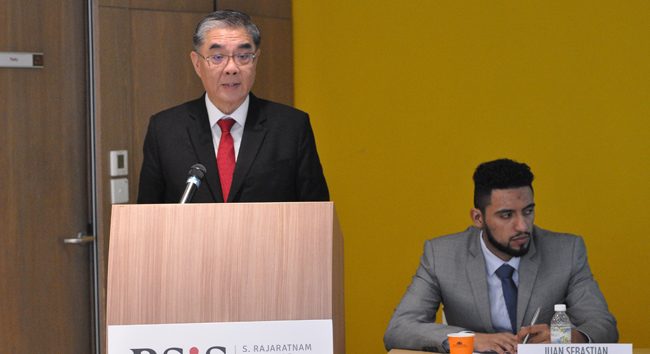
  • In his opening remarks, H.E. Ambassador Ong Keng Yong, executive deputy chairman of RSIS and director of the Institute of Defence and Strategic Studies, Nanyang Technological University, conveyed similar sentiments. He said although positive assessments like the American Chamber of Commerce in Singapore’s (AmCham Singapore) ASEAN Business Outlook survey augur well for ASEAN trade (whether intra or inter-ASEAN), obstacles such as NTBs would naturally dampen growth.


2. NTBs hurt cross-border trade of MSMEs

  • An equally important consequence of NTBs is that it impacts micro, small and medium enterprises (MSMEs) more than large corporations. According to Professor Kaewkamol Pitakdumrongkit, smaller firms are less able to absorb the costs incurred by Non-Tariff Measures (NTMs) and as a result, will have to pass the cost to consumers by raising prices. This price increase could then lead to them losing market share.
  • An example of the compliance costs associated with NTMs can be seen through product standardisation requirements. To meet the standards as imposed by an NTM, a company would need to set up a testing facility to ensure it adheres to the product standards. The cost of building this testing facility may not necessarily be something MSMEs can easily afford, said Prof Kaewkamol.
  • This impact on MSMEs poses a significant challenge as MSMEs make up a majority share of companies in ASEAN. Depending on the country, MSMEs can account for more than 90% of all enterprises, employ between 52% to 95% of the labour force, and contribute between 30% to 53% of the GDP, she explained. To a less quantifiable aspect, NTMs and NTBs affect markets through inflation and limiting access to affordable quality products.


3. ASEAN NTMs increased as tariffs declined

  • While there has been a reduction in tariffs over time, the increase in the number of NTMs have been observed over the same period, said Humphrey.
  • Based on the ASEAN-ERIA-UNCTAD database, non-tariff measures in ASEAN have steadily increased from 1,634 in 2000 to 5,975 measures in 2015. Of the total, 43.1% were technical barriers to trade (TBT), 33.2% were in the form of sanitary and phytosanitary (SPS), 12.8% were export measures and the rest were in the form of various measures.

  • Humphrey brought to attention the almost 6,000 NTMs in existence in ASEAN, many of which have the potential of being barriers to trade. The number of NTMs continue to grow and to his knowledge, not a single NTB has been removed through the ASEAN process. In a related vein, he noted that it has been 10 years since the ASEAN Trade in Goods Agreement (ATIGA) was signed but not all the provisions under ATIGA have been implemented.
  • Based on the research on NTBs in ASEAN conducted by the Asian Trade Centre (ATC) in 2018, ATC Trade Policy Analyst Juan Sebastian Cortes-Sanchez provided examples of NTBs and the respective impact in selected priority sectors.


4. Differentiating NTMs from NTBs and assessing the cost of NTMs

  • Tan Sri Dr Rebecca Fatima Sta Maria said NTMs should be a concern when they are trade distorting. Therefore, it is necessary to distinguish between NTMs and NTBs.
  • Findings from the ATC study reveal that ASEAN has struggled to identify NTMs and NTBs in spite of the many attempts it has undertaken to eliminate NTBs. Attempts at establishing a common definition have been hampered by conflicting perceptions of an NTM’s justification and enforcement across the member countries.
  • One aspect of assessing the impact of NTMs would be to determine the ad-valorem equivalents of the NTMs, said Dr. Rebecca. Ad valorem equivalent (AVE) is a tariff presented as a percentage of the value of goods passed through customs; AVEs have been used by researchers to quantify the compliance costs of NTMs. Dr. Rebecca said there is a lot of work to be done in this area and policymakers should collaborate with researchers and economists to work on AVEs to enhance their understanding of NTMs.


5. What has ASEAN done?

  • In her ASEAN Policy update presentation, Alpana Roy shared that more than 90% of ASEAN countries’ tariff lines have a preference margin of zero and over 70% of intra-ASEAN trade is conducted at the zero rate. This means ASEAN rarely uses preferences because there are hardly any preferences to use. The multilateralisation of these preferences accounts for one of the reasons intra-ASEAN trade has remained at around the same level.

Source: Malaysian Ministry of International Trade and Industry, Malaysia’s Free Trade Agreements
Note: ASEAN-6 includes Brunei Darussalam, Indonesia, Malaysia, Philippines, Singapore, and Thailand. CLMV includes Cambodia, Lao, Myanmar, and Vietnam.

  • Alpana spoke about the ASEAN Trade Repository (ATR) which includes a database on NTMs. The ASEAN NTM database is being updated and undergoing re-classification based on international standards. She added that a set of NTM guidelines were recently developed under the ambit of the ASEAN Trade Facilitation Joint Consultative Committee (ATF-JCC) to better manage NTMs and reduce the trade-distorting effects of NTMs.
  • According to Alpana, since most NTMs are imposed unilaterally, initiatives to tackle NTMs or NTBs requires solving it at the national level and therefore, requires national will. Nevertheless, Alpana added that ASEAN should not confine itself to intra-ASEAN solutions only but should also engage with its dialogue partners. She cited ASEAN’s plan to conclude the Regional Comprehensive Economic Partnership (RCEP) negotiations by the end of 2019 as one among many other efforts. On the back of securing an upgrade of the ASEAN-China Free Trade Agreement (FTA) in 2015, the regional bloc is looking to upgrade its trade agreements with its other dialogue partners.
  • The ASEAN Single Window (ASW) has started its live-operation with five ASEAN member countries (Indonesia, Malaysia, Singapore, Thailand and Vietnam) in January 2018 while the remaining ASEAN member states are scheduled to join by the end of 2019. The ASEAN Self-Certification Scheme, once implemented, will allow certified exporters to make their own declarations in order to qualify for preferential tariffs, she said.


6. Recommendations for addressing NTBs

  • Past efforts by ASEAN to eliminate NTBs have not been successful due to broad reasons, including past measures that have not always addressed the right target, said Cortes-Sanchez. The findings from ATC’s research suggest addressing NTBs at the national and regional institutional level.
  • At the sectoral level, ASEAN needs to develop institutional capacity to ensure the harmonisation of standards and certification procedures and related commitments are implemented. In addition, there should be an institutional mechanism or body tasked with dealing with NTBs that are not related to technical and conformity assessment standards. At the regional institutional level, it is important for ASEAN to identify and collect information on both NTMs and NTBs. Once this has been achieved, ASEAN needs to effectively manage the identified NTMs; and reduce and eliminate the identified NTBs. To realise the measures recommended at the regional institutional level, there needs to be clear procedures and institutional frameworks for tackling the elimination of NTBs, said Cortes-Sanchez.
  • Dr Rebecca cited the ASEAN Solutions for Investments, Services and Trade (ASSIST) initiative as a good regional programme that could help reduce the barriers to trade such as NTBs. The ASSIST initiative is supported by ARISE (ASEAN Regional Integration Support by the EU) Plus. The online solution helps ASEAN-based entities with operational cross-border issues (including NTBs) associated with the implementation of the ASEAN economic agreements.


7. Political will a must to address NTBs

  • While there have been measures to address Non-Tariff Barriers through ASEAN processes, Humphrey said that this often meant that the discussions were taken offline and become bilateral discussions between ASEAN member states. As a result, there is no complete removal of NTBs.
  • In trade, winners and losers are inevitable. The losers in trade will tend to lobby their governments for the implementation of protectionist measures that includes NTBs, said Prof Kaewkamol. ASEAN members need to understand that the downside of trade on domestic constituencies should be addressed through trade adjustment assistance programmes and not regulations.
  • Non-Tariff Barriers tend to be political and as such, will take some time to address the issue, Dr Rebecca opined. She gave an example of Malaysia’s approved permits (APs) in the automotive sector as an example of a trade measure tied to politically driven policies. Once the political will is there, the sharing of information between ASEAN member states will be essential in tackling NTBs.

    •  

      CONCLUSION

      Cooperation among the member states is required since NTBs need to be addressed at the regional institutional level, national level and sectoral level. ASEAN may have bright prospects but having a rosy outlook is not the same as reality. The future prospect should not overwhelm the current reality, Dr Munir said. Together with the uncertainty caused by the new trade order, NTBs could hold back ASEAN from fulfilling its potential. Therefore, it is in the interest of every ASEAN member state to work together in eliminating NTBs.

      ASEAN Roundtable Series

      ASEAN Roundtable Series

      ASEAN Roundtable Series