Cambodia to sign FTA with China to boost agro exports
(10 July 2020) Cambodian Prime Minister Hun Sen is scheduled to be in Beijing on 12 August to sign a free trade agreement (FTA) with his Chinese counterpart. The FTA is expected to usher in an enhanced level of economic cooperation between the two countries, deemed especially important to Cambodia. Officials recently said that negotiations will hinge on agricultural trade and build on Cambodia’s existing trade with China. Hean Vanhan, the secretary of state of the Agriculture Ministry who took part in the FTA negotiations, said a number of products will be on a tariff-free list and will be reviewed periodically. For now, he said, rice, bananas, and mangoes will be on the list. A critical aspect to the FTA will be whether it can offset losses from the partial suspension of the Everything But Arms (EBA) trade benefits to Europe. Hean said the FTA would be able to limit damage from the suspension of EU privileges but did not elaborate on how. Read more>>
Myanmar, China to enhance cross-border e-commerce systems
(13 July 2020) Myanmar and China plan to promote cooperation on digital economy and cross-border e-commerce systems to allow trade and economic activity to proceed smoothly during the times of pandemic. According to a press release from the Chinese Embassy, Yunnan province will provide the training for cross-border e-commerce operators from Mandalay region to help export agricultural products such as rice, beef, bananas and pineapples to Yunnan, or to China’s domestic market through Yunnan. In Myanmar, some Chinese online shopping platforms, such as the eMyan online platform, owned by Tradelink Corporate, a Chinese company based in Jiegao of Ruili, have already grabbed online shopping market share in major cities. Read more>>
Vietnam initiates anti-dumping investigation on corn syrup from China and South Korea
(10 July 2020) Vietnam’s Ministry of Industry and Trade has decided to initiate an anti-dumping investigation on high-fructose corn syrup originating from China and South Korea. Under the established regulations on trade remedies, the ministry would send questionnaires to related parties to collect information for analysis and evaluation of the alleged claims, including harm caused to Vietnam’s sugar industry. If required, the ministry would consider the imposition of temporary anti-dumping measures to prevent the dumping from continuing to cause damage to the domestic industry. The petition was lodged by six refined Vietnamese sugar companies, which together, account for 54.94% of the total domestic output of corn syrup. They have proposed the imposition of a 36.09% tariff on products from China and 40.02% on products from South Korea. Vietnam’s sugar industry has faced difficulties in recent years, partially due to sugar smuggling. Read more>>
Vietnam PM allows resumption of Vietnam-China flights
(13 July 2020) Vietnamese Prime Minister Nguyen Xuan Phuc has allowed the resumption of flights between Vietnam and China, according to an announcement made by the Government Office on 13 July. The frequency and conditions for passenger transport will be discussed and decided by the relevant authorities of the two countries. Phuc said that the demand for entry into Vietnam by overseas Vietnamese people, foreign investors, experts, and students have remained high and the government will, therefore, try to satisfy the demand according to priority and domestic quarantine capacity. Quick COVID-19 tests and appropriate quarantine measures will be applied to different types of entrants. Vietnam has conducted 40 repatriation flights since 21 April, bringing home 10,996 citizens who were stranded abroad due to the pandemic. Read more>>
Myanmar allows entry to Chinese business travellers under new scheme
(13 July 2020) Myanmar’s Ministry of Foreign Affairs Deputy Director General Aung Kyaw Zan told a local news outlet that they plan to allow Chinese travellers who wished to enter Myanmar for urgent business matters under a special scheme. The “Fast Track” scheme will allow entry to foreign travellers via relief flights, special flights and chartered flights. According to Deputy Director-General of Consul Services and Legal Affairs Aung Kyaw Zan, under the normal quarantine programme and entry, travellers have to spend many days in quarantine but the “Fast Track” scheme will not require such a long quarantine period and will be relatively hassle-free. The Myanmar embassy in Beijing issued an advisory which said that Chinese travellers who wish to visit Myanmar under the “Fast Track” scheme can apply for visas. The “Fast Track” scheme will be expanded to other countries as well. Read more>>
Brunei records highest car sales growth in ASEAN while regional output declines
(8 July 2020) Brunei recorded an 8.0% year-on-year increase in car sales in the first five months of 2020, the highest car sales growth in ASEAN, where nationwide lockdowns or partial lockdowns due to the COVID-19 pandemic has considerably slowed down vehicle sales in the region. According to statistics from the ASEAN Automotive Federation, with the exception of Myanmar, which also recorded a positive growth of 4.7%, the rest of the ASEAN member countries recorded a drastic drop in car sales ranging from as low as between -34% to -53%. Meanwhile, vehicle production in the ASEAN region during the January-May period of 2020 dropped by 39.2% year-on-year to 1.08 million, due to the impact of COVID-19. In the same period, Thailand’s vehicle output fell 40.2% year-on-year, while Indonesia’s vehicle production was down by 32.6% year-on-year. Malaysia recorded the largest year-on-year decline for that period, its vehicle production declined by more than half (51.1%) to 121,005 units.
ASEAN
Southeast Asia investment activity in 1Q2020 falls 65% to US$1.4 billion
(8 July 2020) Private equity (PE) and venture capital (VC) investment activities across Southeast Asia have slowed down in the first quarter of 2020 (1Q2020) amid the COVID-19 pandemic, according to a report released by an advisory firm. A total of 141 deals worth US$1.4 billion were announced in 1Q2020, representing a 9% and 65% year-on-year decline in the total number of deals and value, respectively. Announced PE and VC-backed exits declined to six deals from nine in the first quarter of 2019. The report also noted the amount of undeployed funds reached record levels of US$439 billion by mid-May 2020 and expects the second quarter of 2020 to be a slow quarter as well. Due to the COVID-19 outbreak over the past eight to 12 weeks, PE funds have focused on dealing with issues and making short-term adjustments to ensure the business has sufficient resources and support to weather the storm.
INDONESIA
Burden-sharing scheme with Bank Indonesia may affect central bank’s credibility
(8 July 2020) International credit rating agency Moody’s has stated that a burden-sharing scheme inked between the government and Bank Indonesia may affect the credibility of the central bank, in terms of its monetary policy framework. Moody’s warned that there are still certain aspects of the burden-sharing mechanism that are unclear, including its exit strategy to end the partial deficit financing. The government and Bank Indonesia agreed on 6 July 2020, to a burden-sharing scheme worth US$39.7 billion to finance the nation’s COVID-19 response and recovery efforts. The scheme will see Bank Indonesia purchase US$27.5 billion in government bonds to finance healthcare and social safety nets. Bank Indonesia will also bear the debt costs of the government’s stimulus package for small and medium enterprises (SMEs) and large businesses.
MALAYSIA
Malaysia’s central bank announced new e-KYC guideliness
(30 June 2020) Bank Negara Malaysia issued its policy document on Electronic Know-Your-Customer (e-KYC) on 30 June, following an earlier exposure draft it prepared in December 2019. This new policy is effective immediately for all financial institutions including banks, insurers, remittance companies and money changers. The central bank said that the introduction of the policy was in line with its effort to facilitate greater digital offerings of financial services. The policy document aims to accelerate and streamline practices of industry players in their adoption of e-KYC technology, the online process of identifying and verifying individual customers. The policy document states that financial institutions may rely on humans to conduct e-KYC via video calls or utilise technology like AI, machine learning and predictive algorithms to manage the process.
MALAYSIA
Malaysia’s industrial production index drops 22.1% year-on-year in May 2020
(9 July 2020) Malaysia’s industrial production index (IPI) dropped 22.1% year-on-year in May 2020. This is due to decreases in all three components of the IPI: manufacturing component (-23.2%), the mining component (-22.2%), and the electricity component (-10.3%). However, the annual contraction in May is smaller than the record 32% slump posted in April. On a month-on-month basis, the IPI in May 2020 increased by 18.2% since more industries were allowed to resume operations after a temporary closure of most manufacturing plants in compliance with the country’s Movement Control Order.
SINGAPORE
Jet engine maker Rolls-Royce to cut 240 jobs in Singapore due to COVID-19 impact
(9 July 2020) British jet-engine maker Rolls-Royce will cut about 240 jobs in Singapore due to the impact of COVID-19 on the aerospace industry. The layoffs will start in mid-August as part of a global restructuring. Rolls-Royce employs about 1,000 people making fan blades and assembling and testing engines at Seletar Aerospace Park. The layoffs will impact about 24% of the workforce. The lay-offs come after the engineering giant announced in May that it would slash at least 9,000 jobs worldwide, or over 17% of its global headcount. Rolls-Royce has been working with the Singapore Industrial and Services Employees’ Union and NTUC’s Employment and Employability Institute (e2i) to help affected workers.
THE PHILIPPINES
Data shows economy starting to recover from pandemic
(8 July 2020) The Philippines economy is starting to rebound from the COVID-19 pandemic but returning to positive growth depends on proactive implementation of the economic recovery programme, said acting Socioeconomic Planning Secretary Karl Kendrick Chua on 8 July. He said that based on data obtained for March and April, data on trade and production are starting to show improvements. He also cited the Purchasing Managers’ Index (PMI) which indicated that manufacturing performance improved to more normal territories in June from the contraction in April and May. Finance Assistant Secretary Jose Antonio Lambino II said the Bureau of Customs (BOC) surpassed last month’s collection target by 4.4% to US$860 million (PHP42.54 billion), compared to the June target of US$823 million (PHP40.74 billion). He said this was another sign of rising economic activity in the country.
THE PHILIPPINES
Filipino peso strengthens by 2% against dollar in 2020 due to dropping imports
(10 July 2020) The Filipino peso is the best performer in Asia in 2020, having gained 2% against the US dollar. This was attributed to a collapse in imports into the Philippines, leading to lower demand for foreign currencies and helping to strengthen the peso. Imports slumped by 41% year-on-year in May 2020, after a 65% drop in April. A smaller gap in the Philippines’ trade deficit is expected to offset the impact of a decline in remittances from the Philippines’ diaspora communities, which is also expected to impact the peso.
VIETNAM
Planned acquisition of stake into Japan’s Eneos refinery by Petrolimex stalls
(9 July 2020) Vietnam’s top gasoline seller Petrolimex’s planned acquisition of a stake in a Japanese refinery owned by Japan’s oil company Eneos has fallen by more than a year behind schedule due to expected political changes in Vietnam in January 2021. The Vietnamese government is reportedly holding off on major decisions ahead of the upcoming overhaul in the Communist Party’s leadership. Petrolimex had agreed in 2018 to invest in a Japanese refinery built and run by Eneos and export the gas to Vietnam. A joint venture to run the refinery was to be established in April 2019, but this has yet to be approved by the Vietnamese government. The planned joint venture involves the Eneos-owned Marifu refinery in Japan’s Yamaguchi Prefecture. Petrolimex currently runs about 5,000 filling stations in Vietnam, but it lacks an oil refinery.
CAMBODIA
Tourism sector to receive UNWTO support for post-pandemic recovery
(6 July 2020) The World Tourism Organization (UNWTO), the United Nations agency responsible for the promotion of responsible, sustainable and universally accessible tourism, said that it will support Cambodia in restoring its tourism sector after the COVID-19 pandemic ends. The announcement was made during the UNWTO 32nd meeting via video conferencing on 30 June. According to a local news outlet, Tourism Minister Thong Khon said that the UNWTO has regarded Cambodia as a priority country in Asia-Pacific and Southeast Asia to receive technical assistance to support the restoration of the country’s tourism sector post-COVID-19. He added that the UNWTO will assist Cambodia with human resource development and exchange experiences in managing the tourism sector after the pandemic.
Vietnam to increase rice exports to EU under EVFTA
(8 July 2020) Vietnam’s rice quotas under the Vietnam-EU Free Trade Agreement (EVFTA) are expected to increase the country’s rice exports from the second half of 2020, said its Ministry of Industry and Trade (MoIT). Under the EVTA, which is expected to come into force from 1 August, the European Union (EU) has pledged to provide an annual rice quota of 80,000 tonnes to Vietnam. According to Tran Thanh Hai, deputy director of MoIT’s Import and Export Department, Vietnam had a modest value at US$10.7 million from rice exports to the EU because of high import tariffs in this market. By 2025, Vietnam’s agriculture sector expects to increase its rice exports by up to 65% due to the EVFTA. Read more>>
THAILAND
Thai National Shippers’ Council cut 2020 export outlook from -8% to -10%
(7 July 2020) Thailand’s exports are expected to shrink by 10% in 2020, deeper than the previous forecast of an 8% drop, due to the COVID-19 pandemic and the strength of the baht currency, the Thai National Shippers’ Council said on 7 July. Commerce Ministry data showed that during the January-March period, the value of annual exports fell 3.7% in dollar terms and declined 5.2% in baht terms. The council will send a letter to the Prime Minister Prayut Chan-ocha in a bid to help keep the baht at 34 baht per US dollar. Read more>>
THAILAND
“Travel bubbles” plan may be delayed due to rise in COVID-19 cases in prospective countries
(8 July 2020) Thailand’s plan to implement “travel bubbles” are likely to be delayed after several countries shortlisted for the scheme have seen a resurgence of COVID-19 cases, according to the Civil Aviation Authority of Thailand (CAAT). CAAT director-general Chula Sukmanop said even though talks about travel bubble arrangements are being discussed with a number of countries including China, Japan and South Korea, the scheme will be put on hold due to the rise in infections. He added that Thailand will be closely monitoring the COVID-19 situation this month. The Thai government had earlier come up with a plan to launch travel bubbles with several countries with low coronavirus risk and the initial arrangements were to be adopted with the first group of international tourists in August at the earliest. Read more>>
VIETNAM
Central bank to consider stronger money policies to aid economic growth
(7 July 2020) The State Bank of Viet Nam (SBV) could increase credit growth limits for credit institutions in 2020 or even launch stronger monetary policies to aid the country’s post-pandemic growth, said SBV governor Le Minh Hung at a government meeting last week. Hung said the central bank was asking credit institutions to cut costs and lower profit targets so lending rates could be decreased to support businesses while the banking system’s operation quality and safety are enhanced. According to SBV statistics, loan payment deadlines were restructured for nearly 260,000 customers with outstanding loans worth nearly US$775.8 million (VND18 trillion). Banks also provided new loans worth US$47.2 billion (VND1.1 quadrillion) to 240,000 customers at rates that were 0.5-2.5 percentage points lower than pre-pandemic rates. Read more>>
CAMBODIA
Investment in construction sector in first half of 2020 exceeds US$3.8 billion
(7 July 2020) Capital investment in Cambodia’s construction sector increased 13.3% year-on-year to more than US$3.8 billion in the first half of 2020, the Ministry of Land Management, Urban Planning and Construction said in a report. The Ministry received 2,522 applications for construction projects during the period, up 23.2% from the 2,047 applications received in the first half of 2019. According to the Cambodian Valuers and Estate Agents Association (CVEA), the strong growth in capital investment, however, may not necessarily reflect actual construction activities. A local housing advisory firm said that the COVID-19 pandemic has stifled construction activity and housing sales in the first half of 2020 notwithstanding the increase in capital investment. He said around 68% of high-rise condominium projects were suspended during the period, while the remainder experienced delays. Read more>>
About Greater Mekong Subregion (GMS)
The Greater Mekong Subregion (GMS) Economic Programme was launched by the Asian Development Bank in 1992 connecting five developing ASEAN countries, namely Cambodia, Laos, Myanmar, Vietnam and Thailand, and Chinese provinces of Yunnan and Guangxi Zhuang Autonomous region. The region has some of the most robust economies sharing the Mekong River Basin thanks to its reform and liberalisation. The subregion is growing at a faster pace than the whole of East Asia and the Asia Pacific as the GDP growth rate for 2017 was at 6.4 percent, according to the World Bank. The population at the subregion as of 2016 is at 340 million while the GDP at PPP is at US$3.1 trillion in 2016. In 2015, trading within the region was at US$444 billion.
Published on 9 July 2020 | Written by Aznita Ahmad Pharmy, Research Fellow, CIMB ASEAN Research Institute
CARI Viewpoint: ASEAN needs to move forward with a coordinated post-pandemic recovery response while pursuing forward-looking community-building and market integration
CIMB ASEAN Research Institute (CARI) organised its third edition of “CARI Briefings: COVID-19 Economic Recovery Plan Series titled “How Can ASEAN Bounce Back: Can the ASEAN Economic Community Retain its Vision in a Post-Pandemic World?” on 3 July 2020 featuring His Excellency Dato Lim Jock Hoi, Secretary-General of ASEAN. The session was moderated by Tan Sri Dr. Munir Majid, Chairman of CARI, and the discussion centred on what ASEAN is doing to sustain the economies of member countries, its regional response and coordination towards a robust post-pandemic recovery and efforts to sustain momentum to achieve its vision.
During the briefing, among the key insights shared were:
1) ASEAN responded quickly to the COVID-19 pandemic
a) ASEAN merchandise trade down 32% in 2020 due to COVID-19 and its economy is projected to contract by 2.7%, a first since the Asian Financial Crisis
The world is currently facing an unprecedented health and economic crisis due to the COVID-19 pandemic. H.E. Dato Lim Jock Hoi said in ASEAN alone, the number of confirmed COVID-19 cases is estimated to be around 150,000 while the number of deaths is around 4,500.
According to Dato Lim Jock Hoi, the economic situation around the world is worsening, with a 4.9% contraction projected for the global economy, a 32% drop in global merchandise trade projected in a worst-case scenario in 2020. In terms of investment, global FDI is expected to decrease by up to 40% in 2020, bringing it down to below US$ 1 trillion for the first time since 2005, while FDI flows to developing Asia is expected to decline between 30% to 45%, he said.
In ASEAN, the region is expected to contract by 2.7%, a first in 22 years since the Asian Financial Crisis. Among ASEAN member states, Dato Lim Jock Hoi said the economic outlook varies: while some are expected to see a considerable contraction, others will be faced with stagnation, and just a few can still observe growth, albeit much more muted than the previous years. He revealed that more than 40% of the region’s workforce and 50 million enterprises are in the hard-hit sectors, while over 200 million informal sector workers have their livelihoods at risk.
b) ASEAN members responded swiftly to address the pandemic
“ASEAN individually and collectively as a region has been very quick in response to the pandemic and in the immediate instances, national governments sped up and ensured financial liquidity and market stability. Stimulus measures were rolled out on an unprecedented scale and speed to bolster the health system, save lives and safeguard the livelihood of most of the vulnerable groups,” said Dato Lim Jock Hoi.
“Regionally, the early announcement of a commitment to work together in the fight against the pandemic was critical to set the tone especially as the immediate reaction of many countries around the world to turn inward [in looking for solutions],” he added.
In March 2020, ASEAN Economic Ministers (AEM) announced their commitment to keep markets open and ensure supply chain connectivity, particularly essential goods. This commitment has since been materialised as the ASEAN Hanoi Action Plan on Strengthening ASEAN Economic Cooperation and Supply Chain Connectivity in Response to the COVID-19 Pandemic. The action plan was adopted on 4 June by the AEM and further endorsed by the ASEAN Economic Community (AEC) Council on 19 June, and by ASEAN leaders on 26 June at the 36th ASEAN Summit.
Dato Lim Jock Hoi pointed out that commitment alone was insufficient to drive the region’s response to the pandemic. The establishment of the ASEAN Coordinating Council Working Group on Public Health Emergencies (ACCWG-PHE) was instrumental to ensuring the right steps were taken; the working group had its first meeting on 31 March. Reporting directly to the ASEAN Coordinating Council, Dato Lim Jock Hoi said the cross-sectoral and cross-pillar working group allows for a holistic and coordinated response, stronger political buy-in and prompt decision-making process. “This is one area we will be putting more emphasis on how to work together among the three pillars [of ASEAN],” he added.
c) Cross-sectoral measures to mitigate the economic fallout from COVID-19
At the sectoral level in ASEAN, the commitment to work together was also made by the most affected sectors such as food and agriculture, tourism and other sectoral bodies, according to Dato Lim Jock Hoi.
He cited the food and agriculture sector which committed to cooperate to ensure the continuance of food security, safety and nutrition in the region, in light of COVID-19’s impact on food supply.
The tourism sector is committed to coordinate measures in the new normal and to work together for a more resilient and sustainable recovery. “This is an important area because most of our member states’ economies are very much dependent on tourism. Other sectors are also looking at how COVID-19 has affected or raised the issue relating to their work such as consumer protection, digital economy and transport,” commented Dato Lim Jock Hoi.
He added that at the highest political level, ASEAN leaders continue to lead the region’s response, such as holding the Special Summit on COVID-19 on 14 March, and the virtual 36th ASEAN Summit on 26 June, where the leaders announced:
The establishment of the COVID-19 ASEAN Response Fund,
The setting up of regional reserves of medical supplies for public health emergencies,
The development of standard operating procedures (SOPs) for public health emergencies, The development of a comprehensive recovery plan, and
A proposal to look into the feasibility of an ASEAN safe travel corridor to explore facilitated movement of people such as business people as the region slowly enters into the new normal.
2) How ASEAN should move forward
With the health and livelihoods of the people in the region at stake, many are looking to see how ASEAN as a region takes the next step. Dato Lim Jock Hoi presented three points on how ASEAN should proceed.
a) Coordinated post-pandemic recovery plan
“ASEAN must have a coordinated, whole-of-community, comprehensive recovery plan, that will take ASEAN through the recovery stages, from reopening to recovery, and to long term resilience. Such a plan shall be robust, credible, and pragmatic. It needs to articulate clearly on how the region will work together across different areas affected by COVID-19,” said Dato Lim Jock Hoi.
The ASEAN Secretary-General expressed his appreciation to the private sector, particularly the ASEAN Business Advisory Council, and the joint business councils, who have helped to further distil the prioritised recommendations including the idea of an ASEAN Special High-Level Commission (AHLSC) and Special Business Advisory Body (SBAB).
The prioritised recommendations will be directed to the appropriate channels and ASEAN will continue to work on its recovery through dialogue with other external partners.. When asked by Tan Sri Dr. Munir for an update on the AHLSC proposal, Dato Lim Jock Hoi said that it is a work-in-progress. “We are working with the ACC on how we can best address this issue.”
b) Continuation of ASEAN community-building and market integration initiatives
Even with the many pressing issues that ASEAN has to deal with currently, the region must continue its work towards achieving its vision.
“Progress in ASEAN community-building and regional integration efforts is more important now than ever. The global economy will significantly slump and the recovery will be long. Neither the external economy nor the domestic/regional economy can act as the automatic engine for recovery,” Dato Lim Jock Hoi pointed out.
“The region must be prepared to seize the opportunities presented by the post-pandemic world. To this end, enforcement of the implementation of AEC commitments will be key. Commitments and initiatives that are critical for market integration and regional competitiveness must forge ahead,” he said.
He highlighted the current initiatives important for ASEAN:
ASEAN Single Window (ASW): More effort should be directed to expand documentation to be exchanged on the ASEAN Single Window. Similarly, the feasibility of expansion to other partners should be explored,
ASEAN-Wide Self-Certification (AWSC): The operationalisation of the ASEAN-Wide Self Certification (AWSC) is expected by 1 September, but remaining countries must accelerate the domestic process to ratify the relevant protocol in time,
ASEAN Trade in Goods Agreement (ATIGA): The general review of ATIGA will need to be sufficiently ambitious to help the seamless flow of goods in the region and address past implementation challenges,
ASEAN Trade in Services Agreement (ATISA): The signing and ratification of ATISA need to be accelerated so as not to lose out the competitiveness rendered by our services sector,
Investment facilitation: Much more needs to be done to promote and facilitate investment into the region, particularly those that are sustainable, environmentally and socially, and that can better prepare the region for the new digital era,
ASEAN Agreement on Electronic Commerce: Remaining ASEAN member states should also complete the ratification of the ASEAN Agreement on Electronic Commerce to allow for its entry into force, so that work in this area can be reinvigorated,
Regional Comprehensive Economic Partnership (RCEP): The signing of the RCEP in 2020, as mandated by ASEAN leaders, will boost the confidence needed for a faster and more resilient recovery,
Mid-term Reviews: ASEAN is undertaking the important exercise of the mid-term review of the ASEAN Community Blueprints, the Master Plan of ASEAN Connectivity 2025, and the review of the Initiative for ASEAN Integration (IAI) Work Plan III 2016-2020.
c) ASEAN needs to build a stronger, more resilient, inclusive and sustainable future
According to Dato Lim Jock Hoi, the post-pandemic world will not be a return to business-as-usual. “The onus is on us to make sure we take this period as an opportunity to be even stronger after the pandemic,” he said.
To achieve this, he presented the following areas for consideration:
Mid-term review to modernise ASEAN’s market
Internally, ASEAN should use the mid-term review and the pandemic as an opportunity to really modernise its market and business/investment environment, and thus realise the full potential of the intra-ASEAN market.
ASEAN must push forward its digital agenda
ASEAN must now forge ahead with its digital agenda that will also underpin the region’s future growth potential. Digital transformation is not a standalone sector in ASEAN’s work; the development of a consolidated strategy on the fourth industrial revolution and the ASEAN Digital Master Plan will contribute to this effort.
Human capital development that would create a more inclusive ASEAN
Human capital development must, therefore, play a key part of the ASEAN agenda, and the focus must be to expand opportunities for all segments of society, particularly the vulnerable groups. Similarly, more effective and participatory stakeholder engagement is needed for a more inclusive ASEAN.
Comprehensive sustainability agenda to ensure long-term resilience
As ASEAN looks forward to a post-pandemic world, we need to address the region’s long-term resilience by promoting sustainability in all aspects. We need to re-think our existing approaches to sustainability, which cannot be tackled from the environmental perspective alone, but also from the perspectives of financing, production, consumption, energy, standards, and so on.
Commitment to an open, rules-based and non-discriminatory multilateral system
ASEAN shall continue to advance the interest and priorities of its people while contributing to an open, rules-based, and non-discriminatory multilateral system, which will best benefit small and medium-sized economies like ASEAN. The region should participate in relevant reform efforts, to ensure that the multilateral system remains effective, relevant, fair, and inclusive.
3) Questions and Answers
During the ensuing questions and answers session, the following topics were discussed. Dato Lim Jock Hoi was joined by his colleagues, Deputy Secretary-General for the ASEAN Economic Community Dr. Aladdin D. Rillo; External Economic Relations Division Assistant Director, Anna Robeniol; and ASEAN Integration Monitoring Directorate (AIMD) Director, Julia Puspadewi Tijaja.
a) The effectiveness of ASEAN mechanisms in addressing COVID-19
In dealing with the repercussions of the COVID-19 pandemic, Tan Sri Dr. Munir pondered if ASEAN mechanisms were fit-for-purpose, particularly how the decision-making process is for the ASEAN Coordinating Council.
According to Dato Lim Jock Hoi, the ASEAN Coordinating Council (ACC) is the highest body before the ASEAN leaders. The three community councils (political-security, economic, socio-cultural) are required to pass their reports to the ACC which acts as the gatekeeper for the ASEAN Leaders’ Summit. “This is where the COVID-19 is being handled by the ACC and the ACC created another working group called ASEAN Coordinating Council Working Group on Public Health Emergencies,” he explained.
He said that the public health emergencies working group is represented by the senior officials of all the three community councils and therefore will address cross-pillar and cross-sectoral issues. “It is important that we should utilise the mechanism because this mechanism will address the cross-pillar, sectoral and issues.
b) Private sector’s role in ASEAN’s economic recovery still important
The private sector in ASEAN has been anxious to see significant progress in ASEAN’s efforts to promote trade facilitation and market integration. A question was put forth on what more could be done by the private sector to help ASEAN achieve economic integration.
Dato Lim Jock Hoi noted that trade facilitation was an important area in the region’s post-pandemic recovery plan and would require the support of the private sector. On what more the private sector can do to further assist ASEAN, Dr. Aladdin provided some suggestions.
“In my view, one important area where the private sector can assist is in terms of how we can restore the supply chain connectivity in the region. There are two possibilities where businesses can help: one is in terms of the ability of the private sector to enhance information sharing among the people associated with the supply chain. Secondly, the private sector can invest in [technology such as Big Data and AI] for ASEAN to restore the supply chain connectivity,” he said.
c) RCEP will be signed in 2020 but may not enter into force in 2021
The signing of RCEP is obviously very important for the region, particularly since it sends a signal that ASEAN is moving towards regional integration and freeing the flow of trade and investment in other sectors, said Dato Lim Jock Hoi. However, he opines that the ratification will take some time.
“We are working very hard now to prepare the RCEP agreement for signing, hopefully by November when Vietnam hosts the next ASEAN Summit,” said ASEAN External Economic Relations Division Assistant Director, Anna Robeniol.
According to her, due to the different domestic processes for each signatory to ratify the agreement, the agreement may not enter into force next year. Under current arrangements, the agreement has to be ratified by at least six ASEAN member states and four ASEAN FTA partners for it to enter into force.
4) Conclusion
ASEAN currently needs to address challenges on many fronts. In terms of the COVID-19 pandemic, it needs to balance between measures to control the number of infections and reopening the economy to protect the livelihoods of its people.
In the regional context, while the bloc needs to attend to the urgent issue of the pandemic, it should remain steadfast towards achieving its goals of community-building and economic integration. ASEAN’s institutional arrangements must be fast-tracked. The challenges posed by the current COVID-19 crisis require swift decisions that are workable and can be executed with speed. The proposal to set up the ASEAN High-Level Special Commission is a potential pathway that can execute quick decisions since it would comprise leaders who are second only to the ASEAN leaders.
ASEAN must also strive to strengthen its cooperation amongst member states in order to deepen social and economic integration. Commitments have been made at the regional level to address the economic impact of the pandemic on hard-hit sectors such as tourism, both at the national and regional level. ASEAN must not waste a crisis and truly work as a united group to emerge from this crisis stronger and more resilient.
As mentioned by Dato Lim Jock Hoi during the webinar, commitment alone is insufficient and the mechanisms are in place to drive effective implementation of the measures. The regional bloc will also work on its post-pandemic economic recovery through dialogue with external partners. He said, “The world is facing a collective hardship, and there’s never a better time for cooperation and partnership.”
Chinese-backed megacity project in Malaysia delayed due to COVID-19
(7 July 2020) The US$100 billion Forest City megacity project in Malaysia’s Johor state is expected to be delayed due to the COVID-19 pandemic. Sales of property products to investors has dropped 90% since March 2020, while development work such as reclamation works have slowed down considerably. According to a regional news outlet, the project is struggling to attract buyers due to the economic downturn brought on by the pandemic. The 1,740 hectares project is two-thirds owned by Chinese property giant Country Garden, with the remaining one-third owned by a Malaysian entity. The megacity project is a mix of residential, leisure, commercial, and industrial spaces, and will also include its own customs facility enabling residents who work in Singapore to commute back and forth on a daily basis. Despite this recent development, however, property sales in Malaysia for the second half of 2020 is expected to be less severe due to the government’s recently introduced home ownership campaign. Read more>>
Singapore Exchange to cooperate with Chinese investment banking firm to bridge financial markets
(8 July 2020) Singapore Exchange signed a memorandum of understanding with Chinese investment firm China International Capital Corporation (CICC) to explore cooperation in the fields of investment banking, equities, private equity, asset management, wealth management and research. Both sides hope to capture the business opportunities through deepened interconnection, cross-border capital movements, and Chinese firms hoping to access Singapore’s capital market. The partnership hopes to benefit from CICC’s knowledge in domestic and overseas markets, and experience in cross-border business. Read more>>
Chinese logistics giant BEST Inc to expand into Cambodia, Malaysia, and Singapore
(7 July 2020) Chinese smart supply chain solutions and logistics services giant BEST Inc has expanded its operations into Cambodia, Malaysia, and Singapore following previous launches in Vietnam and Thailand in 2019, the company announced on 2 July. BEST Inc hopes to build an efficient logistics network in Southeast Asia, and plans to operate 12 sortation centres and around 400 service stations across Cambodia, Malaysia and Singapore over the next three years. This includes operating two customised and high-tech flagship sortation centres in Phnom Penh and Kuala Lumpur. According to the logistics company, its total parcel volume from Southeast Asia reached 8.8 million units in the first quarter of 2020. Read more>>
Thailand Tourism Ministry targeting certain Chinese provinces for Phuket “tourism bubble”
(4 July 2020) Thailand’s Tourism Ministry have stated they will target certain provinces in China for a “tourism bubble” campaign for Phuket. The campaign will only target Chinese provinces which have managed to contain COVID-19. Phuket is to lead the planned foreign tourism bubble campaign with selected partner countries as well. The primary target is China due to the shorter travel time, although other markets being considered include South Korea, Japan, Australia, and New Zealand. Thailand welcomed almost 40 million foreign tourists in 2019 but this year, the country’s central bank expects only 8 million foreign arrivals due to COVID-19 restricted travel. Read more>>
Alibaba plans to open third cloud data centre in Indonesia in 2021
(3 July 2020) Chinese tech giant Alibaba plans to open a third cloud data centre in Indonesia by 2021, thereby expanding its presence in the Indonesian market. The first centre was built in 2018 and the second, in 2019. According to Alibaba Cloud, a subsidiary of Alibaba, the latest data centre would minimise risks of data loss by dividing the workload between the three centres. A data scrubbing centre would also be built alongside the new data centre in Indonesia. The location of the third centre, however, was not disclosed by Alibaba. Rivals Google and Amazon are also planning on expanding their cloud service subsidiaries in Indonesia, which is considered as the single largest digital economy in Southeast Asia. Read more>>
ASEAN Secretary-General: ASEAN remains committed to multilateral cooperation and recognises the critical role of the private sector in the bloc’s COVID-19 economic recovery plan
From top: H.E. Dato Lim Jock Hoi, Secretary-General of ASEAN; and Tan Sri Dr. Munir Majid, Chairman of CIMB ASEAN Research Institute
Kuala Lumpur, 3 July 2020 – CIMB ASEAN Research Institute (“CARI”) hosted the CARI Briefings webinar under its COVID-19 Economic Recovery Plan Series, titled “How Can ASEAN Bounce Back: Can the ASEAN Economic Community Retain its Vision in a Post-Pandemic World?” The session featured H.E. Dato Lim Jock Hoi, Secretary-General of ASEAN. Moderated by Tan Sri Dr. Munir Majid, Chairman of CARI, the discussion centred on what ASEAN is doing to sustain the economies of member countries, its regional response and coordination towards a robust post-pandemic recovery and efforts to sustain momentum to achieve its vision.
1. ASEAN remains committed to its community-building agenda and multilateral cooperation amid the pandemic
H.E. Dato Lim Jock Hoi began his session by stressing the significance of the region’s early commitment to cooperate instead of turning inward amid the pandemic. “ASEAN will continue to work together, including with external partners and partner institutions. This demonstrates ASEAN’s commitment to multilateral cooperation to effectively address the expansive implications of this unprecedented threat,” he said.
The spread and impact of the pandemic knows no boundaries, hence a coordinated response and closer cooperation is required even more. ASEAN has taken steps to work together, among member states as well as dialogue partners. The bloc just held its 36th ASEAN Summit virtually and adopted a vision statement, which recognises the social and economic repercussions of the COVID-19 pandemic and reaffirmed ASEAN Leaders’ strong commitment to sustain the momentum of ASEAN community building. ASEAN leaders also announced the establishment of a COVID-19 ASEAN Response Fund and the development of a comprehensive recovery plan.
2. Private sector’s role is indispensable in post-pandemic economic recovery
“Coordination for reopening and post-pandemic recovery is critical given the region’s high level of economic integration and interconnectedness. The private sector will play an integral role in these efforts, to restore employment, business confidence, and in working towards a swift and strong recovery,” commented Dato Lim Jock Hoi.
At the 36th Summit recently, ASEAN recognised the crucial role of the private sector in post-pandemic economic recovery, and aimed to foster cross-pillar and cross-sectoral collaboration within ASEAN as well as with relevant stakeholders to ensure a coordinated response to the pandemic.
Earlier, the ASEAN Business Advisory Council has proposed for the regional bloc to set up an ASEAN High-Level Special Commission (AHLSC) to expedite the decision-making process with regards to the region’s post-pandemic recovery plan. The mechanism on how to move forward with the proposal is under discussion to avoid overlaps with the existing ASEAN mechanism.
3. Post-pandemic recovery an opportunity to reassess ASEAN’s growth trajectory
Dato Lim Jock Hoi noted the unprecedented health and socio-economic impact of the COVID-19 pandemic but highlighted the opportunity presented for the region to reassess its path.
“ASEAN post-pandemic recovery is an opportunity for the region to recalibrate its growth trajectory to one that is more resilient, digitally-enabled, inclusive, and sustainable,” said Dato Lim Jock Hoi.
Among the most striking trend is the acceleration of digital technology adoption during the pandemic, which offered added impetus and urgency for ASEAN to embrace new technologies and address the digital divide across and within ASEAN member states.
The opportunity to recalibrate growth comes at the midway point of the second ASEAN Economic Community (AEC) Blueprint 2025 as ASEAN goes through the Mid-term Review this year to evaluate its past progress and plan for the future. The region is also at a critical period given the commencement of the development of a consolidated strategy for the Fourth Industrial Revolution and the final preparation stage of the Regional Comprehensive Economic Partnership (RCEP) towards its signing.
Conclusion
In summing up the session, Tan Sri Dr. Munir expressed confidence in Dato Lim Jock Hoi’s leadership and conveyed the hopes of the private sector of an effective ASEAN response towards the economic challenges posed by the COVID-19 pandemic.
“Secretary-General Dato Lim Jock Hoi is in many ways in the hot seat of ASEAN response to the COVID-19 health and economic crisis. ASEAN is fortunate to have him heading the secretariat at this time. Well experienced particularly on the economy at the highest levels he can well handle the pressures and challenges ASEAN faces. The business sector, particularly, looks forward to working with him to fashion rapid ASEAN responses in these unprecedented times in global history,” he remarked.
(In picture) Dr. Aladdin D. Rillo, Deputy Secretary-General for the ASEAN Economic Community, responds to a question from the audience
Malaysia leads mobile wallet usage in Southeast Asia
(24 June 2020) Malaysia has the highest mobile/digital wallet usage in Southeast Asia at 40%, ahead of the Philippines (36%), Thailand (27%) and Singapore (26%), according to the Mastercard Impact Study 2020. Malaysian consumers also shifted to other payment methods, such as contactless debit cards (26%) and contactless credit cards (22%), while cash usage declined 64% since the beginning of the pandemic. Singapore, the Philippines and Thailand also reduced their cash usage by 67%, 64% and 59% respectively, with a similar increase seen in use among all contactless payment methods. The report noted that even as countries in the region start to ease the restrictions and prepare for the “new normal,” some of the trends and habits formed in response to the pandemic would likely remain.
ASEAN
ASEAN leaders reaffirm commitment to mitigate impact of COVID-19 at 36th Summit
(26 June 2020) ASEAN leaders adopted the “ASEAN Leaders’ Vision Statement on A Cohesive and Responsive ASEAN: Rising Above Challenges And Sustaining Growth,” which, among others, recognised the social and economic repercussions of the COVID-19 pandemic. The 36th ASEAN Summit was held virtually and hosted by the 2020 ASEAN Chair, Vietnam, from Hanoi. In the document, the leaders reaffirmed strong commitment to alleviating the adverse impact of the pandemic on people’s livelihood, societies and economies, among others, through the implementation of a comprehensive recovery plan. The leaders of the regional grouping also agreed to sustain the momentum of ASEAN community-building and be forward-looking in charting the continuing development of ASEAN beyond 2025.
MALAYSIA
Malaysia’s exports suffer worst decline in 11 years
(29 June 2020) Malaysia’s exports suffered a sharp decrease by 25.5% year-on-year to US$14.6 billion (RM62.7 billion) in May 2020. This was its biggest fall since May 2009. It was the second consecutive month with a double-digit decline for exports after a 23.8% year-on-year decrease in April to US$15.1 billion (RM64.9 billion). According to the Department Of Statistics Malaysia (DOSM), the country’s imports similarly suffered a worst drop since January 2009. Imports fell 30% to US$12.2 billion (RM52.3 billion) year-on-year. Although the country’s trade balance returned to a surplus of US$2.4 billion (RM10.4 billion) in May, after registering its first monthly deficit in over 22 years in April, Malaysia’s exports recorded a decrease at a slower pace than that of imports, said the DOSM.
VIETNAM
VN-Index rebounds, propped up by PMI data and interest cuts
(2 July 2020) Vietnam’s benchmark VN-Index surged on 1 July after a six-day losing streak as investor sentiment improved following solid data of PMI in June 2020 and steep cuts in interest rates of some banks. The VN-Index recouped 2.23% to close at 843.49 points on 1 July after losing 5.4% in the previous six sessions. IHS Markit data released on 1 July showed that Vietnam Manufacturing Purchasing Managers’ Index (PMI) posted 51.1 in June, up from 42.7 in May and above the 50.0 no-change mark for the first time in five months. The reading represented a continuation of the recovery seen since the PMI hit a record low in April. According to an analyst, the business results in the first quarter of 2020 were pessimistic, but opines that the market has recovered recently thanks to investors’ confidence in the economic support packages by the government and that businesses will soon return to normal and resume activities.
SINGAPORE
Home prices fall by most in three years in 2Q20 due to city-wide shutdown
(2 July 2020) Home prices in Singapore fell the most in three years in the second quarter of 2020, due to the city-wide shutdown caused by COVID-19. Property prices declined by 1.1% quarter-on-quarter in the second quarter, a slight increase from the 1% decrease in the first quarter of 2020. Singapore’s shutdown, which only started easing on 19 June, sent housing sales plunging to a near six-year low in April 2020, after which sales rebounded in May. Analysts forecast that housing prices may fall by between 3% to 6% in 2020 due to macroeconomic uncertainties.
INDONESIA
World Bank classifies Indonesia as an upper-middle income country
(2 July 2020) Indonesia has been officially classified as an upper-middle income country according to the World Bank’s latest countries classifications by income level, released on 1 July. The classification is based on gross national income (GNI) per capita, and Indonesia’s economy saw its GNI per capita rise to US$4,050 in 2019, surpassing the income threshold for upper-middle income (US$4,046 to US$12,535) from US$3,840 in 2018. The World Bank uses the classification as a way of determining whether a country can use a bank’s facilities, such as loan pricing. The Indonesian economy has come under stress due to the COVID-19 pandemic, with the World Bank projecting zero growth for the country in 2020.
INDONESIA
Indonesia mulling the return of banking regulatory authority to central bank
(2 July 2020) Indonesian President Joko Widodo is considering issuing an emergency decree which would transfer regulatory authority over the banking system from the Financial Services Authority (OJK) back to Bank Indonesia, amidst concerns that the COVID-19 pandemic is exposing strains in the financial system. The Indonesian government is considering adopting the French model of having an independent administrative authority under the central bank which would oversee the banking system. In early 2020, Indonesia’s supreme audit board had referred to the OJK’s supervisory role over the financial system as “weak,” pointing to loopholes in its oversight of seven banks. However, on aggregate, the banking system has been referred to as “secure” by the OJK.
BRUNEI, JAPAN
Japan to possibly discuss with Brunei to ease COVID-19-related travel restrictions
(2 July 2020) Japan might open talks with Brunei as early as July 2020 to ease COVID-19-related travel restrictions between both countries. Business travellers are to be given priority, followed by students and then tourists. Travel to and fro Japan has virtually stopped since restrictions were imposed, with a 99.9% drop year-on-year in foreign arrivals in May 2020. A total of 129 countries and regions are currently on Japan’s entry ban list, with foreign travelers who have been to any of the areas within 14 days being turned away. Travel between Japan and Vietnam was partially resumed on 25 June, with a chartered flight to Vietnam carrying 150 passengers, mainly business people.
THE PHILIPPINES, JAPAN
Japan extends US$464 million loan to the Philippines to help fight COVID-19
(1 July 2020) Japan will extend a US$464 million loan to the Philippine government to help finance the country’s emergency measures to fight COVID-19. This makes the Philippines the first recipient of the highly concessional COVID-19 Crisis Response Emergency Support Loan designed by Japan to help ease the global health crisis. The loan is co-financed by the Asian Development Bank, and adds to the US$18 million Japanese grant aimed at providing Philippine hospitals and institutions with advanced medical equipment. The Philippines government has raised a further US$4.83 billion in concessional loans for its COVID-19 response from the World Bank, Asian Infrastructure Investment Bank, and the Agence Française de Développement.
THAILAND
Thailand prepares for haze
(30 June 2020) Thai authorities have warned that seasonal haze in the southern parts of the country is expected to be worse in 2020 due to droughts in neighbouring countries. The ASEAN Specialised Meteorological Centre (ASMC) said that temperatures in the lower parts of the region are expected to rise from July to September, leading to a possibility of intense transboundary haze pollution in the south. According to a local news outlet, this has prompted the Environment Ministry to call on agencies to prepare measures to limit the damage. Minister of Natural Resources and Environment Varawut Silpa-archa said the Pollution Control Department will be the main agency to invoke the ASEAN Agreement on Transboundary Haze Pollution and ask for cooperation from related countries to address the issue.
Thailand implements third extension of coronavirus emergency until 31 July
(30 June 2020) Thailand will remain under a state of coronavirus emergency until 31 July, making it the third extension of the emergency decree. Originally imposed on 26 March, the emergency decree was supposed to end on 30 April. With no local transmission of the virus for over a month, Thailand will start easing restrictions from 1 July, with bars and pubs allowed to reopen, shopping malls and department stores allowed to extend their operations until 10pm, and schools restarting. While tourists will still be barred from entering Thailand, work-permit holders and their spouses, foreign spouses, and foreigners with permanent residence status, will be allowed in. Special arrangements are being negotiated with Japan, South Korea, Singapore, China and Hong Kong for short term business trips. Read more>>
THAILAND
Tourism industry expected to lose US$47 billion under worst case scenario
(2 July 2020) Thailand’s tourism industry is expected to lose US$47 billion in 2020 in a worst case scenario, according to a recently published report by the United Nations Conference on Trade and Development (UNCTAD). The report laid out three scenarios for the global tourism industry, with lockdown measures lasting four, eight, and 12 months, respectively. Global tourism revenues under these scenarios would fall by US$1.17 trillion, US$2.22 trillion and US$3.3 trillion respectively, or between 1.5%-4.2% of the world’s GDP. The UNCTAD report called for governments to boost social protections for affected workers in the industry. Read more>>
MYANMAR
Myanmar imposes 15-day extension of travel bans and curfews to combat COVID-19
(28 June 2020) Myanmar is imposing a 15-day extension of its travel restrictions and curfews until 15 July to combat the spread of COVID-19. The restrictions include the suspension of international flights and a ban on the issuance of all visas and visa-exemption services, as well as a nightly curfew and a ban on the gathering of more than five peoples. United Nations officials, diplomats and foreign nationals who need to enter Myanmar must obtain exemptions from a Myanmar mission. Read more>>
VIETNAM
Vietnam economy expected to grow 3.5% in 2020
(1 July 2020) UOB Group has trimmed Vietnam’s 2020 growth forecast to 3.5% year-on-year from its earlier projections of 5.2%. This projection was based on the expectation of a rebound of 5.5% to 7.0% in the second half of 2020, which is possible given the country’s exit from a lockdown earlier than many of its neighbours and the dynamism of its economy. Vietnam’s economy expanded by 0.36% y-o-y in the second quarter of 2020, a significant drop from the 3.68% y-o-y growth in the first quarter of 2020. Activities across the board decelerated sharply in 2Q20, with the services sector bearing the worst of the brunt and expanding by only 0.57% y-o-y in 1H20 (as compared to 7.30% growth seen at the end of 2019). Read more>>
CAMBODIA
Around 400 garments, footwear and travel goods factories suspend operations due to COVID-19
(1 July 2020) Around 400 garments, footwear and travel goods factories in Cambodia have suspended operations due to COVID-19, leaving some 150,000 workers jobless. This was according to a joint statement released on 1 July by the Garment Manufacturers Association in Cambodia, the Cambodia Footwear Association and the European Chamber of Commerce in Cambodia. The associations warned that the numbers are likely to rise in the coming weeks as numerous brands and retailers in Europe and North America cancel or delay orders due to falling demand. The statement called on the European Union to postpone the effective date on 12 August of the partial withdrawal of Cambodia’s Everything But Arms (EBA) trade benefits for a year due to the pandemic. Read more>>
About Greater Mekong Subregion (GMS)
The Greater Mekong Subregion (GMS) Economic Programme was launched by the Asian Development Bank in 1992 connecting five developing ASEAN countries, namely Cambodia, Laos, Myanmar, Vietnam and Thailand, and Chinese provinces of Yunnan and Guangxi Zhuang Autonomous region. The region has some of the most robust economies sharing the Mekong River Basin thanks to its reform and liberalisation. The subregion is growing at a faster pace than the whole of East Asia and the Asia Pacific as the GDP growth rate for 2017 was at 6.4 percent, according to the World Bank. The population at the subregion as of 2016 is at 340 million while the GDP at PPP is at US$3.1 trillion in 2016. In 2015, trading within the region was at US$444 billion.
ASEAN commodity purchasing centre opens in Chongqing
(29 June 2020) An ASEAN commodity purchasing centre opened in southwest China’s Chongqing Municipality on 28 June. Operated by the ASEAN international logistics park of Chongqing, and with a total investment of US$1.41 million, the 14,000-square-meter purchasing centre aims to become a new platform for the exchange of goods between the western Chinese inland regions and the ASEAN member countries. Customers can buy various products ranging from silver products to seafood at the centre located at the Chongqing Highway Logistics Base. According to an official at the logistics base, the purchasing centre will work with the traditional commercial and e-commerce enterprises at the base to further promote the integration of transportation, logistics, commerce, and industry. Read more>>
Chinese expo to act as platform for Cambodian farmers
(29 June 2020) The China International Import Expo (CIIE), scheduled to be held from 5-10 November 2020, can act as a platform for Cambodian farmers to showcase their products, according to the Cambodian Rural Development Agency. The third CIIE opened registration on 24 June. Professional visitors, including buyers, industry insiders and experts from enterprises, social organisations, public institutions and government organs, can register on its official website. On 16 June, China and Cambodia initiated a “fast track” for the transfer of people and a “green corridor” for the flow of goods between the two countries amid the COVID-19 pandemic. Read more>>
Myanmar negotiates with China for soybean export
(29 June 2020) China, through the General Administration of Customs of China (GACC), has sent questions related to food safety and import procedures to Myanmar’s Ministry of Agriculture, Livestock and Irrigation, in order to import Myanmar’s soybeans through a legitimate channel. China imports around 90 million tonnes of soybeans annually but following the trade war with the US, China has reduced importation of soybean from the US and turned to Asian markets. Myanmar farmers from the northern Shan State have started to cultivate soybeans of American origin on a trial basis. If the legal channel materialises, the growers in Shan State will see an increase in income. The related ministries in Myanmar are endeavouring to export soybeans to a larger market like China, coordinating closely with GACC, according to a statement released online by the Commerce Ministry. Read more>>
Hong Kong welcomes Thailand’s relaxation of inbound passenger control
(29 June 2020) The Hong Kong Special Administrative Region (HKSAR) government welcomed Thailand’s decision to set up a special travel arrangement for cross-border control with five economies including Hong Kong as a first step in relaxing its inbound passenger control. Thailand’s special arrangement was announced by Deputy Secretary General to the Prime Minister for Political Affairs Kobsak Pootrakool at a webinar organised by the Commerce and Economic Development Bureau of the Hong Kong government and the Thailand Board of Investment on 29 June. Secretary for Commerce and Economic Development of the HKSAR government Edward Yau said if cross-boundary business exchange can be gradually resumed for Hong Kong, it would give a tremendous boost to its economic recovery. Read more>>
Vietnam’s Dong Nai prepares to welcome FDI moving out of China
(26 June 2020) Vietnam’s southern province of Dong Nai plans to build industrial parks and expand existing ones to be ready for the shift in foreign direct investment flows from China to Vietnam because of the COVID-19 pandemic, which has hit that country hard. According to Vietnam’s Statistics Office, in the first five months of 2020, Dong Nai attracted a total of US$612 million in FDI. Deputy general director of the Dau Giay Industrial Zone Joint Stock Company Nguyen Thị Cam Hong said South Korean and Japanese investors came to survey the industrial zone in May 2020. To welcome new FDI inflows, Dong Nai plans to build industrial parks at Long Thanh, Cam My, Thong Nhat, Trang Bom, and Nhơn Trạch districts and Long Khanh Town, each between 200ha and 900ha in size. So far, 1,700 companies have invested in Dong Nai, including over 1,200 foreign firms from 43 countries and territories, and have brought in US$24 billion. Read more>>
CARI Viewpoint: ASEAN cannot rely on external trade to sustain growth post-COVID, and must foster greater internal trade through regulatory transparency, stronger enforcement, and stakeholder engagement
CIMB ASEAN Research Institute (CARI) hosted a CARI Briefings webinar under its COVID-19 Economic Recovery Plan Series, titled ‘How Can ASEAN Bounce Back: An EU Perspective’, on 23 June 2020. The session featured Paolo R. Vergano, Senior Fellow of CARI and Partner at FratiniVergano – European Lawyers, and key expert for trade facilitation in the ARISE Plus project of the ASEAN Regional Integration Support by the EU.
The COVID-19 global pandemic has had major ramifications for the global trading system, with supply chains disrupted and protectionism on the rise. For trade-dependent ASEAN, 2020 will prove to be a painful year economically as the Member States seek to find ways of returning to pre-pandemic growth levels. Paolo sought to provide an answer to this conundrum through a trade and institutional perspective; arguing in favour of greater economic integration within the region and pointing to the EU experience as providing a possible path forward for ASEAN policymakers.
During the briefing, among the key insights shared were:
1) ASEAN can no longer depend on external trade as its main driver
Paolo observed that with world trade expected to contract by between 13% to 32% in 2020 due to COVID19, ASEAN will no longer be able to depend on external trade as its main economic driver, and should instead foster greater ASEAN economic integration. ASEAN integration should be pushed in favor of what he describes as the present ‘emotional’ response to the pandemic, which was to restrict trade and ban exports. He noted that the European Union encountered the same emotional response, and reacted by placing bans on the exports on foodstuffs. With bans now being lifted, Paolo stresses that policymakers should start to think rationally about how to respond to these challenges.
Stressing the importance of comparing intra-ASEAN and intra-EU trade stats to help facilitate the larger discussion, Paolo first points to the share of intra-ASEAN trade vis-a-vis ASEAN’s total trade. Despite eight years of implementations of various agreements meant to increase intra-regional trade, the percentage share of intra-ASEAN trade actually decreased by 10% between 2010 and 2018. Within the same period, overall ASEAN exports actually increased by 30%. Within the same time period, intra-EU trade increased by roughly 10%.
As Paolo stresses, these numbers indicate not just a problem for ASEAN, but also an opportunity. If ASEAN were to lift all restrictions and simplify its trading regime, it has the potential of significantly expanding its economic gains. This has been the objective of most agreements and legal instruments in ASEAN (e.g. ASEAN Trading Goods Agreement, ASEAN Economic Community Blueprint 2025).
So what has been impairing greater intra-regional trade?
2) Regulatory Transparency
Paolo notes that traders and producers need to know about trade-related regulations, legislations, and procedures in place in order to be able to produce and sell their products within ASEAN. As he observes, this transparency is ‘claimed, proclaimed, and sought after in abundance’ in almost every single ASEAN legal instrument. For instance, according to Articles 11 and 40 of the ATIGA, for NTMs and NTMBs, as well as the NTM Guidelines, countries are obliged to notify relevant parties of the implementation of new NTMs. However, between 2013 and 2018, only 180 notifications were made and none within the 60 days of advance notice.
By comparison, the European Union has a number of systems to ensure regulatory transparency. The Technical Regulation Information System (TRIS) requires EU Member States to notify the European Commission of all draft technical regulations (TBTs), with an average of over 700 notifications made every year.
As Paolo notes, ultimately both the EU and ASEAN have different institutional setups. However, regulatory transparency needs to remain a fundamental bedrock upon which everything else builds upon.
3) Stronger Enforcement
While ASEAN rules and commitments tend to be very ambitious, what is less ambitious is the appetite among member states to implement the commitments they have undertaken. The ASEAN Solutions for Investment, Services, and Trade (ASSIST) for B2G solutions to cross-border intra-ASEAN trade issues has seen only 10 cases since 2016, with just one arguably resolved.
By comparison, the EU’s SOLVIT mechanism (the EU’s equivalent of ASEAN’s ASSIST) has dealt with some 10,000 cases within the same period as ASSIST. Over 70% of SOLVIT’s business cases are resolved within an average of 10 weeks.
4) Stakeholder Engagement
As Paolo argues, the reason why many rules in ASEAN tend to be cumbersome and difficult to comply with by operators is due to the fact that said rules are implemented in a vacuum, with little to no input from the private sector. Recently, ASEAN has launched the e-Platform for Consultations with Private Sector, a mechanism for ASEAN business action councils (ABACs) and joint business councils (JBCs) of ASEAN to engage with ASEAN sectoral bodies to help improve the process of developing regulations. However, only five consultations have been held so far.
By comparison, the EU has very transparent process where every piece of legislation at regional level is subject to legislative roadmaps, inception and detailed impact assessments (where private sector and civil society groups can interact with the regulators to discuss new pieces of legislation), public hearings before parliaments and the European Commission, stakeholders consultations, expert groups, etc.
5) Conclusion
In his closing remarks, Paolo made a few observations:
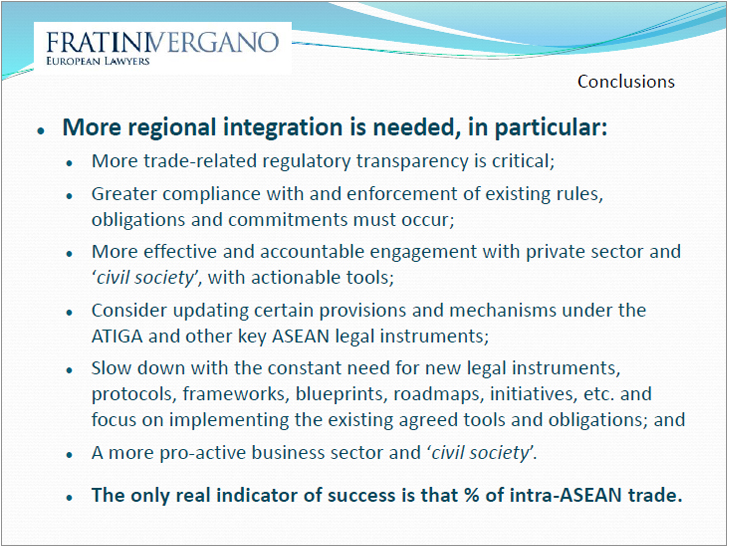
Importance of regulatory transparency: not just proclaimed in a current plethora of agreements but actually delivered by Member States. Paolo urges the private sector to start demanding transparency from their respective governments.
Greater compliance and enforcement of existing rules: while ASEAN tends to be very ambitious with regards to agreements, protocols, MOUs, etc, compliance and enforcement of said rules tends to be wanting. As Paolo stresses, ASEAN ultimately doesn’t need more rules but the implementation of the existing ones.
More engagement with private sector and civil society.
Consider updating certain provisions and mechanisms under the ATIGA and other key ASEAN legal frameworks: Paolo observes that ASEAN will soon be conducting a mid-term review of ATIGA. He stresses that trade in goods remains the bedrock of economic activity in the region, and will be important for the region’s post-COVID bounce.
6) Questions and Answers
During the ensuing questions and answers session, the following topics were discussed:
Elimination of NTMs and minimizing NTBs
Paolo believes that a few relatively simple policies could be implemented at the high level to help eliminate NTMs and minimize NTBs, thus giving ‘teeth’ to ASEAN in terms of enforcing regulatory transparency. For example, when it comes to the notification of new measures, ASEAN could shift the burden of proof to the individual ASEAN Member State that failed to comply with the advance notification of a new measure. In such cases, the burden to prove that such measure is consistent with the ATIGA should be reversed and fall on the ASEAN Member State that adopted it, not on the ASEAN Member State that may challenge it.
ASEAN’s overdependence on external trade
As Tan Sri Dr. Munir notes, certain ASEAN Member States have been relatively successful in attracting extra-ASEAN investments. For example, Indonesia is currently attracting lots of American investments from US companies relocating from China, while Vietnam recently ratified an FTA with the EU. As such, why should these countries focus on ASEAN then?
Paolo concurs that while all regional blocs, including the EU, will always have an element of inter-state competition between its members, he believes that it is a particular issue in ASEAN. He believes that ASEAN being too dependent on external trade to sustain itself may not be feasible in a post-COVID world. As he points out, the issue of near-shoring may see a lot of foreign production in China simply return home rather than relocate to ASEAN.
Prospects for greater EU-ASEAN collaboration
Paolo believes that the future for EU-ASEAN collaboration will be ‘very rosy’, and that he remains confident the relationship will remain strong. However, he does not see the prospects of an FTA between ASEAN and the EU due to intra-regional competition between ASEAN Member States. ASEAN Member States with current preferential access to EU market such as Vietnam and Singapore may not like their ASEAN competitors getting the same preferences.