China-ASEAN Monitor


img-ca-270917.jpg

Photo Credit: Daily Mail

Economy, Investment and Trade

Monorail line to be built in Cambodia
(27 September 2017) China Sky Railway Group will operate on a 10km line in Cambodia in May 2018, according to Tang Tong, the company’s chairman. The line is designed to connect the Royal Palace and Phnom Penh International Airport to support its infrastructure, tourism and public service development, as well as the upcoming 2023 Southeast Asia Games. Tang said that building monorails are more cost-efficient in ASEAN countries due to the high level of private land ownership.
Read more>>

Singapore to partner with Alipay
(25 September 2017) Ant Financial Services Group, the online payment arm of China’s e-commerce leader Alibaba Group Holding, has signed a memorandum of understanding with the Singapore Tourism Board (STB) to share relevant and up-to-date content about Singapore through Alipay’s platforms and STB’s Tourism Information and Services Hub, a digital content and distribution platform. The goal is to to increase exposure of Singapore’s offerings from various tourism businesses and to provide Chinese tourists with access to better information before and during their visits.
Read more>>

Bank of China to improve retail banking business in Malaysia
(22 September 2017) Bank of China Malaysia (BoCM) launched its first mobile application in Malaysia in a bid to better develop its retail banking business in the country, and is also looking to start a new branch in the state of Melaka within the year. BoCM chief executive officer Wang Hongwei said on Thursday that Bank of China (BoC), which currently has 10 branches in Malaysia, is committed to long-term development in Malaysia. Wang made the remarks during the opening ceremony of BoC’s new branch in the state of Penang. The new branch is BoC’s first smart bank branch among Southeast Asian countries.
Read more>>

Chinese tourism boom in Vietnam and Cambodia
(20 September 2017) According to the Vietnam National Administration of Tourism, Vietnam has welcomed 2.7 million Chinese visitors in the first eight months of 2017, seeing a year-on-year increase of 51.4 percent. Meanwhile, about 530,000 Chinese tourists visited Cambodia in the first half of 2017, representing an increase of 40 percent compared with the same period last year, according to a Cambodian Tourism Ministry report released in August. In 2016, Cambodia launched a “China Ready” strategy with the aim of attracting 2 million Chinese tourists annually to Cambodia by 2020.
Read more>>

Foreign Affairs

Malaysia seeks China’s help to end Rohingya crisis
(27 September 2017) Malaysian Deputy Prime Minister Datuk Seri Dr Ahmad Zahid Hamidi has requested China to bring an end to the Rohingya refugee crisis in Bangladesh after his meeting with Meng Jianzhu, China’s political and Legal Affairs Secretary on 26 September. He also said that the Chinese government has channeled US$10 million in food, equipment and other necessities to the Rohingya through the Bangladeshi government.
Read more>>


Don’t lose the shirt off our back

23 September 2017
Originally published in The Star Online

WHILE they should not be negative about China, Asean member states should not however surrender their sovereign rights or abdicate from their commitment to greater regional integration in South-East Asia.

Alas, one or two Asean states have completely sold out. Others are measuring cost and benefit of deeper involvement with China, trying to balance and hedge. Another one or two try to show they have options without particularly wanting to antagonise the rising power.

The need to protect what is yours, usually hard-earned, is not just about abstract sovereignty or about the protection of international law, extremely important though they may be. The rule of law is without fail the most significant foundation of human society, domestic or international.

There are nonetheless real interests and rights also involved.

Next month the Institute for Southeast Asian Studies in Singapore will be holding a seminar on how over the past decade Chinese banana industry practice of “shifting plantations” has transformed and depleted Mekong borderlands, mainly in Laos.

The vast quantities of pesticides, herbicides and fungicides used to maintain monoculture production pose serious health risks to workers and the surrounding environment.

And “…. after 6 to 10 years of producing fruit on cleared farmland, the (Chinese) company usually abandons it for another plot once factors such as soil depletion and pest infestation begin to lower yields.”

Laos has since last year issued a ban on new banana plantations, but the shifting plantation practices have spread to Thailand, Myanmar and Cambodia. When will they learn their lesson?

In Malaysia there is a big debate on the East Coast Rail Line which in itself is no bad thing.

The China-funded project however has to be watched closely to ensure there is no financial stress to Malaysia’s national finances, that there is Malaysian involvement in the sub-contracts, and that what is delivered is of high quality and suitably maintained.

The RM55bil project is huge. The government of Malaysia has to be transparent on how the financing is going to be managed on its balance sheet.

An official statement said 30% of the project will be contracted out to Malaysian companies. My business friends tell me only 15%. Which is which?

Malaysian engineers say there continues to be great difficulty in getting Asean engineers admitted to practise in the country, despite the fact there is the Mutual Recognition Agreement on Qualified Asean Engineers. Engineers from China however get their work permits handed out en bloc.

This kind of favouritism – at the expense of loudly proclaimed Asean integration no less – should not be practised just because the Malaysian government may want to run up contracts with China.

On the other hand, the Prime Minister’s official visit to Washington earlier this month is a good signal that Malaysia has not just bought into China. There will be a balance to promote the national interest.

While it may appear Malaysia had given away more than it had gained from the visit, the invisible hand is protection of the trading relationship with America, much too valuable for the country to be left to the caprice of Donald Trump’s blinkered view on international trade.

This kind of balance however has to be continuously worked at. American businesses will have to up their game in countries such as Malaysia in Asean, and not ride on Trump’s attack on trade to open sales and investment opportunities. In that game, China with its financial resources, institutional arrangements and government which can deliver what it commits to without domestic complication, will win hands down otherwise.

Even in India – with which China does not have the best of relations – China is working hard to get two high speed rail (HSR) projects, from Mumbai and Chennai to Delhi respectively. This is despite the Mumbai-Ahmedabad HSR project (which cuts the 316 mile journey from eight hours to about three) going to Japan, as confirmed during the Japanese prime minister’s visit earlier this month.

Balancing act

The balancing act is not an easy one. It can come out as playing both ends against the middle if not actively and skillfully managed.

Singapore’s travails in its relations with China in the past year is a good example. The island republic took a principled stand on the efficacy of international law when the law of the sea tribunal dismissed Beijing’s South China Sea claims in July last year. China took this as an affront.

The spew of vituperation followed. Singapore was the little red dot. Its armoured personnel carriers were detained in Hong Kong on their way back from Taiwan. Prime Minister Lee Hsien Loong was not invited to the Belt and Road Forum last May.

In sum, Singapore was perceived as veering towards the US in its desire to ensure Washington’s continued commitment to the region.

Balance is not easy, especially when one pole is distracted and the other is totally focused. There was even a first time public debate in Singapore pitting former senior foreign ministry officials on two sides of the argument whether a small state should behave as a small state and not take a position on matters that do not directly involve it, such as the South China Sea territorial claims. A university professor was even expelled from the country.

Anyway, the Singapore prime minister was in China this week to mend fences. Balancing is difficult. It is a continuous effort. It takes at least three to clap and be focused. When the US is out of it, the conduct of the diplomacy becomes more tricky. It is no wonder a number of Asean states have tipped China’s way, and some others are looking like they may go that way too.

Indonesia however has shown it can stand up for its rights in relation to China and not wait on America to give it succour.

Indonesia’s renaming in July of its portion of the South China Sea as the North Natuna Sea has displeased China, but this leading Asean country has been quite cool, calm and collected in playing its hand.

It contends Indonesia has every right to rename its territorial waters, the northern reaches of its exclusive economic zone (EEZ) in the South China Sea. China has demanded that Indonesia revoke its position.

The Chinese foreign minister stated on Aug 25: “The China-Indonesia relationship is developing in a healthy and stable way, the South China Sea dispute is progressing well… Indonesia’s unilateral name changing actions are not conducive to maintaining this excellent situation… (it is) a complication and expansion of the dispute, and affects peace and stability in the region.”

Indonesia has never accepted China’s concept of its “traditional fishing grounds” and therefore of its extended rights over almost all of the South China Sea. It clearly does not accede to the fait accompli which has been the outcome of Beijing’s South China Sea strategy.

While standing by its right to rename its internationally-recognised EEZ, Indonesia stated it would adhere to International Hydrographic Organization procedures by submitting its proposal wherein all member states, including China, will be consulted.

This of course is precisely what China does not want. Its whole diplomacy on the South China Sea is premised on primacy and exclusivity – the rest of the international community out, only China and Asean and its claimant member states. The emphasis shifted from Asean as a whole to the member states separately as China’s rise picked up.

Now Indonesia has set the cat among the pigeons by proposing to take its renaming of the southern reaches of the South China Sea to a formal international audience in line with international practice.

What Indonesia has shown is that adept and subtle diplomatic initiatives can make options available to states in situations which may appear to be hopeless.

Of course it can be argued Indonesia is a middle power which is better able to stand up for its rights. But even Singapore has shown the importance of taking a stand. It may have gone through a small baptism of fire, but there is a respect in the end even if the future relationship has to be continuously worked at.

The main argument about Asean is that the whole is greater than the parts or, if it does not hang together, it will hang separately. A couple of its member states have shown even alone – and Asean states will have to act alone as well – they can make a difference.

When states start out to ingratiate, they will end up grovelling, with their nose rubbed in the sand, and their shirt taken off their back.

Tan Sri Dr Munir Majid, chairman of Bank Muamalat and visiting senior fellow at LSE Ideas (Centre for International Affairs, Diplomacy and Strategy), is also chairman of CIMB Asean Research Institute.

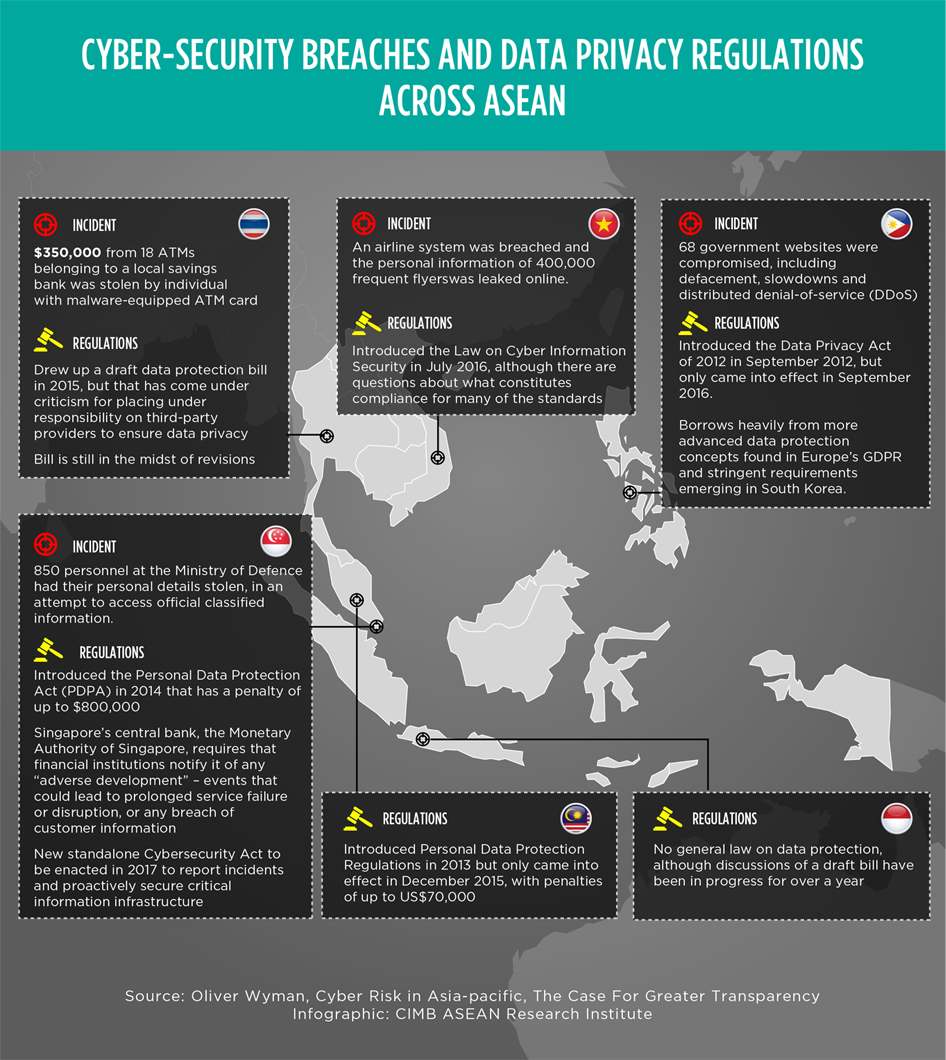
CARI Captures 327


c327_graphic-01 copy.jpg


SINGAPORE

Singapore to develop cyber-security professionals
(20 September 2017) Singapore’s Cyber Security Agency (CSA) will create its first academy to boost the skills of cyber-security professionals working in government and critical sectors in Singapore such as energy, healthcare and transport. CSA chief executive David Koh said that the CSA Academy will plug gaps in the skills of cyber-security professionals, as current programmes in universities and polytechnics cannot meet market needs. Deputy Prime Minister and Coordinating Minister for National Security Teo Chee Hean said that the academy will play a vital role in ensuring a more secure and resilient digital community.

ASEAN

ASEAN countries fare poorly in workforce preparedness for the digital future
(20 September 2017) ASEAN countries, except Singapore, ranked at the bottom half of the Economist Intelligence Unit’s Worldwide Educating for the Future Index. The preparedness gauge, which targets input into youth education rather than output such as test scores, carries a 50% weighting for the teaching environment, 30% for policy environment and 20% for socioeconomic environment. While Singapore came in fifth out of 35 countries surveyed, other ASEAN countries namely the Philippines (25th), Vietnam (28th) and Indonesia (34th) demonstrated a severe need for improvement.

THAILAND

Thailand’s central bank and government clash over interest rates
(19 September 2017) The Thai Finance Ministry is hoping that its central bank, Bank of Thailand (BOT), will cut interest rates to stimulate growth, in light of the strength of the currency and low inflation. This is in direct contrast to the central bank’s aim of keeping the rate steady to minimise financial instability and curb household debt levels. The BOT has so far pushed back against calls to cut its benchmark interest rate from a near record-low of 1.5%, where it’s been since 2015, intervening in the currency market instead and curbing the supply of short-term bonds to limit the Thai baht’s gains, up more than 8% against the US dollar. The next interest-rate decision will be made on 27 September.

ASEAN

Strong export growth comes with currency appreciation
(19 September 2017) According to data from NLI Research Institute, the combined export volume of Singapore, Thailand, Malaysia, Indonesia, the Philippines and Vietnam grew 18.5% on the year in July. The export growth is causing strong currency appreciation; the Malaysian ringgit has climbed around 5% against the greenback, while the Thai baht and Singaporean dollar have appreciated nearly 4% since April. If a currency becomes too strong against the US dollar, it can erode exporters’ earnings and drag down economic growth. V. Ramakrishnan, chief financial officer of Tata Consultancy Services, India’s largest IT service provider, said that sharp Indian rupee appreciation against the US dollar resulted in a US$100 million loss in reported revenues for the April-June period.

ASEAN

ASEAN needs to address forex volatility
(15 September 2017) Thailand Development Research Institute president Chalongphob Sussangkarn said ASEAN countries need a mechanism to reduce volatility and address non-standardised foreign currency exchange rate in the region. He stated that non-standardised exchange rates make cross-border businesses more expensive due to the uncertainty of rate changes. Chalongphob further suggested having similar inflation targets across the region would implicitly minimise volatility in the foreign currency exchange rate.

INDONESIA

Indonesia getting serious on tax enforcement
(20 September 2017) Indonesia’s government has implemented new regulations that will target tracing and targeting the wealth of taxpayers who were not pardoned in the nine-month tax amnesty that ended in March 2017. The regulations call for all assets that were not reported or misreported in the amnesty programme, and which were obtained between Jan 1, 1985 and Dec 31, 2015, to be treated as untaxed income. The estimated value of the undeclared assets has not been made public. The new regulations is the fulfillment of Indonesian President Joko Widodo’s last year vow of strict tax law enforcement after the amnesty period ended.

ASEAN

Japan looking for progress in Trans-Pacific Partnership with remaining countries
(16 September 2017) Chief negotiators from the Trans-Pacific Partnership’s (TPP) remaining participants will meet in Tokyo starting 21 September, as the participants seek progress on the trade deal sans the US. The meeting will focus on debating which rules in the TPP will be suspended in order to accelerate progress. The Tokyo meeting would be considered a success if all 11 participants submit their proposals and agree on concrete items to be frozen. Clearing this hurdle would let negotiators focus on tough issues at a meeting expected in October, such as a review of the rules for the removal of tariffs on apparel products.

THE PHILLIPINES

The Philippines only candidate for rate hike in ASEAN
(21 September 2017) Economists surveyed at Bloomberg predict Bangko Sentral ng Pilipinas, the Philippines central bank, will increase its benchmark rate by the fourth quarter. Governor Nestor Espenilla said in August the central bank is prepared to raise rates if it sees signs the economy is growing too fast, while it’s tolerating a weaker currency for now. The peso is among the few Asian currencies to have fallen this year, dropping 2.7 percent against the dollar. Indonesia and Vietnam have seen interest rate cuts in the past two months, while Thailand’s central bank is adamant on holding its rate.

THAILAND

JD.com to invest US$500 million in Thailand
(18 September 2017) Chinese e-commerce giant JD.com announced a US$500 million investment that will create e-commerce and fintech businesses in Thailand. Chinese e-commerce giants have been flocking to Southeast Asia as the region’s internet economy is forecasted to grow to US$200 billion by 2025. The deal is JD.com’s first in Thailand, and second in Southeast Asia after setting up in Indonesia in 2015.

MALAYSIA

CPI in Malaysia at 3.7 percent
(21 September 2017) The Consumer Price Index (CPI) in Malaysia experienced a sharp increase to 3.7 percent, compared to a year ago in August, driven by rising domestic retail petrol pump prices. MIDF research said that the increase in prices in August were mainly impacted by fuel prices’ pass-through effects. Nomura Global Market Research expects the inflation to rise further to about 4.2 percent year-on-year in September as the daily average RON95 petrol price is 3.3 percent higher in September than in August. Affin Hwang Investment Bank Bhd chief economist Alan Tan believes the central bank, Bank Negara Malaysia (BNM) will maintain its overnight policy rate at 3 percent.

Myanmar Monitor


World Bank

Photo Credit: Myanmar Monitor

Economy, Investment and Trade

Deeper port necessary to meet growing trade demands
(19 September 2017) Logistics businesses from European and Japanese chambers have called for Myanmar to build a deep-sea port with access to Yangon, the commercial capital, to cater for significant volume increase in trade to improve its competitiveness. A report by the European Chamber of Commerce in Myanmar (EuroCham) stated that the lack of port infrastructure and congestion present a significant constraint for sea trade, and called for the establishment of a deep-sea port together with a Special Economic Zone (SEZ). However, previous studies concluded that such an undertaking would be difficult, according to Tatsuya Ueki, head of Mitsui OSK Lines and chair of the logistics group under the Japan Chamber of Commerce and Industry in Myanmar (JCCM).
Read More >

New gas turbine power plants to meet energy supply for 2018
(19 September 2017) Three new natural gas-fired power plants in Myanmar are nearing completion. The power plants have the capacity to generate more than 450 megawatts of power, and are expected meet the energy demands of Myanmar for 2018. U Khin Maung Lay, deputy managing director of the Ministry of Electricity and Energy (MOEE) Electric Power Generation Enterprise said that the annual electricity demand in Myanmar is between 300MW and 400MW. The new power plants will also help to relieve the government’s burden from subsidising loss-making electricity tariffs to households nationwide, estimated at US$400 million for the fiscal year of 2017-18.
Read More >

Myanmar government targets US$6 billion foreign investment for 2017-18 fiscal year
(12 September 2017) According to the Myanmar Ministry of National Planning and Finance, the government seeks to attract US$6 billion in foreign direct investment (FDI) for the current 2017-18 fiscal year. Singapore is Myanmar’s largest investor, followed by China, Hong Kong and Thailand, according to Myanmar Investment Commission (MIC) secretary, U Aung Naing Oo. Myanmar’s national planning and finance deputy minister for U Hset Aung reported that Myanmar had a total FDI of US$6.7 billion for the fiscal year 2016-17, exceeding that year’s targeted amount of US$6 billion.
Read More >

Foreign & Internal Affairs

China backs Myanmar amid Rakhine crisis
(13 September 2017) China has voiced its support for Myanmar’s military crackdown that has been criticised by the United States, causing international divisions ahead of a UN Security Council meeting. International pressure on Myanmar has been strong after United Nations rights chief Zeid Ra’ad Al Hussein said the military actions seemed to be a “textbook example of ethnic cleansing”. The Myanmar government denies any abuses, and blames the Arakan Rohingya Salvation Army (ARSA) for burning down thousands of villages. Beijing’s foreign ministry spokesman Geng Shuang voiced support for the Myanmar government’s efforts to “uphold peace and stability” in Rakhine.
Read More >

Visiting US official barred from Rakhine State Conflict Zone
(8 September 2017) Myanmar is looking to fence the remaining 40 miles of the 170-mile border with (16 September 2017) Myanmar state government secretary, U Tin Maung Swe said that visiting US Deputy Assistant Secretary of State for Southeast Asia Patrick Murphy will be barred from the Maungdaw District of the Rakhine State. The area has seen ongoing conflict since 25 August when self-identifying Rohingya insurgents attacked police posts and an army camp, killing a dozen people. Myanmar dismissed claims that it was barring aid workers, but said it was concerned over security.
Read More >

China-ASEAN Monitor


img-ca2030917.jpg

Photo Credit: The Star Online

Economy, Investment and Trade

Malaysian steel companies benefit from China’s clampdown
(15 September 2017) Steel companies listed on Bursa Malaysia continue to be on the uptrend as China looks to reduce its steel output and clamps down on illegal steel mills. Malaysian Iron and Steel Industry Federation president Datuk Soh Thian Lai stated that China has already cut down its steel production by 100 million tonnes in the past two years. UOB KayHian Research steel analyst Abdul Hadi Manaf said that oversupply in steel from China is no longer an issue as the Chinese government has stricter supply and environmental controls.
Read more>>

Singapore has potential to boost yuan internationalisation
(16 September 2017) Dr. Raymond Yeung, chief economist of Greater China at the Australia and New Zealand Banking Group, says the usage of China’s currency, the yuan as a trade currency between China and Singapore could improve the internationalisation of the yuan. Dr Yeung also noted that usage of the yuan can eliminate the risk of losses stemming from the shift in exchange rate between the US dollar and the yuan. Dr Yeung said Singapore is well-placed to boost the use of the yuan, given that it has competitiveness in currency trading, and a low tax rate for financial and treasury centres of global corporations.
Read more>>

Cambodia, China to agree on nuclear energy cooperation
(13 September 2017) Cambodia signed a memorandum of understanding with China National Nuclear Corporation (CNNC) on cooperation in the peaceful use of nuclear energy during the 14th China-ASEAN Expo and China-ASEAN Business and Investment Summit held in Nanning, China. According to CNNC, Cambodia’s current power supply cannot meet its basic electricity needs, and will require a comprehensive upgrade in order to meet expanding industries. In mid-2016, Cambodia’s Ministry of Industry, Mines and Energy held discussions with CNNC on building a nuclear power plant and establishing corresponding regulatory and legal infrastructure, in collaboration with the International Atomic Energy Agency.
Read more>>

Singapore, China to agree on dispute mediation
(19 September 2017) The Singapore International Mediation Centre and the Mediation Center of the China Council for the Promotion of International Trade / China Chamber of International Commerce signed a Memorandum of Understanding to work together to help businesses resolve disputes that may arise under China’s Belt and Road Initiative. Deputy Secretary of Singapore’s Ministry of Law Han Kok Juan commended the agreement, stating that it will create a framework that resolves any disputes that may arise under the Belt and Road Initiative based on rule of law.
Read more>>

Malaysian sales at 14th China-ASEAN Expo exceeds target
(15 September 2017) Malaysian entrepreneurs succeeded in making US$96.8 million worth of sales at the 14th China-ASEAN Expo (CAEXPO), exceeding the initial target of US$83.5 million by 16 per cent. Malaysia External Trade Development Corporation (Matrade) director (China unit) Ong Yew Chee said that the food and beverage cluster was the top performer at CAEXPO with approximately US$64.1 million in sales, compared to last year’s US$40.5 million. The four-day expo, which has been organised annually in Nanning since 2004, is a platform to promote cooperation between China and Asean in the fields of trade, investment and tourism.
Read more>>


ASEAN Roundtable Series: Deepening Capital Markets in ASEAN – Opportunities and Challenges

Published on 20 September 2017

img-rtroundup-rt7.jpg

img-text-speakers

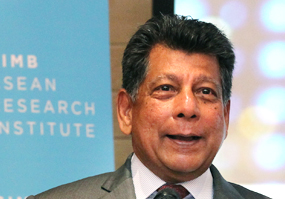
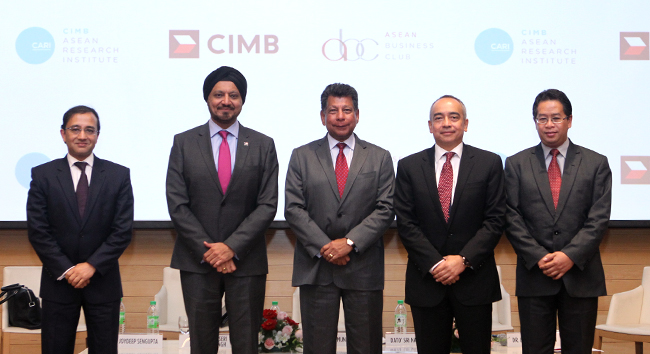
Joydeep Sengupta

Joydeep Sengupta

Senior Partner, McKinsey & Company and Managing Partner, Asia-Pacific Banking Practice

Read more

Mr. Joydeep is a Director in McKinsey & Company and leads the Asia Banking practice, based in Singapore. He has served leading financial institutions in Asia and Europe.

Joydeep has deep expertise in a range of business areas including retail banking, wholesale banking and organization-related topics. He has worked with Asian banks and insurers on business unit strategy, service operations, risk and regulation and sales excellence and channel management.

His recent work includes supporting the performance transformation of several leading banking groups in Asia with a focus on sustainable change management and helping with bank and banking sector restructuring issues facing Asian banks. He is currently a member of several policy-making groups in Asia on financial sector and capital market reform issues.

In addition to serving clients, Joydeep has authored several publications in the areas of asset management, banking reform, economic crisis and infrastructure development. Prior to McKinsey, Joydeep held several managerial positions with HSBC.

Joydeep holds a Post Graduate Diploma in business management from Indian Institute of Management, Ahmedabad and a Bachelor of Commerce from the University of Delhi.

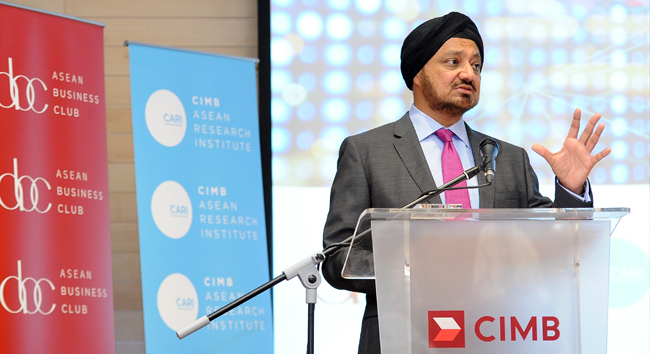
Tan Sri Dato’ Seri Ranjit Ajit Singh

Tan Sri Dato’ Seri Ranjit Ajit Singh

Executive Chairman, Securities Commission (SC) Malaysia Chairman, ASEAN Capital Markets Forum (ACMF)

Read more

Tan Sri Dato’ Seri Ranjit Ajit Singh was appointed as the Executive Chairman of the SC on 1 April 2012. He has extensive experience in the field of finance and securities market regulation and has spearheaded many key initiatives in the development and reform of Malaysia’s capital market. He was appointed the Vice-Chairman of the governing Board of IOSCO and is the Chairman of IOSCO’s largest Committee, the Growth and Emerging Markets Committee. In 2014, Tan Sri Dato’ Seri Ranjit was appointed Chairman of the ASEAN Capital Markets Forum (ACMF). Tan Sri Dato’ Seri Ranjit chairs the Securities Industry Development Corporation (SIDC), the Malaysian Venture Capital and Private Equity Development Council (MVCDC) and the Capital Market Development Fund (CMDF). He is also the Vice-Chairman of the Asian Institute of Finance and a Board member of the Labuan Financial Services Authority and the Financial Reporting Foundation as well as a board member of the Malaysian Institute of Integrity (IIM).


Dato' Sri Nazir Razak width=

Dato’ Sri Nazir Razak

Chairman, CIMB Group

Read more

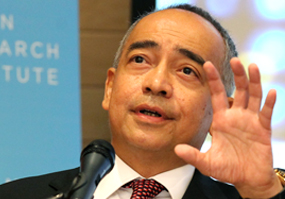
Dato’ Sri Nazir Razak is the Chairman of CIMB Group Holdings Berhad. He joined CIMB’s corporate advisory department in 1989 and served the Group in various capacities before being appointed Chief Executive in 1999. After 15 years as Chief Executive, Nazir became Chairman on 1 September 2014. He spearheaded the Group’s transformation from a Malaysian investment bank into an ASEAN universal bank via several acquisitions and new builds throughout the region.

Today, CIMB is Malaysia’s second-largest financial services group and ASEAN’s fifth-largest by assets. Backed by a staff force of around 39,000, the Group has operations in 15 countries, but positions itself as an ASEAN franchise. Under Nazir’s stewardship, CIMB has won many awards, including best investment bank and best Islamic bank in Asia and best bank in Malaysia. Nazir himself was recognised as Malaysia’s top executive/CEO on several occasions. He was the youngest recipient of FinanceAsia’s ‘Lifetime Achievement Award’ in 2009 and was awarded Euromoney’s ‘Outstanding Achievement Award’ in 2012. In 2015, he was the recipient of Asia House’s ‘Asian Business Leaders Award’.

Nazir is a Director of Khazanah Nasional Berhad and a member of the International Advisory Board of the Blavatnik School of Government at the University of Oxford. A strong advocate of the ASEAN integration, Nazir is the inaugural Chairman of the World Economic Forum’s ASEAN Regional Strategy Group and ASEAN Regional Business Council. He led the establishment of the ASEAN Business Club, which comprises CEOs of large ASEAN multinationals, and the CIMB ASEAN Research Institute. He is also a Founding Board Member of Endeavor Malaysia, a non-profit organisation that helps spur the development of entrepreneurs, and was instrumental in the formation of CIMB Foundation, the Group’s corporate responsibility arm. He is also the Honorary President of the Malaysia-China Chamber of Commerce and a member of the Advisory Board of the Centre for Asian Philanthropy and Society.

Nazir graduated from the University of Bristol with a B.Sc. (Hons) and obtained an M.Phil. from the University of Cambridge. In 2009, he was the Chevening Fellow at the Oxford Centre for Islamic Studies.

Dr. Bambang Irawan

Dr. Bambang Irawan

Senior Research Fellow, CIMB ASEAN Research Institut

Read more

Bambang Irawan is a Senior Research Fellow with the CIMB ASEAN Research Institute (CARI). In his capacity, he has provided analyses on the new AEC Blueprint 2025 from the point of view of the stakeholders, particularly the private sector, as well as on the latest policy developments in Indonesia. Bambang was formerly an Assistant Director at the ASEAN Secretariat, Jakarta, Indonesia. His portfolio covered cooperation and initiatives under the ASEAN finance integration. He coordinated activities and initiatives under financial services liberalisation, capital account liberalisation, capital market development, insurance and taxation.

With the completion of ASEAN Economic Community (AEC) Blueprint 2015, Bambang was involved in the development of the AEC Blueprint 2025 that would guide the cooperation and integration of all economic sectors in ASEAN between 2016 and 2025. His professional experience includes the banking sector and higher education, where he taught economics, statistics and ASEAN studies. Bambang earned his undergraduate degree in economics from the University of Indonesia and MBA from Webster University. His doctorate (economics) is from Monash University, Australia.


img-moderator-header.jpg

img-tsmm.jpg

Tan Sri Dr. Munir Majid

Chairman, CIMB ASEAN Research Institute President, ASEAN Business Club

Read more

Tan Sri Dr. Munir worked in the UK as a university tutor and research analyst in the City before returning to Malaysia at the end of 1978, to be leader writer for the New Straits Times. He progressed to the position of Group Editor before leaving in 1986 to become Chief Executive Officer of a small merchant bank Pertanian Baring Sanwa, whose name he changed to Commerce International Merchant Bankers (CIMB), which was then transformed into one of Malaysia’s leading merchant banks. In 1993, he was invited by the Government of Malaysia to establish the Securities Commission, where he served as Executive Chairman for two terms until 1999. He was instrumental in shaping the legal and regulatory framework of the capital markets in Malaysia, particularly in establishing disclosure-based regulation. He was also responsible for drafting the country’s first code of corporate governance in the aftermath of the Asian Financial Crisis of 1997-98. He was Chairman of the Emerging Markets Committee of the International Organisation of Securities Commissions during his term at Malaysia’s Securities Commission. After leaving the Commission, he became Director of Telekom Malaysia Berhad, Chairman of Celcom (Malaysia) Berhad and Chairman of Malaysian Airline System Berhad. He was the Founder President of the Kuala Lumpur Business Club, established in 2003 and is a member of the Court of Fellows of the Malaysian Institute of Management. He is currently Chairman of Bank Muamalat Malaysia Berhad, CIMB Asean Research Institute, the Asean Business Advisory Council, Malaysia and The Financial Services Professional Board Malaysia (FSPB), as well as President of the Asean Business Club.

Tan Sri Dr. Munir obtained a B.Sc (Econ) and Ph.D in international relations from the London School of Economic and Political Science (LSE) in 1971 and 1978. He is an Honorary Fellow of LSE and continues the long association with his alma mater as Visiting Senior Fellow at the Centre of International Affairs, Diplomacy and Strategy. Tan Sri Dr. Munir is an associate of Southeast Asia Centre (SEAC) at LSE.


The ASEAN Capital Markets Forum (ACMF) highlighted that the size of the capital markets in ASEAN is estimated to be at US$3.5 trillion and collectively the exchanges in ASEAN are ranked as the 9th largest in the world.

The panellists recognised the opportunities presented by the region’s capital markets but there are many hurdles in capital market development and connectivity that ASEAN needs to overcome in order to unlock the potential value to fund infrastructure development, businesses and provide attractive returns for investors.

Joydeep Sengupta, Senior Partner and Managing Partner, Asia Pacific Banking Practice at McKinsey and Company said that deepening of capital markets in ASEAN is crucial to keep up with the kind of growth that the region will need to become a US$5.2 trillion economy by 2025. McKinsey estimates that US$160 billion will be required on an annual basis to meet infrastructure needs.

Currently, 90 percent of infrastructure in ASEAN is financed by the public sector through tax revenue and borrowings from development institutions. There is an infrastructure investment gap of approximately US$100 billion of which the public sector can bridge between US$30-40 billion. The private sector will need to increase its investment from US$5-10 billion to US$50-60 billion.

McKinsey and Company presented the results of research on the performance and health of a select number of capital markets in the ASEAN region. The McKinsey Capital Markets Development Index (MCMDI) is a comprehensive gauge of vibrancy of markets which looks at whether:

  1. issuers can raise reliable and affordable capital at scale (broken down into affordability, availability and diversity of sources)
  2. investors are able to mobilise domestic savings through investments in the markets (broken down into availability and return) and
  3. the market is able to provide high-quality pricing information to support efficient allocation of limited resources (pricing efficiency).

The McKinsey research also found that the overall health of the capital markets was determined by the policies and architecture and design of markets within each country. These included foundational policies, regulatory framework, cornerstone institutions, regulations and standards, taxation and market infrastructure and technology.

Dr. Bambang Irawan, Senior Research Fellow at CARI cited the example of Indonesia, which is running increasingly large fiscal deficits to fund President Jokowi’s infrastructure plans for the country. He said that if capital markets were deepened then funding could come from the private sector, decreasing the strain on government coffers.


img-keythemes.jpg


1. Some capital markets in ASEAN are shallow resulting in lost opportunities in filling funding gaps

 
a. Challenges for individual ASEAN countries

Joydeep said McKinsey’s assessment of the capital markets in ASEAN via MCMDI indicated that there were significant funding gaps, limited choice of investments, expensive capital, lack of avenues to deploy savings, poor liquidity, mediocre risk-adjusted returns and a poor allocation of resources.

With regards to the ability to raise funds at scale, McKinsey found that primary markets are less reliable sources of funds for ASEAN issuers, especially for mid-size companies and infrastructure projects which are usually crowded out by large issuers and governments. Additionally, issuers find it challenging to raise longer-term corporate debt resulting in an asset-liability mismatch which limits investment choices. Finally, the cost of capital in ASEAN is high at about 1.3 times that of developed markets.

With investment opportunities, they found that capital markets lack a full-suite of attractive short-long tenure products (including derivatives) which limited the broadening of investments. Liquidity in the markets was also found to be poor, outside of on-the-run government securities and top-50 equities, resulting in high market impact cost. While the Sharpe ratio for equity products was at 0.9 indicating that returns were not attractive.

Finally, the MCMDI found that ASEAN equity markets are less efficient than developed markets in allocation of resources and that there was a large variance across ASEAN in pricing efficiency.

Dr Bambang, in his presentation about the state of capital markets in Indonesia, concurred with the McKinsey report. He noted that the equity markets in Indonesia are limited in size at 47% of GDP in 2015, less than in other ASEAN countries while 50% of market capitalisation is concentrated in 11 (out of 537 in 2016) of the largest listed companies. He also added that mostly all traded instruments are common stocks, and hedging instruments are not readily available.

Joydeep went on to elaborate on the health and sustainability of the capital markets by looking at foundational policies, as well as market architecture and design of Malaysia and Indonesia. Foundational policies include benchmark assets, supply of capital, demand for capital, intermediation, free markets, and price discovery. Market architecture and design include regulatory frameworks, cornerstone institutions, regulations and standards, taxation, market infrastructure and technologies. He noted that on a scorecard of 1(lowest) to 5 (highest) that Malaysia garnered an average rating of 3.5, and Indonesia, 2.0 which indicated that foundational policies, as well as market architecture and design to support capital market health are weak and can be further strengthened.

With such challenges at a country-level, deepening, increasing connectedness and harmonisation of ASEAN capital markets present an even bigger hurdle.


b. Choke points at the ASEAN level due to lack of harmonisation

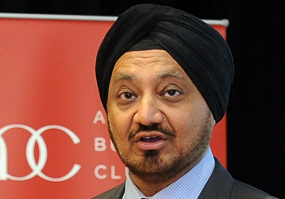
Dato’ Sri Nazir Razak, Chairman of CIMB Group, said that there was a lack of coherent and harmonised policies across ASEAN. For investment in equities, these included capital control limits which vary by country and time, tax settlement cycles and clearing issues that can be much better clarified or harmonised. On the fixed income side, he gave the example of varying tax treatments across countries. For example, Singaporeans and Koreans do not get taxed on capital gains on baht government and corporate bonds while Malaysians do, whereas with rupiah government bonds, Malaysians and Koreans get taxed on capital gains, but Singaporeans do not. He suggested that ASEAN countries should be treated to best-in-class treatment for tax across the region.

Dato’ Sri Nazir added that there is a lack of support from ASEAN government for many of the ACMF’s initiatives which indicated that there was still apprehension of capital outflows, competitive disadvantages and losing control of their markets.

Tan Sri Dato’ Seri Ranjit Ajit Singh, Chairman of the Securities Commission Malaysia and Chairman of ASEAN Capital Markets Forum (ACMF), said that the wider ecosystem including addressing diverging tax regimes and national frameworks continue to present challenges for ASEAN interconnectivity.

Both Tan Sri Ranjit Singh and Dr Bambang agreed that there is a large gap between the depth of capital markets in more developed and less developed countries in the region.


2. ACMF is addressing the connectivity of ASEAN markets as a precursor to integration but measures have led to limited impact

 
According to Tan Sri Ranjit the ACMF has recalibrated its vision to overcome some of the challenges it has faced in the past. The recalibrated vision includes creating an interconnected and inclusive market place to bring the less developed economies into the fold. He also said that ACMF will focus on market needs as it moves forward.

Tan Sri Ranjit also recapped the three broad objectives of ACMF and associated initiatives. The first is the harmonisation in the framework of ASEAN capital markets both in terms of securities regulatory rules and corporate governance and standards. The second is to create linkages within the infrastructure of ASEAN capital markets which to some degree occurred through the connection of the ASEAN Trading Link (ATL). The third objective is to create cross border products such as the ASEAN Exchange Traded Funds and the ASEAN Index, which are works in progress. Other ACMF initiatives include the ASEAN collective investment schemes (CIS) framework. There are 13 funds qualified under the ASEAN CIS and the regime has only three signatories namely Thailand, Malaysia and Singapore with Indonesia and Philippines keen to participate in the regime.

Dato’ Sri Nazir also commented on some of these and other ACMF initiatives from a user’s the perspectives of investors and issuers. He said that the ATL, common prospectus, CIS and dual listing initiatives have had limited traction. He observed that investors are already able to access various stock markets via multiple platforms, including digital ones, so the ATL may not be relevant. For dual listings, even when there is strong multi-market brand recognition, activity tends to flow back to the primary market. He then elaborated on CIMB’s experience in dual listing trying to list in Thailand, which he said a project that was abandoned after four years due to the complications of adhering to two separate legal jurisdictions (Malaysia and Thailand), among other concerns. However, Dato’ Seri Sri Nazir was optimistic about the ARFP initiative which he believes will be important in the near future.


3. Moving Forward: What is next for ASEAN capital markets?

 
The panelists have proposed various initiatives to be taken on board by both policymakers and regulators going forward.
 
a. Policymakers to create the environment necessary for the deepening of capital markets

Joydeep proposed that in order for ASEAN to deepen capital markets and unlock more funding potential policy makers and market participants should be looking at entire ecosystem.

  • For foundational policies he suggested that governments across the region should enhance liquidity in government securities. This should be done by improving predictability of issuances which provides the benchmark to allow the other securities to price more efficiently and hedge interest rates, creating on the run benchmarks and creating compelling primary dealer programmes. This is extremely important, particularly for markets like Indonesia and the Philippines.
  • He then suggested that ASEAN focus on long-term buy and hold investors, such as pension funds which can be a catalyst for the markets. This has social implications because if these institutions are not able to invest with good returns they run a risk of leaving ASEAN with a large poor elderly population.
  • The third is to broaden the investor base – there is a need to attract a broad group of investors.
  • Fourth is to bring back privatisation and equitisation which will act as a catalyst for growth in some markets. His final recommendation around foundational policies was to mandate state owned and large private companies access to bank lending as they are crowding out others from accessing bank lending.
  • In the area of market architecture, Joydeep suggested that ASEAN create a cornerstone institution similar to that of the Hong Kong Mortgage Cooperation in the 1990s which acted as the single largest catalyst for the development of the Hong Kong market.
  • ASEAN should create an infrastructure cooperation, which would drive primary and secondary issuances, allow for securitisation of assets and create the framework for equity and debt in ASEAN markets. He also suggested that ASEAN should leverage on technology to grow supply and demand as well as creating greater pricing efficiency and transparency.

Dr. Bambang added that the region needs to ASEAN efforts to integrate the region’s capital markets should advocate closer cooperation among the relevant ASEAN sectoral bodies including taxation, payment and settlement systems, and the ASEAN infrastructure fund.

 
b. ACMF to review the ATL, promote ASEAN as an asset class and green bonds

Looking forward, Tan Sri Ranjit spoke about what was in the works at ACMF to help further develop and deepen individual ASEAN capital markets as well as enhancing connectivity between markets.

  • The ACMF has reviewed the existing ATL in order to make it easier to for investors to invest in cross border investments.
  • ACMF is also working on creating opportunities to mobilise the large savings pool for infrastructure financing by developing bond markets, promoting various asset classes and through the ASEAN Infrastructure Fund.
  • For example, ACMF is working with the International Capital Market Association on green financing. This is a strategic move to respond to the demand in the global markets for investors looking for investments that are environmentally conscious and follow good corporate governance practices.
  • The way to do this is to create an ecosystem around the new investment or to leverage on the existing infrastructure. The latter was carried out in Malaysia by releasing green bond/sukuks which took advantage of the vibrant sukuk market in the country.
  • The ACMF working groups are now focusing on real estate investment trusts and exchange traded funds.
  • The ACMF is also focusing on less developed markets with initiatives such as the ASEAN Market Development Programme which was launched a couple of years ago and runs programmes such as development of bond markets. He said that these programmes were received well, particularly by CLMV countries.
  • The ACMF was working on the mobility of the professionals across ASEAN. The intention is to have a Mutual Recognition Agreement (MRA) of licensing regimes based on a common licensing framework which is likely to be ready in early 2018.

Tan Sri Ranjit was also confident that the establishment of the International Organization of Securities Commissions (IOSCO) Asia-Pacific hub in Kuala Lumpur was an encouraging development, especially for the capacity building needs of the region. He added that countries like Indonesia and the Philippines were eager to join the ASEAN CIS but that this would only be possible if they were to be signatories to the IOSCO Multilateral Memorandum of Understanding which required them to fulfil certain requirements first.

Tan Sri Ranjit said that one of the challenges moving forward will be the number of competing issues that ASEAN countries face, especially those which are less developed as they prioritise the development of their domestic capital markets ahead of ASEAN and the opening up their markets to foreign capital and investors. He said that market players who are pushing for development of domestic capital markets in their respective countries should push for this to be done through the ASEAN platform.


c. Practical recommendations

  • Allowing room for “switch-on and switch-off” options?
    Here, Dato’ Sri Nazir was also of the opinion that there would be a better response to ACMF initiatives from various governments if they were given guarantees on safeguards and mechanisms which allowed them to “switch on and switch off” certain policies to limit risks such as capital flight. This would be one way to encourage them to agree on and progress forward with regional reforms.
  • Streamline fundraising in ASEAN
    Dato’ Sri Nazir said that ASEAN should focus on the fundraising process and streamline it. He said that the ideal situation for industry players would be to register a prospectus once then to have a free reign of marketing to investors across the region. If raising funds was made simple across the region then it would enable companies to access to the broadest range of capital providers and it would be a very powerful value proposition to being a part of ASEAN.
  • Virtual ASEAN bourse
    He also suggested that there is much room for improvement in how the region promotes intra-ASEAN flows and that there should be a virtual board which listed all the top companies in ASEAN and information such as which exchanges they are listed on and key valuation metrics. This board should be as visible across the region as possible.
  • ASEAN market Information hub
    Tan Sri Ranjit Singh suggested to establish an ASEAN markets information hub for investing in ASEAN capital markets, an initiative which he encouraged the private sector to take on. He added that the task of developing and deepening capital markets should not just be left to regulators but that industry should drive this forward by presenting white papers on issues faced along with recommendations to resolve cross-border challenges.
  • Raising awareness of foreign investors
    Finally, Tan Sri Ranjit and Dato’ Sri Nazir also agreed on the fact there is a need to raise awareness about the investment opportunities in ASEAN capital markets. Currently, too many investors only invest in their domestic markets or overlooking their regional neighbours and investing in developed countries such as the United States. Raising awareness is also key to ensuring that ASEAN is able to maintain and increase investments even as larger markets such as China and India become more accessible for investors.


Tan Sri Munir Majid concluded the session by observing that there has been much progress made and that there were many practical proposals put forward by the panellists. However, he said that ASEAN countries need to be less suspicious of proposals from other member countries and this is where consultants can play a role in providing a more neutral face when proposing reforms especially in relation to harmonisation of rules. More developed nations in ASEAN need to somehow encourage less developed countries in taking on board reforms without making them feel inferior.

Written by Tamanna Patel, Resident Research Fellow at CARI.


ASEAN Roundtable Series

ASEAN Roundtable Series

ASEAN Roundtable Series

ASEAN Roundtable Series

ASEAN Roundtable Series

ASEAN Roundtable Series

ASEAN Roundtable Series

ASEAN Roundtable Series

ASEAN Roundtable Series


img-text-inthemews.jpg

CARI Captures 326


c326_graphic.jpg


ASEAN

ASEAN Manufacturing Purchasing Managers’ Index at 50.4, signalling expansion
(14 September 2017) The Nikkei ASEAN Manufacturing Purchasing Managers’ Index (PMI) rebounded to 50.4 in August from 49.3 in the previous month. Vietnam, whose export demand expanded for the 21st straight month, led the pack with a reading of 51.8 for August. Chua Hak Bin, senior economist at Maybank Kim Eng, believes the current manufacturing recovery, led by electronics, has the momentum to last through early 2018. A PMI reading above 50 signals expansion, while anything below signals contraction.

THAILAND

Thailand’s sovereign bonds challenges conventional wisdom
(12 September 2017) Thai bonds have become a favoured low-yielding destination for bond investors. Foreign investors have pumped a net $2.6 billion into Thai notes so far this month, more than for South Korea, India and Indonesia combined. While Indian and Indonesian debt have attracted more foreign money this year, the two countries offer 10-year yields almost triple that of Thailand. The Thai bonds yield slightly less than those from South Korea, which has a credit rating five levels higher at Moody’s. Moody’s rates the Thai bonds at three levels above junk.

THAILAND

Increasing calls for construction of the Thai Canal
(11 September 2017) Rolf-Dieter Daniel, president of the European Association for Business and Commerce, has joined the growing group of supporters calling for the construction of the Kra Canal (also known as the Thai Canal), a US$28 billion ship canal that will link the Indian and Pacific Oceans. The canal would bypass the Strait of Malacca, and is estimated to reduce at least 1,200km of travelling for ships passing between the Indian and Pacific Oceans, or up to three days’ sailing time. Supporters are hoping that the 135km long canal can be funded through China’s multibillion-dollar Belt and Road Initiative and 21st Century Maritime Silk Road.

MALAYSIA, SINGAPORE

The KL-Singapore High-Speed Rail is expected to provide GDP uplift to both countries
(12 September 2017) The Kuala Lumpur-Singapore High-Speed Rail (HSR) is expected to contribute US$4.99 billion in gross domestic product (GDP) to Malaysia and Singapore, as well as create 111,000 jobs by 2060, according to Malaysia’s Land Public Transport Commission (SPAD) Chief Executive Officer Mohd Azharuddin Mat Sah. Mohd Azharuddin added that Malaysia and Singapore were expected to sign a bilateral agreement for the Johor Bahru-Woodlands Rapid Transit System Link project this December, to provide relief to the perpetually-congested Causeway – one of the world’s busiest land checkpoints.

MALAYSIA, SINGAPORE

Japan to invest in Indonesia rail project
(7 September 2017) Indonesia has agreed to a Japanese overhaul of existing railways connecting Jakarta, the capital city, and Surabaya, the nation’s second-biggest metropolis. The project is estimated to reduce travelling time from 11 hours to five or six hours. The project has been long delayed as previously the two sides were at odds over how to proceed with the development.

ASEAN

Empowerment of ASEAN secretariat necessary to achieve economic integration
(12 September 2017) Weak institutions for ASEAN has been cited as one of the significant factors hindering the progress of Asean’s economic integration. Former ASEAN secretary-general Ong Keng Yong says that more authority and mandate needs to be given to the ASEAN secretary-general, especially to speak on behalf of the whole ASEAN economic community in promoting investments from the rest of the world. Ong laments that nationalistic sentiments and protectionist policies are hindering the success of economic integration in the region.

ASEAN

RCEP likely to miss 2017 deadline
(11 September 2017) Countries negotiating the Regional Comprehensive Economic Partnership (RCEP) trade agreement have struggled to agree on the percentage of goods to come under free-trade agreement, and are likely to miss the 2017 deadline. Philippine Secretary of Trade and Industry Ramon Lopez says that the ministers from the 16 RCEP countries are tempering their expectations and focusing on key elements identified instead.

VIETNAM

Japan Airlines to start code-sharing with Vietjet
(14 September 2017) Japan Airlines (JAL) will begin code-sharing with Vietnamese budget carrier Vietjet Air as early as the current fiscal year ending in March. JAL President Yoshiharu Ueki says that code-sharing is crucial as running everything independently grows increasingly difficult. Through code-sharing – an arrangement where airlines share the same flights – JAL can extend its reach into the Vietnamese market and capture growing demand from business travelers and tourists. Visa requirements for Vietnamese nationals to Japan has also been relaxed, and a record 230,000 Vietnamese traveled to Japan last year.

VIETNAM

Vietnam infrastructure projects delayed again due to capital shortage
(14 September 2017) The Metro Line 2 project in Ho Chi Minh has been delayed again until 2020, leaving it seven years behind schedule. The announcements come a few months after the city’s budget was reduced 5% by the central government in Hanoi, shrinking some $3.57 billion each year through 2020. The cut has raised concerns about financing public projects since the remaining budget only covers about a third of infrastructure investment needs. Vietnam needs to invest in total an estimated $400 billion in infrastructure over the next decade.

CAMBODIA

Vietnam infrastructure projects delayed again due to capital shortage
(11 September 2017) Cambodian Prime Minister Hun Sen threatened the opposition party with dissolution if it continues to support detained leader Kem Sokha, who has been charged with treason over an alleged plot to gain power with support from the United States. Kem Sokha was arrested on 3 September. His party claims that his arrest was illegal because he should have been protected by his parliamentary immunity.

Myanmar Monitor


World Bank

Photo Credit: Retail News Asia

Economy, Investment and Trade

Business and investment prospects to improve
(13 September 2017) According to U Maung Maung Win, Myanmar’s Deputy Minister of Planning and Finance, inflation pressures are expected to ease and private and public investments in infrastructure services and non-commodity sectors such as light manufacturing and hospitality are forecast to grow. The ministry has set an economic growth rate target of 7 percent for the current fiscal year, and is targeting a total foreign direct investment (FDI) of US$11 billion per year within the next 13 years. Legislations such as the Myanmar Companies Act and the Foreign Direct Investment Promotion Plan (FDIPP) will create a more favourable business environment for foreign investors.
Read More >

Banks seek for regulatory roadmap to provide clarity
(13 September 2017) Local banks in Myanmar are calling for a regulatory roadmap to provide better clarification on the progress and timing of upcoming regulations. Azeem Azimuddin, CFO of Ayeyarwady Bank commented that while regulations are necessary, their timing is crucial. In the past regulations were implemented at the wrong time and billions of kyat were pulled out of circulation at a time when businesses needed the funds to expand to meet the growing demands. Hal Bosher, CEO of Yoma Bank, says that Myanmar needs more financial inclusion, that is providing more access to funds for people to borrow.
Read More >

24 state-owned factories under consideration for privatisation or termination
(6 September 2017) Myanmar’s Lower House Investment and Industrial Development Committee are assessing the viability of 24 loss-making state-owned factories. Committee member U Aung Kyaw Kyaw Oo said that the state is working to attract interested parties to work towards privatisation or joint ventures, and terminate the factories deemed necessary. Privatisation and closure of state-owned factories will require the approval of the government’s economic committee led by State Counselor Daw Aung San Suu Kyi.
Read More >

Central Bank issues OK Dollar license, raises questions on standards
(5 September 2017) The Central Bank of Myanmar has issued a Mobile Financial Services (MFS) licence to OK Dollar. OK Dollar, launched in 2016, is held by Internet Wallet Limited, and is the third non-bank financial institution licensed by the Central Bank, according to deputy director general in the Central Bank’s Financial Institutions Regulation and Anti-Money Laundering Department, Daw May Toe Win. The license raised some controversy as OK Dollar’s terms and conditions of service did not meet the standards set by the MFS regulation.

Read More >

Foreign & Internal Affairs

ARSA declares temporary ceasefire
(10 September 2017) The Arakan Rohingya Salvation Army (ARSA) declared a month-long unilateral ceasefire, starting on 10 September, to enable aid groups to help ease a humanitarian crisis in northwest Myanmar. The military’s counter-attack on ARSA in the northwestern Rakhine state has displaced 30,000 non-Muslim civilians, while a further 300,000 self-identified Rohingya have fled to Bangladesh. The United Nations has had to suspend activities in the region following government accusations that its agency had supported the insurgents, but the ceasefire may allow humanitarian aid to reach out to the displaced persons, some who have been left without food since mid-July.
Read More >

Myanmar government to fence remaining border with Bangladesh
(8 September 2017) Myanmar is looking to fence the remaining 40 miles of the 170-mile border with Bangladesh, according to U Zaw Htay, spokesperson of the President’s Office. There is currently no budget allocated for the fencing, but a high-level meeting among members of the National Defense and Security Council was held to discuss a speedy budget allowance for the process, the urgent repair and construction of fences along the Myanmar-Bangladesh border, and increasing security troops in areas where the existing border fence has been compromised.
Read More >

Are central banks in ASEAN in a sweet spot?

The inflation conundrum

In recent months, we have been observing a rise in growth with low inflation numbers. The puzzle is that inflation remains tepid amid rising growth with labor markets near full employment. While low inflation bodes well for consumers it poses a conundrum for policy makers especially at a time when asset valuations remain high. So, should inflation levels drive the central bank’s policy or, rather, should the policy of central banks strive to affect the inflation rate?

The cyclical recovery in global growth has continued to gain ground in 2Q17. The US expanded at 3%, a faster pace than in Q1. In the Euro area recovery has broadened across constituent economies, and even in Japan growth surprised on the upside at 4%, beating expectations of 2.5%. In China, growth was stable at 6.9%, despite risks of rising debt looming over the economy. Elsewhere in ASEAN, the GDP print has been solid, faring better than what was expected for Malaysia, Thailand, Singapore and Vietnam.

As growth revives with unemployment rates falling, consumer spending ticking up and business investment expanding, wages start rising and prices start creeping up. Under normal circumstances, according to the Phillips curve, low unemployment is associated with rising inflation rates. However, this does not seem to be the case in the current global economy. Following the brief period of rising commodity prices at the turn of the year, headline inflation has softened and remains below central bank targets in most advanced countries. The 10 year breakeven rates continue to trend lower, signaling a retreat in investor inflation expectations.

CRB Commodity Index
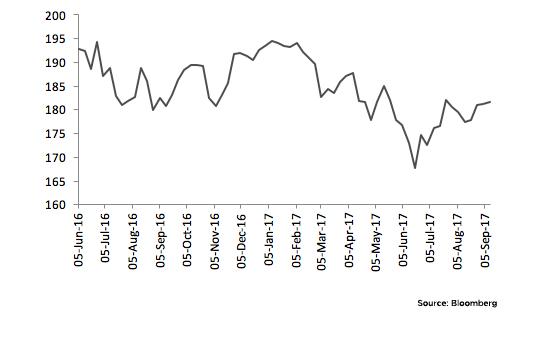
CRB Commodity Index

In ASEAN, the inflation story is in sync with global trends. Following a bout of overshooting, headline figures are largely receding. What does this mean for the direction of monetary policy? To answer this, we need to check on the underlying factors inflation is attributed to, i.e, exchange rate pass through (weaker currency resulting in imported inflation), excess demand beyond economy’s productive capacity (demand-pull) and supply side constraints (cost-push).

Is cost-push factor ruling inflation?

What constitutes supply-side pressures? The usual suspects are administered prices, costs of production inputs, prices of commodities, food and fuel etc. We need to ascertain how strong are these factors for MIST1.

From latest data for Malaysia we observe an easing of headline inflation. Transport cost which is perceived as the main driver of inflation, has been moderating after hitting a high in March 20172, as the low base effect of fuel prices dissipates. Headline readings for July were at 3.2% (y-o-y) and fall within the ambit of central bank target of 3 to 4% for 2017. For Indonesia, inflationary pressures are not broad-based and are largely attributed to administered price hikes (housing, electricity, gas and fuel). The central bank remains watchful of inflationary risks, which have inched lower and are likely to remain contained within the 3 to 5% target.

Headline inflation (%, y-o-y)

For Singapore, higher headline inflation numbers are largely boosted by supply-side factors (a combination of of energy related components and administrative price increases), rather than demand-side drivers. In Thailand, oil prices were the main driver pushing inflation higher at the start of the year. And with oil prices having softened again in recent months, it will now take an even longer time for the BOT to reach its inflation target of 1 to 4%.

How strong is “imported- consumption”?

In open economies fluctuations in exchange rate affect inflation. Thus a depreciation in the exchange rate would make imports costly for a consumer, assuming that other factors remain constant. For simplicity, we focus on the direct effect of pass through on consumer goods prices, and to gauge this we look at the import intensity of consumption, direction of exchange rate movement and import price index (IPI). The basic idea is if a commodity has a very low concentration in consumption basket, then the pass through effect of currency depreciation will be mild.

Evidence clearly points to a sustained strengthening of exchange rates on a trade weighted basis for Thailand and a downward bias for Indonesia and Singapore. Malaysia though remains weak has shown upward bias in recent times.

Nominal effective exchange rate
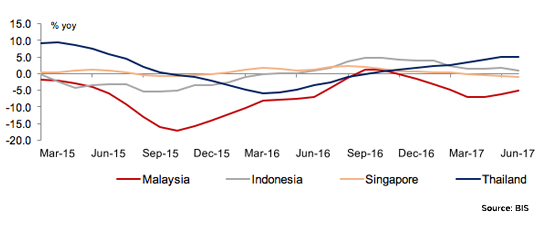

Lately, import price indices are showing a downtick. On the third criterion, import intensity of consumption is observed to be low for Malaysia, Indonesia and Thailand, in tune with general global trends. Putting the above pieces together, for Thailand, a relatively strong currency has kept in check foreign cost pressures and thus imported prices in domestic currency terms low. Therefore the exchange rate pass-through is contained. In the case of Indonesia and Malaysia, the pass-through to consumer prices may be somewhat mitigated by the fact that consumption has a low import content.

Import price index                                                  Import intensity of consumption        graph

In case of Singapore, consumer price inflation primarily stems from the prices of imported goods, as Singapore is highly dependent on imports for its consumption needs. However, a negative output gap3 shows slackness in growth which has undermined imported inflation, as is evident from the declining trend in IPI, thereby limiting the pass through effect of exchange rate.

Output Gap in Singapore
Headline inflation (%, y-o-y)

Is economic activity firm enough to drive inflation?

Incoming data clearly point to a fiscal expansion and exports as the primary drivers of growth in MIST.

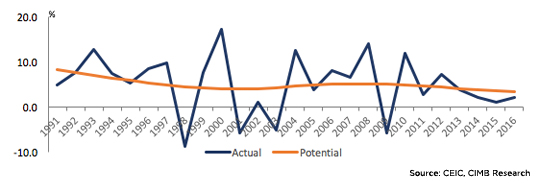
We have seen a resurgence in growth in Malaysia with GDP rebounding to a three year high of 5.8% in 2Q17 (averaging 5.7% in 1H17) which has ushered in an air of optimism to the recovery story. Exports, mainly manufacturing and commodities are the drivers behind this growth, while private consumption remains supportive as well. Sentiment indicators (business and consumer) have also ticked up. Private investment has also shown some exuberance but yet to gain traction.

However, contribution from the external sector in 2H17 is expected to cool as global trade moderates. And if exports moderate, it will have repercussions on several other parts of the economy. Nevertheless, private consumption will continue to remain steady amid a stable labor market and moderate wage gains. Meanwhile, populist spending by the government, ahead of the elections in 2018, is also expected to boost household spending. In our earlier piece4 we quantified the claim that consumption is not driving growth in Malaysia and we reaffirm it. Rather it has been resilient in the face of external shocks and has helped cushion overall growth.

Growth Rates of Actual and Potential Output in Malaysia
Headline inflation (%, y-o-y)

In Indonesia, as per the latest release, growth has been flat at 5% in 1H2017, driven by public investment and an improved external position. Signs of a pick-up in investment in 2Q are encouraging, however, not strong enough to accelerate growth. On the other hand, private consumption (accounting for over 57% of the country’s economic growth) remains sluggish and consumption-GDP ratio has been falling. While household expenditure has shown some improvement since 2016, any significant rise is yet to be observed (multiple interest rate cuts totaling 175 bps failed to stimulate private spending and offtake in credit), given wages remain low. Recovery in export growth this year has not helped to boost consumption growth. As such, the link between stronger export growth and higher wage growth has been weak so far in 2017.

Domestic activity in Singapore has been growing below trend for a while now. The rebound in 2Q GDP print was largely the result of external demand for electronics which supports the manufacturing sector. However, structural challenges are weighing down the domestic sectors. Labor market conditions remain slack dampening consumption.

Growth Rates of Actual and Potential Output in Singapore
Headline inflation (%, y-o-y)

In Thailand, though the GDP prints for 2Q17 beat expectations (3.7% vs 3.2%), growth is yet to be broad-based. In 1H17, economic activity grew by 3.5%, exports with tourism and government stimulus providing the impetus. Private consumption has been lackluster, though recent improvements in farm income5 are helping stimulate it. Deleveraging also continues to weigh on consumption growth, especially in absence of stronger wage growth. Additionally, with capacity utilization at 67%, private investments remain stagnant, despite a mild improvement in 2Q mainly due to the base effect. On the other hand, export growth has surpassed expectations, but is unlikely to be sustained as China’s imports begin to slow.

Thus factors at play do not support a broad-based growth picture, though Malaysia seems relatively better placed than its peers. The next question is how are the current growth numbers and demand affecting inflation? Stated otherwise, is there a possibility of a demand-pull inflation? After all, monetary policy is a demand management tool.

The output gap analysis and inflation

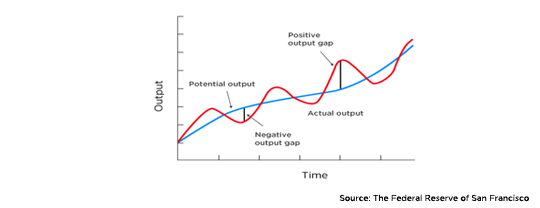
A measure often used for demand driven inflation is the output gap6. In other words, the output gap reflects the economy’s position in the business cycle, and also captures the possible presence of inflationary pressures arising from the level of utilisation of factors of production7. For example, an economy is operating with surplus capacity when actual output is below its potential level (negative output gap). This in turn is associated with easing of cost and price pressures.

Illustration of the relationship between actual and potential output and output gap
Headline inflation (%, y-o-y)

In the case of Malaysia, in level terms, actual output was close to potential output in 2016 (as per latest data available on output gap). Having said that, demand-pull pressures remain modest, in the absence of any significant increase in wages. This is also reflected in core inflation which has been hovering around 2.3 to 2.6%.

Output Gap in Malaysia                                                Core inflation
Headline inflation (%, y-o-y)

For Indonesia and Thailand, core inflation has been inching down which clearly rules out the existence of demand driven pressure on prices. In the case of Thailand, inflation remains at multi year lows of sub 1%, while for Indonesia, we have pointed out earlier a muted growth in consumption.
 
Growth recovery in Singapore is still at an early stage and has yet to translate into greater private consumption and demand given the uncertainties. Consumer-focused industries such as retail remain subdued because of a weak labor market, the property market is still in a slump and there are worries about China’s growth outlook.

Should central banks change path?

From the above discussion, the influence of demand-pull pressures and exchange rate pass through on prices do not appear significant. This leads us to believe the role of supply-side factors adding to volatility in the headline figures.

In Malaysia, currently, demand-pull pressures that would call for a policy response are very modest. Of note, core inflation has remained below policy rate. For now, inflationary pressures are mainly cost-push. However, if growth remains strong, then inflationary pressures may become demand pull via higher wage growth. Bank Negara has held the interest rate at 3% since July 2016, which has translated to negative real interest rates, thereby calling for a tightening bias. However a rate hike at this stage is highly unlikely as the economic recovery is in its nascent stages and remains vulnerable to external headwinds, while inflation is gradually easing.

Bank Indonesia (BI) has recently surprised the markets, delivering a 25 bps cut, lowering the 7 day reverse repo from 4.75% to 4.5% in August 2017. The rate cut may be regarded as a signal that one should be more concerned about the current pace of GDP growth, and raises questions about the central bank’s traditional focus on financial stability and external environment. As such, BI appears to have left the door open for further rate cuts. But we do not foresee further easing. With the Fed announcement on balance sheet normalisation plans likely to be made this month, the external backdrop seems less supportive of rate cuts going forward.

In Singapore, with patchy growth and inflationary pressure remaining benign and well within the comfort zone of the central bank set targets, the Monetary Authority of Singpapore is expected to continue maintaining the current zero-appreciation of the SGD nominal effective exchange rate policy stance.

The Bank of Thailand (BOT) has kept its policy rate (one day repurchase rate) unchanged at a record low of 1.5% for more than two years now8. Though a negative output gap, low credit expansion9 and soft inflation numbers (the central bank has revised down core and headline inflation figures) do open up a debate for further easing, however, such a move at the current juncture might exacerbate financial stability risks, given a prolonged period of low interest rates. There are also doubts that any further cuts will lift demand, given the household debt overhang. 

Output Gap in Thailand
Headline inflation (%, y-o-y)

Conclusion

We observe that inflation is largely cost-push in MIST. The underlying idea is to determine if the shock is temporary or permanent. The generally accepted theory is if the supply shocks are perceived as transient and expectations remain well anchored, then monetary policy need not respond to the shock.  But if change in relative prices caused by the shock result in higher general inflation (via wage growth), central bank needs to step in.
                       
As for MIST, inflation remains contained, as the temporary upswings wane in line with easing fuel and food prices. Having said that, central banks should ensure that the current cyclical pickup in economic activity stabilizes before paring back the accommodative stance. For now, this means that, in terms of monetary policy, interest rates will continue at the low levels for the foreseeable future.

Inflation in MIST
Headline inflation (%, y-o-y)


1 MIST is the acronym for Malaysia, Indonesia, Singapore and Thailand, and the piece primarily covers these countries.
2 Inflation in March 2017 was observed at an 8 year high at 5.1%, breaching the upper range of Central Bank projection of 3-4% for 2017, pushed up by higher fuel costs.
3 We have explained the concept of output gap later in the piece
4 Making trade great again: The misplaced reliance on the Asian consumer, March 2017 by Dr. Arup Raha
5 Resulting from increased agricultural yields following prolonged drought, as well as turnaround in global commodity prices.
6 Stated in simple terms, output gap is the difference between what an economy actually produces (actual output) and the maximum level of goods and services it can produce when operating at full capacity (potential output).
7 Increased demand for output beyond full capacity pushes up cost of factors of production.
8 The BOT had last changed rates in April 2015, when it cut the policy rate by 25 basis points to the present level.
9 There has been a reduced policy transmission, as domestic lenders have not lowered interest rates as much as the reduction in the policy rate owing to concerns about higher credit risks and non-performing loans.

China-ASEAN Monitor


img-ca-130917.jpg

Photo Credit: New Straits Times

Economy, Investment and Trade

China-ASEAN expo seeks to boost cooperation
(12 September 2017) China and ASEAN member countries look to strengthen cooperation in trade and investment during the 14th China-Asean Expo (CAEXPO) and China-Asean Business and Investment Summit (CABIS). China’s Ministry of Commerce spokesperson Gao Feng says bilateral cooperation on production capacity and investment cooperation will be the key agenda. The theme for the 14th CAEXPO and the CABIS is “Building the 21st Century Maritime Silk Road, promoting regional economic integration through tourism”.
Read more>>

China main driver in Southeast Asia’s growth, raises concerns
(10 September 2017) China has invested heavily in Southeast Asia focusing on infrastructure to realise China’s Belt and Road initiatives. Exports to China from Indonesia and Malaysia grew more than 40 percent in the first half of the year. Despite the economic benefits, there are increasing concerns that economic dependence on China increases the ASEAN region’s vulnerabilities to geopolitical risks.
Read more>>

Co-working giants compete in Southeast Asia
(12 September 2017) China-based shared working space provider, UrWork, took part in an early round of funding that raised US$3 million for Indonesian start-up, ReWork. The fundraising will be used to expand ReWork’s operations in Indonesia. This follows closely after US giant WeWork announced its plans to acquire Singapore-based SpaceMob. iResearch analyst Yu Kexin believes that the co-working sector is still in its infancy stage and has room to learn from mature operating models.
Read more>>

Smart bike-sharing company Mobike to launch in Malaysia
(6 September 2017) China-based smart bike-sharing company Mobike launched its dockless bike-sharing service in Malaysia. In Malaysia, Mobike has partnered with Malaysian real estate developer S P Setia for a tailored service to the local market. This is the third ASEAN country Mobike has ventured into, following its rollout in Singapore and Thailand. Competition is heating up as Chinese rival Ofo and Singapore-based Obike both have presence in Malaysia and Thailand.
Read more>>

China gold producers seeking acquisitions of Indonesian mines
(12 September 2017) Shandong Gold Group and China Gold International Resources Corp., both major Chinese gold miners, are among firms seeking to acquire EMR Capital’s Indonesian gold and silver mine in the North Sumatra province. EMR Capital is estimated to make up to US$1.5 billion from the sale of the mine. Gold producers are actively seeking acquisitions as the price of the precious metal continues to rally amid geopolitical concerns, such as North Korea’s missile ambitions.
Read more>>