AEC Blueprint 2025 Analysis: Paper 4 | Liberalisation in the Investment Environment

by Ken Li Yee | Originally published on 10 March 2016.


Summary

Whilst the need to attract Foreign Direct Investment (FDI) has long been a successful driver of investment liberalisation, recent rollbacks and protectionist policies have threatened progress. The AEC Blueprint 2025 hopes to capitalise on on past momentum whilst introducing new initiatives.

Foreword

The AEC Blueprint Analysis series is a publication which seeks to provide insight into the ASEAN Economic Community Blueprint (AEC) 2025. The publication will seek to do so by adopting a holistic approach in its analysis; creating context by examining past achievements, defining present challenges, and discussing future plans. The series will pay special attention to strategic measures outlined within the AEC’s new blueprint, providing insights with regards to the viability of regional economic integration under the AEC.


A. Past Plans

What were the targets in the AEC 2015 Blueprint?
The goal of free flow of investment is a key element in achieving the AEC’s first pillar within the 2015 blueprint, which details the creation of a single market and production base. It should be noted that whilst the liberalisation of trade and other ancillary measures do impact the movement of investment, a stringent focus on direct policies regarding investment will be placed upon this paper. Since 1967, several key agreements and actions were adopted in an effort to remove barriers to investment and facilitate investment flows:

Investment Guarantee Agreements (IGA)
Signed in 1987, the objective of the IGA was to promote greater investment flows between countries by providing a legal framework which defined investment norms and protection. The IGA introduced several basic principles:

  • Principle of non-discrimination, which standardised investment policy treatment across member states,
  • Compensation in the event of expropriation,
  • Free transfer of funds,
  • Investor state dispute settlement mechanisms.

ASEAN Investment Area (AIA) Agreement
Endorsed in 1995, the AIA Agreement fostered cooperation, facilitation, and liberalisation within the investment environment of ASEAN. The AIA Agreement introduced reforms to specific sectors on a pre-agreed schedule:

  • Manufacturing, agriculture, fisheries, forestry, mining and quarrying and services incidental to these sectors were to be covered by the AIA by 2010 for the ASEAN-6 and 2015 for the CLMV nations,
  • Two separate lists, the Temporary Exclusion Lists (TEL) and Sensitive Lists (SL) were also introduced, with the TEL
    to be phased out over time and the SL to be reviewed periodically.

ASEAN Comprehensive Investment Agreement (ACIA)
Coming into effect in 2012, the ACIA improved upon the AIA and IGA by means of several key measures:

  • Adopting international best practices in relation to investment protection
  • Defining portfolio investment, intellectual property, and other general ambiguities
  • Extending the coverage of previous agreements to third-country nationals
  • Introducing Investor-State Dispute Settlement mechanisms (ISDS) and promoting other dispute resolution methods

AEC Blueprint 2015
The AEC Blueprint solidified the commitments of previous agreements and regrouped policies into a four pronged approach to addressing the freedom of investment:

  • Investment Protection
  • Facilitation and Cooperation
  • Promotion and Awareness
  • Liberalisation


B. Past Achievements

What has been achieved?

From a broad perspective, developing economies such as Cambodia and Vietnam have more open policies than developed ones such as Malaysia, Indonesia and Thailand. This is emphasised by Figure #1, which measures FDI restrictiveness on a scale of 0 to 1 with higher scores indicate more restrictive investment policies in a nation.

img-aecpaper4-1

Following the adoption of the AEC Blueprint 2015 in 2007, the uptake for FDI in CLMV nations has been apparent due to market enabling policies. Figure #2 illustrates that a moderate negative correlation between high levels of FDI and low levels of regulatory restrictiveness.

img-aecpaper4-2

In particular, it was observed that FDI restrictiveness was relatively higher within the communication and transport sectors. (Thangavelu, 2015).

Since the introduction of the ACIA, the Reservation Lists (RL) for four member states has changed as of the
AEM-18th AIA council Meeting in August 2015:

  • Brunei narrowed the scope of sectors on its RL,
  • Laos removed the manufacturing sector from its RL,
  • Myanmar shaved off restrictions on foreign investment in certain products,
  • Indonesia introduced more restrictive changes to its coal and mining sectors.


C. Present Challenges

What are the current issues?

ACIA commitments do not necessarily match investment policy:

  • In particular, Indonesia’s passing of Presidential Regulation No. 39/2014 meant that investment policies surrounding manufacturing, agriculture, mining, and services were more restrictive than ACIA commitments (Damuri et al, 2014),
  • The Philippines has severe constraints in the agriculture, fishery, forestry, and mining sectors; foreign equity limits of more than 40% are still present (Llanto et al, 2014),
  • Whilst Malaysia has followed through on liberalising foreign equity restrictions in its services industries, foreign equity restrictions in its goods sectors and megaprojects are still present (MIER, 2014),
  • Vietnam is currently rolling back its investment protectionist policies, and will not have issues in regards to completing the ACIA commitments if current trends continue.

There is no standardised definition of sensitive industries, allowing for the ad-hoc classification of sectors which are not covered by the ACIA.

Standardisation of investment policies across the region is still a long term challenge made harder by several factors:

  • A lack of concrete limitations, where nations such as Singapore and Myanmar do not give specific limitations on foreign equity ownership but rather decide limits on a case by case basis,
  • The Coordinating Committee on Investment (CCI) peer review system has not been used effectively, and most disputes have been settled outside the AIA,
  • A lack of unified commitments and set timeline.


D. Future Plans

What new measures are included in the AEC 2025 Blueprint?
As the ACIA does not posses a concrete timeline and set commitments, the logical step forward would be to formulate these elements in future action plans. This is reflected within the actionable clauses in the AEC 2025 Blueprint,
whereby the focus is placed upon implementing previous commitments and sharpening existing mechanisms for
investment liberalisation.


E. AEC 2025 Blueprint Analysis

What do the measures entail?

img-aecpaper4-3


F. Conclusion

What does the AEC 2025 Blueprint mean in terms of the movement of skilled labor?
ACIA has limited scope as its liberalisation provisions are limited to five sectors and services incidental to these
sectors. The ACIA should broaden its breadth and depth to meet the demand of increasing cross-border investment not limited to the 5 sectors, as the vision of ASEAN gains prominence.

The state of investment liberalisation ultimately depends upon the political capital available to ASEAN member states, where economic conditions, domestic issues, and foreign policy will dictate the success of the ACIA and future endeavours.

In comparison to ATIGA and the AFAS, the ACIA does not posses a definitive list of commitments nor a set timeline for the implementation of policy; this is reflected within the AEC Blueprint 2025 which calls for further clarification to existing modalities and mechanisms.


References
Areethamsirikul, S. (2008). The Impact of ASEAN Enlargement on Economic Integration: Successes and Impediments Under ASEAN Political Institution, The University of Wisconsin – Madison.
ASEAN 2025: Forging Ahead Together, The ASEAN Secretariat (2015).
Damuri, Y.R., I. Setiadi, D. Christian and E. Sasmito (2014), ‘ASEAN Economic Community Scorecard Phase IV:
Indonesia’ . Jakarta: Centre for Strategic and International Studies. (CSIS).
Kalinova, B., A. Palerm and S. Thomsen (2010), “OECD’s FDI Restrictiveness Index: 2013 Update”, OECD Working Papers on International Investment, No. 2010/03, OECD Publishing, Paris.
Llanto, G., R. Serafica, E. Medalla, K. Ortiz, K. Detros, F. Del Frado, M. Mantaring, V.
Ulep, D. Ortiz, P. Padronia, and A. Maddawin. (2014), ‘ASEAN Economic Community Scorecard Phase IV: the Philippines’ Manila: Philippine Institute for Development Studies.
MIER (2014), ‘ASEAN Economic Community Scorecard Phase IV: Malaysia’. Kuala Lumpur: Malaysia Institute of Economic Research.
Secretariat, T. A. (2008). ASEAN Economic Blueprint.
Secretariat, T. A. (2015). ASEAN Intergration Report 2015.
Secretariat, T. A., & UNCTAD. (2015). ASEAN Investment Report 2015 Infrastructure Investment and Connectivity.
Secretariat, T. A. (2015). A Blueprint for Growth ASEAN Economic Community 2015: Progress and Key Achievements.
Thangavelu, S. M. (2015). “FDI Restrictivness Index for ASEAN.” ERIA Discussion Paper Series.


Unable to view it online? You may download the PDF file here:

Download[wpdm_file id=121]

China-ASEAN Monitor


China-ASEAN Monitor

Photo Credit: Reuters


Economy, Investment and Trade

Infrastructure drives China to be Indonesia’s second top investor
(1 February 2018) China became Indonesia’s second-biggest source of foreign direct investment in 2017. According to data released by Indonesia’s Investment Coordinating Board (BKPM), China overtook Japan on the Southeast Asian country’s investor list following aggressive moves in Indonesia’s downstream industries. Additionally, Jakarta and Beijing have also agreed to jointly develop infrastructure project that is specifically designated for Belt and Road Investment, which will further swell up China’s investments into Indonesia. Investment from Japan, who slipped to third place, decreased by 7 percent last year to US$5 billion. Throughout 2017, Indonesia received US$32.34 billion (Rp 430.5 trillion) in FDI excluding investments in the banking and oil and gas sectors, while Singapore remained the largest source of investment into Southeast Asia’s largest economy last year.
Read more>>

More Cambodia trade centres to be established in China
(1 February 2018) Cambodia announced its plans to build a Cambodian cultural village in Beijing and more trade centres in different Chinese provinces following a rise in Cambodian exports to China, which grew 18 percent year-on-year during the first 11 months of 2017. Cambodian Minister of Commerce Pan Sorasak said that Cambodia will continue to boosts investment and spur information for the benefit of Chinese businesses and investors that are interested in prospecting opportunities in Cambodia. As of February 2017, China had spent US$4.2 billion in development assistance in Cambodia.
Read more>>

Development and cooperation key focus to Laos-China Belt and Road Cooperation forum
(2 February 2018) A two-day forum focusing on development and cooperation between Laos and China was held as a result of Chinese President Xi Jinping’s state visit to Laos in November 2017. The Laos – China Belt and Road Cooperation Forum, which commenced on 2 February, was jointly organized by the Commission for Propaganda and Training of the Lao People’s Revolutionary Party, the Lao Ministry of Information, Culture and Tourism, China’s Xinhua News Agency, the Industrial and Commercial Bank of China and the Lao Chinese Chamber of Commerce. President of China’s Xinhua News Agency Cai Mingzhao said that the visit by President Xi in 2017 was a significant milestone in strengthening the bilateral friendship and enhancing the strategic cooperative partnership between the two neighbouring countries. In the forum, both sides agreed to jointly build China-Laos economic corridor, fostering new seeds and mapping out new blueprint.
Read more>>

China skies to be more accessible by Malaysian airlines
(2 February 2018) Negotiations are underway for Malaysian airline companies to expand and open up more air routes in China. Malaysia Airlines Berhad (MAB) is eyeing the second-tier cities of China by providing flights to Wuhan in the central, Nanjing in the east and Fuzhou in the south. Malaysia’s Transport Minister Datuk Seri Liow Tiong Lain said that Malaysia’s low-cost carrier Air Asia also aims to increase its flight frequency to the ancient city of Xian from four days per week to daily. In addition, Liow have also urged the International Civil Aviation Organisation to equally grant the technical cooperation fund for human resources development.
Read more>>

Foreign Affairs

Singapore and China deepens defence cooperation
(5 February 2018) Singapore and China armies will step up bilateral defence cooperation to further strengthen army cooperation through the conduct of Exercise Cooperation as well as navy cooperation. Additionally, both ministers have also discussed regional security issues and have agreed on the need to have an open and inclusive security architectures. During the official defence visit in Singapore, Chinese Minister of National Defence General Chang Wanquan also conveyed his appreciation to Singapore for their significant role as the ASEAN-China country coordinator.
Read more>>

AEC Blueprint 2025 Analysis: Paper 5 | Liberalisation of the Financial Sector

by Ken Li Yee | Originally published on 20 April 2016.


Summary

Liberalisation efforts surrounding the regions banking, insurance, and other financial instrument markets will need to keep up with burgeoning growth in the region; the AEC Blueprint 2025 hopes to continue capitalising upon the success of previous policies.

Foreword

The AEC Blueprint Analysis series is a publication which seeks to provide insight into the ASEAN Economic Community Blueprint (AEC) 2025. The publication will seek to do so by adopting a holistic approach in its analysis; creating context by examining past achievements, defining present challenges, and discussing future plans. The series will pay special attention to strategic measures outlined within the AEC’s new blueprint, providing insights with regards to the viability of regional economic integration under the AEC.


A. Past Plans

What were the targets in the AEC 2015 Blueprint?
ASEAN financial integration envisages a well integrated and smoothly functioning regional financial system with more liberalised capital account regimes and interlinked capital markets that will facilitate greater trade and investment flows in the region. This will be achieved through:

  1. Financial services liberalisation
  2. Capital account liberalisation
  3. Harmonisation of payments and settlements systems

ASEAN aims to only achieve semi-integration in the financial sector by 2020. Full integration comparable to the level achieved by the core member countries of the European Union (EU) is deemed to be too ambitious in the next decade. (“Regional Cooperation in Finance”, 2016)

1. Roadmap for Monetary and Financial Integration of ASEAN (RIA-Fin)
Endorsed in 2003, the RIA-Fin articulated ASEAN’s goals and efforts within a roadmap format. The roadmap also affirmed the usage of a positive list modality, which meant that any commitments made would apply only to an explicit list of sectors. The task of integrating ASEAN’s financial sector was divided into four separate areas:

  • Financial Services Liberalisation:
    Intended to achieve free flow of financial services by 2015 through progressive removal of restrictions on financial services providers with the presence of Qualified ASEAN Banks (QABs) in other ASEAN countries.
  • Capital Market Development:
    Intended to build capacity and lay the long-term infrastructure for development of ASEAN capital markets, with a long-term goal of achieving cross-border collaboration between the various capital markets in ASEAN. This is through enhancing market access, linkages and liquidity through such proposed initiatives as ASEAN Exchanges linkages, Bond Markets linkages; and promoting credit ratings comparability between domestic and international credit rating agencies.
  • Capital Account Liberalisation:
    Intended to achieve freer flow of capital by 2015. This refers to the easing of capital restrictions and implementation of safeguards against volatility and systematic risks. In essence red tape surrounding Foreign Direct Investments (FDI), investment into equities, and bank borrowing will be addressed.
  • Currency Cooperation:
    To explore currency arrangements between member states aimed at facilitating intra-regional trade, investment and economic integration are viewed as part of ASEAN’s goals in integrating financial markets. (“Regional Cooperation in Finance”, 2016)

2. AEC Blueprint 2015
Put into effect in 2007, the AEC Blueprint 2015 focused on further clarifying the objectives of financial
integration. Under the blueprint, the “ASEAN minus x” approach was adopted allowing for flexible
commitments. The blueprint also adopted a schedule for financial services subsectors identified for
liberalisation by 2015.

3. In 2008, the ASEAN Capital Markets Forum (ACMF) outlined six strategic components of the Implementation
Plan:

Creating an Enabling Environment for Regional Integration

  1. Design and Implement a Mutual Recognition/Harmonization framework of gradually expanding
    scope and country coverage (Strategic Component I)

Creating the Market Infrastructure and Regionally Focused Products and Intermediaries

  1. Implement an Exchange Alliance framework to facilitate cross-border trades with local brokers
    initially; and strengthen and harmonize exchange governance, listing rules and corporate
    governance framework (Strategic Component II)
  2. Promote new products and regionally active intermediaries to build awareness of ASEAN as an
    asset class (Strategic Component III)
  3. Reinforce and expedite implementation of ongoing strategies and initiatives to strengthen and
    integrate bond markets. (Strategic Component IV)

Strengthening the Implementation Processes

  1. Refine the strategies for domestic capital market development in each ASEAN country and
    incorporate measures and milestones that support regional integration initiatives. (Strategic
    Component V)
  2. Strengthen the ASEAN level working mechanisms in order to better coordinate regional integration
    initiatives and monitor and support its implementation at the country level. (Strategic Component
    VI)

4. ASEAN Financial Integration Framework (AFIF)

Adopted in 2011, the AFIF continued the blueprint’s initial objectives whilst committing ASEAN to the goal of a
semi-integrated financial region by 2020. Several developments were added in subsequent installments:

  • Differentiated timelines and targets for the ASEAN 5 and BCLMV nations in recognition of differing
    states of development and readiness
  • Accord of equal access, treatment and environment to QABs;
  • Regard to safeguard financial and monetary stability in the process of financial services
    liberalisation, capital market development, capital account liberalisation and harmonisation of
    payments and settlement systems; and
  • Shared responsibility among AMS for enhanced collaboration on financial stability and capacity
    building.

5. ASEAN Banking Integration Framework (ABIF)
A framework agreement which was signed in 2015, the ABIF provided a guiding platform for the formation of
bilateral agreements between member states concerning the banking industry. Under the framework, Qualified
ASEAN Banks (QABs), which are defined by the individual bilateral agreements, will be given access to the
markets of member states with the support of central banks.

6. ASEAN Insurance Integration Framework (AIIF)
AIIF was finalised and agreed upon to guide the progressive liberalization to ensure more competitive
insurance markets and greater choice for consumers. Competitive insurance markets will lower the cost of
insuring business risks, which will stimulate economic growth and spur intra-ASEAN trade. ASEAN members
have agreed to prioritise the liberalisation of cross-border supply of Marine, Aviation and Goods in International
Transit (MAT) insurance.


B. Past Achievements

What has been achieved?

1. State of ASEAN Capital markets

As illustrated by the Figure #1, the disparity in the size of financial institutions and markets in member states
shows a developmental gap between the ASEAN 5 and CLMV nations

  • With exception to Singapore, the capital markets of member states offer limited depth and liquidity,
    and are therefore subject to excessive global capital flow volatility; this is only true when compared to
    the relatively more systematically insulated nature of developed capital markets around the world
    (Almekinders et el, 2014)
  • Despite its size, ASEAN’s market capitalisation jumped 12.2% in 2014 alone, whereas the
    Compounded Annual Growth Rate (CAGR) of the ASEAN 5 bond market for the past decade stood
    at 11.3% (ADB, 2015)
  • Increased growth however, cannot be attributed to financial integration between member states

img-aecpaper5-1

2. Financial Services Liberalisation

As key financial intermediaries for the region, banks make up the bulk of ASEAN’s financial markets and can
be used as indicators of financial services integration through cross border activities.

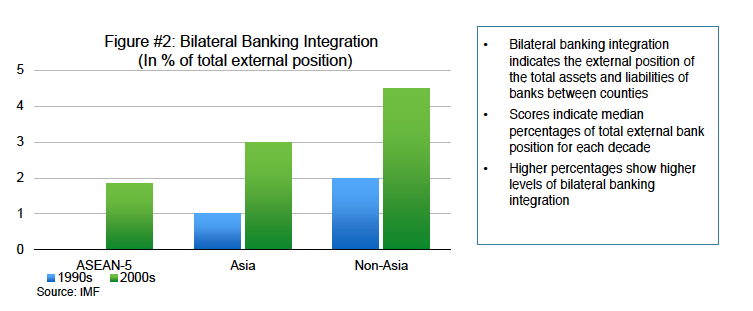
  • As demonstrated in Figure #2, bilateral banking integration is relatively low within member states when
    compared to the region and the rest of the world.
  • In 2009, foreign banks made up 18% of total commercial banks in Malaysia, the Philippines, and
    Thailand; Malaysia accounted for the highest share of foreign ASEAN based banks at 8.5%. (IMF,
    2015) Foreign banks in AMS countries are largely big sized international banks as opposed to ASEANbased
    banks. (ADB, 2013)
  • Except Maybank Banking Berhad, no home grown ASEAN based bank has a branch or subsidiary in
    all ASEAN countries; on the other hand, foreign owned and controlled insurance companies are
    pervasive amongst member states, especially amongst the lesser-developed markets. (Lee, 2015)
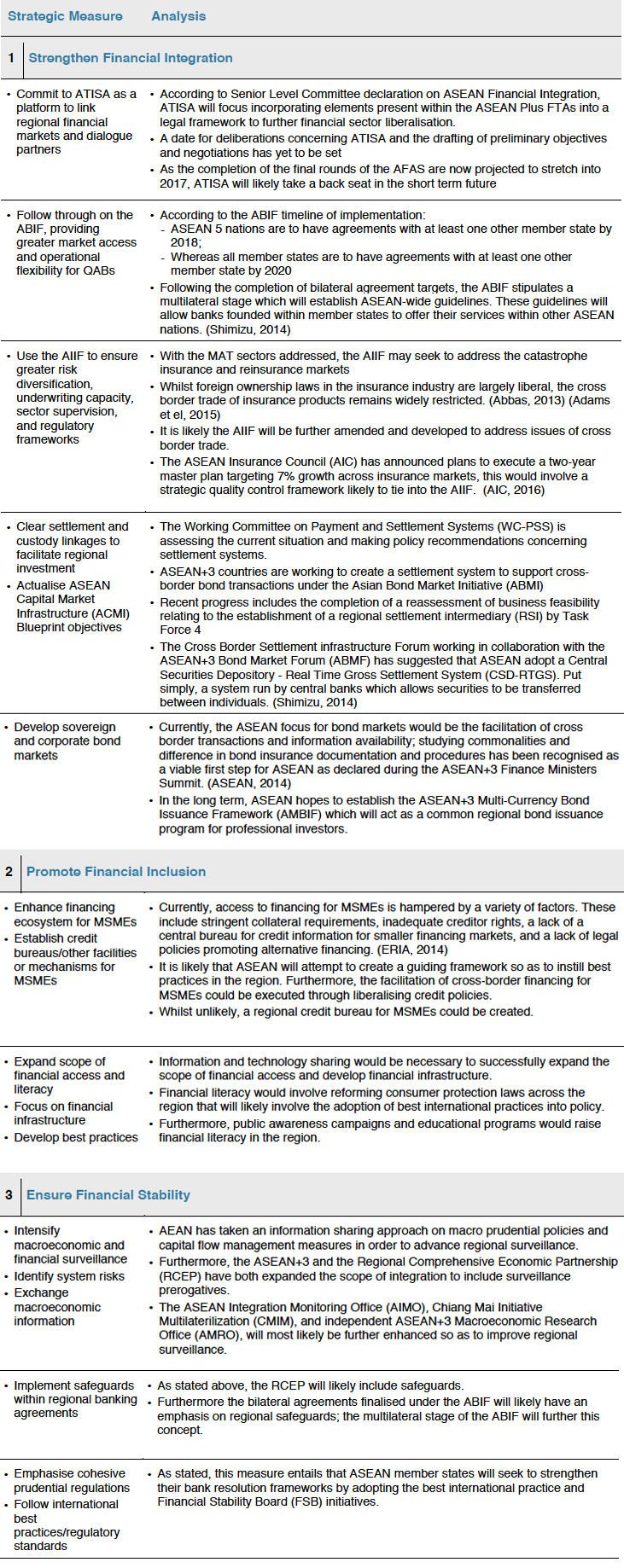
  • The ABIF which was signed into effect by the Sixth Package of the AFAS in large part hopes to solve
    the lack of ASEAN banking integration (Indonesian Ministry of Finance, 2015)

img-aecpaper5-2

3. Capital Account Liberalisation

  • The preliminary assessment and identification of rules relating to foreign exchange transactions has been
    completed.
  • Member states have drafted individual roadmaps to liberalise capital account regimes.

4. Capital Market Development

  • Agreement to adopt ISO20022 as a common standard for fund transfers in ASEAN, upon readiness of
    individual countries
  • ASEAN Trading Link electronically connects exchanges in Malaysia, Singapore and Thailand providing
    investors with easier and more seamless access into ASEAN markets from one single access point.
  • ASEAN Disclosure Standards provides significant efficiencies to issuers as they need only to adopt a
    single set of disclosure standards for prospectuses in an offering across multiple ASEAN jurisdictions.
    Malaysia, Thailand and Singapore are signatories to the Scheme. The Scheme is benchmarked against the
    International Organisation of Securities Commissions’ (“IOSCO”) disclosure standards. A
    Memorandum of Understanding (MoU) which establishes a Streamlined Review Framework for the
    ASEAN Common Prospectus.
  • Through the Memorandum of Understanding (MoU) on Expedited Entry of Secondary Listings among
    regulators and exchanges from Malaysia, Singapore and Thailand, the time-to-market for corporations
    seeking a secondary listing in a participating ASEAN country has been reduced from the normal timeframe
    of up to 16 weeks to 35 business days.
  • The ASEAN Corporate Governance Scorecard is based on a corporate governance ranking
    methodology which leverages on methodologies already implemented in ASEAN countries, as well as
    those applied by multilateral agencies such as the OECD. The Scorecard aims to raise corporate
    governance standards and practices, showcase and enhance the visibility of well-governed PLCs and
    promote ASEAN as an asset class internationally.
  • The ASEAN Capital Markets Infrastructure Blueprint aims to enhance connectivity of ASEAN capital
    markets through post trading linkages. Having greater access to different markets helps ASEAN investors
    to diversify risks and issuers to lower borrowing costs, while keeping transactions efficient.
  • The ASEAN Bond Market Development Scorecard monitors development of bond market development.
    Starting with Malaysia, Singapore and Thailand, ASEAN member states have also developed and adopted
    the ASEAN Debt Securities Standards.
  • ASEAN members monitor the progress of capital account liberalisation through the ASEAN Capital
    Account Liberalisation Heat map
    and Individual Milestones Blueprint.
  • The Policy Dialogue Process on Capital Flows and Safeguard Mechanisms for Capital Account
    Liberalisation
    allow ASEAN members to monitor capital flow trends and exchange experiences on capital
    flow management.
  • The Principles and Guidelines on Pre-Departure Orientation Program ensure that migrant workers
    receive adequate information to prepare them for their new life in their new destination, supporting a large
    group in ASEAN that may lack access to financial education.
  • A Collective Investment Scheme (CIS) was operationalised in 2014, allowing for the cross border offering of products to signatory countries; five companies have already had their products approved as of 2015.


C. Present Challenges

What are the current issues?

1. Developmental Gap
The developmental gap which exists between ASEAN financial markets defines and divides the monetary and
fiscal policy goals of each member state. This in turn means that integration efforts are often retarded by
national restrictions and regulations, which is exacerbated by the ASEAN minus x formula.

2. Public-Private Collaboration
The success of ASEAN financial sector integration hinges not only on the policy reform of governments, but
also the efforts of private sector financial institutions and agents. Whilst policy reform has seen progress,
greater efforts will need to be placed on public private sector collaboration in order to see the true benefits of
integration efforts. In particular, a lack of private sector consultations has been highlighted as a key problem
with current policy direction. (Chia, 2011)

3. Translating regional commitments to country policy
Although the broad objectives and overarching regional commitments have been developed, comprehensive
initiatives have been lacking. As ASEAN continues to remain sensitive towards the policy objectives of member
states, various exclusions and exceptions and a time consuming national legislative process have been
marked as detrimental to financial integration. (Chia, 2011)


D. Future Plans

What new measures are included in the AEC 2025 Blueprint?
The AEC Blueprint 2025 refocuses financial sector integration with new measures relating to financial inclusion and stability; these two new areas largely involve information sharing initiatives and the adoption of best practices with regards to policy.


E. AEC 2025 Blueprint Analysis

What do the measures entail?

img-aecpaer5-1

img-aecpaer5-2


F. Conclusion

What does the AEC 2025 Blueprint mean in terms of the movement of skilled labor?
Given the development gaps among ASEAN member states, ASEAN has set itself a conservative target for
financial integration. Although the AEC Blueprint 2025 takes a step forward by introducing two new areas of
focus, financial inclusion and stability, the majority of strategic measures offered do not hint towards any big
changes in policy in achieving financial integration.

No central body such as the European Central Bank has been proposed, which continues to confirm that the
AEC’s goals lie towards financial integration tempered by flexibility rather than clear-cut unified policy.

Likely to be further developed under ATISA by 2017, the Blueprint focuses on completing previous objectives
and established initiatives.


References
Abbas, R. (2013, November). Waking up to an ASEAN community by 2015 – Dream or reality? Asia Insurance Review.
Adams, S., Irwin, G., & Caparelli, D. (2015). ASEAn Insurance Markets; Integration, Regulation, and Trade (Rep.). Global Council.
Almekinders, G., Fukuda, S., Mourmouras, A., & Zhou, J. (n.d.). ASEAN Financial Integration (Rep. No. 15/34). Asia and Pacific: IMF.
ACMF (2008). The Implementation Plan. ACMF. Vietnam, Danang.
ACMF (2013). ASEAN Regulators Implement Cross Border Securities Offering Standards.
ASEAN Insurance Council. (2016, February 8). Two Year Master Plan to Spur ASEAN Insurance Industry Growth
[Press release]. Retrieved February 8, 2016, from www.aseanic.org
ASEAN 2025: Forging Ahead Together, The ASEAN Secretariat (2015).
ASEAN. (2014, May 3). The Joint Statement of the 17th ASEAN 3 Finance Ministers and Central Bank Governors’ Meeting
[Press release]. Retrieved February 8, 2016, from http:/
www.asean.org/asean-economic-community/asean-finance-ministers-meeting-afmm/overview/

Secretariat, T. A. (2008). ASEAN Economic Blueprint.
Secretariat, T. A. (2015). ASEAN Intergration Report 2015.
Secretariat, T. A., & UNCTAD. (2015). ASEAN Investment Report 2015 Infrastructure Investment and Connectivity.
Secretariat, T. A. (2015). A Blueprint for Growth ASEAN Economic Community 2015: Progress and Key Achievements.
Shimizu, S. (2014). ASEAN Financial and Capital Markets —Policies and Prospects of Regional Integration (Vol. XIV, Ser. 54, Rep.). Japan Research Institute.


Unable to view it online? You may download the PDF file here:

Download[wpdm_file id=121]

AEC Blueprint 2025 Analysis: Paper 6 | Liberalisation in the Movement of Skilled Labour and Business Visitors

by Dr. Bambang Irawan | Originally published on 11 August 2016.


Summary

The AEC 2025 Blueprint does little to expand on the objectives set forth in the AEC 2015 Blueprint in regards to the movement of skilled labor. Crucial skill gaps around ASEAN which threaten to derail the AEC ambition need to be met with proactive action; action which is lacking significantly in ASEAN’s current ambitions for skilled labor.

Foreword

The AEC Blueprint Analysis series is a publication which seeks to provide insight into the ASEAN Economic Community Blueprint (AEC) 2025. The publication will seek to do so by adopting a holistic approach in its analysis; creating context by examining past achievements, defining present challenges, and discussing future plans. The series will pay special attention to strategic measures outlined within the AEC’s new blueprint, providing insights with regards to the viability of regional economic integration under the AEC.


A. Past Plans

What were the targets in the AEC 2015 Blueprint?
Another characteristic of ASEAN’s single market and production base is the free flow of skilled labor within ASEAN. ASEAN has taken a two pronged approach to open the door towards the movement of skilled labor:

  1. Allow managed mobility or facilitated entry for the movement of natural persons engaged in trade in goods, services, and investments, according to the prevailing regulations of the receiving country;
  2. To facilitate the free flow of services (by 2015) by harmonisation and standardization

1. AEC Blueprint 2015

What were the targets in the AEC 2015 Blueprint?
Mutual Recognition Arrangements (MRAs) for major professional services, including PIS services sectors by 2008, MRAs constitute the following objectives:

  • Form the main policy tool for skilled labor mobility in ASEAN
  • Do not override local labor policy
  • Provide a local license for regulated professions

Facilitate issuance of visas and employment passes for ASEAN professionals and skilled labor who are engaged in cross-border trade and investment related activities.

Enhance cooperation amongst ASEAN University Network (AUN) members in terms of mobility.

Develop core competencies of skills and qualifications for job skills required in:

  • 12 Priority services sectors by 2009
  • All other identified services sectors by 2015

2. ASEAN Agreement on The Movement of Natural persons (MNP)

Signed in 2012, the MNP Agreement hopes to capitalise on MRAs by providing a legal framework to facilitate the temporary cross-border moment of people engaged in the trade of goods, services, and investment.

The MNP Agreement details streamlined procedures for the migration of business visitors, intra-corporate transferees, and contractual service suppliers.

3. ASEAN Qualifications Reference Framework (AQRF)

Finalised in 2014, the AQRF unifies education frameworks across ASEAN member states to enable the mobility of students and professionals in the region.

Although not a legal framework, the AQRF is designed to develop transparency amongst national qualifications in education, facilitating easier access to schools, colleges, and universities; ultimately, the AQRF is aimed at helping workers practice their professions across ASEAN.


B. Past Achievements

What has been achieved?

1. Unskilled labour

Screen Shot 2018-02-06 at 5.16.08 PM

As illustrated by Figures #1 and #2, the intra-ASEAN flow of labor is largely focused on several main corridors with concentrated destinations in Thailand, Singapore, and Malaysia.

The top corridor flowing from Myanmar to Thailand currently represents 28.8% of all intra-ASEAN movement.

More than 87% of intra-ASEAN migrants are unskilled workers.


2. Skilled labour

The eight completed MRAs cover 1.5% of the total ASEAN labor force (ADB-ILO, 2014)

MRA Implementation Progress: The MRAs can be broken into four main groups with different implementation processes:

  1. Architectural and Engineering Services
    The two service lines have MRAs which establish an ASEAN level council which has the power to declare vetted professionals as ASEAN chartered professionals; ASEAN charted professionals have their qualifications recognised by member states. As the most straightforward of the ASEAN MRAs, this group has seen the most success in implementing their MRAs. (Fukunaga, 2016)
  2. Medical, Dental, and Nursing Services
    MRAs relating to these service lines do not establish an ASEAN level council but rather leave the qualification of foreign professionals to national legislation. Instead, these MRAs act as touchstones for qualification equivalents. Implementation is therefore harder to measure, and is liable to domestic policy shifts. (ERIA, 2012)
  3. Accounting and Surveying Services
    Largely frameworks rather than actual agreed upon MRAs, these still need to go through a thorough vetting process and agreed upon by all member states before being actionable.
  4. Tourism Services
    The first MRA to deal with an unregulated profession, this MRA focuses on competency standards rather than a certified qualification. As such, this MRA is largely open to the interpretation of host countries and instead acts as a best practice guideline.


C. Present Challenges

What are the current issues?
ASEAN’s focus on ensuring the freedom of mobility of service professionals does not address the majority of actual labor movement in the region, as highlighted by the large proportion of unskilled migrant workers and the low coverage of MRAs.

Labor mobility is still highly limited in comparison to other regional unions such as the European Union and the Australia/New Zealand Closer Economic Relation Agreement. While these latter unions allow for the general movement of people, ASEAN member states are still constrained by immigration regulations, which act as further barriers even where MRAs have been implemented.

With national legislation taking precedence over MRAs, the possibility of policy progress backsliding has not been addressed.


D. Future Plans

What new measures are included in the AEC 2025 Blueprint?
Whilst the ASEAN 2025 Blueprint does not contain any explicit shifts in focus or policy, the deepening and expanding of existing MRAs, the MNP Agreement, and reduction of documentation may help to address existing shortfalls.


E. AEC 2025 Blueprint Analysis

What do the measures entail?

Screen Shot 2018-02-06 at 5.20.00 PM

Screen Shot 2018-02-06 at 5.20.08 PM


F. Conclusion

What does the AEC 2025 Blueprint mean in terms of the movement of skilled labor?

The AEC 2025 Blueprint does little to expand on the objectives of the AEC 2015 Blueprint in regards to the movement of skilled labor. Issues such as the movement of unskilled labor, the limited scope of MRAs, and immigration policy barriers are sensitive issues that have not been addressed.

ASEAN needs to address a crucial skills gap which may derail the AEC ambition. It is projected that there is a undersupply of 9 million skilled and 13 million semi-skilled workers by 2030 in Indonesia and Myanmar alone (World Bank). Recent research suggests that, based on current trends, more than half of all high-skill employment in Cambodia, Indonesia, Laos, the Philippines, Thailand, and Vietnam could be filled by workers with insufficient qualifications by 2025 (McKinsey).


References
ADB, ILO,. (2014). Managing integration for better jobs and shared prosperity. Thailand: ADB.
Retrieved from http://www.adb.org/sites/default/files/publication/42818/asean-community-2015-managing-integration.pdf
McKinsey Global Institute’s reports: on Indonesia, The archipelago economy: Unleashing Indonesia’s potential, September 2012; and Myanmar, Myanmar’s moment: Unique opportunities, major challenges, June 2013.
The ASEAN Secretariat (2015), ASEAN 2025: Forging Ahead Together. ERIA,. (2012). Mid-Term Review of the Implementation of AEC Blueprint.
Fukunaga, Y. (2016). Assessing the Progress of ASEAN MRAs on Professional Services. ERIA’S AEC Scorecard Phase IV Project.
United Nations (2016). United Nations Population Division | Department of Economic and Social Affairs. [online] Available at:
http:/www.un.org/en/development/desa/population/migration/data/estimates2/estimates15.shtml.
The ASEAN Secretariat (2008). ASEAN Economic Blueprint.
The ASEAN Secretariat (2015). ASEAN Intergration Report 2015.
The ASEAN Secretariat & UNCTAD. (2015). ASEAN Investment Report 2015 Infrastructure Investment and Connectivity.
The ASEAN Secretariat (2015). A Blueprint for Growth ASEAN Economic Community 2015: Progress and Key Achievements.


Unable to view it online? You may download the PDF file here:

Download[wpdm_file id=121]

AEC Blueprint 2025 Analysis: Paper 7 | An Analysis of Enhancing Participation in Global Value Chains

by Dr. Bambang Irawan | Originally published on 11 August 2016.


Summary

A production value chain describes the labor, materials, and processes which go into a product to convert it from conception to consumption ready. In present day economies, value chains are dispersed geographically amongst a myriad of nations in order to capitalise upon the varying technological strengths, resource riches, and human expertise.

Foreword

The AEC Blueprint Analysis series is a publication which seeks to provide insight into the ASEAN Economic Community Blueprint (AEC) 2025. The publication will seek to do so by adopting a holistic approach in its analysis; creating context by examining past achievements, defining present challenges, and discussing future plans. The series will pay special attention to strategic measures outlined within the AEC’s new blueprint, providing insights with regards to the viability of regional economic integration under the AEC.

Global Value Chains (GVCs)

A production value chain describes the labor, materials, and processes which go into a product to convert it from conception to consumption ready. In present day economies, value chains are dispersed geographically amongst a myriad of nations in order to capitalise upon the varying technological strengths, resource riches, and human expertise.

Participation in this Global Value Chain (GVC) of fragmented production and consumption is of the utmost importance as it determines the impact the global economy has on a country’s economic resilience, income distribution, knowledge creation, and other non-economic factors such as social and environmental impact.

A. Targets under the AEC 2015 Blueprint

Whilst enhancing global supply participation in the GVC was the second component of pillar 4, the AEC Blueprint developed in 2007 detailed no explicit measures towards this goal. Instead, it can be said that all initiatives undertaken in the standards harmonisation, the enhancement of regulatory regimes, and trade and investment facilitation have all fed into aiding ASEAN’s position in the GVC.

Furthermore, the development of regional and ASEAN+1 Free Trade Agreements (FTAs) and Comprehensive Economic Partnerships (CEP) have helped to improve ASEAN participation in the GVC by the same measures mentioned above. Currently, the largest planned economic partnership being negotiated is the Regional Comprehensive Economic Partnership (RCEP).

RCEP
Negotiations began in 2012 towards the development of an FTA which would untangle overlapping bi/multilateral agreements between stakeholders in existing ASEAN+1 FTAs. (DFAT, 2015) Furthermore, the RCEP would help to deepen commitments in the following areas:

  • Trade in Goods
  • Trade in Services
  • Investment
  • Economic and Technical Cooperation
  • Intellectual Property
  • Competition
  • Dispute Settlement
  • Other emerging issues

RCEP Coverage

  1. ASEAN Member States
  2. Australia
  3. China
  4. India
  5. Japan
  6. South Korea
  7. New Zealand


B. Significant Achievements To Date

It has been observed that ASEAN exports have a high reliance on imported parts on imported parts and components. (AIS, 2015)

This balance in forwards and backwards linkages establish ASEAN as a highly integrated regional bloc in the GVC; this reflects a healthy balance of not only commodity but value added production which is sourced from the region.

Screen Shot 2018-02-06 at 11.43.48 AM

As demonstrated in the table above, six overarching FTAs and CEPs currently apply to ASEAN member states, five of which apply to ASEAN+1 members. These pacts feature the following key characteristics:

  • A single undertaking or sequential approach to negotiations; the former requires for all parties to a negotiation to reach a consensus on all topics before a resolution is passed, whilst the latter allows for a partial resolution to be passed with selective, flexible commitments from each party. (WTO, 2016)
  • Duty Phase Out dates which specify when all measures adopted would need to be implemented.
  • Defined ROOs which specify how much of a good needs to have been sourced from a nation in order for it to be qualified as originating from said nation.

Another important shift in ASEAN’s interaction with the GVC would be the passing of the Trans-Pacific Partnership (TPP). Currently, only four ASEAN countries are signatories to the TPP as of 4 February 2016: (BBC, 2016)

  • Brunei
  • Malaysia
  • Singapore
  • Vietnam

ASEAN member states have also taken to signing bilateral and multilateral agreements and Memorandums of Understanding (MoUs) too numerous to cover in a meaningful manner; agreements such as the ACIA, ATIGA, and the AFAS also directly impact ASEAN’s regional value chain, as well as its value proposition in the GVC and have been discussed in previous reports.

 
C. Current Issues and Challenges
Currently, the RCEP has adopted a single undertaking approach towards its negotiations which has significantly impeded its finalisation; furthermore, the approach eschew’s ASEAN’s recognition that different member states have differing institutional capacities for liberalisation.

The fractured participation of ASEAN member states in the TPP has further divided the bloc’s engagement within the GVC. Member states which are currently signatories are expected to enhance their participation whilst detracting from non signatories. (Shira, 2015)

The increasing overlap and interlocking of bilateral trade deals between ASEAN states and external nations has resulted in increasingly uneven tariffs which distort trade; whilst the liberalisation of these policies has been viewed as positive, inefficiency may be created due to discrimination against cheaper producers in nations not privy to such deals. (The Economist, 2003)

 
D. Plans under the AEC 2025 Blueprint
The AEC 2025 blueprint recognises the need for explicitly listed ancillary actions to be adopted in furthering ASEAN’s participation in the GVC.

Whilst no groundbreaking measures have been affirmed, the blueprint calls for the enhancement of existing regional strategies so that they may be expanded towards a more global perspective.
 

E. AEC 2025 Blueprint Analysis

img-aecpaper7-1

 
F. Conclusion: Moving Forward with the AEC 2025 Plans
The AEC 2025 Blueprint showcases ASEAN’s desire to look further afield in terms of capitalising on its regional successes and existing ASEAN+1 agreements; however, this has also been tempered with recognition that further action is required in solidifying and enhancing existing GVC facilitating measures.

Key to the enhancement of ASEAN’s participation in the GVC would be the achievement of the finalisation of the RCEP. This common platform agreement would allow ASEAN to apply a “one size fits all” agreement to future interested parties not currently included in negotiations. This is reflected by the bloc’s adoption of a “single undertaking approach”.

Lastly, the blueprint requires much needed specificity in relation to its shift in goals, as whilst recognising that a focus on participation in the GVC may be an important and ultimate goal for ASEAN, actual actionable points have yet to be explored and defined. Given the importance of ASEAN in the global economy, feedbacks from multinational corporations based in the region will be useful in mapping out the strategic measures for ASEAN.


References
ASEAN 2025: Forging Ahead Together, The ASEAN Secretariat (2015).
ASEAN Secretariat (2008). ASEAN Economic Blueprint.
ASEAN Secretariat (2015). ASEAN Integration Report (AIS) 2015.
ASEAN Secretariat & UNCTAD. (2015). ASEAN Investment Report 2015 Infrastructure Investment and Connectivity.
ASEAN Secretariat (2015). A Blueprint for Growth ASEAN Economic Community 2015: Progress and Key Achievements.
ASEAN Secretariat (2015) 27th ASEAN Summit, Kuala Lumpur , Malaysia, 18-22 November 2015 – ASEAN | ONE VISION ONE IDENTITY ONE COMMUNITY. (n.d.). Retrieved May 15, 2016, from http://www.asean.org/asean/asean-structure/asean-summit/27th-asean-summit-kuala-lumpur-malaysia-18-22-november-2015/
BBC, (2016, February 4). Trans Pacific Partnership trade deal signed in Auckland. Retrieved May 15, 2016, from http://www.bbc.com/news/business-35480600
Department of Foreign Affairs and Trade, DFAT.. Guiding Principles and Objectives for Negotiating the Regional Comprehensive Economic Partnership.
The Economist, Noodle soup. (2003, October 08). Retrieved May 15, 2016, from http://www.economist.com/node/2117440
Shira, D. (2015, October 16). ASEAN’s Winners and Losers under TPP. Retrieved May 15, 2016, from http:/www.aseanbriefing.com/news/2015/10/16/aseans-winners-and-losers-under-tpp.html
WTO (2016), How the negotiations are organized. (n.d.). Retrieved May 15, 2016, from https://www.wto.org/english/tratop_edda_e/work_organi_e.htm


Unable to view it online? You may download the PDF file here:

Download[wpdm_file id=121]

CARI Captures 343

c342_graphic


PHILIPPINES

Philippines rejects aid from EU
(24 January 2018) European Union Ambassador Franz Jessen said that the Philippines formally rejected P380 million (US$7.6 million) in aid or Trade Related Technical Assistance from the European Union in late 2017. The ambassador also said the Philippines is about to reject an additional P2.4 billion (US$85.8 million) in aid for sustainable energy projects.

MALAYSIA

Malaysian economy to strengthen around Q3
(22 January 2018) The Department of Statistics Malaysia said that the economy will continue to strengthen between March and May of 2018. The leading index, which monitors the economic performance in advance, expanded 1% in November 2017 to 121.3 points from 120.1 points in October 2017. Underpinning the growth were the number of housing units approved (0.5%); expected sales value in manufacturing sector (0.4%); real imports of other basic precious and other non-ferrous metals (0.1%) and number of new companies registered (0.1%).

CAMBODIA

Cambodia urges companies to focus on corporate governance
(23 January 2018) Speakers at a seminar titled, “Driving Corporate Governance Practices in Cambodia” emphasised on the importance of good corporate governance for Cambodian companies. Director General of the Securities and Exchange Commission of Cambodia Sou Socheat said good corporate governance is key to building a company’s reputation and to increase trust with partners and clients, helping improve the firm’s bottom line.

VIETNAM

Vietnam and India to strengthen defence ties
(25 January 2018) Indian Prime Minister Narendra Modi’s bilateral meeting with his Vietnamese counterpart, Nguyen Xuan Phuc, ahead of the India-ASEAN summit has been focusing on Vietnam’s defence capabilities. India and Vietnam discussed maritime cooperation and vowed to further expand their defence ties. Hanoi has been urging India to increase its profile in the Southeast Asia region and both countries are looking to further build their defence partnership.

THAILAND

Thai exports up 8.6% y-o-y in Dec but below forecasts
(22 January 2018) Thai exports rose by 8.6 percent in December 2017 but this was at a slower pace than previous months and below expectations leading to the first trade deficit in five months. This growth level falls below the median forecast of a 10.65 percent rise from economists.The export gains were led by cars, computers and parts and rubber.

VIETNAM

Vietnam accelerates sale of SOEs to raise revenue
(22 January 2018) The Vietnam government is pushing the sale of stakes in its state-owned enterprises (SOEs) to boost revenue and ease a strained budget. Deputy Prime Minister Vuong Dinh Hue said that the country plans to sell 6.5 times more shares than it offered last year. In 2017, the state raised 135.6 trillion dong (US$6 billion) from these sales. “We need more foreign investment but also want to lure good investors who can help our companies improve corporate governance,” Hue said.

INDONESIA

Indonesian trade mission to India and Pakistan
(22 January 2018) Indonesian Trade Minister Enggartiasto Lukita led a trade mission to South Asia. The mission consisted of 61 business people, including members from Indonesia’s Chamber of Commerce and Industry (Kadin), who will explore the cooperation with their counterparts in India and Pakistan. Minister Enggartiasto said, he would raise the issue of the ASEAN-India Business and Investment Meet and Expo which relates to the completion of the long awaited Regional Comprehensive Economic Partnership.

PHILIPPINES

Philippines will maintain trade privileges with EU
(22 January 2018) The Philippines is likely to keep its Generalized Scheme of Preferences Plus (GSP+) status with the European Union following a positive assessment which highlighted the Philippines’ progress in areas of labour rights and corruption. Philippines Trade Secretary Ramon Lopez said that the outcome of the second biennial GSP report released by the European Commission and the European External Action Service puts the country in a good position to continue enjoying its trade privileges under the GSP+.

THAILAND

Thailand estimates an 8 percent increase in tourism in 2018
(25 January 2018) The Tourism Authority of Thailand (TAT) has set a growth target of 8 percent in tourism revenue from the international market. In 2017, 35 million international visitors landed in Thailand with tourism earnings reaching approximately US$53 billion. Tanes Petsuwan, TAT Deputy Governor for Marketing Communications noted that Thailand’s international airports serve 135 scheduled and chartered airlines while foreign low-cost airlines are boosting their frequencies to Bangkok as well as other popular tourism destinations, such as Phuket and Chiang Mai.

BRUNEI

MICE study shows Brunei increasingly attractive destination
(22 January 2018) A study conducted on the global MICE (meetings, incentives, conferences and events), business and luxury travel industry shows Brunei as an emerging major tourism and hospitality destination, one that could soon overtake several developed markets. According to the Brunei Ministry of Primary Resources and Tourism tourist arrivals to the country had increased by 10 percent towards the end of 2017, compared to 0.3 percent in 2016.

Myanmar Monitor


img-mm-250118

Photo credit: MM Biz Today

Economy, Investment and Trade

Myanmar to reduce registration fees for SMEs
(21 January 2018) The Deputy Director-General of the Directorate of Investment and Company Administration(DICA) Aung Than Kyaw said that there are plans underway to reduce the registration fee for small-and medium-sized enterprises (SMEs). He said that the plan is to enable easier registration for all SMEs and the smooth operation of loan schemes for the export sector. The current company registration fee is around K500,000 (US$375) but general expenses take the total to K1 million (US$700).
Read More >

Myanmar to draft plan for digital economy
(19 January 2018) A member of the Digital Economy Development Committee (DEDC) said the committee is in the midst of drafting Myanmar’s Digital Economy Development Master Plan. The plan will include a short-term (2-3 years) and a medium-term (3-5 years) working programme. Implementation will begin when the master plan and these accompanying working programmes are completed. Myanmar has an estimated 46.4 million internet users and 89 percent of the population has access to the internet.
Read More >

Myanmar needs labour law reform for sustainable development
(18 January 2018) Myanmar hosted a forum on labour titled, ‘Initiative to Promote Fundamental Labour Rights and Practices’ funded by the European Union. While all speakers and attendees commended Myanmar on progress made in the labour sector, a representative from the Union of Myanmar Federation of Chambers of Commerce and Industry said that, “Both workers and employers deserve a labour market that is fair and predictable. A well-developed labour law is a key element in creating this environment. However, laws alone are not enough. Implementation of the legal framework is also essential, and in this area the private sector believes there is significant room for improvement”.
Read More >

Myanmar prepares for fifth firm to list on stock exchange
(18 January 2018) The Yangon Stock Exchange (YSX) will welcome its fifth listing, TMH Telecom Co, on 26 January 2018. According to the YSX, the company sold 540,000 shares priced at around K3,000 (US$0.23) during its Initial Public Offering, raising some K1.6 billion (US$750,000) in proceeds. TMH Telecom, which provides telecommunications, internet and top-up services, will use around 70 percent of the funds raised for equipment and labour costs associated with its 126 telecommunications towers in Mandalay and Shan regions.
Read More >

Foreign Affairs

Myanmar to sign ceasefire with two more rebel groups
(24 January 2018) Two rebel groups, New Mon State Party and the Lahu Democratic Union, have agreed to sign the National Ceasefire Agreement (NCA) after a meeting with Suu Kyi and the military’s commander-in-chief, Senior General Min Aung Hlaing. While these two groups have not engaged in active fighting for years, many see this as a positive step in the delayed and stuttering peace process in Myanmar. Aung San Suu Kyi expressed her gratitude to the groups for “for helping in the enduring existence of the union, peace in the union and development based on peace”.
Read More >

China-ASEAN Monitor


img-ca-100118

Photo Credit: Getty Images


Economy, Investment and Trade

Trade between Vietnam and China to reach US$100billion in 2018
(21 January 2018) Experts are predicting that bilateral trade between Vietnam and China will reach a record high of US$100 billion in 2018. This comes after two-way trade in 2017 surpassed trade in 2016 by US$21.8 billion. The number of products which reached export earnings over US$1 billion increased to 13, seven more than in 2016 and included seafood, rice rubber and footwear.
Read more>>

Cambodia to ensure sanitary and phytosanitary standards for exports to China
(23 January 2018) Cambodia will form a working group to to check sanitary and phytosanitary measures for Cambodian goods for export to China. The working group will be made up of representatives of Cambodia’s Ministry of Commerce and Ministry of Agriculture who will cooperate with officials from China’s Administration of Quality Supervision, Inspection and Quarantine. Cambodian Director General of the General Directorate of Agriculture Hean Vanhan said, “We are prioritising the monitoring of sanitary and phytosanitary standards because, after tariffs, they are the biggest barriers we face to expand our exports”.
Read more>>

Myanmar’s bilateral trade with China surpasses US$7 billion
(22 January 2018) According to the Ministry of Commerce, bilateral trade between Myanmar and China hit US$7.4 billion in the first eight months of Myanmar’s fiscal year (April to November 2017). Exports to China stood at US$3.4 billion and included products such as rice, peas, sesame seeds, corns, fruits and vegetable, dried tea leaves, rubber and minerals. In the previous fiscal year from 2016 to 2017, total bilateral trade between the two countries stood at US$10.8 billion.
Read more>>

Quasi-sovereign Chinese fund to raise US$3 billion for Belt & Road
(23 January 2018) The China-ASEAN Investment Cooperation Fund (CAF), backed by the Export-Import Bank of China, is currently pitching the fund to prospective investors. CAF original aim to to raise US$1 billion, mainly from Chinese state-owned enterprises, has now tripled. It is unclear whether state-owned enterprises would face capital-control obstacles in investing in the fund, given that CAF was set up under the direction of China’s State Council. A unit of state-owned construction and engineering company China Gezhouba Group said in late 2017 that it would invest US$150 million of the US$1 billion that CAF was seeking back then.
Read more>>

Foreign Affairs

China warns US that it will take “necessary measures” if provoked in South China Sea
(21 January 2018) A Chinese foreign ministry spokesperson said that China would take “necessary measures” to safeguard the country’s sovereignty. This came after a US guided missile destroyer came within 12 nautical miles of Huangyan Island in the South China Sea. Chinese Ministry of Defense also chimed in and added that the US should not “cause trouble out of nothing.” An Gang, a senior research fellow at the Pangoal Institution, a Beijing-based think tank, said that this will not be the last of the provocations from the US. He added that China and ASEAN countries have agreed to use negotiations to solve problems, so the US and other non-regional forces no longer have an excuse to get involved in the South China Sea.
Read more>>

CARI Captures 342

c342_graphic


SINGAPORE

Singapore poised to benefit from fourth industrial revolution
(13 January 2018) According to a new report from the World Economic Forum, Singapore is among the 25 countries best positioned to benefit from the rise of advanced manufacturing and smart factories. The report noted that Singapore’s manufacturing capabilities “have evolved considerably, with strong competencies today in high-value areas of manufacturing such as research and development and product design”. Last November, the Singapore Economic Development Board launched a set of guidelines called the Singapore Smart Industry Readiness Index, to help manufacturers build smart factories of the future.

CAMBODIA

Cambodian government aims to reduce foreign debt
(16 January 2018) A representative from the Ministry of Economy and Finance said that the government plans to reduce its foreign debt and raise capital through the issuance of bonds. Decreasing foreign debt will help balance the expenditure budget, improving the country’s current account. Chan Sophal, Director of the Centre for Policy Studies, said that the government’s new strategy to reduce foreign borrowing while strengthening local borrowing will help increase the public revenue of the country.

INDONESIA

Indonesia happy to welcome more investment from foreign banks
(15 January 2018) According to the head of the Indonesia’s Financial Services Authority, the government in Jakarta wants to see investments, similar to that of Mitsubishi UFJ Financial Group Inc’s purchase of a stake in PT Bank Danamon Indonesia, as it seeks to boost lending and fund ambitious infrastructure projects. Wimboh Santoso Chairman of the regulator Otoritas Jasa Keuangan (OJK) said that lenders from India and South Korea are also keen to invest in Indonesia and that many international banks are intending to come to Indonesia as the country has a big market, a large population and is rich in natural resources. The Indonesian government has been facing a revenue shortfall and rising debt as President Joko Widodo seeks to fund hundreds of billions of dollars of infrastructure projects.

THAILAND

Large banks begin fundraising through debt
(15 January 2017) Large banks have raised local and foreign currency debentures to lock in cheap costs and increase liquidity in anticipation of higher loan demand.The Bank of Thailand expects the country’s GDP to grow by 3.9 percent in 2018, with merchandise shipments rising 4 percent. Kasikornbank (KBank) president Predee Daochai said the bank prepared a dollar-denominated reserve to respond to customer demand for foreign currency loans. Last year, Siam Commercial Bank allocated US$900 million in debentures, US$400 million of which was for senior unsecured notes with a maturity of five years issued in January.

LAOS, MYANMAR

Myanmar and Laos sign deals on sectoral partnership
(16 January 2018) Myanmar and Laos have reached three memorandums of understanding on bilateral cooperation in three sectors on related to electric power, science and technology, and anti-corruption. The signing of the MOU’s was witnessed by Myanmar State Counselor, Aung San Suu Kyi and visiting Lao Prime Minister, Thongloun Sisoulith. The last Lao leader to visit Myanmar was President Bounnhang Vorachitch in August 2016.

SINGAPORE

Singapore unveils plan to dominate maritime industry
(13 January 2018) Singapore unveiled its ambitious plans to be a maritime industry world leader. The Sea Transport Industry Transformation Map (ITM) has an overarching vision to make Singapore a global maritime hub for connectivity, innovation and talent. This means expanding the sector’s value-add by S$4.5 billion (US$3.4 billion) and creating over 5,000 good jobs by 2025. The container throughput rose 8.9 per cent to 33.7 million containers in 2017, while the maritime industry as a whole employed more than 170,000 people and contributed 7 percent to the economy.

MALAYSIA

MIDA Frankfurt says Malaysia seen as a hub for business within the region
(15 January 2018) Yusni Hasnan Chu, Director of the Malaysian Investment Development Authority (MIDA) in Frankfurt said that they will be pitching Malaysia as a business hub as the country has all the attributes of a strategic manufacturing hub with a fine distribution network in the region. He said that MIDA is seeking to get foreign investors to invest in green technology which is evolving as a major sector in Malaysia. Other targeted areas of interest for investment in Malaysia are the 4.0 smart manufacturing and sectors such as aerospace, medical devices, electrical and electronics and machinery. The MIDA Frankfurt office exceeded the target of RM2.5 billion (US$ 630 million) set for the Frankfurt office for 2017 and reached RM4.8 billion (US$1.22 billion) for the year.

THAILAND

Thailand looks to break into the top 20 in World Bank ranking
(16 January 2018) Minister from the Prime Minister’s Office Kobsak Pootrakool says that Thailand could break into the top 20 in the World Bank’s Ease of Doing Business ranking for 2019 after it managed to jump to 26th-most business-friendly nation in the 2018 ranking. Tossaporn Sirisamphan, Secretary- General of the Office of The Public Sector Development Commission said that the country will improve its World Bank ranking by reforming its digital laws but he remained cautious because the number of users of existing digital platforms is is still low.

CAMBODIA

CSX calls local companies to issue bonds
(15 January 2018) Local companies were recently asked to get in touch with the Cambodia Securities Exchange (CSX) if they are interested in issuing bonds. Mr Soleil Lamun, Director of CSX market operations department, said with the announcement they hope to get the ball rolling and attract the first companies interesting in issuing bonds. In December, the Securities and Exchange Commission of Cambodia approved the rules that will regulate the local bond market, together with three new financial tools that aim to boost trading on the local bourse.

MALAYSIA, SINGAPORE

High-speed rail contract tests Malaysia-Singapore ties
(15 January 2018) As a deadline to award the multi-billion dollar project nears, the leaders of Malaysia and Singapore are expected to discuss plans for a high-speed rail project linking their countries. The high-speed rail valued at US$17 billion is the biggest joint project undertaken by the Southeast Asian neighbours in recent years. Associate Professor, Ja Ian Chong from Department of Political Science at National University of Singapore said that the preferred bidder could be a source of contention as Singapore has had difficulties recently in its relationships with China.

Myanmar Monitor


aw_ysx1

Photo credit: Myanmar Eleven

Economy, Investment and Trade

Businesses unhappy with new minimum wage level
(15 January 2018) Business organisations are raising objections to the increase in daily wages approved by the National Committee for Designating Minimum Wage. The committee has decided to set minimum wage at US$3.6 (4,800 kyat), a 33 percent increase from the current rate of US$2.7 (3,600 kyat). Kyaw Win, Vice President of the Myanmar Garment Manufacturers Association, said that the government should strike a balance between the wage hike and the growth of small and medium enterprises. Both local and foreign businesses were welcome to lodge complaint with regards to the decision by January 16 but the new wage will come into effect 60 days after these complaints are submitted.
Read More >

Myanmar eases overdraft restriction deadline
(9 January 2018) Real estate agents are saying the prospects for the Myanmar property market are positive for 2018. Their optimism is based on two factors – the implementation in late 2017 of the Condominium Law and a rise in the number of housing loans. The new Law allowed foreigners to develop property, subject to approval from the Myanmar Investment Commission and they will also be able to pre-sell before completion of the property. Property market players are expecting more foreigners to take advantage of the new rules in 2018.
Read More >

Ministry of Electricity and Energy to provide 3,600 MW of power by 2021
(16 January 2018) Myanmar Ministry of Electricity and Energy (MOEE) has pledged to provide an additional 3,600 megawatts of electricity within the next four years. A study by MOEE revealed that between 2010 and 2017, demand for electricity rose by 16 percent on average per year. In addition to the implementation of the new power projects over the next four years, Deputy Minister for Electricity and Energy Dr Tun Naing said that the MOEE has been upgrading existing 20 year old plants to ensure they are operating under full capacity. Due to heavily subsidised electricity prices, it is estimated that the government has made more than US$300 million in losses.
Read More >

Tanintharyi region calls for investors with promise of electricity
(13 January 2018) Tun Wanna, Superintendent engineer at Tanintharyi Region Electricity Supply Enterprise, said the region should make good use of its abundant of water resources to improve access to electricity. Myint Maung, Tanintharyi Region Government Minister for Natural Resources and Environmental Conservation, said that the Strategic Environmental Assessment, a nationwide study on Myanmar’s hydropower potential funded by International Finance Corporation and Australian Aid is underway and will help improve electricity access in Tanintharyi region. He also urged foreign investors to do business in the region with “full of opportunities”.
Read More >

Despite drop in trading on YSX venture capital funding for tech continues to be strong
(15 January 2018) Despite the fact that the Myanmar Stock Price Index hit an all-time low in the first week of January, venture capital investments in tech start-ups continue to soar. Myanmar VC firm BOD Tech Ventures provided a six digit sum under Series A funding to Innoveller Co, a three-year-old software as a service (SaaS) provider for bus ticketing solutions. BOD Tech Ventures also provided funding for online travel agency Flymya.com, travel portal Go-Myanmar.com, mobile education platform DedaaBox, local content creator Myanmar Online Creations, food delivery startup Yangondoor2door, e-commerce platform shopmyar.com and Laundry.com.mm.
Read More >