CARI Captures 346

c344_graphic


BRUNEI

Brunei economic freedom ranking
(19 February 2018) According to the 2018 Index of Economic Freedom released by the Heritage Foundation, a Washington-based think-tank, Brunei Darussalam is ranked 70th, with a score 64.2 for economic freedom. Whereas among ASEAN countries, Singapore ranked 2nd, Malaysia ranked 22nd, Thailand at 53rd, the Philippines at 61st, Indonesia at 69th, Brunei at 70th, Cambodia at 101st, Myanmar at 135th, Laos at 138th, and Vietnam 141st respectively. Compared to 2017, Brunei’s score has decreased by 5.6 points with a drop in the fiscal health making. The think tank also noted that lower scores in property rights, monetary freedom and labour freedom affected the sultanate’s ranking.

INDONESIA

New tax data integration system to improve data transparency
(22 February 2018) Indonesia has introduced a new tax data integration system which aims to improve taxpayers data transparency. Indonesia state-owned energy company Pertamina is the first company to participate in the system. The system allows the directorate general to monitor data such as purchases, sales and employees’ salaries of participating companies’ and the company could also pay taxes and file reports automatically. Indonesia State-owned Enterprises Minister Rini Soemarno said the system is expected to reduce disputes between the tax office and taxpayers. About 30 Indonesian SOEs will be asked to join the system.

CAMBODIA

Cambodia-Thailand target bilateral trade flow to reach US$15 billion by 2020
(22 February 2018) Thailand and Cambodia are working towards their goal of reaching US$15 billion of trade flows by 2020. To do so, Thailand will encourage domestic investors to expand their investment across the border to develop the country’s capabilities, especially in information technology, software and digital services. Thailand’s exports to Cambodia are mainly oil, gems and jewellery, and beverages, whereas Thailand imports food and other vegetables, gold and gems, and metallic ore from Cambodia. Thailand is the 9th largest country that had invested in Cambodia from 1994 to the end of the third quarter of 2017. China led the list, South Korea second, followed by the UK in the same period.

INDONESIA-SINGAPORE

Three Indonesian industrial estates offered to Singapore for development
(19 February 2018) Indonesia Industry Minister Airlangga Hartarto said that Indonesia had offered the development of three industrial estates, namely Tanah Tuning Industrial Estate In North Kalimantan, Kuala Tanjung Industrial Estate in North Sulawesi and Bitung Industrial Estate in North Sulawesi, to Singapore. Airlangga said that Singapore has a strategic role in the interest of Indonesia and the region. In 2017, Singapore was the biggest contributor of foreign investment in Indonesia with investments worth US$8.4 billion, which is 26.2 percent of total foreign investment in the country.

THAILAND

Bank of Thailand to increase scope for banking agents
(20 February 2018) The Bank of Thailand plans to increase the business scope of banking agents to money withdrawals and retail payment services. Assistant Governor, Financial Institution Policy Group Bank Of Thailand Somboon Chitphentom said the amended regulation will require banking agents to have physical service points, suitable equipment and clear-cut operational processes. This will provide banks more flexibility in distribution channel models, financial services and transactions and service hours. Under the amended regulation, banking agents are allowed to provide a maximum money withdrawal of 5,000 baht per transaction, and retail payment of 20,000 per day.

CAMBODIA

Japanese investment valued at US$1.6 billion in 2017
(19 February 2018) According to the Council for the Development of Cambodia (CDC), Japanese investment in the kingdom was valued at US$1.6 billion in 2017 with over than 130 registered projects in various sectors. CDC’s Secretary-General Sok Chenda Sophea said Japanese investment in non-textile manufacturing, including electronics, electrical devices and spare parts for vehicles, have played an important role in contributing to Cambodia’s human capital development. Japanese investors are encouraged to invest in Cambodia thanks to improvements in investment regulation and the tax collection mechanism.

MALAYSIA

Malaysia wins WTO praise for economic achievement
(17 February 2018) Members of the World Trade Organisation (WTO) commended Malaysia for its impressive economic achievement, prudent trade and economic policies. Forty-three members who participated in a question and answer session at the 7th Trade Policy Review (TPR) in Kuala Lumpur also commended Malaysia for actively pursuing trade openness through unilateral reforms, regional and bilateral trade agreements and multilateral rule-making. According to Malaysia’s Ministry of International Trade and Industry (MITI), the move to rationalise subsidies on fuel and sugar among others indicates Malaysia’s willingness to move towards a market-oriented mechanism. The ministry also added that Malaysia reaffirms its commitment to adhere to WTO’s rules and principles during negotiations for free trade agreements.

VIETNAM-INDONESIA

New Vietnamese decree set to may end affect Indonesian automotive exports to the country
(19 February 2018) Vietnamese authorities issued Decree No. 116/2017/ND-CP on requirements for the manufacturing, assembly and import of motorized vehicles and trade in motorized vehicle warranty and maintenance services, which specifies an array of requirements, including ratings on emissions and safety of imported vehicles. This decree, which took effect on 1st Jan, may put an end to Indonesian automotive exports to Vietnam as the Indonesian National Standards (SNI) would be unable to fulfil the criteria imposed by the new decree. Indonesia’s Trade Ministry’s Director General for International Trade Oke Nurwan said representatives from the Ministry of Transportation, Ministry of Industry and the Indonesian Automotive Association (Gaikindo) would discuss the issue and take a persuasive approach with the Vietnamese authorities. Under the new Vietnamese decree, Indonesia will lose up to US$85 million of vehicle exports to Vietnam.

PHILIPPINES

New Vietnamese decree set to may end affect Indonesian automotive exports to the country
(22 February 2018) According to the Philippine Statistics Authority (PSA), total foreign investment pledges for the Philippines fell by more than half in 2017. Total foreign investment pledges approved by seven investment promotion agencies last year totalled US$2.03 billion ( P105.6 billion), lower by 51.8 percent from US$4.22 billion (P219 billion) in 2016. The seven agencies are the Board of Investments (BOI), Philippine Economic Zone Authority (PEZA), Clark Development Corporation (CDC), Subic Bay Metropolitan Authority (SBMA), Authority of the Freeport Area of Bataan (AFAB), BOI-Autonomous Region in Muslim Mindanao (BOI-ARMM), and Cagayan Economic Zone Authority (CEZA). However, the combined amount of foreign investment and pledges from Filipinos in the 4th quarter of 2017 increased by 2.8% compared to the same period in 2016.

SINGAPORE

Budget 2018 introduced new taxes
(19 February 2018) Singapore Finance Minister Heng Swee Keat presented the Government 2018 Budget with measures to develop an innovative economy, a smart and green city, a caring and cohesive society, and a fiscally sustainable future. For the first time in more than a decade, the goods and services tax (GST) will be increased from 7 percent to 9 percent and will be implemented between 2021 to 2025. Singapore government will also impose a tax on digital services from overseas suppliers, even if they do not have a physical presence in Singapore, beginning 1 Jan 2020. The government will also introduce carbon tax where all facilities that produce more than 25,000 tonnes greenhouse gas emissions a year will be taxed on their total emissions. Between 2019-2023, the carbon tax will be SGD5 per tonne of greenhouse gas emissions. The Government plans to increase the rate to between SGD10 and SGD15 per tonne of emissions by 2030.

Myanmar Monitor


img-mm-250118

Photo credit: The Nation

Economy, Investment and Trade

Myanmar to speed up railway reforms
(19 February 2018) Myanmar plans to improve its railway sector by investing in infrastructure development over the next five years. Senior General Manager and Project Director at Myanmar Railways Ba Myint said US$2.4 billion (Kyat75 billion) would be invested in refurbishment of railway stations, maintenance and modernization of existing facilities and system. The government has stated that it is open to any technical and financial aids from foreign countries and donor organisations including Japan, Korea and Asian Development Bank. In 2017, there were more than 47 million passengers carried by state-owned trains, and it is expected to grow every year due to increasing internal migration.
Read More >

New export products to reduce trade deficit
(19 February 2018) The Myanmar government will target a new list of products for exports in order to counter the country’s widening trade deficit. Myanmar Ministry of Commerce (MOC) will include the list under the National Export Strategy. Director general of the Myanmar Trade Promotion Organisation U Aung Soe said the new list will include fruits, handicrafts, gems, jewellery, processed food products and IT services.
Read More >

Kyat to remain stable
(19 February 2018) Myanmar kyat is currently at its strongest level against the US dollar, which is now set at K1,328 per dollar. Economic Advisor to the Myanmar State Counsellor Sean Turnell said the Central Bank has decreased money printing from 60 percent of GDP to 40 percent of GDP, which has seen inflation level fall below 5 percent in 2018 compared to 16 percent in 2016. Turnell said despite concerns of currency depreciation, kyat has been remarkably stable over the last year. In July 2016, the kyat traded at around K1,360 per dollar.
Read More >

SMEs call for greater access to loans by foreign banks
(20 February 2018) Start-ups and small and medium-sized enterprises (SMEs) in Myanmar have called for equal treatment of foreign and local banks by the Central Bank so that they are provided with more options to borrow money. The business community wants the Central Bank of Myanmar to provide similar benefits enjoyed by local banks to the foreign banks as it will give them a higher chance of obtaining loans at a more competitive interest rate. Some local businesses are finding it hard to gain 10 percent profit margin after paying taxes, wages and other expenses while lending rates of 13 percent puts pressure on the bottom line.
Read More >

Israel to help build post harvest warehouses in Mandalay
(19 February 2018) To help farmers with post-harvest production in the Mandalay Region, an Israeli company is in talks with the Myanmar government to build warehouses within a year. Estimated to cost from US$10 million to US$20 million, the project will be carried out with a local partner. Deputy Head of Mission at the Israeli embassy in Yangon Nir Balzam said his government is also helping the Myanmar Agriculture Ministry in Mandalay by sending students to Israel to learn more about farming. Israeli expertise and technology in agriculture is helping Myanmar to reform its vast agriculture sector.
Read More >

AEC Blueprint 2025 Analysis: Paper 1 | An Introduction

by Ken Li Yee | Originally published on 20 January 2016.


Summary

A brief overview discussing the methodology and potential limitations surrounding the series.

Foreword

The AEC Blueprint Analysis series is a publication which seeks to provide insight into the ASEAN Economic Community Blueprint (AEC) 2025. The publication will seek to do so by adopting a holistic approach in its analysis; creating context by examining past achievements, defining present challenges, and discussing future plans. The series will pay special attention to strategic measures outlined within the AEC’s new blueprint, providing insights with regards to the viability of regional economic integration under the AEC.


A. Aims

What does this series hope to achieve?

The formal declaration of the ASEAN Economic Community (AEC) marks the culmination of a decade’s worth of efforts enshrined within the AEC Blueprint 2015, yet the attainment of a single ASEAN market can be said to be far from final. The release of the AEC Blueprint 2025 emphasises this very point, underlining the dynamic and ongoing nature of regional economic integration. As with its predecessor, the AEC Blueprint 2025 was released with the intention that it would serve as a roadmap for future collaborative measures, revising the elements and characteristics vital to developing regional economic unity, and also introducing new areas of emphasis.

The AEC Blueprint 2025 Analysis series represents the CIMB ASEAN Research Institute’s (CARI) efforts in providing an in depth look at what the next decade will bring for the AEC. More specifically, this series will attempt to explore the viability of economic integration under the AEC through a comprehensive, contextualised analysis of the AEC Blueprint 2025.
 

B. Methodolody

How will each element of the AEC Blueprint 2025 be explored?

As the series hopes to adopt a holistic approach towards dissecting the AEC Blueprint 2025, several elements will be explored in tandem for each item of the blueprint.

Firstly, both the past plans and achievements will be considered so as to provide a firm background and basis for further analysis. Secondly, present challenges against regional economic integration will be delineated to frame the issues the AEC Blueprint will attempt to address. Lastly, the AEC Blueprint’s strategic measures will be evaluated with regards to actionable initiatives in order to provide insight into the viability of economic unification under the AEC.

Reports are to be released on a fortnightly basis, with each of the 26 reports exploring a single element of the AEC blueprint. Refer to the schedule under section D for the list of characteristics and elements which will be explored. Special attention will be placed on the two new areas of
emphasis outlined in the blueprint:

  1. The role of Micro, Small and Medium Enterprises (MSMEs),
  2. The use of technology to enhance trade and investments, provide an e-based business platform, promote good governance, and facilitate the use of green technology;

Report Structure

  • A) Past Plans
    What were the targets in the AEC 2015 Blueprint?
  • B) Past Achievements
    What has been achieved?
  • C) Present Challenges
    What are the current issues?
  • D) Future Plans
    What new measures are included in the AEC 2025 Blueprint?
  • E) AEC Blueprint Analysis
    What do the measures entail?
  • F) Conclusion
    What does the AEC 2025 Blueprint mean in terms of the Trade in Goods?


C. Limitations

What are the constraints of this series?

It should be noted that even as the series endeavours to provide an analysis grounded in realistic expectations and research, several limitations do restrict the attainment of aims as outlined above. These are:

  • The AEC has yet to release a detailed plan of action,
  • Inability to forecast future economic conditions,
  • Analysis is based on publicly available literature, meaning unpublished progress and events will not be reflected,
  • Inability to foresee changes in political administrations and agendas, based off current status quo;


D. AEC Blueprint 2025’s Characteristics and Elements

A. A Highly Integrated and Cohesive Economy

    A.1. Trade in Goods
    A.2. Trade in Services
    A.3. Investment Environment
    A.4. Financial Integration, Financial Inclusion, Financial Stability
    A.5. Facilitating Movement of Skilled Labour and Business Visitors
    A.6. Enhancing Participation in Global Value Chains

B. A Competitive, Innovative and Dynamic ASEAN

    B.1. Effective Competition Policy
    B.2. Consumer Protection
    B.3. Strengthening Intellectual Property Rights Cooperation
    B.4. Productivity-Driven Growth, Innovation, Research and Development, and Technology Commercialisation
    B.5. Taxation Cooperation
    B.6. Sustainable Economic Development

C. Enhanced Connectivity and Sectoral Cooperation

    C.1. Transport (Long)
    C.2. Information and Communications Technology
    C.3. E-Commerce
    C.4. Energy
    C.5. Food, Agriculture, Forestry
    C.6. Tourism
    C.7. Healthcare
    C.8. Minerals
    C.9. Science and Technology

D. A Resilient, Inclusive, People-Oriented and People-Centred ASEAN

    D.1. Public-Private Partnership
    D.2. Narrowing the Development Gap

E. A Global ASEAN

F. Implementation and Review


References
ASEAN 2025: Forging Ahead Together, The ASEAN Secretariat (2015).
Secretariat, T. A. (2008). ASEAN Economic Blueprint.
Secretariat, T. A. (2015). ASEAN Integration Report 2015.


Unable to view it online? You may download the PDF file here:

Download[wpdm_file id=121]

AEC Blueprint 2025 Analysis: Paper 2 | Liberalisation of the Trade in Goods

by Ken Li Yee | Originally published on 3 March 2016.


Summary

With the removal of tariff barriers defining a decade of success in liberalising the free flow of goods, the AEC Blueprint 2025 hopes to capitalise on past achievements whilst introducing new initiatives.

Foreword

The AEC Blueprint Analysis series is a publication which seeks to provide insight into the ASEAN Economic Community Blueprint (AEC) 2025. The publication will seek to do so by adopting a holistic approach in its analysis; creating context by examining past achievements, defining present challenges, and discussing future plans. The series will pay special attention to strategic measures outlined within the AEC’s new blueprint, providing insights with regards to the viability of regional economic integration under the AEC.


A. Past Plans

What were the targets in the AEC 2015 Blueprint?

img-aecpaper2-1

The goal of free flow of goods is a key element in achieving the AEC’s first pillar within the 2015 blueprint, which details the creation of a single market and production base. Since 1967, several key
agreements and actions were adopted in an effort to remove trade barriers and facilitate trade:

1. The ASEAN Free Trade Area (AFTA)
Signed in 1992, the AFTA detailed the implementation of a Common Effective Preferential Tariff (CEPT) scheme. This applied a 0%-5% tariff rate to goods traded between ASEAN member states.

2. The AEC Blueprint 2015
Adopted in 2007, the blueprint outlined strategic measures and also delineated a definitive timeline for the CEPT scheme to be implemented, which further enhanced AFTA.

3. The ASEAN Trade in Goods Agreement (ATIGA)
Ratified in 2009, ATIGA expanded on both the CEPT-AFTA and AEC Blueprint 2015. ATIGA also formalised the self-certification and ASEAN Single Window (ASW) concepts for trade facilitation and information sharing.


B. Past Achievements

What has been achieved?

Out of the targeted actions outlined above, the AEC’s most significant accomplishment to date lies with the removal of tariff barriers; as of 2015, 95.99% of intra-regional tariff lines have been liberalised, 99.2% in the ASEAN-6 and 90.8% for CLMV nations. Information sharing initiatives and the harmonisation of technical and regulatory standards have gained traction, whilst groundwork provided by the ROO and NTB has paved the way for future action.

img-aecpaper2-2


C. Present Challenges

What are the current issues?

img-aecpaper2-3

Whilst import duties between the ASEAN-6 have been virtually eliminated, it should be noted that tariff reductions for CLMV countries are still underway and have been given a deadline in 2018. Several key areas still require progress, as outlined below:

  • NTB Measures:
    ASEAN nations face issues with the common classification of NTB measures, which in turn has impeded the rollback and halting of NTBs. Institutional fragmentation has also played a large part in hindering progress. (Cadot, Munadi, & Ing, 2013)
  • Rules of Origin:
    Currently, an estimated 80% of intra-ASEAN trade occurs at Most Favoured Nation (MFN) tariff rates
    rather than CEPT rates. (Menon and Melendez May 2015) This means that CEPT has not been as effective as intended, as caused by classification and certification related issues for trade.
  • Customs/Regulatory Harmonisation:
    A key issue cited by multinationals operating in Southeast Asia is the lack of uniform customs
    procedures and cross-border regulatory recognition. (Wood & Tam, February 2013)


D. Future Plans

What new measures are included in the AEC 2025 Blueprint?

img-aecpaper2-4

The AEC Blueprint 2025 hopes to capitalise upon previous successes by finalising CEPT implementation
The AEC Blueprint 2025 focuses on several strategic planks when it comes to the free flow of goods:

  • At the foremost of those undertakings would be the facilitation of trade, which includes both information sharing and regulatory harmonisation initiatives
  • The addressing of NTBs remains largely undeveloped

These strategic measures are analysed in depth below.


E. AEC 2025 Blueprint Analysis

What do the measures entail?

img-aecpaper2-5

img-aecpaper2-6

img-aecpaper2-7


F. Conclusion

What does the AEC 2025 Blueprint mean in terms of the Trade in Goods?
Where the AEC 2015 Blueprint saw major strides in the removal of import duties, the AEC 2025 Blueprint places a greater focus on trade facilitation measures.

In particular, the AEC 2025 Blueprint’s two largest areas of focus will be the harmonisation of customs regulations and removal of technical and regulatory barriers. Whilst feasible, it should be noted that successful implementation of these two areas will require greater participation from CLMV nations in particular, as well as a firm commitment to regulatory transparency.

Meanwhile, the removal of NTBs still remains a large challenge, with the preliminary job of classifying NTBs being ASEAN’s greatest hurdle in the short term future. Long term aspirations in the full removal of NTBs are unlikely as examples of NTB elimination around the world have remained unsuccessful. (Majid November 2015)


References
ASEAN 2025: Forging Ahead Together, The ASEAN Secretariat (2015).
Majid, T. S. D. M. (November 2015). ASEAN Community in two or three parts [Opion]. Retrieved from http://www.cariasean.org/news/asean-community-in-two-or-three-parts/
Menon, J., & Melendez, A. C. (May 2015). Realizing an ASEAN Economic Community: Progress and Remaining Challenges.
Secretariat, T. A. (2008). ASEAN Economic Blueprint.
Secretariat, T. A. (2015). ASEAN Intergration Report 2015.
Secretariat, T. A., & UNCTAD. (2015). ASEAN Investment Report 2015 Infrastructure Investment and Connectivity.
Scretariat, T. A. (2015). A Blueprint for Growth ASEAN Economic Community 2015: Progress and Key Achievements.
Wood, J., & Tam, G. (February 2013). Riding the ASEAN Elephant; How business is responding to an unusual animal.
Cadot, O., Munadi, E., & Ing, L. Y. (2013). Streamlining NTMs in ASEAN: The Way Forward (ERIA-DP-2013-24).
Hamanaka, S. (December 2014). Trans Pacific Partnership Versus Regional Comprehensive Economic Partnership: Control Of Membership And Agenda Setting.


Unable to view it online? You may download the PDF file here:

Download[wpdm_file id=121]

AEC Blueprint 2025 Analysis: Paper 3 | Liberalisation of the Trade in Services

by Ken Li Yee | Originally published on 3 March 2016.


Summary

The AFAS helped to pave the way for commitments towards liberalising the trade in services. However, not all of these commitments have translated to concrete policy change, and with the introduction of ATISA, will the AEC Blueprint 2025 be able to right ASEAN’s path?

Foreword

The AEC Blueprint Analysis series is a publication which seeks to provide insight into the ASEAN Economic Community Blueprint (AEC) 2025. The publication will seek to do so by adopting a holistic approach in its analysis; creating context by examining past achievements, defining present challenges, and discussing future plans. The series will pay special attention to strategic measures outlined within the AEC’s new blueprint, providing insights with regards to the viability of regional economic integration under the AEC.


A. Past Plans

What were the targets in the AEC 2015 Blueprint?
The goal of free flow of goods was a key element in achieving the AEC’s first pillar within the 2015 blueprint, which detailed the creation of a single market and production base. As the World Trade Organisation’s (WTO) General Agreement on Trade in Services (GATS) covers a significant portion of liberalising the trade in services, ASEAN’s focus has primarily been centred on addressing issues not covered by the treaty; this is known as the GATS-Plus principle. (Secretariat, 2015) Since the formation of ASEAN in 1967, several agreements and plans have been put in motion:

1. General Agreement on Trade in Services (GATS)
GATS defined the four main modes of supply for the delivery of services so as to simplify discussions regarding the subject. It should be noted that services liberalisation will be discussed in terms of the GATS classification of service delivery modes:

  1. Mode 1: Cross-border supply – Service deliveries between entities in different states (e.g. sale of data).
  2. Mode 2: Consumption abroad – Service deliveries to a service consumer in another territory (e.g. tourism).
  3. Mode 3: Commercial Presence – Services provided in a member state by a foreign-owned supplier (e.g. FDI).
  4. Mode 4: Presence of a natural person – Services provided by a natural person in the territory of another country (e.g. foreign consultants).

2. ASEAN Framework Agreement on Services (AFAS)
Signed in 1995, the AFAS detailed broad guidelines concerning improving market access and standardising national treatment for services suppliers amongst member states.

  • In 2003, the Protocol to Amend the AFAS was signed, introducing the “ASEAN Minus X” implementation method. This meant that countries not ready to partake in certain economic schemes were able to opt out
  • without halting the progress of services liberalisation for other member states.

  • The AFAS can be viewed as a modular agreement, with consecutive packages of commitments signed into agreement following rounds of negotiation by the ASEAN Economic Ministers (AEM); whilst the 9th package of the AFAS is the latest package in effect, the 10th AFAS package has been finalised and will be ratified in the short term future.

3. The AEC Blueprint 2015
Adopted in 2007, the blueprint defined the commitments and priority sectors which would be the focus of negotiations.

Screen Shot 2018-02-21 at 11.07.30 AM

  • A timeline was adopted, with commitment packages to be finalised every two years.
  • The blueprint also called for ancillary actions to be taken in support of services liberalisation, such as the completion of MRAs.


B. Past Achievements

What has been achieved?

Screen Shot 2018-02-21 at 11.10.29 AM

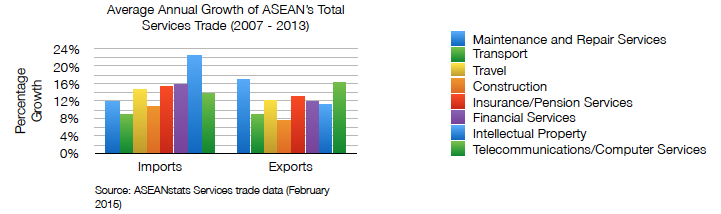
As illustrated by the graph above, the average annual growth of total services trade of ASEAN member states over the period 2007-2013 has been strong. In particular, the growth in intellectual property imports and exports in maintenance and repair services is apparent. Growth in the trade of services has been encouraged by the increasing scope and coverage of AFAS’ package commitments, as illustrated in the figures below:

  • The number of service subsectors targeted by the 9th and latest AFAS package has been increased to 104.
  • The removal of foreign ownership restrictions and lowering of trade barriers has increased in scope as illustrated by the rise in minimum ASEAN equity participation and liberalisation measures.

Screen Shot 2018-02-21 at 11.16.54 AM

According to GATS classification, the AFAS has been primarily successful in addressing service liberalisation in Modes 1 and 2, as illustrated by the AFAS’ complete removal commitment. Mode 4 has seen moderate progress with the finalisation of certain MRAs, whilst Mode 3 has improved under increasing minimum ASEAN equity participation requirements. Under the AFAS and AEC Blueprint 2015, ASEAN has concluded:

  • Nine packages of general commitments.
  • Two additional packages of commitments concerning Financial Services.
  • Three further packages of commitments pertaining to Air-Transport Services.
  • Seven MRAs have been finalised covering various sectors for both trade in goods and services.

ASEAN commitments have increased with time in terms of both number and depth, with policy change occurring
across the development spectrum. (Dee 2015)


C. Present Challenges

What are the current issues?

Screen Shot 2018-02-21 at 12.02.35 PM

A comparison between services trade commitments with actual domestic policies in each of the ASEAN member states done by the ERIA found that there was a significant lag between AFAS commitments and the implementation of domestic policy change. (Dee, 2015)

This is reflected in the table to the right, where sectors with negative correlation indicate rising scorecard liberalisation and falling trade barriers in those sectors; on the other hand, positive correlations showcase sectors where whilst scorecard liberalisation rates are increasing, the barriers to trade are also increasing.

Although an increase in country scorecard liberalisation rates should directly result in the national decrease of trade barriers, this is apparently not the case. Instead, correlations between scorecard liberalisation rates and trade barriers in most sectors are either weak or even positive. This means that commitments are not being translated into policy change.

AFAS initiated liberalisation is currently relatively marginal compared to GATS commitments. (Deunden, 2012)

Mode 3 liberalisation only increases the minimum foreign ownership threshold to a 70% ASEAN equity share.

Mode 4 liberalisation is confined to the movement of professionals only.


D. Future Plans

What new measures are included in the AEC 2025 Blueprint?

Screen Shot 2018-02-21 at 12.04.26 PM

The AEC 2025 Blueprint seeks to replace an aging AFAS with the ASEAN Trade in Services Agreement. (ATISA)

Several new supplementary initiatives have been brought to the table, in particular, the call for common definitions with regards to sensitive lists and sectors.

A key component of focus will be the ongoing review of the “ASEAN minus x” commitment system, with the majority of ASEAN states hoping to lower the level of flexibility offered so as to advance a unified free trade agenda.


E. AEC 2025 Blueprint Analysis

What do the measures entail?

Screen Shot 2018-02-21 at 12.24.56 PM

Screen Shot 2018-02-21 at 12.25.07 PM


F. Conclusion

What does the AEC 2025 Blueprint mean in terms of Trade in Services?
It is unclear at this point what the ATISA will bring to the table in concrete terms, however, the significant issue of domestic legislation change lagging behind commitments is unlikely to be directly addressed by the new legal instrument.

Instead, the development of initiatives fostering economic growth will continue to push the liberalisation of services. This is evidenced by the positive correlation between trade in services liberalisation and economic growth, which is best seen in the case of Vietnam and its rush of foreign ownership liberalisation and simultaneous economic boom, where FDI attracted by more liberal laws has spurred growth.

The most significant change indicated by the AEC Blueprint 2025 would be the fact that it hints that several key mechanisms under the AFAS will be reviewed, such as but not limited to:

  • The ASEAN Minus x commitment system.
  • Defining sensitive sectors and legitimate public policy concerns.

References
ASEAN 2025: Forging Ahead Together, The ASEAN Secretariat (2015).
Chia, S.Y. 2013. The ASEAN Economic Community: Progress, Challenges, and Prospects. ADBI Working Paper 440. Tokyo: Asian Development Bank Institute.
Dee, P. (2015). Monitoring the Implementation of Services Trade Reform towards an ASEAN Economic Community.
Deunden, N. 2012. An Assessment of the Implementation of AEC Service Liberalisation Milestones. Paper presented at the ASEAN Roundtable 2012 on Examining the ASEAN Economic Community Scorecard. ISEAS.
May 2012.
Dinh, H. (2013), ‘Impact of Regulatory Barriers to Trade in Banking Services’, in P. Dee (ed.), Priorities and Pathways in Services Reform: Part 1—Quantitative Studies, World Scientific Studies in International Economics 26. Singapore: World Scientific, pp.67–109.
Secretariat, T. A. (2008). ASEAN Economic Blueprint.
Secretariat, T. A. (2015). ASEAN Integration Report 2015.
Secretariat, T. A., & UNCTAD. (2015). ASEAN Investment Report 2015 Infrastructure Investment and Connectivity.
Secretariat, T. A. (2015). A Blueprint for Growth ASEAN Economic Community 2015: Progress and Key Achievements.


Unable to view it online? You may download the PDF file here:

Download[wpdm_file id=121]

CARI Captures 345

c344_graphic


BRUNEI

Brunei takes 35th spot in the Global IP index
(10 February 2018) Brunei was ranked 35th in the sixth edition of the International Intellectual Property (IP) Index released by the US Chamber of Commerce Global Innovation Policy Center (GIPC). However, the country’s overall score in the IP rating has decreased from 41 percent in the fifth edition to 38 percent in the sixth edition, indicating weaker performance on the new indicators. To address that, the Sultanate will continue to work on the expansion of high-tech capacity with a focus on knowledge-intensive sectors. Technology and Creative Industry has also been included in the Brunei Economic Development Board as one of the five key areas for national development.

CAMBODIA

Cambodia to receive development aid from Japan
(13 February 2018) To boost some ongoing key projects in Cambodia, the Japanese government will contribute US$168 million to the Cambodian administration to help improve its socio-economic development and achieve their goal of becoming a middle-income country by 2030. Secretary-General of the Cambodia Rehabilitation and Development Board of the Council for the Development of Cambodia (CDC) Chhieng Yanara described the Japanese government’s aid as timely and demonstrates the commitment of both countries in strengthening their strategic cooperation.

INDONESIA

Export restriction increases rubber prices
(12 February 2018) Reduced supply from rubber exporting countries has led to global natural rubber prices rising by 5 percent in January. The International Tripartite Rubber Council (ITRC) with Indonesia, Thailand and Malaysia as members, have implemented the “Agreed Export Tonnage Scheme” (AETS), which reduces the volume of natural export rubber to 350,000 tons from January to March 2018. According to the International Rubber Conference Organization (IRCO), the price of daily composite rubber has increased from US$1.46 on December 21st to US$1.54 on January 31st. In 2012, Indonesia exported 2.44 million tons of rubber worth US$7.86 billion, while in 2017, 2.77 million tons of rubber worth US$4.77 billion were exported.

THAILAND

Thailand central bank urges institutions to refrain from cryptocurrency transaction
(12 February 2018) Thailand’s central bank has advised financial institutions not to participate in the transaction of cryptocurrency. The central bank said it might create unregulated trading, which would lead to problems in the future. Governor of Thailand Central Bank Veerathai Santiprabhob said banks are prohibited from investing or trading, offering and creating platforms for cryptocurrency trading and exchange. He said cryptocurrency transaction may be used in illegal activities and it is not acknowledged as a legal tender in Thailand.

VIETNAM

MoF urged to remove tax for locally manufactured auto parts
(13 February 2018) Ministry of Industry and Trade (MoIT) of Vietnam has asked its Ministry of Finance to remove tax on the special consumption of locally-manufactured auto parts. MoIT urged the finance ministry to exempt import tax on auto parts manufacturers who invest in Vietnam. Instead of the current 30 days, The MoIT also recommended the application of a tax payment guarantee for a period of eight months.

PHILIPPINES

Foreign direct investments in 2017 exceeds BSP’s target
(12 February 2018) Foreign direct investments (FDIs) into Philippines surged to US$8.7 billion during the first 11 months of 2017, exceeding the full-year target of US$8 billion set by the Bangko Sentral ng Pilipinas (BSP). Data from the BSP showed that net FDI coming into the Philippines amounted to US$869 million in November 2017, which is higher by 16.9 percent than the US$744 million worth on investments in November 2016. BSP described the sustained FDI inflows as a reflection of investors confidence, given Philippines’ solid macroeconomic fundamentals and government growth prospects.

LAOS

Laos to participate in high-speed rail talks
(10 February 2018) Thailand and China will conduct talks with Laos about linking the high-speed train system from Nong Khai, Thailand to Vientiane, Laos. In a meeting in Beijing between the representatives of the Laos Ministry of Transport led by its Transport Minister Arkhom Termpittayapaisith and Chinese counterparts led by Wang Xiaotao, they decided that the Bangkok-Nong Khai high-speed train project should efficiently connect the high-speed network in Laos to the nation’s capital. To further the discussion, China will invite Lao authorities to discuss the connectivity of the high-speed network including matters on immigration and custom procedure for cross border passengers.

Myanmar Monitor


img-mm-250118

Photo credit: Myanmar Business Today

Economy, Investment and Trade

Withholding taxes to be removed by Myanmar government in April
(13 February 2018) All forms of withholding taxes will be removed starting 1 April 2018. Goods, services and leases procured currently are levied 2 percent of withholding tax, while a 10 percent withholding tax is levied on royalties paid. This measure was done in response to the complaints made by the local businesses, who said it was an unnecessary burden on cash flows and profits.
Read More >

Local banks struggling to cope with new banking regulations
(12 February 2018) Local banks in Myanmar are struggling to follow the new regulations set by the Central Bank of Myanmar (CBM). One of the new regulated rules that local banks find tough to adapt is to convert all overdraft loans to term loans within a given deadline of six months. Senior advisor at Kanbawza Bank and former CBM Vice governor said the regulations imposed by CBM are meant to align the Myanmar financial sector with the international banking industry. The new regulations were set in July 2017 to modernise the domestic financial sector and better attract foreign direct investment at a time of slower economic growth in the country.
Read More >

Myanmar to introduce its goods in the international market
(13 February 2018) Myanmar aims to enter the international market by holding an exhibition of its goods at the upcoming 123rd Spring Canton Fair of China. The government has encouraged its local entrepreneurs and traders to attend and participate in the exhibition. Director General of the Trading Department of the Myanmar Ministry of Commerce, U Yan Naing Tun said that the participation in the trade fair will not only prevent illegal trading but will also promote the country’s trading sector. Based on the statistic given by the Myanmar Ministry of Commerce, in the last fiscal year of 2016-17, bilateral trade between Myanmar and China recorded about US$10.7 billion.
Read More >

Myanmar’s citizen investment reached US$750 million
(10 February 2018) Myanmar citizens have made a total investment of over US$750 million (3.372 trillion kyats) up to February this year. On February 2nd, the Commission of the Directorate of Investment and Company Administration in Yangon, Myanmar had approved three citizen investments and one business. According to Myanmar Investment Commission (MIC), total foreign investments have reached US$5.4 billion (7.19 trillion kyats) as of the first week of February this fiscal year.
Read More >

Yangon Port calls for foreign investments to improve jetty
(11 February 2018) Myanmar Yangon port, which now handles 90 percent of sea-based goods transportation, is seeking for foreign investments to upgrade their jetties. The jetties are mainly used for handling domestic cargo to international-standard ports. Myanmar Deputy General Manager of the Ministry of Transport and Telecommunications Dr. Myo Nyein Aye said the new upgrade on the jetties will create an inflow of additional investments once it becomes an international port.
Read More >

China-ASEAN Monitor


China-ASEAN Monitor

Photo Credit: Yahoo News Singapore


Economy, Investment and Trade

China and Indonesia to further cooperation on BRI
(10 February 2018) China is working closely with Indonesia in intensifying its Belt and Road Initiative (BRI), which helps promote more cooperation in key areas such as infrastructure and inject new force into the development of China’s relations with Indonesia. Given China’s strong economic ties with Indonesia, the East Asian nation has always been Indonesia’s largest trading partner and investments between both nations are increasing every year. The two-way trade between China-Indonesia has experienced an increase of 17 percent, which saw trade amounting to US$63.4 billion last year (2017) compared to 2016, which recorded US$52 billion. Chinese Premier Li Keqiang said that the economic ties between the two countries are highly complementary and there is a huge potential for economic and trade cooperation.
Read more>>

Rise of textile exports to China
(12 February 2018) Vietnam remains a big importer of textile feedstock and accessories from China but their export is on the rise too. According to the Viet Nam Textile & Apparel Association (Vitas), textile exports to China have been rising steadily, rising up from US$2.2 billion in 2015 to US$3.2 billion in 2017 and they see this as a promising sign for the industry. Last year, Vietnam imports from China included over US$6 billion worth of silk, US$2 billion worth of leather and US$800 million worth of threads while Vietnam textile and garment exports around the world were worth US$31 billion last year.
Read more>>

Laos benefits from Chinese dry-processing cement project
(9 February 2018) A Chinese-invested new dry-processing cement project has started operations in Laos’s capital city Vientiane. On behalf of the provincial government, Governor of Vientiane province Vidong Xaiason, expressed his heartfelt gratitude towards the completion and operation of the plant and wished them success in the years to come.
Read more>>

Asean e-commerce set to improve thanks to Chinese investment
(8 February 2018) The entry of Chinese tech giants is likely to bring capital and know-how into the Asean e-commerce sector. Despite 23 percent compounded annual growth over the past five years, Global research firm Credit Suisse highlighted that business-to-consumer e-tailing penetration is less than 2 percent of total retail sales in South East Asia. Citing the example of Malaysia’s digital free trade zone joint project with Alibaba, Credit Suisse said the entry of tech giants could serve as catalysts to drive faster policy implementation by South East Asian governments. The research firm noted that countries with less physical infrastructure constraints such as Malaysia and Thailand are better positioned to benefit from import of foreign logistics know-how.
Read more>>

CARI Captures 344

c344_graphic


MALAYSIA-SINGAPORE

Liquidity to boost from Malaysia – Singapore new trade link
(6 February 2018) Bursa Malaysia Bhd and Singapore Exchange Limited recently announced for an establishment of new trading link between both stock markets as part of efforts to reduce costs associated to trading as well as to foster greater cross-border investment. The new trade link would permit investors to trade and settle shares in more coherent ways on either stock market. Malaysian Prime Minister Dato’ Seri Najib Tun Razak said that the combined market capitalization of more than US$1.2 trillion and about 1,600 public listed companies would allow for a smooth access between both markets. According to CIMB Research, the linking of the trade will also benefit retail sectors as it enables a more efficient transaction experience for participating investors. Based on CIMB’s estimation, a 1.0 percent increase in market trading value will be able to grow net profit by about 0.7 percent on Bursa Malaysia 18-20FY.

PHILIPPINES

Philippines investment pledges soar in January 2018
6 February 2018) In January, pledges on investment that has been approved by the Philippines Board of Investments (BOI) surged 538 percent to US$1.0 billion (PHP51.3 billion) from US$0.15 billion (PHP8.0 billion) in the same month last year. Other notable projects mentioned by BOI are the renewable energy projects amounting to US$0.5 billion (PHP27 billion), followed by water supply and distribution projects at US$0.3 billion (PHP13.9 billion). Trade Secretary and BOI Chairman Ramon Lopez said that this reflects the strong confidence of investors in the Duterte administration, positive reforms and programs being undertaken by the country to move forward.

INDIA-ASEAN

Growth in trade between India and Asean
(3 February 2018) To improve cooperation between both regions, India and Asean are in the process of negotiating agreements on trade and services. India had shared a total exports and imports of approximately 11.2 percent and 10.56 percent respectively, between 2016-2017. As of 2015, to strengthen the engagement with Asean and Asean centric processes, India had also established a separate mission to Asean. Recently, Prime Minister of India Narendra Modi invited leaders from all ten Asean nations to join him in the India Republic Day celebrations.

INDONESIA

Indonesia to approve ASEAN act on banking sector liberalisation
(7 February 2018) Sixth Package of Commitments on Financial Services under the ASEAN Framework Agreement on Services (AFAS) will be undergoing a protocol ratification by the Indonesian government and the House of Representatives. Institutions will be allowed to operate in other ASEAN countries and receive equivalent treatment with other domestic banks under the AFAS, Qualified ASEAN Banks (QAB) protocol. Indonesia Finance Minister Sri Mulyani Indrawati said that currently, there are two QAB from Malaysia that are operating in Indonesia, which are CIMB Niaga and Maybank. By ratifying the protocol, banks from other ASEAN countries will be allowed to open their branches in Indonesia.

THAILAND

Large building to have new energy code
(9 February 2018) By the middle of 2018, buildings with space area that have more than 10,000 square meters need to abide to a new building energy code (BEC). Director General of the Energy Policy and Planning Office (Eppo), Twarath Sutabutr said under the new regulations, property developers will need to design and manage the new buildings by following specific criteria including the expectation of cutting electricity consumption by 10 percent. He added that over the next 20 years, BEC regulations will aim towards reducing the energy consumption by 13.7 billion kilowatt-hours, representing a power bill of approximately US$1.5 billion (THB 48 billion).The new BEC regulations is an effort of Department of Alternative Energy Development and Efficiency (DEDE), the Architect Council of Thailand and the Engineering Institute of Thailand to form a standard guideline in creating more value-added buildings using eco-friendly designs to attract buyers and tenants.

PHILIPPINES

Alibaba’s financial technology to benefit OFWs
(8 February 2018) Ant Financial Group, a unit of Alibaba owned by Jack Ma is keen on helping the Philippines by bringing inclusive financial services to overseas Filipino workers (OFWs). Through financial technology solutions, more than 10 million Filipinos working abroad will benefit through the usage of mobile payment which will reduce the cost of remittance for OFWs. Philippine Finance Secretary Carlos Dominguez III also said that this approach will be able to help them to have a better management of cash and their earnings. In October 2017, Jack Ma met Philippines President Rodrigo Duterte in Malacanang, Philippines to discuss about providing opportunities in the country to boost its mobile technology, internet banking and e-commerce industry.

CAMBODIA-VIETNAM

2017 sees 30 percent grow in Cambodia-Vietnam trade
(6 February 2018) Bilateral trade between Cambodia and Vietnam in 2017 surged nearly 30 percent to about US$3.8 billion with Vietnam’s trade exports and imports to and from Cambodia going up by 26 percent and 40 percent respectively. According to additional data from the United Nation’s International Trade Statistics Database, Cambodia had reported a total of US$1.6 billion worth of trades with Vietnam in 2016.

MALAYSIA

Malaysia’s 2017 exports strongest since 2015
(7 February 2018) In 2017, Malaysia’s total export rose at almost 19 percent and to a record high of US$237.4 billion (RM 935.4 billion), which was the strongest growth since 2005. The Ministry of International Trade and Industry (MITI) said that as world prices improved, Malaysia has recorded a sharp rebound in export growth. Additionally, Malaysia’s stellar export growth of major commodities was also driven by strong global demand for smart electronics as there was a production increase of electrical and electronic (E&E) products which from US$0.4billion (RM 1.7 billion) in 2016 to US$7.3 billion (RM 28.7 billion) in 2017.

INDONESIA

Indonesia’s annual economic growth to rise 5.6 percent
(7 February 2018) Led by robust domestic demand, The International Monetary Fund (IMF) said Indonesia’s annual economic growth will gradually incline to about 5.6 percent over the medium term. 2018 annual gross domestic product growth rate was projected in the IMF annual review of Indonesia’s economic policies report to be at 5.3 percent, compared with 5.1 percent annual growth in 2017. The IMF board emphasized that the priority should be given to financing infrastructure with domestic revenue, as well as greater participation from the private sector. The IMF board also urged for the Indonesian authorities to minimize the control of the state and the role of state-owned enterprises in some related economic sectors.

PHILIPPINES

MoneyGram and GCash collaborate to drive financial inclusion
(8 February 2018) MoneyGram and Gcash announced a new collaboration to drive financial inclusion in the Philippines that will provide their beneficiaries with the best services in user-friendly, rapid-response and low-cost money transfer by emerging their capabilities in remittance and digital payments. With over 30 million active smart mobile users and expanding internet penetration in the Philippines, MoneyGram’s strategy is to offer consumers with various options of transferring their money and receiving their money conveniently, to and from remote unbanked and underbanked Filipinos communities. In 2017, accounting for 9.9 percent of the country’s GDP, Philippines was the world’s third largest remittance recipient with US$32.8 billion inflows.

Myanmar Monitor


img-mm-250118

Photo credit: The Myanmar Times

Economy, Investment and Trade

Foreign trade volume rises in Myanmar
(6 February 2018) According to Myanmar’s Ministry of Commerce, the country recorded foreign trade volume exceeding US$26 billion for the period between April 2017 to January 2018, with maritime route reaching US$20 billion whereas the border route reached a total of US$6 billion. With exports reaching US$11.4 billion and import US$15.1 billion, trade deficit for 2017 – 2018FY widened to US$3.7 billion, slightly up from last year’s US$3.6 billion.
Read More >

Myanmar and China launch strategic mission to reduce poverty
(5 February 2018) During the visit of Chinese Foreign Minister Wang Yi in November 2017, an agreement for a model project for rural poverty reduction was launched in Lewe and Tatkon township in Nay Pyi Taw. The project, which includes social infrastructure development, vocational training, income generation and capacity-building assistance for the residents of the area are being financially and technically supported by China. Additionally, China has also provided a total funding of US$5.31 million (CHN 33) for the project that will potentially benefit approximately more than 7,000 people from 1,400 households. Based on the data source from the Myanmar Household Income and Expenditure Survey, the country’s poverty rate dropped to 19.4 percent in 2015 from 25.6 percent in 2009-2010.
Read More >

KNU to negotiate construction of highway linking to Thailand border
(2 February 2018) The Karen National Union (KNU) has demanded for negotiations with the Union government over plans to resume building a highway between the Thailand border and the Dawei Special Economic Zone in Tanintharyi Region. The KNU added that if the construction of the highway continues, it would cut through pristine forests and rural communities under its purview. However, despite some environmental impacts, KNU also acknowledges that the continuation of the project would provide an opportunity to showcase that socio-economic development projects in ethnic areas could still bring various benefits to local communities while still preserving their culture, natural environment and maintaining security.
Read More >

Logistic hub to be built in cooperation between Myanmar and South Korea
(6 February 2018) A memorandum of understanding to build a standard international logistics hub in Yangon has been signed between Myanmar and South Korea. In order to boost Myanmar’s export, the country’s Ministry of Commerce had implemented a national export strategy that is crucial for both exporters and importers, which include a formation of a logistics hub that would reduce the transportation cost. As of January 2017-2018 FY, Foreign Direct Investment (FDI) worth over US$5.2 billion has entered the country whereas bilateral trade between Myanmar and South Korea reached US$510 million between November 2017 – 2018FY.
Read More >

Myanmar Pristine Ayeyarwady coastline industrial zone to be developed with US$10 billion investment
(7 February 2018) The difficulty to reach Pristine Ayeyarwady coastline, which can only be crossed by a small boat has triggered the locals to request for an upgrade on the infrastructure facilities from the authorities in order to allow more access for tourists. Myanmar Regional Minister for Electricity, Energy, Industry and Transportation U Win Htay, said that the coastline industrial zone was among the policy recommendations by the European Chamber of Commerce to boost the country’s maritime trade. Chief Executive Officer of Myanmar Construction and Development (MCD), Public Co Ltd said that the coastline industrial project would “kill two birds with one stone” and would enable land confiscations to be avoided. In November 2017, Win Htay told Frontier that MCD was one of several companies invited by the regional government to submit proposals for projects along Ayayarwady Region’s 514-kilometre (332-mile) coast.
Read More >