Thailand: Macro snapshot


HIGHLIGHTS

Macro snapshot

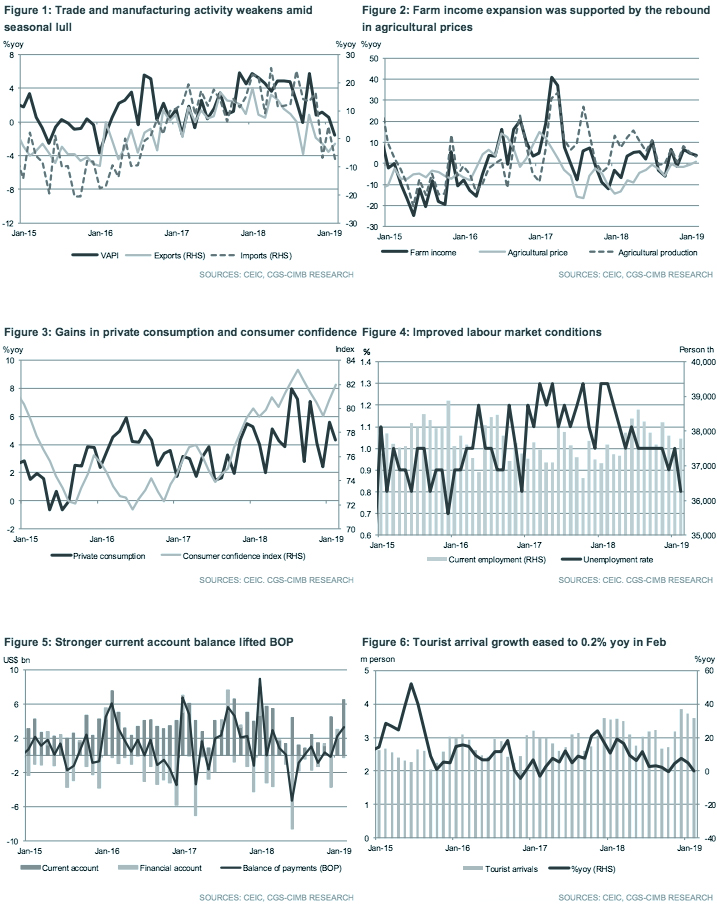
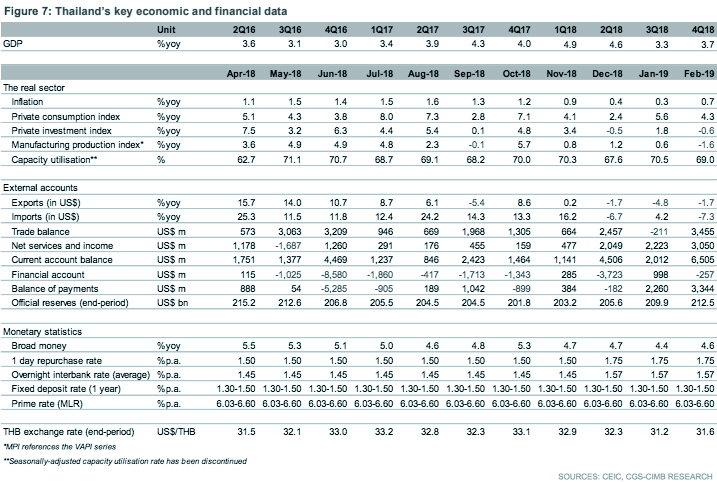
  • Thailand’s trade balance came in healthier at a surplus of US$3.5bn in February as a result of a sharp contraction in imports
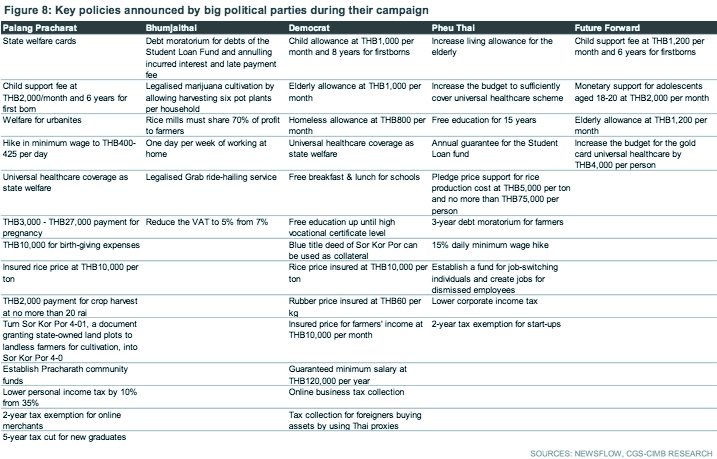
  • Better-than-expected election results for pro-junta coalition raises likelihood of pro-poor policies and continuity of key projects like EEC and SEC
  • Political stability in the immediate term is expected to encourage private consumption and investment, supporting the GDP growth outlook at 4.0%.

Trade balance returned to a healthy position as imports plunge
Thailand’s exports contracted albeit at a slower pace in February (-1.7% yoy vs.-4.8% yoy in January) while imports waned 7.3% yoy (+4.2% yoy in January), resulting in a trade surplus of US$3.5bn (-US$0.2bn in January). The dip in industrial activity (-1.6% yoy in February vs. +0.6% yoy in January) was due to pronounced slippages in textiles & apparel, chemicals, rubber & plastics, electrical appliances and hard disk drive segments, in conjunction with one less working day this year.

Potential boost in consumer spending with government assistance
Overall private consumption grew 4.3% yoy (+5.6% yoy in January), complemented by higher consumer confidence (82.0 pt vs. 80.7 pt in January) and labour market improvements. Nominal farm income rose 3.9% yoy in February (+4.8% yoy in January), supported by an uptick in agricultural prices (+0.7% yoy vs. -0.4% yoy in January). The THB87bn cash handouts to the low-income earners since Dec 2018 possibly supported household spending. Extensive measures promised by pro-junta Palang Pracharat Party (PPR) to maintain state welfare cards, hike daily minimum wage and lower personal income tax are anticipated to lift consumer spending going forward, if the party leads the new government.

Stronger current account lifted BOP balance
The balance of payments (BOP) surplus widened (+US$3.3bn in February vs. +US$2.3bn in January), supported by a healthier current account surplus (+US$6.5bn vs. +US$2.0bn) driven by the goods surplus and services & income accounts (+US$3.1bn vs. +US$2.2bn in January). Tourist arrival growth eased to 0.2% yoy in February (+4.9% yoy in January), attributable to the decline in Chinese tourist arrivals due to last year’s higher base.

Major investment plans remain on track after elections
Infrastructure projects in the Eastern Economic Corridor (EEC) are expected to broadly continue as planned, with Gen Prayut of PPR widely tipped as the new Prime Minister. The winning bidders for the five mega-projects are on track to be unveiled by April, with China and Japan bids expected to be frontrunners. Both countries have agreed to coinvest as well as offer loan arrangements to fund the EEC projects. Besides that, the Southern Economic Corridor (SEC), a master plan spanning four years (2019-2022), is due to be launched soon with a budget of THB107bn, as approved by the cabinet in January.

Clearing of political clouds brightens economic prospects
The better-than-expected election results for the pro-junta coalition raises likelihood of pro-poor policies and continuity of key infrastructure projects. Political stability could also provide a breakthrough on efforts to boost private investments, which had turned cautious following the 2014 coup d’état. We retain our GDP growth outlook for Thailand (CGSCIMB: +4.0% in 2019F), which may still prod the Bank of Thailand (BOT) into one policy rate hike to 2.00% by the end of 2019. Risks to this view include a downturn in global growth, protracted US-China trade tensions and monetary policy easing by the US Federal Reserve.
 

Originally published by CIMB Research and Economics on 29 March 2019.


This article has been edited to reflect its time-sensitivity.

Press Release: Experts attribute Southeast Asian countries’ ‘hedging behaviour’ to external uncertainties, while cautioning that the lack of cohesiveness among ASEAN member states may cost ASEAN’s centrality in the new trade order


Experts attribute Southeast Asian countries’ ‘hedging behaviour’ to external uncertainties, while cautioning that the lack of cohesiveness among ASEAN member states may cost ASEAN’s centrality in the new trade order

(From left) Prof. Dr. Kuik Cheng-Chwee, Associate Professor of the Institute of Malaysian and International Studies (IKMAS), Universiti Kebangsaan Malaysia; Dr. Cecilia Ruthstrom-Ruin, Deputy Director-General, Head of Department for Asia and Oceania, Ministry of Foreign Affairs, Sweden; Dato’ Dr. Ooi Kee Beng, Executive Director of Penang Institute; Tan Sri Dr. Munir Majid, Chairman of CIMB ASEAN Research Institute (CARI) and President of the ASEAN Business Club; Tobias Glitterstam, Senior Vice President and Head of Asia and Oceania of Business Sweden; Ng Lip Yong, Honorary Advisor of Malaysia-China Chamber of Commerce; and H.E. Ambassador Dag Juhlin-Dannfelt, Ambassador of Sweden in Malaysia, at the ASEAN Roundtable Series entitled “How Does ASEAN Navigate the New Trade [Dis]order?”. The roundtable discussion was organised by CARI in partnership with the Embassy of Sweden in Malaysia on 1 April 2019.

Kuala Lumpur, 1 April 2019 – Experts speaking at the ASEAN Roundtable Series on the topic of “How does ASEAN navigate the new trade [dis]order?” organised by CIMB ASEAN Research Institute (CARI) traced the roots of hedging behaviour and identified lack of cohesiveness as some of the weaknesses that ASEAN has to overcome while navigating the new trade uncertainties.

Professor Kuik Cheng Chwee, Associate Professor of the Institute of Malaysian and International Studies (IKMAS) at the Universiti Kebangsaan Malaysia (UKM) said the growing US-China uncertainty has been the primary external factor shaping Southeast Asian security and economic environment in the Trump-Xi era, but the issue is not just about trade. It is also about the risks of power rivalries, the dangers of ASEAN marginalisation, and the politics of infrastructure development partnerships.

“All ASEAN countries navigate by deepening their hedging behaviour. The structural uncertainties are presenting both challenges and opportunities to all ASEAN countries, prompting the medium- and small-sized regional states to deepen their hedging behaviour, as evidenced in their ambiguous and contradictory approaches vis-a-vis the US’ FONOPs (freedom of navigation operations) in the South China Sea, China’s Belt and Road Initiative (BRI), and the Quad (the US, Japan, India and Australia) powers’ “Indo-Pacific” strategies,” said Professor Kuik.

Echoing similar views, Honorary Advisor of the Malaysia-China Chamber of Commerce Ng Lip Yong said that it is likely that ASEAN member states will prioritise national interests above ASEAN’s regional interest amidst the current trade tension between the US and China.

“Although ASEAN is often considered an economic bloc, it is unlikely that ASEAN will respond to the new trade scenario in a cohesive manner. As witnessed in the case of the EU-ASEAN free-trade agreement (FTA) negotiations, it has now resulted in bilateral rather than multilateral agreements. Despite all the efforts, currently only Singapore and Vietnam have signed the FTA with the EU,” said Ng who was formerly the Deputy International Trade and Industry Minister of Malaysia.

Dato’ Dr Ooi Kee Beng, Executive Director of Penang Institute pointed out that ASEAN as a region is bounded from without rather than from within; and is not held together by common imaginings of a historical or cultural past. The historical expediencies that created the countries in Southeast Asia are vital to the understanding of how their foreign affairs policies have been developing.

In relation to the issue of China, he said China’s rise in recent decades is causing worry among its small neighbours and how ASEAN should handle the rising giant is a major strategic dilemma for its members.

“While ASEAN countries tend to think of China as an unstoppable rising power, it is crucial for ASEAN to understand the nature of China’s rise the way they would do with a peer country. How China rebuilt itself, how this informs its immediate future and the way it views the world provide a perspective worth contemplating for strategists,” said Dato’ Dr Ooi.

The roundtable discussion was organised by CARI in collaboration with the Swedish Embassy in Malaysia. H.E. Ambassador Dag Juhlin-Dannfelt, Ambassador of Sweden in Malaysia in his opening remarks said Sweden is a staunch believer in a rules-based international order for trade and Sweden is greatly interested in the development of ASEAN integration at a time of increasing challenges to WTO-rules based international trade order.

“Sweden and Malaysia have common interests in developing and defending principles of open, knowledge-based, trade-oriented economies, with transparent, rules-based trade and investment regimes. There is great potential for increased commercial engagement between the two countries and adding to the current line-up of over 90 Swedish companies in Malaysia.”

In conclusion, Tan Sri Munir Majid, Chairman of CARI concurred with the observations that ASEAN member states’ hedging behaviour and the lack of oneness may cost ASEAN’s centrality in the new trade order.
“ASEAN’s political determination will either make or break the integration aspiration. It will either set ASEAN apart from the protectionist trade order or derail it from its integration trajectory. ASEAN must forge deep partnership within the bloc to ensure its centrality among the competing forces,” said Tan Sri Munir.

He welcomed the collaboration with the Swedish embassy in Malaysia for this ASEAN Roundtable Series as the Swedish Embassy’s presence, knowledge and concerns are among the strongest in the region relative to other European counterparts.

Event update for ASEAN Roundtable Series on Tackling Non-Tariff Barriers in the New Trade Order>>

Mekong Monitor


Photo credit: The Irrawaddy


TRADE, ECONOMY, AND INVESTMENT


VIETNAM, THAILAND

Vietnam to collaborate with Thai energy developer on US$7.8 billion LNG project
(21 March 2019) The provincial government of Vietnam’s Ninh Thuan province announced that it is in discussions with Thailand’s Gulf Energy Development to develop four gas-fueled power plants with a combined 6000-megawatt capacity and liquefied natural gas (LNG) import facilities. According to Vietnamese industry and trade deputy minister Hoang Quoc Vuong, the US$7.8 billion project will help ease the country’s dependence on coal-fired power. Meanwhile, Gulf Energy Development chief executive Sarath Ratanavadi was previously quoted in December 2018 saying that the company will invest US$4.7 billion to develop new power plants across Southeast Asia in the coming few years. He added that the company was also in talks for other energy projects in Laos, Myanmar and Vietnam.
Read more>>

CAMBODIA, LAOS

Cambodia to buy electricity from Laos due to growing domestic power consumption
(25 March 2019) Cambodia’s primary electric utility company Electricite du Cambodge announced that it has inked an agreement with Laos to procure 200 megawatts of electricity from 2019 to 2021, according to a report by the Khmer Times. The energy will be sourced from Laos’ Don Sahong hydropower dam near the border and transmitted through transmission lines that are being developed. According to the Cambodian mines and energy ministry state secretary Ty Norin, the country will increase energy imports in order to meet the country’s growing power consumption. Last week, Prime Minister Hun Sen appealed to the private sector for assistance as the country’s hydropower dams are unable to meet domestic demand due to the dry weather.
Read more>>

THAILAND-CLMV

Thailand to manufacture trains for domestic use and other CLMV markets
(27 March 2019) Thai deputy transport minister Pailin Chuchottaworn announced in March that the country hopes to establish train assembly plants in the northeastern region to reduce the country’s dependence on train imports and lower government spending. The kingdom has previously imported train carriages from Germany, China, Japan, Austria and Turkey. According to Pailin, the government intends to build three plants to produce 900 carriages every year by 2027. If the plan comes to fruition, the government will only need to pay 10% or less of what it currently does for new trains. Procuring a new train costs an estimated 70 billion baht (US$2.2 billion). Moreover, the government hopes that the new factories will provide much-needed employment opportunities in the northeastern region and that the country will eventually be able to export trains to its CLMV neighbours.
Read more>>

VIETNAM, THAILAND

Thailand’s Kasikorn Bank to open its first branch in Vietnam
(22 March 2019) Ho Chi Minh City (HCMC) welcomes and pledges to facilitate the establishment of Thai Kasikorn Bank’s first branch in Vietnam, said HCMC municipal committee vice chairman Tran Vinh Tuyen. Tran expressed his hope that the bank will assist in the development of local banking services, diversify local credit offerings, and help develop financial management capacity in the country through the sharing of experiences. In response, Kasikorn Bank representative Pattanapong Tansomboon said that the bank is keen to support the city’s financial services, including through the development of digital banking services, cashless payments, and supporting SME development. According to Viet Nam News, the bank is still in the process of obtaining a license to establish its first branch in HCMC.
Read more>>


mekong-monitor-map

About Greater Mekong Subregion (GMS)

The Greater Mekong Subregion (GMS) Economic Programme was launched by the Asian Development Bank in 1992 connecting five developing ASEAN countries, namely Cambodia, Laos, Myanmar, Vietnam and Thailand, and Chinese provinces of Yunnan and Guangxi Zhuang Autonomous region. The region has some of the most robust economies sharing the Mekong River Basin thanks to its reform and liberalisation. The subregion is growing at a faster pace than the whole of East Asia and the Asia Pacific as the GDP growth rate for 2017 was at 6.4 percent, according to the World Bank. The population at the subregion as of 2016 is at 340 million while the GDP at PPP is at US$3.1 trillion in 2016. In 2015, trading within the region was at US$444 billion.

Singapore: February 2019 industrial production


HIGHLIGHTS

February 2019 industrial production

  • Industrial output rose by 0.7% yoy in February on gains in biomedical, and slower declines in electronics and precision engineering.
  • Notably, January’s readings were revised from -3.1% yoy to -0.4% yoy due to a sizeable upward adjustment to electronics production.
  • We expect MAS to maintain its current monetary settings at its April review.

Factory output rebounded in Feb despite CNY holiday season
Singapore’s industrial production index (IPI) grew 0.7% yoy in February as manufacturers wound down for the seasonal Lunar New Year break. January’s dip in factory activity was revised to -0.4% yoy, less severe than initially estimated (-3.1% yoy), primarily due to a sizable upward adjustment to electronics production. IPI excluding biomed reported a shallower decline (-1.6% yoy in Feb vs. -2.8% yoy in January). On a seasonally-adjusted basis, IPI dropped 4.1% mom in February (+3.1% mom in January).

Drag abates in the electronics sector
Electronics output contraction narrowed in February (-1.1% yoy vs. -4.0% yoy in Janruary), due to a marginal rebound in the semiconductor segment (+1.1% yoy vs. -2.6% yoy in January) and more modest declines in the infocomms & consumer electronics segments (-6.6% yoy vs. -20.5% yoy in January). We note that there was a notable revision in electronics in January (revised: -4.0% yoy, initial: -13.7% yoy) due to a less severe semiconductor output contraction (revised: -2.6% yoy, initial: -14.2% yoy).

Robust demand for drugs and MedTech products
Biomedical production strengthened 13.3% yoy in Feb (+10.3% yoy in January), supported by expansion in pharmaceutical output (+17.9% yoy vs. +13.7% yoy in January) and medical technology output (+3.3% yoy vs. +1.9% yoy in January).

Activity in other manufacturing segments remain subdued
A reversal in precision modules & components (+7.4% yoy vs. -5.8% yoy in January) due to increased production of optical products, could not lift the precision engineering segment out of its sustained contraction (-14.9% yoy in Feb vs. -16.8% yoy in January). Meanwhile, weaker marine & offshore activities (-7.7% yoy in Feb vs. +2.6% yoy in Jan) led to slower gains in transport engineering (+4.2% yoy vs. +10.4% yoy in January). There was also a major downward revision in January’s growth reading for marine & offshore engineering due to updated information about a firm-specific factor as mentioned in Feb’s press release (revised: +2.6% yoy, initial: +26.9% yoy). Chemicals output steadied the boat, growing 2.0% in Feb (+1.7% yoy in January), while festive demand lifted output of food, beverages and tobacco (+12.2% yoy vs. +6.4% yoy in January), particularly infant milk and beverage products.

External headwinds call for cautious approach
The combined January-February IPI readings registered a mild expansion of 0.1% yoy, while slippages in the forward-looking PMI indicate that a potential recovery in Singapore’s manufacturing sector may only emerge in the second half of the year. In addition, protracted negotiations between the US and China on ending their trade stand-off, now likely to push on into Apr, are not helping to soothe frayed sentiment among exporters. Having continually tightened its exchange-rate based monetary policy throughout 2018, we expect the Monetary Authority of Singapore (MAS) to take a pause and maintain the slope, width and mid-point of the S$NEER at its bi-annual review next month, to monitor heightened risks to the external outlook.

Originally published by CIMB Research and Economics on 27 March 2019.

This article has been edited to reflect its time-sensitivity.

China-ASEAN Monitor


Photo credit: Reuters


Economy, Investment and Trade


Indonesia proposes BRI investments worth US$91.1 billion
(20 March 2019) Indonesia presented a menu of 28 projects with a combined value of US$91.1 billion to Chinese investors during a Belt and Road Initiative (BRI) forum held in Bali on March 20-21, according to Indonesian coordinating maritime affairs minister Luhut Pandjaitan. Out of the 28 projects, he expected at least two to three projects to be signed. While Luhut declined to elaborate on the details of the projects, he provided that the projects will be developed in four locations — North Sumatra, North Kalimantan, North Sulawesi and Bali — under the country’s the Regional Comprehensive Economic Corridor. However, he stressed that Chinese investors will be required to meet four conditions in order for projects to proceed, i.e., (i) they can use only environmentally-friendly technologies, (ii) local labour use must be maximised, (iii) investors must transfer knowledge to local labour through capacity-building programmes, and (iv) projects must help reduce the country’s reliance on extractive industries and benefit the economy in the long run. It has been argued that Indonesia could benefit from the ongoing US-China trade war as Chinese companies seek a destination to relocate their businesses to.
Read more>>

Chinese and Japanese firms invited to invest in Thai EEC megaprojects
(23 March 2019) A delegation of 200 Japanese and Chinese firms will visit Thailand on April 2 to review five proposed investments under the Eastern Economic Corridor (EEC) and attend business matching events in Bangkok, according to EEC Office secretary-general Kanit Sangsubhan. Kanit provided that the delegation’s primary agenda will be to consider investing in five key EEC infrastructure projects either through solo bids or consortiums. The five projects comprise a high-speed rail connecting three airports; Map Ta Phut industrial port; Laem Chabang maritime port; an integrated MRO (maintenance, repair and overhaul) facility; and U-Tapao international airport. Together, these five projects are worth approximately US$30 billion and are expected to create 475,668 new jobs. Furthermore, the Japan Bank for International Cooperation (JBIC) will reportedly offer financing for both Japanese and Chinese companies participating in these projects in the three EEC provinces of Chachoengsao, Chon Buri and Rayong. Following the announcement of the country’s preliminary election results on March 25, Deputy Prime Minister Somkid Jatusripitak assured the public that major investment projects such as the EEC will proceed despite the impending change in government.
Read more>>

Malaysia to finalise deal on China-backed ECRL project by early April
(23 March 2019) Malaysia is looking to finalise negotiations on the East Coast Rail Link (ECRL) with China on April 2, according to the country’s lead negotiator Daim Zainuddin. The rail project was originally billed at US$20 billion, and was suspended in July due to concerns over costs. Daim was quoted by The Straits Times saying that the revised terms would save billions for the country and carry commercial benefits for the country. Separately, Malaysian Prime Minister Mahathir Mohamad said that the country may also consider procuring fighter jets from China or other countries if the European Union proceeds with the ratification of its proposed palm oil restrictions. He added that another consideration for doing so was because Chinese aviation technology has surpassed Western technology.
Read more>>

Cambodian PM insists that Chinese investments are not a form of colonisation
(22 March 2019) Cambodian Prime Minister Hun Sen denied that Chinese investments are a form of colonisation and that the country would not allow this to happen even if colonisation was indeed Beijing’s intention, according to an AFP report. Hun Sen’s remarks were made during the breaking ground ceremony of the US$2 billion Chinese-funded Phnom Penh-Sihanoukville expressway, constructed by the China Road and Bridge Corporation under the Belt and Road Initiative (BRI). Also in attendance at the ceremony was Chinese vice foreign minister Kong Xuanyou, who reiterated China’s stance that their aid and investments were neither threats nor traps. Similarly, Philippines’ President Rodrigo Duterte again denied that Chinese loans were disadvantageous to the country and that it was not possible for China to seize the Philippines’ natural resources because the country will repay its loans. Duterte’s comments were made in response to domestic concerns over China’s ability to seize the Philippines’ gas fields which the government had earlier provided as collateral for the US$62 million Chico dam loan.
Read more>>

Myanmar’s broken rice, livestock border exports face legal barriers
(22 March 2019) China began the suspension of broken rice imports from Myanmar in the third week of March as part of its crackdown on illegal rice trading at the Myanmar-China border, according to the Myanmar Rice Miller Association. Rice merchants involved in the trade were quoted by Myanmar Times saying that they opted for illegal means because of tight volume restrictions and high tax rates imposed by the Chinese government. Presently, China imposes a 5% tax on broken rice exports and 50%-60% tax on rice exports. The challenges come despite the Myanmar government’s previous request for China to increase its rice import quota to 400,000 tonnes from the present 100,000 tonnes. More recently, Myanmar’s Fruit, Flower and Vegetable Producer and Exporter Association said that it hopes to obtain permits from China for eight more types of crops so that more of the country’s agricultural products can be traded legally at the border. The eight types of agriculture products are avocado, pomelo, banana, pineapple, elephant foot yam, jackfruit, rambutan and lemon.
Read more>>

Thailand: March Monetary Policy Committee meeting


HIGHLIGHTS

March Monetary Policy Committee meeting

  • BOT unanimously voted to keep the policy interest rate unchanged at 1.75%.
  • Hawks in MPC folded as BOT downgraded GDP growth and core inflation outlook in 2019, signalling monetary policy normalisation is on ice for now.
  • Policy language leaves enough leeway for BOT to revisit an interest rate hike in late 2019, provided economic and political outcomes meet expectations.

MPC votes unanimously for status quo in monetary policy
The Bank of Thailand’s (BOT) Monetary Policy Committee (MPC) voted unanimously to keep the 1-day repurchase rate unchanged at 1.75%. The decision to keep the benchmark interest rate on hold for a second consecutive meeting was in line with our expectation and consensus.

BOT downgrades growth outlook on external headwinds
BOT downgraded its Thailand’s GDP growth forecast from 4.0% to 3.8% in 2019 (CGSCIMB: +4.0%), citing a slowdown in external demand. Notably, policymakers added the weaker economic momentum in advanced economies to the laundry list of growth risks like US-China trade tensions and weaker demand growth in China. Domestic demand remained supported by social assistance as well as improvements in farm and non-farm incomes. However, further delays in the progress of major infrastructure projects present a downside risk to the domestic economy.

Subdued inflation buys policymakers time to remain patient
BOT reduced its core inflation forecast from 0.9% to 0.8% in 2019, but left its headline inflation forecast at 1.0% in 2019 (CGS-CIMB: +1.0%) as energy and food prices are expected to trend higher than the central bank’s previous assessment. Inflationary pressures remain below policymakers’ target range, and are therefore unlikely to trigger significant immediate upward pressure on interest rates.

Consumption supported by weak inflation and welfare spending
Private consumption moderated slightly to 3.5% yoy in December (+3.8% yoy in November). Rural purchasing power improved as nominal farm incomes rebounded 1.4% yoy in December (-6.0% yoy in November), as higher agricultural production (+3.1% yoy) offsets declines in crop prices (-1.6% yoy). Cost of living pressures remain contained, as headline inflation decelerated to 0.4% yoy in December (+0.9% yoy in November), amid lower F&B prices and retail fuel prices. THB87bn of welfare disbursements from December 2018 to September 2019 to low income households are expected to boost consumer spending.

Interest rates on hold for now
Unlike in Jan, when two MPC members favoured a further increase in interest rates, the hawks caved at today’s meeting. Unexpected twists in the run up to the 24 March elections and external headwinds have nudged the central bank into taking a more defensive posture for now. We think the BOT may revisit the debate on resuming monetary policy normalisation towards the end of the year, after the royal coronation and a period of political stabilisation following the elections, and concurrently allow policymakers to assess Thailand’s economic standing. We reiterate our forecast of one policy rate hike to 2.00% by end-2019, under a base case scenario where Thailand continues to grow near its potential growth rate and a pro-military government led by General Prayut emerges victorious in the elections, providing policy continuity.

Monetary policy outlook clouded by wavering Federal Reserve
The current path of the Bank of Thailand (BOT)’s monetary policy normalisation will be milder than in past cycles, with future policy deliberations highly data dependent. Given the stable GDP growth outlook for Thailand (CGS-CIMB: +4.0% in 2019F), one further interest rate hike to 2.00% by end-2019F is warranted to create policy space and address the central bank’s concerns over financial stability, in our view. However, risks to our forecast include slower external demand, tepid inflation and more recently, the Federal Reserve’s increasingly dovish stance on further US interest rate hikes.


Originally published by CIMB Research and Economics on 20 March 2019.

CARI Captures 396


ASEAN-ROK

South Korean banks enjoy brisk earnings in Southeast Asia
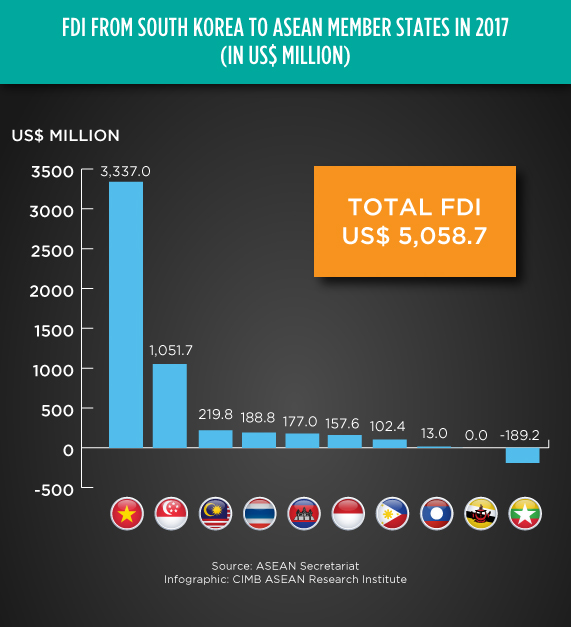
(19 March 2019) South Korean banks operating in Southeast Asia reported significant growth in 2018, notably in Vietnam, Indonesia and Singapore, according to a South Korean Financial Supervisory Service (FSS) report published on March 19. The net incomes of 12 banks operating in the region doubled from US$61 million in 2017 to US$131.8 million in 2018. Specifically, the combined net income of the 12 banks operating in Vietnam grew from US$5.72 billion in 2017 to US$6.43 billion in 2018, while their combined earnings in Singapore grew by 17.2% in 2018. Meanwhile, South Korean President Moon Jae-in recapped his recent three-country tour in Southeast Asia during a cabinet meeting and stressed the importance of cultivating relations with the ASEAN bloc.

CAMBODIA-ROK

Cambodia and South Korea agree to enhance bilateral cooperation
(18 March 2019) South Korean President Moon Jae-in’s state visit to Cambodia from March 14 to 16 concluded with the inking of seven agreements between the parties to increase bilateral cooperation in several areas, according to a statement by the Cambodian Ministry of Foreign Affairs and International Cooperation. This included agreements on double taxation prevention, increased market access for Cambodian goods into South Korea, loan agreements and frameworks, as well as memoranda of understanding on various areas of cooperation. According to data from the Korean Export-Import Bank, the country’s investments in Cambodia are primarily in real estate (29%), banking and finance (21%), construction (18%), manufacturing (15%), and agriculture (4%). Bilateral trade between the countries saw an 11% increase last year, reaching US$975 million.

THE PHILIPPINES-JAPAN

The Philippines secures US$1.24 billion in investment pledges from Japan
(18 March 2019) Japanese companies committed to US$1.24 billion in new investments in the Philippines during a bilateral business meeting held in Tokyo recently, according to the Philippines’ Department of Trade and Industry (DTI). The new investments will include a US$76 million affordable housing joint venture, US$19.2 million waste-to-energy project, US$250 million large-scale integrated poultry farm, and US$46 million automotive system manufacturing facility. Together, these investments are expected to create 16,000 domestic jobs. The bilateral business meeting comes as the Philippines government looks to pass the Trabaho tax reform bill, which seeks to lower corporate income tax from 30% to 20% by 2029.

SINGAPORE-US

Singapore and US ink agreement to promote infrastructure development in Asia
(21 March 2019) Singapore’s Infrastructure Asia and the US’s Overseas Private Investment Corporation (OPIC) signed a Memorandum of Understanding to promote and facilitate infrastructure investments in Asia, during trade and industry minister Chan Chun Sing’s working visit to Washington DC on March 20. According to a statement from the Ministry of Trade and Industry, the agreement encompasses information sharing, deal facilitation, structuring and capacity building schemes in areas of mutual interest. Under the agreement, Investor Asia will connect investors with infrastructure development projects, while OPIC will assist US companies looking to expand their presence in emerging markets. Speaking at an event in Washington DC, Chan also said that whether or not the Regional Comprehensive Economic Partnership (RCEP) negotiations can be concluded this year depends on the outcomes of upcoming national elections in Australia, India, Indonesia and Thailand — who together — form a quarter of the pact’s 16 members. These elections will be held from March to May.

SINGAPORE-IRELAND

Ireland looks to strengthen Asian footprint with Brexit looming
(20 March 2019) Irish business, enterprise and innovation minister Heather Humphreys’s trade mission to Singapore concluded with both parties agreeing on possible areas for further collaboration and commitments from four Irish companies to set up new offices in Singapore, according to The Straits Times. The mission comes under Enterprise Ireland’s “Global Ireland 2025” and post-Brexit strategy, which aims to boost Ireland’s exports to markets beyond Britain by 50% by 2020. This strategy will include the establishment of Enterprise Ireland representative offices in Melbourne and Ho Chi Minh City, in addition to current offices in Singapore and Sydney.

MALAYSIA, THE PHILIPPINES, VIETNAM

Filipino rice merchants to shun Sabah and Labuan in future transhipment trades
(15 March 2019) Rice buyers from the Philippines expressed their disappointment over a Labuan court decision to classify 351,000 bags of Vietnamese rice exports en route to the Philippines as smuggled goods, according to Free Malaysia Today (FMT). Subsequently, the rice buyers announced a boycott of Sabah and Labuan ports in favour of Tarakan Port in North Kalimantan — a move that FMT says could cost the state almost US$500 million. In response, Labuan Indian Chamber of Commerce and Industry chairman Dahlif Singh said that the incident was most unfortunate, especially when transhipment trade had given the duty-free island a much needed boost after the slump in the oil and gas sector. He also attributed the issue to excessive red tape, failure to enhance Labuan Port’s infrastructure over the years, as well as a delay in the preparation of transhipment guidelines.

MALAYSIA, INDONESIA

Malaysia and Indonesia warn of retaliation if the EU greenlights palm oil restrictions
(18 March 2019) Malaysia will consider retaliatory measures against European exports if it proceeds with its ban on the use of palm oil in biofuels, said Malaysian primary industries minister Teresa Kok in a statement denouncing the European Union’s (EU) recent decision to classify palm oil as a “high risk” agriculture commodity. Kok’s statement follows Malaysian Prime Minister Mahathir Mohamad’s letter to French President Emmanuel Macron, where he said that such a move by the European bloc would lead to the possible suspension of EU-Malaysia free trade negotiations and the “imposition of like-minded legislation against French exports.” Similarly, Indonesian coordinating economic minister Darmin Nasution confirmed that the government will lodge a formal protest with the World Trade Organization. Indonesia will also consider restricting EU market access if the bloc ratifies the proposal.

THAILAND

Thailand hopes to restore WTO multilateral system
(19 March 2019) Thailand will push for the restoration of the World Trade Organization’s (WTO) multilateral dispute settlement system and other reforms during a high-level ASEAN meeting in Vientiane in early April, said the head of its Trade Negotiations Department Auramon Supthaweethum. According to Supthaweethum, the WTO’s appellate adjudication body has not been able to operate at full capacity for over a year as it has not been able to fulfill quorum requirements. Furthermore, the group has yet to fill six of the seven seats that will be vacated when current member terms expire at the end of the year, failing which the WTO will be unable to fulfill its essential duty as an adjudication body. Separately, Supthaweethum also announced that Thailand will delay its application to join the Comprehensive and Progressive Agreement for Trans-Pacific Partnership (CPTPP) until after the country’s general elections on March 24.

ASEAN

ASEAN advances roadmaps for sustainable capital markets and fuel efficiency
(19 March 2019) The ASEAN Capital Markets Forum (ACMF) endorsed the Roadmap on ASEAN Sustainable Capital Markets on March 18 aimed at promoting sustainable investment classes in the region in line with Thailand’s “Advancing Partnership for Sustainability” chairmanship theme, according to a statement by Securities Commission (SC) Malaysia. Clauses under the roadmap that will be passed on to the ASEAN Finance Ministers’ Meeting for acknowledgement in April include measures to expand investor participation in ASEAN capital market products that contribute to greater regional connectivity and sustainability, as well as mechanisms to allow cross-border professional services and investment offerings. Meanwhile, the ASEAN Secretariat published a seven-year roadmap outlining new light duty vehicle (LDV) fuel efficiency targets across the region, setting an “aspirational” stretch target to reduce fuel consumption per 100 kilometers by 26% from 7.20 LGe/100km in 2015 to 5.3 LGe/100km by 2025.

ASEAN

Grab and AirAsia launch new digital financial services
(19 March 2019) Southeast Asian ride-hailing giant Grab announced on March 19 that it is expanding beyond its core service to provide financial services aimed at small and medium enterprises across the region. This includes expanding accessibility for its digital payment system GrabPay, credit services that will allow users to pay their monthly accumulated expenses on the app in one go or in instalments, an online insurance marketplace in partnership with China’s Zhong An, as well as loan offerings in partnership with Japan’s Credit Saison. The company’s slew of financial products comes in addition to existing services integrated on the Grab application such as Happy Fresh grocery deliveries, Hooq video streaming and China’s Ping An health services. Grab’s announcements were made at the Money 20/20 conference in Singapore, where AirAsia head Tony Fernandes also launched the airlines’ e-money application BigPay. Fernandes was quoted saying that the service aims to make traveling easier by reducing remittance charges and allowing users to enjoy real currency exchange rates at no additional cost.

Mekong Monitor


Photo credit: The Irrawaddy


TRADE, ECONOMY, AND INVESTMENT


MYANMAR, THAILAND

Myanmar and Thailand opens new bridge link on the East-West Economic Corridor
(19 March 2019) Myanmar State Counselor Daw Aung San Suu Kyi and Thai Prime Minister Prayut Chan-o-cha officiated a new bridge connecting Thailand’s Mae Sot district in Tak province with Myanmar’s Myawaddy city in Kayin State on March 19, an initiative aimed at boosting cross-border trade and investment between the countries. The 270-metre long bridge also lies on the East-West Economic Corridor — a project under the Mekong-Japan cooperation scheme which includes an initiative (among others) to connect Vietnam’s Dong Ha City with Yangon’s Thilawa Special Economic Zone via Cambodia and Thailand. The new bridge is expected to also boost connectivity between Bangkok and Yangon, especially once transportation infrastructure on Myanmar’s side of the corridor improves. According to Myanmar’s Ministry of Commerce, bilateral trade between both countries stood at $5 billion in fiscal year 2017-2018.
Read more>>

THAILAND, LAOS

Thailand and Laos renew power purchase agreements
(19 March 2019) The Electricity Generating Authority of Thailand (EGAT) and Electric de Laos (EDL) inked the renewal of two power purchase agreements (PPA) that will allow Thailand to continue procuring electricity from Laos’ Nam Ngum 1 and Say-sed hydroelectric plants. According to Thai energy minister Siri Jirapongphan, the EGAT will purchase electricity at a slightly higher rate than before as it takes into account the current costs of power generation. He added that this is the first time that the countries have altered contract terms after 50 years of energy cooperation. Furthermore, the Thai government expects to sign more PPAs with Laos down the road as it plans to purchase up to 9,000MW of electricity from its Mekong neighbour by 2030.
Read more>>

VIETNAM, CAMBODIA

Vietnam and Cambodia boost postal services, telecommunications and ICT cooperation
(15 March 2019) Talks between Vietnamese information and communications minister Nguyen Manh Hung and Cambodian posts and telecommunications minister Tram Iv Tek in Phnom Penh on March 14 culminated in the signing of three cooperation agreements between the parties. Under these agreements, the countries will work together to develop cross-border delivery and postal financial services, as well as continue negotiations relating to modern broadband mobile communication systems, network transfers and television digitalisation. Further, Vietnam will assist Cambodia in the development of cyber security infrastructure.
Read more>>

VIETNAM, LAOS

Vietnam exported US$97.4 million in goods to Laos in the first two months of 2019
(18 March 2019) Vietnam’s exports to Laos saw a 20.26% year-on-year increase in January and February 2019, reaching US$97.4 million. The statistics were published by the Vietnamese Ministry of Industry and Trade, who also provided that the country’s key exports to Laos were oil and gas, as well as steel and steel products — which together accounted for 40.84% of the total. This uptrend follows the 14% year-on-year increase in total annual trade between the two countries which exceeded US$1 billion last year. According to Viet Nam News, the Lao government is gradually easing its business regulations and upgrading its infrastructure in order to attract more foreign investors.
Read more>>

VIETNAM, LAOS

Vietnam and Laos share knowledge on building up farming cooperatives
(19 March 2019) Vietnamese Deputy Prime Minister Vuong Dinh Hue met Lao National Economic Research Institute head Bouasone Bouphavanh during a working visit to Hanoi on March 19, where they shared their experiences related to the effective development of cooperatives. Vuong shared that up to 60% of Vietnamese cooperatives are now operating smoothly as opposed to the previous 10%. He attributed this improvement to the government’s new formation strategy that promotes the development of cooperatives “on the basis of economic benefits”, as opposed to utilising rules and regulations to compel farmers to participate in such activities. According to Viet Nam News, Vuong also stressed the need for cooperatives to grow in tandem with restructured agricultural production processes and “new style rural areas”.
Read more>>


mekong-monitor-map

About Greater Mekong Subregion (GMS)

The Greater Mekong Subregion (GMS) Economic Programme was launched by the Asian Development Bank in 1992 connecting five developing ASEAN countries, namely Cambodia, Laos, Myanmar, Vietnam and Thailand, and Chinese provinces of Yunnan and Guangxi Zhuang Autonomous region. The region has some of the most robust economies sharing the Mekong River Basin thanks to its reform and liberalisation. The subregion is growing at a faster pace than the whole of East Asia and the Asia Pacific as the GDP growth rate for 2017 was at 6.4 percent, according to the World Bank. The population at the subregion as of 2016 is at 340 million while the GDP at PPP is at US$3.1 trillion in 2016. In 2015, trading within the region was at US$444 billion.

China-ASEAN Monitor


Photo credit: New Mandala


Economy, Investment and Trade


China-ASEAN trade volume hits record high in 2018
(15 March 2019) Trade between China and ASEAN saw a 14.1% year-on-year increase in 2018 to reach a record high of US$587.87 billion, according to the Chinese Ministry of Commerce. Furthermore, total two-way investments amounted to US$205.71 billion last year, in which mutual investment stock grew 22 times since 2004. The figures were presented by a senior ministry official during a meeting on the 16th China-ASEAN Expo, which will be held in South China’s Guangxi Zhuang autonomous region from September 20 to 23. This year’s expo will be themed “Building the Belt & Road, Realizing Our Vision for a Community of Shared Future”, with Indonesia as the Country of Honor.
Read more>>

Chinese garment manufacturer begins construction on US$150 million factory in Cambodia
(14 March 2019) Shenzhou International Group (SIG) Holdings recently began construction works on what will be the largest garment production facility in Cambodia in the Phnom Penh Special Economic Zone. The US$150 million Marvel Garment Company, slated for completion in 2021, is expected to eventually employ 17,000 workers to meet its needs. Meanwhile, the Bank of China announced that it will establish a ‘Chinese Desk’ in the Cambodian Ministry of Commerce to facilitate Chinese businesses operating in the country. According to the head of the bank’s Phnom Penh branch Chen Changjiang, the desk will also allow Chinese businesses in Cambodia to make payments via WeChat Pay and Alipay.
Read more>>

Chinese courier increases stake in Myanmar logistics company
(13 March 2019) China’s largest listed courier company SF Holding will acquire a 25% stake in Myanmar logistics company Kospa for US$4 million to help fund an expansion of Kospa’s fleet and warehouse capacity, according to a joint statement issued. Kospa is a joint venture between Myanmar’s Yoma Strategic and Japan’s Kokubu Group. Yoma Strategic will retain its 50% stake while Kokubu Group will hold the remaining 25% in Kospa. The injection of capital from the Shenzhen-listed company comes as Yoma looks to meet the growing appetite for e-commerce in Myanmar. Furthermore, the group hopes to contribute to the development of China-Myanmar cross-border trade, which according to Frontier Myanmar Research (FMR), holds latent potential for “higher end logistics solutions” in the long run. However, FMR notes that the Myanmar government will have to first address issues surrounding the country’s transportation infrastructure, trade finance and customs regulations before such potential can be unlocked.
Read more>>

Chinese investors keen to expand ASEAN supply chain through Thailand’s EEC
(15 March 2019) A group of public and private sector investors, led by representatives of China’s government, expressed interest in procuring a 10,000 rai plot of industrial land in Thailand’s Eastern Economic Corridor (EEC). The request for land was due to China’s desire to create its own community within the EEC to serve investors and improve its supply chain in ASEAN, according to Industrial Estate Authority of Thailand (IEAT) governor Somchit Pilouk. Somchit further said that this interest comes as part of China’s investment expansion plan in 12 key industries in ASEAN, which is expected to attract over 500 Chinese businesses to the special economic zone. To this end, the Chinese investors have identified three key Thai provinces to advance their goals — Rayong, Chon Buri and Chachoengsao.
Read more>>

The Philippines denies that Chinese loans are disadvantageous to the country
(17 March 2019) The Philippines finance secretary Carlos Dominguez released a statement denying assertions that loans from China puts the country at a disadvantage. In fact, he said loans negotiated by President Rodrigo Duterte’s administration benefited from even lower interest rates and better terms than those obtained by the previous administration. For instance, the Philippines’ US$211 million loan for the Kaliwa Dam Project carries a 2% annual interest rate — one percentage point lower than the 3% per annum rate secured by President Duterte’s predecessor for a similar project. Moreover, the loan has a maturity period of 20 years with a grace period of seven years.
Read more>>

Indonesia: February 2019 trade


HIGHLIGHTS

February 2019 trade

  • The trade balance swung into a surplus of US$330m in February amid a steeper contraction in imports relative to exports.
  • February’s rebound lowered cumulative trade deficit to US$734m in 2M19 (- US$809m in 2M18), easing pressure on the current account deficit (CAD).
  • Slowing global growth momentum remains a key downside risk. We expect Bank Indonesia to keep the policy rate unchanged at 6.00% next week.

First trade surplus in five months…
Weak trade performance unexpectedly lifted Indonesia’s trade balance to a US$300m surplus in February (-US$1.1bn in January). Both exports and imports missed expectations, with imports contracting at a faster pace (-14.0% yoy in February vs. -2.1% yoy in January) relative to exports (-11.3% yoy in February vs. -4.3% yoy in January). Indonesia’s export contraction tracked the export performance of other Asian peers.

…due to a rebound in the non-O&G trade balance
Non-O&G imports fell for the first time since Jun 2017, and helped to lift non-O&G trade balance (+US$794m vs. -US$642m in January). O&G trade deficit was little changed (- US$464m in February vs. -US$422m in January) as falling O&G imports were offset by further contraction in O&G exports.

Disappointing exports amid slowing global growth momentum
Indonesia has yet to reap the benefits of trade diversion from the US-China trade conflict. Non-O&G exports to China have been on a decline in the past five months, at an increasingly steeper pace (-18.1% yoy in 2M19), while non-O&G exports to the US remained muted (-1.6% yoy in 2M19). Slowing global growth momentum weakened nonO&G exports to other key trading partners, such as Japan (-15.9% yoy in 2M19), Singapore (-20.7% yoy), Malaysia (-7.3% yoy), Thailand (-5.2% yoy), and the EU (-9.6% yoy). Slowing external demand was reflected in the large deceleration in export volume expansion (+5.3% yoy in February vs. +14.6% yoy in Jan), while export price growth remained lacklustre (-15.8% yoy in February vs. -16.5% yoy in Jan) amid lower commodity prices.

Broad-based weakness in import demand
Weakness in import growth was across the board, led by lower import prices (-5.2% yoy in February vs. -6.8% yoy in January) and import volume (-9.3% yoy vs. +5.0% yoy in January). By category, higher import taxes dampened imports of consumption goods (-26.9% yoy in February vs. -10.5% yoy in January), while imports of raw materials (-15.0% yoy vs. -0.4% yoy in January) and capital goods (-0.8% yoy vs. -5.0% yoy in January) also declined.

Bank Indonesia expected to maintain policy rate
The rebound in February’s trade balance lowered cumulative trade deficit to US$734m in 2M19 (-US$809m in 2M18), easing pressure on the current account deficit (CAD) position. Nonetheless, easing global growth and its impact on commodity prices remain a key downside risk. Hence, we expect Bank Indonesia to leave its 7-Day Reverse Repo Rate (7DRRR) at 6.00% at the Board of Governors’ meeting on 21 March.


Originally published by CIMB Research and Economics on 15 March 2019.