CARI Briefings on Industry 4.0 and the Forces of Change in ASEAN ~ Swedish Industry Voices in Response to the COVID-19 Pandemic

Published on 24 September 2020
Writer: Aznita Ahmad Pharmy, Research Fellow, CARI
Editors: Jukhee Hong, Executive Director, CARI and Eleen Ooi Yi Ling, Research Manager, CARI


CARI Viewpoint: Companies in ASEAN need to have a cultural shift to successfully embrace IR4.0

CIMB ASEAN Research Institute (CARI) organised “CARI Briefings: COVID-19 Economic Recovery Plan Series titled “How Can ASEAN Bounce Back: Industry 4.0 and the Forces of Change in ASEAN ~ Swedish Industry Voices in Response to the COVID-19 Pandemic” on 15 September 2020 featuring voices from the Swedish organisation and firms in the region including Kacper Pierzynowski, co-author of “Southeast Asia’s Big Shift – Industry 4.0 and the Forces of Change in the ASEAN Bloc” report and Daniel Häggmark, Managing Director of Monitor ERP. The session was moderated by Tan Sri Dr. Munir Majid, Chairman of CARI, and the discussion centred on Swedish companies’ experience in utilising Industry 4.0 (IR4.0) during the COVID-19 pandemic and how ASEAN can adopt IR4.0 in a post-pandemic world.

During the briefing, among the key insights shared were:

1) COVID-19 accelerated the shift towards IR4.0


In the early days of the pandemic, the lockdowns and border restrictions had companies looking at supply chain resilience. According to Kacper, Swedish companies in the ASEAN region discussed main strategies to either simplify the supply chains or work towards the setting up of a back-up capacity to gain a higher degree of control over the supply chains to enable a quicker return to normal levels post-disruption.

During his presentation, Kacper remarked that while many people viewed the COVID-19 as a black swan that would force businesses to utilise IR4.0 technologies, he did not share that view. He opines that COVID-19 is basically further accelerating the move towards IR4.0 which is driven by existing underlying factors such as increasing cost levels in China, rising protectionism, trade tensions and shifting demands.

According to Business Sweden report, “Southeast Asia’s Big Shift – Industry 4.0 and the Forces of Change in the ASEAN Bloc,” four out of five of the 300 manufacturers surveyed in six ASEAN countries have already budgeted investments for IR4.0 in the coming three years. The trending technologies that manufacturers are investing in are smart machines and robots, smart energy systems, big data, virtual modelling, e-learning, additive manufacturing, and augmented reality.

In view of the COVID-19 situation at the moment, Kacper observed that companies are emphasising on solutions that would allow them to work remotely such as cloud and e-commerce. He said local manufactures should also be more open towards collaborating with technology providers.

2) To move towards IR4.0, companies need to assess their capacity and start small


Kacper said the pandemic proved to be a stress test for companies’ technological maturity. “How quickly do companies react to the disruption and how quickly can they respond?” he ventured.

For companies wanting to adopt IR4.0 technologies, Kacper said they would need to consider the following:

  • Evaluate capabilities – the company should look into its capacity and capabilities in order to react to the correct changes to the supply chain. The company should also look at how dependent it is on its suppliers and network and whether it should look into integration or redundancy.
  • Capacity for resilience – what is the company’s capacity to build resilience and manage disruption? Do they have the right tools to perform scenario analysis?
  • Availability of the right tools – does the company have the right tools in place to capture opportunities in a changing environment? It should look at its responsiveness level and how it can leverage digital tools to expand service offerings.

Moving towards IR4.0 in a time of economic slowdown caused by COVID-19 would no doubt prove challenging for small and medium enterprises. Kacper said companies wanting to make the transition “do not need to jump in the deep water at once.”

“You can gradually develop, starting small, within the areas that are critical for you to cover at the first move. Nowadays, technology providers are thinking in those dimensions, providing something that is easily swallowed at the first start,” he said.

In his sharing session, Daniel concurred and said that for SMEs, the adoption of IR4.0 can be done in small, simple ways from the beginning. His company, Monitor ERP, supplies ERP systems for manufacturing companies and thus has a good understanding of manufacturing SMEs in the region. Daniel said that for companies to start small, they can start with simple things that can help them to always deliver their products on time.

One of the issues he has observed is that many SMEs want to go from “zero to hero overnight.” The important thing is for companies to implement solutions that help the organisation grow and stay competitive, he said.

3) Product-as-a-service concept under IR4.0 could potentially open up new opportunities

One of the impacts from the adoption of next generation technologies is how it could propagate value added services in the manufacturing industry, Kacper said.

“Product-as-a-service business model allows customers to purchase the desired result rather than the product that delivers the result,” he said. According to him, data from Sweden shows services currently making up 50% of employment in the manufacturing sector, a significant increase from 39% in 2008. Revenue from services in the manufacturing sector in Sweden has also grown to the range of 25%-30% in the past years from 10% during the late 1990s.

“It’s becoming increasingly profitable to think around more value add services that we are offering together with the product. Digital platforms and sensors coupled together with the monitoring analytical tools and technologies such as artificial intelligence allow the manufacturing industry to offer increasingly high value services,” he commented.

Companies such as ABB, Volvo and Atlas Copco are typical examples of Swedish companies that have equipped their machines with sensors to transmit data on how their products are being used, and these data that can be then be used for internally driven prevention maintenance and decision fleet management, he added.

According to Kacper, digital twinning also has enormous potential for the high-tech industry. Connectivity with sensors enables companies to identify the essential parts of a product, digitally react and accept images. Digital twinning allows products to remain “evergreen” as the products can be continuously updated or refined online.

Selling a product as a service is more complicated than just selling the product but it can lead to higher profit, commented Kacper. Companies that move towards the product-as-a-service concept, i.e., servitisation stand to benefit from it.

4) Businesses need to be inclusive and design a flatter organisational structure to gain employee buy-in to embrace IR4.0

The awareness among businesses of IR4.0 and its acceleration is being driven mainly by the younger generation of managers.

“There is a clear shift, on one hand, you might say that the shift is being driven by the fact that the younger generation is stepping into managerial positions and have certain influence and impact on the decision-making process,” said Kacper.

Daniel remarked that procuring technology is one thing but how to implement it is another matter. “I’m not so worried about the technical part, but more on the softer part, like how do you drive change in an organisation?”

Organisations would need to think about how to get their people’s buy-in and how to get everyone to work together. From this standpoint, he believes that the Swedish business culture offers some guidance.

“Swedish leadership is very consensus-based, we like to make group decisions or at least always involve everyone in decisions, and there is no hierarchy basically. It is a reflection of the culture of Swedish companies which always focuses on the future and change,” he said.

Daniel also brought up Hofstede’s cultural dimensions which indicates Sweden as one of the countries with the lowest power distance scores in the world. This is reflected in its comparatively flatter social and business organisational structure.

He noted that changing a company’s business culture is no simple task but there are many small areas in which the company can try to adopt. He has observed that many SMEs in Malaysia have a very top-down organisational structure where it would be difficult to bring about change and fewer opportunities for all employees to get their opinions heard.

When asked on crucial investment areas a company should make to adopt IR4.0, Daniel ranked people, software and hardware in terms of importance, while Kacper said the proper foundation would have to be in place first.

“I think if you don’t have the proper software in place where people can communicate efficiently and share information on the same route, it doesn’t really matter how much automation you put in. It doesn’t matter if your machine can run 30 seconds faster in a cycle if you don’t have enough raw material to run the production,” he said.

5) Beyond COVID-19, sustainability must be a core business value

The experience from the COVID-19 pandemic has emphasised the need for businesses to prepare for the challenges ahead.

“While physical infrastructure and education was key to Sweden’s development as an industrial nation in the first half of the century, digital literacy and infrastructure combined with making sustainability a core business value are the challenges of the 21st century,” said His Excellency Dag Juhlin-Dannfelt, Ambassador of Sweden in Malaysia during his special remarks

“To remain competitive and relevant as manufacturers and service providers, the challenges such as connectivity, sustainability and digitalisation must be managed,” he said.

According to him, European Union members have taken the initiative to bring economies back on track by focusing on sustainable growth, integrating the need for a green transition and to necessitate digital transformation. With ASEAN projected to become the 4th largest economy in the world by 2030, he said the substantial growth potential should transition to a more connected, digitalised and sustainable economy.

“As Malaysia and ASEAN prepare to relaunch their economies, the challenges of upgrading economic activities to the realities of the new normal, the fourth industrial revolution, and the need for business activities to be environmentally and socially sustainable will be key for success; it is of paramount importance,” he commented.

6) Conclusion


IR4.0 remains crucial to businesses despite COVID-19

Industry 4.0 is a necessary step forward for manufacturers in ASEAN, particularly since manufacturing is a major contributor to the region’s GDP. Whilst companies are busy responding to COVID-19, Tan Sri Munir said that it is also necessary to anticipate and to implement the particular technologies that would drive the fourth industrial revolution in Malaysia and in ASEAN. The COVID-19 pandemic has made it more challenging for companies to adopt IR4.0 but it can be done on a smaller scale and at a gradual pace, depending on the companies priorities.


The human element and business culture must not be forgotten when adopting IR4.0

Technology is a main component of IR4.0 but as has been discussed during the webinar, the human element is an equally important ingredient. Successful adoption of IR4.0 requires buy-in from everyone in the organisation that would allow them to understand and accept the changes, and be able to work together with the new technology. Business culture plays a prominent role whereby a less hierarchical organisational structure often found in Swedish companies would make it easier in obtaining employee buy-in.

Taking note that Malaysia has a more hierarchical, almost feudal system in place, Tan Sri Munir said though it may take a long time, Malaysians need to be less hierarchical in their way of thinking in order to move forward. “There’s a lot to be done on the education and personal level in Malaysia, which is always a great challenge,” he said.


Sustainability is a key component in the post-pandemic era

In preparing for future shocks, companies need to look ahead to stay prepared. As mentioned by H.E. Ambassador Dag, Swedish businesses have made sustainability a core business value. To stay relevant and competitive, businesses in ASEAN need to manage the challenges of connectivity, digitalisation and sustainability.


VIEW WEBINAR RECORDING


China-ASEAN Monitor: Indonesia halts seafood exports to China after COVID-19 tests


Photo Credit: AFP


TRADE, ECONOMY, AND INVESTMENT


Indonesia halts seafood exports to China after COVID-19 tests
(20 September 2020) Indonesia has suspended exports into China from an Indonesian seafood company PT Putri Indah after its frozen fish products tested positive for COVID-19, according to a statement by the country’s fisheries ministry on 19 September 2020. An investigation is reportedly ongoing and the suspension only applies to the company. According to the ministry, the virus was detected on the outermost side of the package, not on the fish and the seven-day suspension began on 18 September. China’s General Administration of Customs said on 18 September that it would stop accepting import applications from PT Putri Indah for one week after a batch of frozen hairtail fish from the company tested positive for COVID-19. China’s customs had earlier said on 11 September that it would halt imports from companies for a week if their frozen products tested positive for COVID-19 for a first or second time.
Read more>>

First China bond ETF in Singapore to launch amid strong foreign interest in yuan assets
(17 September 2020) The largest exchange-traded fund (ETF) to invest purely in Chinese government bonds is expected to list in Singapore this week, CSOP Asset Management said on 17 September 2020. The first China bond ETF in Singapore will launch with an initial US$676 million derived from both institutional and retail investors, according to a briefing by CSOP and Singapore Exchange. Trading is expected to have begun on 21 September. The launch comes as foreign investors stream into China’s onshore yuan bonds and as it steps up efforts to deregulate its capital markets and promote the global use of the yuan. Chinese government bonds pay a premium over US government debt of more than 200 basis points at the ten-year tenor and are becoming increasingly popular with investors as it recorded a 21st consecutive month of inflows in August.
Read more>>

Last major tunnel along China-Laos railway drilled through
(22 September 2020) The Ban Phoukeu Tunnel which is the last major long tunnel of nearly 9,000 meters along the China-Laos Railway has been drilled through on 22 September according to a Chinese railway engineering company involved with the construction. The drilling of the last tunnel marked an important milestone in the construction of the cross-border railway, and laid a solid foundation for the timely completion of the mega project. With a length of 8,936 meters, the Ban Phoukeu Tunnel is among the 10 major tunnels longer than 5 km along the China-Laos Railway. The China-Laos Railway is a strategic docking project between China’s Belt and Road Initiative and Laos’ strategy to convert from a landlocked country to a land-linked hub. The 422-km railway will run from Boten border gate in northern Laos, bordering China, to Vientiane with an operating speed of 160 km per hour.
Read more>>

Residents of Chinese border city near Myanmar test negative after imported COVID-19 cases
(21 September 2020) Residents at a Chinese border city have all tested negative for COVID-19 following two imported cases from neighbouring Myanmar, and the city-wide home quarantine would be lifted, the provincial government said on 21 September. Last week, the transit point of Ruili in southwestern Yunnan province conducted tests for tens of thousands of residents. The Yunnan government said in a statement that apart from the two imported cases, no local cases or local transmissions of the virus were detected. Movement restrictions such as home quarantine for residents were due to be lifted on 21 September at 10:00 pm but venues such as cinemas, bars and internet cafes are expected to remain closed. Yunnan’s rugged 4,000-km (2,485-mile) border with Laos, Myanmar and Vietnam makes it tough for authorities to step up surveillance and cut illegal immigration into China.
Read more>>

Huawei initiates programme in Brunei to develop local digital talents
(21 September 2020) Huawei Technologies began its “Seeds for the Future 2020” programme in Brunei on 22 September with the aim of developing local information and communications technology (ICT) talents in the kingdom. The programme was first launched in 2008 to develop local skills and bridge communications between both countries. Brunei’s deputy minister of education Romaizah said the ministry is taking a holistic approach towards building a comprehensive ecosystem for digital learning. Due to the COVID-19 pandemic, the programme is being held virtually this year. According to Huawei Technologies in Brunei CEO Zhang Jianwei, participants of the programme will learn about Huawei’s 5G, cloud computing, internet of things, artificial intelligence as well as other digital solutions.
Read more>>

Media Release: The fourth industrial revolution offers opportunities to equalise societies: ASEAN must adopt a holistic 4IR agenda that factors in social equality


The fourth industrial revolution offers opportunities to equalise societies: ASEAN must adopt a holistic 4IR agenda that factors in social equality


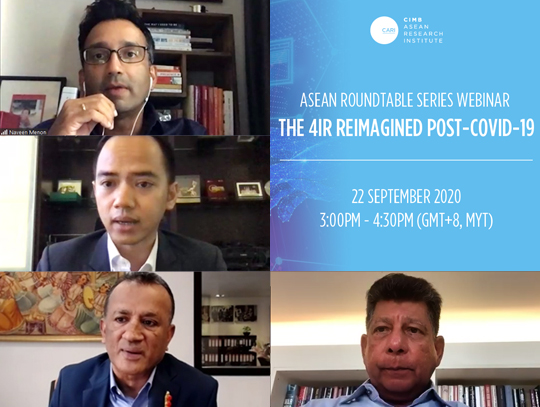
Counterclockwise starting from top left: Naveen Menon, President (ASEAN) for Cisco; Dato’ Fadzli Shah, Chief Strategy Officer of MDEC; Chandran Nair, Founder and CEO of Global Institute For Tomorrow (GIFT); and Tan Sri Dr. Munir Majid, Chairman of CIMB ASEAN Research Institute


Kuala Lumpur, 22 September 2020 – CIMB ASEAN Research Institute (CARI) hosted the ASEAN Roundtable Series, titled “The 4th Industrial Revolution (4IR) Reimagined Post-COVID-19”.

The session featured insights from industry veterans Naveen Menon, President (ASEAN) for Cisco, Dato’ Fadzli Shah, Chief Strategy Officer for MDEC and Chandran Nair, Senior Fellow of CARI, Founder and CEO of Global Institute for Tomorrow (GIFT). Moderated by Tan Sri Dr. Munir Majid, Chairman of CARI, the discussion centred around recent technological and adoption changes brought on by COVID-19 and how the future of 4IR will look like in ASEAN.


1. The 4IR agenda must take both economic benefits and social equality into account


Panellists of the roundtable agreed that while the economic benefits resulting from 4IR adoption are obvious and vast, there are some challenges that need to be addressed upfront.

“The adoption of technology has been one of the biggest drivers of ASEAN’s growth in recent years. Businesses across the region have pushed the frontiers with technology adoption, which coupled with growing penetration of smartphones, has improved productivity, created entirely new industries and made geographical borders redundant to new, open markets. The impact on jobs is not negligible and is likely to be very different than what we have seen in the past. Workers will need to build new skills, forge new career paths and enter new industries. The scale of the challenge is enormous but the ASEAN nations’ investments in reskilling should allow workers to make this transition”, said Naveen Menon, President, ASEAN for Cisco.

Chandran Nair, however, cautioned against focusing on just economic benefits as very often what drives business benefits are in conflict with the social purpose in countries where governance systems are weak and unable to manage rent-seeking economic activities or where there is growing economic inequality driven by economic policies that are not inclusive.

“To ensure the balance between economic gains and social equality, the 4IR initiatives have to be led by strong government policies and a vision of the country and region that recognises the existential threats we face. IR4.0 and businesses-led initiatives will not do this. The pandemic has exposed this reality,” argued Chandran Nair.


2. 4IR can drive social innovation, but its potential benefits differ depending on the priorities and context of the society and ASEAN member states


“Depending on the priorities and given the context of the society and country, 4IR can allow urbanites to have their food delivered by drones while they watch 24/7 streaming, or it can be used to target issues like food security, provide better education for the poor and even help build a multicultural regional community in ASEAN,” explained Chandran.

Echoing the same observations, Naveen pointed out that 4IR technologies potentially provide ASEAN with the opportunity to drive social innovation and equalise society in economic development, environmental sustainability, education and workforce. However he also noted that Industry 4.0 also brings with it a fresh set of challenges.

“The Fourth industrial revolution (Industry 4.0) promises a connected and smart manufacturing system where the internet, machine (physical system) and humans are working together. However, unlike other industrial revolutions, this industrial revolution deals more with information. The data underlying Industry 4.0 is the critical factor and brings with it new sources of value. We need to recognize the value of this data, enable cross-border data flows, develop ethical AI/ML frameworks and ensure the multiple privacy challenges are overcome. I do believe that privacy is a fundamental human right and we need regulations as well as contextual privacy awareness among consumers to make this more equitable,” added Naveen.


3. Barriers remain for 4IR adoption in ASEAN countries


Naveen pointed out that there are five main reasons causing the pace of adoption of 4IR technologies in ASEAN to be slow and patchy, largely due to cost-related factors, lack of 4IR technology demand and supply.

“In terms of costs, the low labour cost in ASEAN makes it less attractive for manufacturers to adopt 4IR technologies, and manufacturers also face difficulty in accessing affordable experts and skilled talent. Similarly, the costs of implementing new technologies can be too high to justify business cases in the short term. Apart from that, there is no customer demand in the region that requires manufacturers to incorporate seamless and agile processes in manufacturing just yet. Manufacturers are also often unsure how to navigate the complex and changing 4IR supplier landscape,” he said.

Datuk Fadzli Shah also shared the view that cost factors remain a hindrance to 4IR adoption.

“In ASEAN, the scope to expand business through the 4IR is astounding but affordable transformational technologies are hard to come by and that’s a huge challenge in the 4IR adoption. More so when surviving the COVID-19 pandemic is the top priority for most SMEs in these trying times. Although adopting 4IR is of significant importance, most SMEs will defer the plan and prioritise staying afloat during this difficult time,” he stressed.

Chandran however, suggested that ASEAN need a new definition of “productivity” that caters for the people of ASEAN, that may be different from the traditional Western economic model. He questions “the logic of displacing labour with technology, rather than putting policy in place to pay people a fair wage” and ensuring social prosperity in the region.


4. Governmental policy intervention in capability building and facilitation of public-private collaboration are crucial in ensuring regional readiness


Manufacturing is crucial for the ASEAN region as a core driver of economic growth — contributing about $670 billion, or 21 percent — to the region’s 2018 GDP, with more than a third coming from Indonesia alone. The COVID-19 pandemic has certainly accentuated the need for fast adoption of 4IR technology and governments play an important role in driving manufacturing growth to build capabilities and to facilitate collaboration between the public and private sector to accelerate 4IR adoption in this area.

Policy areas such as rolling out of 5G infrastructure, establishing national level agencies to drive the cyber security agenda, and the digital re-skilling of the workforce are enabling conditions that will drive the development of the IR4.0 agenda.

“National strategies on 4IR vary among member states. For example, Malaysia is mostly focused on strengthening workforce capabilities and building a strong ecosystem to foster investment. However, there is limited support for rolling out 4IR technologies in manufacturing. This is largely because manufacturing covers multiple industries, requiring not only more intervention and technology development but also a significant amount of collaboration among and between companies and governments across a region that is becoming more interconnected through trade and investment.” added Naveen.

Chandran however suggested that the process of 4IR policy making should start by exploring the question of whether the policies improve social well-being in the region, and understanding the type of region ASEAN aspire to, given the nature of existential threats.


Conclusion: Policy response to 4IR has to be holistic and include human considerations in the new world economy


In summing up the session, Tan Sri Dr. Munir stressed that the response to 4IR has to move beyond technology adoption to ensure that the implication on industrial restructuring and trade patterns are understood in terms of developing human capital skills, particularly industry planning, and the structure of the new world economy.

“The need to think beyond technology enablement for the future: the impact of technology has been emphasised in terms of its enablement. But we must also look at its disablement. And disablement is not just about employment displacement. We should reflect also on its implications for the texture of society and on the nature of social intercourse.”


VIEW WEBINAR RECORDING


DOWNLOAD PRESENTATION SLIDE


Business-as-usual in ASEAN in COVID-19 crisis will result in heavy cost to life and economy


Business-as-usual in ASEAN in COVID-19 crisis will result in heavy cost to life and economy
Originally published in TheEdge Malaysia, 21 September – 27 September 2020.

The most significant thing about the 28-page statement at the end of the ASEAN Foreign Ministers’ Meeting on 9th September is that it sets the tone and agenda for the ASEAN Leaders Meeting in November.

This is not good news. The rambling statement covers all corners without settling on any one of them with any definitive line of actual action.

It reads like a self-satisfied headmaster’s report. Of course, running ASEAN is more complicated than running a school, but rather more than an end-of-term report is needed at a time of grave COVID-19 crisis.

The statement should have picked out and highlighted the critical issue of protecting lives and livelihoods in ASEAN, what has to be done about it, with timelines and a sense of urgency.

The people of ASEAN deserve help during this crisis. Words will not do. Committees and working groups set up without outcome-driven and disciplined timelines for the deliverables will only see the continuation of the ASEAN way – which is a very slow orchestrated process of not upsetting anyone by avoiding difficult issues.

Jakarta is in lockdown again. Malaysia was talking with six countries to effect green lanes or travel bubbles, which has since been abandoned, except for Singapore, because of the rise in COVID-19 cases in several countries and of the fear of imported cases that will swamp its healthcare services.

With Thailand, 20% of whose GDP is dependent on tourism, we are looking at a crashing economy. Indeed all ASEAN economies – irrespective of how well they have done in containing COVID-19 – have been badly hit by a worldwide control of movement of people, goods and services, including, of course, in the region.

Let’s face it. A so-called comprehensive recovery framework to be put to leaders in November is not any good without any flesh and blood in it. The situation requires first a series of actions to get economic engines going again, not an exercise in economic discourse.

This framework has not once been discussed with the private sector, whereas the leaders and economic ministers have repeatedly said, ad nauseam, that engagement with the private sector is necessary to recover from the COVID-19 crisis.

The foreign ministers’ statement mentions the private sector just once, that too in generating confidence and economic activity, but not in terms of engagement to attain the conditions to achieve that outcome – as the leaders and the economic ministers have done.

There is a disconnect between the foreign ministries and the private sector that harms ASEAN and it cannot continue as lives and livelihoods are being ravaged by COVID-19. The foreign ministers, through the ASEAN Coordinating Council, report to the leaders and determine what they will say when they meet.

So, foreign ministries should open up to the private sector, to discuss what should be done to address the Covid-19 crisis. In Pathway225 (“A Pathway Towards Recovery and Hope for ASEAN”), the private sector has offered specific proposals to protect ASEAN lives, effect the process of coming out of lockdown without sacrificing lives, and to carry out implementable steps for ASEAN economic recovery.

In the dire circumstances of COVID-19, the private sector, not just in ASEAN but across the globe, has proposed that these 225 proposals, along with those contained in the Hanoi Plan of Action, be considered by a specially set-up ad hoc body, assisted by another specially set-up body, the Special Business Advisory Board (SBAB), as well as by existing ASEAN official bodies.

This ad hoc body – the ASEAN High-level Special Commission (AHLSC) – will act as an exco of the leaders meeting, delegated to make urgent decisions, specific and not wordy, to address the COVID-19 challenges across the board, including of course the economic dimension.

It is proposed that it meets every month – whereas the ASEAN Summit only meets twice a year, although there has been a special summit this year. The AHLSC is totally in line with the very first article of the ASEAN Charter on the purposes of the organisation.

The private sector does not seek to steal the limelight and does not claim to have the monopoly of solutions to an unprecedented situation. It puts out those 225 proposals to be considered by the AHLSC, for it to prioritise and adopt as it sees fit, but importantly to pick out proposals for urgent implementation, not more and more further study by more and more committees while Rome burns.

For example, the foreign ministers’ statement talks about opening travel corridors while taking care of the public health concerns of member states. All well and good, but how?

Let’s face it. The main problem is lack of trust and confidence in the healthcare standards and in the authenticity of COVID-19 tests among member states. What should be addressed is how to solve this problem instead of just implicitly stating it.

Would it be possible to have an A-Team of ASEAN medical professionals who can attest to the veracity of such tests to allow corridors or travel bubbles to be put in place? Can mass testing standards not be harmonised and monitored to build mutual confidence and trust?

We have to manage risk. Learn to live with this virus. It will be too long to wait for the vaccine and then restart the tourism sector process. It is possible – and urgent – to have an intra-ASEAN travel bubble, at least “city-to-city”. This is something the AHLSC has to look at. Yes, call on the ACCWGPHE (which, I am sure everybody knows, stands for the ASEAN Coordinating Council Working Group for Public Health Emergencies), to give its considered advice, but the it must come down to a decision instead of kicking the ball around.

This is what a top-level, highly successful tourism entrepreneur from Thailand had to say: “Overly harsh restrictions on international air travel can have an unexpected domino effect which will, in turn, destroy the whole tourism sector.”

To take another example, what e-customs procedures can be put in place to facilitate trade in goods, what low value shipments should be allowed, and what repeat trades can be exempted from going round the loop of regulations again and again? All this inhibits intra-ASEAN trade, not to mention the non-tariff barriers (NTBs) that have been increasing.

The Pathway225 proposals want to see a freeze on new NTBs, but the Hanoi Plan of Action only wants a stop to “unnecessary NTBs” with obligations not made under international law. Which is better, what is feasible? The AHLSC can decide.

If there were to be a second or third wave of the virus attack, what should already be in place to ensure there is no disruption in the supply chain, especially of food and medicines, which was a major cause of severe dislocations and deaths when lockdowns took effect in March? Pathway225 proposes “green” ports that will always remain open and a quick definition of essential goods (and services, which the Hanoi Plan of Action does not mention).

All this needs to be done – fast.

It is astounding that the foreign ministers’ statement – the result of many ASEAN officials’ and secretariat’s input – should not mention Pathway225 at all. The report had been submitted to ASEAN leaders, ASEAN economic and foreign ministries and the ASEAN Secretariat on 23 July 2020.

The proposal to establish the AHLSC and SBAB had been raised in a dialogue with ASEAN leaders on 26 June and with ASEAN economic ministers on 24 August. Indonesia, Malaysia, Brunei, Cambodia and Myanmar expressed support for it, with no stated opposition. It had been brought up during the brainstorming session with the ASEAN Secretariat on 14 August, apart from numerous written communications.

What hand is at work to freeze out the proposal, and all the Pathway225 action steps, from official ASEAN documentation, like the foreign ministers’ statement, leading up to the ASEAN Leaders Summit in November?

If it helps, now august white organisations like the World Economic Forum have joined the call for ASEAN to move to a Great Reset, and to abandon the business-as-usual ASEAN way amid the COVID-19 crisis. So the call is not led just by non-white organisations such as the ASEAN Business Advisory Council.

There should be a focus on the life-and-death struggle against COVID-19. The kind of narrative in the foreign ministers’ statement shows there is resistance to change. Just as we grandly point to such resistance among small and medium enterprises (SMEs) for example, to going digital, resistance to change exists across all organisations – including, and particularly, ASEAN.

The difference is, while such SMEs will go out of business, resistance to change within the ASEAN governance structure in addressing the COVID-19 crisis will result in more deaths and greater economic damage than has already been visited upon the region. This huge cost of not taking necessary extraordinary action in an unprecedented crisis is something ASEAN decision-makers will be held accountable for.

CARI Captures 471: Six ASEAN countries score above global average in 2020 Social Progress Index


ASEAN

Six ASEAN countries score above global average in 2020 Social Progress Index
(10 September 2020) Singapore leads ASEAN countries in the 2020 Social Progress Index with 29th place followed by Malaysia (48th), Thailand (79th), Indonesia (84th), Vietnam (88th), the Philippines (98th), Cambodia (118th), Myanmar (120th) and Laos (133rd). This year’s edition is the first to include Vietnam. Singapore, Malaysia, Thailand, Indonesia, Vietnam and the Philippines all obtained scores above the global average of 64.24. According to the index, the world’s social progress is improving, however, despite the overall progress, personal rights and inclusiveness have declined since 2011, while environmental quality and personal safety has stagnated. It also suggested that if current trends continue, the world will not achieve its social goals until 2082. The data also indicates that, unless urgent actions are taken, the COVID-19 pandemic will set the world back another decade, delaying achievement of the goals to 2092—more than 60 years after the 2030 target date of the Sustainable Development Goals.

ASEAN

ASEAN Wide Self Certification to be launched on 20 September 2020
(18 September 2020) The ASEAN Wide Self Certification (AWSC) is set to be launched on 20 September 2020. The launch follows two Self-Certification Pilot Projects, SCPP1 and SCPP2, implemented by ASEAN member states in November 2010 and January 2014, respectively. The AWSC will allow certified exporters to declare the origin status of their goods themselves on permitted commercial documents to claim preferential tariff treatment under the ASEAN Trade in Goods Agreement (ATIGA). The self-certification scheme is expected to improve turnaround time and cost efficiency. The AWSC can be performed anytime and includes other benefits including the simplification of export procedures, and reduction in workload and costs. To become a certified exporter, companies need to check their eligibility, register with their country’s competent authority and fulfill certified exporter obligations. The launch of the AWSC is the culmination of work by ASEAN since the initiative was first thought of during the 22nd ASEAN Free Trade Area (AFTA) Council in 2008. More details can be obtained at the AWSC website.

ASEAN

Southeast Asia GDP projected to contract 3.8% in 2020, grow 5.5% in 2021
(15 September 2020) The Asian Development (ADB) has revised its GDP projections for Southeast Asia to -3.8% in 2020, followed by a forecasted 5.5% growth in 2020. According to an ADB report released in September, Malaysia, the Philippines, Singapore and Thailand experienced double-digit contractions in the second quarter of 2020 and are now expected to shrink by more than 5.0% in 2020. Although COVID-19 infections continue to rise in some countries, notably Indonesia and the Philippines, along with surprise outbreaks elsewhere in the subregion such as Vietnam, economic recovery will continue to be slow and painful, largely determined by developments in world trade and the global economy. Resilient exports of petrochemicals from Brunei, agricultural products from Myanmar, and work-from-home electronics from Vietnam are projected to keep these three economies in growth territory in 2020. Inflation in the region is forecasted to dip by half to 1.0% in 2020 and revive to 2.3% in 2021.

MALAYSIA, JAPAN

Malaysia and Japan sign US$3 billion currency swap arrangement
(18 September 2020) The Bank of Japan and Bank Negara Malaysia have signed a Bilateral Swap Arrangement (BSA) that will provide up to US$3 billion for both countries. Under the agreement, both central banks will be allowed to swap their local currencies (in this case the ringgit and yen) for US dollars, with up to US$3 billion provided. A joint statement by both countries on the occasion stated that the arrangement will contribute to the stability of financial markets, and will further strengthen the growing economic and trade ties between both countries.

INDONESIA

Indonesia’s central bank holds key rate steady to underpin stability of rupiah
(18 September 2020) Indonesia’s central bank, Bank Indonesia, decided to keep its key interest rate unchanged on 17 September in order to keep the rupiah currency stable, with the benchmark seven-day reverse repurchase rate kept steady at 4.00% for a second month running. The rupiah has fallen nearly 2.0% in September 2020 due to concerns over the future independence of the central bank amidst recommendations to overhaul its operations and mandate. The central bank will instead focus on quantitative channels to support the economy. BI has resorted to unconventional policies to cushion the blow from the pandemic, including by directly financing some of the government’s COVID-19 programmes. The central bank has trimmed its key rate four times so far in 2020, as well as cut banks reserve requirements and eased lending rules.

THE PHILIPPINES

Gross international reserves rises to almost US$100 billion in August 2020
(17 September 2020) The Philippines’ gross international reserves (GIR) level rose by US$350 million to $98.95 billion as of end-August from the end-July level of $98.6 billion, according to Bangko Sentral ng Pilipinas (BSP). The Philippine central bank said on 16 September the month-on-month increase in the GIR level reflected inflows primarily from the BSP’s foreign exchange operations and income from its investments abroad. The BSP, however, added that these inflows were partially offset by the foreign currency withdrawals made by the national government to pay its foreign currency debt obligations and revaluation losses from the BSP’s gold holdings. The BSP said the end-August GIR level represents a sufficient external liquidity buffer, which can cushion the domestic economy against external shocks. Similarly, the BSP said the net international reserves (NIR), increased by US$354 million to US$98.95 billion as of end-August from the end-July level of US$98.59 billion.

THAILAND

Bank of Thailand issues digital personal loan regulations
(18 September 2020) The Bank of Thailand has issued digital personal loan regulations to allow consumers with no financial statements better access to financial services. A circular issued to businesses that want to apply for the digital loan business licenses informed them to incorporate alternative data for digital personal loan analysis, other than the traditional financial documents. Such alternative data can include utility bills for water, electricity, and telephone as well as online shopping records, which businesses can use to determine customers’ debt-repayment abilities. Digital loan providers will also need to adopt digital technology for operational processes such as loan offering, debt repayment and information disclosure such as interest rates, fees and penalties. Under the regulations, the maximum credit that can be offered is capped at US$642 with the longest loan period being six months.

MYANMAR

Domestic flights suspended due to spike in COVID-19 cases over weekend
(15 September 2020) Myanmar’s Department of Civil Aviation has suspended all domestic flights until 1 October 2020. This came after COVID-19 cases spiked at 2,455 cases and 14 deaths over the weekend. Domestic travel by air to the cities of Mandalay, Bagan and Inle Lake have been virtually halted. Almost the entire country has been placed under lockdown, while the border with Thailand has been closed since March 2020. Authorities are racing to build a field hospital in the commercial capital of Yangon to cope with a surge of COVID-19 infections that medical practitioners fear will threaten to overwhelm the country’s fragile health system. Three hospitals in Yangon have been repurposed to treat COVID-19 patients and the government is building a field hospital with 500 beds on a football pitch. The country had gone weeks without a case of local transmission before an outbreak in mid-August in the western region of Rakhine that has spread across the country.

SINGAPORE, THAILAND

Arrivals from Singapore and Thailand will not be required to quarantine in England and Scotland
(18 September 2020) Travellers arriving from Singapore and Thailand will not be required to undergo quarantine when they arrive in England and Scotland starting from the morning of 19 September 2020. The two countries were recently added to the list of “travel corridor” countries. When a country’s seven-day rate of cases per 100,000 rises above 20, the UK government will consider imposing quarantine measures. However, the decision to remove quarantine measures for arrivals from Singapore and Thailand are unlikely to lead to an influx of British visitors as the two ASEAN nations are only allowing a limited number of visitors to enter its borders if they either have a work permit, or are a resident or spouse.

SINGAPORE

Singapore and UN body set up global platform to reduce shipping’s carbon footprint
(17 September 2020) Singapore and the International Maritime Organisation (IMO) launched NextGEN on 17 September to help the maritime sector address global warming. The project, which is still in the preliminary stages, aims to develop a common platform for the 174 IMO member states over the next two or three years, to allow the different initiatives of individual countries to be shared and improved upon. The IMO wants to reduce annual greenhouse gas emissions from shipping by at least half by 2050, from 2008 levels. According to Singapore’s Minister of Transport Ong Ye Kung, the Tuas Port, when completed in the 2040s, will be the world’s largest fully automated terminal. The port will stop using conventional diesel-operated movers and will handle twice the number of 20-foot equivalent units with half the carbon emissions intensity, compared to 2005. The port will have a fleet of fully-electric automated guided vehicles instead, and will also give vessels that use cleaner fuels concessions in port dues.

Mekong Monitor: Thai government plans cash handouts worth US$1.6 billion to boost domestic consumption


Photo Credit: The Jakarta Post


TRADE, ECONOMY, AND INVESTMENT


THAILAND

Government plans cash handouts worth US$1.6 billion to boost domestic consumption
(17 September 2020) The Thai government announced cash handouts worth US$1.6 billion to boost domestic consumption and support the country’s struggling economy. Some 14 million low-income earners will receive US$48 each, totalling US$672.1 million, while another US$960.1 million will be offered to some 10 million people to buy goods during the fourth quarter of 2020. Since June, the kingdom has eased most of its COVID-19 restrictions due to its low infection numbers, but a ban since April on foreign tourists is limiting the speed of its domestic recovery. However, the handout plans, which will be financed by some of the government’s US$32 billion (1 trillion baht) borrowing, will still need cabinet approval. The government also plans to revise smart visa rules to attract long-term investors, particularly those with specific skills or those operating in targeted industries.
Read more>>

THAILAND

Consortium of companies to offer foreign visitors mandatory COVID-19 insurance
(15 September 2020) Thailand’s Office of Insurance recently confirmed that it has set up a consortium of 16 insurance companies in Thailand that will offer foreign visitors eligible to enter the country the mandatory COVID-19 insurance. The country plans to open its border to foreign leisure travellers, who will be required to purchase COVID-19 insurance. The insurance covers death due to disease as well as medical expenses for those undergoing treatment. Foreigners will need to pay the insurance premium according to the period of their stay, which is set at the level of risk of their country of origin. The cost of the insurance premium cover starts at US$51.20 up to US$1,383.15.
Read more>>

VIETNAM

Vietnam to restart passenger flights with six Asian cities
(16 September 2020) Vietnam is restarting passenger flights with six Asian cities as it plans to shore up its economy which has been battered by COVID-19 pandemic. Foreigners travelling for business or studies, alongside Vietnamese nationals and their family members, will be allowed to enter Vietnam from China’s Guangzhou, South Korea’s Seoul, Japan’s Tokyo, and Taipei this week, while travellers from Cambodia’s Phnom Penh and Laos’ Vientiane will be allowed to enter from next week. There will be two round trips a week between Vietnam and the specific destinations. All travellers must test negative for COVID-19 both before boarding their flight and upon landing. Those residing in Vietnam for less than 14 days will not be required to quarantine but must be tested. Travellers who transit through the six destinations from other locations will be allowed to enter as well.
Read more>>

VIETNAM

Vietnamese textile companies to produce face masks to offset losses from COVID-19
(16 September 2020) Vietnam’s trade ministry stated that 50 textile companies are producing, or are planning to produce, surgical masks to meet the expected global demand for masks as they become mandatory around the world. Vietnamese textile companies are shifting production to masks to offset the fall in textile exports and foreign investment flows into the local supply chains. Though masks are small-ticket items, Vietnam Textile and Apparel Association (VITAS) said masks have big export potential because they are becoming mandatory and ubiquitous around the world. Foreign direct investment into Vietnam between the start of 2020 to 20 August 2020, fell by 13.7% year-on-year. According to Vietnam’s General Statistics Office, garment and textile exports also fell by 11.6% year-on-year in the same period. Vietnam is the world’s third-largest exporter of textiles after China and India.
Read more>>

MYANMAR, SOUTH KOREA

Myanmar and South Korea discuss economic ties
(16 September 2020) South Korea and Myanmar discussed broadening economic ties during a virtual meeting held on 16 September 2020. The meeting involved South Korean Industry Minister Sung Yun-mo and his Myanmar counterpart Than Myint. The meeting was originally scheduled to take place in the first half of 2020 but was delayed to the COVID-19 pandemic. During the meeting, both countries discussed a wide array of issues including trade, industry, energy and investment. Myanmar and South Korea have also agreed to start the construction of the South Korea-Myanmar Industrial Complex (KMIC), a joint industrial park located just north of Yangon, in December 2020. According to South Korea’s Industry Ministry, the project is anticipated to further pave the way for the two countries to expand cooperation in the construction and infrastructure industries. The construction of KMIC is expected to run through 2024.
Read more>>


mekong-monitor-map

About Greater Mekong Subregion (GMS)

The Greater Mekong Subregion (GMS) Economic Programme was launched by the Asian Development Bank in 1992 connecting five developing ASEAN countries, namely Cambodia, Laos, Myanmar, Vietnam and Thailand, and Chinese provinces of Yunnan and Guangxi Zhuang Autonomous region. The region has some of the most robust economies sharing the Mekong River Basin thanks to its reform and liberalisation. The subregion is growing at a faster pace than the whole of East Asia and the Asia Pacific as the GDP growth rate for 2017 was at 6.4 percent, according to the World Bank. The population at the subregion as of 2016 is at 340 million while the GDP at PPP is at US$3.1 trillion in 2016. In 2015, trading within the region was at US$444 billion.

Media Release: Industry 4.0 offers lifeline to businesses in ASEAN during COVID-19 but employees buy-in is the foundation of the shift to new technologies


Industry 4.0 offers lifeline to businesses in ASEAN during COVID-19 but employees buy-in is the foundation of the shift to new technologies

>
Counterclockwise starting from top left: Kacper Pierzynowski, co-author of “Southeast Asia’s Big Shift – Industry 4.0 and the Forces of Change in the ASEAN Bloc” report; Daniel Häggmark, Managing Director of Monitor ERP; H.E. Ambassador Dag Juhlin-Dannfelt, Ambassador of Sweden in Malaysia; and Tan Sri Dr. Munir Majid, Chairman of CIMB ASEAN Research Institute


Kuala Lumpur, 15 September 2020 – CIMB ASEAN Research Institute (CARI) hosted the CARI Briefings webinar under its COVID-19 Economic Recovery Plan Series, titled “Industry 4.0 and the Forces of Change in ASEAN ~ Swedish Industry Voices in Response to the COVID-19 Pandemic.”

The session featured voices from the Swedish organisation and firms in the region including Kacper Pierzynowski, co-author of “Southeast Asia’s Big Shift – Industry 4.0 and the Forces of Change in the ASEAN Bloc” report and Daniel Häggmark, Managing Director of Monitor ERP.

Moderated by Tan Sri Dr. Munir Majid, Chairman of CARI, the discussion centred around Industry 4.0 (IR4.0) in the region, how Swedish companies utilising IR4.0 have responded to the pandemic and how ASEAN can adopt IR4.0 in a post-pandemic world.


1. COVID-19 pandemic accentuated the critical need of embracing IR4.0 across ASEAN


H.E. Dag Juhlin-Dannfelt, Ambassador of Sweden in Malaysia during his special remarks noted that the experience of the COVID-19-pandemic has shown how vulnerable and unprepared modern societies are to unforeseen events but the utilisation of technology can help businesses emerge from a crisis relatively better.

“Long-term planning perspectives that include digitalisation and corporate sustainability have become necessary ingredients for corporate strategies to be viable in a ten-fifteen year perspective. Through a high degree of digitalisation and a quest for constant innovation, Swedish businesses have managed the COVID-19 environment fairly well, digitalisation making adaptability and thus maintenance of productivity possible,” he said.

In fact, manufacturers in ASEAN surveyed by Business Sweden say they now see the benefits of IR4.0 for their own operations, with COVID-19 further accelerating the awareness and need for it. “For example, remote monitoring capabilities, through performance management platforms and connected machines and assets enabled companies to maintain undisrupted production and react accordingly if any error occurred,” explained Kacper Pierzynowski, co-author of Business Sweden’s report on IR4.0.


2. IR4.0 technologies: new opportunities for new revenue streams and potential innovation


According to the “Southeast Asia’s Big Shift – Industry 4.0 and the Forces of Change in the ASEAN Bloc” report, IR4.0 technologies have the potential of opening up new opportunities.

“Trending technologies such as additive manufacturing, big data, smart machines and robots, virtual modelling and alternate/virtual reality enable companies to obtain a 360-degree view of production lines and customers, set up their own ecosystems and value networks and pave the way for innovations such as mass-customisation of products. This also gives rise to the possibility of data monetisation while moving gradually towards as-a-service concepts,” commented Kacper.


3. The shift towards IR4.0: employees’ buy-in is the foundation of change


Embracing new technologies would not be possible without support from the workforce, said Daniel Häggmark, managing director of Monitor ERP. According to him, more leaders are putting in efforts to involve the entire organisation in the journey towards IR4.0 adoption. He added that Swedish business culture that is non-hierarchical and team focused also creates a very engaged workforce and could make the adoption of new technologies faster and easier.

“There was already keen interest in IR4.0 among the SMEs and government agencies in the four to five years pre-COVID era and the pandemic has challenged the rigid top-down management style among more traditional local manufacturing companies to consider alternatives. Similar to Swedish companies during the global financial crises in 2006 and early 90s, more companies in Malaysia and ASEAN are exploring cost-effective solutions,” he said.


Conclusion: embracing IR4.0 is not all about technologies alone


In the new normal, Tan Sri Munir opines that the implication of industrial restructuring and trade patterns has to be understood now in terms of developing human capital skills, particularly industry planning, and the structure of the new world economy.

“We have to go beyond digitalisation in response to the COVID-19 pandemic which, in a way, is taking place “naturally” perforce, towards anticipating the particular technologies that will drive the future of 4IR. We do not want to be stuck with ICT if the future is in cloud, artificial intelligence and mobility,” he said.

H.E. Ambassador Dag agreed and noted that productivity, sustainability and efficiency are core fundamentals for corporates to be competitive. He added that digitalisation is a necessary tool for commercial businesses to be adaptable and to remain internationally competitive.

Kacper said businesses should embrace customer proximity; work closely with technology and solution providers to enable them to develop and offer a scalable solution that is demand-driven and not a technology-led approach. Beyond this, companies should tap into the local ecosystem and build new partnerships while leveraging their existing networks.


VIEW WEBINAR RECORDING


CARI Analysis: Japan-ASEAN Economic Ties to Grow Despite COVID-19


CARI Analysis: Japan-ASEAN Economic Ties to Grow Despite COVID-19

Author: Mohd Imran Said Bin Mohd Shamsunahar | Research Editor: Eleen Ooi Yi Ling
Webmaster: Nor Amirah Mohd Aminuddin | Research Director: Hong Jukhee

Synopsis
As Japan undergoes a leadership change with the sudden resignation of Prime Minister Shinzo Abe, the geopolitical implications will be of especial interest for regional observers. A survey carried out by Japan Center for Economic Research and Nikkei between August 31 to September 4, 2020, on their expectations for the new Prime Minister found most respondents stressing Tokyo’s role in regional stability and development and greater cooperation with other Asian countries.

Since the establishment of formal relations in 1977, Japan has been one of ASEAN’s strongest regional partners. As another middle power navigating the ongoing Sino-US tensions and fellow proponent of the global rules-based order, Japan can be viewed arguably as a natural partner for ASEAN. The recent adoption of a bilateral commitment to cooperate on COVID-19, a recent upgrade to the Japan-ASEAN Comprehensive Economic Partnership agreement, and the expected signing of the Regional Comprehensive Economic Partnership (RCEP) in November 2020, were among the most recent initiatives in expanding the economic relationship. This relationship has been in development since the mid-seventies and was provided renewed impetus by Tokyo post-2008 to compete with Chinese influence in the region.

CARI Analysis: Japan-ASEAN Economic Ties to Grow Despite COVID-19 looks at these expanding ties between Japan and ASEAN through five main areas of focus; namely trade and global value chains, foreign direct investment and infrastructure development, supply chain relocation to ASEAN, financial cooperation through Japanese capital markets, and finally regional perceptions of Japan as a major power.

(This article contains 14 charts and best viewed on a desktop or horizontally on your mobile.)

KEY MESSAGES

a) A survey carried out by Japan Center for Economic Research and Nikkei between August 31 to September 4, 2020, which solicited responses from ASEAN economists on their expectations for Japan’s new prime minister, found most respondents stressing Tokyo’s role in regional stability and development and greater cooperation with other Asian countries
b) Since the establishment of formal relations in 1977, Japan has been among ASEAN’s strongest regional partners. It is also, arguably, a natural partner for ASEAN as another middle power navigating the ongoing Sino-US tensions and fellow proponent of the international rules based order.
c) On 1 August, 2020, the First Protocol to Amend the Agreement on Comprehensive Economic Partnership among Japan and the Member States of the Association of Southeast Asian Nations entered into force for both Japan and five other ASEAN Member States. This upgrade of the AJCEP agreement (entered into force in 2008) is expected to help boost bilateral trade and investment.
d) Prior to that, on 22 April 2020, both parties also adopted the ASEAN-Japan Economic Resilience Action Plan, designed to boost economic relations and mitigate the impact of COVID-19 from an economic and healthcare perspective.
e) Japan and ASEAN are among the participants of the Regional Comprehensive Economic Partnership (RCEP), which is expected to be signed in November 2020. The agreement is expected to play a large part in post-pandemic recovery efforts for the entire region.
f) The implementation of the Protocol, the adoption of the Economic Resilience Action Plan, and the expected signing of the RCEP Agreement, are among the most recent initiatives in expanding the close economic ties between ASEAN and Japan. These ties flourished from the mid-seventies to eighties, and was reprioritized again by the Japanese government post-2008 to counter Chinese influence in the region.
g) Between 2009 and 2019, total merchandise trade between Japan and ASEAN peaked in 2012 at US$264.5 billion, with Japan composing 8.0% of ASEAN’s total merchandise trade in 2019. In the same year, Thailand was Japan’s largest trading partner.
h) According to a January 2019 study by the Japan-ASEAN Centre on ASEAN global value chains, Japan was the largest source of foreign inputs used in value-added exports from ASEAN until the beginning of the 2000s, after which its share declined. However, Japan’s declining share in terms of the provision of foreign inputs to ASEAN exports may be compensated by the direct provision of inputs and components by Japanese companies operating within the region.
i) Between 2010 and 2019, Japanese FDI into ASEAN peaked in 2013 at US$24.6 billion. Japan was ASEAN’s second largest external source of FDI in 2018. Thailand, Indonesia and Singapore were the three largest destinations for Japanese FDI in 2018.
j) In June 2019, Fitch Solutions revealed that pending Japanese-backed infrastructure projects overtook Chinese-backed ones in the ASEAN-6 by total value. Across ASEAN as a whole and by the number of projects, Japan still narrowly beat China by 240 to 210.
k) Japan has sought to differentiate its overseas development model from that of China’s through a focus on quality, with emphasis paid to Japanese technologies, technical assistance, financing models, and human capital development.
l) In response to the ongoing US-China tensions, Japan has sought to diversify its supply chains away from China. A 2019 survey by the Japan External Trade Organization found that a total of 71.1% of firms surveyed stated they would expand operations in the ASEAN-6 countries, the first increase in six years. A further 53.5% of the firms surveyed wanted to expand sales in the ASEAN-6 in 2019, while a further 17.5% wanted to expand production of general purpose goods.
m) ASEAN is expected to be included in the trilateral Supply Chain Resilience Initiative (SCRI) currently in negotiation between Japan, Australia, and India. The SCRI was set up ostensibly to reduce reliance on Chinese supply chains.
n) In the ISEAS-Yusof Ishak Institute’s The State of SEA Survey Report 2020 published in January 2020, Japan remained the most trusted major power in the region, with 61.2% of ASEAN respondents expressing confidence that Japan would ‘do the right thing’ in providing global peace, prosperity, and governance.

1) Japan-ASEAN economic ties expected to be boosted through recent initiatives in trade liberalization and COVID-19 cooperation


1a. Great expectations for Japan’s new prime minister

As Japan undergoes a leadership change with the sudden resignation of Shinzo Abe, the geopolitical implications will be of special interest for regional observers. A survey carried out by Japan Center for Economic Research and Nikkei between August 31 to September 4, 2020 (shortly after Abe announced his resignation), which solicited responses from economists from ASEAN and India on their expectations for the new prime minister Yoshihide Suga, found most respondents laying emphasis on Tokyo’s role in promoting regional stability and development (particularly in the context of ongoing Sino-US tensions), as well as strengthening cooperation with other Asian countries.1

Carlo Asuncion of Union Bank of the Philippines stated that Japan should ‘”continue to be an important player in the geo-political situation in Asia’, while Somprawin Manprasert of Bank of Ayudhya in Thailand stated that greater cooperation between Japan and Asian countries would be necessary “to cushion external shock from outside of the region, especially protectionism and deglobalization’. 2


1b. Japan a natural partner for ASEAN

Since the establishment of formal relations in 1977, Japan has been one of ASEAN’s strongest regional partners at both the bilateral and multilateral levels. As a fellow middle-power navigating the increasingly tense regional competition between China and the United States, Japan is a natural partner for ASEAN in advocating for the international rules-based order upon which Asian prosperity was built upon.

Since the seventies onwards, Japan has been a close economic and development partner for ASEAN, as well as a long-standing supporter of ASEAN regionalism. On 28 August, 2020, economic ministers from ASEAN and the Minister of Economy, Trade, and Industry (METI) Japan met virtually for the 26th AEM-METI Consultations. The participating ministers acknowledged the economic challenges brought about by the COVID-19 pandemic, and reaffirmed their commitment to take collective actions to mitigate the economic impact of the virus, and to keep their markets open for trade and investment and maintain supply chain connectivity.3

The participating ministers referenced three ongoing initiatives to broaden and deepen bilateral ASEAN-Japan economic ties, including the First Protocol to Amend the Agreement on Comprehensive Economic Partnership among Japan and Member States of the Association of Southeast Asian Nations (the First Protocol to Amend the AJCEP), The ASEAN-Japan Economic Ministers’ Joint Statement on Initiatives on Economic Resilience in Response to the Corona Virus Disease (COVID-19) Outbreak, and the Regional Comprehensive Economic Partnership (RCEP) Agreement.


1c. First Protocol entered into force on 1 August, 2020

On 15 June, 2020, the Japanese government notified the ASEAN governments that the legal procedures necessary for the entry into force of the First Protocol to Amend the AJCEP had been completed. The governments of Thailand, Singapore, Lao PDR, and Myanmar had already made similar notifications.4

The Protocol adds provisions concerning trade in services, movement of business people, and investments to the AJCEP (which entered into force in 2008). The Protocol is also the first bilateral economic partnership agreement between Japan and the Mekong countries of Cambodia, Lao PDR, and Myanmar. The Protocol includes rules and liberalization commitments from ASEAN Member States that are not included in the bilateral Economic Partnership Agreements and related agreements concluded between Japan and ASEAN member states in the past.5

The Protocol entered into force on 1 August, 2020, among Japan, Lao PDR, Myanmar, Singapore, Thailand, and Viet Nam. The remaining five other ASEAN Member States are expected to complete procedures and join by the end of 2020. The Japanese Foreign Ministry stated that the Protocol is expected to promote greater trade and investment between Japan and ASEAN.6

During the 26th AEM-METI Consultations the ministers reviewed the progress of the implementation of the AJCEP, and described it as a ‘vital component of post-COVID-19 recovery efforts’.7


1d. Japan and ASEAN to cooperate on COVID-19

On 22 April, 2020, the ASEAN Economic Ministers (AEM) and Minister of Economy, Trade and Industries of Japan adopted “The ASEAN -Japan Economic Ministers’ Joint Statement on Initiatives on Economic Resilience in Response to the Corona Virus Disease (COVID-19) Outbreak”. 8

Subsequently, on 29 July 2020, both parties adopted the ASEAN-Japan Economic Resilience Action Plan, which was designed to translate the Joint Statement into concrete actions. Malaysian Senior Minister cum International Trade and Industry Minister Datuk Seri Mohamed Azmin Ali would state during a digital meeting between ASEAN Economic Ministers and the Minister of Economy, Trade and Industry of Japan that the action plan ‘signifies a strong commitment and solidarity between Asean and Japan in combating the Covid-19 pandemic, both on the health and economic fronts.’9

The ASEAN-Japan Economic Resilience Action Plan was designed to accomplish three objectives: 10

  1. sustain the close economic ties developed by ASEAN and Japan;
  2. mitigate the adverse impact of COVID-19 on the economy;
  3. strengthen economic resilience in response to the economic challenges brought about by the COVID-19 pandemic.

During the 26th AEM-METI Consultations, the participating ministers noted the progress made in the implementation of the ASEAN-Japan Economic Resilience Action Plan. To enhance the implementation of the Action Plan, the ministers welcomed the launch of the “Dialogue for Innovative and Sustainable Growth (DISG)” to accelerate “Innovative and Sustainable Growth” across the region. The Ministers also referenced the specific support programs led by the Japan External Trade Organization in line with the Action Plan. These included 11

  1. a helpline for recovery & restoration,
  2. a strengthening of the regional supply chain, and
  3. DX platform for ASEAN-Japan collaborative innovation.


1e. Regional Comprehensive Economic Partnership (RCEP)

On 27 August, 2020, the economic ministers of ASEAN, Australia, China, Japan, South Korea and New Zealand met for the 8th Regional Comprehensive Economic Partnership (RCEP) Ministerial Meeting. During the meeting, the ministers acknowledged the economic challenges brought about by the COVID-19 pandemic, and stressed the imperative of keeping markets open and to cooperate in the fight against COVID-19.12

In light of ongoing uncertainties, the ministers recognised the importance of the RCEP Agreement in terms of enhancing business confidence, strengthening the regional economic architecture, and maintaining the stability of regional and global supply chains. The ministers also believed that the agreement would play a significant role in post-pandemic recovery efforts. The Agreement is expected to be signed at the 4th RCEP Summit in November 2020, and that the agreement would remain open to India to rejoin at a later date.13


1f. Both Japan and ASEAN seek to expand the economic relationship

The recent upgrading of the Comprehensive Economic Partnership agreement between ASEAN and Japan, the agreement to cooperate on COVID-19, and the expected signing of the RCEP Agreement in November 2020 are among the recent initiatives to expand the economic relationship between Japan and ASEAN. This relationship flourished from the mid-seventies to the eighties, as Tokyo sought to build stronger relations with ASEAN governments through more inclusive and constructive trade, investment, developmental assistance, and economic cooperation policies. After a lull following the end of the Cold War, there was renewed impetus by Japan after 2008 to regain influence in the region, partly as a counter to the rise of China.14

In the next five sections, this paper will look at the Japan-ASEAN relationship through five main areas of focus; namely trade and global value chains, foreign direct investment and infrastructure development, supply chain relocation to ASEAN, financial cooperation through Japanese capital markets, and finally regional perceptions of Japan as a major power.

2) Japan-ASEAN trade


2a. Total merchandise trade between Japan and ASEAN peaked in 2012 at US$264.5 billion

A perusal of the total merchandise trade between Japan and ASEAN between 2009 and 2019 found that merchandise trade peaked in 2012 at US$264.5 billion. In 2019, merchandise trade measured at US$225.9 billion in 2019 (Figure 1). 15


2b. Japan composed 8% of ASEAN’s total merchandise trade in 2019

Japan’s share of total merchandise trade with ASEAN by value has dropped slightly from 10.5% in 2009 to 8.0% in 2019 (Table 1). In 2018, Japan was ASEAN’s fourth largest trading partner behind China, the EU, and the USA. 16


2c. Thailand was Japan’s largest ASEAN trading partner in 2019

Thailand accounted for Japan’s largest trade partner in ASEAN in 2019, at US$57.8 billion. Viet Nam and Singapore followed at US$40 and US$37.1 billion respectively (Figure 2).

An analysis of trade with Japan for each ASEAN country between 2009 and 2019 differs depending on the country. While Thailand has consistently remained Japan’s largest trade partner in the region, trade with Cambodia or Myanmar has remained negligible (Figure 3).


2d. Japan was the largest source of foreign inputs used in ASEAN value-added exports from the 1990s to 2000s

According to a January 2019 study by the Japan-ASEAN Centre on ASEAN global value chains, Japan was the largest source of foreign inputs used in value-added exports from ASEAN from the 1990s until the beginning of the 2000s (Figure 4).17

Since then Japan’s share of intermediate inputs used in total exports by ASEAN has declined, although the report pointed out that this may be compensated by Japanese foreign affiliates operating within the region who can now directly produce and supply the inputs and components required within ASEAN. 18

3) Japan-ASEAN FDI


3a. The peak of Japanese FDI into ASEAN roughly coincides with the peak of trade in 2012

Between 2010 and 2019, Japanese FDI into ASEAN peaked in 2013 at US$24.6 billion. This roughly coincides with the peak in the trade in merchandise goods between Japan and ASEAN in 2012 (Figure 5). 19


3b. Japan was ASEAN’s second largest external source of FDI in 2018

Japan was the second largest source of extra-ASEAN FDI in 2018; composing 13.7% share of total FDI (Figure 6). 20


3c. Thailand, Indonesia and Singapore were the 3 largest destinations for Japanese FDI in 2018

Thailand, Indonesia and Singapore were the 3 largest destinations for Japanese FDI in 2018, with each of them receiving more than US$ 4 billion (Figure 7).


3d. In June 2019 Japanese-backed projects overtook Chinese-backed ones in ASEAN-6

Data by Fitch Solutions in June 2019 revealed that in terms of the total value of pending projects, Japanese-backed infrastructure projects in the ASEAN-6* outpaced that of China’s by US$367 billion to US$255 billion respectively. Vietnam alone had pending projects worth US$209 billion (Figure 8). 21

It should be noted that the figures from Fitch only counted pending projects; defined as ‘those at the stages of planning, feasibility study, tender and currently under construction’.22

Across ASEAN as a whole and by the number of projects, Japan still narrowly beat China by 240 to 210 (Figure 9).


3e. Qualitative-focused infrastructure development partner

In 2015, former Japanese Prime Minister Shinzo Abe gave two speeches which outlined how Japan would contrast itself with China’s model of international development partnerships (most notably through its landmark Belt and Road Initiative) with regards to ASEAN. Abe pointed to Japan’s experience in not just infrastructure financing and deployment, but also technology sharing, technical development, and human capital development. Abe emphasized the quality of Japanese infrastructure, especially in terms of ‘safety, reliability, and innovation’, and further argued that Japan would not engage in the practice of conditional financial assistance.23

Two quality-focused development concepts that have seen significant ASEAN-Japanese collaboration include the concepts of economic corridors, originally developed by the Asian Development Bank and now featured in ASEAN’s Master Plan on ASEAN Connectivity, as well as the ASEAN Smart City Network, formally launched in July 2018 and drawing heavily upon Japanese experiences, funding, technologies, and technical expertise.24

4) Japan and supply chain relocations to ASEAN


4a. In response to US-China trade tensions, Japan has sought to diversify its supply chains away from China

Intensified tensions between China and the US since 2018 has pushed more Japanese firms to expand operations in the ASEAN-6**, with a 2019 survey carried out by the Japan External Trade Organization finding 41% of companies surveyed considering expanding operations in Vietnam alone in the next three years, up 5.5% from the year prior. The response ratio for Thailand also improved from 34.8% in 2018 to 36.3% in 2019 among firms mainly found in the manufacturing industry. In comparison, the ratio of firms citing China was 48.1%, down 7.3 points from the previous year (Figure 10).25

A total of 71.1% of firms surveyed stated they would expand operations in the ASEAN-6 countries, the first increase in six years. This was attributed in part to risk aversion on the part of the Japanese companies (Figure 11).26

Among the specific functions to be expanded into ASEAN, 53.5% of the firms surveyed wanted to expand sales in the ASEAN-6 in 2019, while a further 17.5% wanted to expand production of general purpose goods (Figure 12).27


4b. Japanese government subsidizing companies to expand to ASEAN

On 7 August, 2020, it was reported by Bloomberg that the Japanese government was providing subsidies worth US$114 million to 30 companies seeking to diversify their production to Southeast Asia, part of the first round of a multi-billion dollar program to diversify supply chains away from China in the aftermath of COVID-19. 28


4c. The Supply Chain Resilience Initiative (SCRI) and ASEAN

In mid-August 2020, Indian and Japanese news outlets reported that India, Japan, and Australia have been in discussions on launching a trilateral Supply Chain Resilience Initiative (SCRI) to reduce supply chain dependency on China. The SCRI was reportedly proposed by Japan, who is keen to launch the initiative by November 2020. 29

The objectives of the SCRI is two-fold: to attract FDI into the Indo-Pacific and to build mutually complementary relationships among partner countries. It was also reported that the initiative would be opened to ASEAN after an understanding was reached between the three core partners. 30

5) Japan-ASEAN Financial Ties – Samurai bonds


5a. Japan’s bond market is an alternative source of foreign financing for ASEAN countries but not without risks

The Japanese bond market (often referred to as the ‘Samurai bond’ market) offers financing at low interest rates for foreign governments and private borrowers. Interest rates in the Japanese bond market are often lower than domestic rates in ASEAN due to Japan’s low interest rate environment. 31

It allows ASEAN governments such as Malaysia and Indonesia to raise money from Japan’s huge capital market with Tokyo providing the necessary guarantees for investors. This in effect creates government-backed bonds which ASEAN governments would then utilize to borrow necessary funds for infrastructure investments, etc.32

Borrowing from the Samurai market is unlikely to be explicitly called “infrastructure” debt. But the money is fungible, and governments borrowing money in global bond markets are free to direct it to whichever key projects they judge to be of merit.33

There are limitations to how many bonds the JBIC can guarantee. The more bonds ASEAN countries issue, the more Japan will be forced to reduce its guarantees. This will result in higher coupon rates for borrowing countries. 34 Holding large amounts of foreign currency debts also exposes ASEAN countries to foreign currency risks and the possibility of sudden reversals in capital flows.35


5b. Between 2018 and 2020, Malaysia, Indonesia, and The Philippines have issued their own Samurai bonds

  • Malaysia: In November 2018, Japan offered 200 billion yen (US$1.75 billion) in Samurai bonds to help Malaysia balance its financial dependence on China. Malaysia successfully issued the number of bonds guaranteed by the Japan Bank for International Cooperation (JBIC) in March 2019, with an oversubscription of more than 1.6 times at 324.7 billion yen against the initial 200 billion yen offered. A proposed second public offering of Samurai bonds to be finalized by the end of the first quarter of 2020 was reportedly scrapped due to the Malaysian government having no immediate need for foreign financing.36
  • Indonesia: On 3 July 2020 the Indonesian government raised US$930 million through the issuance of five-tranche Samurai bonds. The money raised was to be used to finance Indonesia’s budget deficit, including COVID-19 relief and recovery efforts. Indonesia’s issuance was reportedly the first issuance by an Asian country since the pandemic struck in 2020.37
  • The Philippines: The Philippines Finance Secretary announced in June 2020 that Manila was looking to sell yen-denominated bonds in the second half of 2020, and that they will be helped along by the A-status rating recently awarded to them by the Japan Credit Rating Agency [JCR].38

6) Japan the most trusted power in ASEAN


6a. Japan the most trusted to ‘do the right thing’

In the ISEAS-Yusof Ishak Institute’s The State of SEA Survey Report 2020 published in January 2020, Japan remained the most trusted major power in the region, with 61.2% of respondents expressing confidence that Japan would ‘do the right thing’ in providing global peace, prosperity, and governance (Figure 13).39

Among the respondents who stated they trusted Japan, 51% viewed it as a ‘responsible stakeholder that respects and champions international law’ (Figure 14).40

7) Conclusion

ASEAN-Japan relations will be further boosted despite the COVID-19 pandemic. The recent adoption of the ASEAN-Japan Economic Resilience Action Plan, the First Protocol to Amend the AJCEP, and the expected signing of the RCEP Agreement are projected to help further elevate the already significant economic relationship between Japan and ASEAN. However, the impact of the appointment of the new Prime Minister Yoshihide Suga on Japan-ASEAN Relations remains to be seen.


Footnotes

1Japan Center for Economic Research, ‘JCER/Nikkei Consensus Survey on Asian Economies: Experts Project Role for Japan in Regional Stability. New PM Must Bring Economic Recovery, Provide Model for Reform. Mixed Views on Abe Era Monetary Policy, Low Marks on Growth’, September 2020.
2 Ibid.
3 ASEAN, ‘The Twenty-Sixth AEM-METI Consultations’, August 2020.
4 Ministry of Economy, Trade, and Industry, ‘Notification Issued for Entry into Force of the First Protocol to Amend the Agreement on Comprehensive Economic Partnership among Japan and Member States of the Association of Southeast Asian Nations’, June 2020.
5 Ibid.
6 Ministry of Economy, Trade, and Industry, ‘Enters into Force of the First Protocol to Amend the Agreement on Comprehensive Economic Partnership among Japan and Member States of the Association of Southeast Asian Nations’, August 2020.
7 ASEAN, ‘The Twenty-Sixth AEM-METI Consultations’, August 2020.
8 ASEAN, ‘ASEAN-Japan Economic Resilience Action Plan’, July 2020.
9 ASEAN, ‘ASEAN-Japan Economic Resilience Action Plan’, July 2020, Bernama, ‘Asean, Japan team up in Covid-19 fight’, July 2020.
10 Ibid.
11 ASEAN, ‘The Twenty-Sixth AEM-METI Consultations’, August 2020.
12 ASEAN, ‘Joint Media Statement of the 8th Regional Comprehensive Economic Partnership(RCEP) Ministerial Meeting’, August 2020.
13 Ibid.
14 Corey Wallace (2019) Japan’s strategic contrast: continuing influence despite relative power decline in Southeast Asia, The Pacific Review, 32:5, 863-897.
15 ASEAN Secretariat.
16 ASEAN Secretariat, ASEAN Secretariat, ‘ASEAN Statistical Yearbook 2019’, December 2019.
17 ASEAN-Japan Centre, ‘Global Value Chains in ASEAN – Paper 1: Regional Perspective (Revised)’, January 2019.
18 Ibid.
19 ASEAN Secretariat.
20 Ibid.
21 Bloomberg, ‘China No Match for Japan in Southeast Asia Infrastructure Race’, June 2019
*The ASEAN-6 countries include Indonesia, Malaysia, the Philippines, Singapore, Thailand, and Vietnam.
22 Ibid.
23 Corey Wallace (2019) Japan’s strategic contrast: continuing influence despite relative power decline in Southeast Asia, The Pacific Review, 32:5, 863-897.
24 Ibid.
25 Japan External Trade Organization, ‘FY 2019 Survey on the International Operations of Japanese Firms – JETRO Overseas Business Survey’, February 2020.
**The ASEAN-6 refers to Singapore, Thailand, Malaysia, Indonesia, Philippines, Vietnam.
26 Ibid.
27 Ibid.
28 Bloomberg, ‘Japan Push to Cut China Reliance May Be Boost for Southeast Asia’, August 2020.
29 The Economic Times, ‘India-Japan-Australia supply chain in the works to counter China’, August 2020, The Japan Times, ‘Japan, India and Australia eye ‘supply chain pact’ to counter China’, August 2020.
30 Ibid.
31 South China Morning Post, ‘Is Shinzo Abe offering Japan’s Samurai bonds as a foil against China’s debt diplomacy?’, November 2018, The Edge Markets, ‘InTheKnow: Samurai bonds’, August 2019.
32 South China Morning Post, ‘Is Shinzo Abe offering Japan’s Samurai bonds as a foil against China’s debt diplomacy?’, November 2018.
33 Ibid.
34 New Straits Times, ‘Not the last Samurai’, March 2019.
35 Ibid.
36 The Star, ‘Malaysia willing to consider issuing another samurai bond’, March 2019, The Malaysian Reserve, ‘Talks on 2nd Samurai bond grind to a halt’, June 2020.
37 The Jakarta Post, ‘Indonesia raises $930m in samurai bonds to fund pandemic response’, July 2020.
38 Inquirer.net, ‘PH eyes samurai bond sale in second half’, June 2020.
39 ISEAS-Yusof Ishak Institute, ‘The State of SEA Survey Report 2020’, January 2020.
40 Ibid.

 

CARI Captures 470: Indonesian stocks fall by more than 5% after Jakarta reinstates partial lockdown


INDONESIA

Indonesian stocks fall by more than 5% after Jakarta reinstates partial lockdown
(10 September 2020) Indonesian stocks fell by more than 5% on 10 September to their lowest in almost three months following an announcement on 9 September that Jakarta would reinstate partial lockdown measures to combat COVID-19. The benchmark Jakarta Composite Index has been one of the worst-performing stock indexes in the region in 2020, declining by more than 22% as of 10 September. Jakarta is set to return to a partial lockdown from 14 September onwards, similar to the one the capital was placed under from April to June 2020. The reimposition of the lockdown aims to prevent rising COVID-19 cases from overwhelming the city’s healthcare system. The city is home to more than 10 million people and has been the epicentre of Indonesia’s COVID-19 outbreak, accounting for nearly a quarter of the country’s cumulative infections.

SINGAPORE

SIA announces 2,400 job cuts amid COVID-19 fallout
(10 September 2020) The Singapore Airlines (SIA) Group announced during a virtual townhall on 10 September its decision to cut around 4,300 positions. However, the potential number of staff impacted is expected to come down to 2,400 after taking into account a recruitment freeze, natural attrition and the take-up of voluntary departure scheme, the company said in a statement. The company expects to operate at less than 50% of its capacity by the end of its financial year in March 2021, as compared to the level before the COVID-19 pandemic. The layoffs had been widely anticipated and come as international travel continues to stall, with governments enforcing strict border controls to contain COVID-19. According to the International Air Transport Association (IATA), passenger demand for air travel is not expected to return to pre-crisis levels until 2024.

SINGAPORE

Singapore welcomes discussions with Hong Kong on resumption of travel
(10 September 2020) The Singapore Consulate-General in Hong Kong stated they welcomed discussions with Hong Kong on the resumption of cross-border travel between both city-states, given the strong business and people-to-people links. This was after Hong Kong’s Secretary for Commerce and Economic Development Edward Yau Tang-wah stated earlier in the week of 7 September, that the territory is planning “travel bubbles” with 11 countries, including Singapore, South Korea, and Germany. Singapore currently has cross-border travel arrangements with China, Malaysia, Brunei and South Korea. It is currently in talks to resume essential business travel with Japan, with officials tasked to finalise an agreement by early September and has reportedly begun discussions on a reciprocal green lane with Indonesia.

THAILAND

Tourism agency planning on allowing tourists from low-risk countries to visit
(10 September 2020) The Tourism Authority of Thailand is planning on allowing foreign tourists from countries with low COVID-19 risks to visit the country without a mandatory quarantine. The quarantine waiver will be targeted at Asian travellers who usually stay for not more than two weeks. The proposal will require government approval and negotiations with countries where the tourists are targeted. Next week, the agency will seek approval from the Cabinet for a special tourist visa for long-term visitors. Thailand’s hospitality and tourism sectors are counting on the return of international tourists, who contributed two-thirds of the tourism receipts pre-pandemic, to reverse a slump in business and save millions of jobs. The government and businesses are weighing the cost between curbing infection risks and limiting damage to the economy, which is on track for a record contraction of 8.5% in 2020.

ASEAN

ASEAN SMEs Recovery Facility proposed at 53rd ASEAN Foreign Ministers’ Meeting
(10 September 2020) Thailand has proposed the setting up of the ASEAN Small and Medium Enterprises (SMEs) Recovery Facility for post-pandemic recovery in the region. The proposal was made via a statement by Thailand’s Ministry of Foreign Affairs during the 53rd ASEAN Foreign Ministers’ Meeting (AMM-53) held via video conference on 9 September. The aim of the facility is to be a new financing facility for the post-COVID-19 recovery and revival of SMEs in the region. The AMM-53 and related meetings began on 9 September and will conclude on 12 September, with discussions on COVID-19 set to be one of the main agenda together with the preparation for the 37th ASEAN Summit in November 2020. The meeting was chaired by Vietnam’s Deputy Prime Minister and Foreign Affairs Minister, Pham Binh Minh, and attended by Secretary-General of ASEAN Lim Jock Hoi and all ASEAN foreign ministers.

MALAYSIA

Central bank decides to maintain key policy rate at 1.75%
(10 September 2020) Bank Negara Malaysia (BNM) has decided to maintain its overnight policy rate (OPR) at 1.75%, with the central bank citing continued improvement in the global economy due to easing containment measures across economies. The central bank noted that there has been a resumption of manufacturing and trade activities, although recovery in the service sector has been slow. Among the key economic indicators which have shown signs of improvement since April 2020 include labour market conditions, household spending and trade activity. Headline inflation is expected to average negative in 2020, before rising in 2021. BNM has slashed the OPR four consecutive times since the start of 2020, starting with the two 25bps cuts during the January and March meetings, followed by a 50bps cut in May and another 25bps cut in July.

VIETNAM

Nine Vietnamese fragrant rice varieties given tariff quotas under EVFTA
(11 September 2020) Nine Vietnamese fragrant rice varieties will receive tariff export quotas to Europe under the Europe-Vietnam Free Trade Agreement (EVFTA) agreement. Under the agreement, the EU will grant Vietnam a quota of 80,000 tonnes of rice with a 0% tax rate per year, including 30,000 tonnes of milled rice, 20,000 tonnes of unmilled rice and 30,000 tonnes of fragrant rice. The EU will also fully liberalise broken rice, allowing Vietnam to export an estimated 100,000 tonnes to the EU annually. For rice-based products, the EU will bring the tax rate down to 0% after three to five years. Rice plantations in Mekong Delta provinces account for about 25% of the total cultivated area, equivalent to about 1 million hectares.

INDONESIA

Government provides investors with facilities to develop geothermal energy
(10 September 2020) The Indonesian Ministry of Energy and Mineral Resources plan to make it easier for investors to develop geothermal energy in the country through several facilities. The facilities include the issuance of law on geothermal energy, which facilitates the development of geothermal power plants in production forest areas, protected forest areas and conservation forest areas. Minister of Energy and Mineral Resources Arifin Tasrif said the government will also call on geothermal energy contractors to create programmes on public welfare and corporate social responsibility in addition to encouraging provincial and district administrations to use regional incomes from production bonuses. To encourage investment in the geothermal energy sector, the Indonesian government provides various incentives including tax allowances, exemption from property tax and import duty. In a bid to reduce risks contractors may face, the government has also initiated a scheme in which the exploration activities are conducted by the public sector.

THE PHILIPPINES

ADB to test run first disaster insurance scheme in Southeast Asia
(10 September 2020) The Asian Development Bank (ADB) has approved a US$500 million loan to help the Philippines prepare for natural hazards or public health emergencies. The loan includes piloting the first disaster insurance scheme in Southeast Asia. The new policy-based loan will support a new Department of Disaster Resilience which is pending legislation. The new department is expected to speed up the government’s disaster response and reduce bureaucratic inefficiencies. The disaster insurance scheme will be piloted in several cities to bolster their fiscal resilience and provide a predictable, timely source of financing for post-disaster response. The loan will make climate-change adaptation and disaster risk reduction an integral part of comprehensive development plans of local government units (LGUs), even beyond the pandemic. Natural disasters in the Philippines cost 0.7% to 1.0% of its GDP every year, including about US$890 million caused by earthquakes and around US$2.7 billion from typhoons.

VIETNAM

US’s CDC to open regional office in Hanoi
(10 September 2020) The US State Department stated that the US Centers for Disease Control and Prevention (CDC) will open a regional office in Hanoi to increase public health engagement between the US and ASEAN. The announcement was made after an online ministerial meeting with members of ASEAN hosted by Vietnam on 10 September. The role of the regional CDC office was not clearly stated but it is expected to increase the centre’s capacity in the region. Under the US-ASEAN Health Futures programme, launched by the US State Department on 22 April 2020, new initiatives were announced, including additional investments to help ASEAN prepare for public health emergencies, as well as the creation of the Health Futures Alumni Network, which will bring together more than 2,400 medical and public health alumni of US exchange programmes with ASEAN.

Mekong Monitor: Thailand seeks to cut Malacca Strait shipping time via land link


Photo Credit: The Jakarta Post


TRADE, ECONOMY, AND INVESTMENT


THAILAND

Thailand seeks to cut Malacca Strait shipping time via land link
(1 September 2020) Thailand hopes to cut shipping time via the Strait of Malacca with a 100-km highway and railway passageway. Discussions are underway to construct two deep seaports on both sides of the country’s southern coast that would be linked via rail and highway. The government has reportedly set US$2.4 million aside for a study into the building of the seaports, along with a further US$2.9 million to look into the feasibility of highway and rail connections between the two. The new project is expected to reduce shipping time by two days by bypassing the Strait of Malacca, which runs along Peninsular Malaysia’s south-west coast, before turning east past Singapore. This proposal replaces the Kra Canal plan, which has now been shelved on environmental grounds. Thailand’s transport minister Saksiam Chidchob said around a quarter of globally traded goods use the Strait of Malacca and therefore, an alternative route is now a necessity.
Read more>>

MYANMAR

Government extends financial support measures for local businesses
(9 September 2020) The Myanmar government has extended financial support for local businesses until the end of the year. On 7 September, the Ministry of Planning, Finance and Industry (MOPFI) issued Notification 3/2020 which extends current support measures for businesses due to COVID-19 until 31 December 2020. The measures include the extension of tax reliefs to prioritised sectors from 30 September to 31 December. Under the previous notification, corporate income tax and commercial tax payment deadlines for cut, make, pack (CMP) businesses, hotel and tourism firms and SMEs were extended to 30 September. Under Notification 3/2020, income tax payments for the second to fourth quarters of the current financial year have also been extended to 31 December 2020. The Union of Myanmar Travel Association welcomed the extension, saying the relaxation of tax obligations would be good for businesses.
Read more>>

LAOS

Laos forms joint power grid company with China
(7 September 2020) Lao state enterprise, Electricite du Laos (EDL), and China Southern Power Grid have signed an agreement to jointly establish a new venture to operate the country’s power grid. The new venture, Electricite du Laos Transmission Company Limited (EDLT), will work under the Lao government but would take advantage of China Southern’s expertise in constructing, running, and maintaining power grids in addition to its financial resources. Once established, the EDLT is expected to provide reliable power transmission service for EDL, driving social and economic development and improving standards of living in Laos. The company will also assist Laos in enhancing power grid interconnection with neighbouring countries, helping Laos to become the “battery” of clean energy in Southeast Asia.
Read more>>

VIETNAM

Vietnamese textile enterprises turn to domestic market amid COVID-19
(9 September 2020) With export activities facing difficulties due to the COVID-19 pandemic, Vietnamese textile and garment enterprises are turning to the domestic market as they consider it as one of the potential market segments to help offset revenue loss. According to the Vietnam Textile and Apparel Association (VITAS), the domestic consumption of textiles and garments is currently worth about US$3.5-4 billion and covers a population of nearly 100 million people. VISTA vice chairman Truong Van Cam said that although Vietnamese enterprises have been successful in exporting, doing business at home is still difficult for them. This is because when operating in the domestic market, local companies must produce, build distribution systems, and plan other sales and marketing campaigns, rather than only focusing on fulfilling shipments for export. Local businesses have been urged to build a distribution network for the domestic market, and invest in design and standardise their customer service.
Read more>>

CAMBODIA

Cambodia mulling FTA with Japan
(7 September 2020) Cambodia is exploring the possibility of establishing a free trade agreement with Japan, said Prime Minister Hun Sen when he chaired a cabinet meeting on 4 September. According to Hun Sen, he conveyed his intent to the Japanese foreign minister Motegi Toshimitsu when he visited Cambodia in the third week of August. The trade volume between Cambodia and Japan decreased by 3.7% to US$1.01 billion in the first half of 2020. Data from the Japan External Trade Organization (JETRO) from January to June 2020 showed that Cambodia exported US$791.6 million worth of products to Japan, marking a year-on-year decrease of 0.2%. During the same period, Cambodia spent US$218.6 million importing products from Japan, equivalent to a 14.6% decrease.
Read more>>


mekong-monitor-map

About Greater Mekong Subregion (GMS)

The Greater Mekong Subregion (GMS) Economic Programme was launched by the Asian Development Bank in 1992 connecting five developing ASEAN countries, namely Cambodia, Laos, Myanmar, Vietnam and Thailand, and Chinese provinces of Yunnan and Guangxi Zhuang Autonomous region. The region has some of the most robust economies sharing the Mekong River Basin thanks to its reform and liberalisation. The subregion is growing at a faster pace than the whole of East Asia and the Asia Pacific as the GDP growth rate for 2017 was at 6.4 percent, according to the World Bank. The population at the subregion as of 2016 is at 340 million while the GDP at PPP is at US$3.1 trillion in 2016. In 2015, trading within the region was at US$444 billion.