Both ends not against the middle

12 October, 2013
As appeared in TheStar.com.my

Keeping good relations with China and the United States

WHEN you are down, you know who your real friends are. The United States, which is hobbling from a number of self-inflicted injuries, will no doubt take note of those who are gleeful at its current trepidations, those who are disappointed, and those who are just plain scared.

Malaysia should come under the second category, but the outstanding success of Chinese President Xi Jinping’s official visit to Malaysia earlier this month, and US President Obama’s no-show for his scheduled visit afterwards, may encourage an imbalance in respect of relations with the two countries. Malaysia’s policy has been, and must continue to be, one of maintaining equally good relations with both.

Having said that, America’s domestic political paralysis, and the shutdown of its government, which kept President Obama in Washington and from attending important regional summits in Asia before making the long-awaited visit to Malaysia, have harmed US interests and standing. Perception of America has taken a turn for the worse in the region. The Jakarta Globe described the United States as a “Diminishing Superpower”.

On the other hand, China’s stock is rising. As the US wrestles with both economic and political decline, China has quietly but clearly been making substantive proposals relevant to the good life of the nations of South-East Asia.

As with Indonesia before, President Xi Jinping agreed with Prime Minister Datuk Seri Najib Tun Razak to lift bilateral relations to a comprehensive strategic partnership through a 5-year programme for economic and trade cooperation during his visit to Malaysia at the beginning of this month. Among others, this targets bilateral trade between the two countries at US$160bil by 2017 from the present US$95bil. China is already Malaysia’s largest trading partner, having replaced the United States four years ago.

Xi Jinping proposed during his earlier visit to Indonesia the setting up of an Asian infrastructure investment bank, with a Chinese commitment to funding it and an invitation to Asian governments to come on board. This has huge strategic significance.

The Asian Development Bank (ADB) estimates Asia needs US$8 trillion of infrastructure between 2010 and 2020, plus US$390bil for connecting regional infrastructure. There is an insufficiency of financing from traditional sources. This focused bank will help fill a gap in the next phase of Asia’s growth – infrastructure and urbanisation.

Add to this the big story of China’s own growing demand. Expected imports of US$10 trillion in five years. Infrastructure development and growth of second and third-tier cities (second-tier cities have a population of 10 million!). About 400 million tourists coming out of China. Drilled down into various economic activities, sectors and businesses, this is a huge growth story.

Not just Obama, where is America? It is easy to forget, in today’s reality and tomorrow’s prospect, the great American contribution that brought us, including China, to where we are. Even with warts and all, open minds and open markets – nothing short of a revolution in growth of the global economy since the second world war. Yet, there is today.

What are we getting from the United States? It would seem – as there is still a lot of investment, trade and security – not much more than words and invocation of high values against which America itself fails to measure up, like good governance. US Secretary of State John Kerry, who stood in for Obama, was stirring at the APEC CEO summit. Obama could only have done a shade better: we aren’t finished yet; don’t underestimate America; we’ll come roaring back.

What the United States proposes under the Trans-Pacific Partnership (TPP) will bring the kind of prosperity to Asia-Pacific even better than the one America inspired and provided the world since 1945.

Words. The past. What is the worth of American commitments at a time of its relative decline against China especially when its vaunted governmental system is in gridlock.

Truly, the Americans have to pitch it differently. The lustre of American exceptionalism is gone. We all do not want to become a kind of Chinese as we did a kind of American, but the Chinese lolly looks good. The world is now returning to its more natural order of Asian economic dominance after a 200-year Anglo-Saxon aberration, at least according to Singapore’s Kishore Mahbubani.

Yet his own Prime Minister Lee Hsien Loong was clear at that APEC CEO summit in Bali last week. Singapore wished to see a strong America and its continued presence in the region which would be good for Asia-Pacific. Clearly for balance. This has been a consistent Singapore position, echoed in Lee Kuan Yew’s most recent book, One Man’s View of the World (Straits Times, Singapore Press Holdings, 2013).

This despite Singapore’s extremely close relations with China, in Beijing’s present incarnation, based on Deng Xiaoping’s visit to the city state in 1978 which was one of the main inspirations of the Chinese leader’s modernisation policy. Singapore’s provision of logistical facilities for the US navy has not undermined these relations.

Malaysia’s relations with China are now as close as Singapore’s, trumping the city-state’s filial association with the Tun Razak family factor. However, there is no reason why we should go over the top by neglecting the close relations with America. Even if it is only John Kerry standing in for Barack Obama, the United States is making the effort in difficult circumstances.

The United States is the world’s most innovative nation. America is down but not out. It is still the largest economy in the world with the most powerful military forces.

Creative outcomes are flowing all the time, especially in information technology development and even in resource exploitation as with shale oil and gas. Muhammad Ali was knocked down by Henry Cooper but came back to win on points.

China is not the finished item. There are twists and turns ahead domestically as well as in external relations. It made a number of miss-steps over the South China Sea, getting assertive and provocative especially after its claims were pronounced as a “core interest” in March 2010, just like Taiwan and Tibet.

The nine-dash line claims for China 80% of the South China Sea, based on international law and “historical facts”, the latter not recognised by the UN Convention on the Law of the Sea. It is extra-legal, a claim to a kind of suzerainty which is expansive.

But just recently, really since early August (when China and Asean celebrated the 10th anniversary of their strategic partnership which began when China acceded to Asean’s Treaty of Amity and Cooperation in 2003), China has reasserted the economic worth and potential of that cooperation and, as we have noted, has made some truly significant initiatives to develop and deepen it. Apart from Xi Jinping’s visits to Indonesia and Malaysia, these have been repeated at the recently completed Asean summit in Brunei by Prime Minister Li Keqiang.

How will China behave in future? There are racial issues in Malaysian domestic politics, for instance, which might encourage China to exert some kind of pressure if they got out of hand.

China has not been reticent in using economic and trade pressure against the Philippines following their South China Sea spat, affecting for example banana exports from troubled Mindanao. But, after a bad 2½ years, China has now made a real and decisive turn to the good.

America, on the other hand, is paralysed not so much by bad economy as by bad politics. It has got to get its act together. Otherwise it will lose more ground. Then it might have to come roaring back – which would not be a good thing. American excess (and miscalculation) has been a problem, not just in our region. It has been harping on the South China Sea disputes as if nothing else matters. As if all it wants to do is to put China on the spot.

There is now talk of the debt ceiling that expires on 17 October being extended on a short-term basis, but the game of chicken is still on, as is the shutdown of government.

Fareed Zakaria contends lack of leadership in the Republican party is the main cause but whatever it is it is not one big tea party for the world. American word and trust is at stake.

Malaysia, with its good relations with the United States, can give good counsel. If not so much as to have weight to drive sense into Washington political lunatics, at least to get America to see issues in the round in the region.

US-China relations will determine the peace and stability of the region. A little bit of influence through good relations with both, also through Asean, can have a significant and positive impact on that peace and stability.

Of course it also serves the Malaysian interest. The prosperity, based on peace and stability, with China and America fully committed to the endeavour, will realise the full potential of Asia this century.

Best wishes for Umno and the nation

28 September, 2013
As appeared in TheStar.com.my

Avoid economics+politics double whammy

WITH the shine coming off many emerging markets, economic commentators locate the different economies in different orders of risk.

Malaysia does relatively well. We do not suffer from the dreaded twin deficit, fiscal and current account. But exports are coming off as are commodity prices. And the fiscal deficit is sticky in the downward direction, although the Government understands the need to bring it down, evidenced by the reduction in fuel subsidies.

Government revenues are healthy but over one third is derived from Petronas. The oil price is softening even if held up by international crises such as the situation in Syria. Expenditures will have to be watched, and indeed will be watched by the markets, to ensure good investment and return, not wasteful handouts.

Debt, the main cause of the unending Western financial crisis, is under control, although total public debt as a percentage of GDP is rising. Household debt is also rising, but non-performing loans are only 2% of total loan assets. The financial sector is well policed, much improved after the ravages of the 1997-98 Asian financial crisis and further tightened following the Western financial crisis since 2008, whose second main cause is widely accepted to have been poor regulation.

However, any mismanagement of the structural macro-economic balances could cause stresses in the financial markets, and performance of the real economy would be challenged, as interest rates will have to be raised and non-performing loans will rise.

So the picture for the Malaysian economy as a whole is mixed. It is better placed than most emerging economies, but it could be on a knife’s edge if our macro-economic management goes wrong.

Our being better than most emerging economies, however, can get to become worse than them if developments are analysed as leading the country to political imbalance. Economic imbalance coupled with political imbalance will be a double whammy that will hit the country hard.

That is why the happenings in Umno this year are so important, from the elections for the various posts now in process to the general assembly in December. They come at a critical juncture for the Malaysian political economy.

When nominations closed last Saturday, the two top posts were uncontested, which is a good thing for the reason there is less uncertainty. Markets hate that. But there is a crowded contest for all other party positions right up to the three posts of party vice-president. The outcomes will reflect the future as this is the team, especially at the national level, that will be leading the party into 2016.

Umno is the leader of Malaysian politics. The tone it sets will shape the future of the country. There is a Malay backlash against the outcome of this year’s general election that has to be contained. It is all too easy to ride the crest of that backlash to win popular support. It is frightening just to imagine what might be said or promised to get elected. And then… ?

More important than who gets elected is the tone that is set. This is leadership. It will define Malaysia’s medium-term future. Hopefully, there would have been a catharsis in the long run-in to the December assembly.

Umno has always come good at critical times in Malaysia’s history. On the cusp of independence in 1957. Through the formation of Malaysia and the Indonesian confrontation in 1963. In the aftermath of the 1969 riots. Will it show the same wisdom and composure following this year’s general election when it felt abandoned and betrayed by the Chinese? After all that’s been done for them.

Let’s face it. The jolt from the election result is how close Umno came to losing power. Its partners, the MCA and Gerakan, absolutely did not deliver the Chinese vote to the Barisan Nasional coalition.

There should be calm analysis of the election result, not a knee jerk reaction. Umno actually got more seats in the Dewan Rakyat than the last time around. This is no mean achievement against an opposition onslaught, sometimes called a Chinese tsunami but including substantial young urban Malay support. Umno would do well to look into why young urban Malays have turned away.

The crux of the matter is the loss of Chinese support. There are two issues here. First, the machinery to garner that support. Second, the Chinese concerns to be addressed to gain that support. They are of course related.

The leadership of the Chinese parties in the coalition had been poor and weak. They have been divided. How can they even begin to get organised, let alone address effectively the concerns of the Chinese electorate? And have they fared any better since the elections?

If it moves in that direction, however, Umno has itself to examine how Chinese concerns can be addressed, and with what kind of machinery or organisation. What more do the Chinese want? But they are citizens, not supplicants. Handouts may be the stuff of electoral politics but they do not constitute policies or address issues.

The Chinese in turn have to realise there is something called the art of the possible. They are known to be practical people. They have to show it in politics. There can be close negotiation of issues without excitement.

The recent announcement of bumiputra economic empowerment gave rise to negative comment. It is, however, not a new policy but an attempt, not unrelated to the Malay mood after the elections, to assuage aroused anger. It would have been better if two other things had accompanied the initiative: KPIs to measure and report on performance; and further measures to address the needs of the poor. Both would have taken the thunder out of a Malay political announcement however. It would be good if they were incorporated in the Budget on Oct 25. Not better late than never, but at the right time and place.

On the big political issues facing the country, it will be better not to have big circuses and to have grand designs. We have had them before. They did not achieve much. We don’t need public glare and grand notions that would be torn to shreds before anything has even taken place. Economic logic without political nous will not work. This is true in any society, what more in Malaysia.

Better patient hard graft with concerned parties to achieve what is possible. Best through third party non-political intermediation. Quiet diplomacy is not only applicable in international politics.

But all this is not possible if the message from Umno to the Chinese is there is no hope, no chance. Sometimes, in the politics of our country, almost every issue seems to involve a fight to the death. If we do not watch out, that is where we will get. The media, both new and conventional, does not help. They feed on each other to get everyone worked up.

The political parties do not help either. It would be an act of great statesmanship if Umno leaders signal the party can truly lead the nation, not orchestrate a chorus of political anger. That message will also be heard by the markets.

However, if there were to be a convergence of macro-economic pressures and vengeful political management, it will spell serious danger for Malaysia.

Asia’s economic rise at risk?

14 September, 2013
As appeared in TheStar.com.my

Future prospect not current reality

GOOD times and prospects of gain tend to diminish consideration of risk, a trait universal and not just Asian. Actually there are a number of political, social and economic factors which could hold back, even reverse, Asia’s economic rise.

And, as recent financial market attack on currencies, bonds and stocks of a number of countries in emerging Asia shows, there are situational circumstances which could have the systemic consequence of thwarting that rise.

But first, let’s look at future prospects. It is of course based on certain assumptions, primarily rates of economic growth in a stable environment. However, there is also this fact: there has been a shift in Asia’s share of global output, driven by a higher rate of growth over a period of time compared with Western economies which however, continue to be dominant.

The combined gross domestic product (GDP) of Asean, China, India, Japan and South Korea as a percentage of total global output has grown from 23% at the turn of the century to 27% today. It dipped to 21% in 2008 as a result of the Western financial and economic crisis. That of the United States, European Union and Canada has shown a steady decline from 59% to 56% to 48%. There is a clear trend: that of the above Asian emerging economies was 9% in 1960, 14% in 1970 of total global output, the Western economies 69% and 67%.

bizd_ahz_XX09_KeyDriver

Economic prospects

But there can be interruptions. Emerging Asia’s GDP that has been building up since the rise of the Asian “tigers” with rates of growth in excess of 7%, was severely jolted by the 1997-1998 financial crisis. However, Asia’s tigers, cubs and giants are back on the trend-line again.

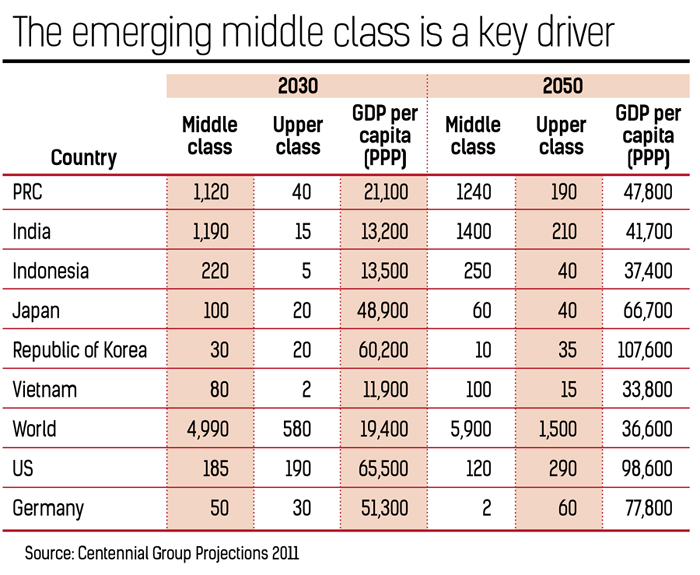
An extrapolation of the trend shows stunning economic prospects. The tables show the future GDP of a select Asia-Seven countries which will be the engine for growth both in Asia and the world; and the size of the middle class of leading Asian economies which will be the key driver of that growth. As noted, consumption by the global middle class accounts for one-third of global demand.

All this can get to the head. Is there already hubris? Japan as No.1? Look where it has been in the past two decades. Look at where the West have put itself after the triumphalism of Fukuyama’s “End of History” following the crashing down of the Berlin Wall in 1989 and the fall of communism. Mismanagement, wars, excess and denial.

Asia has its own set of political issues. The sense of superiority about Asian values that drove political systems does not any longer wash. Neither does the axiom economic growth alone will take care of everything, including political stability.

The world has changed since the halcyon days of Deng Xiaoping, Lee Kuan Yew or Mahathir. Civil society is more assertive. There has been global democratisation with the information technology (IT) revolution, whether domestic leaders like it or not. It is not that opinion and pressure work in favour of a particular system of western democracy. The call is for justice, rule of law, accountability, and against corruption. Asian political systems which do not deliver these political goods are setting themselves up for turmoil and instability, even insurrection and bloodshed – all of which will undermine, retard and reverse Asia’s economic rise.

IT access

Greater consciousness of individual and group rights arises from economic growth. Indeed, economic growth also facilitated IT access. The mistake in Asia is governments assuming the populace should show gratitude for the grapes of growth (not wrath!), and not to absorb the fact that people contributed to the growth and are entitled to it.

Governments cannot control the social consequences of economic growth for the individual or the development of his personality. When they try to do so they encounter resistance whether in the ballot box or on the streets, sometimes both. What they can do is to address the social costs such as inequality of income and opportunity, or environmental degradation.

In international politics, Asian governments have tended to be platitudinous in addressing issues that could upset the applecart of Asia’s economic rise. In South-East Asia, for instance, the Asean way has not developed into a means of dispute settlement. The fact there has been general peace in the region since the end of the Vietnam war in 1975 does not mean it will remain that way (but bear in mind, for instance, what the Pol Pot regime inflicted on Cambodia), especially with disputes unresolved in the South China Sea. The same applies to North-East Asia. There must be regional leadership and development of dispute settlement mechanisms, not just more and more meetings in the hope disputes will not boil over – and spoil the prospect of Asia’s economic rise.

EnginesGrowth

If more limited inter-state disputes and, particularly, intra-state problems are also taken into account – like between Thailand and Cambodia or the genocide in Myanmar or North Korean adventurism – it would appear Asia could be sitting on a tinderbox that may blow up its rosy economic future. There are clear risks that must be addressed.

Of course the risks most often mentioned are economic risks. The 1997-1998 crisis exposed structural macro-economic, financial and corporate governance problems which wrecked a number of Asian economies. Most of them have been addressed, putting Asia on a better footing when the 2008 Western financial and economic crisis came along – with roles rather reversed, Western economic and financial mismanagement being the cause of that disorder.

But with a difference.

Dominant Western economies

With their role and size, dominant Western economies can address their problems in ways rising Asian economies cannot. There is no way Indonesia or India, could have embarked on the kind of quantitative easing (QE) as the Fed has done in the United States without their currencies being taken to the cleaners. As a reserve currency, there is demand for the dollar beyond its net asset backing as it were. If we examined its macro-economic management, the United States fails on all scores: whether deficit as a proportion of GDP; total national debt, public or private; the trade deficit and so on.

Yet the US economy seems to have come out of the woods because of other strong factor endowments, particularly the reserve currency position of the dollar.

With demand for the dollar and with free movement of capital, the QE which the Fed had embarked on these past months to stimulate the US economy has benefited financial markets in fast growing economies as well – especially emerging Asia. Following talk of a tapering of the QE, with the American economy showing good signs of a revival and even Europe appearing to be turning around, there has been a flow-back which has affected the values of Asian currencies, bonds and stocks.

Massive risk

Therefore, even as Asia has risen, and is rising, it must never be forgotten it is a minnow in relation to the force of financial flows which are largely Western-driven. Although this time rising Asian financial markets have not been emptied because macro-economic management has so much improved, particularly level of external debt, the lesson that must not be forgotten is that Asian economies are exposed to financial flows largely outside their control – and these flows can destroy their economies if mismanaged. Herein lies a massive risk to Asia’s economic rise.

Until and unless Asian economies have become big enough to generate sustainable economic demand and to project financial markets whose products are a proxy of that demand – currency, bonds and stocks – rising Asia will have to adhere to the discipline of financial flows very much outside their control.

In the recent financial market tumult caused by expectation of the tapering of QE, a member of the Fed was reported to have said, emerging markets will have to fend for themselves. I was reminded of that time during the 1997-1998 crisis when, as chairman of the Securities Commission fighting our corner against the mayhem caused by unregulated hedge funds, I was simply told by a big market regulator: “if you can’t stand the heat, get out of the kitchen.”

Peaceful rise is not forever

28 September, 2013
As appeared in TheStar.com.my

China’s dilemmas in domestic and foreign policy

CHINA is already the second biggest economy in the world, on the cusp of becoming the largest in the not too distant future. With the world’s largest population and formidable military capability, it is more powerful than the Soviet Union ever was against the United States.

Yet, China is reticent about its success at home and role in the world. It would rather be left alone to continue with its “peaceful rise” to attend to many domestic challenges and to develop relations abroad without undue disturbance. But no power and economy its size can hope just to carry on the way it has these past three decades.

Although millions have been brought out of a-dollar-a-day poverty, over 100 million of its people still live on less than that. China’s per capita income is still less than those of nine African countries, according to LSE economist Danny Quah.

Its Gini coefficient, the measure of income inequality, has for the past decade been consistently above 0.4, the UN determined danger point for social stability (A score of one spells absolute inequality, so the lower the number the better it is). Development with equitable distribution is not taking place efficiently, whether among individuals or regions, the western parts of the country being still far behind the east and coastal areas.

Corruption is extensive which the high profile Bo Xilai trial only highlights. The ills of economic growth with disproportionate gain for some are becoming a plague on China. To add to this, environmental degradation has become a serious problem. The pollution level in 74 Chinese cities, including the capital Beijing, is over three times above the danger point set by WHO. It has been estimated life expectancy at birth in China is shortened by between seven and 12 years because of environmental deterioration.

And, against all these challenges of economic success, economic growth is slowing, a conundrum Chinese authorities have to further manage. Western authorities and economists now seem to move from fear of China to fear for China. Paul Krugman sees a crash into the Great Wall of the Chinese model of development. Having over-extended credit, the economy’s debt-fuelled asset bubble is about to burst, exposing large non-performing loans. Yet others see what economist Arthur Lewis described as the inexhaustible supply of cheap labour drying up which he claimed was behind the economic miracle of China and other emerging economies. Of course there is the usual call for China to restructure its economy, to switch from an investment-driven growth to a consumption-driven one, from export-led to domestically-charged expansion – if China is to avoid being caught in the middle income trap.

Ageing population

To boot, the population is ageing as a result of the one-child policy; so China will not reap the demographic dividend, a virile young population driving further growth and not a dependent, unproductive old one. All the time it is intoned that China’s underlying socio-political stability will be undermined if economic reforms are not put in place, together with reform of the political system.

The advice is not disinterested, even if China’s domestic challenges are truly huge. China must find a way out for itself and not be in denial because some the criticisms and cures offered by the West are not honest or consistent. If China is ageing, then the mantra of having to have at least 8% annual economic growth to absorb the work force coming onto the market does not hold true. Then, at least on this count, China’s slowing economy is not a catastrophe.

Those that will be hurt are other emerging and even Western economies as China has become an engine of global growth. Indeed many Western economies themselves are ageing. Then again, if China is to divert resources away from investment to consumption, how about those in the far west still on less than one-dollar-a-day who need to be linked to become part of a larger consumer base? What about bridging the wealth and income gap by providing the investment essentials to them of a better quality of life?

Thus, there is more than meets the eye on the advice proffered. But, there is also truth in some of them which should not be denied. China must make the balancing choices, an essential part of the management of any political economy. The new leadership is struggling to come up with a new national ethic. This is nowadays a difficult process in the globally democratised age of the IT revolution. Every netizen seems to have an opinion. It is not going to be as straightforward as Deng Xiaoping’s Four Modernisations or the Central Party School’s Peaceful Development, then to Rise and now back to Development, I think.

No.2 and growing

Even as China grapples with these momentous issues, the impact of its size on the world is not something that can be, shall we say, postponed. China is No.2 and growing. It could become Sparta to America’s Athens, rising Germany to stable old Europe, a challenging Japan denied status in the Pacific world, or a hostile Soviet Union seeking to overturn the established world order.

While most, not everything depends on the United States. China has a global role to play. How it is played will define how China is perceived as well as the outlines of the new global and regional order.

China cannot any longer avoid the role it must play by seeking to be left alone in its peaceful rise. Or by being insular and petulant in its foreign policy. Self-righteousness will be a defeatist strategy. It certainly cannot be a policy. Already, its nationalistic impulses have had negative ramifications, as can be seen from its territorial sea disputes in East and South-East Asia. China cannot be seen as attempting to assuage domestic pressures and challenges with international assertion and adventure.

China is not always in the wrong of course, but the way it conducts its foreign policy makes it appear not to be in the right. In South-East Asia, the benefits of its policy of economic cooperation since the 1997-98 financial crisis are not sufficiently underlined as the positive plank of foreign policy. Rather China retreats in hurt pride and spurned affection – and then comes out in anger. Beijing does not quite know how to turn swords into ploughshares. There is too much angst and emotion. This could be observed in the Scarborough Shoals stand-off with the Philippines last year, when the Philippines was not exactly innocent, but China came out as the bullying party. It could be seen even in the failure of Asean foreign ministers to issue a joint communiqué in July last year, widely observed as a consequence of Chinese mischief in tandem with their Cambodian ally.

But, what would have happened to Asean-China relations if an anti-Chinese communiqué had been issued? This is a point that has not been sufficiently advertised, with every commentator tearing his hair out about this first ever Asean failure because of Chinese machination.

Communication issue

It is often said China lacks soft power communication skills. Actually, soft power should be left out as an analytical tool here. China simply has to understand it has to communicate effectively, not intone. It has to develop the skills of subtle diplomacy as well as the ability to make foreign policy with a strategy to achieve its end. With that clarity and ability, China can avoid being wrong-footed, as in the South China Sea disputes, and being undermined after having invested so much economic goodwill.

The American pivot or rebalance to Asia-Pacific drew China into the purely political-security aspect of the US reassertion. China began to act as of it had some kind of Monroe Doctrine right over South-East Asia, just as the Americans claimed in Latin America. This was great power stuff, whereas China has always contended it does not have any such pretensions. President Xi Jinping had discussed with Barack Obama last June in Sunnylands about a “new type of great power relations.” Since then there has been much speculation on what that is all about. It is just G2? What about other relationships in any new world order?

The genius, perhaps unintended, of the US pivot and subsequent American initiatives is in their economic content while highlighting political and security matters in Asia-Pacific relations. In the sweep, previous Chinese economic advantages could be contained. After announcement of the pivot, former US Secretary of State Hillary Clinton led or participated in a number of business meetings in the region involving senior American corporate leaders, an association not often the case in US diplomacy. More senior American corporate leaders are actually represented in visits of the US-Asean Business Council to the region than previously.

Very importantly, American initiatives such as the Trans Pacific Partnership (TPP) and also, on the other side of the world, the Trans Atlantic Trade and Investment Partnership (TATIP), underline the basis of economic relations in significant and dominant blocs of the world (see table). They represent the strengthening of the Washington consensus, if one examines the trade and investment rules being espoused.

Indeed they also seek to repair rules that have been violated to protect interests such as intellectual property, investment rights and financial flows. Fundamentally, these initiatives have significant geopolitical consequence. As I have written previously, the Americans are not about to roll over and die against a rising China. Their palms are still wrapped around the globe.

When I asked a senior Chinese official during a visit to Beijing earlier this month why China has chosen not to participate in the TPP, the answer was: It would only benefit the big countries and their big companies.

When I suggested it would be better to participate to shape the rules that will govern trade and investment relations of the future, the answer was China’s Free Trade Agreements had worked well to the benefit of the member countries. The proposed Regional Comprehensive Economic Partnership (RCEP), which is a massive multilateral expression of such free trade agreements, is of course China’s preferred route.

Wrong turns

It would appear therefore that in terms of strategy in international politics, China would rather let the Americans make the running. Let the United States expend its “American exceptionalism” while China has the absorptive capacity of the Middle Kingdom. However, time may not always be on China’s side as it had been in the past. China has serious domestic problems with a discerning and demanding populace linked to the global democratic marketplace.

China has made a number of wrong turns in the conduct of its foreign policy which may make the Americans a more attractive strategic proposition. This is not the world where China will be left alone to get on with it. Better that China participates more actively in the making of that world even if it does not wish to upset it.

ASEAN industry captains to submit economic integration recommendations to governments

Singapore – The CIMB ASEAN Research Institute (CARI) will publish and submit the findings from its inaugural Network ASEAN Forum (NAF) to policymakers and ASEAN governments.

The one-day forum saw some 300 participants and industry captains from the region such as Jaime Augusto Zobel de Ayala, Chairman of the Philippines’ Ayala Corporation; Budi Sadikin, CEO of Indonesia’s Bank Mandiri and Nazir Razak, Group Chief Executive of Malaysia’s CIMB Group, brainstorm solutions to obstacles in the way of ASEAN economic integration.

Singapore’s Deputy Prime Minister and Finance Minister, Tharman Shanmugaratnam who delivered the NAF opener, said, “I’m optimistic because we know what the weaknesses are and their solutions, because we have a valuable asset in our openness and ability to cooperate and collaborate with each other as a region; and because of proactive private sector efforts such as the NAF, which seeks to work alongside ASEAN governments to realise our vision of an ASEAN Community.”

NAF Chairman and Managing Partner of Northstar Pacific Group, Indonesia, Patrick Walujo said that the NAF sent a clear message to the ASEAN public that the business community is committed to realize the ASEAN Economic Community (AEC) by 2015.

“This effort is dependent on public support and the gains certainly outweigh the pains. However, with less than a fifth of ASEAN businesses having made any plans for AEC 2015, it is abundantly clear that anyone in a position to make policy must make awareness a key consideration,” he added.

The concerns expressed in plenary sessions and six sector-specific roundtables followed a similar theme with participants expressing the need for the greater harmonisation of standards across the region. With their markets at differing levels of maturity and with policies that tend to lean towards protectionism, ASEAN remains largely fragmented.

The six sectors are Aviation, Capital Markets, Connectivity, Financial Services, Healthcare, and Infrastructure, Power & Utilities (IPU).

While resolving issues was a key consideration at the forum, NAF convenor and chair of the Capital Markets roundtable, Nazir Razak said the forum wanted to send a message to the governments of ASEAN member nations to prioritise and focus on achievable goals.

“Let’s get realistic about what’s really going to happen. We need to discuss some of the priority items we ought to do over the next 18 months and put together a roadmap for ASEAN,” he said.

Impetus for AEC also came from Zhang Lei, Founder & CEO of Hillhouse Capital Management, one of the world’s largest investment funds.

He said the region needed to be more consistent and robust in declaring its intentions if it is to lure investors like him.

“ASEAN needs a reliable and consistent message of opening up; something to make foreign investor feel there is a roadmap. It doesn’t matter what the current status is so long as we have a constancy of policy. That will be good for foreign investors,” he said at one of the NAF’s plenary sessions.

Zhang’s comments were echoed by participants at the Financial Services roundtable who urged regulators to be more proactive in discussions to liberalize the financial sector.

“It is my opinion that the financial services sector is one of the most regulated industries and that financial regulators are often the most powerful among industry regulators, very nationalistic and often, most conservative.

“In order to move forward towards regionalisation and meet the AEC 2015 deadline, the involvement of and communication between the respective ASEAN countries’ financial regulators is extremely critical,” said the co-chair of the Financial Services roundtable and CEO of Indonesia’s Bank Mandiri, Budi Sadikin.

Chairman of Ayala Corporation and IPU roundtable chair, Jaime Augusto Zobel de Ayala cited a number of barriers to integration which included the lack of transparency, issues of nationalism in investment, and changing goalposts.

The region, he added, should explore the possibility of an ASEAN fund as a way to bring down nationalism issues and create a friendlier pool of funds for infrastructure projects.

The chair of the Healthcare roundtable, Dr Lim Cheok Peng, Managing Director of IHH Healthcare said industry players need to explore possibilities to address disparities between rich and poorer countries in ASEAN.

“Governments must lift barriers to allow for public private partnerships that will help raise healthcare standards, capabilities and capacity of healthcare professions as well as access to medication,” he added.

Meanwhile, Tony Fernandes, AirAsia Group CEO and chair of Aviation roundtable said governments should open up airport infrastructure to private investors to meet growing passenger demand.

CEO of Indosat and the chair for the Connectivity roundtable, Alexander Rusli said the industry is now at a tipping point. With smartphones being so prevalent and consumers having many connectivity options, telcos across the region need to behave like a “single business unit” to ensure a seamless experience for its customers across ASEAN.

The inaugural NAF was organised by the CIMB ASEAN Research Institute (CARI), a public organisation committed to the development of the ASEAN Economic Community. CARI is also the secretariat of the ASEAN Business Club, a coalition of private sector players committed to the ASEAN agenda.

NAF Media Release: ASEAN private sector to propose solutions to regional economic integration

Network ASEAN Forum

Singapore: Captains of industry from the ASEAN region gathered here today at the inaugural Network ASEAN Forum (NAF) to thrash out issues that continue to stand in the way of the formation of an integrated ASEAN Economic Community by 2015.

Participants were unanimous in noting the near limitless potential of ASEAN as a key global trade and production base, whilst agreeing that much work remained to be done in ensuring seamless integration.

Singapore’s Deputy Prime Minister and Finance Minister, Tharman Shanmugaratnam who delivered the NAF opener, echoed these sentiments in his speech.

“I’m optimistic because we know what the weaknesses are, and their solutions; because we have a valuable asset in our openness and ability to cooperate and collaborate with each other as a region; and because of proactive private sector efforts such as the NAF that seek to work alongside ASEAN governments to realise our vision of an ASEAN Community,” he said.

Central to the forum are the sector-based ‘Lifting the Barriers’ roundtable sessions. These roundtable sessions saw participants discussing issues specific to six key sectors: Aviation; Connectivity; Infrastructure, Power and Utilities (IPU); Capital Markets; Financial Services; and Healthcare.

Universal themes from the three morning sessions roundtables, Aviation; Connectivity; IPU; emerged including the need for ASEAN-wide regulations, better communication and cooperation between key industry players and the abolishment of protectionist policies.

Speaking at the Aviation roundtable session, AirAsia Group CEO and Network ASEAN Forum 2013 (NAF) Convener, Tony Fernandes said the secretariat needed more “meat and muscle”.

“I would like to see the ASEAN Secretary General having greater power and influence on the economic direction so that we can channel our regional proposals to one body, which will then disseminate them to the different ASEAN governments,” he added.

His comments were reflective of the current state of the ASEAN market, which remains a largely fragmented region comprising a hodgepodge of local regulations and standards. The lack of a single ASEAN regulator in any industry and the proliferation of non-binding agreements have also played a role in preventing greater collaboration.

“We have identified a number of barriers to integration which included the lack of transparency, issues of nationalism in investment, and issues of changing goalposts,” said CEO of Ayala Corporation and IPU roundtable chair, Jaime Augusto Zobel de Ayala.

Meanwhile, CEO of Indosat and the chair for the connectivity roundtable, Alexander Rusli, said there was a need to view ASEAN as a “single unit of business”.

“We need to build an ecosystem through the ASEAN spirit with one set of standards defined across the board,” he also said.

“The end game has to be that [in the case of connectivity] wherever we bring our devices, charges have to be transparent and the user experience must be seamless. Otherwise, people will find other modes of communication,” he added.

NAF participants will attend a further three roundtable sessions focused on Capital Markets, Financial Services and Healthcare in the afternoon.

The outcome of these six roundtable discussions will be reflected in policy recommendations which will be published and presented to the policymakers.

The NAF is an event hosted by the CIMB ASEAN Research Institute (CARI), a public organisation committed to the development of the ASEAN Economic Community. CARI is also the secretariat of the ASEAN Business Club, a coalition of private sector players committed to the ASEAN agenda.

Speech by Mr Tharman Shanmugaratnam, Deputy Prime Minister & Minister for Finance at the Opening of the Inaugural Network ASEAN Forum

DPM speech

Speech by Mr Tharman Shanmugaratnam
_____

Mr Patrick Walujo, Chair of the Network ASEAN Forum

Members of the ASEAN Business Club Advisory Council

Distinguished guests, ladies and gentlemen

Introduction
1. I am pleased to join you today at the inaugural Network ASEAN Forum (NAF). Allow me to begin by thanking the CIMB ASEAN Research Institute (CARI) and the ASEAN Business Club (ABC) for bringing us together in Singapore for this first meeting of the NAF.

2. The theme for today’s discussion, “A Strategy for ASEAN”, is apt. ASEAN countries are at an important crossroads, both as individual nations and collectively as a region. I would like to take this opportunity to share some thoughts on the challenges and opportunities we face in the region, and the directions we can take to sustain growth and job creation, as well as maintain macro-economic stability.

Immediate challenge – the expected unwinding of QE in the US
3. Let me touch briefly first on the immediate situation which is something many of us here are watching very carefully. The Fed’s announcement that it could begin tapering off the pace of quantitative easing (QE) as US economic conditions improve was not unexpected. The current volatility in financial markets underscores the need for the tapering process, when it occurs, to be gradual and managed very carefully. But there was never a realistic prospect of a smooth and easy exit from QE. Financial volatility is likely to recur from time to time, given the markets’ tendency to anticipate and front-run monetary policy moves.

4. The tapering of QE and tightening of US monetary policy, when it eventually occurs, will not be a bad thing for the region’s economies. It is not in anyone’s interest, including the emerging economies, for very low global interest rates to continue indefinitely. Low or negative real interest rates have inevitably led to a search for yield, and a build-up of financial imbalances in Asia.

5. The unwinding of QE would also take place together with a recovery in the US, and is not in itself a negative for ASEAN countries. Growth among ASEAN countries has stronger structural underpinnings than in most other regions. Further, the risk of balance of payments crises in the region is relatively low. ASEAN countries have come a long way since the Asian Financial Crisis. Foreign currency debt levels are now much lower, and official foreign reserves much higher. Most ASEAN countries have shifted towards more flexible exchange rate regimes, which has reduced the risk of over-valued currencies and a sudden re-pricing of foreign currency debts. Financial regulatory and supervisory regimes are also now more robust, and bank’s capital buffers are adequate. The non-financial private sector too in ASEAN countries generally have healthy balance sheets.

Long term challenges – responding to a new global environment
6. Some ASEAN countries, like others in Asia, are putting into place immediate measures to calm the markets. However, the key to maintaining confidence in our economies must be to reinforce the fundamentals that support growth over the longer term. Our main priorities have to lie in improving the climate for long-term investments and building up skills and capabilities to drive growth and keep creating good jobs over the medium to long term.

7. In this regard, we have to recognise that the external environment for ASEAN countries will very likely be less supportive in the next five years and possibly beyond. First, there is a real risk of prolonged slow growth in the advanced world, even with recovery from the recession.

8. The US, still a major market for ASEAN, may see relatively low growth for some years. The long-run potential growth rate in the US is viewed by several economists as having fallen to around 2% or lower, compared to 2.5% in the past. Productivity growth has slowed, and will likely be weighed down in the coming years by the lower corporate investments in recent years, including in the recovery to date. Investments in R&D and innovation in particular have been weak. Further, the skills of those who have been unemployed for a long while would also have been eroded – almost half of those unemployed in the US have been out of a job for over six months, and many for over a year.

9. The Eurozone has the same difficulties in productivity growth and a loss of skills, but also more fundamental challenges. It is past the worst and there are signs of a gradual recovery, but there are no easy solutions that will bring growth back to its potential anytime soon. Japan on the other hand is recovering well. But it is too early to tell if structural reforms to liberalise the economy and put public finances on a more stable footing will be implemented as planned and lead to sustained growth. In the meantime, the weaker yen also limits the positive spill-over effects of a Japanese recovery for our region.

10. Overall, we have to expect subdued growth in the advanced world as a whole. The second major factor is China. China is shifting to a lower gear as demographic constraints begin to bite and as its new leadership addresses long-awaited structural reforms. While China’s restructuring holds significant opportunities for us – I will come back to this later – it also poses several challenges. China’s move up the value chain in manufacturing will mean greater competition for some ASEAN countries, especially if we stand still. China’s rebalancing from investment-oriented to consumption-led growth also heralds the end of the commodity “super-cycle”. The end of the boom in commodity prices increases the need to diversify our economies in ASEAN.

11. Third, global interest rates are likely to move higher over the next decade. This is not merely due to the gradual tightening of monetary policy in the US and elsewhere, but to structural factors and especially demographics. Ageing populations in the advanced world as well as China will increasingly limit the global savings pool at the same time when the demand for investments takes off in more developing economies. Without the advantage of low interest rates, policy actions are needed to improve the business environment and ensure adequate incentive for investors.

12. Fourth and last, there are also emerging trends in technology, particularly in robotics and additive manufacturing, and in energy costs with the rise of shale gas that will lead to new supply chains and new patterns of investment around the world. For example, international companies may re-shore certain manufacturing activities, or relocate them closer to final consumer markets in the developed world.

Refocusing our policy directions
13. Taking these trends together, we are therefore facing a significant change in our economic environment, a significant change that we would have to live with over the medium term, and perhaps longer than that.

14. It is therefore important for each of us to explore and open up every new opportunity for growth both domestically and regionally. Let me highlight four key priorities, each of which offering real prospects for improvement in the region’s growth.

15. First, we have to open up further, and create conducive conditions for private investment to grow.

16. Unlike China, which is shifting from investment to consumer-driven growth, ASEAN’s challenge is opposite – to rebuild investment levels. Investment rates remain well below the levels prevailing in the pre-Asian Financial Crisis years, notwithstanding a recent upswing. While it is probably true that there was over-investment before the Asian crisis when investment rates were running at about 33% of GDP (or over 40% in some individual economies), the current rates among the emerging ASEAN economies, averaging 25%, are lower than would be expected at their current stage of development.

17. Consumption remains a valuable source of growth in ASEAN economies, driven by an expanding middle-class. But the region’s average consumption ratio is already quite high, at about 60% (of GDP). To raise potential output growth and hence provide jobs for a young and rapidly-growing labour force in the region, we have to focusing on getting investments back up. This includes a more determined effort to remove impediments to long term, infrastructural investments.

18. It also includes, in some of our economies, reforms to allow labour markets to work more flexibly, and hence enable better employment creation in the formal economy. Flexible labour markets will also help ensure that wages grow in line with productivity over the medium term, and ASEAN’s economies remain competitive.

19. This brings me to the second priority, which is to invest in raising productivity. This is in fact a real opportunity in ASEAN. Productivity levels in ASEAN economies (excluding Singapore) range from 5% to 35% of the level in the US. There is tremendous scope left for convergence with the advanced world.

20. But convergence never occurs automatically. From the experience of the Asian NIEs, and before them Japan, the catch-up in productivity will be aided by expanding sectors such as manufacturing and tradeable services to absorb surplus labour from less efficient agricultural and rural activities. It also involves, in each and every sector, investing in technology and skills, and strengthening communications and other infrastructure.

21. A third priority in ASEAN is to ensure we can take advantage of opportunities in China’s evolving economy. China’s wages are rising rapidly, and will alter the Asian manufacturing supply chain. Some ASEAN economies with relatively low labour costs will benefit by taking over some segments of this supply chain. At the same time, there will be growing demand for higher value, more sophisticated products to cater to the rising middle class in China, even as Chinese producers themselves move up the same value curve. A new wave of growth in services is also expected in China, as it shifts from an investment-led economy to one driven by consumption, urbanisation and environmental concerns.

22. To take part in this new China, we will need to develop new capabilities, and meet the competitive pressures as China itself moves up the value curve.

23. In short, ASEAN is facing a twin challenge – on the outside, an adverse shift in external demand, and internally, supply-side and capability gaps that have to be addressed boldly, so that the region can grow at its full potential. Each of us will have to think hard about the structural reforms that are needed, in education and skills training, legal and regulatory frameworks for investors, and labour markets.

24. I should emphasise that we are not starting from a bad point. ASEAN countries have outperformed many or their emerging market counterparts in other regions. For instance, the Philippines has become the largest call centre in the world, and has also established itself as the world’s fourth largest shipbuilder. Car production in Indonesia has grown by more than 50% over the last three years. By leveraging off its huge domestic market to gain economies of scale, Indonesia is acquiring a competitive advantage in the automobile industry.

25. But we have to go further. It is the reality of economic life that each time you reach a higher level, the need for institutional reforms becomes more complex. Deeper institutional reforms are required if ASEAN is to move from comprising low and middle-income countries to being middle and upper middle-income.

Harnessing opportunities in regional integration
26. Let me come to the fourth priority, which is to accelerate regional integration in ASEAN. This is in many ways an enabler for the other three priorities. We have huge opportunities to be developed through intra-ASEAN trade and investment.

27. While import tariffs on goods have in most part been eliminated, intra-ASEAN trade still has much scope to grow as non-tariff barriers including quotas as well as complex customs and import licencing procedures are reduced or streamlined, and as services sectors are liberalised under the ASEAN Economic Community (AEC) blueprint.

28. ASEAN’s efforts to boost cross-border transport links under the Master Plan on ASEAN Connectivity (MPAC) will also complement trade integration and reduce costs. One such example is the “completion of the Singapore Kunming Rail Link (SKRL) Missing Links”. (The completion of about 4,000 kilometres of missing links in the Indochina region will see a complementary mode of land transportation eventually connecting Singapore, through Malaysia, Thailand, Cambodia and Vietnam, to southern China.) Most of the measures for the SKRL Missing Links project are underway, with ongoing feasibility studies and funding arrangements being worked out.

29. The benefits from trade creation and increased investment often also provide impetus for structural reforms at home, which will inevitably face resistance from vested interests. We have seen this positive feedback between regional integration and domestic reform in other regions. Within ASEAN, the AEC has played a useful role in reshaping policy debates at home and helping to align domestic regulations with regional commitments, such as those reflected in the goods, services and investment agreements in the AEC. Further, by growing the overall regional pie, difficult domestic tradeoffs can become more palatable.

30. ASEAN countries have made significant progress in harmonising standards and regulations, which have lowered costs for businesses and reduced the time-to-market in sectors such as electronics, electrical equipment, medical devices and pharmaceuticals. We must ensure similar progress in services liberalisation.

31. Going forward, we have set our sights higher with the Regional Comprehensive Economic Partnership (RCEP), which will comprise ASEAN and our six ASEAN FTA partners – China, Korea, Japan, India, Australia and New Zealand. The RCEP will link up ASEAN’s trading partners, several of whom do not have existing trade agreements with one another. Our vision is to achieve a modern, comprehensive and high quality agreement, with significant improvements over current ASEAN+1 FTAs. Together with the Trans-Pacific Partnership (TPP), the RCEP could provide a possible pathway to an Asia-Pacific FTA.

32. In short: we have to intensify efforts to deliver our AEC commitments on schedule and begin scoping out the work for future regional economic initiatives post 2015.

Financial markets as an enabling factor
33. Let me finally say a few things about the prospects for integration in financial markets.

34. Building greater depth and breadth in regional financial markets is a critical enabling factor in achieving our goals to boost investments at home, as well as to expand intra-regional trade and investment.

35. Deeper and wider markets, by boosting liquidity and competition, will help to reduce funding costs at a time when interest rates are likely to normalise and rise globally. Corporate bond markets in particular will offer needed diversification for Asian businesses. We also need to develop securitisation markets, with appropriate safeguards, so as to tap broader investor pools as well as allow banks to recycle their capital and invest in new projects.

36. The integration of financial markets within ASEAN and Asia, would also strengthen our individual and collective resilience to external financial shocks, compared to each national market standing on its own, smaller and less liquid.

37. Our regulators are working actively to harmonise rules and market practices across the region, to encourage cross-border flows while mitigating the risks that could arise from them. More too is being done to boost linkages between our markets and economies, and pool liquidity across our markets. Let me mention three examples of these initiatives:

  • An example is the ASEAN Trading Link, launched last year by the stock exchanges in Malaysia, Singapore and Thailand, which allows investors in any participating country to trade securities in the other two markets through a single access point. We can expect other regional stock exchanges, e.g. from Indonesia, Philippines and Vietnam, to join in later. The ASEAN Finance Ministers also agreed in April this year to develop “post-trade linkages” for clearing, settlement and custody to support and enhance the value of the trading link.
  • Another example is the mutual recognition framework for mutual funds (or unit trusts), which will allow funds established in one ASEAN country to be offered to retail investors in other participating ASEAN countries under a streamlined authorisation process, as long as they satisfy a set of eligibility criteria and are well-managed. Once implemented, fund managers will be able to market their funds to other ASEAN markets, while ASEAN investors will benefit from a wider choice of products. Like the ASEAN Trading Link, we expect several countries to implement this first, with others to follow later.
  • A third example is the common prospectus framework for securities offering, which would make it easier and less costly for companies to raise funds across the region by allowing the use of a single prospectus. The first phase of this effort was recently completed when Malaysia, Singapore and Thailand implemented the harmonised ASEAN Disclosure Standards for prospectuses in April 2013. Regulators are now developing a framework that will streamline the approval process for prospectuses across ASEAN countries so that the time needed for listing in multiple markets will be the same as listing in one market.

Conclusion
38. I am optimistic about ASEAN’s prospects.

39. We are at a good starting point. We are also in the right part of the world where there are significant growth opportunities not just domestically but also to be achieved through greater regional integration. While our external environment has gotten tougher, it is a useful reminder that our domestic and regional fundamentals have to be enhanced if we wish to offset negative spill-over effects, and in fact improve our growth performance.

40. I am optimistic because we know what the weaknesses are, and their solutions; because we have a valuable asset in our openness and ability to cooperate and collaborate with each other as a region; and because of proactive private sector efforts such as the NAF that seek to work alongside ASEAN governments to realise our vision of an ASEAN Community.

ASEAN Secretariat Needs More Muscle, Says Air Asia’s Fernandes

SINGAPORE, Aug 23 (NNN-Bernama) — AirAsia Group Chief Executive Officer (CEO) and Network ASEAN Forum 2013 (NAF) Convener Tony Fernandes says the regional secretariat needs more “meat and muscle”.

Speaking at the aviation roundtable session of the inaugural Network Asean Forum (NAF) here today, he added: “I would like to see the Asean Secretary General having greater power and influence on the economic direction.

“This is so that we can channel our regional proposals to one body, which will then disseminate them to the different Asean governments.”

His comments were reflective of the current state of the Asean market, which remains a largely fragmented region comprising a hodgepodge of local regulations and standards.

Participants were unanimous in noting the near limitless potential of Asean as a key global trade and production base, whilst agreeing that much work remained to be done in ensuring seamless integration.

The one-day inaugural NAF saw captains of industry from the region gather to thrash out issues that continue to stand in the way of the formation of an integrated Asean Economic Community (AEC) by 2015.

Central to the forum was the sector-based “Lifting the Barriers’ roundtable sessions.

These roundtable sessions saw participants discussing issues specific to six key sectors, namely, aviation, connectivity, infrastructure, power and utilities(IPU), capital markets, financial services and healthcare.

Universal themes that emerged from the three morning sessions roundtables of aviation, connectivity and IPU included the need for Asean-wide regulations, better communication and cooperation between key industry players and the abolishment of protectionist policies.

The lack of a single Asean regulator in any industry and the proliferation of non-binding agreements has also played a role in preventing greater collaboration.

“We have identified a number of barriers to integration which includes the lack of transparency, issues of nationalism in investment, and of changing goalposts,” said the CEO of Ayala Corporation and IPU roundtable chair,Jaime Augusto Zobel de Ayala.

Meanwhile, the CEO of Indosat and the chair for the connectivity roundtable, Alexander Rusli, said there was a need to view Asean as a “single unit of business”.

“We need to build an ecosystem through the Asean spirit with one set of standards defined across the board.

“The end game has to be that (in the case of connectivity), wherever we bring our devices, charges have to be transparent and the user experience must be seamless. Otherwise, people will find other modes of communication,” he added.

The outcome of the six roundtable discussions will be reflected in policy recommendations which will be published and presented to the policymakers.

The NAF is an event hosted by the CIMB ASEAN Research Institute (CARI), a public organisation committed to the development of the Asean Economic Community.

CARI is also the secretariat of the Asean Business Club, a coalition of private sector players committed to the Asean agenda.

Speech by Mr Tharman Shanmugaratnam, Deputy Prime Minister & Minister for Finance at the Opening of the Inaugural Network ASEAN Forum

DPM speech

Speech by Mr Tharman Shanmugaratnam
_____

Mr Patrick Walujo, Chair of the Network ASEAN Forum

Members of the ASEAN Business Club Advisory Council

Distinguished guests, ladies and gentlemen

Introduction
1. I am pleased to join you today at the inaugural Network ASEAN Forum (NAF). Allow me to begin by thanking the CIMB ASEAN Research Institute (CARI) and the ASEAN Business Club (ABC) for bringing us together in Singapore for this first meeting of the NAF.

2. The theme for today’s discussion, “A Strategy for ASEAN”, is apt.  ASEAN countries are at an important crossroads, both as individual nations and collectively as a region. I would like to take this opportunity to share some thoughts on the challenges and opportunities we face in the region, and the directions we can take to sustain growth and job creation, as well as maintain macro-economic stability.

Immediate challenge – the expected unwinding of QE in the US
3. Let me touch briefly first on the immediate situation which is something many of us here are watching very carefully. The Fed’s announcement that it could begin tapering off the pace of quantitative easing (QE) as US economic conditions improve was not unexpected. The current volatility in financial markets underscores the need for the tapering process, when it occurs, to be gradual and managed very carefully. But there was never a realistic prospect of a smooth and easy exit from QE. Financial volatility is likely to recur from time to time, given the markets’ tendency to anticipate and front-run monetary policy moves.

4.  The tapering of QE and tightening of US monetary policy, when it eventually occurs, will not be a bad thing for the region’s economies. It is not in anyone’s interest, including the emerging economies, for very low global interest rates to continue indefinitely. Low or negative real interest rates have inevitably led to a search for yield, and a build-up of financial imbalances in Asia.

5. The unwinding of QE would also take place together with a recovery in the US, and is not in itself a negative for ASEAN countries. Growth among ASEAN countries has stronger structural underpinnings than in most other regions. Further, the risk of balance of payments crises in the region is relatively low. ASEAN countries have come a long way since the Asian Financial Crisis. Foreign currency debt levels are now much lower, and official foreign reserves much higher. Most ASEAN countries have shifted towards more flexible exchange rate regimes,  which has reduced the risk of over-valued currencies and a sudden re-pricing of foreign currency debts. Financial regulatory and supervisory regimes are also now more robust, and bank’s capital buffers are adequate. The non-financial private sector too in ASEAN countries generally have healthy balance sheets.

Long term challenges – responding to a new global environment
6. Some ASEAN countries, like others in Asia, are putting into place immediate measures to calm the markets. However, the key to maintaining confidence in our economies must be to reinforce the fundamentals that support growth over the longer term. Our main priorities have to lie in improving the climate for long-term investments and building up skills and capabilities to drive growth and keep creating good jobs over the medium to long term.

7. In this regard, we have to recognise that the external environment for ASEAN countries will very likely be less supportive in the next five years and possibly beyond. First, there is a real risk of prolonged slow growth in the advanced world, even with recovery from the recession.

8. The US, still a major market for ASEAN, may see relatively low growth for some years. The long-run potential growth rate in the US is viewed by several economists as having fallen to around 2% or lower, compared to 2.5% in the past. Productivity growth has slowed, and will likely be weighed down in the coming years by the lower corporate investments in recent years, including in the recovery to date. Investments in R&D and innovation in particular have been weak. Further, the skills of those who have been unemployed for a long while would also have been eroded – almost half of those unemployed in the US have been out of a job for over six months, and many for over a year.

9. The Eurozone has the same difficulties in productivity growth and a loss of skills, but also more fundamental challenges. It is past the worst and there are signs of a gradual recovery, but there are no easy solutions that will bring growth back to its potential anytime soon.  Japan on the other hand is recovering well. But it is too early to tell if structural reforms to liberalise the economy and put public finances on a more stable footing will be implemented as planned and lead to sustained growth. In the meantime, the weaker yen also limits the positive spill-over effects of a Japanese recovery for our region.

10.  Overall, we have to expect subdued growth in the advanced world as a whole. The second major factor is China. China is shifting to a lower gear as demographic constraints begin to bite and as its new leadership addresses long-awaited structural reforms. While China’s restructuring holds significant opportunities for us – I will come back to this later – it also poses several challenges. China’s move up the value chain in manufacturing will mean greater competition for some ASEAN countries, especially if we stand still. China’s rebalancing from investment-oriented to consumption-led growth also heralds the end of the commodity “super-cycle”. The end of the boom in commodity prices increases the need to diversify our economies in ASEAN.

11. Third, global interest rates are likely to move higher over the next decade. This is not merely due to the gradual tightening of monetary policy in the US and elsewhere, but to structural factors and especially demographics. Ageing populations in the advanced world as well as China will increasingly limit the global savings pool at the same time when the demand for investments takes off in more developing economies. Without the advantage of low interest rates, policy actions are needed to improve the business environment and ensure adequate incentive for investors.

12. Fourth and last, there are also emerging trends in technology, particularly in robotics and additive manufacturing, and in energy costs with the rise of shale gas that will lead to new supply chains and new patterns of investment around the world. For example, international companies may re-shore certain manufacturing activities, or relocate them closer to final consumer markets in the developed world.

Refocusing our policy directions
13. Taking these trends together, we are therefore facing a significant change in our economic environment, a significant change that we would have to live with over the medium term, and perhaps longer than that.

14. It is therefore important for each of us to explore and open up every new opportunity for growth both domestically and regionally. Let me highlight four key priorities, each of which offering real prospects for improvement in the region’s growth.

15. First, we have to open up further, and create conducive conditions for private investment to grow.

16. Unlike China, which is shifting from investment to consumer-driven growth, ASEAN’s challenge is opposite – to rebuild investment levels. Investment rates remain well below the levels prevailing in the pre-Asian Financial Crisis years, notwithstanding a recent upswing. While it is probably true that there was over-investment before the Asian crisis when investment rates were running at about 33% of GDP (or over 40% in some individual economies), the current rates among the emerging ASEAN economies, averaging 25%, are lower than would be expected at their current stage of development.

17. Consumption remains a valuable source of growth in ASEAN economies, driven by an expanding middle-class. But the region’s average consumption ratio is already quite high, at about 60% (of GDP). To raise potential output growth and hence provide jobs for a young and rapidly-growing labour force in the region, we have to focusing on getting investments back up. This includes a more determined effort to remove impediments to long term, infrastructural investments.

18. It also includes, in some of our economies, reforms to allow labour markets to work more flexibly, and hence enable better employment creation in the formal economy. Flexible labour markets will also help ensure that wages grow in line with productivity over the medium term, and ASEAN’s economies remain competitive.

19. This brings me to the second priority, which is to invest in raising productivity. This is in fact a real opportunity in ASEAN.  Productivity levels in ASEAN economies (excluding Singapore) range from 5% to 35% of the level in the US. There is tremendous scope left for convergence with the advanced world.

20. But convergence never occurs automatically. From the experience of the Asian NIEs, and before them Japan, the catch-up in productivity will be aided by expanding sectors such as manufacturing and tradeable services to absorb surplus labour from less efficient agricultural and rural activities. It also involves, in each and every sector, investing in technology and skills, and strengthening communications and other infrastructure.

21. A third priority in ASEAN is to ensure we can take advantage of opportunities in China’s evolving economy. China’s wages are rising rapidly, and will alter the Asian manufacturing supply chain. Some ASEAN economies with relatively low labour costs will benefit by taking over some segments of this supply chain. At the same time, there will be growing demand for higher value, more sophisticated products to cater to the rising middle class in China, even as Chinese producers themselves move up the same value curve. A new wave of growth in services is also expected in China, as it shifts from an investment-led economy to one driven by consumption, urbanisation and environmental concerns.

22. To take part in this new China, we will need to develop new capabilities, and meet the competitive pressures as China itself moves up the value curve.

23. In short, ASEAN is facing a twin challenge – on the outside, an adverse shift in external demand, and internally, supply-side and capability gaps that have to be addressed boldly, so that the region can grow at its full potential. Each of us will have to think hard about the structural reforms that are needed, in education and skills training, legal and regulatory frameworks for investors, and labour markets.

24. I should emphasise that we are not starting from a bad point. ASEAN countries have outperformed many or their emerging market counterparts in other regions. For instance, the Philippines has become the largest call centre in the world, and has also established itself as the world’s fourth largest shipbuilder. Car production in Indonesia has grown by more than 50% over the last three years. By leveraging off its huge domestic market to gain economies of scale, Indonesia is acquiring a competitive advantage in the automobile industry.

25. But we have to go further. It is the reality of economic life that each time you reach a higher level, the need for institutional reforms becomes more complex. Deeper institutional reforms are required if ASEAN is to move from comprising low and middle-income countries to being middle and upper middle-income.

Harnessing opportunities in regional integration
26. Let me come to the fourth priority, which is to accelerate regional integration in ASEAN. This is in many ways an enabler for the other three priorities. We have huge opportunities to be developed through intra-ASEAN trade and investment.

27. While import tariffs on goods have in most part been eliminated, intra-ASEAN trade still has much scope to grow as non-tariff barriers including quotas as well as complex customs and import licencing procedures are reduced or streamlined, and as services sectors are liberalised under the ASEAN Economic Community (AEC) blueprint.

28. ASEAN’s efforts to boost cross-border transport links under the Master Plan on ASEAN Connectivity (MPAC) will also complement trade integration and reduce costs. One such example is the “completion of the Singapore Kunming Rail Link (SKRL) Missing Links”. (The completion of about 4,000 kilometres of missing links in the Indochina region will see a complementary mode of land transportation eventually connecting Singapore, through Malaysia, Thailand, Cambodia and Vietnam, to southern China.) Most of the measures for the SKRL Missing Links project are underway, with ongoing feasibility studies and funding arrangements being worked out.

29. The benefits from trade creation and increased investment often also provide impetus for structural reforms at home, which will inevitably face resistance from vested interests. We have seen this positive feedback between regional integration and domestic reform in other regions. Within ASEAN, the AEC has played a useful role in reshaping policy debates at home and helping to align domestic regulations with regional commitments, such as those reflected in the goods, services and investment agreements in the AEC. Further, by growing the overall regional pie, difficult domestic tradeoffs can become more palatable.

30. ASEAN countries have made significant progress in harmonising standards and regulations, which have lowered costs for businesses and reduced the time-to-market in sectors such as electronics, electrical equipment, medical devices and pharmaceuticals. We must ensure similar progress in services liberalisation.

31. Going forward, we have set our sights higher with the Regional Comprehensive Economic Partnership (RCEP), which will comprise ASEAN and our six ASEAN FTA partners – China, Korea, Japan, India, Australia and New Zealand. The RCEP will link up ASEAN’s trading partners, several of whom do not have existing trade agreements with one another. Our vision is to achieve a modern, comprehensive and high quality agreement, with significant improvements over current ASEAN+1 FTAs. Together with the Trans-Pacific Partnership (TPP), the RCEP could provide a possible pathway to an Asia-Pacific FTA.

32. In short: we have to intensify efforts to deliver our AEC commitments on schedule and begin scoping out the work for future regional economic initiatives post 2015.

Financial markets as an enabling factor
33. Let me finally say a few things about the prospects for integration in financial markets.

34. Building greater depth and breadth in regional financial markets is a critical enabling factor in achieving our goals to boost investments at home, as well as to expand intra-regional trade and investment.

35. Deeper and wider markets, by boosting liquidity and competition, will help to reduce funding costs at a time when interest rates are likely to normalise and rise globally. Corporate bond markets in particular will offer needed diversification for Asian businesses. We also need to develop securitisation markets, with appropriate safeguards, so as to tap broader investor pools as well as allow banks to recycle their capital and invest in new projects.

36. The integration of financial markets within ASEAN and Asia, would also strengthen our individual and collective resilience to external financial shocks, compared to each national market standing on its own, smaller and less liquid.

37. Our regulators are working actively to harmonise rules and market practices across the region, to encourage cross-border flows while mitigating the risks that could arise from them. More too is being done to boost linkages between our markets and economies, and pool liquidity across our markets. Let me mention three examples of these initiatives:

  • An example is the ASEAN Trading Link, launched last year by the stock exchanges in Malaysia, Singapore and Thailand, which allows investors in any participating country to trade securities in the other two markets through a single access point. We can expect other regional stock exchanges, e.g. from Indonesia, Philippines and Vietnam, to join in later. The ASEAN Finance Ministers also agreed in April this year to develop “post-trade linkages” for clearing, settlement and custody to support and enhance the value of the trading link.
  • Another example is the mutual recognition framework for mutual funds (or unit trusts), which will allow funds established in one ASEAN country to be offered to retail investors in other participating ASEAN countries under a streamlined authorisation process, as long as they satisfy a set of eligibility criteria and are well-managed. Once implemented, fund managers will be able to market their funds to other ASEAN markets, while ASEAN investors will benefit from a wider choice of products. Like the ASEAN Trading Link, we expect several countries to implement this first, with others to follow later.
  • A third example is the common prospectus framework for securities offering, which would make it easier and less costly for companies to raise funds across the region by allowing the use of a single prospectus. The first phase of this effort was recently completed when Malaysia, Singapore and Thailand implemented the harmonised ASEAN Disclosure Standards for prospectuses in April 2013. Regulators are now developing a framework that will streamline the approval process for prospectuses across ASEAN countries so that the time needed for listing in multiple markets will be the same as listing in one market.

Conclusion
38. I am optimistic about ASEAN’s prospects.

39. We are at a good starting point. We are also in the right part of the world where there are significant growth opportunities not just domestically but also to be achieved through greater regional integration. While our external environment has gotten tougher, it is a useful reminder that our domestic and regional fundamentals have to be enhanced if we wish to offset negative spill-over effects, and in fact improve our growth performance.

40. I am optimistic because we know what the weaknesses are, and their solutions; because we have a valuable asset in our openness and ability to cooperate and collaborate with each other as a region; and because of proactive private sector efforts such as the NAF that seek to work alongside ASEAN governments to realise our vision of an ASEAN Community.

Today: Fed tapering ‘will not be a bad thing’ for ASEAN

SINGAPORE — The current bout of uncertainty in financial markets underscores the need for the United States Federal Reserve to scale back its stimulus measures in a gradual and carefully managed process, but the so-called tapering will not be a bad thing, Deputy Prime Minister Tharman Shanmugaratnam said yesterday.

While market volatility will likely recur from time to time, members of the Association of South-east Asian Nations (ASEAN) are in a good position to weather large amounts of capital outflow as growth in the region is supported by solid fundamentals, he added.

“The tapering of quantitative easing and tightening of US monetary policy, when it eventually occurs, will not be a bad thing for the region’s economies. It is not in anyone’s interest, including emerging economies, for very low global interest rates to continue indefinitely. Low or negative interest rates have inevitably led to a search for yield, and a build-up of financial imbalances in Asia,” Mr Tharman said at the inaugural Network ASEAN Forum here.

“The (winding-down) of QE would also take place together with a recovery in the US, and is not in itself a negative for ASEAN countries. Growth among ASEAN countries has stronger structural underpinnings than in most other regions,” he said.

Mr Tharman also noted that the ASEAN countries had come a long way since the 1997 Asian financial crisis, when the region was hit by large-scale capital flight that sent many economies into a tailspin.

“Foreign currency debt levels are now much lower, and official foreign reserves much higher. Most ASEAN countries have shifted towards more flexible exchange-rate regimes, which has reduced the risk of overvalued currencies and a sudden re-pricing of foreign currency debt. Financial regulatory and supervisory regimes are also now more robust, and banks’ capital buffers are adequate.”

Earlier this week, shares in the region plummeted on worries that the US Federal Reserve would start winding down its US$85 billion (S$109 billion)-a-month bond buying programme as early as next month. On Tuesday, the Straits Times Index fell into the red for the year to date, while the Jakarta Composite Index plunged to its lowest in almost a year.

But while the advanced economies recover, relatively low growth in ASEAN’s main trading partners such as the US and euro zone means that external factors will be less supportive than before and will likely stay so in the next five years or more, Mr Tharman warned.

Meanwhile, China’s economic restructuring may pose greater competition for some ASEAN countries.

“China’s rebalancing from investment-oriented to consumption-led growth also heralds the end of the commodity ‘super-cycle’. The end of the boom in commodity prices increased the need to diversify our economies in ASEAN,” said Mr Tharman.

However, China’s evolving economy also offers opportunities. Rising income levels and an expanding middle class in the country will create greater demand for higher-value and more sophisticated products, which some countries can tap for growth.