Special update on 28th & 29th ASEAN Summits

Summit Theme

The theme for the 28th ASEAN Summit under Lao PDR’s chairmanship was “Turning Vision Into Reality For A Dynamic ASEAN Community” as ASEAN begins first year journey in ASEAN Community building.


8 Priorities under Lao Chairmanship

  1. Implementation of the ASEAN Community Vision 2025
  2. Narrowing of the development gap
  3. Trade facilitation
  4. Micro, small and medium-sized enterprises (MSMEs) development
  5. Tourism development
  6. Connectivity
  7. Transition to formal economy in ASEAN
  8. Reinforcing cultural heritage cooperation in ASEAN

Outcome of Summits

  1. ASEAN Declaration on One ASEAN, One Response: ASEAN Responding to Disasters as One in the Region and Outside the Region
  2. Vientiane Declaration on the Adoption of the Initiative for ASEAN Integration Work Plan III
  3. Vientiane Declaration on the Adoption of the Master Plan on ASEAN Connectivity 2025
  4. Vientiane Declaration on Transition from Informal Employment to Formal Employment towards Decent Work Promotion in ASEAN
  5. Vientiane Declaration on Reinforcing Cultural Heritage Cooperation in ASEAN
  6. ASEAN Declaration on Strengthening Education for Out-of-School Children and Youth
  7. ASEAN Joint Statement on Biodiversity Conservation to the Thirteenth Meeting of the Conference of Parties to the Convention on Biological Diversity (CBD COP-13)
  8. ASEAN Joint Statement on Climate Change to the Twenty-Second Session of the Conference of the Parties to the United Nations Framework Convention on Climate Change (UNFCCC COP-22)
  9. ASEAN Declaration of Commitment on HIV and AIDS: Fast Tracking and Sustaining HIV and AIDS Response to End the AIDS Epidemic by 2030.

Update on ASEAN Community Building

  1. ASEAN Community Vision 2025
      The Summits adopted:

    • Master Plan on ASEAN Connectivity (MPAC) 2025 (see below)
    • Initiative for ASEAN Integration (IAI) Work Plan III (see below)
  2. The Summit reaffirmed peaceful resolution of disputes in accordance with the principles of international law, including the 1982 United Nations Convention on the Law of the Sea (UNCLOS).
  3. ASEAN Community Vision 2025 will be implemented in a mutually-reinforcing manner with United Nations 2030 Agenda for Sustainable Development
  4. Strengthening the ASEAN Secretariat and Reviewing the ASEAN Organs
    • The relevant High Level Task Force (HLTF) has made recommendations for more streamlined coordination and efficient work processes within ASEAN institutions

Economic Performance

  • In 2015, ASEAN’s combined GDP stood at USD2.43 trillion while real GDP grew at 4.7% amidst increasingly challenging global conditions.
  • Despite external headwinds, ASEAN economic outlook is projected to remain resilient at 4.5% in 2016, underpinned by strong public and private consumption, robust infrastructure spending and accommodative fiscal policy, before accelerating to 4.8% in 2017.
  • ASEAN’s merchandise trade performance, which reached USD2.28 trillion in 2015, with intra-regional trade accounting for the largest share at 24% or USD545 billion.
  • Total foreign direct investment (FDI) inflows to the region remained resilient at USD120 billion in 2015, with the services sector as the largest contributor at 62.5%.
  • At 18.5% of total FDI inflows or USD22.1 billion, intra-ASEAN FDI inflows also accounted for the largest share of FDI inflows to the region.

Progress of ASEAN Economic Community 2025

  1. In 2016, efforts have been focused on completing the remaining AEC 2015 measures as well as initiating the implementation of new measures under the AEC Blueprint 2025. The following deliverables have been adopted at the 48th ASEAN Economic Ministers (AEM) Meeting:
    1. ASEAN Trade Facilitation Framework;
    2. ASEAN Food Safety Regulatory Framework (AFSRF);
    3. ASEAN Institutional Framework on Access to Finance for MSME;
    4. Report and Work Programme on Starting a Business in ASEAN; and
    5. ASEAN Guidelines for Special Economic Zones Development & Collaboration.
    6. Launch of the ASEAN Tariff Finder website, which is a no-cost online- based tariff search facility.
  2. Pakse Declaration on ASEAN Roadmap for Strategic Development of Ecotourism Clusters and Corridors was adopted by ASEAN Tourism Ministers, which aims at achieving a balanced sustainable development of ecotourism in ASEAN.
  3. Work plans on e-Commerce and good regulatory practice are currently being finalised. We tasked the Sectoral Bodies to ensure effective implementation of these work plans.
  4. The AEC 2025 Monitoring and Evaluation (M&E) Framework was endorsed which is comprised of compliance-monitoring, outcomes- monitoring, and impact evaluation to help ensure the timely and effective implementation of the AEC Blueprint 2025.
  5. The AEC 2025 Consolidated Strategic Action Plan (SAP), as envisioned in the AEC Blueprint 2025, is under development.
  6. Reaffirmed commitments to address non-tariff barriers (NTB) to trade and accord high priority to trade facilitation initiatives.
  7. Operationalisation of the ASEAN Solutions for Investments, Services and Trade (ASSIST), which is aimed at helping businesses address complaints about NTBs for trade in goods.
  8. The establishment of National Trade Repository (NTRs) by all ASEAN Member States while the process of linking the NTRs to the ASEAN Trade Repository (ATR) is still underway.
  9. The exchange of live data of the electronic ATIGA Form D by Indonesia, Singapore and Thailand in the ASEAN Single Window (ASW) production environment. Once fully operationalised, the ASW will provide a regional facility to enable a seamless, standardised and harmonised routing and communication of trade and customs related data among the National Single Windows (NSWs) to expedite customs clearance and release.
  10. The ASEAN Customs Transit System (ACTS) which facilitates the movement of transit goods across the borders in ASEAN is piloting in Malaysia, Singapore and Thailand.
  11. The MRA on Bio-Equivalence (BE) Study Report on Generic Medicinal Products, which will facilitate the movement of generic medicinal products within ASEAN. is completed.
  12. ASEAN Agreement on Movement of Natural Persons (MNP), which shall facilitate the movement of ASEAN people engaging in trade in goods, trade in services and investment in the region, has entered into force. The ASEAN Qualification Reference Framework (AQRF) Governance and Structure, a cross-sectoral and cross-pillar initiative, by the ASEAN Labour Ministers, ASEAN Education Ministers, and ASEAN Economic Ministers, has been endorsed. AQRF will be implemented on a voluntary basis.
  13. 9 AMSs have enacted competition laws, and that the newer competition regimes are in the process of establishing competition agencies to implement their competition laws. The implementation of the ASEAN Competition Action Plan 2025 will be carried out by phases.
  14. Initiatives under the ASEAN Strategic Action Plan on Consumer Protection 2025 towards a common ASEAN consumer protection framework will be developed.
  15. The ASEAN Intellectual Property Rights (IPR) Action Plan 2016-2025 is to be implemented.
  16. Private sector engagement:
    • Focus of ASEAN-BAC 2016: four priority sectors of agri-food, retail, logistics and healthcare, and on the horizontal issues of trade facilitation, e-Commerce and the development of MSMEs, young entrepreneurs and women entrepreneurs
    • ASEAN Strategic Action Plan for SME Development 2016-2025 (SAPSMED 2025) action plan overseen by the ASEAN Coordinating Committee on Micro, Small and Medium Enterprises (ACCMSME), coordinates collaboration among ASEAN
    • Launch of the ASEAN SME Service Centre Web Portal as an information hub for MSMEs operating in the region
    • Launch of ASEAN SME Academy a self-help and self- paced online learning tool for SMEs
    • Implementation of the ASEAN Community Statistical System (ACSS) Strategic Plan 2016-2025 to further strengthen regional statistical cooperation among AMS
  17. Finance – the following have been established:
    • Strategic Action Plans for ASEAN Financial Integration 2025
    • ASEAN Capital Markets Forum Action Plan 2016-2020
    • ASEAN Infrastructure Fund (AIF) reiterated commitment
    • ASEAN Insurance Forum
    • Working Committee on ASEAN Banking Integration Framework
    • Working Committee on Financial Inclusion
    • ASEAN Banking Integration Framework (ABIF):
      • signing of the first bilateral agreement for the operation of Qualified ASEAN Banks between Indonesia and Malaysia
      • the signing of the bilateral Heads of Agreement for ABIF between:
        • (a) Philippines and Malaysia; and
          (b) Thailand and Malaysia.
  18. Transport
    • Establishment of the ASEAN Single Shipping Market in principle
    • Realisation of ASEAN Single Aviation Market with the realisation of open skies – with full ratification of the ASEAN open skies agreements in April 2016
    • ASEAN will continue to engage Dialogue Partners and other partners to conclude more liberal and mutually beneficial air transport agreements, including the third, fourth and fifth freedom traffic rights.
    • Progress made in the negotiation of the ASEAN Framework Agreement on the Facilitation of Cross Border Transport of Passengers by Road Vehicles (CBTP)
    • Implementation of the ACTS Pilot with the completion of the Operating Guidelines for Goods Vehicle Cross-Border Permit, ACTS Manuals for Transport Officials and for Principals and Transporters.
  19. Science and Technology
    • Launch of the inaugural Exchange Programme for Young ASEAN Officials under the Sakura Science Plan;
    • the Japan-ASEAN Science, Technology and Innovation Platform (JASTIP)
    • Young Southeast Asian Leaders Initiative (YSEALI)
    • ASEAN Plan of Action on Science, Technology and Innovation (APASTI) 2016-2025 to be operationalised.
  20. Telecommunications and Information Technology
    • ASEAN ICT Masterplan 2020 (AIM 2020) will propel ASEAN‟s towards a digitally-enabled economy that is secure, sustainable, and transformative.
    • ASEAN Framework on Personal Data Protection aimed at establishing a regional approach on personal data protection is being developed.
  21. Food, Agriculture, and Forestry
    • Development of the Key Performance Indicators for the Strategic Plan for ASEAN Cooperation in Food, Agriculture and Forestry (2016-2025)
    • Formulation of the Strategic Plan of Action for the ASEAN Cooperation on Crops (2016-2020)
    • Formulation of Strategic Plan of Action for the ASEAN Cooperation in Livestock (2016-2020)
    • Formulation Strategic Plan of Action on ASEAN Cooperation in Fisheries (2016-2020),
    • Formulation Strategic Plan of Action for ASEAN Cooperation on Forestry (2016-2025)
    • Emphasis is placed on the use of green technologies and investment of related infrastructure in agriculture to increase productivity while conserving the eco system.
    • Joint ASEAN-Southeast Asian Fisheries Development Center (SEAFDEC) Declaration on Regional Cooperation for Combating IUU Fishing and Enhancing the Competitiveness of ASEAN Fish and Fishery Products which was issued.
    • Thailand granting the ASEAN Plus Three Emergency Rice Reserve (APTEER) Secretariat legal personality and privileges to support its role in enhancing food security.
  22. Energy
    • Progress has been made in implementing the ASEAN Plan of Action on Energy Cooperation (APAEC) 2016-2025 Phase 1: 2016-2020.
    • 1st ASEAN Renewable Energy Outlook with the International Renewable Energy Agency (IRENA) to be launched at the upcoming 34th ASEAN Ministers on Energy Meeting (AMEM) in September 2016.
    • Adoption of Minimum Energy Performance Standards for Air Conditioning
    • Lao PDR, Thailand and Malaysia plan to sign a MoU to pursue the initial phase of the Lao-Thailand- Malaysia-Singapore (LTMS) Power Integration Project.
  23. Tourism
    • ASEAN received 108.9 million international visitors in 2015, an increase of 7.3% from 2014.
    • ASEAN Tourism Strategic Plan (ATSP) 2016-2025 was released.
    • In celebrating the 50th anniversary of ASEAN in 2017, ASEAN tourism campaign “Visit ASEAN@50: Golden Celebration” to be carried out by ASEAN Member States.
    • Signing of the Agreement on the Establishment of the Regional Secretariat for the Implementation of the Mutual Recognition Arrangement on Tourism Professionals (MRA-TP) to be stationed in Jakarta and the further development of key MRA-TP infrastructures, including the ASEAN Tourism Professional Registration System to support its implementation.<
  24. External Economic Relations
    • Entry into force of the Third Protocol to Amend the ASEAN-Korea Trade in Goods Agreement,
    • Entry into force of the Protocol to Amend the Framework Agreement on Comprehensive Economic Co-operation and Certain Agreements Thereunder between ASEAN and China.
    • Conclusion of services and investment negotiations under the ASEAN-Japan Comprehensive Economic Partnership,
    • Planned review of the ASEAN-India Trade in Goods Agreement
    • Commencement of the negotiations for further liberalisation under ASEAN-Korea Trade in Goods Agreement,
    • Endorsement of the Terms of Reference for General Review of the ASEAN-Australia-New Zealand FTA,
    • Progress made in the negotiations for ASEAN-Hong Kong, China FTA.
    • Endorsement of:
      • the renewed ASEAN-Japan 10-Year Strategic Economic Partnership Roadmap,
      • the ASEAN-U.S. Cooperation in Fostering Transparency and Good Regulatory Practices,
      • the ASEAN-U.S. Cooperation in Fostering International Investment.
  25. Regional Economic Comprehensive Partnership (RCEP) negotiations has not concluded and ASEAN has called for the ministers and negotiators to redouble efforts towards its early conclusion.

ASEAN Leaders adopt Master Plan on Connectivity 2025

img-masterplan.jpg

  • MPAC 2025 succeeds the Master Plan on ASEAN Connectivity 2010
  • It was developed in consultation with relevant ASEAN Sectoral Bodies and other stakeholders (Note: CARI and ABC participated in the process).
  • 5 strategic areas:
    1. Sustainable Infrastructure:
      • ASEAN needs at least US$110 billion of infrastructure investment each year to support future growth
      • MPAC 2025 aims to help investors seize opportunities in sustainable infrastructure by improving project preparations, enhancing infrastructure productivity and supporting cities in adopting sustainable practices.
    2. Digital Innovation:
      • Digital technologies in ASEAN could potentially be worth up to US$625 billion by 2030, which may be derived from increased efficiency, new products and services.
      • Capturing digital innovation requires:
        • the establishment of regulatory frameworks for the delivery of new digital services;
        • support for the sharing of best practices on open data;
        • and equipping micro, small and medium enterprises (MSMEs) with the capabilities to access these new technologies.
    3. Seamless Logistics:
      • Improving logistics competitiveness will ease the movement of goods within the ASEAN community, increasing business opportunities for ASEAN citizens.
      • MPAC 2025 aims to support this by identifying and addressing key bottlenecks on important trade routes in ASEAN.
    4. Regulatory Excellence:
      • ASEAN Member States have reduced tariffs significantly, benefiting consumers in the region.
      • The MPAC focuses on standards harmonisation, mutual recognition and technical regulations, as well as trade-distorting non-tariff measures in order to achieve regulatory excellence.
    5. People Mobility:
      • The number of tourists from outside ASEAN could reach 150 million by 2025.
      • MPAC 2025 will focus on providing comprehensive information on travel options and simplifying visa application processes.
      • It will also develop high-quality qualification frameworks in critical vocational occupations, which ASEAN Member States could implement according to their national circumstances, and encourage greater mobility of intra-ASEAN university students.

15 Initiatives of MPAC 2025

  1. Sustainable infrastructure
    • Initiative 1: Establish a Rolling Priority Pipeline List of Potential ASEAN Infrastructure Projects and Sources of Funds.
    • Initiative 2: Establish an ASEAN Platform to Measure and Improve Infrastructure Productivity.
    • Initiative 3: Develop Sustainable Urbanisation Strategies in ASEAN Citie
  2. Digital Innovation
    • Initiative 4: Enhance the MSME technology platform
    • Initiative 5: Develop the ASEAN digital financial inclusion framework
    • Initiative 6: Establish an ASEAN open data network
  3. Seamless Logistics
    • Initiative 7: Establish an ASEAN digital data governance framework 3) Seamless Logistics
    • Initiative 8: Strengthen ASEAN competitiveness through enhanced trade routes and logistics
    • Initiative 9: Enhance supply chain efficiency through addressing key chokepoints
  4. Regulatory excellence
    • Initiative 10: Complete harmonisation of standards, mutual recognition, and technical regulations in three prioritised product groupings
    • Initiative 11: Increase transparency and strengthen evaluation to reduce trade-distorting non- tariff measures
  5. People Mobility
    • Initiative 12: Enhance ASEAN travel by making finding information easier
    • Initiative 13: Ease ASEAN travel by facilitating visa processes
    • Initiative 14: Establish new vocational training programmes and common qualifications across ASEAN Member States, in accordance with national circumstances of each ASEAN Member State
    • Initiative 15: Support higher education exchange across ASEAN Member States

Initiative For ASEAN Integration (IAI) Work Plan III

Initiative for ASEAN Integration (IAI) Work Plan III

    • The IAI provides assistance to Cambodia, Lao PDR, Myanmar and Viet Nam (CLMV countries) to narrow the development gap within ASEAN.
    • The implementation rate for actions of the previous work plans is less than 45%, therefore Work Plan III is focused to undertaking a more strategic and focused effort in the development and implementation of the measures.
    • IAI Work Plan III has been developed in close collaboration with CLMV countries, other ASEAN Member States and stakeholders, and is aligned with the ASEAN Community Vision 2025.
    • In order to assist CLMV countries to meet the targets and commitments to realise the ASEAN Community, five strategic areas have been identified:
      1. Food and Agriculture
        • The populations of CLMV countries are primarily rural and dependent on agriculture, and rural poverty remains endemic. Given the low agricultural productivity, there are great opportunities to improve yields and competitiveness – though these improvements need to be sustainable.
        • ASEAN is also working to increase trade in agriculture through harmonisation of standards and to improve food security in the region. Support to CLMV countries will help promote these objectives.
      2. Trade Facilitation
        • Harmonisation of trade procedures can significantly reduce trade costs, especially in CLMV countries where border and documentary procedures need to be simplified.
        • ASEAN Economic Community is strongly focused on improving trade facilitation through various mechanisms, e.g. ASEAN Trade Repository and ASEAN Single Window, and CLMV countries need assistance to fully participate.
        • Increasing the capacity of CLMV countries to understand WTO rules and processes and implement WTO agreements will also support regional integration.
      3. Micro, Small and Medium Enterprises (MSMEs)
        • MSMEs play a very important role in the economies of the CLMV countries. However, the policy environment supporting MSMEs is still relatively weak, with improvement in access to finance and new markets, business regulation and entrepreneurial education being the most significant factors to be addressed.
        • CLMV countries will need additional support to implement the measures to promote MSMEs as an ASEAN priority.
      4. Education
        • Developing human capital is a major challenge for CLMV countries, with skills gaps widening as economies evolve. Access to basic education has increased, but large numbers of out-of-school children and quality remains largely unaddressed.
        • In technical and vocational education and training (TVET) and higher education, ASEAN is promoting mutual recognition of qualifications standards.
      5. Health and Well-Being
        • While indicators of health in CLMV countries have improved significantly since 2000, the large gaps with other Member States remain. ASEAN continuously pursues regional standards in areas such as maternal and child health, and food safety. CLMV countries will need special support to implement these standards.
        • Health also has important regional dimensions. An integrated surveillance system in all Member States is crucial in areas such as emerging infectious and communicable diseases.


To strengthen the implementation of IAI Work Plan III, four dimensions that are important for delivery by governments have been identified:

    1. Clear governance and ownership
      • Leadership and well-defined roles and responsibilities are crucial for effective implementation.
      • A new governance structure for IAI will be implemented for Work Plan III, with CLMV focal points in each strategic area, and closer integration with existing sectoral bodies.
    2. Presence of core skills and finance
      • Effective implementation requires access to the right resources – people, skills and financing – for delivery.
      • Work Plan III introduces a consistent project development and recognition process to replace the multiple systems under Work Plan II.
    3. Proactive stakeholder engagement
      • Proactive engagement with stakeholders supports the successful implementation of the initiative, and helps motivate complementary activity.
      • The existing mechanism for consultation between the IAI Task Force and Dialogue Partners and external parties will continue.
      • Stakeholders’ forums will be organised to exchange information and encourage project commitments and to encourage CLMV focal points for each strategic area to coordinate with relevant stakeholders.
    4. Robust performance management
      • The effectiveness of implementation will be measured through an impartial and rigorous performance-tracking system, which is regular, data-driven and fact-based.
      • Project performance will be evaluated against planned inputs and targeted outputs. The ASEAN Secretariat will then consolidate this data, and produce semi-annual work plan implementation monitoring reports that the IAI Task Force can use to review progress. Overall outcomes will be assessed periodically.

CARI Captures 303


img-c303-graphic.png


VIETNAM

Vietnam outspends its ASEAN neighbours in infrastructure
Vietnam’s total investment in infrastructure, inclusive of private and public sector, averaged 5.7 percent of its GDP in recent years. This is the highest in Southeast Asia and is comparable to that of China which spent 6.8 percent of its GDP in infrastructure, according to the Asian Development Bank. According to the Vietnamese government the country needs about US$480 billion up to 2020 for infrastructure projects including 11 power plants and 1,380 kilometers of highways. On the other hand Indonesia and the Philippines spend less than 3 percent, with Malaysia and Thailand spending even less at below 2 percent of their GDP on infrastructure.
Source: Bloomberg (23 March 2017)

PHILIPPINES

Philippines fear that China will be building in Scarborough Shoal
Filipino ministers are unhappy about China’s plan to build a radar station in a disputed area of the South China Sea. This has once again brought up tensions that were simmering below the surface. Philippines’ foreign secretary Enrique Manalo said that they had sought clarification from China over the plans. However, China’s foreign minister denied any such plans citing that China placed “great importance” on its relationship with the Philippines. This puts a damper on President Duterte’s attempts to woo China through diplomacy.
Source: Financial Times (22 March 2017)

PHILIPPINES, THAILAND

Philippines and Thailand deepening military ties
Philippines and Thailand are strengthening military ties to address issues of cross-border criminality, including illegal drugs and terrorism. This was agreed upon by the Thai junta leader turned Prime Minister Prayuth Chan-ocha and Philippines President Duterte. The Thai Prime Minister said that the countries are concerned about challenges in curbing terrorism and transnational crime hence need to deepen military cooperation.
Source: euronews. (21 March 2017)
Source: ASEAN Secretariat (10 March 2017)

MALAYSIA

Malaysia doing well in intellectual property protection
President of the ASEAN Intellectual Property Association (ASEAN IPA), Chew Phye Keat said that Malaysia comes in second after Singapore among ASEAN and 19th in the world in the latest US Chamber of Commerce International IP Index. The report was released in February 2017. Malaysia is ranked ahead of Brunei, Indonesia, Philippines, Thailand and Vietnam. Asean IPA, a private sector-based association, with ASEAN non-governmental organisation status, is dedicated to supporting IP protection in the region. Chew also said that the IP Index this year paid special attention to the issues of discrimination and restrictions on the use of brands in the packaging.
Source: The Star (21 March 2017)
Source: US Chamber of Commerce 2017 International IP Index

INDONESIA

Indonesia collects US$337 billion during tax amnesty
Indonesian Finance Minister Sri Mulyani Indrawati is looking for more tax evaders to declare their assets as the country comes close to the end of a tax amnesty period. President Joko Widodo is pushing for major tax reforms to increase revenue in order to fund large public projects such as infrastructure. It was hoped that US$300 billion would to be collected during this period but the collections have surpassed this target reaching US$337 billion.
Source: The Straits Times (22 March 2017)

CAMBODIA

Cambodia reacts to NGO report
A report by the Asean Parliamentarians for Human Rights (APHR) titled, “Death Knell for Democracy: Attacks on Lawmakers and the Threat to Cambodia’s Institutions” accuses the government of threatening democracy in the country and calls for the repeal of the amendments to the Law on Political Parties. This report has elicited a response from Cambodian Foreign Affairs Ministry. In a statement the Ministry called the report “outrageous” further saying that the report lacked facts to back up the allegations made.
Source: Cambodia Daily (23 March 2017)

CAMBODIA, LAOS

Increased air links between Cambodia and Laos
Cambodia and Laos signed a memorandum of understanding to encourage regional airlines to operate more flights between the two countries. This is to meet the increased demand from tourists and also in a bid to boost tourists travelling between the countries. Vann Chanty, director for air transport at Cambodia’s State Secretariat of Civil Aviation, said that the the passenger load between the two countries had increased by 5 percent last year up to 178,000 and the target was to reach 200,000 in the next two years.
Source: Bangkok Post (22 March 2017)

LAOS, MALAYSIA

Laos and Malaysia look to expand ties
Laos Foreign Minister Saleumxay Kommasith and Malaysian Foreign Minister Datuk Seri Anifah Aman said that they are keen to expand cooperations to the banking, finance, transportation, tourism, education and defence sectors for mutual benefit. During a speech Kommasith, also expressed gratitude and appreciation to the Malaysian government and people for their efforts to bring greater economic and social development to Laos. In 2016, Malaysia’s total trade with Laos stood at US$30.96 million which is a 120 percent increase over 2015.
Source: The Malay Mail Online (17 March 2017)

PHILIPPINES

Philippines to welcome ASEAN banks
The Philippines is set to open up its banking sector further by signing agreements with two more ASEAN countries next month. This is in an effort to deepen financial integration and bring about economic development as per the ASEAN Economic Community. This was announced by Philippines Central Bank Governor Amando Tetangco Jr. The Philippines signed a similar agreement with Malaysia in March of 2016.The agreement allows up to three qualified ASEAN banks (QABs) from Malaysia to operate in the Philippines.
Source: PhilStar (22 March 2017)

MYANMAR

Myanmar struggles to keep foreign investors satisfied
While the World Bank projects Myanmar’s growth rate to be at 7 percent this year the country continues to struggle to ensure that its foreign investors are kept satisfied. The World Bank pointed out in January this year that there is a lack of clarity in the government’s communication of economic policies. Furthermore many believe that the coalition government lacks a coherent economic strategy and regulatory framework that would incentivise foreign investors. Additionally, some of the other problems currently faced by companies operating in the country are poor logistics such as lack of paved roads.
Source: Bloomberg (17 March 2017)


Myanmar Monitor


img-mmx230317.jpg

Photo credit: CNN Philippines

Economy, Investment and Trade

Philippines pledges US$300,000 for Rakhine State
Philippines President Rodrigo Duterte, on an official visit to Myanmar this week, met with President U Htin Kyaw and State Counsellor Aung San Suu Kyi at the Presidential Palace at Naypyidaw. During his visit Duterte also witnessed the signing of a memorandum of understanding on food security and agricultural cooperation. The memorandum was signed between the Philippines’ Department of Agriculture and Myanmar’s Ministry of Agriculture, Livestock and Irrigation. Duterte also pledged US$300,000 to Suu Kyi for humanitarian assistance to Myanmar’s Rakhine State. This is the biggest donation made by an ASEAN member this year.
Read More >

Myanmar struggles to keep foreign investors satisfied
While the World Bank projects Myanmar’s growth rate to be at 7 percent this year the country continues to struggle to keep its foreign investors satisfied. The World Bank pointed out in January this year that there is a lack of clarity in the government’s communication of economic policies. Furthermore many believe that the coalition government lacks a coherent economic strategy and regulatory framework that foreign investors look for. Some of the other problems currently faced by companies operating in the country are poor logistics such as lack of paved roads.
Read More >

Australian company pulls out of Myanmar
An Australian mining company, Eumeralla Resources, is set to divest from its operations in Myanmar citing “the relative lack of success in commercial development” in the country. The company had initially invested in Myanmar in July 2013, applying for a licence to explore tin and tungsten on a site in Kayah State, through its 70 percent stake in Mawsaki Mining Company. In October 2014 their licence had been approved state government approval for the permit, but it was still awaiting Union level permission.
Read More >


Internal Affairs

Myanmar praises China for blocking rebels bank account
The Myanmar government praised China for suspending a bank account being used by rebels who are fighting with the Myanmar military. Reuters revealed that the group was openly soliciting funds via China’s state-owned bank Agricultural Bank Of China (AgBank). The Chinese authorities suspended the account however there is no evidence that AgBank or other financial entities which handled transactions for the Myanmar National Democratic Alliance Army have broken Chinese law. According to experts a weakness in controls is what led to the rebels being able to maintain the account.
Read More >

China and Russia block statement on Myanmar;
China with the backing of Russia, stopped a short United Nations Security Council statement on Myanmar after the 15-member body met to discuss the situation in the Rakhine State. The meeting was called by Britain to discuss the Myanmar military’s security operations in the state and members were briefed by U.N. political affairs chief Jeffrey Feltman. The press statement, which was seen by Reuters, was to express concern over renewed fighting in the area and stress the importance of humanitarian access to all in the affected areas.
Read More >

EU calls for an international probe into accusations of abuse of Rohingya
In new developments the European Union has called for an international fact-finding mission to urgently investigate the situation in Rakhine state in Myanmar. There have been allegations of torture, rape and executions perpetrated by the Myanmar military against the Rohingya Muslim minority. The revised draft resolution was submitted to the U.N. Human Rights Council. The 47-member forum, is currently holding a four-week session and will vote on the resolution between 23-24 March.
Read More >


China-ASEAN Monitor


shanghai_port.jpg

Photo Credit: AP

Economy, Investment and Trade

China says ASEAN should not have to choose between two superpowers
Chinese Premier Li Keqiang said during a press conference after the closing of the National People’s Congress that he did not want to see a trade war between the U.S. and China. He noted that bilateral trade and investment created nearly one million jobs in the U.S. in 2016. He also said that diplomats were discussing a potential meeting between President Trump and his Chinese counterpart Xi Jinping. When asked about the role of the world’s two largest economies in Asia Pacific, Li responded by saying the priority is to maintain peace and stability and that he did not want to see nations in the region as “picking sides” in what he described as a “Cold War mentality”. He maintained that China continues to support the integration and cooperation of ASEAN so that the region is stable and able make decisions based on consensus.
Source: Today Online (16 March 2017)

ASEAN-China cooperation to give tourism in the region a boost
Chinese Premier Li Keqiang said that tourism enhances mutual understanding and friendship while boosting cooperation in many other industries as well. This was conveyed by Vice Premier Wang Yang during the opening ceremony of the ASEAN-China Year of Tourism Cooperation held in the Philippines. Li noted that China is ASEAN’s largest supplier of tourists and that the country will use this year to take ASEAN-China relations to a new level. President Duterte sent a message of his own through the Philippines Department of Tourism Secretary Wanda Corazon Tulfo-Teo. He said that there will be a focus on sustainable and inclusive growth and that with tourism the country expects growth in areas such as trade exports, agriculture, transportation, logistics and business process outsourcing.
Source: BusinessWorld Online (16 March 2017)

Philippines is key to RCEP, says China
While Philippines is looking for a quick conclusion to the Regional Comprehensive Economic Partnership (RCEP), Chinese Vice Premier Wang Yang said that the Philippines’ role in the negotiations is “irreplaceable”. Philippines Department of Finance Secretary Carlos Dominguez III said ASEAN with China can lead the region in a direction of more rapid and inclusive economic growth. Wang was on a visit to the Philippines and met with with President Duterte in Davao City to discuss implementation of the Philippines’ large-scale infrastructure projects funded by China.
Source: Inquirer.net (21 March 2017)
Source: ABS-CBN (20 March 2017)

China-Myanmar oil pipeline to begin operations
A pipeline worth US$ 1.5 billion will soon be operational allowing oil to be pumped across Myanmar to reach the Yunnan province in the South West region of China. An agreement between China’s PetroChina and Myanmar’s government will allow 260,000-barrels-per-day to be pumped 770km to Yunnan creating a new oil trading route Once the Electricity and Energy Minister gives the final go ahead the project will begin. This is a rare success in China-Myanmar relationships as the latter has always been wary of Beijing’s economic clout.
Source: The Star (22 March 2017)


Foreign Affairs

Vietnam asks for South Korea’s support in South China Sea dispute
Vietnamese Prime Minister Nguyen Xuan Phuc has sought out Korea’s support over the South China Sea issue. He appealed to South Korean Foreign Minister Yun Byung-se during a meeting in Hanoi. Vietnam is the most vocal nation in ASEAN with regards to China and the South China Sea issue. Vietnam would like South Korea to help it improve its law enforcement in the sea. However, South Korea has not responded to back Vietnam’s position on the issue. Vietnam has previously demanded China stop sending cruise ships to the area in response to Beijing’s latest moves to secure its claims to the area.
Source: Channel News Asia (22 March 2017)


CARI Captures 302


img-c302-graphic.png

ASEAN

Corruption continues to plague ASEAN nations
Transparency International came out with its latest report on corruption and bribery in Asia Pacific. Six of the ten ASEAN nations were featured in the report namely Cambodia, Malaysia, Myanmar, Indonesia, Thailand and Vietnam. The report was based on a survey conducted of approximately 22,000 people in 16 countries, regions and territories across the Asia Pacific between July 2015 to January 2017. Participants were asked about their perceptions and experiences of corruption. Those in Vietnam experienced high levels of corruption with almost 65 percent having paid a bribe to access basic services. While 65 percent of those surveyed in Indonesia felt that corruption has risen in Indonesia.
Source: Transparency International (7 March 2017)

ASEAN

90 percent of products to have tariff cuts for RCEP
ASEAN nations are sticking to their promise to cut import tariffs on 90 percent of products, this will include between 5000 to 6000 items under the Regional Comprehensive Economic Partnership over the next 15 years. Thai Commerce Minister Apiradi Tantraporn said that ASEAN will discuss this with the six other members of this pact. He also added that the plan was to sign this pact during the ASEAN Summit in November of this year.
Source: Bangkok Post (14 March 2017)

ASEAN

EU-ASEAN may resume FTA negotiations
During the 15th ASEAN Economic Ministers – European Union Trade Commissioners Consultations last week it was decided that both regions would work towards reviving stalled negotiations. The negotiations on the ASEAN-EU trade agreement began in 2007 but were abandoned in 2009 due to differences over ambitions for the plan. In a joint press statement officials from both regions stated that such a decision was crucial especially in the current global economic and geopolitical situation where protectionism is on the rise and seen as the way to prevent loss of jobs due to automation and industrialisation. Bilateral trade between the regions stood at US$220.5 billion in 2016. The EU was the largest external source of foreign direct investment into ASEAN in 2015, at US$24.7 billion.
Source: Bangkok Post (10 March 2017)
Source: ASEAN Secretariat (10 March 2017)

SINGAPORE

Singapore’s growth figures to be higher than expected
Economists are projecting Singapore’s growth to be at 2.3 percent, up from the forecast released by the central bank of 1.5 percent. The survey of economists was conducted by the Monetary Authority of Singapore. This bump up in the forecast is due to the unexpected year-on-year growth rate of 2.9 percent which was bolstered by strong growth in the last three months of 2016 in manufacturing sector. The sector experienced an 11.5 percent year-on-year jump in growth.
Source: CNBC (15 March 2017)

INDONESIA

Indonesia’s growth in export and imports slowed down
Data released by the statistics bureau in Indonesia showed that the country’s exports and imports grew at a slower rate in February 2017 compared to January 2017. Shipments from Indonesia rose 11.16 percent to US$12.57 billion. Imports rose at 10.61 percent in February 2017 compared to February 2016 to US$11.26 billion. They country’s trade surplus for February stood at US$1.31 billion, down from the US$1.43 billion recorded in January of this year.
Source: CNBC (14 March 2017)

ASEAN

ACMF introduces the ASEAN Green Bond Standards
The ASEAN Capital Markets Forum (ACMF) in collaboration with the International Capital Market Association (ICMA) introduced the ASEAN Green Bond Standards. This would encourage and facilitate ASEAN capital markets to look to green finance to support sustainable growth in the region and meet demand for green investments. Alongside this, the ACMF also released a revised ASEAN Corporate Governance Scorecard which includes new assessment questions, on stakeholders’ role, streamlined questions on practicing corporate governance and an independent validation.
Source: The Star Online (13 March 2017)

MALAYSIA

China-Malaysia industrial park sees billions in investment
The China-Malaysia Qinzhou Industrial Park (CMQIP) has seen a total investment of US$4.3 billion for 50 projects. The park is a unique government-to-government project which means that both countries are incentivised to look for investors. The administrative committee for the park said that 73 percent of land reserved for industries in the area had already been taken up. CMQIP is developed by a joint venture between Qinzhou Develop­ment (M) Sdn Bhd (led by SP Setia Sdn Bhd and Rimbunan Hijau Group) and China’s Qinzhou Jingu Investment Co Ltd.
Source: The Star (14 March 2017)

PHILIPPINES

Changes to Philippines’ top diplomat
President Duterte promoted Foreign Affairs Undersecretary for Policy Enrique Manalo to the country’s Secretary of Department of Foreign Affairs. This comes after a congressional committee rejected Perfecto Yasay for the position due to his conflicting statements about his citizenship. Yasay formerly practiced law in the United States and was issued U.S. citizenship in 1986 but it became void as he did not take up residency in the country. Thus far acting as the country’s top diplomat Yasay has attended the Asia-Europe Summit in Mongolia, Association of Southeast Asian Nations meetings in Laos and accompanied Duterte on state visits to China and Japan.
Source: Nikkei Asia Review (9 March 2017)

ASEAN

ASEAN should use collective strength says Australian Foreign Minister
On a two day visit to Singapore, Australian Foreign Minister Julie Bishop reminded ASEAN to not underestimate the moral force that it can collectively exert to get other countries to adhere to a rules-based system. She added that ASEAN has the opportunity to lead with a combined GDP of US$3.5 trillion. Bishop also said that the U.S. must play a greater role in keeping peace within the region especially in light of issues in the South China Sea (SCS) area. Australia maintains that it will not take sides in the SCS dispute but has called upon a system that abides by the rule-of-law to be adopted.
Source: The Straits Times (14 March 2017)

MYANMAR, SINGAPORE

Singapore hands over SMVTI to Myanmar
On a three day visit to Myanmar, Singapore’s Emeritus Senior Minister Goh Chok Tong, oversaw the signing of an agreement to handover of the Singapore-Myanmar Vocational Training Institute (SMVTI) to Myanmar over the next three years. Myanmar will take over the funding of SMTVI and Singapore will continue to provide technical and management skills so the operations eventually become independent. Approximately 700 students have graduated from SMTVI so far and some are doing their internships in Singapore. Goh called upon President Htin Kyaw who was grateful for Singapore’s steadfast friendship. Singapore is the second largest investor in Myanmar, after China, with a cumulative US$15.7 billion worth of investments as of December 2016.
Source: The Straits Times (16 March 2017)


Trump’s impact in Asean

Originally published in Malay Mail Online on 17 March 2017.

MARCH 17 — When considering the impact of President Trump in Asean, it is necessary to appreciate the phenomenon that got him elected. Brexit to a large extent was driven by the same populist and nationalistic sentiment that Trump exploited, and across Europe we will see to what extent xenophobia and nationalist rhetoric will succeed in upcoming elections. In the Netherlands, the far-right anti-immigrant Freedom Party led by Geert Wilders (“the Dutch Donald Trump”) has just come joint second in parliamentary elections. In France, Marine Le Pen (who explicitly stated that Trump’s victory will help her), has been enjoying high ratings ahead of next month’s presidential election.

In Germany there will be clues in state elections before federal elections in September. A few days ago, Scotland’s First Minister again stated her case for a second referendum on Scottish independence.

In our region too, populist nationalism, sometimes imbued with religious undertones, has also been invoked either by newly elected leaders (one already known as the “Trump of the East”) or by those trying to bolster their support ahead of upcoming elections.

The proliferation of populist, xenophobic and nationalist leaders or parties across Asean could jeopardise cooperation: If economic protectionism becomes the flavour of the day, the Asean Economic Community would see even slower (and more platitudinal) progress, and geopolitical competition between the United States and China would aggravate the already disunited position on the South China Sea — with diplomacy becoming increasingly bilateral and personal, rather than multilateral and institutional.

There is a positive spin to these trends in both regions, which is that the notorious Asean Way could be vindicated. The prospect of the EU unravelling provides another reminder that we should think carefully about eroding national sovereignty in pursuit of a regional identity, let alone a common currency or legislature.

A prerequisite will be the dissemination of a shared story and the investment of young people into a common destiny, but so far the project has remained elitist and bureaucratic. This must change if we want Asean to play a role in halting the mushrooming of Donald Trumps in South-east Asia.

Coming back to Trump himself, we can’t be entirely sure what his policies towards Southeast Asia will be. Already his record shows there isn’t a consistent level of ideological conviction (or some would argue, a moral basis) behind his announcements, and changes have already been made because of conflicts within the White House, as well as between the White House and other institutions.

An example of the former has been the reversal of attitudes towards the One China policy; or the contrast between Steve Bannon’s assertion that there will war between the US and China within the next decade, and other advisers saying there won’t even be a trade war.

An example of the latter can be seen by the courts blocking the Executive Orders banning citizens from Muslim-majority countries. The Trump White House is to an extent being constrained by the American system of check and balances.

The big question is whether Congress (where both houses have a Republican majority) will also be willing to restrain the president. That will depend on whether its members think their electoral chances will be aided or hampered by supporting the President.

The new healthcare bill (to replace Obamacare) has already divided Republicans, while other prominent Republicans are questioning Trump: Senator John McCain has asked for evidence of President Obama’s alleged wiretapping, while former President George W Bush defended the role of the free press after Trump’s diatribe against “fake news.”

Thus, when it comes to Asean, the consequences of even apparently clear policy statements may not be so obvious. With the US pulling out of the TPP the assumption is that it is dead, and that the RCEP will gain momentum.

But perhaps there will be new demands for multipolarity from within Asean itself. Indeed, one theme of the visit of the Saudi King to Malaysia was to show that we have balance when it comes to seeking foreign investment and partnerships.

With greater uncertainty about the geopolitical impact of Trump’s USA, accompanied by growing distrust all over the world in public institutions, now is the time for Asean’s greatest proponents to respond by articulating a democratic, flexible vision for the future of regionalism in South-east Asia.

There may be scepticism considering urgent issues such as the Rohingya crisis remain unsolved. Nonetheless, if Asean can maintain a meaningful role for itself throughout the geopolitical quagmire, then that would provide a useful defence against unpredictable or egregious leaders of countries, however powerful, with an interest in South-east Asia.

Myanmar Monitor


img-mmw-160317.jpg

Photo credit: World Bank

Economy, Investment and Trade

Myanmar audits state-owned banks
The World Bank is working with the Myanmar government to audit the country’s four state-owned banks. This comes as the country looks to modernise and restructure its financial system to support the rapid growth it is experiencing. According to a lead counsel from the World Bank team, the state banks are undercapitalised and part of the restructuring seeks to recapitalise the banks without putting too much pressure on the fiscal side for government. The four banks have total assets of US$63 billion which is the equivalent of 20 percent of Myanmar’s gross domestic product.
Read More >

Myanmar’s largest private bank is looking to sell stake to foreign firm
KBZ is willing to sell a stake to a foreign lender in order to begin expansion within the country. However, the ability to sell to a foreign firm remains subject to changes in regulation and the central bank. Myanmar is mulling over changes in the companies law which would allow foreign investors to acquire up to 35 percent ownership in a local firm. KBZ is looking to double the number of branches it has to 1000 by 2020 and may consider an initial public offering to fund expansion efforts. Many companies are looking for foreign funding to expand their operations as the demand continues to grow rapidly in the country which saw the economy grow 8.1 percent last year. Myanmar remains one of Asia’s most under-banked countries.
Read More >

Thai Exim bank to open office in Yangon
Thailand’s Export-Import Bank will be opening a representative office in Yangon in April once it has received a permit to trade and registered the office with Myanmar’s Ministry of National Planning and Economic Development. The main goal of the branch will be to support Thai businesses looking to expand or start-up in Myanmar. Thai direct investment in Myanmar mainly goes to the following industries: natural gas exploration and production, power plants, and cement and construction material manufacturing.
Read More >

Foreign Affairs

Myanmar may be spared an international investigation on human rights abuses
A draft resolution prepared by the European Union indicates that it has decided not to pursue an international investigation into the matter. This investigation was urged by the United Nations Commissioner for Human Rights, Zeid Ra’ad al-Hussein. However, the EU has taken the lead within the UN Human Rights Council on issues related to Myanmar and EU diplomats would like to give the domestic process within Myanmar more time.
Read More >

Cambodia offers help in resolving unrest in Myanmar
Prime Minister Hun Sen has offered to lend Myanmar a hand in resolving the country’s struggle with minorities. Cambodia plans to send officials to Myanmar to pass on lessons of his “win-win” policy. These officials will go to Myanmar to study the situation and try to provide a solution using the framework of the “win-win” policy which is premised on the idea of shared prosperity in peacetime. Hun Sen credits this policy for convincing Khmer Rouge rebels to disarm and accept a unified government in the 1990s.
Read More >


China-ASEAN Monitor


shanghai_port.jpg

Photo Credit: Reuters

Economy, Investment and Trade

China and Japan both seek to control RCEP
A tug-of-war can be seen between China and Japan as they both try to steer the RCEP negotiations. China is pushing for a fast conclusion to the agreement with its main agenda being to remove tariffs in the ASEAN region. While Japan, along with Australia, wants a more comprehensive trade deal which will also layout guidelines for services and investment. A Japanese negotiator said that if China pushes for a speedy wrap up to the negotiations ASEAN will only focus on removing tariffs instead of looking to negotiate rules on services and investment. RCEP would cover almost half the world’s population and a third of its economic output. RCEP includes the 10 ASEAN countries, Japan, China, South Korea, Australia, New Zealand and India.
Source: The Financial Times (14 March 2017)
 

China’s capital controls hit property developers
Tight capital controls in China has forced a property developer to close its showrooms in mainland China. Country Garden who built the US$ 100 billion Forest City in southern Malaysia, is now having to renovate the sales centre “to better fit with current foreign exchange policies and regulations”. Currently, 70 percent of buyers of units in this development are Chinese nationals. China has implemented measures to limit the outflow of capital by making approvals for foreign acquisitions by Chinese companies and individuals more stringent.
Source: The Financial Times (14 March 2017)


Foreign Affairs

Philippines takes preemptive action over Chinese presence in Benham Rise
The Philippines has been vocal about asserting its sovereign rights over Benham Rise, an area declared by the United Nations in 2012 as part of its continental shelf. This comes after a Chinese vessel was seen moving back and forth, seemingly surveying the area. Benham Rise is a 13 million hectare undersea region rich in biodiversity and yellowfin tuna, to the east of the Philippines. President Rodrigo Duterte called for “structures” to be built in the area to denote Philippine jurisdiction and told the navy if Chinese vessels return, “go there and tell them straight that this is ours”.
Source: Channel News Asia (14 March 2017)

South China Sea code of conduct draft ready, says China
Chinese Foreign Minister Wang Yi announced, at his annual news conference on the sidelines of China’s National People’s Congress, that a first draft of a code of conduct for behaviour in the South China Sea has been completed. He also went on to say that the situation in the area was now stable and implicitly sent a message to the U.S. saying that those who wanted to “stir up trouble” would be condemned by countries in the region.
Source: The Straits Times (8 March 2017)

Joint training conducted by Filipino and Chinese coast guards
The first-ever reciprocal visit between coast guards from the Philippines and China will be conducted later this year. A ship from Guangdong, China, the Coast Guard headquarters in China, will be visiting the Philippines in August or September of this year. The Philippines will then send two vessels to accompany the Chinese ship back and during this period the coast guards from the two countries will conduct joint training which may include search and rescue, law enforcement, or environmental exercises. Both countries have also laid the groundwork for mutual agreement on the handling of illegal drugs and piracy on the high seas.
Source: CNN Philippines (14 March 2017)


Press Release: ASEAN business community looks for policy certainty and continued mutually beneficial trade relations with the U.S. under President Trump

ASEAN Roundtable Series on “Dealing with a changing world order: What will Trump’s economic and foreign policies mean for ASEAN?”

Kuala Lumpur, 14 March 2017 – ASEAN businesses have urged President Trump’s administration to provide more clarity and certainty in U.S. trade policies for the benefit of mutual growth in the U.S. and ASEAN. A roundtable discussion, with the theme “Dealing with a changing world order: What will Trump’s economic and foreign policies mean for ASEAN?” was organised by CIMB ASEAN Research Institute (CARI) today, in collaboration with the ASEAN Business Club.

img-press-release-rt4.jpg

From left to right: Dr. Arup Raha, chief economist at CIMB Aean Research Institute (CARI); Ambassador Michael W. Michalak, senior vice president and regional managing director at the U.S.-ASEAN Business Council; Tan Sri Dr. Munir Majid, Chairman of CARI and President of the ASEAN Business Club, Dato’ Abdul Majid Ahmad Khan, former ambassador of Malaysia to China; Tunku Zain Al ’Abidin, senior fellow at CARI.

Tan Sri Dr. Munir Majid, Chairman of CARI, and President of the ASEAN Business Club chaired the roundtable. Speakers were Dr. Arup Raha, chief economist at CARI; Ambassador Michael W. Michalak, senior vice president and regional managing director at the U.S.-ASEAN Business Council; Dato’ Abdul Majid Ahmad Khan, former ambassador of Malaysia to China; and Tunku Zain Al ’Abidin who is a senior fellow at CARI.

Over 70 senior corporate executives, government officials, and diplomats from seven countries namely Indonesia, Malaysia, Singapore, Vietnam, U.S., Denmark, and Russia attended the roundtable.

In 2015, the U.S. was ASEAN’s fourth largest trading partner, with trade between the two recorded at US$212 billion. Nearly a third of all U.S. investment in Asia went to ASEAN, more than U.S. investment in China, India, and Japan combined.

The participants of the roundtable highlighted their concerns about President Trump’s possible protectionist policies. Speakers also discussed how the new administration’s policies could negatively impact business and investment in ASEAN and the region’s economic integration.

“The U.S. had already withdrawn from the Trans-Pacific Partnership (TPP), leaving the remaining eleven members in the pact, of which four are ASEAN member states, to reevaluate the trade deal which they began negotiating in 2008. U.S. trade relations with China and other partners are still largely undefined. Business requires certainty to operate and thrive, especially when the ASEAN Econommic Community is at a nascent state with teething issues. We urge President Trump to continue engaging with ASEAN in order to forge mutually beneficial trade ties,” said Tan Sri Dr. Munir Majid.

Ambassador Michalak believes that the U.S. companies will continue to invest in ASEAN due to the region’s favourable demographics and market potential.

“ASEAN, with its ongoing commitment to build an integrated community, remains a very attractive investment destination for American companies. Although the U.S. has a trade deficit with ASEAN, it is an important export market for American products, supporting about half a million jobs in the U.S.,” said Ambassador Michalak.

U.S. businesses have been the largest cumulative source of foreign direct investment in ASEAN, and ASEAN countries are increasing their investment in the United States. U.S. goods and services exports to ASEAN supported over 500,000 American jobs. Major goods exports are machineries, aircraft, mineral fuel and oil, optic and medical Instruments and agricultural products.

Dr. Arup Raha commented that if President Trump follows through with his campaign rhetoric and imposes tariffs of between 25% to 45% on Chinese exports, it would be a game changer for the global economy. Such tariffs would disrupt supply chains that have been functioning for many years and the effects will be felt all over ASEAN.

“Tariffs would also lead to a further rise in the US dollar and weaken the RMB, both of which would have a negative impact on Asian currencies. Over the medium term, potential growth will suffer as efficiency gains from trade are lost. The countries that will feel the most pain are the ones that rely on open international markets to sell their products, and that includes almost all of ASEAN,” said Dr. Raha.

Former Ambassador of Malaysia to China and current President of the Malaysia-China Friendship Association, Dato’ Abdul Majid Khan warns that a trade war between the U.S. and China would not only hurt the two countries, but also global economies. China’s National People’s Congress, which met just last week in Beijing, had also weighed in on the implications and possible impact of President Trump’s policies.

“China may have taken away global manufacturing jobs in the past thirty years, but it has also moved up the global value chains. President Trump has yet to meet with President Xi Jinping, but such a dialogue is crucial to provide better clarity to the world of what to expect from the two superpowers. The sooner the better,” said Dato’ Majid Khan.

Senior Fellow of CARI, Tunku Zain Al ’Abidin thinks that President Trump’s protectionist positions and Brexit referendum results are both a reflection point for ASEAN.

“As evident in the U.S. presidential election results and Brexit vote, there is a growing distrust in public institutions, national or regional. If ASEAN truly wishes to deliver the most optimistic objectives of its proponents, then it needs to build trustworthy yet flexible institutions at an uncertain time such as this,” said Tunku Zain Al-’Abidin.

The panel concluded that ASEAN’s development had benefited tremendously from international trade and foreign investment, and non-ASEAN countries have also gained from ASEAN as an export market, as well as the key role ASEAN has played in global value chains. Similarly, the U.S. is a major market for ASEAN exporters, while ASEAN is a crucial production base for many U.S. companies. Therefore, open trade policies are in the mutual interest of both ASEAN and the U.S.


IN THE NEWS

Making trade great again: The misplaced reliance on the Asian consumer

ASEAN exports are showing signs of life after a dismal performance in 2016. However, the cyclical bounce aside, there are still significant structural issues that are likely to constrain its growth: The slowdown in the Chinese economy1 and its continued rebalancing away more import-intensive investment demand toward consumption; China’s greater on-shoring of production; and the maturation of global supply chains. Besides that, investment demand globally remains soft and that has been the biggest driver of ASEAN exports.

Moreover, protectionism has been on the rise and, if Mr Trump’s campaign rhetoric is to be believed, it will only rise further. Not surprisingly, global trade now grows at almost the same pace as global output, while a decade or so ago, it was growing at about twice the rate.

But this is not a report about exports per se; I will get to that later. It is about what will drive ASEAN economic growth as exports go through an adjustment. The usual answer is “consumption’ and the evidence provided is invariably anecdotal: cafes and bars full of young people, booming online shopping (hey! look at Alibaba), or simply the growth of services. If someone visits Ho Chi Minh City or Jakarta, the trip review usually has a “there is a buzz” embedded in it somewhere.

​​Is domestic consumption driving growth? Quantifying the claim

The evidence though is a little bit different. To make the case that “consumption is driving growth”, we need to try and quantify the claim, rather than simply eyeballing how many lattes appear to be selling at the local coffee shop. At the very least, consumption should be growing faster than GDP, or consumption as a percentage of GDP should be rising. That is the minimum requirement. But it doesn’t end there. Even if consumption as a percentage of GDP is rising, at least two more things need to be checked.

First, as it is possible that consumption’s share in GDP is rising not because consumption is doing great, but because some other part of the economy is doing poorly. As such, we need to see if the growth rate of consumption is actually increasing. And second, we need to check if the rise in consumption is sustainable. That, in turn, requires a couple of additional checks: As consumption is financed either out of income or savings, we need to check whether the share of labour in GDP is rising or if the savings rate is falling2.

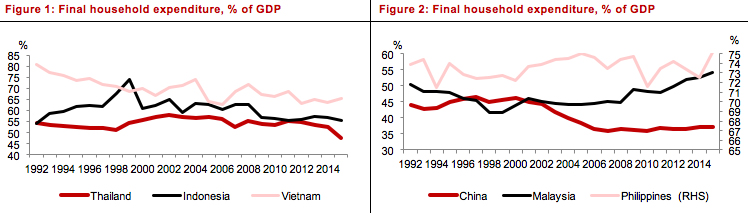
In Thailand and Indonesia, the consumption to GDP ratio has been steadily declining; continuously in Thailand and almost similarly in Indonesia though there was small upward bump between 2011 to 2013. Vietnam is a bit trickier where a declining medium term trend seems to have been interrupted and there has been a steady uptick from 2012 onward, with the ratio rising from 63.8% to 65.1%.

140317-graph1.jpg

Source: World Bank


The ratio in China appears to be rising steadily, though very modestly, from 35.8% in 2007 to 37% in 2015. This may come as a surprise to some as the Chinese have consumption-led growth as an explicit goal, Moreover, consumption is starting from a low base, where the consumption ratio is comfortably below that of the other countries. As such, one would have expected a larger increase. If anything, the Chinese experience provides an uncomfortable hint about how difficult it is for an economy to move to consumption-led growth. More on that later.

There are two countries where the ratio has been rising meaningfully – Malaysia and Philippines – and let’s see if they pass the next test: How has consumption growth been behaving?

140317-graph2.jpg

Source: World Bank


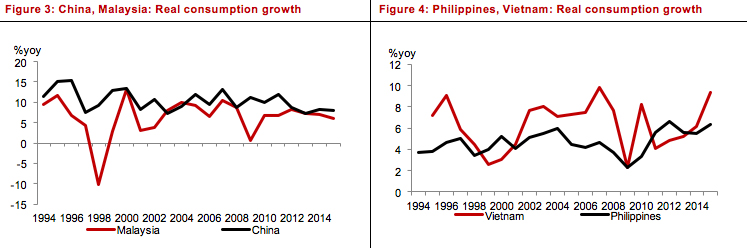
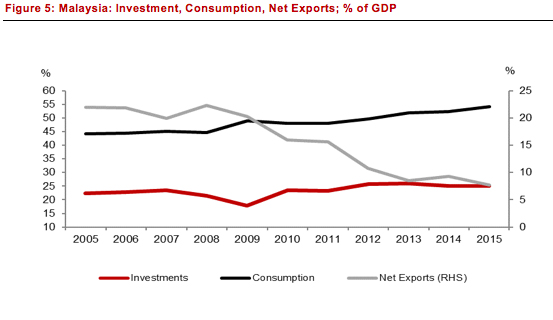
Judging by the second criteria, Malaysia drops out as consumption growth has been moderating over the past few years. Consumption to GDP ratio has been rising largely because trade has been floundering. The importance of exports to the economy has declined since the Global Financial Crisis (GFC) and the end of the commodity boom and is down to approximately 70% from over 110% in 2009. Similarly, imports have also declined, albeit by less, and consequently, as the chart below shows, there has been a huge fall in the share of net exports.

Consumption and investment growth have not been robust, but their share in GDP has gone up largely because the share of net exports has declined. Consumption is not driving growth, though one can legitimately say that it has been resilient in the face of external shocks and has helped cushion overall growth.

140317-graph3.jpg

Source: World Bank


In China, after a post crisis decline in growth, consumption growth has held steady. The two countries where consumption growth is actually booming are the Philippines and Vietnam. In the former, barring a small hiccup in 2013, the trend has been for a rising growth rate since 2009. In Vietnam, consumption is thriving with the current growth rate about double what it was in 2011.

In short, by the criteria used, we can detect modest consumer-led growth in China and in the Philippines. Consumption is flourishing in Vietnam, though it doesn’t necessarily mean that is what is driving growth. More likely, given the declining/steady consumption to GDP ratio, it is trade and direct investment that are driving growth. That, in turn, is generating income growth, which is supporting consumption.

​​The next question: Is it sustainable?

In different ways, the consumption stories in the Philippines and Vietnam can continue.

140317-graph4.jpg

Source: World Bank


The savings rate has been holding steady in the Philippines, which is a good thing as it is much too low for it to start declining from its current level. Without a fall in the savings rate, the share of labour in national income needs to rise for consumption to drive growth, but there isn’t good enough data to be able to draw any strong conclusion. Our optimism comes from the current pace of growth in income and that the Philippine household is tremendously underleveraged. Both should help consumption. High household debt is also likely to constrain consumption in Malaysia and Thailand.

140317-graph5.jpg

Source: CEIC, CIMB Research


For Vietnam, the story isn’t about consumption driving growth but more of a booming consumer, with income coming from other areas of activity. An increasing savings rate shows that the future is being secured. The demographics are good and the middle class is growing, both of which help generate consumption demand.3

A small warning though. The thriving middle class that we see and mention as anecdotal evidence is more a change in the consumption basket as countries are getting richer. It doesn’t mean that, relatively speaking, there is more consumption expenditure. We are observing economic development, changing demographics and hence changing taste (the young want more services, less goods), but you’re not observing consumption-driven growth. This “new” kind of demand is affecting businesses who are catering to these changing tastes. But, it is not driving the overall economy.

​​Can consumption abroad drive growth in ASEAN?

Here is the other common myth: Even as China rebalances away from investment and exports, the more vigorous Chinese consumer will drive ASEAN exports. This is wrong at many levels. First, as noted above, there is no booming Chinese consumer. In real terms, consumption as a percentage of GDP has barely risen. Second, consumption growth is holding steady and can hardly be considered a driver. Third, consumption is much less import intensive than both investment and exports. 4The truth is most of ASEAN exports are in intermediate goods whose final demand typically lies in investment, rather than consumption. To the extent that it is consumption, it has more to do with the consumer in the US, Eurozone and Japan, rather than in Asia.

A paper from the Ministry of Trade and Industry, Singapore, brings it out. To quote: “Of the VA (value added) derived from external final demand, only one-quarter was attributable to the direct exports of goods and services to final demand markets. The remaining three-quarters of the VA from external final demand were generated through global value chain effects”. 5 While this result is for Singapore, it is illustrative of the nature of demand for ASEAN exports.

Besides, as the report shows, that 25% of value added relates to all external demand. If we consider only consumption, the number is much smaller.

​​Moving to a consumption-led economy?

It sounds easier than it is. China has been trying for years — and they have had two natural advantages – and yet have barely moved the share of consumption in GDP. First, in the near 10% growth years, policy measures had been set up to boost investment, all they had to do was reverse some of these decisions to try and boost consumption. Second, China’s consumption to GDP ratio is extremely low and thus easier to nudge upward.

Start with China’s policy settings when investment and exports were driving growth. Primary among these has been a real interest rate kept below its market-clearing level and an undervalued exchange rate. Both of these measures have been changing.

Interest rates have now been liberalised, in particular the ceiling on deposit rates has been scrapped. Artificially low rates, with a large spread between deposit and lending rates, were effectively a transfer away from household income to banks and that hurt consumption.

The exchange rate has also actively been aiding rebalancing. Since 2005, the RMB has appreciated by about 40 % in real trade weighted terms. As a stronger currency helps consumption – rise in real incomes – while a weaker currency helps investment – cheaper for foreigners to invest – clearly policy settings have been moving in favour of rebalancing.

140317-graph6.jpg

Source: CEIC, CIMB Research


Besides the exchange rate and interest rates, there were at least two other issues that have contributed to a high investment (low consumption) ratio.

The first is Chinese labour policy. From the start of reforms to until about the late 1990s, in real terms, wages grew at around 5.9% compared with GDP growth of 9.9%. With wages not keeping pace with GDP growth, household income growth did not keep pace with GDP growth and consumption as a percentage of GDP declined from about 50% of GDP to about 35% of GDP in the mid-2000s. That has now completely changed and labour’s share in income has been rising for several years.6

140317-graph7.jpg

Source: ILO, CIMB Research


The second is the provision of social safety nets or lack of it. Initially there weren’t many safety nets, so as incomes increased, the Chinese did not go out and spend. Instead the savings rate rose from 35% in 1980 to about 50% by the mid-2000s.

But this policy too has been changing. The World Bank and Development Research Center report states that since 1990, China has been putting in social protection programs at a pace that is unprecedented internationally. The report notes that “these include pension programs for urban and rural residents; pension, unemployment, sickness, workplace injury, and maternity insurance for urban sector workers; and a national social assistance scheme that now covers more than 70 million people, among others”.7

The change in policy settings have also been helped as a consumption to GDP ratio of less than 40% is one of the lowest in the world, Yet, despite all this, and a decade of trying, the ratio of consumption to GDP has hardly moved.

In short, moving to a consumption-led growth model is not easy. Expecting the consumer to pick up the slack when trade, and consequently income growth, are struggling is unlikely. For ASEAN economies, at their current stage of development and their external orientation, the old trade-investment virtuous circle remains true.

​​Conclusion
Domestic consumption demand is not driving growth in ASEAN. Nor is it likely to any time soon. While consumption abroad does have a positive effect on ASEAN exports, it is not as much as investment abroad and the presence of value chains. From a structural perspective, trade remains ASEAN’s main driver of growth. And while ASEAN economies cannot really affect global demand they can decide how they respond to it and that involves continuous trade-boosting measures. There needs to be a move away from protectionism. Indeed, barriers to trade need to continue being lowered, while making sure that those who are dislocated by trade are adequately compensated, so as to make the reforms sustainable. Trade deals such as the Trans-Pacific Partnership (TPP), even without the US, are to be encouraged.


1 The Chinese economy grew at a 6.7% pace in 2016. The official target for 2017 is 6.5% and history suggests the actual rate of growth will come very close to that.
2 Technically speaking, the gross savings rate is simply 1 minus the consumption to GDP ratio and so if we know one of them, we automatically know the other. Still, the savings rate is worth looking at from a policy perspective.
3 Vietnam: The Next ASEAN Tiger
4 Joong Shik Kang and Wei Liao, “Chinese Imports: What’s Behind the Slowdown?”, IMF Working Paper, May 2016
5 Feature Article: Analysis of Singapore’s External Sources of Final Demand
6 International Labor Organization, Global Wage Report 2016 / 17, “Wage inequality in the workplace”.
7 China 2030: Building a Building a Modern, Harmonious, and Creative High-Income Society by The World Bank and the Development Research Center of the State Council, the People’s Republic of China, 2012.


Disclaimer: All rights reserved. No part of this report may be reprinted or reproduced or utilised in any form or by any electronic, mechanical or other means, now known or hereafter invented, including photocopying or recording, or in any information storage or retrieval system without proper acknowledgement of CIMB ASEAN Research Institute.

The views, responsibility for facts and opinions in this publication rests exclusively with the authors and their
interpretations do not necessarily reflect the views of CIMB ASEAN Research Institute.