China-ASEAN trade totalled US$362 billion in the first seven months of 2020
(18 August 2020) China’s trade with ASEAN stood at US$362 billion in the first seven months of 2020, up 6.6% year-on-year, according to data from the General Administration of Customs. ASEAN remained China’s largest trading partner during the same period, accounting for 14.6% of China’s total foreign trade volume. This was attributed to upgraded free trade area protocols and supply chain cooperation. Since the establishment of the China-ASEAN Free Trade Area (CAFTA) in 2010, tariffs on 7,000 products have been cancelled. The trade volume between China and ASEAN countries grew from only US$54.8 billion in 2002 to more than US$600 billion in 2019. Read more>>
Construction of China-Laos railway progresses with 14.5-km tunnel drilled
(17 August 2020) China State Railway Group Co., Ltd. announced that a 14.5-km tunnel has been drilled for the China-Laos railway. Also known as Kunming-Vientiane railway, the 1,000 km railway that connects Laos and China is scheduled to be operational by end-2021. The Duoji Tunnel was drilled in Mojiang County in Pu’er City, in southwest Yunnan province. The railway is a major project under the Belt and Road Initiative. By end-July 2020, over 90% of bridges and over 95% of the tunnels on the domestic section of the railway have been completed. According to Chen Yumou, deputy head of the Nanjing branch of China Railway Shanghai Group Co., the COVID-19 pandemic has reportedly boosted trade and railway transportation volume between China and ASEAN in 2020. Read more>>
Temasek subsidiary and Bank of China establish community bank in China
(18 August 2020) Fullerton Financial Holdings (FFH), a subsidiary of Temasek Holdings, and the Bank of China announced the establishment of the Bank of China-Fullerton Community Bank (BOC-Fullerton) in Xiong’An New District in China. Both companies will inject their existing equity interest in the community banks into BOC-Fullerton. The community bank is committed to supporting China’s “three rural” policy and small micro-enterprises through its financial products and business model. The bank will also aid the acceleration of the economic development of counties and villages through the adoption of advanced technologies such as artificial intelligence. FFH had previously jointly invested in the building of community banks in China with the Bank of China, with the first community bank launched in 2011. Read more>>
Chinese wealth management firm to set up online platform with Thailand’s Kasikornbank
(18 August 2020) Chinese wealth management firm Lu International will jointly operate and manage an online wealth management platform with Thailand’s commercial banking firm Kasikornbank. Lu International is a subsidiary of Chinese retail fintech firm Lufax Holding and will utilise Lufax Holding’s “cloud-exporting” model for the platform. Lufax Holding chief executive Greg Gibb said that the firm and Lu International have the technological capabilities and global experience to help address a gap in the Thai market. The announcement of the deal follows Lu International’s launch of a mobile app in Hong Kong, which provides a selection of Hong Kong dollar-based mutual fund products. Read more>>
Joint petrochemical venture between China and Brunei awards scholarships to 23 students
(18 August 2020) Hengyi Industries Sdn Bhd, a joint petrochemical venture between China and Brunei, awarded scholarships to 23 students from Universiti Brunei Darussalam during a ceremony held on 18 August. The students will continue their studies at Zhejiang University in China where they would complete a year and half of academic studies and industrial training. Hengyi Industries is a joint venture between China’s Zhejiang Hengyi Group and Damai Holdings, a wholly-owned subsidiary under the Brunei government’s Strategic Development Capital Fund. The Chinese Ambassador to Brunei Yu Hong said that education cooperation is an important area of exchange between both countries under the Belt and Road Initiative. Read more>>
ASEAN+3 region forecasted to grow 6.0% in 2021
(6 August 2020) Economies in the ASEAN+3 region are expected to rebound in 2021, according to a report released by the ASEAN+3 Macroeconomic Research Office (AMRO) on 6 August. The ASEAN+3 region comprises the 10 member states of the Association of Southeast Asian Nations (ASEAN), and Hong Kong, China, Japan, and South Korea. All ASEAN+3 economies are projected to return to positive growth averaging 6.0% in 2021 with ASEAN forecasted to grow 5.7%. The recovery in ASEAN+3 region is anticipated to be led by China, which is projected to grow by 2.3% in 2020 compared to 6.1% in 2019. Nine of the 14 ASEAN+3 members are expected to contract in 2020, with Thailand having the deepest contraction of 7.8%. In 2020, the ASEAN region is forecasted to contract by 2.6%, from a positive growth of 4.6% in 2019. The smaller economies of Brunei, Laos, Myanmar, and Cambodia, are expected to weather the COVID-19 pandemic better than their larger peers.
ASEAN
Garment workers including those in Southeast Asia lose close to US$6 billion in wages due to COVID-19 pandemic
(11 August) Garment workers supplying global fashion brands have either been underpaid or not paid at all during the COVID-19 crisis, researchers said on 11 August. Garment workers worldwide are estimated to have lost US$3.19 billion to US$5.79 billion in the first three months of the pandemic. In Bangladesh, around US$500 million in wages is estimated to have been withheld while in Indonesia, the withheld amount is estimated at around US$400 million. Pressure group Clean Clothes Campaign said a lack of data limited the research to seven countries, Bangladesh, Cambodia, India, Indonesia, Myanmar, Pakistan and Sri Lanka, but said the situation was probably similar in other low-wage regions. The group added that garment workers in South and Southeast Asia, had only received three fifths of their regular income on average from March to May 2020.
CAMBODIA
Cambodia’s PPE exports jump 130% in the first half of 2020
(9 August 2020) Cambodia exported just over US$191.3 million worth of personal protective equipment (PPE) in the first half of 2020, a 130% rise from the US$83.3 million recorded in 2019. The exports were mainly driven by COVID-19 fears and a shortage of such equipment, according to the General Department of Customs and Excise. Face mask exports for the six months ended June 2020 were valued at US$2.5 million. However, no figure exists for the same period in 2019. Data from the Ministry of Industry, Science, Technology and Innovation show that there are seven factories and seven handicraft workshops that are either in the application process or are currently producing face masks and other PPE. Together, the factories are able to manufacture 138 million face masks, around 20.7 million medical gowns and approximately 9.6 million medical caps on a monthly basis. Government data show their export destinations include China, Japan, the US and Europe.
THAILAND
Thailand’s investment board to hold events aimed at achieving 4,000 pairings
(12 August 2020) Thailand’s Board of Investment (BoI) expects to help 4,000 Thai and foreign companies form business partnerships in 2020 through two international events, though the number is half of 2019’s tally due to the impact of COVID-19. The business matching is projected to create economic value worth US$226 million (7 billion baht) from the events, which have been delayed from early 2020 when the country dealt with the virus outbreak. Together with the Thai Subcon Association and event organiser Informa Markets, BoI will co-organise Subcon Thailand, ASEAN’s largest international industrial subcontracting, in conjunction with Intermach, a showcase of innovative machinery scheduled to be held in September. According to the Industrial Linkage Development Division, it helped facilitate 8,029 business matches, creating more than US$451 million (14 billion baht) in business value in 2019.
THE PHILIPPINES
Central bank purchases US$16.4 billion of government debt
(12 August 2020) The Philippines central bank, Bangko Sentral ng Pilipinas (BSP), has purchased around US$16.4 billion worth of government debt through the end of July 2020, in order to finance the country’s record stimulus measures. This was equivalent to 45% of the Philippines domestic borrowings. Around US$10.2 billion of the total purchases were in the secondary market, while the remainder was directly from the government. An economist stated that the debt-purchase programme by BSP will most likely continue beyond 2020 given the economic conditions. Filipino bonds are the top performers in Asia as of now, with 18% returns. Yields on 10-year bonds have fallen to 2.78% from more than 5% in March 2020.
INDONESIA
Indonesia raises US$1.48 billion from government bonds to fund fiscal deficit
(12 August 2020) The Indonesian government raised US$1.48 billion on 11 August 2020, from government bonds to fund the country’s fiscal deficit and COVID-19 measures. The Finance Ministry received bids for US$7.2 billion from both domestic and foreign investors as well as Indonesia’s central bank, Bank Indonesia. The bids received was the second-highest volume of bids so far in 2020, with foreign investors making up 33% of the incoming bids. The maturity periods of the bond series varies from three months to 28 years, with yields ranging from 3.25% to 7.40%, respectively. The government plans to raise US$66.7 billion in the second half of 2020 to cover a fiscal deficit of 6.34% of GDP. The government has allocated US$47 billion for the country’s COVID-19 response, which includes strengthening the healthcare system and reviving the economy. This is the first time the central bank has bought sovereign debt papers to support the financing of non-public goods.
INDONESIA
Government to ratify bill to boost job creation by end-August 2020
(11 August 2020) The Indonesian government is hopeful a job creation bill will be ratified by parliament by the end of August 2020, amidst worries of a recession due to the COVID-19 pandemic. The Job Creation Bill will allow employers to hire and fire workers with lower severance pay and benefits compared to current labour laws, as well as allow employers to hire workers on flexible work hours (thereby avoiding paying full-time wages). COVID-19 has caused some 3.7 million people to lose their jobs, raising the estimated total number of unemployed Indonesians to 10.6 million, equivalent to almost 8.0% of its working population. Indonesia’s economy shrank by 5.32% year-on-year between April and June 2020, its first negative quarterly performance in 21 years. Six out of the country’s eight major labour unions have agreed to support the bill. However, labour union KSPI said the bill does not recognise minimum wage and makes it easier for companies to retrench their staff.
SINGAPORE
The Philippines cancels Myanmar rice consignments due to local protests
(12 August 2020) Singapore’s central bank warned that the country’s financial services sector may see more retrenchments in the second half of 2020, as the economy faces a contraction of between 5.0%-7.0% in 2020. The Monetary Authority of Singapore stated that financial institutions in Singapore “held up well” in the first half of 2020; with 1,500 jobs created while retrenchment levels staying “subdued.” The financial sector employs more than 170,000 people and contributes 13.0% to the GDP. The central bank has prioritised supporting the local workforce in the financial sector, as the sector undergoes a shift towards new models including digital banking.
LAOS
Laos sees rising public debt following economic impact of COVID-19
(10 August 2020) Laos is seeing a rise in public debt after a drop in revenue collection and an increase in loans amid the COVID-19 pandemic. According to a government official quoted by a Chinese daily, Laos’ public debt could rise to as much as 65% to 68% of GDP in 2020. At the recent ninth ordinary session of the National Assembly’s eighth legislature, Minister of Finance Deputy Prime Minister Somdy Douangdy said Laos’ revenue collection is expected to fall by around US$696 million (LAK 6.322 billion). The value of exports during the first six months of 2020 was at a reduced level of around US$2.6 billion, down by 5.1% compared to the same period in 2019 based on an assessment done by an agency under the Ministry of Industry and Commerce. The tourism sector is also expected to be affected in the second half of 2020 after recording a 60% decline in tourist arrivals in the first six months of 2020.
BRUNEI, MALAYSIA
Brunei and Malaysia added to the UK’s travel corridor list of nations
(12 August 2020) Malaysia and Brunei were added on 11 August 2020 to the UK’s travel corridor list of nations, meaning arrivals from both countries will not be required to self-isolate upon arrival in the UK. Travellers from both countries who arrive in the UK before 4:00 AM (GMT) on 11 August 2020 will still be required to self-isolate. Malaysia’s borders remain closed, however, with locals still barred from travelling abroad. Other Asian countries on the exempt list included Japan, South Korea, Taiwan and Vietnam, as well as the special administrative regions of Hong Kong and Macau.
German firms in Myanmar plan on reducing investments
(12 August 2020) A business outlook survey report recently released by the Delegation of German Industry and Commerce in Myanmar found that about two thirds of the companies surveyed plan to reduce investments compared to before COVID-19. The majority of companies also expect the economy to recover by 2021 at the earliest, while 46.7% expect an economic recovery to take longer. More than two thirds of the companies see the lack of business support measures as the current main challenge. Nevertheless, more than 86.0% of the companies surveyed said they remain committed to Myanmar as a permanent location for business. Total trade volumes between Myanmar and Germany surpassed US$820 million in fiscal year 2018/2019. Myanmar exported US$190 million worth of goods, mainly machinery and pharmaceutical products from Germany so far this year. Read more>>
MYANMAR, INDIA
Trade association to start brokering trade between India and Myanmar after COVID-19
(12 August 2020) The Upper Myanmar India Association plans on starting its own trade brokering business to facilitate trade between India and Myanmar after the COVID-19 pandemic is over. The association’s chair, U Ba Yan, stated that they intend to help Indian traders connect with their counterparts in Myanmar. There are about 150 members in the association. Trade between both countries have come to a halt since COVID-19, with trade only conducted through maritime routes due to the closure of land borders. In the fiscal year 2018/2019, total trade between Myanmar and India reached US$201 million, with exports accounting for US$177.5 million. Total border trade as of 31 December 2019, amounted to US$34 million. Read more>>
VIETNAM
Dung Quat oil refinery processes its first batch of Russian Sokol crude oil
(10 August 2020) Vietnam’s Dung Quat oil refinery processed its first batch of Russian Sokol crude oil on a trial basis, as the owner of the facility, state-run PetroVietnam, seeks to diversify its crude oil sources. Dung Quat’s traditional crude oil source, the Bach Ho field, has seen shrinking output in recent years. The refinery imported more than 710,000 barrels of Sokol crude oil in July 2020 to mix with other types of crude oil for a test run. In 2019, Dung Quat processed its first batch of West Texas Intermediate (WTI) and Bonny Light crude oil, and the refinery plans to import 8 million to 10 million barrels of these two types of crude in 2020. Read more>>
CAMBODIA
Cambodia expected to sign bilateral FTA with China as the EU enforces sanctions on exports
(12 August 2020) Cambodia is expected to sign a bilateral FTA with China in the near term as the EU enforces trade sanctions against the country for alleged human rights violations. On 12 August 2020, the EU enforced tariffs on about 20% of Cambodia’s exports to the bloc. The sanctions came after a year-long review by the EU (concluded in February 2020), which recommended partially suspending Cambodia’s privileges under the Everything But Arms (EBA) scheme. The privileges are vital for Cambodia’s US$10 billion garment and footwear sector; Cambodia sent about 25% of its exports to the EU in 2019. Cambodia now faces tariffs of up to 12% on 40 items it exports to the EU, including travel goods, sugar, and some garment and footwear products. According to analysts, Cambodia’s FTA with China, which focuses on agricultural exports, will do little to help the country’s apparel sector, which employs more than 900,000 workers. Read more>>
THAILAND
Former banker Predee Daochai appointed as new finance minister in revamped cabinet
(12 August 2020) The former co-president of Thailand’s second-largest lender Kasikornbank Pcl, Predee Daochai was appointed as Thailand’s new finance minister in Prime Minister Prayuth Chan-Ocha’s revamped Cabinet on 12 August 2020. A former senior executive of PTT Pcl, Supattanapong Punmeechaow, was named as deputy prime minister and put in charge of the Energy Ministry. This comes as Thailand’s economy is forecasted by the finance ministry to contract by 8.5% in 2020. The country’s economy is facing its worst performance due to both COVID-19 and student protests. According to a finance ministry source, Predee is expected to call for a meeting with top executives at the ministry for an update on economic conditions and forthcoming prospects to prepare measures to manage the economy. Read more>>
About Greater Mekong Subregion (GMS)
The Greater Mekong Subregion (GMS) Economic Programme was launched by the Asian Development Bank in 1992 connecting five developing ASEAN countries, namely Cambodia, Laos, Myanmar, Vietnam and Thailand, and Chinese provinces of Yunnan and Guangxi Zhuang Autonomous region. The region has some of the most robust economies sharing the Mekong River Basin thanks to its reform and liberalisation. The subregion is growing at a faster pace than the whole of East Asia and the Asia Pacific as the GDP growth rate for 2017 was at 6.4 percent, according to the World Bank. The population at the subregion as of 2016 is at 340 million while the GDP at PPP is at US$3.1 trillion in 2016. In 2015, trading within the region was at US$444 billion.
Myanmar approves joint venture for China’s strategic port project
(10 August 2020) Myanmar’s Directorate of Investment and Company Administration (DICA), approved the registration of Kyaukphyu Special Economic Zone Deep Seaport Co. Ltd, a joint venture between Chinese consortium CITIC Myanmar Port Investment Limited and the Myanmar government-backed Kyauk Phyu Special Economic Zone Management Committee on 6 August. The China-backed project ran into delays shortly before Myanmar’s 2015 general election after critics raised concerns that the deal could land Myanmar in a “debt trap” with China. The initial agreement called for a project worth US$9-10 billion and gave the Chinese developer an 85% stake. The current National League for Democracy (NLD) government successfully renegotiated the share ratio with China, along with an agreement that the project would be based on demand. Read more>>
Trade volume between ASEAN and China’s Shaanxi rises to US$2.8 billion in first six months of 2020
(10 August 2020) Trade volume between ASEAN and China’s northwest Shaanxi province reached US$2.8 billion (19.3 billion yuan) in the first half of 2020, recording a 66.3% year-on-year increase, according to data from the Shaanxi provincial Department of Commerce. The department said that ASEAN countries have become vital markets for the province’s companies in terms of project contracting and foreign investment. The province has also become a foreign investment destination, with 266 ASEAN firms having been set up in the provincial capital Xi’an with total investment of nearly US$5.76 billion. Read more>>
Thailand and China to work towards US$140 billion trade goal
(10 August 2020) Thailand and China are working towards increasing their bilateral trade value to US$140 billion in 2021. The goal was discussed during a teleconversation between Auramon Supthaweethum, director-general of Thailand’s Department of Trade Negotiations and Peng Gang, director-general of the Department of Asian Affairs of China’s Ministry of Commerce. Other matters discussed included the connection between Thailand’s Eastern Economic Corridor project and China’s Belt and Road Initiative and Greater Bay Area project, and implementation of the Sino-Thai memorandum of understanding on trade in farm products, particularly the government-to-government agreement to import 1 million tonnes of Thai rice. According to Auromon, both countries will promote bilateral trade through online and offline channels despite the COVID-19 pandemic. Read more>>
China’s Sinovac begins late-stage human trial for potential COVID-19 vaccine in Indonesia
(11 August 2020) China’s Sinovac Biotech Ltd has launched a late-stage human trial on 11 August involving as many as 1,620 patients in Indonesia for a COVID-19 vaccine candidate that it is developing with Indonesian state-owned peer Bio Farma. The vaccine candidate, known as CoronaVac (previously PiCoVacc), is among a few potential vaccines that have entered late-stage trials for a large-scale study to gather proof of efficacy for regulatory approval. The vaccine candidate is already undergoing a late-stage trial in Brazil for as many as 9,000 people. The late-stage human trial in Indonesia comes as the country grapples with spiking infection numbers, with over 127,000 cases recorded as of 11 August. The trial has so far recruited 1,215 people and will last for a duration of six months. Sinovac expects to also test the vaccine candidate in Bangladesh. Read more>>
Potential longan shipments from Cambodia to China by 2022
(6 August 2020) Cambodia hopes to be able to ship Pailin longan to China by the end of 2021 or in early 2022, according to the Ministry of Agriculture, Forestry and Fisheries senior official Ngin Chhay. On 9 June, Cambodia and China officially agreed to export 500,000 tonnes of fresh mangoes a year, which Cambodia expects to pave the way to boost its agricultural crop exports to the Chinese market. However, the quota is out of Cambodia’s reach at the moment due to its limited capacity to sterilise, process and package the fruit in an export-ready manner. Chhay expects the first mango shipment to go out in early 2021, after which they hope to get clearance to export Pailin longan to China by the end of 2021 or early 2022. Read more>>
CARI Commentaries: Is US economic dominance over?
And what can ASEAN do about it?
Author: Imran Said Shamsunahar | Research Editor: Eleen Ooi Yi Ling
Webmaster: Nor Amirah Mohd Aminuddin | Research Director: Hong Jukhee
Synopsis
Despite persistent narratives about the decline of US global influence, especially vis-a-vis its main competitor China, American economic, technological, and financial might is expected to be sustained within the foreseeable future. ASEAN must thus prepare accordingly for the coming US-Sino competition.
(This article contains 3 charts and best viewed on a desktop or horizontally on your mobile.)
Much has been said recently of America’s ‘decline’ on the world stage, with frequent narratives on American global primacy ceding ground to an unstoppable China. Indeed, an ASEAN-wide policy survey released in January 2020 by the Singapore-based ISEAS-Yusof Ishak Institute saw only 7.9% of respondents label the US as the most influential economic power in Southeast Asia (in comparison to a whopping 79.2% for China), while a further 47% had ‘little or no confidence’ in Washington as a strategic partner and provider of regional security. These findings reflected larger beliefs within certain circles of America’s retreat from not just the Asia Pacific but the larger international stage.These attitudes are understandable. It is true that the hostility of the Trump administration towards free trade, international institutions, and traditional allies has dismayed those of us who champion the merits of globalization and international cooperation, and paints an image of an America no longer interested in upholding the global international order (which smaller powers like ASEAN rely upon to safeguard their sovereignty).
However, we risk tunnel vision by focusing solely on the words (or in this case tweets) and actions of the President in lieu of the raw metrics of global power; namely within the economic sphere. As ASEAN seeks to navigate an increasingly fraught international order, its leaders should not succept to notions of excessive American declinism. I argue that America’s economic, technological, and financial lead, among the key pillars of global influence, will remain secure for the foreseeable future. Regardless, as a hegemonic America contests a rising China, ASEAN must respond accordingly to maintain its cohesiveness and regional centrality.
Too big to fail
Lost in much of the fretting on American declinism is the massive lead the American economy continues to hold over China, despite four decades of rapid growth for the latter. The total output of the U.S. economy in 2019 was US$21.4 trillion, significantly larger than China’s output of US$14.3 trillion. On a per-capita basis, the division becomes more stark – US$65,280 to US$10,261 (at current US$).
America’s share of the world economy has remained virtually unchanged since 1980, when it accounted for 25.2% of world GDP. As of December 31, 2018, the US share only dropped to 23.9%. Over the same period, Japan’s share of world GDP fell from 9.7% to 5.8%, while the European Union’s share fell from 34.6% to 22%. This suggests that China’s rise has been at the expense of other countries’ share of the global economy, rather than that of the U.S.
Can China ever catch up?
Furthermore, China’s economy had already been slowing since peaking at 14.2% growth in 2007, before dropping to 6.6% in 2018. As Derek Scissors of the American Enterprise Institute argued, the sooner China slows down, the less likely it will be able to catch up with the US. While the Chinese Communist Party (CCP) insists that China will experience a gradual slowdown, internal factors suggest a more rapid slowdown would not be out of the question. In the aftermath of the pandemic, China watchers warned that the CCP had doubled down on the debt-fueled, state-directed investment strategy which characterized their response to the 2008 Global Financial Crisis.
As observed by late Indian economist Deepak Lal, the aftermath of the big surge in public spending post-2008 saw industrial producer prices falling steadily since 2011. This deflation was partly attributed to the glut in production in major Chinese industries such as steel, coal, glass, aluminium, solar panels, and cement. While this may inflate China’s baseline output (and therefore GDP), the question is whether these add value to the economy.
This emphasis on massive infrastructure investments (conducted largely through state-owned enterprises) will arguably prove a drag on future growth. The crowding out of private investments makes it harder for China to transition from an investment-driven economy to a consumer-led one, a long-stated goal of the CCP. Household consumption as a percentage of GDP in China remains relatively low at 38.7% in 2018 – on par with countries such as Algeria and Gabon. In comparison, household consumption in the U.S. measured at 68.1%. A lack of competition also hinders productivity growth – data from The Conference Board found that China’s projected level of output per worker in 2019 was only 22% of that of America’s.
Inefficient in innovation
Productivity growth remains the engine of capitalism, and is more often than not driven by technological development. While much has been made about the so-called ‘tech war’ between the US and China, the U.S. largely remains at the forefront of technological innovation. The 2019 edition of the Global Innovation Index (GII), considered the most comprehensive measurement system of global innovation, ranked the US third worldwide, with China at a respectable 14.
Furthermore, a February 2020 report by the Centre for Strategic and International Studies (CSIS) noted that while China has become more innovative since 2017, it still suffers from low innovation efficiency (meaning that the significant amount of resources thrown into innovation still produces a smaller level of outputs). The report warned that certain metrics used to demonstrate Chinese innovative excellence can be misleading. For instance, although China is the world’s largest patent producer, about two-thirds of the patents produced every year tend to be utility model patents (defined by the World Intellectual Property Organization as providing protection for ‘minor inventions’ based on incremental improvements to existing products), while only a third can be considered ‘higher-quality invention patents’.
In key sectors such as semiconductors, Jonathan Curtis of Franklin Templeton Investments concluded that Chinese equipment and device manufacturers are still heavily reliant on U.S.-manufactured semiconductor components and technology, a state of affairs they will not be able to change anytime soon. In other areas such as e-commerce platforms and new-electric vehicles, China has been more successful.
Without a major boost to productivity, China will instead have to rely on the sheer scale of its market. However, current demographic projections suggest another barrier China may struggle to overcome. Indeed, a recent forecast by the United Nations World Population Division projected that the number of working-age Chinese (age 15-64) will fall by almost half between now and 2100, while the number of Americans of working age will rise by about 14.2% (see Figure 2).
But what about purchasing power?
OK, you may say, by sheer economic output the U.S. still leads. But what if we adjust GDP by purchasing power parity (PPP). Doesn’t that already show China as having overtaken the U.S.? As argued by Scissors, comparing the U.S. and China through PPP can be misleading.
Scissors notes that while applying PPP is sensible in that prices for similar items vary across borders, they are also problematic in that prices often vary within borders. For example, it would be impractical to assume prices are constant from Kuala Lumpur to Kota Kinabalu in Malaysia. As well, the measurement of PPP requires open markets to eventually force the prices of similar products to converge. However, this often does not hold when it comes to the trade in goods and services (even between linked economies such as Chinese provinces), and more so for investments goods – especially for countries with restrictions on the movement of capital such as China.
Furthermore, GDP does not necessarily measure the size of an economy, but annual economic activity. As already discussed, not all economic output adds value to an economy. Scissors argues a better indicator of the size of an economy is national wealth – the value of real estate, stocks, and other assets (which accumulate over time). By this metric, the U.S. remains far ahead of China, with Credit Suisse’s estimations of U.S. total household wealth in 2019 standing at US$106.0 trillion, compared to China’s US$63.8 trillion.
The Dollar still reigns supreme
The U.S. Dollar remains the settlement currency of choice for the majority of international payments , with data from financial services network Swift showing the USD being used in 45.78% of international payments in May 2020 alone, while the RMB only saw usage in 1.22% of cases.
No one knows this more than ASEAN. A 2017 report by Swift found that a whopping 85% of intra-ASEAN commercial flows in 2016 used the U.S. Dollar as the settlement currency of choice (see Figure 3). In the same year, the U.S. Dollar was also the settlement currency of choice for 78% of extra-ASEAN commercial payments.
Wall Street remains the financial trading centre of the world, with the New York Stock Exchange alone worth US$23.12 trillion in market capitalization in March 2018 – nearly 40% of the world’s total stock market value. By comparison, the world’s fourth largest global exchange, the Shanghai Stock Exchange, only measured at US$5.01 trillion. Even when combining the three independent stock exchanges of the PRC – Shanghai, Shenzhen, and Hong Kong, – China remains smaller than that of the U.S.
The twenty seventh edition of the Global Financial Centres Index (GFCI 27), which provides evaluations on the competitiveness of major global financial centres, ranked New York first with a 29 point lead over Shanghai (ranked a respectable fourth). New York also ranked first in all five metrics of competitiveness used for the GFCI model, namely business environment, human capital, infrastructure, financial sector development, and reputation.
Contrary to narratives of the U.S. being left behind in the burgeoning field of fintech, the GFCI 27 ranked New York first in competitiveness in fostering the Fintech industry (overtaking Beijing from the previous year). With Silicon Valley and Wall Street having long dabbled in the development of financial innovations, it is argued by former U.S. Secretary of the Treasury, Henry M. Paulson, Jr. that the U.S. private sector stands in a good position to spearhead the development of safe and secure digital currencies, while developing the necessary controls against usage in illicit activities.
As argued by Paulson, Jr., the rapid development of Fintech in China – including digital payment systems and a pilot digital RMB project by China’s central bank- will most probably not pose a serious threat to the global dominance of the U.S. Dollar. As Paulson explains, ‘A digital RMB would still be a Chinese RMB. No one is reinventing money.’
Between a Rock and a Hard Place
ASEAN should not be too quick to discount continued American global influence. While the rise and fall of great powers is a historical given, the significant lead held by the U.S. in the world economy, technological innovation and global finance alongside China’s internal challenges of low productivity, demographic decline, and chronic underconsumption suggests to me that Pax Americana is here to stay for the foreseeable future.
Regardless of whether the future validates me or not, an accelerating Sino-US competition in the region can only bode ill for ASEAN. The cohesiveness of the regional bloc will be tested, as individual Member States come under pressure to choose sides. To preserve regional independence and centrality, ASEAN must start to walk-the-talk when it comes to greater ASEAN integration, including greater intra-regional trade and investments.
America will remain powerful. China will grow powerful. But there’s no reason why ASEAN, with its expanding middle class, fast growing economies, and geographical centrality, cannot become powerful as well.
Published on 11 August 2020
Writer: Aznita Ahmad Pharmy, Research Fellow, CARI
Editors: Jukhee Hong, Executive Director, CARI and Eleen Ooi Yi Ling, Research Manager, CARI
CARI Viewpoint: An effective COVID-19 response must be fact-based while the development of pandemic-related ASEAN common standards can increase efficiency
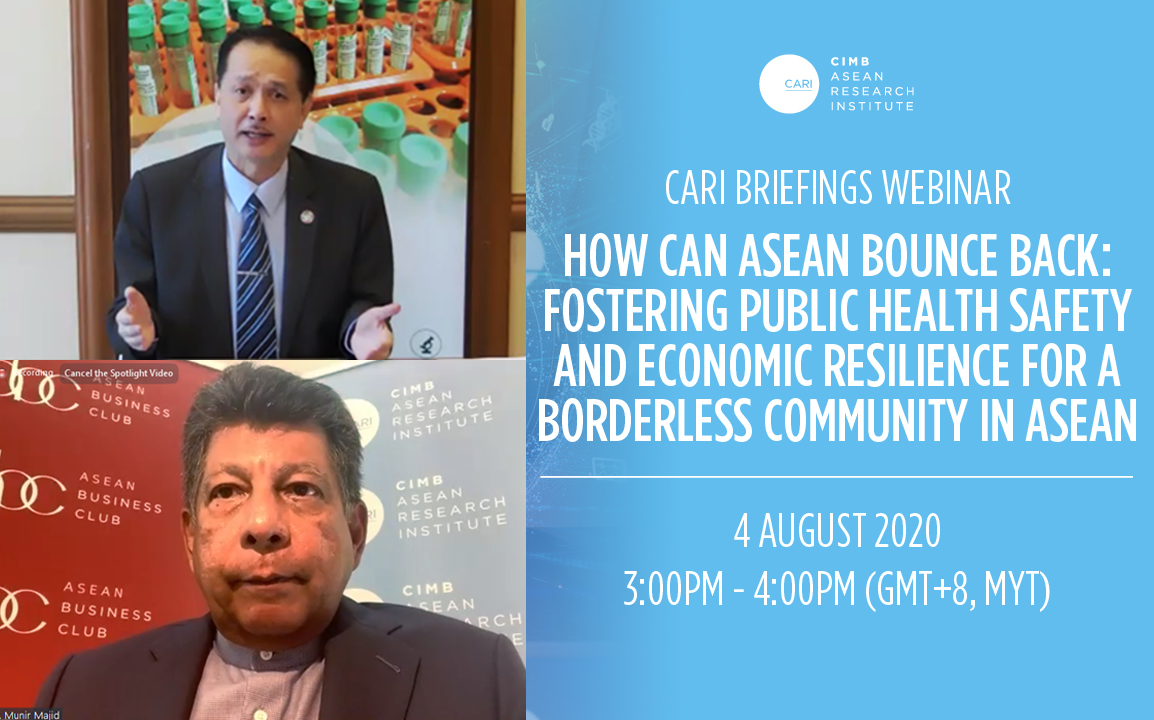
CIMB ASEAN Research Institute (CARI) organised the CARI Briefings webinar under its COVID-19 Economic Recovery Plan Series, titled “How Can ASEAN Bounce Back: Fostering Public Health Safety and Economic Resilience for a Borderless Community in ASEAN.” The session featured Datuk Dr. Noor Hisham Abdullah, Director-General of Health Malaysia and was moderated by Tan Sri Dr. Munir Majid, Chairman of CARI. The discussion centred on Malaysia’s management of the COVID-19 pandemic, the country’s cooperation with ASEAN in addressing COVID-19, as well as the challenges of balancing between public health safety and the survival of the economy.
During the briefing, among the key insights shared were:
1) The world is still struggling to contain the COVID-19 pandemic despite some early success
It’s been almost seven months since the World Health Organization declared the COVID-19 outbreak as a public health emergency of international concern but the pandemic shows no signs of slowing down. As of 8 August 2020, 210 countries are affected by the pandemic with 19.5 million confirmed cases and more than 724,000 deaths worldwide.
According to Dr. Noor Hisham, the pandemic is summed up in the following four situations of COVID-19 transmission around the world:
1st Situation:
This is where the countries affected were alert, well-prepared and acted fast. These countries managed to avoid large outbreaks, flattened the curve and brought the situation under control due to strong and decisive leadership combined with a good communication strategy with the public.
2nd Situation:
This situation is where Malaysia is currently at. In this situation, there was a major outbreak following cases of overseas returnees, as well as the outbreak from the high-risk groups such as the tabligh group. However, the situation has been brought under control with strong leadership and engagement with the public. From March until the present, Malaysia succeeded in bringing down the number of confirmed cases but it is still an ongoing process.
3rd Situation:
In this situation, the countries managed to flatten the curve to single-digits, or down to zero documented cases but due to the easing of restrictions and standard operating procedures (SOPs), they are now struggling with a spike in cases. This can be observed in Hong Kong, Japan and Melbourne, Australia. This situation is a real concern for Malaysia and Dr. Noor Hisham hopes the country can learn from these countries to prevent a similar occurrence.
4th Situation:
This situation is where the cases in the affected countries continue to rise rather than going down. The public health measures have failed to contain the infection due to the leadership, unclear and contradicting information resulting in a population that does not comply with the SOPs. The outcome of countries in this situation is unclear and remains a real concern as well.
The infection is akin to a wildfire. Once it has been sparked, it would be very difficult to contain. Public health measures will be inefficient and this is why the infection needs to be contained as soon as possible, said Dr. Noor Hisham.
2) An effective COVID-19 response must be based on science and supported by the government
a. Science over politics allows the execution of an effective COVID-19 response
The successful execution of the Ministry of Health’s COVID-19 approach so far is partly due to the government allowing the experts to do their job. “Certainly in our success, it is because the Prime Minister [of Malaysia] listens to the technocrats and civil servants, and that’s very important. Science has led, rather than politics,” remarked Dr. Noor Hisham.
For example, the MCO was a new initiative which needed a decisive decision by Tan Sri Muhyiddin Yassin. “We advised the PM and he dared to take that decision at that point of time in March. It was a drastic decision to lock down the whole country,” he said.
He shared the six approaches carried out by the Ministry of Health:
Surveillance and public health intervention
Evidence-based approach / WHO guidelines
Diagnostic and testing
Risk Communication
Movement Control Order
Isolation and treatment
b. Risk communication key to public engagement
From among the six approaches, risk communication is essential in engaging with the public and is implemented through the following methods:
Fighting fake news: “We are not only fighting with the virus but we are also fighting the viral fake news in the media. It’s important for us to identify very early, in terms of risk communication to the public. The more we inform the public, the less fear there will be and they can handle the situation much better,” said Dr. Noor Hisham.
Daily updates: Part of the government’s COVID-19 response in the earlier stage were two daily press conferences: the medical and non-medical. The non-medical press conference was given by Senior Minister for Security Datuk Seri Ismail Sabri Yaakob while Dr. Noor Hisham presided over the medical press conference.
Social media: The MOH interacts with the public through various platforms such as Facebook, Twitter, Instagram and Telegram and has also set up a dedicated COVID-19 hotline for the public.
“I have been given the responsibility to look into the medical perspective and how we can engage with the public. We explain the issues and challenges based on medical facts, not based on rumours but science. It is important to get the public’s trust. Once we have the public trust, we hope the public will comply with the SOP and the advice given by the MOH,” he said.
c. Various stages of lockdowns activated in response to the developing situation
Being in the second situation of COVID-19 transmission, Malaysia has had some success but cannot afford to be complacent. “Looking at the distribution of COVID-19 cases detected in Malaysia until today, we have not won the war yet but certainly we have won a few battles,” said Dr. Noor Hisham.
According to him, Malaysia’s COVID-19 strategic plan is divided into a few battles, the first one being the battle of the Movement Control Order (MCO).
Movement Control Order (MCO): The MCO consisted of MCO 1, 2, 3 and 4. During the MCO, Malaysians were advised to stay at home. This artificial environment was imposed with the intention of bringing down the number of infections from those returning from abroad and controlling the local transmission of COVID-19. This was necessary due to the spike in infections caused by the tabligh group and Malaysians returning home from abroad.
Enhanced Movement Control Order (EMCO): Apart from the MCO, the Malaysian government also implemented the Enhanced MCO (EMCO) whereby an area was put under lockdown and everyone in the area (locals, foreigners, legal and illegal migrants) were tested for COVID-19. Those who tested positive were sent to the hospital while those who tested negative but had been exposed to the positive cases were quarantined.
Conditional Movement Control Order (CMCO): Once the strategy showed signs of flattening the curve, the government needed to change its strategy to protect lives, as well as livelihoods seeing that the lockdown cost the country US$572 million (RM2.4 billion) a day. The CMCO allowed not only essential services but other economic sectors to resume their activities but with SOPs in place. The social and education sectors, however, remained closed. During this time, there was a spike in cases among legal and illegal migrants but the authorities managed to bring down the curve further.
Recovery Movement Control Order (RMCO): Seeing the numbers go down during the CMCO, the government decided to allow the social, education and sports sectors to reopen but with the caveat that they comply with the SOPs. “The SOPs are very important because we need to manage the risk of every sector,” said Dr. Noor Hisham.
While the initial response to the RMCO was positive, that success led to complacency which led to a new spike in cases. The authorities moved swiftly by reactivating public intervention to bring down the cases. “This is what we are doing because we found new clusters, this is the burning ember. If we fail to control this burning ember, it will start to spark a wildfire and once the wildfire has taken off it will be very difficult for public health intervention to be effective,” he explained.
d. Targeted COVID-19 testing instead of mass testing
A country’s testing rate should not be used as a benchmark to the effectiveness of its COVID-19 response as mass testing may not necessarily be the solution for every country.
“Today our total individual sample is 983,297 individuals. We have done more than 1.5 million tests but some tests were duplicated. The positive rate from the tests is 0.92%, which means that for every 100 patients that we test, we only pick up hardly one patient,” said Dr. Noor Hisham.
He revealed that Malaysia’s case fatality rate to be 1.39%, which is much lower than the global rate of 3.29% while the country’s recovery rate stands at 96%. As of 4 August, Malaysia had 1 new confirmed case, 193 active cases and 125 deaths.
“Looking at our tests, we are doing about 29.99 per 1,000 population, almost equivalent to South Korea,” remarked Dr. Noor Hisham. He added that the country has raised its testing capacity but instead of testing everyone, the testing strategy involves testing targeted high-risk groups. The testing strategy appears to be working as they have succeeded in flattening the curve from 3,000 active cases to 193 cases as of 4 August.
“The testing is important. We started in December whereby we enhanced our labs to be ready to test for the virus. We started with 1,000 tests in January. Now, we are capable of doing 37,500 tests a day. We also started the training for the public and private labs in January and we have 56 labs today,” he added.
3) ASEAN provides an important platform for countries in the region to work together to fight COVID-19
The COVID-19 pandemic has resulted in most of ASEAN countries facing similar challenges and therefore, the need for all ASEAN member states to work together.
“We continue to engage and make decisive decisions. Most important was the Special ASEAN and ASEAN+3 Summit on COVID-19 held via videoconferencing on 14 April 2020. ASEAN was proactive in coordinating this effort,” said Dr. Noor Hisham.
“We shared our experiences and we have also invited the delegation from China. We learned from their experiences, the do’s and dont’s and certainly, I think this is an important platform for us to work together as a team in the ASEAN region,” he added.
According to Dr. Noor Hisham, ASEAN’s response to the pandemic includes:
the ASEAN Emergency Operations Centre Network, ASEAN Risk Assessment and Risk Communication, both based in Malaysia;
ASEAN Biodiaspora Virtual Centre for Data Analytics and Visualisation, in the Philippines; and the
Regional Public Health Laboratory Network based in Thailand.
He remarked that ASEAN’s attitude towards the COVID-19 pandemic is guided by the WHO as all ASEAN countries are members of the international public health organisation.
“We are in a shared struggle to protect both lives and livelihoods. It is how we strike a balance between lives and livelihoods. Our strategy from MCO was more towards [protecting] the lives, controlling the virus. But once we manage to flatten the curve, we look into [protecting] the livelihood. This is a very fine balance and we need to look into the situation analysis for respective countries,” Dr. Noor Hisham commented.
4) Questions and Answers
During the ensuing questions and answers session, the following topics were discussed.
a. Tension between those prioritising lives and those prioritising livelihoods
When discussing COVID-19 measures Tan Sri Dr. Munir pointed out that there must have been great tension between those who wanted to control population movement and those who wanted to open up the economy and asked Dr. Noor Hisham how these opposing views were resolved.
“Well, certainly it was very challenging at the initial parts but nonetheless, we have a good structure whereby we discussed all issues during the meeting. I had to defend based on facts and science. We argued everything in the meeting and then the decision was made based on facts. During that meeting, we had only one intention – to break the transmission of COVID-19 infection in the country.”
It was and remains crucial for the MOH to collaborate with other ministries in its COVID-19 response. For example, they needed to work with the immigration department for border control and the police for the enforcement of roadblocks.
“If you compared us in January-February with us today we are more prepared in terms of our health facility and our coordination with other ministries. For example now, the moment we identify an outbreak, we will straight away go to that locality and lockdown that locality instead of having a blanket lockdown in the whole country,” said Dr. Noor Hisham.
b. ASEAN common standards and travel bubbles
The idea of an ASEAN common standard for several areas including contact tracing to allow the safe resumption of intra-ASEAN travel has often been mentioned and Tan Sri Dr. Munir ventured to get Dr. Noor Hisham’s take on this.
ASEAN common standards: ASEAN could provide a platform to establish common standards. “If we can, we should create a benchmark and standards agreeable to all the member states. Rather than all the countries performing duplicate services,” said Dr. Noor Hisham.
Bulk vaccine procurement: ASEAN could work collectively to procure the COVID-19 vaccine. Bulk purchase by ten countries would bring down the cost of the vaccine.
Travel bubbles: Malaysia is currently in discussion with Singapore and Brunei. The country is looking at the number of cases in the two countries. “We will look into mutual agreements by both sides that we can agree upon,” said Dr. Noor Hisham.
c. The possibility of Malaysia being a COVID-19 vaccine manufacturing hub
On the possibility of Malaysia being a manufacturing hub for the COVID-19 vaccine, Dr. Noor Hisham shared the following thoughts:
Malaysia’s manufacturing capacity: Malaysia has the capacity to be a manufacturing hub for the COVID-19 vaccine. However, the country would require clinical trials data before committing to any decision. Malaysia had discussed with China including vaccine-related issues. If there is strong evidence to suggest the vaccine works, Malaysia would volunteer to be the hub for manufacturing for ASEAN countries but the government needs to study on patent issues before taking conclusive actions.
Current findings: Studies conducted in the UK and China showed that after three months only 70% of those infected with COVID-19 had antibodies. The MOH’s own study from among one of the local clusters showed that after three months, only 20% of those infected had antibodies. These studies show that after eight weeks, the antibodies inside the body start to decline, which means that a recovered COVID-19 patient may get re-infected.
More questions than answers: With many questions with regards to the vaccine development at the moment, Dr. Noor Hisham said the MOH would like to see data from the Phase 3 clinical trial first, and to ensure that it is safe and reliable before making any decisions.
5) Conclusion
a. Science over politics, facts over rumours
The COVID-19 pandemic has shown the importance of having a supportive government that listens to the advice given by public health experts. “Malaysia is fortunate to have a government which gives space to professionals to drive the fight and purpose for the measures against the COVID-19 pandemic. We can just look around us and see how countries which do not do so have failed,” said Tan Sri Dr. Munir.
b. Everyone needs to cooperate to mitigate the COVID-19 pandemic
Dr. Noor Hisham emphasised that containing the COVID-19 virus requires cooperation from several parties such as the Immigration Department, police and army personnel as well as the public. Getting the public to comply with the SOPs requires gaining the public’s trust and this is obtained with clear, accurate and continuous sharing of information.
c. Region-wide measure requires strong leadership
On a regional level, ASEAN initiated several measures that aim to enhance experience and information sharing but if the region was to go further by developing common standards or benchmarks, it needs to be driven by a single country to prevent duplicate work. When one country leads in a certain area, other countries can focus on other equally important areas. Coordination is essential to allow countries to work together and avoid the duplication of work.
d. Countries must remain vigilant to fend off next wave of COVID-19 infections
Having a second or third wave of COVID-19 infection remains a real concern and Dr. Noor Hisham said the country has learned from the past few months and is more prepared than before with the understanding on the importance of first and fast implementation. He said countries should also heed the lessons learnt from affected countries and those that managed to keep it under control like New Zealand which strengthened border control and enhanced the local economy.
“We want everything to resume back to normal, but [on the condition of] with the SOPs in place. If we comply with the SOPs, that is how we mitigate as well as manage the risk of COVID-19. We are sure we can manage the risk as long as the public complies with the SOPs. We need strong social responsibility, social discipline and social compliance. If we have that in place, I think we can succeed,” concluded Dr. Noor Hisham.
ASEAN manufacturing downturn continues to ease in July
(4 August 2020) Marketing conditions in ASEAN in July showed further deterioration due to the impact of the COVID-19 pandemic but the rate of contraction was the softest in the current five-month sequence of decline, according to the IHS Markit Purchasing Managers’ Index (PMI). Both factory production and new orders in the ASEAN displayed slower rates of decline. Headline PMI increased to 46.5 in July from 43.7 in June in the health sector, although the figure remained below the no-change 50.0 mark. Underlying data suggested that improvements in sales were primarily driven by stronger domestic demand. Across the seven ASEAN countries covered, only Myanmar registered an improvement in operating conditions in July at 51.7, its highest in six months, while Singapore recorded the worst performance as its headline figure dropped to 37.3 in July.
ASEAN, JAPAN
Revised trade agreement between ASEAN and Japan came into effect 1 August
(4 August 2020) A revised free-trade pact between Japan and the Association of Southeast Asian Nations (ASEAN) facilitating the cross-border flow of services and investment came into force on 1 August 2020. The agreement took effect for Japan, Laos, Myanmar, Singapore, Thailand and Vietnam. The five remaining members of ASEAN, Cambodia, Indonesia, Malaysia, Brunei and the Philippines, are set to join the pact once they conclude domestic procedures. Under the revised pact, the countries are required to maintain transparency in regulating services and not discriminate against foreign investors. It also established a dispute settlement mechanism for companies to sue a government for unfair treatment, as well as rules for foreign travellers to enter and stay in the other countries.
THAILAND
Thailand’s prepares electric vehicle industry for rapid growth
(4 August 2020) The electric vehicle (EV) market in Thailand, considered the most advanced among ASEAN countries, is expected to grow quickly between 2025 to 2030, according to the Electric Vehicle Association of Thailand (EVAT). Several of the association’s requirements for the EV industry have been adopted by the Thai government but EV investment and production have moved slowly due to high operating costs. EVAT chairman Yossapong Laoonual said EV technology is projected to be cheaper from 2025 and become more accessible to the public. EVAT has suggested the government use environmental policies to push EV use in the country, such as by promoting Euro 5 and 6 emission standards, which are set to be adopted in Thailand over the next few years. In September, EVAT will collaborate with Informa Markets to launch the ASEAN Sustainable Energy Week 2020 from 23-26 September.
SINGAPORE
Singapore retail sales record slower fall at 27.8%
(5 August 2020) Retail sales in Singapore in June fell at a slower pace than before, according to data from the Department of Statistics released on 5 August 2020. Takings at the till fell 27.8% compared with the same period in 2019, after recording a decline of 52% in May and 40.3% in April. Excluding motor vehicles, retail sales fell 24.2%. The latest retail figures follow the gradual reopening of the economy; Singapore entered Phase One on 2 June and Phase Two on 19 June. In June, year-on-year retail sales slumped for the 17th consecutive month. But compared to May, seasonally adjusted retail sales recorded a huge upswing, rising by 51.1%. Excluding motor vehicles, takings sales increased 43.1% month-on-month in June.
MALAYSIA
Malaysia’s government’s debts and liabilities currently stands at US$285.6 billion
(6 August 2020) Malaysia’s Finance Minister Tengku Datuk Seri Zafrul Abdul Aziz affirmed in parliament on 6 August that the government’s current debts and liabilities stood at US$285.6 billion (RM1.2 trillion) as announced by the political opposition coalition. He clarified, however, that this did not mean the current administration was “bankrupt,” as it is still able to pay its debts on time. In the first quarter of 2020, Malaysia’s federal debts stood at US$203 billion, while committed guarantees (including government-guaranteed projects and other liabilities) amounted to US$40 billion. The government’s debt in 2019 amounted to US$189.2 billion.
THE PHILIPPINES
Philippine economy suffers deepest contraction in second quarter of 2020
(6 August 2020) The Philippines’ economy suffered its deepest contraction on record in the second quarter of 2020, with its GDP shrinking 16.5% year-on-year. On a quarter-on-quarter basis, GDP declined by 15.2%, with the second consecutive quarter of decline suggesting an economy in recession. The Philippines have now revised its GDP forecast for 2020 to shrink by 5.5%, down from earlier estimates of between 2.0% and 3.4%. The Philippines is expected to experience one of the region’s slowest recoveries due to a continued failure to contain the COVID-19 virus, ongoing restrictions on movement, and inadequate government support policies.
INDONESIA
Economy contracts for the first time in two decades in second quarter of 2020
(5 August 2020) Indonesia’s economy contracted for the first time in more than two decades in the second quarter of 2020, with output slumping by 5.3% year-on-year in the April-June period. This is the first contraction since the first quarter of 1999 during the Asian Financial Crisis. The contraction was attributed to the government’s failure to contain the COVID-19 outbreak as well as inadequate support measures for affected Indonesians. The Indonesian government promised more aggressive fiscal measures in the second half of 2020 to avoid further contractions, having already budgeted US$48 billion worth of stimulus.
MYANMAR
Myanmar’s economy projected to recover at a faster pace than its neighbours
(7 August 2020) Myanmar’s economy is expected to recover at a faster pace than its regional neighbours, according to a 28 July report by the Oxford Business Group. The rapid economic recovery was attributed to Myanmar’s relatively successful containment of COVID-19, as well as its relatively fast growth rate in recent years. The report said Myanmar’s government was able to successfully reduce the burden on the economy and households, as well as transition the national export/import licensing system to an online system, liberalised its license requirements, and reduced taxes and interest rates. The country is also working on improving its healthcare infrastructure and services.
THE PHILIPPINES, MYANMAR
The Philippines cancels Myanmar rice consignments due to local protests
(5 August 2020) A rice export agreement between Myanmar and the Philippines fell through after the Philippines came under pressure from local farmers, according to the Myanmar Rice Traders Association (MRTA). Earlier in the year, the Philippines agreed to two consignments of 75,000 tonnes of rice produced in Myanmar. “We won the tender about two months ago. However, the Philippines cancelled the consignment without any official reason. Apparently, it is because of protests staged by their farmers, so the permit wasn’t granted,” said U Aung Myint, secretary of the MRTA. The consignments, which had been negotiated at the government level, consisted of orders from private companies in the Philippines. In 2019, Myanmar exported 150,000 tonnes of rice to the Philippines for the first time.
INDONESIA
Indonesia plans to boost domestic production of sugar to cut sugar imports
(7 August 2020) Indonesia plans to cut its sugar imports by boosting domestic production through state plantation holding company PT Perkebunan Nusantara III. The company plans to expand sugarcane plantations and renovate mills in order to double production to 2 million tonnes of sugar per year by 2025. The company is in the process of negotiating an agreement with creditors to restructure its US$3.08 billion of debt. The company’s white sugar output accounts for 40% of domestic production, and it plans to reduce Indonesia’s imports as its output and market share increases. Indonesia has imported almost 700,000 tonnes of raw sugar and 150,000 tonnes of white sugar so far in 2020.
Central Bank says Thai economy has bottomed out
(2 August 2020) Thailand’s economy appears to have bottomed out but unemployment remains a serious concern, said the Bank of Thailand (BOT). According to BOT senior director Don Nakornthab, the five economic engines, consumption, private investment, exports, imports, and manufacturing, showed signs of improvement in June even though all recorded negative growth. The indicators suggested the economy had bottomed out and, if the recovery continues, the central bank may revise upward its GDP projection, he said. The BOT’s current 2020 GDP projection is an 8.1% contraction. The GDP for the second quarter (April to June) is projected to contract to within a range of 12% to 13%, close to Thailand’s historic plunge of 12.5% in the second quarter of 1998 during the Asian financial crisis. Don added that the easing of the lockdown restrictions contributed to the economic improvement in June. However, if a second wave of COVID-19 infection occurs and leads to another lockdown, the economic recovery would be further disrupted. Read more>>
THAILAND
“COVID-19-free” health certificate required of foreign diplomats entering Cambodia
(5 August 2020) All foreign diplomats and international organisation officials, who intend to travel to Cambodia will be required to provide a “COVID-19-free” health certificate prior to their departure, the Ministry of Health announced on 5 August. The health certificate must be issued by competent health authorities of the traveller’s country no more than 72 hours prior to the date of travel, certifying that he or she did not test positive for the COVID-19. Diplomats and international organisation officials holding diplomatic visa (Visa A) or official visa (Visa B) of Cambodia will still be required to test for COVID-19 when they arrive in Cambodia. The move came after four US embassy officials in Cambodia tested positive for COVID-19 after they recently travelled to the kingdom from the US. According to the Ministry of Health, three of them have recovered so far. Read more>>
MYANMAR
Export of milled rice rises in first seven months of 2020
(2 August 2020) Cambodia exported more than 420,000 tonnes of rice to international markets in the first seven months of 2020, recording a year-on-year increase of more than 38%, according to a Ministry of Agriculture, Forestry and Fisheries report released on 31 July. Rice exports from Cambodia which passed phytosanitary inspections during the first seven months of 2020 reached 426,073 tonnes, equivalent to a 38.33% increase compared to the same period in 2019. Jasmine and fragrant rice accounted for 79.72% of total rice exports, while white long-grain rice accounted for 18.95%. Long-grain parboiled rice made up 1.32%, followed by red rice (0.01%). China remains the largest market for Cambodian rice with 155,327 tonnes imported, or 36.46% of Cambodia’s total rice exports, followed by the EU (33.85%), ASEAN (13.39%) and other regions (16.30%). Read more>>
CAMBODIA
Vietnam’s exports post slight increase in first seven months of 2020
(30 July 2020) Vietnam’s export of goods in the first seven months of 2020 went up 0.2% to US$145.8 billion compared with the same period in 2019, according to the General Statistics Office. Imports fell by 2.9% to US$139.3 billion, resulting in a trade surplus of US$6.5 billion during that period. Exports by domestic companies recorded strong growth at 13.5% to reach US$50.8 billion while exports by foreign-invested firms fell 5.7% to US$95 billion. Imports by domestic companies rose 1.5% while those in the foreign sector fell 6.2%. During the January-July period, 23 categories of exports earned US$1 billion each and their combined revenues accounted for 87% of Vietnam’s total exports. The US and China remained the largest buyers of Vietnamese goods at US$37.9 billion and US$23.5 billion, respectively. Read more>>
LAOS
Myanmar announces new COVID-19 loan programme worth US$74 billion
(29 July 2020) Myanmar’s COVID-19 Economic Relief Plan (CERP) launched an additional US$74 billion (K100 billion) fund on 28 July targeted at agriculture and livestock businesses, export/import, manufacturing, supply chain, food & beverage, foreign job agencies and vocational schools. First announced on 27 April, CERP was created with the objective of mitigating the negative effects of the COVID-19 pandemic on Myanmar’s most affected sectors such as garment manufacturing, hotels and tourism and small businesses. Since then, the government has amassed additional funds targeted at other business sectors. The loans from the additional US$74 billion fund must be used solely for wages and business operations expenses. Read more>>
About Greater Mekong Subregion (GMS)
The Greater Mekong Subregion (GMS) Economic Programme was launched by the Asian Development Bank in 1992 connecting five developing ASEAN countries, namely Cambodia, Laos, Myanmar, Vietnam and Thailand, and Chinese provinces of Yunnan and Guangxi Zhuang Autonomous region. The region has some of the most robust economies sharing the Mekong River Basin thanks to its reform and liberalisation. The subregion is growing at a faster pace than the whole of East Asia and the Asia Pacific as the GDP growth rate for 2017 was at 6.4 percent, according to the World Bank. The population at the subregion as of 2016 is at 340 million while the GDP at PPP is at US$3.1 trillion in 2016. In 2015, trading within the region was at US$444 billion.
Singapore-China green lane leads to slight increase in passenger numbers at Changi Airport
(21 July 2020) The opening of the Singapore-China green lane and the restarting of transit flights helped to increase passenger numbers at Changi Airport in June, but only by a small margin. Data released by Changi Airport Group (CAG) on 20 July showed that the number of passengers at 48,200 was still 99.2% lower than what it was in the same period in 2019. The Singapore Airlines (SIA) Group reported a similar fall in passenger numbers, with the 17,700 passengers it carried in June equivalent to a 99.5% drop from 2019. CAG told a local news outlet that it has handled more than 10,000 transit passenger movements since the gradual reopening to transit flights on 2 June but noted the numbers remain very low compared to pre-pandemic levels. Currently, only flights by the SIA Group, comprising SIA, SilkAir and Scoot, from selected cities are allowed to transit at Changi. Read more>>
Chinese imports of Thai and Malaysian durians grow despite lockdowns
(4 August 2020) Despite fears that the COVID-19 pandemic early this year would impact durian exports to China, demand and import growth have remained solid, especially for major durian exporters such as Thailand and Malaysia. Thai durian exports to China between January and April 2020 totalled US$567 million, a 78% year-on-year increase. During the same period, Thai exports to China accounted for 72% of its year-on-year growth of global exports. Meanwhile, durian exports to China from Malaysia were hit hard by the pandemic earlier in the year but overall export numbers were not affected. Its durian exports to China in the first quarter of 2020 was equivalent to the previous quarter at US$22 million. Malaysian durian sales in China also saw a massive jump during the COVID-19 lockdown period, particularly in March. Read more>>
Chinese companies dominate bidding for billion-dollar tender for solar power projects in Myanmar
(4 August 2020) Myanmar’s Ministry of Electricity and Energy is expected to announce the winners of its billion-dollar tender for 30 solar power projects in the country, with 155 bids reportedly already received for the sites on offer. The ministry previously announced a tender for ground-mounted, on-grid solar plants at 30 sites totalling 1,060 megawatts in May 2020. Private Chinese firm Sungrow was the largest bidder, submitting bids for 24 sites, while state-owned companies China Machinery Engineering Corporation and Datang Power each submitted more than 10 bids. Chinese companies are expected to dominate the bidding process should they pass the technical criteria. The winning bidder will be selected from among qualified bidders based on pricing alone. Read more>>
Brunei marks first direct flights with mainland China after COVID-19 outbreak
(5 August 2020) Brunei resumed direct flights with Hangzhou, China, on 4 August, marking the first direct flights with the Chinese mainland after COVID-19 disrupted air connections between the two countries. The round-trip direct flights between Bandar Seri Begawan and Hangzhou will be carried out by Royal Brunei Airlines, and will fly every Tuesday from 4 August to 24 October for the time being. Passengers will be required to undergo 14 days of isolation after arriving at either destination. The only other air connection Brunei has with China at this time is with Hong Kong. Read more>>
Foundation for Laos-China Railway completed
(4 August 2020) The foundation of the 414.3 km Laos-China railway project has been completed, while over 20% of the tracks have already been laid. A total of 71 out of the 75 tunnels have been drilled, and 88% of the construction of railway bridges has been completed. Construction on certain stations has not yet started due to the COVID-19 pandemic, while certain areas still require mediation with the current landowners. The completed project will see passenger trains running from Vientiane to the Boten-Mohan border through the four provinces of Vientiane, Luang Prabang, Oudomxay and Luang Namtha. The railway is scheduled for completion by the end of 2021. Read more>>
Tan Sri Dr. Munir Majid, Chairman of CIMB ASEAN Research Institute, spoke to Astro Awani in his capacity as the Chair of the COVID-19 Response and Economic Recovery Working Committee of the ASEAN Business Advisory Council (ASEAN BAC) on the release of the package of recommendations “A Pathway to Recovery and Hope for ASEAN: Recommendations from ASEAN Businesses”. The package contains over 200 policy recommendations that form the basis of ASEAN BAC’s input to the ASEAN Economic Ministers (presented on 4th June 2020 at the ASEAN Economic Ministers’ Meeting) and ASEAN Leaders in the recent 36th ASEAN Summit.
CARI is the Knowledge Partner in the Outline for ASEAN Action (OAA) project that resulted in the package of recommendations presented in “A Pathway to Recovery and Hope for ASEAN: Recommendations from ASEAN Businesses”.
If you are unable to watch the video above, click here.