ASEAN should step up connectivity efforts, experts say

23 November, 2016
By CK Tan, as appeared in Nikkei Asian Review

img-22112016-medianikkei.jpg

KUALA LUMPUR — Southeast Asian policymakers should accelerate integration projects in the pipeline, such as infrastructure development and digital innovation, to meet a 2025 target, experts argued at a roundtable Tuesday.

Meeting to discuss the private sector’s role in the Master Plan on ASEAN Connectivity 2025, participants agreed that with barriers to integration substantially eliminated, the next step is to kick off projects already outlined by the 10 member countries of the Association of Southeast Asian Nations.

“Let’s step it up,” said Ravidran Palaniappan, a senior director at Malaysia’s Ministry of International Trade and Industry, referring to the 40 infrastructure projects identified by the ASEAN Secretariat for implementation across the region. These projects are being handled under public-private partnerships but have not taken off, primarily because of a lack of funding.

The 2025 master plan was adopted by regional leaders in September, succeeding one that ended in 2010. It focuses on five strategic areas: sustainable infrastructure, digital innovation, seamless logistics, regulatory excellence and people mobility.

ASEAN has estimated that an annual $110 billion in infrastructure investment is needed to bridge the gap between developed and emerging economies within the region. The master plan is positioned as the answer to the funding problem — a scheme that will help draw investors to the projects.

For example, the master plan is studying ways to boost tourism in the region by providing travel information on an internet portal and simplifying the visa application process.

“We are considering e-visa for travelers,” said Lim Chze Cheen, head of the ASEAN connectivity division at the regional secretariat. The ASEAN Business travel card proposed by the private sector has apparently been put on the back burner, as some countries oppose it for security reasons.

One official who participated in the discussion said, citing examples of how such smaller countries as Singapore and Malaysia would find it burdensome to accommodate an influx of travelers from China or India using such a card.

“We cannot monitor these travelers once they are in the country,” he said, adding that the cost of issuing the card is another issue to be dealt with.

Another topic on the agenda was a mutual agreement to let professionals work freely within the region.

Hanim Hamzah, regional managing partner at the ZICOlaw Network, a law firm with offices across ASEAN, said member countries need to integrate visa procedures for white-collar workers in her profession.

“If we are not aligned, we can’t row the boat to move forward,” she said.

ASEAN Tourism Association CEO Flora Loh Abdullah proposed a one-stop center for e-visa applications. Her 40-member group, consisting of hotels, airlines and other tourism-industry players, is mulling discount deals to attract more travelers to the region.

Meanwhile, insurance companies are urging ASEAN to hasten digital innovation under the master plan to enable cross-border transactions.

“Cross-border insurance claims will increase the dynamic of business,” said Raymond Kwong, CEO of financial technology company Silverlake Axis. He added that the development of digital space is crucial to retain talent, or else these professionals will leave for China or the U.S.

The roundtable was organized by the CIMB ASEAN Research Institute and the ASEAN Business Club. Munir Majid, who heads both organizations, chaired the meeting attended by about 30 experts from the public and private sectors.

Myanmar Monitor Weekly


img-mmw-22112016.jpg

Soldiers of Kachin Independence Army (KIA) gather during the training session at a military camp near Laiza, Kachin State, northern Myanmar (EPA Photo)

Security

Kachin Independence Army Teams Up with Other Fighters in Myanmar Attack
One of Myanmar’s most powerful ethnic militias, the Kachin Independence Army (KIA), joined three smaller groups in a weekend attack on 10 government targets in the country’s northern provinces, killing at least nine people were killed and wounding 29 people. None of the four groups signed onto the country’s 2015 nationwide ceasefire agreement but the KIA’s political arm took part in Aung San Suu Kyi’s 21-Century Panglong Conference in August.

China has said its army is on high alert after armed groups in Burma attacked military and police posts close to their shared border at the weekend and that it is providing shelter for a number of people who fled the fighting.
Read More >
Read More >

Rohingya Muslims flee Myanmar crackdown to Bangladesh
A total of 130 people have been killed in the latest surge of violence in the country and scores of Rohingya Muslims are fleeing to Bangladesh because of the military crackdown in Rakhine state. Some of the Rohingya were shot as they tried to cross the Naaf River that separates Myanmar and Bangladesh, while others arriving by boat were pushed away by Bangladeshi border guards. The surge of violence is believed to underscore the lack of oversight of the military by the seven-month-old Aung San Suu Kyi administration.
Read More >

Economy

World’s Youngest Stock Market Struggles in Myanmar
Since the YSE, a joint venture between Myanmar, Japan’s Daiwa Institute of Research and the Japan Exchange Group, began trading in March, only 20,000 investors have ventured into the market. Only three companies are listed on the board and at the end of the day just 7,221 shares were traded, compared with nearly 839 million the same day on the New York Stock Exchange. Regulators complain that those who do take the plunge rely largely on rumors, herd psychology and even the stars.
Read More >

Foreign Affairs

World’s press condemn arrest of Myanmar media executives
The World Association of Newspapers (WAN) and News Publishers have echoed international concerns that the detention of the two media executives has raised serious doubts about the NLD-led government’s commitment to freedom of expression. WAN and the World Editors’ Forum wrote a letter to Myanmar President Htin Kyaw and called for authorities to drop the charges against Than Htut Aung and Wai Phyo, CEO and Chief Editor of Eleven Media respectively.
Read More >

Health

Myanmar health authorities struggle to prepare for Zika outbreak
Myanmar is largely unprepared for an outbreak of Zika, experts say, with the health ministry slashing anti-virus measures due to lack of funds, overworked doctors skipping check-ups and pregnant women saying they are in the dark about the dangers. The World Health Organization’s (WHO) warned Myanmar was likely to experience more cases of the mosquito-borne virus that has spread quickly in the region.
Read More >

Myanmar ranks last in ASEAN tobacco control study
Myanmar ranks last of the ASEAN countries in a new tobacco survey by the Southeast Asia Tobacco Control Alliance (SEATCA), which measures each of the ASEAN countries’ implementation of the World Health Organization (WHO) framework for tobacco control. Myanmar scored 45.7 out of 100, falling just behind the Philippines and Laos, while Singapore topped the list with a score of 80.5. According to the study, Myanmar’s smoking policies are badly out of date.
Read More >

Myanmar refugee doctor wins humanitarian prize for clinic in Thailand
The doctor Cynthia Maung opened a health clinic in the border town of Mae Sot in north-western Thailand in 1988 to help fellow refugees who had fled Myanmar’s crackdown at the time. Starting with only four beds, the clinic has now developed into a fully-fledged health facility providing inpatient services, surgery and trauma care, dental care, vaccinations and HIV prevention, serving more than 75,000 patients per year. For her service for refugees, Maung received the AidEx Humanitarian Hero of the Year Award in Brussels.
Read More >


Trump’s America and the Asian Spillover

​​Summary

With the upcoming Trump presidency and Republican control of the House and Senate, this article looks at the possible changes to US policy and how that might affect Asia. It focuses on fiscal, trade, and foreign policy and, as a corollary, how that may affect monetary policy. It is safe to say, there is tremendous uncertainty now and most commentators are guessing just how much of Mr. Trump’s campaign promises will be implemented.

My view is that the first half of next year could be particularly difficult for Asia as tax cuts boost US consumption and hence put upward pressure on inflation and hence bond yields. However, Asian exports do not benefit much as they are more reliant on US investment demand. So, there is a limited trade boost for Asia but they must deal with the consequences of higher rates abroad and a stronger dollar. Expected rate cuts in Indonesia and Malaysia may get delayed and moderated, while nearly all Asian currencies may have to deal with both volatility and weakness.

Over the medium term, as US spending on infrastructure kicks in, and perhaps crowds in private capital, Asia will benefit. Of course, that assumes (or at least hopes) that the US and China are not in a trade war at that moment for that is unambiguously negative for not only Asia, but also for those two countries.

The US fiscal deficit is likely to get bigger, inflation is likely to creep up and the Fed may get more aggressive in the second half of the year. That would put some pressure on Asia not only via higher rates but also a stronger US dollar. But, as that scenario will likely come with higher Asian export growth, the region should be well prepared to deal with these external changes.

​​New Realities

The short term market reaction to the upcoming Trump presidency and Republican control of both the House and Senate has been pro-growth in the US but more mixed abroad. In the US, equity markets have rallied, bonds have sold off, and the USD has strengthened. Industrial commodities, such as copper have recovered, possibly in the hope of more construction activity while oil has sold off due to fears of greater supply.

Moreover, in the US, based on expectations of future policy the markets have been discerning. For example, financial stocks have picked up in part due to a steepening yield curve and possibly, in part, due to expectations of changes in regulation. Technology stocks have lost ground; this is perhaps due to fear of tariffs disrupting supply chains or the fear of being able to outsource less easily or impediments to international hiring.

Emerging markets have shown no such selectivity. Equities, bonds, and currencies have all sold off. A variety of fears are plaguing ASEAN markets, the greatest of which is the future US relationship with China. Indeed, over the medium term, three areas will merit more focused attention: US fiscal policy, trade policy and foreign policy. A corollary of this would be the conduct of US monetary policy if there are significant shifts in other policy areas.

​​The Medium – Term Outlook

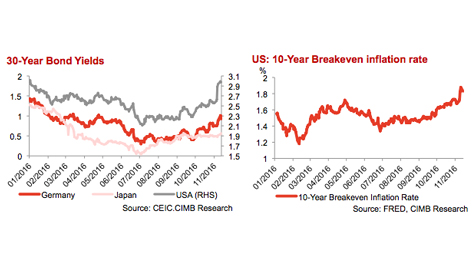
There is an ongoing re-pricing of the US macroeconomic outlook. Clearly, growth and inflation are both expected to rise. To be sure, the markets had been expecting this for some time – the yield on the 30-year Treasury bill has been rising since July as has the breakeven inflation rate in the US – but the elections have accentuated it.
img-arupanalysis-pic1.jpg


To some extent, the outlook is being driven by policy expectations, so let us consider each policy initiative in turn:

Fiscal policy. Mr. Trump has promised to invest in infrastructure, about $500 billion over 5 years1. While this would undoubtedly benefit Asian exports, three details are important. First, it will depend crucially on where the money is spent; second, on how it is financed; and third, what reforms are done on the revenue side.

With regards to the sphere of spending, if expenditure takes place in areas such as roads, bridges, or air transport, it not only would directly boost Asian exports but also would help crowd in private investment providing a further impetus to Asian trade. As most of Asian trade is in intermediate goods catering to investment abroad, the benefits are obvious.

Besides that, it would provide a boost to supply chains and that should get trade multipliers going. All very good.

The second detail is about how this expenditure is likely to be financed. If tax reform – a drop in the corporate tax rate – will get enough funds to be repatriated to finance the stimulus, then well and fine. If, however, the hope is that policy measures will suddenly get the US economy growing at 4% or more, then there is likely to be not only disappointment, but also higher deficits.

Moreover, a 4% plus growth rate achieved through pure demand-side measures, without a commensurate improvement on the supply side, would mean overheating and would likely be met by higher rates. Ultimately, it would be unsustainable2.

A couple of years ago, when there were significant unemployed resources in the economy, a rising fiscal deficit did not necessarily mean higher inflationary expectations and hence higher yields. But today, with the economy near full employment, the outcome is likely to be different.

Third, on the revenue side, Mr. Trump has signaled that he would like to cut the marginal tax rate for both individuals and corporations. History suggests revenue as a percentage of GDP is likely to decline, resulting in higher deficits. The effect of the cuts will be stimulative; the extent of the effect will depend on the magnitude and incidence of the cuts. The greater the income boost to individuals with a higher propensity to consume, the greater the stimulative impact.

In summary, Mr. Trump’s fiscal plans should provide much needed stimulus from the second half of 2017 and should add to GDP growth. The extent of improvement is difficult to predict at this stage. However, it will also result in tighter monetary conditions, via both higher rates and a stronger dollar.

For Asian economies, a boost to US growth is undoubtedly positive to the extent that it helps exports. The larger boost to trade would come via infrastructure spending given the nature of Asia’s exports to the US. While a rise in US consumption is welcome, it is not the main driver of Asia’s exports.

img-arupanalysis-pic2.jpg

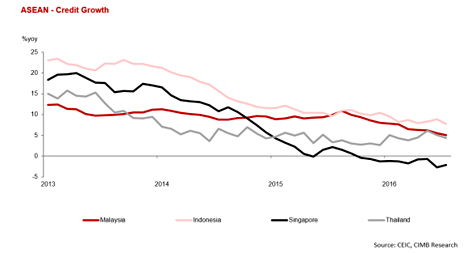
On the negative side, higher US rates will mean an end to rate cutting cycles that we have across Asia, notably in Indonesia, and a possible rise in longer term rates. That will have a contractionary effect on the economy but perhaps not significantly so as credit growth across many ASEAN countries had been poor to begin with. Countries with high household debt, such as Malaysia and Thailand, will probably feel the larger impact of higher longer-term rates.
img-arupanalysis-pic3.jpg

A stronger dollar, especially if it is versus the Renminbi, will mean weaker ASEAN currencies. However, if they all weaken in tandem and trade-weighted impact is likely to much less. As such, the impact on trade, strictly due to currency moves, is unlikely to be great. Moreover, as most ASEAN countries have low dollar-denominated short-term debt, it should not meaningfully impact the external accounts either. Of course, all this depends on the magnitude of the various price movements and that, in turn, is likely to be more driven by Mr. Trump’s trade policy.

Trade policy. The hope for ASEAN is that Mr. Trump will not follow through on most his proposed changes to US trade policy. The most important ones are: The Trans Pacific Partnership (TPP) – labeled a “disaster” by Mr Trump; the second is the threat of tariffs on Chinese exports, ranging from between 25% to 45%, made in various speeches; and the third is his plan to label China a currency manipulator. All 3 measures would be negative for the region, though in differing degrees. Consider them in turn.

Labeling China a currency manipulator would be largely benign. First, very few people think China has an undervalued currency — it is, in fact, bleeding capital — so it’s a label that wouldn’t be taken seriously. Second, all it means is that the US Treasury would start having a dialogue with the Chinese authorities about revaluing the currency. It is a safe bet that the dialogue would not go very far. The larger issue is the negative signal it would send on US-China relations and the uncertainty that would cast on markets.

Although, abandoning the TPP would have negative implications, it would be losing something that ASEAN didn’t have anyway so the loss would be more of possible, rather than actual, benefits. Countries such as Vietnam, which would gain most from integration, have the largest potential loss. As such, market-driven variables are unlikely to respond. It could, however, recast relationships within the region. The TPP was an important part of President Obama’s “pivot” to Asia, in terms of building strategic and military alliances, that effort will undoubtedly come under strain.

Moreover, it is very likely that most Asian countries will tilt more strongly toward the Regional Comprehensive Economic Partnership (RCEP) that includes all ASEAN nations, China, Japan, India, Korea, Australia and New Zealand. It could potentially alter relationships within Asia and how ASEAN relates to China versus the US.

Tariffs on Chinese products could be a game changer for the global economy. Such tariffs would disrupt supply chains that have been functioning for many years and the effects would be felt all over ASEAN. We don’t know what the China’s response is likely to be, though it’s safe to say any response is unlikely to be positive. Retaliation would be almost certain.

The stated reason for the tariffs is that they would benefit the US worker but, in truth, that is not sure. Most likely some other country would replace China as the exporter to the US. What is true, is that the cost of US imported goods will rise, thereby imposing an implicit tax on US consumers and businesses, and the effect of Mr. Trump’s tax plan would be diluted. Furthermore, protectionism will constrain the growth of world income and that includes the US.

Tariffs would also lead to further rise in the US dollar and weakness in the RMB, both of which would have a negative impact on Asian currencies. Over the medium term, potential growth will suffer as efficiency gains from trade are lost. The countries that will feel the most pain are the ones that rely on open international markets to sell their products, and that includes almost all of ASEAN.

The monetary policy response. We are already seeing the market impact of an expected fiscal stimulus, higher expected growth and inflation, and possibly higher fiscal deficits: Yields on 10-year US treasuries have risen (yields on 30-year bonds have been rising since July), the USD is stronger and the breakeven inflation rate (the difference between the yield of a nominal bond and the yield of inflation-indexed bond – TIPS — of similar maturity), which started rising in July, has risen further. Will the US monetary policy outlook change? And what will be the Asian response?

In my view, any change in US Fed Funds glide path is likely to be minor, that is unless policy changes turn out to be much greater than I think. For starters, the consensus view has the Fed would raising rates once this December and probably another 2 times next year. In short, a shallow glide path for the Fed Funds rate is expected in what is believed to be a low growth, low inflation, and low rates world.

Some of that will change with fiscal stimulus, especially if it is large enough and sustained enough, being applied in an economy that is near full employment. But that time has yet to come. Meanwhile, there is still uncertainty about the current state of the economy and the case for a rate increase is hardly cut and dried. Indeed, while there is possibly incipient inflationary pressure – wages grew 2.8% yoy in October – the markets, with higher yields and a stronger dollar, may already have done the initial tightening for the Fed. And given the uncertainty about policy, the Fed may choose to hold back in December and see what unfolds.

Over the medium term though, rates should rise a bit more aggressively. But fiscal policy takes time to have an effect, and monetary policy is unlikely to work at cross purposes, so rate increases are probably more likely to be in the second half of the year and into 2018 rather than being imminent. The Fed needs to get inflation back in the system and even though the breakeven inflation rate has risen, it is still below the Fed’s target.

As such, I think the Fed may desist for a while and there is possibly only one rate hike of 25 bps until the middle of 2017 and perhaps two more after that until the end of the year. In 2018, there will be another wildcard as the Fed Chair is likely to change, possibly to someone more hawkish. With fiscal stimulus starting to show a greater effect, and hopefully trade policy not being too contractionary, another 3 rate increases of 25 bps each can be expected that year.

Looser fiscal policy in tandem with tighter monetary policy makes a textbook case for a stronger dollar and that is what I expect over 2017.

For ASEAN, it means we are possibly nearing the end of a rate cutting cycle. Monetary policy is not just about the Fed, but also about domestic economies, and how respective currencies are behaving and the signal that sends about overall stability. Bank Indonesia has cut rates 6 times this year and I had expected another 2 or 3 more cuts next year. Depending on rupiah (in)stability, and how aggressively the Fed moves, there may now be fewer cuts, but I don’t believe that the cutting cycle is fully over for Bank Indonesia.

I had also expected BNM to cut rates at their next meeting on November 23rd, but given the recent volatility of the ringgit, that cut might be put on the back burner. I emphasize that I think it is on the back burner, rather than off the table, as I believe that, given the opportunity, BNM will cut again. Depending on how the ringgit behaves, we could get one or two cuts in the first half of next year. After that, when the glide path of the Fed Funds rate becomes steeper, Malaysian rates are likely to stay stable.

Currency volatility is damped in Thailand because of the buffer of a large current account surplus. Moreover, policy rates have been steady despite low inflation, as the transmission mechanism is impaired and credit growth remains poor. I had believed that rates could have been modestly reduced next year once fiscal policy gained traction and monetary policy became more effective. That cut may be off the table if we start seeing an improvement in the external sector.

The Singaporean economy is highly reliant on trade and financial flows. Mr. Trump’s policies will not help it. Nonetheless, with monetary policy settings at neutral I do not expect a change. The SGD will probably bear the brunt of the adjustment and weaken along with other regional currencies.

Foreign Policy. If the TPP is scrapped, it would be a dilution of Mr. Obama’s pivot toward Asia and possibly portends an ASEAN pivot toward China. We have already seen the Philippines go that route and Malaysia too has been strengthening its bilateral relationship with China. Of course, relationships with China and the US are not mutually exclusive, but it looks possible that Mr. Trump may not be as engaged with the region as his predecessor.

There are, of course, larger issues such as the US relationship with its NATO allies, the relationship with Russia and opposition to the Russian position on Crimea, Ukraine and Syria, the continued presence of US troops in countries such as Japan and Korea, and possibly even nuclear proliferation. Time alone will answer how much of Mr. Trump’s campaign rhetoric will actually come to pass. In the meanwhile, there is uncertainty, higher risk premiums and volatility.


1 At current GDP, this is about 0.5% of GDP a year. In our view, the needs are greater not only from an infrastructure perspective but also in terms of a stimulus. That said, I welcome this initiative. I have, for some time now, believed that fiscal stimulus (not just in the US, but worldwide) as the most likely effective measure to get growth out of its slump.
2 Potential growth in US is currently measured at around 1.5%to 1.6%. FRED Economic Data.

Myanmar Monitor Weekly


img-mmw-14nov2016.jpg

Than Htut Aung, CEO of the Eleven Media Group, is escorted by police from the court in Yangon on Friday. He and his chief editor will spend the next two weeks in Insein prison while defamation allegations against them are investigated. (AFP Photo)

Politics

Myanmar jails top media chiefs
Police detained Than Htut Aung, the chief executive of Eleven Media Group and the newspaper’s chief editor Wai Phyo, on 11 November, after the Yangon regional government sued them for defamation over a social media post alleging corruption. The pair have been charged under Myanmar’s controversial telecommunication law and will be behind bars for at least two weeks while police continue their investigation.
Read More >

Three Rohingya villages burned in Myanmar: HRW
Satellite images show that several Rohingya village in Myanmar’s Rakhine State have been burned to the ground in recent weeks, Human Rights Watch (HRW) said on 12 November, urging authorities to invite United Nations investigators to look into the destruction. A total of 430 buildings in three villages in the northern Maungdaw district have been destroyed between 22 October and 10 November.
Read More >

New report highlights land confiscation in Myanmar’s Karen State
The Human Rights Watch launched a report called “‘The Farmer Becomes the Criminal’: Land Confiscation in Burma’s Karen State” on 3 November, documenting how government officials, military personnel, local militia members, and businessmen have used intimidation, coercion, and force to seize land from local people in Karen State. Human Rights Watch has also called on Myanmar’s new government to release all land rights activists detained for peaceful protests, investigate allegations of unlawful land seizures, and ensure the return of land taken improperly.
Read More >

Economy

Telenor shifts Myanmar focus to data services
Norwegian telecoms company Telenor will focus on improving data services in Myanmar, the head of the local business has said. Following the sector’s liberalisation Telenor quickly establishing itself as the No. 2 in the market with 18 million subscribers. After a period of astonishing growth in a country which had one of the world’s lowest mobile penetration rates, the fight over customers is shifting to more-lucrative internet services, fuelled by Myanmar’s near-ubiquitous use of Facebook.
Read More >

Foreign Affairs

Myanmar’s Aung San Suu Kyi congratulates Trump on election win
Myanmar State Counsellor and Foreign Minister Aung San Suu Kyi on 9 November offered congratulations to US President-elect Donald Trump. “I am confident that the trust placed in you by the American people will inspire you to promote progress, peace and prosperity in the United States of America and beyond, as you lead your great nation into the future,” Suu Kyi wrote.
Read More >


Asian business must brace for a new US era

09 November, 2016
As appeared in Nikkei Asian Review

asean

WHATEVER happens in the United States Presidential election next Tuesday, the Donald Trump phenomenon is the strongest signal coming out of America.

It is not just an aberration, something transient, but a disturbing condition which is a bad omen for the future of the country and America’s leading position in the world.

The sustained support he has obtained on base and isolationist arguments represents a substantial part of the American people.

The erudite analyses on how Trump has got to where he has, many of which look at the sorry state of the Republican Party that nominated him, miss the point of the malady in the society at large. Indeed the bitterness, anger and attitudes Trump has been able to galvanise precisely sneer and snort at these kinds of analyses which do not get it.

The intellectuals are talking among themselves, as they always have done, whereas Trump actually talks and reaches out to the people below. The intellectuals, like the elites generally, are the ones who are isolated.

Being politically correct, they do not take up issues in clear black and white. How many have said openly and loudly the American Congress is racist in hindering Barack Obama’s presidency? They may come out and join the chorus of indignation when the police shoot and kill defenceless blacks, but how many come down hard on institutional racism in the police force?

There is a lot of racism in America, in high and low places, in check-and-balance institutions, and with guns. Trump speaks to this constituency when he equates any attack on the police as an “attack on us” (USA! USA!).

When he calls into question Obama’s birthplace and birthright, something that has run through the whole of the first black American presidency, it is something that Trump just took up from so many such previous racist assertions.

The moment you touch down in America and go through immigration, you see strained racist welcome, and not infrequently you experience outright racist sentiment. It does not matter if you have invested hundreds of millions in the US and created so many precious jobs – as happened in the case of a large Malaysian investor. What matters is that you are not white.

There is this kind of ready constituency which supports Trump. It may be an uncomfortable truth to other Americans, but they are being disingenuous in denying it.

In the Trump campaign the racism has been particularly harnessed against Hispanics and Muslims. His great big wall along the border with Mexico to stop illegals from stealing into America and his “stop the Muslims from coming to the US” may sound like so much rhetoric, but there is enthusiasm for them in this constituency.

Erudite commentators who have adopted US citizenship years ago have to find acceptance for their views not only by protesting their commitment to America but also by declaring they are lapsed Muslims. You have to be a supplicant to earn the points.

Of course it is often pointed out that much of all this has come about because of the huge income disparity that has developed in America, leaving behind a substantial part of the American population who see the fat cats in Wall Street, Washington or Los Angeles thriving in temples of wealth, power and privilege. Many, furthermore, have lost their manufacturing jobs while huge bonuses continue to be handed out to master-of-the universe bankers and top corporate leaders.

They find safe harbour in, readily, racism and xenophobia. Only Trump says it for them: hit out at Hispanics, Muslims and China, indeed at a lot of the rest of the world. How Americans can so easily get into this state, among those who are not already in it, rests on predisposition-in-reserve and on failure of political leadership.

The jingoistic and isolationist instincts are there. It is sometimes remarked the US attacks other countries to teach their people geography.

But it is in the failure of political leadership that most of America’s troubles lie. Many of the kinds of problems that give Trump his big base of support have not been addressed for so long.

Decaying cities, peeling infrastructure, lost jobs through competition and new technology, obscene income disparities – all lead to loss of hope and belief which only Trump addresses. He may give stupid and uncouth one-shot answers but address them he does. This Messiah.

In Washington they are fiddling their thumbs while Rome burns. This is not untrue. Just look at how Congress is only good at erecting roadblocks to policy initiative or implementation. Budgetary lock-outs. Social benefit freeze-outs. Foreign policy sacrifices. Much – not too ironically – based on the same kind of instincts that give Trump his support.

Not much thought is given to the next round of challenges that will come as China and Asia build up their technological and white-collar job capabilities where, it is argued ad nauseam, America still has the edge.

China is expected to have 200 million college graduates by 2030 – more than the entire American work force. With brain power also from other parts of Asia, there will be a challenge in hitherto American-dominant economic sectors. Financial and capital market dominance will also begin to be whittled away.

Someone like President Obama, who understands the strategic developments and their implications, and is open in engagement with the world, is accused of only being good with words and of trading away American exceptionalism.

He is actually only left with words because so many of his initiatives, such as the Trans-Pacific Partnership, are blocked by attitudes in the check-and-be damned system of government inspired by instincts, much of which is the base of support for Trump.

American exceptionalism, such as it is, in its turn is not being sustained by the kind of values, shallowness of thought and lack of effective governmental leadership that, alas, is characteristic of Trump America. It is not negligible – Trump America, I mean.

In these final hours of the US presidential race, President Obama recently said the fate of the world is at risk, if Trump were to be elected president. He also said the fate of America, of the republic, is at risk.

What he should also have emphasised, more than anything else, it is America that is at risk. And, although he cannot say it just now, it is at risk whether or not Trump gets elected.

How did Trump get there? America put him there.

All too often the discourse on America’s decline takes place in the context of the rise of China. But China really is not its cause. Most of it is self-inflicted – although of course China will surge ahead as the US gets into a deeper hole.

Tan Sri Dr Munir Majid, chairman of Bank Muamalat and visiting senior fellow at LSE Ideas (Centre for International Affairs, Diplomacy and Strategy), is also chairman of CIMB Asean Research Institute.

How did he – Trump – get there?

05 November, 2016
As appeared in The Star Online

WHATEVER happens in the United States Presidential election next Tuesday, the Donald Trump phenomenon is the strongest signal coming out of America.

It is not just an aberration, something transient, but a disturbing condition which is a bad omen for the future of the country and America’s leading position in the world.

The sustained support he has obtained on base and isolationist arguments represents a substantial part of the American people.

The erudite analyses on how Trump has got to where he has, many of which look at the sorry state of the Republican Party that nominated him, miss the point of the malady in the society at large. Indeed the bitterness, anger and attitudes Trump has been able to galvanise precisely sneer and snort at these kinds of analyses which do not get it.

The intellectuals are talking among themselves, as they always have done, whereas Trump actually talks and reaches out to the people below. The intellectuals, like the elites generally, are the ones who are isolated.

Being politically correct, they do not take up issues in clear black and white. How many have said openly and loudly the American Congress is racist in hindering Barack Obama’s presidency? They may come out and join the chorus of indignation when the police shoot and kill defenceless blacks, but how many come down hard on institutional racism in the police force?

There is a lot of racism in America, in high and low places, in check-and-balance institutions, and with guns. Trump speaks to this constituency when he equates any attack on the police as an “attack on us” (USA! USA!).

When he calls into question Obama’s birthplace and birthright, something that has run through the whole of the first black American presidency, it is something that Trump just took up from so many such previous racist assertions.

The moment you touch down in America and go through immigration, you see strained racist welcome, and not infrequently you experience outright racist sentiment. It does not matter if you have invested hundreds of millions in the US and created so many precious jobs – as happened in the case of a large Malaysian investor. What matters is that you are not white.

There is this kind of ready constituency which supports Trump. It may be an uncomfortable truth to other Americans, but they are being disingenuous in denying it.

In the Trump campaign the racism has been particularly harnessed against Hispanics and Muslims. His great big wall along the border with Mexico to stop illegals from stealing into America and his “stop the Muslims from coming to the US” may sound like so much rhetoric, but there is enthusiasm for them in this constituency.

Erudite commentators who have adopted US citizenship years ago have to find acceptance for their views not only by protesting their commitment to America but also by declaring they are lapsed Muslims. You have to be a supplicant to earn the points.

Of course it is often pointed out that much of all this has come about because of the huge income disparity that has developed in America, leaving behind a substantial part of the American population who see the fat cats in Wall Street, Washington or Los Angeles thriving in temples of wealth, power and privilege. Many, furthermore, have lost their manufacturing jobs while huge bonuses continue to be handed out to master-of-the universe bankers and top corporate leaders.

They find safe harbour in, readily, racism and xenophobia. Only Trump says it for them: hit out at Hispanics, Muslims and China, indeed at a lot of the rest of the world. How Americans can so easily get into this state, among those who are not already in it, rests on predisposition-in-reserve and on failure of political leadership.

The jingoistic and isolationist instincts are there. It is sometimes remarked the US attacks other countries to teach their people geography.

But it is in the failure of political leadership that most of America’s troubles lie. Many of the kinds of problems that give Trump his big base of support have not been addressed for so long.

Decaying cities, peeling infrastructure, lost jobs through competition and new technology, obscene income disparities – all lead to loss of hope and belief which only Trump addresses. He may give stupid and uncouth one-shot answers but address them he does. This Messiah.

In Washington they are fiddling their thumbs while Rome burns. This is not untrue. Just look at how Congress is only good at erecting roadblocks to policy initiative or implementation. Budgetary lock-outs. Social benefit freeze-outs. Foreign policy sacrifices. Much – not too ironically – based on the same kind of instincts that give Trump his support.

Not much thought is given to the next round of challenges that will come as China and Asia build up their technological and white-collar job capabilities where, it is argued ad nauseam, America still has the edge.

China is expected to have 200 million college graduates by 2030 – more than the entire American work force. With brain power also from other parts of Asia, there will be a challenge in hitherto American-dominant economic sectors. Financial and capital market dominance will also begin to be whittled away.

Someone like President Obama, who understands the strategic developments and their implications, and is open in engagement with the world, is accused of only being good with words and of trading away American exceptionalism.

He is actually only left with words because so many of his initiatives, such as the Trans-Pacific Partnership, are blocked by attitudes in the check-and-be damned system of government inspired by instincts, much of which is the base of support for Trump.

American exceptionalism, such as it is, in its turn is not being sustained by the kind of values, shallowness of thought and lack of effective governmental leadership that, alas, is characteristic of Trump America. It is not negligible – Trump America, I mean.

In these final hours of the US presidential race, President Obama recently said the fate of the world is at risk, if Trump were to be elected president. He also said the fate of America, of the republic, is at risk.

What he should also have emphasised, more than anything else, it is America that is at risk. And, although he cannot say it just now, it is at risk whether or not Trump gets elected.

How did Trump get there? America put him there.

All too often the discourse on America’s decline takes place in the context of the rise of China. But China really is not its cause. Most of it is self-inflicted – although of course China will surge ahead as the US gets into a deeper hole.

Tan Sri Dr Munir Majid, chairman of Bank Muamalat and visiting senior fellow at LSE Ideas (Centre for International Affairs, Diplomacy and Strategy), is also chairman of CIMB Asean Research Institute.

China – Asean Monitor Weekly


img-camw-04112016.jpg

Photo from The Jakarta Post

Trade and Investment

Malaysian Prime Minister signs 14 business arrangements during China visit
Malaysian Prime Minister Datuk Seri Najib Razak said the proposed investments from 14 business arrangements sealed during his weeklong official visit to China which started on 31 October totalled RM143.64 billion or US$34.26 billion. Najib said the value of investments further supports the conclusion that the official visit would bring bilateral relations between Malaysia and China to new heights. The prime minister also achieved another landmark with the purchase of four littoral mission ships by the Malaysian Navy, Malaysia’s first military equipment trade with China.

This is Najib’s third official visit to China as prime minister. The first was in 2009, and the second in 2014 in conjunction with the 40th anniversary of diplomatic ties between Malaysia and China. Najib has also had three working visits to China, in 2012, 2014 and 2015.
Read More >
Read More >


Brunei welcomes more FDI from China: minister
Brunei welcomed more foreign direct investment (FDI) from China, Second Minister of Foreign Affairs and Trade Lim Jock Seng said on 29 October when meeting a preparatory team for the Brunei branch of Bank of China (Hong Kong) Limited (BOCHK). Brunei is pushing for economic diversification aside from oil and gas industry under the requirement from the Sultan Haji Hassanal Bolkiah, Lim added.
Read More >


Political Security


Growing Philippine-Chinese Ties Raise Questions in ASEAN

The Philippines’ new foreign policy, with President Rodrigo Duterte plans of reducing ties with the United States and strengthen relations with China, is raising questions about what this will mean for its ASEAN member nations and ASEAN centrality. The thawing relations with China are however easing the tensions over the South China Sea conflict, Chinese ships are no longer at the disputed Scarborough Shoal in the South China Sea and Philippine boats can resume fishing, the Philippine defence minister said on 28 October.
Read More >


Is China Repeating Japan’s Missteps?
The sad case of Japan should serve as a cautionary tale for China’s policymakers. Beijing pursued almost identical economic policies to Tokyo’s to generate its rapid development. Now China’s leaders are repeating the missteps the Japanese made that tanked Japan’s economy and thwarted its revival.

About 30 years ago, few foresaw the decline of Japan, which was the East Asian giant poised to overtake the US as the world’s top economy. But even as Japan appeared destined for greatness, its economy was, in reality, starting to rot. Those clubby ties among finance, business, and government misallocated capital and led to wasteful investments. Growth was given a boost by cheap credit in the second half of the 1980s, but that also helped inflate debt levels and stock and property prices. When this “bubble economy” burst in the early 1990s, the financial industry was flattened. Japan has yet to fully recover.
Read More >


Myanmar Monitor Weekly


img-mmw-13102016

Photo via The Straits Times

Society

Myanmar most generous country in the world
Myanmar has been named the most generous country in the world for the third consecutive year, according to the latest Charities Aid Foundation (CAF) World Giving Index. The annual index, which compiled an average of 1,000 responses each from 140 countries, looked at three major yardsticks: helping strangers, donating money and volunteering time.
Read More >

Politics

President’s Office Rejects UN Call for Action on Alleged Rights Abuses in Rakhine state
Myanmar’s President Office spokesperson has denied accusations of human rights violations being carried out by security forces in northern Rakhine State, saying they haven’t done anything lawless. United Nations human rights experts called on the government to take action against alleged arbitrary arrests, extrajudicial killings and burning of mosques and homes by authorities.
Read More >

Investment Law Rules and Regulations Released by March
The government has announced that the rules and regulations for the newly enacted Myanmar Investment Law will be released in three months at the earliest and by the end of March next year at the latest. The law, enacted by President U Htin Kyaw last week, combines the Myanmar Citizens Investment Law and the Foreign Investment Law.
Read More >

Economy

Yangon Electricity Tender Awarded to Murky Consortium
A consortium with links to a Myanmar company previously on the US blacklist and including an international energy company affiliated with the former US Secretary of State Madeleine Albright won a Yangon electricity tender. The consortium is led by National Infrastructure Holdings to generate an extra 300 megawatts of electricity for five years to prevent the city’s frequent blackouts.
Read More >


Myanmar to ramp up gem exports post-sanctions

Only a few weeks after Washington removed all remaining sanctions on Myanmar earlier this month, a delegation from the American Gem Trade Association has already visited the country. Myanmar’s high-quality jade and rubies are highly valued on the global market and expectations are growing among Myanmar businesses for the reopened window to the US, the world’s largest gem market.
Read More >

Foreign Affairs

Dozens of refugees in Thailand returning to Myanmar
Dozens of Myanmar refugees in Thailand are expected to return home on 26 October under a voluntary repatriation process for people displaced by decades of fighting between Myanmar’s military and ethnic armed groups. The pilot group is unlikely to be followed immediately by large numbers of returnees, given that conditions remain “unstable” within Myanmar, say human rights groups.
Read More >


Britain looks east towards Asean

22 October, 2016
As appeared in The Star Online

asean
Unsettling period: The City of London is getting increasingly nervous about its future after Brexit. Many foreign banks are fretting and there is talk of relocating. – Bloomberg

FROM Britain, where they are only and still debating four months afterwards the pros and cons of leaving the European Union (EU) in the Brexit decision, Asean looks like an oasis of opportunity and hope.

With an economy threatened by the prospect of being denied preferential access to the European market because of likely British insistence on control over migrants from the continent, the projected 4%-5% growth for the Asean economy – with about the same GDP as Britain – is attractive to business people in Britain.

Britain is looking to work its way more freely again in the world. The Asean Economic Community (AEC), as is Asia generally, is a good prospect in a world economy of anaemic growth.

When business people in Britain hear that the growth rate on mainland Asean is even higher at about 8%, from a low base with greater need for infrastructure development, their interest is doubly enhanced as this is a rate hard to find post the 2008 Western financial crisis.

The British, however, are in a bit of a muddle. They are engrossed with, and still cannot believe, how the Brexit decision was made.

This is not surprising because it was an ill-advised decision, based on emotional reasons, not tutored by pragmatic considerations which had hitherto driven the British nation.

The Brexit vote is the first real demonstration of how divided the country has become. A decision may have been made in the close vote, but this does not take away the fact that Britain remains divided almost 50-50.

British Prime Minister Theresa May says: Brexit means Brexit. But what is it? Hard, soft, gentle? When and how?

This is all in the air. Thus there is a court case asserting that before triggering Article 50 of the European Union Treaty for the exit from EU, the British government needs parliamentary approval.

Unsurprisingly, the opposition Labour Party has come up with 170 questions for the British government to answer from the time Theresa May announced she would trigger Article 50 next March. Less comfortably, the British cabinet is divided on what kind of relationship Britain should have with the EU after Brexit.

The City of London is getting increasingly nervous about its future after Brexit. Many foreign banks are fretting.

There is talk of relocation as fears rise of loss of “passporting rights” – the lucrative business of selling services into the EU, including clearing of euro-denominated bonds.

The Irish government, which is positioning Dublin as a preferred centre for relocation (because it is the only English-speaking alternative in Europe), estimates there are 100,000 to 150,000 jobs at risk in the City of London out of the 400,000 banking jobs in Britain.

All this, understandably, absorbs the full attention of the British government. A divided nation overwhelmingly demands answers to domestic issues in policy-making. There is scant time to plot the post-Brexit ex-Europe strategy.

British businessmen wish Theresa May would find time to visit Asean, to follow up on the marker left by former prime minister David Cameron earlier, and to give them a boost as they look east towards Asean.

Some wish their government would initiate negotiations on the UK-Asean Free Trade Agreement. The UK-Asean Business Council, which has existed as a standalone despite there being the EU-Asean Business Council, hopes for stronger support from the government.

So looking east towards Asean needs a strategy, a framework and governmental support not quite available given Brexit preoccupations.

Of course the British-Asean relationship existed before Brexit. The question, however, is how much stronger it is desired that it should become after it. Or is it going to be half-cocked should there be a half-Brexit, and not a hard Brexit?

On the other hand, should there be a hard Brexit, when Britain might be inclined to look harder at Asean, Asean member countries might be more attracted to the larger European market – if the EU can get its act together on its own relationship with Asean.

It has never been all or nothing, of course. And great British companies are already in Asean, as there are great European companies. The point is we are here talking of a strategic and focused economic relationship between Asean and Britain which affords greater opportunity to a greater number of companies, as well as taking that relationship to a higher level.

Great British companies, with high-level technology, can offer Asean economies better choice, especially in manufacturing and infrastructure development. This is not happening enough.

If there were a framework of agreement at governmental level, especially with regard to intellectual property protection, and settlement and enforcement of disputes, more investment and joint ventures could take place, to take advantage of the Asean and wider regional market.

In infrastructure development, where the stock in Asean is 20 points below the 70% of GDP level in most countries, Britain has much to offer in at least three facilitating ways: hard-wiring public-private partnerships which have been an abject failure in Asean; introducing “delivery partners” to scrutinise tenders and to ensure objectivity in award of contracts; and in the development of long-term bond markets.

Indeed, more widely, the threat from Brexit to the City of London could also be turned into opportunities of partnership, for instance, in the development of the Islamic fund management industry.

For Britain to be clear about looking east to Asean, there cannot continue to be an opacity about Brexit for too long, and for that self-absorption with Brexit to persist. There needs to be British Government lead for British business to find its way.

Asean, that association of states masquerading as a community of nations, is in no perfect form either. But its economies are growing.

Individual countries can offer themselves as the hub for the single production base which is to penetrate the common market. Both the offer of hub and the free and open market have to be real, however.

The non-tariff measures, that are extensive, are a put-off. Individual state policies too are not always attractive.

It was quite surprising for me to hear that British companies manufacturing high-level technology construction equipment find some of the states in India more attractive than most Asean member countries.

Therefore, it is not as if British companies have no alternatives. But it is clear that many of them wish to be in Asean for expansion and diversification.

What is needed is official facilitation, primarily by the British Government, but also by the Asean states to attract technology and investment.

Tan Sri Dr Munir Majid, chairman of Bank Muamalat and visiting senior fellow at LSE Ideas (Centre for International Affairs, Diplomacy and Strategy), is also chairman of CIMB Asean Research Institute.

ASEAN Trade – Has Misery Created Opportunity?

One of the main reasons behind the downshift in global growth has been the structural decline in global trade (Figure 1). For ASEAN economies, this has been particularly relevant given their dependence on the external sector.

To briefly recap. ASEAN and global trade has been going through a slump over the last five years (Figure 2). In US dollar terms, several Asian countries, ASEAN as well as China, have had negative export growth every month for over 18 months. Even considering the worst of crises, this is unprecedented. Recently, in volume terms there has been a flattening out of trade growth and while in US dollar terms, some of the numbers have become less negative, the outlook is far from constructive.

There are several Issues that have affected trade flows and reduced the trade multiplier from close to 2.3 in the mid 1990s to just above 1 today1. One of these reasons – partly structural, partly cyclical – is the slump in global investment. A large part of global trade is in intermediate goods and machinery, and as investment demand has struggled, so has trade.


img-graph.jpg

Source: WTO and World Bank


China too has played a large role in the trade slowdown. Not only is its growth rate slowing, they are rebalancing the economy and trying to change the composition of growth. They are trying to move from investment demand to consumption, and the latter is less import intensive. Similarly, on the supply side, there is a shift to services from manufacturing where the former is less import intensive.

But perhaps more than either of these economic rebalancing shifts, the larger effect is coming via China’s move away from resource-intensive growth and a move up the value chain. Further, it is on-shoring the production of various intermediate inputs that it had previously imported. At its peak, China used to import about 65 cents worth of inputs for every dollar of exports. Today, it is about 35 cents and likely to go even lower. These changes in trade patterns are likely to affect overall ASEAN trade but not all of it is likely to be negative.
 

The evidence

The IMF’s latest “World Economic Outlook”, published last week provides supportive evidence:

  • Over the period 2012 – 2015, trade as a percent of GDP has declined. In several countries, it has declined in absolute terms 
  • The growth rate of trade in both goods and services has declined, though more for goods. 
  • While 85% of product lines have seen a decline in their trade growth, the “sharpest slowdown was observed in trade in capital and intermediate goods”. 
  • Since 2012, the main cause for a trade slowdown has been poor economic activity in general and the slowdown in investment demand in particular.  


media15sept_chart

Source: WTO and Asean.org


There is a two-way causality between trade and investment. As established above, investment demand is a significant driver of trade flows. However, on its own, trade too boosts growth and productivity, which in turn creates the need for investment. These findings suggest at least two immediate policy initiatives.

The first is to try and boost investment demand. While private investment is unlikely to respond in the near term as the returns to it are low, authorities should try and boost public investment. Indeed, in Indonesia, Thailand and Vietnam that is exactly what is being done and the benefits should follow. In this era of sluggish global growth, and in particular a slowing Chinese economy, the role of fiscal policy has become even more important. It can not only support domestic demand directly but, if coordinated between countries, can give a much-needed boost to the external sector and ignite a positive feedback loop to domestic demand.

The second is to undertake measures to boost trade directly. That effectively means a continued movement toward integration, liberalization and the removal of both tariff and non-tariff barriers. Recently, at a global level, there has been a rise in protectionism, in both action and rhetoric. The backlash against globalization is understandable in a sluggish economic environment where jobs are hard to come by and income growth is poor. However, trade is not the culprit as it boosts growth. But it also creates winners and losers and hence has an income redistribution effect within economies. And it is this income redistribution that has led to the disaffection which policymakers need to address while finding means of boosting trade. For ASEAN economies, trade is likely to play an important role in any recovery.


Opportunity for CLMV (Cambodia, Laos, Myanmar, Vietnam) economies

Some of China’s rebalancing has been by design but some has also been forced on it. As demographics have changed, wages have risen, and with productivity growth not keeping pace, unit labor costs have gone up. That has forced China to start reducing its exports of labor-intensive light manufacturing industries such as garments, footwear, toys and furniture2. This has created an opportunity for CMLV economies which needs to be seized with pro-active policy measures. All these economies have low wages and Vietnam and Cambodia have established manufacturing bases. But as we know, China did not become a manufacturing and exporting juggernaut merely because it had cheap labor. There was supporting infrastructure, an ease of setting up and doing business, access to credit, reliable labor etc. etc. That is the challenge for CLMV economies. The lower-wage labor is there in abundance. They need to create the enabling environment for it to flourish.


1 “The Global Trade Slowdown: Cyclical or Structural?”, Cristina Constantinescu, Aaditya Mattoo, and Michele Ruta, IMF Working Paper, January 2015.
2 “China’s Changing Trade and the Implications for the CLMV Economies” Koshy Mathai, Geoff Gottlieb, Gee Hee Hong, Sung Eun Jung, Jochen Schmittmann, and Jiangyan Yu, IMF, Paper No. 16 /1, September 2016.