CARI Captures 312


c312_graphic.jpg


ASEAN

ASEAN Council on Petroleum meet in Vietnam
(19 May 2017) The ten members of the ASEAN Council on Petroleum (ASCOPE) agreed to boost cooperation when they convened for their 83rd national committee meeting in Vietnam. The participants agreed to promote the reuse of waste catalysts in refineries, upgrade and expand refineries, optimise the model of heat exchanger cleaning and rank the optimal level of operating capacity. ASCOPE also agreed to enhance an emergency response system for gas shortages to address possible energy security emergencies in ASEAN. The Council will also continue developing guidelines for decommissioning the region’s substantial stock of ageing offshore oil and gas infrastructure.

VIETNAM

Vietnam to approve US$7.5 billion coal-fired power plants
(24 May 2017) Vietnam’s investment minister Nguyen Chi Dung said that the country is set to grant investment licenses for three coal-fired power plants worth a combined US$7.5 billion in June. The projects will be undertaken by Japanese, South Korean and Saudi Arabian investors. The projects are expected to be operational by 2021 and 2022 respectively. While Vietnam aims to boost renewable energy output, it has been mostly reliant on coal-fired and hydropower plants to meet its annual electricity demand growth of around 11 percent.

MALAYSIA

Manufacturers moving out of Malaysia
(22 May 2017) Some multinational corporations are leaving Malaysian shores citing a difficult operating environment as the reason for their departure. The Federation of Malaysian Manufacturers said that the new regulations including the Employee Insurance Scheme, Employee Mandatory Commitment, mandatory health checks for foreign workers, the energy subsidy rationalisation, the increases in minimum wage as well as increases in logistical charges including depot charges, seal charges and the bill of lading fees, are the increasing costs of doing business. Recently, JTI Bhd, British American Tobacco Bhd, Seagate Technology Plc, and Western Digital Corp have ceased manufacturing operations in the country.

ASEAN

Former secretary-general of ASEAN proposes
(19 May 2017) Former Secretary General of ASEAN, Surin Pitsuwan, said that the 10-member group could play a peace broker role in the ongoing crisis over North Korea’s nuclear weapons program. He said that the ASEAN Regional Forum should appoint a special envoy on the Korean Peninsula. The ASEAN Regional Forum discusses security issues and includes all members of ASEAN and the six-party security talks on North Korea namely U.S., Japan, China, Russia, North and South Korea. He said that the adversary will usually not be the one to make a concession and that an ASEAN envoy could move among the six capitals and help find them common ground, he added.

ASEAN

ASEAN trade ministers attempt to fast-track RCEP
(19 May 2017) In an attempt to facilitate negotiations on the Regional Comprehensive Economic Cooperation (RCEP), ASEAN trade ministers will hold another intersessional meeting in Hanoi. Trade and Industry Secretary Ramon M. Lopez, who is the current chairman of the ASEAN Economic Ministers Meeting, said the 3rd RCEP Intercessional Meeting will take place in Hanoi. The Philippines hosted the 18th RCEP Trade Negotiating Committee (TNC) Meeting and Related Meetings recently but there was no official report yet on what took place during the meetings in Manila. Lopez has also proposed the adoption of the principle of reciprocity to avoid delaying the conclusion of the negotiations.

ASEAN

ASEAN military heads to increase cooperation on terrorism
(22 May 2017) Military chiefs from ASEAN signed the joint statement aimed at improving joint military exercises, humanitarian assistance and disaster relief capacities. The move also seeks to beef up efforts to formalise the ASEAN Chiefs of Defense Forces Informal Meeting (ACDFIM) which first agreed upon at the 12th ACDFIM held in Malaysia in 2015 to become a mechanism to combat the prevalence of violent ideologies and create a coordinated response to non-traditional threats like disasters. Armed Forces of the Philippines public affairs office chief Col. Edgard Arevalo said threats of terrorism, particularly the spread of ISIS-inspired extremism, maritime security concerns, and the onslaught of disasters and calamities became the focus of the meeting and that these inspired the mutual agreement to forge stronger partnerships.

CAMBODIA

Government launches project to help 15,000 farmer
(24 May 2017) The Cambodian government launched the first phase of a project to help 15,000 farming families commercialise their operations and bring their produce—rice, cassava, chickens and silk—to market. Cambodian Commerce Minister Pan Sorasak said the supply and demand in the country are not balanced— like with vegetables, so they import these goods to fulfil demand. The project, called Accelerating Inclusive Markets for Smallholders, has two components: building infrastructure to help farmers, and offering special micro finance deals, including longer terms and 20 percent government subsidies. The government expects to spend US$60 million on this project.

SINGAPORE

Singapore’s first quarter GDP shrinks at a lower rate than estimated
(24 May 2017) Singapore’s Ministry of Trade and Industry reported a quarter-on-quarter fall in GDP of 1.3 per cent against an advanced estimate of a 1.9 percent dip. A Bloomberg forecast indicated that there would be a 0.9 percent fall. The manufacturing sector contracted by 1.5 per cent quarter-on-quarter, a sharp fall from the 39.8 percent growth seen in the previous quarter, but smaller than the estimated 6.6 percent drop. In year-on-year terms, the city state’s economy grew by 2.7 per cent in the first quarter, down from 2.9 percent in the previous quarter. The Singaporean government is confident that growth forecast for 2017 will remain between the 1 to 3 percent range.

ASEAN

ASEAN and China agree on framework for code of conduct
(18 May 2017) After a meeting between Chinese and ASEAN officials, China’s foreign ministry said the framework had been agreed upon. However, no further details of the framework were given. The Ministry said that all parties will use the framework of regional rules to manage and control disputes, deepen practical maritime cooperation, promote consultation on the code and jointly maintain the peace and stability of the South China Sea. The framework will be submitted at a meeting of the foreign ministers of China and the ASEAN countries in August 2017. Chinese Vice Foreign Minister Liu Zhenmin also made comments which called on others to stay out, an apparent coded message to the United States.

MYANMAR

Aung San Suu Kyi kicks off another round of peace talks
(24 May 2017) Myanmar state counsellor Aung San Suu Kyi is hosting peace talks in the capital city of Naypyidaw in her second attempt to end fighting in the country’s troubled frontier regions. So far, only eight ethnic groups have signed the National Ceasefire Agreement (NCA) which was negotiated by the previous administration. This round of talks will see those signatories as official participants while those who have not signed will only be special guests. Seven groups have refused to sign the ceasefire agreement but have representatives attending the conference including United Wa State Army, Myanmar’s largest non-state armed group, the Myanmar National Democratic Alliance Army (MNDAA), the Shan State Army-North (SSA-N) and the Ta’ang National Liberation Army (TNLA). Many armed groups have complained that Suu Kyi has not listened to their concerns and is working too closely with the military.

Myanmar Monitor


img-mmw-250517

Photo Credit: EPA

Economy, Investment and Trade

Economic cooperation zone to be set up at China-Myanmar border
(24 May 2017) Myanmar and China signed a memorandum of understanding between the ministries of commerce of both countries to establish the China-Myanmar Border Economic Cooperation Zone. This was done during Aung San Suu Kyi’s visit to China for the Belt and Road Forum for International Cooperation. A joint committee, to be headed by the ministers of commerce for both countries, will be formed to discuss the details of the zone. Myanmar Minister for Commerce U Than Myint said that once this area is set up commodities and investments can freely cross the border between the two countries.
Read More >

Thai bank keen to support SMEs in Myanmar
(22 May 2017) Kasikorn Bank (KBank) is looking to obtain permission to open a branch in Myanmar to assist bilateral trade but also to provide support for small to medium enterprises (SMEs) in the country. KBank President said that the bank is keen to share technologies and expertise for the development of Myanmar’s SMEs. In an effort to show their commitment the bank has been actively running seminars and capacity-building workshops for SMEs in Myanmar. Earlier this month, officials from the Central Bank of Myanmar said that it may allow more foreign bank branches but the exact details, such as timeline and plans, have not been released so far.
Read More >

Two countries, one visa plan by Cambodia and Myanmar
(22 May 2017) The Myanmar Ministry of Hotels and Tourism Deputy Director General Daw Khin Than Win said that they are implementing a two country one destination campaign with Cambodia by planning direct flights between the two ancient cities of Bagan and Siem Reap. This means that a tourist can get to Myanmar without a visa at the embassy if they have a Cambodian visa. According to Daw Khin Than Win Myanmar is yet to start the practice of free visas for tourists as it has to submit the plan to cabinet for a bilateral agreement and approval. However, U Htay Hlaing, Director General of Ministry of Labor, Immigration and Population said that the visa exemption issue for two countries one destination is still under discussion between the two ministries and that it would be impossible to allow.
Read More >


Foreign and Internal Affairs

Aung San Suu Kyi kicks off another round of peace talks
(24 May 2017) Aung San Suu Kyi is hosting peace talks in capital city of Naypyidaw in her second attempt to end fighting in the country’s troubled frontier regions. So far, only eight ethnic groups have signed the National Ceasefire Agreement (NCA) which was negotiated by the previous administration. This round of talks will see those signatories as official participants while those who have not signed will only be special guests. Seven groups have refused to sign the ceasefire agreement but have representatives attending the conference including United Wa State Army, Myanmar’s largest non-state armed group, the Myanmar National Democratic Alliance Army (MNDAA), the Shan State Army-North (SSA-N) and the Ta’ang National Liberation Army (TNLA). Many armed groups have complained that Suu Kyi has not listened to their concerns and is working too closely with the military.
Read More >

Myanmar army rejects findings on abuses on Rohingyas
(24 May 2017) Myanmar’s army rejected allegations, made by the United Nations, of human rights abuses during its crackdown on Rohingya Muslims last year. The offensive forced some 75,000 Rohingya to flee to neighboring Bangladesh. Through a state-run media outlet the military said that out of 18 accusations included in the UN report, 12 were found to be incorrect, with the remaining six found to be false and fabricated, based on lies and invented statements. These were the findings of an internal military inquiry. A national panel set up by Suu Kyi in December and chaired by vice president Myint Swe, a former head of military intelligence, is also looking into the allegations.
Read More >

China-ASEAN Monitor


img-cam-240517.jpeg

Photo Credit: Reuters

Foreign Affairs

ASEAN and China agree on framework for code of conduct
(18 May 2017) After a meeting between Chinese and ASEAN officials China’s foreign ministry said the framework had been agreed upon. However, no further details of the framework were given. The Ministry said that all parties will use the framework of regional rules to manage and control disputes, deepen practical maritime cooperation, promote consultation on the code and jointly maintain the peace and stability of the South China Sea. The framework will be submitted at a meeting of the foreign ministers of China and the ASEAN countries in August 2017. Chinese Vice Foreign Minister Liu Zhenmin also made comments which called on others to stay out, apparently a coded message to the United States.
Source: Reuters (18 May 2017)

Duterte claims China threatens war
(22 May 2017) The Philippines and China played down a warning by President Rodrigo Duterte that China would go to war if the Philippines drilled for oil in the disputed South China Sea. However, the Philippines is now trying to play down Duterte’s comments. Foreign Secretary Alan Peter Cayetano said that the meeting between two leaders was frank and friendly and that the discussion was largely about how to stabilise the region and prevent conflict, not threatening it.
Source: Business Insider (22 May 2017)


Economy, Investment and Trade

Chinese automaker agree to buy Proton
(23 May 2017) Chinese automaker Geely has agreed to buy Malaysian manufacturer Proton from DRB-Hicom. Zhejiang Geely Holding Group, which controls Hong Kong-based Geely Automobile and Sweden’s Volvo Car Group, will acquire 49 percent of Proton. Proton also controls British sports car maker Lotus.Other potential bidders included PSA, the Paris-based maker of Peugeot and Citroen cars, its domestic rival Renault and Japan’s Suzuki Motor Corp. Geely hopes to lift Proton’s sales in right hand-drive markets including Malaysia, the United Kingdom, India and Australia.
Source: Reuters (23 May 2017)

Lack of clarity in reporting of Chinese investments in Indonesia
(23 May 2017) Reporting of Chinese foreign direct investments (FDI) into Indonesia have been inconsistent. Indonesia’s Investment Coordinating Board (BKPM) announced that Indonesia received US$2.7 billion in FDI from China during 2016. Bank Indonesia (BI) recorded only US$163 million from China during the same period. China’s Ministry of Commerce’s (MOFCOM) latest data records US$1.5 billion worth of approved outflows of FDI to Indonesia during 2015. But for the same period, BI recorded US$379 million of FDI inflows from China and BKPM reported a figure of US$628 million. These discrepancies have been attributed to a variety of factors. One being that Chinese companies invest in tranches so while BI takes into account only the investment that has been made, BKPM may be taking into account the entire amount promised. Another reason given was that Chinese companies may be channeling their funds to Indonesia through their Singaporean subsidiaries, which MOFCOM does not consider.
Source: Asia Times (23 May 2017)


America vs China: odds narrowing

20 May 2017
Originally published in The Star Online

THE contrast could not be greater. While United States president Donald Trump raves and rants – and belts this or that person – China’s president Xi Jinping looks measured and assured as he offers a global future to the world.

Xi is no angel of course, as his political opponents would know, but his system conserves and protects him, as Trump’s would not. If only Trump were the leader in a centrally controlled political order – but even then his temperament would blow it apart.

Leadership, like politics, is the art of managing the possible. Trump does not understand this, and does not know how. Xi does, knows why, and knows how.

He has a growing economy too behind him, whatever the hiccups. Trump only promises one, without any clarity or logic.

His plan to boost the American economy, based primarily on slashing corporate tax from 35 to 15%, is likely to flounder in an American Congress seriously concerned about its causing the fiscal deficit to balloon.

Already Trump has had to climb down from trying to secure funds from Congress for his dreaded border wall with Mexico in order to avoid budgetary shutdown in September.

The stock market has fallen back from the boost to the price of banks and industrial products following his election. Interest now has returned to what might be termed “American ingenuity stocks” such as Google, Apple and Microsoft on Nasdaq – a proxy for much that is great about America, which Trump’s immigration and closed-door policies threaten to destroy.

Meanwhile Xi has been rolling out his “Belt and Road” plans – something he first envisaged at the end of 2013 – for greater world connectivity and development, committing funds from China and the Asian Infrastructure Investment Bank, and engaging global financial institutions such as the World Bank.

Malaysia, for instance, will be an actual beneficiary with additional projects thrown in. China is Malaysia’s largest trading partner. But the US has not been a laggard, being Malaysia’s fourth largest trading partner. And indeed the US remains the largest foreign investor in Malaysia, both new investments and total stock.

A staggering statistic not often recognised is that total American investment in Asean is more than its investment in China, Japan and India COMBINED!

The point, however, is that this position is being eroded. Trump’s policies are hastening this process. Abandonment of the Trans-Pacific Partnership (TPP) means there is no American strategic peaceful challenge to the Chinese economic juggernaut in Asia-Pacific.

Balance is important to afford choice. Absence of choice means serious exposure to risk. Price, quality and after-service standards are affected, not to mention a new geostrategic economic underlining.

Over-dominance by China in the region is a price not only countries in the region will pay, something that most probably is on Trump’s mind. It is a price that America too will sooner or later have to pay.

China’s Belt and Road proposition is not without its challenges, of course. India is deeply suspicious of the connectivity with Pakistan which cuts across India-claimed Azad Kashmir, about 3000km of it.

The link to the Pakistani port of Gwadar, in southwest Baluchistan on the shores of the Arabian Sea, is seen by India as a Chinese presence at the entrance to the Indian Ocean and a hawk eye on the Indian sub-continent. With the Chinese also in Sri Lanka, India is circumspect on China’s Belt and Road initiative.

There have also been commentaries on some uneconomic linkages which extend right across the English Channel.

All these reservations, however, do not take into account the benefit of connectivity to economies, the time it often takes to get those economic benefits and, most of all, the patience, persistence and long view of history of China and its leaders.

One of the most striking things about the Belt and Road map is that America is not there. Of course, Xi Jinping does not preclude America just as much as the US did not say that China was not permanently excluded from the TPP. And of course, in the Old Silk Routes and shipping lanes, the New World – America – had not been discovered.

But in their revival, led by now rising and then ancient China after 150 years of national humiliation to the present time, there is the irony that the last three quarters of a century of America world dominance is on course to be marginalised, if not supplanted, by the old Eurasian world centred in an ancient civilisation.

Trump does not seem to understand history. The art of the deal is purely transactional. Short-tempered and short-term gratification does not a strategy constitute.

So we have leader, system and economic promise distinguishing the two leaders – and the two countries.

Instead of America first, what we are seeing is Trump hurrying America’s decline relative to a rising China.

We are not seeing a world changed from people wanting to be like a kind of American to being people wanting to be a kind of Chinese. Actually, the Chinese people themselves want to be like a kind of American, with all that wealth, influence and power.

What we are seeing is China – not America – leading the way to that desired, if not always desirable, end. It is China that is driving the next phase in the evolution of world economic development.

Under Xi Jinping, China appears to be heroically moving towards an epochal point in its Peaceful Rise. With Donald Trump, America is being led backwards and inwards, with all the problems of its governance now all coming out. It is in grave danger of losing in the peaceful competition.

Not knowing how to play that game – certainly under its current President – there remains the danger of the status quo power lashing out against the rising one.

The Greek historian Thucydides observed: “It was the rise of Athens and the fear that this instilled in Sparta that made war inevitable.”

A Harvard professor has studied what is now called the Thucydides Trap and found in 12 out of 16 cases in which this occurred in the last 500 years, the outcome was war.

There are many potential flash points against the background of China’s rise – the North Korean Peninsula and the placement of THAAD missiles in the south, the South China Sea – where Trump may temperamentally find cause to lash out. This is the trapdoor he might take the world down because of failure to compete peacefully.

Tan Sri Dr Munir Majid, chairman of Bank Muamalat and visiting senior fellow at LSE Ideas (Centre for International Affairs, Diplomacy and Strategy), is also chairman of CIMB Asean Research Institute.

CARI Captures 311


c311_graphic.jpg


ASEAN

Youth see a positive future in ASEAN
(13 May 2017) The World Economic Forum released its Asean Youth Survey at its annual forum on ASEAN in Cambodia. They survey showed that 69 percent of respondents in the six countries polled – Indonesia, Malaysia, Philippines, Singapore, Thailand and Vietnam – expect to have a better life than their parents do. The survey was taken by 24,000 young people aged 16-22 for their views on ASEAN and their prospects. Around three-quarters of respondents felt that their countries are better off as part of ASEAN. Two-thirds felt that ASEAN membership benefits them personally with regards to improved job prospects, while only 5 percent thought it will make their lives worse.

ASEAN

ASEAN car market set to grow in 2017
(18 May 2017) The auto market in ASEAN indicates healthy demand for the rest of the year across the region’s largest five economies. The Financial Times’ Auto Purchase Index, which measures the six-month outlook for auto sales, moved slightly upwards in Indonesia and Thailand and showed small declines for Malaysia, the Philippines and Vietnam. However, the Financial Times’ Motorcycle Purchase Index fell in four of the five countries. Only Malaysia posted a slight increase. This is in contrast to the auto market, which continues to see many first-time buyers as the consumer class in the region expands.

PHILIPPINES

Philippines GDP growth slows
(18 May 2017) The Philippines’ economy grew at its slowest pace since the last quarter of 2015. This was due to weaker government spending, but strong exports and domestic consumption suggest the Southeast Asian country remains poised to raise rates this year. Gross domestic product (GDP) grew at 6.4 percent in the first quarter of this year below forecasts of 6.8 percent. Despite a fall in growth, the country remains one of the fastest growing economies in Asia with robust consumption, which fueled last year’s growth, continuing to bolster economic activity as exports pick up. However, economists believe that strong exports and consumer spending will lead the central bank to raise interest rates this year.

ASEAN

More ASEAN businesses turn to US$ bond markets for financing
(15 May 2017) ASEAN companies are tapping into more funds in the international market. Between January to April of 2017 ASEAN businesses raised US$12.1 billion in the bond markets. In 2016, they raised approximately US$23.8 billion. Local bond markets where debt is issued in the domestic currencies, such as Indonesia, is unable to give companies what they need. For example, it makes more sense for a geothermal plant which has to buy components and raw materials from overseas to match the funding in USD.

ASEAN

New development fund launched at WEF
(15 May 2017) The Sustainable Development Investment Partnership (SDIP) was launched at the World Economic Forum on ASEAN 2017. The new SDIP Asean Hub aims to support infrastructure development in the Southeast Asian region by helping local projects attain funding and promoting blended finance, the use of public, private and charitable money for investing into development projects. Cambodia was the first regional government to sign up. The SDIP, an initiative by the Organisation for Economic Cooperation and Development (OECD) and the WEF, is made up of 35 global governments, banks, pension funds and charitable organisations.

CAMBODIA

Low cost carrier to enter Cambodia
(17 May 2017) Group CEO of AirAsia Bhd Tan Sri Tony Fernandes met with Cambodian Prime Minister Hun Sen last week on the sidelines of the World Economic Forum on ASEAN to explain why there was a need to set up AirAsia Cambodia. Tony Fernandes said that this subsidiary was needed to handle an increasing number of air travellers from Malaysia to Phnom Penh, Siem Reap and Sihanoukville. Cambodian Minister of Public Works and Transport Sun Chanthol said that Hun Sen fully supported Tony Fernandes’ decision.

ASEAN, PHILIPPINES

Duterte wants Mongolia and Turkey to join ASEAN
(16 May 2017) Philippines President Rodrigo Duterte said he would push for the inclusion of Turkey and Mongolia in ASEAN. He dismissed concerns about their geographic location. Duterte said leaders of Turkey and Mongolia told him about their desire to join the regional bloc at the Belt and Road Forum in China. Geographic location is the first criterion for ASEAN membership, along with recognition by all other members. However Duterte insisted that the two nations were part of the region and that he could allow them entry as the Philippines holds the Chairmanship for this year.

THAILAND

Chinese automaker expands operations in Thailand
(17 May 2017) Chinese automaker SAIC Motor is planning to use Thailand as a hub for manufacturing and export of cars to other parts of Southeast Asia and beyond, emulating the route taken by Japanese automakers decades ago. The major Chinese carmaker has been manufacturing MG-brand vehicles in Thailand through a joint venture with local conglomerate Charoen Pokphand Group. The venture, SAIC-CP Motor, is currently building its second plant in the country southeast of Bangkok, and is reportedly spending over 30 billion baht (US$870 million). The brand’s dealership network is also set to increase by 50 percent to 90 locations by the end of the year.

LAOS

Chinese and Laotian leader meet on cooperation
(13 May 2017) During Premier Li Keqiang’s meeting with Laotian President Bounnhang Vorachit he said that China wants to deepen cooperation with Laos. This cooperation would focus on key projects such as China-Laos railway and cross-border economic cooperation zones and key areas such as infrastructure construction, resource exploration and development, agriculture and power supply. The meeting took place prior to the meeting on Belt and Road Forum for International Cooperation.

MYANMAR

Australian encourages firms to invest in Myanmar
(15 May 2017) The Australian government would encourage its businesses to seize the enormous opportunities in Myanmar. Australian firms’ interest in Myanmar has been on the rise, driven by the improving political climate and stronger bilateral ties. By the end of the first quarter of 2017, 18 Australian firms had been approved by the Myanmar Investment Commission to bring in a combined capital of US$145.8 million. Despite the fact that rents are relatively high and the power supply is not always very reliable, Australian trade and investment has been increasing around 15 per cent on a yearly basis. Oil and gas, mining, tourism and education are the most attractive sectors for Australian investment.

Myanmar Monitor


Investment in Myanmar

File Photo

Economy, Investment and Trade

Australian encourages firms to invest in Myanmar
(15 May 2017) The Australian government would encourages businesses to seize opportunities in Myanmar. Australian firms’ interest in Myanmar has been on the rise, due the improving political climate and stronger bilateral ties. At the end of the first quarter of 2017, 18 Australian firms had been approved by the Myanmar Investment Commission to bring in a combined capital of US$145.8 million. Despite the fact that rents are relatively high and the power supply is not always very reliable, Australian trade and investment has been increasing around 15 per cent on a yearly basis. Oil and gas, mining, tourism and education are the most attractive sectors for Australian investment.
Read More >

Myanmar looks to Vietnamese businesses to invest in the country
(15 May 2017) Speaker of Myanmar’s Parliament and House of Nationalities Mahn Win Khaing Than told Vietnamese Prime Minister Nguyen Xuan Phuc that Myanmar is working to improve its investment environment to attract more foreign investors. While the Mahn Win Khaing Than said that Myanmar had granted many Vietnamese businesses licenses PM Nguyen Xuan Phuc noted that Vietnamese businesspeople are keen on investing in Myanmar. He also suggested the two sides step up high-level visits, implement cooperation mechanisms and convene a meeting of the Vietnam-Myanmar Joint Committee and the political consultation and to step up efforts in negotiations and the signing of agreements to cooperate in agro-forestry-fishery, culture, transport, finance, justice and education.
Read More >

Foreign and Internal Affairs

China reiterates offer to aid peace process in Myanmar
(16 May 2017) Chinese President Xi Jinping told Myanmar’s Aung San Suu Kyi that China would continue to help the country achieve peace, and called for both sides to maintain stability on their shared border. However, it was unclear in what form of the assistance China may provide. China has repeatedly expressed concern about fighting along the border that has occasionally spilled into its territory, for instance in 2015, when five people died in China. Xi and Suu Kyi met following China’s Belt and Road Forum on Sunday and Monday.
Read More >


China-ASEAN Monitor


img-cam-170517.jpg

File Photo

Economy, Investment and Trade

China is taking advantage of the US pullback from emerging Asia
(11 May 2017) Experts say that China has been asserting its presence in the region since the US has moved away from its Asia-pivot. It has managed to this with the ambitious Belt and Road initiative. At the sidelines of the World Economic Forum in Phnom Penh, Cambodian Prime Minister Hun Sen said that his country welcomes China’s investments and that other countries have a lot of ideas, but no money. China’s infrastructure projects with developing countries along the Silk Road that are planned or underway, are estimated to be worth over $900 billion according to Fitch Ratings estimates.
Source: CNBC (4 May 2017)

China’s Xi Jinping rejects protectionism at Belt and Road Forum
(15 May 2017) – Chinese President Xi Jinping stressed the importance of rejecting protectionism in seeking global economic growth. Xi said it was necessary to coordinate policies with the development goals of institutions including the Asia-Pacific Economic Cooperation (APEC), ASEAN, African Union and the European Union. He said countries needed to look for win-win results through greater openness and cooperation, avoid fragmentation, refrain from setting inhibitive thresholds for cooperation or pursuing exclusive arrangements and reject protectionism. Hence, the Belt and Road initiative will be inclusive and open to all to address deep-seated problems in global development had yet to be addressed effectively. Chinese banks will lend 380 billion yuan (US$55.09 billion) to support Belt and Road cooperation, and China will also inject 100 billion yuan (US$14.5 billion) into the Silk Road Fund.
Source: Reuters (15 May 2017)

Chinese and Laotian leader meet on cooperation
(13 May 2017) During Premier Li Keqiang’s meeting with Laotian President Bounnhang Vorachit, he said that China wants to deepen cooperation with Laos. This cooperation would focus on key projects such as China-Laos railway and cross-border economic cooperation zones and key areas such as infrastructure construction, resource exploration and development, agriculture and power supply. This meeting took place prior to the meeting on Belt and Road Forum for International Cooperation
Source: XinHuaNet (13 May 2017)

Economist warns that China’s growing debt a worry
(11 May 2017) China’s ratio of debt to gross domestic product surpassed 250% in 2016. This is especially worrying because China’s GDP per capita is still much lower than that of developed economies such as the EU. China’s leverage i.e. total private credit already outweighs that of the EU. Yet, China’s GDP per capita is less than one-third that of the EU. Moreover much of its population, as well as many of its small and midsize enterprises, do not yet have full access to credit. This level of leverage may prove to be unsustainable for the country in the long run.
Source: Nikkei Asian Review (11 May 2017


Foreign Affairs

Singaporean Ambassador says the country has not acted again China
(11 May 2017) At the China-Singapore forum Ambassador-at-large Tommy Koh said that Singapore does not take sides in the South China Sea issue and nor is it aligned with or against any of the major powers. This was in response to Senior Chinese diplomat Ruan Zongze’s comments that Singapore has taken actions in recent years that adversely affected bilateral ties. Tommy Koh reiterated that Singapore is merely a facilitator, trying to find out whether there is a consensus among the 10 ASEAN countries and is always conscious that its national interest is to promote peace and cooperation between the region and China.
Source: The Straits Times (11 May 2017)

China and Philippines to start SCS talks this month
(11 May 2017) Incoming Foreign Affairs Secretary Senator Alan Peter Cayetano announced that the bilateral talks between the Philippines and China over South China Sea will start in May. Cayetano said that the previous administrations have focused only on protecting the Philippines’ claims on the disputed waters but seem to have forgotten the country’s overall relationship with the world’s second largest economy which includes economic diplomacy as well. This comes after many had criticised President Duterte’s seemingly softening approach towards China.
Source: Manila Bulletin (11 May 2017)


AEC Blueprint 2025 Analysis: Paper 23 | An Analysis of the ASEAN Cooperation in Healthcare

by Dr. Bambang Irawan | Published on 19 May 2017


Summary

The ASEAN healthcare cooperation has now received greater attention due to its growing importance in the AEC. While there are still gaps among member states in the quality of medical services provided, cross-border trade in medical services has taken place in the form of medical tourism and has seen significant growth in the past few years. Member states need to increase their efforts to improve other areas such as the mobility of medical professionals. This will help address the dearth of medical professionals in parts of Southeast Asia and further develop and improve the quality of medical services in the region.

Foreword

The following report is part of a series which attempts to provide a detailed analysis on the ASEAN Economic Community (AEC) Blueprint 2025. Each report will cover a single element of the blueprint, providing a comprehensive look at past achievements, present problems, and the future plans of the AEC. Special attention will be placed upon the strategic measures outlined in the AEC Blueprint 2025. This report aims to provide insight into the viability surrounding regional economic integration under the AEC.

ASEAN Cooperation in Healthcare

Cross-border provision of healthcare services in the ASEAN region has blossomed during the last few years with the emergence of medical tourism, particularly in Malaysia, Singapore and Thailand. The positive economic growth experienced by the region has allowed more people to seek medical services elsewhere to get the best treatment possible. Under the ASEAN 12 priority integration sectors that paved the way for the AEC development, one of the prioritised sectors is cross-border trade of healthcare products. It is then clear that ASEAN has recognised the healthcare sector as increasingly important in the development and establishment of the AEC.

In the AEC Blueprint 2015, healthcare services were mentioned as one of the four prioritised services sector to be substantially liberalised by 2010, together with air transport, e-ASEAN and tourism. Post 2015, with the increasing importance of healthcare, ASEAN member states have agreed to lay out the strategic measures to ensure that development and integration of this sector is systematically implemented. Health cooperation is also an area highlighted under the ASEAN Socio Cultural Community (ASCC) pillar as important to improve the regions resilience against diseases. Therefore, there may be some form of cross-sectoral cooperation in the healthcare sector in the future.

This report aims to review the progress made in the cooperation of integration in healthcare products sub-sector, and in the liberalisation of the healthcare services sub-sector. It will also attempt to analyse the measures under the AEC Blueprint 2025 and propose some recommendations that could improve the current implementation.

A. Targets under the AEC 2015 Blueprint

The AEC 2015 Blueprint did not outline specific strategies and targets for the healthcare sector, but instead it is mentioned under several other sectors, which have committed to supporting the development and integration of the ASEAN healthcare sector. Those sectors include:

1) Free flow of services, where ASEAN is committed to remove substantially all restrictions on trade in healthcare services by 2010

2) Priority Integration Sectors, where integration in ASEAN healthcare sector has been identified as one of them, with a roadmap that combines specific initiatives of the sector and the broad initiatives that cut across other sectors

In addition, as mentioned before, the ASCC pillar covers ASEAN health cooperation. Under this area, the specific strategic objectives include (i) ensuring access to adequate and affordable healthcare, medical services and medicine, and promoting healthy lifestyles for the peoples of ASEAN, (ii) enhancing regional preparedness and capacity through integrated approaches to prevention, surveillance and timely response to communicable and emerging infectious diseases, and (iii) reducing significantly the overall prevalence of illicit drug abuse in the general population.

B. Significant Achievements To Date

Since the AEC Blueprint 2015 does not prescribe any strategic measures and targets on the healthcare sector, the progress explained here will be limited to progress on the liberalisation of the sector.

Area Progress
Substantial removal of all restrictions on trade in healthcare services by 2010
  • Last few years until today have seen a growing trend of medical tourism in the ASEAN region. Medical tourism is the best example of the second mode of cross-border services trade, which is consumption abroad. IPSOS Business Consulting reported that1 Malaysia, Singapore and Thailand have established themselves as the main centres for ASEAN medical tourism. During 2011-2012, medical tourism in these three countries attracted four million patients, generating a revenue of USD 8 billion. The largest growth has been experienced by the Thai medical sector, growing by 12 percent during 2011-2015. Foreign patients have become an important source of revenue. This has been encouraged by greater affordability since medical costs in the three countries are much lower than those in advanced countries (in the US, the costs can be seven to nine times more expensive2).
  • The next mode of services trade, commercial presence, requires that healthcare institutions, such as hospitals, set up branches or offices in other countries. Thailand’s leading hospitals, Bangkok Hospital Group and Bumrungrad International, have had presence in other ASEAN countries, including Cambodia, Myanmar and Vietnam. However, the same cannot yet be said for hospitals from other member states, whose hospitals have not really ventured to expand their operations in other countries. Many private hospital operators in ASEAN have experienced significant growth, making the region a top destination for medical tourists from around the world3. Some of the hospital operators which were successful in their home countries include IHH Healthcare (Malaysia), KPJ Healthcare (Malaysia), Raffles Hospital (Singapore), Bumrungrad Hospital (Thailand), Bangkok Dusit Hospital (Thailand), Siloam Hospital (Indonesia), and Mitra Keluarga Hospital (Indonesia).
  • With regard to the movement of skilled labors across the region, there were three relevant Mutual Recognition Arrangements (MRAs) under healthcare services. MRAs for medical and dental practitioners were concluded and signed on 26 February 2009, and the MRA on nursing services was signed on 8 December 2006. For nursing services4, most ASEAN countries have allowed for foreign nurses to work in their jurisdiction provided that they can obtain a certificate of competency and a working permit. The most difficult is in Thailand where the competency examination is in Thai language.
  • However, unlike other professions with ASEAN MRAs that have achieved competency standards and registration systems at the national and regional levels, the nursing, medical and dental services had not reached that level and member states were still working on their national regulatory adjustments, and therefore the expected free flow of healthcare professionals in the region did not materialised5.
Roadmap for healthcare sector integration that combines specific initiatives of the sector and the broad initiatives that cut across all sectors
  • The ASEAN Healthcare Services Sectoral Working Group (HSSWG) is in charge of facilitation and cooperation in healthcare services under the ASEAN Framework Agreement on Services (AFAS). The HSSWG’s responsibilities include negotiations under the AFAS packages, discussions on the MRAs on medical, dental and nursing practitioners, development of databases of professionals, institutions and systems, and formulation of work programs (annual).

C. Current Issues and Challenges

Healthcare expenditure

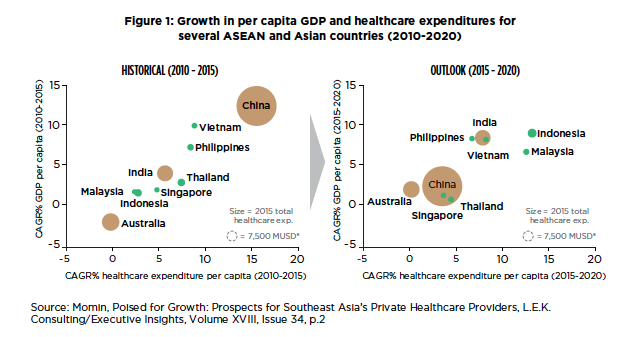
The future of healthcare sector in ASEAN is quite promising given the positive projection on the healthcare spending in the member states. By comparison, the average spending per capita in ASEAN is very low compared to that in advanced countries. For example, the average healthcare expenditure in the OECD countries was USD 4,471 in 2014, while the figure for ASEAN was only USD 643, suggesting a large potential for growth in the region. Figure 1 below describes the historical progress during 2010-2015 and the projected figures for 2015-2020. The chart on the left side of Figure 1 shows that there is a positive correlation between the compound annual growth rate (CAGR) of GDP per capita and that the CAGR of healthcare expenditure per capita and the level reached by ASEAN countries during 2010-2015 was lower than that of China. On the other hand, the chart on the right side of Figure 1 projects that between 2015 and 2020, ASEAN countries will experience higher growth than China and Australia with some countries introducing universal healthcare for most of the population.
img-aecp23-2.jpg

MRAs and qualifications in the healthcare sector

However, some challenges remain for ASEAN member states to tackle. From the human capital point of view, ASEAN has not really encouraged the mobility of medical, dental and nursing professionals across the region, despite the commitments as exemplified in the MRAs, which has negatively affected supply of talents in some countries7. When cross-border movement can be allowed, the issue of inadequate supply of doctors and nurses in some areas can be addressed, and quite possibly, all member states would be able to participate in the medical tourism industry to attract patients from outside of the ASEAN region.

ASEAN currently does not have a standardised regional qualification and curriculum in the medical education, resulting in varying standards and skill base, and therefore limiting trade of services.

D. Plans under the AEC 2025 Blueprint

Under the new AEC Blueprint 2025, the cooperation in healthcare sector aims to promote the development of a strong healthcare industry that can contribute to better healthcare facilities, products and services to meet the growing demand for affordable and quality healthcare in ASEAN. This covers traditional knowledge and medicine, taking into account the importance of effective protection of genetic resources, traditional knowledge, and traditional cultural expressions.

The strategic measures under this sector include:

  • Continue opening up of private healthcare market and public-private partnership (PPP) investments in provision of universal healthcare in the region.
  • Further harmonise standards and conformance in healthcare products and services, such as common technical documents required for registration processes and nutrition labelling.
  • Promote sectors with high growth potential such health tourism and e-healthcare services, which will not have negative impact on the healthcare system of each ASEAN member state.
  • Promote strong health insurance systems in the region.
  • Further facilitate the mobility of healthcare professionals in the region.
  • Enhance further the development of ASEAN regulatory framework on traditional medicines and health supplements, through the setting of appropriate guidelines or frameworks.
  • Continue to develop and issue new healthcare product directives to further facilitate trade in healthcare products in the region.

E. AEC 2025 Blueprint Analysis

The new blueprint has outlined what needs to be done to further develop and integrate the ASEAN healthcare sector, covering areas such as public and private roles, harmonisation of standards, health tourism, health insurance, and mobility of health practitioners. The table below provides some analyses on the progress on each measure in the blueprint.

Issue Current Status and Development
1. Expansion of ASEAN Healthcare Market
a. Greater public-private investments for better healthcare coverage in ASEAN
  • An estimate by the WHO states that currently Singapore and Brunei Darussalam top the ASEAN list in terms of healthcare per capita spending. Other member states are expected to increase their spending to provide better healthcare services.
  • Several member states have taken important steps on this area9. Singapore is in the process of adding 3,700 more beds and recruiting 20,000 more workers under its Healthcare 2020 Masterplan. Malaysia has increased its budget for healthcare of RM25 billion for 201710.
  • In Thailand, Bangkok Dusit Medical Services is investing in non-core medical business, which is expected to be very profitable. The Philippines’ Makati Medical Centre has established new laboratories to improve medical diagnosis and treatment. Vietnam has built VinMec, a luxury hospital resembling a 5-star hotel with 25 VIP rooms and two presidential suites.
  • The Philippines has been at the forefront in PPP. The government opened a bidding for the construction of a high-end tertiary hospital, which would cost around USD135 million. The Brunei Investment Agency has established a joint venture with Parkway Pantai, a large private healthcare provider in Asia, in managing a specialty cardiac centre. The Singapore Government has formed a partnership with Integrated Healthcare Holding in leasing capacity and services from private healthcare providers.
b. Harmonisation of standards and conformance in healthcare products and services
  • In September 2015, ASEAN issued the ASEAN Medical Device Directive (AMDD) to support trade in the region by harmonising the standards of medical equipment. The directive would make it easier for the manufacturer that has registered to sell its products in one jurisdiction to also register in other countries. Thus far, Malaysia and Singapore have advanced more compared to the other members of ASEAN in implementing the directive after it was signed in 2015.
c. Promotion of high-growth sectors such as health tourism and e-healthcare services
  • Patients Beyond Borders, a US-based organisation that compiles statistics of global medical tourism, estimates that the global medical tourism sector has expanded by 25 percent annually with consumers of around 11 million in 2015, almost one-third of whom travel to Southeast Asia for the treatment11.
    Malaysia, Singapore and Thailand continue to be the main destinations for medical tourists, with most of their consumers coming from within the ASEAN region.
  • Indonesia has been the largest contributor to the region’s overall medical tourists, spending around USD11.5 billion annually, mostly in Malaysia. This is due to the fact that the quality of Indonesia’s medical treatment and technology are lagging behind that of Malaysia, Singapore and Thailand.
d. Improvement of health insurance systems in the region
  • In some member states, proper medical treatment through hospital services is limited only to those who can afford to pay the bills or to have access to health insurance. In relation to one sustainable development goal of universal health coverage (UHC), some countries have developed their public healthcare funding schemes12. Indonesia is undergoing a formidable change in health insurances. Prior to 2014, 46 percent of the population was covered under five different schemes, but the government has since committed to providing healthcare insurance to all citizens by 2019 by merging all existing schemes.
  • Thailand has achieved its UHC 100 percent in 2001. Both public and private health systems exist but the public sector plays a larger role. The country has maintained its system through various approaches such as strong primary care gatekeeping and tough negotiations with pharmaceutical companies. Out-of-pocket (OOP)13 rate of 13.1 percent is the highest in the region.
  • In Singapore, 100 percent coverage by Medishield Life was achieved by end of 2015. Public and private health spending is balanced. To guarantee individual hospitalisation services, it is compulsory to have Medisave, a national medical savings scheme. To complement it, Medishield covers expensive medical cost which cannot be covered by Medisave balance. Because of Medisave and Medishield, the Singapore OOP rate has been quite high. Another scheme, the Medifund, serves as a safety net for the poor.
  • Malaysia has achieved UHC through a public healthcare system that provides comprehensive care financed by the government. Private healthcare system has also become popular in meeting demand of wealthier people, resulting in high OOP rate. The "1Care for 1Malaysia" policy introduced in 2012 to allow access to private facilities has been unsuccessful so far, and the government is struggling to rectify the distortion of health treatment in Malaysia.
  • The Philippine Health Insurance Corporation (PHIC), or PhilHealth administers the National Health Insurance Programme (NHIP), with the target of achieving UHC by around 2010. However, by 2012 PhilHealth covered only around 78 percent of the total population. In 2013, the President amended the National Health Insurance Act of 1995, and therefore mandates the government to cover the premiums for the insurance of the indigent and informal sectors.
  • In Vietnam, when Health Insurance Law was passed in 2009, the national Social Health Insurance (SHI) program was established. Similar to what is happening in Indonesia, Vietnam consolidated its schemes into one SHI program. Nonetheless, enrolment rates have remained low, and funds pooling is highly fragmented. High OOP rate indicates the SHI system is not working. In 2012, the government issued the "Master Plan for Universal Health Coverage from 2012-2015 and 2020" which sets the target to reach SHI coverage of 70 and 80 percent by 2015 and 2020 respectively.
e. Promotion of cross-border movement of health practitioners across the region
  • As mentioned above, unlike other professions with ASEAN MRAs that have achieved competency standards and registration systems at the national and regional levels, the nursing, medical and dental services in ASEAN have not agreed upon competency standards and registration systems at national and regional levels. Therefore the expected free mobility of healthcare practitioners across ASEAN has not yet taken place14.
2. Development of regulatory framework and product directives
a. Further development of regulatory framework on traditional medicines and health supplements
(TM & HS)
  • The Product Working Group for Traditional Medicines and Health Supplements (TMHSPWG) was established in 2004 to implement measures to integrate the traditional medicines and health supplements sector, as stipulated in the ASEAN Healthcare Integration Roadmap. The TMHSPWG also works on harmonising technical requirements and explore possible MRAs and eliminating technical barriers to trade for TM & HS without compromising public health and safety. The WG has produced many guidelines for harmonisation of the TM & HS in ASEAN.
    The ASEAN Alliance of Health Supplement Associations (AAHSA)15 represents the health supplement industry in the member states. AAHSA works to develop the ASEAN health supplements sector by: (i) facilitating trade in safe and quality health supplement products for the consumers’ benefit, (ii) developing a well-functioning framework for health supplement regulation that is science-based, workable for both large and small companies and is in line with best international practice, and (iii) strengthening national associations in the health supplement sector which partner with governments in the application of new ASEAN legislation.
b. Development and issuance of new healthcare product directives
  • The AMDD currently seems to be the only health-related directive produced by ASEAN. However, in addition, the ASEAN Cosmetics Directive has been formulated as part of the Agreement on the ASEAN Harmonised cosmetic Regulatory scheme that was signed by ASEAN Economic Ministers in September 2003. The cosmetics directive is aimed at promoting trade by harmonizing the standards and specifications of the cosmetic products in the region.

F. Conclusion: Moving Forward with the AEC 2025 Plans

ASEAN can further develop its health tourism sector by improving their medical capabilities and technology. As described above, Malaysia, Singapore and Thailand are the destinations for medical tourists from within as well as from outside of ASEAN. This has come at the expense of mainly the Indonesian medical sector which cannot yet compete with those three countries, resulting in many Indonesians seeking medical treatment elsewhere. The situation that Indonesia is facing can be addressed by facilitating mobility of medical practitioners, improving trade in medical devices, and partnering with travel and hospitality industries.

Member states need to work more to achieve 100 percent UHC as promoted by the United Nations’ Sustainable Development Goals. The current schemes existing in some countries have been able to provide both treatment and medicines but in larger countries like Indonesia, this has been very challenging. The government needs to find the right balance between public and private health coverage to ensure that the whole population can have access to better medical treatment and facilities. Further integration in the health insurance sub-sector could help promote greater health coverage throughout the ASEAN region, therefore discussions and cooperation between the health and finance authorities could pave the way for greater medical coverage. Figure 2 below explains the proportion between government and private healthcare funding. Brunei Darussalam’s government has made a substantial contribution to the healthcare coverage for the people. In most countries however, the private funding has dominated the provision of healthcare coverage with only Brunei Darussalam, Thailand and Malaysia having the government funding larger than the private funding. Myanmar and Cambodia are the countries whose private funding is the highest in the region.

img-aecp23-6.jpg

The MRAs for ASEAN medical and dental professionals were signed in 2009 but to date ASEAN has not had competency standards and registration systems at both national and regional levels, which has discouraged the free flow of medical talents across the region. While natural barriers may exist (such as language abilities), ASEAN should continue to work towards facilitating free movements of those talents to help areas that cannot develop their health services due to shortage of doctors and nurses. Such facilitation of freer movements can also support the expansion of medical tourism and other health services in ASEAN.

Greater cooperation with the industry will help governments in moving forward and formulating strategies that could promote provision of health services. This includes the hospital, pharmaceutical (including traditional medicines) and health supplement industries.


1 Geared for health – ASEAN’s growing medical and healthcare industry by IPSOS Business Consulting (July 2015), p.4
2 Ibid p.4
3 Opportunities in ASEAN’s Healthcare Sector
4 UNWTO Tourism Highlights 2016 Report
5 Yoshinori Fukunaga, Assessing the Progress of ASEAN MRAs on Professional Services, ERIA 2015, pp.19-20
6 Zafar Momin, Poised for Growth: Prospects for Southeast Asia’s Private Healthcare Providers, L.E.K. Consulting/Executive Insights, Volume XVIII, Issue 34, p.1
7 Lifting the Barriers Reports, CIMB ASEAN Research Insitute, 2015, p.80
8 The content under this section is taken directly from the AEC Blueprint 2025 (ASEAN Secretariat, 2015).
9 Embracing Wellness, Healthcare, Invest in ASEAN
10 Budget 2017: RM25b allocated for healthcare boost, October 2016
11 Logan Connor, Region’s medical tourism boom fueled by Southeast Asians, May 2016
12 Healthcare insurance & reimbursement landscape in ASEAN markets, Deallus Consulting and JPMA, March 2015
13 An out-of-pocket maximum is the most a person has to pay during a policy period for healthcare services. Once the out-of-pocket maximum is reached, the person’s plan begins to pay 100 percent of the allowed amount for covered services.
14 Mohammad Faisal, AEC and congested labor mobility, 2016
15 ASEAN Alliance of Health Supplement Associations (AAHSA)
16 Lifting-the-Barriers Reports, CIMB ASEAN Research Insitute, 2015, p.78
17 Good Health and Well-Being: Why it matters


References

ASEAN Secretariat (2008). ASEAN Economic Community Blueprint
ASEAN Secretariat (2015). ASEAN 2025: Forging Ahead Together
ASEAN Secretariat (2015). A Blueprint for Growth ASEAN Economic Community 2015: Progress and Key Achievements
ASEAN Business Club (ABC) Forum. Lifting the Barriers Report 2015
Geared for health – ASEAN’s growing medical and healthcare industry by IPSOS Business Consulting (July 2015)
Healthcare insurance & reimbursement landscape in ASEAN markets, Deallus Consulting and JPMA, March 2015
Lifting-the-Barriers Reports, CIMB ASEAN Research Institute, 2015
Mohammad Faisal, AEC and Congested Labor Mobility, Jakarta Post, January 2016
Yoshinori Fukunaga, Assessing the Progress of ASEAN MRAs on Professional Services, ERIA 2015
Zafar Momin, Poised for Growth: Prospects for Southeast Asia’s Private Healthcare Providers, L.E.K. Consulting/Executive Insights, Volume XVIII, Issue 34


Unable to view it online? You may download the PDF file here:

Download[wpdm_file id=121]

CARI Captures 310


c310_graphic.jpg


ASEAN

World Economic Forum on ASEAN emphasises on the Fourth Industrial Revolution
(11 May 2017) The World Economic Forum on ASEAN gathered in Phnom Penh, Cambodia to discuss growth in the region. The theme of the summit was Youth, Technology and Growth: Securing ASEAN’s Demographic and Digital Dividend. Philippines President Rodrigo Duterte described ASEAN as “an emerging economic powerhouse” and that the young population in the region is creating a demographic dividend for the bloc. In a panel session on the Fourth Industrial Revolution panelists agreed that the key to taking advantage of new technologies was education and to develop infrastructure like the internet to fully utilise the demographic dividend as well.

ASEAN

ASEAN to be the centre of growth in ASEAN
(4 May 2017) According to a report by professional services firm Ernst and Young (EY) in the next five years, 80 percent of businesses in Australia, Europe, and the US are expecting trade and investment with the ASEAN region to increase. The report finds that member countries are expected to post gross domestic product growth rates of between 3-8 percent over the next five years and enjoy a compound annual growth rate of 5.1 percent until 2021. Investor appetite in the region has been strong with two-thirds of merger and acquisition deals in ASEAN between 2010 and 2016 being either intra-ASEAN, or inter-Asia Pacific. The most active sectors for these deals were the consumer, energy, and financial services.

ASEAN, SINGAPORE

Singapore plans to champion e-commerce in its chairmanship year
(5 May 2017) In 2018 Singapore will take over the Chairmanship of ASEAN and it plans to drive e-commerce and other aspects of the digital economy within the region. Singaporean Minister for Trade and Industry Lim Hng Kiang said that this will be part of a larger agenda to enable companies in the region to expand and grow faster. The idea is to streamline regional trade rules governing e-commerce, improve digital connectivity in the region and lower operational barriers to entry, essentially lowering the cost of doing business.

ASEAN

Poor airports hindering ASEAN’s tourism potential
(8 May 2017) Experts in the aviation industry are of the opinion that ASEAN governments lack an understanding of the importance of aviation infrastructure as the main driver in delivering tourism. International Civil Aviation Organization regional director for the Asia and the Pacific Arun Mishra cited the Ninoy Aquino International Airport an example of a this; a congested airport that badly needed improvement. Chief executive of AirAsia, Tony Fernandes, said that infrastructure is struggling to keep up with the success of airlines. Thailand tourism minister Kobkarn Wattanavrangkul said would like to see ASEAN improve tourism integration by promoting air, land and maritime connectivity.

ASEAN

Thailand may face struggle to accommodate growing tourist inflow
(27 April 2017) Thailand’s tourist inflows are to nearly double by 2030 with an estimated 60 million visitors expected. However, the Southeast Asian kingdom may face “trouble” if investments are not made in infrastructure to accommodate the expected surge in tourist arrivals according to Pongpanu Svetarundra, permanent secretary to the tourism ministry. Thailand is heavily reliant on its tourism industry which has kept its economy growing despite much political instability over the last decade.

ASEAN

ASEAN needs a comprehensive dispute resolution mechanism
(8 May 2017) Singapore diplomat and former Secretary-General of ASEAN Ong Keng Yong said that ASEAN needs to develop a more comprehensive way to resolve disputes. This should include reviewing and making recommendations to improve a 2004 protocol, which covered enhanced dispute settlement mechanisms to resolve economic disputes. He emphasises that to move forward ASEAN needs to be a more rules-based organisation in which all countries adhere to international laws.

ASEAN

World Bank works with ASEAN to examine pipeline of infrastructure projects
(10 May 2017) The Masterplan on ASEAN Connectivity 2025 was updated in November 2016 to reflect on-the-ground developments and recommendations in the Enhancing ASEAN Connectivity Monitoring and Evaluation report, prepared by the Public-Private Partnerships team based at the World Bank’s Singapore Hub for Infrastructure and Urban Development. Now, a new report examining in detail the pipeline of infrastructure projects across the region is underway. Head of the Infrastructure Finance team at the Singapore Hub Cledan Mandri-Perrott said that the initiative represents a strong collaboration between the ASEAN Secretariat and the World Bank Singapore Hub allowing both to draw on one another’s experience and expertise.

ASEAN

ASEAN works with Canada to enhance role of SMEs
(10 May 2017) During the 14th ASEAN-Canada Dialogue Meeting, both parties agreed to enhance the role of Micro, Small, and Medium Enterprises (MSMEs) for regional economic development. Director-General of the ASEAN Cooperation of the Foreign Affairs Ministry of Indonesia Jose Tavares invited Canada to intensify digital innovation for MSMEs in ASEAN. Canada will continue to empower MSMEs in ASEAN member states through the Canada-Organisation for Economic Co-operation and Development Project on ASEAN MSMEs worth US$12 million. Canada will also help formulate conducive policies and programs to encourage ASEAN MSMEs to enter the global supply chain through this project.

ASEAN

US Secretary of State and ASEAN foreign ministers discuss SCS and DPRK
and House passes resolution on US-ASEAN relations
(5 May 2017) The issues of South China Sea (SCS) and North Korea were discussed during US Secretary of State’s first ministerial meeting with all ASEAN members in the US. The US top diplomat and ASEAN foreign ministers reiterated the need for a peaceful resolution to China’s continued island-building and militarisation activities in the SCS. Rex Tillerson also called upon ASEAN foreign ministers to cut funding streams for North Korea’s nuclear and missile programs and to fully implement U.N. sanctions on Pyongyang. On a separate note, Joaquin Castro and Ann Wagner, co-chairs of the recently formed Congressional Caucus on ASEAN introduced a resolution in House of Representatives which recognised the strength of the US-ASEAN economic and strategic partnership and the importance of increased engagement between the two.

ASEAN

Finance ministers of ASEAN meet for the first time in four years
(6 May 2017) Finance ministers of ASEAN, China, Japan and South Korea met on the sidelines of the 50th anniversary of the Asian Development Bank. They agreed to enhance each others resilience to financial shocks and to promote trade and investments. During this meeting Japan proposed to form “a new type of bilateral swap agreements” of up to US$40 billion in order to be prepared to address short-term liquidity problems. It was also noted that as economic ties between ASEAN and Japan strengthen amid ASEAN financial integration it is important to promote the use of local currencies in cross-border transactions in the region.

MYANMAR

China looks to secure majority stake in Myanmar port
(5 May 2017) China is looking to take a stake of up to 85 percent of strategically important sea port, Kyauk Pyu on the Bay of Bengal, in Myanmar. China is keen to gain preferential access to the US$7.3 billion deep sea port as it is the entry point for a Chinese oil and gas pipeline and the port will give it an alternative route for energy imports from the Middle East bypassing the Malacca Straits. The proposal is led by China’s CITIC Group and is part of a consortium of companies and is part of China’s One Belt One Road initiative to develop infrastructure along the old Silk Road.

Myanmar Monitor


img-mm-110517.jpg

File Photo

Economy, Investment and Trade

China looks to secure majority stake in Myanmar port
5 May 2017 – China is looking to take a stake of up to 85 percent of strategically important sea port, Kyauk Pyu on the Bay of Bengal. China is keen to gain preferential access to the US$7.3 billion deep sea port in Myanmar as it is the entry point for a Chinese oil and gas pipeline and the port will give it an alternative route for energy imports from the Middle East bypassing the Malacca Straits. The proposal is led by China’s CITIC Group and is part of a consortium of companies.
Read More >

Large transnational consumer goods company announces joint venture in Myanmar
4 May 2017 – Unilever is entering a joint venture with Europe & Asia Commercial Ltd. in Myanmar to gain a larger market share in the country. Unilever’s President of Southeast Asia said that Myanmar is one the fastest growing and most promising markets in Southeast Asia. The two companies, which have a combined annual sales of over US$109 million, will engage in manufacturing, marketing and distribution of home and personal care products in Myanmar.
Read More >

French and Myanmar Chambers of Commerce sign MOU
8 May 2017 – Union of Myanmar Federation of Chamber of Commerce and Industry on Friday signed a memorandum of understanding (MOU) with French Myanmar Chambers of Commerce and Industry to deepen economic ties. While currently, investment by French firms in Myanmar has only accounted for 1 percent of total FDI, this figure is likely to increase rapidly. Julien Esch, President of French Myanmar CCI, said that the most promising areas for bilateral cooperation were infrastructure, hospitality and tourism, oil and gas, electricity and energy, construction, healthcare and food production. However, Esch noted that while efforts to simplify the process of doing business will lead Myanmar to becoming an investment hub in Asean there were still a lot of things to be done under the National League for Democracy in Myanmar.
Read More >

Foreign and Internal Affairs

Myanmar forges diplomatic ties with the Vatican
4 May 2017 – In a surprise move after Pope Francis met with the Myanmar’s de facto leader, Aung San Suu Kyi, the Vatican and Myanmar established full diplomatic relations. The states will each appoint full-fledged ambassadors soon. This comes after Francis issued statement, in February, criticising the treatment of the Rohingyas, saying they were being persecuted because they wanted to live their culture and Muslim faith. During her visit to the Vatican, Francis gave Suu Kyi a copy of his 2017 message for the Church’s World day of Peace, titled “Non-violence: a style of politics for peace”. Myanmar has about 700,000 Catholics according to the country’s cardinal, Charles Maung Bo.
Read More >

Malaysia still off limits for Myanmar workers
5 May 2017 – U Myo Aung, permanent secretary for the Ministry of Labour, Immigration and Population in Myanmar, has said that they will not allow Myanmar workers to go to Malaysia until they have received the go ahead from the Myanmar Ambassador in Malaysia. He said that they were worried about the political situation in the country and will not allow workers back into the country until things were stable. On the other hand, the Myanmar Overseas Employment Agencies Federation (MOEAF) has said that due to the five month-long suspension many job offers have expired. MOEAF have said that many Myanmar workers have gone to Malaysia illegally because of the ban and that before the ban around 3000 Myanmar workers were going to Malaysia for work every month.
Read More >
