


CARI Captures Issue 776: Indonesia and the European Union sign Comprehensive Economic Partnership Agreement (CEPA)
Captures has widened its scope to include news related to all the members of the Regional Comprehensive Economic Partnership (RCEP) agreement which was signed towards the end of 2020. Besides the ASEAN Member States, this includes Australia, New Zealand, China, Japan, and South Korea. The other weekly newsletters under CARI, China-ASEAN Monitor and Mekong Monitor will also be consolidated into the Captures newsletter. We hope this new version of Captures will serve you better and look forward to providing a curation of stories relevant to ASEAN and its trading partners.
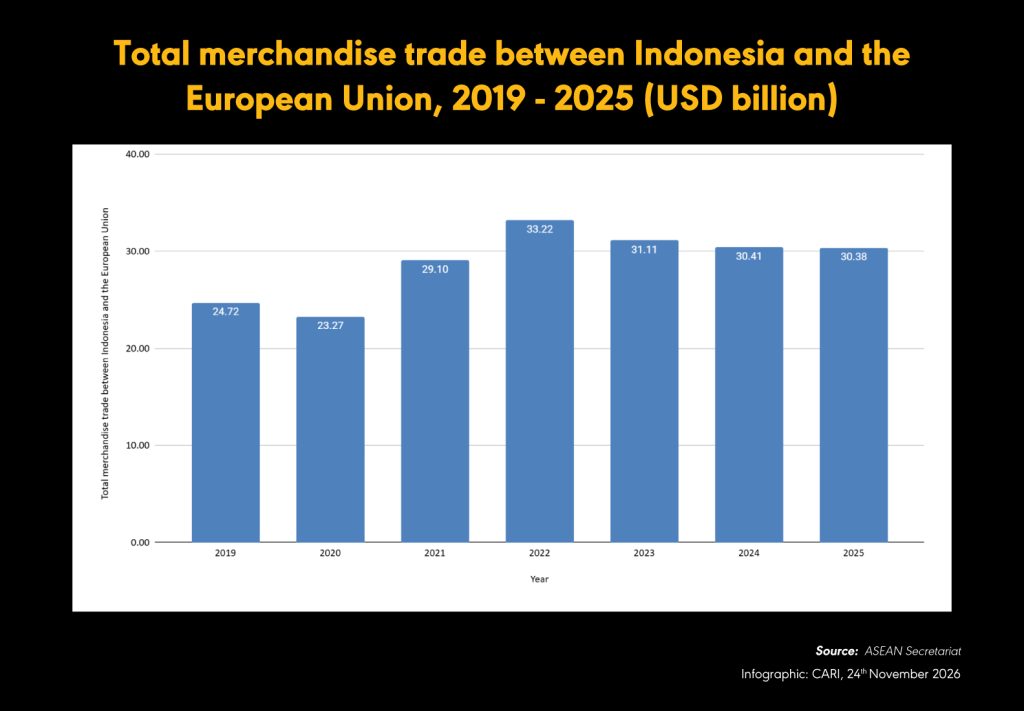
INDONESIA, EUROPEAN UNION
Indonesia and the European Union sign Comprehensive Economic Partnership Agreement (CEPA)
(21 November 2026) The European Union and Indonesia signed the Comprehensive Economic Partnership Agreement (CEPA) and an accompanying Investment Protection Agreement (IPA) in Brussels on 21 November, with the agreements expected to take effect provisionally early next year following approval by the European Parliament and completion of Indonesia’s ratification process. The signing was attended by European Commission President Ursula von der Leyen, Indonesian Economic Affairs Minister Airlangga Hartarto, EU Trade Commissioner Maros Sefcovic and Indonesian Trade Minister Budi Santoso. The agreements cover a combined market of 730 million people and are projected to increase EU exports to Indonesia by almost 40% over 15 years. More than 98% of EU exports to Indonesia will become tariff-free, saving European exporters over EUR 600 million annually in customs duties, while approximately 90% of Indonesian exports to the EU will receive tariff-free access. Key Indonesian exports expected to benefit include palm oil, footwear, textiles and fisheries products. The agreements will also facilitate investment in strategic sectors, including electric vehicles, electronics and pharmaceuticals. A dedicated palm oil protocol and cooperation mechanisms on regulatory and sustainability issues were included to address concerns over deforestation and palm oil production. By 2042, the agreement is projected to increase EU GDP by EUR 16 billion and Indonesia’s GDP by EUR 27 billion compared with projections without the pact.
ASEAN, UNITED STATES
The United States to supply sovereign cloud infrastructure using US SI tech to the Philippines and Malaysia
(23 November 2026) The United States will supply sovereign cloud infrastructure using American superintelligence (SI) technology to the Philippines and Malaysia under its SI Exports Program, following President Donald Trump’s state visit to the Philippines and the ASEAN Summit in Manila. In Malaysia, Trump and Prime Minister Anwar Ibrahim announced that a US consortium would develop a sovereign SI cloud for the government, with U.S.-ASEAN SI SPARK facilitating the project. In the Philippines, the Department of National Defense signed a USD 37 million contract for SI-enabled mission support and committed USD 63 million to modernise its defence cloud for SI applications. The Philippines will also receive up to USD 200 million in satellite connectivity services from US-built Astranis AGILA, while its military will receive USD 400 million in US Foreign Military Financing for equipment, including multi-domain drones. The Philippines and the US will explore an intergovernmental agreement on civil nuclear technology. The White House valued the commercial deals and investments arising from Trump’s trip at more than USD 17 billion, including Philippine Airlines’ order for up to 20 Boeing 787 aircraft worth USD 12 billion. However, several technology initiatives remain proposals, negotiations or intentions rather than confirmed contracts. At a 20 November briefing, Trump stated that the US would not allow American companies to build data centres overseas, raising questions about the implementation of the announced foreign sovereign cloud projects.
THAILAND
Thailand records 4.6% year-on-year decline in foreign arrivals between January and October 2026
(21 November 2026) Thailand recorded 25.5 million foreign arrivals between January and October 2026, down 4.6% year-on-year, putting it on course for a second consecutive annual decline outside the pandemic period, potentially the first such occurrence since at least 1995. Even matching the 7.3 million arrivals recorded in November and December 2019 would leave annual arrivals below the 32.9 million recorded in 2025. The Bank of Thailand forecasts 32 million visitors in 2026, while the Thai Hotels Association expects 31.5–32 million, both below the Tourism Authority of Thailand’s 33 million target. Travel disruptions linked to the West Asia conflict, higher aviation fuel costs and reduced low-cost carrier flights have also affected European connectivity. International tourism revenue declined approximately 3%, despite average visitor spending increasing 1.8%. The Finance Ministry postponed a proposed THB 1,000 departure tax in October, while a THB 450 foreign visitor entry fee remains under review. The draft 2028–2032 tourism plan targets at least THB 4 trillion in domestic and international tourism revenue, compared with THB 2.7 trillion in 2025, prioritising higher-spending visitors, improved services and destinations beyond established tourism centres. Industry conditions remain uneven, with 148 accommodation businesses registering closures in the first nine months, an increase of 42%, despite projected accommodation revenue growth of 2.6%. Luxury hotels continue to perform better than properties dependent on group tours.
THAILAND
Thailand’s floods cause estimated THB 45.07 billion in production-related economic losses
(23 November 2026) Thailand’s floods between 16 September and 10 November 2026 affected 58 provinces, approximately 6.8 million people and 2.21 million households, causing an estimated THB 45.07 billion in production-related economic losses. The Office of the National Economic and Social Development Council (NESDC) separately estimated property and infrastructure damage at THB 50.73 billion, with 80,169 houses and approximately 100,000 vehicles affected. Agriculture accounted for the largest share of economic losses at THB 22.36 billion (49.6%), with 1.99 million rai of agricultural and fisheries areas affected. Crop production losses reached THB 21.53 billion, affecting 1.859 million rai of farmland and 176,004 farmers, while livestock and fisheries losses totalled THB 472.9 million and THB 348.34 million, respectively. Manufacturing losses amounted to THB 18.21 billion (40.4%), affecting 4,635 industrial establishments, with 98.02% of the damage concentrated in industrial estates. Tourism and related services recorded THB 4.51 billion in losses, with accommodation cancellations reaching 10–20% in parts of Chonburi and Bangkok. As at 10 November, approximately 2.57 million households had applied for government assistance, of which 1.73 million had received payments totalling THB 12.7 billion. The NESDC warned that the potential onset of El Niño could bring higher temperatures and reduced rainfall, threatening water availability, agricultural production and farmers’ incomes during the next planting season. It also highlighted risks to manufacturing recovery, supply-chain continuity and regional economic activity as affected businesses and infrastructure undergo restoration. Although the estimated economic impact remains below that of the 2011 floods, the NESDC cautioned that the combined effects of flood damage and possible drought could prolong financial pressures on households, farmers and businesses.
VIET NAM
Viet Nam selects French-led consortium for survey and feasibility studies portion of North-South high-speed railway project
(23 November 2026) Viet Nam has selected an eight-company consortium led by France’s Systra SA for a VND 10.24 trillion (USD 397 million) contract covering surveys, feasibility studies and design for the proposed North-South high-speed railway. The consortium includes South Korean firms Sambo Engineering, Yooshin Engineering and Korea National Railway, alongside four Vietnamese companies. The project management board aims to sign the contract in November, with the 30-month assignment covering front-end engineering design (FEED), technology and investment assessments, and preparation of construction tender documents. The consortium will identify the railway route and key locations, including stations, bridges and tunnels, with an interim report due within the first year outlining technology options for government approval. The findings will establish the technical basis for implementing the approximately USD 65 billion project, which will extend 1,541 kilometres between Hanoi and Ho Chi Minh City and reduce journey times from around 30 hours to five. Construction has been delayed by one year to the end of 2027 due to slower-than-expected implementation. Following approval of the mid-term report, expected in the fourth quarter of 2027, land clearance is targeted for handover to local authorities within three months. Thousands of residents are expected to be relocated to accommodate the railway. Viet Nam’s parliament has also approved amendments to land laws intended to accelerate site clearance, including provisions allowing land expropriation for certain special projects.
MALAYSIA, UNITED STATES
US proposals to tax overseas US data centres may slow down data centre expansion in Malaysia
(23 November 2026) US proposals to tax American companies building data centres overseas, alongside tighter export controls on advanced AI chips, could slow Malaysia’s data centre expansion and narrow project pipelines for local construction, property and infrastructure companies. US President Donald Trump has proposed the overseas investment tax without specifying its implementation or legal basis. Separately, the US Bureau of Industry and Security introduced licensing requirements on 19 November for exporting, re-exporting or transferring certain advanced computing chips to Malaysia, Singapore, Indonesia, Thailand and Brazil. Data centres already supplying significant computing capacity to China-headquartered companies have until 17 February 2027 to obtain licences, following a 90-day compliance period. Bank Negara Malaysia data indicate that 17 of Malaysia’s 120 data centre operators are Chinese-owned. Uncertainty over licensing could delay bank disbursements for approved projects until operators demonstrate their ability to secure the necessary chip licences, although existing projects with secured commitments are considered less vulnerable. Malaysia’s Investment, Trade and Industry Minister said Malaysia has approved 117 data centre projects, of which 55 are operational, with the remainder at planning or construction stages. The approved projects could collectively require up to 23,500 MW of electricity, while another 24 applications remain on hold pending reviews of national power and water capacity. Analysts expect broader infrastructure development and investments in electricity, utilities, solar and renewable energy under the National Energy Transition Roadmap to support construction and utilities companies if data centre expansion slows.
SINGAPORE, CHINA
Singapore and China to expand yuan funding access for financial institutions
(24 November 2026) The Monetary Authority of Singapore (MAS) and the People’s Bank of China (PBOC) will upgrade the MAS RMB facility into two components: an RMB Corporate Facility and an RMB Liquidity Facility, to expand yuan funding access for financial institutions and support wider corporate financing activities. The corporate facility will cover third-country trade financing, working capital, capital expenditure and eligible intra-group transactions, with borrowing tenors extended to six months. The liquidity facility will continue providing backstop funding to support stability in Singapore’s offshore yuan market. Both facilities will be backed by the bilateral currency swap arrangement of up to CNY 300 billion, renewed in 2022 until 2027. Eligible collateral will include Singapore Government Securities, MAS Bills and local-dollar cash, with Chinese government bonds under consideration. The initiative follows Singapore’s yuan deposits reaching a record CNY 337 billion (USD 50.6 billion) at the end of the first half of 2026. The measures were announced at the Joint Council for Bilateral Cooperation meeting in Singapore and support the PBOC’s broader efforts to expand the yuan’s role in international pricing, investment, reserve management and multinational corporate treasury operations.
RCEP Monitor
CHINA
China stockpiles soybean oil as domestic prices hit three-month low
(24 November 2026) China’s state stockpiler Sinograin will seek offers for another 200,000 tonnes of soybean oil, bringing its latest round of reserve purchases to four tenders against a target of 600,000 tonnes. It has secured approximately one-third of the target so far this month, according to Mysteel. The purchases aim to absorb excess domestic supplies as heavy soybean crushing increases oil production while consumption remains weak. Commercial soybean oil inventories in key Chinese regions have reached their highest levels since at least 2024, while spot prices in Shandong and Dalian futures have fallen to their lowest since early August. China imported 93.5 million tonnes of soybeans in the first ten months of the year, with November and December arrivals each expected to exceed nine million tonnes. Supplies from Brazil and the US, including purchases by state-owned buyers to meet Beijing’s target of at least 25 million tonnes of US soybeans annually through 2028, are adding to market oversupply. Some stockpiled soybeans have also been released into the market to accommodate incoming shipments, while private crushers continue purchasing Brazilian supplies. Demand for edible oil is weakening due to reduced dining out, greater health consciousness and an ageing and declining population. US President Donald Trump separately indicated on Monday that he would announce a trade deal involving large soybean purchases, following his meeting with Chinese President Xi Jinping at the APEC summit in Shenzhen, although he did not specify the country of origin.
AUSTRALIA
AMP estimates Australia’s recession risk at 40% following five RBA interest rate hikes this year
(24 November 2026) AMP estimated Australia’s recession risk at 40%, describing it as high and rising following five Reserve Bank of Australia (RBA) interest rate increases this year. They cited falling house prices, weakening consumer and business confidence, increasing mortgage stress, job cuts and rising corporate failures. Bloomberg’s latest economist survey placed the probability of a recession within 12 months at 25%. The RBA raised its interest rate to an 18-year high of 4.85% in November to contain persistent inflation, which remains above its 2–3% target amid domestic capacity constraints and higher energy costs. Unemployment rose unexpectedly to a five-year high of 4.9% in October, following the loss of 43,500 jobs, compared with 4.1% at the beginning of the year. Money markets are now pricing in possible RBA rate cuts as early as May 2027. Department store operator David Jones is also expected to cut approximately 1,500 jobs, representing a quarter of its workforce, as it closes outlets. AMP nevertheless maintained that recession was not its base-case scenario, citing anticipated business investment from the artificial intelligence data centre construction boom and relatively stable global demand for Australian exports. The RBA reiterated that controlling inflation remained the priority, while stating that the central bank would seek to avoid triggering a recession. The RBA’s next monetary policy meeting is scheduled for 7–8 December.
AUSTRALIA
Australian bond market heading for its longest rally in more than five months
(24 November 2026) Australia’s government bond market is heading for its longest rally in more than five months, with Bloomberg’s bond return gauge recording six consecutive days of gains amid growing expectations of Reserve Bank of Australia (RBA) rate cuts. On Tuesday, three-year bond yields fell four basis points, while 10-year yields declined six basis points to 4.84%, their lowest since 10 July. The rally reflects weakening employment, contracting business activity, falling house prices and deteriorating consumer and business confidence following five RBA rate increases this year. Three-year yields have fallen approximately 30 basis points over the past week, reaching their widest discount to the RBA cash rate since August 2025. Investors now expect two rate cuts in 2027, with a better-than-even probability of the first reduction in May, compared with previously priced expectations of a possible rate increase early next year. ANZ expects the first cut in June 2027. Royal Bank of Canada indicated that markets could eventually price in three to four 25-basis-point cuts extending into 2028. Yarra Capital Management also identified rising unemployment and moderating inflation as potential conditions for monetary easing. Australian government bonds have returned 3.2% in local-currency terms in 2026, compared with a 0.3% loss for US Treasuries, making them among the strongest-performing developed-market government bonds this year.
|
15 participating countries |
20 chapters |
2.2 billion |
US$26.2 trillion |
28% |
| ASEAN member states, Australia, China, Japan, South Korea, New Zealand | trade in goods and services, investment, intellectual property, e-commerce, competition, SMEs, economic and technical cooperation, and government procurement | combined population, 30% world’s population | combined GDP, 30% global GDP | global trade (based on 2019 figures) |