


CARI Captures Issue 772: Jakarta Composite Index rises 5.7% after stock exchange announces reforms
Captures has widened its scope to include news related to all the members of the Regional Comprehensive Economic Partnership (RCEP) agreement which was signed towards the end of 2020. Besides the ASEAN Member States, this includes Australia, New Zealand, China, Japan, and South Korea. The other weekly newsletters under CARI, China-ASEAN Monitor and Mekong Monitor will also be consolidated into the Captures newsletter. We hope this new version of Captures will serve you better and look forward to providing a curation of stories relevant to ASEAN and its trading partners.
INDONESIA
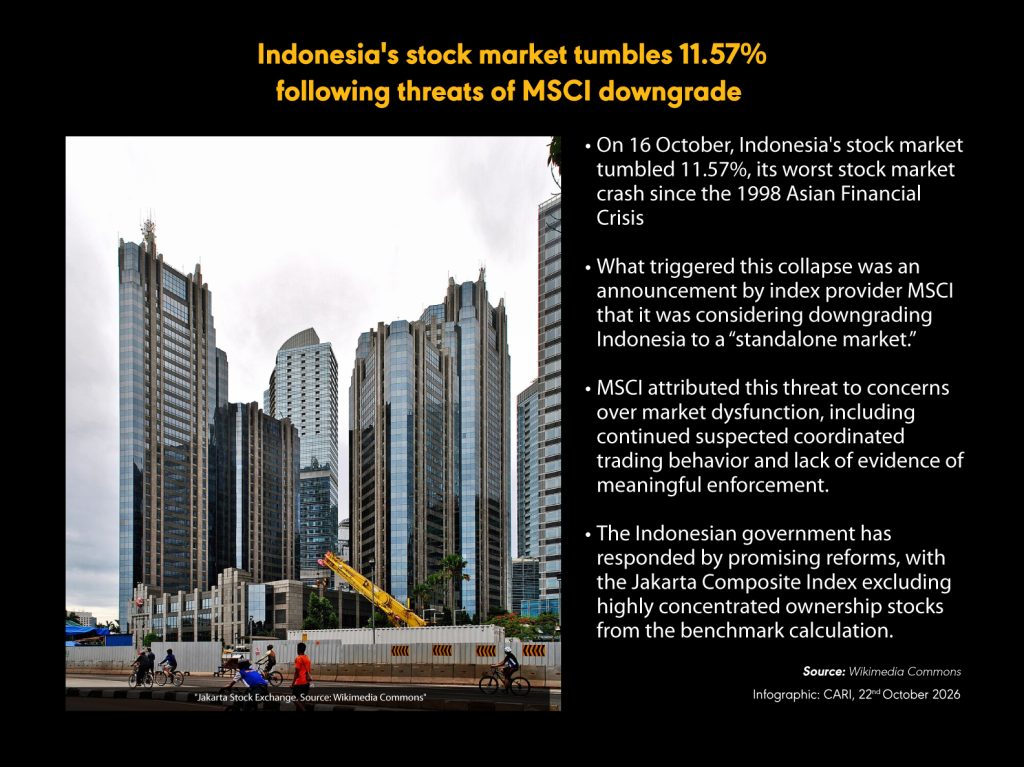
Jakarta Composite Index rises 5.7% after stock exchange announces reforms
(20 October 2026) Indonesia’s Jakarta Composite Index rose 5.7% after the Indonesia Stock Exchange announced plans to exclude highly concentrated ownership stocks from the benchmark calculation, following talks with MSCI, recovering part of its approximately 15% two-day decline. The exchange said the affected shares account for about 18% of the index’s weighting, with a removal timeline to be announced, while trading in these shares will continue normally. The authorities’ list covers about 80 companies, and the planned changes appear to extend beyond the six stocks MSCI removed in May, which currently represent about 7.9% of the JCI. MSCI is considering downgrading Indonesia from emerging-market to standalone status over concerns about opaque ownership structures and coordinated trading, following an earlier warning of a possible frontier-market reclassification. Citigroup said enforcement must cover the broader 80-stock group and extend beyond securities already flagged. Foreign investors have withdrawn a net USD 5.2 billion from Indonesian equities this year, potentially the largest annual outflow on record. A full removal from major global indexes could trigger approximately USD 5.6 billion in passive outflows, with another USD 2.7 billion at risk if FTSE Russell follows suit, while Mirae Asset Sekuritas estimates around USD 3 billion in passive outflows. Separately, Indonesia’s financial regulator reported suspected stock-trading manipulation involving Dian Swastatika and irregularities in share allocations during the initial public offerings of Barito Renewables and Petrindo Jaya Kreasi. Investors indicated that sustained confidence will require greater ownership transparency, stronger corporate governance and consistent regulatory enforcement beyond changes to the benchmark index.
INDONESIA
Sovereign wealth fund Danantara seeking to raise USD 1 billion loan for investment purposes
(21 October 2026) Indonesia’s sovereign wealth fund Danantara is seeking to raise the equivalent of USD 1 billion through a three-year multi-currency revolving credit facility, underwritten by DBS, HSBC, Standard Chartered and United Overseas Bank (UOB). The facility supplements a USD 1 billion loan secured last year, which is also being extended to match the new facility’s tenor. Proceeds will fund general corporate purposes, including acquisitions and planned investments, with the loan currently being syndicated to the broader market. Pricing is expected to be similar to the previous facility, with the US dollar tranche carrying a margin of 95 basis points above the Secured Overnight Financing Rate (SOFR). The facility will be available in US and Singapore dollars, euros, British pounds and Japanese yen. Danantara’s previous loan included an option to increase its size to as much as USD 10 billion. The fundraising follows more than USD 5 billion in investments this year, while the fund had planned to invest approximately USD 13 billion in 2026. Danantara’s Chief Investment Officer has also indicated plans for further fundraising, including potential bond sales in the US and China.
MALAYSIA
Malaysia mulling temporary waiver of crude palm oil export tax to clear record-high inventories
(20 October 2026) Malaysia is considering a temporary waiver of crude palm oil export tax to increase shipments and reduce record-high inventories. Senior officials from the Ministry of Plantation and Commodities are scheduled to meet industry executives to discuss the proposal. Malaysia applies export tax rates of 3% to 10% when crude palm oil prices exceed MYR 2,250 per tonne, with the maximum rate applying above MYR 4,050. The export tax remained at 10% for November, based on a reference price of MYR 4,323.78 per tonne. Record-high inventories were reported in September, while El Niño-related heat threatens to reduce yields. A waiver could help Malaysia regain market share from Indonesia, which raised its combined palm oil export tax and levy to USD 308 per tonne for October.
MALAYSIA
AirAsia shares fall 5.5% after Prime Minister states Malaysia has not agreed to provide financial aid
(20 October 2026) AirAsia Group Bhd shares fell as much as 5.5% to their lowest level since November 2022 after Prime Minister and Finance Minister Anwar Ibrahim told Parliament that the government had made no commitment to provide financial assistance through guarantees, loans or public funds. The stock has declined 75% this year, making it the worst performer in the Bloomberg World Airlines Index. Anwar said any request for assistance would be assessed against national interests, public finances and the need to protect taxpayers, while the government continues to monitor the aviation sector’s exposure to the Iran war. AirAsia has recorded two consecutive quarterly losses as rising jet fuel prices increased costs, with the airline not hedging its fuel expenses. The carrier is seeking USD 1 billion in debt refinancing and has previously sold six newly delivered aircraft, while a subsidiary reportedly fell behind on supplier payments and the group sought revised terms for a USD 200 million private credit loan. Co-founder Tony Fernandes previously said the airline had sufficient liquidity, denied that a bailout was necessary and stated that no aircraft had been repossessed.
MALAYSIA
Iskandar Malaysia attracts MYR 525.26 billion in cumulative investments over 20 years
(20 October 2026) Iskandar Malaysia has attracted MYR 525.26 billion in cumulative investments over 20 years, exceeding its original MYR 383 billion target, creating more than one million jobs and more than doubling average household income. The Iskandar Regional Development Authority (IRDA) said its next development phase will prioritise productivity and high-value activities, including advanced manufacturing, digital and data-driven industries, logistics, and financial and business services. It aims to retain more investment benefits locally through domestic supply chains, technology transfer, innovation and stronger Malaysian enterprises. The Johor-Singapore Special Economic Zone (JS-SEZ) recorded MYR 76.98 billion in approved investments in 2025, supporting Johor’s role as a complementary economic partner to Singapore. Malaysia’s Deputy Prime Minister said future progress should be measured by investment quality, ecosystem strength and long-term benefits for businesses and communities. IRDA noted that ASEAN investment competitiveness increasingly depends on infrastructure, reliable energy supply, skilled labour, digital connectivity, efficient movement of goods and people, and access to regional markets, rather than land availability and costs alone. Johor can combine its land, industrial capacity, talent and cost advantages with Singapore’s capital, technology, business services and international market access. Realising the JS-SEZ’s potential will require coordinated infrastructure development, energy provision, talent development, customs and immigration procedures, and cross-border connectivity, supported by cooperation between federal and state governments and industry stakeholders.
THE PHILIPPINES
Philippine peso falls to record low of 63.09 per US dollar on 19 October
(20 October 2026) The Philippine peso fell to a record low of 63.09 per US dollar on 19 October, surpassing the previous low of 63.06 recorded on 15 October, according to the Bankers Association of the Philippines. The currency has reached a new record low 28 times this year. A senior research fellow at the Philippine Institute for Development Studies attributed the depreciation to persistent US dollar strength, elevated oil prices, geopolitical uncertainty and increased demand for foreign currency. Data from the Bangko Sentral ng Pilipinas showed that the country’s balance of payments deficit widened to USD 9.1 billion at the end of September, compared with USD 5.3 billion during the same period last year, indicating increased net outflows of funds from the Philippines.
CAMBODIA
Air passenger traffic to Cambodia drops 11% year-on-year in first nine months of 2026
(21 October 2026) Cambodia handled approximately 4.56 million air passengers in the first nine months of 2026, down 11% year-on-year, while aircraft movements also declined, according to the State Secretariat of Civil Aviation (SSCA). In contrast, air cargo volumes increased 18% to 76,294 tonnes over the same period, and overflight activity continued to grow. The SSCA Secretary of State said the contrasting trends reflected differing performance across the aviation sector. Techo International Airport, Cambodia’s new 4F-class international airport, is expected to expand capacity for international flights and support the country’s ambition to become a regional aviation hub. Cambodia’s aviation network comprises 35 carriers, including four domestically registered and 31 international airlines, connecting the country to eight ASEAN member states and major markets including China, South Korea, Japan, Qatar and India. Cambodia has established 48 air services agreements covering partners across Southeast Asia, East Asia, Southwest Asia, West Asia, Europe, Oceania, North America, South America and Africa.
RCEP Monitor
CHINA
China records 192 million border crossings in third quarter of 2026
(21 October 2026) China recorded 192 million border crossings in the third quarter of 2026, up 7.9% year-on-year, according to the National Immigration Administration. Foreign arrivals rose 15.6% to 11.6 million, with visa-free entries increasing 24.1% and accounting for 77.5% of the total. Russia, South Korea and Viet Nam were the top three sources of foreign visitors, followed by Malaysia, the United States, Japan, Singapore, Thailand and Australia. Outbound crossings by mainland Chinese residents increased 7.5% to 48.5 million, with Hong Kong and Macau the leading destinations, followed by South Korea, Vietnam, Thailand, Japan, Singapore, Malaysia, Russia and Indonesia. Beijing’s expanded visa-free policies and reciprocal visa-free access for Chinese citizens have supported cross-border travel growth. The State Council aims to attract 190 million inbound tourist visits annually by 2030 and increase inbound visitor spending to more than USD 150 billion a year, supported by broader visa-free access, improved digital payment services and expanded tax refunds. The revamped Huanggang Port in Shenzhen handled 886,000 passenger trips and 74,000 vehicle crossings in its first week after reopening on 12 October, with a joint clearance system reducing passenger processing times from 30 minutes to five minutes.
AUSTRALIA
Australia’s free trade agreement with EU faces parliamentary uncertainty ahead of expected introduction in 2027
(20 October 2026) Australia’s free trade agreement with the European Union, finalised in March after a decade of negotiations, faces parliamentary uncertainty ahead of its expected introduction in early 2027, with the Coalition opposing the deal in its current form and the Greens yet to decide their position. Trade Minister Don Farrell has ruled out renegotiation, stating that Australia must accept or reject the agreement. The deal is valued at AUD 10 billion annually and provides duty-free access to the EU market for 98% of Australian goods exports, covering a market of 450 million people valued at approximately AUD 30 trillion. Guaranteed annual EU access for Australian beef will rise to 35,000 tonnes of carcase weight equivalent (CWE), including 30,600 tonnes of new access, while sheep meat access will reach 30,851 tonnes, including 25,000 tonnes of new access. The National Farmers’ Federation considers these quotas insufficient, seeking at least 50,000 tonnes for beef and 67,000 tonnes for lamb. The EU will eliminate tariffs on 87.3% of dairy products, while Australian vegetable exporters are expected to benefit from the removal of duties. Australia has agreed to protect geographical indications for European products, with concessions allowing continued use of certain terms, including parmesan, while existing feta producers receive grandfathering arrangements. The agreement also strengthens Australia–EU cooperation on critical minerals and includes commitments on the Paris climate agreement, biodiversity, sustainable forestry and sustainable fishing, without requiring new Australian sustainability legislation or regulations. The Greens, whose support or that of the Coalition is needed because Labor lacks a Senate majority, are assessing the agreement’s climate and environmental provisions before deciding whether to support it.
AUSTRALIA
Inflation outlook deteriorates since central bank’s August forecasts
(20 October 2026) The Deputy Governor of the Reserve Bank of Australia (RBA) said the inflation outlook had deteriorated materially since the bank’s August forecasts, with third-quarter data expected to confirm stronger-than-anticipated price pressures. Business liaison indicates that rising costs, particularly fuel expenses, are being passed on to customers, while an increasing number of firms expect inflation of 3.0%–3.5% to become the norm. Inflation remains around 4.0%, above the RBA’s 2.5% target, despite four interest-rate increases this year. Unemployment has risen, but Hauser described the labour market as only slightly weaker and the jobless rate as historically low. Inflation data due next week are expected to reflect persistent cost pressures from higher fuel prices and an investment boom in artificial intelligence. However, higher interest rates and fuel costs are slowing demand, with consumption growth remaining subdued despite continued expansion in some sectors. The deteriorating inflation outlook presents a challenge for the RBA ahead of its early-November policy meeting, as it balances persistent price pressures against easing labour-market conditions and cooling demand.
|
15 participating countries |
20 chapters |
2.2 billion |
US$26.2 trillion |
28% |
| ASEAN member states, Australia, China, Japan, South Korea, New Zealand | trade in goods and services, investment, intellectual property, e-commerce, competition, SMEs, economic and technical cooperation, and government procurement | combined population, 30% world’s population | combined GDP, 30% global GDP | global trade (based on 2019 figures) |