


CARI Captures Issue 769: Flooding in Bangkok could reduce economic growth by 0.025% to 0.05%
Captures has widened its scope to include news related to all the members of the Regional Comprehensive Economic Partnership (RCEP) agreement which was signed towards the end of 2020. Besides the ASEAN Member States, this includes Australia, New Zealand, China, Japan, and South Korea. The other weekly newsletters under CARI, China-ASEAN Monitor and Mekong Monitor will also be consolidated into the Captures newsletter. We hope this new version of Captures will serve you better and look forward to providing a curation of stories relevant to ASEAN and its trading partners.
THAILAND
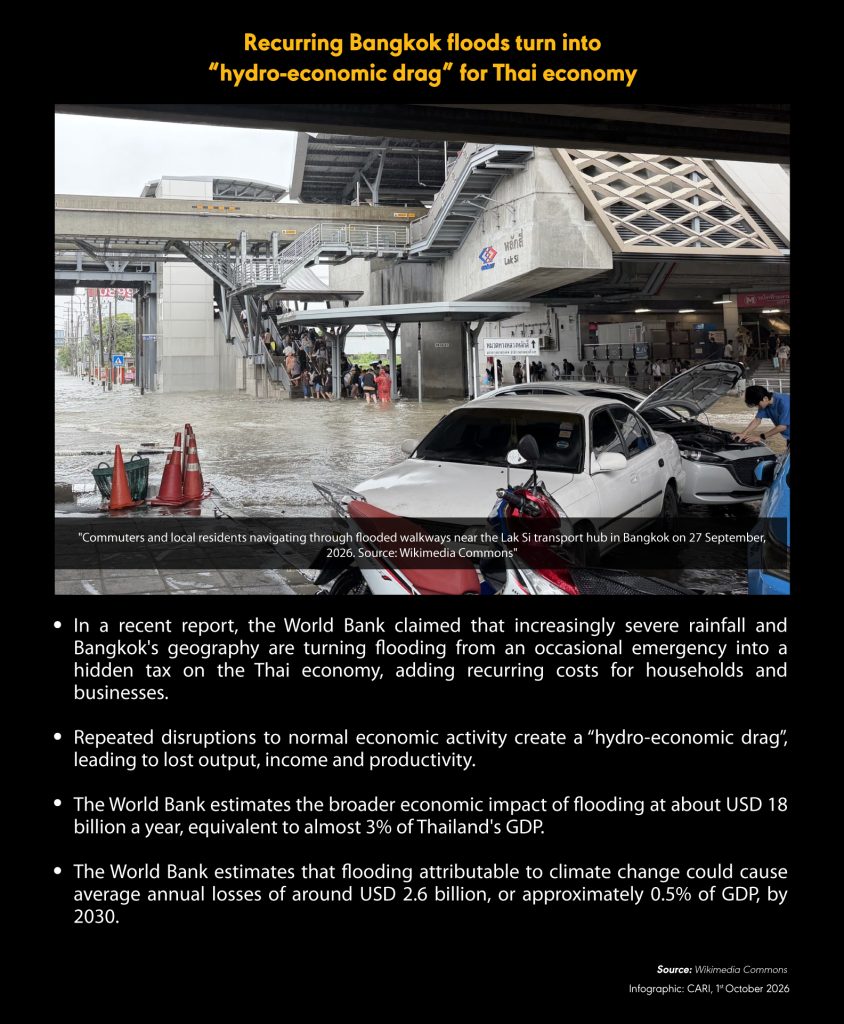
Flooding in Bangkok could reduce economic growth by 0.025% to 0.05%
(28 September 2026) Bangkok received more than 12 inches (about 305 millimetres) of rain over three days, approaching the historical September total of 358 millimetres, causing widespread flooding across the capital. Major roads were submerged, vehicles partially inundated, and floodwater reached chest height in some neighbourhoods. Flooding persisted on Monday, prompting Prime Minister Anutin Charnvirakul’s government to declare Monday and Tuesday holidays for government offices in Bangkok and surrounding provinces. The Industry Ministry postponed until 30 September the release of its revamped manufacturing production index, which is intended to better capture industries including AI-related electronics. No deaths had been reported, although some residents remained unable to leave their homes easily for food and other necessities. The University of the Thai Chamber of Commerce estimated the flooding could reduce national economic growth by 0.025 to 0.05 percentage points, equivalent to about THB 5 to THB 10 billion (USD 298 million), mainly through household property damage, flood-control costs and weaker travel and consumption. The university maintained its 2026 growth forecast at 2.2% to 2.3%, citing the expected rapid recession of floodwaters. The Commerce Ministry said the broader retail and wholesale network remained operational and major retailers were replenishing inventories normally, although some convenience stores in Bang Kapi, Min Buri and Rangsit faced delivery disruptions.
INDONESIA
Indonesia’s coffee industry faces lower production amidst El Nino-induced drought
(26 September 2026) Indonesia’s coffee industry is facing lower production amid prolonged erratic rainfall, with one southern Sumatra farmer expecting his robusta harvest to fall nearly one-third from last year and trees to require two to three years to recover. The USDA forecasts Indonesia’s 2026/27 green coffee production to decline 8% to 11.38 million 60kg bags, potentially making Indonesia the world’s fifth-largest producer behind Ethiopia, although the Indonesian Coffee Exporters and Industries Association disputes the forecast and expects output to increase 1% to 2%. A developing strong El Niño could bring drought to major producing areas and further disrupt flowering and yields. Indonesian Trade Ministry data show coffee export value fell 33% to USD 614 million in January–May, following a 53% increase in 2025 when Indonesian suppliers benefited from reduced Brazilian shipments. Farmers and traders report reduced supply, including coffee arrivals in Pagar Alam falling 50% to 70%, supplies to Asia Makmur dropping about 30%, and a landslide in Aceh destroying half of one grower’s plantation. In West Java, one arabica grower harvested only about one-third of her 2024 crop and said local sales currently provide better margins than exports. Besemah Coffee Shop’s profit margin narrowed to 15% to 20% from about 30%, while prices increased 10% to 20% as coffee, electricity, fuel and packaging costs rose. Larger chains remain better positioned, with publicly listed Fore Kopi Indonesia reporting first-half 2026 revenue of about IDR 1 trillion rupiah (USD 61 million), up more than 50%, and adding 40 outlets. Smaller exporters face increasing competition from multinational traders with greater financing and risk-management capacity. The EU deforestation regulation will require companies to demonstrate that coffee entering the EU is not linked to deforestation and provide origin-tracing information from 30 December for large and medium-sized operators, with most smaller operators following from 30 June.
MALAYSIA
Domestic financial markets adjusting orderly despite stronger US dollar and higher US Treasury yields
(28 September 2026) Bank Negara Malaysia’s Financial Markets Committee (FMC), following its 21 September meeting, said domestic financial markets had adjusted orderly despite a stronger US dollar, higher US Treasury yields and other external pressures. The committee cited sound economic fundamentals, strong foreign direct investment and balanced two-way flows as supporting market resilience. Corporate bond issuance remained strong, and hedging activity increased as the ringgit moderated in September after relative stability in July and August, while Malaysian Government Security yields rose after an extended period of stability. The FMC said higher bond yields could provide an attractive entry point for foreign investors, although geopolitical uncertainty, oil price volatility and changing global interest rates remain near-term headwinds. Market sentiment was supported by 6% year-on-year GDP growth in the second quarter, above the 5.8% market forecast, and strong services-sector investment linked to AI and data centres. The foreign exchange and bond markets are also supported by the Qualified Resident Investor programme and efforts by state-linked companies and corporations to repatriate and convert foreign earnings.
SINGAPORE
Singapore sovereign wealth fund Temasek to open first two Middle East offices in Saudi Arabia and UAE
(30 September 2026) Temasek plans to open its first two Middle East offices in Riyadh and Abu Dhabi in the first half of 2027, expanding its global network to 15 offices across 11 countries. The Singapore sovereign investor, which manages USD 401 billion, said the Middle East would remain an important part of its global network. Temasek plans to provide office space to domestic companies in which it holds significant stakes, with some portfolio companies expected to use the locations as regional hubs. Europe, the Middle East and Africa collectively account for 12% of Temasek’s portfolio exposure, although it does not disclose the Middle East allocation separately. Temasek has also partnered with Global Infrastructure Partners, Abu Dhabi sovereign wealth fund L’imad and ADNOC on an infrastructure investment partnership focused on the Gulf and Central Asia. Its fund management arm Seviora established its first Middle East presence in Abu Dhabi in 2025 and this week signed a memorandum of understanding with First Abu Dhabi Bank for a strategic partnership.
THE PHILIPPINES
The Philippines unveils USD 34.4 billion roadmap to developing country into regional AI hub
(09 September 2026) The Philippine government released the final draft of the Philippines AI+ Infrastructure Masterplan (PAIIM) 2026–2033, a USD 34.4 billion strategy to develop the country into a regional AI infrastructure hub. The plan targets a 30-fold increase in AI data-centre capacity from 50MW to 1.5GW by 2033, with about 400MW planned for deployment by 2030 under its first phase. The Department of Energy estimates that the planned AI industry will require power for around 152,000 GPUs and will seek to add generation capacity without reducing electricity available to households. Immediate power requirements are expected to be met through natural-gas plants, while renewable sources including solar and geothermal are targeted to provide 40% of AI infrastructure power by 2033. The DOE will also examine nuclear power as a longer-term option under the Philippine National Nuclear Energy Safety Act. The masterplan covers six pillars: connectivity infrastructure; AI compute and data centres; sustainable energy and water sourcing; AI workforce development; policy and regulation; and demand creation and adoption. By 2033, the government projects more than 500,000 AI-related jobs and a further 175,000 jobs from AI infrastructure projects. It also estimates AI-driven productivity gains and digital services could increase national GDP by 10% to 12%.
VIET NAM
Viet Nam’s eldercare sector expanding due to ageing population and migration
(29 September 2026) Viet Nam’s eldercare sector is expanding as population ageing, smaller families and migration increase demand for professional services. Dien Hong, which opened its first 60-bed facility in 2014, now operates 10 facilities serving 900 elderly people and plans further expansion, including its first Ho Chi Minh City facility. Monthly basic care at Dien Hong costs VND 7 million to VND 18 million (USD 265 to USD 685), while premium facilities can charge more than VND 100 million. Ken Research projects the elderly-care market will grow from USD 2.68 billion in 2025 to USD 4.8 billion by 2031, with home care’s share of revenue rising from 34% to 42%. UNFPA estimates that about 99% of older Vietnamese currently depend on family care, while 76% live without a pension. Viet Nam’s population aged 65 and above is projected to rise from 7% in 2015 to more than 14% by 2036. Hanoi has introduced measures to support the silver economy, while President To Lam has called for its development. A VND 14.2 trillion elderly healthcare complex at Hanoi Medical University will include about 720 elderly-oriented apartments serving 1,680 people alongside medical facilities. Labour shortages remain a constraint, with operators reporting difficulties recruiting and retaining trained care workers. Affordability is also limited, as nearly 564,000 pension and allowance recipients receive less than VND 3 million a month and 1.35 million receive VND 3 million to VND 6 million, compared with private care-home fees starting at about VND 7 million. Viet Nam has more than 400 nursing homes, nearly half of them charitable or state-funded, with facilities concentrated in Hanoi and Ho Chi Minh City. The sector faces thin profit margins, high operating costs, limited regulation, labour shortages and the absence of state subsidies for residents of private care homes. Dien Hong employs more than 300 people and has expanded its services, while some facilities operate at break-even or a small loss.
VIET NAM
State Treasury raises VND 26.55 trillion in weekly government bond auction on 30 September
(27 September 2026) Viet Nam’s State Treasury raised VND 26.55 trillion (USD 1 billion) in its weekly government bond auction on 30 September, the highest weekly volume so far this year, compared with USD 564 million the previous week. The proportion of bonds sold increased to 86%, from 56% previously, according to a Hanoi Stock Exchange filing. The Treasury sold VND 6.5 trillion of the VND 9 trillion offered in five-year bonds at a 4.27% coupon, and all VND 20 trillion offered in 10-year bonds at 4.43%. It sold VND 50 billion of the VND 500 billion offered in 30-year bonds at 4.62%, while receiving no bids for the combined VND 1.5 trillion offered in three- and 15-year bonds. The government aims to raise VND 500 trillion through bond sales in 2026 and has raised more than VND 276 trillion so far. Vietnamese companies have raised VND 398 trillion through bond issuance as of 18 September, while VND 75 trillion of corporate bonds are due to mature during the remainder of 2026.
RCEP Monitor
AUSTRALIA
Reserve Bank of Australia raises cash rate to highest level in 15 years
(29 September 2026) The Reserve Bank of Australia (RBA) raised its cash rate by 25 basis points to 4.6%, the highest level in 15 years, bringing total increases this year to 100 basis points across four decisions. The RBA said some upside inflation risks identified in August were materialising, including broader Middle East conflict and higher-than-assumed global energy prices, while AI-related demand was increasing prices for technology goods. The RBA said it would take further action if necessary to contain inflation, including additional rate increases. Inflation remained above the 2% to 3% target range throughout 2026, reaching 4.6% in March and 3.5% in July, with August data due on Wednesday. Bank of America said July CPI indicated accelerating inflation and identified second-round effects from higher energy costs. The RBA also warned that the unresolved Middle East conflict could result in higher inflation and weaker economic activity than forecast. Australia’s economy grew 2.1% in the second quarter, down from 2.5% in the first quarter.
NEW ZEALAND
New Zealand Treasury forecasts smaller budget deficit just before elections
(29 September 2026) New Zealand’s Treasury forecasts an operating balance before gains and losses (OBEGAL) deficit of NZD 8.73 billion for the year ending June 2027, down from NZD 14.09 billion projected in May, and ahead of a general election to be held on 07 November. The government now expects an OBEGAL surplus in 2028–29, one year earlier than previously forecast. Treasury expects inflation to return to the 1% to 3% target range in the second quarter of 2027, while annual GDP growth is forecast at 2.9% in that quarter. Prime Minister Christopher Luxon attributed the improved fiscal outlook to the government’s economic management, while opposition Labour said household cost pressures and economic weakness remained significant. The economy grew 2.1% in the second quarter, down from 2.5% in the first, while inflation was above 3% and unemployment was at a decade high. ANZ economists said the fiscal improvement depends on Treasury’s growth forecasts being achieved and future governments maintaining the indicated operating and capital spending allowances.
CHINA
China announces largest stimulus package since September 2024
(30 September 2026) China announced its largest stimulus package since September 2024, including mortgage subsidies for eligible home buyers and expanded People’s Bank of China lending support for infrastructure, technology and small firms. The PBOC also cut the one-year rate on its pledged supplementary lending facility by 25 basis points to 1.5%. The measures are intended to support the government’s 4.5% to 5% annual growth target after growth fell below the range last quarter, but have received limited investor response. The government is also expected to allow local governments to use about CNY 500 billion (USD 74.6 billion) of unused bond quotas for investment. September manufacturing PMI returned to expansion and construction activity ended an eight-month decline, indicating some recovery after disruptions from summer storms and floods. The property measures are expected to provide greater support to lower-tier cities but remain below a comprehensive property-market intervention. Domestic consumption has remained weak, with consumption growth near zero, while investment has been constrained by limited projects outside high-technology and advanced manufacturing. Growth therefore remains heavily dependent on exports, including those supported by global artificial intelligence investment.
|
15 participating countries |
20 chapters |
2.2 billion |
US$26.2 trillion |
28% |
| ASEAN member states, Australia, China, Japan, South Korea, New Zealand | trade in goods and services, investment, intellectual property, e-commerce, competition, SMEs, economic and technical cooperation, and government procurement | combined population, 30% world’s population | combined GDP, 30% global GDP | global trade (based on 2019 figures) |