


CARI Captures Issue 768: The EU and the Philippines reach substantial agreement on free trade deal
Captures has widened its scope to include news related to all the members of the Regional Comprehensive Economic Partnership (RCEP) agreement which was signed towards the end of 2020. Besides the ASEAN Member States, this includes Australia, New Zealand, China, Japan, and South Korea. The other weekly newsletters under CARI, China-ASEAN Monitor and Mekong Monitor will also be consolidated into the Captures newsletter. We hope this new version of Captures will serve you better and look forward to providing a curation of stories relevant to ASEAN and its trading partners.
THE PHILIPPINES, EUROPEAN UNION
The EU and the Philippines reach substantial agreement on free trade deal
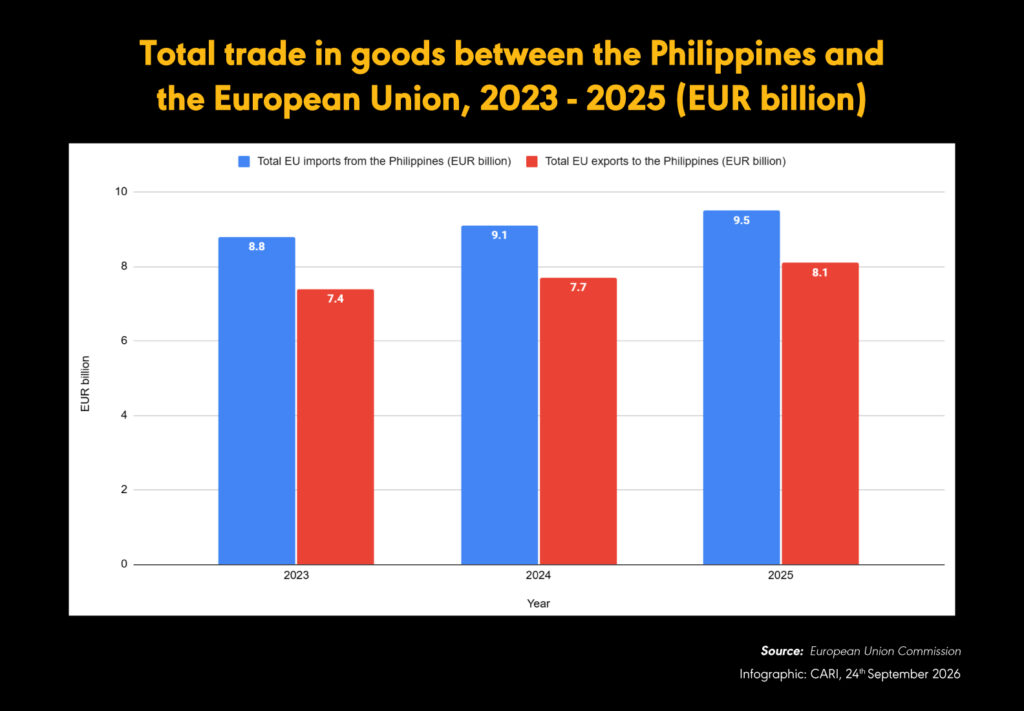
(22 September 2026) The European Union and the Philippines have reached a substantial agreement to deepen trade and investment, with formal conclusion expected in the coming months. EU Trade Commissioner Maros Sefcovic said the agreement would liberalise more than 94% of tariff lines covering over 97% of bilateral trade. EU exporters currently sell more than EUR 8 billion (USD 9.17 billion) of goods annually to the Philippines, including machinery, medicines, pork and dairy products. The agreement is also expected to cover government procurement, intellectual property, digital trade and sustainability. In 2025, the EU accounted for 8.3% of Philippine goods trade and was the country’s fourth-largest trading partner, while Philippine exports to the EU included electronics and agricultural products. The EU has been expanding trade ties with other markets, including through its agreement with India and ongoing negotiations with Malaysia and Thailand. Canada is similarly seeking stronger trade links with Asia amid tariff tensions with the US, with Canada’s International Trade Minister travelling to the Philippines to advance FTA discussions with the Philippines and ASEAN. Canada’s bilateral merchandise trade with ASEAN increased 24% in 2025 to CAD 52.4 billion (USD 37.33 billion).
VIET NAM, UNITED KINGDOM
UK plans to provide up to USD 2.5 billion in financing for metro extension project
(16 September 2026) UK Export Finance (UKEF) plans up to USD 2.5 billion in financing for a 44-kilometre metro extension linking Ho Chi Minh City with Long Thanh International Airport and central Dong Nai. The financing, which may include loans, guarantees and other support rather than direct investment, is part of a broader USD 6.5 billion UKEF credit framework for Vietnam agreed during To Lam’s 2025 visit to London. The head of UKEF Vietnam said the project would include UK technology and services, with at least 20% of project content required to be sourced from the UK. The framework also proposes EUR 150 million (USD 173 million) to procure additional rolling stock for Ho Chi Minh City’s first metro line, which opened in late 2024. UKEF is also considering financing for energy projects, including offshore wind developments involving Petrovietnam, as part of Vietnam’s clean-energy transition. The wider framework covers areas including wind power and smart grids under the Just Energy Transition Partnership. The Vice Chairman of Ho Chi Minh City said the planned Vietnam International Financial Center could channel funding towards transport infrastructure, energy efficiency, green manufacturing and climate-adaptation projects.
VIET NAM
Viet Nam ‘very close’ to concluding trade agreement with the United States
(22 September 2026) Vietnamese President and Communist Party General Secretary To Lam said Viet Nam is “very close” to concluding a reciprocal, balanced and equitable trade agreement with the US following talks with US Trade Representative Jamieson Greer. Greer said the negotiating teams had made “significant progress” and were close to a final result. Viet Nam has offered to increase imports of US high-tech goods, including aircraft, nuclear power equipment and road and railway infrastructure, to help address the bilateral trade imbalance. Key US concerns remain transshipment, rules of origin, customs enforcement and Chinese inputs in Vietnamese manufacturing. Lam said Viet Nam would not accept transshipment and has tightened customs procedures and enacted a law prohibiting goods produced with forced labour. Viet Nam currently faces a 12.5% US levy and three Section 301 investigations covering issues including forced labour, excess manufacturing capacity and intellectual property violations. Lam said the investigations were progressing well and expressed confidence that Viet Nam could avoid higher tariffs. The agreement, once concluded and implemented, is expected by both sides to expand bilateral trade and investment opportunities.
THAILAND
Tariffs and market access remain sticking points in US-Thailand trade negotiations
(24 September 2026) Thailand and the US remain in negotiations over tariffs and market access after an expected 17–18 September call between Prime Minister Anutin Charnvirakul and President Donald Trump did not take place. Thailand’s Foreign Minister said discussions remain focused on tariffs, market access and conditions for US companies investing in Thailand. Thailand’s Commerce Minister said most issues had been resolved, with remaining points being negotiated with the US Trade Representative before being referred to the two leaders. Thailand currently faces a 12.5% US tariff on most covered exports, compared with 10% for Indonesia and Malaysia and 12.5% for Vietnam and the Philippines. Bangkok is seeking treatment comparable with regional peers. A key unresolved issue is likely US access to Thailand’s pork market, which is effectively closed to US producers because Thai regulations prohibit certain feed additives commonly used in US pork production. Sihasak said Thailand is seeking terms that benefit both economies while maintaining positions on issues considered important to its national interests. No new date has been announced for the Anutin-Trump call.
INDONESIA
Indonesia’s nickel hub to reduce output due to El Nino-driven drought
(22 September 2026) Indonesia’s Indonesia Morowali Industrial Park (IMIP) has instructed nickel-processing companies to reduce nickel pig iron (NPI) production as an El Niño-driven drought limits water available for cooling and protecting equipment. The latest reduction could affect about 100,000 tonnes of NPI production, compared with an estimated installed capacity of 4.2 million tonnes annually, or 350,000 tonnes per month. IMIP had earlier warned that production could fall by 30% to 40% if water supplies did not improve. The park is majority-owned by China’s Tsingshan Holding Group and hosts multiple tenant companies. The production cut comes as nickel prices have fallen about 18% on the London Metal Exchange from their early-May peak, with LME nickel rising as much as 1.1% on Tuesday following the news. Indonesia accounts for more than half of global nickel production, much of which is processed at industrial parks such as Morowali. The water shortage forms part of wider disruptions from unusually dry conditions in Indonesia, which have also contributed to forest fires and haze across Southeast Asia.
SINGAPORE
Singapore’s financial sector commits to train more than 80,000 local employees in AI skills
(24 September 2026) Singapore’s financial sector has committed to training more than 80,000 local employees in AI skills, with 23 banks, insurers and asset managers pledging to train all Singapore-based staff by 2028. More than half of the employees at these firms have already completed programmes recognised by an industry association. The firms will also assess how AI is changing jobs and test training and job-redesign approaches, initially covering leaders, wealth managers and operations staff. Singapore’s Deputy Prime Minister said the initiative aims to improve career prospects and workforce productivity. The managing director of MAS said training must be accompanied by support as jobs and tasks evolve. The initiative expands on a 2025 commitment by Singapore’s three local banks to train all 35,000 of their Singapore-based employees for AI. The financial sector accounts for about 14% of Singapore’s economy and employs around 200,000 professionals. The initiative comes as financial institutions expand AI use in areas including compliance and wealth advisory, increasing concerns over potential job displacement.
SINGAPORE
Singapore records 4,620 retrenchments in Q2 2026, highest level since Q4 2020
(21 September 2026) Singapore recorded 4,620 retrenchments in Q2 2026, up from 3,830 in Q1 and the highest quarterly level since 5,640 in Q4 2020. The Ministry of Manpower attributed the increase to business reorganisation and restructuring, concentrated in outward-oriented sectors including manufacturing, information and communications, and financial services. The proportion of retrenched residents returning to employment within six months fell to 54.9% from 60.7% in Q1, while the 12-month re-entry rate remained broadly stable at 69.8%. Overall unemployment remained at 1.9%, with resident and citizen unemployment at 2.9% and 3% respectively. Job vacancies declined during Q2, including fewer openings for professionals, managers, executives and technicians in financial services and information and communications. Vacancies nevertheless continued to exceed the number of unemployed people, with the ratio at 1.48 vacancies per unemployed person in June 2026.
RCEP Monitor
SOUTH KOREA
South Korea to reduce reliance on Middle Eastern crude oil to 50% by 2035
(23 September 2026) South Korea plans to reduce its reliance on Middle Eastern crude oil to 50% by 2035 under a revised 10-year natural resources security plan issued by the Industry Ministry. Middle Eastern sources accounted for 70% of South Korea’s crude oil imports in 2025, with most supplies transported through the Strait of Hormuz. The strategy calls for a fundamental restructuring of supply chains following disruptions caused by the Iran war. South Korea plans to increase crude oil stockpiles by about 20 million barrels by 2030 and secure additional condensate supplies. The country imports about 45% of its naphtha requirements, with 77% normally sourced from the Middle East, contributing to shortages since the conflict began. For natural gas, the government aims to keep Middle Eastern import dependence below 30% by 2035, compared with 20% in 2025. The roadmap will also expand the country’s critical minerals list from 38 to 51, including 10 rare earth elements and germanium, which is used in semiconductor production.
SOUTH KOREA
South Korea extends fuel-price caps for another four weeks amid oil-price volatility and elevated inflation
(23 September 2026) South Korea extended its fuel-price caps for another four weeks, keeping wholesale prices at KRW 1,784 (USD 1.31) per litre for petrol and KRW 1,773 for diesel amid oil-price volatility and elevated inflation. The measures, introduced in March after the US attack on Iran, have exceeded the initially budgeted six-month period. The government has allocated KRW 4.2 trillion for the first six months and a further KRW 1.5 trillion for the extension to compensate refiners for losses, although payments have yet to be made and disagreements over loss calculations could delay compensation. The government has also reduced fuel taxes, restricted exports and introduced discounts at highway service stations ahead of the three-day Chuseok holiday. Brent crude recently approached USD 110 a barrel, while South Korea’s average petrol pump price has declined for 18 consecutive weeks. Economists cited in the article warned that prolonged price controls could increase public expenditure, distort market signals and reduce incentives for consumers to cut fuel use. The measures have also weakened the link between international oil prices and domestic fuel prices in South Korea.
AUSTRALIA
Unemployment rate rises to 4.6% in August 2026, highest level since late 2021
(24 September 2026) Australia’s unemployment rate rose to 4.6% in August, the highest since late 2021, despite net employment increasing by 39,500 after a 15,800 decline in July. Employment growth exceeded the 20,000 market forecast and was entirely driven by part-time jobs. The participation rate increased 0.2 percentage point to 67.1%, while the labour force expanded by 67,700, or 2.1% year-on-year, compared with 1.6% employment growth. The ABS said a higher proportion of people previously outside the labour force moved into unemployment, contributing to the increase in the jobless rate. Markets price a 95% probability of the Reserve Bank of Australia raising its cash rate by 25 basis points to 4.6% next Tuesday. The RBA’s Governor said unemployment of 4.5%–5.0% could help restrain inflation. The RBA has already raised rates three times this year to 4.35%, while trimmed mean inflation remained at 3.6% in July, above the 2%–3% target range. Inflation risks have also increased from higher oil prices and data-centre investment, with oil above USD 100 a barrel. The Australian dollar fell 0.3% to USD 0.7018, a seven-week low.
|
15 participating countries |
20 chapters |
2.2 billion |
US$26.2 trillion |
28% |
| ASEAN member states, Australia, China, Japan, South Korea, New Zealand | trade in goods and services, investment, intellectual property, e-commerce, competition, SMEs, economic and technical cooperation, and government procurement | combined population, 30% world’s population | combined GDP, 30% global GDP | global trade (based on 2019 figures) |