


CARI Captures Issue 760: United States positioning itself as energy partner of choice for Southeast Asia
Captures has widened its scope to include news related to all the members of the Regional Comprehensive Economic Partnership (RCEP) agreement which was signed towards the end of 2020. Besides the ASEAN Member States, this includes Australia, New Zealand, China, Japan, and South Korea. The other weekly newsletters under CARI, China-ASEAN Monitor and Mekong Monitor will also be consolidated into the Captures newsletter. We hope this new version of Captures will serve you better and look forward to providing a curation of stories relevant to ASEAN and its trading partners.
ASEAN, UNITED STATES
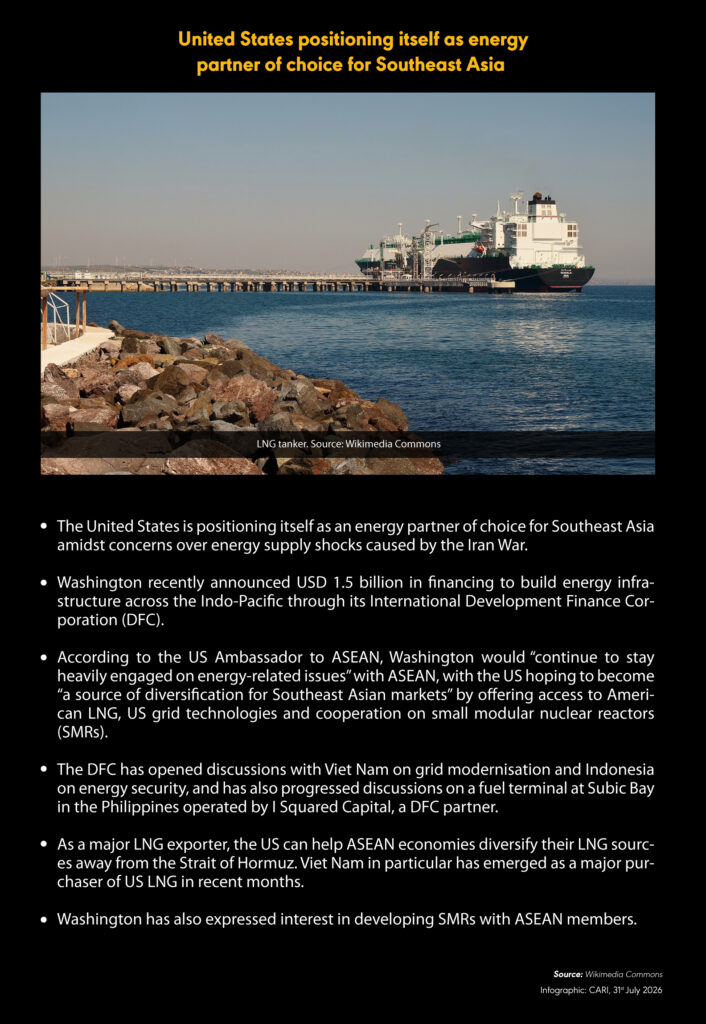
United States positioning itself as energy partner of choice for Southeast Asia
(29 July 2026) The United States announced a USD 1.5 billion financing commitment through the International Development Finance Corporation (DFC) on 22 July to support energy infrastructure across the Indo-Pacific, described as the largest project investment in the agency’s history. The announcement was made during US Secretary of State Marco Rubio’s visit to Manila for the ASEAN foreign ministers’ meeting, and was accompanied by a broader USD 2.5 billion investment commitment covering energy security and future technologies. The US Ambassador to ASEAN said Washington intends to expand engagement on energy security by offering US liquefied natural gas (LNG), grid technologies and cooperation on small modular nuclear reactors (SMRs), while supporting initiatives such as strategic petroleum reserves. Analysts said the funding is intended to mobilise private capital rather than provide direct grants to ASEAN governments and remains an investment platform rather than a portfolio of approved projects. Discussions have reportedly begun with Viet Nam on grid modernisation and Indonesia on energy security, while the Philippines is considered the most advanced potential project location through a fuel terminal at Subic Bay operated by DFC partner I Squared Capital. Analysts noted that the initiative could help diversify Southeast Asia’s energy sources and reduce exposure to supply disruptions, but cautioned that transmission constraints, regulatory uncertainty, project execution challenges and continued dependence on fossil fuels remain significant issues. The US is also promoting SMR cooperation with ASEAN governments, following a trilateral SMR agreement with Japan and South Korea earlier this month. Analysts highlighted potential applications for SMRs in Indonesia and the Philippines due to their dispersed island grids, and in Malaysia and Thailand to support growing data centre and artificial intelligence-related electricity demand. However, regulatory approvals, financing and public acceptance are expected to determine the pace of deployment.
ASEAN, UNITED STATES
US imposes new tariffs of 10-12.5% on seven ASEAN economies citing forced labour practises
(26 July 2026) The US imposed new Section 301 tariffs of 10-12.5% on 60 economies, including seven Southeast Asian countries, citing forced labour practices identified in recent investigations. Among ASEAN members, the Philippines, Singapore, Thailand and Viet Nam face the highest tariff rates, while Malaysia, Indonesia and Cambodia received lower rates after being assessed as having made greater enforcement efforts. The US Trade Representative said the measures were intended to address human rights abuses and trade distortions. The tariffs were announced one day after US Secretary of State Marco Rubio told ASEAN foreign ministers in Manila that the US was “with ASEAN 100 per cent”, prompting analysts to highlight a disconnect between US diplomatic messaging and trade actions. ASEAN governments, including the Philippines, Singapore and Indonesia, reiterated their opposition to forced labour and stated that they would continue engagement with Washington. Exemptions apply to semiconductor-related components and products already covered by existing tariffs, including automobile parts. Analysts said the measures are unlikely to trigger retaliation from ASEAN countries but may reinforce perceptions of the US as an unreliable economic partner. Economic impacts are expected to vary, with Viet Nam and Cambodia considered more exposed because exports to the US account for a larger share of GDP. Thailand could face greater pressure as key exports such as frozen seafood, rubber products and household appliances are not exempt. Despite the tariffs, analysts expect ASEAN countries to continue pursuing dialogue with the US, given its importance as a trade destination and source of foreign direct investment.
VIET NAM, UNITED STATES
US customs officials conduct spot checks at China-linked factories in Viet Nam over transshipment concerns
(28 July 2026) US customs officials have conducted spot inspections at China-linked factories in Viet Nam, reviewing documents, raw material sourcing, production processes and potential software intellectual property violations to assess the extent of value added before exports to the US. The inspections have heightened concerns that Washington could impose additional tariffs on Viet Nam, although officials have reportedly not found significant evidence of Chinese goods being illegally transshipped through the country. The inspections come as Viet Nam and the US continue difficult negotiations on a trade framework agreement reached in October, with disagreements centred on transshipment and other non-tariff barriers. Viet Nam has intensified efforts to address US concerns over trade fraud and intellectual property protection, including the seizure of 50,000 counterfeit Nike products and the submission of a 3,581-page report to the US Trade Representative detailing nearly 20,000 infringement cases handled between 2021 and 2025. Viet Nam is also facing three separate Section 301 investigations by the US, including probes into alleged intellectual property violations, excess manufacturing capacity, and allegations of forced labour in the supply chains. The US is seeking commitments beyond reducing the USD 178 billion bilateral trade gap, including stronger action on transshipment, economic security cooperation and intellectual property protection. Additional pressure emerged after Viet Nam was included among 60 economies subjected to new US tariffs over alleged shortcomings in preventing forced labour in supply chains, a claim rejected by Viet Nam’s foreign ministry.
VIET NAM
Viet Nam seeking USD 76 billion a year from capital markets to reduce reliance on banking
(29 July 2026) Viet Nam approved a comprehensive financial-market reform programme on 27 July, consolidating reforms across banking, equities, bonds, insurance and emerging financial products into a single framework extending to 2045. The programme aims to reduce reliance on bank lending by increasing capital-market fundraising to an average of VND 2 quadrillion (USD 75.95 billion) annually by 2030 and raising capital markets’ share of realised social investment to 30–35% between 2031 and 2045. Businesses are targeted to raise VND 5.4 quadrillion through the stock market during 2026–2030, while stock-market capitalisation is projected to reach 120% of GDP by 2045 from 82.3% at end-2025. Outstanding bond value is targeted to increase to 60% of GDP by 2030 from 30.7% in 2025. Planned measures include encouraging listings of foreign-invested companies, accelerating state divestments, introducing new derivatives products, launching a central counterparty clearing mechanism in 2027, piloting crypto-asset and carbon-credit markets, establishing a trading platform for innovative start-ups, and exploring a gold exchange and central bank digital currency. The programme also calls for full Basel III adoption, wider use of artificial intelligence in banking, expansion of insurance as a long-term funding source, and allowing insurers to invest in infrastructure bonds and real estate investment trusts. Bond issuance will be diversified through green, sustainability-linked and floating-rate instruments. By 2030, the government targets foreign investors’ capital-market assets at around 15% of GDP, stock investment fund assets at 5% of GDP, and pension fund assets to grow by an average of 11.5% annually between 2026 and 2030, alongside easier market access for foreign investors.
MALAYSIA
OECD encourages Malaysia to reintroduce GST and phase out fuel subsidies
(28 July 2026) The OECD’s latest Economic Survey of Malaysia recommends that Malaysia reintroduce the Goods and Services Tax (GST), broaden the personal income tax base, strengthen tax administration and gradually phase out fossil fuel subsidies to reinforce fiscal sustainability as the country approaches high-income status. The report recommends replacing broad energy subsidies with targeted cash transfers and adopting carbon pricing while using the government’s social registry to protect vulnerable households. The OECD said Malaysia’s tax revenue remains below 13% of GDP and that a broad-based consumption tax would provide a more stable revenue source to support higher spending on education, social protection, public investment and an ageing population. It projects Malaysia’s GDP growth at 4.9% in 2026 and 5.0% in 2027, with inflation at 2.1% this year, but warned that elevated public debt and gradual fiscal consolidation leave the country exposed to external shocks, including higher energy prices. The report also stated that although Malaysia is expected to attain high-income status between 2028 and 2030, fewer than half of Malaysians are likely to earn above the high-income threshold by then, with average household incomes needing to roughly double. It further highlighted slowing productivity growth, weaker education outcomes and underdeveloped social protection as priorities requiring structural policy reforms beyond sustaining economic growth.
THAILAND
Government plans to cancel proposed THB 1 trillion land-bridge project due to lack of economic viability
(24 July 2026) Thailand’s government plans to cancel its proposed THB 1 trillion (USD 29.7 billion) land-bridge project linking the Gulf of Thailand and the Andaman Sea after a government study concluded it is no longer economically viable and poses significant environmental risks. Thailand’s Finance Minister said a government committee has recommended terminating the project, with the updated assessment reversing an earlier study that had projected substantial economic benefits. The review lowered the project’s expected financial return to 4.8% from 8% and forecast cargo volumes up to 16% below previous estimates, while noting that nine of the world’s 10 largest shipping lines have already invested in competing projects, limiting commercial interest. The study also warned the project could harm environmentally sensitive areas, including Ranong’s biosphere reserve, wetlands and key marine tourism sites. Instead, the government plans to upgrade Ranong Port and develop a rail connection linking the Andaman coast to Thailand’s existing rail network to improve freight transport. The recommendation will be submitted to Prime Minister Anutin Charnvirakul and the Cabinet for approval. The minister said the government incurred no financial losses from the proposal because no land acquisitions had been made and construction had not commenced.
THE PHILIPPINES
Bangko Sentral ng Pilipinas conducts limited intervention in forex market to support peso
(28 July 2026) The governor of the Philippines’ central bank said the Bangko Sentral ng Pilipinas conducted limited intervention in the foreign exchange market last week to support the peso as it weakened to a record low. The governor stated that intervention was kept small and aimed only at maintaining orderly market conditions, noting that aggressively defending the currency against a strong US dollar would unnecessarily deplete foreign exchange reserves. The peso fell to an all-time low of 61.85 per US dollar and remained near that level as of Tuesday. The governor also said there is a small possibility of more aggressive monetary tightening if needed to return inflation to target. The central bank is monitoring the risk that peso weakness could contribute to higher domestic inflation.
RCEP Monitor
SOUTH KOREA
KOSPI index sees USD 2.18 trillion rout from peak reached just over a month ago
(29 July 2026) South Korean equities extended a sharp sell-off on 30 July, with the KOSPI falling as much as 12.6% intraday before closing 6% lower, following an almost 11% decline the previous day. The index has lost nearly 40% of its value from a peak reached just over a month ago, contributing to an estimated USD 2.18 trillion reduction in Seoul’s equity market value. The downturn was concentrated in AI- and semiconductor-related stocks and was amplified by leveraged retail positions being forcibly unwound by brokers. South Korea’s Finance Minister apologised for the introduction of single-stock leveraged ETFs and said the government is reviewing market stabilisation measures. Following a meeting involving the minister, the Bank of Korea governor and financial regulators, authorities announced plans for additional restrictions on single-stock leveraged products, including potential investment caps of up to 20% of an investor’s total portfolio, higher trading costs and simulated trading requirements. The government also said it would establish a legal basis for emergency market-stabilisation measures. SK Hynix reported a six-fold increase in profit, but its shares still fell 9.6%, while Samsung Electronics declined 5.2%; together the two companies account for more than half of the KOSPI’s market capitalisation.
AUSTRALIA
Inflation in June quarter undershoots forecasts, reducing expectations of interest rate hike next month
(29 July 2026) Australia’s consumer price index (CPI) rose 0.6% quarter-on-quarter in the June quarter, slowing from 1.4% in the previous quarter, while annual inflation eased to 4.0% from 4.1%, according to data from the Australian Bureau of Statistics. Core inflation, measured by the trimmed mean, increased 0.8% during the quarter, below market expectations of 0.9%, with the annual rate rising to 3.6% from 3.5%, but remaining below both market forecasts of 3.7% and the Reserve Bank of Australia’s forecast of 3.8%. Monthly CPI for June declined 0.1%, reducing annual inflation to 3.8%. The softer inflation data was partly driven by lower fuel costs and prompted markets to reduce expectations of an interest rate increase next month to 4%, down from 21% previously, while the probability of a rate hike later this year was priced at 40%. Following the release, the Australian dollar fell 0.4% to USD 0.6949 and three-year government bond yields declined 10 basis points to 4.479%. The Reserve Bank of Australia has raised its policy rate three times this year to 4.35%, and the bank’s governor stated that it remains unclear whether existing tightening is sufficient to return inflation to target. Labour market conditions remained resilient, with employment growth continuing in June despite a modest increase in the unemployment rate.
JAPAN
Japan to reduce 8% sales tax on food to 1% for two years from April 2027
(30 July 2026) Japanese Prime Minister Sanae Takaichi has instructed preparations to reduce Japan’s 8% sales tax on food to 1% for two years from April 2027, with the ruling Liberal Democratic Party beginning discussions to secure approval for the measure. The Secretary General of the LDP said the government intends to fund the tax cut without additional debt issuance, relying instead on higher-than-expected tax revenues. The government is expected to finalise the plan at a cabinet meeting in early August and submit related legislation during the autumn parliamentary session. The proposal would mark the first reduction in Japan’s consumption tax since its introduction in 1989. Takaichi opted for a reduction to 1% rather than a full suspension to avoid extensive modifications to retail cash register systems. The measure is intended as a temporary step before the introduction of a new payout programme targeted at low- and middle-income households. The announcement contributed to a 5.5 basis point rise in the 10-year Japanese government bond yield to 2.800%, reflecting investor concerns about fiscal pressures. Concerns remain over the impact on Japan’s public finances, with around one-quarter of the JPY 122 trillion (USD 746 billion) 2026 budget funded through debt issuance and consumption tax accounting for nearly 22% of revenue. Analysts also questioned the effectiveness of the tax cut in reducing household cost pressures and warned it could support higher inflation by boosting consumer purchasing power.
|
15 participating countries |
20 chapters |
2.2 billion |
US$26.2 trillion |
28% |
| ASEAN member states, Australia, China, Japan, South Korea, New Zealand | trade in goods and services, investment, intellectual property, e-commerce, competition, SMEs, economic and technical cooperation, and government procurement | combined population, 30% world’s population | combined GDP, 30% global GDP | global trade (based on 2019 figures) |