


CARI Captures Issue 758: Amazon’s model struggles to compete with local competitors in Southeast Asia
Captures has widened its scope to include news related to all the members of the Regional Comprehensive Economic Partnership (RCEP) agreement which was signed towards the end of 2020. Besides the ASEAN Member States, this includes Australia, New Zealand, China, Japan, and South Korea. The other weekly newsletters under CARI, China-ASEAN Monitor and Mekong Monitor will also be consolidated into the Captures newsletter. We hope this new version of Captures will serve you better and look forward to providing a curation of stories relevant to ASEAN and its trading partners.
ASEAN
Amazon’s model struggles to compete with local competitors in Southeast Asia
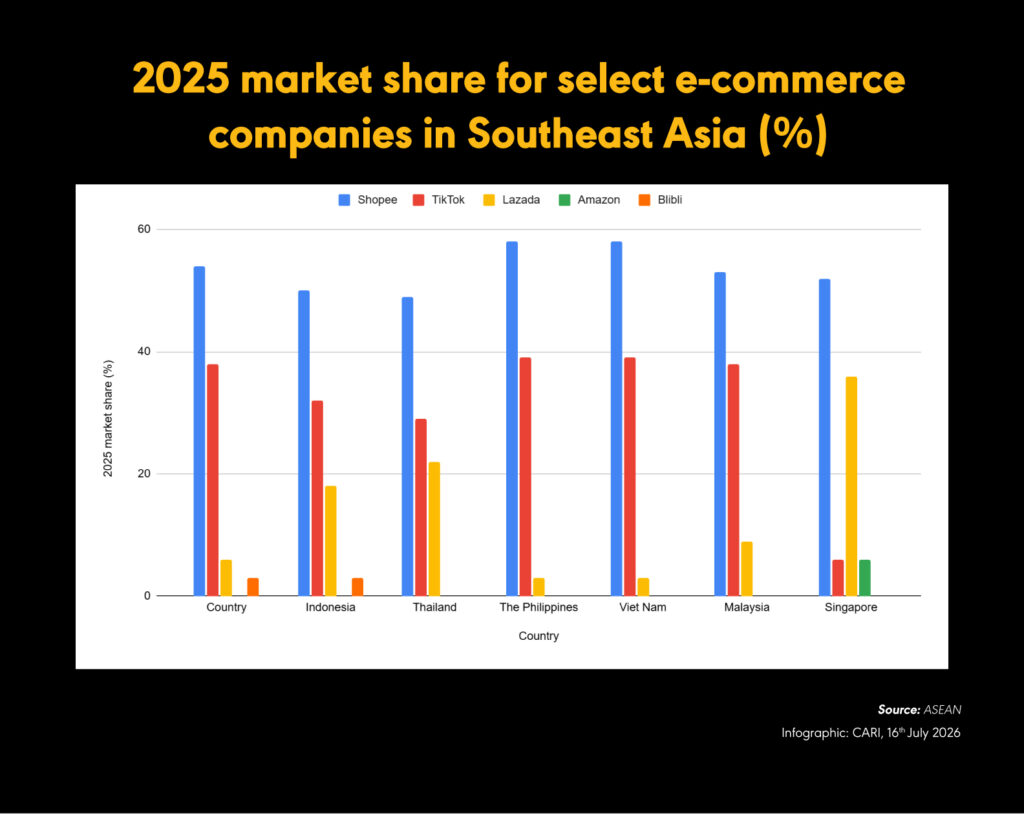
(14 July 2026) Amazon has begun phasing out its Singapore fulfilment service from 06 July, including warehouse storage for retailers, while Amazon Fresh will cease operations and third-party sellers will also be affected. The company will retain its Singapore presence by focusing on cross-border shipments from its US, Japan and Germany stores, with Amazon Singapore citing continued demand for international products. Analysts attributed the retreat to Amazon’s centralised fulfilment model, which was considered costly and less suited to Southeast Asia than the localised logistics networks used by competitors such as Shopee, TikTok Shop and Lazada. Momentum Works said Amazon’s model struggled to adapt to regional market conditions, while Singapore’s relatively small e-commerce market and Amazon’s limited market share made the business difficult to sustain. Momentum Works estimated Singapore’s e-commerce gross merchandise value reached USD 5.9 billion in 2025, of which Amazon accounted for about USD 400 million, or 6%, while Amazon’s total Southeast Asian GMV was approximately USD 0.4 billion compared with Shopee’s USD 83.2 billion, TikTok’s USD 45.6 billion and Lazada’s USD 18 billion. Sea reported Shopee GMV of USD 37.3 billion in the January-March 2026 quarter, up 30% year on year, and reaffirmed guidance for approximately 25% annual GMV growth in 2026. TikTok Shop has expanded rapidly through livestream commerce and retail training programmes in Singapore, while Lazada has strengthened its position through local offerings such as RedMart. Amazon is increasingly positioning Southeast Asia as an export base rather than a consumer market, particularly by supporting Vietnamese SMEs to sell overseas, with the number of products sold by Vietnamese partners on Amazon increasing 35% in the 12 months to July 2025.
ASEAN
Malaysia leads Southeast Asia’s IPO market in first half of 2026
(13 July 2026) Deloitte reported that Malaysia led Southeast Asia’s IPO market in the first half of 2026 with 36 listings raising USD 1.3 billion, while Singapore recorded five IPOs raising USD 868 million. Across Southeast Asia, 47 IPOs raised more than USD 3.07 billion, down from 53 IPOs a year earlier, but total proceeds increased 117% from USD 1.41 billion as the average deal size rose from USD 26 million to USD 65 million. Deloitte said the market is shifting towards fewer but larger and more mature issuers. Three IPOs exceeding USD 500 million in proceeds—UI Boustead REIT in Singapore, Sunway Healthcare Holdings in Malaysia and Dien May Xanh Investment in Vietnam—collectively added approximately USD 8.93 billion in market capitalisation, whereas no IPO surpassed USD 500 million in the first half of 2025. Deloitte attributed Singapore’s improved performance to stronger investor confidence and support from recent capital market reforms, including the Monetary Authority of Singapore’s SGD 6.5 billion Equity Market Development Programme launched in February 2025. The report forecasts a healthy regional IPO market for the remainder of 2026, supported by a strong pipeline, improving investor sentiment and easing interest rates, although global macroeconomic uncertainty and valuation scrutiny remain risks. Deloitte Southeast Asia capital markets services leader Tay Hwee Ling said Malaysia is expected to maintain strong IPO momentum while Singapore should continue attracting sizeable institutional listings.
THAILAND
Thai stocks outperforming Southeast Asian peers as investors bet on political stability
(17 July 2026) Thailand’s benchmark SET Index has risen 30% in 2026, outperforming all Southeast Asian peers, as investors expect the government led by Prime Minister Anutin Charnvirakul to provide greater political stability following his party’s decisive February election victory. JPMorgan Asset Management recommended maintaining exposure to Thai equities, while a Bank of America survey indicated fund managers are reducing their underweight positions on Thailand. Foreign investors have made net purchases of almost USD 2 billion in Thai equities and USD 1.26 billion in bonds this year, reversing nearly USD 13 billion of equity outflows recorded over the previous three years. Improved sentiment has been supported by expectations of stronger foreign direct investment, increased participation in the global artificial intelligence supply chain, resilient exports, steady tourism and closer policy coordination between the government and central bank. Thailand has also benefited from portfolio reallocations away from Indonesia, where investors remain concerned about policy uncertainty. Earnings per share forecasts for the SET Index have increased 7% since Anutin’s election, while MSCI ASEAN earnings estimates have declined 1.9%. Official data showed foreign investment approvals increased 73% year on year to approximately THB 154 billion (USD 4.6 billion) in the first five months of 2026, reflecting faster approval processes and streamlined investment policies. Analysts cautioned that sustaining the market rally will depend on stronger corporate earnings and that risks remain from weak long-term economic growth, global headwinds, tourism uncertainty and the effects of El Niño.
MALAYSIA, INDONESIA
Malaysia emerges as fifth largest source of foreign investment into Indonesia in second quarter of 2026
(16 July 2026) Malaysia was the fifth-largest source of foreign investment into Indonesia in the second quarter of 2026, contributing USD 700 million, as Indonesia recorded total realised investment of IDR 511.8 trillion, up 7.1% year on year, creating 742,223 jobs, a 5.1% increase. Indonesia’s Investment and Downstreaming Minister said Hong Kong was the largest source of foreign investment in Q2 with USD 5.5 billion, followed by Singapore (USD 4.2 billion), China (USD 1.7 billion), Japan (USD 900 million) and Malaysia (USD 700 million), while noting that investments are recorded by the jurisdiction through which funds enter Indonesia rather than their ultimate origin. Total realised investment in the first half of 2026 reached IDR 1,010.6 trillion, up 7.2% year on year and equivalent to 49.5% of the annual target, generating 1,448,862 jobs, a 15% increase from a year earlier. Singapore remained Indonesia’s largest foreign investor in the first half with USD 8.8 billion, followed by Hong Kong (USD 7.8 billion), China (USD 3.9 billion), Japan (USD 1.9 billion) and the United States (USD 1.7 billion). The minister said the government continues to improve the investment climate through regulatory reforms, including Government Regulation No. 28 introduced in October, to provide greater certainty in licensing.
MALAYSIA, SINGAPORE
Johor Bahru-Singapore RTS Link to spur Singaporeans to spend USD 1.05 billion more in Johor Bahru
(16 July 2026) A joint study by the Singapore Business Federation, Restaurant Association of Singapore and Singapore Retailers Association projects that after the Johor Bahru–Singapore RTS Link begins operations in January 2027, Singaporeans will spend an additional USD 1.05 billion annually in Johor Bahru, around 40% more than the projected USD 756 million increase in spending by Johor Bahru visitors in Singapore. The study estimated that Singaporeans spent USD 1.7 billion in Johor Bahru in 2025, while Johor Bahru residents spent USD 1.3 billion in Singapore. Annual trips by Singapore consumers to Johor Bahru are forecast to increase 51%, with groceries, pharmaceuticals, dining and beauty products remaining the main spending categories. Among Johor Bahru respondents, 34% said they intend to visit Singapore after the RTS Link opens, while annual visits by public transport users are projected to increase 57%, with many motorists expected to switch to rail and spend more on overnight stays and entertainment. The study found that Singapore retail and food and beverage businesses expect stronger competition from Johor Bahru, particularly in price-sensitive sectors, while highlighting manpower shortages, compliance requirements and operating costs as barriers to improving competitiveness.
THAILAND
Number of beneficiaries under state welfare card programme reduced by 28%
(17 July 2026) Thailand has reduced the number of beneficiaries under its state welfare card programme by 28% to 9.5 million from 13.2 million in the 2022 registration round after the Ministry of Finance introduced stricter eligibility screening to better target low-income and vulnerable groups. The Fiscal Policy Office said eligible recipients now represent about 14% of the population, compared with the World Bank’s estimated poverty rate of around 12%. Of the 18.8 million people who registered for the 2026 programme, 5.76 million failed to meet existing eligibility criteria, while a further 3.56 million were excluded under new checks covering financial assets, company directorships, securities accounts, land ownership, credit cards and non-bank loans. The tighter screening is expected to reduce the fiscal burden by approximately THB 14.5 billion (USD 431.5 million). The changes come as Thailand’s public debt stood at 66.8% of GDP at the end of May, close to the government’s self-imposed ceiling of 70%. It has been noted that the revised recipient list reflects a more targeted approach to welfare distribution but remains above research estimates of 4 million to 5 million people in need, and called on Prime Minister Anutin Charnvirakul’s government to publish more data on recipient distribution to demonstrate that the reforms are intended to improve the fairness and efficiency of public spending rather than simply reduce expenditure.
SINGAPORE, TIMOR-LESTE
Global Group begins construction of first fuel storage terminal in Timor-Leste
(13 July 2026) Singapore-based Global Group has begun construction of its first fuel storage terminal in Timor-Leste, a USD 10 million project in Liquica expected to be completed within 10 months. The two-hectare facility will include two floating-roof tanks with storage capacity of 3.5 million litres of diesel and 2.5 million litres of petrol, with a second expansion phase planned for 2030. The terminal will support the company’s retail and wholesale fuel operations, which include nine petrol stations, fuel supplies for major construction projects and naval vessels, and a fleet of about 50 fuel trucks. The director of Global Group said the facility will strengthen inventory control, reduce reliance on third-party storage and eliminate annual throughput fees of approximately USD 1.8 million currently paid to Pertamina’s terminal. Global Group said its Timor-Leste operations generate annual turnover of USD 50-60 million and profits of USD 2-3 million, with wholesale fuel sales increasing from about 300,000 litres per month in 2014 to more than 3.5 million litres per month in 2024, supported by annual revenue growth of 8-10%. The company said it controls nearly two-thirds of Timor-Leste’s onshore fuel market and expects additional storage capacity will be required due to rising investor interest and economic development. Once completed, the terminal will become Timor-Leste’s third fuel storage facility and will reserve 150,000 litres of fuel for government use to enhance energy security. Global Group also reiterated its intention to pursue a public listing, after an earlier attempt to list its Timor-Leste unit on the Singapore Exchange’s Catalist board was unsuccessful because the market was considered too high risk, with Hong Kong identified as an alternative listing venue if required.
RCEP Monitor
SOUTH KOREA
Bank of Korea raises benchmark interest rate by 25 basis points to 2.75%
(16 July 2026) The Bank of Korea raised its benchmark interest rate by 25 basis points to 2.75% on 17 July, marking its first rate increase in more than three years and the first under Governor Shin Hyun-song, as it began a monetary tightening cycle to address inflationary pressures linked to the AI-driven semiconductor boom. The central bank had kept rates at 2.5% since May 2025 following its previous easing cycle. Shin said stronger domestic demand generated by the semiconductor boom is expected to sustain underlying inflationary pressures, and the bank will continue tightening until inflation returns to its 2% target. Consumer inflation accelerated to 3.2% year on year in June, the highest since December 2023, while the weak won, higher energy import costs, rising housing prices and elevated household debt also influenced the decision. The Bank of Korea noted that strong export demand for memory chips, sizeable bonus payments at Samsung Electronics and SK Hynix, and increasing household spending, wages and investment could further support inflation. South Korea’s exports rose 70.9% year on year in June, the fastest growth in nearly 50 years, while the government upgraded its 2026 GDP growth forecast to 3.0% from 2.0%, above the IMF’s 2.6% projection. Following the announcement, the Kospi Index fell more than 6%, while the won strengthened slightly to 1,484 per US dollar after having weakened 5% against the dollar year to date. Economists expect the Bank of Korea to raise rates by another 25 basis points in October, followed by two further increases in 2027, potentially lifting the policy rate to 3.5% by the first half of 2027.
CHINA, VIET NAM
China surpasses United States into becoming Vietnam’s largest seafood export market
(17 July 2026) China ha surpassed the United States into becaming Vietnam’s largest seafood export market in the first half of 2026, with imports of nearly USD 1.4 billion, up about 40% year on year, according to the Ministry of Agriculture and Environment. Exports to the United States totalled nearly USD 898 million, down about 1%, while Japan ranked third with nearly USD 788 million, up 2%. Nam Viet Corp said the shift towards China has become more pronounced since the start of the year as its proximity offers lower logistics costs, reduced shipping times and faster capital recovery amid persistently high freight costs to more distant markets. The Vietnam Association of Seafood Exporters and Producers (VASEP) said exporters have increasingly redirected shipments to China because of rising trade barriers in the United States and Europe. Exports to the United States continue to face stricter requirements under the Marine Mammal Protection Act, including additional Certificates of Admissibility for products such as tuna, while shrimp exports remain affected by high anti-dumping duties. VASEP added that higher shipments to the United States ahead of new tariff measures also increased inventories. The association said overall export growth reflected recovering demand and exporters’ ability to diversify markets and restructure products as buyers impose stricter pricing, quality, certification and traceability requirements.
JAPAN
Nationwide core consumer price index forecast to increase by 1.6% year-on-year in June
(17 July 2026) A Reuters poll of 16 economists forecasts that Japan’s nationwide core consumer price index, which excludes fresh food but includes energy, increased 1.6% year on year in June, up from 1.4% in May but remaining below the Bank of Japan’s 2% inflation target for a fifth consecutive month. Economists attributed the expected increase to higher energy prices linked to the Middle East conflict and revisions to medical service fees, despite continued easing in food inflation excluding fresh food. Mitsubishi UFJ Research & Consulting said rising crude oil prices associated with the Iran situation have reduced the decline in energy prices, while Mizuho Securities said the impact of revised medical fees and the Iran conflict is likely to become more evident during the summer. The inflation data will be considered by the Bank of Japan at its upcoming policy meeting alongside its quarterly review of economic growth and inflation forecasts. Japan’s wholesale inflation accelerated to 7.1% year on year in June, the fastest pace since March 2023, reinforcing expectations that the central bank may continue raising interest rates. Official consumer inflation data will be released on 24 July.
|
15 participating countries |
20 chapters |
2.2 billion |
US$26.2 trillion |
28% |
| ASEAN member states, Australia, China, Japan, South Korea, New Zealand | trade in goods and services, investment, intellectual property, e-commerce, competition, SMEs, economic and technical cooperation, and government procurement | combined population, 30% world’s population | combined GDP, 30% global GDP | global trade (based on 2019 figures) |