


CARI Captures Issue 752: Southeast Asia’s manufacturing PMI rises to 51.5 in May 2026, indicating expansion
Captures has widened its scope to include news related to all the members of the Regional Comprehensive Economic Partnership (RCEP) agreement which was signed towards the end of 2020. Besides the ASEAN Member States, this includes Australia, New Zealand, China, Japan, and South Korea. The other weekly newsletters under CARI, China-ASEAN Monitor and Mekong Monitor will also be consolidated into the Captures newsletter. We hope this new version of Captures will serve you better and look forward to providing a curation of stories relevant to ASEAN and its trading partners.
ASEAN
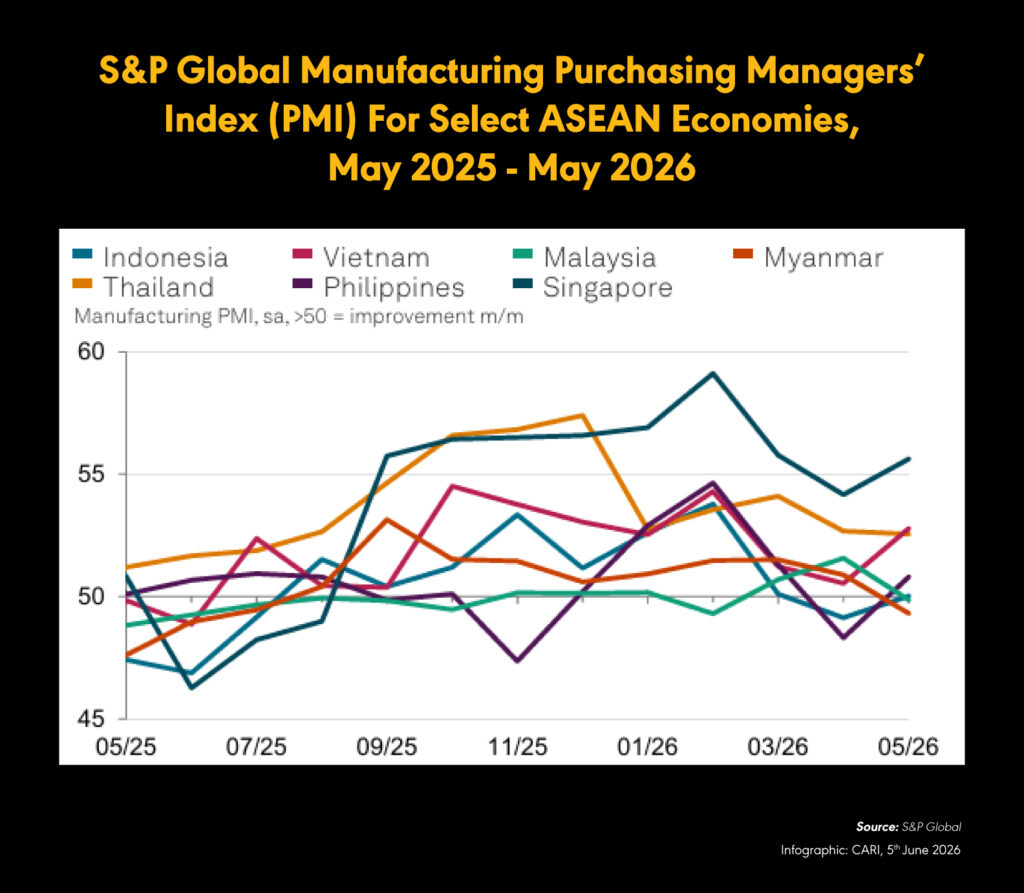
Southeast Asia’s manufacturing PMI rises to 51.5 in May 2026, indicating expansion
(02 June 2026) Southeast Asia’s manufacturing sector ended a three-month slowdown in May, with the manufacturing Purchasing Managers’ Index rising to 51.5 from 50.7 in April, indicating a stronger expansion in activity. Growth was driven by a solid increase in new domestic orders, which enabled manufacturers to raise production despite continued weakness in exports. Viet Nam recorded the region’s highest PMI reading at 52.8, followed by Thailand at 52.6, while the Philippines and Indonesia also remained in expansion territory. Myanmar and Malaysia registered contractionary readings of 49.3 and 49.9, respectively. S&P Global reported that purchasing activity increased across the region, but firms remained cautious about workforce expansion, resulting in a slight decline in employment during May. According to S&P Global Market Intelligence, ongoing trade disruptions and inflationary pressures linked to the current war are expected to continue weighing on growth prospects.
INDONESIA
Monthly inflation accelerates to 0.28% in May from April’s level
(02 June 2026) Indonesia’s monthly inflation accelerated to 0.28% in May from April’s level, driven primarily by higher food, beverage and tobacco prices, according to Statistics Indonesia (BPS). BPS said red chilli peppers were the largest contributor, adding 0.08 percentage points to inflation, followed by cooking oil and shallots at 0.04 percentage points each, tomatoes at 0.03 percentage points and rice at 0.02 percentage points. The BPS attributed the increase to seasonal movements in volatile food prices and changes in demand linked partly to major religious holidays. Annual inflation reached 3.08% in May, while year-to-date inflation stood at 1.35%. Bank Indonesia’s inflation target remains 2.5% with a tolerance range of one percentage point above or below the target for this year and next. Separately, BPS reported that Indonesia’s economy expanded 5.61% year-on-year in the first quarter of 2026, the strongest growth since the third quarter of 2022. The rupiah weakened to more than 17,800 per US dollar, a record low, which Bank Indonesia attributed to global tensions and seasonal factors including corporate demand for dollars to pay dividends and overseas travel by hajj pilgrims.
INDONESIA
Indonesia records trade surplus of USD 0.09 billion in April 2026
(02 June 2026) Indonesia recorded a trade surplus of USD 0.09 billion in April 2026, its smallest monthly surplus since May 2020 and well below the USD 1.5 billion expected in a Reuters poll. Exports rose 21.98% year-on-year to USD 25.3 billion, supported by higher shipments of manufactured products including palm oil and nickel derivatives, basic chemicals and jewellery. Imports increased 22.49% to USD 25.21 billion, driven by an 82.52% surge in oil and gas imports and a 42.9% rise in consumer goods imports. The statistics bureau said Indonesia’s main crude oil suppliers in April were Nigeria, Brazil and Kazakhstan, while refined oil imports primarily came from Malaysia, Singapore and Egypt. Export growth benefited from higher commodity prices following the war in Iran and the depreciation of the rupiah, which fell to a record low of 17,892 per US dollar ahead of the data release.
THE PHILIPPINES
Philippine inflation in May expected to range between 7.1% and 7.9%
(30 May 2026) The Bangko Sentral ng Pilipinas (BSP) expects Philippine inflation in May to range between 7.1% and 7.9%, compared with 7.2% in April. The projected increase is primarily attributed to higher prices for rice, vegetables and meat, as well as the weakening peso, which reached a record low against the US dollar during the month. The BSP said recent reductions in domestic fuel prices and slightly lower electricity rates could partially offset these inflationary pressures. The BSP Governor stated that the May inflation data, due for release on 05 June, will be an important factor in determining the central bank’s next policy decision. The BSP has indicated readiness to implement further monetary tightening after raising its benchmark interest rate by 25 basis points to 4.5% last month.
THAILAND
Bank of Thailand claims current policy interest rate remains appropriate
(02 June 2026) Bank of Thailand Governor Vitai Ratanakorn said the current policy interest rate remains appropriate despite rising inflation and a more hawkish stance by some central banks in response to higher energy prices. Thailand’s headline inflation increased to 2.89% year-on-year in April, up from the previous year, but remained within the central bank’s 1%-3% target range. The governor said inflation could exceed 5% in the third quarter but characterised the increase as a temporary, oil-driven phenomenon rather than a threat to long-term economic growth. He stated that inflation is expected to ease after reaching its peak as market expectations improve regarding a resolution of the Middle East conflict. The comments indicate continued support for maintaining accommodative monetary policy to assist an economy facing higher energy costs and weaker external demand. The Bank of Thailand left its benchmark one-day repurchase rate unchanged at 1% in April, one of the lowest policy rates globally. The next monetary policy meeting is scheduled for 24 June.
CAMBODIA
International visitors to Angkor Wat decline 31.8% year-on-year during January–May 2026 period
(02 June 2026) Cambodia’s Angkor Archaeological Park received 359,471 international visitors during January–May 2026, a decline of 31.8% compared with the same period a year earlier, according to state-owned Angkor Enterprise. Revenue from ticket sales fell 30% year-on-year to USD 17.2 million over the five-month period. The UNESCO World Heritage site in Siem Reap province covers 401 sq km and contains 91 temples dating from the ninth to the 13th centuries. The deputy director of the China-Asean Studies Center at the Cambodia University of Technology and Science said the decline was likely linked to global and regional economic slowdowns, online scam-related issues and the border conflict with Thailand. He added that the conflict in the Middle East had further affected visitor numbers through higher fuel prices and disruptions to some flights.
VIET NAM
Agricultural exports increase 9.2% year-on-year in first five months of 2026
(01 June 2026) Viet Nam’s agriculture, forestry and fisheries exports increased 9.2% year-on-year to nearly USD 30.7 billion in the first five months of 2026, generating a trade surplus of USD 8.4 billion, up 1.1%, according to the Ministry of Agriculture and Environment. Imports rose 12.6% to nearly USD 22.3 billion during the same period. Agricultural products remained the largest export category at almost USD 16.4 billion, up 6.1%, while forestry exports reached USD 7.65 billion, up 4.5%, and seafood exports rose 10.6% to USD 4.65 billion. Exports of production inputs increased 83% to USD 1.7 billion, livestock product exports grew 43.2% to USD 308 million, and salt exports rose 45.8% to USD 6.7 million. China remained the largest export market, accounting for 20.5% of total export value and recording growth of 28.4% year-on-year. The United States represented 18.5% of exports, although shipments declined 3.6%, while exports to the European Union and Japan increased 4.2% and 3.5% respectively, accounting for 11.8% and 6.8% of total exports. The ministry attributed export growth to trade promotion activities, market diversification and the effective use of free trade agreements. The Deputy Minister of Agriculture and Environment said the sector is targeting growth of 3.7% in 2026 and is seeking to achieve 4%, with key indicators broadly tracking planned targets.
RCEP Monitor
CHINA
China extends outbound investment curbs to include individual residents
(03 June 2026) China’s State Council has expanded outbound investment regulations to explicitly include individual residents for the first time, extending oversight beyond corporate overseas investments and bringing previously ambiguous individual cross-border investment activities under a formal regulatory framework. The new rules, released on 02 June, do not specify supervision mechanisms, with detailed implementation measures to be issued later by investment and commerce authorities. Analysts said the changes could increase scrutiny of overseas investments made through offshore entities, including foreign acquisitions, property purchases and stakes in overseas companies. The Institute of International Finance (IIF) said the move may also target offshore capital structures used by China-linked companies, including “red-chip” arrangements that allow firms to raise foreign capital and retain funds overseas. The regulatory changes come amid concerns over capital outflows, with Chinese individuals, companies and financial institutions moving an estimated USD 807 billion overseas in 2025, the highest level on record according to the IIF. Equity outflows rose 67% to USD 208 billion and bond outflows increased 75% to USD 153 billion, while outbound direct investment fell to USD 157 billion. The inclusion of individuals has prompted debate over the future of overseas stock investing by Chinese residents, with the Singapore Management University warning that the rules could potentially restrict access to foreign financial markets. The development follows China’s recent crackdown on unauthorised cross-border stock trading platforms, including actions against Futu Holdings, Tiger Brokers and Longbridge Securities. Shanghai Fangchang Information Development Co. said regulators are likely to continue restricting informal channels while expanding access through regulated programmes such as Hong Kong Stock Connect and the Qualified Domestic Institutional Investor scheme.
AUSTRALIA
Economy slows in first quarter of 2026 to 2.5% year-on-year
(02 June 2026) Australia’s economy slowed in the first quarter of 2026, with GDP increasing 2.5% year-on-year, below the 2.6% forecast by economists and down from 2.6% growth in the previous quarter, according to the Australian Bureau of Statistics. Quarterly GDP growth was 0.3%, below the 0.5% Reuters poll forecast and slower than the 0.8% expansion recorded in the fourth quarter of 2025. Growth was constrained by weak household spending, lower government consumption and severe weather-related disruptions to mining activity and exports. Investment in data centre machinery and equipment provided partial support to economic activity. The Reserve Bank of Australia raised its cash rate by 25 basis points to 4.35% in May, marking its third rate increase of the year following stronger economic performance and renewed inflation pressures in late 2025. Following the GDP release, Australia’s 10-year government bond yield rose to 4.898%, while the S&P/ASX 200 gained 0.5% and the Australian dollar remained largely unchanged at USD 0.7176. Bank of America said the first-quarter figures were too early to reflect significant effects from the Middle East conflict, with any negative impact more likely to emerge in the second quarter. The Reserve Bank is expected to focus on private demand, inflation risks linked to weak productivity and rising unit labour costs, while the central bank forecasts economic growth to slow to 1.3% by the end of 2026.
AUSTRALIA
Australia lifts national minimum wage by 4.75% for 2.8 million lower-paid workers
(02 June 2026) Australia’s Fair Work Commission approved a 4.75% increase in the national minimum wage for approximately 2.8 million lower-paid workers, effective from 01 July 2026. The minimum weekly wage will rise to AUD 1,004.90, equivalent to AUD 26.44 per hour. The increase exceeds last year’s 3.5% adjustment and the 3.75% rise in 2024, but is below the 5%-6% increase sought by trade unions. The commission cited economic uncertainty, tighter monetary policy and higher inflation linked to disruptions in oil supplies from the US-Israeli war on Iran, stating that it was not practical to grant a real wage increase but aimed to prevent workers from being worse off in real terms than on 01 July 2025. Consumer price inflation stood at 4.1% in the first quarter and is projected to peak at 4.8% in the June quarter, above the Reserve Bank of Australia’s 2%-3% target range. Citi said the wage decision, combined with existing cost pressures, supports its expectation of a fourth interest rate increase this year, with the cash rate potentially rising to 4.6% in August. Westpac said the increase was higher than its forecast of 4.25% and could add upward pressure to wage growth and inflation expectations. The Reserve Bank of Australia has already raised rates three times this year to 4.35%, while market pricing implies a 7% probability of another increase next month and a total of 23 basis points of further tightening this year.
|
15 participating countries |
20 chapters |
2.2 billion |
US$26.2 trillion |
28% |
| ASEAN member states, Australia, China, Japan, South Korea, New Zealand | trade in goods and services, investment, intellectual property, e-commerce, competition, SMEs, economic and technical cooperation, and government procurement | combined population, 30% world’s population | combined GDP, 30% global GDP | global trade (based on 2019 figures) |