


CARI Captures Issue 741: Disruptions to global energy supplies due to Iran conflict raises risks to ASEAN’s energy security
Captures has widened its scope to include news related to all the members of the Regional Comprehensive Economic Partnership (RCEP) agreement which was signed towards the end of 2020. Besides the ASEAN Member States, this includes Australia, New Zealand, China, Japan, and South Korea. The other weekly newsletters under CARI, China-ASEAN Monitor and Mekong Monitor will also be consolidated into the Captures newsletter. We hope this new version of Captures will serve you better and look forward to providing a curation of stories relevant to ASEAN and its trading partners.
ASEAN
Disruptions to global energy supplies due to Iran conflict raises risks to ASEAN’s energy security
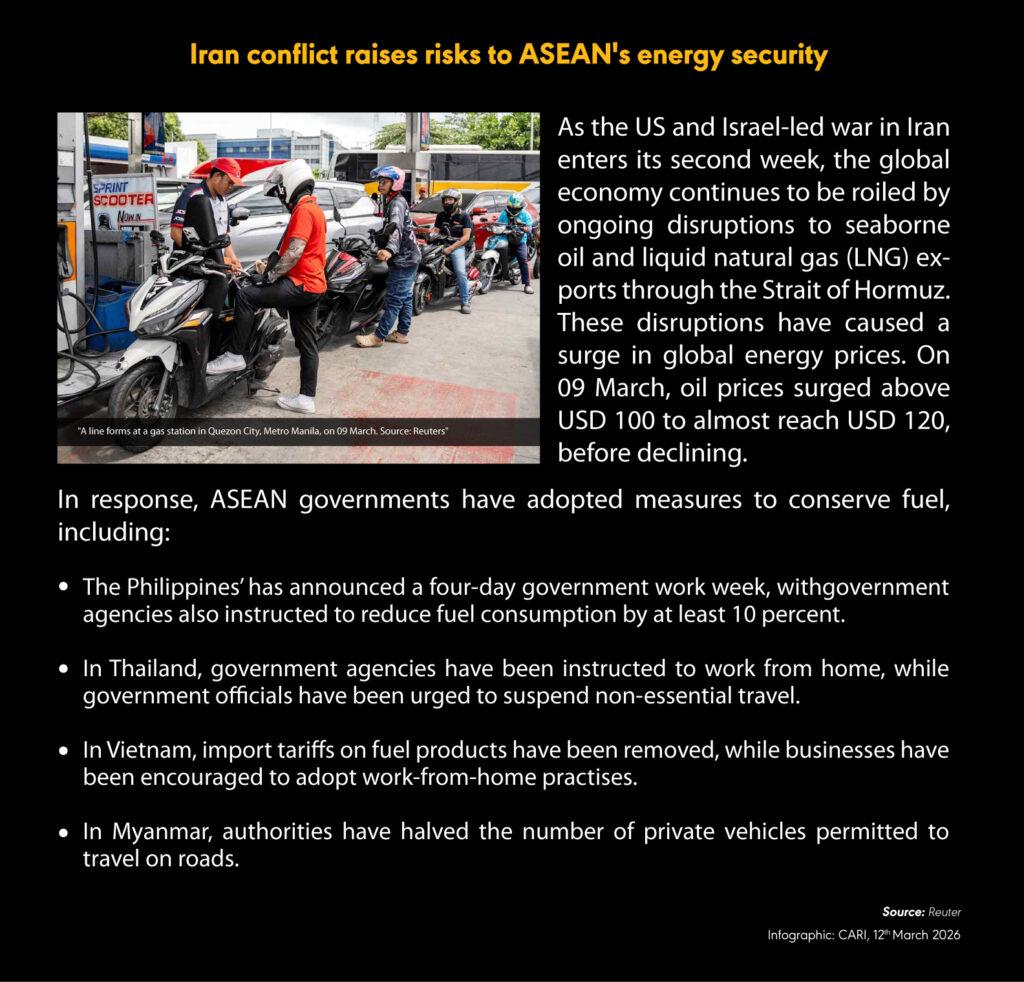
(10 March 2026) Escalating military strikes by Israel and the United States on Iran since 28 February have disrupted shipping routes in the Persian Gulf, raising risks to Southeast Asia’s energy security due to its reliance on imported oil and gas. Missile and drone attacks have targeted oil infrastructure in Saudi Arabia and the United Arab Emirates, forcing shutdowns or output reductions at facilities. Shipping through the Strait of Hormuz is critical to Asia’s energy supply, carrying nearly one-third of the region’s liquefied natural gas imports and about 60% of crude oil flows. The International Energy Agency estimates that about 20 million barrels per day of crude oil and oil products passed through the route in 2025, with almost 90% of exports destined for Asia. Oil prices rose above USD 100 per barrel on 09 March and briefly approached USD 120 before falling below USD 90 after Donald Trump indicated the conflict could end soon. Southeast Asian countries face varying exposure, with the Philippines sourcing 96% of its oil from the Persian Gulf, while Viet Nam and Thailand import about 87% and 74% respectively from the region. Governments in the Philippines and Thailand have ordered reductions in air-conditioning use and official travel to conserve fuel, while Myanmar imposed alternate-day driving rules and queues have appeared at petrol stations across Myanmar and Lao PDR. Indonesia consumes around 1.6 million barrels of oil per day and has allocated IDR 381 trillion (USD 22.4 billion) for fuel subsidies in its 2026 budget based on an oil price assumption of USD 70 per barrel. Malaysia, a net oil and gas exporter, retains some buffer but prime minister Anwar Ibrahim warned a prolonged closure of the Strait of Hormuz could affect the sustainability of the MYR 1.99 per litre RON95 fuel subsidy. Natural gas markets have also tightened, with Asian LNG spot prices rising to about USD 25 per MMBtu in early March before easing to around USD 15–16. Singapore sources about 42.5% of LNG imports from Qatar, while Thailand obtains about 20.5%, exposing electricity generation to supply disruptions. Higher gas prices may lead utilities in Thailand, Viet Nam and Indonesia to increase coal-fired generation, while policymakers are considering diversification of supply, larger reserves and expanded renewable energy deployment to reduce exposure to geopolitical disruptions.
VIET NAM
Viet Nam implements new artificial intelligence law in first for Southeast Asia
(08 March 2026) Viet Mam implemented a new artificial intelligence law on 08 March introducing a risk-tiered regulatory model requiring AI providers, including foreign companies operating locally, to classify systems as low, medium or high risk under guidelines issued by the Vietnam Ministry of Science and Technology. The legislation requires companies to label AI-generated content such as deepfakes and disclose when users are interacting with AI systems rather than human agents. The law was passed by the National Assembly of Vietnam in December and adopts an accountability and transparency framework similar to the European Union AI Act. Viet Nam becomes one of a small group of jurisdictions, alongside the European Union and South Korea, to implement binding AI legislation rather than voluntary governance frameworks. The government stated in a December report that the law aims to align Viet Nam with international regulatory standards while preserving digital sovereignty. Analysts described the legislation as Southeast Asia’s first practical test of whether the region can move from voluntary principles to enforceable AI regulation, potentially influencing policy discussions within Association of Southeast Asian Nations. Legal analysis from LNT & Partners characterised the Vietnamese legislation as an initial framework whose effectiveness will depend on future implementing decrees, sector-specific regulations and enforcement practices. Analysts said the law could accelerate regional discussions about enforceable governance as deepfakes, scams and other AI-related harms expand across Southeast Asia. However, experts noted structural risks including reliance on provider self-classification of AI systems, which may incentivise companies to avoid high-risk designations that trigger compliance costs. Concerns were also raised that rapid introduction of detailed implementing rules could create compliance burdens for smaller firms. Analysts further warned that effective oversight will require mechanisms allowing challenges to automated decisions and participation from civil society, media and external stakeholders to ensure accountability mechanisms function in practice.
MALAYSIA
Airspace disruptions in Middle East could affect international tourism flows to Malaysia
(10 March 2026) The conflict involving the United States and Iran is creating disruptions in global aviation networks that could affect international tourism flows to Malaysia. Airspace disruptions at major Gulf aviation hubs including Dubai, Doha and Abu Dhabi have resulted in longer flight routes and higher ticket prices, affecting Southeast Asian travel markets reliant on these transit points for routes to Europe and Africa. According to analysts, reduced tourist confidence and rising aviation fuel costs linked to higher global oil prices could weaken long-haul travel demand and affect inbound tourism to Malaysia. The situation may test the momentum of the Visit Malaysia 2026 campaign, which targets 47 million international tourist arrivals and MYR 329 billion in tourism revenue. The challenge ranges from moderate to high but could remain manageable if Malaysia leverages regional demand from Singapore, Indonesia, China and Thailand while maintaining its reputation as a stable destination. Analysts emphasised that sustained disruption at Gulf transit hubs could affect air connectivity and the pace of tourist arrivals. Proposed mitigation measures include strengthening airline cooperation to increase seat capacity and expanding codeshare arrangements through alternative Asian transit hubs. Tourism operators such as hotels and travel agencies are also encouraged to provide flexible booking policies to support traveller confidence. It was noted that global conflicts can influence tourist perceptions of travel safety even when destinations are geographically distant from the crisis. He added that international travellers often make decisions based on perceived global stability rather than precise geography, although rapid information flows now allow tourists to access real-time updates. It was noted that the impact on Malaysia could remain limited if travel routes do not require transit through affected Gulf hubs, while airlines are adjusting flight planning to avoid conflict zones and maintain international connectivity.
MALAYSIA
Industrial production growth in Malaysia forecast to moderate in 2026
(10 March 2026) MBSB Research forecasts moderation in Malaysia’s industrial production growth to 3.0% in 2026 from 3.4% in 2025, citing high base effects from front-loaded production last year and risks from rising energy prices linked to escalating tensions in the Middle East. The firm warned that higher energy costs could increase production expenses and inflation, potentially weakening final demand and purchasing activity. Despite this outlook, domestic demand expansion is expected to support output growth and partially offset external risks. Malaysia’s Industrial Production Index recorded stronger-than-expected growth of 5.9% year-on-year in January, up from 4.8% in December 2025. Growth was broad-based across manufacturing (7.3%), electricity (6.3%) and mining (0.1%). Manufacturing expansion was led by electrical and electronics products (15.2%), food, beverages and tobacco (12.2%, and non-metallic mineral and fabricated metal products (7.0%). Mining output was supported by crude oil and condensate production growth of 3.8%, which offset a 2.1% decline in natural gas output. Sales of manufactured goods increased 7.1% year-on-year to MYR 169.4 billion, with the electrical and electronics subsector rising 15.6%. On a seasonally adjusted monthly basis, sales rebounded 2.9% following a 0.5% contraction in December. Export-oriented industries expanded 7.8% year-on-year, led by computer, electronic and optical products (17.2%) and vegetable and animal oils and fats (20.7%). Domestic-oriented industries also grew 6.4%, supported by food products and fabricated metal products. Globally, industrial production trends were mixed, with stronger growth recorded in Taiwan, Singapore and South Korea, while weaker performance was reported in Philippines and Thailand.
CAMBODIA
National Bank of Cambodia approves creation of companies to buy bad debts from financial institutions
(10 March 2026) The National Bank of Cambodia approved a framework to license asset-management institutions (AMIs) to purchase non-performing loans and related collateral from banks and microfinance institutions as bad debt levels rise across Cambodia’s financial sector. Licensed AMIs must hold at least USD 50 million in registered capital and acquire distressed assets through transparent arm’s-length transactions with agreed pricing. The initiative follows economic strain linked to US tariff pressures, two episodes of cross-border conflict with Thailand affecting tourism, trade and remittances, and the return of nearly 1 million Cambodian migrant workers from Thailand requiring employment to service bank and microfinance loans. Rising global energy costs following military actions by the United States and Israel against Iran have increased domestic fuel prices by about 14% within a week, adding pressure to household finances in a fully fuel-import-dependent economy. Asset quality in the financial system has deteriorated, with the International Monetary Fund warning in December about rising non-performing loans and shrinking banking profitability. The ASEAN+3 Macroeconomic Research Office reported the NPL ratio reaching 7.8% for banks and 10% for microfinance institutions in 2025, compared with 6.2% and 7.4% respectively in 2024. Data from the Credit Bureau of Cambodia showed the average personal loan size at about USD 6,500 as of December 2025. The Cambodia Microfinance Association reported the proportion of borrowers more than 30 days overdue on payments rising to 9.6% at end-2025 from 7.3% a year earlier. Mekong Strategic Capital stated that resolving distressed loans could become more difficult as court processing times may extend from about three years to between five and seven years as NPL volumes increase. They also questioned the feasibility of private-sector AMIs addressing roughly USD 5 billion in distressed loans without significant legal system reforms. The IMF’s December Article IV consultation indicated that the central bank does not plan to establish a state-backed AMI or provide liquidity support through purchases of AMI-issued bonds.
THAILAND
Thailand’s oil fund losing more than USD 32 million per day subsidising diesel prices
(11 March 2026) Thailand’s government is expanding measures to curb fuel demand as it subsidises domestic diesel prices through the state-run oil fuel fund amid rising global energy costs. Thailand’s Energy Minister said the fund is losing more than THB 1 billion (USD 32 million) per day, with accumulated losses projected to reach THB 10 billion by 18 March. The government will reassess the situation based on the fund’s position and global prices, but will continue fuel subsidies for now. The minister noted the fund previously managed debt of up to THB 120 billion during the early stages of the Russia‑Ukraine war. Thailand imports a large share of its energy, with about half of oil shipments originating from the Middle East, increasing exposure to supply disruptions if the conflict intensifies or persists. Authorities reported fuel hoarding by some farmers and rural consumers despite assurances that supplies remain sufficient. Thailand’s Commerce Minister said additional measures could be introduced if the situation worsens. The government has suspended most oil exports to prioritise domestic supply, increased biofuel blending ratios to reduce crude demand, and required state employees to work from home. The Bank of Thailand and the armed forces have also adopted remote work arrangements for some personnel.
MYANMAR
Residential property prices rise sharply despite economic contraction and ongoing conflict
(09 March 2026) Residential property prices in Yangon have risen sharply despite economic contraction and ongoing conflict in Myanmar, with condominium prices in some cases doubling since 2020 and tripling in certain outlying townships. A 130 sq m three-bedroom unit at Inno City, a mixed-use development completed in 2023 by South Korean developers, is priced at about MYK 1 billion (USD 476,000), compared with roughly USD 286,000 for a similar unit before the February 2021 military coup. Colliers Thailand said prices in major cities have roughly doubled since 2020 despite weak economic fundamentals. The World Bank estimates Myanmar’s real GDP will contract by 2% in the fiscal year ending March 2026, with inflation expected to remain above 20%. Analysts cited risk hedging rather than income growth or rental returns as the main driver of rising property values. A Yangon-based investor said he increased property investment from 2022, identifying a valuation gap where assets priced in kyat appeared undervalued in US dollar terms amid currency depreciation and inflation. He said the market has shifted from long-term rental investment to short-term property trading and speculative flipping. A property agent said internal migration from conflict-affected northern regions and the destruction of more than 55,000 homes following a March 2025 earthquake in central Myanmar increased demand for housing in Yangon. Some business owners have also redirected capital from manufacturing and hospitality sectors into real estate due to perceived lower risk. Capital controls introduced after the coup, including a 2022 requirement to convert foreign-currency income into kyat and tighter outflow restrictions in June 2024, have reduced overseas property investment and redirected funds into domestic real estate. A property consultant described the resulting demand as “artificial”, with buyers using property as a store of wealth amid concerns over the banking system. The Myanmar kyat depreciated from 1,330 per US dollar in 2021 to 4,520 in 2025, reinforcing property purchases as a hedge.
RCEP Monitor
AUSTRALIA
Consumer confidence edges higher in March 2026 despite Middle East conflict
(10 March 2026) Australia’s consumer confidence remained in pessimistic territory in March, with the Reserve Bank of Australia preparing for policy deliberations amid inflation risks linked to the widening Middle East conflict. A survey by Westpac Banking Corp. showed sentiment rose 1.2% to 91.6 points, remaining below the neutral level of 100. Rising oil prices linked to the war have increased concerns about renewed inflationary pressure in Australia. The central bank raised its policy rate earlier this year and is widely expected to hold rates at 3.85% at the upcoming meeting. Economic indicators show mixed conditions, with a tight labour market and elevated price pressures, but contrasted with weaker-than-expected household consumption growth in the December quarter and a rise in the household savings ratio to its highest level since the third quarter of 2022. Unit labour costs declined for a second consecutive quarter, indicating some easing of domestic inflation pressure. Economists expect the central bank to hold policy at the March meeting despite earlier comments from Governor Michele Bullock that another rate increase remains possible. Data from National Australia Bank Ltd. showed business confidence fell into negative territory in February for the first time in almost a year, while business conditions remained at +7 index points, near the long-run average. Capacity utilisation remained elevated and forward orders increased, while the capital expenditure index rose three points to a three-year high. Sally Auld, chief economist at the bank, said headline inflation could reach about 5% by June due to higher oil prices.
SOUTH KOREA
South Korea records strong export growth in first ten days of March 2026
(11 March 2026) South Korea recorded strong export growth in the first ten days of March, with shipments rising 55.6% year-on-year to USD 21.47 billion, according to data from the Korea Customs Service. The daily average export value increased 31.7% to USD 3.30 billion during the period. Semiconductor exports surged 175.9% amid strong demand for chips used in artificial intelligence applications. Exports of oil products, automobiles, steel products, auto parts, precision machinery and home appliances also increased by double-digit rates. Ship exports declined by double digits over the same period. Imports rose 21.7% year-on-year to USD 19.37 billion in the first 10 days of March. The country recorded a trade surplus of USD 2.10 billion during the period. Imports of chips, semiconductor equipment, machinery, oil products, precision machinery and coal posted double-digit increases. Imports of crude oil and natural gas declined by single digits during the 10-day period.
JAPAN
Japan to release oil from its national reserves starting as early as 16 March
(11 March 2026) Japan will release oil from its national reserves starting as early as 16 March, with Prime Minister Sanae Takaichi stating the government will act before a coordinated decision by the International Energy Agency to stabilise energy markets amid the war involving Iran. Takaichi said Japan would draw crude equivalent to 15 days of demand from private sector reserves and about one month of demand from the state stockpile. Japan’s total reserves equal around 254 days of oil demand, including 146 days held by the state and 108 days held by private companies and joint reserves with producing countries. The decision was taken in coordination with the G7 and the IEA but implemented ahead of a formal international release. About 95% of Japan’s crude oil imports originate from the Middle East, exposing the country to supply disruptions and price shocks linked to the regional conflict. Takaichi said Japan’s crude oil imports are expected to decline significantly from the end of the month. Since the conflict began, domestic refineries have reduced production and petrol prices have increased sharply. The government intends to maintain the national average petrol price at around JPY 170 (USD 1.07) per litre even if global prices continue rising. Economists have warned that sustained high oil prices could increase the risk of stagflation in Japan. The move represents the first major economic challenge for Takaichi following her general election victory the previous month. Japan previously tapped private sector reserves after the Russia’s full-scale invasion of Ukraine in 2022 to address market volatility.
|
15 participating countries |
20 chapters |
2.2 billion |
US$26.2 trillion |
28% |
| ASEAN member states, Australia, China, Japan, South Korea, New Zealand | trade in goods and services, investment, intellectual property, e-commerce, competition, SMEs, economic and technical cooperation, and government procurement | combined population, 30% world’s population | combined GDP, 30% global GDP | global trade (based on 2019 figures) |