


CARI Captures Issue 738: Ruling Bhumjaithai Party declares victory in snap lower house election
Captures has widened its scope to include news related to all the members of the Regional Comprehensive Economic Partnership (RCEP) agreement which was signed towards the end of 2020. Besides the ASEAN Member States, this includes Australia, New Zealand, China, Japan, and South Korea. The other weekly newsletters under CARI, China-ASEAN Monitor and Mekong Monitor will also be consolidated into the Captures newsletter. We hope this new version of Captures will serve you better and look forward to providing a curation of stories relevant to ASEAN and its trading partners.
THAILAND
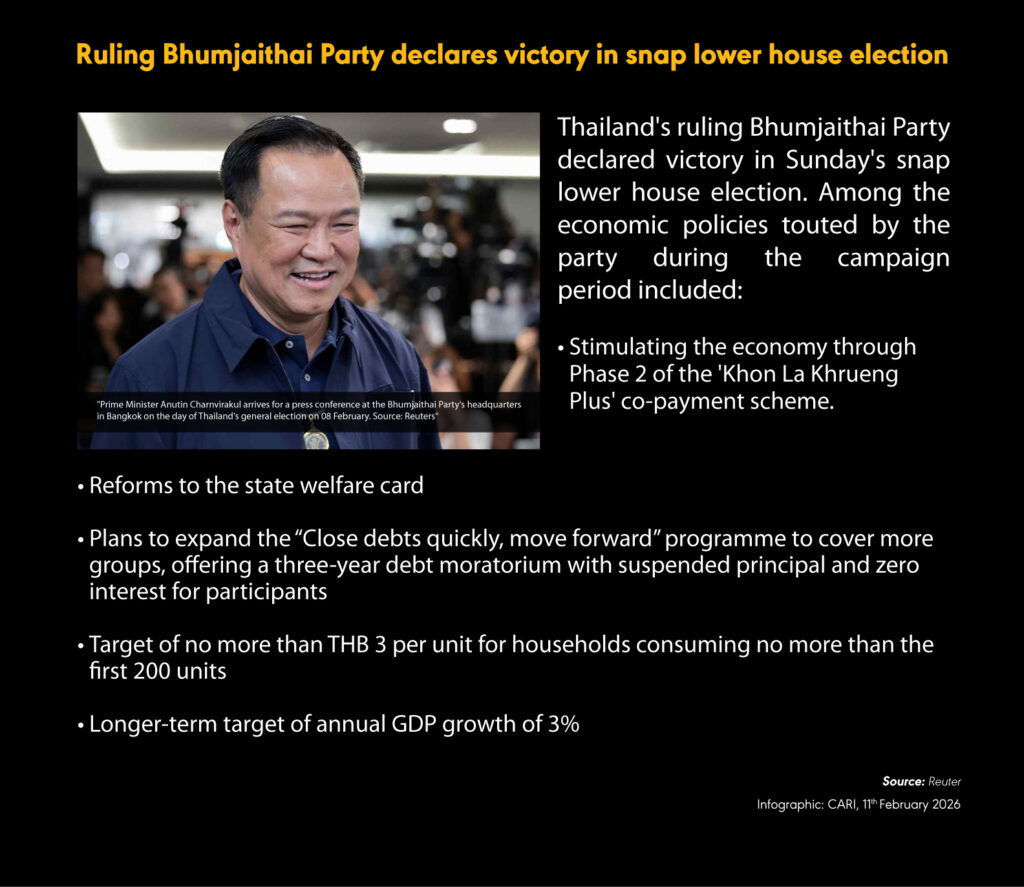
Ruling Bhumjaithai Party declares victory in snap lower house election
(09 February 2026) Thailand’s ruling Bhumjaithai Party declared victory in the snap lower house election, with preliminary results indicating it is likely to retain power under Prime Minister Anutin Charnvirakul as counting neared completion. With nearly 95% of polling stations reporting, the election commission showed Bhumjaithai projected to win about 192 seats, compared with 117 for the reformist People’s Party and 74 for Pheu Thai. The People’s Party conceded defeat, with leader Natthaphong Ruengpanyawut confirming readiness to serve as opposition, while Pheu Thai leader Julapun Amornvivat said the party accepted the outcome. In the 100 proportional representation seats, the People’s Party led with about 27% of votes, ahead of Bhumjaithai’s 17% and Pheu Thai’s 16%. About 52.9 million eligible voters cast two ballots each at more than 99,000 polling stations, with voting closing at 17:00. Voters also participated in a referendum on reforming the 2017 constitution, with around 60% of votes counted so far indicating support for drafting a new constitution, 32% opposing change, and the remainder undecided. The constitutional vote was described as an initial step with no guarantee of reform. The election followed Anutin’s decision to dissolve parliament in December and required at least 251 lower house votes in parliament to select a prime minister. Anutin said coalition discussions would begin only after official results are confirmed.
THAILAND
World Bank downgrades Thailand’s economic growth in 2026 to 1.6%
(11 February 2026) The World Bank’s Thailand Economic Monitor projects Thailand’s economic growth to slow to 1.6% in 2026, down from the 1.7% forecast in July, reflecting weaker global trade, high household debt, and a slower tourism recovery. The economy is estimated to grow 2.2% in 2025. Goods export growth is projected to decelerate to 0.5% in 2026 following a surge in 2025, with particular exposure in sectors affected by US tariffs. Tourist arrivals are forecast to reach 35 million in 2026, equivalent to 88% of pre-pandemic levels, indicating a gradual recovery. Household debt remains among the highest in Southeast Asia, with tight lending conditions constraining private consumption. The central bank’s monetary stance is expected to remain accommodative this year. Headline inflation is projected to rise slightly to 0.7% in 2026 and return to the Bank of Thailand’s 1.0 to 3.0% target range by the third quarter. Private investment is expected to stay subdued, with potential improvement next year. Political uncertainty during the election cycle may delay approval and execution of the 2027 fiscal budget, potentially disrupting public investment plans. Economic growth is forecast to recover to 2.2% in 2027.
MALAYSIA
Ringgit strengthens against US Dollar following strong industrial data
(09 February 2026) The ringgit strengthened against the US dollar on 09 February following December Industrial Production Index data that exceeded market expectations, indicating continued domestic economic resilience. At 18:00, the ringgit rose 0.33% to 3.9325/3.9375 against the US dollar from 3.9440/3.9525 at last Friday’s close. Bank Muamalat Malaysia Bhd said most emerging-market currencies were firmer against the US dollar during the session. They attributed the improved sentiment to a risk-on environment in Asia following election outcomes in Thailand and Japan, which supported Asian currencies. They also said the ringgit is expected to remain well supported in the near term. Against major currencies, the ringgit appreciated versus the Japanese yen to 2.5104/2.5137 from 2.5111/2.5167 and strengthened against the British pound to 5.3482/5.3550 from 5.3548/5.3663. It weakened against the euro to 4.6647/4.6707 from 4.6508/4.6608.
MALAYSIA
GDP growth in Q4 2025 expected to exceed 5.0% recorded in Q4 2024
(09 February 2026) Economists expect Malaysia’s GDP growth in Q4 2025 to exceed the 5.0% recorded in Q4 2024, indicating stronger underlying momentum and reduced downside risks entering 2026. IPPFA Sdn Bhd said the official Q4 2025 outcome is likely to be broadly in line with the Department of Statistics Malaysia’s advance estimate of 5.7%, with limited revision risk. They said growth in Q4 2025 was more internally driven than a year earlier, supported by firmer household spending, tight labour market conditions, and moderating inflation that preserved real purchasing power. They added that any adjustment to the headline figure would likely reflect data completion and benchmarking rather than changes in underlying conditions. Full-year GDP growth for 2025 is estimated at 4.9%, slightly below the 5.1% recorded in 2024 but above the earlier official and Bank Negara Malaysia forecast range of 4.0% to 4.8%. Research firms cited strong Q3 2025 performance, resilient domestic conditions, and more benign tariff impacts as supporting firmer growth expectations. Economists said that official Q4 2025 growth is likely to fall within a narrow 5.5% to 5.8% range, with a modest chance of an upside surprise due to stronger year-end consumption and services activity. They added that growth in Q4 2025 was more broad-based than in Q4 2024, supported by private consumption, services, stabilising manufacturing, and sustained public and private investment. It has been argued that the stronger advance estimate signals economic resilience heading into 2026, thereby reducing the urgency for monetary easing. Barring a sharp global slowdown, any policy rate cuts are more likely in the second half of 2026.
SINGAPORE
Income inequality declines to record low in 2025 according to finance ministry study
(09 February 2026) Singapore’s income inequality declined to a record low in 2025, with the Gini coefficient after taxes and government transfers falling to 0.379 from 0.437 in 2015, according to a finance ministry study on income and social mobility released on 09 February. The ministry said the reduction coincided with real income growth over the past decade, with lower-income groups recording higher real income gains. The figures incorporate a revised methodology that now includes non-employment income such as rental and investment returns. The government also published a wealth inequality measure for the first time, estimating a wealth Gini coefficient of 0.55, compared with an income Gini of about 0.38 after redistribution. The study said Singapore’s wealth inequality level is broadly comparable with other advanced economies. Prime Minister Lawrence Wong said the government is renewing its social compact and aims to further narrow inequality despite a more challenging global environment. The report highlighted continued policy efforts including housing and healthcare subsidies, cash transfers to offset living costs, and increased investment in early childhood education. The government has also raised taxes on high-end property and vehicles while cautioning against policies that could deter high net worth individuals and capital inflows.
VIET NAM, LAO PDR
Lao PDR and Viet Nam agree to accelerate major infrastructure and economic cooperation projects
(09 February 2026) Lao PDR and Viet Nam agreed to accelerate major infrastructure and economic cooperation projects following talks between Lao Prime Minister Sonexay Siphandone and Vietnamese Prime Minister Pham Minh Chinh in Vientiane on 05 February. The leaders reviewed bilateral cooperation and confirmed continued progress across multiple sectors, with emphasis on economic connectivity projects. Both sides agreed to continue key developments, including the Laos–Vietnam railway and the Vientiane–Hanoi expressway, and to expand cooperation in energy, minerals, education, culture, digitalisation, and trade and investment. Construction of the expressway is underway, with Section 2 covering a 203.8 km stretch from Pakxan district to the Laos–Vietnam border in Xaychamphon district, Bolikhamxay province. The contractor reported steady progress and said the project is expected to improve cross-border transport and trade. 3S Development Co., Ltd. said the consortium received government approval to sign a concession agreement in October 2025, formally initiating construction. Machinery has been deployed along much of the route, with work in border areas scheduled to begin after the rainy season. The consortium aims to complete the expressway by 2029 by running bridge and road works in parallel and increasing machinery and labour inputs. The Vietnamese side reaffirmed its commitment to implementing signed agreements and delivering tangible outcomes under the bilateral cooperation framework.
MYANMAR, SINGAPORE, THAILAND, CHINA
Singapore, China, and Thailand rank as largest sources of foreign investment into Myanmar
(10 February 2026) As of end-December 2025, investors from 53 countries and regions had invested in Myanmar, with Singapore, China, and Thailand ranking as the largest sources of investment. Across 12 economic sectors, the power sector accounted for 28.29% of total approved investment, followed by oil and gas at 24.64% and manufacturing at 14.65%. At its first meeting of 2026 on 26 January in Naypyidaw, the Myanmar Investment Commission approved 20 new projects with a combined value of USD 62.911 million and more than MMK 212 billion in local currency. The projects are expected to create 3,382 jobs. The approvals comprise four new foreign investments in the industrial and service sectors and 16 new domestic investments across manufacturing, hotels and tourism, power generation, housing construction, livestock and fisheries, and oil and gas. Key approved activities include electric vehicle assembly and sales, hotel and tourism operations, housing development, oil and gas projects, power generation, livestock breeding, education services, food production, and garment manufacturing. The commission stated it continues to review and approve proposals from local and foreign investors in accordance with the Myanmar Investment Law.
RCEP Monitor
AUSTRALIA
Reserve Bank of Australia’s Deputy Governor states that Inflation remains too high
(11 February 2026) The Reserve Bank of Australia’s Deputy Governor stated that inflation remains too high and that policymakers are prepared to take necessary measures to return it to the 2 to 3% target band. The RBA increased the cash rate by 25 basis points to 3.85% last week, reversing one of three cuts made last year, and indicated further tightening is possible if inflation does not ease as forecast. Markets assign a 70% probability of a further increase to 4.10% at the May meeting, pending first-quarter inflation data. Core inflation rose to 3.4% in the fourth quarter, the fastest pace in over a year and above RBA forecasts, prompting a revision of the projected peak for core inflation this year to 3.7%. The Deputy Governor said credit growth suggested financial conditions may not be restrictive, with mortgage lending rising 9.5% by value in the fourth quarter following a similarly strong previous quarter, and investment loans reaching a record. Additional data showed the unemployment rate fell unexpectedly to 4.1% in December, a seven-month low, indicating potential labour market tightening. He noted that overall growth was constrained by capacity limits despite solid performance in several sectors, alongside robust consumer spending and record-high housing prices.
CHINA
Consumer price index rises 0.2% year-on-year in January 2026, below forecasts
(10 February 2026) China’s consumer price index rose 0.2% year-on-year in January, below the 0.4% increase forecast in a Reuters poll and slowing from 0.8% in December, according to National Bureau of Statistics data. On a month-on-month basis, CPI increased 0.2%, compared with expectations of 0.3%. Core CPI rose 0.8% year-on-year, easing from 1.2% in December. The producer price index declined 1.4% year-on-year, slightly better than the expected 1.5% fall and moderating from a 1.9% decline in December, while rising 0.4% month-on-month for a fourth consecutive increase, partly driven by higher global gold prices. Analysts noted that the data were distorted by the timing of the Lunar New Year, which falls in mid-February this year compared with January last year, and should be assessed on a combined January–February basis. Factory-gate deflation has persisted for more than three years, affecting manufacturer profitability amid weak consumer confidence and production disruptions linked to US trade policies. China’s economy grew 5% last year, meeting the official target, supported by exports to non-US markets. Ongoing deflationary pressure and a prolonged property downturn have weighed on fiscal metrics, with the fiscal revenue-to-GDP ratio falling 4.8 percentage points since 2021 to 17.2%, and the public debt-to-GDP ratio rising 40 percentage points since 2019 to 116% in 2025, according to Morgan Stanley. Policymakers are expected to announce annual economic targets next month, while the People’s Bank of China reiterated its commitment to an appropriately loose monetary policy to support the economy and guide prices towards a reasonable recovery.
JAPAN, UNITED STATES
Japan seeking “in-depth” talks on USD 550 billion investment framework
(11 February 2026) Japan is seeking in-depth discussions with the United States on investments under a USD 550 billion investment framework agreed as part of a bilateral tariff deal, according to Kyodo News. Japan’s Trade Minister departed for Washington to meet the US Commerce Secretary to finalise the first project under the framework. Japan’s Trade Minister stated that an announcement would be made as soon as possible if an agreement is reached. He noted that multiple discussions have already taken place and cautioned that negotiations would not be straightforward. The Trade Minister previously led Japan-US tariff negotiations as economic revitalisation minister under former Prime Minister Shigeru Ishiba. The visit marks his first trip to Washington as trade minister under Prime Minister Sanae Takaichi. Under the tariff arrangement, Japan committed to invest USS 550 billion in the United States in exchange for reduced US tariff rates. Both governments are expected to identify specific projects, with US President Donald Trump to make the final decision on the investments.
|
15 participating countries |
20 chapters |
2.2 billion |
US$26.2 trillion |
28% |
| ASEAN member states, Australia, China, Japan, South Korea, New Zealand | trade in goods and services, investment, intellectual property, e-commerce, competition, SMEs, economic and technical cooperation, and government procurement | combined population, 30% world’s population | combined GDP, 30% global GDP | global trade (based on 2019 figures) |