


CARI Captures Issue 737: Strong ringgit to broadly benefit domestically-driven companies while weighing on exporters
Captures has widened its scope to include news related to all the members of the Regional Comprehensive Economic Partnership (RCEP) agreement which was signed towards the end of 2020. Besides the ASEAN Member States, this includes Australia, New Zealand, China, Japan, and South Korea. The other weekly newsletters under CARI, China-ASEAN Monitor and Mekong Monitor will also be consolidated into the Captures newsletter. We hope this new version of Captures will serve you better and look forward to providing a curation of stories relevant to ASEAN and its trading partners.
MALAYSIA
Strong ringgit to broadly benefit domestically-driven companies while weighing on exporters
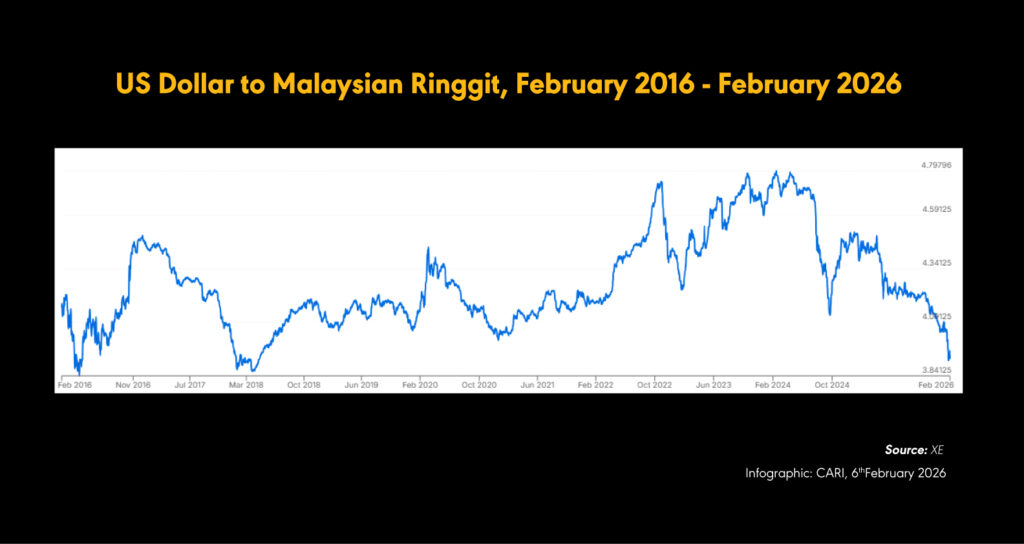
(28 February 2026) Hong Leong Investment Bank Bhd said the ringgit’s recent appreciation is expected to broadly benefit domestically driven companies through lower import and procurement costs, while compressing margins for export-oriented sectors. Beneficiaries identified include aviation, automotive, cement, construction, consumer, media, renewable energy, real estate and telecommunications. Export-heavy sectors flagged as negatively affected due to predominantly US dollar-denominated revenues and limited natural hedges include gloves, technology, electronics manufacturing services, upstream oil and gas, petrochemicals and metal producers. The ringgit has appreciated 12.8% against the US dollar since the start of last year, compared with a 3.5% gain in the Asia Dollar Index, and is at its strongest level since 2018. HLIB maintained its ringgit-US dollar forecast at an average of 4.05 and 4.00 by end-2026, citing near-term tailwinds. The appreciation is expected to be supported by a narrowing interest rate differential between the US and Malaysia. HLIB forecasts the US Federal Reserve to cut rates by 50 basis points this year, above the Fed’s own 25-basis-point projection, while Bank Negara Malaysia is expected to keep the overnight policy rate unchanged. It noted that an eventual upward normalisation of the OPR cannot be ruled out given stronger-than-expected GDP growth. HLIB added that a stronger ringgit could pressure margins where cost pass-through is limited, and in plantations, lower fertiliser costs may be offset by weaker crude palm oil price competitiveness.
MALAYSIA
Malaysia has potential to develop into global physical gold trading hub
(03 February 2026) Malaysia has the potential to develop into a global physical gold trading hub, supported by a business-friendly policy environment, an integrated industry ecosystem and the forthcoming Malaysia Gold Industry Principles. The Malaysia Gold Association said coherent government policies have supported healthy growth in the domestic gold industry. The domestic precious metals industry employs about 250,000 people across trading, retail, manufacturing and related services. The Malaysia Gold Industry Principles are expected to be officially published in the third quarter of this year. The principles will strengthen governance, transparency and market confidence by addressing quality standards and responsible business conduct among traders and retailers. One module will focus on quality control, with retail outlets displaying a symbol or logo to indicate responsible gold shops. The initiative will be voluntary but is intended to support a more standardised and trustworthy trading ecosystem. The principles will act as a self-regulatory framework for the precious metals industry, covering responsible sourcing, ethical conduct and consumer protection. The framework aims to reinforce Malaysia’s position as a well-governed and globally aligned precious metals hub.
VIET NAM, MALAYSIA, INDONESIA
Temporary anti-dumping duties imposed on colourless float glass imports from Indonesia and Malaysia
(03 February 2026) Viet Nam will impose temporary anti-dumping duties on colourless float glass imports from Indonesia and Malaysia, according to an industry ministry statement dated 30 January. The levies will take effect from 13 February and apply for 120 days. Duties on imports from Indonesia will range from 15.17% to 43.78%. Malaysian exports will face higher rates of between 41.07% and 63.39%. The ministry said a preliminary investigation found that dumped imports from both countries had caused significant and evident harm to Viet Nam’s domestic industry. It stated that the volume of the investigated products has been increasing at an annual rate of 61.82%. The ministry noted that no public data on colourless float glass imports is available on the Vietnam Customs website. The temporary measures are intended to curb the rapid rise in imports that could result in serious and irreparable damage to local producers. The ministry said it will continue to work with relevant parties to collect and verify information and documents during the next stage of the investigation.
VIET NAM, UNITED STATES
Viet Nam signals willingness to increase purchase of US goods
(04 February 2026) Viet Nam stated it is willing to increase purchases of US goods, with priority on machinery and high-tech products, according to Viet Nam’s Trade Minister during a visit to Washington for a sixth round of tariff negotiations. Hung met executives from U.S. energy and technology companies including Apple, Exxon Mobil, GE, AES and Excelerate Energy, as confirmed by a trade ministry statement. The negotiations follow a White House statement in October indicating that a bilateral trade agreement would maintain tariffs of 20% on most Vietnamese exports while removing duties on selected products. Vietnam’s exports to the United States, its largest market, reached a record USD 153 billion last year despite the existing tariffs. During the visit, the trade minister witnessed the signing of several memorandums of understanding involving purchases of U.S. crude oil, ethanol and corn. The agreements were signed with Chevron, Marquis Energy and ADM Asia-Pacific Trading in Washington, according to the Vietnam News Agency.
SINGAPORE
Tourism spending reaches SGD 23.9 billion in first nine months of 2025
(03 February 2026) Singapore’s tourism spending reached SGD 23.9 billion in the first nine months of 2025, up 6.5% year on year, according to new figures from the Singapore Tourism Board. The performance places full-year receipts on track to exceed the official projection of SGD 29 billion to SGD 30.5 billion, with final data to be released in the second quarter of 2026. Growth was led by sightseeing, entertainment and gaming, and food and beverage, each recording a 15% increase. Mainland China, Indonesia and Australia were the largest sources of tourism receipts, contributing SGD 3.68 billion, SGD 2.09 billion and SGD 1.54 billion respectively, excluding sightseeing, entertainment and gaming spend. Spending by visitors from China rose 3%, with food and beverage expenditure increasing 19%. International arrivals totalled 16.9 million in 2025, up 2.3% year on year but below the target of up to 18.5 million. Mainland China led arrivals with 3.1 million visitors, followed by Indonesia with 2.4 million, Malaysia and Australia with 1.3 million each, and India with 1.2 million. Arrivals from Viet Nam declined to 344,000 from 393,000, while the Philippines fell to 726,000 after an elevated base in 2024. Japan, Malaysia, Germany and the United States recorded growth of between 5% and 10%. New hotel openings and a full meetings and conventions calendar supported activity. For 2026, STB forecasts 17 million to 18 million arrivals and tourism spending of SGD 31 billion to SGD 32.5 billion, citing global economic uncertainty and political instability as key considerations.
THE PHILIPPINES
The Philippines risks falling behind regional peers in electric vehicle manufacturing
(01 February 2026) Industry leaders warned that the Philippines risks falling behind regional peers in electric vehicle manufacturing amid policy uncertainty, following President Ferdinand Marcos Jr’ s veto of PHP 92.5 billion in unprogrammed appropriations from the 2026 budget. The veto removed PHP 4.57 billion allocated to the Comprehensive Automotive Resurgence Strategy (CARS) and the Revitalising the Automotive Industry for Competitiveness Enhancement (RACE) programme, both designed to incentivise local vehicle production. Under CARS, manufacturers must produce 200,000 units of a registered model over six years, while RACE requires output of 100,000 units to qualify for incentives. Industry groups said the removal of funding could undermine jobs and weaken investor confidence in long-term automotive and EV manufacturing plans. The Electric Vehicle Association of the Philippines said reinstating CARS and RACE was critical to supporting future local EV assembly. The Finance Secretary said on 16 January that a funding solution for CARS had been finalised, while RACE remained part of the broader industrial strategy. Analysts said the episode had reinforced investor unease as EV adoption accelerates across Southeast Asia. Data cited showed EVs accounted for nearly 40% of new car sales in Viet Nam and Singapore in 2025, compared with 12% in the Philippines, or 58,905 units out of total vehicle sales of 491,395. Manufacturing output in the Philippines remains modest, with EV production largely limited to small-scale assembly and electric jeepneys. The debate over local production versus imports hinged on whether incentives could offset higher production costs. Francisco Motors said it had paused a proposed PHP 52 billion peso investment in Camarines Norte due to incentive and approval uncertainty. Industry representatives said frequent leadership changes and slow implementation of the Electric Vehicle Industry Development Act had further weakened policy continuity.
THAILAND, CAMBODIA
Thai border trade with Cambodia plunges 47.3% in 2025 due to border conflict
(02 February 2026) Thailand’s border trade with Cambodia, Lao PDR, Malaysia and Myanmar totalled THB 894 billion in 2025, an 8.5% decline from 2024, while the trade balance remained nearly THB 150 billion in Thailand’s favour, according to the Department of Foreign Trade. Trade with Cambodia fell 47.3% to THB 92 billion, the steepest contraction, while trade with Myanmar declined 7.4% to THB 193 billion. Trade with Malaysia increased 2.8% to THB 315 billion, and trade with Lao PDR rose 2.4% to THB 293 billion. The department said armed clashes and border closures linked to Thai–Cambodian tensions were a key factor behind the contraction, and continued risks could delay border reopenings. They added that fighting between Myanmar’s military and ethnic armed groups disrupted trade, particularly after the Second Thai–Myanmar Friendship Bridge between Mae Sot and Myawaddy was closed on 18 August, affecting a major trade checkpoint. The Sa Dao checkpoint with Malaysia remained the largest border trade gateway by value, followed by Nong Khai and Mae Sot. Diesel and other refined oils were the leading Thai export products in border trade. In contrast, transit trade reached a record THB 1.04 trillion in 2025, up 24.4% from 2024. Transit trade with China totalled THB 608 billion, rising 26.7% and ranking highest by value, followed by Singapore and Viet Nam. Fresh durians were the top Thai export in transit trade, followed by hard disk drives, with transit trade expected to support growth due to strong global demand for electronic goods.
RCEP Monitor
AUSTRALIA
Australia out of step with major peers that are in rate-cutting cycles
(02 February 2026) The Reserve Bank of Australia raised the cash rate by 0.25 percentage points to 3.85%, marking the first increase since 2024, citing a material pickup in inflation in the second half of 2025. The RBA stated that private demand, household spending, investment growth, rising housing prices and a tight labour market contributed to the decision, and forecast inflation remaining above the 2–3% target band into 2027. Inflation is currently at 3.8%, leaving Australia out of step with major peers that are in rate-cutting cycles. EQ Economics said the “narrow path” strategy pursued under former governor Phillip Lowe, which avoided deeper rate hikes to protect employment, had failed after five years of above-target inflation. They argued earlier rate cuts were premature and said rates may need to rise above 5% to contain inflation. Governor Michele Bullock said the board retained the same strategy of reducing inflation while preserving labour market gains, and warned that not acting could impose higher long-term costs on households. She said the RBA was targeting inflation outcomes over one to two years due to policy transmission lags. AMP said the RBA’s earlier cuts were justified based on information available at the time, when inflation appeared to be easing. Australia’s Treasurer rejected claims that government spending drove inflation, noting the RBA statement attributed pressures to private demand. REA Group data showed a borrower on a 5.5% mortgage rate would pay over AUD 100 more per month at 5.75%, with Sydney repayments estimated at AUD 5,775 per month on a median-priced home with an 80% loan-to-value ratio. Roy Morgan research estimated that a 0.25% rate rise this month and another in March would place 1.3 million Australians, or 27.2% of mortgage holders, under mortgage stress.
AUSTRALIA
Australia mulls introducing price floor for critical minerals to attract foreign investments
(04 February 2026) Australia is considering introducing a price floor for critical minerals, including rare earths, to support domestic producers, counter China’s market dominance and attract foreign investment into new mining and processing projects. Australia’s Resources Minister said the policy would be supported by Export Finance Australia, which would be equipped with financial tools to implement minimum pricing mechanisms. Australia holds the world’s fourth-largest rare earth reserves but lags China significantly in processing and refining capacity. The proposal was outlined in Washington DC during a US-convened critical minerals summit involving multiple countries. The initiative follows the United States’ announcement of Project Vault, a USD 12 billion strategic stockpile aimed at reducing reliance on Chinese critical minerals. Australia is planning its own stockpile valued at AUD 1.2 billion, initially targeting rare earth elements, antimony and gallium. The stockpiling effort complements a bilateral agreement signed with the United States in 2025 to improve US access to Australian critical minerals. The government has also released an online prospectus listing 49 mining projects and 29 processing facilities described as ready for investment, with potential structures including offtake agreements. Australia’s Resources Minister said Australia’s resources sector has historically depended on foreign capital and would continue to do so. The United States previously guaranteed a price floor for one critical minerals producer, though the arrangement has not been extended more broadly.
NEW ZEALAND
Unemployment rate rises to decade high of 5.4% in fourth quarter of 2025
(04 February 2026) The New Zealand dollar weakened after labour market data showed the unemployment rate rose to a decade high of 5.4% in the fourth quarter, slightly above expectations, while employment increased 0.5% quarter on quarter. The mixed data reduced market expectations for near-term monetary tightening, with interest rate futures pricing the 2.25% cash rate as unchanged until at least September, when a 25 basis point hike is priced at around 78%. Citi analysts said the data did not justify any near-term increase in the official cash rate, citing a continued unemployment gap despite modest improvements in labour market engagement. The New Zealand dollar fell 0.1% to USD 0.6038 after reaching USD 0.6064 overnight, with gains partly supported by a strong dairy auction. In contrast, the Australian dollar remained near three-year highs following the Reserve Bank of Australia’s decision to raise interest rates to address renewed inflation pressures. The RBA said inflation is not expected to return to the midpoint of its 2–3% target band by mid-2028, prompting markets to price around 40 basis points of further tightening this year, including an 80% probability of a May rate hike. The Australian dollar rose 0.1% to USD 0.7030 after climbing 1.1% overnight to USD 0.7050, close to a three-year high of USD 0.7094. Against the yen, the Australian dollar advanced 0.6% to a record 109.80. UBS now expects the RBA to raise rates in May, bringing forward its earlier forecast from August, and sees a cumulative tightening of up to 75 basis points as a plausible outcome.
|
15 participating countries |
20 chapters |
2.2 billion |
US$26.2 trillion |
28% |
| ASEAN member states, Australia, China, Japan, South Korea, New Zealand | trade in goods and services, investment, intellectual property, e-commerce, competition, SMEs, economic and technical cooperation, and government procurement | combined population, 30% world’s population | combined GDP, 30% global GDP | global trade (based on 2019 figures) |