


CARI Captures Issue 735: Viet Nam seeks new economic model to achieve 10% annual growth goal
Captures has widened its scope to include news related to all the members of the Regional Comprehensive Economic Partnership (RCEP) agreement which was signed towards the end of 2020. Besides the ASEAN Member States, this includes Australia, New Zealand, China, Japan, and South Korea. The other weekly newsletters under CARI, China-ASEAN Monitor and Mekong Monitor will also be consolidated into the Captures newsletter. We hope this new version of Captures will serve you better and look forward to providing a curation of stories relevant to ASEAN and its trading partners.
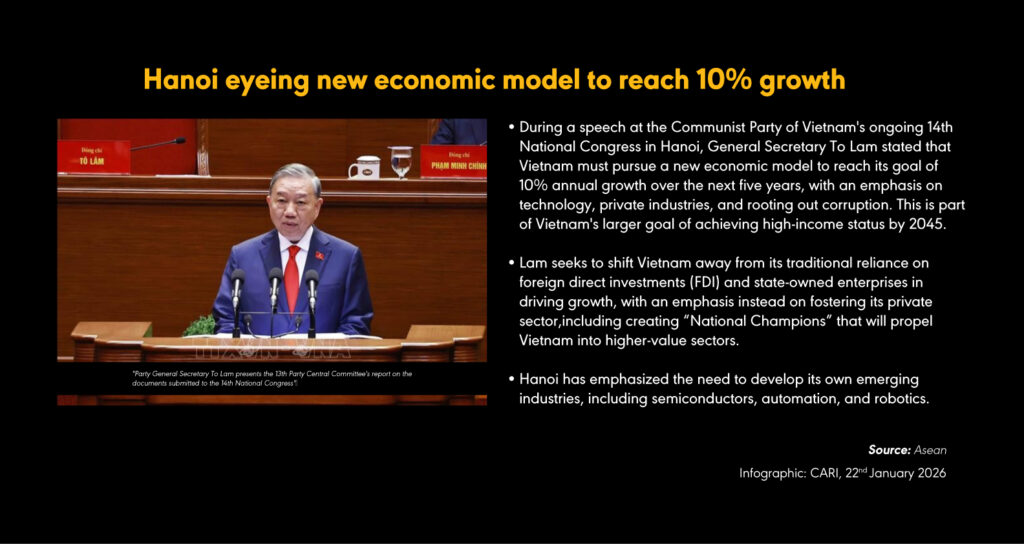
VIET NAM
Viet Nam seeks new economic model to achieve 10% annual growth goal
(20 January 2026) Viet Nam’s General Secretary To Lam, speaking at the opening of the National Congress, called for a “new model” to achieve the government’s target of at least 10% annual growth over the next five years, emphasising technology, private sector development, and anti-corruption. He identified implementation gaps as Viet Nam’s “greatest weakness” and urged reforms in thinking, institutions and governance capacity, with an emphasis on forceful action. The Congress follows major structural reforms already underway, including cutting bureaucracy, halving the number of provinces and removing a tier of local government, which the government and analysts describe as already shaping the macro trajectory. Draft documents posted online ahead of the meeting outline a five-year plan that elevates the private sector to a “most important growth engine” and calls for the development of “large, strong Vietnamese private conglomerates,” while also maintaining state-run firms as strategic guides under Resolution 79. The plan also targets fostering emerging industries such as semiconductors, automation and robotics to support the goal of reaching high-income status by 2045. Viet Nam’s export-dependent economy grew 8.02% last year despite a 20% US tariff, and the country is negotiating a tariff deal with the US while also balancing relations with China.
THE PHILIPPINES
Significant discovery of new natural gas deposit to help address looming power shortages
(19 January 2026) Philippine President Ferdinand Marcos Jr. announced a “significant discovery” of a new natural gas deposit, named Malampaya East 1, located about 5 kilometres east of the existing Malampaya gas field off Palawan province, within the Philippines’ Exclusive Economic Zone. The undersea reservoir is estimated to contain about 98 billion cubic feet (2.7 billion cubic metres) of gas, and initial tests indicated a potential extraction rate of 60 million cubic feet (1.6 million cubic metres) per day, although Marcos did not specify a timeline for commercial production. Marcos stated the deposit could eventually supply power to more than 5.7 million households or nearly 200,000 schools for one year, and he said further testing and another drilling operation would be conducted to explore additional gas resources. The discovery includes condensate, described as a high-value liquid fuel, and Marcos said it would bolster Malampaya’s contribution and strengthen domestic gas supply for years. The announcement follows concerns that the main Malampaya field, which began commercial production over two decades ago, is projected to decline substantially in a few years, raising fears of a potential power crisis in Luzon, where the gas-to-power facility currently supplies over 20% of electricity. Marcos highlighted that Filipino personnel led the drilling and completed it without accidents or environmental incidents. In 2023, the administration extended the Malampaya exploration contract by 15 years.
THE PHILIPPINES
The Philippines issues its first dollar-denominated bond offerings in a year
(20 January 2026) The Philippines has begun marketing its first dollar-denominated sovereign notes in a year, offering tenors of 5.5 years, 10 years and 25 years, with initial price guidance for the 10-year tranche around 100 basis points over US Treasuries. The Philippines’ National Treasurer said the government is targeting benchmark-sized issuance for each tenor, but did not disclose specific target amounts. The bond sale comes amid rising Treasury yields and weaker risk sentiment following renewed trade tensions between the US and Europe, and while the peso has weakened to a record low. The offering is also a test of investor confidence for President Ferdinand Marcos Jr.’s administration, which is dealing with a major corruption scandal involving billions of dollars allocated for flood-control projects, coinciding with a slowdown in economic growth. The funds raised will support financing of the Philippines’ persistent budget deficit. Nomura assessed that valuations are “unexciting” but should be reasonably supported, noting fair value for the 25-year tranche at about 5.65% versus initial guidance of around 5.9%. The Philippines is competing in a market where other Asian issuers, including South Korea’s Woori Bank, are also selling dollar debt, and investment-grade emerging Asian bond yield premiums remain near record lows at under 60 basis points. A Bloomberg index showed the average yield on dollar bonds sold by investment-grade emerging Asian borrowers was about 4.5% on Monday, down from nearly 5.2% in January 2025, when the Philippines last issued a 10-year bond at 90 basis points over Treasuries after starting marketing at around 120 basis points.
MALAYSIA
Malaysia records 4.9% growth in 2025, exceeding official forecasts
(20 January 2026) Malaysia recorded 4.9% GDP growth in 2025, exceeding the official forecast range of 4.0% to 4.8%, Prime Minister Datuk Seri Anwar Ibrahim said during Prime Minister’s Question Time in Parliament on 20 January. He stated that total trade surpassed MYR 3 trillion for the first time last year. Anwar also noted that the ringgit strengthened to MYR 4.05 per USD 1, the best level in five years, and that the Bursa Malaysia index exceeded 1,700 points, its highest in seven years. Unemployment stood at 2.9% in November 2025, the lowest in 11 years, which he attributed to political stability, policy clarity and contributions from the civil service and businesses. In response to concerns about geopolitical risks, Anwar said the government is exploring new markets and has already gained access to new trading areas. Approved investments in the first nine months of 2025 reached MYR 285.2 billion, a 13.2% increase year-on-year. He credited the implementation of the Public Finance and Fiscal Responsibility Act and subsidy rationalisation as examples of the government’s political will on difficult reforms. Anwar emphasised that fiscal gains must be channelled back to citizens through welfare programmes such as Sumbangan Tunai Rahmah (STR) and the minimum wage increase, and stated the government aims to maintain stability to support further policy measures in 2026.
INDONESIA
Indonesian rupiah marks one of the worst currency performances among emerging markets
(20 January 2026) The Indonesian rupiah fell 0.3% to a record low of 16,988 per US dollar on Tuesday, surpassing its previous trough from April and marking one of the worst currency performances among emerging markets with almost a 2% loss year-to-date. The decline has intensified scrutiny on Bank Indonesia (BI) after President Prabowo Subianto nominated his nephew for a BI deputy governor role, raising investor concerns about potential erosion of central bank independence. The nomination follows BI’s agreement last year to share debt costs for Prabowo’s priority programmes as well as ongoing legislative consideration of amendments to the central bank charter. The currency’s weakness is also linked to persistent fiscal concerns, including whether Indonesia will maintain its budget deficit cap, with last year’s deficit reported close to the ceiling. BI stated on Monday that it would maintain currency and financial stability, and on Tuesday reiterated it was active in the market to keep the rupiah aligned with fundamentals. Analysts called for stronger BI action to stabilise the rupiah. A cooling domestic economy could prompt BI to resume monetary easing to support growth, which could further pressure the currency. Bank Indonesia is scheduled to announce its first interest-rate decision of the year on Wednesday, with a Bloomberg survey showing all analysts expect a hold.
INDONESIA
Possible rule shift by MSCI may trigger USD 2 billion outflow from Indonesian stocks
(20 January 2026) MSCI Inc. will decide by the end of January whether to tighten its free-float definition for the MSCI Indonesia Index, with any approved changes to take effect in the May review, potentially triggering more than USD 2 billion of foreign passive outflows from Indonesian equities. The move follows industry feedback and would force passive investors to sell holdings if MSCI concludes that companies have less tradable stock than currently reported, posing a significant test of Indonesia’s capital market reform agenda. Indonesia’s equity market, valued at USD 971 billion, already has the lowest average free float among major Asia-Pacific indexes, with more than 200 benchmark stocks having free floats below 15%. MSCI has proposed using the lower free-float figure between public filings and a new dataset from the Indonesia Central Securities Depository, which could reduce the free-float market capitalisation of 15 index constituents and cause outflows. The Jakarta Composite Index (JCI) outperformed the MSCI Indonesia Index by a record margin last year, rising over 22% while MSCI Indonesia fell 3%, reflecting that many JCI constituents are thinly traded and making the benchmark difficult to track. Indonesian regulators have proposed raising minimum float levels to 10-15% from 7.5%, with a longer-term target of 25%, but no timeline has been set. The proposed changes come amid broader investor concerns over fiscal discipline and central bank independence, which have already weighed on the rupiah, with the currency having already fallen to a record low on Tuesday amid heavy foreign bond outflows. The market’s ability to absorb increased float is uncertain, with analysts noting institutional investors may remain selective and retail liquidity may be insufficient.
CAMBODIA
Exports of garments, footwear, and travel goods reach USD 15.5 billion in 2025
(20 January 2026) Cambodia’s exports of garments, footwear and travel goods reached USD 15.5 billion in 2025, up 15.7% year-on-year, according to a Ministry of Commerce report obtained on 19 January. Garment exports accounted for USD 11.4 billion, rising 16.5% year-on-year, while footwear exports reached USD 2.09 billion, up 24.5%, and travel goods exports totalled USD 2.02 billion, increasing 3.8%. The report noted that the garment, footwear and travel goods industry remains Cambodia’s largest foreign exchange earner, representing about 50% of total export value. The sector comprises more than 1,500 factories and branches and employs over 900,000 workers. The China-Asean Studies Centre at the Cambodia University of Technology and Science attributed the double-digit growth to effective market diversification beyond traditional trading partners and cited the Regional Comprehensive Economic Partnership agreement as a supporting factor. He also projected that the growth trend is likely to continue in 2026, driven by external demand and new investment inflows from China, South Korea and Japan.
RCEP Monitor
CHINA
Economy expands by 5.0% in 2025, marking one of slowest growth rates in decades
(19 January 2026) China’s economy grew 5.0% in 2025, matching the official target of “around five percent,” but growth slowed to 4.5% in the fourth quarter, according to National Bureau of Statistics (NBS) data released on Monday. The NBS attributed the slowdown to deepening external pressures and a domestic imbalance of strong supply and weak demand, and said policy measures to boost consumption, including a trade-in scheme for old household appliances, will continue into 2026. Retail sales growth eased to 3.7% for 2025 from 4.0% in 2024, and December retail sales rose 0.9% year-on-year, the weakest since the end of 2022. Industrial output expanded 5.9% for the year, with December output up 5.2%, and the manufacturing purchasing managers’ index rose to 50.1 in December, the first positive reading since March. Fixed-asset investment contracted 3.8% in 2025, while real estate investment fell 17.2%, reflecting the ongoing property debt crisis despite interest rate cuts and eased homebuying rules. Exports remained resilient, and the trade surplus reached a record USD 1.2 trillion, with shipments to ASEAN up 13.4%, to Africa up 25.8%, and to the EU up 8.4%, even as exports to the United States fell 20% in 2025. Analysts cautioned that the headline figures likely overstate underlying strength, noting that end-of-year output momentum was largely export-driven and that growth this year is expected to be slightly softer than in 2025.
SOUTH KOREA
American battery makers shift production to South Korea to comply with US defense regulations
(19 January 2026) American battery companies SES AI and Amprius Technologies are shifting production from China to South Korea to comply with the U.S. National Defense Authorization Act (NDAA), which bars the Department of Defense from purchasing China-made batteries from October 2027. SES AI has repurposed its Chungju, South Korea factory, originally built in 2021 for electric vehicle batteries, to produce drone and electric vertical takeoff and landing (eVTOL) battery cells, targeting 1 million cells annually with potential scaling to 1 gigawatt hour (GWh), matching its China capacity. Around one-tenth of Chungju’s output will be allocated to SES AI’s eVTOL customers, including Hyundai, while the remainder will focus on drone products. SES AI stated that the shift responds to U.S. policies and investments supporting domestic drone development, and that battery pouch cell production in South Korea costs twice as much as in China, but South Korea-made products are expected to account for nearly half of SES AI’s sales this year. SES AI will continue to supply non-U.S. defence customers from its Chinese factory and contract manufacturers. The move follows concerns from U.S. drone firms after Beijing barred Skydio and BRINC Drones from procuring from Chinese companies, and as the U.S. drone industry seeks to reduce reliance on China, where DJI controls about 70% of global commercial drone sales. Amprius announced in December that it will expand production in South Korea, adding three South Korean contract manufacturers to match the number it uses in China, and its South Korea facility will serve only U.S. government customers. Amprius stated that interest is growing among other clients for non-China-made batteries, and he expects demand for NDAA-compliant supply to increase. Amprius maintains a pilot production line in Fremont, California for batteries and NDAA-compliant components, but has no plans to restart construction of its halted Colorado factory, citing a weakened electric vehicle market outlook.
JAPAN
Japan records 42.7 million tourist arrivals in 2025, surpassing previous record of 37 million in 2024
(20 January 2026) Japan recorded 42.7 million tourist arrivals in 2025, surpassing the previous record of nearly 37 million in 2024, the transport ministry said on 20 January, driven by a weak yen and increased visitors from Europe, the United States and Australia. Despite the overall rise, Chinese tourist arrivals fell about 45% in December to around 330,000, following a diplomatic backlash after Prime Minister Sanae Takaichi’s November comment that Japan could intervene militarily in a Taiwan conflict, which prompted China to urge its citizens to avoid travel to Japan. China remained the largest source market for the first nine months of 2025, with almost 7.5 million visitors, equivalent to a quarter of all foreign tourists, who spent USD 3.7 billion in the third quarter. Japan’s Transport Minister described the 40-million threshold as a “significant achievement” and said the decline in Chinese visitors was offset by increases from other regions, while expressing a desire for Chinese tourists to return soon. The government has a target of 60 million annual tourists by 2030 and has promoted attractions across the country, including Mount Fuji and cultural sites, to broaden visitor distribution. JTB forecasted that overall arrivals in 2026 would be “slightly lower” than 2025 due to reduced demand from China and Hong Kong, but expected tourism income to rise due to higher lodging prices and strong visitor spending. The shift towards repeat visitors has changed travel patterns from major cities to rural areas, supporting policy goals to reduce overcrowding in hotspots.
|
15 participating countries |
20 chapters |
2.2 billion |
US$26.2 trillion |
28% |
| ASEAN member states, Australia, China, Japan, South Korea, New Zealand | trade in goods and services, investment, intellectual property, e-commerce, competition, SMEs, economic and technical cooperation, and government procurement | combined population, 30% world’s population | combined GDP, 30% global GDP | global trade (based on 2019 figures) |